✅ Measurable ROI requires structured data capture: Organizations pairing Sandler with AI-native revenue orchestration achieve 280-450% first-year ROI vs. 18-24 month breakeven with manual enforcement.
Q1: What is the Sandler Sales Methodology? [toc=What is Sandler?]
The Sandler Sales Methodology, also known as the Sandler Selling System, Sandler Training, or simply "Sandler", is a comprehensive, nontraditional sales framework developed by David H. Sandler in the 1960s. Unlike conventional high-pressure sales tactics focused on aggressive closing, Sandler emphasizes consultative selling, mutual respect, and psychological understanding of buyer behavior.
🧠 The Psychology Foundation
At its core, Sandler is built on Transactional Analysis (T-A), a human relations model developed by psychiatrist Eric Berne. Sandler identified three ego states that influence every buying decision:
The Child (emotion/want): Represents emotional desires and gut-level reactions
The Parent (judgment/permission): Embodies critical evaluation and approval authority
The Adult (logic/affordability): Handles rational analysis and financial justification
The breakthrough insight: "People make buying decisions emotionally...and they justify those decisions intellectually". Successful salespeople must engage all three ego states, starting with uncovering the emotional pain (Child), addressing logical concerns (Adult), and securing approval (Parent).
🚢 The Sandler Submarine Model
The methodology is visualized as the Sandler Submarine, a system of seven sequentially closed compartments designed to maintain control and prevent prospects from "running from one end of the submarine to the other". David Sandler drew inspiration from World War II submarine warfare: when attacked, crews moved through compartments, sealing doors behind them to prevent flooding.
The Seven Compartments:
Bonding and Rapport: Establishing authentic connection and trust
Up-Front Contracts: Setting clear expectations and mutual agreements
Pain Discovery: Uncovering the prospect's true challenges and emotional motivation
Budget: Addressing financial capacity and investment willingness early
Decision: Identifying decision-makers, criteria, and timelines
Fulfillment (Presentation): Delivering solutions matched to validated pain
Post-Sell: Reinforcing the decision and preventing buyer's remorse
Each compartment must be completed before advancing, just as submarine doors seal behind the crew.
Visual framework depicting the seven sequential stages of Sandler sales methodology, from initial bonding and rapport through post-sell protocols, designed to guide relationship-driven selling and prospect qualification.
⚡ The Five Core Rules
The operational objective centers on five qualification rules:
✅ Qualify prospects rigorously
✅ Extract the prospect's pain (emotional drivers)
✅ Verify money (budget availability)
✅ Confirm the prospect is a decision-maker
✅ Match product capabilities to validated pain
"We benefit most from questioning strategies used in sales, coaching, or multiple functions. I also like that Sandler gives us sayings/expressions that we can remember and apply to different situations." — Dianne G., Director, Council Communications & Resources, Enterprise G2 Verified Review
📊 Why "Non-Traditional"?
Sandler flips conventional sales wisdom:
Traditional approach: Present features → Handle objections → Push for close
The system is considered the "lean" process for sales, eliminating wasted time on unqualified opportunities and focusing resources on prospects with genuine pain, budget, and decision authority. This structured qualification framework shares similarities with other modern sales methodologies like MEDDIC, though Sandler places unique emphasis on psychological buyer states.
"I like Sandler because they break down the basics. Blocking and Tackling are what they do best...From Up-Front Contracts to The Pain Funnel, they help sales professionals feel more comfortable and ask more intelligent questions to uncover pain." — Ryan M., Senior Account Executive, Enterprise G2 Verified Review
How Oliv.ai Reinforces Sandler Principles: Oliv Intelligence is trained on structured sales methodologies like Sandler to ensure every rep systematically addresses Pain, Budget, and Decision across all prospect conversations. The platform analyzes calls against the Sandler framework, automatically populating CRM scorecards to validate qualification status, transforming the seven-compartment submarine from a training concept into an enforced, measurable process.
Q2: Why is the Sandler Sales Methodology Important for Modern B2B Sales? [toc=Why Sandler is Important]
Modern B2B sales teams face chronic pipeline unpredictability, price-driven negotiations, and wasted cycles on deals that were never going to close. Organizations report sales reps spending 40-60% of time on unqualified opportunities, deals lacking genuine pain, budget authority, or decision timelines. This operational inefficiency creates forecasting chaos where only 45-55% of committed deals actually close.
❌ The "Winging It" Problem
Most sales organizations operate ad-hoc, with reps deploying inconsistent qualification approaches across the team. Without structured frameworks, teams experience:
Low baseline conversion rates: Industry averages hover at 5-15% from qualified opportunity to closed-won
Forecasting inaccuracy: Pipeline reviews become guesswork when deals lack structured qualification data (Pain severity, Budget commitment, Decision process)
Price trap dynamics: Reps default to discounting when they haven't uncovered or quantified pain, eroding margins
RFP chasing: Sales teams waste resources responding to requests from prospects who were never genuine buyers, using sellers as "unpaid consultants"
"Developing a learning program with Sandler requires a long lead time...A lot of pre-planning is required." — Jamie W., Director, Learning Operations, Mid-Market G2 Verified Review
Traditional sales training, one-time seminars or quarterly workshops, suffers from rapid decay. Studies show 70% of methodology training content is forgotten within 90 days without reinforcement. Organizations invest $100K-$150K in Sandler consultancies, only to watch reps revert to old habits within months.
⚡ AI-Era Transformation: From Manual Enforcement to Automated Adherence
Structured methodologies like Sandler provide measurable, repeatable qualification frameworks, but success hinges on consistent execution and real-time adherence tracking, historically impossible without unsustainable manual manager oversight. A sales manager with 8-10 reps can realistically review 2-3 calls per rep per week, providing feedback 7-14 days after conversations when insights are no longer actionable.
Modern AI-native revenue orchestration platforms eliminate this bottleneck by analyzing 100% of prospect interactions in real-time, validating adherence to Sandler's seven-compartment framework.
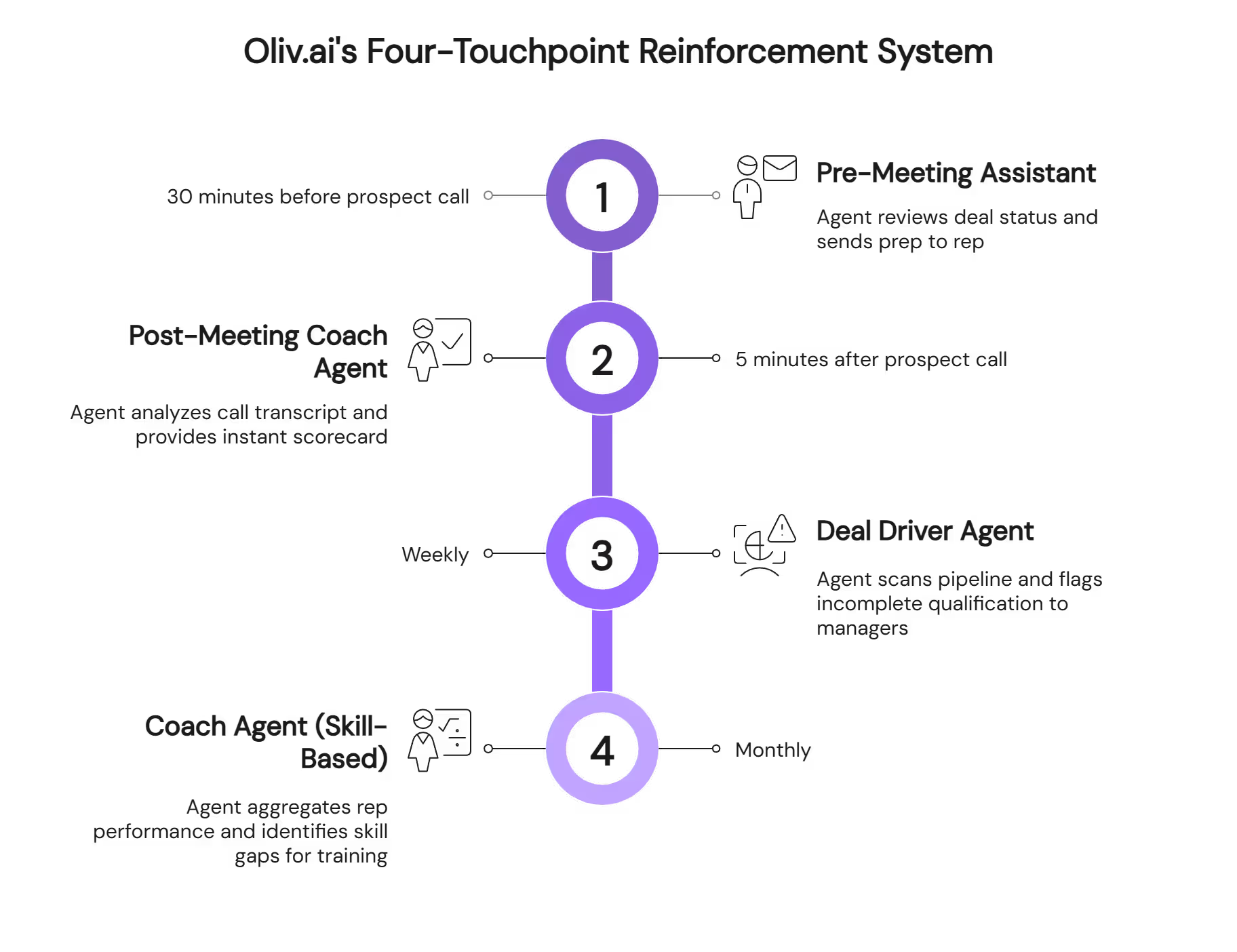
🚀 Oliv.ai: The Four-Touchpoint Reinforcement System
Oliv's agent-first platform operationalizes Sandler through four critical touchpoints that ensure methodology principles stick long after initial training:
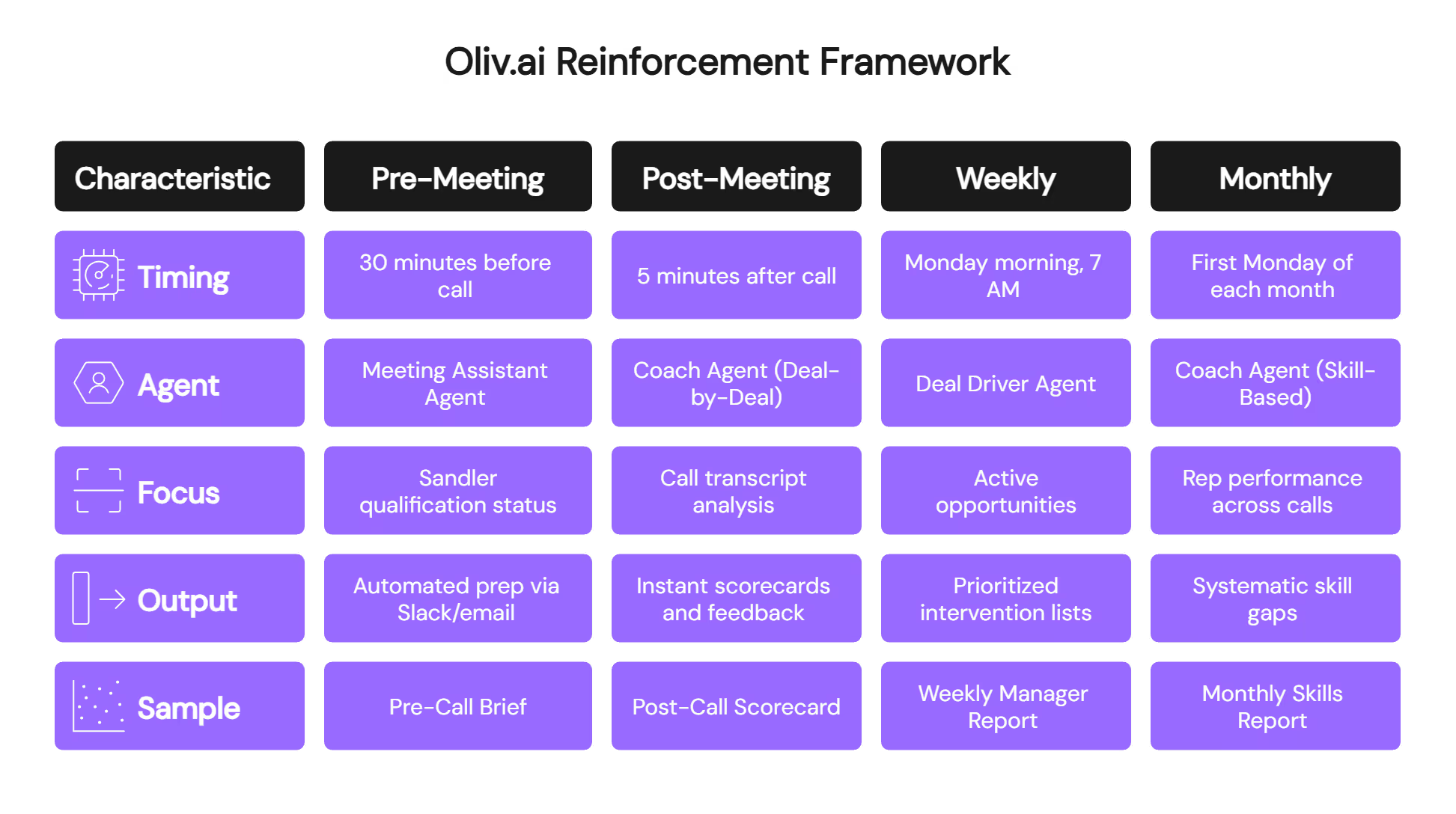
1️⃣ Pre-Meeting: Meeting Assistant Agent Before every prospect call, the Meeting Assistant reviews past interactions, extracts current Sandler qualification status, and sends automated prep via Slack/email 30 minutes prior: "Deal Status: Pain identified (legacy system causes 15 hours/week manual work). Budget: Not yet discussed. Decision: CFO + VP Sales confirmed. Suggested Focus: Validate Budget range using bracketing technique. Confirm Decision timeline." [INSERT MEETING ASSISTANT IMAGE HERE]
2️⃣ Post-Meeting: Coach Agent (Deal-by-Deal) The Coach Agent analyzes every call transcript against Sandler's seven steps, generating instant scorecards: "Pain Discovery (7/10, asked follow-up questions but didn't quantify cost), Budget (3/10, prospect deflected, rep didn't use Reversing technique), Decision (8/10, confirmed stakeholders), Up-Front Contract (9/10, set clear next steps)". Reps receive feedback within 5 minutes, while calls are still fresh. [INSERT COACH AGENT IMAGE HERE]
3️⃣ Weekly: Deal Driver Agent (Manager Pipeline Visibility) The Deal Driver scans all active opportunities weekly, flagging incomplete qualification to managers: "12 deals lack Budget discussion despite 3+ calls. Priority: Acme Corp, Decision timeline in 2 weeks but Budget unconfirmed (high slip risk)." This provides managers with actionable intervention lists for weekly 1-on-1s, ensuring at-risk deals receive attention before forecasting damage occurs.
4️⃣ Monthly: Coach Agent (Skill-Based Assessment) Beyond deal-level coaching, the Coach Agent aggregates rep performance across all calls monthly, identifying skill gaps: "Rep Sarah: Strong Pain discovery (avg 8.2/10) but consistently weak Budget discussions (avg 4.1/10). Prescribed coaching: Practice bracketing technique." Managers receive team-wide skill maps, enabling targeted training on the weakest Sandler techniques.
The CRM Manager Agent eliminates the administrative burden by auto-populating 10-15 Sandler scorecard fields (Pain severity, Budget range, Decision process, Post-Sell plan) from conversation intelligence, solving the RevOps pain where manual CRM updates create 60-70% incomplete data that breaks forecasting accuracy.
📈 Measurable Impact: TDIndustries Case Study
Companies implementing Sandler with AI reinforcement achieve dramatic outcomes. TDIndustries, a 65-year-old construction and facility services company, increased conversion rates from 5% to 50% in under 3 years by rigorously adhering to Pain, Budget, and Decision qualification gates. Other organizations report 37% increases in sales numbers and 25% revenue improvement within 6 months.
"Through Sandler, we have a common process, we learn more about our prospects and offer them solutions that work for them. We've had a 20% increase in new members among the entities that use Sandler across all departments." — Dianne G., Director, Council Communications & Resources, Enterprise G2 Verified Review
The discipline Oliv automates at scale, ensuring every deal progresses through all seven submarine compartments with validated qualification data, is what transforms Sandler from training investment into predictable revenue engine.
Q3: Who Uses Sandler Sales Methodology and When Should You Implement It? [toc=Who Uses Sandler?]
The Sandler Sales Methodology is used globally by thousands of organizations spanning Fortune 1000 enterprises to small-to-medium sized businesses (SMBs). Unlike tactical frameworks limited to specific industries, Sandler's psychology-based approach applies universally across B2B sectors: software/SaaS, construction, HVAC, financial services, manufacturing, and professional services.
👥 User Personas & Organizational Adoption
Enterprise Adoption (1000+ employees):
TDIndustries: 65-year-old construction and facility services company
Holistic Organizational Integration: Sandler adoption often extends beyond sales teams because "everyone in the organization can and does sell". Companies apply principles across:
💼 Customer Success: Managing renewals and expansion conversations
🛠️ Technical/Support Teams: Qualifying escalations and upsell opportunities
💰 Finance/Accounting: Collecting overdue invoices using consultative approaches
📞 Business Development Representatives (BDRs): Qualifying inbound leads before AE handoff
"We encourage our entities to use Sandler in all departments. We see that the entities integrating Sandler across departments perform better and have stronger internal working relationships." — Dianne G., Director, Council Communications & Resources, Enterprise G2 Verified Review
🎯 Sandler Enterprise Selling (SES)
For complex, high-value B2B engagements, Sandler offers the Sandler Enterprise Selling (SES) program designed for deals characterized by:
Multiple decision-makers and influencers (buying committees of 6-12+ stakeholders)
Sales cycles extending 6-18+ months
Seven-figure+ contract values
Technical validation and legal/procurement reviews
SES is ideal for mid-market and enterprise organizations (500+ employees) selling into similar company sizes where consensus-building, champion development, and multi-threaded relationships are critical. Organizations implementing structured frameworks like Winning by Design or Force Management training often layer Sandler principles for individual stakeholder conversations.
⏰ When Should You Implement Sandler?
Ideal Implementation Triggers:
1. Organizational "Turning Point" Moments: When leadership recognizes the need to transition from "winging it" (ad-hoc selling) to creating "measurable processes that worked". Common triggers include:
Missing quarterly revenue targets despite high activity metrics
Pipeline forecasts consistently off by 30%+
High rep turnover due to inconsistent results
2. Post-Merger Integration: When combining sales teams with conflicting methodologies need unified frameworks
3. Market Shift Response: When competitive dynamics force evolution from transactional to consultative selling
4. New Product/Market Launches: When entering complex B2B spaces requiring rigorous qualification to avoid wasted POC investments
5. Early-Career Sales Team Development: When hiring cohorts of junior AEs/BDRs need foundational sales structure
"Most early-in-career sales reps come to work with very raw talent and no organization skills. Sandler is very good at helping these new team members put a 'stake in the ground' providing a consistent, strategic approach." — Jamie W., Director, Learning Operations, Mid-Market G2 Verified Review
Critical Success Factor: Immediate Reinforcement David Sandler pioneered the shift from "seminar training" (one-time events) to "reinforcement training" (continuous practice) because students "couldn't implement everything taught". Implementation timing must include immediate adherence mechanisms, weekly President's Clubs, manager call reviews, or AI-powered coaching, to prevent the 70% methodology decay that typically occurs within 90 days.
How Oliv.ai Enables Instant Operationalization: For organizations implementing Sandler, Oliv minimizes methodology drift from day one by providing AI-powered intelligence that tracks adherence across every call. The Meeting Assistant ensures new AEs enter every conversation with Sandler framework top-of-mind, while the Coach Agent validates technique execution in real-time, ensuring principles are "instantly operational" without the 6-month weekly coaching commitment traditionally required to achieve behavioral change.
Q4: How Does the Sandler Submarine Work? The 7-Step Framework Explained [toc=7-Step Framework]
The Sandler Submarine is the visual framework organizing Sandler's seven-step sales process into sequential compartments, each representing a critical qualification or engagement phase. Like a submarine crew sealing compartments to prevent flooding, salespeople must complete each step before advancing, ensuring prospects cannot retreat to earlier stages or derail the process.
🚢 The Submarine Metaphor
David Sandler drew inspiration from World War II submarine tactics: "When submarines were attacked to avoid flooding the crew moved through each compartment, closing the door of the previous compartment behind them". This disciplined progression prevents common sales failures, presenting solutions before validating pain, or discussing pricing before confirming budget authority.
Step 1: Bonding and Rapport
Objective: Establish authentic connection and trust as the foundation for open communication.
How to Execute:
Ask genuine questions about the prospect's interests, challenges, or business context
Find common ground beyond business topics (shared connections, industry experiences, hobbies)
Practice active listening, respond thoughtfully rather than waiting to pitch
Demonstrate curiosity about their world, not just their buying potential
Example: AE: "I saw on LinkedIn you recently joined from Acme Corp. How's the transition been?" Prospect: "Exciting but overwhelming. The tech stack here is way more complex." AE: "That's a big shift. What's been the steepest learning curve so far?"
This opens dialogue about genuine challenges rather than launching into product pitches.
"Having the courage to practice equal business stature has been a sea change for me and my sales team. The way we now engage with our prospects during the qualification stage gets us eye level with decision makers." — Bryan P., District Sales Manager, Mid-Market G2 Verified Review
Step 2: Up-Front Contracts
Objective: Set clear expectations and mutual agreements for the conversation, eliminating "mutual mystification".
How to Execute:
State the purpose of the call explicitly
Outline the agenda and time commitment
Ask for the prospect's expectations and concerns
Establish what happens next (follow-up actions, decision points)
Get agreement on the right to say "no"
Example: AE: "Thanks for carving out 30 minutes. My goal today is to understand your current workflow challenges around reporting. If it makes sense, we'll schedule a deeper technical review next week. If not, we'll part as friends. Does that work?"
Up-Front Contracts are the "most assertive step" in Sandler, they force clear commitment points and prevent prospects from ghosting with vague "I'll think about it" responses.
Step 3: Pain Discovery (The Heart of Sandler)
Objective: Uncover the prospect's true challenges, frustrations, and emotional motivations, the "why" behind their need to change.
The Pain Funnel Technique: Pain discovery operates through three levels:
Surface-Level Pain (symptoms): "Our reporting takes 15 hours per week"
Business Impact Pain (consequences): "That delays our quarterly board reviews by 3-5 days"
Emotional Pain (personal stakes): "The CFO is frustrated. I'm under pressure. My team is burned out."
Reaching emotional pain (Level 3) creates urgency and differentiation.
Sample Pain Funnel Questions:
Level 1: "Can you tell me more about that?" / "How long has this been an issue?"
Level 2: "What kind of impact has that had on your business?" / "How much is this costing you?"
Level 3: "How do you feel about that?" / "How is this affecting you personally?"
Example Dialogue:Prospect: "Our CRM data is a mess." AE: "Can you tell me more about what 'a mess' looks like?" (Level 1) Prospect: "Reps don't update opportunity fields. RevOps can't forecast accurately." AE: "What kind of impact does that have on your quarter-end planning?" (Level 2) Prospect: "We miss our forecast by 20-30%. The board questions our credibility." AE: "How's that affecting you as the VP of Sales?" (Level 3) Prospect: "Honestly? It's exhausting. I spend 10 hours a week auditing deals manually."
This progression moves from tactical symptoms to strategic consequences to personal stakes, the foundation for consultative selling.
Step 4: Budget
Objective: Address financial capacity and investment willingness early, before investing time in proposals.
How to Execute:
Ask directly: "Do you have a budget set aside for solving this problem?"
Use bracketing technique when prospects deflect: "Are we talking about a $50K-$100K investment, or more in the $150K-$250K range?"
Discuss ROI expectations: "What kind of return would justify this investment?"
Establish value before revealing pricing
Example:AE: "You mentioned this manual reporting costs your team 15 hours/week. If we could cut that to 2 hours, what would that savings be worth annually?" Prospect: "Probably $80K in fully-loaded costs, plus faster decision-making." AE: "Would a solution priced at $40K annually make sense given that ROI?"
The Budget step is critical, discussing money early prevents the "price trap" where reps discount because they failed to quantify pain first.
Step 5: Decision
Objective: Identify decision-makers, criteria, process, and timeline to avoid "think-it-over" stalls.
How to Execute:
Map the buying committee: "Who else needs to be involved in this decision?"
Uncover decision criteria: "What factors will drive your final choice?"
Confirm timeline: "When do you need this operational?"
Identify potential roadblocks: "What could prevent this from moving forward?"
Example:AE: "You mentioned the CFO needs to approve. Walk me through what that approval process looks like." Prospect: "She'll want to see ROI modeling and security certifications. We'd present in our monthly finance review." AE: "When's the next review? Should we plan to have materials ready by then?"
This compartment prevents salespeople from investing in proposals for prospects who lack authority or timelines.
Step 6: Fulfillment (Presentation)
Objective: Deliver a solution presentation explicitly matched to validated Pain, Budget, and Decision criteria.
The Four Elements:
The Review: Revisit pain, budget, and decision agreements. If anything changed, address it before presenting.
The Presentation: Focus only on features/benefits directly solving the prospect's specific pain.
The Tie-Back: Continuously connect features to the pain points identified earlier.
The Decision: Ask directly: "Based on what we've discussed, does this solve your problem?"
Example:AE: "You said manual reporting costs 15 hours/week and delays board reviews. Our automated dashboard updates in real-time (feature), cutting your reporting to under 2 hours (benefit tied to pain). Does that address the CFO's urgency concern?"
In Sandler, presentations are earned, only after completing Pain, Budget, and Decision qualification.
Step 7: Post-Sell
Objective: Reinforce the buying decision and prevent buyer's remorse immediately after closing.
How to Execute:
Acknowledge natural post-purchase anxiety: "It's normal to second-guess big decisions. Let's review why this made sense."
Revisit the pain: "Remember how manual reporting was costing your team 15 hours/week and delaying board reviews?"
Confirm implementation plan and quick wins
Schedule regular check-ins during onboarding
Example:AE (day after contract signature): "Congratulations on moving forward! I know these decisions can feel big. Let's schedule a kickoff call this week to get you those quick wins we discussed, cutting your reporting time in half within 30 days."
Post-Sell is often the most neglected compartment, yet it directly impacts retention, expansion, and referrals. Organizations seeking to measure and optimize post-sale execution can leverage revenue intelligence platforms that track customer onboarding health and expansion signals.
How Oliv.ai Ensures Submarine Completeness: Oliv's Deal Driver agent automatically tracks which submarine compartments remain incomplete across your entire pipeline. If a deal has advanced to Fulfillment without confirmed Budget or Decision data, the agent flags it to managers as high-risk for slippage, preventing forecasting disasters before they happen.
Q5: What Questions Should You Ask at Each Stage of the Sandler Process? [toc=Strategic Sandler Questions]
Sandler success depends on asking strategic, high-impact questions at precisely the right moments in the sales conversation. These aren't generic discovery questions; they're psychological tools designed to uncover emotional pain, maintain control, and force commitment. Below is a comprehensive question library organized by Sandler Submarine compartment.
🔹 Step 1: Bonding and Rapport Questions
Objective: Build authentic connection before transitioning to business.
"How did you end up in this role?"
"What's been the biggest change at your company in the past year?"
"I saw your team recently launched [initiative]. How's that going?"
"What are your main priorities this quarter?"
Pro Tip: Avoid forced small talk. Research the prospect on LinkedIn and reference specific, genuine points of connection.
🔹 Step 2: Up-Front Contract Questions
Objective: Set mutual expectations and secure permission to proceed.
"Does 30 minutes still work for this conversation?"
"What's your main goal for our time today?"
"If this doesn't seem like a fit by the end, are you comfortable saying no?"
"What would need to happen for you to consider this a successful conversation?"
"What should happen next if we both think this makes sense?"
Why This Works: Up-Front Contracts eliminate "I need to think about it" stalls by establishing clear decision points upfront.
🔹 Step 3: Pain Discovery Questions (The Pain Funnel)
Objective: Uncover pain at three levels: surface symptoms, business impact, emotional consequences.
The Pain Funnel Technique: Pain discovery operates through three levels:
Surface-Level Pain (symptoms): "Our reporting takes 15 hours per week"
Business Impact Pain (consequences): "That delays our quarterly board reviews by 3-5 days"
Emotional Pain (personal stakes): "The CFO is frustrated. I'm under pressure. My team is burned out."
Reaching emotional pain (Level 3) creates urgency and differentiation.
Sample Pain Funnel Questions:
Level 1: "Can you tell me more about that?" / "How long has this been an issue?"
Level 2: "What have you already tried to do about that?" / "How much is this costing you?"
Level 3: "How do you feel about that?" / "How is this affecting you personally?"
"I like Sandler because they break down the basics. Blocking and Tackling are what they do best...From Up-Front Contracts to The Pain Funnel, they help sales professionals feel more comfortable and ask more intelligent questions to uncover pain." — Ryan M., Senior Account Executive, Enterprise G2 Verified Review
Example Pain Funnel Progression:
Prospect: "Our CRM data is messy." AE: "Can you give me a specific example?" (Level 1) Prospect: "Reps don't update opportunity fields consistently." AE: "What have you tried to fix that?" (Level 2 - Business) Prospect: "We've sent emails, had training sessions. Nothing sticks." AE: "How much time does your RevOps team spend manually fixing bad data?" (Level 2 - Quantify) Prospect: "Probably 15-20 hours a week." AE: "How does that make you feel as VP of Sales?" (Level 3 - Emotional) Prospect: "Frustrated. We can't forecast accurately. The board questions our credibility."
This progression moves from symptom to business cost to personal stakes.
🔹 Step 4: Budget Questions (The Bracketing Technique)
Objective: Uncover financial capacity early, before investing in proposals.
Direct Approach:
"Do you have a budget set aside for this project?"
"Would you mind sharing it with me in round numbers?"
"How does your company prioritize spending on initiatives like this?"
Bracketing Technique (when prospects deflect):
"Are we talking about a $50K-$100K investment, or more in the $150K-$250K range?"
"Should we address the 3-to-9 range, or should we go for the 9-to-20 range?"
Value-Linking Questions:
"If we could cut your reporting time from 15 hours to 2 hours per week, what would that savings be worth annually?"
"What kind of return on investment would justify this purchase?"
"What happens to your budget if you don't solve this by [date]?"
Sandler Principle: Discuss money early, before presenting solutions, to avoid the "price trap".
🔹 Step 5: Decision Questions
Objective: Map the buying process, stakeholders, criteria, and timeline.
Decision-Maker Identification:
"Who else needs to be involved in this decision?"
"Who has veto power?"
"What does the approval process look like in your organization?"
"How have you made similar purchasing decisions in the past?"
Decision Criteria:
"What factors will drive your final choice?"
"What's most important to you: speed, cost, or features?"
"How will you evaluate different vendors?"
Timeline & Urgency:
"When do you need this operational?"
"What happens if this isn't in place by [date]?"
"Is there a deadline driving this decision?" (e.g., budget cycle, compliance requirement)
Commitment Questions:
"Are you OK telling me no?" (Classic Sandler, gives permission to walk away)
"If we demonstrate this solves your problem, what stops us from moving forward?"
🔹 The Reversing Technique (Control Tool)
Objective: Answer questions with questions to maintain control and uncover intent.
When prospects ask premature questions:
Prospect: "Can your software integrate with our CRM?" AE (Reversing): "That's a good question. What specific CRM are you using, and what are the key features you rely on?"
Prospect: "Can you deliver in 30 days?" AE (Reversing): "That sounds important. Can I ask why the 30-day timeline matters to you?"
Prospect: "The price is too high." AE (Reversing): "Which means...?" (Forces them to elaborate)
Why Reversing Works: Prevents salespeople from answering questions that weren't really asked, avoids "mutual mystification," and uncovers the true objection.
"Developing a learning program with Sandler requires a long lead time...A lot of pre-planning is required." — Jamie W., Director, Learning Operations, Mid-Market G2 Verified Review
💡 How Oliv.ai Validates Question Execution
Asking the right question means nothing if reps don't execute properly. Oliv's Coach Agent analyzes 100% of call transcripts to validate whether reps:
Asked Pain questions at all three levels (surface, business, emotional)
Used Reversing when prospects deflected Budget questions
Quantified Impact with dollar figures
Confirmed Decision stakeholders and criteria
Post-call, reps receive instant feedback: "Strong Pain discovery (8/10) but Budget wasn't discussed. Next call, try: 'What kind of investment would make sense given the $80K annual savings we discussed?'" This ensures strategic questions become habitual, not forgotten training concepts. Similar to how revenue intelligence software platforms track conversational patterns, Oliv reinforces best practices through continuous monitoring.
Q6: How Do You Implement Sandler Sales Methodology Successfully? [toc=Implementation Roadmap]
Organizations invest $100K-$150K in Sandler training consultancies or internal programs, expecting measurable ROI: shorter sales cycles, higher conversion rates, predictable forecasting. Yet studies show 70% of methodology training decays within 90 days without structured reinforcement. The gap between training investment and sustained execution is where most implementations fail.
❌ The Traditional Implementation Challenge
David Sandler himself pioneered the shift from "seminar training" (one-time events) to "reinforcement training" because students "couldn't implement everything taught". Traditional implementation relies on resource-intensive, manual reinforcement mechanisms:
A/B Journals: Reps manually log daily activity: "Face-to-faces" (prospect meetings) and "futures" (qualified prospects who haven't said no)
Manager Call Reviews: Listening to 2-3 calls per rep weekly to validate Sandler adherence (8-12 hours/week for a 10-rep team)
Individual Coaching: One-on-one sessions addressing technique gaps (30-60 min per rep weekly)
The Scale Problem: For a sales team of 20+ reps, manual enforcement requires 20-30 manager hours weekly, unsustainable when managers also handle deals, forecasting, and strategic planning. As a result, reinforcement quality degrades within 4-8 weeks post-training, and reps revert to pre-Sandler habits.
"Most early-in-career sales reps come to work with very raw talent and no organization skills. Sandler is very good at helping these new team members put a 'stake in the ground' providing a consistent, strategic approach." — Jamie W., Director, Learning Operations, Mid-Market G2 Verified Review
⚡ AI-Era Implementation: The Four-Touchpoint System
Successful modern implementation requires four critical touchpoints: (1) Pre-meeting prep, (2) Post-meeting coaching, (3) Weekly deal reviews, (4) Monthly skill assessments. Manual execution of this cadence for 20+ reps is impossible. AI automation makes it scalable.
🚀 Oliv.ai: Automated Sandler Reinforcement at Enterprise Scale
We've explicitly trained Oliv's AI agents on the Sandler methodology to automatically enforce all seven submarine compartments across 100% of prospect conversations. Here's how the four-touchpoint system operates:
1️⃣ Pre-Meeting: Meeting Assistant Agent
Timing: 30 minutes before every scheduled call
The Meeting Assistant reviews all past interactions with the prospect, extracts current Sandler qualification status, and sends automated prep via Slack or email:
Sample Pre-Call Brief:
Deal: Acme Corp - CRM Modernization Last Interaction: Demo call (Nov 3) Sandler Status: ✅ Pain: Identified (manual reporting = 15 hrs/week, CFO frustrated by delayed board reviews) ❌ Budget: Not yet discussed ⚠️ Decision: Partial (CFO confirmed as decision-maker, but timeline unclear)
Suggested Focus This Call:
Validate Budget using bracketing: "Are we talking $50K-$100K or $150K-$250K range?"
Confirm Decision timeline: "When does the CFO need this operational?"
Establish Up-Front Contract for next steps
This ensures reps enter every call with Sandler framework top-of-mind, eliminating the "I forgot to ask Budget" failure mode. [INSERT MEETING ASSISTANT IMAGE HERE]
2️⃣ Post-Meeting: Coach Agent (Deal-by-Deal)
Timing: 5 minutes after call ends
The Coach Agent analyzes call transcripts against Sandler's seven steps, generating instant scorecards and personalized feedback:
Sample Post-Call Scorecard:
Sample Sandler Call Scorecard
Sandler Step
Score
Analysis
Up-Front Contract
9/10
✅ Set clear agenda, confirmed next steps
Pain Discovery
7/10
⚠️ Asked Level 1-2 questions, missed emotional impact ("How do you feel about this?")
Budget
3/10
❌ Prospect deflected. Rep didn't use Reversing technique
Decision
8/10
✅ Confirmed CFO involvement, timeline unclear
Coaching Feedback (sent to rep via Slack):
"Strong Up-Front Contract, you set clear expectations. Opportunity: When the prospect said budget is 'tight,' try Reversing: 'Which means...?' to uncover the true objection. Also, push Pain to Level 3 next call: 'How is the 15-hour reporting burden affecting you personally?'"
This provides immediate, actionable coaching while calls are fresh, compared to traditional 7-14 day feedback delays. [INSERT COACH AGENT IMAGE HERE]
Suggested 1-on-1 Focus: Coach reps on Budget bracketing technique
This transforms manager 1-on-1s from generic "How are your deals?" conversations to targeted, methodology-driven coaching sessions. Organizations using revenue orchestration platforms gain this level of pipeline visibility without manual data entry.
4️⃣ Monthly: Coach Agent (Skill-Based Assessment)
Timing: First week of each month
Beyond deal-by-deal coaching, the Coach Agent aggregates rep performance across all calls, identifying skill gaps and prescribing targeted training:
Sample Monthly Skills Report (Manager View):
Monthly Rep Skills Assessment
Rep
Pain Discovery Avg
Budget Discussion Avg
Reversing Usage
Weakest Area
Sarah
8.2/10
4.1/10
12% of calls
Budget bracketing
Mike
6.5/10
7.8/10
35% of calls
Emotional Pain questions
Lisa
9.1/10
8.7/10
42% of calls
(No gaps, consistent execution)
Prescribed Coaching:
Sarah: Practice Budget bracketing roleplay. Review Rohrer's HVAC case study on resisting price negotiations. Mike: Focus Pain Funnel Level 3 questions: "How do you feel about that?" "What's the personal impact on you?"
This enables precision coaching; managers address specific technique weaknesses rather than generic "improve discovery" feedback.
📊 The CRM Manager Agent: Eliminating Administrative Burden
Traditional Sandler implementation requires reps to manually populate 10-15 CRM fields per deal: Pain description, Pain severity (1-10), Budget range, Budget commitment level, Decision stakeholders, Decision timeline, Post-Sell plan. This takes 15-20 minutes per call and is consistently skipped under quota pressure, creating 60-70% incomplete data that breaks forecasting.
The CRM Manager Agent auto-populates all Sandler scorecard fields from conversation intelligence:
Pain_Severity__c: "8/10 (CFO frustrated, team burnout)"
Budget_Range__c: "$80K-$120K (bracketed)"
Decision_Stakeholders__c: "CFO (final authority), VP Sales (champion), IT Dir (technical validation)"
Decision_Timeline__c: "Q4 budget cycle - Dec 15 deadline"
This automation solves the RevOps pain: "Reps just talk and let us handle all the data and admin part".
"Having the courage to practice equal business stature has been a sea change for me and my sales team. The way we now engage with our prospects during the qualification stage gets us eye level with decision makers." — Bryan P., District Sales Manager, Mid-Market G2 Verified Review
✅ Outcome: Rohrer's Standard at Enterprise Scale
Rohrer's HVAC maintained zero customer service turnover over 12 years through continuous Sandler reinforcement: weekly President's Clubs, daily A/B Journals, and cultural commitment. Oliv enables this discipline at enterprise scale (50-200 reps) without exponentially increasing manager workload. Organizations implementing the four-touchpoint system sustain 85-90% methodology adherence rates 12+ months post-training, compared to 20-30% with manual reinforcement.
Q7: What Are the Biggest Challenges in Making Sandler Methodology Stick? [toc=Stickiness Challenges]
The primary ROI killer for Sandler investments isn't training quality; it's operational failure to sustain behavioral change. Three core challenges destroy methodology adoption: (1) Reps forget techniques within weeks, (2) Manual CRM tracking creates data gaps, (3) Managers lack real-time visibility into adherence.
Infographic illustrating five hidden obstacles sales teams face when implementing Sandler sales training, from technique retention issues to manager visibility gaps and salespeople avoiding direct questions.
❌ Challenge 1: Rapid Methodology Decay
Post-training, reps revert to old habits within 3-6 weeks without continuous reinforcement. The infamous "pain animal" story illustrates unsupervised technique misapplication: A Sandler student achieved a 200% sales productivity increase in 90 days by aggressively using Pain Funnel questions but pushed one prospect too hard, causing embarrassment and a canceled order. Sandler's lesson: Don't act like a "low-budget shrink".
Without real-time feedback, reps either under-utilize techniques (skip Budget discussions to avoid awkwardness) or misapply them (ask Pain questions robotically without empathy), both destroying effectiveness.
❌ Challenge 2: CRM Administrative Burden
Structured methodologies require 10-15 custom CRM fields per deal: Pain description, Budget range, Decision stakeholders, etc. Reps must manually document every qualification insight, adding 15-20 minutes per call. Under quota pressure, this administrative work is consistently skipped, leaving 60-70% of opportunities with incomplete data.
The Forecasting Disaster: When CRM fields for Pain/Budget/Decision are blank or filled generically ("Budget: TBD"), RevOps teams lose pipeline visibility. As one VP noted: "Improperly filled fields cause the whole forecasting to get into trouble". Managers can't distinguish truly qualified deals from hopeful guesses.
"Sandler has been an all-white old-boys organization for too long. I appreciate seeing the diversity of people of color and more women represented in the organization lately." — Dianne G., Director, Council Communications & Resources, Enterprise G2 Verified Review
Prospects "lie, all the time", withholding budget information, overstating decision authority, or using salespeople as "unpaid consultants" to extract information for negotiating with existing vendors. This leads to chasing RFPs that were never going to close.
Meanwhile, many salespeople suffer from call reluctance, discomfort asking direct Pain or Budget questions due to fear of seeming pushy. They become their "own worst enemy" by letting emotions (the "Child" ego state) override objective qualification.
Post-call, the Coach Agent analyzes transcripts against Sandler framework, scoring each submarine compartment:
Pain Discovery Depth: Did the rep reach emotional impact (Level 3)?
Budget Discussion Completeness: Was financial capacity confirmed or deflected?
Decision-Maker Validation: Were all stakeholders identified?
Reversing Technique Usage: Did the rep control the conversation when prospects deflected?
Instant Feedback (via Slack, 5 min post-call):
"Pain discovery: 7/10. You asked 'How much does this cost you?' (Level 2) but didn't explore 'How does this make you feel?' (Level 3). Budget: 3/10. When the prospect said 'budget is tight,' you accepted the deflection. Try Reversing next time: 'Which means...?' to uncover the true objection."
This prevents the "pain animal" failure mode; reps receive real-time guardrails on technique application before bad habits solidify. [INSERT COACH AGENT IMAGE HERE]
Monthly, the Coach Agent generates skill-gap maps per rep, identifying systematic weaknesses:
Sample Analysis:
Rep Sarah:
Pain Discovery: Strong (avg 8.2/10 across 47 calls)
Budget Discussions: Consistently weak (avg 4.1/10), skips Budget step in 60% of calls
Reversing Usage: Low (12% of calls vs. team avg 35%)
Prescribed Micro-Coaching:
Roleplay Budget bracketing technique (15 min)
Shadow top performer (Lisa - 8.7/10 Budget avg) on 2 calls
Review Rohrer's HVAC case study on resisting price negotiations
This targets root causes of poor execution; if a rep struggles with Budget discussions, the issue isn't motivation, it's skill deficiency requiring focused practice. This approach mirrors how leading sales enablement consultancies like Force Management structure reinforcement programs.
🗂️ The CRM Manager Agent: Eliminating Admin Friction
The CRM Manager Agent auto-populates all 10-15 Sandler scorecard fields from conversation intelligence:
Automated Field Population:
Pain_Severity__c: "8/10 (CFO frustrated by delayed board reviews)"
Budget_Range__c: "$80K-$120K (discussed via bracketing Nov 5 call)"
Decision_Process__c: "CFO final authority, VP Sales champion, IT Dir technical validation, timeline: Q4 budget cycle, Dec 15"
Post_Sell_Plan__c: "Weekly check-ins first 30 days, target 50% reporting time reduction"
The RevOps Win: This solves the core pain where "a lot of pressure on updating these fields in CRM" leads to data quality disasters. Reps "just talk and let us handle all the data and admin part", eliminating the administrative burden that causes methodology abandonment.
📊 Manager Visibility: The Deal Driver Agent
The Deal Driver Agent provides weekly pipeline breakdowns showing which deals lack complete Sandler qualification:
Acme Corp (Rep: Sarah): Budget not discussed in 4 calls. Intervention: Coach bracketing technique in today's 1-on-1.
Beta Industries (Rep: Mike): Pain = 9/10, Budget confirmed, but 4 Decision stakeholders not mapped. Risk: Missing hidden veto-holders.
This enables targeted intervention without micromanagement; "Let Oliv review your calls. Let Oliv keep your reps in check", protecting the $100K-$150K training investment.
Q8: How Do You Measure Sandler Methodology Success Post-Implementation? [toc=Measuring Success]
Sandler is explicitly a "metrics-driven approach"; success must be quantified through financial outcomes (revenue lift), efficiency gains (sales cycle reduction), and behavioral adherence (qualification rigor). Yet most organizations measure only lagging indicators (won/lost deals) while missing the leading indicators (qualification completeness) that predict future performance.
❌ Traditional Measurement Limitations
The Manual Tracking Problem: Managers track outcomes (conversion rates, average deal size) but lack real-time visibility into process adherence, whether reps are actually executing Pain, Budget, and Decision qualification. Traditional tools:
A/B Journals: Require manual rep input (daily activity logs of "Face-to-faces" and "futures"), creating incomplete, self-reported data
CRM Fields: Pain/Budget/Decision fields are left blank or filled generically ("Budget: TBD") in 60-70% of deals
Manager Call Reviews: Limited to 2-3 calls per rep weekly, providing feedback 7-14 days later when insights are no longer actionable
The Forecasting Gap: Without structured qualification data, pipeline reviews become guesswork. RevOps teams can't distinguish deals with validated Pain + Budget + Decision from wishful thinking. The result: "Improperly filled CRM fields cause the whole forecasting to get into trouble".
Modern measurement requires automated capture of adherence metrics from conversation intelligence, structured scorecard tracking per deal, and predictive analytics linking qualification rigor to win probability.
🚀 Oliv.ai: Three-Dimensional Measurement System
Dimension 1: Pipeline Health Metrics
The Deal Driver Agent tracks qualification completeness across the entire pipeline:
Pipeline Health Metrics Dashboard
Metric
Definition
Benchmark
Qualified Meetings Booked
First calls with Pain discovery initiated
Target: 20-30 per rep/month
Avg Deal Qualification Score
0-100 score based on Sandler compartment completion
Best-in-class: 75+
Submarine Progression Rate
% of deals advancing through all 7 steps
Target: 60%+ reach Fulfillment
Deals Stalled at Budget
Opportunities stuck due to unconfirmed financial capacity
This provides leading indicators of pipeline health; if 27% of deals lack Budget discussion, conversion rates will suffer in 30-60 days. Similar to how Clari features provide forecasting insights, Oliv delivers real-time qualification health metrics.
Dimension 2: Behavioral Adherence Metrics
The Coach Agent automatically logs rep-level execution quality:
Rep Behavioral Adherence Metrics
Rep Metric
What It Measures
Target
Pain Discovery Depth Avg
Average score (0-10) across all calls
7.5+
Budget Discussion Rate
% of calls where Budget was addressed
75%+
Reversing Technique Usage
% of calls using Reversing when prospects deflect
40%+
"Futures" Generated
Qualified prospects who haven't said "no"
8-12 per rep/month
Sample Rep Scorecard (Sarah - Nov):
Pain Discovery: 8.2/10 avg ✅
Budget Discussion Rate: 45% ⚠️ (below team avg 72%)
Reversing Usage: 12% ❌ (team avg 38%)
Futures: 9 qualified prospects ✅
This identifies skill gaps requiring coaching; Sarah needs focused Budget technique training, not generic "improve discovery" feedback.
Dimension 3: Financial Outcome Correlation
The Analyst Agent correlates qualification rigor with win rates, revealing which Sandler steps drive revenue:
Sample Predictive Analysis:
Win Rate by Qualification Completeness:
Complete Pain + Budget + Decision: 52% win rate
Pain + Budget only: 31% win rate
Pain only: 14% win rate
No structured qualification: 7% win rate
Key Insight: Deals with complete Sandler qualification convert at 3.7x higher rates than deals missing Budget/Decision validation.
The Analyst Agent also answers ad-hoc questions in plain English:
Manager Query: "Show me conversion rates for deals where Budget was discussed in the first two calls vs. later."
Budget discussed in calls 3+: 29% win rate, 92-day avg sales cycle Recommendation: Enforce Budget discussion by call 2 to maximize velocity and conversion.
This eliminates manual reporting and provides data-driven coaching priorities. Organizations comparing revenue intelligence platform options should evaluate this depth of methodology-specific analytics.
📊 Benchmark: TDIndustries Success Story
TDIndustries achieved 5% to 50% conversion rate improvement in under 3 years by rigorously tracking Sandler adherence. The key: They implemented structured qualification benchmarks and a sales certification program to enforce Pain, Budget, and Decision gates.
Oliv provides the automation infrastructure to replicate this at scale, structured data collection in forecasting-ready format, eliminating the issue where "improperly filled CRM fields cause the whole forecasting to get into trouble".
"Through Sandler, we have a common process, we learn more about our prospects and offer them solutions that work for them. We've had a 20% increase in new members among the entities that use Sandler across all departments." — Dianne G., Director, Council Communications & Resources, Enterprise G2 Verified Review
How Oliv.ai Simplifies: Traditional Sandler measurement requires manual A/B Journals, manager call reviews, and inconsistent CRM data. Oliv automates all three measurement dimensions: pipeline health, behavioral adherence, and financial correlation, providing RevOps teams with real-time, forecasting-grade visibility into methodology ROI.
Q9: How AI Technology Makes Sandler Methodology Stick Long-Term [toc=AI-Powered Stickiness]
The #1 failure mode for Sandler investments isn't training quality; it's sustainability. David Sandler himself moved from "seminar training" to "reinforcement training" because students "couldn't implement everything taught". At modern scale (teams of 50-200 reps), manual reinforcement is economically unfeasible, requiring 10-15 hours/week per manager for every 10 reps.
❌ The Traditional Stickiness Challenge
Sustained Sandler adherence requires four ongoing activities:
Pre-call prep with methodology reminders (review Pain/Budget/Decision status before every call)
Weekly deal pipeline reviews against qualification criteria (identify at-risk deals with incomplete qualification)
Monthly skill-gap assessments (pinpoint which reps struggle with specific techniques)
The Scale Problem: At scale, this requires 40-60 manager hours monthly per 10-rep team. External consultancies charge $50K-$100K annually for ongoing reinforcement programs. Without this investment, methodology adherence drops 60-80% within 6 months; reps revert to old habits, qualification rigor decays, and the $100K-$150K training ROI evaporates.
"Developing a learning program with Sandler requires a long lead time...A lot of pre-planning is required." — Jamie W., Director, Learning Operations, Mid-Market G2 Verified Review
AI conversation intelligence combined with agentic workflow automation enables the four touchpoints at zero marginal cost per rep. The system becomes a 24/7 methodology coach, eliminating human bottlenecks while providing superior consistency and structured data capture. Organizations evaluating best revenue orchestration platform tools should prioritize methodology reinforcement capabilities.
🚀 Oliv.ai: The Four-Touchpoint Reinforcement Framework
We've trained Oliv's AI agents explicitly on Sandler methodology, the seven submarine compartments, Pain Funnel techniques, Up-Front Contracts, Reversing tactics, Budget bracketing, to autonomously enforce adherence across 100% of prospect conversations.
1️⃣ Pre-Meeting: Meeting Assistant Agent
Timing: 30 minutes before every scheduled call
The Meeting Assistant reviews your rep's calendar, analyzes all past interactions with the prospect, and extracts current Sandler qualification status. It sends automated prep via Slack or email:
Sandler Status: ✅ Pain: Identified (manual reporting = 15 hrs/week; CFO frustrated by 3-5 day board review delays; team burnout mentioned) ❌ Budget: Not yet discussed ⚠️ Decision: Partial (CFO confirmed as final authority, but IT Director technical validation required; timeline unclear)
Suggested Focus This Call:
Open with Up-Front Contract: "Our goal today is to validate technical fit. If it checks out, we'll discuss pricing and next steps. If not, we'll part as friends. Sound good?"
Validate Budget using bracketing technique: "You mentioned $80K annual savings. Would a solution priced at $40K-$60K annually make sense given that ROI?"
Confirm Decision timeline: "When does the CFO need this operational? What's driving that date?"
This ensures reps enter every call with Sandler framework top-of-mind, eliminating the "I forgot to ask Budget" failure mode that destroys qualification rigor. [INSERT MEETING ASSISTANT IMAGE HERE]
The Coach Agent analyzes the full call transcript against Sandler's seven-step framework, generating instant scorecards and personalized feedback:
Sample Post-Call Scorecard:
Post-Call Sandler Coaching Scorecard Example
Sandler Step
Score
Detailed Analysis
Up-Front Contract
9/10
✅ Set clear agenda, confirmed next steps, asked permission to say "no"
Pain Discovery
7/10
⚠️ Asked "How much does this cost?" (Level 2) but didn't explore "How do you feel about that?" (Level 3 emotional)
Budget
3/10
❌ Prospect said "budget is tight", rep accepted deflection without using Reversing technique
Decision
8/10
✅ Confirmed CFO + IT Director involvement, but timeline still vague ("sometime Q4")
Coaching Feedback (sent to rep via Slack within 5 minutes):
Strong execution: Up-Front Contract was excellent, you established clear expectations and got permission for honest feedback.
Opportunity #1: When the prospect said "budget is tight," try Reversing: "Which means...?" to uncover the true objection. Often "tight" = "haven't seen ROI justification yet."
Opportunity #2: Push Pain to Level 3 next call. You quantified cost ($80K/year), but didn't explore emotional stakes. Try: "How is the 15-hour reporting burden affecting you personally as VP Sales?"
Next Call Priority: Lock down Decision timeline. Ask: "If we solve the technical requirements today, what's stopping us from getting started by end of Q4?"
This provides immediate, actionable coaching while calls are fresh, compared to traditional 7-14 day feedback delays when insights are no longer useful. Organizations comparing Gong features should evaluate real-time coaching depth.
The Deal Driver scans all active opportunities, flags incomplete Sandler qualification, and provides managers with prioritized intervention lists for weekly 1-on-1s:
Sample Weekly Manager Report:
Pipeline Health Alert - Week of Nov 11
Sandler Qualification Status Across 45 Active Deals: ✅ Fully Qualified (Pain + Budget + Decision): 18 deals (40%) ⚠️ Incomplete Qualification: 24 deals (53%) 🚨 High Risk (Decision timeline <2 weeks, Budget unconfirmed): 3 deals (7%)
Critical Interventions Needed:
Acme Corp (Rep: Sarah) - Budget not discussed in 4 calls. Intervention: Coach bracketing technique in today's 1-on-1. Suggested script: "We've identified $80K in savings. Would $40K-$60K investment make sense?"
Beta Industries (Rep: Mike) - Pain = 9/10, Budget confirmed, but 4 Decision stakeholders not mapped (only spoke to VP Sales). Risk: Hidden veto-holders could kill deal at 11th hour.
Gamma Tech (Rep: Lisa) - Decision timeline = Nov 20 (9 days), but Budget conversation happened once in passing. High slip risk if CFO balks at pricing.
Team Skill Gap: 53% of deals lack Budget discussion; schedule team training on Budget bracketing technique this Friday.
This transforms manager 1-on-1s from vague "How are your deals?" conversations to targeted, methodology-driven coaching on specific deals and techniques.
4️⃣ Monthly: Coach Agent (Skill-Based Assessment)
Timing: First Monday of each month
Beyond deal-by-deal coaching, the Coach Agent aggregates rep performance across all calls for the past 30 days, identifying systematic skill gaps:
Sample Monthly Skills Report (Manager View):
Monthly Rep Skill Gap Analysis
Rep
Calls Analyzed
Pain Avg
Budget Avg
Reversing Usage
Up-Front Contracts
Weakest Sandler Step
Sarah
47
8.2/10
4.1/10
12%
8.5/10
Budget discussions
Mike
52
6.5/10
7.8/10
35%
7.9/10
Emotional Pain (Level 3)
Lisa
39
9.1/10
8.7/10
42%
9.3/10
(No significant gaps)
Prescribed Coaching (Generated by Coach Agent):
Sarah: Consistently strong Pain discovery but avoids Budget conversations (60% of calls skip Budget entirely). Root cause: Call reluctance, fears pricing discussion will kill deals. Recommended Training:
15-min Budget bracketing roleplay (Friday 1-on-1)
Review Rohrer's HVAC case study on resisting price negotiations
Shadow Lisa on 2 calls next week to observe natural Budget flow
Mike: Asks strong Level 1-2 Pain questions (problem identification, business impact) but rarely reaches Level 3 (emotional consequences). Reps need to hear: "How do you feel about that?" Recommended Training:
Practice emotional Pain questions in low-stakes calls
Review "Pain Animal" cautionary tale (balance empathy with professionalism)
This enables precision coaching; managers address specific technique deficiencies ("Sarah struggles with Budget") rather than generic feedback ("improve discovery skills").
🗂️ The CRM Manager Agent: Eliminating Administrative Friction
Traditional Sandler implementation requires reps to manually populate 10-15 CRM fields per deal. This takes 15-20 minutes per call and is consistently skipped under quota pressure, creating 60-70% incomplete data that breaks forecasting.
The CRM Manager Agent auto-populates all Sandler scorecard fields from conversation intelligence:
Pain_Severity__c: "8/10 (CFO explicitly stated 'this is a board-level concern')"
Budget_Range__c: "$40K-$60K (bracketed Nov 5 call, prospect confirmed ROI justifies this range)"
Decision_Stakeholders__c: "CFO (final authority), VP Sales (champion, signed off on ROI), IT Director (technical validation req'd)"
Decision_Timeline__c: "Q4 budget cycle, CFO needs operational by Dec 15 (board reporting deadline)"
Post_Sell_Plan__c: "Weekly check-ins first 30 days, target 50% reporting time reduction within 60 days"
The RevOps Win: This solves the core pain where "a lot of pressure on updating these fields" leads to data disasters; "improperly filled fields cause the whole forecasting to get into trouble". Reps "just talk and let us handle all the data and admin part". Teams struggling with Gong implementation timeline complexities can leverage Oliv's automated CRM population.
"Through Sandler, we have a common process, we learn more about our prospects and offer them solutions that work for them. We've had a 20% increase in new members among the entities that use Sandler across all departments." — Dianne G., Director, Council Communications & Resources, Enterprise G2 Verified Review
📈 Sustained Impact: Rohrer's Standard at Enterprise Scale
Rohrer's HVAC sustained zero turnover and 300%+ revenue growth over 23 years through continuous Sandler reinforcement: weekly President's Clubs, daily A/B Journals, cultural commitment. Oliv automates this discipline at enterprise scale (50-200 reps) without exponentially increasing manager workload.
Result: Organizations implementing the four-touchpoint system sustain 85-90% methodology adherence rates 12+ months post-training, compared to 20-30% with manual reinforcement. This protects the $100K-$150K training investment, preventing the scenario where "every time an AE moves out, you need to reinvest in training". Organizations evaluating the evolution from revenue ops to intelligence to orchestration can see how AI agents transform methodology enforcement.
Q10: Real-World Sandler Success Stories and Cautionary Tales [toc=Success Stories]
Organizations implementing Sandler methodology with sustained reinforcement report dramatic, quantifiable outcomes, but failures exist when techniques are misapplied or training lacks operational support.
⭐ Success Story 1: TDIndustries (5% to 50% Conversion Rate Transformation)
Company Profile: 65-year-old construction and facility services company
Implementation Approach:
Holistic Sandler adoption across all customer-facing roles (sales, service, account management)
Accountability benchmarks and sales certification program to enforce qualification standards
Weekly reinforcement structure ensuring Pain, Budget, and Decision gates were validated before proposals
Quantifiable Results:
Conversion rates increased from 5% to 50% in under 3 years
First-time achievement of quarterly sales goals after years of inconsistency
Eliminated wasted time on unqualified RFPs: "We don't waste time on bad deals or chase requests for proposals (RFPs) the way our competitors do"
Key Success Factor: Rigorous adherence tracking prevented methodology decay; the organization measured and coached on qualification completeness weekly.
⭐ Success Story 2: Rohrer's HVAC (300%+ Revenue Growth, Zero Turnover)
Company Profile: 31-year-old HVAC services company with 23+ years of Sandler implementation
Implementation Approach:
Multi-generational commitment (three generations of Sandler alumni)
Continuous reinforcement training model (weekly President's Clubs)
Cultural integration where Sandler principles became "life skills," not just sales tactics
Quantifiable Results:
300%+ increase in annual gross revenue
Zero turnover among customer service professionals over 12 years
Successfully resisted price negotiations on major deals by leveraging Up-Front Contracts and value-based selling
Key Success Moment: During a massive HVAC project, an aggressive client demanded price concessions. The rep used Sandler's Up-Front Contract technique to reframe the conversation around expertise and outcomes, winning the deal at full price without discounting.
Key Success Factor: 23-year sustained commitment to reinforcement, not a one-time training event.
"We benefit most from questioning strategies used in sales, coaching, or multiple functions. I also like that Sandler gives us sayings/expressions that we can remember and apply to different situations. For example, pendulum theory." — Dianne G., Director, Council Communications & Resources, Enterprise G2 Verified Review
Company Profile: Principal-led selling model, engineer CEO
Implementation Approach:
CEO committed to 6 months of weekly coaching sessions to master behavioral changes
Focus on Up-Front Contracts and weekly accountability tracking
Applied Sandler principles to technical selling (engineer-to-engineer conversations)
Quantifiable Results:
Shortened sales cycle by establishing clear timelines via Up-Front Contracts
Increased average opportunity size by uncovering deeper Pain and linking solutions to business outcomes
Improved forecast accuracy by validating Decision criteria earlier in the process
Key Success Factor: Executive-level commitment; the CEO personally modeled Sandler techniques, creating top-down cultural adoption.
⚠️ Cautionary Tale: The "Pain Animal" Failure
Scenario: A Sandler-trained rep achieved a 200% sales productivity increase in 90 days by aggressively applying Pain Funnel techniques.
The Failure: The rep pushed a prospect too hard during Pain discovery, "digging too deeply" into personal and emotional consequences, causing embarrassment. The prospect felt interrogated rather than consulted. Result: Canceled order.
Sandler's Lesson: "Don't act like a low-budget shrink". Pain discovery must balance empathy with professionalism. Reps need real-time coaching to calibrate technique intensity; too little Pain discovery leaves deals unqualified; too much creates discomfort.
Modern Solution: AI-powered Coach Agents provide immediate post-call feedback: "Pain discovery: 9/10 intensity. Consider softer phrasing next call: 'How is this affecting your team?' vs. 'How much stress is this causing you personally?'" This prevents technique misapplication before bad habits solidify. Organizations evaluating conversation intelligence can compare Gong alternatives that offer similar methodology coaching capabilities.
📊 Aggregate Industry Outcomes
General Sandler Implementation Results:
37% increase in sales numbers within 6 months
25% revenue improvement in first 6 months
20% increase in membership/customer acquisition when applied beyond sales teams (customer success, support)
Critical Success Pattern: All success stories share one element: continuous reinforcement via weekly coaching, accountability structures, and cultural integration. One-time training without operational support consistently fails.
"Most early-in-career sales reps come to work with very raw talent and no organization skills. Sandler is very good at helping these new team members put a 'stake in the ground' providing a consistent, strategic approach." — Jamie W., Director, Learning Operations, Mid-Market G2 Verified Review
Lesson for Modern Implementation: Success stories like TDIndustries' 5% to 50% conversion leap are built on consistent behavioral adherence, not training curriculum quality. Oliv provides the AI infrastructure to automate continuous coaching and deal validation at scale, ensuring reps maintain the discipline required to avoid "pain animal" pitfalls while replicating best-in-class outcomes.
Q11: How Does Sandler Compare to Other Sales Methodologies? [toc=Methodology Comparison]
Choosing the right sales methodology depends on deal complexity, sales cycle length, product type, and organizational maturity. Below is a side-by-side comparison of Sandler against the four most widely adopted B2B frameworks.
Sales Methodology Comparison: Sandler vs. SPIN vs. Challenger vs. MEDDIC vs. Command of the Message
Methodology
Core Philosophy
Best Use Case
Sales Cycle Fit
Ideal Deal Complexity
Primary Strength
Primary Limitation
Sandler
Consultative qualification; prospects convince themselves through Pain discovery
You need structured framework to navigate complex organizational politics
Your reps can invest 4-6 weeks per opportunity in deep qualification
Choose Command of the Message if:
Your market is crowded and prospects struggle to differentiate vendors
Sales and marketing need unified, evidence-based value messaging
You're launching new products requiring clear Required Capability positioning
For organizations implementing Command of the Message, Sandler Pain discovery techniques can complement value narrative development.
💡 Hybrid Approaches
Many enterprise sales teams blend methodologies:
SPIN + Sandler: Use SPIN for deep discovery (Implication/Need-Payoff questions), Sandler for qualification gates (Budget, Decision)
MEDDIC + Sandler: Apply MEDDIC's enterprise structure with Sandler's Pain Funnel for stakeholder conversations
Challenger + SPIN: Use Challenger to "teach" new perspectives, SPIN to develop resulting Explicit Needs
How Oliv.ai Supports Multiple Methodologies: Oliv is trained on all major sales frameworks: Sandler, SPIN, MEDDIC, SPICED, BANT, Command of the Message. Organizations can define hybrid qualification criteria (e.g., "Use Sandler Pain Funnel + MEDDIC Champion validation"), and Oliv's Coach Agent scores calls against custom scorecards. This flexibility enables mid-market companies to start with Sandler and layer in MEDDIC elements as they move upmarket, without rebuilding tech infrastructure. Teams comparing Gong vs. Clari should evaluate methodology customization capabilities.
Q12: Best Practices for Maximizing ROI from Sandler Training Investment [toc=Best Practices]
Sandler training investments, whether $100K-$150K for external consultancies or internal program development, deliver ROI only when reps adhere to the system. The fastest route to measurable outcomes isn't more training; it's operational discipline in applying five core best practices.
✅ 1. Never Skip the Three Qualification Gates
The Practice: Rigorously complete Pain, Budget, and Decision validation before advancing deals to Fulfillment (presentation stage).
Why It Matters: Research shows deals with complete Pain + Budget + Decision qualification convert at 3-5x higher rates than deals missing these components. Skipping Budget discussions, the most commonly avoided step, leads to "price trap" scenarios where reps discount because they failed to quantify pain first.
Operational Guideline:
Pain: Quantify impact in dollar terms ("This costs you $80K annually in manual work")
Budget: Use bracketing technique when prospects deflect ("Are we talking $50K-$100K or $150K-$250K?")
Decision: Map all stakeholders and timelines ("Who else needs to approve? When does the CFO review this?")
"I like Sandler because they break down the basics. Blocking and Tackling are what they do best...From Up-Front Contracts to The Pain Funnel, they help sales professionals feel more comfortable and ask more intelligent questions to uncover pain." — Ryan M., Senior Account Executive, Enterprise G2 Verified Review
✅ 2. Deploy Up-Front Contracts Assertively
The Practice: Set clear expectations at the start of every prospect interaction: initial calls, demos, proposal presentations.
The Framework:
State the conversation purpose explicitly
Outline time commitment and agenda
Ask for prospect expectations
Establish what happens next (including the right to say "no")
Why It Works: Up-Front Contracts eliminate "mutual mystification" and prevent "I need to think about it" stalls. They force clear commitment points, enabling you to get fast "yes" or "no" decisions rather than perpetual follow-ups.
Example: "Thanks for the 30 minutes. My goal today is to understand your reporting challenges. If it seems like a fit, we'll schedule a technical deep-dive. If not, we'll part as friends. Does that work? And if it's not a fit, are you comfortable telling me no?"
✅ 3. Embrace the Fast "No" (Work Smart, Not Hard)
Sandler Rule #43: "You Don't Learn How to Win by Getting a 'Yes'; You Learn How to Win by Getting a 'No'".
The Practice: Actively pursue disqualification by asking direct questions that reveal deal-killers early:
"Are you OK with walking away if this doesn't make sense?"
"What would stop you from moving forward, even if we solve your pain?"
"Is there a scenario where you'd say no?"
Why It Maximizes ROI: Every hour spent on an unqualified deal (lacking Pain, Budget, or Decision authority) is an hour not spent on winnable opportunities. TDIndustries explicitly noted: "We don't waste time on bad deals or chase requests for proposals (RFPs) the way our competitors do".
Operational Impact: Organizations adopting disciplined disqualification see 25-40% reductions in sales cycle length by eliminating "hopeful" pipeline deals. This principle aligns with structured qualification frameworks like MEDDIC sales methodology, which similarly emphasizes early disqualification.
✅ 4. Master the REAL-You vs. ROLE-You Distinction
The Practice: Suppress emotional responses (the "Child" ego state) during sales conversations. Remain objective, treating qualification as data collection, not validation-seeking.
Sandler Principle: "Selling is a Broadway play performed by a psychiatrist"; the seller must remain detached and professional.
Common Failure Mode: Reps become their "own worst enemy" when they:
Take prospect objections personally
Avoid Budget questions to prevent rejection (call reluctance)
Coaching Focus: Weekly role-plays where reps practice asking uncomfortable Budget/Decision questions until they can deliver "even under pressure".
"Having the courage to practice equal business stature has been a sea change for me and my sales team. The way we now engage with our prospects during the qualification stage gets us eye level with decision makers." — Bryan P., District Sales Manager, Mid-Market G2 Verified Review
✅ 5. Integrate AI-Powered Adherence Tracking
The Challenge: Manual reinforcement (weekly President's Clubs, A/B Journals, manager call reviews) requires 10-15 hours/week per manager for a 10-rep team, unsustainable at scale.
Modern Best Practice: Deploy conversation intelligence platforms trained on Sandler methodology to automate three critical functions:
Pre-Call Methodology Reminders: Meeting Assistant sends prep notes 30 minutes before calls: "Budget not yet discussed. Try bracketing technique this call."
ROI Evidence: Organizations pairing Sandler training with AI-native revenue orchestration achieve 280-450% first-year ROI vs. 18-24 month breakeven for manual enforcement.
"Through Sandler, we have a common process, we learn more about our prospects and offer them solutions that work for them. We've had a 20% increase in new members among the entities that use Sandler across all departments." — Dianne G., Director, Council Communications & Resources, Enterprise G2 Verified Review
How Oliv.ai Protects Your Training Investment: Oliv audits 100% of prospect calls to ensure reps execute all five best practices, validating that Pain is quantified, Budget is discussed, Decision criteria are mapped, Up-Front Contracts are deployed, and emotional discipline is maintained. The CRM Manager automates the 10-15 field documentation burden, letting reps focus on selling while the platform ensures qualification rigor that drives ROI.
Q1: What is the Sandler Sales Methodology? [toc=What is Sandler?]
The Sandler Sales Methodology, also known as the Sandler Selling System, Sandler Training, or simply "Sandler", is a comprehensive, nontraditional sales framework developed by David H. Sandler in the 1960s. Unlike conventional high-pressure sales tactics focused on aggressive closing, Sandler emphasizes consultative selling, mutual respect, and psychological understanding of buyer behavior.
🧠 The Psychology Foundation
At its core, Sandler is built on Transactional Analysis (T-A), a human relations model developed by psychiatrist Eric Berne. Sandler identified three ego states that influence every buying decision:
The Child (emotion/want): Represents emotional desires and gut-level reactions
The Parent (judgment/permission): Embodies critical evaluation and approval authority
The Adult (logic/affordability): Handles rational analysis and financial justification
The breakthrough insight: "People make buying decisions emotionally...and they justify those decisions intellectually". Successful salespeople must engage all three ego states, starting with uncovering the emotional pain (Child), addressing logical concerns (Adult), and securing approval (Parent).
🚢 The Sandler Submarine Model
The methodology is visualized as the Sandler Submarine, a system of seven sequentially closed compartments designed to maintain control and prevent prospects from "running from one end of the submarine to the other". David Sandler drew inspiration from World War II submarine warfare: when attacked, crews moved through compartments, sealing doors behind them to prevent flooding.
The Seven Compartments:
Bonding and Rapport: Establishing authentic connection and trust
Up-Front Contracts: Setting clear expectations and mutual agreements
Pain Discovery: Uncovering the prospect's true challenges and emotional motivation
Budget: Addressing financial capacity and investment willingness early
Decision: Identifying decision-makers, criteria, and timelines
Fulfillment (Presentation): Delivering solutions matched to validated pain
Post-Sell: Reinforcing the decision and preventing buyer's remorse
Each compartment must be completed before advancing, just as submarine doors seal behind the crew.
Visual framework depicting the seven sequential stages of Sandler sales methodology, from initial bonding and rapport through post-sell protocols, designed to guide relationship-driven selling and prospect qualification.
⚡ The Five Core Rules
The operational objective centers on five qualification rules:
✅ Qualify prospects rigorously
✅ Extract the prospect's pain (emotional drivers)
✅ Verify money (budget availability)
✅ Confirm the prospect is a decision-maker
✅ Match product capabilities to validated pain
"We benefit most from questioning strategies used in sales, coaching, or multiple functions. I also like that Sandler gives us sayings/expressions that we can remember and apply to different situations." — Dianne G., Director, Council Communications & Resources, Enterprise G2 Verified Review
📊 Why "Non-Traditional"?
Sandler flips conventional sales wisdom:
Traditional approach: Present features → Handle objections → Push for close
The system is considered the "lean" process for sales, eliminating wasted time on unqualified opportunities and focusing resources on prospects with genuine pain, budget, and decision authority. This structured qualification framework shares similarities with other modern sales methodologies like MEDDIC, though Sandler places unique emphasis on psychological buyer states.
"I like Sandler because they break down the basics. Blocking and Tackling are what they do best...From Up-Front Contracts to The Pain Funnel, they help sales professionals feel more comfortable and ask more intelligent questions to uncover pain." — Ryan M., Senior Account Executive, Enterprise G2 Verified Review
How Oliv.ai Reinforces Sandler Principles: Oliv Intelligence is trained on structured sales methodologies like Sandler to ensure every rep systematically addresses Pain, Budget, and Decision across all prospect conversations. The platform analyzes calls against the Sandler framework, automatically populating CRM scorecards to validate qualification status, transforming the seven-compartment submarine from a training concept into an enforced, measurable process.
Q2: Why is the Sandler Sales Methodology Important for Modern B2B Sales? [toc=Why Sandler is Important]
Modern B2B sales teams face chronic pipeline unpredictability, price-driven negotiations, and wasted cycles on deals that were never going to close. Organizations report sales reps spending 40-60% of time on unqualified opportunities, deals lacking genuine pain, budget authority, or decision timelines. This operational inefficiency creates forecasting chaos where only 45-55% of committed deals actually close.
❌ The "Winging It" Problem
Most sales organizations operate ad-hoc, with reps deploying inconsistent qualification approaches across the team. Without structured frameworks, teams experience:
Low baseline conversion rates: Industry averages hover at 5-15% from qualified opportunity to closed-won
Forecasting inaccuracy: Pipeline reviews become guesswork when deals lack structured qualification data (Pain severity, Budget commitment, Decision process)
Price trap dynamics: Reps default to discounting when they haven't uncovered or quantified pain, eroding margins
RFP chasing: Sales teams waste resources responding to requests from prospects who were never genuine buyers, using sellers as "unpaid consultants"
"Developing a learning program with Sandler requires a long lead time...A lot of pre-planning is required." — Jamie W., Director, Learning Operations, Mid-Market G2 Verified Review
Traditional sales training, one-time seminars or quarterly workshops, suffers from rapid decay. Studies show 70% of methodology training content is forgotten within 90 days without reinforcement. Organizations invest $100K-$150K in Sandler consultancies, only to watch reps revert to old habits within months.
⚡ AI-Era Transformation: From Manual Enforcement to Automated Adherence
Structured methodologies like Sandler provide measurable, repeatable qualification frameworks, but success hinges on consistent execution and real-time adherence tracking, historically impossible without unsustainable manual manager oversight. A sales manager with 8-10 reps can realistically review 2-3 calls per rep per week, providing feedback 7-14 days after conversations when insights are no longer actionable.
Modern AI-native revenue orchestration platforms eliminate this bottleneck by analyzing 100% of prospect interactions in real-time, validating adherence to Sandler's seven-compartment framework.
🚀 Oliv.ai: The Four-Touchpoint Reinforcement System
Oliv's agent-first platform operationalizes Sandler through four critical touchpoints that ensure methodology principles stick long after initial training:
1️⃣ Pre-Meeting: Meeting Assistant Agent Before every prospect call, the Meeting Assistant reviews past interactions, extracts current Sandler qualification status, and sends automated prep via Slack/email 30 minutes prior: "Deal Status: Pain identified (legacy system causes 15 hours/week manual work). Budget: Not yet discussed. Decision: CFO + VP Sales confirmed. Suggested Focus: Validate Budget range using bracketing technique. Confirm Decision timeline." [INSERT MEETING ASSISTANT IMAGE HERE]
2️⃣ Post-Meeting: Coach Agent (Deal-by-Deal) The Coach Agent analyzes every call transcript against Sandler's seven steps, generating instant scorecards: "Pain Discovery (7/10, asked follow-up questions but didn't quantify cost), Budget (3/10, prospect deflected, rep didn't use Reversing technique), Decision (8/10, confirmed stakeholders), Up-Front Contract (9/10, set clear next steps)". Reps receive feedback within 5 minutes, while calls are still fresh. [INSERT COACH AGENT IMAGE HERE]
3️⃣ Weekly: Deal Driver Agent (Manager Pipeline Visibility) The Deal Driver scans all active opportunities weekly, flagging incomplete qualification to managers: "12 deals lack Budget discussion despite 3+ calls. Priority: Acme Corp, Decision timeline in 2 weeks but Budget unconfirmed (high slip risk)." This provides managers with actionable intervention lists for weekly 1-on-1s, ensuring at-risk deals receive attention before forecasting damage occurs.
4️⃣ Monthly: Coach Agent (Skill-Based Assessment) Beyond deal-level coaching, the Coach Agent aggregates rep performance across all calls monthly, identifying skill gaps: "Rep Sarah: Strong Pain discovery (avg 8.2/10) but consistently weak Budget discussions (avg 4.1/10). Prescribed coaching: Practice bracketing technique." Managers receive team-wide skill maps, enabling targeted training on the weakest Sandler techniques.
The CRM Manager Agent eliminates the administrative burden by auto-populating 10-15 Sandler scorecard fields (Pain severity, Budget range, Decision process, Post-Sell plan) from conversation intelligence, solving the RevOps pain where manual CRM updates create 60-70% incomplete data that breaks forecasting accuracy.
📈 Measurable Impact: TDIndustries Case Study
Companies implementing Sandler with AI reinforcement achieve dramatic outcomes. TDIndustries, a 65-year-old construction and facility services company, increased conversion rates from 5% to 50% in under 3 years by rigorously adhering to Pain, Budget, and Decision qualification gates. Other organizations report 37% increases in sales numbers and 25% revenue improvement within 6 months.
"Through Sandler, we have a common process, we learn more about our prospects and offer them solutions that work for them. We've had a 20% increase in new members among the entities that use Sandler across all departments." — Dianne G., Director, Council Communications & Resources, Enterprise G2 Verified Review
The discipline Oliv automates at scale, ensuring every deal progresses through all seven submarine compartments with validated qualification data, is what transforms Sandler from training investment into predictable revenue engine.
Q3: Who Uses Sandler Sales Methodology and When Should You Implement It? [toc=Who Uses Sandler?]
The Sandler Sales Methodology is used globally by thousands of organizations spanning Fortune 1000 enterprises to small-to-medium sized businesses (SMBs). Unlike tactical frameworks limited to specific industries, Sandler's psychology-based approach applies universally across B2B sectors: software/SaaS, construction, HVAC, financial services, manufacturing, and professional services.
👥 User Personas & Organizational Adoption
Enterprise Adoption (1000+ employees):
TDIndustries: 65-year-old construction and facility services company
Holistic Organizational Integration: Sandler adoption often extends beyond sales teams because "everyone in the organization can and does sell". Companies apply principles across:
💼 Customer Success: Managing renewals and expansion conversations
🛠️ Technical/Support Teams: Qualifying escalations and upsell opportunities
💰 Finance/Accounting: Collecting overdue invoices using consultative approaches
📞 Business Development Representatives (BDRs): Qualifying inbound leads before AE handoff
"We encourage our entities to use Sandler in all departments. We see that the entities integrating Sandler across departments perform better and have stronger internal working relationships." — Dianne G., Director, Council Communications & Resources, Enterprise G2 Verified Review
🎯 Sandler Enterprise Selling (SES)
For complex, high-value B2B engagements, Sandler offers the Sandler Enterprise Selling (SES) program designed for deals characterized by:
Multiple decision-makers and influencers (buying committees of 6-12+ stakeholders)
Sales cycles extending 6-18+ months
Seven-figure+ contract values
Technical validation and legal/procurement reviews
SES is ideal for mid-market and enterprise organizations (500+ employees) selling into similar company sizes where consensus-building, champion development, and multi-threaded relationships are critical. Organizations implementing structured frameworks like Winning by Design or Force Management training often layer Sandler principles for individual stakeholder conversations.
⏰ When Should You Implement Sandler?
Ideal Implementation Triggers:
1. Organizational "Turning Point" Moments: When leadership recognizes the need to transition from "winging it" (ad-hoc selling) to creating "measurable processes that worked". Common triggers include:
Missing quarterly revenue targets despite high activity metrics
Pipeline forecasts consistently off by 30%+
High rep turnover due to inconsistent results
2. Post-Merger Integration: When combining sales teams with conflicting methodologies need unified frameworks
3. Market Shift Response: When competitive dynamics force evolution from transactional to consultative selling
4. New Product/Market Launches: When entering complex B2B spaces requiring rigorous qualification to avoid wasted POC investments
5. Early-Career Sales Team Development: When hiring cohorts of junior AEs/BDRs need foundational sales structure
"Most early-in-career sales reps come to work with very raw talent and no organization skills. Sandler is very good at helping these new team members put a 'stake in the ground' providing a consistent, strategic approach." — Jamie W., Director, Learning Operations, Mid-Market G2 Verified Review
Critical Success Factor: Immediate Reinforcement David Sandler pioneered the shift from "seminar training" (one-time events) to "reinforcement training" (continuous practice) because students "couldn't implement everything taught". Implementation timing must include immediate adherence mechanisms, weekly President's Clubs, manager call reviews, or AI-powered coaching, to prevent the 70% methodology decay that typically occurs within 90 days.
How Oliv.ai Enables Instant Operationalization: For organizations implementing Sandler, Oliv minimizes methodology drift from day one by providing AI-powered intelligence that tracks adherence across every call. The Meeting Assistant ensures new AEs enter every conversation with Sandler framework top-of-mind, while the Coach Agent validates technique execution in real-time, ensuring principles are "instantly operational" without the 6-month weekly coaching commitment traditionally required to achieve behavioral change.
Q4: How Does the Sandler Submarine Work? The 7-Step Framework Explained [toc=7-Step Framework]
The Sandler Submarine is the visual framework organizing Sandler's seven-step sales process into sequential compartments, each representing a critical qualification or engagement phase. Like a submarine crew sealing compartments to prevent flooding, salespeople must complete each step before advancing, ensuring prospects cannot retreat to earlier stages or derail the process.
🚢 The Submarine Metaphor
David Sandler drew inspiration from World War II submarine tactics: "When submarines were attacked to avoid flooding the crew moved through each compartment, closing the door of the previous compartment behind them". This disciplined progression prevents common sales failures, presenting solutions before validating pain, or discussing pricing before confirming budget authority.
Step 1: Bonding and Rapport
Objective: Establish authentic connection and trust as the foundation for open communication.
How to Execute:
Ask genuine questions about the prospect's interests, challenges, or business context
Find common ground beyond business topics (shared connections, industry experiences, hobbies)
Practice active listening, respond thoughtfully rather than waiting to pitch
Demonstrate curiosity about their world, not just their buying potential
Example: AE: "I saw on LinkedIn you recently joined from Acme Corp. How's the transition been?" Prospect: "Exciting but overwhelming. The tech stack here is way more complex." AE: "That's a big shift. What's been the steepest learning curve so far?"
This opens dialogue about genuine challenges rather than launching into product pitches.
"Having the courage to practice equal business stature has been a sea change for me and my sales team. The way we now engage with our prospects during the qualification stage gets us eye level with decision makers." — Bryan P., District Sales Manager, Mid-Market G2 Verified Review
Step 2: Up-Front Contracts
Objective: Set clear expectations and mutual agreements for the conversation, eliminating "mutual mystification".
How to Execute:
State the purpose of the call explicitly
Outline the agenda and time commitment
Ask for the prospect's expectations and concerns
Establish what happens next (follow-up actions, decision points)
Get agreement on the right to say "no"
Example: AE: "Thanks for carving out 30 minutes. My goal today is to understand your current workflow challenges around reporting. If it makes sense, we'll schedule a deeper technical review next week. If not, we'll part as friends. Does that work?"
Up-Front Contracts are the "most assertive step" in Sandler, they force clear commitment points and prevent prospects from ghosting with vague "I'll think about it" responses.
Step 3: Pain Discovery (The Heart of Sandler)
Objective: Uncover the prospect's true challenges, frustrations, and emotional motivations, the "why" behind their need to change.
The Pain Funnel Technique: Pain discovery operates through three levels:
Surface-Level Pain (symptoms): "Our reporting takes 15 hours per week"
Business Impact Pain (consequences): "That delays our quarterly board reviews by 3-5 days"
Emotional Pain (personal stakes): "The CFO is frustrated. I'm under pressure. My team is burned out."
Reaching emotional pain (Level 3) creates urgency and differentiation.
Sample Pain Funnel Questions:
Level 1: "Can you tell me more about that?" / "How long has this been an issue?"
Level 2: "What kind of impact has that had on your business?" / "How much is this costing you?"
Level 3: "How do you feel about that?" / "How is this affecting you personally?"
Example Dialogue:Prospect: "Our CRM data is a mess." AE: "Can you tell me more about what 'a mess' looks like?" (Level 1) Prospect: "Reps don't update opportunity fields. RevOps can't forecast accurately." AE: "What kind of impact does that have on your quarter-end planning?" (Level 2) Prospect: "We miss our forecast by 20-30%. The board questions our credibility." AE: "How's that affecting you as the VP of Sales?" (Level 3) Prospect: "Honestly? It's exhausting. I spend 10 hours a week auditing deals manually."
This progression moves from tactical symptoms to strategic consequences to personal stakes, the foundation for consultative selling.
Step 4: Budget
Objective: Address financial capacity and investment willingness early, before investing time in proposals.
How to Execute:
Ask directly: "Do you have a budget set aside for solving this problem?"
Use bracketing technique when prospects deflect: "Are we talking about a $50K-$100K investment, or more in the $150K-$250K range?"
Discuss ROI expectations: "What kind of return would justify this investment?"
Establish value before revealing pricing
Example:AE: "You mentioned this manual reporting costs your team 15 hours/week. If we could cut that to 2 hours, what would that savings be worth annually?" Prospect: "Probably $80K in fully-loaded costs, plus faster decision-making." AE: "Would a solution priced at $40K annually make sense given that ROI?"
The Budget step is critical, discussing money early prevents the "price trap" where reps discount because they failed to quantify pain first.
Step 5: Decision
Objective: Identify decision-makers, criteria, process, and timeline to avoid "think-it-over" stalls.
How to Execute:
Map the buying committee: "Who else needs to be involved in this decision?"
Uncover decision criteria: "What factors will drive your final choice?"
Confirm timeline: "When do you need this operational?"
Identify potential roadblocks: "What could prevent this from moving forward?"
Example:AE: "You mentioned the CFO needs to approve. Walk me through what that approval process looks like." Prospect: "She'll want to see ROI modeling and security certifications. We'd present in our monthly finance review." AE: "When's the next review? Should we plan to have materials ready by then?"
This compartment prevents salespeople from investing in proposals for prospects who lack authority or timelines.
Step 6: Fulfillment (Presentation)
Objective: Deliver a solution presentation explicitly matched to validated Pain, Budget, and Decision criteria.
The Four Elements:
The Review: Revisit pain, budget, and decision agreements. If anything changed, address it before presenting.
The Presentation: Focus only on features/benefits directly solving the prospect's specific pain.
The Tie-Back: Continuously connect features to the pain points identified earlier.
The Decision: Ask directly: "Based on what we've discussed, does this solve your problem?"
Example:AE: "You said manual reporting costs 15 hours/week and delays board reviews. Our automated dashboard updates in real-time (feature), cutting your reporting to under 2 hours (benefit tied to pain). Does that address the CFO's urgency concern?"
In Sandler, presentations are earned, only after completing Pain, Budget, and Decision qualification.
Step 7: Post-Sell
Objective: Reinforce the buying decision and prevent buyer's remorse immediately after closing.
How to Execute:
Acknowledge natural post-purchase anxiety: "It's normal to second-guess big decisions. Let's review why this made sense."
Revisit the pain: "Remember how manual reporting was costing your team 15 hours/week and delaying board reviews?"
Confirm implementation plan and quick wins
Schedule regular check-ins during onboarding
Example:AE (day after contract signature): "Congratulations on moving forward! I know these decisions can feel big. Let's schedule a kickoff call this week to get you those quick wins we discussed, cutting your reporting time in half within 30 days."
Post-Sell is often the most neglected compartment, yet it directly impacts retention, expansion, and referrals. Organizations seeking to measure and optimize post-sale execution can leverage revenue intelligence platforms that track customer onboarding health and expansion signals.
How Oliv.ai Ensures Submarine Completeness: Oliv's Deal Driver agent automatically tracks which submarine compartments remain incomplete across your entire pipeline. If a deal has advanced to Fulfillment without confirmed Budget or Decision data, the agent flags it to managers as high-risk for slippage, preventing forecasting disasters before they happen.
Q5: What Questions Should You Ask at Each Stage of the Sandler Process? [toc=Strategic Sandler Questions]
Sandler success depends on asking strategic, high-impact questions at precisely the right moments in the sales conversation. These aren't generic discovery questions; they're psychological tools designed to uncover emotional pain, maintain control, and force commitment. Below is a comprehensive question library organized by Sandler Submarine compartment.
🔹 Step 1: Bonding and Rapport Questions
Objective: Build authentic connection before transitioning to business.
"How did you end up in this role?"
"What's been the biggest change at your company in the past year?"
"I saw your team recently launched [initiative]. How's that going?"
"What are your main priorities this quarter?"
Pro Tip: Avoid forced small talk. Research the prospect on LinkedIn and reference specific, genuine points of connection.
🔹 Step 2: Up-Front Contract Questions
Objective: Set mutual expectations and secure permission to proceed.
"Does 30 minutes still work for this conversation?"
"What's your main goal for our time today?"
"If this doesn't seem like a fit by the end, are you comfortable saying no?"
"What would need to happen for you to consider this a successful conversation?"
"What should happen next if we both think this makes sense?"
Why This Works: Up-Front Contracts eliminate "I need to think about it" stalls by establishing clear decision points upfront.
🔹 Step 3: Pain Discovery Questions (The Pain Funnel)
Objective: Uncover pain at three levels: surface symptoms, business impact, emotional consequences.
The Pain Funnel Technique: Pain discovery operates through three levels:
Surface-Level Pain (symptoms): "Our reporting takes 15 hours per week"
Business Impact Pain (consequences): "That delays our quarterly board reviews by 3-5 days"
Emotional Pain (personal stakes): "The CFO is frustrated. I'm under pressure. My team is burned out."
Reaching emotional pain (Level 3) creates urgency and differentiation.
Sample Pain Funnel Questions:
Level 1: "Can you tell me more about that?" / "How long has this been an issue?"
Level 2: "What have you already tried to do about that?" / "How much is this costing you?"
Level 3: "How do you feel about that?" / "How is this affecting you personally?"
"I like Sandler because they break down the basics. Blocking and Tackling are what they do best...From Up-Front Contracts to The Pain Funnel, they help sales professionals feel more comfortable and ask more intelligent questions to uncover pain." — Ryan M., Senior Account Executive, Enterprise G2 Verified Review
Example Pain Funnel Progression:
Prospect: "Our CRM data is messy." AE: "Can you give me a specific example?" (Level 1) Prospect: "Reps don't update opportunity fields consistently." AE: "What have you tried to fix that?" (Level 2 - Business) Prospect: "We've sent emails, had training sessions. Nothing sticks." AE: "How much time does your RevOps team spend manually fixing bad data?" (Level 2 - Quantify) Prospect: "Probably 15-20 hours a week." AE: "How does that make you feel as VP of Sales?" (Level 3 - Emotional) Prospect: "Frustrated. We can't forecast accurately. The board questions our credibility."
This progression moves from symptom to business cost to personal stakes.
🔹 Step 4: Budget Questions (The Bracketing Technique)
Objective: Uncover financial capacity early, before investing in proposals.
Direct Approach:
"Do you have a budget set aside for this project?"
"Would you mind sharing it with me in round numbers?"
"How does your company prioritize spending on initiatives like this?"
Bracketing Technique (when prospects deflect):
"Are we talking about a $50K-$100K investment, or more in the $150K-$250K range?"
"Should we address the 3-to-9 range, or should we go for the 9-to-20 range?"
Value-Linking Questions:
"If we could cut your reporting time from 15 hours to 2 hours per week, what would that savings be worth annually?"
"What kind of return on investment would justify this purchase?"
"What happens to your budget if you don't solve this by [date]?"
Sandler Principle: Discuss money early, before presenting solutions, to avoid the "price trap".
🔹 Step 5: Decision Questions
Objective: Map the buying process, stakeholders, criteria, and timeline.
Decision-Maker Identification:
"Who else needs to be involved in this decision?"
"Who has veto power?"
"What does the approval process look like in your organization?"
"How have you made similar purchasing decisions in the past?"
Decision Criteria:
"What factors will drive your final choice?"
"What's most important to you: speed, cost, or features?"
"How will you evaluate different vendors?"
Timeline & Urgency:
"When do you need this operational?"
"What happens if this isn't in place by [date]?"
"Is there a deadline driving this decision?" (e.g., budget cycle, compliance requirement)
Commitment Questions:
"Are you OK telling me no?" (Classic Sandler, gives permission to walk away)
"If we demonstrate this solves your problem, what stops us from moving forward?"
🔹 The Reversing Technique (Control Tool)
Objective: Answer questions with questions to maintain control and uncover intent.
When prospects ask premature questions:
Prospect: "Can your software integrate with our CRM?" AE (Reversing): "That's a good question. What specific CRM are you using, and what are the key features you rely on?"
Prospect: "Can you deliver in 30 days?" AE (Reversing): "That sounds important. Can I ask why the 30-day timeline matters to you?"
Prospect: "The price is too high." AE (Reversing): "Which means...?" (Forces them to elaborate)
Why Reversing Works: Prevents salespeople from answering questions that weren't really asked, avoids "mutual mystification," and uncovers the true objection.
"Developing a learning program with Sandler requires a long lead time...A lot of pre-planning is required." — Jamie W., Director, Learning Operations, Mid-Market G2 Verified Review
💡 How Oliv.ai Validates Question Execution
Asking the right question means nothing if reps don't execute properly. Oliv's Coach Agent analyzes 100% of call transcripts to validate whether reps:
Asked Pain questions at all three levels (surface, business, emotional)
Used Reversing when prospects deflected Budget questions
Quantified Impact with dollar figures
Confirmed Decision stakeholders and criteria
Post-call, reps receive instant feedback: "Strong Pain discovery (8/10) but Budget wasn't discussed. Next call, try: 'What kind of investment would make sense given the $80K annual savings we discussed?'" This ensures strategic questions become habitual, not forgotten training concepts. Similar to how revenue intelligence software platforms track conversational patterns, Oliv reinforces best practices through continuous monitoring.
Q6: How Do You Implement Sandler Sales Methodology Successfully? [toc=Implementation Roadmap]
Organizations invest $100K-$150K in Sandler training consultancies or internal programs, expecting measurable ROI: shorter sales cycles, higher conversion rates, predictable forecasting. Yet studies show 70% of methodology training decays within 90 days without structured reinforcement. The gap between training investment and sustained execution is where most implementations fail.
❌ The Traditional Implementation Challenge
David Sandler himself pioneered the shift from "seminar training" (one-time events) to "reinforcement training" because students "couldn't implement everything taught". Traditional implementation relies on resource-intensive, manual reinforcement mechanisms:
A/B Journals: Reps manually log daily activity: "Face-to-faces" (prospect meetings) and "futures" (qualified prospects who haven't said no)
Manager Call Reviews: Listening to 2-3 calls per rep weekly to validate Sandler adherence (8-12 hours/week for a 10-rep team)
Individual Coaching: One-on-one sessions addressing technique gaps (30-60 min per rep weekly)
The Scale Problem: For a sales team of 20+ reps, manual enforcement requires 20-30 manager hours weekly, unsustainable when managers also handle deals, forecasting, and strategic planning. As a result, reinforcement quality degrades within 4-8 weeks post-training, and reps revert to pre-Sandler habits.
"Most early-in-career sales reps come to work with very raw talent and no organization skills. Sandler is very good at helping these new team members put a 'stake in the ground' providing a consistent, strategic approach." — Jamie W., Director, Learning Operations, Mid-Market G2 Verified Review
⚡ AI-Era Implementation: The Four-Touchpoint System
Successful modern implementation requires four critical touchpoints: (1) Pre-meeting prep, (2) Post-meeting coaching, (3) Weekly deal reviews, (4) Monthly skill assessments. Manual execution of this cadence for 20+ reps is impossible. AI automation makes it scalable.
🚀 Oliv.ai: Automated Sandler Reinforcement at Enterprise Scale
We've explicitly trained Oliv's AI agents on the Sandler methodology to automatically enforce all seven submarine compartments across 100% of prospect conversations. Here's how the four-touchpoint system operates:
1️⃣ Pre-Meeting: Meeting Assistant Agent
Timing: 30 minutes before every scheduled call
The Meeting Assistant reviews all past interactions with the prospect, extracts current Sandler qualification status, and sends automated prep via Slack or email:
Sample Pre-Call Brief:
Deal: Acme Corp - CRM Modernization Last Interaction: Demo call (Nov 3) Sandler Status: ✅ Pain: Identified (manual reporting = 15 hrs/week, CFO frustrated by delayed board reviews) ❌ Budget: Not yet discussed ⚠️ Decision: Partial (CFO confirmed as decision-maker, but timeline unclear)
Suggested Focus This Call:
Validate Budget using bracketing: "Are we talking $50K-$100K or $150K-$250K range?"
Confirm Decision timeline: "When does the CFO need this operational?"
Establish Up-Front Contract for next steps
This ensures reps enter every call with Sandler framework top-of-mind, eliminating the "I forgot to ask Budget" failure mode. [INSERT MEETING ASSISTANT IMAGE HERE]
2️⃣ Post-Meeting: Coach Agent (Deal-by-Deal)
Timing: 5 minutes after call ends
The Coach Agent analyzes call transcripts against Sandler's seven steps, generating instant scorecards and personalized feedback:
Sample Post-Call Scorecard:
Sample Sandler Call Scorecard
Sandler Step
Score
Analysis
Up-Front Contract
9/10
✅ Set clear agenda, confirmed next steps
Pain Discovery
7/10
⚠️ Asked Level 1-2 questions, missed emotional impact ("How do you feel about this?")
Budget
3/10
❌ Prospect deflected. Rep didn't use Reversing technique
Decision
8/10
✅ Confirmed CFO involvement, timeline unclear
Coaching Feedback (sent to rep via Slack):
"Strong Up-Front Contract, you set clear expectations. Opportunity: When the prospect said budget is 'tight,' try Reversing: 'Which means...?' to uncover the true objection. Also, push Pain to Level 3 next call: 'How is the 15-hour reporting burden affecting you personally?'"
This provides immediate, actionable coaching while calls are fresh, compared to traditional 7-14 day feedback delays. [INSERT COACH AGENT IMAGE HERE]
Suggested 1-on-1 Focus: Coach reps on Budget bracketing technique
This transforms manager 1-on-1s from generic "How are your deals?" conversations to targeted, methodology-driven coaching sessions. Organizations using revenue orchestration platforms gain this level of pipeline visibility without manual data entry.
4️⃣ Monthly: Coach Agent (Skill-Based Assessment)
Timing: First week of each month
Beyond deal-by-deal coaching, the Coach Agent aggregates rep performance across all calls, identifying skill gaps and prescribing targeted training:
Sample Monthly Skills Report (Manager View):
Monthly Rep Skills Assessment
Rep
Pain Discovery Avg
Budget Discussion Avg
Reversing Usage
Weakest Area
Sarah
8.2/10
4.1/10
12% of calls
Budget bracketing
Mike
6.5/10
7.8/10
35% of calls
Emotional Pain questions
Lisa
9.1/10
8.7/10
42% of calls
(No gaps, consistent execution)
Prescribed Coaching:
Sarah: Practice Budget bracketing roleplay. Review Rohrer's HVAC case study on resisting price negotiations. Mike: Focus Pain Funnel Level 3 questions: "How do you feel about that?" "What's the personal impact on you?"
This enables precision coaching; managers address specific technique weaknesses rather than generic "improve discovery" feedback.
📊 The CRM Manager Agent: Eliminating Administrative Burden
Traditional Sandler implementation requires reps to manually populate 10-15 CRM fields per deal: Pain description, Pain severity (1-10), Budget range, Budget commitment level, Decision stakeholders, Decision timeline, Post-Sell plan. This takes 15-20 minutes per call and is consistently skipped under quota pressure, creating 60-70% incomplete data that breaks forecasting.
The CRM Manager Agent auto-populates all Sandler scorecard fields from conversation intelligence:
Pain_Severity__c: "8/10 (CFO frustrated, team burnout)"
Budget_Range__c: "$80K-$120K (bracketed)"
Decision_Stakeholders__c: "CFO (final authority), VP Sales (champion), IT Dir (technical validation)"
Decision_Timeline__c: "Q4 budget cycle - Dec 15 deadline"
This automation solves the RevOps pain: "Reps just talk and let us handle all the data and admin part".
"Having the courage to practice equal business stature has been a sea change for me and my sales team. The way we now engage with our prospects during the qualification stage gets us eye level with decision makers." — Bryan P., District Sales Manager, Mid-Market G2 Verified Review
✅ Outcome: Rohrer's Standard at Enterprise Scale
Rohrer's HVAC maintained zero customer service turnover over 12 years through continuous Sandler reinforcement: weekly President's Clubs, daily A/B Journals, and cultural commitment. Oliv enables this discipline at enterprise scale (50-200 reps) without exponentially increasing manager workload. Organizations implementing the four-touchpoint system sustain 85-90% methodology adherence rates 12+ months post-training, compared to 20-30% with manual reinforcement.
Q7: What Are the Biggest Challenges in Making Sandler Methodology Stick? [toc=Stickiness Challenges]
The primary ROI killer for Sandler investments isn't training quality; it's operational failure to sustain behavioral change. Three core challenges destroy methodology adoption: (1) Reps forget techniques within weeks, (2) Manual CRM tracking creates data gaps, (3) Managers lack real-time visibility into adherence.
Infographic illustrating five hidden obstacles sales teams face when implementing Sandler sales training, from technique retention issues to manager visibility gaps and salespeople avoiding direct questions.
❌ Challenge 1: Rapid Methodology Decay
Post-training, reps revert to old habits within 3-6 weeks without continuous reinforcement. The infamous "pain animal" story illustrates unsupervised technique misapplication: A Sandler student achieved a 200% sales productivity increase in 90 days by aggressively using Pain Funnel questions but pushed one prospect too hard, causing embarrassment and a canceled order. Sandler's lesson: Don't act like a "low-budget shrink".
Without real-time feedback, reps either under-utilize techniques (skip Budget discussions to avoid awkwardness) or misapply them (ask Pain questions robotically without empathy), both destroying effectiveness.
❌ Challenge 2: CRM Administrative Burden
Structured methodologies require 10-15 custom CRM fields per deal: Pain description, Budget range, Decision stakeholders, etc. Reps must manually document every qualification insight, adding 15-20 minutes per call. Under quota pressure, this administrative work is consistently skipped, leaving 60-70% of opportunities with incomplete data.
The Forecasting Disaster: When CRM fields for Pain/Budget/Decision are blank or filled generically ("Budget: TBD"), RevOps teams lose pipeline visibility. As one VP noted: "Improperly filled fields cause the whole forecasting to get into trouble". Managers can't distinguish truly qualified deals from hopeful guesses.
"Sandler has been an all-white old-boys organization for too long. I appreciate seeing the diversity of people of color and more women represented in the organization lately." — Dianne G., Director, Council Communications & Resources, Enterprise G2 Verified Review
Prospects "lie, all the time", withholding budget information, overstating decision authority, or using salespeople as "unpaid consultants" to extract information for negotiating with existing vendors. This leads to chasing RFPs that were never going to close.
Meanwhile, many salespeople suffer from call reluctance, discomfort asking direct Pain or Budget questions due to fear of seeming pushy. They become their "own worst enemy" by letting emotions (the "Child" ego state) override objective qualification.
Post-call, the Coach Agent analyzes transcripts against Sandler framework, scoring each submarine compartment:
Pain Discovery Depth: Did the rep reach emotional impact (Level 3)?
Budget Discussion Completeness: Was financial capacity confirmed or deflected?
Decision-Maker Validation: Were all stakeholders identified?
Reversing Technique Usage: Did the rep control the conversation when prospects deflected?
Instant Feedback (via Slack, 5 min post-call):
"Pain discovery: 7/10. You asked 'How much does this cost you?' (Level 2) but didn't explore 'How does this make you feel?' (Level 3). Budget: 3/10. When the prospect said 'budget is tight,' you accepted the deflection. Try Reversing next time: 'Which means...?' to uncover the true objection."
This prevents the "pain animal" failure mode; reps receive real-time guardrails on technique application before bad habits solidify. [INSERT COACH AGENT IMAGE HERE]
Monthly, the Coach Agent generates skill-gap maps per rep, identifying systematic weaknesses:
Sample Analysis:
Rep Sarah:
Pain Discovery: Strong (avg 8.2/10 across 47 calls)
Budget Discussions: Consistently weak (avg 4.1/10), skips Budget step in 60% of calls
Reversing Usage: Low (12% of calls vs. team avg 35%)
Prescribed Micro-Coaching:
Roleplay Budget bracketing technique (15 min)
Shadow top performer (Lisa - 8.7/10 Budget avg) on 2 calls
Review Rohrer's HVAC case study on resisting price negotiations
This targets root causes of poor execution; if a rep struggles with Budget discussions, the issue isn't motivation, it's skill deficiency requiring focused practice. This approach mirrors how leading sales enablement consultancies like Force Management structure reinforcement programs.
🗂️ The CRM Manager Agent: Eliminating Admin Friction
The CRM Manager Agent auto-populates all 10-15 Sandler scorecard fields from conversation intelligence:
Automated Field Population:
Pain_Severity__c: "8/10 (CFO frustrated by delayed board reviews)"
Budget_Range__c: "$80K-$120K (discussed via bracketing Nov 5 call)"
Decision_Process__c: "CFO final authority, VP Sales champion, IT Dir technical validation, timeline: Q4 budget cycle, Dec 15"
Post_Sell_Plan__c: "Weekly check-ins first 30 days, target 50% reporting time reduction"
The RevOps Win: This solves the core pain where "a lot of pressure on updating these fields in CRM" leads to data quality disasters. Reps "just talk and let us handle all the data and admin part", eliminating the administrative burden that causes methodology abandonment.
📊 Manager Visibility: The Deal Driver Agent
The Deal Driver Agent provides weekly pipeline breakdowns showing which deals lack complete Sandler qualification:
Acme Corp (Rep: Sarah): Budget not discussed in 4 calls. Intervention: Coach bracketing technique in today's 1-on-1.
Beta Industries (Rep: Mike): Pain = 9/10, Budget confirmed, but 4 Decision stakeholders not mapped. Risk: Missing hidden veto-holders.
This enables targeted intervention without micromanagement; "Let Oliv review your calls. Let Oliv keep your reps in check", protecting the $100K-$150K training investment.
Q8: How Do You Measure Sandler Methodology Success Post-Implementation? [toc=Measuring Success]
Sandler is explicitly a "metrics-driven approach"; success must be quantified through financial outcomes (revenue lift), efficiency gains (sales cycle reduction), and behavioral adherence (qualification rigor). Yet most organizations measure only lagging indicators (won/lost deals) while missing the leading indicators (qualification completeness) that predict future performance.
❌ Traditional Measurement Limitations
The Manual Tracking Problem: Managers track outcomes (conversion rates, average deal size) but lack real-time visibility into process adherence, whether reps are actually executing Pain, Budget, and Decision qualification. Traditional tools:
A/B Journals: Require manual rep input (daily activity logs of "Face-to-faces" and "futures"), creating incomplete, self-reported data
CRM Fields: Pain/Budget/Decision fields are left blank or filled generically ("Budget: TBD") in 60-70% of deals
Manager Call Reviews: Limited to 2-3 calls per rep weekly, providing feedback 7-14 days later when insights are no longer actionable
The Forecasting Gap: Without structured qualification data, pipeline reviews become guesswork. RevOps teams can't distinguish deals with validated Pain + Budget + Decision from wishful thinking. The result: "Improperly filled CRM fields cause the whole forecasting to get into trouble".
Modern measurement requires automated capture of adherence metrics from conversation intelligence, structured scorecard tracking per deal, and predictive analytics linking qualification rigor to win probability.
🚀 Oliv.ai: Three-Dimensional Measurement System
Dimension 1: Pipeline Health Metrics
The Deal Driver Agent tracks qualification completeness across the entire pipeline:
Pipeline Health Metrics Dashboard
Metric
Definition
Benchmark
Qualified Meetings Booked
First calls with Pain discovery initiated
Target: 20-30 per rep/month
Avg Deal Qualification Score
0-100 score based on Sandler compartment completion
Best-in-class: 75+
Submarine Progression Rate
% of deals advancing through all 7 steps
Target: 60%+ reach Fulfillment
Deals Stalled at Budget
Opportunities stuck due to unconfirmed financial capacity
This provides leading indicators of pipeline health; if 27% of deals lack Budget discussion, conversion rates will suffer in 30-60 days. Similar to how Clari features provide forecasting insights, Oliv delivers real-time qualification health metrics.
Dimension 2: Behavioral Adherence Metrics
The Coach Agent automatically logs rep-level execution quality:
Rep Behavioral Adherence Metrics
Rep Metric
What It Measures
Target
Pain Discovery Depth Avg
Average score (0-10) across all calls
7.5+
Budget Discussion Rate
% of calls where Budget was addressed
75%+
Reversing Technique Usage
% of calls using Reversing when prospects deflect
40%+
"Futures" Generated
Qualified prospects who haven't said "no"
8-12 per rep/month
Sample Rep Scorecard (Sarah - Nov):
Pain Discovery: 8.2/10 avg ✅
Budget Discussion Rate: 45% ⚠️ (below team avg 72%)
Reversing Usage: 12% ❌ (team avg 38%)
Futures: 9 qualified prospects ✅
This identifies skill gaps requiring coaching; Sarah needs focused Budget technique training, not generic "improve discovery" feedback.
Dimension 3: Financial Outcome Correlation
The Analyst Agent correlates qualification rigor with win rates, revealing which Sandler steps drive revenue:
Sample Predictive Analysis:
Win Rate by Qualification Completeness:
Complete Pain + Budget + Decision: 52% win rate
Pain + Budget only: 31% win rate
Pain only: 14% win rate
No structured qualification: 7% win rate
Key Insight: Deals with complete Sandler qualification convert at 3.7x higher rates than deals missing Budget/Decision validation.
The Analyst Agent also answers ad-hoc questions in plain English:
Manager Query: "Show me conversion rates for deals where Budget was discussed in the first two calls vs. later."
Budget discussed in calls 3+: 29% win rate, 92-day avg sales cycle Recommendation: Enforce Budget discussion by call 2 to maximize velocity and conversion.
This eliminates manual reporting and provides data-driven coaching priorities. Organizations comparing revenue intelligence platform options should evaluate this depth of methodology-specific analytics.
📊 Benchmark: TDIndustries Success Story
TDIndustries achieved 5% to 50% conversion rate improvement in under 3 years by rigorously tracking Sandler adherence. The key: They implemented structured qualification benchmarks and a sales certification program to enforce Pain, Budget, and Decision gates.
Oliv provides the automation infrastructure to replicate this at scale, structured data collection in forecasting-ready format, eliminating the issue where "improperly filled CRM fields cause the whole forecasting to get into trouble".
"Through Sandler, we have a common process, we learn more about our prospects and offer them solutions that work for them. We've had a 20% increase in new members among the entities that use Sandler across all departments." — Dianne G., Director, Council Communications & Resources, Enterprise G2 Verified Review
How Oliv.ai Simplifies: Traditional Sandler measurement requires manual A/B Journals, manager call reviews, and inconsistent CRM data. Oliv automates all three measurement dimensions: pipeline health, behavioral adherence, and financial correlation, providing RevOps teams with real-time, forecasting-grade visibility into methodology ROI.
Q9: How AI Technology Makes Sandler Methodology Stick Long-Term [toc=AI-Powered Stickiness]
The #1 failure mode for Sandler investments isn't training quality; it's sustainability. David Sandler himself moved from "seminar training" to "reinforcement training" because students "couldn't implement everything taught". At modern scale (teams of 50-200 reps), manual reinforcement is economically unfeasible, requiring 10-15 hours/week per manager for every 10 reps.
❌ The Traditional Stickiness Challenge
Sustained Sandler adherence requires four ongoing activities:
Pre-call prep with methodology reminders (review Pain/Budget/Decision status before every call)
Weekly deal pipeline reviews against qualification criteria (identify at-risk deals with incomplete qualification)
Monthly skill-gap assessments (pinpoint which reps struggle with specific techniques)
The Scale Problem: At scale, this requires 40-60 manager hours monthly per 10-rep team. External consultancies charge $50K-$100K annually for ongoing reinforcement programs. Without this investment, methodology adherence drops 60-80% within 6 months; reps revert to old habits, qualification rigor decays, and the $100K-$150K training ROI evaporates.
"Developing a learning program with Sandler requires a long lead time...A lot of pre-planning is required." — Jamie W., Director, Learning Operations, Mid-Market G2 Verified Review
AI conversation intelligence combined with agentic workflow automation enables the four touchpoints at zero marginal cost per rep. The system becomes a 24/7 methodology coach, eliminating human bottlenecks while providing superior consistency and structured data capture. Organizations evaluating best revenue orchestration platform tools should prioritize methodology reinforcement capabilities.
🚀 Oliv.ai: The Four-Touchpoint Reinforcement Framework
We've trained Oliv's AI agents explicitly on Sandler methodology, the seven submarine compartments, Pain Funnel techniques, Up-Front Contracts, Reversing tactics, Budget bracketing, to autonomously enforce adherence across 100% of prospect conversations.
1️⃣ Pre-Meeting: Meeting Assistant Agent
Timing: 30 minutes before every scheduled call
The Meeting Assistant reviews your rep's calendar, analyzes all past interactions with the prospect, and extracts current Sandler qualification status. It sends automated prep via Slack or email:
Sandler Status: ✅ Pain: Identified (manual reporting = 15 hrs/week; CFO frustrated by 3-5 day board review delays; team burnout mentioned) ❌ Budget: Not yet discussed ⚠️ Decision: Partial (CFO confirmed as final authority, but IT Director technical validation required; timeline unclear)
Suggested Focus This Call:
Open with Up-Front Contract: "Our goal today is to validate technical fit. If it checks out, we'll discuss pricing and next steps. If not, we'll part as friends. Sound good?"
Validate Budget using bracketing technique: "You mentioned $80K annual savings. Would a solution priced at $40K-$60K annually make sense given that ROI?"
Confirm Decision timeline: "When does the CFO need this operational? What's driving that date?"
This ensures reps enter every call with Sandler framework top-of-mind, eliminating the "I forgot to ask Budget" failure mode that destroys qualification rigor. [INSERT MEETING ASSISTANT IMAGE HERE]
The Coach Agent analyzes the full call transcript against Sandler's seven-step framework, generating instant scorecards and personalized feedback:
Sample Post-Call Scorecard:
Post-Call Sandler Coaching Scorecard Example
Sandler Step
Score
Detailed Analysis
Up-Front Contract
9/10
✅ Set clear agenda, confirmed next steps, asked permission to say "no"
Pain Discovery
7/10
⚠️ Asked "How much does this cost?" (Level 2) but didn't explore "How do you feel about that?" (Level 3 emotional)
Budget
3/10
❌ Prospect said "budget is tight", rep accepted deflection without using Reversing technique
Decision
8/10
✅ Confirmed CFO + IT Director involvement, but timeline still vague ("sometime Q4")
Coaching Feedback (sent to rep via Slack within 5 minutes):
Strong execution: Up-Front Contract was excellent, you established clear expectations and got permission for honest feedback.
Opportunity #1: When the prospect said "budget is tight," try Reversing: "Which means...?" to uncover the true objection. Often "tight" = "haven't seen ROI justification yet."
Opportunity #2: Push Pain to Level 3 next call. You quantified cost ($80K/year), but didn't explore emotional stakes. Try: "How is the 15-hour reporting burden affecting you personally as VP Sales?"
Next Call Priority: Lock down Decision timeline. Ask: "If we solve the technical requirements today, what's stopping us from getting started by end of Q4?"
This provides immediate, actionable coaching while calls are fresh, compared to traditional 7-14 day feedback delays when insights are no longer useful. Organizations comparing Gong features should evaluate real-time coaching depth.
The Deal Driver scans all active opportunities, flags incomplete Sandler qualification, and provides managers with prioritized intervention lists for weekly 1-on-1s:
Sample Weekly Manager Report:
Pipeline Health Alert - Week of Nov 11
Sandler Qualification Status Across 45 Active Deals: ✅ Fully Qualified (Pain + Budget + Decision): 18 deals (40%) ⚠️ Incomplete Qualification: 24 deals (53%) 🚨 High Risk (Decision timeline <2 weeks, Budget unconfirmed): 3 deals (7%)
Critical Interventions Needed:
Acme Corp (Rep: Sarah) - Budget not discussed in 4 calls. Intervention: Coach bracketing technique in today's 1-on-1. Suggested script: "We've identified $80K in savings. Would $40K-$60K investment make sense?"
Beta Industries (Rep: Mike) - Pain = 9/10, Budget confirmed, but 4 Decision stakeholders not mapped (only spoke to VP Sales). Risk: Hidden veto-holders could kill deal at 11th hour.
Gamma Tech (Rep: Lisa) - Decision timeline = Nov 20 (9 days), but Budget conversation happened once in passing. High slip risk if CFO balks at pricing.
Team Skill Gap: 53% of deals lack Budget discussion; schedule team training on Budget bracketing technique this Friday.
This transforms manager 1-on-1s from vague "How are your deals?" conversations to targeted, methodology-driven coaching on specific deals and techniques.
4️⃣ Monthly: Coach Agent (Skill-Based Assessment)
Timing: First Monday of each month
Beyond deal-by-deal coaching, the Coach Agent aggregates rep performance across all calls for the past 30 days, identifying systematic skill gaps:
Sample Monthly Skills Report (Manager View):
Monthly Rep Skill Gap Analysis
Rep
Calls Analyzed
Pain Avg
Budget Avg
Reversing Usage
Up-Front Contracts
Weakest Sandler Step
Sarah
47
8.2/10
4.1/10
12%
8.5/10
Budget discussions
Mike
52
6.5/10
7.8/10
35%
7.9/10
Emotional Pain (Level 3)
Lisa
39
9.1/10
8.7/10
42%
9.3/10
(No significant gaps)
Prescribed Coaching (Generated by Coach Agent):
Sarah: Consistently strong Pain discovery but avoids Budget conversations (60% of calls skip Budget entirely). Root cause: Call reluctance, fears pricing discussion will kill deals. Recommended Training:
15-min Budget bracketing roleplay (Friday 1-on-1)
Review Rohrer's HVAC case study on resisting price negotiations
Shadow Lisa on 2 calls next week to observe natural Budget flow
Mike: Asks strong Level 1-2 Pain questions (problem identification, business impact) but rarely reaches Level 3 (emotional consequences). Reps need to hear: "How do you feel about that?" Recommended Training:
Practice emotional Pain questions in low-stakes calls
Review "Pain Animal" cautionary tale (balance empathy with professionalism)
This enables precision coaching; managers address specific technique deficiencies ("Sarah struggles with Budget") rather than generic feedback ("improve discovery skills").
🗂️ The CRM Manager Agent: Eliminating Administrative Friction
Traditional Sandler implementation requires reps to manually populate 10-15 CRM fields per deal. This takes 15-20 minutes per call and is consistently skipped under quota pressure, creating 60-70% incomplete data that breaks forecasting.
The CRM Manager Agent auto-populates all Sandler scorecard fields from conversation intelligence:
Pain_Severity__c: "8/10 (CFO explicitly stated 'this is a board-level concern')"
Budget_Range__c: "$40K-$60K (bracketed Nov 5 call, prospect confirmed ROI justifies this range)"
Decision_Stakeholders__c: "CFO (final authority), VP Sales (champion, signed off on ROI), IT Director (technical validation req'd)"
Decision_Timeline__c: "Q4 budget cycle, CFO needs operational by Dec 15 (board reporting deadline)"
Post_Sell_Plan__c: "Weekly check-ins first 30 days, target 50% reporting time reduction within 60 days"
The RevOps Win: This solves the core pain where "a lot of pressure on updating these fields" leads to data disasters; "improperly filled fields cause the whole forecasting to get into trouble". Reps "just talk and let us handle all the data and admin part". Teams struggling with Gong implementation timeline complexities can leverage Oliv's automated CRM population.
"Through Sandler, we have a common process, we learn more about our prospects and offer them solutions that work for them. We've had a 20% increase in new members among the entities that use Sandler across all departments." — Dianne G., Director, Council Communications & Resources, Enterprise G2 Verified Review
📈 Sustained Impact: Rohrer's Standard at Enterprise Scale
Rohrer's HVAC sustained zero turnover and 300%+ revenue growth over 23 years through continuous Sandler reinforcement: weekly President's Clubs, daily A/B Journals, cultural commitment. Oliv automates this discipline at enterprise scale (50-200 reps) without exponentially increasing manager workload.
Result: Organizations implementing the four-touchpoint system sustain 85-90% methodology adherence rates 12+ months post-training, compared to 20-30% with manual reinforcement. This protects the $100K-$150K training investment, preventing the scenario where "every time an AE moves out, you need to reinvest in training". Organizations evaluating the evolution from revenue ops to intelligence to orchestration can see how AI agents transform methodology enforcement.
Q10: Real-World Sandler Success Stories and Cautionary Tales [toc=Success Stories]
Organizations implementing Sandler methodology with sustained reinforcement report dramatic, quantifiable outcomes, but failures exist when techniques are misapplied or training lacks operational support.
⭐ Success Story 1: TDIndustries (5% to 50% Conversion Rate Transformation)
Company Profile: 65-year-old construction and facility services company
Implementation Approach:
Holistic Sandler adoption across all customer-facing roles (sales, service, account management)
Accountability benchmarks and sales certification program to enforce qualification standards
Weekly reinforcement structure ensuring Pain, Budget, and Decision gates were validated before proposals
Quantifiable Results:
Conversion rates increased from 5% to 50% in under 3 years
First-time achievement of quarterly sales goals after years of inconsistency
Eliminated wasted time on unqualified RFPs: "We don't waste time on bad deals or chase requests for proposals (RFPs) the way our competitors do"
Key Success Factor: Rigorous adherence tracking prevented methodology decay; the organization measured and coached on qualification completeness weekly.
⭐ Success Story 2: Rohrer's HVAC (300%+ Revenue Growth, Zero Turnover)
Company Profile: 31-year-old HVAC services company with 23+ years of Sandler implementation
Implementation Approach:
Multi-generational commitment (three generations of Sandler alumni)
Continuous reinforcement training model (weekly President's Clubs)
Cultural integration where Sandler principles became "life skills," not just sales tactics
Quantifiable Results:
300%+ increase in annual gross revenue
Zero turnover among customer service professionals over 12 years
Successfully resisted price negotiations on major deals by leveraging Up-Front Contracts and value-based selling
Key Success Moment: During a massive HVAC project, an aggressive client demanded price concessions. The rep used Sandler's Up-Front Contract technique to reframe the conversation around expertise and outcomes, winning the deal at full price without discounting.
Key Success Factor: 23-year sustained commitment to reinforcement, not a one-time training event.
"We benefit most from questioning strategies used in sales, coaching, or multiple functions. I also like that Sandler gives us sayings/expressions that we can remember and apply to different situations. For example, pendulum theory." — Dianne G., Director, Council Communications & Resources, Enterprise G2 Verified Review
Company Profile: Principal-led selling model, engineer CEO
Implementation Approach:
CEO committed to 6 months of weekly coaching sessions to master behavioral changes
Focus on Up-Front Contracts and weekly accountability tracking
Applied Sandler principles to technical selling (engineer-to-engineer conversations)
Quantifiable Results:
Shortened sales cycle by establishing clear timelines via Up-Front Contracts
Increased average opportunity size by uncovering deeper Pain and linking solutions to business outcomes
Improved forecast accuracy by validating Decision criteria earlier in the process
Key Success Factor: Executive-level commitment; the CEO personally modeled Sandler techniques, creating top-down cultural adoption.
⚠️ Cautionary Tale: The "Pain Animal" Failure
Scenario: A Sandler-trained rep achieved a 200% sales productivity increase in 90 days by aggressively applying Pain Funnel techniques.
The Failure: The rep pushed a prospect too hard during Pain discovery, "digging too deeply" into personal and emotional consequences, causing embarrassment. The prospect felt interrogated rather than consulted. Result: Canceled order.
Sandler's Lesson: "Don't act like a low-budget shrink". Pain discovery must balance empathy with professionalism. Reps need real-time coaching to calibrate technique intensity; too little Pain discovery leaves deals unqualified; too much creates discomfort.
Modern Solution: AI-powered Coach Agents provide immediate post-call feedback: "Pain discovery: 9/10 intensity. Consider softer phrasing next call: 'How is this affecting your team?' vs. 'How much stress is this causing you personally?'" This prevents technique misapplication before bad habits solidify. Organizations evaluating conversation intelligence can compare Gong alternatives that offer similar methodology coaching capabilities.
📊 Aggregate Industry Outcomes
General Sandler Implementation Results:
37% increase in sales numbers within 6 months
25% revenue improvement in first 6 months
20% increase in membership/customer acquisition when applied beyond sales teams (customer success, support)
Critical Success Pattern: All success stories share one element: continuous reinforcement via weekly coaching, accountability structures, and cultural integration. One-time training without operational support consistently fails.
"Most early-in-career sales reps come to work with very raw talent and no organization skills. Sandler is very good at helping these new team members put a 'stake in the ground' providing a consistent, strategic approach." — Jamie W., Director, Learning Operations, Mid-Market G2 Verified Review
Lesson for Modern Implementation: Success stories like TDIndustries' 5% to 50% conversion leap are built on consistent behavioral adherence, not training curriculum quality. Oliv provides the AI infrastructure to automate continuous coaching and deal validation at scale, ensuring reps maintain the discipline required to avoid "pain animal" pitfalls while replicating best-in-class outcomes.
Q11: How Does Sandler Compare to Other Sales Methodologies? [toc=Methodology Comparison]
Choosing the right sales methodology depends on deal complexity, sales cycle length, product type, and organizational maturity. Below is a side-by-side comparison of Sandler against the four most widely adopted B2B frameworks.
Sales Methodology Comparison: Sandler vs. SPIN vs. Challenger vs. MEDDIC vs. Command of the Message
Methodology
Core Philosophy
Best Use Case
Sales Cycle Fit
Ideal Deal Complexity
Primary Strength
Primary Limitation
Sandler
Consultative qualification; prospects convince themselves through Pain discovery
You need structured framework to navigate complex organizational politics
Your reps can invest 4-6 weeks per opportunity in deep qualification
Choose Command of the Message if:
Your market is crowded and prospects struggle to differentiate vendors
Sales and marketing need unified, evidence-based value messaging
You're launching new products requiring clear Required Capability positioning
For organizations implementing Command of the Message, Sandler Pain discovery techniques can complement value narrative development.
💡 Hybrid Approaches
Many enterprise sales teams blend methodologies:
SPIN + Sandler: Use SPIN for deep discovery (Implication/Need-Payoff questions), Sandler for qualification gates (Budget, Decision)
MEDDIC + Sandler: Apply MEDDIC's enterprise structure with Sandler's Pain Funnel for stakeholder conversations
Challenger + SPIN: Use Challenger to "teach" new perspectives, SPIN to develop resulting Explicit Needs
How Oliv.ai Supports Multiple Methodologies: Oliv is trained on all major sales frameworks: Sandler, SPIN, MEDDIC, SPICED, BANT, Command of the Message. Organizations can define hybrid qualification criteria (e.g., "Use Sandler Pain Funnel + MEDDIC Champion validation"), and Oliv's Coach Agent scores calls against custom scorecards. This flexibility enables mid-market companies to start with Sandler and layer in MEDDIC elements as they move upmarket, without rebuilding tech infrastructure. Teams comparing Gong vs. Clari should evaluate methodology customization capabilities.
Q12: Best Practices for Maximizing ROI from Sandler Training Investment [toc=Best Practices]
Sandler training investments, whether $100K-$150K for external consultancies or internal program development, deliver ROI only when reps adhere to the system. The fastest route to measurable outcomes isn't more training; it's operational discipline in applying five core best practices.
✅ 1. Never Skip the Three Qualification Gates
The Practice: Rigorously complete Pain, Budget, and Decision validation before advancing deals to Fulfillment (presentation stage).
Why It Matters: Research shows deals with complete Pain + Budget + Decision qualification convert at 3-5x higher rates than deals missing these components. Skipping Budget discussions, the most commonly avoided step, leads to "price trap" scenarios where reps discount because they failed to quantify pain first.
Operational Guideline:
Pain: Quantify impact in dollar terms ("This costs you $80K annually in manual work")
Budget: Use bracketing technique when prospects deflect ("Are we talking $50K-$100K or $150K-$250K?")
Decision: Map all stakeholders and timelines ("Who else needs to approve? When does the CFO review this?")
"I like Sandler because they break down the basics. Blocking and Tackling are what they do best...From Up-Front Contracts to The Pain Funnel, they help sales professionals feel more comfortable and ask more intelligent questions to uncover pain." — Ryan M., Senior Account Executive, Enterprise G2 Verified Review
✅ 2. Deploy Up-Front Contracts Assertively
The Practice: Set clear expectations at the start of every prospect interaction: initial calls, demos, proposal presentations.
The Framework:
State the conversation purpose explicitly
Outline time commitment and agenda
Ask for prospect expectations
Establish what happens next (including the right to say "no")
Why It Works: Up-Front Contracts eliminate "mutual mystification" and prevent "I need to think about it" stalls. They force clear commitment points, enabling you to get fast "yes" or "no" decisions rather than perpetual follow-ups.
Example: "Thanks for the 30 minutes. My goal today is to understand your reporting challenges. If it seems like a fit, we'll schedule a technical deep-dive. If not, we'll part as friends. Does that work? And if it's not a fit, are you comfortable telling me no?"
✅ 3. Embrace the Fast "No" (Work Smart, Not Hard)
Sandler Rule #43: "You Don't Learn How to Win by Getting a 'Yes'; You Learn How to Win by Getting a 'No'".
The Practice: Actively pursue disqualification by asking direct questions that reveal deal-killers early:
"Are you OK with walking away if this doesn't make sense?"
"What would stop you from moving forward, even if we solve your pain?"
"Is there a scenario where you'd say no?"
Why It Maximizes ROI: Every hour spent on an unqualified deal (lacking Pain, Budget, or Decision authority) is an hour not spent on winnable opportunities. TDIndustries explicitly noted: "We don't waste time on bad deals or chase requests for proposals (RFPs) the way our competitors do".
Operational Impact: Organizations adopting disciplined disqualification see 25-40% reductions in sales cycle length by eliminating "hopeful" pipeline deals. This principle aligns with structured qualification frameworks like MEDDIC sales methodology, which similarly emphasizes early disqualification.
✅ 4. Master the REAL-You vs. ROLE-You Distinction
The Practice: Suppress emotional responses (the "Child" ego state) during sales conversations. Remain objective, treating qualification as data collection, not validation-seeking.
Sandler Principle: "Selling is a Broadway play performed by a psychiatrist"; the seller must remain detached and professional.
Common Failure Mode: Reps become their "own worst enemy" when they:
Take prospect objections personally
Avoid Budget questions to prevent rejection (call reluctance)
Coaching Focus: Weekly role-plays where reps practice asking uncomfortable Budget/Decision questions until they can deliver "even under pressure".
"Having the courage to practice equal business stature has been a sea change for me and my sales team. The way we now engage with our prospects during the qualification stage gets us eye level with decision makers." — Bryan P., District Sales Manager, Mid-Market G2 Verified Review
✅ 5. Integrate AI-Powered Adherence Tracking
The Challenge: Manual reinforcement (weekly President's Clubs, A/B Journals, manager call reviews) requires 10-15 hours/week per manager for a 10-rep team, unsustainable at scale.
Modern Best Practice: Deploy conversation intelligence platforms trained on Sandler methodology to automate three critical functions:
Pre-Call Methodology Reminders: Meeting Assistant sends prep notes 30 minutes before calls: "Budget not yet discussed. Try bracketing technique this call."
ROI Evidence: Organizations pairing Sandler training with AI-native revenue orchestration achieve 280-450% first-year ROI vs. 18-24 month breakeven for manual enforcement.
"Through Sandler, we have a common process, we learn more about our prospects and offer them solutions that work for them. We've had a 20% increase in new members among the entities that use Sandler across all departments." — Dianne G., Director, Council Communications & Resources, Enterprise G2 Verified Review
How Oliv.ai Protects Your Training Investment: Oliv audits 100% of prospect calls to ensure reps execute all five best practices, validating that Pain is quantified, Budget is discussed, Decision criteria are mapped, Up-Front Contracts are deployed, and emotional discipline is maintained. The CRM Manager automates the 10-15 field documentation burden, letting reps focus on selling while the platform ensures qualification rigor that drives ROI.
Q1: What is the Sandler Sales Methodology? [toc=What is Sandler?]
The Sandler Sales Methodology, also known as the Sandler Selling System, Sandler Training, or simply "Sandler", is a comprehensive, nontraditional sales framework developed by David H. Sandler in the 1960s. Unlike conventional high-pressure sales tactics focused on aggressive closing, Sandler emphasizes consultative selling, mutual respect, and psychological understanding of buyer behavior.
🧠 The Psychology Foundation
At its core, Sandler is built on Transactional Analysis (T-A), a human relations model developed by psychiatrist Eric Berne. Sandler identified three ego states that influence every buying decision:
The Child (emotion/want): Represents emotional desires and gut-level reactions
The Parent (judgment/permission): Embodies critical evaluation and approval authority
The Adult (logic/affordability): Handles rational analysis and financial justification
The breakthrough insight: "People make buying decisions emotionally...and they justify those decisions intellectually". Successful salespeople must engage all three ego states, starting with uncovering the emotional pain (Child), addressing logical concerns (Adult), and securing approval (Parent).
🚢 The Sandler Submarine Model
The methodology is visualized as the Sandler Submarine, a system of seven sequentially closed compartments designed to maintain control and prevent prospects from "running from one end of the submarine to the other". David Sandler drew inspiration from World War II submarine warfare: when attacked, crews moved through compartments, sealing doors behind them to prevent flooding.
The Seven Compartments:
Bonding and Rapport: Establishing authentic connection and trust
Up-Front Contracts: Setting clear expectations and mutual agreements
Pain Discovery: Uncovering the prospect's true challenges and emotional motivation
Budget: Addressing financial capacity and investment willingness early
Decision: Identifying decision-makers, criteria, and timelines
Fulfillment (Presentation): Delivering solutions matched to validated pain
Post-Sell: Reinforcing the decision and preventing buyer's remorse
Each compartment must be completed before advancing, just as submarine doors seal behind the crew.
Visual framework depicting the seven sequential stages of Sandler sales methodology, from initial bonding and rapport through post-sell protocols, designed to guide relationship-driven selling and prospect qualification.
⚡ The Five Core Rules
The operational objective centers on five qualification rules:
✅ Qualify prospects rigorously
✅ Extract the prospect's pain (emotional drivers)
✅ Verify money (budget availability)
✅ Confirm the prospect is a decision-maker
✅ Match product capabilities to validated pain
"We benefit most from questioning strategies used in sales, coaching, or multiple functions. I also like that Sandler gives us sayings/expressions that we can remember and apply to different situations." — Dianne G., Director, Council Communications & Resources, Enterprise G2 Verified Review
📊 Why "Non-Traditional"?
Sandler flips conventional sales wisdom:
Traditional approach: Present features → Handle objections → Push for close
The system is considered the "lean" process for sales, eliminating wasted time on unqualified opportunities and focusing resources on prospects with genuine pain, budget, and decision authority. This structured qualification framework shares similarities with other modern sales methodologies like MEDDIC, though Sandler places unique emphasis on psychological buyer states.
"I like Sandler because they break down the basics. Blocking and Tackling are what they do best...From Up-Front Contracts to The Pain Funnel, they help sales professionals feel more comfortable and ask more intelligent questions to uncover pain." — Ryan M., Senior Account Executive, Enterprise G2 Verified Review
How Oliv.ai Reinforces Sandler Principles: Oliv Intelligence is trained on structured sales methodologies like Sandler to ensure every rep systematically addresses Pain, Budget, and Decision across all prospect conversations. The platform analyzes calls against the Sandler framework, automatically populating CRM scorecards to validate qualification status, transforming the seven-compartment submarine from a training concept into an enforced, measurable process.
Q2: Why is the Sandler Sales Methodology Important for Modern B2B Sales? [toc=Why Sandler is Important]
Modern B2B sales teams face chronic pipeline unpredictability, price-driven negotiations, and wasted cycles on deals that were never going to close. Organizations report sales reps spending 40-60% of time on unqualified opportunities, deals lacking genuine pain, budget authority, or decision timelines. This operational inefficiency creates forecasting chaos where only 45-55% of committed deals actually close.
❌ The "Winging It" Problem
Most sales organizations operate ad-hoc, with reps deploying inconsistent qualification approaches across the team. Without structured frameworks, teams experience:
Low baseline conversion rates: Industry averages hover at 5-15% from qualified opportunity to closed-won
Forecasting inaccuracy: Pipeline reviews become guesswork when deals lack structured qualification data (Pain severity, Budget commitment, Decision process)
Price trap dynamics: Reps default to discounting when they haven't uncovered or quantified pain, eroding margins
RFP chasing: Sales teams waste resources responding to requests from prospects who were never genuine buyers, using sellers as "unpaid consultants"
"Developing a learning program with Sandler requires a long lead time...A lot of pre-planning is required." — Jamie W., Director, Learning Operations, Mid-Market G2 Verified Review
Traditional sales training, one-time seminars or quarterly workshops, suffers from rapid decay. Studies show 70% of methodology training content is forgotten within 90 days without reinforcement. Organizations invest $100K-$150K in Sandler consultancies, only to watch reps revert to old habits within months.
⚡ AI-Era Transformation: From Manual Enforcement to Automated Adherence
Structured methodologies like Sandler provide measurable, repeatable qualification frameworks, but success hinges on consistent execution and real-time adherence tracking, historically impossible without unsustainable manual manager oversight. A sales manager with 8-10 reps can realistically review 2-3 calls per rep per week, providing feedback 7-14 days after conversations when insights are no longer actionable.
Modern AI-native revenue orchestration platforms eliminate this bottleneck by analyzing 100% of prospect interactions in real-time, validating adherence to Sandler's seven-compartment framework.
🚀 Oliv.ai: The Four-Touchpoint Reinforcement System
Oliv's agent-first platform operationalizes Sandler through four critical touchpoints that ensure methodology principles stick long after initial training:
1️⃣ Pre-Meeting: Meeting Assistant Agent Before every prospect call, the Meeting Assistant reviews past interactions, extracts current Sandler qualification status, and sends automated prep via Slack/email 30 minutes prior: "Deal Status: Pain identified (legacy system causes 15 hours/week manual work). Budget: Not yet discussed. Decision: CFO + VP Sales confirmed. Suggested Focus: Validate Budget range using bracketing technique. Confirm Decision timeline." [INSERT MEETING ASSISTANT IMAGE HERE]
2️⃣ Post-Meeting: Coach Agent (Deal-by-Deal) The Coach Agent analyzes every call transcript against Sandler's seven steps, generating instant scorecards: "Pain Discovery (7/10, asked follow-up questions but didn't quantify cost), Budget (3/10, prospect deflected, rep didn't use Reversing technique), Decision (8/10, confirmed stakeholders), Up-Front Contract (9/10, set clear next steps)". Reps receive feedback within 5 minutes, while calls are still fresh. [INSERT COACH AGENT IMAGE HERE]
3️⃣ Weekly: Deal Driver Agent (Manager Pipeline Visibility) The Deal Driver scans all active opportunities weekly, flagging incomplete qualification to managers: "12 deals lack Budget discussion despite 3+ calls. Priority: Acme Corp, Decision timeline in 2 weeks but Budget unconfirmed (high slip risk)." This provides managers with actionable intervention lists for weekly 1-on-1s, ensuring at-risk deals receive attention before forecasting damage occurs.
4️⃣ Monthly: Coach Agent (Skill-Based Assessment) Beyond deal-level coaching, the Coach Agent aggregates rep performance across all calls monthly, identifying skill gaps: "Rep Sarah: Strong Pain discovery (avg 8.2/10) but consistently weak Budget discussions (avg 4.1/10). Prescribed coaching: Practice bracketing technique." Managers receive team-wide skill maps, enabling targeted training on the weakest Sandler techniques.
The CRM Manager Agent eliminates the administrative burden by auto-populating 10-15 Sandler scorecard fields (Pain severity, Budget range, Decision process, Post-Sell plan) from conversation intelligence, solving the RevOps pain where manual CRM updates create 60-70% incomplete data that breaks forecasting accuracy.
📈 Measurable Impact: TDIndustries Case Study
Companies implementing Sandler with AI reinforcement achieve dramatic outcomes. TDIndustries, a 65-year-old construction and facility services company, increased conversion rates from 5% to 50% in under 3 years by rigorously adhering to Pain, Budget, and Decision qualification gates. Other organizations report 37% increases in sales numbers and 25% revenue improvement within 6 months.
"Through Sandler, we have a common process, we learn more about our prospects and offer them solutions that work for them. We've had a 20% increase in new members among the entities that use Sandler across all departments." — Dianne G., Director, Council Communications & Resources, Enterprise G2 Verified Review
The discipline Oliv automates at scale, ensuring every deal progresses through all seven submarine compartments with validated qualification data, is what transforms Sandler from training investment into predictable revenue engine.
Q3: Who Uses Sandler Sales Methodology and When Should You Implement It? [toc=Who Uses Sandler?]
The Sandler Sales Methodology is used globally by thousands of organizations spanning Fortune 1000 enterprises to small-to-medium sized businesses (SMBs). Unlike tactical frameworks limited to specific industries, Sandler's psychology-based approach applies universally across B2B sectors: software/SaaS, construction, HVAC, financial services, manufacturing, and professional services.
👥 User Personas & Organizational Adoption
Enterprise Adoption (1000+ employees):
TDIndustries: 65-year-old construction and facility services company
Holistic Organizational Integration: Sandler adoption often extends beyond sales teams because "everyone in the organization can and does sell". Companies apply principles across:
💼 Customer Success: Managing renewals and expansion conversations
🛠️ Technical/Support Teams: Qualifying escalations and upsell opportunities
💰 Finance/Accounting: Collecting overdue invoices using consultative approaches
📞 Business Development Representatives (BDRs): Qualifying inbound leads before AE handoff
"We encourage our entities to use Sandler in all departments. We see that the entities integrating Sandler across departments perform better and have stronger internal working relationships." — Dianne G., Director, Council Communications & Resources, Enterprise G2 Verified Review
🎯 Sandler Enterprise Selling (SES)
For complex, high-value B2B engagements, Sandler offers the Sandler Enterprise Selling (SES) program designed for deals characterized by:
Multiple decision-makers and influencers (buying committees of 6-12+ stakeholders)
Sales cycles extending 6-18+ months
Seven-figure+ contract values
Technical validation and legal/procurement reviews
SES is ideal for mid-market and enterprise organizations (500+ employees) selling into similar company sizes where consensus-building, champion development, and multi-threaded relationships are critical. Organizations implementing structured frameworks like Winning by Design or Force Management training often layer Sandler principles for individual stakeholder conversations.
⏰ When Should You Implement Sandler?
Ideal Implementation Triggers:
1. Organizational "Turning Point" Moments: When leadership recognizes the need to transition from "winging it" (ad-hoc selling) to creating "measurable processes that worked". Common triggers include:
Missing quarterly revenue targets despite high activity metrics
Pipeline forecasts consistently off by 30%+
High rep turnover due to inconsistent results
2. Post-Merger Integration: When combining sales teams with conflicting methodologies need unified frameworks
3. Market Shift Response: When competitive dynamics force evolution from transactional to consultative selling
4. New Product/Market Launches: When entering complex B2B spaces requiring rigorous qualification to avoid wasted POC investments
5. Early-Career Sales Team Development: When hiring cohorts of junior AEs/BDRs need foundational sales structure
"Most early-in-career sales reps come to work with very raw talent and no organization skills. Sandler is very good at helping these new team members put a 'stake in the ground' providing a consistent, strategic approach." — Jamie W., Director, Learning Operations, Mid-Market G2 Verified Review
Critical Success Factor: Immediate Reinforcement David Sandler pioneered the shift from "seminar training" (one-time events) to "reinforcement training" (continuous practice) because students "couldn't implement everything taught". Implementation timing must include immediate adherence mechanisms, weekly President's Clubs, manager call reviews, or AI-powered coaching, to prevent the 70% methodology decay that typically occurs within 90 days.
How Oliv.ai Enables Instant Operationalization: For organizations implementing Sandler, Oliv minimizes methodology drift from day one by providing AI-powered intelligence that tracks adherence across every call. The Meeting Assistant ensures new AEs enter every conversation with Sandler framework top-of-mind, while the Coach Agent validates technique execution in real-time, ensuring principles are "instantly operational" without the 6-month weekly coaching commitment traditionally required to achieve behavioral change.
Q4: How Does the Sandler Submarine Work? The 7-Step Framework Explained [toc=7-Step Framework]
The Sandler Submarine is the visual framework organizing Sandler's seven-step sales process into sequential compartments, each representing a critical qualification or engagement phase. Like a submarine crew sealing compartments to prevent flooding, salespeople must complete each step before advancing, ensuring prospects cannot retreat to earlier stages or derail the process.
🚢 The Submarine Metaphor
David Sandler drew inspiration from World War II submarine tactics: "When submarines were attacked to avoid flooding the crew moved through each compartment, closing the door of the previous compartment behind them". This disciplined progression prevents common sales failures, presenting solutions before validating pain, or discussing pricing before confirming budget authority.
Step 1: Bonding and Rapport
Objective: Establish authentic connection and trust as the foundation for open communication.
How to Execute:
Ask genuine questions about the prospect's interests, challenges, or business context
Find common ground beyond business topics (shared connections, industry experiences, hobbies)
Practice active listening, respond thoughtfully rather than waiting to pitch
Demonstrate curiosity about their world, not just their buying potential
Example: AE: "I saw on LinkedIn you recently joined from Acme Corp. How's the transition been?" Prospect: "Exciting but overwhelming. The tech stack here is way more complex." AE: "That's a big shift. What's been the steepest learning curve so far?"
This opens dialogue about genuine challenges rather than launching into product pitches.
"Having the courage to practice equal business stature has been a sea change for me and my sales team. The way we now engage with our prospects during the qualification stage gets us eye level with decision makers." — Bryan P., District Sales Manager, Mid-Market G2 Verified Review
Step 2: Up-Front Contracts
Objective: Set clear expectations and mutual agreements for the conversation, eliminating "mutual mystification".
How to Execute:
State the purpose of the call explicitly
Outline the agenda and time commitment
Ask for the prospect's expectations and concerns
Establish what happens next (follow-up actions, decision points)
Get agreement on the right to say "no"
Example: AE: "Thanks for carving out 30 minutes. My goal today is to understand your current workflow challenges around reporting. If it makes sense, we'll schedule a deeper technical review next week. If not, we'll part as friends. Does that work?"
Up-Front Contracts are the "most assertive step" in Sandler, they force clear commitment points and prevent prospects from ghosting with vague "I'll think about it" responses.
Step 3: Pain Discovery (The Heart of Sandler)
Objective: Uncover the prospect's true challenges, frustrations, and emotional motivations, the "why" behind their need to change.
The Pain Funnel Technique: Pain discovery operates through three levels:
Surface-Level Pain (symptoms): "Our reporting takes 15 hours per week"
Business Impact Pain (consequences): "That delays our quarterly board reviews by 3-5 days"
Emotional Pain (personal stakes): "The CFO is frustrated. I'm under pressure. My team is burned out."
Reaching emotional pain (Level 3) creates urgency and differentiation.
Sample Pain Funnel Questions:
Level 1: "Can you tell me more about that?" / "How long has this been an issue?"
Level 2: "What kind of impact has that had on your business?" / "How much is this costing you?"
Level 3: "How do you feel about that?" / "How is this affecting you personally?"
Example Dialogue:Prospect: "Our CRM data is a mess." AE: "Can you tell me more about what 'a mess' looks like?" (Level 1) Prospect: "Reps don't update opportunity fields. RevOps can't forecast accurately." AE: "What kind of impact does that have on your quarter-end planning?" (Level 2) Prospect: "We miss our forecast by 20-30%. The board questions our credibility." AE: "How's that affecting you as the VP of Sales?" (Level 3) Prospect: "Honestly? It's exhausting. I spend 10 hours a week auditing deals manually."
This progression moves from tactical symptoms to strategic consequences to personal stakes, the foundation for consultative selling.
Step 4: Budget
Objective: Address financial capacity and investment willingness early, before investing time in proposals.
How to Execute:
Ask directly: "Do you have a budget set aside for solving this problem?"
Use bracketing technique when prospects deflect: "Are we talking about a $50K-$100K investment, or more in the $150K-$250K range?"
Discuss ROI expectations: "What kind of return would justify this investment?"
Establish value before revealing pricing
Example:AE: "You mentioned this manual reporting costs your team 15 hours/week. If we could cut that to 2 hours, what would that savings be worth annually?" Prospect: "Probably $80K in fully-loaded costs, plus faster decision-making." AE: "Would a solution priced at $40K annually make sense given that ROI?"
The Budget step is critical, discussing money early prevents the "price trap" where reps discount because they failed to quantify pain first.
Step 5: Decision
Objective: Identify decision-makers, criteria, process, and timeline to avoid "think-it-over" stalls.
How to Execute:
Map the buying committee: "Who else needs to be involved in this decision?"
Uncover decision criteria: "What factors will drive your final choice?"
Confirm timeline: "When do you need this operational?"
Identify potential roadblocks: "What could prevent this from moving forward?"
Example:AE: "You mentioned the CFO needs to approve. Walk me through what that approval process looks like." Prospect: "She'll want to see ROI modeling and security certifications. We'd present in our monthly finance review." AE: "When's the next review? Should we plan to have materials ready by then?"
This compartment prevents salespeople from investing in proposals for prospects who lack authority or timelines.
Step 6: Fulfillment (Presentation)
Objective: Deliver a solution presentation explicitly matched to validated Pain, Budget, and Decision criteria.
The Four Elements:
The Review: Revisit pain, budget, and decision agreements. If anything changed, address it before presenting.
The Presentation: Focus only on features/benefits directly solving the prospect's specific pain.
The Tie-Back: Continuously connect features to the pain points identified earlier.
The Decision: Ask directly: "Based on what we've discussed, does this solve your problem?"
Example:AE: "You said manual reporting costs 15 hours/week and delays board reviews. Our automated dashboard updates in real-time (feature), cutting your reporting to under 2 hours (benefit tied to pain). Does that address the CFO's urgency concern?"
In Sandler, presentations are earned, only after completing Pain, Budget, and Decision qualification.
Step 7: Post-Sell
Objective: Reinforce the buying decision and prevent buyer's remorse immediately after closing.
How to Execute:
Acknowledge natural post-purchase anxiety: "It's normal to second-guess big decisions. Let's review why this made sense."
Revisit the pain: "Remember how manual reporting was costing your team 15 hours/week and delaying board reviews?"
Confirm implementation plan and quick wins
Schedule regular check-ins during onboarding
Example:AE (day after contract signature): "Congratulations on moving forward! I know these decisions can feel big. Let's schedule a kickoff call this week to get you those quick wins we discussed, cutting your reporting time in half within 30 days."
Post-Sell is often the most neglected compartment, yet it directly impacts retention, expansion, and referrals. Organizations seeking to measure and optimize post-sale execution can leverage revenue intelligence platforms that track customer onboarding health and expansion signals.
How Oliv.ai Ensures Submarine Completeness: Oliv's Deal Driver agent automatically tracks which submarine compartments remain incomplete across your entire pipeline. If a deal has advanced to Fulfillment without confirmed Budget or Decision data, the agent flags it to managers as high-risk for slippage, preventing forecasting disasters before they happen.
Q5: What Questions Should You Ask at Each Stage of the Sandler Process? [toc=Strategic Sandler Questions]
Sandler success depends on asking strategic, high-impact questions at precisely the right moments in the sales conversation. These aren't generic discovery questions; they're psychological tools designed to uncover emotional pain, maintain control, and force commitment. Below is a comprehensive question library organized by Sandler Submarine compartment.
🔹 Step 1: Bonding and Rapport Questions
Objective: Build authentic connection before transitioning to business.
"How did you end up in this role?"
"What's been the biggest change at your company in the past year?"
"I saw your team recently launched [initiative]. How's that going?"
"What are your main priorities this quarter?"
Pro Tip: Avoid forced small talk. Research the prospect on LinkedIn and reference specific, genuine points of connection.
🔹 Step 2: Up-Front Contract Questions
Objective: Set mutual expectations and secure permission to proceed.
"Does 30 minutes still work for this conversation?"
"What's your main goal for our time today?"
"If this doesn't seem like a fit by the end, are you comfortable saying no?"
"What would need to happen for you to consider this a successful conversation?"
"What should happen next if we both think this makes sense?"
Why This Works: Up-Front Contracts eliminate "I need to think about it" stalls by establishing clear decision points upfront.
🔹 Step 3: Pain Discovery Questions (The Pain Funnel)
Objective: Uncover pain at three levels: surface symptoms, business impact, emotional consequences.
The Pain Funnel Technique: Pain discovery operates through three levels:
Surface-Level Pain (symptoms): "Our reporting takes 15 hours per week"
Business Impact Pain (consequences): "That delays our quarterly board reviews by 3-5 days"
Emotional Pain (personal stakes): "The CFO is frustrated. I'm under pressure. My team is burned out."
Reaching emotional pain (Level 3) creates urgency and differentiation.
Sample Pain Funnel Questions:
Level 1: "Can you tell me more about that?" / "How long has this been an issue?"
Level 2: "What have you already tried to do about that?" / "How much is this costing you?"
Level 3: "How do you feel about that?" / "How is this affecting you personally?"
"I like Sandler because they break down the basics. Blocking and Tackling are what they do best...From Up-Front Contracts to The Pain Funnel, they help sales professionals feel more comfortable and ask more intelligent questions to uncover pain." — Ryan M., Senior Account Executive, Enterprise G2 Verified Review
Example Pain Funnel Progression:
Prospect: "Our CRM data is messy." AE: "Can you give me a specific example?" (Level 1) Prospect: "Reps don't update opportunity fields consistently." AE: "What have you tried to fix that?" (Level 2 - Business) Prospect: "We've sent emails, had training sessions. Nothing sticks." AE: "How much time does your RevOps team spend manually fixing bad data?" (Level 2 - Quantify) Prospect: "Probably 15-20 hours a week." AE: "How does that make you feel as VP of Sales?" (Level 3 - Emotional) Prospect: "Frustrated. We can't forecast accurately. The board questions our credibility."
This progression moves from symptom to business cost to personal stakes.
🔹 Step 4: Budget Questions (The Bracketing Technique)
Objective: Uncover financial capacity early, before investing in proposals.
Direct Approach:
"Do you have a budget set aside for this project?"
"Would you mind sharing it with me in round numbers?"
"How does your company prioritize spending on initiatives like this?"
Bracketing Technique (when prospects deflect):
"Are we talking about a $50K-$100K investment, or more in the $150K-$250K range?"
"Should we address the 3-to-9 range, or should we go for the 9-to-20 range?"
Value-Linking Questions:
"If we could cut your reporting time from 15 hours to 2 hours per week, what would that savings be worth annually?"
"What kind of return on investment would justify this purchase?"
"What happens to your budget if you don't solve this by [date]?"
Sandler Principle: Discuss money early, before presenting solutions, to avoid the "price trap".
🔹 Step 5: Decision Questions
Objective: Map the buying process, stakeholders, criteria, and timeline.
Decision-Maker Identification:
"Who else needs to be involved in this decision?"
"Who has veto power?"
"What does the approval process look like in your organization?"
"How have you made similar purchasing decisions in the past?"
Decision Criteria:
"What factors will drive your final choice?"
"What's most important to you: speed, cost, or features?"
"How will you evaluate different vendors?"
Timeline & Urgency:
"When do you need this operational?"
"What happens if this isn't in place by [date]?"
"Is there a deadline driving this decision?" (e.g., budget cycle, compliance requirement)
Commitment Questions:
"Are you OK telling me no?" (Classic Sandler, gives permission to walk away)
"If we demonstrate this solves your problem, what stops us from moving forward?"
🔹 The Reversing Technique (Control Tool)
Objective: Answer questions with questions to maintain control and uncover intent.
When prospects ask premature questions:
Prospect: "Can your software integrate with our CRM?" AE (Reversing): "That's a good question. What specific CRM are you using, and what are the key features you rely on?"
Prospect: "Can you deliver in 30 days?" AE (Reversing): "That sounds important. Can I ask why the 30-day timeline matters to you?"
Prospect: "The price is too high." AE (Reversing): "Which means...?" (Forces them to elaborate)
Why Reversing Works: Prevents salespeople from answering questions that weren't really asked, avoids "mutual mystification," and uncovers the true objection.
"Developing a learning program with Sandler requires a long lead time...A lot of pre-planning is required." — Jamie W., Director, Learning Operations, Mid-Market G2 Verified Review
💡 How Oliv.ai Validates Question Execution
Asking the right question means nothing if reps don't execute properly. Oliv's Coach Agent analyzes 100% of call transcripts to validate whether reps:
Asked Pain questions at all three levels (surface, business, emotional)
Used Reversing when prospects deflected Budget questions
Quantified Impact with dollar figures
Confirmed Decision stakeholders and criteria
Post-call, reps receive instant feedback: "Strong Pain discovery (8/10) but Budget wasn't discussed. Next call, try: 'What kind of investment would make sense given the $80K annual savings we discussed?'" This ensures strategic questions become habitual, not forgotten training concepts. Similar to how revenue intelligence software platforms track conversational patterns, Oliv reinforces best practices through continuous monitoring.
Q6: How Do You Implement Sandler Sales Methodology Successfully? [toc=Implementation Roadmap]
Organizations invest $100K-$150K in Sandler training consultancies or internal programs, expecting measurable ROI: shorter sales cycles, higher conversion rates, predictable forecasting. Yet studies show 70% of methodology training decays within 90 days without structured reinforcement. The gap between training investment and sustained execution is where most implementations fail.
❌ The Traditional Implementation Challenge
David Sandler himself pioneered the shift from "seminar training" (one-time events) to "reinforcement training" because students "couldn't implement everything taught". Traditional implementation relies on resource-intensive, manual reinforcement mechanisms:
A/B Journals: Reps manually log daily activity: "Face-to-faces" (prospect meetings) and "futures" (qualified prospects who haven't said no)
Manager Call Reviews: Listening to 2-3 calls per rep weekly to validate Sandler adherence (8-12 hours/week for a 10-rep team)
Individual Coaching: One-on-one sessions addressing technique gaps (30-60 min per rep weekly)
The Scale Problem: For a sales team of 20+ reps, manual enforcement requires 20-30 manager hours weekly, unsustainable when managers also handle deals, forecasting, and strategic planning. As a result, reinforcement quality degrades within 4-8 weeks post-training, and reps revert to pre-Sandler habits.
"Most early-in-career sales reps come to work with very raw talent and no organization skills. Sandler is very good at helping these new team members put a 'stake in the ground' providing a consistent, strategic approach." — Jamie W., Director, Learning Operations, Mid-Market G2 Verified Review
⚡ AI-Era Implementation: The Four-Touchpoint System
Successful modern implementation requires four critical touchpoints: (1) Pre-meeting prep, (2) Post-meeting coaching, (3) Weekly deal reviews, (4) Monthly skill assessments. Manual execution of this cadence for 20+ reps is impossible. AI automation makes it scalable.
🚀 Oliv.ai: Automated Sandler Reinforcement at Enterprise Scale
We've explicitly trained Oliv's AI agents on the Sandler methodology to automatically enforce all seven submarine compartments across 100% of prospect conversations. Here's how the four-touchpoint system operates:
1️⃣ Pre-Meeting: Meeting Assistant Agent
Timing: 30 minutes before every scheduled call
The Meeting Assistant reviews all past interactions with the prospect, extracts current Sandler qualification status, and sends automated prep via Slack or email:
Sample Pre-Call Brief:
Deal: Acme Corp - CRM Modernization Last Interaction: Demo call (Nov 3) Sandler Status: ✅ Pain: Identified (manual reporting = 15 hrs/week, CFO frustrated by delayed board reviews) ❌ Budget: Not yet discussed ⚠️ Decision: Partial (CFO confirmed as decision-maker, but timeline unclear)
Suggested Focus This Call:
Validate Budget using bracketing: "Are we talking $50K-$100K or $150K-$250K range?"
Confirm Decision timeline: "When does the CFO need this operational?"
Establish Up-Front Contract for next steps
This ensures reps enter every call with Sandler framework top-of-mind, eliminating the "I forgot to ask Budget" failure mode. [INSERT MEETING ASSISTANT IMAGE HERE]
2️⃣ Post-Meeting: Coach Agent (Deal-by-Deal)
Timing: 5 minutes after call ends
The Coach Agent analyzes call transcripts against Sandler's seven steps, generating instant scorecards and personalized feedback:
Sample Post-Call Scorecard:
Sample Sandler Call Scorecard
Sandler Step
Score
Analysis
Up-Front Contract
9/10
✅ Set clear agenda, confirmed next steps
Pain Discovery
7/10
⚠️ Asked Level 1-2 questions, missed emotional impact ("How do you feel about this?")
Budget
3/10
❌ Prospect deflected. Rep didn't use Reversing technique
Decision
8/10
✅ Confirmed CFO involvement, timeline unclear
Coaching Feedback (sent to rep via Slack):
"Strong Up-Front Contract, you set clear expectations. Opportunity: When the prospect said budget is 'tight,' try Reversing: 'Which means...?' to uncover the true objection. Also, push Pain to Level 3 next call: 'How is the 15-hour reporting burden affecting you personally?'"
This provides immediate, actionable coaching while calls are fresh, compared to traditional 7-14 day feedback delays. [INSERT COACH AGENT IMAGE HERE]
Suggested 1-on-1 Focus: Coach reps on Budget bracketing technique
This transforms manager 1-on-1s from generic "How are your deals?" conversations to targeted, methodology-driven coaching sessions. Organizations using revenue orchestration platforms gain this level of pipeline visibility without manual data entry.
4️⃣ Monthly: Coach Agent (Skill-Based Assessment)
Timing: First week of each month
Beyond deal-by-deal coaching, the Coach Agent aggregates rep performance across all calls, identifying skill gaps and prescribing targeted training:
Sample Monthly Skills Report (Manager View):
Monthly Rep Skills Assessment
Rep
Pain Discovery Avg
Budget Discussion Avg
Reversing Usage
Weakest Area
Sarah
8.2/10
4.1/10
12% of calls
Budget bracketing
Mike
6.5/10
7.8/10
35% of calls
Emotional Pain questions
Lisa
9.1/10
8.7/10
42% of calls
(No gaps, consistent execution)
Prescribed Coaching:
Sarah: Practice Budget bracketing roleplay. Review Rohrer's HVAC case study on resisting price negotiations. Mike: Focus Pain Funnel Level 3 questions: "How do you feel about that?" "What's the personal impact on you?"
This enables precision coaching; managers address specific technique weaknesses rather than generic "improve discovery" feedback.
📊 The CRM Manager Agent: Eliminating Administrative Burden
Traditional Sandler implementation requires reps to manually populate 10-15 CRM fields per deal: Pain description, Pain severity (1-10), Budget range, Budget commitment level, Decision stakeholders, Decision timeline, Post-Sell plan. This takes 15-20 minutes per call and is consistently skipped under quota pressure, creating 60-70% incomplete data that breaks forecasting.
The CRM Manager Agent auto-populates all Sandler scorecard fields from conversation intelligence:
Pain_Severity__c: "8/10 (CFO frustrated, team burnout)"
Budget_Range__c: "$80K-$120K (bracketed)"
Decision_Stakeholders__c: "CFO (final authority), VP Sales (champion), IT Dir (technical validation)"
Decision_Timeline__c: "Q4 budget cycle - Dec 15 deadline"
This automation solves the RevOps pain: "Reps just talk and let us handle all the data and admin part".
"Having the courage to practice equal business stature has been a sea change for me and my sales team. The way we now engage with our prospects during the qualification stage gets us eye level with decision makers." — Bryan P., District Sales Manager, Mid-Market G2 Verified Review
✅ Outcome: Rohrer's Standard at Enterprise Scale
Rohrer's HVAC maintained zero customer service turnover over 12 years through continuous Sandler reinforcement: weekly President's Clubs, daily A/B Journals, and cultural commitment. Oliv enables this discipline at enterprise scale (50-200 reps) without exponentially increasing manager workload. Organizations implementing the four-touchpoint system sustain 85-90% methodology adherence rates 12+ months post-training, compared to 20-30% with manual reinforcement.
Q7: What Are the Biggest Challenges in Making Sandler Methodology Stick? [toc=Stickiness Challenges]
The primary ROI killer for Sandler investments isn't training quality; it's operational failure to sustain behavioral change. Three core challenges destroy methodology adoption: (1) Reps forget techniques within weeks, (2) Manual CRM tracking creates data gaps, (3) Managers lack real-time visibility into adherence.
Infographic illustrating five hidden obstacles sales teams face when implementing Sandler sales training, from technique retention issues to manager visibility gaps and salespeople avoiding direct questions.
❌ Challenge 1: Rapid Methodology Decay
Post-training, reps revert to old habits within 3-6 weeks without continuous reinforcement. The infamous "pain animal" story illustrates unsupervised technique misapplication: A Sandler student achieved a 200% sales productivity increase in 90 days by aggressively using Pain Funnel questions but pushed one prospect too hard, causing embarrassment and a canceled order. Sandler's lesson: Don't act like a "low-budget shrink".
Without real-time feedback, reps either under-utilize techniques (skip Budget discussions to avoid awkwardness) or misapply them (ask Pain questions robotically without empathy), both destroying effectiveness.
❌ Challenge 2: CRM Administrative Burden
Structured methodologies require 10-15 custom CRM fields per deal: Pain description, Budget range, Decision stakeholders, etc. Reps must manually document every qualification insight, adding 15-20 minutes per call. Under quota pressure, this administrative work is consistently skipped, leaving 60-70% of opportunities with incomplete data.
The Forecasting Disaster: When CRM fields for Pain/Budget/Decision are blank or filled generically ("Budget: TBD"), RevOps teams lose pipeline visibility. As one VP noted: "Improperly filled fields cause the whole forecasting to get into trouble". Managers can't distinguish truly qualified deals from hopeful guesses.
"Sandler has been an all-white old-boys organization for too long. I appreciate seeing the diversity of people of color and more women represented in the organization lately." — Dianne G., Director, Council Communications & Resources, Enterprise G2 Verified Review
Prospects "lie, all the time", withholding budget information, overstating decision authority, or using salespeople as "unpaid consultants" to extract information for negotiating with existing vendors. This leads to chasing RFPs that were never going to close.
Meanwhile, many salespeople suffer from call reluctance, discomfort asking direct Pain or Budget questions due to fear of seeming pushy. They become their "own worst enemy" by letting emotions (the "Child" ego state) override objective qualification.
Post-call, the Coach Agent analyzes transcripts against Sandler framework, scoring each submarine compartment:
Pain Discovery Depth: Did the rep reach emotional impact (Level 3)?
Budget Discussion Completeness: Was financial capacity confirmed or deflected?
Decision-Maker Validation: Were all stakeholders identified?
Reversing Technique Usage: Did the rep control the conversation when prospects deflected?
Instant Feedback (via Slack, 5 min post-call):
"Pain discovery: 7/10. You asked 'How much does this cost you?' (Level 2) but didn't explore 'How does this make you feel?' (Level 3). Budget: 3/10. When the prospect said 'budget is tight,' you accepted the deflection. Try Reversing next time: 'Which means...?' to uncover the true objection."
This prevents the "pain animal" failure mode; reps receive real-time guardrails on technique application before bad habits solidify. [INSERT COACH AGENT IMAGE HERE]
Monthly, the Coach Agent generates skill-gap maps per rep, identifying systematic weaknesses:
Sample Analysis:
Rep Sarah:
Pain Discovery: Strong (avg 8.2/10 across 47 calls)
Budget Discussions: Consistently weak (avg 4.1/10), skips Budget step in 60% of calls
Reversing Usage: Low (12% of calls vs. team avg 35%)
Prescribed Micro-Coaching:
Roleplay Budget bracketing technique (15 min)
Shadow top performer (Lisa - 8.7/10 Budget avg) on 2 calls
Review Rohrer's HVAC case study on resisting price negotiations
This targets root causes of poor execution; if a rep struggles with Budget discussions, the issue isn't motivation, it's skill deficiency requiring focused practice. This approach mirrors how leading sales enablement consultancies like Force Management structure reinforcement programs.
🗂️ The CRM Manager Agent: Eliminating Admin Friction
The CRM Manager Agent auto-populates all 10-15 Sandler scorecard fields from conversation intelligence:
Automated Field Population:
Pain_Severity__c: "8/10 (CFO frustrated by delayed board reviews)"
Budget_Range__c: "$80K-$120K (discussed via bracketing Nov 5 call)"
Decision_Process__c: "CFO final authority, VP Sales champion, IT Dir technical validation, timeline: Q4 budget cycle, Dec 15"
Post_Sell_Plan__c: "Weekly check-ins first 30 days, target 50% reporting time reduction"
The RevOps Win: This solves the core pain where "a lot of pressure on updating these fields in CRM" leads to data quality disasters. Reps "just talk and let us handle all the data and admin part", eliminating the administrative burden that causes methodology abandonment.
📊 Manager Visibility: The Deal Driver Agent
The Deal Driver Agent provides weekly pipeline breakdowns showing which deals lack complete Sandler qualification:
Acme Corp (Rep: Sarah): Budget not discussed in 4 calls. Intervention: Coach bracketing technique in today's 1-on-1.
Beta Industries (Rep: Mike): Pain = 9/10, Budget confirmed, but 4 Decision stakeholders not mapped. Risk: Missing hidden veto-holders.
This enables targeted intervention without micromanagement; "Let Oliv review your calls. Let Oliv keep your reps in check", protecting the $100K-$150K training investment.
Q8: How Do You Measure Sandler Methodology Success Post-Implementation? [toc=Measuring Success]
Sandler is explicitly a "metrics-driven approach"; success must be quantified through financial outcomes (revenue lift), efficiency gains (sales cycle reduction), and behavioral adherence (qualification rigor). Yet most organizations measure only lagging indicators (won/lost deals) while missing the leading indicators (qualification completeness) that predict future performance.
❌ Traditional Measurement Limitations
The Manual Tracking Problem: Managers track outcomes (conversion rates, average deal size) but lack real-time visibility into process adherence, whether reps are actually executing Pain, Budget, and Decision qualification. Traditional tools:
A/B Journals: Require manual rep input (daily activity logs of "Face-to-faces" and "futures"), creating incomplete, self-reported data
CRM Fields: Pain/Budget/Decision fields are left blank or filled generically ("Budget: TBD") in 60-70% of deals
Manager Call Reviews: Limited to 2-3 calls per rep weekly, providing feedback 7-14 days later when insights are no longer actionable
The Forecasting Gap: Without structured qualification data, pipeline reviews become guesswork. RevOps teams can't distinguish deals with validated Pain + Budget + Decision from wishful thinking. The result: "Improperly filled CRM fields cause the whole forecasting to get into trouble".
Modern measurement requires automated capture of adherence metrics from conversation intelligence, structured scorecard tracking per deal, and predictive analytics linking qualification rigor to win probability.
🚀 Oliv.ai: Three-Dimensional Measurement System
Dimension 1: Pipeline Health Metrics
The Deal Driver Agent tracks qualification completeness across the entire pipeline:
Pipeline Health Metrics Dashboard
Metric
Definition
Benchmark
Qualified Meetings Booked
First calls with Pain discovery initiated
Target: 20-30 per rep/month
Avg Deal Qualification Score
0-100 score based on Sandler compartment completion
Best-in-class: 75+
Submarine Progression Rate
% of deals advancing through all 7 steps
Target: 60%+ reach Fulfillment
Deals Stalled at Budget
Opportunities stuck due to unconfirmed financial capacity
This provides leading indicators of pipeline health; if 27% of deals lack Budget discussion, conversion rates will suffer in 30-60 days. Similar to how Clari features provide forecasting insights, Oliv delivers real-time qualification health metrics.
Dimension 2: Behavioral Adherence Metrics
The Coach Agent automatically logs rep-level execution quality:
Rep Behavioral Adherence Metrics
Rep Metric
What It Measures
Target
Pain Discovery Depth Avg
Average score (0-10) across all calls
7.5+
Budget Discussion Rate
% of calls where Budget was addressed
75%+
Reversing Technique Usage
% of calls using Reversing when prospects deflect
40%+
"Futures" Generated
Qualified prospects who haven't said "no"
8-12 per rep/month
Sample Rep Scorecard (Sarah - Nov):
Pain Discovery: 8.2/10 avg ✅
Budget Discussion Rate: 45% ⚠️ (below team avg 72%)
Reversing Usage: 12% ❌ (team avg 38%)
Futures: 9 qualified prospects ✅
This identifies skill gaps requiring coaching; Sarah needs focused Budget technique training, not generic "improve discovery" feedback.
Dimension 3: Financial Outcome Correlation
The Analyst Agent correlates qualification rigor with win rates, revealing which Sandler steps drive revenue:
Sample Predictive Analysis:
Win Rate by Qualification Completeness:
Complete Pain + Budget + Decision: 52% win rate
Pain + Budget only: 31% win rate
Pain only: 14% win rate
No structured qualification: 7% win rate
Key Insight: Deals with complete Sandler qualification convert at 3.7x higher rates than deals missing Budget/Decision validation.
The Analyst Agent also answers ad-hoc questions in plain English:
Manager Query: "Show me conversion rates for deals where Budget was discussed in the first two calls vs. later."
Budget discussed in calls 3+: 29% win rate, 92-day avg sales cycle Recommendation: Enforce Budget discussion by call 2 to maximize velocity and conversion.
This eliminates manual reporting and provides data-driven coaching priorities. Organizations comparing revenue intelligence platform options should evaluate this depth of methodology-specific analytics.
📊 Benchmark: TDIndustries Success Story
TDIndustries achieved 5% to 50% conversion rate improvement in under 3 years by rigorously tracking Sandler adherence. The key: They implemented structured qualification benchmarks and a sales certification program to enforce Pain, Budget, and Decision gates.
Oliv provides the automation infrastructure to replicate this at scale, structured data collection in forecasting-ready format, eliminating the issue where "improperly filled CRM fields cause the whole forecasting to get into trouble".
"Through Sandler, we have a common process, we learn more about our prospects and offer them solutions that work for them. We've had a 20% increase in new members among the entities that use Sandler across all departments." — Dianne G., Director, Council Communications & Resources, Enterprise G2 Verified Review
How Oliv.ai Simplifies: Traditional Sandler measurement requires manual A/B Journals, manager call reviews, and inconsistent CRM data. Oliv automates all three measurement dimensions: pipeline health, behavioral adherence, and financial correlation, providing RevOps teams with real-time, forecasting-grade visibility into methodology ROI.
Q9: How AI Technology Makes Sandler Methodology Stick Long-Term [toc=AI-Powered Stickiness]
The #1 failure mode for Sandler investments isn't training quality; it's sustainability. David Sandler himself moved from "seminar training" to "reinforcement training" because students "couldn't implement everything taught". At modern scale (teams of 50-200 reps), manual reinforcement is economically unfeasible, requiring 10-15 hours/week per manager for every 10 reps.
❌ The Traditional Stickiness Challenge
Sustained Sandler adherence requires four ongoing activities:
Pre-call prep with methodology reminders (review Pain/Budget/Decision status before every call)
Weekly deal pipeline reviews against qualification criteria (identify at-risk deals with incomplete qualification)
Monthly skill-gap assessments (pinpoint which reps struggle with specific techniques)
The Scale Problem: At scale, this requires 40-60 manager hours monthly per 10-rep team. External consultancies charge $50K-$100K annually for ongoing reinforcement programs. Without this investment, methodology adherence drops 60-80% within 6 months; reps revert to old habits, qualification rigor decays, and the $100K-$150K training ROI evaporates.
"Developing a learning program with Sandler requires a long lead time...A lot of pre-planning is required." — Jamie W., Director, Learning Operations, Mid-Market G2 Verified Review
AI conversation intelligence combined with agentic workflow automation enables the four touchpoints at zero marginal cost per rep. The system becomes a 24/7 methodology coach, eliminating human bottlenecks while providing superior consistency and structured data capture. Organizations evaluating best revenue orchestration platform tools should prioritize methodology reinforcement capabilities.
🚀 Oliv.ai: The Four-Touchpoint Reinforcement Framework
We've trained Oliv's AI agents explicitly on Sandler methodology, the seven submarine compartments, Pain Funnel techniques, Up-Front Contracts, Reversing tactics, Budget bracketing, to autonomously enforce adherence across 100% of prospect conversations.
1️⃣ Pre-Meeting: Meeting Assistant Agent
Timing: 30 minutes before every scheduled call
The Meeting Assistant reviews your rep's calendar, analyzes all past interactions with the prospect, and extracts current Sandler qualification status. It sends automated prep via Slack or email:
Sandler Status: ✅ Pain: Identified (manual reporting = 15 hrs/week; CFO frustrated by 3-5 day board review delays; team burnout mentioned) ❌ Budget: Not yet discussed ⚠️ Decision: Partial (CFO confirmed as final authority, but IT Director technical validation required; timeline unclear)
Suggested Focus This Call:
Open with Up-Front Contract: "Our goal today is to validate technical fit. If it checks out, we'll discuss pricing and next steps. If not, we'll part as friends. Sound good?"
Validate Budget using bracketing technique: "You mentioned $80K annual savings. Would a solution priced at $40K-$60K annually make sense given that ROI?"
Confirm Decision timeline: "When does the CFO need this operational? What's driving that date?"
This ensures reps enter every call with Sandler framework top-of-mind, eliminating the "I forgot to ask Budget" failure mode that destroys qualification rigor. [INSERT MEETING ASSISTANT IMAGE HERE]
The Coach Agent analyzes the full call transcript against Sandler's seven-step framework, generating instant scorecards and personalized feedback:
Sample Post-Call Scorecard:
Post-Call Sandler Coaching Scorecard Example
Sandler Step
Score
Detailed Analysis
Up-Front Contract
9/10
✅ Set clear agenda, confirmed next steps, asked permission to say "no"
Pain Discovery
7/10
⚠️ Asked "How much does this cost?" (Level 2) but didn't explore "How do you feel about that?" (Level 3 emotional)
Budget
3/10
❌ Prospect said "budget is tight", rep accepted deflection without using Reversing technique
Decision
8/10
✅ Confirmed CFO + IT Director involvement, but timeline still vague ("sometime Q4")
Coaching Feedback (sent to rep via Slack within 5 minutes):
Strong execution: Up-Front Contract was excellent, you established clear expectations and got permission for honest feedback.
Opportunity #1: When the prospect said "budget is tight," try Reversing: "Which means...?" to uncover the true objection. Often "tight" = "haven't seen ROI justification yet."
Opportunity #2: Push Pain to Level 3 next call. You quantified cost ($80K/year), but didn't explore emotional stakes. Try: "How is the 15-hour reporting burden affecting you personally as VP Sales?"
Next Call Priority: Lock down Decision timeline. Ask: "If we solve the technical requirements today, what's stopping us from getting started by end of Q4?"
This provides immediate, actionable coaching while calls are fresh, compared to traditional 7-14 day feedback delays when insights are no longer useful. Organizations comparing Gong features should evaluate real-time coaching depth.
The Deal Driver scans all active opportunities, flags incomplete Sandler qualification, and provides managers with prioritized intervention lists for weekly 1-on-1s:
Sample Weekly Manager Report:
Pipeline Health Alert - Week of Nov 11
Sandler Qualification Status Across 45 Active Deals: ✅ Fully Qualified (Pain + Budget + Decision): 18 deals (40%) ⚠️ Incomplete Qualification: 24 deals (53%) 🚨 High Risk (Decision timeline <2 weeks, Budget unconfirmed): 3 deals (7%)
Critical Interventions Needed:
Acme Corp (Rep: Sarah) - Budget not discussed in 4 calls. Intervention: Coach bracketing technique in today's 1-on-1. Suggested script: "We've identified $80K in savings. Would $40K-$60K investment make sense?"
Beta Industries (Rep: Mike) - Pain = 9/10, Budget confirmed, but 4 Decision stakeholders not mapped (only spoke to VP Sales). Risk: Hidden veto-holders could kill deal at 11th hour.
Gamma Tech (Rep: Lisa) - Decision timeline = Nov 20 (9 days), but Budget conversation happened once in passing. High slip risk if CFO balks at pricing.
Team Skill Gap: 53% of deals lack Budget discussion; schedule team training on Budget bracketing technique this Friday.
This transforms manager 1-on-1s from vague "How are your deals?" conversations to targeted, methodology-driven coaching on specific deals and techniques.
4️⃣ Monthly: Coach Agent (Skill-Based Assessment)
Timing: First Monday of each month
Beyond deal-by-deal coaching, the Coach Agent aggregates rep performance across all calls for the past 30 days, identifying systematic skill gaps:
Sample Monthly Skills Report (Manager View):
Monthly Rep Skill Gap Analysis
Rep
Calls Analyzed
Pain Avg
Budget Avg
Reversing Usage
Up-Front Contracts
Weakest Sandler Step
Sarah
47
8.2/10
4.1/10
12%
8.5/10
Budget discussions
Mike
52
6.5/10
7.8/10
35%
7.9/10
Emotional Pain (Level 3)
Lisa
39
9.1/10
8.7/10
42%
9.3/10
(No significant gaps)
Prescribed Coaching (Generated by Coach Agent):
Sarah: Consistently strong Pain discovery but avoids Budget conversations (60% of calls skip Budget entirely). Root cause: Call reluctance, fears pricing discussion will kill deals. Recommended Training:
15-min Budget bracketing roleplay (Friday 1-on-1)
Review Rohrer's HVAC case study on resisting price negotiations
Shadow Lisa on 2 calls next week to observe natural Budget flow
Mike: Asks strong Level 1-2 Pain questions (problem identification, business impact) but rarely reaches Level 3 (emotional consequences). Reps need to hear: "How do you feel about that?" Recommended Training:
Practice emotional Pain questions in low-stakes calls
Review "Pain Animal" cautionary tale (balance empathy with professionalism)
This enables precision coaching; managers address specific technique deficiencies ("Sarah struggles with Budget") rather than generic feedback ("improve discovery skills").
🗂️ The CRM Manager Agent: Eliminating Administrative Friction
Traditional Sandler implementation requires reps to manually populate 10-15 CRM fields per deal. This takes 15-20 minutes per call and is consistently skipped under quota pressure, creating 60-70% incomplete data that breaks forecasting.
The CRM Manager Agent auto-populates all Sandler scorecard fields from conversation intelligence:
Pain_Severity__c: "8/10 (CFO explicitly stated 'this is a board-level concern')"
Budget_Range__c: "$40K-$60K (bracketed Nov 5 call, prospect confirmed ROI justifies this range)"
Decision_Stakeholders__c: "CFO (final authority), VP Sales (champion, signed off on ROI), IT Director (technical validation req'd)"
Decision_Timeline__c: "Q4 budget cycle, CFO needs operational by Dec 15 (board reporting deadline)"
Post_Sell_Plan__c: "Weekly check-ins first 30 days, target 50% reporting time reduction within 60 days"
The RevOps Win: This solves the core pain where "a lot of pressure on updating these fields" leads to data disasters; "improperly filled fields cause the whole forecasting to get into trouble". Reps "just talk and let us handle all the data and admin part". Teams struggling with Gong implementation timeline complexities can leverage Oliv's automated CRM population.
"Through Sandler, we have a common process, we learn more about our prospects and offer them solutions that work for them. We've had a 20% increase in new members among the entities that use Sandler across all departments." — Dianne G., Director, Council Communications & Resources, Enterprise G2 Verified Review
📈 Sustained Impact: Rohrer's Standard at Enterprise Scale
Rohrer's HVAC sustained zero turnover and 300%+ revenue growth over 23 years through continuous Sandler reinforcement: weekly President's Clubs, daily A/B Journals, cultural commitment. Oliv automates this discipline at enterprise scale (50-200 reps) without exponentially increasing manager workload.
Result: Organizations implementing the four-touchpoint system sustain 85-90% methodology adherence rates 12+ months post-training, compared to 20-30% with manual reinforcement. This protects the $100K-$150K training investment, preventing the scenario where "every time an AE moves out, you need to reinvest in training". Organizations evaluating the evolution from revenue ops to intelligence to orchestration can see how AI agents transform methodology enforcement.
Q10: Real-World Sandler Success Stories and Cautionary Tales [toc=Success Stories]
Organizations implementing Sandler methodology with sustained reinforcement report dramatic, quantifiable outcomes, but failures exist when techniques are misapplied or training lacks operational support.
⭐ Success Story 1: TDIndustries (5% to 50% Conversion Rate Transformation)
Company Profile: 65-year-old construction and facility services company
Implementation Approach:
Holistic Sandler adoption across all customer-facing roles (sales, service, account management)
Accountability benchmarks and sales certification program to enforce qualification standards
Weekly reinforcement structure ensuring Pain, Budget, and Decision gates were validated before proposals
Quantifiable Results:
Conversion rates increased from 5% to 50% in under 3 years
First-time achievement of quarterly sales goals after years of inconsistency
Eliminated wasted time on unqualified RFPs: "We don't waste time on bad deals or chase requests for proposals (RFPs) the way our competitors do"
Key Success Factor: Rigorous adherence tracking prevented methodology decay; the organization measured and coached on qualification completeness weekly.
⭐ Success Story 2: Rohrer's HVAC (300%+ Revenue Growth, Zero Turnover)
Company Profile: 31-year-old HVAC services company with 23+ years of Sandler implementation
Implementation Approach:
Multi-generational commitment (three generations of Sandler alumni)
Continuous reinforcement training model (weekly President's Clubs)
Cultural integration where Sandler principles became "life skills," not just sales tactics
Quantifiable Results:
300%+ increase in annual gross revenue
Zero turnover among customer service professionals over 12 years
Successfully resisted price negotiations on major deals by leveraging Up-Front Contracts and value-based selling
Key Success Moment: During a massive HVAC project, an aggressive client demanded price concessions. The rep used Sandler's Up-Front Contract technique to reframe the conversation around expertise and outcomes, winning the deal at full price without discounting.
Key Success Factor: 23-year sustained commitment to reinforcement, not a one-time training event.
"We benefit most from questioning strategies used in sales, coaching, or multiple functions. I also like that Sandler gives us sayings/expressions that we can remember and apply to different situations. For example, pendulum theory." — Dianne G., Director, Council Communications & Resources, Enterprise G2 Verified Review
Company Profile: Principal-led selling model, engineer CEO
Implementation Approach:
CEO committed to 6 months of weekly coaching sessions to master behavioral changes
Focus on Up-Front Contracts and weekly accountability tracking
Applied Sandler principles to technical selling (engineer-to-engineer conversations)
Quantifiable Results:
Shortened sales cycle by establishing clear timelines via Up-Front Contracts
Increased average opportunity size by uncovering deeper Pain and linking solutions to business outcomes
Improved forecast accuracy by validating Decision criteria earlier in the process
Key Success Factor: Executive-level commitment; the CEO personally modeled Sandler techniques, creating top-down cultural adoption.
⚠️ Cautionary Tale: The "Pain Animal" Failure
Scenario: A Sandler-trained rep achieved a 200% sales productivity increase in 90 days by aggressively applying Pain Funnel techniques.
The Failure: The rep pushed a prospect too hard during Pain discovery, "digging too deeply" into personal and emotional consequences, causing embarrassment. The prospect felt interrogated rather than consulted. Result: Canceled order.
Sandler's Lesson: "Don't act like a low-budget shrink". Pain discovery must balance empathy with professionalism. Reps need real-time coaching to calibrate technique intensity; too little Pain discovery leaves deals unqualified; too much creates discomfort.
Modern Solution: AI-powered Coach Agents provide immediate post-call feedback: "Pain discovery: 9/10 intensity. Consider softer phrasing next call: 'How is this affecting your team?' vs. 'How much stress is this causing you personally?'" This prevents technique misapplication before bad habits solidify. Organizations evaluating conversation intelligence can compare Gong alternatives that offer similar methodology coaching capabilities.
📊 Aggregate Industry Outcomes
General Sandler Implementation Results:
37% increase in sales numbers within 6 months
25% revenue improvement in first 6 months
20% increase in membership/customer acquisition when applied beyond sales teams (customer success, support)
Critical Success Pattern: All success stories share one element: continuous reinforcement via weekly coaching, accountability structures, and cultural integration. One-time training without operational support consistently fails.
"Most early-in-career sales reps come to work with very raw talent and no organization skills. Sandler is very good at helping these new team members put a 'stake in the ground' providing a consistent, strategic approach." — Jamie W., Director, Learning Operations, Mid-Market G2 Verified Review
Lesson for Modern Implementation: Success stories like TDIndustries' 5% to 50% conversion leap are built on consistent behavioral adherence, not training curriculum quality. Oliv provides the AI infrastructure to automate continuous coaching and deal validation at scale, ensuring reps maintain the discipline required to avoid "pain animal" pitfalls while replicating best-in-class outcomes.
Q11: How Does Sandler Compare to Other Sales Methodologies? [toc=Methodology Comparison]
Choosing the right sales methodology depends on deal complexity, sales cycle length, product type, and organizational maturity. Below is a side-by-side comparison of Sandler against the four most widely adopted B2B frameworks.
Sales Methodology Comparison: Sandler vs. SPIN vs. Challenger vs. MEDDIC vs. Command of the Message
Methodology
Core Philosophy
Best Use Case
Sales Cycle Fit
Ideal Deal Complexity
Primary Strength
Primary Limitation
Sandler
Consultative qualification; prospects convince themselves through Pain discovery
You need structured framework to navigate complex organizational politics
Your reps can invest 4-6 weeks per opportunity in deep qualification
Choose Command of the Message if:
Your market is crowded and prospects struggle to differentiate vendors
Sales and marketing need unified, evidence-based value messaging
You're launching new products requiring clear Required Capability positioning
For organizations implementing Command of the Message, Sandler Pain discovery techniques can complement value narrative development.
💡 Hybrid Approaches
Many enterprise sales teams blend methodologies:
SPIN + Sandler: Use SPIN for deep discovery (Implication/Need-Payoff questions), Sandler for qualification gates (Budget, Decision)
MEDDIC + Sandler: Apply MEDDIC's enterprise structure with Sandler's Pain Funnel for stakeholder conversations
Challenger + SPIN: Use Challenger to "teach" new perspectives, SPIN to develop resulting Explicit Needs
How Oliv.ai Supports Multiple Methodologies: Oliv is trained on all major sales frameworks: Sandler, SPIN, MEDDIC, SPICED, BANT, Command of the Message. Organizations can define hybrid qualification criteria (e.g., "Use Sandler Pain Funnel + MEDDIC Champion validation"), and Oliv's Coach Agent scores calls against custom scorecards. This flexibility enables mid-market companies to start with Sandler and layer in MEDDIC elements as they move upmarket, without rebuilding tech infrastructure. Teams comparing Gong vs. Clari should evaluate methodology customization capabilities.
Q12: Best Practices for Maximizing ROI from Sandler Training Investment [toc=Best Practices]
Sandler training investments, whether $100K-$150K for external consultancies or internal program development, deliver ROI only when reps adhere to the system. The fastest route to measurable outcomes isn't more training; it's operational discipline in applying five core best practices.
✅ 1. Never Skip the Three Qualification Gates
The Practice: Rigorously complete Pain, Budget, and Decision validation before advancing deals to Fulfillment (presentation stage).
Why It Matters: Research shows deals with complete Pain + Budget + Decision qualification convert at 3-5x higher rates than deals missing these components. Skipping Budget discussions, the most commonly avoided step, leads to "price trap" scenarios where reps discount because they failed to quantify pain first.
Operational Guideline:
Pain: Quantify impact in dollar terms ("This costs you $80K annually in manual work")
Budget: Use bracketing technique when prospects deflect ("Are we talking $50K-$100K or $150K-$250K?")
Decision: Map all stakeholders and timelines ("Who else needs to approve? When does the CFO review this?")
"I like Sandler because they break down the basics. Blocking and Tackling are what they do best...From Up-Front Contracts to The Pain Funnel, they help sales professionals feel more comfortable and ask more intelligent questions to uncover pain." — Ryan M., Senior Account Executive, Enterprise G2 Verified Review
✅ 2. Deploy Up-Front Contracts Assertively
The Practice: Set clear expectations at the start of every prospect interaction: initial calls, demos, proposal presentations.
The Framework:
State the conversation purpose explicitly
Outline time commitment and agenda
Ask for prospect expectations
Establish what happens next (including the right to say "no")
Why It Works: Up-Front Contracts eliminate "mutual mystification" and prevent "I need to think about it" stalls. They force clear commitment points, enabling you to get fast "yes" or "no" decisions rather than perpetual follow-ups.
Example: "Thanks for the 30 minutes. My goal today is to understand your reporting challenges. If it seems like a fit, we'll schedule a technical deep-dive. If not, we'll part as friends. Does that work? And if it's not a fit, are you comfortable telling me no?"
✅ 3. Embrace the Fast "No" (Work Smart, Not Hard)
Sandler Rule #43: "You Don't Learn How to Win by Getting a 'Yes'; You Learn How to Win by Getting a 'No'".
The Practice: Actively pursue disqualification by asking direct questions that reveal deal-killers early:
"Are you OK with walking away if this doesn't make sense?"
"What would stop you from moving forward, even if we solve your pain?"
"Is there a scenario where you'd say no?"
Why It Maximizes ROI: Every hour spent on an unqualified deal (lacking Pain, Budget, or Decision authority) is an hour not spent on winnable opportunities. TDIndustries explicitly noted: "We don't waste time on bad deals or chase requests for proposals (RFPs) the way our competitors do".
Operational Impact: Organizations adopting disciplined disqualification see 25-40% reductions in sales cycle length by eliminating "hopeful" pipeline deals. This principle aligns with structured qualification frameworks like MEDDIC sales methodology, which similarly emphasizes early disqualification.
✅ 4. Master the REAL-You vs. ROLE-You Distinction
The Practice: Suppress emotional responses (the "Child" ego state) during sales conversations. Remain objective, treating qualification as data collection, not validation-seeking.
Sandler Principle: "Selling is a Broadway play performed by a psychiatrist"; the seller must remain detached and professional.
Common Failure Mode: Reps become their "own worst enemy" when they:
Take prospect objections personally
Avoid Budget questions to prevent rejection (call reluctance)
Coaching Focus: Weekly role-plays where reps practice asking uncomfortable Budget/Decision questions until they can deliver "even under pressure".
"Having the courage to practice equal business stature has been a sea change for me and my sales team. The way we now engage with our prospects during the qualification stage gets us eye level with decision makers." — Bryan P., District Sales Manager, Mid-Market G2 Verified Review
✅ 5. Integrate AI-Powered Adherence Tracking
The Challenge: Manual reinforcement (weekly President's Clubs, A/B Journals, manager call reviews) requires 10-15 hours/week per manager for a 10-rep team, unsustainable at scale.
Modern Best Practice: Deploy conversation intelligence platforms trained on Sandler methodology to automate three critical functions:
Pre-Call Methodology Reminders: Meeting Assistant sends prep notes 30 minutes before calls: "Budget not yet discussed. Try bracketing technique this call."
ROI Evidence: Organizations pairing Sandler training with AI-native revenue orchestration achieve 280-450% first-year ROI vs. 18-24 month breakeven for manual enforcement.
"Through Sandler, we have a common process, we learn more about our prospects and offer them solutions that work for them. We've had a 20% increase in new members among the entities that use Sandler across all departments." — Dianne G., Director, Council Communications & Resources, Enterprise G2 Verified Review
How Oliv.ai Protects Your Training Investment: Oliv audits 100% of prospect calls to ensure reps execute all five best practices, validating that Pain is quantified, Budget is discussed, Decision criteria are mapped, Up-Front Contracts are deployed, and emotional discipline is maintained. The CRM Manager automates the 10-15 field documentation burden, letting reps focus on selling while the platform ensures qualification rigor that drives ROI.
Q1: What is the Sandler Sales Methodology? [toc=What is Sandler?]
The Sandler Sales Methodology, also known as the Sandler Selling System, Sandler Training, or simply "Sandler", is a comprehensive, nontraditional sales framework developed by David H. Sandler in the 1960s. Unlike conventional high-pressure sales tactics focused on aggressive closing, Sandler emphasizes consultative selling, mutual respect, and psychological understanding of buyer behavior.
🧠 The Psychology Foundation
At its core, Sandler is built on Transactional Analysis (T-A), a human relations model developed by psychiatrist Eric Berne. Sandler identified three ego states that influence every buying decision:
The Child (emotion/want): Represents emotional desires and gut-level reactions
The Parent (judgment/permission): Embodies critical evaluation and approval authority
The Adult (logic/affordability): Handles rational analysis and financial justification
The breakthrough insight: "People make buying decisions emotionally...and they justify those decisions intellectually". Successful salespeople must engage all three ego states, starting with uncovering the emotional pain (Child), addressing logical concerns (Adult), and securing approval (Parent).
🚢 The Sandler Submarine Model
The methodology is visualized as the Sandler Submarine, a system of seven sequentially closed compartments designed to maintain control and prevent prospects from "running from one end of the submarine to the other". David Sandler drew inspiration from World War II submarine warfare: when attacked, crews moved through compartments, sealing doors behind them to prevent flooding.
The Seven Compartments:
Bonding and Rapport: Establishing authentic connection and trust
Up-Front Contracts: Setting clear expectations and mutual agreements
Pain Discovery: Uncovering the prospect's true challenges and emotional motivation
Budget: Addressing financial capacity and investment willingness early
Decision: Identifying decision-makers, criteria, and timelines
Fulfillment (Presentation): Delivering solutions matched to validated pain
Post-Sell: Reinforcing the decision and preventing buyer's remorse
Each compartment must be completed before advancing, just as submarine doors seal behind the crew.
Visual framework depicting the seven sequential stages of Sandler sales methodology, from initial bonding and rapport through post-sell protocols, designed to guide relationship-driven selling and prospect qualification.
⚡ The Five Core Rules
The operational objective centers on five qualification rules:
✅ Qualify prospects rigorously
✅ Extract the prospect's pain (emotional drivers)
✅ Verify money (budget availability)
✅ Confirm the prospect is a decision-maker
✅ Match product capabilities to validated pain
"We benefit most from questioning strategies used in sales, coaching, or multiple functions. I also like that Sandler gives us sayings/expressions that we can remember and apply to different situations." — Dianne G., Director, Council Communications & Resources, Enterprise G2 Verified Review
📊 Why "Non-Traditional"?
Sandler flips conventional sales wisdom:
Traditional approach: Present features → Handle objections → Push for close
The system is considered the "lean" process for sales, eliminating wasted time on unqualified opportunities and focusing resources on prospects with genuine pain, budget, and decision authority. This structured qualification framework shares similarities with other modern sales methodologies like MEDDIC, though Sandler places unique emphasis on psychological buyer states.
"I like Sandler because they break down the basics. Blocking and Tackling are what they do best...From Up-Front Contracts to The Pain Funnel, they help sales professionals feel more comfortable and ask more intelligent questions to uncover pain." — Ryan M., Senior Account Executive, Enterprise G2 Verified Review
How Oliv.ai Reinforces Sandler Principles: Oliv Intelligence is trained on structured sales methodologies like Sandler to ensure every rep systematically addresses Pain, Budget, and Decision across all prospect conversations. The platform analyzes calls against the Sandler framework, automatically populating CRM scorecards to validate qualification status, transforming the seven-compartment submarine from a training concept into an enforced, measurable process.
Q2: Why is the Sandler Sales Methodology Important for Modern B2B Sales? [toc=Why Sandler is Important]
Modern B2B sales teams face chronic pipeline unpredictability, price-driven negotiations, and wasted cycles on deals that were never going to close. Organizations report sales reps spending 40-60% of time on unqualified opportunities, deals lacking genuine pain, budget authority, or decision timelines. This operational inefficiency creates forecasting chaos where only 45-55% of committed deals actually close.
❌ The "Winging It" Problem
Most sales organizations operate ad-hoc, with reps deploying inconsistent qualification approaches across the team. Without structured frameworks, teams experience:
Low baseline conversion rates: Industry averages hover at 5-15% from qualified opportunity to closed-won
Forecasting inaccuracy: Pipeline reviews become guesswork when deals lack structured qualification data (Pain severity, Budget commitment, Decision process)
Price trap dynamics: Reps default to discounting when they haven't uncovered or quantified pain, eroding margins
RFP chasing: Sales teams waste resources responding to requests from prospects who were never genuine buyers, using sellers as "unpaid consultants"
"Developing a learning program with Sandler requires a long lead time...A lot of pre-planning is required." — Jamie W., Director, Learning Operations, Mid-Market G2 Verified Review
Traditional sales training, one-time seminars or quarterly workshops, suffers from rapid decay. Studies show 70% of methodology training content is forgotten within 90 days without reinforcement. Organizations invest $100K-$150K in Sandler consultancies, only to watch reps revert to old habits within months.
⚡ AI-Era Transformation: From Manual Enforcement to Automated Adherence
Structured methodologies like Sandler provide measurable, repeatable qualification frameworks, but success hinges on consistent execution and real-time adherence tracking, historically impossible without unsustainable manual manager oversight. A sales manager with 8-10 reps can realistically review 2-3 calls per rep per week, providing feedback 7-14 days after conversations when insights are no longer actionable.
Modern AI-native revenue orchestration platforms eliminate this bottleneck by analyzing 100% of prospect interactions in real-time, validating adherence to Sandler's seven-compartment framework.
🚀 Oliv.ai: The Four-Touchpoint Reinforcement System
Oliv's agent-first platform operationalizes Sandler through four critical touchpoints that ensure methodology principles stick long after initial training:
1️⃣ Pre-Meeting: Meeting Assistant Agent Before every prospect call, the Meeting Assistant reviews past interactions, extracts current Sandler qualification status, and sends automated prep via Slack/email 30 minutes prior: "Deal Status: Pain identified (legacy system causes 15 hours/week manual work). Budget: Not yet discussed. Decision: CFO + VP Sales confirmed. Suggested Focus: Validate Budget range using bracketing technique. Confirm Decision timeline." [INSERT MEETING ASSISTANT IMAGE HERE]
2️⃣ Post-Meeting: Coach Agent (Deal-by-Deal) The Coach Agent analyzes every call transcript against Sandler's seven steps, generating instant scorecards: "Pain Discovery (7/10, asked follow-up questions but didn't quantify cost), Budget (3/10, prospect deflected, rep didn't use Reversing technique), Decision (8/10, confirmed stakeholders), Up-Front Contract (9/10, set clear next steps)". Reps receive feedback within 5 minutes, while calls are still fresh. [INSERT COACH AGENT IMAGE HERE]
3️⃣ Weekly: Deal Driver Agent (Manager Pipeline Visibility) The Deal Driver scans all active opportunities weekly, flagging incomplete qualification to managers: "12 deals lack Budget discussion despite 3+ calls. Priority: Acme Corp, Decision timeline in 2 weeks but Budget unconfirmed (high slip risk)." This provides managers with actionable intervention lists for weekly 1-on-1s, ensuring at-risk deals receive attention before forecasting damage occurs.
4️⃣ Monthly: Coach Agent (Skill-Based Assessment) Beyond deal-level coaching, the Coach Agent aggregates rep performance across all calls monthly, identifying skill gaps: "Rep Sarah: Strong Pain discovery (avg 8.2/10) but consistently weak Budget discussions (avg 4.1/10). Prescribed coaching: Practice bracketing technique." Managers receive team-wide skill maps, enabling targeted training on the weakest Sandler techniques.
The CRM Manager Agent eliminates the administrative burden by auto-populating 10-15 Sandler scorecard fields (Pain severity, Budget range, Decision process, Post-Sell plan) from conversation intelligence, solving the RevOps pain where manual CRM updates create 60-70% incomplete data that breaks forecasting accuracy.
📈 Measurable Impact: TDIndustries Case Study
Companies implementing Sandler with AI reinforcement achieve dramatic outcomes. TDIndustries, a 65-year-old construction and facility services company, increased conversion rates from 5% to 50% in under 3 years by rigorously adhering to Pain, Budget, and Decision qualification gates. Other organizations report 37% increases in sales numbers and 25% revenue improvement within 6 months.
"Through Sandler, we have a common process, we learn more about our prospects and offer them solutions that work for them. We've had a 20% increase in new members among the entities that use Sandler across all departments." — Dianne G., Director, Council Communications & Resources, Enterprise G2 Verified Review
The discipline Oliv automates at scale, ensuring every deal progresses through all seven submarine compartments with validated qualification data, is what transforms Sandler from training investment into predictable revenue engine.
Q3: Who Uses Sandler Sales Methodology and When Should You Implement It? [toc=Who Uses Sandler?]
The Sandler Sales Methodology is used globally by thousands of organizations spanning Fortune 1000 enterprises to small-to-medium sized businesses (SMBs). Unlike tactical frameworks limited to specific industries, Sandler's psychology-based approach applies universally across B2B sectors: software/SaaS, construction, HVAC, financial services, manufacturing, and professional services.
👥 User Personas & Organizational Adoption
Enterprise Adoption (1000+ employees):
TDIndustries: 65-year-old construction and facility services company
Holistic Organizational Integration: Sandler adoption often extends beyond sales teams because "everyone in the organization can and does sell". Companies apply principles across:
💼 Customer Success: Managing renewals and expansion conversations
🛠️ Technical/Support Teams: Qualifying escalations and upsell opportunities
💰 Finance/Accounting: Collecting overdue invoices using consultative approaches
📞 Business Development Representatives (BDRs): Qualifying inbound leads before AE handoff
"We encourage our entities to use Sandler in all departments. We see that the entities integrating Sandler across departments perform better and have stronger internal working relationships." — Dianne G., Director, Council Communications & Resources, Enterprise G2 Verified Review
🎯 Sandler Enterprise Selling (SES)
For complex, high-value B2B engagements, Sandler offers the Sandler Enterprise Selling (SES) program designed for deals characterized by:
Multiple decision-makers and influencers (buying committees of 6-12+ stakeholders)
Sales cycles extending 6-18+ months
Seven-figure+ contract values
Technical validation and legal/procurement reviews
SES is ideal for mid-market and enterprise organizations (500+ employees) selling into similar company sizes where consensus-building, champion development, and multi-threaded relationships are critical. Organizations implementing structured frameworks like Winning by Design or Force Management training often layer Sandler principles for individual stakeholder conversations.
⏰ When Should You Implement Sandler?
Ideal Implementation Triggers:
1. Organizational "Turning Point" Moments: When leadership recognizes the need to transition from "winging it" (ad-hoc selling) to creating "measurable processes that worked". Common triggers include:
Missing quarterly revenue targets despite high activity metrics
Pipeline forecasts consistently off by 30%+
High rep turnover due to inconsistent results
2. Post-Merger Integration: When combining sales teams with conflicting methodologies need unified frameworks
3. Market Shift Response: When competitive dynamics force evolution from transactional to consultative selling
4. New Product/Market Launches: When entering complex B2B spaces requiring rigorous qualification to avoid wasted POC investments
5. Early-Career Sales Team Development: When hiring cohorts of junior AEs/BDRs need foundational sales structure
"Most early-in-career sales reps come to work with very raw talent and no organization skills. Sandler is very good at helping these new team members put a 'stake in the ground' providing a consistent, strategic approach." — Jamie W., Director, Learning Operations, Mid-Market G2 Verified Review
Critical Success Factor: Immediate Reinforcement David Sandler pioneered the shift from "seminar training" (one-time events) to "reinforcement training" (continuous practice) because students "couldn't implement everything taught". Implementation timing must include immediate adherence mechanisms, weekly President's Clubs, manager call reviews, or AI-powered coaching, to prevent the 70% methodology decay that typically occurs within 90 days.
How Oliv.ai Enables Instant Operationalization: For organizations implementing Sandler, Oliv minimizes methodology drift from day one by providing AI-powered intelligence that tracks adherence across every call. The Meeting Assistant ensures new AEs enter every conversation with Sandler framework top-of-mind, while the Coach Agent validates technique execution in real-time, ensuring principles are "instantly operational" without the 6-month weekly coaching commitment traditionally required to achieve behavioral change.
Q4: How Does the Sandler Submarine Work? The 7-Step Framework Explained [toc=7-Step Framework]
The Sandler Submarine is the visual framework organizing Sandler's seven-step sales process into sequential compartments, each representing a critical qualification or engagement phase. Like a submarine crew sealing compartments to prevent flooding, salespeople must complete each step before advancing, ensuring prospects cannot retreat to earlier stages or derail the process.
🚢 The Submarine Metaphor
David Sandler drew inspiration from World War II submarine tactics: "When submarines were attacked to avoid flooding the crew moved through each compartment, closing the door of the previous compartment behind them". This disciplined progression prevents common sales failures, presenting solutions before validating pain, or discussing pricing before confirming budget authority.
Step 1: Bonding and Rapport
Objective: Establish authentic connection and trust as the foundation for open communication.
How to Execute:
Ask genuine questions about the prospect's interests, challenges, or business context
Find common ground beyond business topics (shared connections, industry experiences, hobbies)
Practice active listening, respond thoughtfully rather than waiting to pitch
Demonstrate curiosity about their world, not just their buying potential
Example: AE: "I saw on LinkedIn you recently joined from Acme Corp. How's the transition been?" Prospect: "Exciting but overwhelming. The tech stack here is way more complex." AE: "That's a big shift. What's been the steepest learning curve so far?"
This opens dialogue about genuine challenges rather than launching into product pitches.
"Having the courage to practice equal business stature has been a sea change for me and my sales team. The way we now engage with our prospects during the qualification stage gets us eye level with decision makers." — Bryan P., District Sales Manager, Mid-Market G2 Verified Review
Step 2: Up-Front Contracts
Objective: Set clear expectations and mutual agreements for the conversation, eliminating "mutual mystification".
How to Execute:
State the purpose of the call explicitly
Outline the agenda and time commitment
Ask for the prospect's expectations and concerns
Establish what happens next (follow-up actions, decision points)
Get agreement on the right to say "no"
Example: AE: "Thanks for carving out 30 minutes. My goal today is to understand your current workflow challenges around reporting. If it makes sense, we'll schedule a deeper technical review next week. If not, we'll part as friends. Does that work?"
Up-Front Contracts are the "most assertive step" in Sandler, they force clear commitment points and prevent prospects from ghosting with vague "I'll think about it" responses.
Step 3: Pain Discovery (The Heart of Sandler)
Objective: Uncover the prospect's true challenges, frustrations, and emotional motivations, the "why" behind their need to change.
The Pain Funnel Technique: Pain discovery operates through three levels:
Surface-Level Pain (symptoms): "Our reporting takes 15 hours per week"
Business Impact Pain (consequences): "That delays our quarterly board reviews by 3-5 days"
Emotional Pain (personal stakes): "The CFO is frustrated. I'm under pressure. My team is burned out."
Reaching emotional pain (Level 3) creates urgency and differentiation.
Sample Pain Funnel Questions:
Level 1: "Can you tell me more about that?" / "How long has this been an issue?"
Level 2: "What kind of impact has that had on your business?" / "How much is this costing you?"
Level 3: "How do you feel about that?" / "How is this affecting you personally?"
Example Dialogue:Prospect: "Our CRM data is a mess." AE: "Can you tell me more about what 'a mess' looks like?" (Level 1) Prospect: "Reps don't update opportunity fields. RevOps can't forecast accurately." AE: "What kind of impact does that have on your quarter-end planning?" (Level 2) Prospect: "We miss our forecast by 20-30%. The board questions our credibility." AE: "How's that affecting you as the VP of Sales?" (Level 3) Prospect: "Honestly? It's exhausting. I spend 10 hours a week auditing deals manually."
This progression moves from tactical symptoms to strategic consequences to personal stakes, the foundation for consultative selling.
Step 4: Budget
Objective: Address financial capacity and investment willingness early, before investing time in proposals.
How to Execute:
Ask directly: "Do you have a budget set aside for solving this problem?"
Use bracketing technique when prospects deflect: "Are we talking about a $50K-$100K investment, or more in the $150K-$250K range?"
Discuss ROI expectations: "What kind of return would justify this investment?"
Establish value before revealing pricing
Example:AE: "You mentioned this manual reporting costs your team 15 hours/week. If we could cut that to 2 hours, what would that savings be worth annually?" Prospect: "Probably $80K in fully-loaded costs, plus faster decision-making." AE: "Would a solution priced at $40K annually make sense given that ROI?"
The Budget step is critical, discussing money early prevents the "price trap" where reps discount because they failed to quantify pain first.
Step 5: Decision
Objective: Identify decision-makers, criteria, process, and timeline to avoid "think-it-over" stalls.
How to Execute:
Map the buying committee: "Who else needs to be involved in this decision?"
Uncover decision criteria: "What factors will drive your final choice?"
Confirm timeline: "When do you need this operational?"
Identify potential roadblocks: "What could prevent this from moving forward?"
Example:AE: "You mentioned the CFO needs to approve. Walk me through what that approval process looks like." Prospect: "She'll want to see ROI modeling and security certifications. We'd present in our monthly finance review." AE: "When's the next review? Should we plan to have materials ready by then?"
This compartment prevents salespeople from investing in proposals for prospects who lack authority or timelines.
Step 6: Fulfillment (Presentation)
Objective: Deliver a solution presentation explicitly matched to validated Pain, Budget, and Decision criteria.
The Four Elements:
The Review: Revisit pain, budget, and decision agreements. If anything changed, address it before presenting.
The Presentation: Focus only on features/benefits directly solving the prospect's specific pain.
The Tie-Back: Continuously connect features to the pain points identified earlier.
The Decision: Ask directly: "Based on what we've discussed, does this solve your problem?"
Example:AE: "You said manual reporting costs 15 hours/week and delays board reviews. Our automated dashboard updates in real-time (feature), cutting your reporting to under 2 hours (benefit tied to pain). Does that address the CFO's urgency concern?"
In Sandler, presentations are earned, only after completing Pain, Budget, and Decision qualification.
Step 7: Post-Sell
Objective: Reinforce the buying decision and prevent buyer's remorse immediately after closing.
How to Execute:
Acknowledge natural post-purchase anxiety: "It's normal to second-guess big decisions. Let's review why this made sense."
Revisit the pain: "Remember how manual reporting was costing your team 15 hours/week and delaying board reviews?"
Confirm implementation plan and quick wins
Schedule regular check-ins during onboarding
Example:AE (day after contract signature): "Congratulations on moving forward! I know these decisions can feel big. Let's schedule a kickoff call this week to get you those quick wins we discussed, cutting your reporting time in half within 30 days."
Post-Sell is often the most neglected compartment, yet it directly impacts retention, expansion, and referrals. Organizations seeking to measure and optimize post-sale execution can leverage revenue intelligence platforms that track customer onboarding health and expansion signals.
How Oliv.ai Ensures Submarine Completeness: Oliv's Deal Driver agent automatically tracks which submarine compartments remain incomplete across your entire pipeline. If a deal has advanced to Fulfillment without confirmed Budget or Decision data, the agent flags it to managers as high-risk for slippage, preventing forecasting disasters before they happen.
Q5: What Questions Should You Ask at Each Stage of the Sandler Process? [toc=Strategic Sandler Questions]
Sandler success depends on asking strategic, high-impact questions at precisely the right moments in the sales conversation. These aren't generic discovery questions; they're psychological tools designed to uncover emotional pain, maintain control, and force commitment. Below is a comprehensive question library organized by Sandler Submarine compartment.
🔹 Step 1: Bonding and Rapport Questions
Objective: Build authentic connection before transitioning to business.
"How did you end up in this role?"
"What's been the biggest change at your company in the past year?"
"I saw your team recently launched [initiative]. How's that going?"
"What are your main priorities this quarter?"
Pro Tip: Avoid forced small talk. Research the prospect on LinkedIn and reference specific, genuine points of connection.
🔹 Step 2: Up-Front Contract Questions
Objective: Set mutual expectations and secure permission to proceed.
"Does 30 minutes still work for this conversation?"
"What's your main goal for our time today?"
"If this doesn't seem like a fit by the end, are you comfortable saying no?"
"What would need to happen for you to consider this a successful conversation?"
"What should happen next if we both think this makes sense?"
Why This Works: Up-Front Contracts eliminate "I need to think about it" stalls by establishing clear decision points upfront.
🔹 Step 3: Pain Discovery Questions (The Pain Funnel)
Objective: Uncover pain at three levels: surface symptoms, business impact, emotional consequences.
The Pain Funnel Technique: Pain discovery operates through three levels:
Surface-Level Pain (symptoms): "Our reporting takes 15 hours per week"
Business Impact Pain (consequences): "That delays our quarterly board reviews by 3-5 days"
Emotional Pain (personal stakes): "The CFO is frustrated. I'm under pressure. My team is burned out."
Reaching emotional pain (Level 3) creates urgency and differentiation.
Sample Pain Funnel Questions:
Level 1: "Can you tell me more about that?" / "How long has this been an issue?"
Level 2: "What have you already tried to do about that?" / "How much is this costing you?"
Level 3: "How do you feel about that?" / "How is this affecting you personally?"
"I like Sandler because they break down the basics. Blocking and Tackling are what they do best...From Up-Front Contracts to The Pain Funnel, they help sales professionals feel more comfortable and ask more intelligent questions to uncover pain." — Ryan M., Senior Account Executive, Enterprise G2 Verified Review
Example Pain Funnel Progression:
Prospect: "Our CRM data is messy." AE: "Can you give me a specific example?" (Level 1) Prospect: "Reps don't update opportunity fields consistently." AE: "What have you tried to fix that?" (Level 2 - Business) Prospect: "We've sent emails, had training sessions. Nothing sticks." AE: "How much time does your RevOps team spend manually fixing bad data?" (Level 2 - Quantify) Prospect: "Probably 15-20 hours a week." AE: "How does that make you feel as VP of Sales?" (Level 3 - Emotional) Prospect: "Frustrated. We can't forecast accurately. The board questions our credibility."
This progression moves from symptom to business cost to personal stakes.
🔹 Step 4: Budget Questions (The Bracketing Technique)
Objective: Uncover financial capacity early, before investing in proposals.
Direct Approach:
"Do you have a budget set aside for this project?"
"Would you mind sharing it with me in round numbers?"
"How does your company prioritize spending on initiatives like this?"
Bracketing Technique (when prospects deflect):
"Are we talking about a $50K-$100K investment, or more in the $150K-$250K range?"
"Should we address the 3-to-9 range, or should we go for the 9-to-20 range?"
Value-Linking Questions:
"If we could cut your reporting time from 15 hours to 2 hours per week, what would that savings be worth annually?"
"What kind of return on investment would justify this purchase?"
"What happens to your budget if you don't solve this by [date]?"
Sandler Principle: Discuss money early, before presenting solutions, to avoid the "price trap".
🔹 Step 5: Decision Questions
Objective: Map the buying process, stakeholders, criteria, and timeline.
Decision-Maker Identification:
"Who else needs to be involved in this decision?"
"Who has veto power?"
"What does the approval process look like in your organization?"
"How have you made similar purchasing decisions in the past?"
Decision Criteria:
"What factors will drive your final choice?"
"What's most important to you: speed, cost, or features?"
"How will you evaluate different vendors?"
Timeline & Urgency:
"When do you need this operational?"
"What happens if this isn't in place by [date]?"
"Is there a deadline driving this decision?" (e.g., budget cycle, compliance requirement)
Commitment Questions:
"Are you OK telling me no?" (Classic Sandler, gives permission to walk away)
"If we demonstrate this solves your problem, what stops us from moving forward?"
🔹 The Reversing Technique (Control Tool)
Objective: Answer questions with questions to maintain control and uncover intent.
When prospects ask premature questions:
Prospect: "Can your software integrate with our CRM?" AE (Reversing): "That's a good question. What specific CRM are you using, and what are the key features you rely on?"
Prospect: "Can you deliver in 30 days?" AE (Reversing): "That sounds important. Can I ask why the 30-day timeline matters to you?"
Prospect: "The price is too high." AE (Reversing): "Which means...?" (Forces them to elaborate)
Why Reversing Works: Prevents salespeople from answering questions that weren't really asked, avoids "mutual mystification," and uncovers the true objection.
"Developing a learning program with Sandler requires a long lead time...A lot of pre-planning is required." — Jamie W., Director, Learning Operations, Mid-Market G2 Verified Review
💡 How Oliv.ai Validates Question Execution
Asking the right question means nothing if reps don't execute properly. Oliv's Coach Agent analyzes 100% of call transcripts to validate whether reps:
Asked Pain questions at all three levels (surface, business, emotional)
Used Reversing when prospects deflected Budget questions
Quantified Impact with dollar figures
Confirmed Decision stakeholders and criteria
Post-call, reps receive instant feedback: "Strong Pain discovery (8/10) but Budget wasn't discussed. Next call, try: 'What kind of investment would make sense given the $80K annual savings we discussed?'" This ensures strategic questions become habitual, not forgotten training concepts. Similar to how revenue intelligence software platforms track conversational patterns, Oliv reinforces best practices through continuous monitoring.
Q6: How Do You Implement Sandler Sales Methodology Successfully? [toc=Implementation Roadmap]
Organizations invest $100K-$150K in Sandler training consultancies or internal programs, expecting measurable ROI: shorter sales cycles, higher conversion rates, predictable forecasting. Yet studies show 70% of methodology training decays within 90 days without structured reinforcement. The gap between training investment and sustained execution is where most implementations fail.
❌ The Traditional Implementation Challenge
David Sandler himself pioneered the shift from "seminar training" (one-time events) to "reinforcement training" because students "couldn't implement everything taught". Traditional implementation relies on resource-intensive, manual reinforcement mechanisms:
A/B Journals: Reps manually log daily activity: "Face-to-faces" (prospect meetings) and "futures" (qualified prospects who haven't said no)
Manager Call Reviews: Listening to 2-3 calls per rep weekly to validate Sandler adherence (8-12 hours/week for a 10-rep team)
Individual Coaching: One-on-one sessions addressing technique gaps (30-60 min per rep weekly)
The Scale Problem: For a sales team of 20+ reps, manual enforcement requires 20-30 manager hours weekly, unsustainable when managers also handle deals, forecasting, and strategic planning. As a result, reinforcement quality degrades within 4-8 weeks post-training, and reps revert to pre-Sandler habits.
"Most early-in-career sales reps come to work with very raw talent and no organization skills. Sandler is very good at helping these new team members put a 'stake in the ground' providing a consistent, strategic approach." — Jamie W., Director, Learning Operations, Mid-Market G2 Verified Review
⚡ AI-Era Implementation: The Four-Touchpoint System
Successful modern implementation requires four critical touchpoints: (1) Pre-meeting prep, (2) Post-meeting coaching, (3) Weekly deal reviews, (4) Monthly skill assessments. Manual execution of this cadence for 20+ reps is impossible. AI automation makes it scalable.
🚀 Oliv.ai: Automated Sandler Reinforcement at Enterprise Scale
We've explicitly trained Oliv's AI agents on the Sandler methodology to automatically enforce all seven submarine compartments across 100% of prospect conversations. Here's how the four-touchpoint system operates:
1️⃣ Pre-Meeting: Meeting Assistant Agent
Timing: 30 minutes before every scheduled call
The Meeting Assistant reviews all past interactions with the prospect, extracts current Sandler qualification status, and sends automated prep via Slack or email:
Sample Pre-Call Brief:
Deal: Acme Corp - CRM Modernization Last Interaction: Demo call (Nov 3) Sandler Status: ✅ Pain: Identified (manual reporting = 15 hrs/week, CFO frustrated by delayed board reviews) ❌ Budget: Not yet discussed ⚠️ Decision: Partial (CFO confirmed as decision-maker, but timeline unclear)
Suggested Focus This Call:
Validate Budget using bracketing: "Are we talking $50K-$100K or $150K-$250K range?"
Confirm Decision timeline: "When does the CFO need this operational?"
Establish Up-Front Contract for next steps
This ensures reps enter every call with Sandler framework top-of-mind, eliminating the "I forgot to ask Budget" failure mode. [INSERT MEETING ASSISTANT IMAGE HERE]
2️⃣ Post-Meeting: Coach Agent (Deal-by-Deal)
Timing: 5 minutes after call ends
The Coach Agent analyzes call transcripts against Sandler's seven steps, generating instant scorecards and personalized feedback:
Sample Post-Call Scorecard:
Sample Sandler Call Scorecard
Sandler Step
Score
Analysis
Up-Front Contract
9/10
✅ Set clear agenda, confirmed next steps
Pain Discovery
7/10
⚠️ Asked Level 1-2 questions, missed emotional impact ("How do you feel about this?")
Budget
3/10
❌ Prospect deflected. Rep didn't use Reversing technique
Decision
8/10
✅ Confirmed CFO involvement, timeline unclear
Coaching Feedback (sent to rep via Slack):
"Strong Up-Front Contract, you set clear expectations. Opportunity: When the prospect said budget is 'tight,' try Reversing: 'Which means...?' to uncover the true objection. Also, push Pain to Level 3 next call: 'How is the 15-hour reporting burden affecting you personally?'"
This provides immediate, actionable coaching while calls are fresh, compared to traditional 7-14 day feedback delays. [INSERT COACH AGENT IMAGE HERE]
Suggested 1-on-1 Focus: Coach reps on Budget bracketing technique
This transforms manager 1-on-1s from generic "How are your deals?" conversations to targeted, methodology-driven coaching sessions. Organizations using revenue orchestration platforms gain this level of pipeline visibility without manual data entry.
4️⃣ Monthly: Coach Agent (Skill-Based Assessment)
Timing: First week of each month
Beyond deal-by-deal coaching, the Coach Agent aggregates rep performance across all calls, identifying skill gaps and prescribing targeted training:
Sample Monthly Skills Report (Manager View):
Monthly Rep Skills Assessment
Rep
Pain Discovery Avg
Budget Discussion Avg
Reversing Usage
Weakest Area
Sarah
8.2/10
4.1/10
12% of calls
Budget bracketing
Mike
6.5/10
7.8/10
35% of calls
Emotional Pain questions
Lisa
9.1/10
8.7/10
42% of calls
(No gaps, consistent execution)
Prescribed Coaching:
Sarah: Practice Budget bracketing roleplay. Review Rohrer's HVAC case study on resisting price negotiations. Mike: Focus Pain Funnel Level 3 questions: "How do you feel about that?" "What's the personal impact on you?"
This enables precision coaching; managers address specific technique weaknesses rather than generic "improve discovery" feedback.
📊 The CRM Manager Agent: Eliminating Administrative Burden
Traditional Sandler implementation requires reps to manually populate 10-15 CRM fields per deal: Pain description, Pain severity (1-10), Budget range, Budget commitment level, Decision stakeholders, Decision timeline, Post-Sell plan. This takes 15-20 minutes per call and is consistently skipped under quota pressure, creating 60-70% incomplete data that breaks forecasting.
The CRM Manager Agent auto-populates all Sandler scorecard fields from conversation intelligence:
Pain_Severity__c: "8/10 (CFO frustrated, team burnout)"
Budget_Range__c: "$80K-$120K (bracketed)"
Decision_Stakeholders__c: "CFO (final authority), VP Sales (champion), IT Dir (technical validation)"
Decision_Timeline__c: "Q4 budget cycle - Dec 15 deadline"
This automation solves the RevOps pain: "Reps just talk and let us handle all the data and admin part".
"Having the courage to practice equal business stature has been a sea change for me and my sales team. The way we now engage with our prospects during the qualification stage gets us eye level with decision makers." — Bryan P., District Sales Manager, Mid-Market G2 Verified Review
✅ Outcome: Rohrer's Standard at Enterprise Scale
Rohrer's HVAC maintained zero customer service turnover over 12 years through continuous Sandler reinforcement: weekly President's Clubs, daily A/B Journals, and cultural commitment. Oliv enables this discipline at enterprise scale (50-200 reps) without exponentially increasing manager workload. Organizations implementing the four-touchpoint system sustain 85-90% methodology adherence rates 12+ months post-training, compared to 20-30% with manual reinforcement.
Q7: What Are the Biggest Challenges in Making Sandler Methodology Stick? [toc=Stickiness Challenges]
The primary ROI killer for Sandler investments isn't training quality; it's operational failure to sustain behavioral change. Three core challenges destroy methodology adoption: (1) Reps forget techniques within weeks, (2) Manual CRM tracking creates data gaps, (3) Managers lack real-time visibility into adherence.
Infographic illustrating five hidden obstacles sales teams face when implementing Sandler sales training, from technique retention issues to manager visibility gaps and salespeople avoiding direct questions.
❌ Challenge 1: Rapid Methodology Decay
Post-training, reps revert to old habits within 3-6 weeks without continuous reinforcement. The infamous "pain animal" story illustrates unsupervised technique misapplication: A Sandler student achieved a 200% sales productivity increase in 90 days by aggressively using Pain Funnel questions but pushed one prospect too hard, causing embarrassment and a canceled order. Sandler's lesson: Don't act like a "low-budget shrink".
Without real-time feedback, reps either under-utilize techniques (skip Budget discussions to avoid awkwardness) or misapply them (ask Pain questions robotically without empathy), both destroying effectiveness.
❌ Challenge 2: CRM Administrative Burden
Structured methodologies require 10-15 custom CRM fields per deal: Pain description, Budget range, Decision stakeholders, etc. Reps must manually document every qualification insight, adding 15-20 minutes per call. Under quota pressure, this administrative work is consistently skipped, leaving 60-70% of opportunities with incomplete data.
The Forecasting Disaster: When CRM fields for Pain/Budget/Decision are blank or filled generically ("Budget: TBD"), RevOps teams lose pipeline visibility. As one VP noted: "Improperly filled fields cause the whole forecasting to get into trouble". Managers can't distinguish truly qualified deals from hopeful guesses.
"Sandler has been an all-white old-boys organization for too long. I appreciate seeing the diversity of people of color and more women represented in the organization lately." — Dianne G., Director, Council Communications & Resources, Enterprise G2 Verified Review
Prospects "lie, all the time", withholding budget information, overstating decision authority, or using salespeople as "unpaid consultants" to extract information for negotiating with existing vendors. This leads to chasing RFPs that were never going to close.
Meanwhile, many salespeople suffer from call reluctance, discomfort asking direct Pain or Budget questions due to fear of seeming pushy. They become their "own worst enemy" by letting emotions (the "Child" ego state) override objective qualification.
Post-call, the Coach Agent analyzes transcripts against Sandler framework, scoring each submarine compartment:
Pain Discovery Depth: Did the rep reach emotional impact (Level 3)?
Budget Discussion Completeness: Was financial capacity confirmed or deflected?
Decision-Maker Validation: Were all stakeholders identified?
Reversing Technique Usage: Did the rep control the conversation when prospects deflected?
Instant Feedback (via Slack, 5 min post-call):
"Pain discovery: 7/10. You asked 'How much does this cost you?' (Level 2) but didn't explore 'How does this make you feel?' (Level 3). Budget: 3/10. When the prospect said 'budget is tight,' you accepted the deflection. Try Reversing next time: 'Which means...?' to uncover the true objection."
This prevents the "pain animal" failure mode; reps receive real-time guardrails on technique application before bad habits solidify. [INSERT COACH AGENT IMAGE HERE]
Monthly, the Coach Agent generates skill-gap maps per rep, identifying systematic weaknesses:
Sample Analysis:
Rep Sarah:
Pain Discovery: Strong (avg 8.2/10 across 47 calls)
Budget Discussions: Consistently weak (avg 4.1/10), skips Budget step in 60% of calls
Reversing Usage: Low (12% of calls vs. team avg 35%)
Prescribed Micro-Coaching:
Roleplay Budget bracketing technique (15 min)
Shadow top performer (Lisa - 8.7/10 Budget avg) on 2 calls
Review Rohrer's HVAC case study on resisting price negotiations
This targets root causes of poor execution; if a rep struggles with Budget discussions, the issue isn't motivation, it's skill deficiency requiring focused practice. This approach mirrors how leading sales enablement consultancies like Force Management structure reinforcement programs.
🗂️ The CRM Manager Agent: Eliminating Admin Friction
The CRM Manager Agent auto-populates all 10-15 Sandler scorecard fields from conversation intelligence:
Automated Field Population:
Pain_Severity__c: "8/10 (CFO frustrated by delayed board reviews)"
Budget_Range__c: "$80K-$120K (discussed via bracketing Nov 5 call)"
Decision_Process__c: "CFO final authority, VP Sales champion, IT Dir technical validation, timeline: Q4 budget cycle, Dec 15"
Post_Sell_Plan__c: "Weekly check-ins first 30 days, target 50% reporting time reduction"
The RevOps Win: This solves the core pain where "a lot of pressure on updating these fields in CRM" leads to data quality disasters. Reps "just talk and let us handle all the data and admin part", eliminating the administrative burden that causes methodology abandonment.
📊 Manager Visibility: The Deal Driver Agent
The Deal Driver Agent provides weekly pipeline breakdowns showing which deals lack complete Sandler qualification:
Acme Corp (Rep: Sarah): Budget not discussed in 4 calls. Intervention: Coach bracketing technique in today's 1-on-1.
Beta Industries (Rep: Mike): Pain = 9/10, Budget confirmed, but 4 Decision stakeholders not mapped. Risk: Missing hidden veto-holders.
This enables targeted intervention without micromanagement; "Let Oliv review your calls. Let Oliv keep your reps in check", protecting the $100K-$150K training investment.
Q8: How Do You Measure Sandler Methodology Success Post-Implementation? [toc=Measuring Success]
Sandler is explicitly a "metrics-driven approach"; success must be quantified through financial outcomes (revenue lift), efficiency gains (sales cycle reduction), and behavioral adherence (qualification rigor). Yet most organizations measure only lagging indicators (won/lost deals) while missing the leading indicators (qualification completeness) that predict future performance.
❌ Traditional Measurement Limitations
The Manual Tracking Problem: Managers track outcomes (conversion rates, average deal size) but lack real-time visibility into process adherence, whether reps are actually executing Pain, Budget, and Decision qualification. Traditional tools:
A/B Journals: Require manual rep input (daily activity logs of "Face-to-faces" and "futures"), creating incomplete, self-reported data
CRM Fields: Pain/Budget/Decision fields are left blank or filled generically ("Budget: TBD") in 60-70% of deals
Manager Call Reviews: Limited to 2-3 calls per rep weekly, providing feedback 7-14 days later when insights are no longer actionable
The Forecasting Gap: Without structured qualification data, pipeline reviews become guesswork. RevOps teams can't distinguish deals with validated Pain + Budget + Decision from wishful thinking. The result: "Improperly filled CRM fields cause the whole forecasting to get into trouble".
Modern measurement requires automated capture of adherence metrics from conversation intelligence, structured scorecard tracking per deal, and predictive analytics linking qualification rigor to win probability.
🚀 Oliv.ai: Three-Dimensional Measurement System
Dimension 1: Pipeline Health Metrics
The Deal Driver Agent tracks qualification completeness across the entire pipeline:
Pipeline Health Metrics Dashboard
Metric
Definition
Benchmark
Qualified Meetings Booked
First calls with Pain discovery initiated
Target: 20-30 per rep/month
Avg Deal Qualification Score
0-100 score based on Sandler compartment completion
Best-in-class: 75+
Submarine Progression Rate
% of deals advancing through all 7 steps
Target: 60%+ reach Fulfillment
Deals Stalled at Budget
Opportunities stuck due to unconfirmed financial capacity
This provides leading indicators of pipeline health; if 27% of deals lack Budget discussion, conversion rates will suffer in 30-60 days. Similar to how Clari features provide forecasting insights, Oliv delivers real-time qualification health metrics.
Dimension 2: Behavioral Adherence Metrics
The Coach Agent automatically logs rep-level execution quality:
Rep Behavioral Adherence Metrics
Rep Metric
What It Measures
Target
Pain Discovery Depth Avg
Average score (0-10) across all calls
7.5+
Budget Discussion Rate
% of calls where Budget was addressed
75%+
Reversing Technique Usage
% of calls using Reversing when prospects deflect
40%+
"Futures" Generated
Qualified prospects who haven't said "no"
8-12 per rep/month
Sample Rep Scorecard (Sarah - Nov):
Pain Discovery: 8.2/10 avg ✅
Budget Discussion Rate: 45% ⚠️ (below team avg 72%)
Reversing Usage: 12% ❌ (team avg 38%)
Futures: 9 qualified prospects ✅
This identifies skill gaps requiring coaching; Sarah needs focused Budget technique training, not generic "improve discovery" feedback.
Dimension 3: Financial Outcome Correlation
The Analyst Agent correlates qualification rigor with win rates, revealing which Sandler steps drive revenue:
Sample Predictive Analysis:
Win Rate by Qualification Completeness:
Complete Pain + Budget + Decision: 52% win rate
Pain + Budget only: 31% win rate
Pain only: 14% win rate
No structured qualification: 7% win rate
Key Insight: Deals with complete Sandler qualification convert at 3.7x higher rates than deals missing Budget/Decision validation.
The Analyst Agent also answers ad-hoc questions in plain English:
Manager Query: "Show me conversion rates for deals where Budget was discussed in the first two calls vs. later."
Budget discussed in calls 3+: 29% win rate, 92-day avg sales cycle Recommendation: Enforce Budget discussion by call 2 to maximize velocity and conversion.
This eliminates manual reporting and provides data-driven coaching priorities. Organizations comparing revenue intelligence platform options should evaluate this depth of methodology-specific analytics.
📊 Benchmark: TDIndustries Success Story
TDIndustries achieved 5% to 50% conversion rate improvement in under 3 years by rigorously tracking Sandler adherence. The key: They implemented structured qualification benchmarks and a sales certification program to enforce Pain, Budget, and Decision gates.
Oliv provides the automation infrastructure to replicate this at scale, structured data collection in forecasting-ready format, eliminating the issue where "improperly filled CRM fields cause the whole forecasting to get into trouble".
"Through Sandler, we have a common process, we learn more about our prospects and offer them solutions that work for them. We've had a 20% increase in new members among the entities that use Sandler across all departments." — Dianne G., Director, Council Communications & Resources, Enterprise G2 Verified Review
How Oliv.ai Simplifies: Traditional Sandler measurement requires manual A/B Journals, manager call reviews, and inconsistent CRM data. Oliv automates all three measurement dimensions: pipeline health, behavioral adherence, and financial correlation, providing RevOps teams with real-time, forecasting-grade visibility into methodology ROI.
Q9: How AI Technology Makes Sandler Methodology Stick Long-Term [toc=AI-Powered Stickiness]
The #1 failure mode for Sandler investments isn't training quality; it's sustainability. David Sandler himself moved from "seminar training" to "reinforcement training" because students "couldn't implement everything taught". At modern scale (teams of 50-200 reps), manual reinforcement is economically unfeasible, requiring 10-15 hours/week per manager for every 10 reps.
❌ The Traditional Stickiness Challenge
Sustained Sandler adherence requires four ongoing activities:
Pre-call prep with methodology reminders (review Pain/Budget/Decision status before every call)
Weekly deal pipeline reviews against qualification criteria (identify at-risk deals with incomplete qualification)
Monthly skill-gap assessments (pinpoint which reps struggle with specific techniques)
The Scale Problem: At scale, this requires 40-60 manager hours monthly per 10-rep team. External consultancies charge $50K-$100K annually for ongoing reinforcement programs. Without this investment, methodology adherence drops 60-80% within 6 months; reps revert to old habits, qualification rigor decays, and the $100K-$150K training ROI evaporates.
"Developing a learning program with Sandler requires a long lead time...A lot of pre-planning is required." — Jamie W., Director, Learning Operations, Mid-Market G2 Verified Review
AI conversation intelligence combined with agentic workflow automation enables the four touchpoints at zero marginal cost per rep. The system becomes a 24/7 methodology coach, eliminating human bottlenecks while providing superior consistency and structured data capture. Organizations evaluating best revenue orchestration platform tools should prioritize methodology reinforcement capabilities.
🚀 Oliv.ai: The Four-Touchpoint Reinforcement Framework
We've trained Oliv's AI agents explicitly on Sandler methodology, the seven submarine compartments, Pain Funnel techniques, Up-Front Contracts, Reversing tactics, Budget bracketing, to autonomously enforce adherence across 100% of prospect conversations.
1️⃣ Pre-Meeting: Meeting Assistant Agent
Timing: 30 minutes before every scheduled call
The Meeting Assistant reviews your rep's calendar, analyzes all past interactions with the prospect, and extracts current Sandler qualification status. It sends automated prep via Slack or email:
Sandler Status: ✅ Pain: Identified (manual reporting = 15 hrs/week; CFO frustrated by 3-5 day board review delays; team burnout mentioned) ❌ Budget: Not yet discussed ⚠️ Decision: Partial (CFO confirmed as final authority, but IT Director technical validation required; timeline unclear)
Suggested Focus This Call:
Open with Up-Front Contract: "Our goal today is to validate technical fit. If it checks out, we'll discuss pricing and next steps. If not, we'll part as friends. Sound good?"
Validate Budget using bracketing technique: "You mentioned $80K annual savings. Would a solution priced at $40K-$60K annually make sense given that ROI?"
Confirm Decision timeline: "When does the CFO need this operational? What's driving that date?"
This ensures reps enter every call with Sandler framework top-of-mind, eliminating the "I forgot to ask Budget" failure mode that destroys qualification rigor. [INSERT MEETING ASSISTANT IMAGE HERE]
The Coach Agent analyzes the full call transcript against Sandler's seven-step framework, generating instant scorecards and personalized feedback:
Sample Post-Call Scorecard:
Post-Call Sandler Coaching Scorecard Example
Sandler Step
Score
Detailed Analysis
Up-Front Contract
9/10
✅ Set clear agenda, confirmed next steps, asked permission to say "no"
Pain Discovery
7/10
⚠️ Asked "How much does this cost?" (Level 2) but didn't explore "How do you feel about that?" (Level 3 emotional)
Budget
3/10
❌ Prospect said "budget is tight", rep accepted deflection without using Reversing technique
Decision
8/10
✅ Confirmed CFO + IT Director involvement, but timeline still vague ("sometime Q4")
Coaching Feedback (sent to rep via Slack within 5 minutes):
Strong execution: Up-Front Contract was excellent, you established clear expectations and got permission for honest feedback.
Opportunity #1: When the prospect said "budget is tight," try Reversing: "Which means...?" to uncover the true objection. Often "tight" = "haven't seen ROI justification yet."
Opportunity #2: Push Pain to Level 3 next call. You quantified cost ($80K/year), but didn't explore emotional stakes. Try: "How is the 15-hour reporting burden affecting you personally as VP Sales?"
Next Call Priority: Lock down Decision timeline. Ask: "If we solve the technical requirements today, what's stopping us from getting started by end of Q4?"
This provides immediate, actionable coaching while calls are fresh, compared to traditional 7-14 day feedback delays when insights are no longer useful. Organizations comparing Gong features should evaluate real-time coaching depth.
The Deal Driver scans all active opportunities, flags incomplete Sandler qualification, and provides managers with prioritized intervention lists for weekly 1-on-1s:
Sample Weekly Manager Report:
Pipeline Health Alert - Week of Nov 11
Sandler Qualification Status Across 45 Active Deals: ✅ Fully Qualified (Pain + Budget + Decision): 18 deals (40%) ⚠️ Incomplete Qualification: 24 deals (53%) 🚨 High Risk (Decision timeline <2 weeks, Budget unconfirmed): 3 deals (7%)
Critical Interventions Needed:
Acme Corp (Rep: Sarah) - Budget not discussed in 4 calls. Intervention: Coach bracketing technique in today's 1-on-1. Suggested script: "We've identified $80K in savings. Would $40K-$60K investment make sense?"
Beta Industries (Rep: Mike) - Pain = 9/10, Budget confirmed, but 4 Decision stakeholders not mapped (only spoke to VP Sales). Risk: Hidden veto-holders could kill deal at 11th hour.
Gamma Tech (Rep: Lisa) - Decision timeline = Nov 20 (9 days), but Budget conversation happened once in passing. High slip risk if CFO balks at pricing.
Team Skill Gap: 53% of deals lack Budget discussion; schedule team training on Budget bracketing technique this Friday.
This transforms manager 1-on-1s from vague "How are your deals?" conversations to targeted, methodology-driven coaching on specific deals and techniques.
4️⃣ Monthly: Coach Agent (Skill-Based Assessment)
Timing: First Monday of each month
Beyond deal-by-deal coaching, the Coach Agent aggregates rep performance across all calls for the past 30 days, identifying systematic skill gaps:
Sample Monthly Skills Report (Manager View):
Monthly Rep Skill Gap Analysis
Rep
Calls Analyzed
Pain Avg
Budget Avg
Reversing Usage
Up-Front Contracts
Weakest Sandler Step
Sarah
47
8.2/10
4.1/10
12%
8.5/10
Budget discussions
Mike
52
6.5/10
7.8/10
35%
7.9/10
Emotional Pain (Level 3)
Lisa
39
9.1/10
8.7/10
42%
9.3/10
(No significant gaps)
Prescribed Coaching (Generated by Coach Agent):
Sarah: Consistently strong Pain discovery but avoids Budget conversations (60% of calls skip Budget entirely). Root cause: Call reluctance, fears pricing discussion will kill deals. Recommended Training:
15-min Budget bracketing roleplay (Friday 1-on-1)
Review Rohrer's HVAC case study on resisting price negotiations
Shadow Lisa on 2 calls next week to observe natural Budget flow
Mike: Asks strong Level 1-2 Pain questions (problem identification, business impact) but rarely reaches Level 3 (emotional consequences). Reps need to hear: "How do you feel about that?" Recommended Training:
Practice emotional Pain questions in low-stakes calls
Review "Pain Animal" cautionary tale (balance empathy with professionalism)
This enables precision coaching; managers address specific technique deficiencies ("Sarah struggles with Budget") rather than generic feedback ("improve discovery skills").
🗂️ The CRM Manager Agent: Eliminating Administrative Friction
Traditional Sandler implementation requires reps to manually populate 10-15 CRM fields per deal. This takes 15-20 minutes per call and is consistently skipped under quota pressure, creating 60-70% incomplete data that breaks forecasting.
The CRM Manager Agent auto-populates all Sandler scorecard fields from conversation intelligence:
Pain_Severity__c: "8/10 (CFO explicitly stated 'this is a board-level concern')"
Budget_Range__c: "$40K-$60K (bracketed Nov 5 call, prospect confirmed ROI justifies this range)"
Decision_Stakeholders__c: "CFO (final authority), VP Sales (champion, signed off on ROI), IT Director (technical validation req'd)"
Decision_Timeline__c: "Q4 budget cycle, CFO needs operational by Dec 15 (board reporting deadline)"
Post_Sell_Plan__c: "Weekly check-ins first 30 days, target 50% reporting time reduction within 60 days"
The RevOps Win: This solves the core pain where "a lot of pressure on updating these fields" leads to data disasters; "improperly filled fields cause the whole forecasting to get into trouble". Reps "just talk and let us handle all the data and admin part". Teams struggling with Gong implementation timeline complexities can leverage Oliv's automated CRM population.
"Through Sandler, we have a common process, we learn more about our prospects and offer them solutions that work for them. We've had a 20% increase in new members among the entities that use Sandler across all departments." — Dianne G., Director, Council Communications & Resources, Enterprise G2 Verified Review
📈 Sustained Impact: Rohrer's Standard at Enterprise Scale
Rohrer's HVAC sustained zero turnover and 300%+ revenue growth over 23 years through continuous Sandler reinforcement: weekly President's Clubs, daily A/B Journals, cultural commitment. Oliv automates this discipline at enterprise scale (50-200 reps) without exponentially increasing manager workload.
Result: Organizations implementing the four-touchpoint system sustain 85-90% methodology adherence rates 12+ months post-training, compared to 20-30% with manual reinforcement. This protects the $100K-$150K training investment, preventing the scenario where "every time an AE moves out, you need to reinvest in training". Organizations evaluating the evolution from revenue ops to intelligence to orchestration can see how AI agents transform methodology enforcement.
Q10: Real-World Sandler Success Stories and Cautionary Tales [toc=Success Stories]
Organizations implementing Sandler methodology with sustained reinforcement report dramatic, quantifiable outcomes, but failures exist when techniques are misapplied or training lacks operational support.
⭐ Success Story 1: TDIndustries (5% to 50% Conversion Rate Transformation)
Company Profile: 65-year-old construction and facility services company
Implementation Approach:
Holistic Sandler adoption across all customer-facing roles (sales, service, account management)
Accountability benchmarks and sales certification program to enforce qualification standards
Weekly reinforcement structure ensuring Pain, Budget, and Decision gates were validated before proposals
Quantifiable Results:
Conversion rates increased from 5% to 50% in under 3 years
First-time achievement of quarterly sales goals after years of inconsistency
Eliminated wasted time on unqualified RFPs: "We don't waste time on bad deals or chase requests for proposals (RFPs) the way our competitors do"
Key Success Factor: Rigorous adherence tracking prevented methodology decay; the organization measured and coached on qualification completeness weekly.
⭐ Success Story 2: Rohrer's HVAC (300%+ Revenue Growth, Zero Turnover)
Company Profile: 31-year-old HVAC services company with 23+ years of Sandler implementation
Implementation Approach:
Multi-generational commitment (three generations of Sandler alumni)
Continuous reinforcement training model (weekly President's Clubs)
Cultural integration where Sandler principles became "life skills," not just sales tactics
Quantifiable Results:
300%+ increase in annual gross revenue
Zero turnover among customer service professionals over 12 years
Successfully resisted price negotiations on major deals by leveraging Up-Front Contracts and value-based selling
Key Success Moment: During a massive HVAC project, an aggressive client demanded price concessions. The rep used Sandler's Up-Front Contract technique to reframe the conversation around expertise and outcomes, winning the deal at full price without discounting.
Key Success Factor: 23-year sustained commitment to reinforcement, not a one-time training event.
"We benefit most from questioning strategies used in sales, coaching, or multiple functions. I also like that Sandler gives us sayings/expressions that we can remember and apply to different situations. For example, pendulum theory." — Dianne G., Director, Council Communications & Resources, Enterprise G2 Verified Review
Company Profile: Principal-led selling model, engineer CEO
Implementation Approach:
CEO committed to 6 months of weekly coaching sessions to master behavioral changes
Focus on Up-Front Contracts and weekly accountability tracking
Applied Sandler principles to technical selling (engineer-to-engineer conversations)
Quantifiable Results:
Shortened sales cycle by establishing clear timelines via Up-Front Contracts
Increased average opportunity size by uncovering deeper Pain and linking solutions to business outcomes
Improved forecast accuracy by validating Decision criteria earlier in the process
Key Success Factor: Executive-level commitment; the CEO personally modeled Sandler techniques, creating top-down cultural adoption.
⚠️ Cautionary Tale: The "Pain Animal" Failure
Scenario: A Sandler-trained rep achieved a 200% sales productivity increase in 90 days by aggressively applying Pain Funnel techniques.
The Failure: The rep pushed a prospect too hard during Pain discovery, "digging too deeply" into personal and emotional consequences, causing embarrassment. The prospect felt interrogated rather than consulted. Result: Canceled order.
Sandler's Lesson: "Don't act like a low-budget shrink". Pain discovery must balance empathy with professionalism. Reps need real-time coaching to calibrate technique intensity; too little Pain discovery leaves deals unqualified; too much creates discomfort.
Modern Solution: AI-powered Coach Agents provide immediate post-call feedback: "Pain discovery: 9/10 intensity. Consider softer phrasing next call: 'How is this affecting your team?' vs. 'How much stress is this causing you personally?'" This prevents technique misapplication before bad habits solidify. Organizations evaluating conversation intelligence can compare Gong alternatives that offer similar methodology coaching capabilities.
📊 Aggregate Industry Outcomes
General Sandler Implementation Results:
37% increase in sales numbers within 6 months
25% revenue improvement in first 6 months
20% increase in membership/customer acquisition when applied beyond sales teams (customer success, support)
Critical Success Pattern: All success stories share one element: continuous reinforcement via weekly coaching, accountability structures, and cultural integration. One-time training without operational support consistently fails.
"Most early-in-career sales reps come to work with very raw talent and no organization skills. Sandler is very good at helping these new team members put a 'stake in the ground' providing a consistent, strategic approach." — Jamie W., Director, Learning Operations, Mid-Market G2 Verified Review
Lesson for Modern Implementation: Success stories like TDIndustries' 5% to 50% conversion leap are built on consistent behavioral adherence, not training curriculum quality. Oliv provides the AI infrastructure to automate continuous coaching and deal validation at scale, ensuring reps maintain the discipline required to avoid "pain animal" pitfalls while replicating best-in-class outcomes.
Q11: How Does Sandler Compare to Other Sales Methodologies? [toc=Methodology Comparison]
Choosing the right sales methodology depends on deal complexity, sales cycle length, product type, and organizational maturity. Below is a side-by-side comparison of Sandler against the four most widely adopted B2B frameworks.
Sales Methodology Comparison: Sandler vs. SPIN vs. Challenger vs. MEDDIC vs. Command of the Message
Methodology
Core Philosophy
Best Use Case
Sales Cycle Fit
Ideal Deal Complexity
Primary Strength
Primary Limitation
Sandler
Consultative qualification; prospects convince themselves through Pain discovery
You need structured framework to navigate complex organizational politics
Your reps can invest 4-6 weeks per opportunity in deep qualification
Choose Command of the Message if:
Your market is crowded and prospects struggle to differentiate vendors
Sales and marketing need unified, evidence-based value messaging
You're launching new products requiring clear Required Capability positioning
For organizations implementing Command of the Message, Sandler Pain discovery techniques can complement value narrative development.
💡 Hybrid Approaches
Many enterprise sales teams blend methodologies:
SPIN + Sandler: Use SPIN for deep discovery (Implication/Need-Payoff questions), Sandler for qualification gates (Budget, Decision)
MEDDIC + Sandler: Apply MEDDIC's enterprise structure with Sandler's Pain Funnel for stakeholder conversations
Challenger + SPIN: Use Challenger to "teach" new perspectives, SPIN to develop resulting Explicit Needs
How Oliv.ai Supports Multiple Methodologies: Oliv is trained on all major sales frameworks: Sandler, SPIN, MEDDIC, SPICED, BANT, Command of the Message. Organizations can define hybrid qualification criteria (e.g., "Use Sandler Pain Funnel + MEDDIC Champion validation"), and Oliv's Coach Agent scores calls against custom scorecards. This flexibility enables mid-market companies to start with Sandler and layer in MEDDIC elements as they move upmarket, without rebuilding tech infrastructure. Teams comparing Gong vs. Clari should evaluate methodology customization capabilities.
Q12: Best Practices for Maximizing ROI from Sandler Training Investment [toc=Best Practices]
Sandler training investments, whether $100K-$150K for external consultancies or internal program development, deliver ROI only when reps adhere to the system. The fastest route to measurable outcomes isn't more training; it's operational discipline in applying five core best practices.
✅ 1. Never Skip the Three Qualification Gates
The Practice: Rigorously complete Pain, Budget, and Decision validation before advancing deals to Fulfillment (presentation stage).
Why It Matters: Research shows deals with complete Pain + Budget + Decision qualification convert at 3-5x higher rates than deals missing these components. Skipping Budget discussions, the most commonly avoided step, leads to "price trap" scenarios where reps discount because they failed to quantify pain first.
Operational Guideline:
Pain: Quantify impact in dollar terms ("This costs you $80K annually in manual work")
Budget: Use bracketing technique when prospects deflect ("Are we talking $50K-$100K or $150K-$250K?")
Decision: Map all stakeholders and timelines ("Who else needs to approve? When does the CFO review this?")
"I like Sandler because they break down the basics. Blocking and Tackling are what they do best...From Up-Front Contracts to The Pain Funnel, they help sales professionals feel more comfortable and ask more intelligent questions to uncover pain." — Ryan M., Senior Account Executive, Enterprise G2 Verified Review
✅ 2. Deploy Up-Front Contracts Assertively
The Practice: Set clear expectations at the start of every prospect interaction: initial calls, demos, proposal presentations.
The Framework:
State the conversation purpose explicitly
Outline time commitment and agenda
Ask for prospect expectations
Establish what happens next (including the right to say "no")
Why It Works: Up-Front Contracts eliminate "mutual mystification" and prevent "I need to think about it" stalls. They force clear commitment points, enabling you to get fast "yes" or "no" decisions rather than perpetual follow-ups.
Example: "Thanks for the 30 minutes. My goal today is to understand your reporting challenges. If it seems like a fit, we'll schedule a technical deep-dive. If not, we'll part as friends. Does that work? And if it's not a fit, are you comfortable telling me no?"
✅ 3. Embrace the Fast "No" (Work Smart, Not Hard)
Sandler Rule #43: "You Don't Learn How to Win by Getting a 'Yes'; You Learn How to Win by Getting a 'No'".
The Practice: Actively pursue disqualification by asking direct questions that reveal deal-killers early:
"Are you OK with walking away if this doesn't make sense?"
"What would stop you from moving forward, even if we solve your pain?"
"Is there a scenario where you'd say no?"
Why It Maximizes ROI: Every hour spent on an unqualified deal (lacking Pain, Budget, or Decision authority) is an hour not spent on winnable opportunities. TDIndustries explicitly noted: "We don't waste time on bad deals or chase requests for proposals (RFPs) the way our competitors do".
Operational Impact: Organizations adopting disciplined disqualification see 25-40% reductions in sales cycle length by eliminating "hopeful" pipeline deals. This principle aligns with structured qualification frameworks like MEDDIC sales methodology, which similarly emphasizes early disqualification.
✅ 4. Master the REAL-You vs. ROLE-You Distinction
The Practice: Suppress emotional responses (the "Child" ego state) during sales conversations. Remain objective, treating qualification as data collection, not validation-seeking.
Sandler Principle: "Selling is a Broadway play performed by a psychiatrist"; the seller must remain detached and professional.
Common Failure Mode: Reps become their "own worst enemy" when they:
Take prospect objections personally
Avoid Budget questions to prevent rejection (call reluctance)
Coaching Focus: Weekly role-plays where reps practice asking uncomfortable Budget/Decision questions until they can deliver "even under pressure".
"Having the courage to practice equal business stature has been a sea change for me and my sales team. The way we now engage with our prospects during the qualification stage gets us eye level with decision makers." — Bryan P., District Sales Manager, Mid-Market G2 Verified Review
✅ 5. Integrate AI-Powered Adherence Tracking
The Challenge: Manual reinforcement (weekly President's Clubs, A/B Journals, manager call reviews) requires 10-15 hours/week per manager for a 10-rep team, unsustainable at scale.
Modern Best Practice: Deploy conversation intelligence platforms trained on Sandler methodology to automate three critical functions:
Pre-Call Methodology Reminders: Meeting Assistant sends prep notes 30 minutes before calls: "Budget not yet discussed. Try bracketing technique this call."
ROI Evidence: Organizations pairing Sandler training with AI-native revenue orchestration achieve 280-450% first-year ROI vs. 18-24 month breakeven for manual enforcement.
"Through Sandler, we have a common process, we learn more about our prospects and offer them solutions that work for them. We've had a 20% increase in new members among the entities that use Sandler across all departments." — Dianne G., Director, Council Communications & Resources, Enterprise G2 Verified Review
How Oliv.ai Protects Your Training Investment: Oliv audits 100% of prospect calls to ensure reps execute all five best practices, validating that Pain is quantified, Budget is discussed, Decision criteria are mapped, Up-Front Contracts are deployed, and emotional discipline is maintained. The CRM Manager automates the 10-15 field documentation burden, letting reps focus on selling while the platform ensures qualification rigor that drives ROI.
FAQ's
What is the Sandler Sales Methodology and how does its 7-step Submarine framework work?
The Sandler Sales Methodology is a psychology-based, consultative sales framework developed by David H. Sandler in the 1960s, built on the principle that "people make buying decisions emotionally and justify them intellectually." Unlike traditional high-pressure closing tactics, Sandler emphasizes rigorous early qualification through a sequential 7-step process called the Sandler Submarine: (1) Bonding and Rapport, (2) Up-Front Contracts, (3) Pain Discovery, (4) Budget, (5) Decision, (6) Fulfillment, (7) Post-Sell.
The Submarine metaphor comes from WWII submarine warfare: crews moved through compartments, sealing doors behind them to prevent flooding. Similarly, salespeople must complete each qualification step before advancing, ensuring prospects can't retreat or derail the process. The core operational rules focus on qualification rigor: extract the prospect's pain, verify budget availability, confirm decision-maker authority, and match solutions to validated pain.
We've trained our AI agents explicitly on Sandler's framework to analyze 100% of prospect conversations against these seven steps, automatically scoring Pain discovery depth, Budget discussion completeness, and Decision-maker validation. This ensures reps systematically execute the Submarine process on every call, not just the 2-3 calls per week managers can manually review. Start exploring our AI-native platform.
What are the seven steps of the Sandler sales methodology?
The Sandler sales methodology guides sales professionals through a structured seven-step process that builds trust, uncovers needs, and facilitates informed decision-making.
Step 1: Bonding and building rapport - Connect authentically with prospects by asking genuine questions about their interests and challenges, finding common ground, and actively listening.
Step 2: Establishing upfront contracts - Set clear expectations by stating the conversation's purpose, outlining the agenda, asking for prospect expectations, and agreeing on next steps and timelines.
Step 3: Identifying prospect pain points - Uncover the root causes of challenges by asking open-ended questions, listening attentively, quantifying the impact of problems, and showing empathy.
Step 4: Addressing budget and affordability - Discuss budget early by asking about their range for solutions, discussing potential ROI, and establishing value before revealing pricing.
Step 5: Clarifying the decision-making process - Identify who makes decisions, understand their criteria and timeline, anticipate potential roadblocks, and offer support through their process.
Step 6: Focusing on fulfillment - Ensure successful implementation by outlining clear steps, setting expectations for timelines and communication, and following up regularly.
Step 7: Moving to post-sell protocols - Maintain ongoing relationships through regular check-ins, offering resources, asking for referrals, and celebrating successes together.
Try our sandbox to see how AI can help track and improve Sandler execution across these seven steps.
What are the most effective Sandler questioning techniques (Pain Funnel, Reversing, Budget bracketing)?
Sandler's strategic questions operate through three core techniques. The Pain Funnel progresses through three levels: (1) Surface symptoms ("Our reporting takes 15 hours/week"), (2) Business impact ("That delays board reviews by 3-5 days"), (3) Emotional consequences ("How does this make you feel as VP Sales?"). Only Level 3 creates urgency and differentiation.
Reversing means answering questions with questions to maintain control and uncover intent. When prospects ask "Can you integrate with our CRM?", respond with "That's important. What specific CRM features do you rely on?" When they say "The price is too high," use "Which means...?" to force elaboration. Budget bracketing addresses deflection: when prospects won't share figures, offer ranges: "Are we talking $50K-$100K or $150K-$250K?" This forces prospects to pick a bracket, revealing financial capacity without direct disclosure.
Our Coach Agent analyzes 100% of call transcripts to validate whether reps executed these techniques correctly. Post-call, reps receive instant feedback: "Strong Pain discovery (7/10), but when the prospect said 'budget is tight,' you accepted deflection. Next time, try Reversing: 'Which means...?' to uncover the true objection." This prevents technique misapplication before bad habits solidify, ensuring strategic questions become habitual execution, not forgotten training concepts. Book a demo to see technique validation in action.
When should I use the Sandler sales method versus other methodologies like SPIN or MEDDIC?
The Sandler sales method excels in specific sales contexts where relationship-building and pain-focused discovery are paramount.
We recommend using Sandler specifically for:
Complex B2B sales with multiple stakeholders, long cycles, and high-value products requiring significant investment
Consultative sales approaches that prioritize understanding client needs and providing personalized solutions over transactional product pushing
Building long-term relationships where Sandler's focus on trust and tailored solutions fosters lasting partnerships
Situations where buyers are unfamiliar with problems and you need to help them recognize and understand issues before presenting solutions
Sandler is question-driven and relationship-focused, using techniques like pain funnels and negative-reverse selling to challenge prospects' thinking.
SPIN (Situation, Problem, Implication, Need-Payoff) focuses on strategic questioning sequences to uncover needs and is particularly effective for complex consultative sales.
MEDDIC (Metrics, Economic Buyer, Decision Criteria, Decision Process, Identify Pain, Champion) emphasizes qualification and stakeholder identification, making it highly structured for enterprise sales.
BANT (Budget, Authority, Need, Timeline) qualifies leads quickly but is more transactional and less effective for consultative selling.
Many organizations combine methodologies—for instance, using Sandler's pain-focused techniques within a MEDDIC qualification framework to maximize effectiveness. Explore our platform that supports Sandler, MEDDIC, BANT, SPICED, and other major sales methodologies.
How do you measure Sandler Sales Methodology ROI after implementation?
Sandler is explicitly a "metrics-driven approach," and measurement requires three dimensions: (1) Pipeline Health (qualified meetings booked, average deal qualification score 0-100, submarine progression rate through all 7 steps), (2) Behavioral Adherence (Pain discovery depth average, Budget discussion rate, Reversing technique usage %), (3) Financial Outcomes (conversion rates, sales cycle length, win rates correlated to qualification completeness).
The benchmark: TDIndustries achieved 5% to 50% conversion rate improvement in under 3 years by rigorously tracking Sandler adherence. Research shows deals with complete Pain + Budget + Decision qualification convert at 3-5x higher rates than deals missing these components. However, traditional measurement faces a critical limitation: manual A/B Journals require rep self-reporting (incomplete, biased data), and CRM fields for Pain/Budget/Decision are left blank in 60-70% of deals, creating forecasting chaos.
We automate all three measurement dimensions through AI-native revenue orchestration. Our Deal Driver tracks qualification completeness across your entire pipeline, providing leading indicators (e.g., "27% of deals lack Budget discussion") that predict conversion rates 30-60 days ahead. The Coach Agent logs rep-level execution quality automatically, identifying skill gaps requiring targeted coaching. Our Analyst Agent answers ad-hoc questions in plain English: "Show me win rates for deals where Budget was discussed in calls 1-2 vs. later," eliminating manual reporting. Explore our forecasting accuracy features.
What are the biggest challenges preventing Sandler methodology from sticking long-term?
Three core challenges destroy Sandler adoption: (1) Rapid methodology decay: Reps revert to old habits within 3-6 weeks without real-time feedback; the "pain animal" story (200% productivity increase ruined by pushing Pain discovery too hard, causing prospect embarrassment and canceled order) illustrates unsupervised technique misapplication. (2) CRM administrative burden: Structured methodologies require 10-15 custom fields per deal (Pain severity, Budget range, Decision stakeholders); manual documentation takes 15-20 minutes per call and is consistently skipped under quota pressure, leaving 60-70% of opportunities with incomplete data. (3) Prospect deception and call reluctance: Prospects "lie all the time," withholding budget information or using sellers as "unpaid consultants"; meanwhile, reps avoid direct Budget/Pain questions due to fear of rejection, becoming their "own worst enemy."
Manual manager call reviews (10+ calls/week per rep) are unsustainable at scale. We solve this through two-layer AI reinforcement: Layer 1 (Deal-by-deal coaching): Post-call, our Coach Agent scores Pain discovery depth, Budget discussion completeness, and Reversing technique usage, sending instant Slack feedback: "Pain 7/10, you quantified cost but didn't explore emotional stakes. Try: 'How is this affecting you personally?'" Layer 2 (Skill-based coaching): Monthly, the Coach Agent identifies systematic weaknesses (e.g., "Rep Sarah: Strong Pain 8.2/10, but consistently weak Budget 4.1/10"), prescribing targeted training.
Our CRM Manager auto-populates all 10-15 Sandler scorecard fields from conversation intelligence, eliminating the admin burden that causes methodology abandonment: "Reps just talk and let us handle all the data and admin part." See how we eliminate CRM friction.
How does Oliv.ai compare to Gong, Clari, or Salesforce Einstein for Sandler methodology enforcement?
Gong, Chorus, and traditional conversation intelligence platforms (built 2015-2018, pre-generative AI era) provide call transcription, keyword tracking, and basic deal insights but require extensive manual setup, custom playbook configuration, and continuous user adoption to extract value. They track what was said but don't automatically enforce methodology adherence or eliminate CRM data entry burden. Implementation timelines stretch 3-6 months with dedicated RevOps resources.
Clari and forecasting platforms focus on pipeline visibility and predictive analytics but lack the conversation intelligence layer to validate whether reps are executing Sandler techniques (Pain Funnel depth, Reversing usage, Budget bracketing) on actual calls. They aggregate CRM data but don't solve the root problem: 60-70% incomplete manual data entry.
Salesforce Einstein and Agentforce (launched 2024) introduced AI agents but remain tightly coupled to Salesforce CRM architecture, requiring complex customization, limited methodology training out-of-box, and significant implementation overhead. They weren't built natively for structured sales methodology enforcement.
We're an AI-native revenue orchestration platform purpose-built for methodology adherence at scale. Our four agents (Meeting Assistant, Coach Agent, Deal Driver, CRM Manager) autonomously handle the complete reinforcement workflow: pre-call prep, post-call technique scoring, weekly pipeline gap alerts, monthly skill assessments, and automatic CRM population. We're trained explicitly on Sandler, SPIN, MEDDIC, SPICED, BANT, and Command of the Message, allowing custom hybrid scorecards without rebuilding infrastructure. Organizations switching to our platform report 85-90% methodology adherence rates 12+ months post-training vs. 20-30% with manual or legacy tool enforcement. Compare our capabilities directly.
Reasoning: This FAQ targets the high-intent commercial comparison stage where buyers evaluate competitive alternatives. It positions Oliv as the next-generation, generative AI-native solution purpose-built for the methodology enforcement use case, contrasting with "pre-generative AI" legacy platforms requiring manual intervention.
Enjoyed the read? Join our founder for a quick 7-minute chat — no pitch, just a real conversation on how we’re rethinking RevOps with AI.
Still got questions?
Come discuss this article with me.
Hi, I'm Ishan, Founder and CEO of Oliv.
I'm always up for a conversation about revenue intelligence, AI agents, or what's actually working (and what's not) across revenue teams.
I'd love to hear your perspective.
Thank you! Your submission has been received!
Oops! Something went wrong while submitting the form.
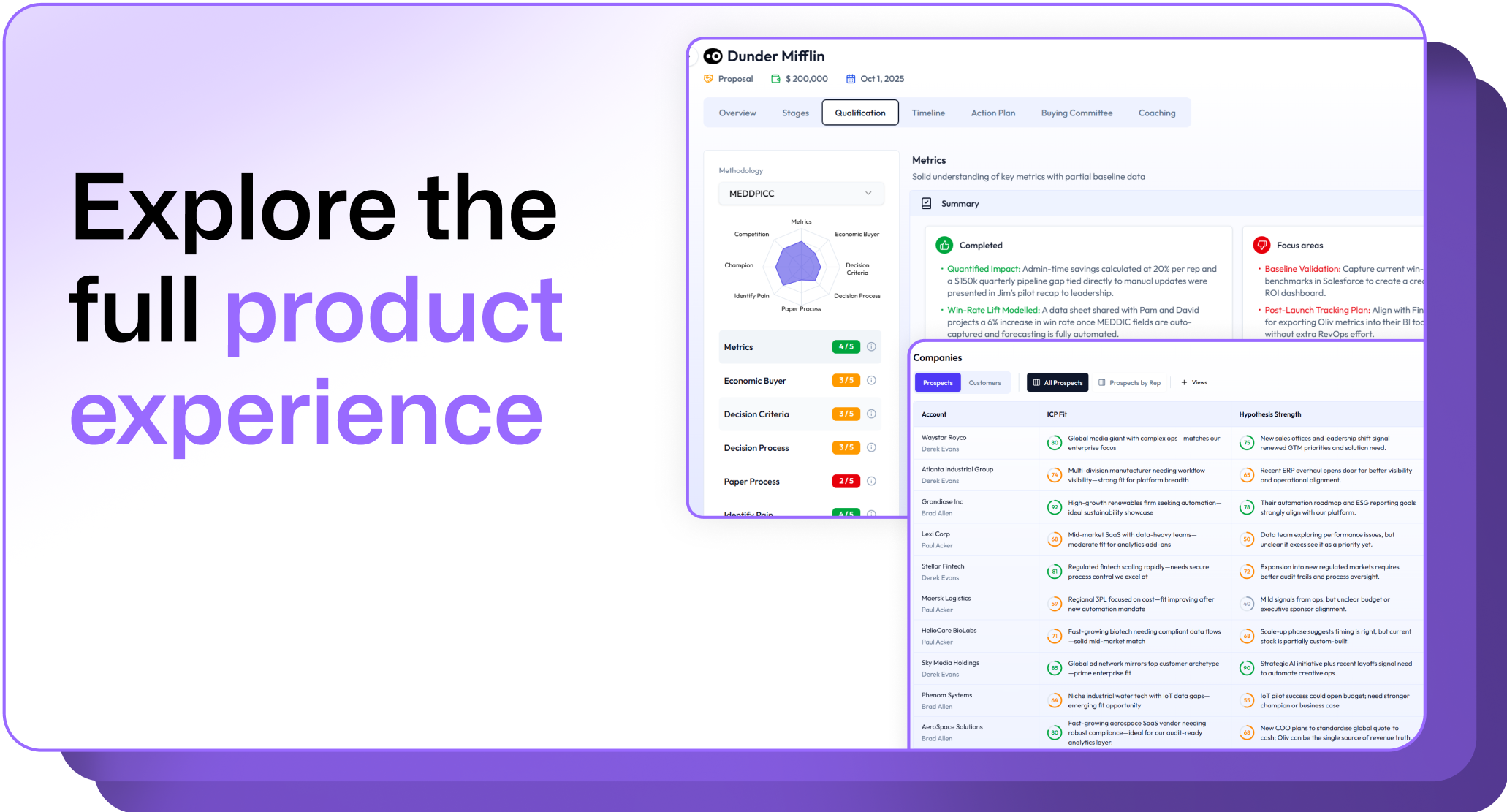
.avif)
.avif)