The $500/User Revenue Stack | CRO's Guide to Consolidating Gong + Clari Into One Platform | 2026
Written by
Ishan Chhabra
Last Updated :
March 15, 2026
Skim in :
7
mins
In this article
Still got questions?
Come discuss this article with me.
Hi, I'm Ishan, Founder and CEO of Oliv.
I'm always up for a conversation about revenue intelligence, AI agents, or what's actually working (and what's not) across revenue teams.
I'd love to hear your perspective.
Thank you! Your submission has been received!
Oops! Something went wrong while submitting the form.
Meet Oliv’s AI Agents
Hi! I’m, Deal Driver
I track deals, flag risks, send weekly pipeline updates and give sales managers full visibility into deal progress
Hi! I’m, CRM Manager
I maintain CRM hygiene by updating core, custom and qualification fields all without your team lifting a finger
Hi! I’m, Forecaster
I build accurate forecasts based on real deal movement and tell you which deals to pull in to hit your number
Hi! I’m, Coach
I believe performance fuels revenue. I spot skill gaps, score calls and build coaching plans to help every rep level up
Hi! I’m, Prospector
I dig into target accounts to surface the right contacts, tailor and time outreach so you always strike when it counts
Hi! I’m, Pipeline tracker
I call reps to get deal updates, and deliver a real-time, CRM-synced roll-up view of deal progress
Hi! I’m, Analyst
I answer complex pipeline questions, uncover deal patterns, and build reports that guide strategic decisions
TL;DR
Stacking Gong + Clari costs $319K to $590K/year for 100 users before implementation or training fees.
CRM failure, not people failure, is why CROs can't answer basic pipeline questions despite five dashboards.
RevOps teams burn 40+ hours/month on manual cleanup; automation recovers $611K+ annually for a 50-rep team.
Gong's 8 to 24 week implementation means your first 90 days are spent on setup, not ROI.
A 15-rep startup can replace Gong's $44K to $78K Year 1 cost with a unified platform at ~$17,820/year.
Full migration from Gong + Clari to a consolidated platform is achievable in 6 to 8 weeks with a parallel-run approach.
Q1: Why Can't You Answer Basic Pipeline Questions Despite Having Gong, Clari, and Five Other Dashboards? [toc=Pipeline Visibility Paradox]
An estimated 67% of sales reps consistently miss their quotas and yet the average mid-market revenue team spends upwards of $300,000 per year on tools that were supposed to prevent exactly that. If you're a CRO asking "Why are we losing FinTech deals in Stage 2?" and the only answer you get is a shrug and a request for "more time to pull reports," the problem isn't your people. It's a systemic CRM failure. The data your tools depend on was never entered correctly, because selling has never been contingent on data entry.
The shift from manually pulling insights across ten screens to receiving proactive, contextual intelligence where you already work.
⚠️ The Dashboard-Digging Trap
Gong records the call and that's genuinely valuable for conversation intelligence. But what happens to those insights? They're logged as unstructured activity notes in your CRM. Clari overlays Salesforce with pipeline visualisation, but it still depends on the same dirty data reps never entered in the first place. The result is a paradox: more dashboards, less clarity.
"It's too complicated, and not intuitive at all. Using it is very...discomforting. Searching for calls is not easy, moving around in the calls is not easy, and understanding the pipeline management portion of it is almost impossible." — John S., Senior Account Executive, Mid-Market — G2 Verified Review
Meanwhile, competitors force all companies into standardised workflows a $1M enterprise deal gets reviewed the same way as a $10K SMB deal killing agility in the mid-market.
💡 From Dashboard-Digging to Proactive Intelligence
The AI-era shift isn't about building a better dashboard. It's about eliminating the dashboard entirely. Instead of managers "pulling" insights from 10 different screens, AI-native platforms reason across every data source calls, emails, Slack, CRM and push answers proactively. The question changes from "Where do I find this data?" to "What should I act on right now?"
✅ How Oliv.ai Replaces the Dashboard with an Analyst Agent
Oliv approaches this differently. Instead of another panel for your team to monitor, the Analyst Agent operates as an "ask-me-anything" strategic engine. A CRO types a plain-English question "Which FinTech deals stalled at Stage 2 this quarter and why?" and receives visual dashboards with interpretive commentary in seconds. No clicking through ten screens. No manual auditing.
Beyond ad-hoc questions, Oliv's agentic execution model shifts the focus from "documentation" to AI-native revenue orchestration. It doesn't just tell you what happened it performs the jobs-to-be-done autonomously.
"Before switching to Oliv, cleaning up messy CRM fields and guessing at forecasts used to swallow half my week. Oliv fixes the data as it happens and drops a forecast I can actually bank on." — Darius Kim, Head of RevOps, Driftloop
Q2: What Does the $500/User Revenue Stack Actually Cost You? (Gong + Clari TCO Breakdown) [toc=Gong + Clari TCO Breakdown]
When you stack Gong for conversation intelligence and Clari for forecasting, per-user costs regularly surpass $400 to $500 per month before you account for implementation, training, or integration maintenance. Below is a transparent breakdown of what each platform actually costs in 2026.
How Gong + Clari costs compound across six hidden layers to exceed $500/user/month before your team sees a single actionable insight.
"It is really just a glorified SFDC overlay. Actually, Salesforce has built most of the forecasting functionality by now anyway so I'm not sure where they fit into that whole overcrowded Martech space." — conaldinho11, r/SalesOperations — Reddit Thread
✅ How Oliv.ai Simplifies This
Oliv consolidates conversation intelligence, deal management, forecasting, and CRM hygiene into a single platform starting at a fraction of the stacked cost with no mandatory platform fee, no forced bundling, and no multi-year lock-in.
Q3: How Do You Justify Automation Spend When RevOps Burns 40+ Hours/Month on Data Cleanup? [toc=RevOps Automation ROI]
RevOps teams in mid-market organisations routinely spend 40+ hours per month on manual data cleanup deduplicating records, normalising fields, and chasing reps to update MEDDIC or BANT fields that were supposed to be filled in last week. At a loaded RevOps salary of approximately $150K/year, that translates to roughly $3,500/month in admin labour per team member money spent maintaining data rather than optimising pipeline.
❌ Why Legacy Tools Make the Problem Worse
Traditional platforms don't eliminate this burden they often compound it:
Salesforce: Einstein Activity Capture stores data in separate AWS instances that are unusable for standard reporting. RevOps teams end up manually exporting and cleaning data in spreadsheets the very cycle automation was supposed to break.
Neither tool addresses the root cause: reps don't enter data because selling has never been contingent on documentation. Any platform that still depends on manual input is fighting a losing battle.
💡 The AI-Native Data Platform Shift
The generative AI era introduces a fundamentally different approach: automated data platforms that enrich, deduplicate, and normalise records autonomously. Instead of asking reps to be better data-entry clerks, these systems transform the CRM from a "manual logbook" into a self-healing data asset one that updates itself from the conversations, emails, and Slack threads already happening naturally.
✅ How Oliv.ai Automates the Foundation
Oliv's CRM Manager Agent automatically enriches accounts and contacts, creates new opportunities based on qualification criteria, and populates methodology fields (MEDDIC, BANT) directly from conversation context without rep effort. The Data Cleanser Agent deduplicates and normalises records weekly, flagging anomalies autonomously.
The tangible result: reps save 2 to 3 hours per week, and managers reclaim up to one full day per week of manual auditing time. For a 50-rep team, a simple ROI formula tells the story:
(Hours saved/week x loaded hourly rate x 52 weeks) minus annual platform cost = net savings
Example: 50 reps x 2.5 hrs/week x $45/hr x 52 = ~$292K recovered minus Oliv's annual cost = significant net positive in Year 1
Q4: How Do You Reduce Tool Sprawl Without Sacrificing Best-in-Class Reporting? [toc=Consolidation Without Compromise]
"Best-in-class reporting" in the previous decade meant maintaining 50 different dashboards across 5 different tools each vendor claiming to be the "single pane of glass" while quietly creating yet another data silo. The fear for CROs considering consolidation is legitimate: will reducing tools mean downgrading the reporting quality your board has come to expect?
❌ The One-Way Integration Problem
Gong is widely acknowledged as strong in conversation intelligence. But its data integration model is fundamentally one-way it pulls data in from your CRM and communication tools but makes it notoriously difficult to export structured data back out. This creates a walled garden where insights are trapped behind Gong's proprietary UI.
Clari integrates tightly with Salesforce, which is both its strength and its limitation. As one Reddit user noted, it's essentially "a glorified SFDC overlay". If Salesforce's native data is dirty and it almost always is Clari's reporting inherits every flaw.
"Clari should find ways to differentiate from the native Salesforce features (e.g. Pipeline Inspection, Forecasting) in order to remain competitive in the long-run." — Dan J., Mid-Market — G2 Verified Review
💡 The Single Source of Truth Principle
Effective consolidation doesn't mean fewer reports it means fewer sources of reports. The CRM must remain the single source of truth, and any revenue intelligence platform must push structured data back into HubSpot or Salesforce objects rather than trapping it behind a proprietary UI. When data flows bidirectionally, every existing Salesforce report, dashboard, and BI integration improves automatically.
✅ How Oliv.ai Unifies Reporting Without Compromising Depth
Oliv operates as an AI-native revenue orchestration platform that ensures everything flows back into the CRM as structured properties not just activity logs. We maintain a Full Open Export policy: upon termination, customers receive a complete CSV dump of all meetings, recordings, and metadata. Zero UI lock-in.
The Analyst Agent eliminates the need for specialised reporting tools entirely. Instead of building custom Salesforce reports or exporting data to spreadsheets, leaders generate visual dashboards using natural-language queries "Show me Q1 win-rate by segment and rep" and get both the visualisation and interpretive commentary in seconds. No custom code, no manual data stitching, no walled garden.
Q5: How Do You Kill 'Noisy Platform' Alerts and Only Get What's Actually Actionable? [toc=Eliminating Alert Fatigue]
Sales managers in 2026 are battling what the industry calls "Note-Taker Fatigue." The average mid-market manager receives 30+ keyword-triggered Slack and email notifications daily from their conversation intelligence platform most of which are noise. A prospect casually mentions a competitor's name in passing, and it triggers the same alert as an active competitive evaluation. Budget comes up in the context of a holiday, and it flags identically to a real procurement discussion. The result: managers learn to ignore alerts entirely, defeating the purpose of the tool.
❌ The V1 Keyword Matching Trap
Gong's Smart Trackers while powerful in concept are fundamentally keyword-based, built on V1 machine learning that cannot distinguish context. If you set a tracker for "budget," it fires whether the prospect is discussing their procurement cycle or their team's holiday budget. If you track "competitor," it flags a passing mention the same way it flags an active evaluation.
Beyond the keyword problem, Gong's dashboards are passive they require managers to "pull" insights by clicking through multiple screens rather than pushing actionable intelligence to the right person at the right time.
The generative AI era replaces keyword-matching with LLM-powered contextual reasoning. Instead of flagging every mention of a word, these AI-native platforms understand the nuance of a conversation distinguishing a casual competitor reference from an active evaluation, or an off-topic budget remark from a genuine procurement signal.
✅ Oliv's Three-Layer Intelligence Delivery
Oliv delivers "Insights, Right on Time" through a structured three-layer system:
Morning Briefs: 30 minutes before every call, Oliv pushes a Slack/Email summary of account history, stakeholder map, and tech stack so reps never walk into a meeting cold.
Sunset Summaries: Every evening, managers receive a concise daily breakdown of which deals moved, which stalled, and which require immediate intervention replacing the need to dig through 10 dashboards.
Contextual Risk Alerts: Oliv only flags genuine deal risks a champion going silent, a competitor being actively evaluated, budget authority shifting rather than generic keyword mentions.
The net effect: managers go from 30+ noisy alerts per day to a handful of signals that actually require action.
Q6: How Does a Unified Platform Handle Conflicting Information Across Calls? [toc=Resolving Conflicting Deal Data]
Here's a scenario every sales team faces: a prospect mentions a $50K budget in the first discovery call. By meeting three, a different stakeholder references $75K. Two people give conflicting answers about who signs off on the purchase. Which number is real? Which decision process is authoritative? In most CRMs, the answer is "whichever one the rep remembered to enter last" if they entered anything at all.
❌ Why Rule-Based Systems Can't Resolve Conflicts
Legacy platforms are built on brittle, rule-based logic that doesn't handle nuance:
Gong: Logs both meetings as activity summaries or notes in the CRM. It records that "budget" was mentioned but cannot reason about which figure is the current, authoritative number. There's no conflict resolution just sequential logging.
Salesforce Einstein: Frequently fails to associate activities with the correct opportunities when duplicate accounts exist (e.g., Google US vs. Google India). It lacks the reasoning to determine which "Economic Buyer" or "Budget" is most current.
Clari: Relies on manual "roll-up" forecasting where the rep determines which budget number is "real" in the UI introducing significant human bias into the forecast.
LLM-powered platforms introduce a fundamentally different approach: chain-of-thought reasoning that parses transcripts across the full deal timeline, identifies the most recent and authoritative data point, and flags the change for human validation before updating the CRM.
✅ Oliv's Stitched Deal History and Evolving Summary
Oliv uses AI-Based Object Association to resolve conflicts automatically. It stitches data from meetings, emails, support tickets, Slack, and even Telegram into a single 360 degree account view. Instead of a one-time log, Oliv maintains an evolving deal summary that updates after every interaction.
When a budget changes, the AI reasons through the transcript, identifies the new authoritative number, and prompts the rep via Slack to validate the change before writing it to the CRM property. The result: your forecast reflects the most current reality of the deal, not the last thing someone remembered to type.
Think of it this way: legacy platforms like Gong and Clari are a dashcam they record the accident. Oliv is autopilot it helps you drive the deal to the destination.
Q7: How Do You Convince Sales Teams This Isn't 'Just Another Platform' to Learn? [toc=Overcoming Tool Fatigue]
"SaaS is a dirty word" in 2026. Sales teams are exhausted by the cycle of new tool introductions that promise transformation but deliver another login, another three-month training program, and another layer of documentation burden. If your consolidation strategy requires reps to adopt yet another platform, adoption will fail regardless of how good the technology is.
⚠️ The Legacy Implementation Problem
Traditional revenue tools demand significant behaviour change from the very people who resist change most front-line reps:
Gong: Implementation spans 8 to 24 weeks, with 8 to 12 hours of end-user training per cohort, followed by pilot programs and feedback cycles before a full rollout. That's months before you see value.
Salesforce Agentforce: Heavily chat-based, requiring reps to proactively query a bot to get work done adding a manual step to every workflow.
Low adoption is the norm: As one G2 reviewer noted about Gong Engage, "Our team is struggling with low adoption, and they won't even spend the time to support us during this transition".
"It was a big mistake on our part to commit to a two year term. Gong is a really powerful tool but it's probably the highest end option on the market, and now we're stuck with a tool that works technically but isn't the right business decision." — Iris P., Head of Marketing, Sales & Partnerships, Mid-Market — G2 Verified Review
💡 The "Agentic Workforce" Paradigm Shift
The answer isn't a better training program it's eliminating the need for training altogether. The agentic workforce paradigm delivers value where your team already lives Slack, Email, CRM without requiring a new login, a new UI, or a behavioural shift.
✅ Oliv's Invisible UI: Removing Work, Not Adding Tabs
Oliv isn't a SaaS application your team has to use it's a set of agents that perform work for them:
Follow-Up Emails: Drafted automatically in Gmail/Outlook after every call, ready to send with one click.
CRM Updates: Fields populated autonomously from conversation context no manual entry required.
Business Cases: Built for reps based on deal data, stakeholder inputs, and competitive positioning.
Morning Briefs: Pushed to Slack 30 minutes before every call with full account context.
Configuration takes 5 minutes. Users start receiving value immediately. The pitch to reps isn't "learn this new tool" it's "this removes 2 to 3 hours of admin from your week."
Q8: What's a Realistic Revenue Tech Stack for a 15-Rep Team on a Startup Budget? [toc=Startup Tech Stack Budget]
Startups and SMBs are routinely priced out of the "Gold Standard" revenue tools due to mandatory platform fees and forced bundling. Below is a factual breakdown of what the legacy stack actually costs a 15-rep team and a practical alternative.
No platform fee, no forced annual prepayment, no 8-week implementation. A 15-rep startup gets conversation intelligence, deal management, forecasting, and CRM hygiene in a single revenue orchestration platform at roughly 60 to 77% less than Gong's Year 1 cost with configuration complete in 5 minutes.
Q9: Can You Buy Just a Couple of AI Agents for Managers Without a Full Platform License? [toc=Modular Agent Pricing]
Picture this: a VP of Sales wants deal intelligence for 5 front-line managers. She calls Gong and gets quoted a per-seat license for the entire 80-person org, plus a mandatory $20K+ platform fee, plus a two-year commitment. What started as a targeted investment becomes an enterprise-wide procurement nightmare. This is the forced-bundling model that legacy revenue platforms have operated on for the past decade and it's the single biggest barrier to surgical, role-specific adoption.
A 25-user team on Gong pays between $47,000 and $65,100 in Year 1 before a single actionable insight is generated during the 8 to 24 week implementation period.
💡 The Modular AI Pricing Model
The generative AI era enables a fundamentally different commercial model: purchasing specific agents for specific roles, scaling spend with actual usage, and eliminating forced enterprise-wide licensing. This is the difference between buying a full car for every employee and purchasing ride-credits only when someone needs to travel.
✅ Oliv's Pick-Your-Agent Approach
Oliv is modular by design. We don't force team-wide licensing to unlock manager-level capabilities:
Free Core Plan: Meeting intelligence at no cost especially valuable for teams transitioning off Gong.
Role-Specific Agents: The Deal Driver Agent for managers, the CRM Manager for reps, the Forecaster Agent for leadership each purchased independently.
Pay-per-Run Options: Agents like the Researcher can be purchased per report, letting you scale spend with actual usage rather than committed seats.
No platform fee. No forced bundling. No multi-year lock-in.
Q10: How Do You Quantify Admin Hours Saved for a Board-Ready ROI Case? [toc=Admin Hours ROI Formula]
Manual admin is the hidden killer of revenue. Before a CFO approves any automation investment, they need a concrete, defensible formula not a vendor's marketing claim. Below is a step-by-step framework for building a board-ready ROI case.
⏰ Step 1: Audit Current Admin Hours by Role
Start by documenting where manual hours are actually spent. Based on industry benchmarks and verified user data:
Weekly Admin Hours by Role
Role
Weekly Admin Task
Hours/Week
AEs (per rep)
Follow-up emails, CRM updates, business case drafting
Oliv's Meeting Assistant and CRM Manager automate rep-level admin; the Forecaster and Deal Driver eliminate manager roll-ups; and RevOps teams analyse data in a spreadsheet-like interface without custom code making the hours in the table above directly recoverable from Day 1.
Q11: What ROI Should You Expect in 90 Days vs. 6 Months vs. 1 Year? [toc=Phased ROI Timeline]
Most legacy revenue tool deployments spend their first 90 days on implementation not results. When you're paying full licence fees during an 8 to 24 week setup period, the clock is ticking on ROI before a single insight reaches your team. Mid-market teams using Gong typically report a 9 to 12 month payback period, and only if platform utilisation stays above 75%.
❌ The Traditional Implementation Tax
Legacy platforms front-load cost while back-loading value:
Gong: 8 to 24 weeks of implementation across three phases technical setup, data integration, and user training (800 to 1,200 hours for a 100-person team). ROI doesn't begin until Month 4 at the earliest.
Clari: 8 to 16 weeks of deployment plus $15K to $75K in professional services fees. RevOps teams invest 40 to 60 internal hours before a single dashboard goes live.
During these months, you're paying full licence fees with zero productivity gain. That's the "implementation tax" built into every pre-generative AI platform.
💡 Instant Configuration, Compounding Returns
AI-native platforms invert this timeline entirely. Configuration happens in minutes rather than months. Value delivery starts on Day 1 through proactive agents, and returns compound as adoption deepens organically without formal training programs.
✅ Oliv's Phased ROI Timeline
Oliv Phased ROI Timeline
Milestone
What Happens
Measurable Impact
Day 1
5-minute configuration; CRM integration live
Meeting recording, transcription, and AI summaries active
At Month 3, a Gong deployment is still in user training. At Month 3, an Oliv deployment has already saved your managers 12 full workdays and improved CRM data completeness by 90%.
At Month 3, legacy deployments are still in training mode. AI-native platforms have already saved managers 12 full workdays.
Q12: Step-by-Step: How Do You Actually Migrate From Gong + Clari to a Unified Platform? [toc=Migration Playbook]
Migrating away from entrenched revenue tools feels daunting especially with active deals in the pipeline. Below is a practical, five-phase migration playbook designed for RevOps leaders managing a mid-cycle transition.
A practical 6 to 8 week migration playbook for RevOps leaders transitioning from Gong + Clari without disrupting active deals.
Phase 1: Audit & Overlap Mapping (Week 1 to 2)
Inventory all active tools: List every revenue tool, its primary function, monthly cost, and number of active users.
Map capability overlaps: Identify where Gong and Clari duplicate each other or Salesforce-native features. Clari's forecasting, for example, now substantially overlaps Salesforce Pipeline Inspection.
Document integration dependencies: Which workflows depend on Gong's API? Which Clari fields feed board reports?
"Clari should find ways to differentiate from the native Salesforce features (e.g. Pipeline Inspection, Forecasting) in order to remain competitive in the long-run." — Dan J., Mid-Market — G2 Verified Review
Phase 2: Data Export & Preservation (Week 2 to 3)
Gong call data: Begin API-based exports immediately Gong only supports single-call downloads, so budget developer time accordingly (~$4K per 1,000 calls for custom export scripts).
Clari forecast history: Export historical forecast snapshots and deal analytics from Clari to CSV before contract expiration.
CRM baseline: Take a clean Salesforce/HubSpot snapshot as your migration benchmark.
Deploy the new unified platform alongside existing tools no cold cutover.
Run both systems for 3 to 4 weeks to validate data parity, CRM write-back accuracy, and agent reliability.
Compare forecast outputs side-by-side: legacy roll-up vs. AI-generated forecast.
Phase 4: Cutover & Decommission (Week 6 to 8)
Redirect calendar integrations and recording bots to the new platform.
Disable Gong/Clari user provisioning; revoke OAuth tokens.
Confirm all active deal data has been fully migrated and validated in the CRM.
⚠️ Phase 5: Optimise & Scale (Week 8+)
Activate advanced agents (Forecaster, Deal Driver, Analyst) once baseline data flows are validated.
Configure role-specific alert thresholds and Sunset Summary cadences.
Conduct a 30-day post-migration review: compare CRM data completeness, forecast accuracy, and admin hours against the Phase 1 baseline.
✅ How Oliv.ai Simplifies This
Oliv's 5-minute configuration, full CRM write-back, and open data export policy eliminate the two biggest migration risks prolonged parallel runs and data lock-in. Teams migrating from Gong + Clari to Oliv typically complete the full transition within 6 to 8 weeks while maintaining uninterrupted pipeline visibility.
Q1: Why Can't You Answer Basic Pipeline Questions Despite Having Gong, Clari, and Five Other Dashboards? [toc=Pipeline Visibility Paradox]
An estimated 67% of sales reps consistently miss their quotas and yet the average mid-market revenue team spends upwards of $300,000 per year on tools that were supposed to prevent exactly that. If you're a CRO asking "Why are we losing FinTech deals in Stage 2?" and the only answer you get is a shrug and a request for "more time to pull reports," the problem isn't your people. It's a systemic CRM failure. The data your tools depend on was never entered correctly, because selling has never been contingent on data entry.
The shift from manually pulling insights across ten screens to receiving proactive, contextual intelligence where you already work.
⚠️ The Dashboard-Digging Trap
Gong records the call and that's genuinely valuable for conversation intelligence. But what happens to those insights? They're logged as unstructured activity notes in your CRM. Clari overlays Salesforce with pipeline visualisation, but it still depends on the same dirty data reps never entered in the first place. The result is a paradox: more dashboards, less clarity.
"It's too complicated, and not intuitive at all. Using it is very...discomforting. Searching for calls is not easy, moving around in the calls is not easy, and understanding the pipeline management portion of it is almost impossible." — John S., Senior Account Executive, Mid-Market — G2 Verified Review
Meanwhile, competitors force all companies into standardised workflows a $1M enterprise deal gets reviewed the same way as a $10K SMB deal killing agility in the mid-market.
💡 From Dashboard-Digging to Proactive Intelligence
The AI-era shift isn't about building a better dashboard. It's about eliminating the dashboard entirely. Instead of managers "pulling" insights from 10 different screens, AI-native platforms reason across every data source calls, emails, Slack, CRM and push answers proactively. The question changes from "Where do I find this data?" to "What should I act on right now?"
✅ How Oliv.ai Replaces the Dashboard with an Analyst Agent
Oliv approaches this differently. Instead of another panel for your team to monitor, the Analyst Agent operates as an "ask-me-anything" strategic engine. A CRO types a plain-English question "Which FinTech deals stalled at Stage 2 this quarter and why?" and receives visual dashboards with interpretive commentary in seconds. No clicking through ten screens. No manual auditing.
Beyond ad-hoc questions, Oliv's agentic execution model shifts the focus from "documentation" to AI-native revenue orchestration. It doesn't just tell you what happened it performs the jobs-to-be-done autonomously.
"Before switching to Oliv, cleaning up messy CRM fields and guessing at forecasts used to swallow half my week. Oliv fixes the data as it happens and drops a forecast I can actually bank on." — Darius Kim, Head of RevOps, Driftloop
Q2: What Does the $500/User Revenue Stack Actually Cost You? (Gong + Clari TCO Breakdown) [toc=Gong + Clari TCO Breakdown]
When you stack Gong for conversation intelligence and Clari for forecasting, per-user costs regularly surpass $400 to $500 per month before you account for implementation, training, or integration maintenance. Below is a transparent breakdown of what each platform actually costs in 2026.
How Gong + Clari costs compound across six hidden layers to exceed $500/user/month before your team sees a single actionable insight.
"It is really just a glorified SFDC overlay. Actually, Salesforce has built most of the forecasting functionality by now anyway so I'm not sure where they fit into that whole overcrowded Martech space." — conaldinho11, r/SalesOperations — Reddit Thread
✅ How Oliv.ai Simplifies This
Oliv consolidates conversation intelligence, deal management, forecasting, and CRM hygiene into a single platform starting at a fraction of the stacked cost with no mandatory platform fee, no forced bundling, and no multi-year lock-in.
Q3: How Do You Justify Automation Spend When RevOps Burns 40+ Hours/Month on Data Cleanup? [toc=RevOps Automation ROI]
RevOps teams in mid-market organisations routinely spend 40+ hours per month on manual data cleanup deduplicating records, normalising fields, and chasing reps to update MEDDIC or BANT fields that were supposed to be filled in last week. At a loaded RevOps salary of approximately $150K/year, that translates to roughly $3,500/month in admin labour per team member money spent maintaining data rather than optimising pipeline.
❌ Why Legacy Tools Make the Problem Worse
Traditional platforms don't eliminate this burden they often compound it:
Salesforce: Einstein Activity Capture stores data in separate AWS instances that are unusable for standard reporting. RevOps teams end up manually exporting and cleaning data in spreadsheets the very cycle automation was supposed to break.
Neither tool addresses the root cause: reps don't enter data because selling has never been contingent on documentation. Any platform that still depends on manual input is fighting a losing battle.
💡 The AI-Native Data Platform Shift
The generative AI era introduces a fundamentally different approach: automated data platforms that enrich, deduplicate, and normalise records autonomously. Instead of asking reps to be better data-entry clerks, these systems transform the CRM from a "manual logbook" into a self-healing data asset one that updates itself from the conversations, emails, and Slack threads already happening naturally.
✅ How Oliv.ai Automates the Foundation
Oliv's CRM Manager Agent automatically enriches accounts and contacts, creates new opportunities based on qualification criteria, and populates methodology fields (MEDDIC, BANT) directly from conversation context without rep effort. The Data Cleanser Agent deduplicates and normalises records weekly, flagging anomalies autonomously.
The tangible result: reps save 2 to 3 hours per week, and managers reclaim up to one full day per week of manual auditing time. For a 50-rep team, a simple ROI formula tells the story:
(Hours saved/week x loaded hourly rate x 52 weeks) minus annual platform cost = net savings
Example: 50 reps x 2.5 hrs/week x $45/hr x 52 = ~$292K recovered minus Oliv's annual cost = significant net positive in Year 1
Q4: How Do You Reduce Tool Sprawl Without Sacrificing Best-in-Class Reporting? [toc=Consolidation Without Compromise]
"Best-in-class reporting" in the previous decade meant maintaining 50 different dashboards across 5 different tools each vendor claiming to be the "single pane of glass" while quietly creating yet another data silo. The fear for CROs considering consolidation is legitimate: will reducing tools mean downgrading the reporting quality your board has come to expect?
❌ The One-Way Integration Problem
Gong is widely acknowledged as strong in conversation intelligence. But its data integration model is fundamentally one-way it pulls data in from your CRM and communication tools but makes it notoriously difficult to export structured data back out. This creates a walled garden where insights are trapped behind Gong's proprietary UI.
Clari integrates tightly with Salesforce, which is both its strength and its limitation. As one Reddit user noted, it's essentially "a glorified SFDC overlay". If Salesforce's native data is dirty and it almost always is Clari's reporting inherits every flaw.
"Clari should find ways to differentiate from the native Salesforce features (e.g. Pipeline Inspection, Forecasting) in order to remain competitive in the long-run." — Dan J., Mid-Market — G2 Verified Review
💡 The Single Source of Truth Principle
Effective consolidation doesn't mean fewer reports it means fewer sources of reports. The CRM must remain the single source of truth, and any revenue intelligence platform must push structured data back into HubSpot or Salesforce objects rather than trapping it behind a proprietary UI. When data flows bidirectionally, every existing Salesforce report, dashboard, and BI integration improves automatically.
✅ How Oliv.ai Unifies Reporting Without Compromising Depth
Oliv operates as an AI-native revenue orchestration platform that ensures everything flows back into the CRM as structured properties not just activity logs. We maintain a Full Open Export policy: upon termination, customers receive a complete CSV dump of all meetings, recordings, and metadata. Zero UI lock-in.
The Analyst Agent eliminates the need for specialised reporting tools entirely. Instead of building custom Salesforce reports or exporting data to spreadsheets, leaders generate visual dashboards using natural-language queries "Show me Q1 win-rate by segment and rep" and get both the visualisation and interpretive commentary in seconds. No custom code, no manual data stitching, no walled garden.
Q5: How Do You Kill 'Noisy Platform' Alerts and Only Get What's Actually Actionable? [toc=Eliminating Alert Fatigue]
Sales managers in 2026 are battling what the industry calls "Note-Taker Fatigue." The average mid-market manager receives 30+ keyword-triggered Slack and email notifications daily from their conversation intelligence platform most of which are noise. A prospect casually mentions a competitor's name in passing, and it triggers the same alert as an active competitive evaluation. Budget comes up in the context of a holiday, and it flags identically to a real procurement discussion. The result: managers learn to ignore alerts entirely, defeating the purpose of the tool.
❌ The V1 Keyword Matching Trap
Gong's Smart Trackers while powerful in concept are fundamentally keyword-based, built on V1 machine learning that cannot distinguish context. If you set a tracker for "budget," it fires whether the prospect is discussing their procurement cycle or their team's holiday budget. If you track "competitor," it flags a passing mention the same way it flags an active evaluation.
Beyond the keyword problem, Gong's dashboards are passive they require managers to "pull" insights by clicking through multiple screens rather than pushing actionable intelligence to the right person at the right time.
The generative AI era replaces keyword-matching with LLM-powered contextual reasoning. Instead of flagging every mention of a word, these AI-native platforms understand the nuance of a conversation distinguishing a casual competitor reference from an active evaluation, or an off-topic budget remark from a genuine procurement signal.
✅ Oliv's Three-Layer Intelligence Delivery
Oliv delivers "Insights, Right on Time" through a structured three-layer system:
Morning Briefs: 30 minutes before every call, Oliv pushes a Slack/Email summary of account history, stakeholder map, and tech stack so reps never walk into a meeting cold.
Sunset Summaries: Every evening, managers receive a concise daily breakdown of which deals moved, which stalled, and which require immediate intervention replacing the need to dig through 10 dashboards.
Contextual Risk Alerts: Oliv only flags genuine deal risks a champion going silent, a competitor being actively evaluated, budget authority shifting rather than generic keyword mentions.
The net effect: managers go from 30+ noisy alerts per day to a handful of signals that actually require action.
Q6: How Does a Unified Platform Handle Conflicting Information Across Calls? [toc=Resolving Conflicting Deal Data]
Here's a scenario every sales team faces: a prospect mentions a $50K budget in the first discovery call. By meeting three, a different stakeholder references $75K. Two people give conflicting answers about who signs off on the purchase. Which number is real? Which decision process is authoritative? In most CRMs, the answer is "whichever one the rep remembered to enter last" if they entered anything at all.
❌ Why Rule-Based Systems Can't Resolve Conflicts
Legacy platforms are built on brittle, rule-based logic that doesn't handle nuance:
Gong: Logs both meetings as activity summaries or notes in the CRM. It records that "budget" was mentioned but cannot reason about which figure is the current, authoritative number. There's no conflict resolution just sequential logging.
Salesforce Einstein: Frequently fails to associate activities with the correct opportunities when duplicate accounts exist (e.g., Google US vs. Google India). It lacks the reasoning to determine which "Economic Buyer" or "Budget" is most current.
Clari: Relies on manual "roll-up" forecasting where the rep determines which budget number is "real" in the UI introducing significant human bias into the forecast.
LLM-powered platforms introduce a fundamentally different approach: chain-of-thought reasoning that parses transcripts across the full deal timeline, identifies the most recent and authoritative data point, and flags the change for human validation before updating the CRM.
✅ Oliv's Stitched Deal History and Evolving Summary
Oliv uses AI-Based Object Association to resolve conflicts automatically. It stitches data from meetings, emails, support tickets, Slack, and even Telegram into a single 360 degree account view. Instead of a one-time log, Oliv maintains an evolving deal summary that updates after every interaction.
When a budget changes, the AI reasons through the transcript, identifies the new authoritative number, and prompts the rep via Slack to validate the change before writing it to the CRM property. The result: your forecast reflects the most current reality of the deal, not the last thing someone remembered to type.
Think of it this way: legacy platforms like Gong and Clari are a dashcam they record the accident. Oliv is autopilot it helps you drive the deal to the destination.
Q7: How Do You Convince Sales Teams This Isn't 'Just Another Platform' to Learn? [toc=Overcoming Tool Fatigue]
"SaaS is a dirty word" in 2026. Sales teams are exhausted by the cycle of new tool introductions that promise transformation but deliver another login, another three-month training program, and another layer of documentation burden. If your consolidation strategy requires reps to adopt yet another platform, adoption will fail regardless of how good the technology is.
⚠️ The Legacy Implementation Problem
Traditional revenue tools demand significant behaviour change from the very people who resist change most front-line reps:
Gong: Implementation spans 8 to 24 weeks, with 8 to 12 hours of end-user training per cohort, followed by pilot programs and feedback cycles before a full rollout. That's months before you see value.
Salesforce Agentforce: Heavily chat-based, requiring reps to proactively query a bot to get work done adding a manual step to every workflow.
Low adoption is the norm: As one G2 reviewer noted about Gong Engage, "Our team is struggling with low adoption, and they won't even spend the time to support us during this transition".
"It was a big mistake on our part to commit to a two year term. Gong is a really powerful tool but it's probably the highest end option on the market, and now we're stuck with a tool that works technically but isn't the right business decision." — Iris P., Head of Marketing, Sales & Partnerships, Mid-Market — G2 Verified Review
💡 The "Agentic Workforce" Paradigm Shift
The answer isn't a better training program it's eliminating the need for training altogether. The agentic workforce paradigm delivers value where your team already lives Slack, Email, CRM without requiring a new login, a new UI, or a behavioural shift.
✅ Oliv's Invisible UI: Removing Work, Not Adding Tabs
Oliv isn't a SaaS application your team has to use it's a set of agents that perform work for them:
Follow-Up Emails: Drafted automatically in Gmail/Outlook after every call, ready to send with one click.
CRM Updates: Fields populated autonomously from conversation context no manual entry required.
Business Cases: Built for reps based on deal data, stakeholder inputs, and competitive positioning.
Morning Briefs: Pushed to Slack 30 minutes before every call with full account context.
Configuration takes 5 minutes. Users start receiving value immediately. The pitch to reps isn't "learn this new tool" it's "this removes 2 to 3 hours of admin from your week."
Q8: What's a Realistic Revenue Tech Stack for a 15-Rep Team on a Startup Budget? [toc=Startup Tech Stack Budget]
Startups and SMBs are routinely priced out of the "Gold Standard" revenue tools due to mandatory platform fees and forced bundling. Below is a factual breakdown of what the legacy stack actually costs a 15-rep team and a practical alternative.
No platform fee, no forced annual prepayment, no 8-week implementation. A 15-rep startup gets conversation intelligence, deal management, forecasting, and CRM hygiene in a single revenue orchestration platform at roughly 60 to 77% less than Gong's Year 1 cost with configuration complete in 5 minutes.
Q9: Can You Buy Just a Couple of AI Agents for Managers Without a Full Platform License? [toc=Modular Agent Pricing]
Picture this: a VP of Sales wants deal intelligence for 5 front-line managers. She calls Gong and gets quoted a per-seat license for the entire 80-person org, plus a mandatory $20K+ platform fee, plus a two-year commitment. What started as a targeted investment becomes an enterprise-wide procurement nightmare. This is the forced-bundling model that legacy revenue platforms have operated on for the past decade and it's the single biggest barrier to surgical, role-specific adoption.
A 25-user team on Gong pays between $47,000 and $65,100 in Year 1 before a single actionable insight is generated during the 8 to 24 week implementation period.
💡 The Modular AI Pricing Model
The generative AI era enables a fundamentally different commercial model: purchasing specific agents for specific roles, scaling spend with actual usage, and eliminating forced enterprise-wide licensing. This is the difference between buying a full car for every employee and purchasing ride-credits only when someone needs to travel.
✅ Oliv's Pick-Your-Agent Approach
Oliv is modular by design. We don't force team-wide licensing to unlock manager-level capabilities:
Free Core Plan: Meeting intelligence at no cost especially valuable for teams transitioning off Gong.
Role-Specific Agents: The Deal Driver Agent for managers, the CRM Manager for reps, the Forecaster Agent for leadership each purchased independently.
Pay-per-Run Options: Agents like the Researcher can be purchased per report, letting you scale spend with actual usage rather than committed seats.
No platform fee. No forced bundling. No multi-year lock-in.
Q10: How Do You Quantify Admin Hours Saved for a Board-Ready ROI Case? [toc=Admin Hours ROI Formula]
Manual admin is the hidden killer of revenue. Before a CFO approves any automation investment, they need a concrete, defensible formula not a vendor's marketing claim. Below is a step-by-step framework for building a board-ready ROI case.
⏰ Step 1: Audit Current Admin Hours by Role
Start by documenting where manual hours are actually spent. Based on industry benchmarks and verified user data:
Weekly Admin Hours by Role
Role
Weekly Admin Task
Hours/Week
AEs (per rep)
Follow-up emails, CRM updates, business case drafting
Oliv's Meeting Assistant and CRM Manager automate rep-level admin; the Forecaster and Deal Driver eliminate manager roll-ups; and RevOps teams analyse data in a spreadsheet-like interface without custom code making the hours in the table above directly recoverable from Day 1.
Q11: What ROI Should You Expect in 90 Days vs. 6 Months vs. 1 Year? [toc=Phased ROI Timeline]
Most legacy revenue tool deployments spend their first 90 days on implementation not results. When you're paying full licence fees during an 8 to 24 week setup period, the clock is ticking on ROI before a single insight reaches your team. Mid-market teams using Gong typically report a 9 to 12 month payback period, and only if platform utilisation stays above 75%.
❌ The Traditional Implementation Tax
Legacy platforms front-load cost while back-loading value:
Gong: 8 to 24 weeks of implementation across three phases technical setup, data integration, and user training (800 to 1,200 hours for a 100-person team). ROI doesn't begin until Month 4 at the earliest.
Clari: 8 to 16 weeks of deployment plus $15K to $75K in professional services fees. RevOps teams invest 40 to 60 internal hours before a single dashboard goes live.
During these months, you're paying full licence fees with zero productivity gain. That's the "implementation tax" built into every pre-generative AI platform.
💡 Instant Configuration, Compounding Returns
AI-native platforms invert this timeline entirely. Configuration happens in minutes rather than months. Value delivery starts on Day 1 through proactive agents, and returns compound as adoption deepens organically without formal training programs.
✅ Oliv's Phased ROI Timeline
Oliv Phased ROI Timeline
Milestone
What Happens
Measurable Impact
Day 1
5-minute configuration; CRM integration live
Meeting recording, transcription, and AI summaries active
At Month 3, a Gong deployment is still in user training. At Month 3, an Oliv deployment has already saved your managers 12 full workdays and improved CRM data completeness by 90%.
At Month 3, legacy deployments are still in training mode. AI-native platforms have already saved managers 12 full workdays.
Q12: Step-by-Step: How Do You Actually Migrate From Gong + Clari to a Unified Platform? [toc=Migration Playbook]
Migrating away from entrenched revenue tools feels daunting especially with active deals in the pipeline. Below is a practical, five-phase migration playbook designed for RevOps leaders managing a mid-cycle transition.
A practical 6 to 8 week migration playbook for RevOps leaders transitioning from Gong + Clari without disrupting active deals.
Phase 1: Audit & Overlap Mapping (Week 1 to 2)
Inventory all active tools: List every revenue tool, its primary function, monthly cost, and number of active users.
Map capability overlaps: Identify where Gong and Clari duplicate each other or Salesforce-native features. Clari's forecasting, for example, now substantially overlaps Salesforce Pipeline Inspection.
Document integration dependencies: Which workflows depend on Gong's API? Which Clari fields feed board reports?
"Clari should find ways to differentiate from the native Salesforce features (e.g. Pipeline Inspection, Forecasting) in order to remain competitive in the long-run." — Dan J., Mid-Market — G2 Verified Review
Phase 2: Data Export & Preservation (Week 2 to 3)
Gong call data: Begin API-based exports immediately Gong only supports single-call downloads, so budget developer time accordingly (~$4K per 1,000 calls for custom export scripts).
Clari forecast history: Export historical forecast snapshots and deal analytics from Clari to CSV before contract expiration.
CRM baseline: Take a clean Salesforce/HubSpot snapshot as your migration benchmark.
Deploy the new unified platform alongside existing tools no cold cutover.
Run both systems for 3 to 4 weeks to validate data parity, CRM write-back accuracy, and agent reliability.
Compare forecast outputs side-by-side: legacy roll-up vs. AI-generated forecast.
Phase 4: Cutover & Decommission (Week 6 to 8)
Redirect calendar integrations and recording bots to the new platform.
Disable Gong/Clari user provisioning; revoke OAuth tokens.
Confirm all active deal data has been fully migrated and validated in the CRM.
⚠️ Phase 5: Optimise & Scale (Week 8+)
Activate advanced agents (Forecaster, Deal Driver, Analyst) once baseline data flows are validated.
Configure role-specific alert thresholds and Sunset Summary cadences.
Conduct a 30-day post-migration review: compare CRM data completeness, forecast accuracy, and admin hours against the Phase 1 baseline.
✅ How Oliv.ai Simplifies This
Oliv's 5-minute configuration, full CRM write-back, and open data export policy eliminate the two biggest migration risks prolonged parallel runs and data lock-in. Teams migrating from Gong + Clari to Oliv typically complete the full transition within 6 to 8 weeks while maintaining uninterrupted pipeline visibility.
Q1: Why Can't You Answer Basic Pipeline Questions Despite Having Gong, Clari, and Five Other Dashboards? [toc=Pipeline Visibility Paradox]
An estimated 67% of sales reps consistently miss their quotas and yet the average mid-market revenue team spends upwards of $300,000 per year on tools that were supposed to prevent exactly that. If you're a CRO asking "Why are we losing FinTech deals in Stage 2?" and the only answer you get is a shrug and a request for "more time to pull reports," the problem isn't your people. It's a systemic CRM failure. The data your tools depend on was never entered correctly, because selling has never been contingent on data entry.
The shift from manually pulling insights across ten screens to receiving proactive, contextual intelligence where you already work.
⚠️ The Dashboard-Digging Trap
Gong records the call and that's genuinely valuable for conversation intelligence. But what happens to those insights? They're logged as unstructured activity notes in your CRM. Clari overlays Salesforce with pipeline visualisation, but it still depends on the same dirty data reps never entered in the first place. The result is a paradox: more dashboards, less clarity.
"It's too complicated, and not intuitive at all. Using it is very...discomforting. Searching for calls is not easy, moving around in the calls is not easy, and understanding the pipeline management portion of it is almost impossible." — John S., Senior Account Executive, Mid-Market — G2 Verified Review
Meanwhile, competitors force all companies into standardised workflows a $1M enterprise deal gets reviewed the same way as a $10K SMB deal killing agility in the mid-market.
💡 From Dashboard-Digging to Proactive Intelligence
The AI-era shift isn't about building a better dashboard. It's about eliminating the dashboard entirely. Instead of managers "pulling" insights from 10 different screens, AI-native platforms reason across every data source calls, emails, Slack, CRM and push answers proactively. The question changes from "Where do I find this data?" to "What should I act on right now?"
✅ How Oliv.ai Replaces the Dashboard with an Analyst Agent
Oliv approaches this differently. Instead of another panel for your team to monitor, the Analyst Agent operates as an "ask-me-anything" strategic engine. A CRO types a plain-English question "Which FinTech deals stalled at Stage 2 this quarter and why?" and receives visual dashboards with interpretive commentary in seconds. No clicking through ten screens. No manual auditing.
Beyond ad-hoc questions, Oliv's agentic execution model shifts the focus from "documentation" to AI-native revenue orchestration. It doesn't just tell you what happened it performs the jobs-to-be-done autonomously.
"Before switching to Oliv, cleaning up messy CRM fields and guessing at forecasts used to swallow half my week. Oliv fixes the data as it happens and drops a forecast I can actually bank on." — Darius Kim, Head of RevOps, Driftloop
Q2: What Does the $500/User Revenue Stack Actually Cost You? (Gong + Clari TCO Breakdown) [toc=Gong + Clari TCO Breakdown]
When you stack Gong for conversation intelligence and Clari for forecasting, per-user costs regularly surpass $400 to $500 per month before you account for implementation, training, or integration maintenance. Below is a transparent breakdown of what each platform actually costs in 2026.
How Gong + Clari costs compound across six hidden layers to exceed $500/user/month before your team sees a single actionable insight.
"It is really just a glorified SFDC overlay. Actually, Salesforce has built most of the forecasting functionality by now anyway so I'm not sure where they fit into that whole overcrowded Martech space." — conaldinho11, r/SalesOperations — Reddit Thread
✅ How Oliv.ai Simplifies This
Oliv consolidates conversation intelligence, deal management, forecasting, and CRM hygiene into a single platform starting at a fraction of the stacked cost with no mandatory platform fee, no forced bundling, and no multi-year lock-in.
Q3: How Do You Justify Automation Spend When RevOps Burns 40+ Hours/Month on Data Cleanup? [toc=RevOps Automation ROI]
RevOps teams in mid-market organisations routinely spend 40+ hours per month on manual data cleanup deduplicating records, normalising fields, and chasing reps to update MEDDIC or BANT fields that were supposed to be filled in last week. At a loaded RevOps salary of approximately $150K/year, that translates to roughly $3,500/month in admin labour per team member money spent maintaining data rather than optimising pipeline.
❌ Why Legacy Tools Make the Problem Worse
Traditional platforms don't eliminate this burden they often compound it:
Salesforce: Einstein Activity Capture stores data in separate AWS instances that are unusable for standard reporting. RevOps teams end up manually exporting and cleaning data in spreadsheets the very cycle automation was supposed to break.
Neither tool addresses the root cause: reps don't enter data because selling has never been contingent on documentation. Any platform that still depends on manual input is fighting a losing battle.
💡 The AI-Native Data Platform Shift
The generative AI era introduces a fundamentally different approach: automated data platforms that enrich, deduplicate, and normalise records autonomously. Instead of asking reps to be better data-entry clerks, these systems transform the CRM from a "manual logbook" into a self-healing data asset one that updates itself from the conversations, emails, and Slack threads already happening naturally.
✅ How Oliv.ai Automates the Foundation
Oliv's CRM Manager Agent automatically enriches accounts and contacts, creates new opportunities based on qualification criteria, and populates methodology fields (MEDDIC, BANT) directly from conversation context without rep effort. The Data Cleanser Agent deduplicates and normalises records weekly, flagging anomalies autonomously.
The tangible result: reps save 2 to 3 hours per week, and managers reclaim up to one full day per week of manual auditing time. For a 50-rep team, a simple ROI formula tells the story:
(Hours saved/week x loaded hourly rate x 52 weeks) minus annual platform cost = net savings
Example: 50 reps x 2.5 hrs/week x $45/hr x 52 = ~$292K recovered minus Oliv's annual cost = significant net positive in Year 1
Q4: How Do You Reduce Tool Sprawl Without Sacrificing Best-in-Class Reporting? [toc=Consolidation Without Compromise]
"Best-in-class reporting" in the previous decade meant maintaining 50 different dashboards across 5 different tools each vendor claiming to be the "single pane of glass" while quietly creating yet another data silo. The fear for CROs considering consolidation is legitimate: will reducing tools mean downgrading the reporting quality your board has come to expect?
❌ The One-Way Integration Problem
Gong is widely acknowledged as strong in conversation intelligence. But its data integration model is fundamentally one-way it pulls data in from your CRM and communication tools but makes it notoriously difficult to export structured data back out. This creates a walled garden where insights are trapped behind Gong's proprietary UI.
Clari integrates tightly with Salesforce, which is both its strength and its limitation. As one Reddit user noted, it's essentially "a glorified SFDC overlay". If Salesforce's native data is dirty and it almost always is Clari's reporting inherits every flaw.
"Clari should find ways to differentiate from the native Salesforce features (e.g. Pipeline Inspection, Forecasting) in order to remain competitive in the long-run." — Dan J., Mid-Market — G2 Verified Review
💡 The Single Source of Truth Principle
Effective consolidation doesn't mean fewer reports it means fewer sources of reports. The CRM must remain the single source of truth, and any revenue intelligence platform must push structured data back into HubSpot or Salesforce objects rather than trapping it behind a proprietary UI. When data flows bidirectionally, every existing Salesforce report, dashboard, and BI integration improves automatically.
✅ How Oliv.ai Unifies Reporting Without Compromising Depth
Oliv operates as an AI-native revenue orchestration platform that ensures everything flows back into the CRM as structured properties not just activity logs. We maintain a Full Open Export policy: upon termination, customers receive a complete CSV dump of all meetings, recordings, and metadata. Zero UI lock-in.
The Analyst Agent eliminates the need for specialised reporting tools entirely. Instead of building custom Salesforce reports or exporting data to spreadsheets, leaders generate visual dashboards using natural-language queries "Show me Q1 win-rate by segment and rep" and get both the visualisation and interpretive commentary in seconds. No custom code, no manual data stitching, no walled garden.
Q5: How Do You Kill 'Noisy Platform' Alerts and Only Get What's Actually Actionable? [toc=Eliminating Alert Fatigue]
Sales managers in 2026 are battling what the industry calls "Note-Taker Fatigue." The average mid-market manager receives 30+ keyword-triggered Slack and email notifications daily from their conversation intelligence platform most of which are noise. A prospect casually mentions a competitor's name in passing, and it triggers the same alert as an active competitive evaluation. Budget comes up in the context of a holiday, and it flags identically to a real procurement discussion. The result: managers learn to ignore alerts entirely, defeating the purpose of the tool.
❌ The V1 Keyword Matching Trap
Gong's Smart Trackers while powerful in concept are fundamentally keyword-based, built on V1 machine learning that cannot distinguish context. If you set a tracker for "budget," it fires whether the prospect is discussing their procurement cycle or their team's holiday budget. If you track "competitor," it flags a passing mention the same way it flags an active evaluation.
Beyond the keyword problem, Gong's dashboards are passive they require managers to "pull" insights by clicking through multiple screens rather than pushing actionable intelligence to the right person at the right time.
The generative AI era replaces keyword-matching with LLM-powered contextual reasoning. Instead of flagging every mention of a word, these AI-native platforms understand the nuance of a conversation distinguishing a casual competitor reference from an active evaluation, or an off-topic budget remark from a genuine procurement signal.
✅ Oliv's Three-Layer Intelligence Delivery
Oliv delivers "Insights, Right on Time" through a structured three-layer system:
Morning Briefs: 30 minutes before every call, Oliv pushes a Slack/Email summary of account history, stakeholder map, and tech stack so reps never walk into a meeting cold.
Sunset Summaries: Every evening, managers receive a concise daily breakdown of which deals moved, which stalled, and which require immediate intervention replacing the need to dig through 10 dashboards.
Contextual Risk Alerts: Oliv only flags genuine deal risks a champion going silent, a competitor being actively evaluated, budget authority shifting rather than generic keyword mentions.
The net effect: managers go from 30+ noisy alerts per day to a handful of signals that actually require action.
Q6: How Does a Unified Platform Handle Conflicting Information Across Calls? [toc=Resolving Conflicting Deal Data]
Here's a scenario every sales team faces: a prospect mentions a $50K budget in the first discovery call. By meeting three, a different stakeholder references $75K. Two people give conflicting answers about who signs off on the purchase. Which number is real? Which decision process is authoritative? In most CRMs, the answer is "whichever one the rep remembered to enter last" if they entered anything at all.
❌ Why Rule-Based Systems Can't Resolve Conflicts
Legacy platforms are built on brittle, rule-based logic that doesn't handle nuance:
Gong: Logs both meetings as activity summaries or notes in the CRM. It records that "budget" was mentioned but cannot reason about which figure is the current, authoritative number. There's no conflict resolution just sequential logging.
Salesforce Einstein: Frequently fails to associate activities with the correct opportunities when duplicate accounts exist (e.g., Google US vs. Google India). It lacks the reasoning to determine which "Economic Buyer" or "Budget" is most current.
Clari: Relies on manual "roll-up" forecasting where the rep determines which budget number is "real" in the UI introducing significant human bias into the forecast.
LLM-powered platforms introduce a fundamentally different approach: chain-of-thought reasoning that parses transcripts across the full deal timeline, identifies the most recent and authoritative data point, and flags the change for human validation before updating the CRM.
✅ Oliv's Stitched Deal History and Evolving Summary
Oliv uses AI-Based Object Association to resolve conflicts automatically. It stitches data from meetings, emails, support tickets, Slack, and even Telegram into a single 360 degree account view. Instead of a one-time log, Oliv maintains an evolving deal summary that updates after every interaction.
When a budget changes, the AI reasons through the transcript, identifies the new authoritative number, and prompts the rep via Slack to validate the change before writing it to the CRM property. The result: your forecast reflects the most current reality of the deal, not the last thing someone remembered to type.
Think of it this way: legacy platforms like Gong and Clari are a dashcam they record the accident. Oliv is autopilot it helps you drive the deal to the destination.
Q7: How Do You Convince Sales Teams This Isn't 'Just Another Platform' to Learn? [toc=Overcoming Tool Fatigue]
"SaaS is a dirty word" in 2026. Sales teams are exhausted by the cycle of new tool introductions that promise transformation but deliver another login, another three-month training program, and another layer of documentation burden. If your consolidation strategy requires reps to adopt yet another platform, adoption will fail regardless of how good the technology is.
⚠️ The Legacy Implementation Problem
Traditional revenue tools demand significant behaviour change from the very people who resist change most front-line reps:
Gong: Implementation spans 8 to 24 weeks, with 8 to 12 hours of end-user training per cohort, followed by pilot programs and feedback cycles before a full rollout. That's months before you see value.
Salesforce Agentforce: Heavily chat-based, requiring reps to proactively query a bot to get work done adding a manual step to every workflow.
Low adoption is the norm: As one G2 reviewer noted about Gong Engage, "Our team is struggling with low adoption, and they won't even spend the time to support us during this transition".
"It was a big mistake on our part to commit to a two year term. Gong is a really powerful tool but it's probably the highest end option on the market, and now we're stuck with a tool that works technically but isn't the right business decision." — Iris P., Head of Marketing, Sales & Partnerships, Mid-Market — G2 Verified Review
💡 The "Agentic Workforce" Paradigm Shift
The answer isn't a better training program it's eliminating the need for training altogether. The agentic workforce paradigm delivers value where your team already lives Slack, Email, CRM without requiring a new login, a new UI, or a behavioural shift.
✅ Oliv's Invisible UI: Removing Work, Not Adding Tabs
Oliv isn't a SaaS application your team has to use it's a set of agents that perform work for them:
Follow-Up Emails: Drafted automatically in Gmail/Outlook after every call, ready to send with one click.
CRM Updates: Fields populated autonomously from conversation context no manual entry required.
Business Cases: Built for reps based on deal data, stakeholder inputs, and competitive positioning.
Morning Briefs: Pushed to Slack 30 minutes before every call with full account context.
Configuration takes 5 minutes. Users start receiving value immediately. The pitch to reps isn't "learn this new tool" it's "this removes 2 to 3 hours of admin from your week."
Q8: What's a Realistic Revenue Tech Stack for a 15-Rep Team on a Startup Budget? [toc=Startup Tech Stack Budget]
Startups and SMBs are routinely priced out of the "Gold Standard" revenue tools due to mandatory platform fees and forced bundling. Below is a factual breakdown of what the legacy stack actually costs a 15-rep team and a practical alternative.
No platform fee, no forced annual prepayment, no 8-week implementation. A 15-rep startup gets conversation intelligence, deal management, forecasting, and CRM hygiene in a single revenue orchestration platform at roughly 60 to 77% less than Gong's Year 1 cost with configuration complete in 5 minutes.
Q9: Can You Buy Just a Couple of AI Agents for Managers Without a Full Platform License? [toc=Modular Agent Pricing]
Picture this: a VP of Sales wants deal intelligence for 5 front-line managers. She calls Gong and gets quoted a per-seat license for the entire 80-person org, plus a mandatory $20K+ platform fee, plus a two-year commitment. What started as a targeted investment becomes an enterprise-wide procurement nightmare. This is the forced-bundling model that legacy revenue platforms have operated on for the past decade and it's the single biggest barrier to surgical, role-specific adoption.
A 25-user team on Gong pays between $47,000 and $65,100 in Year 1 before a single actionable insight is generated during the 8 to 24 week implementation period.
💡 The Modular AI Pricing Model
The generative AI era enables a fundamentally different commercial model: purchasing specific agents for specific roles, scaling spend with actual usage, and eliminating forced enterprise-wide licensing. This is the difference between buying a full car for every employee and purchasing ride-credits only when someone needs to travel.
✅ Oliv's Pick-Your-Agent Approach
Oliv is modular by design. We don't force team-wide licensing to unlock manager-level capabilities:
Free Core Plan: Meeting intelligence at no cost especially valuable for teams transitioning off Gong.
Role-Specific Agents: The Deal Driver Agent for managers, the CRM Manager for reps, the Forecaster Agent for leadership each purchased independently.
Pay-per-Run Options: Agents like the Researcher can be purchased per report, letting you scale spend with actual usage rather than committed seats.
No platform fee. No forced bundling. No multi-year lock-in.
Q10: How Do You Quantify Admin Hours Saved for a Board-Ready ROI Case? [toc=Admin Hours ROI Formula]
Manual admin is the hidden killer of revenue. Before a CFO approves any automation investment, they need a concrete, defensible formula not a vendor's marketing claim. Below is a step-by-step framework for building a board-ready ROI case.
⏰ Step 1: Audit Current Admin Hours by Role
Start by documenting where manual hours are actually spent. Based on industry benchmarks and verified user data:
Weekly Admin Hours by Role
Role
Weekly Admin Task
Hours/Week
AEs (per rep)
Follow-up emails, CRM updates, business case drafting
Oliv's Meeting Assistant and CRM Manager automate rep-level admin; the Forecaster and Deal Driver eliminate manager roll-ups; and RevOps teams analyse data in a spreadsheet-like interface without custom code making the hours in the table above directly recoverable from Day 1.
Q11: What ROI Should You Expect in 90 Days vs. 6 Months vs. 1 Year? [toc=Phased ROI Timeline]
Most legacy revenue tool deployments spend their first 90 days on implementation not results. When you're paying full licence fees during an 8 to 24 week setup period, the clock is ticking on ROI before a single insight reaches your team. Mid-market teams using Gong typically report a 9 to 12 month payback period, and only if platform utilisation stays above 75%.
❌ The Traditional Implementation Tax
Legacy platforms front-load cost while back-loading value:
Gong: 8 to 24 weeks of implementation across three phases technical setup, data integration, and user training (800 to 1,200 hours for a 100-person team). ROI doesn't begin until Month 4 at the earliest.
Clari: 8 to 16 weeks of deployment plus $15K to $75K in professional services fees. RevOps teams invest 40 to 60 internal hours before a single dashboard goes live.
During these months, you're paying full licence fees with zero productivity gain. That's the "implementation tax" built into every pre-generative AI platform.
💡 Instant Configuration, Compounding Returns
AI-native platforms invert this timeline entirely. Configuration happens in minutes rather than months. Value delivery starts on Day 1 through proactive agents, and returns compound as adoption deepens organically without formal training programs.
✅ Oliv's Phased ROI Timeline
Oliv Phased ROI Timeline
Milestone
What Happens
Measurable Impact
Day 1
5-minute configuration; CRM integration live
Meeting recording, transcription, and AI summaries active
At Month 3, a Gong deployment is still in user training. At Month 3, an Oliv deployment has already saved your managers 12 full workdays and improved CRM data completeness by 90%.
At Month 3, legacy deployments are still in training mode. AI-native platforms have already saved managers 12 full workdays.
Q12: Step-by-Step: How Do You Actually Migrate From Gong + Clari to a Unified Platform? [toc=Migration Playbook]
Migrating away from entrenched revenue tools feels daunting especially with active deals in the pipeline. Below is a practical, five-phase migration playbook designed for RevOps leaders managing a mid-cycle transition.
A practical 6 to 8 week migration playbook for RevOps leaders transitioning from Gong + Clari without disrupting active deals.
Phase 1: Audit & Overlap Mapping (Week 1 to 2)
Inventory all active tools: List every revenue tool, its primary function, monthly cost, and number of active users.
Map capability overlaps: Identify where Gong and Clari duplicate each other or Salesforce-native features. Clari's forecasting, for example, now substantially overlaps Salesforce Pipeline Inspection.
Document integration dependencies: Which workflows depend on Gong's API? Which Clari fields feed board reports?
"Clari should find ways to differentiate from the native Salesforce features (e.g. Pipeline Inspection, Forecasting) in order to remain competitive in the long-run." — Dan J., Mid-Market — G2 Verified Review
Phase 2: Data Export & Preservation (Week 2 to 3)
Gong call data: Begin API-based exports immediately Gong only supports single-call downloads, so budget developer time accordingly (~$4K per 1,000 calls for custom export scripts).
Clari forecast history: Export historical forecast snapshots and deal analytics from Clari to CSV before contract expiration.
CRM baseline: Take a clean Salesforce/HubSpot snapshot as your migration benchmark.
Deploy the new unified platform alongside existing tools no cold cutover.
Run both systems for 3 to 4 weeks to validate data parity, CRM write-back accuracy, and agent reliability.
Compare forecast outputs side-by-side: legacy roll-up vs. AI-generated forecast.
Phase 4: Cutover & Decommission (Week 6 to 8)
Redirect calendar integrations and recording bots to the new platform.
Disable Gong/Clari user provisioning; revoke OAuth tokens.
Confirm all active deal data has been fully migrated and validated in the CRM.
⚠️ Phase 5: Optimise & Scale (Week 8+)
Activate advanced agents (Forecaster, Deal Driver, Analyst) once baseline data flows are validated.
Configure role-specific alert thresholds and Sunset Summary cadences.
Conduct a 30-day post-migration review: compare CRM data completeness, forecast accuracy, and admin hours against the Phase 1 baseline.
✅ How Oliv.ai Simplifies This
Oliv's 5-minute configuration, full CRM write-back, and open data export policy eliminate the two biggest migration risks prolonged parallel runs and data lock-in. Teams migrating from Gong + Clari to Oliv typically complete the full transition within 6 to 8 weeks while maintaining uninterrupted pipeline visibility.
Q1: Why Can't You Answer Basic Pipeline Questions Despite Having Gong, Clari, and Five Other Dashboards? [toc=Pipeline Visibility Paradox]
An estimated 67% of sales reps consistently miss their quotas and yet the average mid-market revenue team spends upwards of $300,000 per year on tools that were supposed to prevent exactly that. If you're a CRO asking "Why are we losing FinTech deals in Stage 2?" and the only answer you get is a shrug and a request for "more time to pull reports," the problem isn't your people. It's a systemic CRM failure. The data your tools depend on was never entered correctly, because selling has never been contingent on data entry.
The shift from manually pulling insights across ten screens to receiving proactive, contextual intelligence where you already work.
⚠️ The Dashboard-Digging Trap
Gong records the call and that's genuinely valuable for conversation intelligence. But what happens to those insights? They're logged as unstructured activity notes in your CRM. Clari overlays Salesforce with pipeline visualisation, but it still depends on the same dirty data reps never entered in the first place. The result is a paradox: more dashboards, less clarity.
"It's too complicated, and not intuitive at all. Using it is very...discomforting. Searching for calls is not easy, moving around in the calls is not easy, and understanding the pipeline management portion of it is almost impossible." — John S., Senior Account Executive, Mid-Market — G2 Verified Review
Meanwhile, competitors force all companies into standardised workflows a $1M enterprise deal gets reviewed the same way as a $10K SMB deal killing agility in the mid-market.
💡 From Dashboard-Digging to Proactive Intelligence
The AI-era shift isn't about building a better dashboard. It's about eliminating the dashboard entirely. Instead of managers "pulling" insights from 10 different screens, AI-native platforms reason across every data source calls, emails, Slack, CRM and push answers proactively. The question changes from "Where do I find this data?" to "What should I act on right now?"
✅ How Oliv.ai Replaces the Dashboard with an Analyst Agent
Oliv approaches this differently. Instead of another panel for your team to monitor, the Analyst Agent operates as an "ask-me-anything" strategic engine. A CRO types a plain-English question "Which FinTech deals stalled at Stage 2 this quarter and why?" and receives visual dashboards with interpretive commentary in seconds. No clicking through ten screens. No manual auditing.
Beyond ad-hoc questions, Oliv's agentic execution model shifts the focus from "documentation" to AI-native revenue orchestration. It doesn't just tell you what happened it performs the jobs-to-be-done autonomously.
"Before switching to Oliv, cleaning up messy CRM fields and guessing at forecasts used to swallow half my week. Oliv fixes the data as it happens and drops a forecast I can actually bank on." — Darius Kim, Head of RevOps, Driftloop
Q2: What Does the $500/User Revenue Stack Actually Cost You? (Gong + Clari TCO Breakdown) [toc=Gong + Clari TCO Breakdown]
When you stack Gong for conversation intelligence and Clari for forecasting, per-user costs regularly surpass $400 to $500 per month before you account for implementation, training, or integration maintenance. Below is a transparent breakdown of what each platform actually costs in 2026.
How Gong + Clari costs compound across six hidden layers to exceed $500/user/month before your team sees a single actionable insight.
"It is really just a glorified SFDC overlay. Actually, Salesforce has built most of the forecasting functionality by now anyway so I'm not sure where they fit into that whole overcrowded Martech space." — conaldinho11, r/SalesOperations — Reddit Thread
✅ How Oliv.ai Simplifies This
Oliv consolidates conversation intelligence, deal management, forecasting, and CRM hygiene into a single platform starting at a fraction of the stacked cost with no mandatory platform fee, no forced bundling, and no multi-year lock-in.
Q3: How Do You Justify Automation Spend When RevOps Burns 40+ Hours/Month on Data Cleanup? [toc=RevOps Automation ROI]
RevOps teams in mid-market organisations routinely spend 40+ hours per month on manual data cleanup deduplicating records, normalising fields, and chasing reps to update MEDDIC or BANT fields that were supposed to be filled in last week. At a loaded RevOps salary of approximately $150K/year, that translates to roughly $3,500/month in admin labour per team member money spent maintaining data rather than optimising pipeline.
❌ Why Legacy Tools Make the Problem Worse
Traditional platforms don't eliminate this burden they often compound it:
Salesforce: Einstein Activity Capture stores data in separate AWS instances that are unusable for standard reporting. RevOps teams end up manually exporting and cleaning data in spreadsheets the very cycle automation was supposed to break.
Neither tool addresses the root cause: reps don't enter data because selling has never been contingent on documentation. Any platform that still depends on manual input is fighting a losing battle.
💡 The AI-Native Data Platform Shift
The generative AI era introduces a fundamentally different approach: automated data platforms that enrich, deduplicate, and normalise records autonomously. Instead of asking reps to be better data-entry clerks, these systems transform the CRM from a "manual logbook" into a self-healing data asset one that updates itself from the conversations, emails, and Slack threads already happening naturally.
✅ How Oliv.ai Automates the Foundation
Oliv's CRM Manager Agent automatically enriches accounts and contacts, creates new opportunities based on qualification criteria, and populates methodology fields (MEDDIC, BANT) directly from conversation context without rep effort. The Data Cleanser Agent deduplicates and normalises records weekly, flagging anomalies autonomously.
The tangible result: reps save 2 to 3 hours per week, and managers reclaim up to one full day per week of manual auditing time. For a 50-rep team, a simple ROI formula tells the story:
(Hours saved/week x loaded hourly rate x 52 weeks) minus annual platform cost = net savings
Example: 50 reps x 2.5 hrs/week x $45/hr x 52 = ~$292K recovered minus Oliv's annual cost = significant net positive in Year 1
Q4: How Do You Reduce Tool Sprawl Without Sacrificing Best-in-Class Reporting? [toc=Consolidation Without Compromise]
"Best-in-class reporting" in the previous decade meant maintaining 50 different dashboards across 5 different tools each vendor claiming to be the "single pane of glass" while quietly creating yet another data silo. The fear for CROs considering consolidation is legitimate: will reducing tools mean downgrading the reporting quality your board has come to expect?
❌ The One-Way Integration Problem
Gong is widely acknowledged as strong in conversation intelligence. But its data integration model is fundamentally one-way it pulls data in from your CRM and communication tools but makes it notoriously difficult to export structured data back out. This creates a walled garden where insights are trapped behind Gong's proprietary UI.
Clari integrates tightly with Salesforce, which is both its strength and its limitation. As one Reddit user noted, it's essentially "a glorified SFDC overlay". If Salesforce's native data is dirty and it almost always is Clari's reporting inherits every flaw.
"Clari should find ways to differentiate from the native Salesforce features (e.g. Pipeline Inspection, Forecasting) in order to remain competitive in the long-run." — Dan J., Mid-Market — G2 Verified Review
💡 The Single Source of Truth Principle
Effective consolidation doesn't mean fewer reports it means fewer sources of reports. The CRM must remain the single source of truth, and any revenue intelligence platform must push structured data back into HubSpot or Salesforce objects rather than trapping it behind a proprietary UI. When data flows bidirectionally, every existing Salesforce report, dashboard, and BI integration improves automatically.
✅ How Oliv.ai Unifies Reporting Without Compromising Depth
Oliv operates as an AI-native revenue orchestration platform that ensures everything flows back into the CRM as structured properties not just activity logs. We maintain a Full Open Export policy: upon termination, customers receive a complete CSV dump of all meetings, recordings, and metadata. Zero UI lock-in.
The Analyst Agent eliminates the need for specialised reporting tools entirely. Instead of building custom Salesforce reports or exporting data to spreadsheets, leaders generate visual dashboards using natural-language queries "Show me Q1 win-rate by segment and rep" and get both the visualisation and interpretive commentary in seconds. No custom code, no manual data stitching, no walled garden.
Q5: How Do You Kill 'Noisy Platform' Alerts and Only Get What's Actually Actionable? [toc=Eliminating Alert Fatigue]
Sales managers in 2026 are battling what the industry calls "Note-Taker Fatigue." The average mid-market manager receives 30+ keyword-triggered Slack and email notifications daily from their conversation intelligence platform most of which are noise. A prospect casually mentions a competitor's name in passing, and it triggers the same alert as an active competitive evaluation. Budget comes up in the context of a holiday, and it flags identically to a real procurement discussion. The result: managers learn to ignore alerts entirely, defeating the purpose of the tool.
❌ The V1 Keyword Matching Trap
Gong's Smart Trackers while powerful in concept are fundamentally keyword-based, built on V1 machine learning that cannot distinguish context. If you set a tracker for "budget," it fires whether the prospect is discussing their procurement cycle or their team's holiday budget. If you track "competitor," it flags a passing mention the same way it flags an active evaluation.
Beyond the keyword problem, Gong's dashboards are passive they require managers to "pull" insights by clicking through multiple screens rather than pushing actionable intelligence to the right person at the right time.
The generative AI era replaces keyword-matching with LLM-powered contextual reasoning. Instead of flagging every mention of a word, these AI-native platforms understand the nuance of a conversation distinguishing a casual competitor reference from an active evaluation, or an off-topic budget remark from a genuine procurement signal.
✅ Oliv's Three-Layer Intelligence Delivery
Oliv delivers "Insights, Right on Time" through a structured three-layer system:
Morning Briefs: 30 minutes before every call, Oliv pushes a Slack/Email summary of account history, stakeholder map, and tech stack so reps never walk into a meeting cold.
Sunset Summaries: Every evening, managers receive a concise daily breakdown of which deals moved, which stalled, and which require immediate intervention replacing the need to dig through 10 dashboards.
Contextual Risk Alerts: Oliv only flags genuine deal risks a champion going silent, a competitor being actively evaluated, budget authority shifting rather than generic keyword mentions.
The net effect: managers go from 30+ noisy alerts per day to a handful of signals that actually require action.
Q6: How Does a Unified Platform Handle Conflicting Information Across Calls? [toc=Resolving Conflicting Deal Data]
Here's a scenario every sales team faces: a prospect mentions a $50K budget in the first discovery call. By meeting three, a different stakeholder references $75K. Two people give conflicting answers about who signs off on the purchase. Which number is real? Which decision process is authoritative? In most CRMs, the answer is "whichever one the rep remembered to enter last" if they entered anything at all.
❌ Why Rule-Based Systems Can't Resolve Conflicts
Legacy platforms are built on brittle, rule-based logic that doesn't handle nuance:
Gong: Logs both meetings as activity summaries or notes in the CRM. It records that "budget" was mentioned but cannot reason about which figure is the current, authoritative number. There's no conflict resolution just sequential logging.
Salesforce Einstein: Frequently fails to associate activities with the correct opportunities when duplicate accounts exist (e.g., Google US vs. Google India). It lacks the reasoning to determine which "Economic Buyer" or "Budget" is most current.
Clari: Relies on manual "roll-up" forecasting where the rep determines which budget number is "real" in the UI introducing significant human bias into the forecast.
LLM-powered platforms introduce a fundamentally different approach: chain-of-thought reasoning that parses transcripts across the full deal timeline, identifies the most recent and authoritative data point, and flags the change for human validation before updating the CRM.
✅ Oliv's Stitched Deal History and Evolving Summary
Oliv uses AI-Based Object Association to resolve conflicts automatically. It stitches data from meetings, emails, support tickets, Slack, and even Telegram into a single 360 degree account view. Instead of a one-time log, Oliv maintains an evolving deal summary that updates after every interaction.
When a budget changes, the AI reasons through the transcript, identifies the new authoritative number, and prompts the rep via Slack to validate the change before writing it to the CRM property. The result: your forecast reflects the most current reality of the deal, not the last thing someone remembered to type.
Think of it this way: legacy platforms like Gong and Clari are a dashcam they record the accident. Oliv is autopilot it helps you drive the deal to the destination.
Q7: How Do You Convince Sales Teams This Isn't 'Just Another Platform' to Learn? [toc=Overcoming Tool Fatigue]
"SaaS is a dirty word" in 2026. Sales teams are exhausted by the cycle of new tool introductions that promise transformation but deliver another login, another three-month training program, and another layer of documentation burden. If your consolidation strategy requires reps to adopt yet another platform, adoption will fail regardless of how good the technology is.
⚠️ The Legacy Implementation Problem
Traditional revenue tools demand significant behaviour change from the very people who resist change most front-line reps:
Gong: Implementation spans 8 to 24 weeks, with 8 to 12 hours of end-user training per cohort, followed by pilot programs and feedback cycles before a full rollout. That's months before you see value.
Salesforce Agentforce: Heavily chat-based, requiring reps to proactively query a bot to get work done adding a manual step to every workflow.
Low adoption is the norm: As one G2 reviewer noted about Gong Engage, "Our team is struggling with low adoption, and they won't even spend the time to support us during this transition".
"It was a big mistake on our part to commit to a two year term. Gong is a really powerful tool but it's probably the highest end option on the market, and now we're stuck with a tool that works technically but isn't the right business decision." — Iris P., Head of Marketing, Sales & Partnerships, Mid-Market — G2 Verified Review
💡 The "Agentic Workforce" Paradigm Shift
The answer isn't a better training program it's eliminating the need for training altogether. The agentic workforce paradigm delivers value where your team already lives Slack, Email, CRM without requiring a new login, a new UI, or a behavioural shift.
✅ Oliv's Invisible UI: Removing Work, Not Adding Tabs
Oliv isn't a SaaS application your team has to use it's a set of agents that perform work for them:
Follow-Up Emails: Drafted automatically in Gmail/Outlook after every call, ready to send with one click.
CRM Updates: Fields populated autonomously from conversation context no manual entry required.
Business Cases: Built for reps based on deal data, stakeholder inputs, and competitive positioning.
Morning Briefs: Pushed to Slack 30 minutes before every call with full account context.
Configuration takes 5 minutes. Users start receiving value immediately. The pitch to reps isn't "learn this new tool" it's "this removes 2 to 3 hours of admin from your week."
Q8: What's a Realistic Revenue Tech Stack for a 15-Rep Team on a Startup Budget? [toc=Startup Tech Stack Budget]
Startups and SMBs are routinely priced out of the "Gold Standard" revenue tools due to mandatory platform fees and forced bundling. Below is a factual breakdown of what the legacy stack actually costs a 15-rep team and a practical alternative.
No platform fee, no forced annual prepayment, no 8-week implementation. A 15-rep startup gets conversation intelligence, deal management, forecasting, and CRM hygiene in a single revenue orchestration platform at roughly 60 to 77% less than Gong's Year 1 cost with configuration complete in 5 minutes.
Q9: Can You Buy Just a Couple of AI Agents for Managers Without a Full Platform License? [toc=Modular Agent Pricing]
Picture this: a VP of Sales wants deal intelligence for 5 front-line managers. She calls Gong and gets quoted a per-seat license for the entire 80-person org, plus a mandatory $20K+ platform fee, plus a two-year commitment. What started as a targeted investment becomes an enterprise-wide procurement nightmare. This is the forced-bundling model that legacy revenue platforms have operated on for the past decade and it's the single biggest barrier to surgical, role-specific adoption.
A 25-user team on Gong pays between $47,000 and $65,100 in Year 1 before a single actionable insight is generated during the 8 to 24 week implementation period.
💡 The Modular AI Pricing Model
The generative AI era enables a fundamentally different commercial model: purchasing specific agents for specific roles, scaling spend with actual usage, and eliminating forced enterprise-wide licensing. This is the difference between buying a full car for every employee and purchasing ride-credits only when someone needs to travel.
✅ Oliv's Pick-Your-Agent Approach
Oliv is modular by design. We don't force team-wide licensing to unlock manager-level capabilities:
Free Core Plan: Meeting intelligence at no cost especially valuable for teams transitioning off Gong.
Role-Specific Agents: The Deal Driver Agent for managers, the CRM Manager for reps, the Forecaster Agent for leadership each purchased independently.
Pay-per-Run Options: Agents like the Researcher can be purchased per report, letting you scale spend with actual usage rather than committed seats.
No platform fee. No forced bundling. No multi-year lock-in.
Q10: How Do You Quantify Admin Hours Saved for a Board-Ready ROI Case? [toc=Admin Hours ROI Formula]
Manual admin is the hidden killer of revenue. Before a CFO approves any automation investment, they need a concrete, defensible formula not a vendor's marketing claim. Below is a step-by-step framework for building a board-ready ROI case.
⏰ Step 1: Audit Current Admin Hours by Role
Start by documenting where manual hours are actually spent. Based on industry benchmarks and verified user data:
Weekly Admin Hours by Role
Role
Weekly Admin Task
Hours/Week
AEs (per rep)
Follow-up emails, CRM updates, business case drafting
Oliv's Meeting Assistant and CRM Manager automate rep-level admin; the Forecaster and Deal Driver eliminate manager roll-ups; and RevOps teams analyse data in a spreadsheet-like interface without custom code making the hours in the table above directly recoverable from Day 1.
Q11: What ROI Should You Expect in 90 Days vs. 6 Months vs. 1 Year? [toc=Phased ROI Timeline]
Most legacy revenue tool deployments spend their first 90 days on implementation not results. When you're paying full licence fees during an 8 to 24 week setup period, the clock is ticking on ROI before a single insight reaches your team. Mid-market teams using Gong typically report a 9 to 12 month payback period, and only if platform utilisation stays above 75%.
❌ The Traditional Implementation Tax
Legacy platforms front-load cost while back-loading value:
Gong: 8 to 24 weeks of implementation across three phases technical setup, data integration, and user training (800 to 1,200 hours for a 100-person team). ROI doesn't begin until Month 4 at the earliest.
Clari: 8 to 16 weeks of deployment plus $15K to $75K in professional services fees. RevOps teams invest 40 to 60 internal hours before a single dashboard goes live.
During these months, you're paying full licence fees with zero productivity gain. That's the "implementation tax" built into every pre-generative AI platform.
💡 Instant Configuration, Compounding Returns
AI-native platforms invert this timeline entirely. Configuration happens in minutes rather than months. Value delivery starts on Day 1 through proactive agents, and returns compound as adoption deepens organically without formal training programs.
✅ Oliv's Phased ROI Timeline
Oliv Phased ROI Timeline
Milestone
What Happens
Measurable Impact
Day 1
5-minute configuration; CRM integration live
Meeting recording, transcription, and AI summaries active
At Month 3, a Gong deployment is still in user training. At Month 3, an Oliv deployment has already saved your managers 12 full workdays and improved CRM data completeness by 90%.
At Month 3, legacy deployments are still in training mode. AI-native platforms have already saved managers 12 full workdays.
Q12: Step-by-Step: How Do You Actually Migrate From Gong + Clari to a Unified Platform? [toc=Migration Playbook]
Migrating away from entrenched revenue tools feels daunting especially with active deals in the pipeline. Below is a practical, five-phase migration playbook designed for RevOps leaders managing a mid-cycle transition.
A practical 6 to 8 week migration playbook for RevOps leaders transitioning from Gong + Clari without disrupting active deals.
Phase 1: Audit & Overlap Mapping (Week 1 to 2)
Inventory all active tools: List every revenue tool, its primary function, monthly cost, and number of active users.
Map capability overlaps: Identify where Gong and Clari duplicate each other or Salesforce-native features. Clari's forecasting, for example, now substantially overlaps Salesforce Pipeline Inspection.
Document integration dependencies: Which workflows depend on Gong's API? Which Clari fields feed board reports?
"Clari should find ways to differentiate from the native Salesforce features (e.g. Pipeline Inspection, Forecasting) in order to remain competitive in the long-run." — Dan J., Mid-Market — G2 Verified Review
Phase 2: Data Export & Preservation (Week 2 to 3)
Gong call data: Begin API-based exports immediately Gong only supports single-call downloads, so budget developer time accordingly (~$4K per 1,000 calls for custom export scripts).
Clari forecast history: Export historical forecast snapshots and deal analytics from Clari to CSV before contract expiration.
CRM baseline: Take a clean Salesforce/HubSpot snapshot as your migration benchmark.
Deploy the new unified platform alongside existing tools no cold cutover.
Run both systems for 3 to 4 weeks to validate data parity, CRM write-back accuracy, and agent reliability.
Compare forecast outputs side-by-side: legacy roll-up vs. AI-generated forecast.
Phase 4: Cutover & Decommission (Week 6 to 8)
Redirect calendar integrations and recording bots to the new platform.
Disable Gong/Clari user provisioning; revoke OAuth tokens.
Confirm all active deal data has been fully migrated and validated in the CRM.
⚠️ Phase 5: Optimise & Scale (Week 8+)
Activate advanced agents (Forecaster, Deal Driver, Analyst) once baseline data flows are validated.
Configure role-specific alert thresholds and Sunset Summary cadences.
Conduct a 30-day post-migration review: compare CRM data completeness, forecast accuracy, and admin hours against the Phase 1 baseline.
✅ How Oliv.ai Simplifies This
Oliv's 5-minute configuration, full CRM write-back, and open data export policy eliminate the two biggest migration risks prolonged parallel runs and data lock-in. Teams migrating from Gong + Clari to Oliv typically complete the full transition within 6 to 8 weeks while maintaining uninterrupted pipeline visibility.
FAQ's
What is the true total cost of ownership when stacking Gong and Clari?
When you combine Gong's per-user licenses ($108 to $250/month), mandatory platform fee ($5,000 to $50,000/year), and implementation costs with Clari's modular pricing and professional services, the stacked total reaches $319K to $590K annually for a 100-user team. Most mid-market leaders don't see this number until after contract signatures because each vendor quotes in isolation.
We built our platform to eliminate this stacking problem entirely. Oliv consolidates conversation intelligence, deal management, forecasting, and CRM hygiene into a single solution with no platform fee and no forced bundling. For a transparent breakdown, see our pricing plans.
Why can't my team answer basic pipeline questions despite having multiple revenue tools?
The root cause is CRM data quality, not tool quantity. Reps view data entry as administrative overhead rather than part of selling, so the CRM is perpetually incomplete. Gong records calls but logs them as unstructured notes. Clari visualises Salesforce data but inherits every gap. More dashboards don't solve the problem when the underlying data was never entered correctly.
We replace dashboard-digging with proactive intelligence. Our Analyst Agent lets CROs ask plain-English questions across the entire pipeline and receive visual dashboards with interpretive commentary in seconds. Explore how our revenue intelligence platform works.
How do I quantify admin hours saved to build a board-ready ROI case?
Start by auditing actual admin hours: AEs spend 2 to 3 hours/week on CRM updates and follow-ups, managers spend roughly 10 hours/week on call reviews and forecast roll-ups, and RevOps burns 10 to 15 hours/week on deduplication and field normalisation. Multiply hours saved by fully loaded hourly rates ($45 to $75/hour depending on role) across 52 weeks, then subtract your annual platform cost. For a 50-rep team, this formula yields net annual savings exceeding $611,000.
Our Meeting Assistant, CRM Manager, and Forecaster agents automate the tasks in that formula, making the hours directly recoverable from Day 1. See our ROI calculator for your team size.
What's the difference between Gong's forecasting and a unified AI-native forecast?
Gong's forecasting is primarily activity-based, inferring deal probability from email volume and call frequency rather than actual conversation context. It also requires a core license for every seat to unlock the Forecast module, adding significant cost. Clari's forecasting depends on manual roll-ups where managers determine which numbers are "real," introducing human bias.
Our Forecaster Agent lives on the same data platform as our Deal Driver and conversation intelligence, so every forecast is grounded in actual call context like unresolved objections, champion engagement, and stakeholder sentiment. Learn more about AI-native sales forecasting.
What's a realistic tech stack for a 15-rep startup team on a limited budget?
Gong's Year 1 cost for 15 users ranges from $44,000 to $78,200 when you include per-user licenses, mandatory platform fees, and implementation. Adding Clari for forecasting layers another $22K to $35K on top. Most startups can't justify this spend, especially with annual prepayment requirements that strain cash flow.
We designed our platform specifically for fast-moving teams that need conversation intelligence, deal management, and CRM hygiene without enterprise-grade pricing. A 15-rep team on our Supreme tier costs approximately $17,820/year, roughly 60 to 77% less than Gong alone. Start a free trial to see it in action.
How long does migration from Gong + Clari to a unified platform actually take?
A full migration follows five phases: Audit and Overlap Mapping (Weeks 1 to 2), Data Export and Preservation (Weeks 2 to 3), Parallel Run (Weeks 3 to 6), Cutover and Decommission (Weeks 6 to 8), and Optimise and Scale (Week 8 onward). The most critical step is starting Gong API-based data exports early, as Gong only supports single-call downloads.
Our 5-minute configuration, full CRM write-back, and open data export policy eliminate the two biggest migration risks: prolonged parallel runs and data lock-in. Teams typically complete the full transition within 6 to 8 weeks while maintaining uninterrupted pipeline visibility. Read our detailed Gong migration guide.
What ROI should I expect in 90 days vs. 6 months vs. 1 year after consolidation?
With legacy tools, the first 90 days are consumed by implementation, not results. Gong takes 8 to 24 weeks to deploy; Clari requires $15K to $75K in professional services. Mid-market teams report a 9 to 12 month payback period with Gong.
Our phased ROI timeline looks fundamentally different: within 30 days you get automated CRM hygiene and 90%+ data completeness. By 90 days, managers reclaim one full day per week and see initial pipeline velocity improvements. At 6 to 12 months, teams achieve 35% higher win rates and 25% improved forecast accuracy. Book a demo to map ROI for your team size.
Enjoyed the read? Join our founder for a quick 7-minute chat — no pitch, just a real conversation on how we’re rethinking RevOps with AI.
Still got questions?
Come discuss this article with me.
Hi, I'm Ishan, Founder and CEO of Oliv.
I'm always up for a conversation about revenue intelligence, AI agents, or what's actually working (and what's not) across revenue teams.
I'd love to hear your perspective.
Thank you! Your submission has been received!
Oops! Something went wrong while submitting the form.
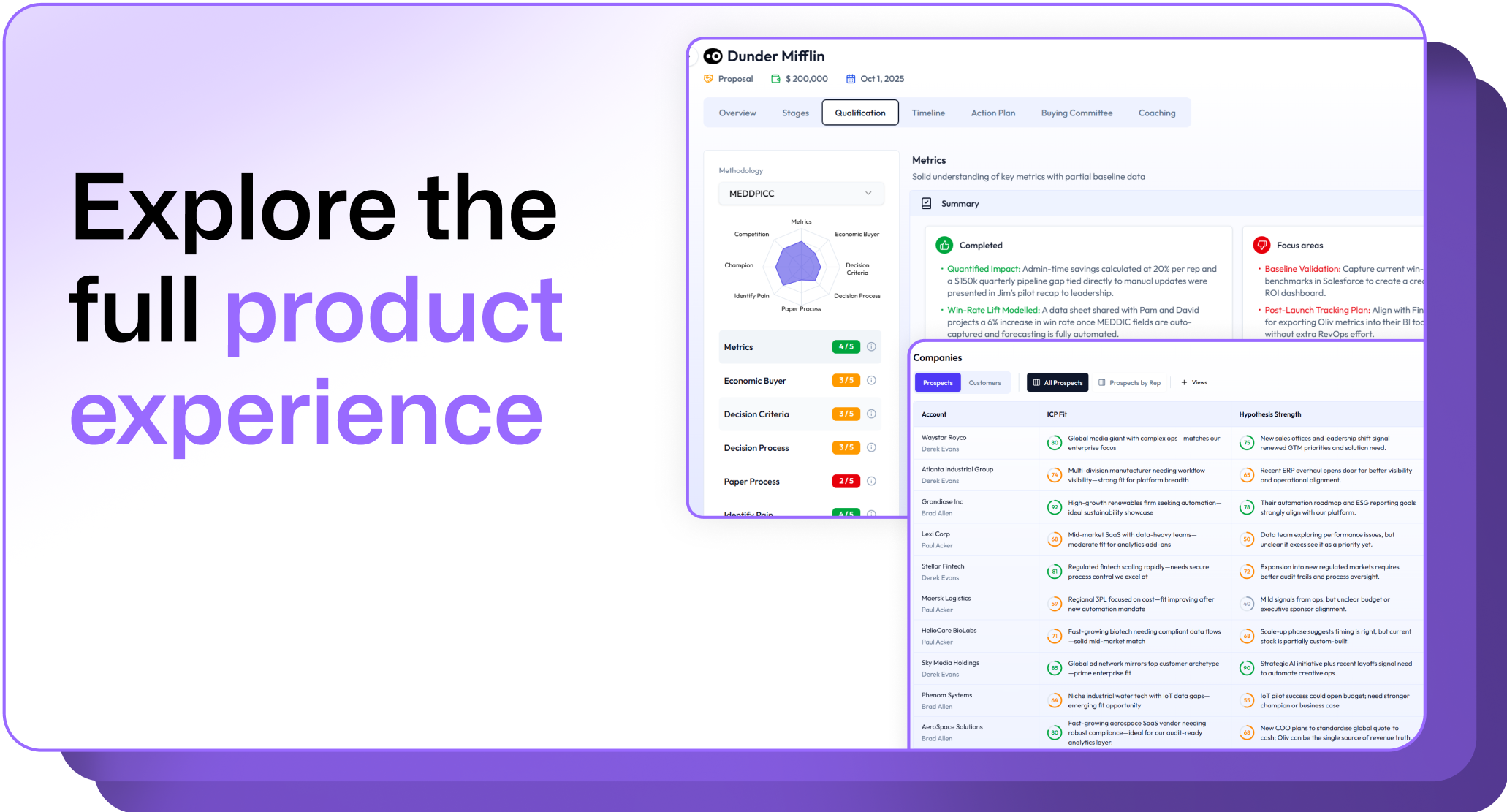
.avif)
.png)






.png)

.png)
.png)