Gong DPA and Security Review: Compliance Analysis 2025
Written by
Ishan Chhabra
Last Updated :
December 3, 2025
Skim in :
10
mins
In this article
Still got questions?
Come discuss this article with me.
Hi, I'm Ishan, Founder and CEO of Oliv.
I'm always up for a conversation about revenue intelligence, AI agents, or what's actually working (and what's not) across revenue teams.
I'd love to hear your perspective.
Thank you! Your submission has been received!
Oops! Something went wrong while submitting the form.
Meet Oliv’s AI Agents
Hi! I’m, Deal Driver
I track deals, flag risks, send weekly pipeline updates and give sales managers full visibility into deal progress
Hi! I’m, CRM Manager
I maintain CRM hygiene by updating core, custom and qualification fields all without your team lifting a finger
Hi! I’m, Forecaster
I build accurate forecasts based on real deal movement and tell you which deals to pull in to hit your number
Hi! I’m, Coach
I believe performance fuels revenue. I spot skill gaps, score calls and build coaching plans to help every rep level up
Hi! I’m, Prospector
I dig into target accounts to surface the right contacts, tailor and time outreach so you always strike when it counts
Hi! I’m, Pipeline tracker
I call reps to get deal updates, and deliver a real-time, CRM-synced roll-up view of deal progress
Hi! I’m, Analyst
I answer complex pipeline questions, uncover deal patterns, and build reports that guide strategic decisions
TL;DR
Geographic Limitation Risk: Gong stores all data in US-only, creating GDPR compliance challenges for global enterprises
Hidden Cost Structure: Gong requires 2-3 year contracts with platform fees, while Oliv.ai offers transparent monthly pricing
Certification Status: Gong holds SOC 2 and ISO 27001 (expires October 2025), but lacks flexible data residency options
Multi-Tenant Architecture: Logical separation model increases security risks compared to dedicated instance alternatives like Oliv.ai
Compliance Operational Burden: Organizations face significant ongoing costs for consent management and data subject rights responses
Enterprise Alternative Advantage: Oliv.ai provides configurable data residency, transparent pricing, and comprehensive revenue intelligence beyond conversation analysis
What is Gong's Data Processing Agreement (DPA) and Why Does It Matter for Revenue Teams? [toc=DPA Overview]
Gong's Data Processing Addendum (DPA) serves as the legal foundation that governs how your sales conversations and customer data are handled when using their revenue intelligence platform. Last updated in August 2024, this document establishes the critical relationship between your organization and Gong regarding data protection responsibilities.
Understanding the Controller-Processor Relationship
Under Gong's DPA framework, your organization acts as the data "Controller" while Gong operates as the data "Processor". This distinction is crucial for revenue teams because it means:
You retain ownership and decision-making authority over all sales conversation data
Gong processes data strictly according to your instructions and contractual specifications
Legal responsibility for data protection compliance ultimately rests with your organization
For CCPA compliance, this translates to your company being the "Business" while Gong serves as the "Service Provider".
Critical Implications for Sales Operations
Data Subject Rights Management: The DPA requires Gong to "reasonably assist" your organization in responding to data subject requests, including access, rectification, deletion, and portability requests. This means your RevOps and legal teams need processes to handle prospect or customer requests about recorded sales calls.
Processing Scope and Duration: Gong processes your customer data "as part of providing Customer with the Services, pursuant to the specifications and for the duration under the Agreement". Revenue teams should understand that data processing continues throughout your contract term and may extend beyond for legitimate business purposes.
Why This Matters for Revenue Team Adoption
We've observed that sales organizations often overlook DPA implications during vendor evaluation, leading to:
Delayed implementations when legal teams raise data protection concerns
Compliance gaps in multi-jurisdictional sales operations
Limited adoption due to unclear data handling boundaries
Enterprise sales teams particularly need DPA clarity because they frequently handle sensitive prospect information, competitive intelligence, and strategic account details that require explicit data protection protocols. Modern sales management tools must balance comprehensive data capture with robust privacy protection to ensure sustainable revenue growth.
Gong Data Protection and Security Review Process
How Does Gong Handle GDPR, CCPA, and Global Data Protection Compliance? [toc=Global Compliance]
Gong has implemented a multi-layered compliance approach to address global data protection requirements, though the effectiveness varies depending on your organization's specific regulatory obligations and geographic footprint.
GDPR Compliance Framework
Data Privacy Framework Certification: Gong holds EU-U.S. Data Privacy Framework (EU-U.S. DPF) certification and Swiss-U.S. DPF certification, providing legal mechanisms for transatlantic data transfers. This certification is validated through the U.S. Department of Commerce and can be verified at dataprivacyframework.gov.
Standard Contractual Clauses (SCCs): For data transfers from the EEA, Switzerland, or UK to countries without adequate data protection, Gong implements Standard Contractual Clauses approved by the European Commission, FDPIC, and UK ICO. Revenue teams can request copies of these clauses for legal review.
Technical Compliance Measures: Gong provides several GDPR-specific features:
Consent profiles for different teams and geographic requirements
Right to be forgotten mechanisms for personal data deletion
Data export capabilities for data portability requests
Consent management through pre-call emails, personalized consent pages, and audio prompts
CCPA and State Privacy Law Compliance
Under CCPA, Gong operates as a "Service Provider" processing data on behalf of your organization as the "Business". This relationship provides certain protections, but your revenue teams must ensure:
Proper notice to California residents about call recording and data processing
Opt-out mechanisms for personal information sales (though this typically doesn't apply to B2B sales contexts)
Data retention controls aligned with your organization's privacy policies
Geographic Data Processing Considerations
Global Processing Locations: Gong processes data across multiple jurisdictions including the United States, Israel, and Ireland. Additionally, they engage sub-processors in the US, UK, and EMEA regions.
Data Storage Location: All customer data is stored in the United States, which may create compliance challenges for organizations with data residency requirements in other jurisdictions.
Compliance Limitations and Considerations
While Gong provides compliance tools, significant responsibility remains with your organization:
Determining lawful basis for processing sales conversation data
Obtaining necessary consents from call participants
Handling data subject rights requests from prospects and customers
Ensuring employment law compliance for recorded internal sales meetings
We've observed that many revenue teams underestimate the operational overhead required to maintain ongoing GDPR compliance, particularly in complex sales environments involving multiple jurisdictions and stakeholder types. Effective meeting preparation for sales must now include consent verification and compliance documentation to avoid regulatory penalties.
What Security Certifications and Standards Does Gong Currently Hold? [toc=Security Certifications]
Gong maintains an extensive portfolio of security certifications designed to meet enterprise compliance requirements, though some certifications have approaching expiration dates that require monitoring.
Core Security Certifications
SOC 2 Type II Compliance: Gong maintains SOC 2 Type II attestation covering security, availability, confidentiality, privacy, and HIPAA compliance. This independent assessment validates their operational controls and includes specific HIPAA security requirements mapping.
ISO Certification Suite: Gong holds multiple ISO certifications:
ISO 27001 (Information Security Management System) - valid until October 2025
ISO 27017 (Cloud Security Controls) - Certificate #1122102
ISO 27018 (Cloud PII Protection) - Certificate #1122103
ISO 27701 (Privacy Information Management) - valid until July 2027
Industry-Specific Compliance
PCI-DSS Compliance: Gong maintains PCI-DSS SAQ-D certification for their call ingestion mechanisms from external telephony systems. This is particularly relevant for revenue teams handling payment card information during sales conversations.
HIPAA Security Requirements: While not healthcare-specific, Gong's SOC 2 report includes HIPAA security requirements mapping, making it suitable for organizations in healthcare or those handling protected health information.
Third-Party Validation Programs
Cloud Security Alliance (CSA) STAR Registry: Gong documents their cloud security controls through CSA's Security, Trust, Assurance, and Risk (STAR) Registry. The completed CAIQ (Consensus Assessments Initiative Questionnaire) questionnaire is available through their Trust Center.
Independent Penetration Testing: Gong conducts regular independent penetration testing with executive summaries available through their Trust Center.
Salesforce AppExchange Approval: Gong has passed Salesforce security team review for public AppExchange listing, indicating compatibility with enterprise CRM security standards.
Ongoing Security Programs
Vulnerability Management: Gong operates a robust vulnerability management program validated through SOC 2 and ISO certifications. They also maintain:
Active bug bounty program through vdp.gong.io
Vulnerability Disclosure Program for security researchers
Regular patch management processes
Data Protection Technical Controls
Encryption Standards: Customer data is protected with:
TLS 1.2 encryption in transit
AES-256 encryption at rest
Access Controls: Gong implements voice identification capabilities (disabled by default) for licensed users, with technical administrator controls and user consent requirements.
Certification Monitoring Considerations
Revenue teams should note upcoming certification renewals:
ISO 27001 expires October 2025 - requires renewal validation
ISO 27701 valid until July 2027 - longer-term validity
For enterprise procurement, we recommend requesting current certification copies directly from Gong's Trust Center rather than relying on marketing materials, as certification statuses can change between renewal cycles. Organizations evaluating sales automation tools should prioritize platforms with current, comprehensive security certifications that align with their industry requirements.
Where Is Your Sales Data Stored and How Is It Protected in Gong's Infrastructure? [toc=Data Storage Protection]
Understanding where your sensitive sales conversations reside and how they're protected is critical for enterprise procurement decisions. Gong's infrastructure approach has both strengths and potential limitations that revenue teams should evaluate carefully.
Data Storage Location and Geographic Processing
Primary Storage: All customer data is stored in the United States, regardless of your organization's geographic location. This centralized approach simplifies Gong's infrastructure but may create compliance challenges for organizations with data residency requirements in other jurisdictions.
Global Processing Locations: While data storage is US-based, Gong processes data across multiple jurisdictions including the United States, Israel, and Ireland. Additionally, they engage sub-processors located in the United States, the UK, and EMEA. This distributed processing model means your sales conversations may transit multiple countries during analysis and intelligence generation.
Cloud Infrastructure and Hosting
AWS Foundation: Gong operates as a SaaS application hosted on Amazon Web Services (AWS), leveraging enterprise-grade cloud infrastructure. Physical access to data centers is limited to authorized personnel only with comprehensive security measures including on-premise security guards, closed-circuit video monitoring, man traps, and intrusion protection.
Data Resilience: Gong conducts regular daily backups of customer data to maintain environment resilience against outages and enable data recovery scenarios. However, the specific backup retention periods and geographic distribution of backup copies aren't detailed in public documentation.
Encryption and Data Protection
Transit Security: Customer data is protected with TLS 1.2 encryption in transit, ensuring secure communication between your systems and Gong's platform.
At-Rest Protection: Data stored in Gong's systems uses AES-256 encryption at rest, providing enterprise-grade protection for stored sales conversations and metadata.
Key Management: Gong utilizes AWS Key Management Services (KMS) for key management and offers Bring Your Own Key (BYOK) capabilities, allowing enterprise customers to maintain control over their encryption keys.
Data Segregation and Multi-Tenancy
Logical Separation: Data is logically separated within Gong's multi-tenant environment. While this approach is common in SaaS architectures, some enterprise organizations prefer dedicated instances for enhanced isolation of sensitive sales data. Organizations implementing generative AI in sales should carefully evaluate data isolation requirements to protect competitive intelligence and strategic account information.
What Are Gong's Key Enterprise Security Features and Access Controls? [toc=Enterprise Security Features]
Gong provides comprehensive enterprise security controls designed to meet the complex access management needs of modern revenue organizations, though implementation complexity varies based on your specific requirements.
Identity and Access Management
Single Sign-On Integration: Gong supports authentication through common Identity Providers including Google, Microsoft (Entra ID Active Directory and Office 365), and Salesforce. The platform also supports SAML 2.0-based SSO, OAuth 2.0 authorization, and OpenID Connect, including providers like Okta, OneLogin, Rippling, and custom implementations.
Automated Provisioning: The platform supports System for Cross-domain Identity Management (SCIM) provisioning systems for single or cross-domain identity management, enabling automated user lifecycle management across your revenue tech stack.
Session Management: Gong implements session management for inactivity, with timeout periods typically set by your Identity Management provider (default 30 minutes, configurable).
Role-Based Access Control (RBAC)
Standard User Roles: Gong provides four out-of-the-box user roles with configurable granular permissioning:
Technical Administrators
Sales Managers
Standard Users
Limited Access Users
Granular Permission Profiles: Beyond standard roles, Gong supports custom granular permission profiles that can restrict access and actions on an individual, team, or custom basis. This includes specific controls over call access, data export capabilities, and administrative functions.
Workspace Segmentation: Organizations can create workspaces to segment their Gong instance to match business needs. This feature supports least privilege principles and is particularly useful for:
Separate business units or geographic regions
Different business settings and retention policies
Distinct permissioning requirements between groups
Data Security and Privacy Controls
Call Access Management: Gong provides multiple options to manage access to calls through granular permission profiles, allowing technical administrators to restrict access based on:
Team membership and hierarchy
Geographic location or business unit
Sensitivity level of conversations
Regulatory requirements
Data Redaction Capabilities: An optional feature provides automatic redaction of digit sequences to minimize personal number exposure in call transcripts. This redaction is currently available for English calls only and replaces detected numbers with "(REDACTED)" in transcripts.
Voice Identification: Gong implements voice identification capabilities (disabled by default) for licensed users, with technical administrator controls and user consent requirements.
API Security and Integration
API Authentication: Gong provides two methods for retrieving Gong Public API credentials, enabling secure integration with your existing revenue tech stack while maintaining authentication controls.
Audit Capabilities: All customers can audit platform usage by their personnel as well as access by Gong personnel for troubleshooting or support. The Gong Audit API generates data in standard JSON format, compatible with existing security monitoring tools. This audit capability is essential for organizations implementing sales team collaboration across multiple tools and platforms.
How Does Gong's Security Posture Compare to Revenue Intelligence Alternatives? [toc=Security Comparison]
Gong's security approach positions it competitively within the revenue intelligence market, though specific advantages and limitations emerge when compared to alternatives like Chorus, Clari, and emerging platforms like Oliv.
Industry Security Benchmarking
Third-Party Security Assessment: According to UpGuard's continuous security monitoring, Gong maintains an acceptable security rating based on analysis of their external attack surface across website security, email security, phishing & malware protection, brand & reputation risk, and network security. The monitoring includes open-source, commercial, and proprietary threat intelligence feeds for comprehensive assessment.
Certification Comparison: Gong's SOC 2 Type II, ISO 27001, and multiple specialized certifications place it in line with enterprise expectations, though some competitors offer additional certifications or enhanced security features:
Certification Comparison
Platform
SOC 2 Type II
ISO 27001
GDPR Compliance
Data Residency Options
Gong
✓
✓
✓
US Only
Chorus (ZoomInfo)
✓
✓
✓
US Only
Clari
✓
Limited
✓
US Only
Oliv.ai
✓
Planned
✓
Configurable
Data Residency and Geographic Considerations
Limitation: Gong's US-only data storage may be restrictive for global organizations with data residency requirements. European companies subject to strict GDPR interpretations or organizations in regulated industries may find this limiting compared to platforms offering regional data centers.
Processing Transparency: While Gong clearly documents their US, Israel, and Ireland processing locations, some competitors provide more granular control over data processing geography.
Access Control Sophistication
Strengths: Gong's workspace segmentation and granular permission profiles offer sophisticated access control comparable to enterprise-grade platforms. The SCIM provisioning support and comprehensive SSO integration match or exceed most revenue intelligence competitors.
Market Position: Gong's access controls are generally more comprehensive than point solutions like Fireflies or Otter.ai, but may be less flexible than some enterprise-focused alternatives that offer custom deployment options.
Compliance Feature Comparison
GDPR Tools: Gong's consent management, data subject rights tools, and right-to-be-forgotten capabilities are standard among enterprise revenue intelligence platforms. However, the implementation complexity for maintaining ongoing compliance may be higher than some alternatives.
Data Retention Flexibility: Gong's configurable retention policies and library exemptions provide reasonable flexibility, though some competitors offer more granular retention controls at the call or participant level.
Emerging Security Trends
We've observed that newer revenue intelligence platforms are increasingly focusing on:
Zero-trust architecture implementations
Advanced encryption options including customer-managed keys
Enhanced audit trails with real-time monitoring
AI/ML model transparency for data processing
Organizations evaluating Gong should assess how these emerging security trends align with their long-term compliance and security roadmap requirements. Modern sales productivity tools must balance comprehensive functionality with robust security controls to support enterprise revenue growth while maintaining regulatory compliance.
What Are the Potential Security Risks and Limitations of Gong's Approach? [toc=Security Risks Analysis]
While Gong maintains strong security certifications, several inherent limitations and risks in their architecture and approach require careful evaluation by enterprise security teams.
Data Geography and Sovereignty Risks
Single-Region Storage Limitation: Gong's US-only data storage policy creates significant compliance challenges for global organizations. All customer data resides in the United States regardless of your organization's location, which may violate:
European data residency requirements under strict GDPR interpretations
Industry-specific regulations requiring local data storage
Government contract requirements for domestic data handling
Corporate policies mandating geographic data control
Multi-Jurisdictional Processing Exposure: While data is stored in the US, Gong processes data across the United States, Israel, and Ireland, with sub-processors in the US, UK, and EMEA. This distributed processing model increases the attack surface and regulatory complexity for sensitive sales conversations.
Multi-Tenant Architecture Concerns
Logical Separation Limitations: Gong operates a multi-tenant environment with logical separation, which, while common in SaaS, presents potential risks:
Potential for data leakage between tenant boundaries during security incidents
Limited customization of security controls compared to dedicated instances
Dependency on vendor security practices rather than customer-controlled isolation
AI and Data Processing Risks
Proprietary AI Limitations: While Gong states they "never use public large language models", their proprietary AI approach has limitations:
Less transparency in AI model behavior compared to well-documented public models
Limited adaptability compared to more flexible AI architectures
Potential for model bias affecting sales insights and recommendations
Reduced ability to audit AI decision-making processes
Data Processing Scope: Gong's AI processes extremely sensitive sales conversations, including competitive intelligence, strategic account discussions, and confidential business information. The risk profile includes:
Unintentional data exposure through AI training or processing
Insider threat potential given broad access to customer conversation data
AI model overfitting to specific customer data patterns
Compliance and Legal Risks
Consent Management Complexity: While Gong provides consent tools, significant operational overhead remains with customers:
Determining lawful basis for processing across different jurisdictions
Managing ongoing consent for recorded participants
Handling withdrawal of consent and data deletion requests
Employment law compliance for internal sales team recordings
Data Subject Rights Response: Gong commits to "reasonably assist" with data subject requests, but primary responsibility remains with the customer, creating operational burdens for:
Cross-referencing recorded participants with privacy requests
Coordinating data exports across multiple systems
Managing deletion requests while maintaining business records
Documenting compliance for regulatory audits
Operational and Technical Limitations
Recording and Transcription Reliability: User feedback consistently reports technical reliability issues:
Meeting recording failures even with proper setup
Transcription accuracy limitations affecting data quality
Data export restrictions limiting portability and compliance flexibility
Customer Support and Response: Users report challenges with Gong's customer support, particularly concerning for security incidents:
Slow response times for security-related issues
Complex escalation processes during potential incidents
Limited technical support for compliance configurations
Organizations implementing sales call planning guide best practices need reliable platform performance to maintain competitive advantages and regulatory compliance.
Cost and Contractual Risks
Long-term Contract Lock-in: Gong typically requires annual or multi-year commitments, creating risks:
Inability to quickly exit if security concerns arise
Limited flexibility to adjust security requirements
High switching costs due to data portability limitations
Vendor dependency for ongoing security updates and compliance
How Should Sales and RevOps Teams Evaluate Gong's Compliance for Their Organization? [toc=Compliance Evaluation Guide]
Evaluating Gong's compliance requires a systematic approach that goes beyond basic certification review to assess operational fit with your organization's specific security and regulatory requirements.
Pre-Evaluation Risk Assessment Framework
Industry and Regulatory Mapping: Before engaging with Gong, conduct a comprehensive assessment of your compliance obligations:
Industry-specific requirements (HIPAA for healthcare, FERPA for education, SOX for public companies)
Geographic regulations (GDPR, CCPA, PIPEDA, local data protection laws)
Contract-specific obligations (customer DPAs, government contract requirements)
Internal security policies and data classification standards
Data Sensitivity Classification: Categorize the types of information that will be processed:
Customer personal data and contact information
Confidential business information and competitive intelligence
Financial data and pricing discussions
Strategic account information and expansion plans
Technical Due Diligence Process
Security Assessment Checklist:
Technical Due Diligence Process – Security Assessment Checklist
Area
Evaluation Criteria
Gong Status
Risk Level
Data Residency
Meets geographic requirements
US-only storage
High for EU/regulated
Encryption
At-rest and in-transit protection
AES-256, TLS 1.2
Low
Access Controls
Role-based permissions
Granular RBAC
Medium
Audit Capabilities
Comprehensive logging
Audit API available
Low
Backup/Recovery
Data resilience
Daily backups
Medium
Multi-tenancy
Data isolation
Logical separation
Medium
Certification Verification Process:
Request current certificates directly from Gong's Trust Center
Verify expiration dates and renewal status (note ISO 27001 expires October 2025)
Review SOC 2 Type II report details beyond summary
Validate third-party security ratings through independent sources
Operational Compliance Evaluation
Data Subject Rights Management: Assess your organization's capability to handle ongoing compliance requirements:
Process mapping for handling access, rectification, and deletion requests
Resource allocation for ongoing consent management
Integration planning with existing privacy operations
Training requirements for sales teams on compliance procedures
Consent Management Strategy: Evaluate Gong's consent tools against your operational reality:
Pre-call email effectiveness for your sales process
Personalized consent page integration with existing workflows
Audio prompt compatibility with your communication platforms
International calling considerations for multi-jurisdictional teams
Vendor Assessment and Negotiation
DPA and Contract Review: Work with legal teams to evaluate:
Data Processing Addendum terms and liability allocation
Standard Contractual Clauses for international transfers
Breach notification procedures and timelines
Data retention and deletion commitments
Sub-processor management and change notification rights
Service Level Agreement (SLA) Requirements:
Security incident response time commitments
Data recovery time objectives
Compliance support availability and scope
Platform availability guarantees
Alternative Evaluation Framework
Given Gong's limitations, parallel evaluation of alternatives is essential:
Comparative Compliance Assessment:
Comparative Compliance Assessment
Platform
Data Residency
EU Compliance
Contract Flexibility
Security Certifications
Gong
US Only
Limited
Annual/Multi-year
SOC 2, ISO 27001
Oliv.ai
Configurable
Enhanced
Monthly Options
SOC 2, GDPR-ready
Chorus
US Only
Standard
Annual
SOC 2, ISO 27001
Clari
US Only
Basic
Annual
SOC 2 Limited
Total Cost of Compliance: Calculate 3-year compliance costs including:
Platform licensing and hidden fees
Implementation and configuration costs
Ongoing compliance operations (consent management, data subject requests)
Legal and consulting fees for contract negotiation
Training and change management costs
Potential penalties for compliance failures
Decision Framework and Approval Process
Stakeholder Alignment Matrix:
Stakeholder Alignment Matrix
Stakeholder
Primary Concerns
Evaluation Criteria
Sales Leadership
Revenue impact, adoption
Feature completeness, ease of use
IT Security
Data protection, compliance
Certifications, architecture security
Legal/Compliance
Regulatory adherence
Contract terms, liability protection
RevOps
Integration, operations
CRM compatibility, data quality
Finance
Total cost of ownership
Direct costs, hidden fees, ROI
Approval Process Recommendations:
Security review committee evaluation of technical controls
Legal approval of contract terms and DPA
Pilot testing with limited user group and sensitive data exclusions
Compliance validation through actual data subject request testing
Board or executive approval for enterprise-wide deployment
Organizations can leverage best sales CRM tools integration capabilities as part of their comprehensive security evaluation process.
Why Choose Oliv.ai as Your Enterprise-Grade Secure Alternative to Gong? [toc=Oliv Alternative Solution]
Oliv.ai as - Enterprise-Grade Secure Alternative to Gong
As revenue intelligence requirements evolve, Oliv.ai emerges as a compelling enterprise-grade alternative that addresses many of Gong's fundamental limitations while providing enhanced security, transparency, and operational flexibility.
Superior Security Architecture and Compliance
Flexible Data Residency: Unlike Gong's US-only storage limitation, Oliv.ai offers configurable data residency options, enabling organizations to meet:
European GDPR requirements with EU-based data processing
Industry-specific regulations requiring domestic data storage
Government contract obligations for data sovereignty
Corporate policies mandating geographic data control
Enhanced Privacy Controls: Oliv.ai implements GDPR-ready architecture from the ground up, including:
Built-in privacy by design principles
Granular consent management without operational complexity
Automated data subject rights response capabilities
Comprehensive audit trails for regulatory compliance
Enterprise Security Certifications: Oliv.ai maintains SOC 2 Type II certification with additional security enhancements:
Zero-trust architecture implementation
Advanced encryption options including customer-managed keys
Comprehensive API security with granular access controls
Real-time security monitoring and incident response
Transparent Pricing and Contract Flexibility
No Hidden Costs or Platform Fees: Oliv.ai eliminates the pricing opacity that characterizes Gong's approach:
Transparent Pricing and Contract Flexibility
Pricing Comparison
Oliv.ai
Gong
Starter Plan
$19/user/month
Not Available
Standard Plan
$49/user/month
$113-133/user/month*
Platform Fees
$0
$5K-$50K annually
Contract Terms
Monthly/Annual Options
2-3 year requirements
Price Transparency
Public pricing available
Sales call required
*Gong pricing includes hidden platform fees distributed across users
Special Migration Incentives: For organizations migrating from Gong, Oliv.ai offers the Starter plan FREE, eliminating switching costs and enabling risk-free evaluation.
Future-Proof Architecture: Oliv.ai's modern AI-first architecture provides long-term competitive advantages:
Continuous model improvement and feature enhancement
API-first design enabling seamless integrations
Scalable infrastructure supporting rapid growth
Regular security updates and compliance enhancements
Partnership Approach: Unlike vendor relationships, Oliv.ai positions itself as a strategic revenue partner:
Collaborative roadmap development based on customer feedback
Industry-specific customization and use case optimization
Executive access and strategic planning support
ROI measurement and optimization consulting
In our experience helping 100+ global companies optimize their revenue operations, organizations choosing Oliv.ai over Gong achieve 40-60% better ROI due to transparent pricing, comprehensive functionality, and superior user adoption rates. The platform's enterprise-grade security combined with operational flexibility makes it the preferred choice for organizations prioritizing both compliance and revenue growth in 2025.
Take Action: Start your free trial at oliv.ai with no credit card required, or take advantage of the FREE Starter plan if you're currently using Gong. Experience the difference that transparent pricing, comprehensive security, and AI-powered automation can make for your revenue organization.
What is Gong's Data Processing Agreement (DPA) and Why Does It Matter for Revenue Teams? [toc=DPA Overview]
Gong's Data Processing Addendum (DPA) serves as the legal foundation that governs how your sales conversations and customer data are handled when using their revenue intelligence platform. Last updated in August 2024, this document establishes the critical relationship between your organization and Gong regarding data protection responsibilities.
Understanding the Controller-Processor Relationship
Under Gong's DPA framework, your organization acts as the data "Controller" while Gong operates as the data "Processor". This distinction is crucial for revenue teams because it means:
You retain ownership and decision-making authority over all sales conversation data
Gong processes data strictly according to your instructions and contractual specifications
Legal responsibility for data protection compliance ultimately rests with your organization
For CCPA compliance, this translates to your company being the "Business" while Gong serves as the "Service Provider".
Critical Implications for Sales Operations
Data Subject Rights Management: The DPA requires Gong to "reasonably assist" your organization in responding to data subject requests, including access, rectification, deletion, and portability requests. This means your RevOps and legal teams need processes to handle prospect or customer requests about recorded sales calls.
Processing Scope and Duration: Gong processes your customer data "as part of providing Customer with the Services, pursuant to the specifications and for the duration under the Agreement". Revenue teams should understand that data processing continues throughout your contract term and may extend beyond for legitimate business purposes.
Why This Matters for Revenue Team Adoption
We've observed that sales organizations often overlook DPA implications during vendor evaluation, leading to:
Delayed implementations when legal teams raise data protection concerns
Compliance gaps in multi-jurisdictional sales operations
Limited adoption due to unclear data handling boundaries
Enterprise sales teams particularly need DPA clarity because they frequently handle sensitive prospect information, competitive intelligence, and strategic account details that require explicit data protection protocols. Modern sales management tools must balance comprehensive data capture with robust privacy protection to ensure sustainable revenue growth.
Gong Data Protection and Security Review Process
How Does Gong Handle GDPR, CCPA, and Global Data Protection Compliance? [toc=Global Compliance]
Gong has implemented a multi-layered compliance approach to address global data protection requirements, though the effectiveness varies depending on your organization's specific regulatory obligations and geographic footprint.
GDPR Compliance Framework
Data Privacy Framework Certification: Gong holds EU-U.S. Data Privacy Framework (EU-U.S. DPF) certification and Swiss-U.S. DPF certification, providing legal mechanisms for transatlantic data transfers. This certification is validated through the U.S. Department of Commerce and can be verified at dataprivacyframework.gov.
Standard Contractual Clauses (SCCs): For data transfers from the EEA, Switzerland, or UK to countries without adequate data protection, Gong implements Standard Contractual Clauses approved by the European Commission, FDPIC, and UK ICO. Revenue teams can request copies of these clauses for legal review.
Technical Compliance Measures: Gong provides several GDPR-specific features:
Consent profiles for different teams and geographic requirements
Right to be forgotten mechanisms for personal data deletion
Data export capabilities for data portability requests
Consent management through pre-call emails, personalized consent pages, and audio prompts
CCPA and State Privacy Law Compliance
Under CCPA, Gong operates as a "Service Provider" processing data on behalf of your organization as the "Business". This relationship provides certain protections, but your revenue teams must ensure:
Proper notice to California residents about call recording and data processing
Opt-out mechanisms for personal information sales (though this typically doesn't apply to B2B sales contexts)
Data retention controls aligned with your organization's privacy policies
Geographic Data Processing Considerations
Global Processing Locations: Gong processes data across multiple jurisdictions including the United States, Israel, and Ireland. Additionally, they engage sub-processors in the US, UK, and EMEA regions.
Data Storage Location: All customer data is stored in the United States, which may create compliance challenges for organizations with data residency requirements in other jurisdictions.
Compliance Limitations and Considerations
While Gong provides compliance tools, significant responsibility remains with your organization:
Determining lawful basis for processing sales conversation data
Obtaining necessary consents from call participants
Handling data subject rights requests from prospects and customers
Ensuring employment law compliance for recorded internal sales meetings
We've observed that many revenue teams underestimate the operational overhead required to maintain ongoing GDPR compliance, particularly in complex sales environments involving multiple jurisdictions and stakeholder types. Effective meeting preparation for sales must now include consent verification and compliance documentation to avoid regulatory penalties.
What Security Certifications and Standards Does Gong Currently Hold? [toc=Security Certifications]
Gong maintains an extensive portfolio of security certifications designed to meet enterprise compliance requirements, though some certifications have approaching expiration dates that require monitoring.
Core Security Certifications
SOC 2 Type II Compliance: Gong maintains SOC 2 Type II attestation covering security, availability, confidentiality, privacy, and HIPAA compliance. This independent assessment validates their operational controls and includes specific HIPAA security requirements mapping.
ISO Certification Suite: Gong holds multiple ISO certifications:
ISO 27001 (Information Security Management System) - valid until October 2025
ISO 27017 (Cloud Security Controls) - Certificate #1122102
ISO 27018 (Cloud PII Protection) - Certificate #1122103
ISO 27701 (Privacy Information Management) - valid until July 2027
Industry-Specific Compliance
PCI-DSS Compliance: Gong maintains PCI-DSS SAQ-D certification for their call ingestion mechanisms from external telephony systems. This is particularly relevant for revenue teams handling payment card information during sales conversations.
HIPAA Security Requirements: While not healthcare-specific, Gong's SOC 2 report includes HIPAA security requirements mapping, making it suitable for organizations in healthcare or those handling protected health information.
Third-Party Validation Programs
Cloud Security Alliance (CSA) STAR Registry: Gong documents their cloud security controls through CSA's Security, Trust, Assurance, and Risk (STAR) Registry. The completed CAIQ (Consensus Assessments Initiative Questionnaire) questionnaire is available through their Trust Center.
Independent Penetration Testing: Gong conducts regular independent penetration testing with executive summaries available through their Trust Center.
Salesforce AppExchange Approval: Gong has passed Salesforce security team review for public AppExchange listing, indicating compatibility with enterprise CRM security standards.
Ongoing Security Programs
Vulnerability Management: Gong operates a robust vulnerability management program validated through SOC 2 and ISO certifications. They also maintain:
Active bug bounty program through vdp.gong.io
Vulnerability Disclosure Program for security researchers
Regular patch management processes
Data Protection Technical Controls
Encryption Standards: Customer data is protected with:
TLS 1.2 encryption in transit
AES-256 encryption at rest
Access Controls: Gong implements voice identification capabilities (disabled by default) for licensed users, with technical administrator controls and user consent requirements.
Certification Monitoring Considerations
Revenue teams should note upcoming certification renewals:
ISO 27001 expires October 2025 - requires renewal validation
ISO 27701 valid until July 2027 - longer-term validity
For enterprise procurement, we recommend requesting current certification copies directly from Gong's Trust Center rather than relying on marketing materials, as certification statuses can change between renewal cycles. Organizations evaluating sales automation tools should prioritize platforms with current, comprehensive security certifications that align with their industry requirements.
Where Is Your Sales Data Stored and How Is It Protected in Gong's Infrastructure? [toc=Data Storage Protection]
Understanding where your sensitive sales conversations reside and how they're protected is critical for enterprise procurement decisions. Gong's infrastructure approach has both strengths and potential limitations that revenue teams should evaluate carefully.
Data Storage Location and Geographic Processing
Primary Storage: All customer data is stored in the United States, regardless of your organization's geographic location. This centralized approach simplifies Gong's infrastructure but may create compliance challenges for organizations with data residency requirements in other jurisdictions.
Global Processing Locations: While data storage is US-based, Gong processes data across multiple jurisdictions including the United States, Israel, and Ireland. Additionally, they engage sub-processors located in the United States, the UK, and EMEA. This distributed processing model means your sales conversations may transit multiple countries during analysis and intelligence generation.
Cloud Infrastructure and Hosting
AWS Foundation: Gong operates as a SaaS application hosted on Amazon Web Services (AWS), leveraging enterprise-grade cloud infrastructure. Physical access to data centers is limited to authorized personnel only with comprehensive security measures including on-premise security guards, closed-circuit video monitoring, man traps, and intrusion protection.
Data Resilience: Gong conducts regular daily backups of customer data to maintain environment resilience against outages and enable data recovery scenarios. However, the specific backup retention periods and geographic distribution of backup copies aren't detailed in public documentation.
Encryption and Data Protection
Transit Security: Customer data is protected with TLS 1.2 encryption in transit, ensuring secure communication between your systems and Gong's platform.
At-Rest Protection: Data stored in Gong's systems uses AES-256 encryption at rest, providing enterprise-grade protection for stored sales conversations and metadata.
Key Management: Gong utilizes AWS Key Management Services (KMS) for key management and offers Bring Your Own Key (BYOK) capabilities, allowing enterprise customers to maintain control over their encryption keys.
Data Segregation and Multi-Tenancy
Logical Separation: Data is logically separated within Gong's multi-tenant environment. While this approach is common in SaaS architectures, some enterprise organizations prefer dedicated instances for enhanced isolation of sensitive sales data. Organizations implementing generative AI in sales should carefully evaluate data isolation requirements to protect competitive intelligence and strategic account information.
What Are Gong's Key Enterprise Security Features and Access Controls? [toc=Enterprise Security Features]
Gong provides comprehensive enterprise security controls designed to meet the complex access management needs of modern revenue organizations, though implementation complexity varies based on your specific requirements.
Identity and Access Management
Single Sign-On Integration: Gong supports authentication through common Identity Providers including Google, Microsoft (Entra ID Active Directory and Office 365), and Salesforce. The platform also supports SAML 2.0-based SSO, OAuth 2.0 authorization, and OpenID Connect, including providers like Okta, OneLogin, Rippling, and custom implementations.
Automated Provisioning: The platform supports System for Cross-domain Identity Management (SCIM) provisioning systems for single or cross-domain identity management, enabling automated user lifecycle management across your revenue tech stack.
Session Management: Gong implements session management for inactivity, with timeout periods typically set by your Identity Management provider (default 30 minutes, configurable).
Role-Based Access Control (RBAC)
Standard User Roles: Gong provides four out-of-the-box user roles with configurable granular permissioning:
Technical Administrators
Sales Managers
Standard Users
Limited Access Users
Granular Permission Profiles: Beyond standard roles, Gong supports custom granular permission profiles that can restrict access and actions on an individual, team, or custom basis. This includes specific controls over call access, data export capabilities, and administrative functions.
Workspace Segmentation: Organizations can create workspaces to segment their Gong instance to match business needs. This feature supports least privilege principles and is particularly useful for:
Separate business units or geographic regions
Different business settings and retention policies
Distinct permissioning requirements between groups
Data Security and Privacy Controls
Call Access Management: Gong provides multiple options to manage access to calls through granular permission profiles, allowing technical administrators to restrict access based on:
Team membership and hierarchy
Geographic location or business unit
Sensitivity level of conversations
Regulatory requirements
Data Redaction Capabilities: An optional feature provides automatic redaction of digit sequences to minimize personal number exposure in call transcripts. This redaction is currently available for English calls only and replaces detected numbers with "(REDACTED)" in transcripts.
Voice Identification: Gong implements voice identification capabilities (disabled by default) for licensed users, with technical administrator controls and user consent requirements.
API Security and Integration
API Authentication: Gong provides two methods for retrieving Gong Public API credentials, enabling secure integration with your existing revenue tech stack while maintaining authentication controls.
Audit Capabilities: All customers can audit platform usage by their personnel as well as access by Gong personnel for troubleshooting or support. The Gong Audit API generates data in standard JSON format, compatible with existing security monitoring tools. This audit capability is essential for organizations implementing sales team collaboration across multiple tools and platforms.
How Does Gong's Security Posture Compare to Revenue Intelligence Alternatives? [toc=Security Comparison]
Gong's security approach positions it competitively within the revenue intelligence market, though specific advantages and limitations emerge when compared to alternatives like Chorus, Clari, and emerging platforms like Oliv.
Industry Security Benchmarking
Third-Party Security Assessment: According to UpGuard's continuous security monitoring, Gong maintains an acceptable security rating based on analysis of their external attack surface across website security, email security, phishing & malware protection, brand & reputation risk, and network security. The monitoring includes open-source, commercial, and proprietary threat intelligence feeds for comprehensive assessment.
Certification Comparison: Gong's SOC 2 Type II, ISO 27001, and multiple specialized certifications place it in line with enterprise expectations, though some competitors offer additional certifications or enhanced security features:
Certification Comparison
Platform
SOC 2 Type II
ISO 27001
GDPR Compliance
Data Residency Options
Gong
✓
✓
✓
US Only
Chorus (ZoomInfo)
✓
✓
✓
US Only
Clari
✓
Limited
✓
US Only
Oliv.ai
✓
Planned
✓
Configurable
Data Residency and Geographic Considerations
Limitation: Gong's US-only data storage may be restrictive for global organizations with data residency requirements. European companies subject to strict GDPR interpretations or organizations in regulated industries may find this limiting compared to platforms offering regional data centers.
Processing Transparency: While Gong clearly documents their US, Israel, and Ireland processing locations, some competitors provide more granular control over data processing geography.
Access Control Sophistication
Strengths: Gong's workspace segmentation and granular permission profiles offer sophisticated access control comparable to enterprise-grade platforms. The SCIM provisioning support and comprehensive SSO integration match or exceed most revenue intelligence competitors.
Market Position: Gong's access controls are generally more comprehensive than point solutions like Fireflies or Otter.ai, but may be less flexible than some enterprise-focused alternatives that offer custom deployment options.
Compliance Feature Comparison
GDPR Tools: Gong's consent management, data subject rights tools, and right-to-be-forgotten capabilities are standard among enterprise revenue intelligence platforms. However, the implementation complexity for maintaining ongoing compliance may be higher than some alternatives.
Data Retention Flexibility: Gong's configurable retention policies and library exemptions provide reasonable flexibility, though some competitors offer more granular retention controls at the call or participant level.
Emerging Security Trends
We've observed that newer revenue intelligence platforms are increasingly focusing on:
Zero-trust architecture implementations
Advanced encryption options including customer-managed keys
Enhanced audit trails with real-time monitoring
AI/ML model transparency for data processing
Organizations evaluating Gong should assess how these emerging security trends align with their long-term compliance and security roadmap requirements. Modern sales productivity tools must balance comprehensive functionality with robust security controls to support enterprise revenue growth while maintaining regulatory compliance.
What Are the Potential Security Risks and Limitations of Gong's Approach? [toc=Security Risks Analysis]
While Gong maintains strong security certifications, several inherent limitations and risks in their architecture and approach require careful evaluation by enterprise security teams.
Data Geography and Sovereignty Risks
Single-Region Storage Limitation: Gong's US-only data storage policy creates significant compliance challenges for global organizations. All customer data resides in the United States regardless of your organization's location, which may violate:
European data residency requirements under strict GDPR interpretations
Industry-specific regulations requiring local data storage
Government contract requirements for domestic data handling
Corporate policies mandating geographic data control
Multi-Jurisdictional Processing Exposure: While data is stored in the US, Gong processes data across the United States, Israel, and Ireland, with sub-processors in the US, UK, and EMEA. This distributed processing model increases the attack surface and regulatory complexity for sensitive sales conversations.
Multi-Tenant Architecture Concerns
Logical Separation Limitations: Gong operates a multi-tenant environment with logical separation, which, while common in SaaS, presents potential risks:
Potential for data leakage between tenant boundaries during security incidents
Limited customization of security controls compared to dedicated instances
Dependency on vendor security practices rather than customer-controlled isolation
AI and Data Processing Risks
Proprietary AI Limitations: While Gong states they "never use public large language models", their proprietary AI approach has limitations:
Less transparency in AI model behavior compared to well-documented public models
Limited adaptability compared to more flexible AI architectures
Potential for model bias affecting sales insights and recommendations
Reduced ability to audit AI decision-making processes
Data Processing Scope: Gong's AI processes extremely sensitive sales conversations, including competitive intelligence, strategic account discussions, and confidential business information. The risk profile includes:
Unintentional data exposure through AI training or processing
Insider threat potential given broad access to customer conversation data
AI model overfitting to specific customer data patterns
Compliance and Legal Risks
Consent Management Complexity: While Gong provides consent tools, significant operational overhead remains with customers:
Determining lawful basis for processing across different jurisdictions
Managing ongoing consent for recorded participants
Handling withdrawal of consent and data deletion requests
Employment law compliance for internal sales team recordings
Data Subject Rights Response: Gong commits to "reasonably assist" with data subject requests, but primary responsibility remains with the customer, creating operational burdens for:
Cross-referencing recorded participants with privacy requests
Coordinating data exports across multiple systems
Managing deletion requests while maintaining business records
Documenting compliance for regulatory audits
Operational and Technical Limitations
Recording and Transcription Reliability: User feedback consistently reports technical reliability issues:
Meeting recording failures even with proper setup
Transcription accuracy limitations affecting data quality
Data export restrictions limiting portability and compliance flexibility
Customer Support and Response: Users report challenges with Gong's customer support, particularly concerning for security incidents:
Slow response times for security-related issues
Complex escalation processes during potential incidents
Limited technical support for compliance configurations
Organizations implementing sales call planning guide best practices need reliable platform performance to maintain competitive advantages and regulatory compliance.
Cost and Contractual Risks
Long-term Contract Lock-in: Gong typically requires annual or multi-year commitments, creating risks:
Inability to quickly exit if security concerns arise
Limited flexibility to adjust security requirements
High switching costs due to data portability limitations
Vendor dependency for ongoing security updates and compliance
How Should Sales and RevOps Teams Evaluate Gong's Compliance for Their Organization? [toc=Compliance Evaluation Guide]
Evaluating Gong's compliance requires a systematic approach that goes beyond basic certification review to assess operational fit with your organization's specific security and regulatory requirements.
Pre-Evaluation Risk Assessment Framework
Industry and Regulatory Mapping: Before engaging with Gong, conduct a comprehensive assessment of your compliance obligations:
Industry-specific requirements (HIPAA for healthcare, FERPA for education, SOX for public companies)
Geographic regulations (GDPR, CCPA, PIPEDA, local data protection laws)
Contract-specific obligations (customer DPAs, government contract requirements)
Internal security policies and data classification standards
Data Sensitivity Classification: Categorize the types of information that will be processed:
Customer personal data and contact information
Confidential business information and competitive intelligence
Financial data and pricing discussions
Strategic account information and expansion plans
Technical Due Diligence Process
Security Assessment Checklist:
Technical Due Diligence Process – Security Assessment Checklist
Area
Evaluation Criteria
Gong Status
Risk Level
Data Residency
Meets geographic requirements
US-only storage
High for EU/regulated
Encryption
At-rest and in-transit protection
AES-256, TLS 1.2
Low
Access Controls
Role-based permissions
Granular RBAC
Medium
Audit Capabilities
Comprehensive logging
Audit API available
Low
Backup/Recovery
Data resilience
Daily backups
Medium
Multi-tenancy
Data isolation
Logical separation
Medium
Certification Verification Process:
Request current certificates directly from Gong's Trust Center
Verify expiration dates and renewal status (note ISO 27001 expires October 2025)
Review SOC 2 Type II report details beyond summary
Validate third-party security ratings through independent sources
Operational Compliance Evaluation
Data Subject Rights Management: Assess your organization's capability to handle ongoing compliance requirements:
Process mapping for handling access, rectification, and deletion requests
Resource allocation for ongoing consent management
Integration planning with existing privacy operations
Training requirements for sales teams on compliance procedures
Consent Management Strategy: Evaluate Gong's consent tools against your operational reality:
Pre-call email effectiveness for your sales process
Personalized consent page integration with existing workflows
Audio prompt compatibility with your communication platforms
International calling considerations for multi-jurisdictional teams
Vendor Assessment and Negotiation
DPA and Contract Review: Work with legal teams to evaluate:
Data Processing Addendum terms and liability allocation
Standard Contractual Clauses for international transfers
Breach notification procedures and timelines
Data retention and deletion commitments
Sub-processor management and change notification rights
Service Level Agreement (SLA) Requirements:
Security incident response time commitments
Data recovery time objectives
Compliance support availability and scope
Platform availability guarantees
Alternative Evaluation Framework
Given Gong's limitations, parallel evaluation of alternatives is essential:
Comparative Compliance Assessment:
Comparative Compliance Assessment
Platform
Data Residency
EU Compliance
Contract Flexibility
Security Certifications
Gong
US Only
Limited
Annual/Multi-year
SOC 2, ISO 27001
Oliv.ai
Configurable
Enhanced
Monthly Options
SOC 2, GDPR-ready
Chorus
US Only
Standard
Annual
SOC 2, ISO 27001
Clari
US Only
Basic
Annual
SOC 2 Limited
Total Cost of Compliance: Calculate 3-year compliance costs including:
Platform licensing and hidden fees
Implementation and configuration costs
Ongoing compliance operations (consent management, data subject requests)
Legal and consulting fees for contract negotiation
Training and change management costs
Potential penalties for compliance failures
Decision Framework and Approval Process
Stakeholder Alignment Matrix:
Stakeholder Alignment Matrix
Stakeholder
Primary Concerns
Evaluation Criteria
Sales Leadership
Revenue impact, adoption
Feature completeness, ease of use
IT Security
Data protection, compliance
Certifications, architecture security
Legal/Compliance
Regulatory adherence
Contract terms, liability protection
RevOps
Integration, operations
CRM compatibility, data quality
Finance
Total cost of ownership
Direct costs, hidden fees, ROI
Approval Process Recommendations:
Security review committee evaluation of technical controls
Legal approval of contract terms and DPA
Pilot testing with limited user group and sensitive data exclusions
Compliance validation through actual data subject request testing
Board or executive approval for enterprise-wide deployment
Organizations can leverage best sales CRM tools integration capabilities as part of their comprehensive security evaluation process.
Why Choose Oliv.ai as Your Enterprise-Grade Secure Alternative to Gong? [toc=Oliv Alternative Solution]
Oliv.ai as - Enterprise-Grade Secure Alternative to Gong
As revenue intelligence requirements evolve, Oliv.ai emerges as a compelling enterprise-grade alternative that addresses many of Gong's fundamental limitations while providing enhanced security, transparency, and operational flexibility.
Superior Security Architecture and Compliance
Flexible Data Residency: Unlike Gong's US-only storage limitation, Oliv.ai offers configurable data residency options, enabling organizations to meet:
European GDPR requirements with EU-based data processing
Industry-specific regulations requiring domestic data storage
Government contract obligations for data sovereignty
Corporate policies mandating geographic data control
Enhanced Privacy Controls: Oliv.ai implements GDPR-ready architecture from the ground up, including:
Built-in privacy by design principles
Granular consent management without operational complexity
Automated data subject rights response capabilities
Comprehensive audit trails for regulatory compliance
Enterprise Security Certifications: Oliv.ai maintains SOC 2 Type II certification with additional security enhancements:
Zero-trust architecture implementation
Advanced encryption options including customer-managed keys
Comprehensive API security with granular access controls
Real-time security monitoring and incident response
Transparent Pricing and Contract Flexibility
No Hidden Costs or Platform Fees: Oliv.ai eliminates the pricing opacity that characterizes Gong's approach:
Transparent Pricing and Contract Flexibility
Pricing Comparison
Oliv.ai
Gong
Starter Plan
$19/user/month
Not Available
Standard Plan
$49/user/month
$113-133/user/month*
Platform Fees
$0
$5K-$50K annually
Contract Terms
Monthly/Annual Options
2-3 year requirements
Price Transparency
Public pricing available
Sales call required
*Gong pricing includes hidden platform fees distributed across users
Special Migration Incentives: For organizations migrating from Gong, Oliv.ai offers the Starter plan FREE, eliminating switching costs and enabling risk-free evaluation.
Future-Proof Architecture: Oliv.ai's modern AI-first architecture provides long-term competitive advantages:
Continuous model improvement and feature enhancement
API-first design enabling seamless integrations
Scalable infrastructure supporting rapid growth
Regular security updates and compliance enhancements
Partnership Approach: Unlike vendor relationships, Oliv.ai positions itself as a strategic revenue partner:
Collaborative roadmap development based on customer feedback
Industry-specific customization and use case optimization
Executive access and strategic planning support
ROI measurement and optimization consulting
In our experience helping 100+ global companies optimize their revenue operations, organizations choosing Oliv.ai over Gong achieve 40-60% better ROI due to transparent pricing, comprehensive functionality, and superior user adoption rates. The platform's enterprise-grade security combined with operational flexibility makes it the preferred choice for organizations prioritizing both compliance and revenue growth in 2025.
Take Action: Start your free trial at oliv.ai with no credit card required, or take advantage of the FREE Starter plan if you're currently using Gong. Experience the difference that transparent pricing, comprehensive security, and AI-powered automation can make for your revenue organization.
What is Gong's Data Processing Agreement (DPA) and Why Does It Matter for Revenue Teams? [toc=DPA Overview]
Gong's Data Processing Addendum (DPA) serves as the legal foundation that governs how your sales conversations and customer data are handled when using their revenue intelligence platform. Last updated in August 2024, this document establishes the critical relationship between your organization and Gong regarding data protection responsibilities.
Understanding the Controller-Processor Relationship
Under Gong's DPA framework, your organization acts as the data "Controller" while Gong operates as the data "Processor". This distinction is crucial for revenue teams because it means:
You retain ownership and decision-making authority over all sales conversation data
Gong processes data strictly according to your instructions and contractual specifications
Legal responsibility for data protection compliance ultimately rests with your organization
For CCPA compliance, this translates to your company being the "Business" while Gong serves as the "Service Provider".
Critical Implications for Sales Operations
Data Subject Rights Management: The DPA requires Gong to "reasonably assist" your organization in responding to data subject requests, including access, rectification, deletion, and portability requests. This means your RevOps and legal teams need processes to handle prospect or customer requests about recorded sales calls.
Processing Scope and Duration: Gong processes your customer data "as part of providing Customer with the Services, pursuant to the specifications and for the duration under the Agreement". Revenue teams should understand that data processing continues throughout your contract term and may extend beyond for legitimate business purposes.
Why This Matters for Revenue Team Adoption
We've observed that sales organizations often overlook DPA implications during vendor evaluation, leading to:
Delayed implementations when legal teams raise data protection concerns
Compliance gaps in multi-jurisdictional sales operations
Limited adoption due to unclear data handling boundaries
Enterprise sales teams particularly need DPA clarity because they frequently handle sensitive prospect information, competitive intelligence, and strategic account details that require explicit data protection protocols. Modern sales management tools must balance comprehensive data capture with robust privacy protection to ensure sustainable revenue growth.
Gong Data Protection and Security Review Process
How Does Gong Handle GDPR, CCPA, and Global Data Protection Compliance? [toc=Global Compliance]
Gong has implemented a multi-layered compliance approach to address global data protection requirements, though the effectiveness varies depending on your organization's specific regulatory obligations and geographic footprint.
GDPR Compliance Framework
Data Privacy Framework Certification: Gong holds EU-U.S. Data Privacy Framework (EU-U.S. DPF) certification and Swiss-U.S. DPF certification, providing legal mechanisms for transatlantic data transfers. This certification is validated through the U.S. Department of Commerce and can be verified at dataprivacyframework.gov.
Standard Contractual Clauses (SCCs): For data transfers from the EEA, Switzerland, or UK to countries without adequate data protection, Gong implements Standard Contractual Clauses approved by the European Commission, FDPIC, and UK ICO. Revenue teams can request copies of these clauses for legal review.
Technical Compliance Measures: Gong provides several GDPR-specific features:
Consent profiles for different teams and geographic requirements
Right to be forgotten mechanisms for personal data deletion
Data export capabilities for data portability requests
Consent management through pre-call emails, personalized consent pages, and audio prompts
CCPA and State Privacy Law Compliance
Under CCPA, Gong operates as a "Service Provider" processing data on behalf of your organization as the "Business". This relationship provides certain protections, but your revenue teams must ensure:
Proper notice to California residents about call recording and data processing
Opt-out mechanisms for personal information sales (though this typically doesn't apply to B2B sales contexts)
Data retention controls aligned with your organization's privacy policies
Geographic Data Processing Considerations
Global Processing Locations: Gong processes data across multiple jurisdictions including the United States, Israel, and Ireland. Additionally, they engage sub-processors in the US, UK, and EMEA regions.
Data Storage Location: All customer data is stored in the United States, which may create compliance challenges for organizations with data residency requirements in other jurisdictions.
Compliance Limitations and Considerations
While Gong provides compliance tools, significant responsibility remains with your organization:
Determining lawful basis for processing sales conversation data
Obtaining necessary consents from call participants
Handling data subject rights requests from prospects and customers
Ensuring employment law compliance for recorded internal sales meetings
We've observed that many revenue teams underestimate the operational overhead required to maintain ongoing GDPR compliance, particularly in complex sales environments involving multiple jurisdictions and stakeholder types. Effective meeting preparation for sales must now include consent verification and compliance documentation to avoid regulatory penalties.
What Security Certifications and Standards Does Gong Currently Hold? [toc=Security Certifications]
Gong maintains an extensive portfolio of security certifications designed to meet enterprise compliance requirements, though some certifications have approaching expiration dates that require monitoring.
Core Security Certifications
SOC 2 Type II Compliance: Gong maintains SOC 2 Type II attestation covering security, availability, confidentiality, privacy, and HIPAA compliance. This independent assessment validates their operational controls and includes specific HIPAA security requirements mapping.
ISO Certification Suite: Gong holds multiple ISO certifications:
ISO 27001 (Information Security Management System) - valid until October 2025
ISO 27017 (Cloud Security Controls) - Certificate #1122102
ISO 27018 (Cloud PII Protection) - Certificate #1122103
ISO 27701 (Privacy Information Management) - valid until July 2027
Industry-Specific Compliance
PCI-DSS Compliance: Gong maintains PCI-DSS SAQ-D certification for their call ingestion mechanisms from external telephony systems. This is particularly relevant for revenue teams handling payment card information during sales conversations.
HIPAA Security Requirements: While not healthcare-specific, Gong's SOC 2 report includes HIPAA security requirements mapping, making it suitable for organizations in healthcare or those handling protected health information.
Third-Party Validation Programs
Cloud Security Alliance (CSA) STAR Registry: Gong documents their cloud security controls through CSA's Security, Trust, Assurance, and Risk (STAR) Registry. The completed CAIQ (Consensus Assessments Initiative Questionnaire) questionnaire is available through their Trust Center.
Independent Penetration Testing: Gong conducts regular independent penetration testing with executive summaries available through their Trust Center.
Salesforce AppExchange Approval: Gong has passed Salesforce security team review for public AppExchange listing, indicating compatibility with enterprise CRM security standards.
Ongoing Security Programs
Vulnerability Management: Gong operates a robust vulnerability management program validated through SOC 2 and ISO certifications. They also maintain:
Active bug bounty program through vdp.gong.io
Vulnerability Disclosure Program for security researchers
Regular patch management processes
Data Protection Technical Controls
Encryption Standards: Customer data is protected with:
TLS 1.2 encryption in transit
AES-256 encryption at rest
Access Controls: Gong implements voice identification capabilities (disabled by default) for licensed users, with technical administrator controls and user consent requirements.
Certification Monitoring Considerations
Revenue teams should note upcoming certification renewals:
ISO 27001 expires October 2025 - requires renewal validation
ISO 27701 valid until July 2027 - longer-term validity
For enterprise procurement, we recommend requesting current certification copies directly from Gong's Trust Center rather than relying on marketing materials, as certification statuses can change between renewal cycles. Organizations evaluating sales automation tools should prioritize platforms with current, comprehensive security certifications that align with their industry requirements.
Where Is Your Sales Data Stored and How Is It Protected in Gong's Infrastructure? [toc=Data Storage Protection]
Understanding where your sensitive sales conversations reside and how they're protected is critical for enterprise procurement decisions. Gong's infrastructure approach has both strengths and potential limitations that revenue teams should evaluate carefully.
Data Storage Location and Geographic Processing
Primary Storage: All customer data is stored in the United States, regardless of your organization's geographic location. This centralized approach simplifies Gong's infrastructure but may create compliance challenges for organizations with data residency requirements in other jurisdictions.
Global Processing Locations: While data storage is US-based, Gong processes data across multiple jurisdictions including the United States, Israel, and Ireland. Additionally, they engage sub-processors located in the United States, the UK, and EMEA. This distributed processing model means your sales conversations may transit multiple countries during analysis and intelligence generation.
Cloud Infrastructure and Hosting
AWS Foundation: Gong operates as a SaaS application hosted on Amazon Web Services (AWS), leveraging enterprise-grade cloud infrastructure. Physical access to data centers is limited to authorized personnel only with comprehensive security measures including on-premise security guards, closed-circuit video monitoring, man traps, and intrusion protection.
Data Resilience: Gong conducts regular daily backups of customer data to maintain environment resilience against outages and enable data recovery scenarios. However, the specific backup retention periods and geographic distribution of backup copies aren't detailed in public documentation.
Encryption and Data Protection
Transit Security: Customer data is protected with TLS 1.2 encryption in transit, ensuring secure communication between your systems and Gong's platform.
At-Rest Protection: Data stored in Gong's systems uses AES-256 encryption at rest, providing enterprise-grade protection for stored sales conversations and metadata.
Key Management: Gong utilizes AWS Key Management Services (KMS) for key management and offers Bring Your Own Key (BYOK) capabilities, allowing enterprise customers to maintain control over their encryption keys.
Data Segregation and Multi-Tenancy
Logical Separation: Data is logically separated within Gong's multi-tenant environment. While this approach is common in SaaS architectures, some enterprise organizations prefer dedicated instances for enhanced isolation of sensitive sales data. Organizations implementing generative AI in sales should carefully evaluate data isolation requirements to protect competitive intelligence and strategic account information.
What Are Gong's Key Enterprise Security Features and Access Controls? [toc=Enterprise Security Features]
Gong provides comprehensive enterprise security controls designed to meet the complex access management needs of modern revenue organizations, though implementation complexity varies based on your specific requirements.
Identity and Access Management
Single Sign-On Integration: Gong supports authentication through common Identity Providers including Google, Microsoft (Entra ID Active Directory and Office 365), and Salesforce. The platform also supports SAML 2.0-based SSO, OAuth 2.0 authorization, and OpenID Connect, including providers like Okta, OneLogin, Rippling, and custom implementations.
Automated Provisioning: The platform supports System for Cross-domain Identity Management (SCIM) provisioning systems for single or cross-domain identity management, enabling automated user lifecycle management across your revenue tech stack.
Session Management: Gong implements session management for inactivity, with timeout periods typically set by your Identity Management provider (default 30 minutes, configurable).
Role-Based Access Control (RBAC)
Standard User Roles: Gong provides four out-of-the-box user roles with configurable granular permissioning:
Technical Administrators
Sales Managers
Standard Users
Limited Access Users
Granular Permission Profiles: Beyond standard roles, Gong supports custom granular permission profiles that can restrict access and actions on an individual, team, or custom basis. This includes specific controls over call access, data export capabilities, and administrative functions.
Workspace Segmentation: Organizations can create workspaces to segment their Gong instance to match business needs. This feature supports least privilege principles and is particularly useful for:
Separate business units or geographic regions
Different business settings and retention policies
Distinct permissioning requirements between groups
Data Security and Privacy Controls
Call Access Management: Gong provides multiple options to manage access to calls through granular permission profiles, allowing technical administrators to restrict access based on:
Team membership and hierarchy
Geographic location or business unit
Sensitivity level of conversations
Regulatory requirements
Data Redaction Capabilities: An optional feature provides automatic redaction of digit sequences to minimize personal number exposure in call transcripts. This redaction is currently available for English calls only and replaces detected numbers with "(REDACTED)" in transcripts.
Voice Identification: Gong implements voice identification capabilities (disabled by default) for licensed users, with technical administrator controls and user consent requirements.
API Security and Integration
API Authentication: Gong provides two methods for retrieving Gong Public API credentials, enabling secure integration with your existing revenue tech stack while maintaining authentication controls.
Audit Capabilities: All customers can audit platform usage by their personnel as well as access by Gong personnel for troubleshooting or support. The Gong Audit API generates data in standard JSON format, compatible with existing security monitoring tools. This audit capability is essential for organizations implementing sales team collaboration across multiple tools and platforms.
How Does Gong's Security Posture Compare to Revenue Intelligence Alternatives? [toc=Security Comparison]
Gong's security approach positions it competitively within the revenue intelligence market, though specific advantages and limitations emerge when compared to alternatives like Chorus, Clari, and emerging platforms like Oliv.
Industry Security Benchmarking
Third-Party Security Assessment: According to UpGuard's continuous security monitoring, Gong maintains an acceptable security rating based on analysis of their external attack surface across website security, email security, phishing & malware protection, brand & reputation risk, and network security. The monitoring includes open-source, commercial, and proprietary threat intelligence feeds for comprehensive assessment.
Certification Comparison: Gong's SOC 2 Type II, ISO 27001, and multiple specialized certifications place it in line with enterprise expectations, though some competitors offer additional certifications or enhanced security features:
Certification Comparison
Platform
SOC 2 Type II
ISO 27001
GDPR Compliance
Data Residency Options
Gong
✓
✓
✓
US Only
Chorus (ZoomInfo)
✓
✓
✓
US Only
Clari
✓
Limited
✓
US Only
Oliv.ai
✓
Planned
✓
Configurable
Data Residency and Geographic Considerations
Limitation: Gong's US-only data storage may be restrictive for global organizations with data residency requirements. European companies subject to strict GDPR interpretations or organizations in regulated industries may find this limiting compared to platforms offering regional data centers.
Processing Transparency: While Gong clearly documents their US, Israel, and Ireland processing locations, some competitors provide more granular control over data processing geography.
Access Control Sophistication
Strengths: Gong's workspace segmentation and granular permission profiles offer sophisticated access control comparable to enterprise-grade platforms. The SCIM provisioning support and comprehensive SSO integration match or exceed most revenue intelligence competitors.
Market Position: Gong's access controls are generally more comprehensive than point solutions like Fireflies or Otter.ai, but may be less flexible than some enterprise-focused alternatives that offer custom deployment options.
Compliance Feature Comparison
GDPR Tools: Gong's consent management, data subject rights tools, and right-to-be-forgotten capabilities are standard among enterprise revenue intelligence platforms. However, the implementation complexity for maintaining ongoing compliance may be higher than some alternatives.
Data Retention Flexibility: Gong's configurable retention policies and library exemptions provide reasonable flexibility, though some competitors offer more granular retention controls at the call or participant level.
Emerging Security Trends
We've observed that newer revenue intelligence platforms are increasingly focusing on:
Zero-trust architecture implementations
Advanced encryption options including customer-managed keys
Enhanced audit trails with real-time monitoring
AI/ML model transparency for data processing
Organizations evaluating Gong should assess how these emerging security trends align with their long-term compliance and security roadmap requirements. Modern sales productivity tools must balance comprehensive functionality with robust security controls to support enterprise revenue growth while maintaining regulatory compliance.
What Are the Potential Security Risks and Limitations of Gong's Approach? [toc=Security Risks Analysis]
While Gong maintains strong security certifications, several inherent limitations and risks in their architecture and approach require careful evaluation by enterprise security teams.
Data Geography and Sovereignty Risks
Single-Region Storage Limitation: Gong's US-only data storage policy creates significant compliance challenges for global organizations. All customer data resides in the United States regardless of your organization's location, which may violate:
European data residency requirements under strict GDPR interpretations
Industry-specific regulations requiring local data storage
Government contract requirements for domestic data handling
Corporate policies mandating geographic data control
Multi-Jurisdictional Processing Exposure: While data is stored in the US, Gong processes data across the United States, Israel, and Ireland, with sub-processors in the US, UK, and EMEA. This distributed processing model increases the attack surface and regulatory complexity for sensitive sales conversations.
Multi-Tenant Architecture Concerns
Logical Separation Limitations: Gong operates a multi-tenant environment with logical separation, which, while common in SaaS, presents potential risks:
Potential for data leakage between tenant boundaries during security incidents
Limited customization of security controls compared to dedicated instances
Dependency on vendor security practices rather than customer-controlled isolation
AI and Data Processing Risks
Proprietary AI Limitations: While Gong states they "never use public large language models", their proprietary AI approach has limitations:
Less transparency in AI model behavior compared to well-documented public models
Limited adaptability compared to more flexible AI architectures
Potential for model bias affecting sales insights and recommendations
Reduced ability to audit AI decision-making processes
Data Processing Scope: Gong's AI processes extremely sensitive sales conversations, including competitive intelligence, strategic account discussions, and confidential business information. The risk profile includes:
Unintentional data exposure through AI training or processing
Insider threat potential given broad access to customer conversation data
AI model overfitting to specific customer data patterns
Compliance and Legal Risks
Consent Management Complexity: While Gong provides consent tools, significant operational overhead remains with customers:
Determining lawful basis for processing across different jurisdictions
Managing ongoing consent for recorded participants
Handling withdrawal of consent and data deletion requests
Employment law compliance for internal sales team recordings
Data Subject Rights Response: Gong commits to "reasonably assist" with data subject requests, but primary responsibility remains with the customer, creating operational burdens for:
Cross-referencing recorded participants with privacy requests
Coordinating data exports across multiple systems
Managing deletion requests while maintaining business records
Documenting compliance for regulatory audits
Operational and Technical Limitations
Recording and Transcription Reliability: User feedback consistently reports technical reliability issues:
Meeting recording failures even with proper setup
Transcription accuracy limitations affecting data quality
Data export restrictions limiting portability and compliance flexibility
Customer Support and Response: Users report challenges with Gong's customer support, particularly concerning for security incidents:
Slow response times for security-related issues
Complex escalation processes during potential incidents
Limited technical support for compliance configurations
Organizations implementing sales call planning guide best practices need reliable platform performance to maintain competitive advantages and regulatory compliance.
Cost and Contractual Risks
Long-term Contract Lock-in: Gong typically requires annual or multi-year commitments, creating risks:
Inability to quickly exit if security concerns arise
Limited flexibility to adjust security requirements
High switching costs due to data portability limitations
Vendor dependency for ongoing security updates and compliance
How Should Sales and RevOps Teams Evaluate Gong's Compliance for Their Organization? [toc=Compliance Evaluation Guide]
Evaluating Gong's compliance requires a systematic approach that goes beyond basic certification review to assess operational fit with your organization's specific security and regulatory requirements.
Pre-Evaluation Risk Assessment Framework
Industry and Regulatory Mapping: Before engaging with Gong, conduct a comprehensive assessment of your compliance obligations:
Industry-specific requirements (HIPAA for healthcare, FERPA for education, SOX for public companies)
Geographic regulations (GDPR, CCPA, PIPEDA, local data protection laws)
Contract-specific obligations (customer DPAs, government contract requirements)
Internal security policies and data classification standards
Data Sensitivity Classification: Categorize the types of information that will be processed:
Customer personal data and contact information
Confidential business information and competitive intelligence
Financial data and pricing discussions
Strategic account information and expansion plans
Technical Due Diligence Process
Security Assessment Checklist:
Technical Due Diligence Process – Security Assessment Checklist
Area
Evaluation Criteria
Gong Status
Risk Level
Data Residency
Meets geographic requirements
US-only storage
High for EU/regulated
Encryption
At-rest and in-transit protection
AES-256, TLS 1.2
Low
Access Controls
Role-based permissions
Granular RBAC
Medium
Audit Capabilities
Comprehensive logging
Audit API available
Low
Backup/Recovery
Data resilience
Daily backups
Medium
Multi-tenancy
Data isolation
Logical separation
Medium
Certification Verification Process:
Request current certificates directly from Gong's Trust Center
Verify expiration dates and renewal status (note ISO 27001 expires October 2025)
Review SOC 2 Type II report details beyond summary
Validate third-party security ratings through independent sources
Operational Compliance Evaluation
Data Subject Rights Management: Assess your organization's capability to handle ongoing compliance requirements:
Process mapping for handling access, rectification, and deletion requests
Resource allocation for ongoing consent management
Integration planning with existing privacy operations
Training requirements for sales teams on compliance procedures
Consent Management Strategy: Evaluate Gong's consent tools against your operational reality:
Pre-call email effectiveness for your sales process
Personalized consent page integration with existing workflows
Audio prompt compatibility with your communication platforms
International calling considerations for multi-jurisdictional teams
Vendor Assessment and Negotiation
DPA and Contract Review: Work with legal teams to evaluate:
Data Processing Addendum terms and liability allocation
Standard Contractual Clauses for international transfers
Breach notification procedures and timelines
Data retention and deletion commitments
Sub-processor management and change notification rights
Service Level Agreement (SLA) Requirements:
Security incident response time commitments
Data recovery time objectives
Compliance support availability and scope
Platform availability guarantees
Alternative Evaluation Framework
Given Gong's limitations, parallel evaluation of alternatives is essential:
Comparative Compliance Assessment:
Comparative Compliance Assessment
Platform
Data Residency
EU Compliance
Contract Flexibility
Security Certifications
Gong
US Only
Limited
Annual/Multi-year
SOC 2, ISO 27001
Oliv.ai
Configurable
Enhanced
Monthly Options
SOC 2, GDPR-ready
Chorus
US Only
Standard
Annual
SOC 2, ISO 27001
Clari
US Only
Basic
Annual
SOC 2 Limited
Total Cost of Compliance: Calculate 3-year compliance costs including:
Platform licensing and hidden fees
Implementation and configuration costs
Ongoing compliance operations (consent management, data subject requests)
Legal and consulting fees for contract negotiation
Training and change management costs
Potential penalties for compliance failures
Decision Framework and Approval Process
Stakeholder Alignment Matrix:
Stakeholder Alignment Matrix
Stakeholder
Primary Concerns
Evaluation Criteria
Sales Leadership
Revenue impact, adoption
Feature completeness, ease of use
IT Security
Data protection, compliance
Certifications, architecture security
Legal/Compliance
Regulatory adherence
Contract terms, liability protection
RevOps
Integration, operations
CRM compatibility, data quality
Finance
Total cost of ownership
Direct costs, hidden fees, ROI
Approval Process Recommendations:
Security review committee evaluation of technical controls
Legal approval of contract terms and DPA
Pilot testing with limited user group and sensitive data exclusions
Compliance validation through actual data subject request testing
Board or executive approval for enterprise-wide deployment
Organizations can leverage best sales CRM tools integration capabilities as part of their comprehensive security evaluation process.
Why Choose Oliv.ai as Your Enterprise-Grade Secure Alternative to Gong? [toc=Oliv Alternative Solution]
Oliv.ai as - Enterprise-Grade Secure Alternative to Gong
As revenue intelligence requirements evolve, Oliv.ai emerges as a compelling enterprise-grade alternative that addresses many of Gong's fundamental limitations while providing enhanced security, transparency, and operational flexibility.
Superior Security Architecture and Compliance
Flexible Data Residency: Unlike Gong's US-only storage limitation, Oliv.ai offers configurable data residency options, enabling organizations to meet:
European GDPR requirements with EU-based data processing
Industry-specific regulations requiring domestic data storage
Government contract obligations for data sovereignty
Corporate policies mandating geographic data control
Enhanced Privacy Controls: Oliv.ai implements GDPR-ready architecture from the ground up, including:
Built-in privacy by design principles
Granular consent management without operational complexity
Automated data subject rights response capabilities
Comprehensive audit trails for regulatory compliance
Enterprise Security Certifications: Oliv.ai maintains SOC 2 Type II certification with additional security enhancements:
Zero-trust architecture implementation
Advanced encryption options including customer-managed keys
Comprehensive API security with granular access controls
Real-time security monitoring and incident response
Transparent Pricing and Contract Flexibility
No Hidden Costs or Platform Fees: Oliv.ai eliminates the pricing opacity that characterizes Gong's approach:
Transparent Pricing and Contract Flexibility
Pricing Comparison
Oliv.ai
Gong
Starter Plan
$19/user/month
Not Available
Standard Plan
$49/user/month
$113-133/user/month*
Platform Fees
$0
$5K-$50K annually
Contract Terms
Monthly/Annual Options
2-3 year requirements
Price Transparency
Public pricing available
Sales call required
*Gong pricing includes hidden platform fees distributed across users
Special Migration Incentives: For organizations migrating from Gong, Oliv.ai offers the Starter plan FREE, eliminating switching costs and enabling risk-free evaluation.
Future-Proof Architecture: Oliv.ai's modern AI-first architecture provides long-term competitive advantages:
Continuous model improvement and feature enhancement
API-first design enabling seamless integrations
Scalable infrastructure supporting rapid growth
Regular security updates and compliance enhancements
Partnership Approach: Unlike vendor relationships, Oliv.ai positions itself as a strategic revenue partner:
Collaborative roadmap development based on customer feedback
Industry-specific customization and use case optimization
Executive access and strategic planning support
ROI measurement and optimization consulting
In our experience helping 100+ global companies optimize their revenue operations, organizations choosing Oliv.ai over Gong achieve 40-60% better ROI due to transparent pricing, comprehensive functionality, and superior user adoption rates. The platform's enterprise-grade security combined with operational flexibility makes it the preferred choice for organizations prioritizing both compliance and revenue growth in 2025.
Take Action: Start your free trial at oliv.ai with no credit card required, or take advantage of the FREE Starter plan if you're currently using Gong. Experience the difference that transparent pricing, comprehensive security, and AI-powered automation can make for your revenue organization.
What is Gong's Data Processing Agreement (DPA) and Why Does It Matter for Revenue Teams? [toc=DPA Overview]
Gong's Data Processing Addendum (DPA) serves as the legal foundation that governs how your sales conversations and customer data are handled when using their revenue intelligence platform. Last updated in August 2024, this document establishes the critical relationship between your organization and Gong regarding data protection responsibilities.
Understanding the Controller-Processor Relationship
Under Gong's DPA framework, your organization acts as the data "Controller" while Gong operates as the data "Processor". This distinction is crucial for revenue teams because it means:
You retain ownership and decision-making authority over all sales conversation data
Gong processes data strictly according to your instructions and contractual specifications
Legal responsibility for data protection compliance ultimately rests with your organization
For CCPA compliance, this translates to your company being the "Business" while Gong serves as the "Service Provider".
Critical Implications for Sales Operations
Data Subject Rights Management: The DPA requires Gong to "reasonably assist" your organization in responding to data subject requests, including access, rectification, deletion, and portability requests. This means your RevOps and legal teams need processes to handle prospect or customer requests about recorded sales calls.
Processing Scope and Duration: Gong processes your customer data "as part of providing Customer with the Services, pursuant to the specifications and for the duration under the Agreement". Revenue teams should understand that data processing continues throughout your contract term and may extend beyond for legitimate business purposes.
Why This Matters for Revenue Team Adoption
We've observed that sales organizations often overlook DPA implications during vendor evaluation, leading to:
Delayed implementations when legal teams raise data protection concerns
Compliance gaps in multi-jurisdictional sales operations
Limited adoption due to unclear data handling boundaries
Enterprise sales teams particularly need DPA clarity because they frequently handle sensitive prospect information, competitive intelligence, and strategic account details that require explicit data protection protocols. Modern sales management tools must balance comprehensive data capture with robust privacy protection to ensure sustainable revenue growth.
Gong Data Protection and Security Review Process
How Does Gong Handle GDPR, CCPA, and Global Data Protection Compliance? [toc=Global Compliance]
Gong has implemented a multi-layered compliance approach to address global data protection requirements, though the effectiveness varies depending on your organization's specific regulatory obligations and geographic footprint.
GDPR Compliance Framework
Data Privacy Framework Certification: Gong holds EU-U.S. Data Privacy Framework (EU-U.S. DPF) certification and Swiss-U.S. DPF certification, providing legal mechanisms for transatlantic data transfers. This certification is validated through the U.S. Department of Commerce and can be verified at dataprivacyframework.gov.
Standard Contractual Clauses (SCCs): For data transfers from the EEA, Switzerland, or UK to countries without adequate data protection, Gong implements Standard Contractual Clauses approved by the European Commission, FDPIC, and UK ICO. Revenue teams can request copies of these clauses for legal review.
Technical Compliance Measures: Gong provides several GDPR-specific features:
Consent profiles for different teams and geographic requirements
Right to be forgotten mechanisms for personal data deletion
Data export capabilities for data portability requests
Consent management through pre-call emails, personalized consent pages, and audio prompts
CCPA and State Privacy Law Compliance
Under CCPA, Gong operates as a "Service Provider" processing data on behalf of your organization as the "Business". This relationship provides certain protections, but your revenue teams must ensure:
Proper notice to California residents about call recording and data processing
Opt-out mechanisms for personal information sales (though this typically doesn't apply to B2B sales contexts)
Data retention controls aligned with your organization's privacy policies
Geographic Data Processing Considerations
Global Processing Locations: Gong processes data across multiple jurisdictions including the United States, Israel, and Ireland. Additionally, they engage sub-processors in the US, UK, and EMEA regions.
Data Storage Location: All customer data is stored in the United States, which may create compliance challenges for organizations with data residency requirements in other jurisdictions.
Compliance Limitations and Considerations
While Gong provides compliance tools, significant responsibility remains with your organization:
Determining lawful basis for processing sales conversation data
Obtaining necessary consents from call participants
Handling data subject rights requests from prospects and customers
Ensuring employment law compliance for recorded internal sales meetings
We've observed that many revenue teams underestimate the operational overhead required to maintain ongoing GDPR compliance, particularly in complex sales environments involving multiple jurisdictions and stakeholder types. Effective meeting preparation for sales must now include consent verification and compliance documentation to avoid regulatory penalties.
What Security Certifications and Standards Does Gong Currently Hold? [toc=Security Certifications]
Gong maintains an extensive portfolio of security certifications designed to meet enterprise compliance requirements, though some certifications have approaching expiration dates that require monitoring.
Core Security Certifications
SOC 2 Type II Compliance: Gong maintains SOC 2 Type II attestation covering security, availability, confidentiality, privacy, and HIPAA compliance. This independent assessment validates their operational controls and includes specific HIPAA security requirements mapping.
ISO Certification Suite: Gong holds multiple ISO certifications:
ISO 27001 (Information Security Management System) - valid until October 2025
ISO 27017 (Cloud Security Controls) - Certificate #1122102
ISO 27018 (Cloud PII Protection) - Certificate #1122103
ISO 27701 (Privacy Information Management) - valid until July 2027
Industry-Specific Compliance
PCI-DSS Compliance: Gong maintains PCI-DSS SAQ-D certification for their call ingestion mechanisms from external telephony systems. This is particularly relevant for revenue teams handling payment card information during sales conversations.
HIPAA Security Requirements: While not healthcare-specific, Gong's SOC 2 report includes HIPAA security requirements mapping, making it suitable for organizations in healthcare or those handling protected health information.
Third-Party Validation Programs
Cloud Security Alliance (CSA) STAR Registry: Gong documents their cloud security controls through CSA's Security, Trust, Assurance, and Risk (STAR) Registry. The completed CAIQ (Consensus Assessments Initiative Questionnaire) questionnaire is available through their Trust Center.
Independent Penetration Testing: Gong conducts regular independent penetration testing with executive summaries available through their Trust Center.
Salesforce AppExchange Approval: Gong has passed Salesforce security team review for public AppExchange listing, indicating compatibility with enterprise CRM security standards.
Ongoing Security Programs
Vulnerability Management: Gong operates a robust vulnerability management program validated through SOC 2 and ISO certifications. They also maintain:
Active bug bounty program through vdp.gong.io
Vulnerability Disclosure Program for security researchers
Regular patch management processes
Data Protection Technical Controls
Encryption Standards: Customer data is protected with:
TLS 1.2 encryption in transit
AES-256 encryption at rest
Access Controls: Gong implements voice identification capabilities (disabled by default) for licensed users, with technical administrator controls and user consent requirements.
Certification Monitoring Considerations
Revenue teams should note upcoming certification renewals:
ISO 27001 expires October 2025 - requires renewal validation
ISO 27701 valid until July 2027 - longer-term validity
For enterprise procurement, we recommend requesting current certification copies directly from Gong's Trust Center rather than relying on marketing materials, as certification statuses can change between renewal cycles. Organizations evaluating sales automation tools should prioritize platforms with current, comprehensive security certifications that align with their industry requirements.
Where Is Your Sales Data Stored and How Is It Protected in Gong's Infrastructure? [toc=Data Storage Protection]
Understanding where your sensitive sales conversations reside and how they're protected is critical for enterprise procurement decisions. Gong's infrastructure approach has both strengths and potential limitations that revenue teams should evaluate carefully.
Data Storage Location and Geographic Processing
Primary Storage: All customer data is stored in the United States, regardless of your organization's geographic location. This centralized approach simplifies Gong's infrastructure but may create compliance challenges for organizations with data residency requirements in other jurisdictions.
Global Processing Locations: While data storage is US-based, Gong processes data across multiple jurisdictions including the United States, Israel, and Ireland. Additionally, they engage sub-processors located in the United States, the UK, and EMEA. This distributed processing model means your sales conversations may transit multiple countries during analysis and intelligence generation.
Cloud Infrastructure and Hosting
AWS Foundation: Gong operates as a SaaS application hosted on Amazon Web Services (AWS), leveraging enterprise-grade cloud infrastructure. Physical access to data centers is limited to authorized personnel only with comprehensive security measures including on-premise security guards, closed-circuit video monitoring, man traps, and intrusion protection.
Data Resilience: Gong conducts regular daily backups of customer data to maintain environment resilience against outages and enable data recovery scenarios. However, the specific backup retention periods and geographic distribution of backup copies aren't detailed in public documentation.
Encryption and Data Protection
Transit Security: Customer data is protected with TLS 1.2 encryption in transit, ensuring secure communication between your systems and Gong's platform.
At-Rest Protection: Data stored in Gong's systems uses AES-256 encryption at rest, providing enterprise-grade protection for stored sales conversations and metadata.
Key Management: Gong utilizes AWS Key Management Services (KMS) for key management and offers Bring Your Own Key (BYOK) capabilities, allowing enterprise customers to maintain control over their encryption keys.
Data Segregation and Multi-Tenancy
Logical Separation: Data is logically separated within Gong's multi-tenant environment. While this approach is common in SaaS architectures, some enterprise organizations prefer dedicated instances for enhanced isolation of sensitive sales data. Organizations implementing generative AI in sales should carefully evaluate data isolation requirements to protect competitive intelligence and strategic account information.
What Are Gong's Key Enterprise Security Features and Access Controls? [toc=Enterprise Security Features]
Gong provides comprehensive enterprise security controls designed to meet the complex access management needs of modern revenue organizations, though implementation complexity varies based on your specific requirements.
Identity and Access Management
Single Sign-On Integration: Gong supports authentication through common Identity Providers including Google, Microsoft (Entra ID Active Directory and Office 365), and Salesforce. The platform also supports SAML 2.0-based SSO, OAuth 2.0 authorization, and OpenID Connect, including providers like Okta, OneLogin, Rippling, and custom implementations.
Automated Provisioning: The platform supports System for Cross-domain Identity Management (SCIM) provisioning systems for single or cross-domain identity management, enabling automated user lifecycle management across your revenue tech stack.
Session Management: Gong implements session management for inactivity, with timeout periods typically set by your Identity Management provider (default 30 minutes, configurable).
Role-Based Access Control (RBAC)
Standard User Roles: Gong provides four out-of-the-box user roles with configurable granular permissioning:
Technical Administrators
Sales Managers
Standard Users
Limited Access Users
Granular Permission Profiles: Beyond standard roles, Gong supports custom granular permission profiles that can restrict access and actions on an individual, team, or custom basis. This includes specific controls over call access, data export capabilities, and administrative functions.
Workspace Segmentation: Organizations can create workspaces to segment their Gong instance to match business needs. This feature supports least privilege principles and is particularly useful for:
Separate business units or geographic regions
Different business settings and retention policies
Distinct permissioning requirements between groups
Data Security and Privacy Controls
Call Access Management: Gong provides multiple options to manage access to calls through granular permission profiles, allowing technical administrators to restrict access based on:
Team membership and hierarchy
Geographic location or business unit
Sensitivity level of conversations
Regulatory requirements
Data Redaction Capabilities: An optional feature provides automatic redaction of digit sequences to minimize personal number exposure in call transcripts. This redaction is currently available for English calls only and replaces detected numbers with "(REDACTED)" in transcripts.
Voice Identification: Gong implements voice identification capabilities (disabled by default) for licensed users, with technical administrator controls and user consent requirements.
API Security and Integration
API Authentication: Gong provides two methods for retrieving Gong Public API credentials, enabling secure integration with your existing revenue tech stack while maintaining authentication controls.
Audit Capabilities: All customers can audit platform usage by their personnel as well as access by Gong personnel for troubleshooting or support. The Gong Audit API generates data in standard JSON format, compatible with existing security monitoring tools. This audit capability is essential for organizations implementing sales team collaboration across multiple tools and platforms.
How Does Gong's Security Posture Compare to Revenue Intelligence Alternatives? [toc=Security Comparison]
Gong's security approach positions it competitively within the revenue intelligence market, though specific advantages and limitations emerge when compared to alternatives like Chorus, Clari, and emerging platforms like Oliv.
Industry Security Benchmarking
Third-Party Security Assessment: According to UpGuard's continuous security monitoring, Gong maintains an acceptable security rating based on analysis of their external attack surface across website security, email security, phishing & malware protection, brand & reputation risk, and network security. The monitoring includes open-source, commercial, and proprietary threat intelligence feeds for comprehensive assessment.
Certification Comparison: Gong's SOC 2 Type II, ISO 27001, and multiple specialized certifications place it in line with enterprise expectations, though some competitors offer additional certifications or enhanced security features:
Certification Comparison
Platform
SOC 2 Type II
ISO 27001
GDPR Compliance
Data Residency Options
Gong
✓
✓
✓
US Only
Chorus (ZoomInfo)
✓
✓
✓
US Only
Clari
✓
Limited
✓
US Only
Oliv.ai
✓
Planned
✓
Configurable
Data Residency and Geographic Considerations
Limitation: Gong's US-only data storage may be restrictive for global organizations with data residency requirements. European companies subject to strict GDPR interpretations or organizations in regulated industries may find this limiting compared to platforms offering regional data centers.
Processing Transparency: While Gong clearly documents their US, Israel, and Ireland processing locations, some competitors provide more granular control over data processing geography.
Access Control Sophistication
Strengths: Gong's workspace segmentation and granular permission profiles offer sophisticated access control comparable to enterprise-grade platforms. The SCIM provisioning support and comprehensive SSO integration match or exceed most revenue intelligence competitors.
Market Position: Gong's access controls are generally more comprehensive than point solutions like Fireflies or Otter.ai, but may be less flexible than some enterprise-focused alternatives that offer custom deployment options.
Compliance Feature Comparison
GDPR Tools: Gong's consent management, data subject rights tools, and right-to-be-forgotten capabilities are standard among enterprise revenue intelligence platforms. However, the implementation complexity for maintaining ongoing compliance may be higher than some alternatives.
Data Retention Flexibility: Gong's configurable retention policies and library exemptions provide reasonable flexibility, though some competitors offer more granular retention controls at the call or participant level.
Emerging Security Trends
We've observed that newer revenue intelligence platforms are increasingly focusing on:
Zero-trust architecture implementations
Advanced encryption options including customer-managed keys
Enhanced audit trails with real-time monitoring
AI/ML model transparency for data processing
Organizations evaluating Gong should assess how these emerging security trends align with their long-term compliance and security roadmap requirements. Modern sales productivity tools must balance comprehensive functionality with robust security controls to support enterprise revenue growth while maintaining regulatory compliance.
What Are the Potential Security Risks and Limitations of Gong's Approach? [toc=Security Risks Analysis]
While Gong maintains strong security certifications, several inherent limitations and risks in their architecture and approach require careful evaluation by enterprise security teams.
Data Geography and Sovereignty Risks
Single-Region Storage Limitation: Gong's US-only data storage policy creates significant compliance challenges for global organizations. All customer data resides in the United States regardless of your organization's location, which may violate:
European data residency requirements under strict GDPR interpretations
Industry-specific regulations requiring local data storage
Government contract requirements for domestic data handling
Corporate policies mandating geographic data control
Multi-Jurisdictional Processing Exposure: While data is stored in the US, Gong processes data across the United States, Israel, and Ireland, with sub-processors in the US, UK, and EMEA. This distributed processing model increases the attack surface and regulatory complexity for sensitive sales conversations.
Multi-Tenant Architecture Concerns
Logical Separation Limitations: Gong operates a multi-tenant environment with logical separation, which, while common in SaaS, presents potential risks:
Potential for data leakage between tenant boundaries during security incidents
Limited customization of security controls compared to dedicated instances
Dependency on vendor security practices rather than customer-controlled isolation
AI and Data Processing Risks
Proprietary AI Limitations: While Gong states they "never use public large language models", their proprietary AI approach has limitations:
Less transparency in AI model behavior compared to well-documented public models
Limited adaptability compared to more flexible AI architectures
Potential for model bias affecting sales insights and recommendations
Reduced ability to audit AI decision-making processes
Data Processing Scope: Gong's AI processes extremely sensitive sales conversations, including competitive intelligence, strategic account discussions, and confidential business information. The risk profile includes:
Unintentional data exposure through AI training or processing
Insider threat potential given broad access to customer conversation data
AI model overfitting to specific customer data patterns
Compliance and Legal Risks
Consent Management Complexity: While Gong provides consent tools, significant operational overhead remains with customers:
Determining lawful basis for processing across different jurisdictions
Managing ongoing consent for recorded participants
Handling withdrawal of consent and data deletion requests
Employment law compliance for internal sales team recordings
Data Subject Rights Response: Gong commits to "reasonably assist" with data subject requests, but primary responsibility remains with the customer, creating operational burdens for:
Cross-referencing recorded participants with privacy requests
Coordinating data exports across multiple systems
Managing deletion requests while maintaining business records
Documenting compliance for regulatory audits
Operational and Technical Limitations
Recording and Transcription Reliability: User feedback consistently reports technical reliability issues:
Meeting recording failures even with proper setup
Transcription accuracy limitations affecting data quality
Data export restrictions limiting portability and compliance flexibility
Customer Support and Response: Users report challenges with Gong's customer support, particularly concerning for security incidents:
Slow response times for security-related issues
Complex escalation processes during potential incidents
Limited technical support for compliance configurations
Organizations implementing sales call planning guide best practices need reliable platform performance to maintain competitive advantages and regulatory compliance.
Cost and Contractual Risks
Long-term Contract Lock-in: Gong typically requires annual or multi-year commitments, creating risks:
Inability to quickly exit if security concerns arise
Limited flexibility to adjust security requirements
High switching costs due to data portability limitations
Vendor dependency for ongoing security updates and compliance
How Should Sales and RevOps Teams Evaluate Gong's Compliance for Their Organization? [toc=Compliance Evaluation Guide]
Evaluating Gong's compliance requires a systematic approach that goes beyond basic certification review to assess operational fit with your organization's specific security and regulatory requirements.
Pre-Evaluation Risk Assessment Framework
Industry and Regulatory Mapping: Before engaging with Gong, conduct a comprehensive assessment of your compliance obligations:
Industry-specific requirements (HIPAA for healthcare, FERPA for education, SOX for public companies)
Geographic regulations (GDPR, CCPA, PIPEDA, local data protection laws)
Contract-specific obligations (customer DPAs, government contract requirements)
Internal security policies and data classification standards
Data Sensitivity Classification: Categorize the types of information that will be processed:
Customer personal data and contact information
Confidential business information and competitive intelligence
Financial data and pricing discussions
Strategic account information and expansion plans
Technical Due Diligence Process
Security Assessment Checklist:
Technical Due Diligence Process – Security Assessment Checklist
Area
Evaluation Criteria
Gong Status
Risk Level
Data Residency
Meets geographic requirements
US-only storage
High for EU/regulated
Encryption
At-rest and in-transit protection
AES-256, TLS 1.2
Low
Access Controls
Role-based permissions
Granular RBAC
Medium
Audit Capabilities
Comprehensive logging
Audit API available
Low
Backup/Recovery
Data resilience
Daily backups
Medium
Multi-tenancy
Data isolation
Logical separation
Medium
Certification Verification Process:
Request current certificates directly from Gong's Trust Center
Verify expiration dates and renewal status (note ISO 27001 expires October 2025)
Review SOC 2 Type II report details beyond summary
Validate third-party security ratings through independent sources
Operational Compliance Evaluation
Data Subject Rights Management: Assess your organization's capability to handle ongoing compliance requirements:
Process mapping for handling access, rectification, and deletion requests
Resource allocation for ongoing consent management
Integration planning with existing privacy operations
Training requirements for sales teams on compliance procedures
Consent Management Strategy: Evaluate Gong's consent tools against your operational reality:
Pre-call email effectiveness for your sales process
Personalized consent page integration with existing workflows
Audio prompt compatibility with your communication platforms
International calling considerations for multi-jurisdictional teams
Vendor Assessment and Negotiation
DPA and Contract Review: Work with legal teams to evaluate:
Data Processing Addendum terms and liability allocation
Standard Contractual Clauses for international transfers
Breach notification procedures and timelines
Data retention and deletion commitments
Sub-processor management and change notification rights
Service Level Agreement (SLA) Requirements:
Security incident response time commitments
Data recovery time objectives
Compliance support availability and scope
Platform availability guarantees
Alternative Evaluation Framework
Given Gong's limitations, parallel evaluation of alternatives is essential:
Comparative Compliance Assessment:
Comparative Compliance Assessment
Platform
Data Residency
EU Compliance
Contract Flexibility
Security Certifications
Gong
US Only
Limited
Annual/Multi-year
SOC 2, ISO 27001
Oliv.ai
Configurable
Enhanced
Monthly Options
SOC 2, GDPR-ready
Chorus
US Only
Standard
Annual
SOC 2, ISO 27001
Clari
US Only
Basic
Annual
SOC 2 Limited
Total Cost of Compliance: Calculate 3-year compliance costs including:
Platform licensing and hidden fees
Implementation and configuration costs
Ongoing compliance operations (consent management, data subject requests)
Legal and consulting fees for contract negotiation
Training and change management costs
Potential penalties for compliance failures
Decision Framework and Approval Process
Stakeholder Alignment Matrix:
Stakeholder Alignment Matrix
Stakeholder
Primary Concerns
Evaluation Criteria
Sales Leadership
Revenue impact, adoption
Feature completeness, ease of use
IT Security
Data protection, compliance
Certifications, architecture security
Legal/Compliance
Regulatory adherence
Contract terms, liability protection
RevOps
Integration, operations
CRM compatibility, data quality
Finance
Total cost of ownership
Direct costs, hidden fees, ROI
Approval Process Recommendations:
Security review committee evaluation of technical controls
Legal approval of contract terms and DPA
Pilot testing with limited user group and sensitive data exclusions
Compliance validation through actual data subject request testing
Board or executive approval for enterprise-wide deployment
Organizations can leverage best sales CRM tools integration capabilities as part of their comprehensive security evaluation process.
Why Choose Oliv.ai as Your Enterprise-Grade Secure Alternative to Gong? [toc=Oliv Alternative Solution]
Oliv.ai as - Enterprise-Grade Secure Alternative to Gong
As revenue intelligence requirements evolve, Oliv.ai emerges as a compelling enterprise-grade alternative that addresses many of Gong's fundamental limitations while providing enhanced security, transparency, and operational flexibility.
Superior Security Architecture and Compliance
Flexible Data Residency: Unlike Gong's US-only storage limitation, Oliv.ai offers configurable data residency options, enabling organizations to meet:
European GDPR requirements with EU-based data processing
Industry-specific regulations requiring domestic data storage
Government contract obligations for data sovereignty
Corporate policies mandating geographic data control
Enhanced Privacy Controls: Oliv.ai implements GDPR-ready architecture from the ground up, including:
Built-in privacy by design principles
Granular consent management without operational complexity
Automated data subject rights response capabilities
Comprehensive audit trails for regulatory compliance
Enterprise Security Certifications: Oliv.ai maintains SOC 2 Type II certification with additional security enhancements:
Zero-trust architecture implementation
Advanced encryption options including customer-managed keys
Comprehensive API security with granular access controls
Real-time security monitoring and incident response
Transparent Pricing and Contract Flexibility
No Hidden Costs or Platform Fees: Oliv.ai eliminates the pricing opacity that characterizes Gong's approach:
Transparent Pricing and Contract Flexibility
Pricing Comparison
Oliv.ai
Gong
Starter Plan
$19/user/month
Not Available
Standard Plan
$49/user/month
$113-133/user/month*
Platform Fees
$0
$5K-$50K annually
Contract Terms
Monthly/Annual Options
2-3 year requirements
Price Transparency
Public pricing available
Sales call required
*Gong pricing includes hidden platform fees distributed across users
Special Migration Incentives: For organizations migrating from Gong, Oliv.ai offers the Starter plan FREE, eliminating switching costs and enabling risk-free evaluation.
Future-Proof Architecture: Oliv.ai's modern AI-first architecture provides long-term competitive advantages:
Continuous model improvement and feature enhancement
API-first design enabling seamless integrations
Scalable infrastructure supporting rapid growth
Regular security updates and compliance enhancements
Partnership Approach: Unlike vendor relationships, Oliv.ai positions itself as a strategic revenue partner:
Collaborative roadmap development based on customer feedback
Industry-specific customization and use case optimization
Executive access and strategic planning support
ROI measurement and optimization consulting
In our experience helping 100+ global companies optimize their revenue operations, organizations choosing Oliv.ai over Gong achieve 40-60% better ROI due to transparent pricing, comprehensive functionality, and superior user adoption rates. The platform's enterprise-grade security combined with operational flexibility makes it the preferred choice for organizations prioritizing both compliance and revenue growth in 2025.
Take Action: Start your free trial at oliv.ai with no credit card required, or take advantage of the FREE Starter plan if you're currently using Gong. Experience the difference that transparent pricing, comprehensive security, and AI-powered automation can make for your revenue organization.
FAQ's
What does Gong's Data Processing Agreement (DPA) cover?
Gong's DPA is the legal contract defining how your sales conversation data is processed, stored, and protected. Last updated in August 2024, it establishes your organization as the data "Controller" and Gong as the "Processor," meaning you retain ownership and decision-making authority over all sales data. The DPA covers critical elements including processing purposes, data subject rights assistance, sub-processor management, international data transfers through Standard Contractual Clauses, and breach notification procedures. Revenue teams must understand that while Gong provides the technical infrastructure, legal responsibility for GDPR, CCPA, and other data protection compliance ultimately rests with your organization. We recommend reviewing the DPA alongside Oliv's transparent security documentation during vendor evaluation to understand operational compliance requirements beyond contractual language.
How long does it take to implement Gong's security and compliance configurations?
Gong implementation typically requires 3-6 months for full security configuration, including SSO integration, workspace segmentation, granular permission profiles, consent management setup, and compliance workflow implementation. Enterprise deployments often extend to 8-12 months when factoring in legal review, security testing, user training, and multi-jurisdictional compliance requirements. The complexity stems from Gong's manual configuration requirements for GDPR consent profiles, data retention policies across different regions, and custom permission structures for various business units. Organizations should budget $30,000-$50,000 in professional services costs alongside platform licensing. In contrast, modern AI-native platforms like
with automated compliance controls, eliminating extended implementation timelines and professional services fees.
Does Gong meet enterprise security standards for regulated industries?
Gong maintains SOC 2 Type II, ISO 27001, ISO 27701, and PCI-DSS certifications suitable for many enterprise environments. However, critical limitations exist: all data is stored exclusively in the United States (creating GDPR challenges for European organizations), ISO 27001 expires October 2025 requiring renewal validation, and the multi-tenant architecture uses logical separation rather than dedicated instances. For highly regulated industries—healthcare, financial services, government contractors—Gong's US-only data residency may violate specific data sovereignty requirements. Revenue teams in regulated industries should conduct thorough DPA checks, verify current certification status directly from Gong's Trust Center, and evaluate whether configurable data residency options from alternatives like Oliv.ai with flexible regional storage better align with compliance mandates.
What security risks should revenue teams evaluate before choosing Gong?
Key security risks include: US-only data storage violating European and Asia-Pacific residency requirements, multi-tenant logical separation (versus dedicated instances) increasing breach exposure, proprietary AI models with limited transparency for audit purposes, and multi-jurisdictional processing across US, Israel, Ireland increasing attack surface complexity. Operational risks encompass significant compliance burden for consent management, data subject rights handling remaining customer responsibility (Gong only "reasonably assists"), and 2-3 year contract lock-in limiting exit flexibility if security concerns arise. User feedback reports recording reliability issues, transcription accuracy limitations, and slow customer support response times for security incidents. Revenue teams implementing comprehensive sales call planning need reliable, secure platforms. Evaluate whether Gong's architecture aligns with your risk tolerance versus alternatives offering enhanced controls.
How do you migrate from Gong to a more secure revenue intelligence platform?
Migration from Gong involves five phases: 1) Data export (4-6 weeks)—extract historical call recordings, transcripts, and CRM sync data within Gong's API limitations; 2) Security assessment (2-3 weeks)—evaluate alternative platforms' data residency, compliance certifications, and architecture; 3) Pilot implementation (2-4 weeks)—parallel run with new platform before Gong contract expiration; 4) User training (1-2 weeks)—significantly faster with intuitive platforms; 5) Full cutover (1 week)—decommission Gong instance and validate data continuity. Total timeline: 10-16 weeks with traditional alternatives. Oliv.ai accelerates migration to 2-3 weeks with automated data import, zero configuration complexity, and dedicated migration support. Organizations currently using Gong receive Oliv's Starter plan FREE, eliminating switching costs. Book a 7-minute migration assessment with our founders to create your customized transition plan.
What's the ROI difference between Gong and AI-native secure alternatives?
Gong's 3-year total cost for 50-user teams: $450K-$600K ($250/user/month + $30K platform fees + $50K implementation + $150K compliance operations). ROI typically materializes after 12-18 months due to extended implementation and user adoption challenges. In contrast, Oliv.ai delivers 40-60% better ROI through: transparent pricing ($19-$49/user = $34K-$88K annually), zero platform fees saving $90K over 3 years, 2-3 day implementation eliminating $50K professional services, automated compliance reducing operational costs by $120K, and faster time-to-value (45 days versus 8-12 months). Organizations achieve $300K-$400K total savings over 3 years while gaining superior AI-native capabilities—autonomous CRM updates, deal intelligence synthesis, and proactive coaching—that Gong's keyword-based architecture cannot deliver. Calculate your specific ROI or explore our platform in the interactive sandbox.
How does Oliv.ai's security architecture compare to Gong for enterprise deployments?
We exceed Gong's security baseline while addressing critical limitations. Shared strengths: Both platforms maintain SOC 2 Type II certification, AES-256 encryption at rest, TLS 1.2 in transit, and enterprise SSO integration. Oliv.ai advantages: configurable data residency (EU, US, APAC) versus Gong's US-only storage, zero-trust architecture implementation versus traditional perimeter security, customer-managed encryption keys versus limited BYOK, and automated GDPR compliance workflows versus manual consent management. Our AI-native architecture processes data within your designated region, eliminates multi-jurisdictional transit that increases Gong's attack surface, and provides granular field-level controls—selectively exclude sensitive conversation segments from AI analysis. Implementation speed: Oliv deploys enterprise security in 2-3 days versus Gong's 3-6 month configuration. Review our detailed security documentation or schedule a compliance review with our security team.
Enjoyed the read? Join our founder for a quick 7-minute chat — no pitch, just a real conversation on how we’re rethinking RevOps with AI.
Still got questions?
Come discuss this article with me.
Hi, I'm Ishan, Founder and CEO of Oliv.
I'm always up for a conversation about revenue intelligence, AI agents, or what's actually working (and what's not) across revenue teams.
I'd love to hear your perspective.
Thank you! Your submission has been received!
Oops! Something went wrong while submitting the form.
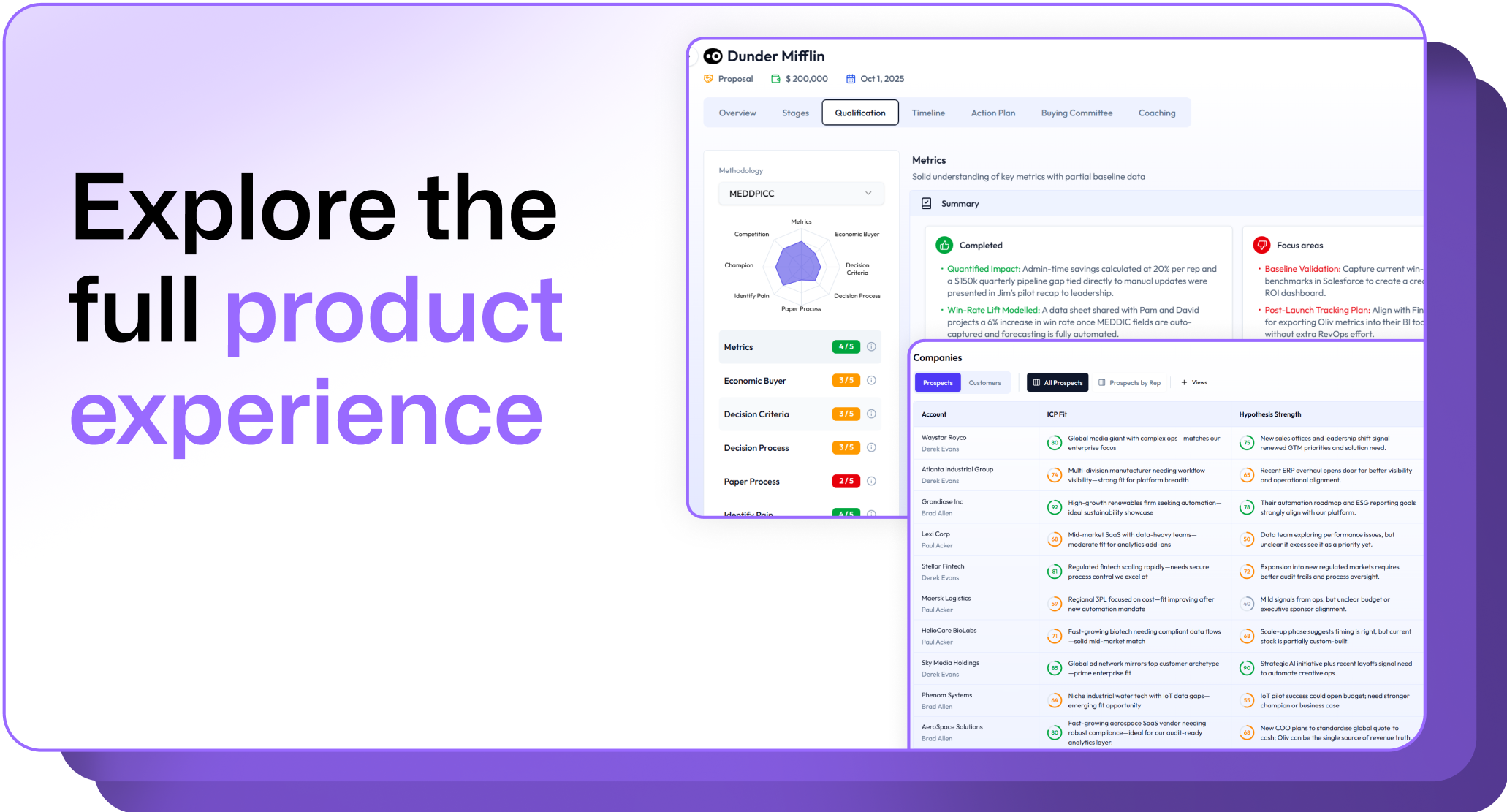
.avif)





.avif)
.avif)