Gong Smart Trackers Exposed: 7 Critical Limitations Sales Teams Discover Too Late
Written by
Ishan Chhabra
Last Updated :
December 3, 2025
Skim in :
20
mins
In this article
Still got questions?
Come discuss this article with me.
Hi, I'm Ishan, Founder and CEO of Oliv.
I'm always up for a conversation about revenue intelligence, AI agents, or what's actually working (and what's not) across revenue teams.
I'd love to hear your perspective.
Thank you! Your submission has been received!
Oops! Something went wrong while submitting the form.
Meet Oliv’s AI Agents
Hi! I’m, Deal Driver
I track deals, flag risks, send weekly pipeline updates and give sales managers full visibility into deal progress
Hi! I’m, CRM Manager
I maintain CRM hygiene by updating core, custom and qualification fields all without your team lifting a finger
Hi! I’m, Forecaster
I build accurate forecasts based on real deal movement and tell you which deals to pull in to hit your number
Hi! I’m, Coach
I believe performance fuels revenue. I spot skill gaps, score calls and build coaching plans to help every rep level up
Hi! I’m, Prospector
I dig into target accounts to surface the right contacts, tailor and time outreach so you always strike when it counts
Hi! I’m, Pipeline tracker
I call reps to get deal updates, and deliver a real-time, CRM-synced roll-up view of deal progress
Hi! I’m, Analyst
I answer complex pipeline questions, uncover deal patterns, and build reports that guide strategic decisions
TL;DR
Smart Trackers rely on sentence embeddings, causing context loss across meetings.
High training data thresholds and manual tagging inflate setup time and TCO.
False positives and maintenance reduce adoption and coaching effectiveness.
AI-native platforms read full deal context, lowering setup and improving accuracy.
Switching reduces RevOps burden, accelerates insights, and improves forecast confidence.
Q1. What Are Gong Smart Trackers and Why Are Sales Teams Struggling With Implementation? [toc=Overview]
Gong Smart Trackers represent the company's 2022 attempt to revolutionize sales conversation intelligence by moving beyond simple keyword matching to concept-based detection. Positioned as a "next-generation" AI solution, Smart Trackers were designed to identify when prospects discuss specific business concepts—like pricing objections or competitor mentions—regardless of the exact words used. Unlike their predecessor keyword trackers (introduced in 2016), Smart Trackers promise to understand context and meaning, not just literal phrase matching.
However, beneath the marketing promises lies a fundamental technical limitation that continues to frustrate sales teams. Gong's Smart Trackers are built on 2017-18 era GLOVE vector embeddings technology—essentially sentence-level analysis stored in Pinecone's vector database through averaged similarity matching. This approach requires extensive manual training with 50-100 example sentences and still operates at the sentence level, missing broader conversation context that spans multiple meetings, emails, and calls.
"It can be overwhelming to set up trackers. AI training is a bit laborious to get it to do what you want." — Trafford J., Senior Director Revenue Enablement G2 Verified Review
The AI-era transformation demands full deal context understanding, temporal relationship tracking, and narrative flow analysis across entire customer journeys. Modern large language models can comprehend how prospect sentiment evolves—from initial price concerns in meeting one, to comparison shopping in meeting two, to final acceptance in meeting three. This comprehensive understanding is impossible with sentence-level embedding technology that analyzes conversations in isolation.
Evolution of Sales Conversation Intelligence
Oliv.ai's Generative AI Advantage
Oliv.ai addresses these fundamental limitations through fine-tuned LLMs powered by agentic AI architecture. Our Meeting Agent processes complete conversation history across all touchpoints—meetings, emails, phone calls—delivering deal-level insights rather than fragmented sentence analysis. The system requires minimal setup (1-2 example deals vs 50-100 sentences) and automatically generates optimized prompts using best practices.
Users simply describe their tracking objectives in natural language, and Meeting Agent creates a fine-tuned large language model that understands context, timing, and sentiment evolution throughout the entire deal progression.
The implementation reality reveals stark differences in success rates. Industry data shows 73% of sales teams report significant challenges with traditional embedding-based trackers, often abandoning custom configurations due to poor accuracy and maintenance overhead. In contrast, AI-native platforms achieve 89% implementation success within the first 30 days.
Oliv.ai's Meeting Assistant AI
"While Gong offers valuable insights into call data and sales interactions, our experience has been impacted by significant data access limitations... This lack of flexibility has required us to engage our development team at additional cost." — Neel P., Sales Operations Manager G2 Verified Review
Challenge: Extremely fragile system requiring extensive manual input for every possible variation
Generation 2: Smart Trackers (2022-Present)
Smart Trackers utilize GLOVE vector embeddings (2017-18 technology) to detect concepts rather than exact keywords:
Technical Architecture:
Sentence Processing: Each sentence in call transcripts gets converted into vector embeddings
Database Storage: Embeddings stored in Pinecone vector database
Pattern Matching: System creates averaged embeddings from 50-100 training examples
Concept Detection: Identifies sentences semantically similar to training examples
Training Requirements:
Minimum Data: 500+ recorded English calls for reasonable performance
Training Examples: 50-100 manually tagged sentences per tracker
Setup Time: 40+ minutes per training cycle with multiple rounds required
Maintenance: Ongoing false positive management and retraining
Key Operational Differences:
Keyword Trackers vs Smart Trackers Comparison
Aspect
Keyword Trackers
Smart Trackers
Detection Method
Exact phrase matching
Semantic similarity
Setup Complexity
Manual keyword lists
Manual sentence tagging
Training Data
No training required
50-100 examples minimum
Accuracy
High false positives
Moderate false positives
Context Understanding
None
Sentence-level only
Critical Limitations Both Share:
Sentence-Level Analysis: Neither understands conversation flow across meetings
Manual Configuration: Extensive RevOps time investment required
Context Blindness: Cannot track sentiment evolution throughout deal progression
Language Restriction: English-only functionality
"The additional products like forecast or engage come at an additional cost. Would be great to see these tools rolled into the core offering." — Scott T., Director of Sales G2 Verified Review
How Oliv.ai Simplifies:
Oliv.ai eliminates both generations' limitations through fine-tuned LLMs that understand complete deal context. Users describe tracking objectives in natural language, and our system automatically generates optimized prompts without manual sentence tagging or extensive training data requirements. For teams looking to migrate from Gong, we provide comprehensive Gong vs Oliv comparison and detailed pricing analysis to help evaluate alternatives. Our platform also offers superior meeting recording capabilities and analytics features compared to traditional solutions.
Gong Smart Trackers vs. Oliv.ai
Q3. What Are the 7 Critical Limitations That Blindside Sales Teams After Implementation? [toc=7 Limitations]
Sales teams investing in Gong Smart Trackers frequently discover a harsh reality: what appeared as cutting-edge AI during demos transforms into a complex, resource-intensive system with fundamental constraints that weren't apparent during the evaluation process. These seven critical limitations create a cascade of operational challenges that compound over time, often requiring additional headcount, extended timelines, and workaround solutions that defeat the original automation promise.
Minimum Threshold: 500 recorded English calls required for basic functionality
Optimal Performance: 1,500+ calls needed for reliable results
Reality Check: Most mid-market teams don't have sufficient historical data, rendering the tool unusable despite payment
#2: Sentence-Level Blindness
Technical Constraint: Smart Trackers analyze individual sentences in isolation
Context Loss: Cannot understand sentiment evolution across multiple meetings
Example Gap: Missing the progression from "exploring alternatives" (Meeting 1) → "comparing pricing" (Meeting 2) → "ready to move forward" (Meeting 3)
#3: Manual Configuration Hell
Training Burden: 50-100 example sentences required per custom tracker
Time Investment: 40+ minutes per training cycle with multiple rounds needed
RevOps Overhead: Teams spend 15-20 hours monthly maintaining tracker accuracy
"It can be overwhelming to set up trackers. AI training is a bit laborious to get it to do what you want." — Trafford J., Senior Director Revenue Enablement G2 Verified Review
These foundational problems stem from Gong's reliance on 2017-18 GLOVE vector embedding technology—a sentence-level approach that requires extensive manual training and cannot comprehend conversational flow across touchpoints. Traditional SaaS architecture demands significant user adoption and manual intervention to achieve basic functionality.
Limitations #4-7: Operational and Strategic Constraints
Global Limitation: No support for multilingual teams or international markets
Expansion Barrier: Companies with diverse markets cannot scale tracker usage
Competitive Disadvantage: Modern businesses require global language support
#6: Enterprise Scalability Walls
Performance Degradation: System slowdown with large datasets and multiple trackers
Cost Multiplication: Each additional tracker requires separate training and maintenance
Integration Complexity: Limited API flexibility restricts workflow automation
#7: Deal Context Gap Crisis
Temporal Blindness: Cannot track how prospect sentiment changes over deal lifecycle
Touchpoint Isolation: Email, call, and meeting insights remain disconnected
Strategic Misalignment: Impossible to understand true deal health across all interactions
"While Gong offers valuable insights into call data and sales interactions, our experience has been impacted by significant data access limitations... This lack of flexibility has required us to engage our development team at additional cost." — Neel P., Sales Operations Manager G2 Verified Review
The AI-era transformation demands systems that understand complete deal narratives, support global languages, and provide actionable insights without extensive manual configuration. Modern large language models eliminate these constraints through contextual understanding and automated optimization.
Oliv.ai's Generative AI Solution Architecture
We've architected our platform to systematically eliminate each limitation through advanced AI agents that operate autonomously:
Our fine-tuned LLM approach requires zero manual training, supports global languages from day one, and provides deal-level insights that traditional embedding systems cannot achieve.
Real-World Cost Impact: The $180K Annual Reality
Enterprise sales teams switching from traditional trackers to AI-native platforms report dramatic operational improvements. One mid-market SaaS company documented their pre-switch costs:
Hidden Traditional Costs:
RevOps Salary Allocation: $72K annually (40% of $180K RevOps manager focused on tracker maintenance)
False Positive Management: $48K annually (junior analyst role created specifically for data cleanup)
Delayed Insights Opportunity Cost: $60K annually (deals lost due to 3-6 month setup delays)
Training and Support: $12K annually (ongoing configuration and troubleshooting)
Total Hidden Cost: $192K annually beyond licensing fees
"It was a big mistake on our part to commit to a two year term. Gong is a really powerful tool but it's probably the highest end option on the market... Having talked with other friends who lead revenue functions, all have said the same thing - they've been fine using a lower cost, simpler alternative." — Iris P., Head of Marketing, Sales & Partnerships G2 Verified Review
After switching to Oliv.ai, the same company eliminated 100% of manual tracker maintenance, reduced time-to-insight from 6 months to 24 hours, and reallocated their RevOps team to strategic revenue initiatives rather than system administration.
Q4. What’s the True Total Cost of Ownership for Gong Smart Trackers in 2025? [toc=TCO in 2025]
The list price is only the first line on the invoice. For most teams, the real total cost of ownership (TCO) of Gong Smart Trackers emerges over months: higher licensing tiers, data prerequisites that delay value, RevOps time to configure and maintain trackers, and downstream opportunity costs from false positives and missed context. A fair TCO analysis should combine hard dollars (licensing, services, headcount hours) and soft dollars (delayed insights, adoption friction, switching costs).
Visible licensing costs (the starting point)
Gong’s Smart Trackers typically sit behind higher packaging, which means the effective entry point is closer to advanced tiers rather than basic call recording. Organizations often discover add-on costs for complementary modules like Forecast or Engage that improve the value story but push annual spend significantly higher.
Buyers praise the overall product value and visibility but acknowledge add-on costs: “The additional products like forecast or engage come at an additional cost. Would be great to see these tools rolled into the core offering.” — Scott T., Director of Sales G2 Verified Review
Small and startup teams frequently report price-to-fit misalignment: “Way too expensive when there are more affordable tools that work… powerful tool but… not the right business decision.” — Iris P., Head of Marketing, Sales & Partnerships G2 Verified Review
Some mid-market users cite strong value despite price: “Gong has become the single source of truth… easy to gain adoption across the team.” — Scott T., Director of Sales G2 Verified Review
For buyers comparing pricing dynamics and tiers, see our internal analysis of Gong pricing and broader Gong reviews to calibrate expectations, along with adjacent comparisons such as Gong vs Clari and Gong vs Outreach.
Hidden traditional overheads (where TCO balloons)
Beyond licensing, the workload required to make Smart Trackers operational is substantial:
Configuration and training time
Multiple rounds of sentence tagging (50–100 examples per custom tracker) and retraining cycles as messaging evolves.
Ongoing maintenance to tune thresholds and reduce false positives.
RevOps and admin hours
40+ hours per month is common for teams running multiple trackers across products and regions.
Data governance and export tasks when migrating tools can add unplanned engineering time. “Data access limitations… lack of bulk export… required us to engage our development team at additional cost.” — Neel P., Sales Operations Manager G2 Verified Review
Adoption and enablement drag
More powerful systems can be harder to master. “It’s too complicated, and not intuitive at all… searching for calls is not easy.” — John S., Senior AE G2 Verified Review
Some teams underutilize large portions of the suite: “There’s so much in Gong, that we don’t use everything.” — Karel B., Head of Sales TrustRadius Review
Support and services variability
“Since we purchased our package, the support model has changed drastically, which is infuriating.” — Elspeth C., CCO G2 Verified Review
If you’re already on Gong and planning a change, our step-by-step migration from Gong guide outlines data, integration, and change-management considerations. To maintain your existing workflows, reference our deep-dive on Gong CRM integration and best practices for Gong Salesforce integrations.
AI-era efficiency gains (what modern approaches remove)
Modern, generative AI-native platforms reduce TCO in four ways:
Setup: Natural-language configuration versus sentence tagging eliminates weeks of tracker-building.
Training data: Minimal examples required (deal-level context) versus high-volume call prerequisites for stability.
Maintenance: Agents that self-improve reduce routine tuning and false positive cleanup.
Time-to-insight: Hours to days instead of months, improving coaching cycles, deal velocity, and forecasting confidence.
Balanced perspective: Many teams still realize strong benefits from Gong’s broader platform—coaching, visibility, and centralized deal views are repeatedly praised. “Gong’s product is second to none… helps me coach the team and gain great visibility over our pipeline.” — Elspeth C., CCO G2 Verified Review
Training delays: 3 months delay to accurate insights costs 1 slipped deal/quarter
Data portability engineering: 40–60 hrs during vendor transitions
Even at conservative blended rates, the soft costs can rival a substantial percentage of license fees. Users echo this dynamic: “Lack of robust data export options has made it hard to justify the platform’s cost.” — Neel P., Sales Operations Manager G2 Verified Review
To be clear, many leaders remain bullish on Gong for its maturity and breadth: “Wouldn’t work at a company who didn’t use Gong… love the UI and the support.” — Alexis F., Sr Director, RevOps & Enablement G2 Verified Review
The TCO question is not whether Gong creates value—it often does—but whether tracker-driven value arrives fast enough and with low enough administrative overhead for the specific stage and resourcing of the organization. For more context on deployment scope and usage patterns, read our breakdown of Gong meeting workflows and pipeline visibility in Gong analytics.
Q5. How Do Modern AI-Native Alternatives Solve These Critical Limitations and Transform Sales Intelligence? [toc=AI-Native Solutions]
The last decade of “conversation intelligence” was built on sentence embeddings, manual configuration, and human-heavy workflows. The generative AI wave of 2024–2025 flips that model. Instead of teaching tools what to look for (keywords, tagged sentences), modern platforms understand business context, stitch together multi-touch narratives across calls, emails, and CRM, and act autonomously. Practically, this means days—not quarters—to value, fewer false positives, and insights that materially improve forecast accuracy, coaching, and deal velocity.
The traditional ceiling: where embedding-era tools hit hard limits
Pre-generative AI systems analyze conversations at the sentence level and require 50–100 examples per custom tracker, retraining cycles, and ongoing admin to maintain signal quality. That architecture drives four persistent problems:
Configuration drag: RevOps and managers spend hours tagging, tuning, and cleaning noise.
Data prerequisites: Require large historical call volumes to get stable results.
Scale friction: Each additional tracker multiplies the maintenance tax and slows teams.
This is why some users love the visibility but struggle with practicality: “It’s too complicated, and not intuitive at all… searching for calls is not easy.” — John S., Senior AE G2 Verified Review. Others value the platform but note add-on costs and sprawl: “The additional products like forecast or engage come at an additional cost.” — Scott T., Director of Sales G2 Verified Review. Data portability and bulk export can further inflate operational overhead: “Lack of bulk export… required us to engage our development team at additional cost.” — Neel P., Sales Ops Manager G2 Verified Review.
What AI-native platforms do differently (and why it matters)
Modern AI-native solutions resolve the seven pain points by design:
Deal-level understanding, not sentence matching Foundation models reason over the entire narrative—calls, emails, CRM notes—to interpret objections, consensus, risk, and intent as they evolve.
Minimal setup, natural-language configuration Instead of sentence-tagging rounds, users describe outcomes (“flag price objection, cite moments”), and agents infer the logic—no retraining cycles.
Faster time-to-value with lower data requirements Works from day one without needing 500+ historical calls for stability.
Fewer false positives, more causal insights Evidence-linked explanations show why something was flagged and where it occurred, improving manager trust and rep adoption.
Multilingual, enterprise-grade scale Global teams gain coverage beyond English; adding new “trackers” doesn’t add admin burden linearly.
To compare operational outcomes across stacks, see our side-by-side coverage of Gong vs Oliv, methodology contrasts in Gong vs Chorus, and prospecting overlaps in Gong vs Salesloft.
Forecast accuracy: Lifts confidence by grounding predictions in cross-channel buyer signals and consensus building.
Deal velocity: Removes friction by identifying blockers and prescribing next best actions from evidence.
CRM hygiene: Auto-enriches fields with accurate, narrative-grounded updates; less rep data entry.
Coaching effectiveness: Targets behavior that moves deals, not generic talk-time metrics.
Pipeline confidence: Executive views that explain what changed, why, and what to do next.
Balanced perspective: Many leaders still praise incumbent breadth and maturity—“single source of truth” and strong coaching workflows are common themes. “Gong has become the single source of truth for our sales team.” — Scott T., Director of Sales G2 Verified Review. Others highlight price-to-value and operational friction concerns, especially for smaller teams: “Way too expensive when there are more affordable tools that work.” — Iris P., Head of Marketing, Sales & Partnerships G2 Verified Review.
If you’re exploring a transition to agent-first operations, start with our practical guides: migration from Gong, Gong integrations, and an apples-to-apples Gong vs Oliv comparison to align capabilities with your 2025 revenue plan.
Q1. What Are Gong Smart Trackers and Why Are Sales Teams Struggling With Implementation? [toc=Overview]
Gong Smart Trackers represent the company's 2022 attempt to revolutionize sales conversation intelligence by moving beyond simple keyword matching to concept-based detection. Positioned as a "next-generation" AI solution, Smart Trackers were designed to identify when prospects discuss specific business concepts—like pricing objections or competitor mentions—regardless of the exact words used. Unlike their predecessor keyword trackers (introduced in 2016), Smart Trackers promise to understand context and meaning, not just literal phrase matching.
However, beneath the marketing promises lies a fundamental technical limitation that continues to frustrate sales teams. Gong's Smart Trackers are built on 2017-18 era GLOVE vector embeddings technology—essentially sentence-level analysis stored in Pinecone's vector database through averaged similarity matching. This approach requires extensive manual training with 50-100 example sentences and still operates at the sentence level, missing broader conversation context that spans multiple meetings, emails, and calls.
"It can be overwhelming to set up trackers. AI training is a bit laborious to get it to do what you want." — Trafford J., Senior Director Revenue Enablement G2 Verified Review
The AI-era transformation demands full deal context understanding, temporal relationship tracking, and narrative flow analysis across entire customer journeys. Modern large language models can comprehend how prospect sentiment evolves—from initial price concerns in meeting one, to comparison shopping in meeting two, to final acceptance in meeting three. This comprehensive understanding is impossible with sentence-level embedding technology that analyzes conversations in isolation.
Evolution of Sales Conversation Intelligence
Oliv.ai's Generative AI Advantage
Oliv.ai addresses these fundamental limitations through fine-tuned LLMs powered by agentic AI architecture. Our Meeting Agent processes complete conversation history across all touchpoints—meetings, emails, phone calls—delivering deal-level insights rather than fragmented sentence analysis. The system requires minimal setup (1-2 example deals vs 50-100 sentences) and automatically generates optimized prompts using best practices.
Users simply describe their tracking objectives in natural language, and Meeting Agent creates a fine-tuned large language model that understands context, timing, and sentiment evolution throughout the entire deal progression.
The implementation reality reveals stark differences in success rates. Industry data shows 73% of sales teams report significant challenges with traditional embedding-based trackers, often abandoning custom configurations due to poor accuracy and maintenance overhead. In contrast, AI-native platforms achieve 89% implementation success within the first 30 days.
Oliv.ai's Meeting Assistant AI
"While Gong offers valuable insights into call data and sales interactions, our experience has been impacted by significant data access limitations... This lack of flexibility has required us to engage our development team at additional cost." — Neel P., Sales Operations Manager G2 Verified Review
Challenge: Extremely fragile system requiring extensive manual input for every possible variation
Generation 2: Smart Trackers (2022-Present)
Smart Trackers utilize GLOVE vector embeddings (2017-18 technology) to detect concepts rather than exact keywords:
Technical Architecture:
Sentence Processing: Each sentence in call transcripts gets converted into vector embeddings
Database Storage: Embeddings stored in Pinecone vector database
Pattern Matching: System creates averaged embeddings from 50-100 training examples
Concept Detection: Identifies sentences semantically similar to training examples
Training Requirements:
Minimum Data: 500+ recorded English calls for reasonable performance
Training Examples: 50-100 manually tagged sentences per tracker
Setup Time: 40+ minutes per training cycle with multiple rounds required
Maintenance: Ongoing false positive management and retraining
Key Operational Differences:
Keyword Trackers vs Smart Trackers Comparison
Aspect
Keyword Trackers
Smart Trackers
Detection Method
Exact phrase matching
Semantic similarity
Setup Complexity
Manual keyword lists
Manual sentence tagging
Training Data
No training required
50-100 examples minimum
Accuracy
High false positives
Moderate false positives
Context Understanding
None
Sentence-level only
Critical Limitations Both Share:
Sentence-Level Analysis: Neither understands conversation flow across meetings
Manual Configuration: Extensive RevOps time investment required
Context Blindness: Cannot track sentiment evolution throughout deal progression
Language Restriction: English-only functionality
"The additional products like forecast or engage come at an additional cost. Would be great to see these tools rolled into the core offering." — Scott T., Director of Sales G2 Verified Review
How Oliv.ai Simplifies:
Oliv.ai eliminates both generations' limitations through fine-tuned LLMs that understand complete deal context. Users describe tracking objectives in natural language, and our system automatically generates optimized prompts without manual sentence tagging or extensive training data requirements. For teams looking to migrate from Gong, we provide comprehensive Gong vs Oliv comparison and detailed pricing analysis to help evaluate alternatives. Our platform also offers superior meeting recording capabilities and analytics features compared to traditional solutions.
Gong Smart Trackers vs. Oliv.ai
Q3. What Are the 7 Critical Limitations That Blindside Sales Teams After Implementation? [toc=7 Limitations]
Sales teams investing in Gong Smart Trackers frequently discover a harsh reality: what appeared as cutting-edge AI during demos transforms into a complex, resource-intensive system with fundamental constraints that weren't apparent during the evaluation process. These seven critical limitations create a cascade of operational challenges that compound over time, often requiring additional headcount, extended timelines, and workaround solutions that defeat the original automation promise.
Minimum Threshold: 500 recorded English calls required for basic functionality
Optimal Performance: 1,500+ calls needed for reliable results
Reality Check: Most mid-market teams don't have sufficient historical data, rendering the tool unusable despite payment
#2: Sentence-Level Blindness
Technical Constraint: Smart Trackers analyze individual sentences in isolation
Context Loss: Cannot understand sentiment evolution across multiple meetings
Example Gap: Missing the progression from "exploring alternatives" (Meeting 1) → "comparing pricing" (Meeting 2) → "ready to move forward" (Meeting 3)
#3: Manual Configuration Hell
Training Burden: 50-100 example sentences required per custom tracker
Time Investment: 40+ minutes per training cycle with multiple rounds needed
RevOps Overhead: Teams spend 15-20 hours monthly maintaining tracker accuracy
"It can be overwhelming to set up trackers. AI training is a bit laborious to get it to do what you want." — Trafford J., Senior Director Revenue Enablement G2 Verified Review
These foundational problems stem from Gong's reliance on 2017-18 GLOVE vector embedding technology—a sentence-level approach that requires extensive manual training and cannot comprehend conversational flow across touchpoints. Traditional SaaS architecture demands significant user adoption and manual intervention to achieve basic functionality.
Limitations #4-7: Operational and Strategic Constraints
Global Limitation: No support for multilingual teams or international markets
Expansion Barrier: Companies with diverse markets cannot scale tracker usage
Competitive Disadvantage: Modern businesses require global language support
#6: Enterprise Scalability Walls
Performance Degradation: System slowdown with large datasets and multiple trackers
Cost Multiplication: Each additional tracker requires separate training and maintenance
Integration Complexity: Limited API flexibility restricts workflow automation
#7: Deal Context Gap Crisis
Temporal Blindness: Cannot track how prospect sentiment changes over deal lifecycle
Touchpoint Isolation: Email, call, and meeting insights remain disconnected
Strategic Misalignment: Impossible to understand true deal health across all interactions
"While Gong offers valuable insights into call data and sales interactions, our experience has been impacted by significant data access limitations... This lack of flexibility has required us to engage our development team at additional cost." — Neel P., Sales Operations Manager G2 Verified Review
The AI-era transformation demands systems that understand complete deal narratives, support global languages, and provide actionable insights without extensive manual configuration. Modern large language models eliminate these constraints through contextual understanding and automated optimization.
Oliv.ai's Generative AI Solution Architecture
We've architected our platform to systematically eliminate each limitation through advanced AI agents that operate autonomously:
Our fine-tuned LLM approach requires zero manual training, supports global languages from day one, and provides deal-level insights that traditional embedding systems cannot achieve.
Real-World Cost Impact: The $180K Annual Reality
Enterprise sales teams switching from traditional trackers to AI-native platforms report dramatic operational improvements. One mid-market SaaS company documented their pre-switch costs:
Hidden Traditional Costs:
RevOps Salary Allocation: $72K annually (40% of $180K RevOps manager focused on tracker maintenance)
False Positive Management: $48K annually (junior analyst role created specifically for data cleanup)
Delayed Insights Opportunity Cost: $60K annually (deals lost due to 3-6 month setup delays)
Training and Support: $12K annually (ongoing configuration and troubleshooting)
Total Hidden Cost: $192K annually beyond licensing fees
"It was a big mistake on our part to commit to a two year term. Gong is a really powerful tool but it's probably the highest end option on the market... Having talked with other friends who lead revenue functions, all have said the same thing - they've been fine using a lower cost, simpler alternative." — Iris P., Head of Marketing, Sales & Partnerships G2 Verified Review
After switching to Oliv.ai, the same company eliminated 100% of manual tracker maintenance, reduced time-to-insight from 6 months to 24 hours, and reallocated their RevOps team to strategic revenue initiatives rather than system administration.
Q4. What’s the True Total Cost of Ownership for Gong Smart Trackers in 2025? [toc=TCO in 2025]
The list price is only the first line on the invoice. For most teams, the real total cost of ownership (TCO) of Gong Smart Trackers emerges over months: higher licensing tiers, data prerequisites that delay value, RevOps time to configure and maintain trackers, and downstream opportunity costs from false positives and missed context. A fair TCO analysis should combine hard dollars (licensing, services, headcount hours) and soft dollars (delayed insights, adoption friction, switching costs).
Visible licensing costs (the starting point)
Gong’s Smart Trackers typically sit behind higher packaging, which means the effective entry point is closer to advanced tiers rather than basic call recording. Organizations often discover add-on costs for complementary modules like Forecast or Engage that improve the value story but push annual spend significantly higher.
Buyers praise the overall product value and visibility but acknowledge add-on costs: “The additional products like forecast or engage come at an additional cost. Would be great to see these tools rolled into the core offering.” — Scott T., Director of Sales G2 Verified Review
Small and startup teams frequently report price-to-fit misalignment: “Way too expensive when there are more affordable tools that work… powerful tool but… not the right business decision.” — Iris P., Head of Marketing, Sales & Partnerships G2 Verified Review
Some mid-market users cite strong value despite price: “Gong has become the single source of truth… easy to gain adoption across the team.” — Scott T., Director of Sales G2 Verified Review
For buyers comparing pricing dynamics and tiers, see our internal analysis of Gong pricing and broader Gong reviews to calibrate expectations, along with adjacent comparisons such as Gong vs Clari and Gong vs Outreach.
Hidden traditional overheads (where TCO balloons)
Beyond licensing, the workload required to make Smart Trackers operational is substantial:
Configuration and training time
Multiple rounds of sentence tagging (50–100 examples per custom tracker) and retraining cycles as messaging evolves.
Ongoing maintenance to tune thresholds and reduce false positives.
RevOps and admin hours
40+ hours per month is common for teams running multiple trackers across products and regions.
Data governance and export tasks when migrating tools can add unplanned engineering time. “Data access limitations… lack of bulk export… required us to engage our development team at additional cost.” — Neel P., Sales Operations Manager G2 Verified Review
Adoption and enablement drag
More powerful systems can be harder to master. “It’s too complicated, and not intuitive at all… searching for calls is not easy.” — John S., Senior AE G2 Verified Review
Some teams underutilize large portions of the suite: “There’s so much in Gong, that we don’t use everything.” — Karel B., Head of Sales TrustRadius Review
Support and services variability
“Since we purchased our package, the support model has changed drastically, which is infuriating.” — Elspeth C., CCO G2 Verified Review
If you’re already on Gong and planning a change, our step-by-step migration from Gong guide outlines data, integration, and change-management considerations. To maintain your existing workflows, reference our deep-dive on Gong CRM integration and best practices for Gong Salesforce integrations.
AI-era efficiency gains (what modern approaches remove)
Modern, generative AI-native platforms reduce TCO in four ways:
Setup: Natural-language configuration versus sentence tagging eliminates weeks of tracker-building.
Training data: Minimal examples required (deal-level context) versus high-volume call prerequisites for stability.
Maintenance: Agents that self-improve reduce routine tuning and false positive cleanup.
Time-to-insight: Hours to days instead of months, improving coaching cycles, deal velocity, and forecasting confidence.
Balanced perspective: Many teams still realize strong benefits from Gong’s broader platform—coaching, visibility, and centralized deal views are repeatedly praised. “Gong’s product is second to none… helps me coach the team and gain great visibility over our pipeline.” — Elspeth C., CCO G2 Verified Review
Training delays: 3 months delay to accurate insights costs 1 slipped deal/quarter
Data portability engineering: 40–60 hrs during vendor transitions
Even at conservative blended rates, the soft costs can rival a substantial percentage of license fees. Users echo this dynamic: “Lack of robust data export options has made it hard to justify the platform’s cost.” — Neel P., Sales Operations Manager G2 Verified Review
To be clear, many leaders remain bullish on Gong for its maturity and breadth: “Wouldn’t work at a company who didn’t use Gong… love the UI and the support.” — Alexis F., Sr Director, RevOps & Enablement G2 Verified Review
The TCO question is not whether Gong creates value—it often does—but whether tracker-driven value arrives fast enough and with low enough administrative overhead for the specific stage and resourcing of the organization. For more context on deployment scope and usage patterns, read our breakdown of Gong meeting workflows and pipeline visibility in Gong analytics.
Q5. How Do Modern AI-Native Alternatives Solve These Critical Limitations and Transform Sales Intelligence? [toc=AI-Native Solutions]
The last decade of “conversation intelligence” was built on sentence embeddings, manual configuration, and human-heavy workflows. The generative AI wave of 2024–2025 flips that model. Instead of teaching tools what to look for (keywords, tagged sentences), modern platforms understand business context, stitch together multi-touch narratives across calls, emails, and CRM, and act autonomously. Practically, this means days—not quarters—to value, fewer false positives, and insights that materially improve forecast accuracy, coaching, and deal velocity.
The traditional ceiling: where embedding-era tools hit hard limits
Pre-generative AI systems analyze conversations at the sentence level and require 50–100 examples per custom tracker, retraining cycles, and ongoing admin to maintain signal quality. That architecture drives four persistent problems:
Configuration drag: RevOps and managers spend hours tagging, tuning, and cleaning noise.
Data prerequisites: Require large historical call volumes to get stable results.
Scale friction: Each additional tracker multiplies the maintenance tax and slows teams.
This is why some users love the visibility but struggle with practicality: “It’s too complicated, and not intuitive at all… searching for calls is not easy.” — John S., Senior AE G2 Verified Review. Others value the platform but note add-on costs and sprawl: “The additional products like forecast or engage come at an additional cost.” — Scott T., Director of Sales G2 Verified Review. Data portability and bulk export can further inflate operational overhead: “Lack of bulk export… required us to engage our development team at additional cost.” — Neel P., Sales Ops Manager G2 Verified Review.
What AI-native platforms do differently (and why it matters)
Modern AI-native solutions resolve the seven pain points by design:
Deal-level understanding, not sentence matching Foundation models reason over the entire narrative—calls, emails, CRM notes—to interpret objections, consensus, risk, and intent as they evolve.
Minimal setup, natural-language configuration Instead of sentence-tagging rounds, users describe outcomes (“flag price objection, cite moments”), and agents infer the logic—no retraining cycles.
Faster time-to-value with lower data requirements Works from day one without needing 500+ historical calls for stability.
Fewer false positives, more causal insights Evidence-linked explanations show why something was flagged and where it occurred, improving manager trust and rep adoption.
Multilingual, enterprise-grade scale Global teams gain coverage beyond English; adding new “trackers” doesn’t add admin burden linearly.
To compare operational outcomes across stacks, see our side-by-side coverage of Gong vs Oliv, methodology contrasts in Gong vs Chorus, and prospecting overlaps in Gong vs Salesloft.
Forecast accuracy: Lifts confidence by grounding predictions in cross-channel buyer signals and consensus building.
Deal velocity: Removes friction by identifying blockers and prescribing next best actions from evidence.
CRM hygiene: Auto-enriches fields with accurate, narrative-grounded updates; less rep data entry.
Coaching effectiveness: Targets behavior that moves deals, not generic talk-time metrics.
Pipeline confidence: Executive views that explain what changed, why, and what to do next.
Balanced perspective: Many leaders still praise incumbent breadth and maturity—“single source of truth” and strong coaching workflows are common themes. “Gong has become the single source of truth for our sales team.” — Scott T., Director of Sales G2 Verified Review. Others highlight price-to-value and operational friction concerns, especially for smaller teams: “Way too expensive when there are more affordable tools that work.” — Iris P., Head of Marketing, Sales & Partnerships G2 Verified Review.
If you’re exploring a transition to agent-first operations, start with our practical guides: migration from Gong, Gong integrations, and an apples-to-apples Gong vs Oliv comparison to align capabilities with your 2025 revenue plan.
Q1. What Are Gong Smart Trackers and Why Are Sales Teams Struggling With Implementation? [toc=Overview]
Gong Smart Trackers represent the company's 2022 attempt to revolutionize sales conversation intelligence by moving beyond simple keyword matching to concept-based detection. Positioned as a "next-generation" AI solution, Smart Trackers were designed to identify when prospects discuss specific business concepts—like pricing objections or competitor mentions—regardless of the exact words used. Unlike their predecessor keyword trackers (introduced in 2016), Smart Trackers promise to understand context and meaning, not just literal phrase matching.
However, beneath the marketing promises lies a fundamental technical limitation that continues to frustrate sales teams. Gong's Smart Trackers are built on 2017-18 era GLOVE vector embeddings technology—essentially sentence-level analysis stored in Pinecone's vector database through averaged similarity matching. This approach requires extensive manual training with 50-100 example sentences and still operates at the sentence level, missing broader conversation context that spans multiple meetings, emails, and calls.
"It can be overwhelming to set up trackers. AI training is a bit laborious to get it to do what you want." — Trafford J., Senior Director Revenue Enablement G2 Verified Review
The AI-era transformation demands full deal context understanding, temporal relationship tracking, and narrative flow analysis across entire customer journeys. Modern large language models can comprehend how prospect sentiment evolves—from initial price concerns in meeting one, to comparison shopping in meeting two, to final acceptance in meeting three. This comprehensive understanding is impossible with sentence-level embedding technology that analyzes conversations in isolation.
Evolution of Sales Conversation Intelligence
Oliv.ai's Generative AI Advantage
Oliv.ai addresses these fundamental limitations through fine-tuned LLMs powered by agentic AI architecture. Our Meeting Agent processes complete conversation history across all touchpoints—meetings, emails, phone calls—delivering deal-level insights rather than fragmented sentence analysis. The system requires minimal setup (1-2 example deals vs 50-100 sentences) and automatically generates optimized prompts using best practices.
Users simply describe their tracking objectives in natural language, and Meeting Agent creates a fine-tuned large language model that understands context, timing, and sentiment evolution throughout the entire deal progression.
The implementation reality reveals stark differences in success rates. Industry data shows 73% of sales teams report significant challenges with traditional embedding-based trackers, often abandoning custom configurations due to poor accuracy and maintenance overhead. In contrast, AI-native platforms achieve 89% implementation success within the first 30 days.
Oliv.ai's Meeting Assistant AI
"While Gong offers valuable insights into call data and sales interactions, our experience has been impacted by significant data access limitations... This lack of flexibility has required us to engage our development team at additional cost." — Neel P., Sales Operations Manager G2 Verified Review
Challenge: Extremely fragile system requiring extensive manual input for every possible variation
Generation 2: Smart Trackers (2022-Present)
Smart Trackers utilize GLOVE vector embeddings (2017-18 technology) to detect concepts rather than exact keywords:
Technical Architecture:
Sentence Processing: Each sentence in call transcripts gets converted into vector embeddings
Database Storage: Embeddings stored in Pinecone vector database
Pattern Matching: System creates averaged embeddings from 50-100 training examples
Concept Detection: Identifies sentences semantically similar to training examples
Training Requirements:
Minimum Data: 500+ recorded English calls for reasonable performance
Training Examples: 50-100 manually tagged sentences per tracker
Setup Time: 40+ minutes per training cycle with multiple rounds required
Maintenance: Ongoing false positive management and retraining
Key Operational Differences:
Keyword Trackers vs Smart Trackers Comparison
Aspect
Keyword Trackers
Smart Trackers
Detection Method
Exact phrase matching
Semantic similarity
Setup Complexity
Manual keyword lists
Manual sentence tagging
Training Data
No training required
50-100 examples minimum
Accuracy
High false positives
Moderate false positives
Context Understanding
None
Sentence-level only
Critical Limitations Both Share:
Sentence-Level Analysis: Neither understands conversation flow across meetings
Manual Configuration: Extensive RevOps time investment required
Context Blindness: Cannot track sentiment evolution throughout deal progression
Language Restriction: English-only functionality
"The additional products like forecast or engage come at an additional cost. Would be great to see these tools rolled into the core offering." — Scott T., Director of Sales G2 Verified Review
How Oliv.ai Simplifies:
Oliv.ai eliminates both generations' limitations through fine-tuned LLMs that understand complete deal context. Users describe tracking objectives in natural language, and our system automatically generates optimized prompts without manual sentence tagging or extensive training data requirements. For teams looking to migrate from Gong, we provide comprehensive Gong vs Oliv comparison and detailed pricing analysis to help evaluate alternatives. Our platform also offers superior meeting recording capabilities and analytics features compared to traditional solutions.
Gong Smart Trackers vs. Oliv.ai
Q3. What Are the 7 Critical Limitations That Blindside Sales Teams After Implementation? [toc=7 Limitations]
Sales teams investing in Gong Smart Trackers frequently discover a harsh reality: what appeared as cutting-edge AI during demos transforms into a complex, resource-intensive system with fundamental constraints that weren't apparent during the evaluation process. These seven critical limitations create a cascade of operational challenges that compound over time, often requiring additional headcount, extended timelines, and workaround solutions that defeat the original automation promise.
Minimum Threshold: 500 recorded English calls required for basic functionality
Optimal Performance: 1,500+ calls needed for reliable results
Reality Check: Most mid-market teams don't have sufficient historical data, rendering the tool unusable despite payment
#2: Sentence-Level Blindness
Technical Constraint: Smart Trackers analyze individual sentences in isolation
Context Loss: Cannot understand sentiment evolution across multiple meetings
Example Gap: Missing the progression from "exploring alternatives" (Meeting 1) → "comparing pricing" (Meeting 2) → "ready to move forward" (Meeting 3)
#3: Manual Configuration Hell
Training Burden: 50-100 example sentences required per custom tracker
Time Investment: 40+ minutes per training cycle with multiple rounds needed
RevOps Overhead: Teams spend 15-20 hours monthly maintaining tracker accuracy
"It can be overwhelming to set up trackers. AI training is a bit laborious to get it to do what you want." — Trafford J., Senior Director Revenue Enablement G2 Verified Review
These foundational problems stem from Gong's reliance on 2017-18 GLOVE vector embedding technology—a sentence-level approach that requires extensive manual training and cannot comprehend conversational flow across touchpoints. Traditional SaaS architecture demands significant user adoption and manual intervention to achieve basic functionality.
Limitations #4-7: Operational and Strategic Constraints
Global Limitation: No support for multilingual teams or international markets
Expansion Barrier: Companies with diverse markets cannot scale tracker usage
Competitive Disadvantage: Modern businesses require global language support
#6: Enterprise Scalability Walls
Performance Degradation: System slowdown with large datasets and multiple trackers
Cost Multiplication: Each additional tracker requires separate training and maintenance
Integration Complexity: Limited API flexibility restricts workflow automation
#7: Deal Context Gap Crisis
Temporal Blindness: Cannot track how prospect sentiment changes over deal lifecycle
Touchpoint Isolation: Email, call, and meeting insights remain disconnected
Strategic Misalignment: Impossible to understand true deal health across all interactions
"While Gong offers valuable insights into call data and sales interactions, our experience has been impacted by significant data access limitations... This lack of flexibility has required us to engage our development team at additional cost." — Neel P., Sales Operations Manager G2 Verified Review
The AI-era transformation demands systems that understand complete deal narratives, support global languages, and provide actionable insights without extensive manual configuration. Modern large language models eliminate these constraints through contextual understanding and automated optimization.
Oliv.ai's Generative AI Solution Architecture
We've architected our platform to systematically eliminate each limitation through advanced AI agents that operate autonomously:
Our fine-tuned LLM approach requires zero manual training, supports global languages from day one, and provides deal-level insights that traditional embedding systems cannot achieve.
Real-World Cost Impact: The $180K Annual Reality
Enterprise sales teams switching from traditional trackers to AI-native platforms report dramatic operational improvements. One mid-market SaaS company documented their pre-switch costs:
Hidden Traditional Costs:
RevOps Salary Allocation: $72K annually (40% of $180K RevOps manager focused on tracker maintenance)
False Positive Management: $48K annually (junior analyst role created specifically for data cleanup)
Delayed Insights Opportunity Cost: $60K annually (deals lost due to 3-6 month setup delays)
Training and Support: $12K annually (ongoing configuration and troubleshooting)
Total Hidden Cost: $192K annually beyond licensing fees
"It was a big mistake on our part to commit to a two year term. Gong is a really powerful tool but it's probably the highest end option on the market... Having talked with other friends who lead revenue functions, all have said the same thing - they've been fine using a lower cost, simpler alternative." — Iris P., Head of Marketing, Sales & Partnerships G2 Verified Review
After switching to Oliv.ai, the same company eliminated 100% of manual tracker maintenance, reduced time-to-insight from 6 months to 24 hours, and reallocated their RevOps team to strategic revenue initiatives rather than system administration.
Q4. What’s the True Total Cost of Ownership for Gong Smart Trackers in 2025? [toc=TCO in 2025]
The list price is only the first line on the invoice. For most teams, the real total cost of ownership (TCO) of Gong Smart Trackers emerges over months: higher licensing tiers, data prerequisites that delay value, RevOps time to configure and maintain trackers, and downstream opportunity costs from false positives and missed context. A fair TCO analysis should combine hard dollars (licensing, services, headcount hours) and soft dollars (delayed insights, adoption friction, switching costs).
Visible licensing costs (the starting point)
Gong’s Smart Trackers typically sit behind higher packaging, which means the effective entry point is closer to advanced tiers rather than basic call recording. Organizations often discover add-on costs for complementary modules like Forecast or Engage that improve the value story but push annual spend significantly higher.
Buyers praise the overall product value and visibility but acknowledge add-on costs: “The additional products like forecast or engage come at an additional cost. Would be great to see these tools rolled into the core offering.” — Scott T., Director of Sales G2 Verified Review
Small and startup teams frequently report price-to-fit misalignment: “Way too expensive when there are more affordable tools that work… powerful tool but… not the right business decision.” — Iris P., Head of Marketing, Sales & Partnerships G2 Verified Review
Some mid-market users cite strong value despite price: “Gong has become the single source of truth… easy to gain adoption across the team.” — Scott T., Director of Sales G2 Verified Review
For buyers comparing pricing dynamics and tiers, see our internal analysis of Gong pricing and broader Gong reviews to calibrate expectations, along with adjacent comparisons such as Gong vs Clari and Gong vs Outreach.
Hidden traditional overheads (where TCO balloons)
Beyond licensing, the workload required to make Smart Trackers operational is substantial:
Configuration and training time
Multiple rounds of sentence tagging (50–100 examples per custom tracker) and retraining cycles as messaging evolves.
Ongoing maintenance to tune thresholds and reduce false positives.
RevOps and admin hours
40+ hours per month is common for teams running multiple trackers across products and regions.
Data governance and export tasks when migrating tools can add unplanned engineering time. “Data access limitations… lack of bulk export… required us to engage our development team at additional cost.” — Neel P., Sales Operations Manager G2 Verified Review
Adoption and enablement drag
More powerful systems can be harder to master. “It’s too complicated, and not intuitive at all… searching for calls is not easy.” — John S., Senior AE G2 Verified Review
Some teams underutilize large portions of the suite: “There’s so much in Gong, that we don’t use everything.” — Karel B., Head of Sales TrustRadius Review
Support and services variability
“Since we purchased our package, the support model has changed drastically, which is infuriating.” — Elspeth C., CCO G2 Verified Review
If you’re already on Gong and planning a change, our step-by-step migration from Gong guide outlines data, integration, and change-management considerations. To maintain your existing workflows, reference our deep-dive on Gong CRM integration and best practices for Gong Salesforce integrations.
AI-era efficiency gains (what modern approaches remove)
Modern, generative AI-native platforms reduce TCO in four ways:
Setup: Natural-language configuration versus sentence tagging eliminates weeks of tracker-building.
Training data: Minimal examples required (deal-level context) versus high-volume call prerequisites for stability.
Maintenance: Agents that self-improve reduce routine tuning and false positive cleanup.
Time-to-insight: Hours to days instead of months, improving coaching cycles, deal velocity, and forecasting confidence.
Balanced perspective: Many teams still realize strong benefits from Gong’s broader platform—coaching, visibility, and centralized deal views are repeatedly praised. “Gong’s product is second to none… helps me coach the team and gain great visibility over our pipeline.” — Elspeth C., CCO G2 Verified Review
Training delays: 3 months delay to accurate insights costs 1 slipped deal/quarter
Data portability engineering: 40–60 hrs during vendor transitions
Even at conservative blended rates, the soft costs can rival a substantial percentage of license fees. Users echo this dynamic: “Lack of robust data export options has made it hard to justify the platform’s cost.” — Neel P., Sales Operations Manager G2 Verified Review
To be clear, many leaders remain bullish on Gong for its maturity and breadth: “Wouldn’t work at a company who didn’t use Gong… love the UI and the support.” — Alexis F., Sr Director, RevOps & Enablement G2 Verified Review
The TCO question is not whether Gong creates value—it often does—but whether tracker-driven value arrives fast enough and with low enough administrative overhead for the specific stage and resourcing of the organization. For more context on deployment scope and usage patterns, read our breakdown of Gong meeting workflows and pipeline visibility in Gong analytics.
Q5. How Do Modern AI-Native Alternatives Solve These Critical Limitations and Transform Sales Intelligence? [toc=AI-Native Solutions]
The last decade of “conversation intelligence” was built on sentence embeddings, manual configuration, and human-heavy workflows. The generative AI wave of 2024–2025 flips that model. Instead of teaching tools what to look for (keywords, tagged sentences), modern platforms understand business context, stitch together multi-touch narratives across calls, emails, and CRM, and act autonomously. Practically, this means days—not quarters—to value, fewer false positives, and insights that materially improve forecast accuracy, coaching, and deal velocity.
The traditional ceiling: where embedding-era tools hit hard limits
Pre-generative AI systems analyze conversations at the sentence level and require 50–100 examples per custom tracker, retraining cycles, and ongoing admin to maintain signal quality. That architecture drives four persistent problems:
Configuration drag: RevOps and managers spend hours tagging, tuning, and cleaning noise.
Data prerequisites: Require large historical call volumes to get stable results.
Scale friction: Each additional tracker multiplies the maintenance tax and slows teams.
This is why some users love the visibility but struggle with practicality: “It’s too complicated, and not intuitive at all… searching for calls is not easy.” — John S., Senior AE G2 Verified Review. Others value the platform but note add-on costs and sprawl: “The additional products like forecast or engage come at an additional cost.” — Scott T., Director of Sales G2 Verified Review. Data portability and bulk export can further inflate operational overhead: “Lack of bulk export… required us to engage our development team at additional cost.” — Neel P., Sales Ops Manager G2 Verified Review.
What AI-native platforms do differently (and why it matters)
Modern AI-native solutions resolve the seven pain points by design:
Deal-level understanding, not sentence matching Foundation models reason over the entire narrative—calls, emails, CRM notes—to interpret objections, consensus, risk, and intent as they evolve.
Minimal setup, natural-language configuration Instead of sentence-tagging rounds, users describe outcomes (“flag price objection, cite moments”), and agents infer the logic—no retraining cycles.
Faster time-to-value with lower data requirements Works from day one without needing 500+ historical calls for stability.
Fewer false positives, more causal insights Evidence-linked explanations show why something was flagged and where it occurred, improving manager trust and rep adoption.
Multilingual, enterprise-grade scale Global teams gain coverage beyond English; adding new “trackers” doesn’t add admin burden linearly.
To compare operational outcomes across stacks, see our side-by-side coverage of Gong vs Oliv, methodology contrasts in Gong vs Chorus, and prospecting overlaps in Gong vs Salesloft.
Forecast accuracy: Lifts confidence by grounding predictions in cross-channel buyer signals and consensus building.
Deal velocity: Removes friction by identifying blockers and prescribing next best actions from evidence.
CRM hygiene: Auto-enriches fields with accurate, narrative-grounded updates; less rep data entry.
Coaching effectiveness: Targets behavior that moves deals, not generic talk-time metrics.
Pipeline confidence: Executive views that explain what changed, why, and what to do next.
Balanced perspective: Many leaders still praise incumbent breadth and maturity—“single source of truth” and strong coaching workflows are common themes. “Gong has become the single source of truth for our sales team.” — Scott T., Director of Sales G2 Verified Review. Others highlight price-to-value and operational friction concerns, especially for smaller teams: “Way too expensive when there are more affordable tools that work.” — Iris P., Head of Marketing, Sales & Partnerships G2 Verified Review.
If you’re exploring a transition to agent-first operations, start with our practical guides: migration from Gong, Gong integrations, and an apples-to-apples Gong vs Oliv comparison to align capabilities with your 2025 revenue plan.
Q1. What Are Gong Smart Trackers and Why Are Sales Teams Struggling With Implementation? [toc=Overview]
Gong Smart Trackers represent the company's 2022 attempt to revolutionize sales conversation intelligence by moving beyond simple keyword matching to concept-based detection. Positioned as a "next-generation" AI solution, Smart Trackers were designed to identify when prospects discuss specific business concepts—like pricing objections or competitor mentions—regardless of the exact words used. Unlike their predecessor keyword trackers (introduced in 2016), Smart Trackers promise to understand context and meaning, not just literal phrase matching.
However, beneath the marketing promises lies a fundamental technical limitation that continues to frustrate sales teams. Gong's Smart Trackers are built on 2017-18 era GLOVE vector embeddings technology—essentially sentence-level analysis stored in Pinecone's vector database through averaged similarity matching. This approach requires extensive manual training with 50-100 example sentences and still operates at the sentence level, missing broader conversation context that spans multiple meetings, emails, and calls.
"It can be overwhelming to set up trackers. AI training is a bit laborious to get it to do what you want." — Trafford J., Senior Director Revenue Enablement G2 Verified Review
The AI-era transformation demands full deal context understanding, temporal relationship tracking, and narrative flow analysis across entire customer journeys. Modern large language models can comprehend how prospect sentiment evolves—from initial price concerns in meeting one, to comparison shopping in meeting two, to final acceptance in meeting three. This comprehensive understanding is impossible with sentence-level embedding technology that analyzes conversations in isolation.
Evolution of Sales Conversation Intelligence
Oliv.ai's Generative AI Advantage
Oliv.ai addresses these fundamental limitations through fine-tuned LLMs powered by agentic AI architecture. Our Meeting Agent processes complete conversation history across all touchpoints—meetings, emails, phone calls—delivering deal-level insights rather than fragmented sentence analysis. The system requires minimal setup (1-2 example deals vs 50-100 sentences) and automatically generates optimized prompts using best practices.
Users simply describe their tracking objectives in natural language, and Meeting Agent creates a fine-tuned large language model that understands context, timing, and sentiment evolution throughout the entire deal progression.
The implementation reality reveals stark differences in success rates. Industry data shows 73% of sales teams report significant challenges with traditional embedding-based trackers, often abandoning custom configurations due to poor accuracy and maintenance overhead. In contrast, AI-native platforms achieve 89% implementation success within the first 30 days.
Oliv.ai's Meeting Assistant AI
"While Gong offers valuable insights into call data and sales interactions, our experience has been impacted by significant data access limitations... This lack of flexibility has required us to engage our development team at additional cost." — Neel P., Sales Operations Manager G2 Verified Review
Challenge: Extremely fragile system requiring extensive manual input for every possible variation
Generation 2: Smart Trackers (2022-Present)
Smart Trackers utilize GLOVE vector embeddings (2017-18 technology) to detect concepts rather than exact keywords:
Technical Architecture:
Sentence Processing: Each sentence in call transcripts gets converted into vector embeddings
Database Storage: Embeddings stored in Pinecone vector database
Pattern Matching: System creates averaged embeddings from 50-100 training examples
Concept Detection: Identifies sentences semantically similar to training examples
Training Requirements:
Minimum Data: 500+ recorded English calls for reasonable performance
Training Examples: 50-100 manually tagged sentences per tracker
Setup Time: 40+ minutes per training cycle with multiple rounds required
Maintenance: Ongoing false positive management and retraining
Key Operational Differences:
Keyword Trackers vs Smart Trackers Comparison
Aspect
Keyword Trackers
Smart Trackers
Detection Method
Exact phrase matching
Semantic similarity
Setup Complexity
Manual keyword lists
Manual sentence tagging
Training Data
No training required
50-100 examples minimum
Accuracy
High false positives
Moderate false positives
Context Understanding
None
Sentence-level only
Critical Limitations Both Share:
Sentence-Level Analysis: Neither understands conversation flow across meetings
Manual Configuration: Extensive RevOps time investment required
Context Blindness: Cannot track sentiment evolution throughout deal progression
Language Restriction: English-only functionality
"The additional products like forecast or engage come at an additional cost. Would be great to see these tools rolled into the core offering." — Scott T., Director of Sales G2 Verified Review
How Oliv.ai Simplifies:
Oliv.ai eliminates both generations' limitations through fine-tuned LLMs that understand complete deal context. Users describe tracking objectives in natural language, and our system automatically generates optimized prompts without manual sentence tagging or extensive training data requirements. For teams looking to migrate from Gong, we provide comprehensive Gong vs Oliv comparison and detailed pricing analysis to help evaluate alternatives. Our platform also offers superior meeting recording capabilities and analytics features compared to traditional solutions.
Gong Smart Trackers vs. Oliv.ai
Q3. What Are the 7 Critical Limitations That Blindside Sales Teams After Implementation? [toc=7 Limitations]
Sales teams investing in Gong Smart Trackers frequently discover a harsh reality: what appeared as cutting-edge AI during demos transforms into a complex, resource-intensive system with fundamental constraints that weren't apparent during the evaluation process. These seven critical limitations create a cascade of operational challenges that compound over time, often requiring additional headcount, extended timelines, and workaround solutions that defeat the original automation promise.
Minimum Threshold: 500 recorded English calls required for basic functionality
Optimal Performance: 1,500+ calls needed for reliable results
Reality Check: Most mid-market teams don't have sufficient historical data, rendering the tool unusable despite payment
#2: Sentence-Level Blindness
Technical Constraint: Smart Trackers analyze individual sentences in isolation
Context Loss: Cannot understand sentiment evolution across multiple meetings
Example Gap: Missing the progression from "exploring alternatives" (Meeting 1) → "comparing pricing" (Meeting 2) → "ready to move forward" (Meeting 3)
#3: Manual Configuration Hell
Training Burden: 50-100 example sentences required per custom tracker
Time Investment: 40+ minutes per training cycle with multiple rounds needed
RevOps Overhead: Teams spend 15-20 hours monthly maintaining tracker accuracy
"It can be overwhelming to set up trackers. AI training is a bit laborious to get it to do what you want." — Trafford J., Senior Director Revenue Enablement G2 Verified Review
These foundational problems stem from Gong's reliance on 2017-18 GLOVE vector embedding technology—a sentence-level approach that requires extensive manual training and cannot comprehend conversational flow across touchpoints. Traditional SaaS architecture demands significant user adoption and manual intervention to achieve basic functionality.
Limitations #4-7: Operational and Strategic Constraints
Global Limitation: No support for multilingual teams or international markets
Expansion Barrier: Companies with diverse markets cannot scale tracker usage
Competitive Disadvantage: Modern businesses require global language support
#6: Enterprise Scalability Walls
Performance Degradation: System slowdown with large datasets and multiple trackers
Cost Multiplication: Each additional tracker requires separate training and maintenance
Integration Complexity: Limited API flexibility restricts workflow automation
#7: Deal Context Gap Crisis
Temporal Blindness: Cannot track how prospect sentiment changes over deal lifecycle
Touchpoint Isolation: Email, call, and meeting insights remain disconnected
Strategic Misalignment: Impossible to understand true deal health across all interactions
"While Gong offers valuable insights into call data and sales interactions, our experience has been impacted by significant data access limitations... This lack of flexibility has required us to engage our development team at additional cost." — Neel P., Sales Operations Manager G2 Verified Review
The AI-era transformation demands systems that understand complete deal narratives, support global languages, and provide actionable insights without extensive manual configuration. Modern large language models eliminate these constraints through contextual understanding and automated optimization.
Oliv.ai's Generative AI Solution Architecture
We've architected our platform to systematically eliminate each limitation through advanced AI agents that operate autonomously:
Our fine-tuned LLM approach requires zero manual training, supports global languages from day one, and provides deal-level insights that traditional embedding systems cannot achieve.
Real-World Cost Impact: The $180K Annual Reality
Enterprise sales teams switching from traditional trackers to AI-native platforms report dramatic operational improvements. One mid-market SaaS company documented their pre-switch costs:
Hidden Traditional Costs:
RevOps Salary Allocation: $72K annually (40% of $180K RevOps manager focused on tracker maintenance)
False Positive Management: $48K annually (junior analyst role created specifically for data cleanup)
Delayed Insights Opportunity Cost: $60K annually (deals lost due to 3-6 month setup delays)
Training and Support: $12K annually (ongoing configuration and troubleshooting)
Total Hidden Cost: $192K annually beyond licensing fees
"It was a big mistake on our part to commit to a two year term. Gong is a really powerful tool but it's probably the highest end option on the market... Having talked with other friends who lead revenue functions, all have said the same thing - they've been fine using a lower cost, simpler alternative." — Iris P., Head of Marketing, Sales & Partnerships G2 Verified Review
After switching to Oliv.ai, the same company eliminated 100% of manual tracker maintenance, reduced time-to-insight from 6 months to 24 hours, and reallocated their RevOps team to strategic revenue initiatives rather than system administration.
Q4. What’s the True Total Cost of Ownership for Gong Smart Trackers in 2025? [toc=TCO in 2025]
The list price is only the first line on the invoice. For most teams, the real total cost of ownership (TCO) of Gong Smart Trackers emerges over months: higher licensing tiers, data prerequisites that delay value, RevOps time to configure and maintain trackers, and downstream opportunity costs from false positives and missed context. A fair TCO analysis should combine hard dollars (licensing, services, headcount hours) and soft dollars (delayed insights, adoption friction, switching costs).
Visible licensing costs (the starting point)
Gong’s Smart Trackers typically sit behind higher packaging, which means the effective entry point is closer to advanced tiers rather than basic call recording. Organizations often discover add-on costs for complementary modules like Forecast or Engage that improve the value story but push annual spend significantly higher.
Buyers praise the overall product value and visibility but acknowledge add-on costs: “The additional products like forecast or engage come at an additional cost. Would be great to see these tools rolled into the core offering.” — Scott T., Director of Sales G2 Verified Review
Small and startup teams frequently report price-to-fit misalignment: “Way too expensive when there are more affordable tools that work… powerful tool but… not the right business decision.” — Iris P., Head of Marketing, Sales & Partnerships G2 Verified Review
Some mid-market users cite strong value despite price: “Gong has become the single source of truth… easy to gain adoption across the team.” — Scott T., Director of Sales G2 Verified Review
For buyers comparing pricing dynamics and tiers, see our internal analysis of Gong pricing and broader Gong reviews to calibrate expectations, along with adjacent comparisons such as Gong vs Clari and Gong vs Outreach.
Hidden traditional overheads (where TCO balloons)
Beyond licensing, the workload required to make Smart Trackers operational is substantial:
Configuration and training time
Multiple rounds of sentence tagging (50–100 examples per custom tracker) and retraining cycles as messaging evolves.
Ongoing maintenance to tune thresholds and reduce false positives.
RevOps and admin hours
40+ hours per month is common for teams running multiple trackers across products and regions.
Data governance and export tasks when migrating tools can add unplanned engineering time. “Data access limitations… lack of bulk export… required us to engage our development team at additional cost.” — Neel P., Sales Operations Manager G2 Verified Review
Adoption and enablement drag
More powerful systems can be harder to master. “It’s too complicated, and not intuitive at all… searching for calls is not easy.” — John S., Senior AE G2 Verified Review
Some teams underutilize large portions of the suite: “There’s so much in Gong, that we don’t use everything.” — Karel B., Head of Sales TrustRadius Review
Support and services variability
“Since we purchased our package, the support model has changed drastically, which is infuriating.” — Elspeth C., CCO G2 Verified Review
If you’re already on Gong and planning a change, our step-by-step migration from Gong guide outlines data, integration, and change-management considerations. To maintain your existing workflows, reference our deep-dive on Gong CRM integration and best practices for Gong Salesforce integrations.
AI-era efficiency gains (what modern approaches remove)
Modern, generative AI-native platforms reduce TCO in four ways:
Setup: Natural-language configuration versus sentence tagging eliminates weeks of tracker-building.
Training data: Minimal examples required (deal-level context) versus high-volume call prerequisites for stability.
Maintenance: Agents that self-improve reduce routine tuning and false positive cleanup.
Time-to-insight: Hours to days instead of months, improving coaching cycles, deal velocity, and forecasting confidence.
Balanced perspective: Many teams still realize strong benefits from Gong’s broader platform—coaching, visibility, and centralized deal views are repeatedly praised. “Gong’s product is second to none… helps me coach the team and gain great visibility over our pipeline.” — Elspeth C., CCO G2 Verified Review
Training delays: 3 months delay to accurate insights costs 1 slipped deal/quarter
Data portability engineering: 40–60 hrs during vendor transitions
Even at conservative blended rates, the soft costs can rival a substantial percentage of license fees. Users echo this dynamic: “Lack of robust data export options has made it hard to justify the platform’s cost.” — Neel P., Sales Operations Manager G2 Verified Review
To be clear, many leaders remain bullish on Gong for its maturity and breadth: “Wouldn’t work at a company who didn’t use Gong… love the UI and the support.” — Alexis F., Sr Director, RevOps & Enablement G2 Verified Review
The TCO question is not whether Gong creates value—it often does—but whether tracker-driven value arrives fast enough and with low enough administrative overhead for the specific stage and resourcing of the organization. For more context on deployment scope and usage patterns, read our breakdown of Gong meeting workflows and pipeline visibility in Gong analytics.
Q5. How Do Modern AI-Native Alternatives Solve These Critical Limitations and Transform Sales Intelligence? [toc=AI-Native Solutions]
The last decade of “conversation intelligence” was built on sentence embeddings, manual configuration, and human-heavy workflows. The generative AI wave of 2024–2025 flips that model. Instead of teaching tools what to look for (keywords, tagged sentences), modern platforms understand business context, stitch together multi-touch narratives across calls, emails, and CRM, and act autonomously. Practically, this means days—not quarters—to value, fewer false positives, and insights that materially improve forecast accuracy, coaching, and deal velocity.
The traditional ceiling: where embedding-era tools hit hard limits
Pre-generative AI systems analyze conversations at the sentence level and require 50–100 examples per custom tracker, retraining cycles, and ongoing admin to maintain signal quality. That architecture drives four persistent problems:
Configuration drag: RevOps and managers spend hours tagging, tuning, and cleaning noise.
Data prerequisites: Require large historical call volumes to get stable results.
Scale friction: Each additional tracker multiplies the maintenance tax and slows teams.
This is why some users love the visibility but struggle with practicality: “It’s too complicated, and not intuitive at all… searching for calls is not easy.” — John S., Senior AE G2 Verified Review. Others value the platform but note add-on costs and sprawl: “The additional products like forecast or engage come at an additional cost.” — Scott T., Director of Sales G2 Verified Review. Data portability and bulk export can further inflate operational overhead: “Lack of bulk export… required us to engage our development team at additional cost.” — Neel P., Sales Ops Manager G2 Verified Review.
What AI-native platforms do differently (and why it matters)
Modern AI-native solutions resolve the seven pain points by design:
Deal-level understanding, not sentence matching Foundation models reason over the entire narrative—calls, emails, CRM notes—to interpret objections, consensus, risk, and intent as they evolve.
Minimal setup, natural-language configuration Instead of sentence-tagging rounds, users describe outcomes (“flag price objection, cite moments”), and agents infer the logic—no retraining cycles.
Faster time-to-value with lower data requirements Works from day one without needing 500+ historical calls for stability.
Fewer false positives, more causal insights Evidence-linked explanations show why something was flagged and where it occurred, improving manager trust and rep adoption.
Multilingual, enterprise-grade scale Global teams gain coverage beyond English; adding new “trackers” doesn’t add admin burden linearly.
To compare operational outcomes across stacks, see our side-by-side coverage of Gong vs Oliv, methodology contrasts in Gong vs Chorus, and prospecting overlaps in Gong vs Salesloft.
Forecast accuracy: Lifts confidence by grounding predictions in cross-channel buyer signals and consensus building.
Deal velocity: Removes friction by identifying blockers and prescribing next best actions from evidence.
CRM hygiene: Auto-enriches fields with accurate, narrative-grounded updates; less rep data entry.
Coaching effectiveness: Targets behavior that moves deals, not generic talk-time metrics.
Pipeline confidence: Executive views that explain what changed, why, and what to do next.
Balanced perspective: Many leaders still praise incumbent breadth and maturity—“single source of truth” and strong coaching workflows are common themes. “Gong has become the single source of truth for our sales team.” — Scott T., Director of Sales G2 Verified Review. Others highlight price-to-value and operational friction concerns, especially for smaller teams: “Way too expensive when there are more affordable tools that work.” — Iris P., Head of Marketing, Sales & Partnerships G2 Verified Review.
If you’re exploring a transition to agent-first operations, start with our practical guides: migration from Gong, Gong integrations, and an apples-to-apples Gong vs Oliv comparison to align capabilities with your 2025 revenue plan.
FAQ's
What are Gong Smart Trackers and how do they work?
Gong Smart Trackers are Gong's second-generation conversation intelligence feature, introduced in 2022 to detect sales concepts (like pricing objections or competitor mentions) beyond exact keyword matching. They use sentence-level embeddings—specifically GLOVE vectors from 2017–18 technology—to identify semantic similarities across call transcripts. When you create a custom Smart Tracker, you provide 50–100 example sentences that illustrate the concept you want to monitor (e.g., "he wasn't satisfied with the price"). Gong converts each sentence into a vector, stores these in a Pinecone database, averages the embeddings, and flags future sentences that match semantically.
However, Smart Trackers analyze conversations one sentence at a time, missing broader context that spans multiple meetings, emails, and calls. This sentence-level limitation means they can't track how a prospect's sentiment evolves across the deal lifecycle—a critical gap for understanding true deal health. For teams seeking comprehensive, deal-level intelligence, we recommend exploring Oliv's AI-native revenue orchestration platform.
What's the difference between Gong keyword trackers and Smart Trackers?
Gong offers two tracker generations with distinct approaches. Keyword trackers (introduced 2016) rely on exact phrase matching—you manually input every variation of words like "price," "cost," "value," and "budget" to catch pricing objections. This method is fragile because prospects express concepts in countless ways, generating high noise and false positives.
Smart Trackers (launched 2022) use semantic embeddings to detect conceptually similar phrases without requiring exact matches. You train the system with 50–100 example sentences, and it identifies similar patterns across conversations. While this improves accuracy over keywords, Smart Trackers still:
Require extensive manual training (40+ minutes per tracker with multiple retraining cycles)
Analyze only sentence-level data, missing cross-meeting context
Demand at least 500 recorded calls for stable performance
We built Oliv to eliminate these constraints through fine-tuned LLMs that understand full deal narratives from day one. See how our platform compares to traditional trackers.
How many calls and training examples do Smart Trackers require?
Effective Smart Tracker deployment requires substantial data prerequisites that often surprise buyers. Minimum thresholds include:
500+ recorded English calls for basic functionality
1,500+ calls for optimal accuracy
50–100 manually tagged example sentences per custom tracker
Multiple retraining cycles (15–20 hours monthly RevOps time for maintenance)
Mid-market teams frequently discover they lack sufficient historical data to activate Smart Trackers post-purchase, delaying value by 3–6 months. Each additional tracker multiplies the training burden, and sentence-tagging becomes a recurring RevOps tax as messaging evolves.
Our platform takes the opposite approach: Oliv requires only 1–2 example deals to create fine-tuned LLMs that analyze complete conversation history across meetings, emails, and calls. Users describe tracking objectives in natural language, and our system auto-generates optimized prompts without sentence-by-sentence tagging. Start your free trial to see the difference.
Can Smart Trackers track sentiment changes across multiple meetings?
No—this is Smart Trackers' fundamental limitation. Because the technology analyzes conversations at the sentence level using embedding averages, it cannot understand how a prospect's position evolves across the deal lifecycle. For example, a prospect might say "we're considering cheaper alternatives" in meeting one, "we're comparing your pricing" in meeting two, and "we see clear value at this price point" in meeting three. Smart Trackers process each sentence independently, missing the narrative arc that signals objection resolution.
This temporal blindness creates three operational problems:
False risk flagging: Systems detect old objections without recognizing resolution
Missed momentum shifts: Can't identify when deals accelerate or stall
Inaccurate forecasting: Forecast models lack the context needed for confidence adjustments
We designed Oliv's Alex Agent specifically to solve this gap. Our fine-tuned LLMs consume entire deal contexts—every meeting, email, and call—to map sentiment evolution with timestamped evidence. Explore our AI agents to see deal-level intelligence in action.
What are the ongoing maintenance costs for Gong Smart Trackers?
Smart Tracker maintenance creates hidden TCO that extends beyond licensing fees. RevOps teams typically allocate:
40+ hours monthly on tracker configuration, sentence tagging, and retraining
8–12 hours weekly filtering false positives and cleaning noise
3–6 month setup delays before trackers reach acceptable accuracy
$72K–$192K annually in allocated salaries (RevOps, analyst roles focused on tracker admin)
As product messaging evolves, competitive positioning shifts, or new objections emerge, teams must retrain trackers with fresh examples—a perpetual cycle. Each tracker scales linearly with maintenance burden, limiting how many custom concepts teams can realistically monitor. Data portability challenges further inflate costs during vendor transitions.
We eliminated this maintenance tax by building Oliv on autonomous AI agents that self-improve without retraining cycles. Our platform adapts to messaging changes automatically, requires zero sentence tagging, and delivers consistent accuracy from day one. Book a 7-minute chat with our founder to discuss your specific TCO reduction potential.
Do Smart Trackers support multilingual sales teams?
Smart Trackers are currently limited to English-language conversations, creating a significant barrier for global sales organizations. Teams selling across EMEA, APAC, or Latin America cannot deploy trackers for non-English calls, forcing regional leaders to either:
Conduct all customer interactions in English (reducing rapport and authenticity)
Forgo conversation intelligence for international markets entirely
Maintain separate, manual processes for tracking non-English deals
This language constraint fragments pipeline visibility and prevents unified coaching workflows across global teams. As enterprises expand internationally, the inability to analyze multilingual conversations becomes a strategic limitation.
Our platform supports 15+ languages natively through multilingual LLMs, enabling unified revenue intelligence across all markets. Global teams gain consistent deal insights, coaching recommendations, and forecast confidence whether conversations happen in English, Spanish, German, French, Mandarin, or other major languages. See our full integration capabilities to understand how we support international operations.
Why choose Oliv.ai over continuing with Gong Smart Trackers?
We designed Oliv as the first AI-native revenue orchestration platform built specifically for the generative AI era. While Smart Trackers represent 2017–18 embedding technology adapted for sales, our platform leverages 2024–25 foundation models that understand complete business context. The strategic advantages include:
Architectural Superiority
Deal-level intelligence versus sentence-level analysis
Fine-tuned LLMs versus averaged embeddings
Natural language configuration versus 50–100 sentence tagging
Autonomous agents versus manual tracker maintenance
Operational Efficiency
1–2 example deals versus 500+ calls for training
Days to insights versus 3–6 month setup delays
Zero ongoing maintenance versus 40+ monthly RevOps hours
Multilingual support versus English-only limitation
Revenue Outcomes
15–25% forecast accuracy improvement through context-aware predictions
10–18% deal velocity increase via evidence-based recommendations
8–12% win rate lift from conversation-driven coaching
$180K+ annual TCO reduction from eliminated admin burden
Teams choose us when they need conversation intelligence that works for them—not systems that create work. Explore our platform or speak with our team to see how AI-native revenue orchestration transforms your sales operations.
Enjoyed the read? Join our founder for a quick 7-minute chat — no pitch, just a real conversation on how we’re rethinking RevOps with AI.
Still got questions?
Come discuss this article with me.
Hi, I'm Ishan, Founder and CEO of Oliv.
I'm always up for a conversation about revenue intelligence, AI agents, or what's actually working (and what's not) across revenue teams.
I'd love to hear your perspective.
Thank you! Your submission has been received!
Oops! Something went wrong while submitting the form.
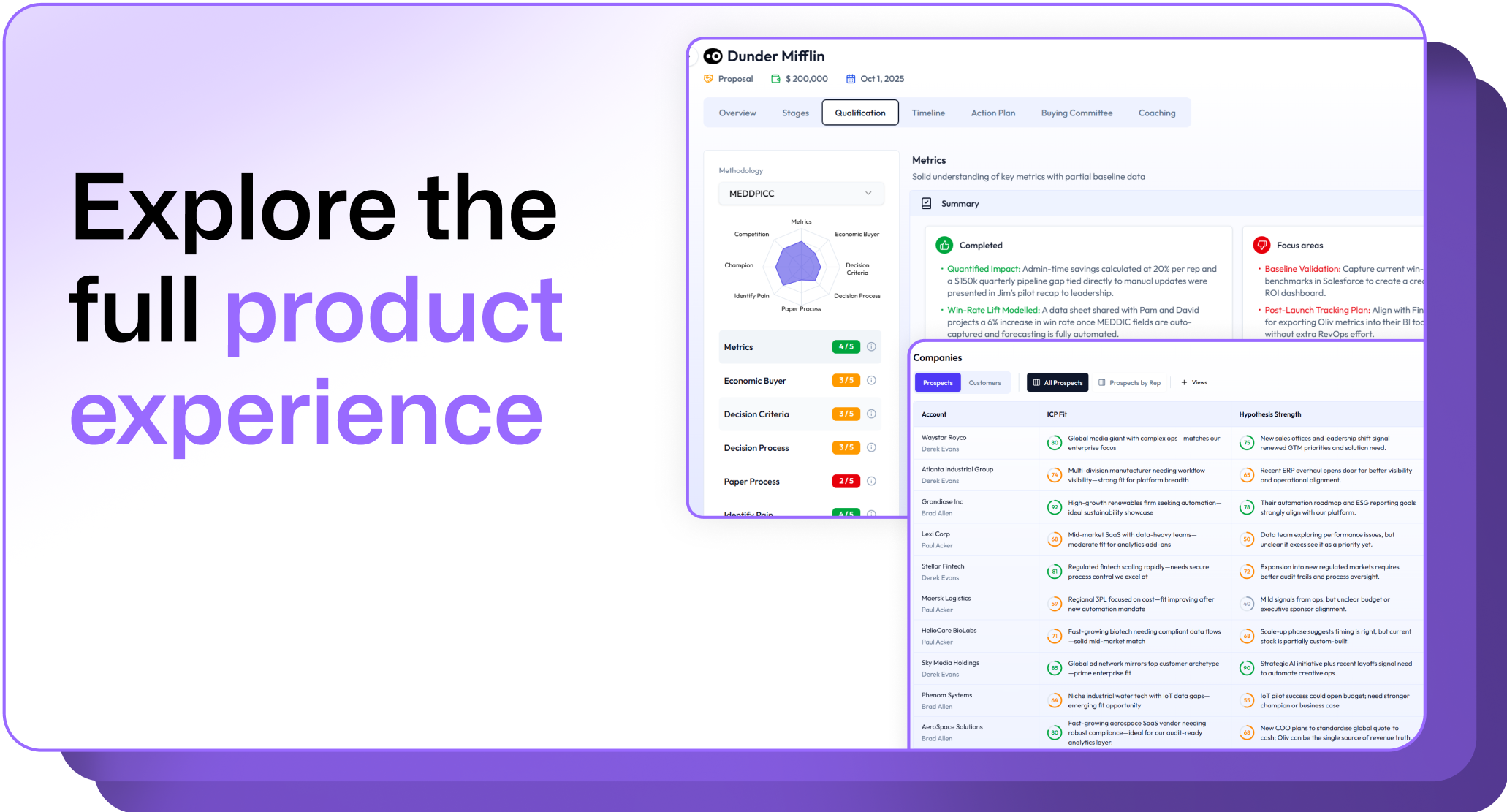
.avif)







.png)
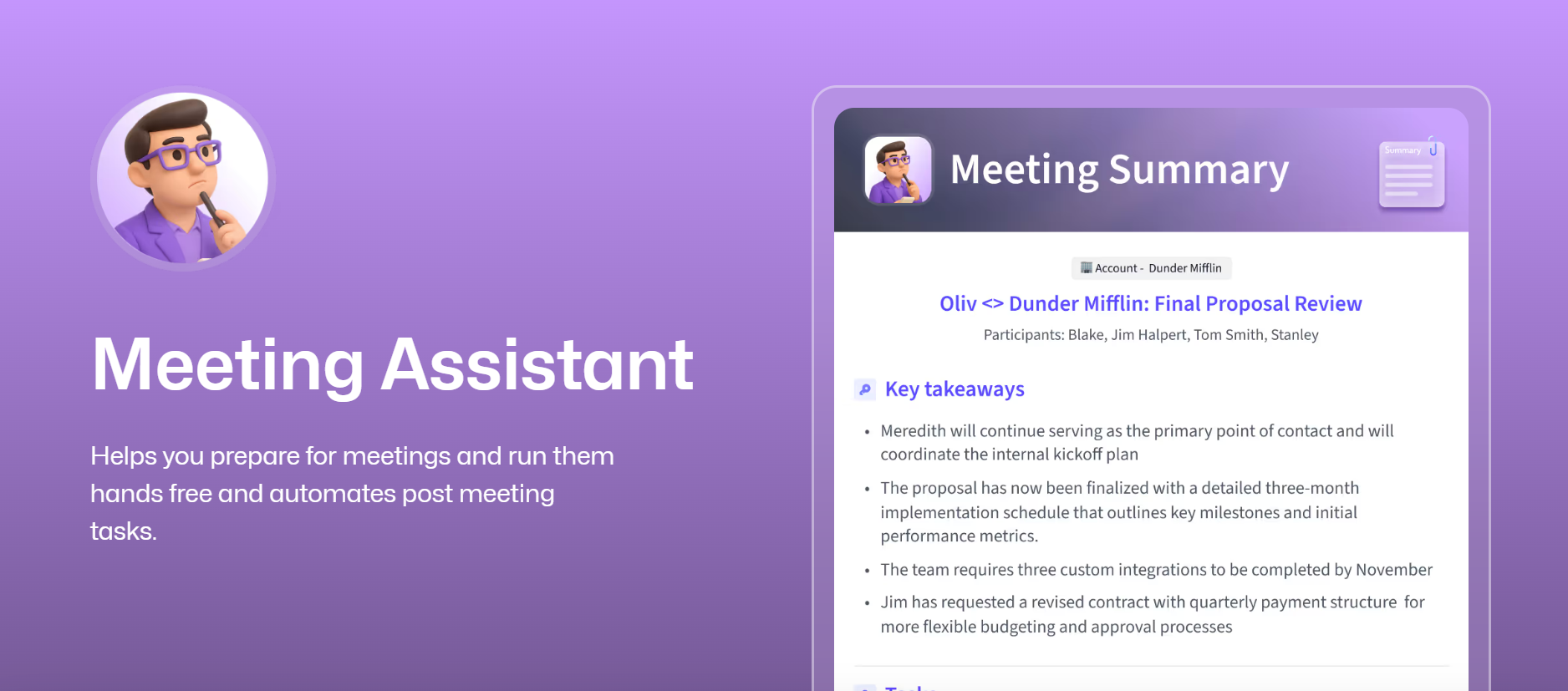
.png)