RevOps Integration Blueprint: Unify Calls, Email, Slack, and CRM Into One Deal View | 2026
Written by
Ishan Chhabra
Last Updated :
March 17, 2026
Skim in :
8
mins
In this article
Still got questions?
Come discuss this article with me.
Hi, I'm Ishan, Founder and CEO of Oliv.
I'm always up for a conversation about revenue intelligence, AI agents, or what's actually working (and what's not) across revenue teams.
I'd love to hear your perspective.
Thank you! Your submission has been received!
Oops! Something went wrong while submitting the form.
Meet Oliv’s AI Agents
Hi! I’m, Deal Driver
I track deals, flag risks, send weekly pipeline updates and give sales managers full visibility into deal progress
Hi! I’m, CRM Manager
I maintain CRM hygiene by updating core, custom and qualification fields all without your team lifting a finger
Hi! I’m, Forecaster
I build accurate forecasts based on real deal movement and tell you which deals to pull in to hit your number
Hi! I’m, Coach
I believe performance fuels revenue. I spot skill gaps, score calls and build coaching plans to help every rep level up
Hi! I’m, Prospector
I dig into target accounts to surface the right contacts, tailor and time outreach so you always strike when it counts
Hi! I’m, Pipeline tracker
I call reps to get deal updates, and deliver a real-time, CRM-synced roll-up view of deal progress
Hi! I’m, Analyst
I answer complex pipeline questions, uncover deal patterns, and build reports that guide strategic decisions
TL;DR
Mid-market reps toggle between 10+ tools daily, scattering deal context and turning forecasts into guesswork.
First-gen tools like Gong and Clari capture meeting data but miss Slack, Telegram, and dialer context entirely.
AI-based object association replaces brittle rule-based CRM mapping, even across duplicate accounts and multi-product deals.
Oliv natively covers all 9 data source categories, including the "dark social" layer competitors ignore.
Stacking Gong and Clari costs $500+/user/month; Oliv delivers 91% TCO reduction with faster time-to-value.
A practical 5-step RevOps blueprint compresses typical 6 to 8 week implementations into 2 to 4 weeks.
Q1: Why Is Your Revenue Data Scattered Across Ten Tools and Why Does It Kill Forecasts? [toc=Scattered Revenue Data]
If you're a Director of RevOps at a growth-stage company, you already know the pain: your pipeline reviews are built on partial truths. The average mid-market sales rep toggles between 10+ tools daily, including CRM, dialer, email, Slack, meeting recorder, and LinkedIn, and the result is a deal history scattered in fragments across every platform. When reps skip CRM updates because they feel like administrative policing, forecasting becomes guesswork.
⚠️ The Legacy Stack Problem
Traditional revenue intelligence tools were built to solve this, but each one only captures a slice of reality.
Gong records meetings and provides conversation intelligence, but it doesn't capture email threads, Slack discussions, or dialer activity into a unified deal record. As one user put it:
"Before Gong we had a lack of visibility across our deals because information was siloed in several places like CRM, Email, Zoom, phone." - Scott T., Director of Sales, Mid-Market, G2 Verified Review
Clari is powerful for forecasting roll-ups, but the process remains fundamentally rep-driven. One Reddit user observed:
"It is really just a glorified SFDC overlay. Actually, Salesforce has built most of the forecasting functionality by now anyway, so I'm not sure where they fit." - conaldinho11, r/SalesOperations Reddit Thread
Salesforce depends entirely on human data entry. When reps neglect fields, which they consistently do, the CRM becomes a static repository that reflects perhaps 40% of deal reality.
✅ The AI-Era Shift: From Documentation to Stitching
Generative AI has fundamentally changed what's possible. Instead of requiring humans to log every interaction, fine-tuned LLMs can now automatically ingest, parse, and stitch unstructured data from calls, emails, messaging threads, and web signals, mapping each interaction to the correct deal record without manual entry or rigid rule-based logic.
The average mid-market sales rep toggles between 10+ tools daily. AI-native data stitching consolidates every fragment into a single deal view.
How Oliv.ai Engineers the Unified Deal View
Oliv is built as an AI-native data platform, not a SaaS tool you adopt and train your team to use, but a foundation layer that does the work autonomously.
Full-Spectrum Data Stitching: Oliv unifies data from Zoom/Teams/Meet, Gmail/Outlook, Slack, Telegram, LinkedIn, dialers (JustCall, Orum, Aircall), support tickets, and web sources (Crunchbase, news) into a single intelligence layer.
100+ Fine-Tuned LLMs: Rather than generic AI, Oliv operates purpose-built models that extract specific signals, such as competitor mentions, churn risks, and feature requests, across the deal lifecycle.
Zero Manual Entry: The CRM Manager Agent automatically creates contacts, enriches accounts, and updates standard and custom CRM fields based on conversation context, not human memory.
"Before switching to Oliv, cleaning up messy CRM fields used to swallow half my week. Oliv fixes the data as it happens." - Darius Kim, Head of RevOps, Driftloop
Q2: Why Do Teams Call First-Gen Tools 'Keyword Trackers' and What's the Alternative? [toc=Keyword Trackers vs Contextual AI]
The term "keyword tracker" has become shorthand for a fundamental limitation of first-generation conversation intelligence. These tools flag specific words, such as "budget," "competitor," or "timeline," without understanding the context in which they appear. A prospect mentioning their "holiday budget" triggers the same alert as a serious procurement discussion, and managers eventually stop trusting the signals altogether.
❌ The "Noisy Platform" Syndrome
Gong's Smart Trackers, widely regarded as category-leading, are still built on V1 machine learning: keyword matching and basic rule-based logic. The result is what sales managers describe as "Noisy Platform" syndrome, a flood of alerts that buries actionable insights under irrelevant noise.
✅ Gong excels at recording and transcription fidelity
❌ But even power users struggle with the complexity:
"It can be overwhelming to set up trackers. AI training is a bit laborious to get it to do what you want." - Trafford J., Senior Director Revenue Enablement, Mid-Market, G2 Verified Review
What Users Say About the Navigation Experience
Other users are blunter about the navigation experience:
"It's too complicated, and not intuitive at all. Using it is very... discomforting. Searching for calls is not easy, moving around in the calls is not easy, and understanding the pipeline management portion of it is almost impossible." - John S., Senior Account Executive, Mid-Market, G2 Verified Review
Clari compounds this for RevOps directors who need the full picture; its forecasting module is useful once data is in, but it remains a pre-generative AI tool that requires managers to manually pull information from disparate screens.
✅ Contextual Reasoning: The Generative AI Alternative
The alternative to keyword tracking isn't better keywords, it's contextual understanding. Generative AI with Chain-of-Thought reasoning can distinguish between a competitor mentioned in passing and an active evaluation, between a standard technical objection and a champion losing confidence in the deal. This shifts the model from "what was said" to "what was meant."
How Oliv Replaces Keyword Trackers With Intent Intelligence
Oliv is powered by 100+ fine-tuned LLMs that understand the nuance of sales conversations at the intent level, not the word level.
Reasoning Models Over Rigid Rules: Oliv uses Chain-of-Thought analysis to evaluate every interaction and auto-populate evidence-based scorecards (MEDDPICC, BANT) based on deal context.
Signal, Not Noise: Where keyword trackers flag volume, Oliv surfaces meaning, knowing when a prospect is raising a routine technical question versus signaling a genuine objection.
Coach Agent: Identifies individual skill gaps based on live deal performance, turning conversation analysis into a personalized coaching loop rather than a wall of alerts.
"Gong blew up my Slack all day, but I still had to click through ten screens... With Oliv, I finally get what I need, forecast, pipeline review, deal updates, dropped right in my inbox." - Mia Patterson, Sales Manager, Beacon
Q3: What Data Sources Does a True RevOps Integration Blueprint Stitch Together? [toc=Data Sources Blueprint]
A modern RevOps integration blueprint must account for every channel where deal-relevant interactions occur, not just recorded meetings. Below is a comprehensive map of the data sources that feed a unified deal view, along with the type of intelligence each provides.
📞 Meeting & Call Platforms
Meeting and Call Platform Data Sources
Source
Data Type
Examples
Video Conferencing
Call recordings, transcripts, speaker analytics
Zoom, Microsoft Teams, Google Meet, Cisco Webex
Dialers
Outbound/inbound call recordings, call disposition, talk time
Aircall, Orum, JustCall, Nooks, Dialpad
These represent the traditional foundation of conversation intelligence, where tools like Gong and Chorus have historically operated.
📧 Email & Calendar
Email and Calendar Data Sources
Source
Data Type
Examples
Email
Thread context, attachments, response time, sentiment
Email threads contain critical deal context, including pricing discussions, stakeholder introductions, and objection handling, that meeting recorders miss entirely.
This is the most under-captured layer in modern B2B sales. Deal progression happens in shared Slack channels and Telegram threads, yet most revenue intelligence tools treat these platforms exclusively as notification endpoints, not data sources.
The CRM remains the system of record, but it should be the destination of stitched intelligence, not the place where reps manually enter fragmented data.
How Oliv.ai Covers the Full Spectrum
Oliv natively integrates across all layers above, including meetings, emails, Slack, Telegram, LinkedIn, dialers, web enrichment, and multi-CRM support (Salesforce, HubSpot, Dynamics, Pipedrive, Zoho). Its AI Data Platform automatically tracks everything across these sources and maps each interaction to the correct deal using AI-based object association, creating a single, evolving 360 degree deal view without any manual entry.
Q4: How Do You Capture Deal Context From Slack and Telegram, Not Just Zoom Calls? [toc=Slack & Telegram Deal Context]
In modern B2B sales, the most revealing deal signals often surface outside of scheduled meetings. A champion shares competitive intel in a shared Slack channel. A technical buyer raises a blocker in a Telegram group. A procurement lead confirms budget alignment via a quick message instead of scheduling a 30-minute call. This "dark social" layer of deal context is invisible to any tool that only records video conferences.
❌ The Competitor Blind Spot
The gap isn't just a feature limitation; it's an architectural one. Traditional revenue intelligence platforms were built around a meeting-centric model.
Gong records and analyzes calls, but does not import from Slack or Telegram. It remains blind to how a deal actually progresses between scheduled meetings, including the stakeholder introductions, the informal objections, and the budget confirmations that happen in chat.
Salesforce Einstein Activity Capture attempts email capture but has been widely criticized for its limitations. One reviewer noted its biggest shortcoming:
"Its biggest handicap is that it does not allow for data storage or data migration. You can't really input the data from Einstein into another platform." - Verified Reviewer, Enterprise, Gartner Peer Insights
What This Means for Your CRM
The result is a CRM that tells you when meetings happened but not what was decided in the 15 Slack messages exchanged afterward.
✅ Treating Messaging Platforms as Data Sources
The AI-era breakthrough isn't adding Slack as a notification channel; it's ingesting Slack and Telegram as first-class data sources. Large language models can now parse unstructured messaging threads, identify deal-relevant context, attribute messages to known contacts, and map them to the correct CRM opportunity. This turns ephemeral chat history into structured, queryable deal intelligence.
How Oliv Captures the Full Conversation Cycle
Oliv is the only revenue orchestration platform that stitches data entirely across all communication channels, including the ones competitors ignore.
Omnichannel Capture: Oliv integrates with Slack and Telegram natively, bringing "dark social" context into the evolving deal summary alongside call transcripts and email threads.
Slack Deal Rooms: Oliv can automatically create Deal Rooms in Slack, share AI-generated insights with all stakeholders, and ingest those discussions back into the CRM, turning a notification channel into a bi-directional intelligence loop.
MAP Manager Agent: Automatically updates Mutual Action Plans based on milestones mentioned in Slack or Telegram messages, ensuring no commitment falls through the cracks.
LinkedIn Partner Integration: As a LinkedIn Partner, Oliv tracks stakeholder job changes and job moves, alerting CSMs or AEs when a key decision-maker leaves an account, a signal that lives entirely outside the meeting-recording paradigm.
"Chorus has been an okay experience... will be moving to Gong next term, used Clari before it was awful." - Justin S., Senior Marketing Operations Specialist, Enterprise, G2 Verified Review
This review captures the vendor-hopping cycle that many RevOps teams experience, moving between tools that each cover only a fraction of the conversation landscape. Oliv breaks this cycle by covering calls, emails, Slack, Telegram, and LinkedIn in a single platform.
Q5: How Does AI Map a Slack Message to the Right CRM Opportunity? [toc=AI Slack-to-CRM Mapping]
In enterprise accounts running multiple products, a single Slack message could belong to any of three or four open opportunities. Imagine an account like "Acme Corp" with separate deals for Platform, Analytics, and Professional Services. When a stakeholder sends a message about timeline changes, which opportunity does it attach to? Manual CRM entry is unreliable because reps either guess or skip the step entirely. Rule-based automation fares no better: duplicate accounts (e.g., Google US vs. Google India) and overlapping contact records break rigid matching logic before it even starts.
Oliv's context engineering examines participants, product mentions, and deal history to map each Slack message to the correct opportunity automatically.
❌ Why Rule-Based Mapping Fails at Scale
Legacy systems attempt to solve this with deterministic rules: match by domain, match by contact owner, match by most recent activity. But these approaches collapse under real-world complexity.
Einstein Activity Capture uses brittle rule-based logic that frequently attaches activities to the wrong record when duplicate accounts exist. One enterprise reviewer highlighted the core data limitation:
"Its biggest handicap is that it does not allow for data storage or data migration. You can't really input the data from Einstein into another platform."
Gong captures meeting-level data but lacks the intelligence to apply contextual reasoning to unstructured chat. Its keyword dependence means it cannot differentiate between two opportunities at the same account, and it doesn't ingest Slack or Telegram in the first place.
Clari's Integration Complexity
Even Clari, praised for its forecasting overlay, creates integration headaches for RevOps. As one Head of Sales Operations noted:
"I find the setup process challenging, especially when migrating fields from Salesforce... integration capabilities are inadequate, particularly in pulling in call transcripts." - Josiah R., Head of Sales Operations, Mid-Market, G2 Verified Review
✅ AI-Based Object Association: Reasoning Over Rules
The breakthrough isn't better rules; it's replacing rules with reasoning altogether. Large language models can examine the complete interaction history of multiple opportunities at the same domain, analyze participants, topics, and timelines, and determine the correct logical association. This is a capability that deterministic rule engines simply cannot replicate.
How Oliv Uses Context Engineering to Solve Mapping
Oliv's core IP is its AI-based activity mapping technology. Rather than relying on prompt engineering, Oliv uses context engineering, examining the full history of different opportunities at the same domain and correctly mapping new stakeholder interactions to the relevant deal.
Contextual Specification: When a new Slack message arrives, Oliv reasons through which opportunity's context (participants, product mentions, deal stage, historical thread) aligns with the message content.
Automatic Deduplication: Oliv's AI identifies when "Google US" and "Google India" are related entities and associates activities to the right logical account, even merging duplicates automatically.
Custom Integration Velocity: For companies with unique data architectures, Oliv builds custom integrations rapidly, connecting proprietary data lakes to the deal narrative without months-long IT projects.
"Instead of brittle rules, Oliv asks AI to look at all their history and figure out which one will be the right logical one." - Ishan Chhabra, Founder, Oliv AI
Q6: How Does a 360 Degree Deal Narrative Get Built From Fragmented Sources? [toc=360 Deal Narrative]
A 360 degree deal narrative is not an activity log. It's not a list of "email sent," "call logged," "meeting held." It's a chronological, context-rich story that shows how a deal evolved: who said what, which objections surfaced, when sentiment shifted, and what the next milestone is. The distinction matters because most revenue intelligence platforms today deliver the log but never assemble the story. RevOps directors are left with timestamps but no intelligence.
❌ Activity Logs vs Deal Intelligence
Traditional tools measure deal progress by counting activities rather than understanding their quality. This creates fundamental blind spots.
Gong analyzes the number of activities (10 emails sent, 3 meetings held) rather than the substance of those interactions. A rep "blasting emails" and a rep having a high-value discovery call register as equal pipeline activity. Even supporters acknowledge the gap:
"The additional products like forecast or engage come at an additional cost. Would be great to see these tools rolled into the core offering."
Clari excels at surfacing forecasting views but struggles to deliver a coherent narrative. One Sales Operations Manager described the experience:
"All the pieces are there but missing the story line. Would prefer to have a summary analytics page... You have to click around through the different modules and extract the different pieces, ultimately putting it in an Excel for easier manipulation." - Natalie O., Sales Operations Manager, Mid-Market, G2 Verified Review
Salesforce remains a static repository that depends on human data entry. When reps stop entering data, which they consistently do, the CRM fails as a narrative source entirely.
✅ From Activity Counting to Narrative Assembly
The AI-era approach is fundamentally different: every interaction across channels is ingested, time-stamped, deduplicated, attributed to the correct contact and opportunity, then synthesized into an evolving summary that updates after every call, email, or Slack message. The system doesn't just record events; it weaves them into a coherent deal story.
How Oliv Builds the Evolving Deal Summary
Oliv's Evolving Deal Summary consolidates every interaction into structured Takeaways and Next Steps, visible in the manager's weekly portfolio report.
Last Meaningful Engagement: Oliv differentiates between surface-level activity and substantive deal movement. A rep sending five follow-up emails doesn't trigger the same signal as a confirmed technical review meeting.
360 Degree Stitched Narrative: Every call transcript, email thread, Slack message, and LinkedIn signal is woven into a single chronological deal story that matures as the sales cycle progresses.
Reasoning Over Rules: Instead of simple matching, Oliv's AI reasons through the full deal history to associate activities correctly, even merging duplicate accounts automatically to maintain narrative integrity.
"With Gong, I have trouble understanding breadth versus depth... Oliv is the first time I've ever been speechless." - Akil Sharperson, CSM Lead, Triple Whale
Q7: Does This Integrate With Your Dialer Stack, Including Aircall, Orum, and JustCall? [toc=Dialer Stack Integration]
Mid-market revenue teams rely heavily on specialized dialers for outbound prospecting and inbound call handling. When the dialer stack operates in isolation, disconnected from CRM, email, and meeting data, critical context gets lost between calls. Below is a factual breakdown of how major platforms handle dialer integration, and where the gaps persist.
📞 Gong's Dialer Integration Limitations
Gong records meetings natively via Zoom, Teams, and Meet, but its own dialer product (Gong Engage) has drawn significant criticism from users:
✅ Strong core conversation intelligence for recorded meetings
✅ Captures call-level analytics and talk ratios
❌ Gong Engage "lacks task APIs, does not integrate with other vendors or parallel dialers, and isn't built to function as a proper sequencing tool"
❌ Professional Services support is limited. One team reported being told their engagement was being "brought to a close" despite needing training for 10+ new hires
"Gong is strong at conversation intelligence, but that's where its usefulness ends... The platform lacks task APIs, does not integrate with other vendors or parallel dialers." - Anonymous Reviewer, G2 Verified Review
📞 Salesloft's Dialer Challenges
Salesloft positions its Conversations product as a Gong competitor, but users report fundamental reliability issues with the dialer:
✅ Cadence and email tracking features work well
❌ "Conversations doesn't work at all. They sell it as a Gong competitor. It doesn't even have the functionality of Zoom." Verified User, Mid-Market, G2 Verified Review
❌ Dialer is "often slow at launching when making calls" with "data connectivity between apps" frequently breaking Andrew B., Sales Development Representative, G2 Verified Review
📞 Outreach's Dialer Gaps
Outreach handles email sequencing well but its calling infrastructure falls short for high-volume teams:
✅ Solid email and sequence management
❌ "Dialing features are not great, and for high volume teams, this will be a huge lag. Sometimes numbers don't connect, sometimes valid numbers don't dial, and we show as spam 15 to 20% of the time." Ethan R., Sales Development Representative, Mid-Market, G2 Verified Review
Oliv acts as a unified intelligence layer that plugs into your existing dialer stack without forcing a platform switch. It natively integrates with Orum, Nooks, JustCall, Aircall, and Dialpad, pulling call recordings and context directly into the deal narrative. Oliv doesn't hold data hostage; it ingests from your dialer and full-open exports it into your CRM, ensuring every call becomes part of the 360 degree deal view.
Q8: How Do You Deliver Deal Insights in Slack and Email Without Spamming Your Team? [toc=Insight Delivery Without Spam]
Sales managers overseeing 8 to 12 reps face a brutal volume problem: 25 to 35 calls per day across their team, plus hundreds of emails and Slack messages. It's practically impossible to review every deal in real time. Traditional tools attempted to solve this by pushing alerts, but they overcorrected, creating a firehose of notifications that managers eventually mute entirely.
❌ The Legacy Delivery Model: Five Note-Takers, Zero Task Completion
The pattern is painfully consistent across first-generation platforms. Tools capture data but dump it on users without curation, forcing managers to dig for insights rather than receiving them.
Gong provides rich call data, but the experience is often overwhelming. One senior AE described the navigation:
"It's too complicated, and not intuitive at all. Using it is very... discomforting. Searching for calls is not easy, moving around in the calls is not easy." - John S., Senior Account Executive, Mid-Market, G2 Verified Review
Salesforce Agentforce's Chat-Based Friction
Salesforce Agentforce takes a different approach but lands in the same place. Its chat-based UX requires managers to manually "talk to a bot" to extract insights, adding friction instead of removing it. Users report:
"Lots of clicking to get select the right options. UX needs improvement. Everything opens in a new browser tab, clustering the browser." Verified User, Enterprise, G2 Verified Review
The result? Managers spend evenings listening to recordings at 2x speed or "dashboard digging" just to stay informed, not because the data doesn't exist, but because no platform delivers it intelligently.
✅ Smart Insight Delivery: From Firehose to Editorial Brief
The AI-era model flips the delivery architecture. Instead of flooding every channel with raw alerts, generative AI can time-gate, batch, and route insights based on urgency, recipient role, and deal stage. A first-call summary doesn't need the same delivery urgency as a deal at risk of slipping. A manager reviewing pipeline needs a curated digest, not 47 individual call notifications.
How Oliv Architects Insight Delivery
Oliv provides "Insights, Right on Time," delivered directly where your team lives, in Slack and Email, without the noise.
⏰ Morning Briefs: 30 minutes before any call, Oliv pushes a Slack summary of the account history, stakeholder map, and tech stack so the rep never goes in "cold."
🌅 Sunset Summaries: Every evening, managers receive a daily digest of which deals moved, which stalled, and which require urgent intervention, no dashboard required.
📊 Weekly Deal Driver: A proactive pipeline review that highlights contextual risks and coaching opportunities, saving managers an estimated one full day per week of manual auditing.
🔇 No Spam Architecture: Oliv's agents are delivered "where you live." Reps never leave Slack or Gmail, and managers never receive an alert that doesn't carry actionable context.
"Gong blew up my Slack all day... With Oliv, I finally get what I need, forecast, pipeline review, deal updates, dropped right in my inbox."
Mia Patterson, Sales Manager, Beacon
Q9: How Do Gong, Clari, and Salesforce Compare on Multi-Channel Integration Coverage? [toc=Multi-Channel Integration Comparison]
For RevOps directors evaluating revenue intelligence platforms, the most critical question isn't which tool has the best AI, it's which tool captures the most complete picture of your deal. Below is a factual comparison of multi-channel integration coverage across the major platforms, based on publicly documented capabilities and verified user feedback.
📊 Multi-Channel Integration Coverage Matrix
Multi-Channel Integration Coverage Matrix
Data Source
Gong
Clari
Salesforce (Einstein)
Outreach
Oliv.ai
Zoom / Teams / Meet
✅ Native
✅ Via Copilot
✅ Via Einstein Activity Capture
❌ Limited
✅ Native
Gmail / Outlook
✅ Email tracking
✅ Via Groove
✅ Einstein Activity Capture
✅ Native
✅ Native
Slack
❌ Notification only
❌ Not captured
❌ Not captured
❌ Not captured
✅ Native ingestion
Telegram
-
-
-
-
✅ Native ingestion
LinkedIn
❌ Limited
-
-
-
✅ Partner integration
Dialers (Aircall, Orum, JustCall)
⚠️ Partial
❌ Via Groove/Aircall only
-
-
✅ Native (5+ dialers)
Support Tickets (Zendesk, Intercom)
-
-
✅ Via Service Cloud
-
✅ Native
Web Enrichment (Crunchbase, News)
-
-
-
-
✅ Native
CRM Write-Back (Object-Level)
⚠️ Notes only
✅ Bi-directional fields
✅ Native
⚠️ Limited sync
✅ Full object-level
❌ Key Integration Gaps by Platform
Gong excels at conversation intelligence but operates primarily at the meeting level. One Sales Operations Manager summarized the data portability challenge:
"This lack of flexibility has required us to engage our development team at additional cost, adding significant operational and opportunity costs just to extract data we already own." - Neel P., Sales Operations Manager, Small-Business, G2 Verified Review
Clari's Narrower Integration Surface
Clari provides strong forecasting views when data is available, but the integration surface is narrower than expected. As one reviewer noted:
"Clari should find ways to differentiate from the native Salesforce features (e.g., Pipeline Inspection, Forecasting) in order to remain competitive in the long-run." - Dan J., Mid-Market, G2 Verified Review
Einstein's Setup Complications
Salesforce Einstein benefits from native CRM access but introduces its own complications:
"It has an extremely complicated set up process" and "does not allow for data storage or data migration. - Verified Reviewer, Enterprise, Gartner Peer Insights
✅ How Oliv.ai Fills the Coverage Gap
Oliv is the only platform in this comparison that natively covers all nine data source categories, from video meetings and email through Slack, Telegram, LinkedIn, multi-dialer support, support tickets, and web enrichment. This isn't an add-on architecture; it's a foundation-layer AI Data Platform that stitches every source into a single deal view with zero manual entry.
Q10: How Do You Create a Single Source of Truth When Data Lives Everywhere? [toc=Single Source of Truth]
Every RevOps director aspires to a "single source of truth", but the reality on the ground is that reps hate updating the CRM, data exists in bits and pieces across every platform, and CROs can't answer basic pipeline questions without a 45-minute forensic investigation. The RevOps director is stuck between enforcement (policing reps into logging activities) and acceptance (living with dirty data that erodes forecast confidence).
❌ Why the Traditional Model Fails
The fundamental flaw isn't the CRM itself, it's that every legacy tool in the stack depends on human compliance to function.
Gong captures calls and generates notes, but it doesn't update CRM properties. The notes it logs are unstructured and unsearchable, unusable for RevOps reporting or dashboard automation. As one user observed:
"Before Gong we had a lack of visibility across our deals because information was siloed in several places like CRM, Email, Zoom, phone." Scott T., Director of Sales, Mid-Market, G2 Verified Review
The Salesforce Overlay Problem
Salesforce adds manual burden to SDRs and AEs. One Reddit commenter captured the Clari and Salesforce dynamic precisely:
"It is really just a glorified SFDC overlay... I think it can be useful if you have a complex GTM motion but definitely overkill for most companies." conaldinho11, r/SalesOperations Reddit Thread
✅ The AI-Native Revenue Orchestration Paradigm
The shift isn't about better documentation tools, it's about replacing documentation with AI-Native Revenue Orchestration. AI agents can maintain CRM data autonomously, following a 5-step integration blueprint:
Audit all channels where deal context exists (calls, email, Slack, Telegram, dialer, LinkedIn)
Map each channel to CRM objects (contacts, accounts, opportunities, custom fields)
Configure AI ingestion per source, what data to extract, how to deduplicate, where to write
Build the evolving deal narrative from stitched signals
Deliver insights where teams live (Slack briefs, email digests, weekly reports)
How Oliv Engineers the Single Source of Truth
Oliv's CRM Manager Agent updates actual CRM objects and properties, standard and custom, based on the context of every conversation, email, and message. We call this the "Invisible UI" principle: reps never leave Slack or Gmail, yet every CRM field stays current.
Object-Level Automation replaces documentation-level logging. Oliv writes to the correct field, not just a notes box
Automatic Contact Creation and Enrichment eliminates the need for reps to manually add stakeholders discovered in calls or Slack threads
💰 The TCO Argument
The cost of maintaining the legacy stack compounds over time. Stacking Gong (~$250/mo bundled) and Clari (~$200/mo) leads to a TCO of $500+/user once platform fees and implementation are factored in. Over three years for 100 users, that's approximately $789,300 for Gong alone, versus $68,400 on Oliv: a 91% cost reduction with faster time-to-value.
Q11: How Do You Get IT and Security to Approve a Tool That Connects to CRM + Email + Calendar + Slack? [toc=IT Security Approval]
For mid-market and enterprise RevOps directors, the hardest part of deploying a new revenue intelligence tool often isn't the evaluation, it's getting IT and Security to sign off. AI policies remain immature at most organizations, and security reviews can delay deployments by 6 to 9 months. The fear is threefold: data leakage across connected systems, hallucinated CRM updates creating legal liability, and compliance gaps in newer AI vendors.
❌ The Legacy Security Problem
Older SaaS platforms were built in an era when security was bolted on after launch, not engineered into the foundation. This creates real challenges for IT teams conducting vendor reviews.
Salesforce Agentforce benefits from Salesforce's enterprise infrastructure, but the complexity of its add-on architecture means each integration point introduces new permission scoping. Users report the friction directly:
"Can be complex to set up and customize... Expensive, especially for smaller teams. Steep learning curve for new users." Shubham G., Senior BDM, Small-Business, G2 Verified Review
The AI Adoption Challenge
Generic GPT-based tools are not grounded in company-specific data, leading to high error rates. As one Agentforce reviewer noted the broader AI concern:
"Adoption is low because of the lack of knowledge on the subject as AI is a new field. Customers are finding issues in deploying and using agents." Anusha T., Web Developer, Small-Business, G2 Verified Review
✅ The "Security by Design" Standard for AI-Native Tools
IT teams evaluating AI-native revenue tools should require:
Enterprise Security Requirements for AI-Native Revenue Tools
Security Requirement
What It Means
Why It Matters
SOC 2 Type II
Audited controls for data handling
Baseline enterprise trust
GDPR / CCPA Compliance
Data subject rights, deletion, portability
Legal obligation for EU/US data
SAML SSO + SCIM
Single sign-on + automated user provisioning
Reduces access management burden
AES-256 Encryption at Rest
Data encrypted in storage
Protects against breaches
TLS 1.2+ in Transit
Encrypted data transmission
Prevents interception
Audit Logging
Complete record of agent actions
Accountability and compliance
Human-in-the-Loop (HITL)
AI drafts, human approves before CRM push
Prevents hallucinated data entry
How Oliv Passes Enterprise Security Reviews
Oliv is built with enterprise-grade security by design, not as an afterthought. All certifications are publicly accessible at trust.oliv.ai.
✅ SOC 2, GDPR, and CCPA compliant, documentation available for procurement and legal review
✅ Human-in-the-Loop (HITL): To prevent legal liability, Oliv's agents draft follow-ups and CRM updates but nudge the rep to verify and approve in Slack before any data is pushed
✅ Grounded Data Lake: Oliv's fine-tuned LLMs operate only within the customer's secure data workspace, ensuring the AI never pulls from its general training knowledge, effectively eliminating hallucination risk
Why Oliv Requires Zero Prompt Engineering
"Effectively crafting prompts and configuring the underlying actions demands a specific skill set often called 'prompt engineering.' You really need to understand how the AI interprets instructions to achieve the desired outcomes."
Oliv eliminates this complexity entirely, there's no prompt engineering required, no specialized admin roles, and no multi-week configuration cycles.
Q12: What Does the RevOps Integration Blueprint Look Like in Practice, A 5-Step Implementation Roadmap? [toc=5-Step Implementation Roadmap]
Moving from fragmented revenue data to a unified deal view doesn't require a six-month implementation project. Below is a practical, step-by-step roadmap that any RevOps director can follow, from initial audit to full deployment.
The complete RevOps integration roadmap, from channel audit to insight delivery, compressed from 6 to 8 weeks into a 2 to 4 week deployment.
Step 1: Audit Your Deal Context Channels ⏰ (Day 1)
Before selecting or configuring any tool, map every channel where deal-relevant interactions occur.
Deal Context Channel Audit
Channel Category
Common Tools
Deal Context Captured
Video Meetings
Zoom, Teams, Meet, Webex
Discovery calls, demos, negotiations
Email
Gmail, Outlook
Proposals, follow-ups, stakeholder introductions
Messaging
Slack, Telegram
Deal updates, internal alignment, buyer signals
Dialers
Aircall, Orum, JustCall, Nooks
Cold outreach, inbound calls, follow-up calls
Social/Web
LinkedIn, Crunchbase, news
Job changes, funding events, tech stack signals
Support
Zendesk, Intercom, Freshdesk
Churn signals, product friction, escalations
Source: Oliv AI integration documentation; industry-standard RevOps audit frameworks.
Step 2: Map Channels to CRM Objects (Day 2 to 3)
Define how each data source maps to your CRM structure:
This mapping determines which CRM fields get updated and by what logic. Rule-based systems break here, which is why AI-based association is critical for accuracy.
Step 3: Configure AI Ingestion Per Source (Week 1 to 2)
For traditional platforms, this step involves weeks of setup:
Gong implementation typically takes 6 to 8 weeks and consumes 40 to 140 admin hours
Clari requires Salesforce hierarchy configuration, field migration, and training. One reviewer noted:
"I find the setup process challenging, especially when migrating fields from Salesforce, as it can't handle formula fields directly." Josiah R., Head of Sales Operations, Mid-Market, G2 Verified Review
With Oliv, baseline configuration takes approximately 5 minutes. Connect your CRM, calendar, email, and meeting platform via OAuth, and the AI begins ingesting immediately.
Step 4: Build the Evolving Deal Narrative (Week 2 to 3)
Once ingestion is live, the platform should automatically:
Time-stamp every interaction across channels
Deduplicate contacts and accounts
Attribute each activity to the correct opportunity
Synthesize interactions into a chronological deal summary
Update CRM fields with extracted intelligence (not just notes)
Step 5: Deliver Insights In-Flow (Week 3 to 4) ✅
Configure delivery cadence to match your team's workflow:
Pre-call briefs → Slack (30 min before meetings)
Daily deal movement digest → Email (end of day for managers)
Oliv compresses this entire 5-step blueprint from a typical 6 to 8 week implementation into a 2 to 4 week fully customized deployment. The baseline configuration takes 5 minutes, AI ingestion begins immediately, and the CRM Manager Agent, Morning Briefs, Sunset Summaries, and Weekly Deal Drivers are operational within the first week, delivering time-to-value that legacy platforms simply cannot match.
Q1: Why Is Your Revenue Data Scattered Across Ten Tools and Why Does It Kill Forecasts? [toc=Scattered Revenue Data]
If you're a Director of RevOps at a growth-stage company, you already know the pain: your pipeline reviews are built on partial truths. The average mid-market sales rep toggles between 10+ tools daily, including CRM, dialer, email, Slack, meeting recorder, and LinkedIn, and the result is a deal history scattered in fragments across every platform. When reps skip CRM updates because they feel like administrative policing, forecasting becomes guesswork.
⚠️ The Legacy Stack Problem
Traditional revenue intelligence tools were built to solve this, but each one only captures a slice of reality.
Gong records meetings and provides conversation intelligence, but it doesn't capture email threads, Slack discussions, or dialer activity into a unified deal record. As one user put it:
"Before Gong we had a lack of visibility across our deals because information was siloed in several places like CRM, Email, Zoom, phone." - Scott T., Director of Sales, Mid-Market, G2 Verified Review
Clari is powerful for forecasting roll-ups, but the process remains fundamentally rep-driven. One Reddit user observed:
"It is really just a glorified SFDC overlay. Actually, Salesforce has built most of the forecasting functionality by now anyway, so I'm not sure where they fit." - conaldinho11, r/SalesOperations Reddit Thread
Salesforce depends entirely on human data entry. When reps neglect fields, which they consistently do, the CRM becomes a static repository that reflects perhaps 40% of deal reality.
✅ The AI-Era Shift: From Documentation to Stitching
Generative AI has fundamentally changed what's possible. Instead of requiring humans to log every interaction, fine-tuned LLMs can now automatically ingest, parse, and stitch unstructured data from calls, emails, messaging threads, and web signals, mapping each interaction to the correct deal record without manual entry or rigid rule-based logic.
The average mid-market sales rep toggles between 10+ tools daily. AI-native data stitching consolidates every fragment into a single deal view.
How Oliv.ai Engineers the Unified Deal View
Oliv is built as an AI-native data platform, not a SaaS tool you adopt and train your team to use, but a foundation layer that does the work autonomously.
Full-Spectrum Data Stitching: Oliv unifies data from Zoom/Teams/Meet, Gmail/Outlook, Slack, Telegram, LinkedIn, dialers (JustCall, Orum, Aircall), support tickets, and web sources (Crunchbase, news) into a single intelligence layer.
100+ Fine-Tuned LLMs: Rather than generic AI, Oliv operates purpose-built models that extract specific signals, such as competitor mentions, churn risks, and feature requests, across the deal lifecycle.
Zero Manual Entry: The CRM Manager Agent automatically creates contacts, enriches accounts, and updates standard and custom CRM fields based on conversation context, not human memory.
"Before switching to Oliv, cleaning up messy CRM fields used to swallow half my week. Oliv fixes the data as it happens." - Darius Kim, Head of RevOps, Driftloop
Q2: Why Do Teams Call First-Gen Tools 'Keyword Trackers' and What's the Alternative? [toc=Keyword Trackers vs Contextual AI]
The term "keyword tracker" has become shorthand for a fundamental limitation of first-generation conversation intelligence. These tools flag specific words, such as "budget," "competitor," or "timeline," without understanding the context in which they appear. A prospect mentioning their "holiday budget" triggers the same alert as a serious procurement discussion, and managers eventually stop trusting the signals altogether.
❌ The "Noisy Platform" Syndrome
Gong's Smart Trackers, widely regarded as category-leading, are still built on V1 machine learning: keyword matching and basic rule-based logic. The result is what sales managers describe as "Noisy Platform" syndrome, a flood of alerts that buries actionable insights under irrelevant noise.
✅ Gong excels at recording and transcription fidelity
❌ But even power users struggle with the complexity:
"It can be overwhelming to set up trackers. AI training is a bit laborious to get it to do what you want." - Trafford J., Senior Director Revenue Enablement, Mid-Market, G2 Verified Review
What Users Say About the Navigation Experience
Other users are blunter about the navigation experience:
"It's too complicated, and not intuitive at all. Using it is very... discomforting. Searching for calls is not easy, moving around in the calls is not easy, and understanding the pipeline management portion of it is almost impossible." - John S., Senior Account Executive, Mid-Market, G2 Verified Review
Clari compounds this for RevOps directors who need the full picture; its forecasting module is useful once data is in, but it remains a pre-generative AI tool that requires managers to manually pull information from disparate screens.
✅ Contextual Reasoning: The Generative AI Alternative
The alternative to keyword tracking isn't better keywords, it's contextual understanding. Generative AI with Chain-of-Thought reasoning can distinguish between a competitor mentioned in passing and an active evaluation, between a standard technical objection and a champion losing confidence in the deal. This shifts the model from "what was said" to "what was meant."
How Oliv Replaces Keyword Trackers With Intent Intelligence
Oliv is powered by 100+ fine-tuned LLMs that understand the nuance of sales conversations at the intent level, not the word level.
Reasoning Models Over Rigid Rules: Oliv uses Chain-of-Thought analysis to evaluate every interaction and auto-populate evidence-based scorecards (MEDDPICC, BANT) based on deal context.
Signal, Not Noise: Where keyword trackers flag volume, Oliv surfaces meaning, knowing when a prospect is raising a routine technical question versus signaling a genuine objection.
Coach Agent: Identifies individual skill gaps based on live deal performance, turning conversation analysis into a personalized coaching loop rather than a wall of alerts.
"Gong blew up my Slack all day, but I still had to click through ten screens... With Oliv, I finally get what I need, forecast, pipeline review, deal updates, dropped right in my inbox." - Mia Patterson, Sales Manager, Beacon
Q3: What Data Sources Does a True RevOps Integration Blueprint Stitch Together? [toc=Data Sources Blueprint]
A modern RevOps integration blueprint must account for every channel where deal-relevant interactions occur, not just recorded meetings. Below is a comprehensive map of the data sources that feed a unified deal view, along with the type of intelligence each provides.
📞 Meeting & Call Platforms
Meeting and Call Platform Data Sources
Source
Data Type
Examples
Video Conferencing
Call recordings, transcripts, speaker analytics
Zoom, Microsoft Teams, Google Meet, Cisco Webex
Dialers
Outbound/inbound call recordings, call disposition, talk time
Aircall, Orum, JustCall, Nooks, Dialpad
These represent the traditional foundation of conversation intelligence, where tools like Gong and Chorus have historically operated.
📧 Email & Calendar
Email and Calendar Data Sources
Source
Data Type
Examples
Email
Thread context, attachments, response time, sentiment
Email threads contain critical deal context, including pricing discussions, stakeholder introductions, and objection handling, that meeting recorders miss entirely.
This is the most under-captured layer in modern B2B sales. Deal progression happens in shared Slack channels and Telegram threads, yet most revenue intelligence tools treat these platforms exclusively as notification endpoints, not data sources.
The CRM remains the system of record, but it should be the destination of stitched intelligence, not the place where reps manually enter fragmented data.
How Oliv.ai Covers the Full Spectrum
Oliv natively integrates across all layers above, including meetings, emails, Slack, Telegram, LinkedIn, dialers, web enrichment, and multi-CRM support (Salesforce, HubSpot, Dynamics, Pipedrive, Zoho). Its AI Data Platform automatically tracks everything across these sources and maps each interaction to the correct deal using AI-based object association, creating a single, evolving 360 degree deal view without any manual entry.
Q4: How Do You Capture Deal Context From Slack and Telegram, Not Just Zoom Calls? [toc=Slack & Telegram Deal Context]
In modern B2B sales, the most revealing deal signals often surface outside of scheduled meetings. A champion shares competitive intel in a shared Slack channel. A technical buyer raises a blocker in a Telegram group. A procurement lead confirms budget alignment via a quick message instead of scheduling a 30-minute call. This "dark social" layer of deal context is invisible to any tool that only records video conferences.
❌ The Competitor Blind Spot
The gap isn't just a feature limitation; it's an architectural one. Traditional revenue intelligence platforms were built around a meeting-centric model.
Gong records and analyzes calls, but does not import from Slack or Telegram. It remains blind to how a deal actually progresses between scheduled meetings, including the stakeholder introductions, the informal objections, and the budget confirmations that happen in chat.
Salesforce Einstein Activity Capture attempts email capture but has been widely criticized for its limitations. One reviewer noted its biggest shortcoming:
"Its biggest handicap is that it does not allow for data storage or data migration. You can't really input the data from Einstein into another platform." - Verified Reviewer, Enterprise, Gartner Peer Insights
What This Means for Your CRM
The result is a CRM that tells you when meetings happened but not what was decided in the 15 Slack messages exchanged afterward.
✅ Treating Messaging Platforms as Data Sources
The AI-era breakthrough isn't adding Slack as a notification channel; it's ingesting Slack and Telegram as first-class data sources. Large language models can now parse unstructured messaging threads, identify deal-relevant context, attribute messages to known contacts, and map them to the correct CRM opportunity. This turns ephemeral chat history into structured, queryable deal intelligence.
How Oliv Captures the Full Conversation Cycle
Oliv is the only revenue orchestration platform that stitches data entirely across all communication channels, including the ones competitors ignore.
Omnichannel Capture: Oliv integrates with Slack and Telegram natively, bringing "dark social" context into the evolving deal summary alongside call transcripts and email threads.
Slack Deal Rooms: Oliv can automatically create Deal Rooms in Slack, share AI-generated insights with all stakeholders, and ingest those discussions back into the CRM, turning a notification channel into a bi-directional intelligence loop.
MAP Manager Agent: Automatically updates Mutual Action Plans based on milestones mentioned in Slack or Telegram messages, ensuring no commitment falls through the cracks.
LinkedIn Partner Integration: As a LinkedIn Partner, Oliv tracks stakeholder job changes and job moves, alerting CSMs or AEs when a key decision-maker leaves an account, a signal that lives entirely outside the meeting-recording paradigm.
"Chorus has been an okay experience... will be moving to Gong next term, used Clari before it was awful." - Justin S., Senior Marketing Operations Specialist, Enterprise, G2 Verified Review
This review captures the vendor-hopping cycle that many RevOps teams experience, moving between tools that each cover only a fraction of the conversation landscape. Oliv breaks this cycle by covering calls, emails, Slack, Telegram, and LinkedIn in a single platform.
Q5: How Does AI Map a Slack Message to the Right CRM Opportunity? [toc=AI Slack-to-CRM Mapping]
In enterprise accounts running multiple products, a single Slack message could belong to any of three or four open opportunities. Imagine an account like "Acme Corp" with separate deals for Platform, Analytics, and Professional Services. When a stakeholder sends a message about timeline changes, which opportunity does it attach to? Manual CRM entry is unreliable because reps either guess or skip the step entirely. Rule-based automation fares no better: duplicate accounts (e.g., Google US vs. Google India) and overlapping contact records break rigid matching logic before it even starts.
Oliv's context engineering examines participants, product mentions, and deal history to map each Slack message to the correct opportunity automatically.
❌ Why Rule-Based Mapping Fails at Scale
Legacy systems attempt to solve this with deterministic rules: match by domain, match by contact owner, match by most recent activity. But these approaches collapse under real-world complexity.
Einstein Activity Capture uses brittle rule-based logic that frequently attaches activities to the wrong record when duplicate accounts exist. One enterprise reviewer highlighted the core data limitation:
"Its biggest handicap is that it does not allow for data storage or data migration. You can't really input the data from Einstein into another platform."
Gong captures meeting-level data but lacks the intelligence to apply contextual reasoning to unstructured chat. Its keyword dependence means it cannot differentiate between two opportunities at the same account, and it doesn't ingest Slack or Telegram in the first place.
Clari's Integration Complexity
Even Clari, praised for its forecasting overlay, creates integration headaches for RevOps. As one Head of Sales Operations noted:
"I find the setup process challenging, especially when migrating fields from Salesforce... integration capabilities are inadequate, particularly in pulling in call transcripts." - Josiah R., Head of Sales Operations, Mid-Market, G2 Verified Review
✅ AI-Based Object Association: Reasoning Over Rules
The breakthrough isn't better rules; it's replacing rules with reasoning altogether. Large language models can examine the complete interaction history of multiple opportunities at the same domain, analyze participants, topics, and timelines, and determine the correct logical association. This is a capability that deterministic rule engines simply cannot replicate.
How Oliv Uses Context Engineering to Solve Mapping
Oliv's core IP is its AI-based activity mapping technology. Rather than relying on prompt engineering, Oliv uses context engineering, examining the full history of different opportunities at the same domain and correctly mapping new stakeholder interactions to the relevant deal.
Contextual Specification: When a new Slack message arrives, Oliv reasons through which opportunity's context (participants, product mentions, deal stage, historical thread) aligns with the message content.
Automatic Deduplication: Oliv's AI identifies when "Google US" and "Google India" are related entities and associates activities to the right logical account, even merging duplicates automatically.
Custom Integration Velocity: For companies with unique data architectures, Oliv builds custom integrations rapidly, connecting proprietary data lakes to the deal narrative without months-long IT projects.
"Instead of brittle rules, Oliv asks AI to look at all their history and figure out which one will be the right logical one." - Ishan Chhabra, Founder, Oliv AI
Q6: How Does a 360 Degree Deal Narrative Get Built From Fragmented Sources? [toc=360 Deal Narrative]
A 360 degree deal narrative is not an activity log. It's not a list of "email sent," "call logged," "meeting held." It's a chronological, context-rich story that shows how a deal evolved: who said what, which objections surfaced, when sentiment shifted, and what the next milestone is. The distinction matters because most revenue intelligence platforms today deliver the log but never assemble the story. RevOps directors are left with timestamps but no intelligence.
❌ Activity Logs vs Deal Intelligence
Traditional tools measure deal progress by counting activities rather than understanding their quality. This creates fundamental blind spots.
Gong analyzes the number of activities (10 emails sent, 3 meetings held) rather than the substance of those interactions. A rep "blasting emails" and a rep having a high-value discovery call register as equal pipeline activity. Even supporters acknowledge the gap:
"The additional products like forecast or engage come at an additional cost. Would be great to see these tools rolled into the core offering."
Clari excels at surfacing forecasting views but struggles to deliver a coherent narrative. One Sales Operations Manager described the experience:
"All the pieces are there but missing the story line. Would prefer to have a summary analytics page... You have to click around through the different modules and extract the different pieces, ultimately putting it in an Excel for easier manipulation." - Natalie O., Sales Operations Manager, Mid-Market, G2 Verified Review
Salesforce remains a static repository that depends on human data entry. When reps stop entering data, which they consistently do, the CRM fails as a narrative source entirely.
✅ From Activity Counting to Narrative Assembly
The AI-era approach is fundamentally different: every interaction across channels is ingested, time-stamped, deduplicated, attributed to the correct contact and opportunity, then synthesized into an evolving summary that updates after every call, email, or Slack message. The system doesn't just record events; it weaves them into a coherent deal story.
How Oliv Builds the Evolving Deal Summary
Oliv's Evolving Deal Summary consolidates every interaction into structured Takeaways and Next Steps, visible in the manager's weekly portfolio report.
Last Meaningful Engagement: Oliv differentiates between surface-level activity and substantive deal movement. A rep sending five follow-up emails doesn't trigger the same signal as a confirmed technical review meeting.
360 Degree Stitched Narrative: Every call transcript, email thread, Slack message, and LinkedIn signal is woven into a single chronological deal story that matures as the sales cycle progresses.
Reasoning Over Rules: Instead of simple matching, Oliv's AI reasons through the full deal history to associate activities correctly, even merging duplicate accounts automatically to maintain narrative integrity.
"With Gong, I have trouble understanding breadth versus depth... Oliv is the first time I've ever been speechless." - Akil Sharperson, CSM Lead, Triple Whale
Q7: Does This Integrate With Your Dialer Stack, Including Aircall, Orum, and JustCall? [toc=Dialer Stack Integration]
Mid-market revenue teams rely heavily on specialized dialers for outbound prospecting and inbound call handling. When the dialer stack operates in isolation, disconnected from CRM, email, and meeting data, critical context gets lost between calls. Below is a factual breakdown of how major platforms handle dialer integration, and where the gaps persist.
📞 Gong's Dialer Integration Limitations
Gong records meetings natively via Zoom, Teams, and Meet, but its own dialer product (Gong Engage) has drawn significant criticism from users:
✅ Strong core conversation intelligence for recorded meetings
✅ Captures call-level analytics and talk ratios
❌ Gong Engage "lacks task APIs, does not integrate with other vendors or parallel dialers, and isn't built to function as a proper sequencing tool"
❌ Professional Services support is limited. One team reported being told their engagement was being "brought to a close" despite needing training for 10+ new hires
"Gong is strong at conversation intelligence, but that's where its usefulness ends... The platform lacks task APIs, does not integrate with other vendors or parallel dialers." - Anonymous Reviewer, G2 Verified Review
📞 Salesloft's Dialer Challenges
Salesloft positions its Conversations product as a Gong competitor, but users report fundamental reliability issues with the dialer:
✅ Cadence and email tracking features work well
❌ "Conversations doesn't work at all. They sell it as a Gong competitor. It doesn't even have the functionality of Zoom." Verified User, Mid-Market, G2 Verified Review
❌ Dialer is "often slow at launching when making calls" with "data connectivity between apps" frequently breaking Andrew B., Sales Development Representative, G2 Verified Review
📞 Outreach's Dialer Gaps
Outreach handles email sequencing well but its calling infrastructure falls short for high-volume teams:
✅ Solid email and sequence management
❌ "Dialing features are not great, and for high volume teams, this will be a huge lag. Sometimes numbers don't connect, sometimes valid numbers don't dial, and we show as spam 15 to 20% of the time." Ethan R., Sales Development Representative, Mid-Market, G2 Verified Review
Oliv acts as a unified intelligence layer that plugs into your existing dialer stack without forcing a platform switch. It natively integrates with Orum, Nooks, JustCall, Aircall, and Dialpad, pulling call recordings and context directly into the deal narrative. Oliv doesn't hold data hostage; it ingests from your dialer and full-open exports it into your CRM, ensuring every call becomes part of the 360 degree deal view.
Q8: How Do You Deliver Deal Insights in Slack and Email Without Spamming Your Team? [toc=Insight Delivery Without Spam]
Sales managers overseeing 8 to 12 reps face a brutal volume problem: 25 to 35 calls per day across their team, plus hundreds of emails and Slack messages. It's practically impossible to review every deal in real time. Traditional tools attempted to solve this by pushing alerts, but they overcorrected, creating a firehose of notifications that managers eventually mute entirely.
❌ The Legacy Delivery Model: Five Note-Takers, Zero Task Completion
The pattern is painfully consistent across first-generation platforms. Tools capture data but dump it on users without curation, forcing managers to dig for insights rather than receiving them.
Gong provides rich call data, but the experience is often overwhelming. One senior AE described the navigation:
"It's too complicated, and not intuitive at all. Using it is very... discomforting. Searching for calls is not easy, moving around in the calls is not easy." - John S., Senior Account Executive, Mid-Market, G2 Verified Review
Salesforce Agentforce's Chat-Based Friction
Salesforce Agentforce takes a different approach but lands in the same place. Its chat-based UX requires managers to manually "talk to a bot" to extract insights, adding friction instead of removing it. Users report:
"Lots of clicking to get select the right options. UX needs improvement. Everything opens in a new browser tab, clustering the browser." Verified User, Enterprise, G2 Verified Review
The result? Managers spend evenings listening to recordings at 2x speed or "dashboard digging" just to stay informed, not because the data doesn't exist, but because no platform delivers it intelligently.
✅ Smart Insight Delivery: From Firehose to Editorial Brief
The AI-era model flips the delivery architecture. Instead of flooding every channel with raw alerts, generative AI can time-gate, batch, and route insights based on urgency, recipient role, and deal stage. A first-call summary doesn't need the same delivery urgency as a deal at risk of slipping. A manager reviewing pipeline needs a curated digest, not 47 individual call notifications.
How Oliv Architects Insight Delivery
Oliv provides "Insights, Right on Time," delivered directly where your team lives, in Slack and Email, without the noise.
⏰ Morning Briefs: 30 minutes before any call, Oliv pushes a Slack summary of the account history, stakeholder map, and tech stack so the rep never goes in "cold."
🌅 Sunset Summaries: Every evening, managers receive a daily digest of which deals moved, which stalled, and which require urgent intervention, no dashboard required.
📊 Weekly Deal Driver: A proactive pipeline review that highlights contextual risks and coaching opportunities, saving managers an estimated one full day per week of manual auditing.
🔇 No Spam Architecture: Oliv's agents are delivered "where you live." Reps never leave Slack or Gmail, and managers never receive an alert that doesn't carry actionable context.
"Gong blew up my Slack all day... With Oliv, I finally get what I need, forecast, pipeline review, deal updates, dropped right in my inbox."
Mia Patterson, Sales Manager, Beacon
Q9: How Do Gong, Clari, and Salesforce Compare on Multi-Channel Integration Coverage? [toc=Multi-Channel Integration Comparison]
For RevOps directors evaluating revenue intelligence platforms, the most critical question isn't which tool has the best AI, it's which tool captures the most complete picture of your deal. Below is a factual comparison of multi-channel integration coverage across the major platforms, based on publicly documented capabilities and verified user feedback.
📊 Multi-Channel Integration Coverage Matrix
Multi-Channel Integration Coverage Matrix
Data Source
Gong
Clari
Salesforce (Einstein)
Outreach
Oliv.ai
Zoom / Teams / Meet
✅ Native
✅ Via Copilot
✅ Via Einstein Activity Capture
❌ Limited
✅ Native
Gmail / Outlook
✅ Email tracking
✅ Via Groove
✅ Einstein Activity Capture
✅ Native
✅ Native
Slack
❌ Notification only
❌ Not captured
❌ Not captured
❌ Not captured
✅ Native ingestion
Telegram
-
-
-
-
✅ Native ingestion
LinkedIn
❌ Limited
-
-
-
✅ Partner integration
Dialers (Aircall, Orum, JustCall)
⚠️ Partial
❌ Via Groove/Aircall only
-
-
✅ Native (5+ dialers)
Support Tickets (Zendesk, Intercom)
-
-
✅ Via Service Cloud
-
✅ Native
Web Enrichment (Crunchbase, News)
-
-
-
-
✅ Native
CRM Write-Back (Object-Level)
⚠️ Notes only
✅ Bi-directional fields
✅ Native
⚠️ Limited sync
✅ Full object-level
❌ Key Integration Gaps by Platform
Gong excels at conversation intelligence but operates primarily at the meeting level. One Sales Operations Manager summarized the data portability challenge:
"This lack of flexibility has required us to engage our development team at additional cost, adding significant operational and opportunity costs just to extract data we already own." - Neel P., Sales Operations Manager, Small-Business, G2 Verified Review
Clari's Narrower Integration Surface
Clari provides strong forecasting views when data is available, but the integration surface is narrower than expected. As one reviewer noted:
"Clari should find ways to differentiate from the native Salesforce features (e.g., Pipeline Inspection, Forecasting) in order to remain competitive in the long-run." - Dan J., Mid-Market, G2 Verified Review
Einstein's Setup Complications
Salesforce Einstein benefits from native CRM access but introduces its own complications:
"It has an extremely complicated set up process" and "does not allow for data storage or data migration. - Verified Reviewer, Enterprise, Gartner Peer Insights
✅ How Oliv.ai Fills the Coverage Gap
Oliv is the only platform in this comparison that natively covers all nine data source categories, from video meetings and email through Slack, Telegram, LinkedIn, multi-dialer support, support tickets, and web enrichment. This isn't an add-on architecture; it's a foundation-layer AI Data Platform that stitches every source into a single deal view with zero manual entry.
Q10: How Do You Create a Single Source of Truth When Data Lives Everywhere? [toc=Single Source of Truth]
Every RevOps director aspires to a "single source of truth", but the reality on the ground is that reps hate updating the CRM, data exists in bits and pieces across every platform, and CROs can't answer basic pipeline questions without a 45-minute forensic investigation. The RevOps director is stuck between enforcement (policing reps into logging activities) and acceptance (living with dirty data that erodes forecast confidence).
❌ Why the Traditional Model Fails
The fundamental flaw isn't the CRM itself, it's that every legacy tool in the stack depends on human compliance to function.
Gong captures calls and generates notes, but it doesn't update CRM properties. The notes it logs are unstructured and unsearchable, unusable for RevOps reporting or dashboard automation. As one user observed:
"Before Gong we had a lack of visibility across our deals because information was siloed in several places like CRM, Email, Zoom, phone." Scott T., Director of Sales, Mid-Market, G2 Verified Review
The Salesforce Overlay Problem
Salesforce adds manual burden to SDRs and AEs. One Reddit commenter captured the Clari and Salesforce dynamic precisely:
"It is really just a glorified SFDC overlay... I think it can be useful if you have a complex GTM motion but definitely overkill for most companies." conaldinho11, r/SalesOperations Reddit Thread
✅ The AI-Native Revenue Orchestration Paradigm
The shift isn't about better documentation tools, it's about replacing documentation with AI-Native Revenue Orchestration. AI agents can maintain CRM data autonomously, following a 5-step integration blueprint:
Audit all channels where deal context exists (calls, email, Slack, Telegram, dialer, LinkedIn)
Map each channel to CRM objects (contacts, accounts, opportunities, custom fields)
Configure AI ingestion per source, what data to extract, how to deduplicate, where to write
Build the evolving deal narrative from stitched signals
Deliver insights where teams live (Slack briefs, email digests, weekly reports)
How Oliv Engineers the Single Source of Truth
Oliv's CRM Manager Agent updates actual CRM objects and properties, standard and custom, based on the context of every conversation, email, and message. We call this the "Invisible UI" principle: reps never leave Slack or Gmail, yet every CRM field stays current.
Object-Level Automation replaces documentation-level logging. Oliv writes to the correct field, not just a notes box
Automatic Contact Creation and Enrichment eliminates the need for reps to manually add stakeholders discovered in calls or Slack threads
💰 The TCO Argument
The cost of maintaining the legacy stack compounds over time. Stacking Gong (~$250/mo bundled) and Clari (~$200/mo) leads to a TCO of $500+/user once platform fees and implementation are factored in. Over three years for 100 users, that's approximately $789,300 for Gong alone, versus $68,400 on Oliv: a 91% cost reduction with faster time-to-value.
Q11: How Do You Get IT and Security to Approve a Tool That Connects to CRM + Email + Calendar + Slack? [toc=IT Security Approval]
For mid-market and enterprise RevOps directors, the hardest part of deploying a new revenue intelligence tool often isn't the evaluation, it's getting IT and Security to sign off. AI policies remain immature at most organizations, and security reviews can delay deployments by 6 to 9 months. The fear is threefold: data leakage across connected systems, hallucinated CRM updates creating legal liability, and compliance gaps in newer AI vendors.
❌ The Legacy Security Problem
Older SaaS platforms were built in an era when security was bolted on after launch, not engineered into the foundation. This creates real challenges for IT teams conducting vendor reviews.
Salesforce Agentforce benefits from Salesforce's enterprise infrastructure, but the complexity of its add-on architecture means each integration point introduces new permission scoping. Users report the friction directly:
"Can be complex to set up and customize... Expensive, especially for smaller teams. Steep learning curve for new users." Shubham G., Senior BDM, Small-Business, G2 Verified Review
The AI Adoption Challenge
Generic GPT-based tools are not grounded in company-specific data, leading to high error rates. As one Agentforce reviewer noted the broader AI concern:
"Adoption is low because of the lack of knowledge on the subject as AI is a new field. Customers are finding issues in deploying and using agents." Anusha T., Web Developer, Small-Business, G2 Verified Review
✅ The "Security by Design" Standard for AI-Native Tools
IT teams evaluating AI-native revenue tools should require:
Enterprise Security Requirements for AI-Native Revenue Tools
Security Requirement
What It Means
Why It Matters
SOC 2 Type II
Audited controls for data handling
Baseline enterprise trust
GDPR / CCPA Compliance
Data subject rights, deletion, portability
Legal obligation for EU/US data
SAML SSO + SCIM
Single sign-on + automated user provisioning
Reduces access management burden
AES-256 Encryption at Rest
Data encrypted in storage
Protects against breaches
TLS 1.2+ in Transit
Encrypted data transmission
Prevents interception
Audit Logging
Complete record of agent actions
Accountability and compliance
Human-in-the-Loop (HITL)
AI drafts, human approves before CRM push
Prevents hallucinated data entry
How Oliv Passes Enterprise Security Reviews
Oliv is built with enterprise-grade security by design, not as an afterthought. All certifications are publicly accessible at trust.oliv.ai.
✅ SOC 2, GDPR, and CCPA compliant, documentation available for procurement and legal review
✅ Human-in-the-Loop (HITL): To prevent legal liability, Oliv's agents draft follow-ups and CRM updates but nudge the rep to verify and approve in Slack before any data is pushed
✅ Grounded Data Lake: Oliv's fine-tuned LLMs operate only within the customer's secure data workspace, ensuring the AI never pulls from its general training knowledge, effectively eliminating hallucination risk
Why Oliv Requires Zero Prompt Engineering
"Effectively crafting prompts and configuring the underlying actions demands a specific skill set often called 'prompt engineering.' You really need to understand how the AI interprets instructions to achieve the desired outcomes."
Oliv eliminates this complexity entirely, there's no prompt engineering required, no specialized admin roles, and no multi-week configuration cycles.
Q12: What Does the RevOps Integration Blueprint Look Like in Practice, A 5-Step Implementation Roadmap? [toc=5-Step Implementation Roadmap]
Moving from fragmented revenue data to a unified deal view doesn't require a six-month implementation project. Below is a practical, step-by-step roadmap that any RevOps director can follow, from initial audit to full deployment.
The complete RevOps integration roadmap, from channel audit to insight delivery, compressed from 6 to 8 weeks into a 2 to 4 week deployment.
Step 1: Audit Your Deal Context Channels ⏰ (Day 1)
Before selecting or configuring any tool, map every channel where deal-relevant interactions occur.
Deal Context Channel Audit
Channel Category
Common Tools
Deal Context Captured
Video Meetings
Zoom, Teams, Meet, Webex
Discovery calls, demos, negotiations
Email
Gmail, Outlook
Proposals, follow-ups, stakeholder introductions
Messaging
Slack, Telegram
Deal updates, internal alignment, buyer signals
Dialers
Aircall, Orum, JustCall, Nooks
Cold outreach, inbound calls, follow-up calls
Social/Web
LinkedIn, Crunchbase, news
Job changes, funding events, tech stack signals
Support
Zendesk, Intercom, Freshdesk
Churn signals, product friction, escalations
Source: Oliv AI integration documentation; industry-standard RevOps audit frameworks.
Step 2: Map Channels to CRM Objects (Day 2 to 3)
Define how each data source maps to your CRM structure:
This mapping determines which CRM fields get updated and by what logic. Rule-based systems break here, which is why AI-based association is critical for accuracy.
Step 3: Configure AI Ingestion Per Source (Week 1 to 2)
For traditional platforms, this step involves weeks of setup:
Gong implementation typically takes 6 to 8 weeks and consumes 40 to 140 admin hours
Clari requires Salesforce hierarchy configuration, field migration, and training. One reviewer noted:
"I find the setup process challenging, especially when migrating fields from Salesforce, as it can't handle formula fields directly." Josiah R., Head of Sales Operations, Mid-Market, G2 Verified Review
With Oliv, baseline configuration takes approximately 5 minutes. Connect your CRM, calendar, email, and meeting platform via OAuth, and the AI begins ingesting immediately.
Step 4: Build the Evolving Deal Narrative (Week 2 to 3)
Once ingestion is live, the platform should automatically:
Time-stamp every interaction across channels
Deduplicate contacts and accounts
Attribute each activity to the correct opportunity
Synthesize interactions into a chronological deal summary
Update CRM fields with extracted intelligence (not just notes)
Step 5: Deliver Insights In-Flow (Week 3 to 4) ✅
Configure delivery cadence to match your team's workflow:
Pre-call briefs → Slack (30 min before meetings)
Daily deal movement digest → Email (end of day for managers)
Oliv compresses this entire 5-step blueprint from a typical 6 to 8 week implementation into a 2 to 4 week fully customized deployment. The baseline configuration takes 5 minutes, AI ingestion begins immediately, and the CRM Manager Agent, Morning Briefs, Sunset Summaries, and Weekly Deal Drivers are operational within the first week, delivering time-to-value that legacy platforms simply cannot match.
Q1: Why Is Your Revenue Data Scattered Across Ten Tools and Why Does It Kill Forecasts? [toc=Scattered Revenue Data]
If you're a Director of RevOps at a growth-stage company, you already know the pain: your pipeline reviews are built on partial truths. The average mid-market sales rep toggles between 10+ tools daily, including CRM, dialer, email, Slack, meeting recorder, and LinkedIn, and the result is a deal history scattered in fragments across every platform. When reps skip CRM updates because they feel like administrative policing, forecasting becomes guesswork.
⚠️ The Legacy Stack Problem
Traditional revenue intelligence tools were built to solve this, but each one only captures a slice of reality.
Gong records meetings and provides conversation intelligence, but it doesn't capture email threads, Slack discussions, or dialer activity into a unified deal record. As one user put it:
"Before Gong we had a lack of visibility across our deals because information was siloed in several places like CRM, Email, Zoom, phone." - Scott T., Director of Sales, Mid-Market, G2 Verified Review
Clari is powerful for forecasting roll-ups, but the process remains fundamentally rep-driven. One Reddit user observed:
"It is really just a glorified SFDC overlay. Actually, Salesforce has built most of the forecasting functionality by now anyway, so I'm not sure where they fit." - conaldinho11, r/SalesOperations Reddit Thread
Salesforce depends entirely on human data entry. When reps neglect fields, which they consistently do, the CRM becomes a static repository that reflects perhaps 40% of deal reality.
✅ The AI-Era Shift: From Documentation to Stitching
Generative AI has fundamentally changed what's possible. Instead of requiring humans to log every interaction, fine-tuned LLMs can now automatically ingest, parse, and stitch unstructured data from calls, emails, messaging threads, and web signals, mapping each interaction to the correct deal record without manual entry or rigid rule-based logic.
The average mid-market sales rep toggles between 10+ tools daily. AI-native data stitching consolidates every fragment into a single deal view.
How Oliv.ai Engineers the Unified Deal View
Oliv is built as an AI-native data platform, not a SaaS tool you adopt and train your team to use, but a foundation layer that does the work autonomously.
Full-Spectrum Data Stitching: Oliv unifies data from Zoom/Teams/Meet, Gmail/Outlook, Slack, Telegram, LinkedIn, dialers (JustCall, Orum, Aircall), support tickets, and web sources (Crunchbase, news) into a single intelligence layer.
100+ Fine-Tuned LLMs: Rather than generic AI, Oliv operates purpose-built models that extract specific signals, such as competitor mentions, churn risks, and feature requests, across the deal lifecycle.
Zero Manual Entry: The CRM Manager Agent automatically creates contacts, enriches accounts, and updates standard and custom CRM fields based on conversation context, not human memory.
"Before switching to Oliv, cleaning up messy CRM fields used to swallow half my week. Oliv fixes the data as it happens." - Darius Kim, Head of RevOps, Driftloop
Q2: Why Do Teams Call First-Gen Tools 'Keyword Trackers' and What's the Alternative? [toc=Keyword Trackers vs Contextual AI]
The term "keyword tracker" has become shorthand for a fundamental limitation of first-generation conversation intelligence. These tools flag specific words, such as "budget," "competitor," or "timeline," without understanding the context in which they appear. A prospect mentioning their "holiday budget" triggers the same alert as a serious procurement discussion, and managers eventually stop trusting the signals altogether.
❌ The "Noisy Platform" Syndrome
Gong's Smart Trackers, widely regarded as category-leading, are still built on V1 machine learning: keyword matching and basic rule-based logic. The result is what sales managers describe as "Noisy Platform" syndrome, a flood of alerts that buries actionable insights under irrelevant noise.
✅ Gong excels at recording and transcription fidelity
❌ But even power users struggle with the complexity:
"It can be overwhelming to set up trackers. AI training is a bit laborious to get it to do what you want." - Trafford J., Senior Director Revenue Enablement, Mid-Market, G2 Verified Review
What Users Say About the Navigation Experience
Other users are blunter about the navigation experience:
"It's too complicated, and not intuitive at all. Using it is very... discomforting. Searching for calls is not easy, moving around in the calls is not easy, and understanding the pipeline management portion of it is almost impossible." - John S., Senior Account Executive, Mid-Market, G2 Verified Review
Clari compounds this for RevOps directors who need the full picture; its forecasting module is useful once data is in, but it remains a pre-generative AI tool that requires managers to manually pull information from disparate screens.
✅ Contextual Reasoning: The Generative AI Alternative
The alternative to keyword tracking isn't better keywords, it's contextual understanding. Generative AI with Chain-of-Thought reasoning can distinguish between a competitor mentioned in passing and an active evaluation, between a standard technical objection and a champion losing confidence in the deal. This shifts the model from "what was said" to "what was meant."
How Oliv Replaces Keyword Trackers With Intent Intelligence
Oliv is powered by 100+ fine-tuned LLMs that understand the nuance of sales conversations at the intent level, not the word level.
Reasoning Models Over Rigid Rules: Oliv uses Chain-of-Thought analysis to evaluate every interaction and auto-populate evidence-based scorecards (MEDDPICC, BANT) based on deal context.
Signal, Not Noise: Where keyword trackers flag volume, Oliv surfaces meaning, knowing when a prospect is raising a routine technical question versus signaling a genuine objection.
Coach Agent: Identifies individual skill gaps based on live deal performance, turning conversation analysis into a personalized coaching loop rather than a wall of alerts.
"Gong blew up my Slack all day, but I still had to click through ten screens... With Oliv, I finally get what I need, forecast, pipeline review, deal updates, dropped right in my inbox." - Mia Patterson, Sales Manager, Beacon
Q3: What Data Sources Does a True RevOps Integration Blueprint Stitch Together? [toc=Data Sources Blueprint]
A modern RevOps integration blueprint must account for every channel where deal-relevant interactions occur, not just recorded meetings. Below is a comprehensive map of the data sources that feed a unified deal view, along with the type of intelligence each provides.
📞 Meeting & Call Platforms
Meeting and Call Platform Data Sources
Source
Data Type
Examples
Video Conferencing
Call recordings, transcripts, speaker analytics
Zoom, Microsoft Teams, Google Meet, Cisco Webex
Dialers
Outbound/inbound call recordings, call disposition, talk time
Aircall, Orum, JustCall, Nooks, Dialpad
These represent the traditional foundation of conversation intelligence, where tools like Gong and Chorus have historically operated.
📧 Email & Calendar
Email and Calendar Data Sources
Source
Data Type
Examples
Email
Thread context, attachments, response time, sentiment
Email threads contain critical deal context, including pricing discussions, stakeholder introductions, and objection handling, that meeting recorders miss entirely.
This is the most under-captured layer in modern B2B sales. Deal progression happens in shared Slack channels and Telegram threads, yet most revenue intelligence tools treat these platforms exclusively as notification endpoints, not data sources.
The CRM remains the system of record, but it should be the destination of stitched intelligence, not the place where reps manually enter fragmented data.
How Oliv.ai Covers the Full Spectrum
Oliv natively integrates across all layers above, including meetings, emails, Slack, Telegram, LinkedIn, dialers, web enrichment, and multi-CRM support (Salesforce, HubSpot, Dynamics, Pipedrive, Zoho). Its AI Data Platform automatically tracks everything across these sources and maps each interaction to the correct deal using AI-based object association, creating a single, evolving 360 degree deal view without any manual entry.
Q4: How Do You Capture Deal Context From Slack and Telegram, Not Just Zoom Calls? [toc=Slack & Telegram Deal Context]
In modern B2B sales, the most revealing deal signals often surface outside of scheduled meetings. A champion shares competitive intel in a shared Slack channel. A technical buyer raises a blocker in a Telegram group. A procurement lead confirms budget alignment via a quick message instead of scheduling a 30-minute call. This "dark social" layer of deal context is invisible to any tool that only records video conferences.
❌ The Competitor Blind Spot
The gap isn't just a feature limitation; it's an architectural one. Traditional revenue intelligence platforms were built around a meeting-centric model.
Gong records and analyzes calls, but does not import from Slack or Telegram. It remains blind to how a deal actually progresses between scheduled meetings, including the stakeholder introductions, the informal objections, and the budget confirmations that happen in chat.
Salesforce Einstein Activity Capture attempts email capture but has been widely criticized for its limitations. One reviewer noted its biggest shortcoming:
"Its biggest handicap is that it does not allow for data storage or data migration. You can't really input the data from Einstein into another platform." - Verified Reviewer, Enterprise, Gartner Peer Insights
What This Means for Your CRM
The result is a CRM that tells you when meetings happened but not what was decided in the 15 Slack messages exchanged afterward.
✅ Treating Messaging Platforms as Data Sources
The AI-era breakthrough isn't adding Slack as a notification channel; it's ingesting Slack and Telegram as first-class data sources. Large language models can now parse unstructured messaging threads, identify deal-relevant context, attribute messages to known contacts, and map them to the correct CRM opportunity. This turns ephemeral chat history into structured, queryable deal intelligence.
How Oliv Captures the Full Conversation Cycle
Oliv is the only revenue orchestration platform that stitches data entirely across all communication channels, including the ones competitors ignore.
Omnichannel Capture: Oliv integrates with Slack and Telegram natively, bringing "dark social" context into the evolving deal summary alongside call transcripts and email threads.
Slack Deal Rooms: Oliv can automatically create Deal Rooms in Slack, share AI-generated insights with all stakeholders, and ingest those discussions back into the CRM, turning a notification channel into a bi-directional intelligence loop.
MAP Manager Agent: Automatically updates Mutual Action Plans based on milestones mentioned in Slack or Telegram messages, ensuring no commitment falls through the cracks.
LinkedIn Partner Integration: As a LinkedIn Partner, Oliv tracks stakeholder job changes and job moves, alerting CSMs or AEs when a key decision-maker leaves an account, a signal that lives entirely outside the meeting-recording paradigm.
"Chorus has been an okay experience... will be moving to Gong next term, used Clari before it was awful." - Justin S., Senior Marketing Operations Specialist, Enterprise, G2 Verified Review
This review captures the vendor-hopping cycle that many RevOps teams experience, moving between tools that each cover only a fraction of the conversation landscape. Oliv breaks this cycle by covering calls, emails, Slack, Telegram, and LinkedIn in a single platform.
Q5: How Does AI Map a Slack Message to the Right CRM Opportunity? [toc=AI Slack-to-CRM Mapping]
In enterprise accounts running multiple products, a single Slack message could belong to any of three or four open opportunities. Imagine an account like "Acme Corp" with separate deals for Platform, Analytics, and Professional Services. When a stakeholder sends a message about timeline changes, which opportunity does it attach to? Manual CRM entry is unreliable because reps either guess or skip the step entirely. Rule-based automation fares no better: duplicate accounts (e.g., Google US vs. Google India) and overlapping contact records break rigid matching logic before it even starts.
Oliv's context engineering examines participants, product mentions, and deal history to map each Slack message to the correct opportunity automatically.
❌ Why Rule-Based Mapping Fails at Scale
Legacy systems attempt to solve this with deterministic rules: match by domain, match by contact owner, match by most recent activity. But these approaches collapse under real-world complexity.
Einstein Activity Capture uses brittle rule-based logic that frequently attaches activities to the wrong record when duplicate accounts exist. One enterprise reviewer highlighted the core data limitation:
"Its biggest handicap is that it does not allow for data storage or data migration. You can't really input the data from Einstein into another platform."
Gong captures meeting-level data but lacks the intelligence to apply contextual reasoning to unstructured chat. Its keyword dependence means it cannot differentiate between two opportunities at the same account, and it doesn't ingest Slack or Telegram in the first place.
Clari's Integration Complexity
Even Clari, praised for its forecasting overlay, creates integration headaches for RevOps. As one Head of Sales Operations noted:
"I find the setup process challenging, especially when migrating fields from Salesforce... integration capabilities are inadequate, particularly in pulling in call transcripts." - Josiah R., Head of Sales Operations, Mid-Market, G2 Verified Review
✅ AI-Based Object Association: Reasoning Over Rules
The breakthrough isn't better rules; it's replacing rules with reasoning altogether. Large language models can examine the complete interaction history of multiple opportunities at the same domain, analyze participants, topics, and timelines, and determine the correct logical association. This is a capability that deterministic rule engines simply cannot replicate.
How Oliv Uses Context Engineering to Solve Mapping
Oliv's core IP is its AI-based activity mapping technology. Rather than relying on prompt engineering, Oliv uses context engineering, examining the full history of different opportunities at the same domain and correctly mapping new stakeholder interactions to the relevant deal.
Contextual Specification: When a new Slack message arrives, Oliv reasons through which opportunity's context (participants, product mentions, deal stage, historical thread) aligns with the message content.
Automatic Deduplication: Oliv's AI identifies when "Google US" and "Google India" are related entities and associates activities to the right logical account, even merging duplicates automatically.
Custom Integration Velocity: For companies with unique data architectures, Oliv builds custom integrations rapidly, connecting proprietary data lakes to the deal narrative without months-long IT projects.
"Instead of brittle rules, Oliv asks AI to look at all their history and figure out which one will be the right logical one." - Ishan Chhabra, Founder, Oliv AI
Q6: How Does a 360 Degree Deal Narrative Get Built From Fragmented Sources? [toc=360 Deal Narrative]
A 360 degree deal narrative is not an activity log. It's not a list of "email sent," "call logged," "meeting held." It's a chronological, context-rich story that shows how a deal evolved: who said what, which objections surfaced, when sentiment shifted, and what the next milestone is. The distinction matters because most revenue intelligence platforms today deliver the log but never assemble the story. RevOps directors are left with timestamps but no intelligence.
❌ Activity Logs vs Deal Intelligence
Traditional tools measure deal progress by counting activities rather than understanding their quality. This creates fundamental blind spots.
Gong analyzes the number of activities (10 emails sent, 3 meetings held) rather than the substance of those interactions. A rep "blasting emails" and a rep having a high-value discovery call register as equal pipeline activity. Even supporters acknowledge the gap:
"The additional products like forecast or engage come at an additional cost. Would be great to see these tools rolled into the core offering."
Clari excels at surfacing forecasting views but struggles to deliver a coherent narrative. One Sales Operations Manager described the experience:
"All the pieces are there but missing the story line. Would prefer to have a summary analytics page... You have to click around through the different modules and extract the different pieces, ultimately putting it in an Excel for easier manipulation." - Natalie O., Sales Operations Manager, Mid-Market, G2 Verified Review
Salesforce remains a static repository that depends on human data entry. When reps stop entering data, which they consistently do, the CRM fails as a narrative source entirely.
✅ From Activity Counting to Narrative Assembly
The AI-era approach is fundamentally different: every interaction across channels is ingested, time-stamped, deduplicated, attributed to the correct contact and opportunity, then synthesized into an evolving summary that updates after every call, email, or Slack message. The system doesn't just record events; it weaves them into a coherent deal story.
How Oliv Builds the Evolving Deal Summary
Oliv's Evolving Deal Summary consolidates every interaction into structured Takeaways and Next Steps, visible in the manager's weekly portfolio report.
Last Meaningful Engagement: Oliv differentiates between surface-level activity and substantive deal movement. A rep sending five follow-up emails doesn't trigger the same signal as a confirmed technical review meeting.
360 Degree Stitched Narrative: Every call transcript, email thread, Slack message, and LinkedIn signal is woven into a single chronological deal story that matures as the sales cycle progresses.
Reasoning Over Rules: Instead of simple matching, Oliv's AI reasons through the full deal history to associate activities correctly, even merging duplicate accounts automatically to maintain narrative integrity.
"With Gong, I have trouble understanding breadth versus depth... Oliv is the first time I've ever been speechless." - Akil Sharperson, CSM Lead, Triple Whale
Q7: Does This Integrate With Your Dialer Stack, Including Aircall, Orum, and JustCall? [toc=Dialer Stack Integration]
Mid-market revenue teams rely heavily on specialized dialers for outbound prospecting and inbound call handling. When the dialer stack operates in isolation, disconnected from CRM, email, and meeting data, critical context gets lost between calls. Below is a factual breakdown of how major platforms handle dialer integration, and where the gaps persist.
📞 Gong's Dialer Integration Limitations
Gong records meetings natively via Zoom, Teams, and Meet, but its own dialer product (Gong Engage) has drawn significant criticism from users:
✅ Strong core conversation intelligence for recorded meetings
✅ Captures call-level analytics and talk ratios
❌ Gong Engage "lacks task APIs, does not integrate with other vendors or parallel dialers, and isn't built to function as a proper sequencing tool"
❌ Professional Services support is limited. One team reported being told their engagement was being "brought to a close" despite needing training for 10+ new hires
"Gong is strong at conversation intelligence, but that's where its usefulness ends... The platform lacks task APIs, does not integrate with other vendors or parallel dialers." - Anonymous Reviewer, G2 Verified Review
📞 Salesloft's Dialer Challenges
Salesloft positions its Conversations product as a Gong competitor, but users report fundamental reliability issues with the dialer:
✅ Cadence and email tracking features work well
❌ "Conversations doesn't work at all. They sell it as a Gong competitor. It doesn't even have the functionality of Zoom." Verified User, Mid-Market, G2 Verified Review
❌ Dialer is "often slow at launching when making calls" with "data connectivity between apps" frequently breaking Andrew B., Sales Development Representative, G2 Verified Review
📞 Outreach's Dialer Gaps
Outreach handles email sequencing well but its calling infrastructure falls short for high-volume teams:
✅ Solid email and sequence management
❌ "Dialing features are not great, and for high volume teams, this will be a huge lag. Sometimes numbers don't connect, sometimes valid numbers don't dial, and we show as spam 15 to 20% of the time." Ethan R., Sales Development Representative, Mid-Market, G2 Verified Review
Oliv acts as a unified intelligence layer that plugs into your existing dialer stack without forcing a platform switch. It natively integrates with Orum, Nooks, JustCall, Aircall, and Dialpad, pulling call recordings and context directly into the deal narrative. Oliv doesn't hold data hostage; it ingests from your dialer and full-open exports it into your CRM, ensuring every call becomes part of the 360 degree deal view.
Q8: How Do You Deliver Deal Insights in Slack and Email Without Spamming Your Team? [toc=Insight Delivery Without Spam]
Sales managers overseeing 8 to 12 reps face a brutal volume problem: 25 to 35 calls per day across their team, plus hundreds of emails and Slack messages. It's practically impossible to review every deal in real time. Traditional tools attempted to solve this by pushing alerts, but they overcorrected, creating a firehose of notifications that managers eventually mute entirely.
❌ The Legacy Delivery Model: Five Note-Takers, Zero Task Completion
The pattern is painfully consistent across first-generation platforms. Tools capture data but dump it on users without curation, forcing managers to dig for insights rather than receiving them.
Gong provides rich call data, but the experience is often overwhelming. One senior AE described the navigation:
"It's too complicated, and not intuitive at all. Using it is very... discomforting. Searching for calls is not easy, moving around in the calls is not easy." - John S., Senior Account Executive, Mid-Market, G2 Verified Review
Salesforce Agentforce's Chat-Based Friction
Salesforce Agentforce takes a different approach but lands in the same place. Its chat-based UX requires managers to manually "talk to a bot" to extract insights, adding friction instead of removing it. Users report:
"Lots of clicking to get select the right options. UX needs improvement. Everything opens in a new browser tab, clustering the browser." Verified User, Enterprise, G2 Verified Review
The result? Managers spend evenings listening to recordings at 2x speed or "dashboard digging" just to stay informed, not because the data doesn't exist, but because no platform delivers it intelligently.
✅ Smart Insight Delivery: From Firehose to Editorial Brief
The AI-era model flips the delivery architecture. Instead of flooding every channel with raw alerts, generative AI can time-gate, batch, and route insights based on urgency, recipient role, and deal stage. A first-call summary doesn't need the same delivery urgency as a deal at risk of slipping. A manager reviewing pipeline needs a curated digest, not 47 individual call notifications.
How Oliv Architects Insight Delivery
Oliv provides "Insights, Right on Time," delivered directly where your team lives, in Slack and Email, without the noise.
⏰ Morning Briefs: 30 minutes before any call, Oliv pushes a Slack summary of the account history, stakeholder map, and tech stack so the rep never goes in "cold."
🌅 Sunset Summaries: Every evening, managers receive a daily digest of which deals moved, which stalled, and which require urgent intervention, no dashboard required.
📊 Weekly Deal Driver: A proactive pipeline review that highlights contextual risks and coaching opportunities, saving managers an estimated one full day per week of manual auditing.
🔇 No Spam Architecture: Oliv's agents are delivered "where you live." Reps never leave Slack or Gmail, and managers never receive an alert that doesn't carry actionable context.
"Gong blew up my Slack all day... With Oliv, I finally get what I need, forecast, pipeline review, deal updates, dropped right in my inbox."
Mia Patterson, Sales Manager, Beacon
Q9: How Do Gong, Clari, and Salesforce Compare on Multi-Channel Integration Coverage? [toc=Multi-Channel Integration Comparison]
For RevOps directors evaluating revenue intelligence platforms, the most critical question isn't which tool has the best AI, it's which tool captures the most complete picture of your deal. Below is a factual comparison of multi-channel integration coverage across the major platforms, based on publicly documented capabilities and verified user feedback.
📊 Multi-Channel Integration Coverage Matrix
Multi-Channel Integration Coverage Matrix
Data Source
Gong
Clari
Salesforce (Einstein)
Outreach
Oliv.ai
Zoom / Teams / Meet
✅ Native
✅ Via Copilot
✅ Via Einstein Activity Capture
❌ Limited
✅ Native
Gmail / Outlook
✅ Email tracking
✅ Via Groove
✅ Einstein Activity Capture
✅ Native
✅ Native
Slack
❌ Notification only
❌ Not captured
❌ Not captured
❌ Not captured
✅ Native ingestion
Telegram
-
-
-
-
✅ Native ingestion
LinkedIn
❌ Limited
-
-
-
✅ Partner integration
Dialers (Aircall, Orum, JustCall)
⚠️ Partial
❌ Via Groove/Aircall only
-
-
✅ Native (5+ dialers)
Support Tickets (Zendesk, Intercom)
-
-
✅ Via Service Cloud
-
✅ Native
Web Enrichment (Crunchbase, News)
-
-
-
-
✅ Native
CRM Write-Back (Object-Level)
⚠️ Notes only
✅ Bi-directional fields
✅ Native
⚠️ Limited sync
✅ Full object-level
❌ Key Integration Gaps by Platform
Gong excels at conversation intelligence but operates primarily at the meeting level. One Sales Operations Manager summarized the data portability challenge:
"This lack of flexibility has required us to engage our development team at additional cost, adding significant operational and opportunity costs just to extract data we already own." - Neel P., Sales Operations Manager, Small-Business, G2 Verified Review
Clari's Narrower Integration Surface
Clari provides strong forecasting views when data is available, but the integration surface is narrower than expected. As one reviewer noted:
"Clari should find ways to differentiate from the native Salesforce features (e.g., Pipeline Inspection, Forecasting) in order to remain competitive in the long-run." - Dan J., Mid-Market, G2 Verified Review
Einstein's Setup Complications
Salesforce Einstein benefits from native CRM access but introduces its own complications:
"It has an extremely complicated set up process" and "does not allow for data storage or data migration. - Verified Reviewer, Enterprise, Gartner Peer Insights
✅ How Oliv.ai Fills the Coverage Gap
Oliv is the only platform in this comparison that natively covers all nine data source categories, from video meetings and email through Slack, Telegram, LinkedIn, multi-dialer support, support tickets, and web enrichment. This isn't an add-on architecture; it's a foundation-layer AI Data Platform that stitches every source into a single deal view with zero manual entry.
Q10: How Do You Create a Single Source of Truth When Data Lives Everywhere? [toc=Single Source of Truth]
Every RevOps director aspires to a "single source of truth", but the reality on the ground is that reps hate updating the CRM, data exists in bits and pieces across every platform, and CROs can't answer basic pipeline questions without a 45-minute forensic investigation. The RevOps director is stuck between enforcement (policing reps into logging activities) and acceptance (living with dirty data that erodes forecast confidence).
❌ Why the Traditional Model Fails
The fundamental flaw isn't the CRM itself, it's that every legacy tool in the stack depends on human compliance to function.
Gong captures calls and generates notes, but it doesn't update CRM properties. The notes it logs are unstructured and unsearchable, unusable for RevOps reporting or dashboard automation. As one user observed:
"Before Gong we had a lack of visibility across our deals because information was siloed in several places like CRM, Email, Zoom, phone." Scott T., Director of Sales, Mid-Market, G2 Verified Review
The Salesforce Overlay Problem
Salesforce adds manual burden to SDRs and AEs. One Reddit commenter captured the Clari and Salesforce dynamic precisely:
"It is really just a glorified SFDC overlay... I think it can be useful if you have a complex GTM motion but definitely overkill for most companies." conaldinho11, r/SalesOperations Reddit Thread
✅ The AI-Native Revenue Orchestration Paradigm
The shift isn't about better documentation tools, it's about replacing documentation with AI-Native Revenue Orchestration. AI agents can maintain CRM data autonomously, following a 5-step integration blueprint:
Audit all channels where deal context exists (calls, email, Slack, Telegram, dialer, LinkedIn)
Map each channel to CRM objects (contacts, accounts, opportunities, custom fields)
Configure AI ingestion per source, what data to extract, how to deduplicate, where to write
Build the evolving deal narrative from stitched signals
Deliver insights where teams live (Slack briefs, email digests, weekly reports)
How Oliv Engineers the Single Source of Truth
Oliv's CRM Manager Agent updates actual CRM objects and properties, standard and custom, based on the context of every conversation, email, and message. We call this the "Invisible UI" principle: reps never leave Slack or Gmail, yet every CRM field stays current.
Object-Level Automation replaces documentation-level logging. Oliv writes to the correct field, not just a notes box
Automatic Contact Creation and Enrichment eliminates the need for reps to manually add stakeholders discovered in calls or Slack threads
💰 The TCO Argument
The cost of maintaining the legacy stack compounds over time. Stacking Gong (~$250/mo bundled) and Clari (~$200/mo) leads to a TCO of $500+/user once platform fees and implementation are factored in. Over three years for 100 users, that's approximately $789,300 for Gong alone, versus $68,400 on Oliv: a 91% cost reduction with faster time-to-value.
Q11: How Do You Get IT and Security to Approve a Tool That Connects to CRM + Email + Calendar + Slack? [toc=IT Security Approval]
For mid-market and enterprise RevOps directors, the hardest part of deploying a new revenue intelligence tool often isn't the evaluation, it's getting IT and Security to sign off. AI policies remain immature at most organizations, and security reviews can delay deployments by 6 to 9 months. The fear is threefold: data leakage across connected systems, hallucinated CRM updates creating legal liability, and compliance gaps in newer AI vendors.
❌ The Legacy Security Problem
Older SaaS platforms were built in an era when security was bolted on after launch, not engineered into the foundation. This creates real challenges for IT teams conducting vendor reviews.
Salesforce Agentforce benefits from Salesforce's enterprise infrastructure, but the complexity of its add-on architecture means each integration point introduces new permission scoping. Users report the friction directly:
"Can be complex to set up and customize... Expensive, especially for smaller teams. Steep learning curve for new users." Shubham G., Senior BDM, Small-Business, G2 Verified Review
The AI Adoption Challenge
Generic GPT-based tools are not grounded in company-specific data, leading to high error rates. As one Agentforce reviewer noted the broader AI concern:
"Adoption is low because of the lack of knowledge on the subject as AI is a new field. Customers are finding issues in deploying and using agents." Anusha T., Web Developer, Small-Business, G2 Verified Review
✅ The "Security by Design" Standard for AI-Native Tools
IT teams evaluating AI-native revenue tools should require:
Enterprise Security Requirements for AI-Native Revenue Tools
Security Requirement
What It Means
Why It Matters
SOC 2 Type II
Audited controls for data handling
Baseline enterprise trust
GDPR / CCPA Compliance
Data subject rights, deletion, portability
Legal obligation for EU/US data
SAML SSO + SCIM
Single sign-on + automated user provisioning
Reduces access management burden
AES-256 Encryption at Rest
Data encrypted in storage
Protects against breaches
TLS 1.2+ in Transit
Encrypted data transmission
Prevents interception
Audit Logging
Complete record of agent actions
Accountability and compliance
Human-in-the-Loop (HITL)
AI drafts, human approves before CRM push
Prevents hallucinated data entry
How Oliv Passes Enterprise Security Reviews
Oliv is built with enterprise-grade security by design, not as an afterthought. All certifications are publicly accessible at trust.oliv.ai.
✅ SOC 2, GDPR, and CCPA compliant, documentation available for procurement and legal review
✅ Human-in-the-Loop (HITL): To prevent legal liability, Oliv's agents draft follow-ups and CRM updates but nudge the rep to verify and approve in Slack before any data is pushed
✅ Grounded Data Lake: Oliv's fine-tuned LLMs operate only within the customer's secure data workspace, ensuring the AI never pulls from its general training knowledge, effectively eliminating hallucination risk
Why Oliv Requires Zero Prompt Engineering
"Effectively crafting prompts and configuring the underlying actions demands a specific skill set often called 'prompt engineering.' You really need to understand how the AI interprets instructions to achieve the desired outcomes."
Oliv eliminates this complexity entirely, there's no prompt engineering required, no specialized admin roles, and no multi-week configuration cycles.
Q12: What Does the RevOps Integration Blueprint Look Like in Practice, A 5-Step Implementation Roadmap? [toc=5-Step Implementation Roadmap]
Moving from fragmented revenue data to a unified deal view doesn't require a six-month implementation project. Below is a practical, step-by-step roadmap that any RevOps director can follow, from initial audit to full deployment.
The complete RevOps integration roadmap, from channel audit to insight delivery, compressed from 6 to 8 weeks into a 2 to 4 week deployment.
Step 1: Audit Your Deal Context Channels ⏰ (Day 1)
Before selecting or configuring any tool, map every channel where deal-relevant interactions occur.
Deal Context Channel Audit
Channel Category
Common Tools
Deal Context Captured
Video Meetings
Zoom, Teams, Meet, Webex
Discovery calls, demos, negotiations
Email
Gmail, Outlook
Proposals, follow-ups, stakeholder introductions
Messaging
Slack, Telegram
Deal updates, internal alignment, buyer signals
Dialers
Aircall, Orum, JustCall, Nooks
Cold outreach, inbound calls, follow-up calls
Social/Web
LinkedIn, Crunchbase, news
Job changes, funding events, tech stack signals
Support
Zendesk, Intercom, Freshdesk
Churn signals, product friction, escalations
Source: Oliv AI integration documentation; industry-standard RevOps audit frameworks.
Step 2: Map Channels to CRM Objects (Day 2 to 3)
Define how each data source maps to your CRM structure:
This mapping determines which CRM fields get updated and by what logic. Rule-based systems break here, which is why AI-based association is critical for accuracy.
Step 3: Configure AI Ingestion Per Source (Week 1 to 2)
For traditional platforms, this step involves weeks of setup:
Gong implementation typically takes 6 to 8 weeks and consumes 40 to 140 admin hours
Clari requires Salesforce hierarchy configuration, field migration, and training. One reviewer noted:
"I find the setup process challenging, especially when migrating fields from Salesforce, as it can't handle formula fields directly." Josiah R., Head of Sales Operations, Mid-Market, G2 Verified Review
With Oliv, baseline configuration takes approximately 5 minutes. Connect your CRM, calendar, email, and meeting platform via OAuth, and the AI begins ingesting immediately.
Step 4: Build the Evolving Deal Narrative (Week 2 to 3)
Once ingestion is live, the platform should automatically:
Time-stamp every interaction across channels
Deduplicate contacts and accounts
Attribute each activity to the correct opportunity
Synthesize interactions into a chronological deal summary
Update CRM fields with extracted intelligence (not just notes)
Step 5: Deliver Insights In-Flow (Week 3 to 4) ✅
Configure delivery cadence to match your team's workflow:
Pre-call briefs → Slack (30 min before meetings)
Daily deal movement digest → Email (end of day for managers)
Oliv compresses this entire 5-step blueprint from a typical 6 to 8 week implementation into a 2 to 4 week fully customized deployment. The baseline configuration takes 5 minutes, AI ingestion begins immediately, and the CRM Manager Agent, Morning Briefs, Sunset Summaries, and Weekly Deal Drivers are operational within the first week, delivering time-to-value that legacy platforms simply cannot match.
Q1: Why Is Your Revenue Data Scattered Across Ten Tools and Why Does It Kill Forecasts? [toc=Scattered Revenue Data]
If you're a Director of RevOps at a growth-stage company, you already know the pain: your pipeline reviews are built on partial truths. The average mid-market sales rep toggles between 10+ tools daily, including CRM, dialer, email, Slack, meeting recorder, and LinkedIn, and the result is a deal history scattered in fragments across every platform. When reps skip CRM updates because they feel like administrative policing, forecasting becomes guesswork.
⚠️ The Legacy Stack Problem
Traditional revenue intelligence tools were built to solve this, but each one only captures a slice of reality.
Gong records meetings and provides conversation intelligence, but it doesn't capture email threads, Slack discussions, or dialer activity into a unified deal record. As one user put it:
"Before Gong we had a lack of visibility across our deals because information was siloed in several places like CRM, Email, Zoom, phone." - Scott T., Director of Sales, Mid-Market, G2 Verified Review
Clari is powerful for forecasting roll-ups, but the process remains fundamentally rep-driven. One Reddit user observed:
"It is really just a glorified SFDC overlay. Actually, Salesforce has built most of the forecasting functionality by now anyway, so I'm not sure where they fit." - conaldinho11, r/SalesOperations Reddit Thread
Salesforce depends entirely on human data entry. When reps neglect fields, which they consistently do, the CRM becomes a static repository that reflects perhaps 40% of deal reality.
✅ The AI-Era Shift: From Documentation to Stitching
Generative AI has fundamentally changed what's possible. Instead of requiring humans to log every interaction, fine-tuned LLMs can now automatically ingest, parse, and stitch unstructured data from calls, emails, messaging threads, and web signals, mapping each interaction to the correct deal record without manual entry or rigid rule-based logic.
The average mid-market sales rep toggles between 10+ tools daily. AI-native data stitching consolidates every fragment into a single deal view.
How Oliv.ai Engineers the Unified Deal View
Oliv is built as an AI-native data platform, not a SaaS tool you adopt and train your team to use, but a foundation layer that does the work autonomously.
Full-Spectrum Data Stitching: Oliv unifies data from Zoom/Teams/Meet, Gmail/Outlook, Slack, Telegram, LinkedIn, dialers (JustCall, Orum, Aircall), support tickets, and web sources (Crunchbase, news) into a single intelligence layer.
100+ Fine-Tuned LLMs: Rather than generic AI, Oliv operates purpose-built models that extract specific signals, such as competitor mentions, churn risks, and feature requests, across the deal lifecycle.
Zero Manual Entry: The CRM Manager Agent automatically creates contacts, enriches accounts, and updates standard and custom CRM fields based on conversation context, not human memory.
"Before switching to Oliv, cleaning up messy CRM fields used to swallow half my week. Oliv fixes the data as it happens." - Darius Kim, Head of RevOps, Driftloop
Q2: Why Do Teams Call First-Gen Tools 'Keyword Trackers' and What's the Alternative? [toc=Keyword Trackers vs Contextual AI]
The term "keyword tracker" has become shorthand for a fundamental limitation of first-generation conversation intelligence. These tools flag specific words, such as "budget," "competitor," or "timeline," without understanding the context in which they appear. A prospect mentioning their "holiday budget" triggers the same alert as a serious procurement discussion, and managers eventually stop trusting the signals altogether.
❌ The "Noisy Platform" Syndrome
Gong's Smart Trackers, widely regarded as category-leading, are still built on V1 machine learning: keyword matching and basic rule-based logic. The result is what sales managers describe as "Noisy Platform" syndrome, a flood of alerts that buries actionable insights under irrelevant noise.
✅ Gong excels at recording and transcription fidelity
❌ But even power users struggle with the complexity:
"It can be overwhelming to set up trackers. AI training is a bit laborious to get it to do what you want." - Trafford J., Senior Director Revenue Enablement, Mid-Market, G2 Verified Review
What Users Say About the Navigation Experience
Other users are blunter about the navigation experience:
"It's too complicated, and not intuitive at all. Using it is very... discomforting. Searching for calls is not easy, moving around in the calls is not easy, and understanding the pipeline management portion of it is almost impossible." - John S., Senior Account Executive, Mid-Market, G2 Verified Review
Clari compounds this for RevOps directors who need the full picture; its forecasting module is useful once data is in, but it remains a pre-generative AI tool that requires managers to manually pull information from disparate screens.
✅ Contextual Reasoning: The Generative AI Alternative
The alternative to keyword tracking isn't better keywords, it's contextual understanding. Generative AI with Chain-of-Thought reasoning can distinguish between a competitor mentioned in passing and an active evaluation, between a standard technical objection and a champion losing confidence in the deal. This shifts the model from "what was said" to "what was meant."
How Oliv Replaces Keyword Trackers With Intent Intelligence
Oliv is powered by 100+ fine-tuned LLMs that understand the nuance of sales conversations at the intent level, not the word level.
Reasoning Models Over Rigid Rules: Oliv uses Chain-of-Thought analysis to evaluate every interaction and auto-populate evidence-based scorecards (MEDDPICC, BANT) based on deal context.
Signal, Not Noise: Where keyword trackers flag volume, Oliv surfaces meaning, knowing when a prospect is raising a routine technical question versus signaling a genuine objection.
Coach Agent: Identifies individual skill gaps based on live deal performance, turning conversation analysis into a personalized coaching loop rather than a wall of alerts.
"Gong blew up my Slack all day, but I still had to click through ten screens... With Oliv, I finally get what I need, forecast, pipeline review, deal updates, dropped right in my inbox." - Mia Patterson, Sales Manager, Beacon
Q3: What Data Sources Does a True RevOps Integration Blueprint Stitch Together? [toc=Data Sources Blueprint]
A modern RevOps integration blueprint must account for every channel where deal-relevant interactions occur, not just recorded meetings. Below is a comprehensive map of the data sources that feed a unified deal view, along with the type of intelligence each provides.
📞 Meeting & Call Platforms
Meeting and Call Platform Data Sources
Source
Data Type
Examples
Video Conferencing
Call recordings, transcripts, speaker analytics
Zoom, Microsoft Teams, Google Meet, Cisco Webex
Dialers
Outbound/inbound call recordings, call disposition, talk time
Aircall, Orum, JustCall, Nooks, Dialpad
These represent the traditional foundation of conversation intelligence, where tools like Gong and Chorus have historically operated.
📧 Email & Calendar
Email and Calendar Data Sources
Source
Data Type
Examples
Email
Thread context, attachments, response time, sentiment
Email threads contain critical deal context, including pricing discussions, stakeholder introductions, and objection handling, that meeting recorders miss entirely.
This is the most under-captured layer in modern B2B sales. Deal progression happens in shared Slack channels and Telegram threads, yet most revenue intelligence tools treat these platforms exclusively as notification endpoints, not data sources.
The CRM remains the system of record, but it should be the destination of stitched intelligence, not the place where reps manually enter fragmented data.
How Oliv.ai Covers the Full Spectrum
Oliv natively integrates across all layers above, including meetings, emails, Slack, Telegram, LinkedIn, dialers, web enrichment, and multi-CRM support (Salesforce, HubSpot, Dynamics, Pipedrive, Zoho). Its AI Data Platform automatically tracks everything across these sources and maps each interaction to the correct deal using AI-based object association, creating a single, evolving 360 degree deal view without any manual entry.
Q4: How Do You Capture Deal Context From Slack and Telegram, Not Just Zoom Calls? [toc=Slack & Telegram Deal Context]
In modern B2B sales, the most revealing deal signals often surface outside of scheduled meetings. A champion shares competitive intel in a shared Slack channel. A technical buyer raises a blocker in a Telegram group. A procurement lead confirms budget alignment via a quick message instead of scheduling a 30-minute call. This "dark social" layer of deal context is invisible to any tool that only records video conferences.
❌ The Competitor Blind Spot
The gap isn't just a feature limitation; it's an architectural one. Traditional revenue intelligence platforms were built around a meeting-centric model.
Gong records and analyzes calls, but does not import from Slack or Telegram. It remains blind to how a deal actually progresses between scheduled meetings, including the stakeholder introductions, the informal objections, and the budget confirmations that happen in chat.
Salesforce Einstein Activity Capture attempts email capture but has been widely criticized for its limitations. One reviewer noted its biggest shortcoming:
"Its biggest handicap is that it does not allow for data storage or data migration. You can't really input the data from Einstein into another platform." - Verified Reviewer, Enterprise, Gartner Peer Insights
What This Means for Your CRM
The result is a CRM that tells you when meetings happened but not what was decided in the 15 Slack messages exchanged afterward.
✅ Treating Messaging Platforms as Data Sources
The AI-era breakthrough isn't adding Slack as a notification channel; it's ingesting Slack and Telegram as first-class data sources. Large language models can now parse unstructured messaging threads, identify deal-relevant context, attribute messages to known contacts, and map them to the correct CRM opportunity. This turns ephemeral chat history into structured, queryable deal intelligence.
How Oliv Captures the Full Conversation Cycle
Oliv is the only revenue orchestration platform that stitches data entirely across all communication channels, including the ones competitors ignore.
Omnichannel Capture: Oliv integrates with Slack and Telegram natively, bringing "dark social" context into the evolving deal summary alongside call transcripts and email threads.
Slack Deal Rooms: Oliv can automatically create Deal Rooms in Slack, share AI-generated insights with all stakeholders, and ingest those discussions back into the CRM, turning a notification channel into a bi-directional intelligence loop.
MAP Manager Agent: Automatically updates Mutual Action Plans based on milestones mentioned in Slack or Telegram messages, ensuring no commitment falls through the cracks.
LinkedIn Partner Integration: As a LinkedIn Partner, Oliv tracks stakeholder job changes and job moves, alerting CSMs or AEs when a key decision-maker leaves an account, a signal that lives entirely outside the meeting-recording paradigm.
"Chorus has been an okay experience... will be moving to Gong next term, used Clari before it was awful." - Justin S., Senior Marketing Operations Specialist, Enterprise, G2 Verified Review
This review captures the vendor-hopping cycle that many RevOps teams experience, moving between tools that each cover only a fraction of the conversation landscape. Oliv breaks this cycle by covering calls, emails, Slack, Telegram, and LinkedIn in a single platform.
Q5: How Does AI Map a Slack Message to the Right CRM Opportunity? [toc=AI Slack-to-CRM Mapping]
In enterprise accounts running multiple products, a single Slack message could belong to any of three or four open opportunities. Imagine an account like "Acme Corp" with separate deals for Platform, Analytics, and Professional Services. When a stakeholder sends a message about timeline changes, which opportunity does it attach to? Manual CRM entry is unreliable because reps either guess or skip the step entirely. Rule-based automation fares no better: duplicate accounts (e.g., Google US vs. Google India) and overlapping contact records break rigid matching logic before it even starts.
Oliv's context engineering examines participants, product mentions, and deal history to map each Slack message to the correct opportunity automatically.
❌ Why Rule-Based Mapping Fails at Scale
Legacy systems attempt to solve this with deterministic rules: match by domain, match by contact owner, match by most recent activity. But these approaches collapse under real-world complexity.
Einstein Activity Capture uses brittle rule-based logic that frequently attaches activities to the wrong record when duplicate accounts exist. One enterprise reviewer highlighted the core data limitation:
"Its biggest handicap is that it does not allow for data storage or data migration. You can't really input the data from Einstein into another platform."
Gong captures meeting-level data but lacks the intelligence to apply contextual reasoning to unstructured chat. Its keyword dependence means it cannot differentiate between two opportunities at the same account, and it doesn't ingest Slack or Telegram in the first place.
Clari's Integration Complexity
Even Clari, praised for its forecasting overlay, creates integration headaches for RevOps. As one Head of Sales Operations noted:
"I find the setup process challenging, especially when migrating fields from Salesforce... integration capabilities are inadequate, particularly in pulling in call transcripts." - Josiah R., Head of Sales Operations, Mid-Market, G2 Verified Review
✅ AI-Based Object Association: Reasoning Over Rules
The breakthrough isn't better rules; it's replacing rules with reasoning altogether. Large language models can examine the complete interaction history of multiple opportunities at the same domain, analyze participants, topics, and timelines, and determine the correct logical association. This is a capability that deterministic rule engines simply cannot replicate.
How Oliv Uses Context Engineering to Solve Mapping
Oliv's core IP is its AI-based activity mapping technology. Rather than relying on prompt engineering, Oliv uses context engineering, examining the full history of different opportunities at the same domain and correctly mapping new stakeholder interactions to the relevant deal.
Contextual Specification: When a new Slack message arrives, Oliv reasons through which opportunity's context (participants, product mentions, deal stage, historical thread) aligns with the message content.
Automatic Deduplication: Oliv's AI identifies when "Google US" and "Google India" are related entities and associates activities to the right logical account, even merging duplicates automatically.
Custom Integration Velocity: For companies with unique data architectures, Oliv builds custom integrations rapidly, connecting proprietary data lakes to the deal narrative without months-long IT projects.
"Instead of brittle rules, Oliv asks AI to look at all their history and figure out which one will be the right logical one." - Ishan Chhabra, Founder, Oliv AI
Q6: How Does a 360 Degree Deal Narrative Get Built From Fragmented Sources? [toc=360 Deal Narrative]
A 360 degree deal narrative is not an activity log. It's not a list of "email sent," "call logged," "meeting held." It's a chronological, context-rich story that shows how a deal evolved: who said what, which objections surfaced, when sentiment shifted, and what the next milestone is. The distinction matters because most revenue intelligence platforms today deliver the log but never assemble the story. RevOps directors are left with timestamps but no intelligence.
❌ Activity Logs vs Deal Intelligence
Traditional tools measure deal progress by counting activities rather than understanding their quality. This creates fundamental blind spots.
Gong analyzes the number of activities (10 emails sent, 3 meetings held) rather than the substance of those interactions. A rep "blasting emails" and a rep having a high-value discovery call register as equal pipeline activity. Even supporters acknowledge the gap:
"The additional products like forecast or engage come at an additional cost. Would be great to see these tools rolled into the core offering."
Clari excels at surfacing forecasting views but struggles to deliver a coherent narrative. One Sales Operations Manager described the experience:
"All the pieces are there but missing the story line. Would prefer to have a summary analytics page... You have to click around through the different modules and extract the different pieces, ultimately putting it in an Excel for easier manipulation." - Natalie O., Sales Operations Manager, Mid-Market, G2 Verified Review
Salesforce remains a static repository that depends on human data entry. When reps stop entering data, which they consistently do, the CRM fails as a narrative source entirely.
✅ From Activity Counting to Narrative Assembly
The AI-era approach is fundamentally different: every interaction across channels is ingested, time-stamped, deduplicated, attributed to the correct contact and opportunity, then synthesized into an evolving summary that updates after every call, email, or Slack message. The system doesn't just record events; it weaves them into a coherent deal story.
How Oliv Builds the Evolving Deal Summary
Oliv's Evolving Deal Summary consolidates every interaction into structured Takeaways and Next Steps, visible in the manager's weekly portfolio report.
Last Meaningful Engagement: Oliv differentiates between surface-level activity and substantive deal movement. A rep sending five follow-up emails doesn't trigger the same signal as a confirmed technical review meeting.
360 Degree Stitched Narrative: Every call transcript, email thread, Slack message, and LinkedIn signal is woven into a single chronological deal story that matures as the sales cycle progresses.
Reasoning Over Rules: Instead of simple matching, Oliv's AI reasons through the full deal history to associate activities correctly, even merging duplicate accounts automatically to maintain narrative integrity.
"With Gong, I have trouble understanding breadth versus depth... Oliv is the first time I've ever been speechless." - Akil Sharperson, CSM Lead, Triple Whale
Q7: Does This Integrate With Your Dialer Stack, Including Aircall, Orum, and JustCall? [toc=Dialer Stack Integration]
Mid-market revenue teams rely heavily on specialized dialers for outbound prospecting and inbound call handling. When the dialer stack operates in isolation, disconnected from CRM, email, and meeting data, critical context gets lost between calls. Below is a factual breakdown of how major platforms handle dialer integration, and where the gaps persist.
📞 Gong's Dialer Integration Limitations
Gong records meetings natively via Zoom, Teams, and Meet, but its own dialer product (Gong Engage) has drawn significant criticism from users:
✅ Strong core conversation intelligence for recorded meetings
✅ Captures call-level analytics and talk ratios
❌ Gong Engage "lacks task APIs, does not integrate with other vendors or parallel dialers, and isn't built to function as a proper sequencing tool"
❌ Professional Services support is limited. One team reported being told their engagement was being "brought to a close" despite needing training for 10+ new hires
"Gong is strong at conversation intelligence, but that's where its usefulness ends... The platform lacks task APIs, does not integrate with other vendors or parallel dialers." - Anonymous Reviewer, G2 Verified Review
📞 Salesloft's Dialer Challenges
Salesloft positions its Conversations product as a Gong competitor, but users report fundamental reliability issues with the dialer:
✅ Cadence and email tracking features work well
❌ "Conversations doesn't work at all. They sell it as a Gong competitor. It doesn't even have the functionality of Zoom." Verified User, Mid-Market, G2 Verified Review
❌ Dialer is "often slow at launching when making calls" with "data connectivity between apps" frequently breaking Andrew B., Sales Development Representative, G2 Verified Review
📞 Outreach's Dialer Gaps
Outreach handles email sequencing well but its calling infrastructure falls short for high-volume teams:
✅ Solid email and sequence management
❌ "Dialing features are not great, and for high volume teams, this will be a huge lag. Sometimes numbers don't connect, sometimes valid numbers don't dial, and we show as spam 15 to 20% of the time." Ethan R., Sales Development Representative, Mid-Market, G2 Verified Review
Oliv acts as a unified intelligence layer that plugs into your existing dialer stack without forcing a platform switch. It natively integrates with Orum, Nooks, JustCall, Aircall, and Dialpad, pulling call recordings and context directly into the deal narrative. Oliv doesn't hold data hostage; it ingests from your dialer and full-open exports it into your CRM, ensuring every call becomes part of the 360 degree deal view.
Q8: How Do You Deliver Deal Insights in Slack and Email Without Spamming Your Team? [toc=Insight Delivery Without Spam]
Sales managers overseeing 8 to 12 reps face a brutal volume problem: 25 to 35 calls per day across their team, plus hundreds of emails and Slack messages. It's practically impossible to review every deal in real time. Traditional tools attempted to solve this by pushing alerts, but they overcorrected, creating a firehose of notifications that managers eventually mute entirely.
❌ The Legacy Delivery Model: Five Note-Takers, Zero Task Completion
The pattern is painfully consistent across first-generation platforms. Tools capture data but dump it on users without curation, forcing managers to dig for insights rather than receiving them.
Gong provides rich call data, but the experience is often overwhelming. One senior AE described the navigation:
"It's too complicated, and not intuitive at all. Using it is very... discomforting. Searching for calls is not easy, moving around in the calls is not easy." - John S., Senior Account Executive, Mid-Market, G2 Verified Review
Salesforce Agentforce's Chat-Based Friction
Salesforce Agentforce takes a different approach but lands in the same place. Its chat-based UX requires managers to manually "talk to a bot" to extract insights, adding friction instead of removing it. Users report:
"Lots of clicking to get select the right options. UX needs improvement. Everything opens in a new browser tab, clustering the browser." Verified User, Enterprise, G2 Verified Review
The result? Managers spend evenings listening to recordings at 2x speed or "dashboard digging" just to stay informed, not because the data doesn't exist, but because no platform delivers it intelligently.
✅ Smart Insight Delivery: From Firehose to Editorial Brief
The AI-era model flips the delivery architecture. Instead of flooding every channel with raw alerts, generative AI can time-gate, batch, and route insights based on urgency, recipient role, and deal stage. A first-call summary doesn't need the same delivery urgency as a deal at risk of slipping. A manager reviewing pipeline needs a curated digest, not 47 individual call notifications.
How Oliv Architects Insight Delivery
Oliv provides "Insights, Right on Time," delivered directly where your team lives, in Slack and Email, without the noise.
⏰ Morning Briefs: 30 minutes before any call, Oliv pushes a Slack summary of the account history, stakeholder map, and tech stack so the rep never goes in "cold."
🌅 Sunset Summaries: Every evening, managers receive a daily digest of which deals moved, which stalled, and which require urgent intervention, no dashboard required.
📊 Weekly Deal Driver: A proactive pipeline review that highlights contextual risks and coaching opportunities, saving managers an estimated one full day per week of manual auditing.
🔇 No Spam Architecture: Oliv's agents are delivered "where you live." Reps never leave Slack or Gmail, and managers never receive an alert that doesn't carry actionable context.
"Gong blew up my Slack all day... With Oliv, I finally get what I need, forecast, pipeline review, deal updates, dropped right in my inbox."
Mia Patterson, Sales Manager, Beacon
Q9: How Do Gong, Clari, and Salesforce Compare on Multi-Channel Integration Coverage? [toc=Multi-Channel Integration Comparison]
For RevOps directors evaluating revenue intelligence platforms, the most critical question isn't which tool has the best AI, it's which tool captures the most complete picture of your deal. Below is a factual comparison of multi-channel integration coverage across the major platforms, based on publicly documented capabilities and verified user feedback.
📊 Multi-Channel Integration Coverage Matrix
Multi-Channel Integration Coverage Matrix
Data Source
Gong
Clari
Salesforce (Einstein)
Outreach
Oliv.ai
Zoom / Teams / Meet
✅ Native
✅ Via Copilot
✅ Via Einstein Activity Capture
❌ Limited
✅ Native
Gmail / Outlook
✅ Email tracking
✅ Via Groove
✅ Einstein Activity Capture
✅ Native
✅ Native
Slack
❌ Notification only
❌ Not captured
❌ Not captured
❌ Not captured
✅ Native ingestion
Telegram
-
-
-
-
✅ Native ingestion
LinkedIn
❌ Limited
-
-
-
✅ Partner integration
Dialers (Aircall, Orum, JustCall)
⚠️ Partial
❌ Via Groove/Aircall only
-
-
✅ Native (5+ dialers)
Support Tickets (Zendesk, Intercom)
-
-
✅ Via Service Cloud
-
✅ Native
Web Enrichment (Crunchbase, News)
-
-
-
-
✅ Native
CRM Write-Back (Object-Level)
⚠️ Notes only
✅ Bi-directional fields
✅ Native
⚠️ Limited sync
✅ Full object-level
❌ Key Integration Gaps by Platform
Gong excels at conversation intelligence but operates primarily at the meeting level. One Sales Operations Manager summarized the data portability challenge:
"This lack of flexibility has required us to engage our development team at additional cost, adding significant operational and opportunity costs just to extract data we already own." - Neel P., Sales Operations Manager, Small-Business, G2 Verified Review
Clari's Narrower Integration Surface
Clari provides strong forecasting views when data is available, but the integration surface is narrower than expected. As one reviewer noted:
"Clari should find ways to differentiate from the native Salesforce features (e.g., Pipeline Inspection, Forecasting) in order to remain competitive in the long-run." - Dan J., Mid-Market, G2 Verified Review
Einstein's Setup Complications
Salesforce Einstein benefits from native CRM access but introduces its own complications:
"It has an extremely complicated set up process" and "does not allow for data storage or data migration. - Verified Reviewer, Enterprise, Gartner Peer Insights
✅ How Oliv.ai Fills the Coverage Gap
Oliv is the only platform in this comparison that natively covers all nine data source categories, from video meetings and email through Slack, Telegram, LinkedIn, multi-dialer support, support tickets, and web enrichment. This isn't an add-on architecture; it's a foundation-layer AI Data Platform that stitches every source into a single deal view with zero manual entry.
Q10: How Do You Create a Single Source of Truth When Data Lives Everywhere? [toc=Single Source of Truth]
Every RevOps director aspires to a "single source of truth", but the reality on the ground is that reps hate updating the CRM, data exists in bits and pieces across every platform, and CROs can't answer basic pipeline questions without a 45-minute forensic investigation. The RevOps director is stuck between enforcement (policing reps into logging activities) and acceptance (living with dirty data that erodes forecast confidence).
❌ Why the Traditional Model Fails
The fundamental flaw isn't the CRM itself, it's that every legacy tool in the stack depends on human compliance to function.
Gong captures calls and generates notes, but it doesn't update CRM properties. The notes it logs are unstructured and unsearchable, unusable for RevOps reporting or dashboard automation. As one user observed:
"Before Gong we had a lack of visibility across our deals because information was siloed in several places like CRM, Email, Zoom, phone." Scott T., Director of Sales, Mid-Market, G2 Verified Review
The Salesforce Overlay Problem
Salesforce adds manual burden to SDRs and AEs. One Reddit commenter captured the Clari and Salesforce dynamic precisely:
"It is really just a glorified SFDC overlay... I think it can be useful if you have a complex GTM motion but definitely overkill for most companies." conaldinho11, r/SalesOperations Reddit Thread
✅ The AI-Native Revenue Orchestration Paradigm
The shift isn't about better documentation tools, it's about replacing documentation with AI-Native Revenue Orchestration. AI agents can maintain CRM data autonomously, following a 5-step integration blueprint:
Audit all channels where deal context exists (calls, email, Slack, Telegram, dialer, LinkedIn)
Map each channel to CRM objects (contacts, accounts, opportunities, custom fields)
Configure AI ingestion per source, what data to extract, how to deduplicate, where to write
Build the evolving deal narrative from stitched signals
Deliver insights where teams live (Slack briefs, email digests, weekly reports)
How Oliv Engineers the Single Source of Truth
Oliv's CRM Manager Agent updates actual CRM objects and properties, standard and custom, based on the context of every conversation, email, and message. We call this the "Invisible UI" principle: reps never leave Slack or Gmail, yet every CRM field stays current.
Object-Level Automation replaces documentation-level logging. Oliv writes to the correct field, not just a notes box
Automatic Contact Creation and Enrichment eliminates the need for reps to manually add stakeholders discovered in calls or Slack threads
💰 The TCO Argument
The cost of maintaining the legacy stack compounds over time. Stacking Gong (~$250/mo bundled) and Clari (~$200/mo) leads to a TCO of $500+/user once platform fees and implementation are factored in. Over three years for 100 users, that's approximately $789,300 for Gong alone, versus $68,400 on Oliv: a 91% cost reduction with faster time-to-value.
Q11: How Do You Get IT and Security to Approve a Tool That Connects to CRM + Email + Calendar + Slack? [toc=IT Security Approval]
For mid-market and enterprise RevOps directors, the hardest part of deploying a new revenue intelligence tool often isn't the evaluation, it's getting IT and Security to sign off. AI policies remain immature at most organizations, and security reviews can delay deployments by 6 to 9 months. The fear is threefold: data leakage across connected systems, hallucinated CRM updates creating legal liability, and compliance gaps in newer AI vendors.
❌ The Legacy Security Problem
Older SaaS platforms were built in an era when security was bolted on after launch, not engineered into the foundation. This creates real challenges for IT teams conducting vendor reviews.
Salesforce Agentforce benefits from Salesforce's enterprise infrastructure, but the complexity of its add-on architecture means each integration point introduces new permission scoping. Users report the friction directly:
"Can be complex to set up and customize... Expensive, especially for smaller teams. Steep learning curve for new users." Shubham G., Senior BDM, Small-Business, G2 Verified Review
The AI Adoption Challenge
Generic GPT-based tools are not grounded in company-specific data, leading to high error rates. As one Agentforce reviewer noted the broader AI concern:
"Adoption is low because of the lack of knowledge on the subject as AI is a new field. Customers are finding issues in deploying and using agents." Anusha T., Web Developer, Small-Business, G2 Verified Review
✅ The "Security by Design" Standard for AI-Native Tools
IT teams evaluating AI-native revenue tools should require:
Enterprise Security Requirements for AI-Native Revenue Tools
Security Requirement
What It Means
Why It Matters
SOC 2 Type II
Audited controls for data handling
Baseline enterprise trust
GDPR / CCPA Compliance
Data subject rights, deletion, portability
Legal obligation for EU/US data
SAML SSO + SCIM
Single sign-on + automated user provisioning
Reduces access management burden
AES-256 Encryption at Rest
Data encrypted in storage
Protects against breaches
TLS 1.2+ in Transit
Encrypted data transmission
Prevents interception
Audit Logging
Complete record of agent actions
Accountability and compliance
Human-in-the-Loop (HITL)
AI drafts, human approves before CRM push
Prevents hallucinated data entry
How Oliv Passes Enterprise Security Reviews
Oliv is built with enterprise-grade security by design, not as an afterthought. All certifications are publicly accessible at trust.oliv.ai.
✅ SOC 2, GDPR, and CCPA compliant, documentation available for procurement and legal review
✅ Human-in-the-Loop (HITL): To prevent legal liability, Oliv's agents draft follow-ups and CRM updates but nudge the rep to verify and approve in Slack before any data is pushed
✅ Grounded Data Lake: Oliv's fine-tuned LLMs operate only within the customer's secure data workspace, ensuring the AI never pulls from its general training knowledge, effectively eliminating hallucination risk
Why Oliv Requires Zero Prompt Engineering
"Effectively crafting prompts and configuring the underlying actions demands a specific skill set often called 'prompt engineering.' You really need to understand how the AI interprets instructions to achieve the desired outcomes."
Oliv eliminates this complexity entirely, there's no prompt engineering required, no specialized admin roles, and no multi-week configuration cycles.
Q12: What Does the RevOps Integration Blueprint Look Like in Practice, A 5-Step Implementation Roadmap? [toc=5-Step Implementation Roadmap]
Moving from fragmented revenue data to a unified deal view doesn't require a six-month implementation project. Below is a practical, step-by-step roadmap that any RevOps director can follow, from initial audit to full deployment.
The complete RevOps integration roadmap, from channel audit to insight delivery, compressed from 6 to 8 weeks into a 2 to 4 week deployment.
Step 1: Audit Your Deal Context Channels ⏰ (Day 1)
Before selecting or configuring any tool, map every channel where deal-relevant interactions occur.
Deal Context Channel Audit
Channel Category
Common Tools
Deal Context Captured
Video Meetings
Zoom, Teams, Meet, Webex
Discovery calls, demos, negotiations
Email
Gmail, Outlook
Proposals, follow-ups, stakeholder introductions
Messaging
Slack, Telegram
Deal updates, internal alignment, buyer signals
Dialers
Aircall, Orum, JustCall, Nooks
Cold outreach, inbound calls, follow-up calls
Social/Web
LinkedIn, Crunchbase, news
Job changes, funding events, tech stack signals
Support
Zendesk, Intercom, Freshdesk
Churn signals, product friction, escalations
Source: Oliv AI integration documentation; industry-standard RevOps audit frameworks.
Step 2: Map Channels to CRM Objects (Day 2 to 3)
Define how each data source maps to your CRM structure:
This mapping determines which CRM fields get updated and by what logic. Rule-based systems break here, which is why AI-based association is critical for accuracy.
Step 3: Configure AI Ingestion Per Source (Week 1 to 2)
For traditional platforms, this step involves weeks of setup:
Gong implementation typically takes 6 to 8 weeks and consumes 40 to 140 admin hours
Clari requires Salesforce hierarchy configuration, field migration, and training. One reviewer noted:
"I find the setup process challenging, especially when migrating fields from Salesforce, as it can't handle formula fields directly." Josiah R., Head of Sales Operations, Mid-Market, G2 Verified Review
With Oliv, baseline configuration takes approximately 5 minutes. Connect your CRM, calendar, email, and meeting platform via OAuth, and the AI begins ingesting immediately.
Step 4: Build the Evolving Deal Narrative (Week 2 to 3)
Once ingestion is live, the platform should automatically:
Time-stamp every interaction across channels
Deduplicate contacts and accounts
Attribute each activity to the correct opportunity
Synthesize interactions into a chronological deal summary
Update CRM fields with extracted intelligence (not just notes)
Step 5: Deliver Insights In-Flow (Week 3 to 4) ✅
Configure delivery cadence to match your team's workflow:
Pre-call briefs → Slack (30 min before meetings)
Daily deal movement digest → Email (end of day for managers)
Oliv compresses this entire 5-step blueprint from a typical 6 to 8 week implementation into a 2 to 4 week fully customized deployment. The baseline configuration takes 5 minutes, AI ingestion begins immediately, and the CRM Manager Agent, Morning Briefs, Sunset Summaries, and Weekly Deal Drivers are operational within the first week, delivering time-to-value that legacy platforms simply cannot match.
FAQ's
What is a RevOps integration blueprint, and why does every growth-stage company need one?
A RevOps integration blueprint is a structured framework that maps every channel where deal-relevant interactions occur, from calls and emails to Slack, Telegram, dialers, and web signals, and defines how each data source connects to your CRM. Without this blueprint, revenue data stays fragmented across 10+ tools, and forecasting becomes guesswork.
At growth-stage companies (50 to 1,000 employees), reps toggle between platforms daily, and critical deal context falls through the cracks. We built our AI-Native Revenue Orchestration platform to execute this blueprint autonomously, stitching every interaction into a single deal view without manual entry.
The blueprint follows five steps: audit your deal channels, map them to CRM objects, configure AI ingestion, build the evolving deal narrative, and deliver insights in-flow. This process typically takes 6 to 8 weeks with legacy tools but compresses to 2 to 4 weeks with an AI-native approach.
How does AI-based data stitching differ from traditional CRM integrations?
Traditional CRM integrations rely on rule-based logic: match by domain, match by contact owner, or match by most recent activity. These deterministic rules collapse when real-world complexity enters the picture, such as duplicate accounts (Google US vs. Google India) or multiple open opportunities at the same company.
AI-based data stitching uses large language models to examine the complete interaction history of each opportunity, analyze participants, topics, deal stages, and timelines, and determine the correct logical association. This is contextual reasoning, not keyword matching or rigid automation.
Our platform uses context engineering to look at the full history of different opportunities at the same domain and correctly map new stakeholder interactions to the relevant deal, even merging duplicates automatically when detected.
What data sources should a modern RevOps stack capture beyond calls and meetings?
A complete RevOps stack must capture nine distinct data source categories: video meetings (Zoom, Teams, Meet), email (Gmail, Outlook), messaging platforms (Slack, Telegram), dialers (Aircall, Orum, JustCall), LinkedIn signals, web enrichment (Crunchbase, news), support tickets (Zendesk, Intercom), calendar patterns, and CRM write-back at the object level.
The most critical and under-captured layer is messaging, what we call the "dark social" layer. Deal progression increasingly happens in shared Slack channels and Telegram threads, yet most revenue intelligence tools treat these platforms exclusively as notification endpoints, not data sources.
We natively integrate across all nine categories, pulling context from every channel and mapping each interaction to the correct deal using AI-based object association, with zero manual entry required.
First-generation tools flag specific words like "budget," "competitor," or "timeline" without understanding context. A prospect mentioning their "holiday budget" triggers the same alert as a serious procurement discussion. Over time, managers stop trusting the signals, and the tool becomes noise rather than intelligence.
This "Noisy Platform" syndrome means sales managers receive a flood of irrelevant alerts that bury actionable insights. Even power users acknowledge that setting up trackers is overwhelming and laborious to configure correctly.
The alternative is not better keywords but contextual understanding. We use Chain-of-Thought reasoning across 100+ fine-tuned LLMs to distinguish between a competitor mentioned in passing and an active competitive evaluation, shifting the model from "what was said" to "what was meant."
How do you capture deal context from Slack and Telegram, not just Zoom calls?
In modern B2B sales, the most revealing deal signals often surface outside of scheduled meetings. A champion shares competitive intel in a shared Slack channel. A technical buyer raises a blocker in a Telegram group. A procurement lead confirms budget via a quick message instead of scheduling a call. This "dark social" layer is invisible to any tool that only records video conferences.
Traditional platforms like Gong do not ingest Slack or Telegram data. They remain blind to how a deal actually progresses between scheduled meetings. We treat messaging platforms as first-class data sources, not notification channels.
Our platform can automatically create Deal Rooms in Slack, share AI-generated insights with stakeholders, and ingest those discussions back into the CRM, turning a notification channel into a bi-directional intelligence loop. The MAP Manager Agent updates Mutual Action Plans based on milestones mentioned in Slack or Telegram.
How does an AI-native platform build a 360-degree deal narrative instead of an activity log?
Most revenue platforms deliver an activity log: "email sent," "call logged," "meeting held." A 360-degree deal narrative is fundamentally different. It is a chronological, context-rich story showing how a deal evolved, which objections surfaced, when sentiment shifted, and what the next milestone is.
Traditional tools measure deal progress by counting activities rather than understanding their quality. A rep "blasting emails" and a rep having a high-value discovery call register as equal pipeline activity. We differentiate between surface-level activity and substantive deal movement through our AI-powered analytics.
Our Evolving Deal Summary consolidates every interaction into structured Takeaways and Next Steps. Every call transcript, email thread, Slack message, and LinkedIn signal is woven into a single chronological deal story that matures as the sales cycle progresses, visible in the manager's weekly portfolio report.
What does the migration path look like for teams currently using Gong or Clari?
Moving from a legacy stack to an AI-native platform does not require a six-month implementation project. Our 5-step integration blueprint compresses the typical 6 to 8 week deployment timeline into 2 to 4 weeks with full customization.
The baseline configuration takes approximately 5 minutes: connect your CRM, calendar, email, and meeting platform via OAuth, and our AI begins ingesting immediately. Compare this to Gong implementations that typically consume 40 to 140 admin hours, or Clari setups that require complex Salesforce hierarchy configuration and field migration.
For teams currently on Gong, the conversation intelligence layer is included at no additional cost, making the transition frictionless. Our CRM Manager Agent, Morning Briefs, Sunset Summaries, and Weekly Deal Drivers are operational within the first week, delivering time-to-value that legacy platforms cannot match. Book a quick demo with our team to see the migration path for your specific stack.
Enjoyed the read? Join our founder for a quick 7-minute chat — no pitch, just a real conversation on how we’re rethinking RevOps with AI.
Still got questions?
Come discuss this article with me.
Hi, I'm Ishan, Founder and CEO of Oliv.
I'm always up for a conversation about revenue intelligence, AI agents, or what's actually working (and what's not) across revenue teams.
I'd love to hear your perspective.
Thank you! Your submission has been received!
Oops! Something went wrong while submitting the form.
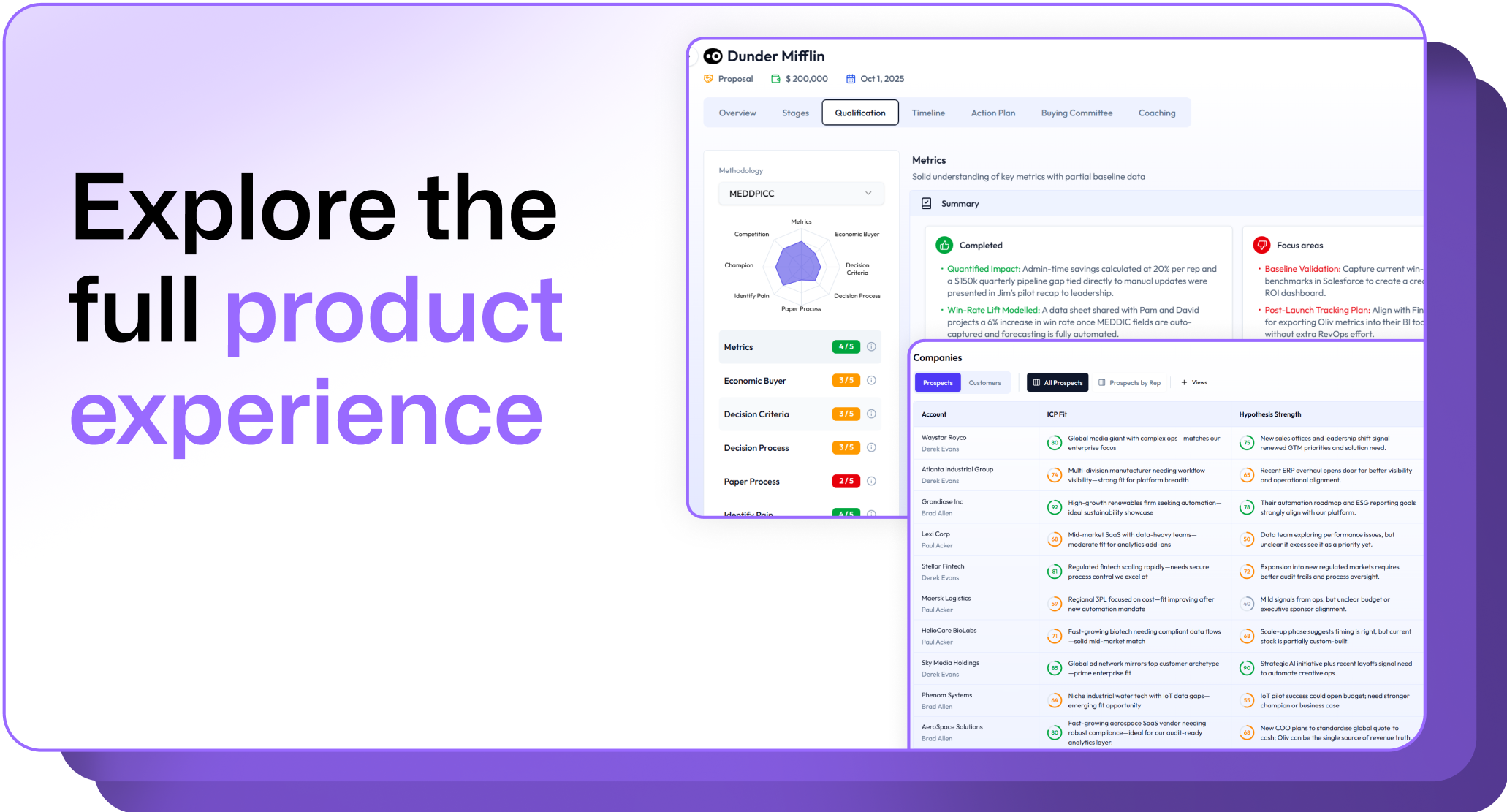
.avif)
.png)







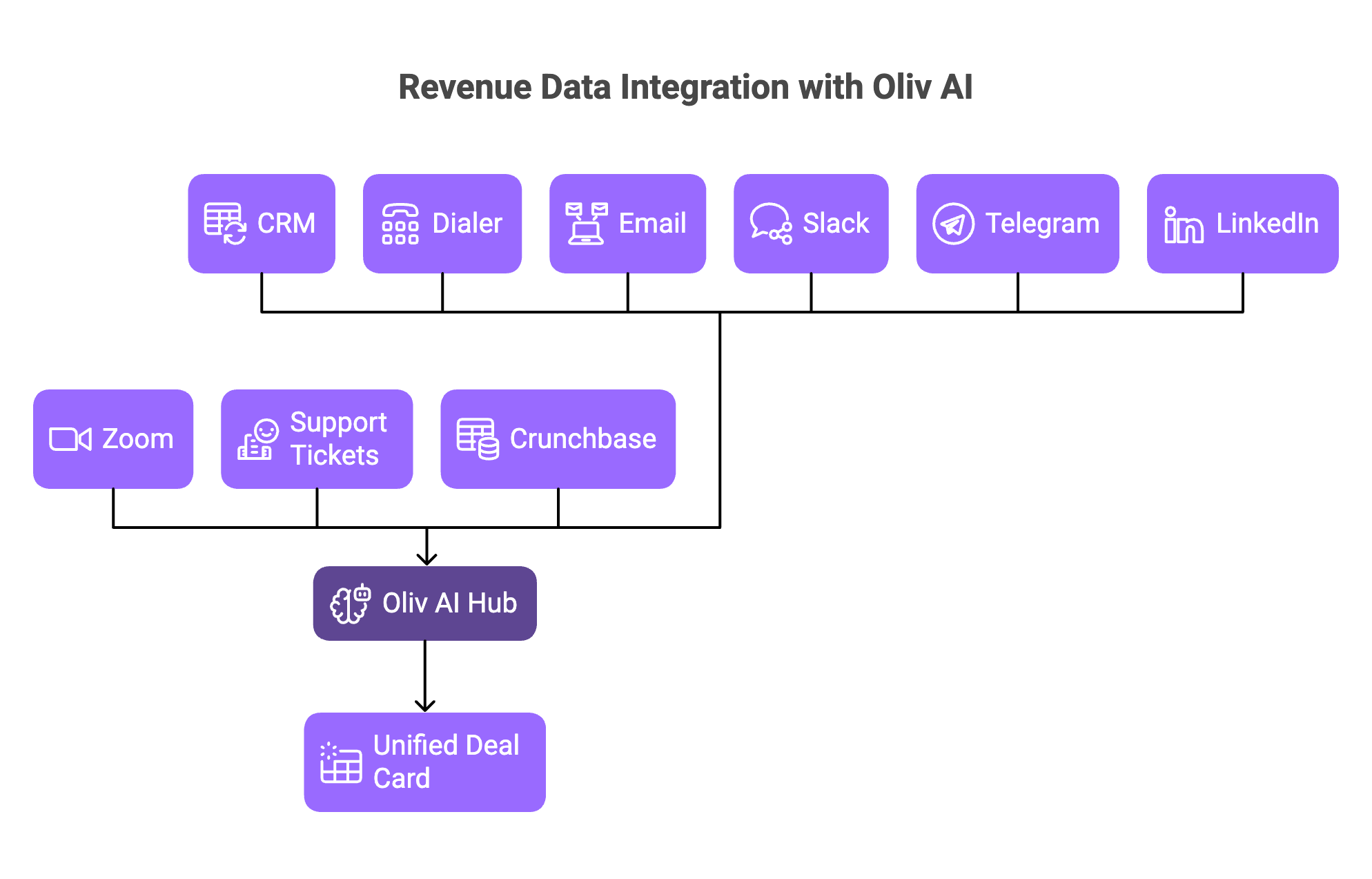
.png)
.png)