Gong vs Outreach: Why 73% Choose AI-Native Alternatives Instead in 2026
Written by
Ishan Chhabra
Last Updated :
July 21, 2026
Skim in :
12
mins
In this article
Still got questions?
Come discuss this article with me.
Hi, I'm Ishan, Founder and CEO of Oliv.
I'm always up for a conversation about revenue intelligence, AI agents, or what's actually working (and what's not) across revenue teams.
I'd love to hear your perspective.
Thank you! Your submission has been received!
Oops! Something went wrong while submitting the form.
Meet Oliv’s AI Agents
Hi! I’m, Deal Driver
I track deals, flag risks, send weekly pipeline updates and give sales managers full visibility into deal progress
Hi! I’m, CRM Manager
I maintain CRM hygiene by updating core, custom and qualification fields all without your team lifting a finger
Hi! I’m, Forecaster
I build accurate forecasts based on real deal movement and tell you which deals to pull in to hit your number
Hi! I’m, Coach
I believe performance fuels revenue. I spot skill gaps, score calls and build coaching plans to help every rep level up
Hi! I’m, Prospector
I dig into target accounts to surface the right contacts, tailor and time outreach so you always strike when it counts
Hi! I’m, Pipeline tracker
I call reps to get deal updates, and deliver a real-time, CRM-synced roll-up view of deal progress
Hi! I’m, Analyst
I answer complex pipeline questions, uncover deal patterns, and build reports that guide strategic decisions
TL;DR
Gong leads conversation intelligence and coaching, while Outreach leads outbound sequencing and dialing, so they solve different jobs and rarely replace each other.
Gong cannot fully replace Outreach for sequencing, which is why many teams run both and push stacked cost past $500 per user per month.
Neither vendor publishes pricing; Gong now quotes closer to $250 per user monthly, plus platform fees, implementation, and integration overages.
Both carry SOC 2 Type II, GDPR, and CCPA, but two-party consent friction and 2026 AI governance raise fresh questions for autonomous agents.
Both share three blind spots: unstructured activity logs, one-way CRM integrations, and invisible off-record channels like Slack and Telegram.
AI-native platforms like Oliv unify insight, engagement, and autonomous CRM hygiene in one system at lower total cost.
What Are Gong and Outreach, and Why Are Revenue Teams Still Comparing Them in 2026? [toc=1. Gong vs Outreach Basics]
Gong is a conversation-intelligence platform that records and analyzes sales calls. Outreach is a sales-engagement platform that automates multichannel outbound sequences. Teams still compare them in 2026 because both now brand themselves as "revenue AI platforms," Gong through Agent Studio and Outreach through Omni. Yet each was built for a different job, so buyers end up stitching insight and execution together by hand.
🧾 The renewal-window moment nobody enjoys
Picture a RevOps lead in August, staring at two renewal quotes. One is for Gong. One is for Outreach. Her reps are already logging into three tools a day.
She is not comparing feature lists for fun. She is asking a sharper question. Why am I paying a premium for software that still hands my team more manual work?
That is the real search behind "Gong vs Outreach." Most readers land here mid-purchase or actively hunting an alternative to Gong. I have sat in that seat, and the anxiety is always the same: the fear of signing another multi-year contract for a tool that becomes a glorified note-taker.
📚 Two tools, two different decades
Here is the plain-English split. Gong listens. Outreach acts.
Gong (conversation intelligence): records calls, transcribes them, and surfaces deal and coaching signals. Its origin is the call library.
Outreach (sales engagement): builds sequences, dials prospects, and automates follow-up cadences. Its origin is the outbound motion.
Gong analyzes what happened in a conversation. Outreach drives the activity that creates conversations in the first place. Both added AI messaging by 2026, but the architecture underneath still reflects the problem each was born to solve.
There is even a naming muddle here. The category started as "conversational intelligence," then Gong pushed "revenue intelligence." When you actually talk to buyers, most still say conversational intelligence. That gap between marketing language and operator language tells you how much of this is repositioning versus real change.
⚖️ Insight versus execution versus autonomous action
So the honest framing is three-layered, not two.
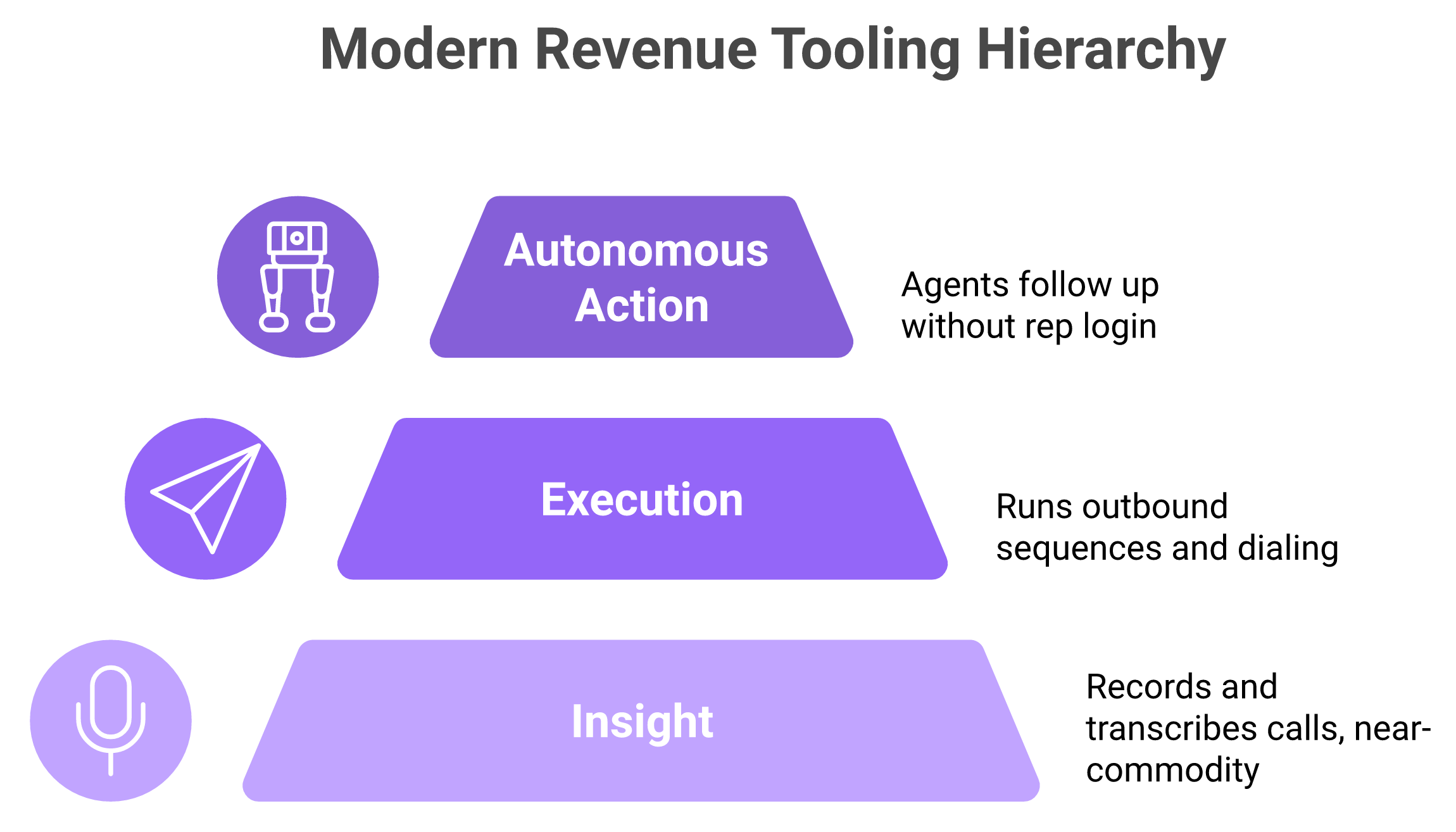
Insight: understanding the call and the deal (Gong's strength).
Execution: running the outbound motion (Outreach's strength).
Autonomous action: doing the follow-up work without a rep logging in (where neither legacy tool truly lives yet).
I think of a modern revenue intelligence platform as three layers of a cake. The bottom layer is baseline conversation intelligence, essentially a Gong replacement. Honestly, that layer is close to a commodity now. Zoom, Microsoft Teams, and Google already record and transcribe calls natively. If call recording is all you need, you may not need Gong at all.
The three layers of modern revenue tooling, where autonomous agents sit above commoditized call recording.
The layers above, deal-level intelligence and agents that act, are where the 2026 decision actually gets interesting.
At Oliv, we built for those upper layers first. The baseline recording is table stakes, so our focus is the intelligence and agent work that sits on top: reading the whole deal, then doing the busywork the rep would otherwise carry. That is the lens I will use to compare these tools through the rest of this article.
How Do Gong, Outreach, and Oliv Compare Across Core Capabilities? [toc=2. Capability Comparison]
Gong leads on conversation intelligence and coaching. Outreach leads on sequencing, dialing, and prospecting cadences. Neither owns autonomous CRM hygiene or unbiased forecasting end to end. Oliv unifies all three layers under specialized AI agents that share one knowledge graph, so engagement signals flow into coaching and forecasting without CSV exports or manual tagging.
🧵 One deal, six tabs, no single thread
Most teams no longer evaluate these tools in isolation. They need one fabric that runs from cold touch to closed-won. The pain shows up in a specific place: a deal where the discovery call lives in Gong, the follow-up sequence lives in Outreach, and the forecast lives in a spreadsheet.
That fragmentation is the real cost. A rep updates one system, forgets the other two, and the manager rebuilds the picture by hand every Friday.
📊 Capability comparison at a glance
Gong vs Outreach vs Oliv Capability Comparison
Capability
Gong
Outreach
Oliv
Conversation intelligence
Strong, mature call library
Basic (Kaia)
Native, 5-min processing
Sales engagement / sequencing
Weak (Engage)
Strong, core strength
Agent-drafted outreach
Forecasting
Add-on module
Add-on (Commit)
Built-in, deal-level
Coaching
Strong scorecards
Limited
Agent finds live skill gaps
CRM hygiene
Logs activity
Logs activity
Autonomous field updates
AI agents
Agent Studio (2026)
Omni (2026)
30+ agents in production
⏱️ Where the seams show
The processing gap is a small detail that reveals a bigger design choice. Gong's call analysis carries a 20 to 30 minute delay after a call ends. Ours runs closer to five minutes, so a manager can act before the next meeting starts.
The deeper issue is depth of understanding. Legacy tools bury you in dashboards. The job is not more data, it is the right intelligence at the right moment.
"Gong has become the single source of truth for our sales team. From deal management to forecasting it's been really easy to gain adoption." Scott T., Director of Sales Gong G2 Verified Review
"The additional products like forecast or engage come at an additional cost. Would be great to see these tools rolled into the core offering." Scott T., Director of Sales Gong G2 Verified Review
That second line matters. The "single view" is real, but only after you buy several modules. Outreach reviewers describe the same stitching problem from the engagement side.
"It says the email failed due to inbox sync failure. But, other one-off emails go. Outreach is not meant for small teams with less than 30 BDs and have a Hubspot CRM." Vamsi C., Revenue Operations Outreach G2 Verified Review
At Oliv, we treat each capability as an agent, not a tab. The Meeting agent, Prospector, and CRM Manager share one deal graph, so an insight from a call updates the forecast and the coaching view at once. That shared context is the column legacy stacks cannot draw, because their tools were bought separately and never designed to think together. If you are weighing the full field, our roundup of the best revenue intelligence software platforms lays out how these categories overlap.
Is Gong or Outreach Better for Conversation Intelligence and Coaching? [toc=3. Conversation Intelligence and Coaching]
Gong is the stronger conversation-intelligence and coaching tool. Its call library, scorecards, and Smart Trackers outclass Outreach's Kaia. But Gong's trackers are keyword-based, so they catch mentions without understanding intent. A passing competitor reference gets flagged the same as an active evaluation. Context-reasoning language models close that gap.
🏆 Gong wins the recording-and-coaching layer
Let me give Gong its due. For pure call analysis and manager coaching, it is the category benchmark, and reviewers who use it daily are genuinely loyal.
"The wide ranging suite of features and functionalities really help me coach the team and gain great visibility over our pipeline." Elspeth C., Chief Commercial Officer Gong G2 Verified Review
"Trackers are far superior than other competitors in the market and reps, managers and enablement alike love it." Trafford J., Senior Director Revenue Enablement Gong G2 Verified Review
Outreach's Kaia exists, but no one buys Outreach for conversation intelligence. On this layer, Gong is the clear pick.
🔍 The keyword-tracker limit hiding in plain sight
Here is where the standard read gets it backwards. Trackers sound like intelligence, but they are keyword matching, which is closer to a very smart search filter than true understanding.
A tracker for "competitor" fires whether a buyer says "we're moving off a competitor" or "a competitor mentioned you." Same flag, opposite meaning. The tool counts the word and misses the intent.
The problem with Gong and Clari is that they lean on keyword trackers and activity tracking to read a deal. That gives you a thin picture of what is actually happening. Even fans admit the setup tax.
"It can be overwhelming to set up trackers. AI training is a bit laborious to get it to do what you want." Trafford J., Senior Director Revenue Enablement Gong G2 Verified Review
I might be slightly hard on this, but from what surfaces when you actually run coaching off trackers, you spend more time tuning the tracker than coaching the rep.
🧠 What context-aware models do differently
A fine-tuned language model reads the whole exchange, not a word list. It can tell an objection from an aside, and a real buying signal from small talk.
That difference decides whether coaching is based on what a rep truly did, or on how often a keyword happened to appear.
At Oliv, our Coach agent pulls skill gaps from live deals, not from staged role-plays or keyword counts. Because the model reasons over full context, it separates a passing mention from an active evaluation, so a manager coaches the moment that actually moved the deal. That is the shift from counting words to understanding conversations, and it sits at the heart of the best sales coaching software today.
Which Tool Wins for Sales Engagement, Prospecting, and Sequences? [toc=4. Sales Engagement and Prospecting]
Outreach wins sales engagement outright. Its sequences, dialer, and prospecting workflows are exactly what Gong Engage tries and fails to match, according to reviewers who call Engage buggy and unsupported. But both were built for mass, non-personalized outbound. In 2026, high-volume cold email returns less and less as reps abandon sequences before the touches that convert.
🥇 Outreach owns the outbound motion
For running outbound at scale, Outreach is the stronger tool, full stop. Reps live in it daily, and the core sequencing works.
"Outreach is really really good for emailing, sequencing, and prospect management. It talks to Salesforce really well as well." Ethan R., Sales Development Representative Outreach G2 Verified Review
Gong Engage, by contrast, is the weak link in Gong's suite. The reviews are blunt about it.
"The platform lacks task APIs, does not integrate with other vendors or parallel dialers, and isn't built to function as a proper sequencing tool. If you're considering them, I highly recommend looking at better options like Outreach, Salesloft, or Apollo." Verified reviewer Gong G2 Verified Review
So if the choice is Gong Engage versus Outreach for sequencing, pick Outreach. That part is not close.
📉 The problem both tools share
Now the uncomfortable part. Both were designed for the same play: send more touches to more people. That play is aging fast.
Outreach calls a series of touches a sequence, and the drop-off is brutal. Roughly 90% of reps quit before the later steps, yet those later touches capture a real share of replies. So reps either give up early, or grind a cadence that feels like spam to the buyer.
Even loyal users feel the friction underneath the automation.
"The reports are difficult to make sense of, onboarding takes time and there are many glitches ongoing. And our account manager changed 3 times in 4 months." Greg D., CRO Outreach G2 Verified Review
"Sometimes numbers don't connect, sometimes valid numbers don't dial, and we show as spam 15-20% of the time." Ethan R., Sales Development Representative Outreach G2 Verified Review
🎣 Why deep research beats spray-and-pray
I use a fishing analogy for this. You might cast 100 times to get one bite. Bulk cold email is exactly that, and the water is getting fished out.
The counter is not more volume. It is fewer, better-researched messages that earn a reply.
At Oliv, our Prospector agent builds a deep dossier on each account, then drafts personalized, multichannel outreach off real context, not a static template. That is the shift from casting 100 generic lines to placing a few that actually land, which is where I think outbound is heading over the next two years. It is also why we count deep-research prospecting among the best AI sales tools emerging now.
How Do Gong and Outreach Handle Security, Compliance, and AI Governance? [toc=5. Security and Compliance]
Both Gong and Outreach carry SOC 2 Type II, GDPR, and CCPA compliance, so they clear baseline IT and Legal gates. The newer risks are governance ones. Two-party consent laws make Gong's "you're on a recorded line" disclosure a small rapport tax. And the EU AI Act, plus 2026 MCP interoperability, raises fresh questions about how autonomous agents reach and expose your deal data.
✅ The baseline both vendors clear
Let me start with the easy part. On paper, both tools pass a standard security review.
SOC 2 Type II: an audited control standard for how a vendor handles data.
GDPR and CCPA: European and California data-privacy laws that govern consent and portability.
Both Gong and Outreach hold these, so your IT and Legal reviewers rarely block the purchase on certifications alone. Gong even appointed a Chief Trust Officer in 2025 to signal how seriously it takes this layer. That is real, and I will give both credit for it. If you want the deeper diligence checklist, our breakdown of Gong DPA and security covers the fine print.
⚠️ The consent tax nobody prices in
Here is the friction that shows up in the field, not the security questionnaire. Many US states require two-party consent, meaning both people must be told the call is recorded.
That forces the awkward "you're on a recorded line" line at the top of a call.
"The requirement to inform prospects that they are on a recorded line can feel awkward and off-putting, often creating a negative first impression and harming rapport." Verified reviewer Gong G2 Verified Review
That is a soft cost, but it is real. You pay it on every first call, and it sets a slightly defensive tone before discovery even starts. It is one reason buyers keep scanning the Gong alternatives list.
🔐 The governance question for 2026
The harder question is newer. As tools add autonomous agents, who governs what those agents can read and write?
The EU AI Act now sets rules for higher-risk automated systems. And MCP (Model Context Protocol, a standard for connecting AI models to tools) is spreading fast, with Outreach joining the Anthropic MCP ecosystem in early 2026. More connection means more surface area for data to leak between systems.
At Oliv, we hold SOC 2 Type II, GDPR, and CCPA compliance, and our agents run on grounded language models scoped to a secure workspace. Grounded means the model answers from your actual deal data, not guesses, which lowers the odds of a hallucinated field write. For a buying committee worried about agent governance, that scoped, trust-first setup is the answer I would want to see, and you can pull the reports directly from our trust portal. It is the standard we hold across our revenue intelligence platform.
What Do Gong and Outreach Actually Cost in 2026 (Including Hidden Fees)? [toc=6. Pricing and Hidden Costs]
Neither vendor publishes transparent pricing. In 2026, Gong is quoting bundled packages closer to $250 per user per month, up from the old $160 point, with platform and third-party implementation fees on top. Outreach runs roughly $100 to $500 per user monthly. Stack both, add integration overages, and many teams clear $3,000 per rep annually before the hidden costs even land.
💸 The bundle sticker shock
The first surprise is the quote itself. The old $160 per-user figure many buyers still cite is out of date.
Gong now tends to quote closer to $250 per user per month for everything combined. That jump is easy to miss until the contract lands on your desk. Our detailed Gong pricing breakdown walks through each tier.
💰 The fees that hide below the seat price
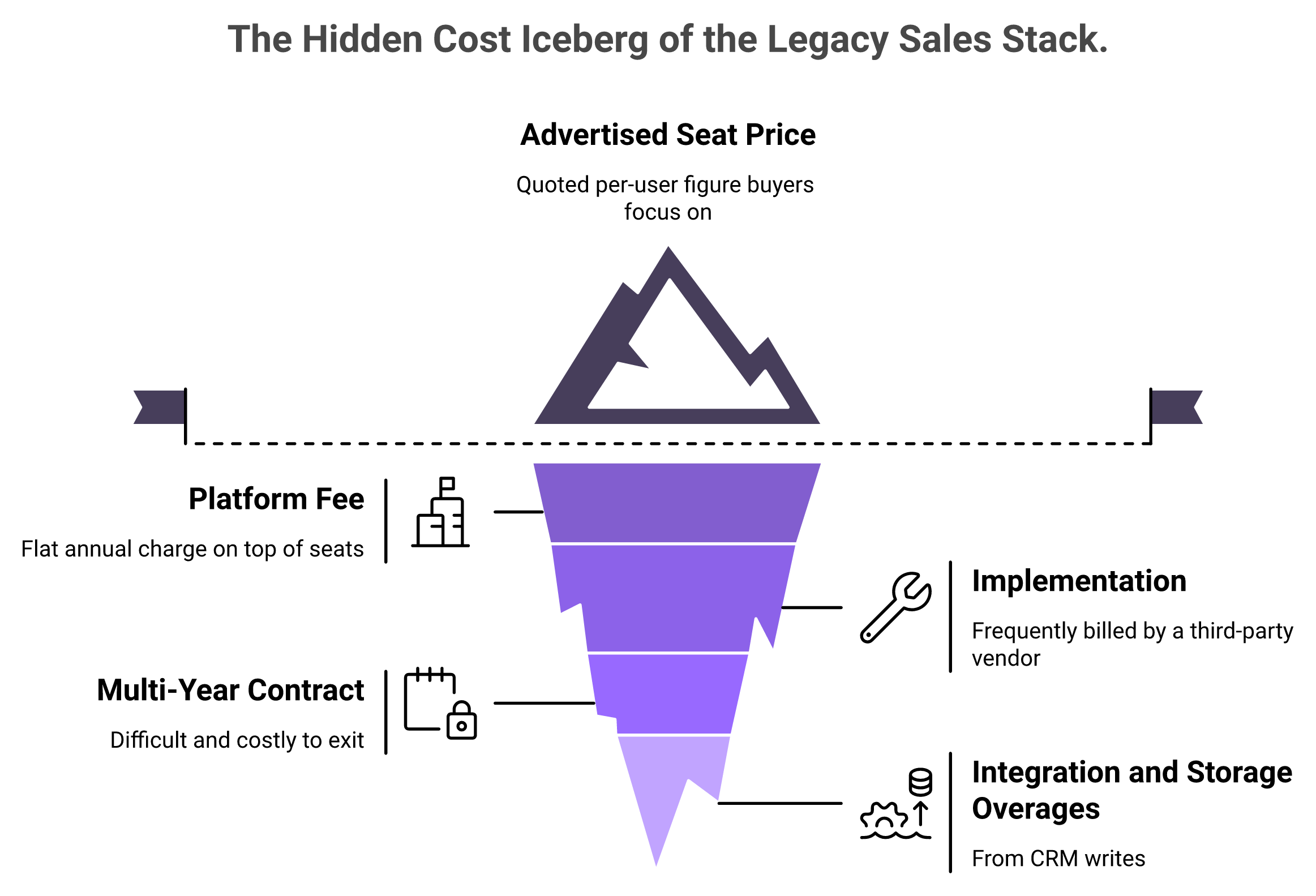
The seat price is only part of it. Two costs get buried under the headline number.
The advertised seat price is just the tip; platform fees, implementation, and overages hide beneath the surface.
Gong and Outreach Hidden Cost Lines
Cost line
What it looks like
Platform fee
A flat annual charge on top of seats
Implementation
Often paid to a third-party vendor
Contract term
Frequently multi-year, hard to exit
Integration overage
Storage and API costs from CRM writes
I spoke with a team of 20 considering Gong recently. Their quote was $50,000, and $10,000 of that was implementation paid to an outside vendor. That is real cash gone before a single call is analyzed.
The overages sting too. Roughly 73% of organizations hit unexpected costs when wiring these tools into their CRM. Reviewers feel the trap clearly.
"It was a big mistake on our part to commit to a two year term. Gong is a really powerful tool but it's probably the highest end option on the market, and now we're stuck." Iris P., Head of Marketing Gong G2 Verified Review
"The pricing is probably the biggest obstacle and hence we are looking to change." Miodrag, Enterprise Account Executive Gong TrustRadius Verified Review
🧮 The full-stack total is the real number
Here is the part the vendor decks never show. You do not buy one tool, you buy a stack.
Gong for intelligence, Outreach for engagement, and often a forecasting add-on. For a 25 to 200 rep team, that combined bill quietly pushes past $500 per user per month. That math is why teams reassess their Gong forecasting spend at renewal.
At Oliv, pricing is modular, from $19 to $120 per user per month, with no separate platform fee. We also migrate historical Gong recordings for free and let you export your data openly, so switching does not become its own line item. When I do the math for a mid-market team, the whole point is roughly double the functionality at close to half the stacked cost.
What Do Real Users Say About Gong vs Outreach in 2026? [toc=7. User Reviews]
Users love Gong for coaching visibility and Outreach for cadence control. But the recurring complaints tell the real story. Gong gets called "too complicated," its bulk data export is painful, and post-sale support quality has slipped. Outreach's CRM sync breaks, dialer numbers flag as spam, and evergreen contracts frustrate smaller teams.
🧩 The complexity and adoption gap
Start with a rep, not a dashboard. A senior AE who likes the call recordings still finds the rest of Gong a maze.
"It's too complicated, and not intuitive at all. Searching for calls is not easy, and understanding the pipeline management portion of it is almost impossible." John S., Senior Account Executive Gong G2 Verified Review
The lesson is simple. Power the team never adopts is power you paid for and lost. For the full picture, we broke down the patterns across every Gong review we could find.
📦 The data export and lock-in complaint
Next is the exit door, which turns out to be narrow. A RevOps manager trying to leave found the data hard to take with her.
"It requires downloading calls individually, which is impractical and inefficient for a large volume of data. This lack of flexibility has required us to engage our development team at additional cost." Neel P., Sales Operations Manager Gong G2 Verified Review
Owning your data and being able to move it are two different things. That gap is where lock-in lives.
🔌 The integration and support reliability issue
Outreach draws its own recurring gripes. The tool runs the outbound motion well, until the sync or the support breaks.
"The reports are difficult to make sense of, onboarding takes time and there are many glitches ongoing. And our account manager changed 3 times in 4 months." Greg D., CRO Outreach G2 Verified Review
"Sometimes numbers don't connect, sometimes valid numbers don't dial, and we show as spam 15-20% of the time." Ethan R., Sales Development Representative Outreach G2 Verified Review
⚖️ The honest balance
I want to be fair here. Plenty of reviewers genuinely rate these tools highly, and Gong especially earns real love for coaching.
"The wide ranging suite of features and functionalities really help me coach the team and gain great visibility over our pipeline." Elspeth C., Chief Commercial Officer Gong G2 Verified Review
I have read hundreds of these reviews, and a pattern holds. The praise is about insight, and the pain is about adoption, export, and cost. At Oliv, we designed for the two loudest complaints directly: open data export by default, and structured updates written back to the CRM as real deal fields, not a pile of activity logs nobody can query. It is a core reason we rank among the best revenue intelligence software platforms.
Where Do Both Gong and Outreach Fall Short on Data and CRM Integration? [toc=8. Data and Integration Gaps]
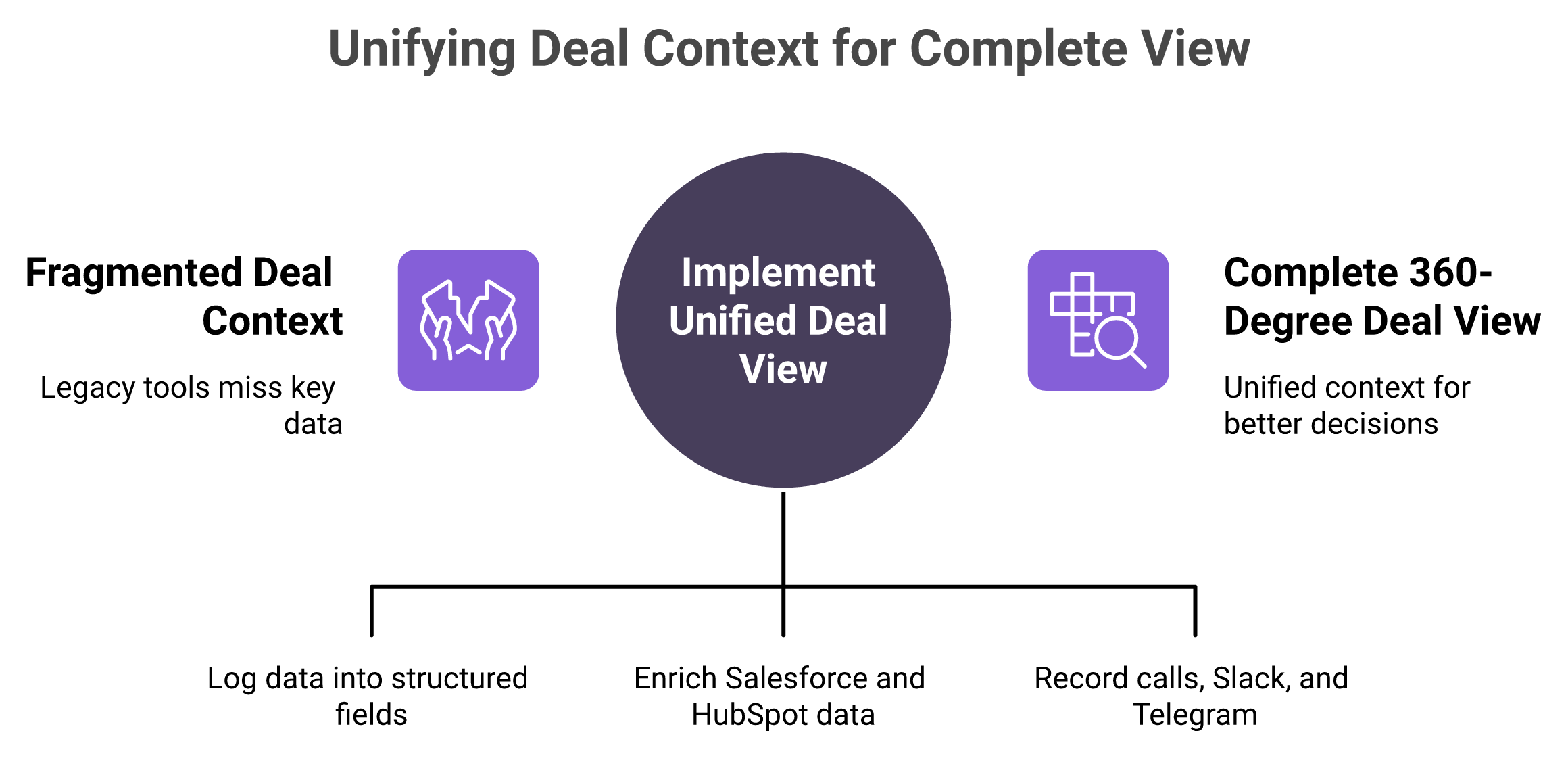
Both tools share three blind spots. They log activity instead of structuring deal data, so insights are hard to retrieve. They run one-way Salesforce and HubSpot integrations that trap data in their own screens rather than enriching your CRM. And they only see recorded meetings, missing the unrecorded calls, Slack, and Telegram where real deal context lives.
The three structural blind spots that keep both Gong and Outreach from seeing the full deal.
🗂️ Pillar one: activity logs are not intelligence
The first gap is what the data looks like once it lands. These tools push a lot into the CRM, but as activities, not structured fields.
An activity log records that something happened. It does not tell you the deal's risk, the next step, or the buyer's objection in a way you can query later.
So the data piles up and stays hard to use. You can see everything and understand very little, which defeats the point of buying intelligence in the first place.
🔁 Pillar two: one-way integrations trap your data
The second gap is direction. Both tools pull data in far better than they push it back out.
"If your business needs easy, bulk access to call data or plans to integrate with other platforms, these limitations can create challenges." Neel P., Sales Operations Manager Gong G2 Verified Review
Here is how I read it. The tool wants to be the center of the universe, so it collects everything, but it does not enrich the CRM you actually run the business on. Your system of record stays thin while the vendor's UI gets rich. Our guide to Gong integrations shows where those one-way limits bite.
📡 Pillar three: the channels neither tool can see
The third gap is coverage. Both platforms watch recorded meetings and logged CRM activity, and that is roughly all.
They miss the unrecorded phone call, the Slack thread, and the Telegram chat. For some teams, like crypto-native sales, Telegram is where the deal actually moves, and legacy tools like Gong capture none of it.
That means the picture is always partial. You coach and forecast off the slice that happened to be on camera.
At Oliv, we built the CRM back as an AI-native data platform. Our agents stitch calls, emails, Slack, Telegram, and the web into one deal view, and write structured updates back into Salesforce or HubSpot, not activity clutter. Our Voice agent even captures off-the-record calls, so the context that used to vanish after a hallway conversation finally lands where the deal lives. That is the shift we track from revenue ops to intelligence to orchestration.
Why Are 73% of Teams Choosing AI-Native Alternatives Instead? [toc=9. The AI-Native Shift]
Teams are leaving the Gong-plus-Outreach stack because the math and the model both broke. Around 73% hit unexpected integration and maintenance costs, and legacy tools were built to be used, not to do the work. AI-native platforms flip that. Autonomous agents research accounts, update the CRM, and forecast without a rep logging in, cutting cost 40 to 60% while lifting deal velocity.
🧱 Two things these tools did well
Let me be fair before I push. Gong and Outreach earned their place for real reasons.
Gong made call coaching visible at scale. Outreach made outbound repeatable. Both were genuine steps up from spreadsheets and memory.
But here is the doubt worth sitting with. These tools were designed a decade ago, before generative AI, and they still ask your team to log in and do the work. So the honest question is not whether they were good. It is whether they are the tools you should start with in 2026. That is why so many buyers now scan the agentforce alternatives and competitors before renewing.
🤖 The shift from software you use to agents that work
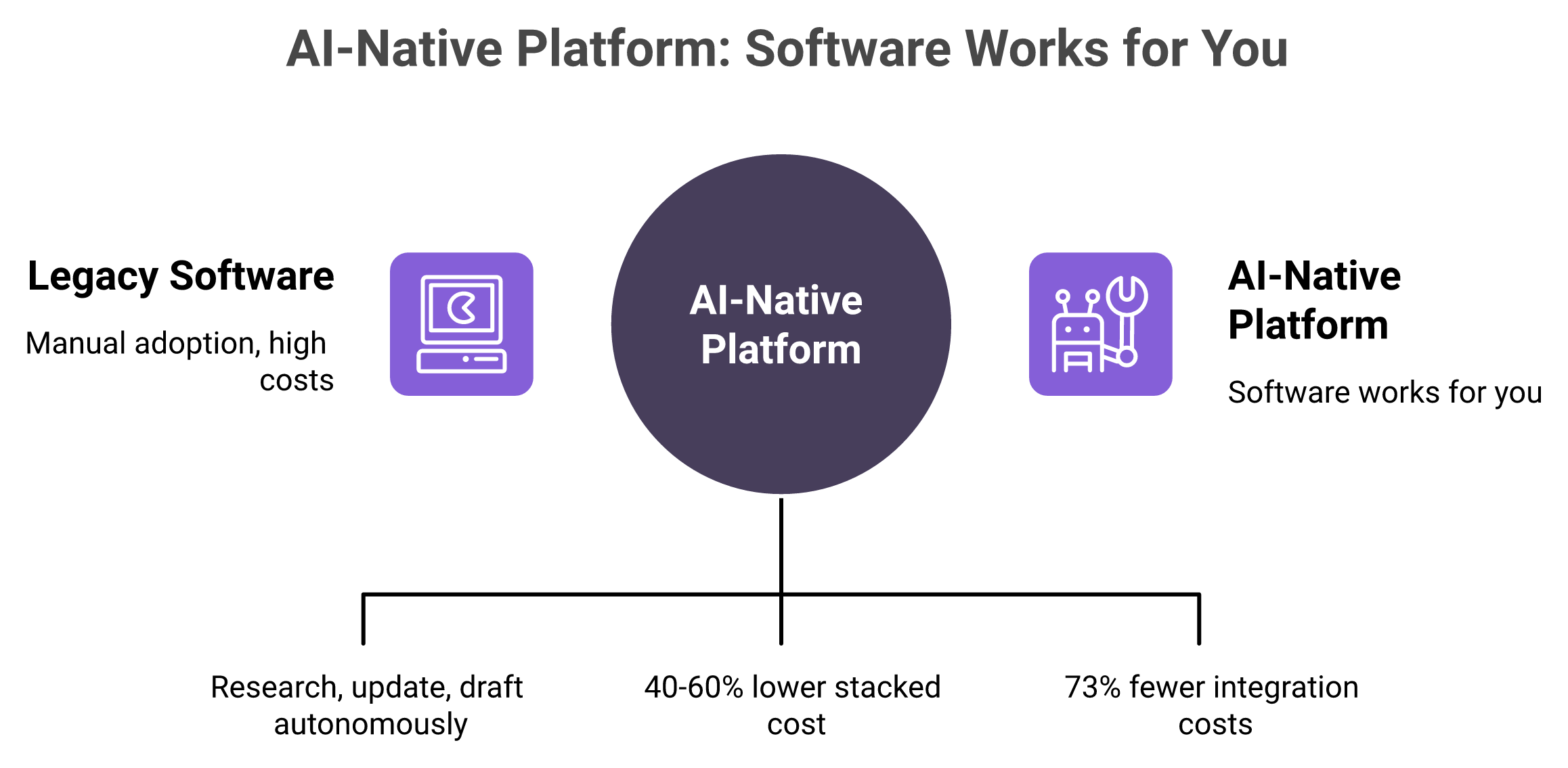
This is the real pivot. Old SaaS is something you log into. You adopt it, you train on it, and you feed it data by hand.
An AI-native platform runs the other way. Agents do the task, then show you the result.
The shift from software you log into toward agents that do the work, and the cost gap between them.
Think of the difference like driving. Managing sales without analytics is like driving without a map. But logging into a dashboard to read that map yourself is still work. An agent is closer to Waze rerouting you automatically while you keep your eyes on the road.
Traditional: you record, tag, and update everything manually.
AI-assisted: the tool surfaces insights, but you still act on them.
Agent-first: the system researches, updates, and drafts, then asks for your call.
That third mode is the one legacy tools were never built for, and it defines today's revenue orchestration platform category.
💰 The payoff, in cash and time
Now the numbers, because a founder's money is real and finite. The stacked legacy bill for a 25 to 200 rep team quietly clears $500 per user per month.
The overage problem compounds it. Roughly 73% of organizations meet costs they did not plan for when wiring these tools into the CRM. That is budget you cannot spend on pipeline.
An agent-first approach cuts that stacked cost by 40 to 60% and returns the hours reps burn on data entry. At Oliv, we deliver conversation intelligence, engagement, and CRM management as autonomous agents on one platform, so the work happens without a rep opening a tab. That is the shift I think defines the next two years: SaaS you log into becomes agents that work for you, and revenue orchestration gives way to revenue engineering. It is the same logic behind the best AI sales forecasting software emerging now.
Can You Migrate Off Gong or Outreach Without Losing Your Data? [toc=10. Migration and Lock-In]
Yes, but read the fine print first. Gong's migration terms are use-it-or-lose-it. Unused services expire in 60 days with no refund, and Gong will only migrate web-conference recordings, not your full history. That lock-in, plus individual-call-only export, is why teams stall. A modern alternative should migrate historical recordings and metadata for free, and hand you a complete export on request.
⏰ The 60-day clause that quietly traps you
The migration terms are stricter than most buyers notice. There is a hard clock on the help you paid for.
Any migration services you do not use within 60 days expire, with no credit and no refund. Worse, the migration itself is partial: Gong will move web-conference recordings, but not necessarily your full call history and metadata. So you can leave, but you may not take everything with you. Our guide to the realistic Gong implementation timeline shows how these clauses shape the exit.
📦 What reviewers actually hit on the way out
This is not theory. Buyers describe the same wall when they try to extract their own data.
"It requires downloading calls individually, which is impractical and inefficient for a large volume of data. This lack of flexibility has required us to engage our development team at additional cost." Neel P., Sales Operations Manager Gong G2 Verified Review
"It was a big mistake on our part to commit to a two year term, and now we're stuck with a tool that works technically but isn't the right business decision." Iris P., Head of Marketing Gong G2 Verified Review
Read those together and the pattern is clear. The contract and the export design both make leaving expensive.
✅ How a clean exit should work
Migration fear is the last thing that keeps teams stuck. So the fix has to be a real risk reversal, not a promise.
At Oliv, we migrate your historical Gong recordings and metadata for free, so you start with your history intact, not a blank library. And if you ever leave us, you get a full export on request, no dev team required. I would rather earn the renewal every year than trap you with a clause, because a tool that only keeps customers through lock-in is a tool that stopped competing on merit. If you are still weighing options, our list of Gong alternatives lays out the trade-offs.
Gong vs Outreach vs Oliv: Which Should You Choose (and Can You Use Both)? [toc=11. Decision Framework]
Choose Gong if conversation intelligence and coaching are your only priority and budget is no constraint. Choose Outreach if high-volume outbound sequencing is your core motion. Gong cannot fully replace Outreach, so many teams run both, which is exactly why the stack gets expensive. Choose an AI-native platform like Oliv when you want insight, engagement, and autonomous CRM hygiene in one system at lower total cost.
🧭 Can Gong replace Outreach? Not really
Let me answer the common question directly. No, Gong cannot fully replace Outreach.
Gong reads conversations and deal risk. It does not run multichannel sequencing or a serious dialer. Gong Engage tried, and reviewers were blunt that it fell short.
"It isn't built to function as a proper sequencing tool. If you're considering them, I highly recommend looking at better options like Outreach, Salesloft, or Apollo." Verified reviewer Gong G2 Verified Review
So teams that need both insight and outbound end up buying both. That is the "use both" reality, and it is precisely what drives the bill up. Our head-to-head on Gong vs Salesloft shows the same split in the engagement layer.
📋 Choose by team size and motion
Here is the practical cut, by team size and what you actually need.
Gong vs Outreach vs Oliv by Team Size and Motion
Team size
Best fit
Why
5 to 25 reps
Oliv
One platform, modular pricing, no stacked fees
25 to 200 reps
Oliv
Insight, engagement, and CRM in one, avoids $500/user stack
200+ reps, CI-only
Gong
Deepest coaching library if budget is open
Outbound-heavy
Outreach
Strongest sequencing and dialer
On the build-versus-buy question, my view is simple. Most teams should not build their own agents, they should buy, for the same reason that has always held true in software. Our roundup of the best revenue orchestration platform tools compares the buy options side by side.
🗣️ Where I'd start the conversation
August is renewal season for a lot of Gong contracts, so this decision is live for many readers right now. My honest advice is to stop reading ultimate guides and answer the exact question in front of you: what is this stack actually costing me, and what is it doing for me on its own?
At Oliv, the 25 to 200 rep team is our sweet spot, and the renewal window is usually where the switch makes the most sense. Rather than book a demo, I would rather you try the sandbox and run one of your own deals through our agents. Where my head is right now is a real question I would love your take on: if agents can research, update, and draft on their own, what is the last task you would still want a human rep to own? If you want the direct comparison, our Gong vs Oliv breakdown covers it.
What Are Gong and Outreach, and Why Are Revenue Teams Still Comparing Them in 2026? [toc=1. Gong vs Outreach Basics]
Gong is a conversation-intelligence platform that records and analyzes sales calls. Outreach is a sales-engagement platform that automates multichannel outbound sequences. Teams still compare them in 2026 because both now brand themselves as "revenue AI platforms," Gong through Agent Studio and Outreach through Omni. Yet each was built for a different job, so buyers end up stitching insight and execution together by hand.
🧾 The renewal-window moment nobody enjoys
Picture a RevOps lead in August, staring at two renewal quotes. One is for Gong. One is for Outreach. Her reps are already logging into three tools a day.
She is not comparing feature lists for fun. She is asking a sharper question. Why am I paying a premium for software that still hands my team more manual work?
That is the real search behind "Gong vs Outreach." Most readers land here mid-purchase or actively hunting an alternative to Gong. I have sat in that seat, and the anxiety is always the same: the fear of signing another multi-year contract for a tool that becomes a glorified note-taker.
📚 Two tools, two different decades
Here is the plain-English split. Gong listens. Outreach acts.
Gong (conversation intelligence): records calls, transcribes them, and surfaces deal and coaching signals. Its origin is the call library.
Outreach (sales engagement): builds sequences, dials prospects, and automates follow-up cadences. Its origin is the outbound motion.
Gong analyzes what happened in a conversation. Outreach drives the activity that creates conversations in the first place. Both added AI messaging by 2026, but the architecture underneath still reflects the problem each was born to solve.
There is even a naming muddle here. The category started as "conversational intelligence," then Gong pushed "revenue intelligence." When you actually talk to buyers, most still say conversational intelligence. That gap between marketing language and operator language tells you how much of this is repositioning versus real change.
⚖️ Insight versus execution versus autonomous action
So the honest framing is three-layered, not two.
Insight: understanding the call and the deal (Gong's strength).
Execution: running the outbound motion (Outreach's strength).
Autonomous action: doing the follow-up work without a rep logging in (where neither legacy tool truly lives yet).
I think of a modern revenue intelligence platform as three layers of a cake. The bottom layer is baseline conversation intelligence, essentially a Gong replacement. Honestly, that layer is close to a commodity now. Zoom, Microsoft Teams, and Google already record and transcribe calls natively. If call recording is all you need, you may not need Gong at all.
The three layers of modern revenue tooling, where autonomous agents sit above commoditized call recording.
The layers above, deal-level intelligence and agents that act, are where the 2026 decision actually gets interesting.
At Oliv, we built for those upper layers first. The baseline recording is table stakes, so our focus is the intelligence and agent work that sits on top: reading the whole deal, then doing the busywork the rep would otherwise carry. That is the lens I will use to compare these tools through the rest of this article.
How Do Gong, Outreach, and Oliv Compare Across Core Capabilities? [toc=2. Capability Comparison]
Gong leads on conversation intelligence and coaching. Outreach leads on sequencing, dialing, and prospecting cadences. Neither owns autonomous CRM hygiene or unbiased forecasting end to end. Oliv unifies all three layers under specialized AI agents that share one knowledge graph, so engagement signals flow into coaching and forecasting without CSV exports or manual tagging.
🧵 One deal, six tabs, no single thread
Most teams no longer evaluate these tools in isolation. They need one fabric that runs from cold touch to closed-won. The pain shows up in a specific place: a deal where the discovery call lives in Gong, the follow-up sequence lives in Outreach, and the forecast lives in a spreadsheet.
That fragmentation is the real cost. A rep updates one system, forgets the other two, and the manager rebuilds the picture by hand every Friday.
📊 Capability comparison at a glance
Gong vs Outreach vs Oliv Capability Comparison
Capability
Gong
Outreach
Oliv
Conversation intelligence
Strong, mature call library
Basic (Kaia)
Native, 5-min processing
Sales engagement / sequencing
Weak (Engage)
Strong, core strength
Agent-drafted outreach
Forecasting
Add-on module
Add-on (Commit)
Built-in, deal-level
Coaching
Strong scorecards
Limited
Agent finds live skill gaps
CRM hygiene
Logs activity
Logs activity
Autonomous field updates
AI agents
Agent Studio (2026)
Omni (2026)
30+ agents in production
⏱️ Where the seams show
The processing gap is a small detail that reveals a bigger design choice. Gong's call analysis carries a 20 to 30 minute delay after a call ends. Ours runs closer to five minutes, so a manager can act before the next meeting starts.
The deeper issue is depth of understanding. Legacy tools bury you in dashboards. The job is not more data, it is the right intelligence at the right moment.
"Gong has become the single source of truth for our sales team. From deal management to forecasting it's been really easy to gain adoption." Scott T., Director of Sales Gong G2 Verified Review
"The additional products like forecast or engage come at an additional cost. Would be great to see these tools rolled into the core offering." Scott T., Director of Sales Gong G2 Verified Review
That second line matters. The "single view" is real, but only after you buy several modules. Outreach reviewers describe the same stitching problem from the engagement side.
"It says the email failed due to inbox sync failure. But, other one-off emails go. Outreach is not meant for small teams with less than 30 BDs and have a Hubspot CRM." Vamsi C., Revenue Operations Outreach G2 Verified Review
At Oliv, we treat each capability as an agent, not a tab. The Meeting agent, Prospector, and CRM Manager share one deal graph, so an insight from a call updates the forecast and the coaching view at once. That shared context is the column legacy stacks cannot draw, because their tools were bought separately and never designed to think together. If you are weighing the full field, our roundup of the best revenue intelligence software platforms lays out how these categories overlap.
Is Gong or Outreach Better for Conversation Intelligence and Coaching? [toc=3. Conversation Intelligence and Coaching]
Gong is the stronger conversation-intelligence and coaching tool. Its call library, scorecards, and Smart Trackers outclass Outreach's Kaia. But Gong's trackers are keyword-based, so they catch mentions without understanding intent. A passing competitor reference gets flagged the same as an active evaluation. Context-reasoning language models close that gap.
🏆 Gong wins the recording-and-coaching layer
Let me give Gong its due. For pure call analysis and manager coaching, it is the category benchmark, and reviewers who use it daily are genuinely loyal.
"The wide ranging suite of features and functionalities really help me coach the team and gain great visibility over our pipeline." Elspeth C., Chief Commercial Officer Gong G2 Verified Review
"Trackers are far superior than other competitors in the market and reps, managers and enablement alike love it." Trafford J., Senior Director Revenue Enablement Gong G2 Verified Review
Outreach's Kaia exists, but no one buys Outreach for conversation intelligence. On this layer, Gong is the clear pick.
🔍 The keyword-tracker limit hiding in plain sight
Here is where the standard read gets it backwards. Trackers sound like intelligence, but they are keyword matching, which is closer to a very smart search filter than true understanding.
A tracker for "competitor" fires whether a buyer says "we're moving off a competitor" or "a competitor mentioned you." Same flag, opposite meaning. The tool counts the word and misses the intent.
The problem with Gong and Clari is that they lean on keyword trackers and activity tracking to read a deal. That gives you a thin picture of what is actually happening. Even fans admit the setup tax.
"It can be overwhelming to set up trackers. AI training is a bit laborious to get it to do what you want." Trafford J., Senior Director Revenue Enablement Gong G2 Verified Review
I might be slightly hard on this, but from what surfaces when you actually run coaching off trackers, you spend more time tuning the tracker than coaching the rep.
🧠 What context-aware models do differently
A fine-tuned language model reads the whole exchange, not a word list. It can tell an objection from an aside, and a real buying signal from small talk.
That difference decides whether coaching is based on what a rep truly did, or on how often a keyword happened to appear.
At Oliv, our Coach agent pulls skill gaps from live deals, not from staged role-plays or keyword counts. Because the model reasons over full context, it separates a passing mention from an active evaluation, so a manager coaches the moment that actually moved the deal. That is the shift from counting words to understanding conversations, and it sits at the heart of the best sales coaching software today.
Which Tool Wins for Sales Engagement, Prospecting, and Sequences? [toc=4. Sales Engagement and Prospecting]
Outreach wins sales engagement outright. Its sequences, dialer, and prospecting workflows are exactly what Gong Engage tries and fails to match, according to reviewers who call Engage buggy and unsupported. But both were built for mass, non-personalized outbound. In 2026, high-volume cold email returns less and less as reps abandon sequences before the touches that convert.
🥇 Outreach owns the outbound motion
For running outbound at scale, Outreach is the stronger tool, full stop. Reps live in it daily, and the core sequencing works.
"Outreach is really really good for emailing, sequencing, and prospect management. It talks to Salesforce really well as well." Ethan R., Sales Development Representative Outreach G2 Verified Review
Gong Engage, by contrast, is the weak link in Gong's suite. The reviews are blunt about it.
"The platform lacks task APIs, does not integrate with other vendors or parallel dialers, and isn't built to function as a proper sequencing tool. If you're considering them, I highly recommend looking at better options like Outreach, Salesloft, or Apollo." Verified reviewer Gong G2 Verified Review
So if the choice is Gong Engage versus Outreach for sequencing, pick Outreach. That part is not close.
📉 The problem both tools share
Now the uncomfortable part. Both were designed for the same play: send more touches to more people. That play is aging fast.
Outreach calls a series of touches a sequence, and the drop-off is brutal. Roughly 90% of reps quit before the later steps, yet those later touches capture a real share of replies. So reps either give up early, or grind a cadence that feels like spam to the buyer.
Even loyal users feel the friction underneath the automation.
"The reports are difficult to make sense of, onboarding takes time and there are many glitches ongoing. And our account manager changed 3 times in 4 months." Greg D., CRO Outreach G2 Verified Review
"Sometimes numbers don't connect, sometimes valid numbers don't dial, and we show as spam 15-20% of the time." Ethan R., Sales Development Representative Outreach G2 Verified Review
🎣 Why deep research beats spray-and-pray
I use a fishing analogy for this. You might cast 100 times to get one bite. Bulk cold email is exactly that, and the water is getting fished out.
The counter is not more volume. It is fewer, better-researched messages that earn a reply.
At Oliv, our Prospector agent builds a deep dossier on each account, then drafts personalized, multichannel outreach off real context, not a static template. That is the shift from casting 100 generic lines to placing a few that actually land, which is where I think outbound is heading over the next two years. It is also why we count deep-research prospecting among the best AI sales tools emerging now.
How Do Gong and Outreach Handle Security, Compliance, and AI Governance? [toc=5. Security and Compliance]
Both Gong and Outreach carry SOC 2 Type II, GDPR, and CCPA compliance, so they clear baseline IT and Legal gates. The newer risks are governance ones. Two-party consent laws make Gong's "you're on a recorded line" disclosure a small rapport tax. And the EU AI Act, plus 2026 MCP interoperability, raises fresh questions about how autonomous agents reach and expose your deal data.
✅ The baseline both vendors clear
Let me start with the easy part. On paper, both tools pass a standard security review.
SOC 2 Type II: an audited control standard for how a vendor handles data.
GDPR and CCPA: European and California data-privacy laws that govern consent and portability.
Both Gong and Outreach hold these, so your IT and Legal reviewers rarely block the purchase on certifications alone. Gong even appointed a Chief Trust Officer in 2025 to signal how seriously it takes this layer. That is real, and I will give both credit for it. If you want the deeper diligence checklist, our breakdown of Gong DPA and security covers the fine print.
⚠️ The consent tax nobody prices in
Here is the friction that shows up in the field, not the security questionnaire. Many US states require two-party consent, meaning both people must be told the call is recorded.
That forces the awkward "you're on a recorded line" line at the top of a call.
"The requirement to inform prospects that they are on a recorded line can feel awkward and off-putting, often creating a negative first impression and harming rapport." Verified reviewer Gong G2 Verified Review
That is a soft cost, but it is real. You pay it on every first call, and it sets a slightly defensive tone before discovery even starts. It is one reason buyers keep scanning the Gong alternatives list.
🔐 The governance question for 2026
The harder question is newer. As tools add autonomous agents, who governs what those agents can read and write?
The EU AI Act now sets rules for higher-risk automated systems. And MCP (Model Context Protocol, a standard for connecting AI models to tools) is spreading fast, with Outreach joining the Anthropic MCP ecosystem in early 2026. More connection means more surface area for data to leak between systems.
At Oliv, we hold SOC 2 Type II, GDPR, and CCPA compliance, and our agents run on grounded language models scoped to a secure workspace. Grounded means the model answers from your actual deal data, not guesses, which lowers the odds of a hallucinated field write. For a buying committee worried about agent governance, that scoped, trust-first setup is the answer I would want to see, and you can pull the reports directly from our trust portal. It is the standard we hold across our revenue intelligence platform.
What Do Gong and Outreach Actually Cost in 2026 (Including Hidden Fees)? [toc=6. Pricing and Hidden Costs]
Neither vendor publishes transparent pricing. In 2026, Gong is quoting bundled packages closer to $250 per user per month, up from the old $160 point, with platform and third-party implementation fees on top. Outreach runs roughly $100 to $500 per user monthly. Stack both, add integration overages, and many teams clear $3,000 per rep annually before the hidden costs even land.
💸 The bundle sticker shock
The first surprise is the quote itself. The old $160 per-user figure many buyers still cite is out of date.
Gong now tends to quote closer to $250 per user per month for everything combined. That jump is easy to miss until the contract lands on your desk. Our detailed Gong pricing breakdown walks through each tier.
💰 The fees that hide below the seat price
The seat price is only part of it. Two costs get buried under the headline number.
The advertised seat price is just the tip; platform fees, implementation, and overages hide beneath the surface.
Gong and Outreach Hidden Cost Lines
Cost line
What it looks like
Platform fee
A flat annual charge on top of seats
Implementation
Often paid to a third-party vendor
Contract term
Frequently multi-year, hard to exit
Integration overage
Storage and API costs from CRM writes
I spoke with a team of 20 considering Gong recently. Their quote was $50,000, and $10,000 of that was implementation paid to an outside vendor. That is real cash gone before a single call is analyzed.
The overages sting too. Roughly 73% of organizations hit unexpected costs when wiring these tools into their CRM. Reviewers feel the trap clearly.
"It was a big mistake on our part to commit to a two year term. Gong is a really powerful tool but it's probably the highest end option on the market, and now we're stuck." Iris P., Head of Marketing Gong G2 Verified Review
"The pricing is probably the biggest obstacle and hence we are looking to change." Miodrag, Enterprise Account Executive Gong TrustRadius Verified Review
🧮 The full-stack total is the real number
Here is the part the vendor decks never show. You do not buy one tool, you buy a stack.
Gong for intelligence, Outreach for engagement, and often a forecasting add-on. For a 25 to 200 rep team, that combined bill quietly pushes past $500 per user per month. That math is why teams reassess their Gong forecasting spend at renewal.
At Oliv, pricing is modular, from $19 to $120 per user per month, with no separate platform fee. We also migrate historical Gong recordings for free and let you export your data openly, so switching does not become its own line item. When I do the math for a mid-market team, the whole point is roughly double the functionality at close to half the stacked cost.
What Do Real Users Say About Gong vs Outreach in 2026? [toc=7. User Reviews]
Users love Gong for coaching visibility and Outreach for cadence control. But the recurring complaints tell the real story. Gong gets called "too complicated," its bulk data export is painful, and post-sale support quality has slipped. Outreach's CRM sync breaks, dialer numbers flag as spam, and evergreen contracts frustrate smaller teams.
🧩 The complexity and adoption gap
Start with a rep, not a dashboard. A senior AE who likes the call recordings still finds the rest of Gong a maze.
"It's too complicated, and not intuitive at all. Searching for calls is not easy, and understanding the pipeline management portion of it is almost impossible." John S., Senior Account Executive Gong G2 Verified Review
The lesson is simple. Power the team never adopts is power you paid for and lost. For the full picture, we broke down the patterns across every Gong review we could find.
📦 The data export and lock-in complaint
Next is the exit door, which turns out to be narrow. A RevOps manager trying to leave found the data hard to take with her.
"It requires downloading calls individually, which is impractical and inefficient for a large volume of data. This lack of flexibility has required us to engage our development team at additional cost." Neel P., Sales Operations Manager Gong G2 Verified Review
Owning your data and being able to move it are two different things. That gap is where lock-in lives.
🔌 The integration and support reliability issue
Outreach draws its own recurring gripes. The tool runs the outbound motion well, until the sync or the support breaks.
"The reports are difficult to make sense of, onboarding takes time and there are many glitches ongoing. And our account manager changed 3 times in 4 months." Greg D., CRO Outreach G2 Verified Review
"Sometimes numbers don't connect, sometimes valid numbers don't dial, and we show as spam 15-20% of the time." Ethan R., Sales Development Representative Outreach G2 Verified Review
⚖️ The honest balance
I want to be fair here. Plenty of reviewers genuinely rate these tools highly, and Gong especially earns real love for coaching.
"The wide ranging suite of features and functionalities really help me coach the team and gain great visibility over our pipeline." Elspeth C., Chief Commercial Officer Gong G2 Verified Review
I have read hundreds of these reviews, and a pattern holds. The praise is about insight, and the pain is about adoption, export, and cost. At Oliv, we designed for the two loudest complaints directly: open data export by default, and structured updates written back to the CRM as real deal fields, not a pile of activity logs nobody can query. It is a core reason we rank among the best revenue intelligence software platforms.
Where Do Both Gong and Outreach Fall Short on Data and CRM Integration? [toc=8. Data and Integration Gaps]
Both tools share three blind spots. They log activity instead of structuring deal data, so insights are hard to retrieve. They run one-way Salesforce and HubSpot integrations that trap data in their own screens rather than enriching your CRM. And they only see recorded meetings, missing the unrecorded calls, Slack, and Telegram where real deal context lives.
The three structural blind spots that keep both Gong and Outreach from seeing the full deal.
🗂️ Pillar one: activity logs are not intelligence
The first gap is what the data looks like once it lands. These tools push a lot into the CRM, but as activities, not structured fields.
An activity log records that something happened. It does not tell you the deal's risk, the next step, or the buyer's objection in a way you can query later.
So the data piles up and stays hard to use. You can see everything and understand very little, which defeats the point of buying intelligence in the first place.
🔁 Pillar two: one-way integrations trap your data
The second gap is direction. Both tools pull data in far better than they push it back out.
"If your business needs easy, bulk access to call data or plans to integrate with other platforms, these limitations can create challenges." Neel P., Sales Operations Manager Gong G2 Verified Review
Here is how I read it. The tool wants to be the center of the universe, so it collects everything, but it does not enrich the CRM you actually run the business on. Your system of record stays thin while the vendor's UI gets rich. Our guide to Gong integrations shows where those one-way limits bite.
📡 Pillar three: the channels neither tool can see
The third gap is coverage. Both platforms watch recorded meetings and logged CRM activity, and that is roughly all.
They miss the unrecorded phone call, the Slack thread, and the Telegram chat. For some teams, like crypto-native sales, Telegram is where the deal actually moves, and legacy tools like Gong capture none of it.
That means the picture is always partial. You coach and forecast off the slice that happened to be on camera.
At Oliv, we built the CRM back as an AI-native data platform. Our agents stitch calls, emails, Slack, Telegram, and the web into one deal view, and write structured updates back into Salesforce or HubSpot, not activity clutter. Our Voice agent even captures off-the-record calls, so the context that used to vanish after a hallway conversation finally lands where the deal lives. That is the shift we track from revenue ops to intelligence to orchestration.
Why Are 73% of Teams Choosing AI-Native Alternatives Instead? [toc=9. The AI-Native Shift]
Teams are leaving the Gong-plus-Outreach stack because the math and the model both broke. Around 73% hit unexpected integration and maintenance costs, and legacy tools were built to be used, not to do the work. AI-native platforms flip that. Autonomous agents research accounts, update the CRM, and forecast without a rep logging in, cutting cost 40 to 60% while lifting deal velocity.
🧱 Two things these tools did well
Let me be fair before I push. Gong and Outreach earned their place for real reasons.
Gong made call coaching visible at scale. Outreach made outbound repeatable. Both were genuine steps up from spreadsheets and memory.
But here is the doubt worth sitting with. These tools were designed a decade ago, before generative AI, and they still ask your team to log in and do the work. So the honest question is not whether they were good. It is whether they are the tools you should start with in 2026. That is why so many buyers now scan the agentforce alternatives and competitors before renewing.
🤖 The shift from software you use to agents that work
This is the real pivot. Old SaaS is something you log into. You adopt it, you train on it, and you feed it data by hand.
An AI-native platform runs the other way. Agents do the task, then show you the result.
The shift from software you log into toward agents that do the work, and the cost gap between them.
Think of the difference like driving. Managing sales without analytics is like driving without a map. But logging into a dashboard to read that map yourself is still work. An agent is closer to Waze rerouting you automatically while you keep your eyes on the road.
Traditional: you record, tag, and update everything manually.
AI-assisted: the tool surfaces insights, but you still act on them.
Agent-first: the system researches, updates, and drafts, then asks for your call.
That third mode is the one legacy tools were never built for, and it defines today's revenue orchestration platform category.
💰 The payoff, in cash and time
Now the numbers, because a founder's money is real and finite. The stacked legacy bill for a 25 to 200 rep team quietly clears $500 per user per month.
The overage problem compounds it. Roughly 73% of organizations meet costs they did not plan for when wiring these tools into the CRM. That is budget you cannot spend on pipeline.
An agent-first approach cuts that stacked cost by 40 to 60% and returns the hours reps burn on data entry. At Oliv, we deliver conversation intelligence, engagement, and CRM management as autonomous agents on one platform, so the work happens without a rep opening a tab. That is the shift I think defines the next two years: SaaS you log into becomes agents that work for you, and revenue orchestration gives way to revenue engineering. It is the same logic behind the best AI sales forecasting software emerging now.
Can You Migrate Off Gong or Outreach Without Losing Your Data? [toc=10. Migration and Lock-In]
Yes, but read the fine print first. Gong's migration terms are use-it-or-lose-it. Unused services expire in 60 days with no refund, and Gong will only migrate web-conference recordings, not your full history. That lock-in, plus individual-call-only export, is why teams stall. A modern alternative should migrate historical recordings and metadata for free, and hand you a complete export on request.
⏰ The 60-day clause that quietly traps you
The migration terms are stricter than most buyers notice. There is a hard clock on the help you paid for.
Any migration services you do not use within 60 days expire, with no credit and no refund. Worse, the migration itself is partial: Gong will move web-conference recordings, but not necessarily your full call history and metadata. So you can leave, but you may not take everything with you. Our guide to the realistic Gong implementation timeline shows how these clauses shape the exit.
📦 What reviewers actually hit on the way out
This is not theory. Buyers describe the same wall when they try to extract their own data.
"It requires downloading calls individually, which is impractical and inefficient for a large volume of data. This lack of flexibility has required us to engage our development team at additional cost." Neel P., Sales Operations Manager Gong G2 Verified Review
"It was a big mistake on our part to commit to a two year term, and now we're stuck with a tool that works technically but isn't the right business decision." Iris P., Head of Marketing Gong G2 Verified Review
Read those together and the pattern is clear. The contract and the export design both make leaving expensive.
✅ How a clean exit should work
Migration fear is the last thing that keeps teams stuck. So the fix has to be a real risk reversal, not a promise.
At Oliv, we migrate your historical Gong recordings and metadata for free, so you start with your history intact, not a blank library. And if you ever leave us, you get a full export on request, no dev team required. I would rather earn the renewal every year than trap you with a clause, because a tool that only keeps customers through lock-in is a tool that stopped competing on merit. If you are still weighing options, our list of Gong alternatives lays out the trade-offs.
Gong vs Outreach vs Oliv: Which Should You Choose (and Can You Use Both)? [toc=11. Decision Framework]
Choose Gong if conversation intelligence and coaching are your only priority and budget is no constraint. Choose Outreach if high-volume outbound sequencing is your core motion. Gong cannot fully replace Outreach, so many teams run both, which is exactly why the stack gets expensive. Choose an AI-native platform like Oliv when you want insight, engagement, and autonomous CRM hygiene in one system at lower total cost.
🧭 Can Gong replace Outreach? Not really
Let me answer the common question directly. No, Gong cannot fully replace Outreach.
Gong reads conversations and deal risk. It does not run multichannel sequencing or a serious dialer. Gong Engage tried, and reviewers were blunt that it fell short.
"It isn't built to function as a proper sequencing tool. If you're considering them, I highly recommend looking at better options like Outreach, Salesloft, or Apollo." Verified reviewer Gong G2 Verified Review
So teams that need both insight and outbound end up buying both. That is the "use both" reality, and it is precisely what drives the bill up. Our head-to-head on Gong vs Salesloft shows the same split in the engagement layer.
📋 Choose by team size and motion
Here is the practical cut, by team size and what you actually need.
Gong vs Outreach vs Oliv by Team Size and Motion
Team size
Best fit
Why
5 to 25 reps
Oliv
One platform, modular pricing, no stacked fees
25 to 200 reps
Oliv
Insight, engagement, and CRM in one, avoids $500/user stack
200+ reps, CI-only
Gong
Deepest coaching library if budget is open
Outbound-heavy
Outreach
Strongest sequencing and dialer
On the build-versus-buy question, my view is simple. Most teams should not build their own agents, they should buy, for the same reason that has always held true in software. Our roundup of the best revenue orchestration platform tools compares the buy options side by side.
🗣️ Where I'd start the conversation
August is renewal season for a lot of Gong contracts, so this decision is live for many readers right now. My honest advice is to stop reading ultimate guides and answer the exact question in front of you: what is this stack actually costing me, and what is it doing for me on its own?
At Oliv, the 25 to 200 rep team is our sweet spot, and the renewal window is usually where the switch makes the most sense. Rather than book a demo, I would rather you try the sandbox and run one of your own deals through our agents. Where my head is right now is a real question I would love your take on: if agents can research, update, and draft on their own, what is the last task you would still want a human rep to own? If you want the direct comparison, our Gong vs Oliv breakdown covers it.
What Are Gong and Outreach, and Why Are Revenue Teams Still Comparing Them in 2026? [toc=1. Gong vs Outreach Basics]
Gong is a conversation-intelligence platform that records and analyzes sales calls. Outreach is a sales-engagement platform that automates multichannel outbound sequences. Teams still compare them in 2026 because both now brand themselves as "revenue AI platforms," Gong through Agent Studio and Outreach through Omni. Yet each was built for a different job, so buyers end up stitching insight and execution together by hand.
🧾 The renewal-window moment nobody enjoys
Picture a RevOps lead in August, staring at two renewal quotes. One is for Gong. One is for Outreach. Her reps are already logging into three tools a day.
She is not comparing feature lists for fun. She is asking a sharper question. Why am I paying a premium for software that still hands my team more manual work?
That is the real search behind "Gong vs Outreach." Most readers land here mid-purchase or actively hunting an alternative to Gong. I have sat in that seat, and the anxiety is always the same: the fear of signing another multi-year contract for a tool that becomes a glorified note-taker.
📚 Two tools, two different decades
Here is the plain-English split. Gong listens. Outreach acts.
Gong (conversation intelligence): records calls, transcribes them, and surfaces deal and coaching signals. Its origin is the call library.
Outreach (sales engagement): builds sequences, dials prospects, and automates follow-up cadences. Its origin is the outbound motion.
Gong analyzes what happened in a conversation. Outreach drives the activity that creates conversations in the first place. Both added AI messaging by 2026, but the architecture underneath still reflects the problem each was born to solve.
There is even a naming muddle here. The category started as "conversational intelligence," then Gong pushed "revenue intelligence." When you actually talk to buyers, most still say conversational intelligence. That gap between marketing language and operator language tells you how much of this is repositioning versus real change.
⚖️ Insight versus execution versus autonomous action
So the honest framing is three-layered, not two.
Insight: understanding the call and the deal (Gong's strength).
Execution: running the outbound motion (Outreach's strength).
Autonomous action: doing the follow-up work without a rep logging in (where neither legacy tool truly lives yet).
I think of a modern revenue intelligence platform as three layers of a cake. The bottom layer is baseline conversation intelligence, essentially a Gong replacement. Honestly, that layer is close to a commodity now. Zoom, Microsoft Teams, and Google already record and transcribe calls natively. If call recording is all you need, you may not need Gong at all.
The three layers of modern revenue tooling, where autonomous agents sit above commoditized call recording.
The layers above, deal-level intelligence and agents that act, are where the 2026 decision actually gets interesting.
At Oliv, we built for those upper layers first. The baseline recording is table stakes, so our focus is the intelligence and agent work that sits on top: reading the whole deal, then doing the busywork the rep would otherwise carry. That is the lens I will use to compare these tools through the rest of this article.
How Do Gong, Outreach, and Oliv Compare Across Core Capabilities? [toc=2. Capability Comparison]
Gong leads on conversation intelligence and coaching. Outreach leads on sequencing, dialing, and prospecting cadences. Neither owns autonomous CRM hygiene or unbiased forecasting end to end. Oliv unifies all three layers under specialized AI agents that share one knowledge graph, so engagement signals flow into coaching and forecasting without CSV exports or manual tagging.
🧵 One deal, six tabs, no single thread
Most teams no longer evaluate these tools in isolation. They need one fabric that runs from cold touch to closed-won. The pain shows up in a specific place: a deal where the discovery call lives in Gong, the follow-up sequence lives in Outreach, and the forecast lives in a spreadsheet.
That fragmentation is the real cost. A rep updates one system, forgets the other two, and the manager rebuilds the picture by hand every Friday.
📊 Capability comparison at a glance
Gong vs Outreach vs Oliv Capability Comparison
Capability
Gong
Outreach
Oliv
Conversation intelligence
Strong, mature call library
Basic (Kaia)
Native, 5-min processing
Sales engagement / sequencing
Weak (Engage)
Strong, core strength
Agent-drafted outreach
Forecasting
Add-on module
Add-on (Commit)
Built-in, deal-level
Coaching
Strong scorecards
Limited
Agent finds live skill gaps
CRM hygiene
Logs activity
Logs activity
Autonomous field updates
AI agents
Agent Studio (2026)
Omni (2026)
30+ agents in production
⏱️ Where the seams show
The processing gap is a small detail that reveals a bigger design choice. Gong's call analysis carries a 20 to 30 minute delay after a call ends. Ours runs closer to five minutes, so a manager can act before the next meeting starts.
The deeper issue is depth of understanding. Legacy tools bury you in dashboards. The job is not more data, it is the right intelligence at the right moment.
"Gong has become the single source of truth for our sales team. From deal management to forecasting it's been really easy to gain adoption." Scott T., Director of Sales Gong G2 Verified Review
"The additional products like forecast or engage come at an additional cost. Would be great to see these tools rolled into the core offering." Scott T., Director of Sales Gong G2 Verified Review
That second line matters. The "single view" is real, but only after you buy several modules. Outreach reviewers describe the same stitching problem from the engagement side.
"It says the email failed due to inbox sync failure. But, other one-off emails go. Outreach is not meant for small teams with less than 30 BDs and have a Hubspot CRM." Vamsi C., Revenue Operations Outreach G2 Verified Review
At Oliv, we treat each capability as an agent, not a tab. The Meeting agent, Prospector, and CRM Manager share one deal graph, so an insight from a call updates the forecast and the coaching view at once. That shared context is the column legacy stacks cannot draw, because their tools were bought separately and never designed to think together. If you are weighing the full field, our roundup of the best revenue intelligence software platforms lays out how these categories overlap.
Is Gong or Outreach Better for Conversation Intelligence and Coaching? [toc=3. Conversation Intelligence and Coaching]
Gong is the stronger conversation-intelligence and coaching tool. Its call library, scorecards, and Smart Trackers outclass Outreach's Kaia. But Gong's trackers are keyword-based, so they catch mentions without understanding intent. A passing competitor reference gets flagged the same as an active evaluation. Context-reasoning language models close that gap.
🏆 Gong wins the recording-and-coaching layer
Let me give Gong its due. For pure call analysis and manager coaching, it is the category benchmark, and reviewers who use it daily are genuinely loyal.
"The wide ranging suite of features and functionalities really help me coach the team and gain great visibility over our pipeline." Elspeth C., Chief Commercial Officer Gong G2 Verified Review
"Trackers are far superior than other competitors in the market and reps, managers and enablement alike love it." Trafford J., Senior Director Revenue Enablement Gong G2 Verified Review
Outreach's Kaia exists, but no one buys Outreach for conversation intelligence. On this layer, Gong is the clear pick.
🔍 The keyword-tracker limit hiding in plain sight
Here is where the standard read gets it backwards. Trackers sound like intelligence, but they are keyword matching, which is closer to a very smart search filter than true understanding.
A tracker for "competitor" fires whether a buyer says "we're moving off a competitor" or "a competitor mentioned you." Same flag, opposite meaning. The tool counts the word and misses the intent.
The problem with Gong and Clari is that they lean on keyword trackers and activity tracking to read a deal. That gives you a thin picture of what is actually happening. Even fans admit the setup tax.
"It can be overwhelming to set up trackers. AI training is a bit laborious to get it to do what you want." Trafford J., Senior Director Revenue Enablement Gong G2 Verified Review
I might be slightly hard on this, but from what surfaces when you actually run coaching off trackers, you spend more time tuning the tracker than coaching the rep.
🧠 What context-aware models do differently
A fine-tuned language model reads the whole exchange, not a word list. It can tell an objection from an aside, and a real buying signal from small talk.
That difference decides whether coaching is based on what a rep truly did, or on how often a keyword happened to appear.
At Oliv, our Coach agent pulls skill gaps from live deals, not from staged role-plays or keyword counts. Because the model reasons over full context, it separates a passing mention from an active evaluation, so a manager coaches the moment that actually moved the deal. That is the shift from counting words to understanding conversations, and it sits at the heart of the best sales coaching software today.
Which Tool Wins for Sales Engagement, Prospecting, and Sequences? [toc=4. Sales Engagement and Prospecting]
Outreach wins sales engagement outright. Its sequences, dialer, and prospecting workflows are exactly what Gong Engage tries and fails to match, according to reviewers who call Engage buggy and unsupported. But both were built for mass, non-personalized outbound. In 2026, high-volume cold email returns less and less as reps abandon sequences before the touches that convert.
🥇 Outreach owns the outbound motion
For running outbound at scale, Outreach is the stronger tool, full stop. Reps live in it daily, and the core sequencing works.
"Outreach is really really good for emailing, sequencing, and prospect management. It talks to Salesforce really well as well." Ethan R., Sales Development Representative Outreach G2 Verified Review
Gong Engage, by contrast, is the weak link in Gong's suite. The reviews are blunt about it.
"The platform lacks task APIs, does not integrate with other vendors or parallel dialers, and isn't built to function as a proper sequencing tool. If you're considering them, I highly recommend looking at better options like Outreach, Salesloft, or Apollo." Verified reviewer Gong G2 Verified Review
So if the choice is Gong Engage versus Outreach for sequencing, pick Outreach. That part is not close.
📉 The problem both tools share
Now the uncomfortable part. Both were designed for the same play: send more touches to more people. That play is aging fast.
Outreach calls a series of touches a sequence, and the drop-off is brutal. Roughly 90% of reps quit before the later steps, yet those later touches capture a real share of replies. So reps either give up early, or grind a cadence that feels like spam to the buyer.
Even loyal users feel the friction underneath the automation.
"The reports are difficult to make sense of, onboarding takes time and there are many glitches ongoing. And our account manager changed 3 times in 4 months." Greg D., CRO Outreach G2 Verified Review
"Sometimes numbers don't connect, sometimes valid numbers don't dial, and we show as spam 15-20% of the time." Ethan R., Sales Development Representative Outreach G2 Verified Review
🎣 Why deep research beats spray-and-pray
I use a fishing analogy for this. You might cast 100 times to get one bite. Bulk cold email is exactly that, and the water is getting fished out.
The counter is not more volume. It is fewer, better-researched messages that earn a reply.
At Oliv, our Prospector agent builds a deep dossier on each account, then drafts personalized, multichannel outreach off real context, not a static template. That is the shift from casting 100 generic lines to placing a few that actually land, which is where I think outbound is heading over the next two years. It is also why we count deep-research prospecting among the best AI sales tools emerging now.
How Do Gong and Outreach Handle Security, Compliance, and AI Governance? [toc=5. Security and Compliance]
Both Gong and Outreach carry SOC 2 Type II, GDPR, and CCPA compliance, so they clear baseline IT and Legal gates. The newer risks are governance ones. Two-party consent laws make Gong's "you're on a recorded line" disclosure a small rapport tax. And the EU AI Act, plus 2026 MCP interoperability, raises fresh questions about how autonomous agents reach and expose your deal data.
✅ The baseline both vendors clear
Let me start with the easy part. On paper, both tools pass a standard security review.
SOC 2 Type II: an audited control standard for how a vendor handles data.
GDPR and CCPA: European and California data-privacy laws that govern consent and portability.
Both Gong and Outreach hold these, so your IT and Legal reviewers rarely block the purchase on certifications alone. Gong even appointed a Chief Trust Officer in 2025 to signal how seriously it takes this layer. That is real, and I will give both credit for it. If you want the deeper diligence checklist, our breakdown of Gong DPA and security covers the fine print.
⚠️ The consent tax nobody prices in
Here is the friction that shows up in the field, not the security questionnaire. Many US states require two-party consent, meaning both people must be told the call is recorded.
That forces the awkward "you're on a recorded line" line at the top of a call.
"The requirement to inform prospects that they are on a recorded line can feel awkward and off-putting, often creating a negative first impression and harming rapport." Verified reviewer Gong G2 Verified Review
That is a soft cost, but it is real. You pay it on every first call, and it sets a slightly defensive tone before discovery even starts. It is one reason buyers keep scanning the Gong alternatives list.
🔐 The governance question for 2026
The harder question is newer. As tools add autonomous agents, who governs what those agents can read and write?
The EU AI Act now sets rules for higher-risk automated systems. And MCP (Model Context Protocol, a standard for connecting AI models to tools) is spreading fast, with Outreach joining the Anthropic MCP ecosystem in early 2026. More connection means more surface area for data to leak between systems.
At Oliv, we hold SOC 2 Type II, GDPR, and CCPA compliance, and our agents run on grounded language models scoped to a secure workspace. Grounded means the model answers from your actual deal data, not guesses, which lowers the odds of a hallucinated field write. For a buying committee worried about agent governance, that scoped, trust-first setup is the answer I would want to see, and you can pull the reports directly from our trust portal. It is the standard we hold across our revenue intelligence platform.
What Do Gong and Outreach Actually Cost in 2026 (Including Hidden Fees)? [toc=6. Pricing and Hidden Costs]
Neither vendor publishes transparent pricing. In 2026, Gong is quoting bundled packages closer to $250 per user per month, up from the old $160 point, with platform and third-party implementation fees on top. Outreach runs roughly $100 to $500 per user monthly. Stack both, add integration overages, and many teams clear $3,000 per rep annually before the hidden costs even land.
💸 The bundle sticker shock
The first surprise is the quote itself. The old $160 per-user figure many buyers still cite is out of date.
Gong now tends to quote closer to $250 per user per month for everything combined. That jump is easy to miss until the contract lands on your desk. Our detailed Gong pricing breakdown walks through each tier.
💰 The fees that hide below the seat price
The seat price is only part of it. Two costs get buried under the headline number.
The advertised seat price is just the tip; platform fees, implementation, and overages hide beneath the surface.
Gong and Outreach Hidden Cost Lines
Cost line
What it looks like
Platform fee
A flat annual charge on top of seats
Implementation
Often paid to a third-party vendor
Contract term
Frequently multi-year, hard to exit
Integration overage
Storage and API costs from CRM writes
I spoke with a team of 20 considering Gong recently. Their quote was $50,000, and $10,000 of that was implementation paid to an outside vendor. That is real cash gone before a single call is analyzed.
The overages sting too. Roughly 73% of organizations hit unexpected costs when wiring these tools into their CRM. Reviewers feel the trap clearly.
"It was a big mistake on our part to commit to a two year term. Gong is a really powerful tool but it's probably the highest end option on the market, and now we're stuck." Iris P., Head of Marketing Gong G2 Verified Review
"The pricing is probably the biggest obstacle and hence we are looking to change." Miodrag, Enterprise Account Executive Gong TrustRadius Verified Review
🧮 The full-stack total is the real number
Here is the part the vendor decks never show. You do not buy one tool, you buy a stack.
Gong for intelligence, Outreach for engagement, and often a forecasting add-on. For a 25 to 200 rep team, that combined bill quietly pushes past $500 per user per month. That math is why teams reassess their Gong forecasting spend at renewal.
At Oliv, pricing is modular, from $19 to $120 per user per month, with no separate platform fee. We also migrate historical Gong recordings for free and let you export your data openly, so switching does not become its own line item. When I do the math for a mid-market team, the whole point is roughly double the functionality at close to half the stacked cost.
What Do Real Users Say About Gong vs Outreach in 2026? [toc=7. User Reviews]
Users love Gong for coaching visibility and Outreach for cadence control. But the recurring complaints tell the real story. Gong gets called "too complicated," its bulk data export is painful, and post-sale support quality has slipped. Outreach's CRM sync breaks, dialer numbers flag as spam, and evergreen contracts frustrate smaller teams.
🧩 The complexity and adoption gap
Start with a rep, not a dashboard. A senior AE who likes the call recordings still finds the rest of Gong a maze.
"It's too complicated, and not intuitive at all. Searching for calls is not easy, and understanding the pipeline management portion of it is almost impossible." John S., Senior Account Executive Gong G2 Verified Review
The lesson is simple. Power the team never adopts is power you paid for and lost. For the full picture, we broke down the patterns across every Gong review we could find.
📦 The data export and lock-in complaint
Next is the exit door, which turns out to be narrow. A RevOps manager trying to leave found the data hard to take with her.
"It requires downloading calls individually, which is impractical and inefficient for a large volume of data. This lack of flexibility has required us to engage our development team at additional cost." Neel P., Sales Operations Manager Gong G2 Verified Review
Owning your data and being able to move it are two different things. That gap is where lock-in lives.
🔌 The integration and support reliability issue
Outreach draws its own recurring gripes. The tool runs the outbound motion well, until the sync or the support breaks.
"The reports are difficult to make sense of, onboarding takes time and there are many glitches ongoing. And our account manager changed 3 times in 4 months." Greg D., CRO Outreach G2 Verified Review
"Sometimes numbers don't connect, sometimes valid numbers don't dial, and we show as spam 15-20% of the time." Ethan R., Sales Development Representative Outreach G2 Verified Review
⚖️ The honest balance
I want to be fair here. Plenty of reviewers genuinely rate these tools highly, and Gong especially earns real love for coaching.
"The wide ranging suite of features and functionalities really help me coach the team and gain great visibility over our pipeline." Elspeth C., Chief Commercial Officer Gong G2 Verified Review
I have read hundreds of these reviews, and a pattern holds. The praise is about insight, and the pain is about adoption, export, and cost. At Oliv, we designed for the two loudest complaints directly: open data export by default, and structured updates written back to the CRM as real deal fields, not a pile of activity logs nobody can query. It is a core reason we rank among the best revenue intelligence software platforms.
Where Do Both Gong and Outreach Fall Short on Data and CRM Integration? [toc=8. Data and Integration Gaps]
Both tools share three blind spots. They log activity instead of structuring deal data, so insights are hard to retrieve. They run one-way Salesforce and HubSpot integrations that trap data in their own screens rather than enriching your CRM. And they only see recorded meetings, missing the unrecorded calls, Slack, and Telegram where real deal context lives.
The three structural blind spots that keep both Gong and Outreach from seeing the full deal.
🗂️ Pillar one: activity logs are not intelligence
The first gap is what the data looks like once it lands. These tools push a lot into the CRM, but as activities, not structured fields.
An activity log records that something happened. It does not tell you the deal's risk, the next step, or the buyer's objection in a way you can query later.
So the data piles up and stays hard to use. You can see everything and understand very little, which defeats the point of buying intelligence in the first place.
🔁 Pillar two: one-way integrations trap your data
The second gap is direction. Both tools pull data in far better than they push it back out.
"If your business needs easy, bulk access to call data or plans to integrate with other platforms, these limitations can create challenges." Neel P., Sales Operations Manager Gong G2 Verified Review
Here is how I read it. The tool wants to be the center of the universe, so it collects everything, but it does not enrich the CRM you actually run the business on. Your system of record stays thin while the vendor's UI gets rich. Our guide to Gong integrations shows where those one-way limits bite.
📡 Pillar three: the channels neither tool can see
The third gap is coverage. Both platforms watch recorded meetings and logged CRM activity, and that is roughly all.
They miss the unrecorded phone call, the Slack thread, and the Telegram chat. For some teams, like crypto-native sales, Telegram is where the deal actually moves, and legacy tools like Gong capture none of it.
That means the picture is always partial. You coach and forecast off the slice that happened to be on camera.
At Oliv, we built the CRM back as an AI-native data platform. Our agents stitch calls, emails, Slack, Telegram, and the web into one deal view, and write structured updates back into Salesforce or HubSpot, not activity clutter. Our Voice agent even captures off-the-record calls, so the context that used to vanish after a hallway conversation finally lands where the deal lives. That is the shift we track from revenue ops to intelligence to orchestration.
Why Are 73% of Teams Choosing AI-Native Alternatives Instead? [toc=9. The AI-Native Shift]
Teams are leaving the Gong-plus-Outreach stack because the math and the model both broke. Around 73% hit unexpected integration and maintenance costs, and legacy tools were built to be used, not to do the work. AI-native platforms flip that. Autonomous agents research accounts, update the CRM, and forecast without a rep logging in, cutting cost 40 to 60% while lifting deal velocity.
🧱 Two things these tools did well
Let me be fair before I push. Gong and Outreach earned their place for real reasons.
Gong made call coaching visible at scale. Outreach made outbound repeatable. Both were genuine steps up from spreadsheets and memory.
But here is the doubt worth sitting with. These tools were designed a decade ago, before generative AI, and they still ask your team to log in and do the work. So the honest question is not whether they were good. It is whether they are the tools you should start with in 2026. That is why so many buyers now scan the agentforce alternatives and competitors before renewing.
🤖 The shift from software you use to agents that work
This is the real pivot. Old SaaS is something you log into. You adopt it, you train on it, and you feed it data by hand.
An AI-native platform runs the other way. Agents do the task, then show you the result.
The shift from software you log into toward agents that do the work, and the cost gap between them.
Think of the difference like driving. Managing sales without analytics is like driving without a map. But logging into a dashboard to read that map yourself is still work. An agent is closer to Waze rerouting you automatically while you keep your eyes on the road.
Traditional: you record, tag, and update everything manually.
AI-assisted: the tool surfaces insights, but you still act on them.
Agent-first: the system researches, updates, and drafts, then asks for your call.
That third mode is the one legacy tools were never built for, and it defines today's revenue orchestration platform category.
💰 The payoff, in cash and time
Now the numbers, because a founder's money is real and finite. The stacked legacy bill for a 25 to 200 rep team quietly clears $500 per user per month.
The overage problem compounds it. Roughly 73% of organizations meet costs they did not plan for when wiring these tools into the CRM. That is budget you cannot spend on pipeline.
An agent-first approach cuts that stacked cost by 40 to 60% and returns the hours reps burn on data entry. At Oliv, we deliver conversation intelligence, engagement, and CRM management as autonomous agents on one platform, so the work happens without a rep opening a tab. That is the shift I think defines the next two years: SaaS you log into becomes agents that work for you, and revenue orchestration gives way to revenue engineering. It is the same logic behind the best AI sales forecasting software emerging now.
Can You Migrate Off Gong or Outreach Without Losing Your Data? [toc=10. Migration and Lock-In]
Yes, but read the fine print first. Gong's migration terms are use-it-or-lose-it. Unused services expire in 60 days with no refund, and Gong will only migrate web-conference recordings, not your full history. That lock-in, plus individual-call-only export, is why teams stall. A modern alternative should migrate historical recordings and metadata for free, and hand you a complete export on request.
⏰ The 60-day clause that quietly traps you
The migration terms are stricter than most buyers notice. There is a hard clock on the help you paid for.
Any migration services you do not use within 60 days expire, with no credit and no refund. Worse, the migration itself is partial: Gong will move web-conference recordings, but not necessarily your full call history and metadata. So you can leave, but you may not take everything with you. Our guide to the realistic Gong implementation timeline shows how these clauses shape the exit.
📦 What reviewers actually hit on the way out
This is not theory. Buyers describe the same wall when they try to extract their own data.
"It requires downloading calls individually, which is impractical and inefficient for a large volume of data. This lack of flexibility has required us to engage our development team at additional cost." Neel P., Sales Operations Manager Gong G2 Verified Review
"It was a big mistake on our part to commit to a two year term, and now we're stuck with a tool that works technically but isn't the right business decision." Iris P., Head of Marketing Gong G2 Verified Review
Read those together and the pattern is clear. The contract and the export design both make leaving expensive.
✅ How a clean exit should work
Migration fear is the last thing that keeps teams stuck. So the fix has to be a real risk reversal, not a promise.
At Oliv, we migrate your historical Gong recordings and metadata for free, so you start with your history intact, not a blank library. And if you ever leave us, you get a full export on request, no dev team required. I would rather earn the renewal every year than trap you with a clause, because a tool that only keeps customers through lock-in is a tool that stopped competing on merit. If you are still weighing options, our list of Gong alternatives lays out the trade-offs.
Gong vs Outreach vs Oliv: Which Should You Choose (and Can You Use Both)? [toc=11. Decision Framework]
Choose Gong if conversation intelligence and coaching are your only priority and budget is no constraint. Choose Outreach if high-volume outbound sequencing is your core motion. Gong cannot fully replace Outreach, so many teams run both, which is exactly why the stack gets expensive. Choose an AI-native platform like Oliv when you want insight, engagement, and autonomous CRM hygiene in one system at lower total cost.
🧭 Can Gong replace Outreach? Not really
Let me answer the common question directly. No, Gong cannot fully replace Outreach.
Gong reads conversations and deal risk. It does not run multichannel sequencing or a serious dialer. Gong Engage tried, and reviewers were blunt that it fell short.
"It isn't built to function as a proper sequencing tool. If you're considering them, I highly recommend looking at better options like Outreach, Salesloft, or Apollo." Verified reviewer Gong G2 Verified Review
So teams that need both insight and outbound end up buying both. That is the "use both" reality, and it is precisely what drives the bill up. Our head-to-head on Gong vs Salesloft shows the same split in the engagement layer.
📋 Choose by team size and motion
Here is the practical cut, by team size and what you actually need.
Gong vs Outreach vs Oliv by Team Size and Motion
Team size
Best fit
Why
5 to 25 reps
Oliv
One platform, modular pricing, no stacked fees
25 to 200 reps
Oliv
Insight, engagement, and CRM in one, avoids $500/user stack
200+ reps, CI-only
Gong
Deepest coaching library if budget is open
Outbound-heavy
Outreach
Strongest sequencing and dialer
On the build-versus-buy question, my view is simple. Most teams should not build their own agents, they should buy, for the same reason that has always held true in software. Our roundup of the best revenue orchestration platform tools compares the buy options side by side.
🗣️ Where I'd start the conversation
August is renewal season for a lot of Gong contracts, so this decision is live for many readers right now. My honest advice is to stop reading ultimate guides and answer the exact question in front of you: what is this stack actually costing me, and what is it doing for me on its own?
At Oliv, the 25 to 200 rep team is our sweet spot, and the renewal window is usually where the switch makes the most sense. Rather than book a demo, I would rather you try the sandbox and run one of your own deals through our agents. Where my head is right now is a real question I would love your take on: if agents can research, update, and draft on their own, what is the last task you would still want a human rep to own? If you want the direct comparison, our Gong vs Oliv breakdown covers it.
What Are Gong and Outreach, and Why Are Revenue Teams Still Comparing Them in 2026? [toc=1. Gong vs Outreach Basics]
Gong is a conversation-intelligence platform that records and analyzes sales calls. Outreach is a sales-engagement platform that automates multichannel outbound sequences. Teams still compare them in 2026 because both now brand themselves as "revenue AI platforms," Gong through Agent Studio and Outreach through Omni. Yet each was built for a different job, so buyers end up stitching insight and execution together by hand.
🧾 The renewal-window moment nobody enjoys
Picture a RevOps lead in August, staring at two renewal quotes. One is for Gong. One is for Outreach. Her reps are already logging into three tools a day.
She is not comparing feature lists for fun. She is asking a sharper question. Why am I paying a premium for software that still hands my team more manual work?
That is the real search behind "Gong vs Outreach." Most readers land here mid-purchase or actively hunting an alternative to Gong. I have sat in that seat, and the anxiety is always the same: the fear of signing another multi-year contract for a tool that becomes a glorified note-taker.
📚 Two tools, two different decades
Here is the plain-English split. Gong listens. Outreach acts.
Gong (conversation intelligence): records calls, transcribes them, and surfaces deal and coaching signals. Its origin is the call library.
Outreach (sales engagement): builds sequences, dials prospects, and automates follow-up cadences. Its origin is the outbound motion.
Gong analyzes what happened in a conversation. Outreach drives the activity that creates conversations in the first place. Both added AI messaging by 2026, but the architecture underneath still reflects the problem each was born to solve.
There is even a naming muddle here. The category started as "conversational intelligence," then Gong pushed "revenue intelligence." When you actually talk to buyers, most still say conversational intelligence. That gap between marketing language and operator language tells you how much of this is repositioning versus real change.
⚖️ Insight versus execution versus autonomous action
So the honest framing is three-layered, not two.
Insight: understanding the call and the deal (Gong's strength).
Execution: running the outbound motion (Outreach's strength).
Autonomous action: doing the follow-up work without a rep logging in (where neither legacy tool truly lives yet).
I think of a modern revenue intelligence platform as three layers of a cake. The bottom layer is baseline conversation intelligence, essentially a Gong replacement. Honestly, that layer is close to a commodity now. Zoom, Microsoft Teams, and Google already record and transcribe calls natively. If call recording is all you need, you may not need Gong at all.
The three layers of modern revenue tooling, where autonomous agents sit above commoditized call recording.
The layers above, deal-level intelligence and agents that act, are where the 2026 decision actually gets interesting.
At Oliv, we built for those upper layers first. The baseline recording is table stakes, so our focus is the intelligence and agent work that sits on top: reading the whole deal, then doing the busywork the rep would otherwise carry. That is the lens I will use to compare these tools through the rest of this article.
How Do Gong, Outreach, and Oliv Compare Across Core Capabilities? [toc=2. Capability Comparison]
Gong leads on conversation intelligence and coaching. Outreach leads on sequencing, dialing, and prospecting cadences. Neither owns autonomous CRM hygiene or unbiased forecasting end to end. Oliv unifies all three layers under specialized AI agents that share one knowledge graph, so engagement signals flow into coaching and forecasting without CSV exports or manual tagging.
🧵 One deal, six tabs, no single thread
Most teams no longer evaluate these tools in isolation. They need one fabric that runs from cold touch to closed-won. The pain shows up in a specific place: a deal where the discovery call lives in Gong, the follow-up sequence lives in Outreach, and the forecast lives in a spreadsheet.
That fragmentation is the real cost. A rep updates one system, forgets the other two, and the manager rebuilds the picture by hand every Friday.
📊 Capability comparison at a glance
Gong vs Outreach vs Oliv Capability Comparison
Capability
Gong
Outreach
Oliv
Conversation intelligence
Strong, mature call library
Basic (Kaia)
Native, 5-min processing
Sales engagement / sequencing
Weak (Engage)
Strong, core strength
Agent-drafted outreach
Forecasting
Add-on module
Add-on (Commit)
Built-in, deal-level
Coaching
Strong scorecards
Limited
Agent finds live skill gaps
CRM hygiene
Logs activity
Logs activity
Autonomous field updates
AI agents
Agent Studio (2026)
Omni (2026)
30+ agents in production
⏱️ Where the seams show
The processing gap is a small detail that reveals a bigger design choice. Gong's call analysis carries a 20 to 30 minute delay after a call ends. Ours runs closer to five minutes, so a manager can act before the next meeting starts.
The deeper issue is depth of understanding. Legacy tools bury you in dashboards. The job is not more data, it is the right intelligence at the right moment.
"Gong has become the single source of truth for our sales team. From deal management to forecasting it's been really easy to gain adoption." Scott T., Director of Sales Gong G2 Verified Review
"The additional products like forecast or engage come at an additional cost. Would be great to see these tools rolled into the core offering." Scott T., Director of Sales Gong G2 Verified Review
That second line matters. The "single view" is real, but only after you buy several modules. Outreach reviewers describe the same stitching problem from the engagement side.
"It says the email failed due to inbox sync failure. But, other one-off emails go. Outreach is not meant for small teams with less than 30 BDs and have a Hubspot CRM." Vamsi C., Revenue Operations Outreach G2 Verified Review
At Oliv, we treat each capability as an agent, not a tab. The Meeting agent, Prospector, and CRM Manager share one deal graph, so an insight from a call updates the forecast and the coaching view at once. That shared context is the column legacy stacks cannot draw, because their tools were bought separately and never designed to think together. If you are weighing the full field, our roundup of the best revenue intelligence software platforms lays out how these categories overlap.
Is Gong or Outreach Better for Conversation Intelligence and Coaching? [toc=3. Conversation Intelligence and Coaching]
Gong is the stronger conversation-intelligence and coaching tool. Its call library, scorecards, and Smart Trackers outclass Outreach's Kaia. But Gong's trackers are keyword-based, so they catch mentions without understanding intent. A passing competitor reference gets flagged the same as an active evaluation. Context-reasoning language models close that gap.
🏆 Gong wins the recording-and-coaching layer
Let me give Gong its due. For pure call analysis and manager coaching, it is the category benchmark, and reviewers who use it daily are genuinely loyal.
"The wide ranging suite of features and functionalities really help me coach the team and gain great visibility over our pipeline." Elspeth C., Chief Commercial Officer Gong G2 Verified Review
"Trackers are far superior than other competitors in the market and reps, managers and enablement alike love it." Trafford J., Senior Director Revenue Enablement Gong G2 Verified Review
Outreach's Kaia exists, but no one buys Outreach for conversation intelligence. On this layer, Gong is the clear pick.
🔍 The keyword-tracker limit hiding in plain sight
Here is where the standard read gets it backwards. Trackers sound like intelligence, but they are keyword matching, which is closer to a very smart search filter than true understanding.
A tracker for "competitor" fires whether a buyer says "we're moving off a competitor" or "a competitor mentioned you." Same flag, opposite meaning. The tool counts the word and misses the intent.
The problem with Gong and Clari is that they lean on keyword trackers and activity tracking to read a deal. That gives you a thin picture of what is actually happening. Even fans admit the setup tax.
"It can be overwhelming to set up trackers. AI training is a bit laborious to get it to do what you want." Trafford J., Senior Director Revenue Enablement Gong G2 Verified Review
I might be slightly hard on this, but from what surfaces when you actually run coaching off trackers, you spend more time tuning the tracker than coaching the rep.
🧠 What context-aware models do differently
A fine-tuned language model reads the whole exchange, not a word list. It can tell an objection from an aside, and a real buying signal from small talk.
That difference decides whether coaching is based on what a rep truly did, or on how often a keyword happened to appear.
At Oliv, our Coach agent pulls skill gaps from live deals, not from staged role-plays or keyword counts. Because the model reasons over full context, it separates a passing mention from an active evaluation, so a manager coaches the moment that actually moved the deal. That is the shift from counting words to understanding conversations, and it sits at the heart of the best sales coaching software today.
Which Tool Wins for Sales Engagement, Prospecting, and Sequences? [toc=4. Sales Engagement and Prospecting]
Outreach wins sales engagement outright. Its sequences, dialer, and prospecting workflows are exactly what Gong Engage tries and fails to match, according to reviewers who call Engage buggy and unsupported. But both were built for mass, non-personalized outbound. In 2026, high-volume cold email returns less and less as reps abandon sequences before the touches that convert.
🥇 Outreach owns the outbound motion
For running outbound at scale, Outreach is the stronger tool, full stop. Reps live in it daily, and the core sequencing works.
"Outreach is really really good for emailing, sequencing, and prospect management. It talks to Salesforce really well as well." Ethan R., Sales Development Representative Outreach G2 Verified Review
Gong Engage, by contrast, is the weak link in Gong's suite. The reviews are blunt about it.
"The platform lacks task APIs, does not integrate with other vendors or parallel dialers, and isn't built to function as a proper sequencing tool. If you're considering them, I highly recommend looking at better options like Outreach, Salesloft, or Apollo." Verified reviewer Gong G2 Verified Review
So if the choice is Gong Engage versus Outreach for sequencing, pick Outreach. That part is not close.
📉 The problem both tools share
Now the uncomfortable part. Both were designed for the same play: send more touches to more people. That play is aging fast.
Outreach calls a series of touches a sequence, and the drop-off is brutal. Roughly 90% of reps quit before the later steps, yet those later touches capture a real share of replies. So reps either give up early, or grind a cadence that feels like spam to the buyer.
Even loyal users feel the friction underneath the automation.
"The reports are difficult to make sense of, onboarding takes time and there are many glitches ongoing. And our account manager changed 3 times in 4 months." Greg D., CRO Outreach G2 Verified Review
"Sometimes numbers don't connect, sometimes valid numbers don't dial, and we show as spam 15-20% of the time." Ethan R., Sales Development Representative Outreach G2 Verified Review
🎣 Why deep research beats spray-and-pray
I use a fishing analogy for this. You might cast 100 times to get one bite. Bulk cold email is exactly that, and the water is getting fished out.
The counter is not more volume. It is fewer, better-researched messages that earn a reply.
At Oliv, our Prospector agent builds a deep dossier on each account, then drafts personalized, multichannel outreach off real context, not a static template. That is the shift from casting 100 generic lines to placing a few that actually land, which is where I think outbound is heading over the next two years. It is also why we count deep-research prospecting among the best AI sales tools emerging now.
How Do Gong and Outreach Handle Security, Compliance, and AI Governance? [toc=5. Security and Compliance]
Both Gong and Outreach carry SOC 2 Type II, GDPR, and CCPA compliance, so they clear baseline IT and Legal gates. The newer risks are governance ones. Two-party consent laws make Gong's "you're on a recorded line" disclosure a small rapport tax. And the EU AI Act, plus 2026 MCP interoperability, raises fresh questions about how autonomous agents reach and expose your deal data.
✅ The baseline both vendors clear
Let me start with the easy part. On paper, both tools pass a standard security review.
SOC 2 Type II: an audited control standard for how a vendor handles data.
GDPR and CCPA: European and California data-privacy laws that govern consent and portability.
Both Gong and Outreach hold these, so your IT and Legal reviewers rarely block the purchase on certifications alone. Gong even appointed a Chief Trust Officer in 2025 to signal how seriously it takes this layer. That is real, and I will give both credit for it. If you want the deeper diligence checklist, our breakdown of Gong DPA and security covers the fine print.
⚠️ The consent tax nobody prices in
Here is the friction that shows up in the field, not the security questionnaire. Many US states require two-party consent, meaning both people must be told the call is recorded.
That forces the awkward "you're on a recorded line" line at the top of a call.
"The requirement to inform prospects that they are on a recorded line can feel awkward and off-putting, often creating a negative first impression and harming rapport." Verified reviewer Gong G2 Verified Review
That is a soft cost, but it is real. You pay it on every first call, and it sets a slightly defensive tone before discovery even starts. It is one reason buyers keep scanning the Gong alternatives list.
🔐 The governance question for 2026
The harder question is newer. As tools add autonomous agents, who governs what those agents can read and write?
The EU AI Act now sets rules for higher-risk automated systems. And MCP (Model Context Protocol, a standard for connecting AI models to tools) is spreading fast, with Outreach joining the Anthropic MCP ecosystem in early 2026. More connection means more surface area for data to leak between systems.
At Oliv, we hold SOC 2 Type II, GDPR, and CCPA compliance, and our agents run on grounded language models scoped to a secure workspace. Grounded means the model answers from your actual deal data, not guesses, which lowers the odds of a hallucinated field write. For a buying committee worried about agent governance, that scoped, trust-first setup is the answer I would want to see, and you can pull the reports directly from our trust portal. It is the standard we hold across our revenue intelligence platform.
What Do Gong and Outreach Actually Cost in 2026 (Including Hidden Fees)? [toc=6. Pricing and Hidden Costs]
Neither vendor publishes transparent pricing. In 2026, Gong is quoting bundled packages closer to $250 per user per month, up from the old $160 point, with platform and third-party implementation fees on top. Outreach runs roughly $100 to $500 per user monthly. Stack both, add integration overages, and many teams clear $3,000 per rep annually before the hidden costs even land.
💸 The bundle sticker shock
The first surprise is the quote itself. The old $160 per-user figure many buyers still cite is out of date.
Gong now tends to quote closer to $250 per user per month for everything combined. That jump is easy to miss until the contract lands on your desk. Our detailed Gong pricing breakdown walks through each tier.
💰 The fees that hide below the seat price
The seat price is only part of it. Two costs get buried under the headline number.
The advertised seat price is just the tip; platform fees, implementation, and overages hide beneath the surface.
Gong and Outreach Hidden Cost Lines
Cost line
What it looks like
Platform fee
A flat annual charge on top of seats
Implementation
Often paid to a third-party vendor
Contract term
Frequently multi-year, hard to exit
Integration overage
Storage and API costs from CRM writes
I spoke with a team of 20 considering Gong recently. Their quote was $50,000, and $10,000 of that was implementation paid to an outside vendor. That is real cash gone before a single call is analyzed.
The overages sting too. Roughly 73% of organizations hit unexpected costs when wiring these tools into their CRM. Reviewers feel the trap clearly.
"It was a big mistake on our part to commit to a two year term. Gong is a really powerful tool but it's probably the highest end option on the market, and now we're stuck." Iris P., Head of Marketing Gong G2 Verified Review
"The pricing is probably the biggest obstacle and hence we are looking to change." Miodrag, Enterprise Account Executive Gong TrustRadius Verified Review
🧮 The full-stack total is the real number
Here is the part the vendor decks never show. You do not buy one tool, you buy a stack.
Gong for intelligence, Outreach for engagement, and often a forecasting add-on. For a 25 to 200 rep team, that combined bill quietly pushes past $500 per user per month. That math is why teams reassess their Gong forecasting spend at renewal.
At Oliv, pricing is modular, from $19 to $120 per user per month, with no separate platform fee. We also migrate historical Gong recordings for free and let you export your data openly, so switching does not become its own line item. When I do the math for a mid-market team, the whole point is roughly double the functionality at close to half the stacked cost.
What Do Real Users Say About Gong vs Outreach in 2026? [toc=7. User Reviews]
Users love Gong for coaching visibility and Outreach for cadence control. But the recurring complaints tell the real story. Gong gets called "too complicated," its bulk data export is painful, and post-sale support quality has slipped. Outreach's CRM sync breaks, dialer numbers flag as spam, and evergreen contracts frustrate smaller teams.
🧩 The complexity and adoption gap
Start with a rep, not a dashboard. A senior AE who likes the call recordings still finds the rest of Gong a maze.
"It's too complicated, and not intuitive at all. Searching for calls is not easy, and understanding the pipeline management portion of it is almost impossible." John S., Senior Account Executive Gong G2 Verified Review
The lesson is simple. Power the team never adopts is power you paid for and lost. For the full picture, we broke down the patterns across every Gong review we could find.
📦 The data export and lock-in complaint
Next is the exit door, which turns out to be narrow. A RevOps manager trying to leave found the data hard to take with her.
"It requires downloading calls individually, which is impractical and inefficient for a large volume of data. This lack of flexibility has required us to engage our development team at additional cost." Neel P., Sales Operations Manager Gong G2 Verified Review
Owning your data and being able to move it are two different things. That gap is where lock-in lives.
🔌 The integration and support reliability issue
Outreach draws its own recurring gripes. The tool runs the outbound motion well, until the sync or the support breaks.
"The reports are difficult to make sense of, onboarding takes time and there are many glitches ongoing. And our account manager changed 3 times in 4 months." Greg D., CRO Outreach G2 Verified Review
"Sometimes numbers don't connect, sometimes valid numbers don't dial, and we show as spam 15-20% of the time." Ethan R., Sales Development Representative Outreach G2 Verified Review
⚖️ The honest balance
I want to be fair here. Plenty of reviewers genuinely rate these tools highly, and Gong especially earns real love for coaching.
"The wide ranging suite of features and functionalities really help me coach the team and gain great visibility over our pipeline." Elspeth C., Chief Commercial Officer Gong G2 Verified Review
I have read hundreds of these reviews, and a pattern holds. The praise is about insight, and the pain is about adoption, export, and cost. At Oliv, we designed for the two loudest complaints directly: open data export by default, and structured updates written back to the CRM as real deal fields, not a pile of activity logs nobody can query. It is a core reason we rank among the best revenue intelligence software platforms.
Where Do Both Gong and Outreach Fall Short on Data and CRM Integration? [toc=8. Data and Integration Gaps]
Both tools share three blind spots. They log activity instead of structuring deal data, so insights are hard to retrieve. They run one-way Salesforce and HubSpot integrations that trap data in their own screens rather than enriching your CRM. And they only see recorded meetings, missing the unrecorded calls, Slack, and Telegram where real deal context lives.
The three structural blind spots that keep both Gong and Outreach from seeing the full deal.
🗂️ Pillar one: activity logs are not intelligence
The first gap is what the data looks like once it lands. These tools push a lot into the CRM, but as activities, not structured fields.
An activity log records that something happened. It does not tell you the deal's risk, the next step, or the buyer's objection in a way you can query later.
So the data piles up and stays hard to use. You can see everything and understand very little, which defeats the point of buying intelligence in the first place.
🔁 Pillar two: one-way integrations trap your data
The second gap is direction. Both tools pull data in far better than they push it back out.
"If your business needs easy, bulk access to call data or plans to integrate with other platforms, these limitations can create challenges." Neel P., Sales Operations Manager Gong G2 Verified Review
Here is how I read it. The tool wants to be the center of the universe, so it collects everything, but it does not enrich the CRM you actually run the business on. Your system of record stays thin while the vendor's UI gets rich. Our guide to Gong integrations shows where those one-way limits bite.
📡 Pillar three: the channels neither tool can see
The third gap is coverage. Both platforms watch recorded meetings and logged CRM activity, and that is roughly all.
They miss the unrecorded phone call, the Slack thread, and the Telegram chat. For some teams, like crypto-native sales, Telegram is where the deal actually moves, and legacy tools like Gong capture none of it.
That means the picture is always partial. You coach and forecast off the slice that happened to be on camera.
At Oliv, we built the CRM back as an AI-native data platform. Our agents stitch calls, emails, Slack, Telegram, and the web into one deal view, and write structured updates back into Salesforce or HubSpot, not activity clutter. Our Voice agent even captures off-the-record calls, so the context that used to vanish after a hallway conversation finally lands where the deal lives. That is the shift we track from revenue ops to intelligence to orchestration.
Why Are 73% of Teams Choosing AI-Native Alternatives Instead? [toc=9. The AI-Native Shift]
Teams are leaving the Gong-plus-Outreach stack because the math and the model both broke. Around 73% hit unexpected integration and maintenance costs, and legacy tools were built to be used, not to do the work. AI-native platforms flip that. Autonomous agents research accounts, update the CRM, and forecast without a rep logging in, cutting cost 40 to 60% while lifting deal velocity.
🧱 Two things these tools did well
Let me be fair before I push. Gong and Outreach earned their place for real reasons.
Gong made call coaching visible at scale. Outreach made outbound repeatable. Both were genuine steps up from spreadsheets and memory.
But here is the doubt worth sitting with. These tools were designed a decade ago, before generative AI, and they still ask your team to log in and do the work. So the honest question is not whether they were good. It is whether they are the tools you should start with in 2026. That is why so many buyers now scan the agentforce alternatives and competitors before renewing.
🤖 The shift from software you use to agents that work
This is the real pivot. Old SaaS is something you log into. You adopt it, you train on it, and you feed it data by hand.
An AI-native platform runs the other way. Agents do the task, then show you the result.
The shift from software you log into toward agents that do the work, and the cost gap between them.
Think of the difference like driving. Managing sales without analytics is like driving without a map. But logging into a dashboard to read that map yourself is still work. An agent is closer to Waze rerouting you automatically while you keep your eyes on the road.
Traditional: you record, tag, and update everything manually.
AI-assisted: the tool surfaces insights, but you still act on them.
Agent-first: the system researches, updates, and drafts, then asks for your call.
That third mode is the one legacy tools were never built for, and it defines today's revenue orchestration platform category.
💰 The payoff, in cash and time
Now the numbers, because a founder's money is real and finite. The stacked legacy bill for a 25 to 200 rep team quietly clears $500 per user per month.
The overage problem compounds it. Roughly 73% of organizations meet costs they did not plan for when wiring these tools into the CRM. That is budget you cannot spend on pipeline.
An agent-first approach cuts that stacked cost by 40 to 60% and returns the hours reps burn on data entry. At Oliv, we deliver conversation intelligence, engagement, and CRM management as autonomous agents on one platform, so the work happens without a rep opening a tab. That is the shift I think defines the next two years: SaaS you log into becomes agents that work for you, and revenue orchestration gives way to revenue engineering. It is the same logic behind the best AI sales forecasting software emerging now.
Can You Migrate Off Gong or Outreach Without Losing Your Data? [toc=10. Migration and Lock-In]
Yes, but read the fine print first. Gong's migration terms are use-it-or-lose-it. Unused services expire in 60 days with no refund, and Gong will only migrate web-conference recordings, not your full history. That lock-in, plus individual-call-only export, is why teams stall. A modern alternative should migrate historical recordings and metadata for free, and hand you a complete export on request.
⏰ The 60-day clause that quietly traps you
The migration terms are stricter than most buyers notice. There is a hard clock on the help you paid for.
Any migration services you do not use within 60 days expire, with no credit and no refund. Worse, the migration itself is partial: Gong will move web-conference recordings, but not necessarily your full call history and metadata. So you can leave, but you may not take everything with you. Our guide to the realistic Gong implementation timeline shows how these clauses shape the exit.
📦 What reviewers actually hit on the way out
This is not theory. Buyers describe the same wall when they try to extract their own data.
"It requires downloading calls individually, which is impractical and inefficient for a large volume of data. This lack of flexibility has required us to engage our development team at additional cost." Neel P., Sales Operations Manager Gong G2 Verified Review
"It was a big mistake on our part to commit to a two year term, and now we're stuck with a tool that works technically but isn't the right business decision." Iris P., Head of Marketing Gong G2 Verified Review
Read those together and the pattern is clear. The contract and the export design both make leaving expensive.
✅ How a clean exit should work
Migration fear is the last thing that keeps teams stuck. So the fix has to be a real risk reversal, not a promise.
At Oliv, we migrate your historical Gong recordings and metadata for free, so you start with your history intact, not a blank library. And if you ever leave us, you get a full export on request, no dev team required. I would rather earn the renewal every year than trap you with a clause, because a tool that only keeps customers through lock-in is a tool that stopped competing on merit. If you are still weighing options, our list of Gong alternatives lays out the trade-offs.
Gong vs Outreach vs Oliv: Which Should You Choose (and Can You Use Both)? [toc=11. Decision Framework]
Choose Gong if conversation intelligence and coaching are your only priority and budget is no constraint. Choose Outreach if high-volume outbound sequencing is your core motion. Gong cannot fully replace Outreach, so many teams run both, which is exactly why the stack gets expensive. Choose an AI-native platform like Oliv when you want insight, engagement, and autonomous CRM hygiene in one system at lower total cost.
🧭 Can Gong replace Outreach? Not really
Let me answer the common question directly. No, Gong cannot fully replace Outreach.
Gong reads conversations and deal risk. It does not run multichannel sequencing or a serious dialer. Gong Engage tried, and reviewers were blunt that it fell short.
"It isn't built to function as a proper sequencing tool. If you're considering them, I highly recommend looking at better options like Outreach, Salesloft, or Apollo." Verified reviewer Gong G2 Verified Review
So teams that need both insight and outbound end up buying both. That is the "use both" reality, and it is precisely what drives the bill up. Our head-to-head on Gong vs Salesloft shows the same split in the engagement layer.
📋 Choose by team size and motion
Here is the practical cut, by team size and what you actually need.
Gong vs Outreach vs Oliv by Team Size and Motion
Team size
Best fit
Why
5 to 25 reps
Oliv
One platform, modular pricing, no stacked fees
25 to 200 reps
Oliv
Insight, engagement, and CRM in one, avoids $500/user stack
200+ reps, CI-only
Gong
Deepest coaching library if budget is open
Outbound-heavy
Outreach
Strongest sequencing and dialer
On the build-versus-buy question, my view is simple. Most teams should not build their own agents, they should buy, for the same reason that has always held true in software. Our roundup of the best revenue orchestration platform tools compares the buy options side by side.
🗣️ Where I'd start the conversation
August is renewal season for a lot of Gong contracts, so this decision is live for many readers right now. My honest advice is to stop reading ultimate guides and answer the exact question in front of you: what is this stack actually costing me, and what is it doing for me on its own?
At Oliv, the 25 to 200 rep team is our sweet spot, and the renewal window is usually where the switch makes the most sense. Rather than book a demo, I would rather you try the sandbox and run one of your own deals through our agents. Where my head is right now is a real question I would love your take on: if agents can research, update, and draft on their own, what is the last task you would still want a human rep to own? If you want the direct comparison, our Gong vs Oliv breakdown covers it.
FAQ's
What is the difference between Gong and Outreach?
Gong and Outreach are often compared, but they were built for different jobs.
Gong is a conversation-intelligence platform. It records calls, transcribes them, and surfaces coaching and deal signals.
Outreach is a sales-engagement platform. It runs multichannel sequences, dialing, and prospecting cadences.
In short, Gong listens and analyzes what happened in a conversation, while Outreach drives the outbound activity that creates conversations in the first place.
Both added AI messaging by 2026, Gong through Agent Studio and Outreach through Omni, yet the architecture underneath still reflects the problem each was born to solve. That is why teams frequently end up buying both, then stitching insight and execution together by hand.
The 2026 decision is really three-layered: insight, execution, and autonomous action. Legacy tools stop at the first two. We break down how these categories overlap in our guide to the revenue intelligence platform landscape, so you can see where each tool truly fits before signing another contract.
Can Gong replace Outreach for sales engagement?
No, Gong cannot fully replace Outreach for sales engagement.
Gong reads conversations and deal risk. It does not run serious multichannel sequencing or a strong dialer. Gong Engage exists, but reviewers consistently call it the weak link in the suite, pointing instead to Outreach, Salesloft, or Apollo for real sequencing.
Gong strength: call analysis, coaching scorecards, and deal intelligence.
Outreach strength: sequences, cadences, dialing, and prospecting at volume.
Because the two cover different layers, teams that need both insight and outbound end up buying both. That is exactly what drives the stacked bill past $500 per user per month for a 25 to 200 rep team.
The better question in 2026 is whether you need two tools at all. An AI-native platform can deliver conversation intelligence, engagement, and autonomous CRM hygiene together. We compare that consolidation path directly in our Gong vs Oliv breakdown, which shows how one system can cover both jobs at lower total cost.
Which is better for conversation intelligence and coaching, Gong or Outreach?
Gong is the stronger tool for conversation intelligence and coaching. Its call library, scorecards, and trackers clearly outclass Outreach's Kaia, and daily users are genuinely loyal to it for coaching visibility.
There is a catch worth understanding, though. Gong's trackers are keyword-based, which means they catch mentions without understanding intent.
A tracker for "competitor" fires whether a buyer says "we're moving off a competitor" or "a competitor mentioned you."
Same flag, opposite meaning, so the tool counts the word and misses the intent.
Reviewers also note that setting up and training trackers can be laborious, so managers sometimes spend more time tuning the tool than coaching the rep.
A context-aware language model reads the whole exchange instead of a word list, separating an objection from an aside and a real buying signal from small talk. That difference decides whether coaching reflects what a rep truly did. We explain that shift in our roundup of the best sales coaching software, where understanding conversations beats simply counting words.
How much do Gong and Outreach cost in 2026?
Neither Gong nor Outreach publishes transparent pricing, so buyers negotiate blind.
Gong: now quoting bundled packages closer to $250 per user per month, up from the old $160 point, plus platform and implementation fees.
Outreach: roughly $100 to $500 per user monthly depending on tier and volume.
The seat price is only the visible tip. Hidden costs stack underneath it, including a flat platform fee, third-party implementation, multi-year contract lock-in, and integration or storage overages from CRM writes.
One team of 20 received a $50,000 quote, of which $10,000 was implementation paid to an outside vendor. Roughly 73 percent of organizations report unexpected costs when wiring these tools into their CRM.
Stack Gong for intelligence and Outreach for engagement, and many teams clear $3,000 per rep annually before hidden fees land. We walk through each tier and the fine print in our Gong pricing breakdown, so you can model the real total cost of ownership before committing.
How do Gong and Outreach handle security and compliance?
Both Gong and Outreach clear the baseline compliance bar, so most IT and Legal reviews pass on certifications alone.
SOC 2 Type II: an audited standard for how a vendor handles data.
GDPR and CCPA: European and California privacy laws governing consent and portability.
The newer risks are governance ones. Many US states require two-party consent, forcing the awkward "you're on a recorded line" disclosure that can cost rapport on a first call.
Then there is AI governance. The EU AI Act now sets rules for higher-risk automated systems, and MCP interoperability in 2026 raises fresh questions about how autonomous agents access and expose deal data. More connection means more surface area for leaks.
We think trust should be built in, not bolted on. Grounded, workspace-scoped language models answer from your actual deal data rather than guesses, which lowers hallucination risk. For a deeper diligence checklist on how recording tools handle data, see our breakdown of Gong DPA and security before your buying committee signs off.
Can you migrate off Gong or Outreach without losing your data?
Yes, you can migrate, but you must read the fine print first, because the terms are stricter than most buyers expect.
Gong's migration services are use-it-or-lose-it, with unused services expiring in 60 days and no refund.
Gong will only migrate web-conference recordings, not necessarily your full history and metadata.
Bulk export often requires downloading calls individually, which reviewers say forces engaging a development team at extra cost.
That combination of contract clauses and export friction is exactly why teams stall on switching, even when the tool no longer fits.
A clean exit should work the other way. A modern alternative ought to migrate your historical recordings and metadata for free, then hand you a complete export on request if you ever leave.
Lock-in is the last thing that keeps teams stuck, so the fix has to be a genuine risk reversal, not a promise. If you are weighing your options at renewal, our list of Gong alternatives lays out the trade-offs and the migration realities side by side.
Where do Gong and Outreach fall short on data and CRM integration?
Both tools share three structural blind spots that neither fully solves.
Unstructured activity logs: they push data into the CRM as activities, not structured fields, so insights are not retrievable later.
One-way integrations: they pull data in far better than they push it out, trapping it in their own UI instead of enriching Salesforce or HubSpot.
Invisible channels: they only see recorded meetings, missing unrecorded calls, Slack, and Telegram where real deal context often lives.
The result is a partial picture. You can see a lot of activity yet understand very little about deal risk or next steps, and you coach and forecast off only the slice that happened to be on camera.
For some teams, like crypto-native sales, Telegram is where deals actually move, and legacy tools capture none of it. We think the CRM should be rebuilt as an AI-native data platform that stitches calls, emails, Slack, and Telegram into one deal view. Our guide to Gong integrations shows exactly where those one-way limits bite.
Enjoyed the read? Join our founder for a quick 7-minute chat — no pitch, just a real conversation on how we’re rethinking RevOps with AI.
Still got questions?
Come discuss this article with me.
Hi, I'm Ishan, Founder and CEO of Oliv.
I'm always up for a conversation about revenue intelligence, AI agents, or what's actually working (and what's not) across revenue teams.
I'd love to hear your perspective.
Thank you! Your submission has been received!
Oops! Something went wrong while submitting the form.
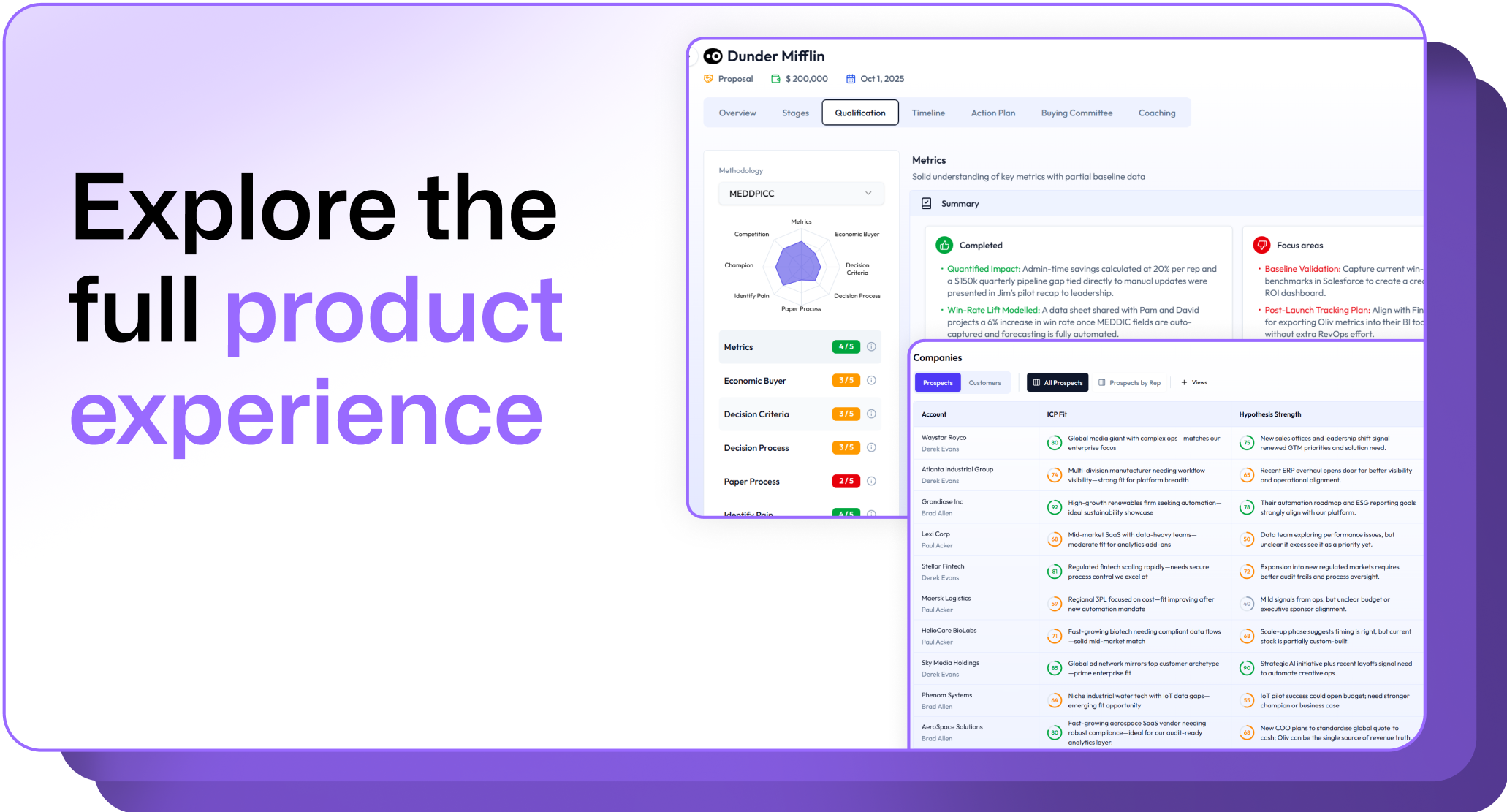
.avif)