Gong Limitations in 2026: Why are CROs moving away from Gong?
Written by
Ishan Chhabra
Last Updated :
December 23, 2025
Skim in :
8
mins
In this article
Still got questions?
Come discuss this article with me.
Hi, I'm Ishan, Founder and CEO of Oliv.
I'm always up for a conversation about revenue intelligence, AI agents, or what's actually working (and what's not) across revenue teams.
I'd love to hear your perspective.
Thank you! Your submission has been received!
Oops! Something went wrong while submitting the form.
Meet Oliv’s AI Agents
Hi! I’m, Deal Driver
I track deals, flag risks, send weekly pipeline updates and give sales managers full visibility into deal progress
Hi! I’m, CRM Manager
I maintain CRM hygiene by updating core, custom and qualification fields all without your team lifting a finger
Hi! I’m, Forecaster
I build accurate forecasts based on real deal movement and tell you which deals to pull in to hit your number
Hi! I’m, Coach
I believe performance fuels revenue. I spot skill gaps, score calls and build coaching plans to help every rep level up
Hi! I’m, Prospector
I dig into target accounts to surface the right contacts, tailor and time outreach so you always strike when it counts
Hi! I’m, Pipeline tracker
I call reps to get deal updates, and deliver a real-time, CRM-synced roll-up view of deal progress
Hi! I’m, Analyst
I answer complex pipeline questions, uncover deal patterns, and build reports that guide strategic decisions
TL;DR
Gong's keyword-based Smart Trackers lack generative AI reasoning, creating contextual blind spots that require manual manager review and interpretation.
True TCO reaches $400-$500 per user monthly when stacking Gong with Clari for forecasting and Outreach for engagement, plus hidden platform fees.
CRM fields don't auto-update; reps manually enter MEDDPICC/BANT data even after Gong records calls, creating persistent hygiene gaps.
Data portability is severely limited; bulk export requires custom API development, complicating migrations and creating vendor lock-in.
AI-native platforms eliminate manager time tax through autonomous agents that score calls, update CRM, forecast deals, and surface risks via Slack.
Migration takes 2-4 weeks with modern platforms vs. Gong's 3-6 month implementations, with free historical data transfer available.
Q1. What Is Gong in 2026 and Why Are CROs Re-Evaluating It? [toc=Gong in 2026]
Gong revolutionized sales intelligence when it launched in 2015, pioneering the Revenue Intelligence category and becoming the go-to platform for call recording, conversation analysis, and sales coaching. The platform built its reputation on Smart Trackers, automated call transcription, and deal insights that promised to transform how sales teams operated. By 2024, Gong had become deeply embedded in thousands of sales organizations, with many revenue leaders viewing it as essential infrastructure for their go-to-market strategy.
⭐ The Traditional Revenue Intelligence Model
However, Gong's architecture represents a first-generation approach built in the pre-generative AI era. The platform operates as traditional SaaS software requiring extensive user training, manual dashboard monitoring, and ongoing administrative overhead to extract value. Sales managers must log into Gong daily to review call recordings, manually tag insights, and build custom trackers using keyword-based logic. This review-based workflow creates significant time tax: managers often report listening to recordings during commutes or off-hours just to stay current with their team's activities.
"It was a big mistake on our part to commit to a two year term. Gong is a really powerful tool but it's probably the highest end option on the market... Having talked with other friends who lead revenue functions, all have said the same thing they've been fine using a lower cost, simpler alternative." — Iris P., Head of Marketing, Sales & Partnerships, G2 Verified Review
The cost structure compounds these operational challenges. While Gong initially positioned itself around $160 per user monthly, the 2026 reality involves mandatory platform fees ($5,000-$50,000+ annually), bundled modules approaching $250 per seat, and implementation costs ranging from $7,500 to $30,000+. Many organizations find themselves stacking Gong with Clari for forecasting and Outreach for engagement, driving total costs toward $400-$500 per user per month.
🤖 The 2026 Shift to Agentic Revenue Orchestration
CROs evaluating their 2026 tech stacks face fundamentally different expectations than five years ago. Modern revenue operations demand AI-native platforms that provide autonomous, real-time intelligence across the entire deal lifecycle not just post-call analytics. Generative AI has shifted the paradigm from "software you adopt" to "agents that work for you," performing tasks like automatic CRM updates, proactive risk flagging, and autonomous forecasting without requiring managers to dig through dashboards.
"The additional products like forecast or engage come at an additional cost. Would be great to see these tools rolled into the core offering." — Scott T., Director of Sales, G2 Verified Review
Flowchart illustrating Oliv's interconnected AI agent ecosystem where specialized agents—CRM Manager, Forecaster, Coaching, Prospector, Deal Driver, Analyst, and Meeting Assistant—work autonomously on unified deal-level data to eliminate manual workflows.
This is where Oliv.ai enters as the AI-native alternative built specifically for the agentic era. Rather than treating Revenue Intelligence as a dashboard to monitor, we position AI-Native Revenue Orchestration as an autonomous system where AI agents actively perform work on behalf of sales teams. Our CRM Manager Agent automatically updates opportunity fields with MEDDPICC qualifications after each call. The Forecaster Agent generates unbiased weekly forecasts with AI commentary on risks and quick wins. The Deal Driver Agent proactively surfaces stalled deals via Slack or email eliminating the need for manual dashboard reviews entirely.
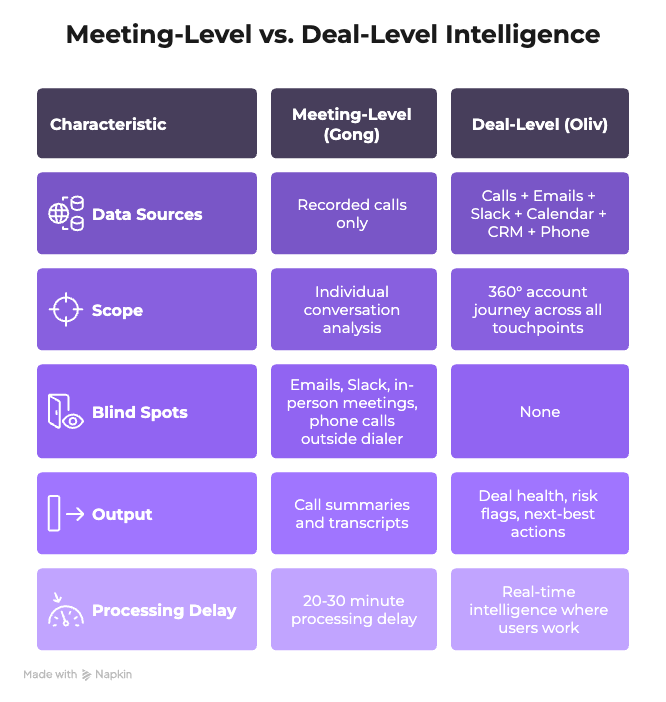
While Gong understands individual meetings, Oliv understands entire deals by stitching data across calls, emails, Slack messages, and CRM activity into a unified 360° account journey. This deal-level intelligence is critical for Account Executives and managers who need pipeline visibility, not just call summaries.
Q2. What Are Gong's Core Architectural Limitations in 2026? [toc=Architectural Limitations]
Gong's intelligence engine relies on Smart Trackers a feature set built on older machine learning and keyword-matching technology rather than true generative AI. These trackers analyze call transcripts by scanning for predefined keywords and phrases, then surfacing moments where those terms appear. While this approach was innovative in 2015, it operates fundamentally differently from how modern LLMs reason about conversations. Smart Trackers require manual configuration: sales ops teams must specify exact keywords to track (e.g., "competitor name," "budget," "timeline"), creating significant administrative overhead as business needs evolve.
The contextual reasoning gap becomes apparent in real-world scenarios. If a prospect mentions "We're also looking at Salesforce," a keyword tracker flags this as a competitor mention but cannot reliably distinguish whether they're casually aware of alternatives or actively evaluating them in a formal bake-off. This lack of nuanced intent understanding leads to false positives that bury managers in low-signal alerts, or false negatives where critical deal risks go undetected because they weren't expressed using tracked keywords.
⚠️ Structural Data Limitations
Gong's architecture imposes several hard constraints that limit its utility in complex enterprise environments:
High data thresholds: Smart Trackers require substantial historical call volume before pattern recognition becomes reliable
English-primary focus: Limited multilingual capabilities restrict global deployment
Meeting-level blindness: Gong only sees what happens on recorded calls, missing email threads, Slack conversations, in-person meetings, and phone calls made outside its dialer
No cross-deal synthesis: Each conversation is analyzed independently; the system doesn't connect insights across multiple touchpoints in a deal lifecycle
"AI is not great (yet) the product still feels like its at its infancy and needs to be developed further." — Annabelle H., Board of Directors, G2 Verified Review
🔍 The Generative AI Gap
Modern answer engines and revenue workflows require multi-step reasoning capabilities that legacy keyword systems cannot provide. When a CRO asks "Which deals in Q1 pipeline have unaddressed technical concerns?" a keyword tracker might surface calls mentioning "technical" or "concern" but cannot synthesize conversation context, email follow-ups, and prior meeting history to identify deals where technical validation is genuinely blocking progress. This gap explains why Gong summaries often feel "fluffy": they recite what was said without analyzing what it means for deal strategy.
"It can be overwhelming to set up trackers. AI training is a bit laborious to get it to do what you want." — Trafford J., Senior Director Revenue Enablement, G2 Verified Review
✅ Oliv.ai's LLM-Native Architecture
Oliv approaches this problem fundamentally differently by building on GPT-first foundations from day one. Our agentic data platform uses large language models to understand conversation intent, sentiment, and business context not just keyword matches. The CRM Manager Agent employs AI-based object association to correctly map activities to opportunities even in messy Salesforce instances with duplicate accounts, something rule-based systems consistently fail at.
More importantly, Oliv stitches intelligence across every channel where revenue activity happens: recorded calls, emails, Slack threads, calendar events, and CRM data. This unified data layer enables true deal-level reasoning. When our Analyst Agent is asked about technical objections, it synthesizes signals across all touchpoints to surface deals where technical validation is genuinely at risk providing the multi-step reasoning that modern revenue operations demand.
Q3. How Does Gong's Manual, Review-Based Workflow Create a Manager Time Tax? [toc=Manager Time Tax]
Picture a typical Monday morning for a sales manager using Gong: log in to review 20+ call recordings from the previous week, manually scan transcripts for coaching moments, fill out scorecards tracking whether reps asked discovery questions, update a spreadsheet tracking deal health, then schedule one-on-ones to discuss findings. This review-based workflow turns managers into full-time auditors rather than strategic coaches. Industry data suggests managers spend 8-12 hours weekly on Gong-related administrative tasks time that could be invested in strategic deal support or pipeline building.
The operational friction compounds throughout the workflow. After each call ends, Gong imposes a 20-30 minute processing delay before recordings and transcripts become available. In fast-paced sales environments where immediate follow-up creates competitive advantage, this latency is increasingly viewed as an operational bottleneck. Managers report feeling forced to "dig through recordings and dashboards" to find relevant insights, with no autonomous system flagging which deals require immediate attention versus which are progressing normally.
Workflow comparison table contrasting Gong's manual 8-12 hour weekly review burden with Oliv's automated 30-minute agentic workflow, demonstrating time reclaimed through AI-native revenue orchestration for sales managers.
⏰ The Dashboard-Centric Burden
"It's too complicated, and not intuitive at all. Using it is very...discomforting. Searching for calls is not easy, moving around in the calls is not easy, and understanding the pipeline management portion of it is almost impossible." — John S., Senior Account Executive, G2 Verified Review
Gong's intelligence lives exclusively inside its dashboard requiring managers to context-switch away from their natural workflow in Slack, email, or CRM to access insights. There's no proactive alerting when a strategic deal goes dark or when a rep consistently misses qualification questions. Instead, managers must remember to check Gong, navigate its interface, and manually interpret data to determine next actions.
"It takes an eternity to upload a call to listen to it." — Remington Adams, Team Lead SDR, TrustRadius Verified Review
🚀 The AI-Native Shift to Real-Time Intelligence
Modern revenue operations should invert this relationship: rather than managers monitoring software, AI agents should actively monitor deals and surface insights where managers already work. The paradigm shift is from passive analytics (recording what happened) to active orchestration (triggering next-best actions automatically). This requires moving intelligence out of dashboards and into the flow of work via Slack notifications, email briefs, and automated CRM updates.
✅ Oliv's Agentic Automation Eliminates the Time Tax
We designed Oliv specifically to eliminate managerial review burden through autonomous agents that perform work rather than generate dashboards to monitor. Our Coaching Agent automatically scores every call against your methodology (MEDDPICC, BANT, SPICED), identifies specific skill gaps, and pushes personalized coaching feedback directly to reps via Slack no manager review required. The Meeting Assistant sends prep notes 30 minutes before each call, synthesizing prior conversation history, open action items, and account context automatically.
Most transformatively, the Deal Driver Agent continuously monitors pipeline health and proactively flags stalled deals, missing next steps, or unaddressed objections via daily Slack digests. Managers receive a one-page summary of exactly which deals need attention and why eliminating hours spent manually reviewing recordings to surface the same insights.
"There's so much in Gong, that we don't use everything. Gong's deal forecasting we don't use." — Karel Bos, Head of Sales, TrustRadius Verified Review
This shift from review-based workflows to agentic automation is analogous to moving from manually reviewing CCTV footage to having an intelligent security system that alerts you only when threats are detected. Teams using Oliv report reclaiming 6-10 hours weekly previously spent on manual Gong reviews time reinvested in strategic deal coaching and pipeline generation.
Q4. In What Ways Does Gong Fail CRM Hygiene, Data Portability, and RevOps Needs? [toc=CRM & Data Issues]
Gong's CRM integration follows a fundamentally passive model: it logs meeting summaries and call recordings as "notes" or "activities" attached to contact records, but does not automatically update structured opportunity fields or custom objects. After a discovery call where a prospect reveals budget authority, timeline, and pain points, Account Executives still must manually navigate to Salesforce and fill out MEDDPICC, BANT, or SPICED qualification fields even though Gong recorded the entire conversation. This creates a persistent CRM hygiene problem where the system of record remains incomplete or stale, forcing managers to trust verbal updates over data-driven pipeline reviews.
❌ The Data Association and Export Crisis
The technical limitations compound when dealing with enterprise CRM complexity. Gong relies on rigid, rule-based logic to associate activities with accounts and opportunities. In organizations with duplicate records, complex account hierarchies, or non-standard Salesforce customizations, this frequently results in misassociated activities calls logged to the wrong opportunity or orphaned entirely. RevOps teams report spending hours weekly manually reconciling Gong data with CRM reality, undermining the platform's value proposition.
"While Gong offers valuable insights into call data and sales interactions, our experience has been impacted by significant data access limitations, especially concerning data portability and bulk export capabilities... Gong's support team has stated they are in full compliance with CCPA, but their current solution requires downloading calls individually, which is impractical and inefficient for a large volume of data." — Neel P., Sales Operations Manager, G2 Verified Review
The data portability problem becomes critical during vendor transitions or business intelligence initiatives. Gong's API is widely described as "wonky," requiring extensive custom development to extract structured data. Organizations attempting to analyze win-loss patterns, rep performance trends, or customer sentiment across their historical conversation corpus must write significant custom code adding unexpected engineering costs and creating vendor lock-in by making migration increasingly painful as data accumulates.
🔒 2026 Governance and AI-Readiness Gaps
Modern revenue operations face escalating demands around data governance: GDPR compliance, SOC 2 auditability, data residency requirements, and the need for clean, structured data to power AI workflows. Gong's one-way data model pulling information in but making bulk export cumbersome creates compliance and audit risk. When M&A due diligence or regulatory audits require comprehensive call data exports, teams discover the painful reality that their conversation intelligence is effectively trapped inside Gong's UI.
"The lack of robust data export options has made it hard to justify the platform's cost, especially as it falls short of meeting practical data management needs... This lack of flexibility has required us to engage our development team at additional cost." — Neel P., Sales Operations Manager, G2 Verified Review
✅ Oliv's CRM Autonomy and Open Data Model
We architected Oliv specifically to solve the CRM hygiene crisis through our CRM Manager Agent. Using LLM-based understanding rather than rigid rules, the agent automatically extracts qualification criteria from conversations and updates the corresponding CRM fields in real-time. When a prospect mentions budget on a call, the Budget field updates automatically. When they identify a technical evaluator, the agent creates the contact record and maps the relationship no manual AE effort required.
Critically, our AI-based object association correctly handles enterprise CRM complexity. Even when duplicate accounts exist or naming conventions vary, the agent uses contextual reasoning to map activities to the right opportunity. We also maintain a full open-export policy: customers can export complete meeting data, transcripts, and metadata via CSV at any time ensuring data portability and eliminating vendor lock-in concerns that plague traditional RI platforms.
Q5. How Expensive Is Gong Really in 2026 (And What Is the True TCO)? [toc=Pricing & TCO]
Gong's 2026 pricing structure involves multiple cost layers that significantly exceed the headline per-user rates often cited in initial sales conversations. Understanding the true total cost of ownership (TCO) requires examining license fees, platform charges, implementation costs, and the hidden expenses of tool stacking.
💰 Per-User License Costs
Gong's foundational Conversational Intelligence product historically carried pricing around $160 per user per month when sold standalone. However, the company has increasingly moved to a bundled "Foundation" model that combines CI with Gong Engage (sales engagement) and Gong Forecast (forecasting), pushing effective per-user costs to approximately $200-$250 per user per month for most mid-market and enterprise deployments.
💸 Platform Fees and Hidden Charges
Beyond per-seat licensing, Gong imposes mandatory platform fees ranging from $5,000 to $50,000+ annually depending on company size and contract tier. These fees are non-negotiable and recur annually, adding $400-$4,000+ per month to the total bill before a single user license is counted.
Implementation and onboarding costs represent another significant expense layer:
Professional services fees: $7,500-$30,000+ for initial setup
Third-party implementation partners: some organizations report quotes exceeding $50,000 for a 20-person team
Timeline: 3-6 months to full deployment, creating opportunity cost during the implementation period
⚠️ Contract Structure and Lock-In
Gong requires annual or multi-year contracts with 100% upfront payment no monthly billing options exist. Contracts typically include:
5-15% automatic annual price increases built into multi-year agreements
Rigid seat count commitments with limited flexibility to reduce licenses mid-contract
Renewal pressure as data accumulates and migration becomes increasingly difficult
"It was a big mistake on our part to commit to a two year term. Gong is a really powerful tool but it's probably the highest end option on the market, and now we're stuck with a tool that works technically but isn't the right business decision." — Iris P., Head of Marketing, Sales & Partnerships, G2 Verified Review
📊 Total Cost of Ownership Example
For a 50-person sales organization, realistic TCO calculations reveal:
When organizations stack Gong with Clari for robust forecasting (adding ~$150/user/month) and Outreach or Salesloft for engagement automation, effective costs approach $400-$500 per user per month, or $240,000-$300,000 annually for that same 50-person team.
✅ Oliv's Transparent, Modular Pricing
Oliv eliminates hidden costs through transparent, modular pricing with zero platform fees. We offer free implementation, training, and ongoing support. Organizations can start with basic meeting intelligence and add specialized agents (CRM Manager, Forecaster, Coaching, Prospector) only as needed ensuring teams pay exclusively for functionality they actively use rather than bundled features that create underutilization waste.
Q6. Where Do Gong's Modules Fall Short: Smart Trackers, Analytics, Engage, and Forecast? [toc=Module Limitations]
Gong's product portfolio spans four primary modules, each facing distinct limitations that drive user dissatisfaction and platform switching decisions. Understanding these functional gaps is critical for revenue leaders evaluating whether Gong's feature set justifies its premium pricing.
Side-by-side comparison illustrating Gong's keyword-based Smart Tracker limitations versus generative AI contextual reasoning, showing how legacy technology flags competitor mentions without understanding urgency, buying stage, or intent.
⚠️ Smart Trackers: Keyword Limitations and Setup Burden
Gong Smart Trackers form the core of its conversation intelligence engine but rely on older keyword-matching and basic machine learning rather than generative AI. Key limitations include:
Manual keyword specification: RevOps teams must define and maintain tracker dictionaries for competitors, objections, and key topics
Contextual failure: Trackers flag mentions without understanding intent unable to distinguish between casual competitor references and active evaluations
High setup burden: "It can be overwhelming to set up trackers. AI training is a bit laborious to get it to do what you want." — Trafford J., Senior Director Revenue Enablement, G2 Verified Review
English-primary focus: Limited multilingual capabilities restrict global deployment
Dashboard dependency: Insights live exclusively in Gong's UI, requiring constant context-switching
Limited bulk export: No native way to export aggregate data for external analysis
"Wonky" API: Custom development required for most reporting and BI integration use cases
❌ Gong Engage: The Failed Engagement Module
Gong Engage represents the platform's most criticized module, with widespread user reports of implementation failures and abandonment:
"We've had a disappointing experience with Gong Engage... The platform lacks task APIs, does not integrate with other vendors or parallel dialers, and isn't built to function as a proper sequencing tool. Gong is strong at conversation intelligence, but that's where its usefulness ends." — Anonymous Reviewer, G2 Verified Review
Specific Engage limitations include:
No task API: Cannot integrate with external dialers or workflow tools
Mass outreach design: Built for high-volume, low-personalization cadences a failing strategy in 2026's deliverability environment
Poor adoption: "Our team is struggling with low adoption, and they won't even spend the time to support us during this transition."
Cost inefficiency: Significantly more expensive than Outreach, Salesloft, or Apollo for equivalent functionality
📊 Gong Forecast: Weak Forecasting Capabilities
Gong's forecasting module consistently receives criticism for lacking the depth of dedicated platforms like Clari:
Manual process: Requires managers to manually review deals and input qualitative context
Bundling cost: "The additional products like forecast or engage come at an additional cost. Would be great to see these tools rolled into the core offering." — Scott T., Director of Sales, G2 Verified Review
This weakness forces organizations into expensive dual-tool stacks (Gong + Clari), defeating the purpose of a unified platform.
✅ Oliv's Integrated, AI-Native Module Approach
Oliv addresses these module gaps through purpose-built AI agents that combine functionality across conversation intelligence, forecasting, coaching, and prospecting in a single platform eliminating the need for stacking and ensuring each capability leverages our generative AI foundation for superior contextual understanding and automation.
Q7. Why Are CROs Stacking Gong with Other Tools and Why That's No Longer Sustainable? [toc=Tool Stacking Problem]
The typical 2025-2026 revenue tech stack for mid-market B2B companies follows a predictable pattern: Gong for conversation intelligence, Clari for forecasting, Outreach or Salesloft for sales engagement, Salesforce as the CRM foundation, plus assorted point solutions for enrichment, intent data, and analytics. This multi-tool architecture emerged because no single platform delivered enterprise-grade capabilities across all revenue functions but the operational and financial burden of maintaining it has become untenable.
💸 The Stacking Tax: Cost and Complexity
Revenue leaders face compounding costs when building best-of-breed stacks:
Gong (CI): $200-$250 per user/month
Clari (Forecasting): $120-$150 per user/month
Outreach/Salesloft (Engagement): $100-$125 per user/month
Salesforce + various clouds: $150-$300+ per user/month
Total effective cost: $400-$500+ per user per month for core revenue infrastructure before adding enrichment tools, intent platforms, or analytics layers. For a 50-person sales team, this approaches $300,000 annually just for the primary stack.
Beyond direct costs, operational complexity creates hidden expenses: RevOps teams spend hours weekly manually stitching data across platforms, building custom integrations to sync insights between tools, and troubleshooting when different systems provide conflicting deal health scores or activity attribution. Each vendor upgrade risks breaking integrations, and onboarding new reps requires training across 4-5 separate platforms.
⚠️ Data Fragmentation and Trust Erosion
"Before Gong we had a lack of visibility across our deals because information was siloed in several places like CRM, Email, Zoom, phone. Now all of this is centralized in one view via the Gong deal boards." — Scott T., Director of Sales, G2 Verified Review
Yet even with Gong deployed, organizations still face fragmentation: Gong sees calls but not Outreach email sequences. Clari sees pipeline but not conversation sentiment. Salesforce holds the official record but lacks automated field updates. This creates conflicting sources of truth where deal health scores, next step recommendations, and risk flags vary depending which dashboard a manager checks eroding confidence in the data and forcing reliance on manual judgment.
🚀 The 2026 Consolidation Mandate
CROs entering 2026 face board-level pressure around three mandates:
Margin improvement: Reduce sales & marketing spend as a percentage of revenue
Efficiency gains: Increase revenue per rep without proportional headcount growth
Stack rationalization: Eliminate redundant tools and consolidate on platforms that deliver multiple capabilities
Multi-year vendor lock-in and 5-15% annual price escalations make legacy stacks increasingly difficult to justify. The question shifts from "Can we afford to consolidate?" to "Can we afford not to?"
✅ Oliv as the Unified AI-Native Revenue Orchestration Platform
We designed Oliv specifically to replace 3-4 point solutions through specialized AI agents that work together on a unified data foundation. Our CRM Manager Agent eliminates manual field updates. The Forecaster Agent produces unbiased forecasts without requiring Clari. The Prospector Agent handles research and personalized outreach without needing Outreach. The Coaching Agent automates rep development without separate enablement tools.
A 50-person team moving from a stacked Gong/Clari/Outreach architecture to Oliv's agent-first platform typically achieves $100,000-$200,000+ in annual savings while gaining superior deal-level intelligence, faster implementation (weeks vs. months), and eliminating the integration burden that consumes RevOps bandwidth. This consolidation doesn't sacrifice capability it enhances it by ensuring all agents operate on the same unified view of deals, conversations, and pipeline health.
Q8. What Strategic Risks Do Gong's Limitations Create for CROs in 2026? [toc=Strategic CRO Risks]
Chief Revenue Officers entering 2026 face an unforgiving mandate from boards and investors: achieve efficient growth with improving unit economics while reducing sales & marketing spend as a percentage of revenue. This means simultaneously increasing quota attainment, improving forecast accuracy to within ±5%, and rationalizing bloated tech stacks that have ballooned to $400-$500 per rep monthly. In this environment, every platform in the revenue stack must demonstrate clear ROI and strategic contribution or face replacement.
⚠️ How Gong's Limitations Create Forecast and Pipeline Blind Spots
Gong's architecture creates systematic gaps that undermine forecast reliability. The platform only captures data from recorded calls missing email threads, Slack conversations, in-person meetings, and phone calls made outside its dialer. When a strategic deal involves months of relationship-building across multiple channels, Gong provides fragmentary intelligence at best. CROs relying on Gong for pipeline health assessment face a fundamental problem: the platform reports on conversations it recorded, not on the actual state of deals.
The 20-30 minute processing delay and manual review requirement mean deal risk signals surface too late. By the time a manager identifies a stalled opportunity through Gong dashboard analysis, the competitive window for intervention may have already closed. This reactive posture reviewing what happened rather than predicting what's about to happen forces CROs to rely on verbal updates from managers during forecast calls, reintroducing the subjective bias that revenue intelligence was supposed to eliminate.
"As a Series B startup we rely on the intelligence and insights from Gong to understand and scale what's working, and to better understand real risk and opportunity." — Trafford J., Senior Director Revenue Enablement, G2 Verified Review
Yet when forecast accuracy remains inconsistent despite Gong deployment, boards lose confidence in pipeline calls. The strategic risk isn't just missing a quarter it's eroding the CRO's credibility as a data-driven operator.
🚀 The AI-Native Alternative: Continuous Pipeline Intelligence
Modern AI-Native Revenue Orchestration platforms should function as always-on monitoring systems that continuously assess deal health across all channels, automatically flag deviations from expected progression patterns, and surface interventions to the right stakeholder at the right time. This requires moving beyond conversation analytics to comprehensive deal-level reasoning that synthesizes signals across calls, emails, CRM activity, and engagement patterns to identify risk before it becomes visible in lagging indicators.
✅ Oliv's Autonomous Risk Detection and Forecast Generation
Our Forecaster Agent produces unbiased weekly forecasts by analyzing deal progression velocity, stakeholder engagement patterns, and historical win/loss indicators across your entire pipeline not just recorded calls. The agent automatically identifies which deals are trending off-track and provides AI commentary on specific risks (e.g., "Champion hasn't responded in 14 days; decision timeline slipping") and quick wins (e.g., "Economic buyer just engaged; propose close timeline").
The Analyst Agent enables CROs to run natural-language win/loss analysis across the full dataset, asking questions like "Which deals stalled due to unresolved technical concerns in Q4?" and receiving comprehensive answers without requiring RevOps to write custom SQL queries. The Deal Driver Agent proactively surfaces at-risk opportunities via Slack every morning, eliminating the need for managers to manually scan dashboards. This shift from reactive review to proactive intelligence transforms forecast accuracy from a subjective art into a data-driven science giving CROs the board-level credibility that comes from consistently delivering on commitments.
Q9. How Does Oliv.ai's Agentic Model Solve Gong's Limitations at the Deal Level? [toc=Oliv's Agentic Solution]
The limitations driving CROs away from Gong cluster into four categories: architectural constraints (keyword trackers vs. contextual AI), manual workflow burden (review-based processes), CRM hygiene failures (activity logging without field updates), and cost inefficiency (bundling, platform fees, stack duplication). These aren't isolated bugs they're fundamental design characteristics of first-generation revenue intelligence platforms built in the pre-generative AI era.
Comparison table highlighting Gong's meeting-level blindness to emails, Slack, and phone calls versus Oliv's deal-level intelligence that synthesizes 360-degree account journey data with real-time insights and no processing delays.
❌ Why Bolting AI Features Onto Legacy SaaS Doesn't Work
Some incumbent platforms have attempted to address these limitations by adding generative AI features to existing architectures upgrading Smart Trackers with LLM summarization or offering GPT-powered call summaries. However, these bolt-on approaches fail to solve the core problem: the underlying data model and workflow paradigm remain unchanged. Gong still logs activities without updating CRM fields. It still requires managers to review dashboards manually. It still operates at the meeting level rather than the deal level. Adding AI-generated summaries to a fundamentally manual, reactive system is analogous to putting a more powerful engine in a horse-drawn carriage it doesn't transform the vehicle's fundamental category.
"There's so much in Gong, that we don't use everything. Gong's deal forecasting we don't use." — Karel Bos, Head of Sales, TrustRadius Verified Review
🤖 Oliv's Agentic Philosophy: AI Agents That Perform Work, Not Software You Operate
We designed Oliv around a fundamentally different paradigm: agentic automation where specialized AI agents autonomously perform revenue operations tasks rather than generating dashboards for humans to interpret and act upon. This isn't about "AI-assisted workflows" it's about agents that complete workflows end-to-end without human intervention. The CRM Manager Agent doesn't suggest field updates; it makes them automatically. The Coaching Agent doesn't flag calls for manager review; it scores them, identifies skill gaps, and pushes personalized feedback directly to reps.
✅ Mapping Oliv Agents to Gong's Gaps
How Oliv's AI Agents Address Gong's Core Limitations
Gong Limitation
Oliv Agent Solution
Deal-Level Impact
Activity logging only
CRM Manager Agent: Updates opportunity fields automatically with MEDDPICC/BANT qualification data
CRM becomes single source of truth; eliminates manual data entry
Weak forecasting
Forecaster Agent: Generates unbiased weekly forecasts with risk commentary and quick-win identification
Transforms Monday forecast meetings from 2-hour manual reviews to 15-minute data-driven discussions
Replaces spray-and-pray with targeted, relevant messaging
Dashboard-trapped insights
Deal Driver Agent: Proactively surfaces stalled deals, missing next steps, unaddressed objections via Slack
Intelligence comes to managers where they work; no dashboard digging required
Limited analytics access
Analyst Agent: Natural language interface for win/loss analysis and pipeline interrogation
CROs get answers in minutes, not weeks of custom SQL development
The critical differentiator is deal-level context: while Gong understands individual meetings, Oliv stitches intelligence across calls, emails, Slack messages, calendar activity, and CRM data to maintain a unified 360° view of each opportunity. This enables true deal reasoning understanding not just what was said on a call, but where the deal stands, what's blocking progress, and what action will move it forward.
The analogy is moving from manually reviewing CCTV footage (Gong) to having an intelligent security system (Oliv) that monitors continuously, recognizes threat patterns, and alerts you only when intervention is required with specific recommendations on what action to take.
Q10. What Does Migration from Gong Look Like in Practice (Without Losing Years of Data)? [toc=Migration Process]
Migrating from Gong to an AI-native platform raises legitimate concerns about data portability, implementation timelines, and organizational change management. Understanding the realistic migration path helps de-risk the transition and enables informed decision-making around contract renewal timing.
📊 Step 1: Data Export and Historical Preservation
Gong's Data Export Reality: Gong does not provide native bulk export functionality for call recordings, transcripts, and metadata. As documented in user reviews, the platform requires downloading calls individually, which is impractical for organizations with thousands of historical recordings.
"If you're considering switching platforms and have six months or less on your contract, start engaging the Gong API documentation immediately to download all of your call data in a usable format... Gong does provide an API for data export, including documentation to facilitate access to individual call downloads... we remain committed to assisting your team within these existing product parameters." — Neel P., Sales Operations Manager, G2 Verified Review
Migration approach:
6+ months before contract end: Begin API-based bulk download process or engage development resources to automate extraction
Alternative: Some organizations negotiate data export support as part of contract termination, though Gong has historically charged fees for this service
⏰ Step 2: Implementation Timeline for New Platform
Oliv Implementation Process:
Week 1: Calendar and CRM integration (instant automated setup)
Weeks 1-2: AI agents begin auto-joining meetings, transcribing, and updating CRM fields
Week 4+: Full production deployment with specialized agents (Forecaster, Coaching, Prospector) activated
Parallel running period: Many organizations run Gong and Oliv concurrently for 30-60 days during transition, allowing side-by-side validation of insights, forecasts, and CRM automation quality before full cutover.
✅ Step 3: Change Management and User Adoption
Training requirements:
Gong: Requires extensive user training (typically 2-4 weeks) due to complex interface and manual workflows
Oliv: Minimal training needed; agents work autonomously in background, delivering insights via Slack/email where users already operate
Adoption acceleration: Because Oliv operates agentically rather than requiring dashboard monitoring, user adoption friction is significantly lower. Reps receive automated CRM updates and meeting prep they don't need to "learn new software."
💡 Oliv's Migration Support
We provide free historical data migration services for organizations transitioning from Gong, importing past recordings and metadata to ensure continuity of conversation intelligence. Our open-export policy guarantees that customers retain full access to their data via CSV export at any time eliminating the vendor lock-in concern that makes Gong exits painful. Implementation timelines average 2-4 weeks from kickoff to full production, compared to Gong's typical 3-6 month deployment cycles, minimizing disruption and accelerating time-to-value for revenue teams undergoing platform transitions.
Q11. Is Gong Still Worth It in 2026 or Is It Time to Move On? [toc=Worth It Decision]
Gong remains a legitimate choice for specific organizational profiles: large enterprises (1,000+ employees) with dedicated RevOps teams, high tolerance for complexity, substantial training budgets, and financial capacity to absorb $300,000-$500,000 annual platform costs. Organizations already deeply embedded in Gong workflows with extensive custom integrations and strong user adoption may find the switching cost outweighs incremental benefit particularly if they've built institutional muscle around its specific paradigms and can justify the ongoing investment.
⚠️ The Accumulating Evidence for Reconsideration
However, user review patterns and pricing analyses reveal recurring themes that should prompt serious renewal evaluation:
Cost vs. value disconnect: "It was a big mistake on our part to commit to a two year term... now we're stuck with a tool that works technically but isn't the right business decision." — Iris P., G2 Review
Underutilization waste: Organizations pay for bundled modules (Engage, Forecast) that receive low adoption, creating sunk cost
Manual burden persistence: "It's too complicated, and not intuitive at all. Using it is very...discomforting." — John S., G2 Review
Stack duplication: Need to layer Clari for forecasting drives total costs toward $400-$500 per user monthly
"The additional products like forecast or engage come at an additional cost. Would be great to see these tools rolled into the core offering." — Scott T., Director of Sales, G2 Verified Review
📋 Decision Framework: Four Evaluation Criteria
Gong Renewal Evaluation Framework
Criteria
Stick with Gong If...
Evaluate Alternatives If...
Stack economics
Total revenue platform spend <$200/user/month with high utilization
Gong + other tools approaching $400-$500/user/month; underutilized licenses
Workflow preference
Team comfortable with dashboard-centric, review-based processes
No near-term need for bulk export; satisfied with API complexity
Planning migration, M&A activity, or require flexible analytics access
AI readiness
Legacy keyword tracking meets current needs
Need contextual AI reasoning, real-time insights, autonomous CRM updates
✅ Strategic Switching Windows
The optimal time to evaluate Gong alternatives occurs during three natural inflection points:
Contract renewal: 6-12 months before Gong renewal, allowing sufficient time for parallel evaluation
Stack consolidation initiatives: When CFO/board mandate tech spend reduction or tool rationalization
GTM transformation: During sales methodology changes, CRM migrations, or revenue team restructuring
Rather than renewing Gong for another 2-3 years at escalating prices with 5-15% annual increases, forward-thinking CROs are modeling the economics of AI-native alternatives. A 50-person team moving from Gong+Clari ($300K+ annually) to Oliv's unified platform typically achieves $100K-$200K in annual savings while gaining superior deal-level intelligence, autonomous workflows, and implementation measured in weeks rather than months. We invite you to model your specific ROI scenario or run a 30-day pilot to validate the agent-first approach before committing to another multi-year legacy contract.
Q1. What Is Gong in 2026 and Why Are CROs Re-Evaluating It? [toc=Gong in 2026]
Gong revolutionized sales intelligence when it launched in 2015, pioneering the Revenue Intelligence category and becoming the go-to platform for call recording, conversation analysis, and sales coaching. The platform built its reputation on Smart Trackers, automated call transcription, and deal insights that promised to transform how sales teams operated. By 2024, Gong had become deeply embedded in thousands of sales organizations, with many revenue leaders viewing it as essential infrastructure for their go-to-market strategy.
⭐ The Traditional Revenue Intelligence Model
However, Gong's architecture represents a first-generation approach built in the pre-generative AI era. The platform operates as traditional SaaS software requiring extensive user training, manual dashboard monitoring, and ongoing administrative overhead to extract value. Sales managers must log into Gong daily to review call recordings, manually tag insights, and build custom trackers using keyword-based logic. This review-based workflow creates significant time tax: managers often report listening to recordings during commutes or off-hours just to stay current with their team's activities.
"It was a big mistake on our part to commit to a two year term. Gong is a really powerful tool but it's probably the highest end option on the market... Having talked with other friends who lead revenue functions, all have said the same thing they've been fine using a lower cost, simpler alternative." — Iris P., Head of Marketing, Sales & Partnerships, G2 Verified Review
The cost structure compounds these operational challenges. While Gong initially positioned itself around $160 per user monthly, the 2026 reality involves mandatory platform fees ($5,000-$50,000+ annually), bundled modules approaching $250 per seat, and implementation costs ranging from $7,500 to $30,000+. Many organizations find themselves stacking Gong with Clari for forecasting and Outreach for engagement, driving total costs toward $400-$500 per user per month.
🤖 The 2026 Shift to Agentic Revenue Orchestration
CROs evaluating their 2026 tech stacks face fundamentally different expectations than five years ago. Modern revenue operations demand AI-native platforms that provide autonomous, real-time intelligence across the entire deal lifecycle not just post-call analytics. Generative AI has shifted the paradigm from "software you adopt" to "agents that work for you," performing tasks like automatic CRM updates, proactive risk flagging, and autonomous forecasting without requiring managers to dig through dashboards.
"The additional products like forecast or engage come at an additional cost. Would be great to see these tools rolled into the core offering." — Scott T., Director of Sales, G2 Verified Review
Flowchart illustrating Oliv's interconnected AI agent ecosystem where specialized agents—CRM Manager, Forecaster, Coaching, Prospector, Deal Driver, Analyst, and Meeting Assistant—work autonomously on unified deal-level data to eliminate manual workflows.
This is where Oliv.ai enters as the AI-native alternative built specifically for the agentic era. Rather than treating Revenue Intelligence as a dashboard to monitor, we position AI-Native Revenue Orchestration as an autonomous system where AI agents actively perform work on behalf of sales teams. Our CRM Manager Agent automatically updates opportunity fields with MEDDPICC qualifications after each call. The Forecaster Agent generates unbiased weekly forecasts with AI commentary on risks and quick wins. The Deal Driver Agent proactively surfaces stalled deals via Slack or email eliminating the need for manual dashboard reviews entirely.
While Gong understands individual meetings, Oliv understands entire deals by stitching data across calls, emails, Slack messages, and CRM activity into a unified 360° account journey. This deal-level intelligence is critical for Account Executives and managers who need pipeline visibility, not just call summaries.
Q2. What Are Gong's Core Architectural Limitations in 2026? [toc=Architectural Limitations]
Gong's intelligence engine relies on Smart Trackers a feature set built on older machine learning and keyword-matching technology rather than true generative AI. These trackers analyze call transcripts by scanning for predefined keywords and phrases, then surfacing moments where those terms appear. While this approach was innovative in 2015, it operates fundamentally differently from how modern LLMs reason about conversations. Smart Trackers require manual configuration: sales ops teams must specify exact keywords to track (e.g., "competitor name," "budget," "timeline"), creating significant administrative overhead as business needs evolve.
The contextual reasoning gap becomes apparent in real-world scenarios. If a prospect mentions "We're also looking at Salesforce," a keyword tracker flags this as a competitor mention but cannot reliably distinguish whether they're casually aware of alternatives or actively evaluating them in a formal bake-off. This lack of nuanced intent understanding leads to false positives that bury managers in low-signal alerts, or false negatives where critical deal risks go undetected because they weren't expressed using tracked keywords.
⚠️ Structural Data Limitations
Gong's architecture imposes several hard constraints that limit its utility in complex enterprise environments:
High data thresholds: Smart Trackers require substantial historical call volume before pattern recognition becomes reliable
English-primary focus: Limited multilingual capabilities restrict global deployment
Meeting-level blindness: Gong only sees what happens on recorded calls, missing email threads, Slack conversations, in-person meetings, and phone calls made outside its dialer
No cross-deal synthesis: Each conversation is analyzed independently; the system doesn't connect insights across multiple touchpoints in a deal lifecycle
"AI is not great (yet) the product still feels like its at its infancy and needs to be developed further." — Annabelle H., Board of Directors, G2 Verified Review
🔍 The Generative AI Gap
Modern answer engines and revenue workflows require multi-step reasoning capabilities that legacy keyword systems cannot provide. When a CRO asks "Which deals in Q1 pipeline have unaddressed technical concerns?" a keyword tracker might surface calls mentioning "technical" or "concern" but cannot synthesize conversation context, email follow-ups, and prior meeting history to identify deals where technical validation is genuinely blocking progress. This gap explains why Gong summaries often feel "fluffy": they recite what was said without analyzing what it means for deal strategy.
"It can be overwhelming to set up trackers. AI training is a bit laborious to get it to do what you want." — Trafford J., Senior Director Revenue Enablement, G2 Verified Review
✅ Oliv.ai's LLM-Native Architecture
Oliv approaches this problem fundamentally differently by building on GPT-first foundations from day one. Our agentic data platform uses large language models to understand conversation intent, sentiment, and business context not just keyword matches. The CRM Manager Agent employs AI-based object association to correctly map activities to opportunities even in messy Salesforce instances with duplicate accounts, something rule-based systems consistently fail at.
More importantly, Oliv stitches intelligence across every channel where revenue activity happens: recorded calls, emails, Slack threads, calendar events, and CRM data. This unified data layer enables true deal-level reasoning. When our Analyst Agent is asked about technical objections, it synthesizes signals across all touchpoints to surface deals where technical validation is genuinely at risk providing the multi-step reasoning that modern revenue operations demand.
Q3. How Does Gong's Manual, Review-Based Workflow Create a Manager Time Tax? [toc=Manager Time Tax]
Picture a typical Monday morning for a sales manager using Gong: log in to review 20+ call recordings from the previous week, manually scan transcripts for coaching moments, fill out scorecards tracking whether reps asked discovery questions, update a spreadsheet tracking deal health, then schedule one-on-ones to discuss findings. This review-based workflow turns managers into full-time auditors rather than strategic coaches. Industry data suggests managers spend 8-12 hours weekly on Gong-related administrative tasks time that could be invested in strategic deal support or pipeline building.
The operational friction compounds throughout the workflow. After each call ends, Gong imposes a 20-30 minute processing delay before recordings and transcripts become available. In fast-paced sales environments where immediate follow-up creates competitive advantage, this latency is increasingly viewed as an operational bottleneck. Managers report feeling forced to "dig through recordings and dashboards" to find relevant insights, with no autonomous system flagging which deals require immediate attention versus which are progressing normally.
Workflow comparison table contrasting Gong's manual 8-12 hour weekly review burden with Oliv's automated 30-minute agentic workflow, demonstrating time reclaimed through AI-native revenue orchestration for sales managers.
⏰ The Dashboard-Centric Burden
"It's too complicated, and not intuitive at all. Using it is very...discomforting. Searching for calls is not easy, moving around in the calls is not easy, and understanding the pipeline management portion of it is almost impossible." — John S., Senior Account Executive, G2 Verified Review
Gong's intelligence lives exclusively inside its dashboard requiring managers to context-switch away from their natural workflow in Slack, email, or CRM to access insights. There's no proactive alerting when a strategic deal goes dark or when a rep consistently misses qualification questions. Instead, managers must remember to check Gong, navigate its interface, and manually interpret data to determine next actions.
"It takes an eternity to upload a call to listen to it." — Remington Adams, Team Lead SDR, TrustRadius Verified Review
🚀 The AI-Native Shift to Real-Time Intelligence
Modern revenue operations should invert this relationship: rather than managers monitoring software, AI agents should actively monitor deals and surface insights where managers already work. The paradigm shift is from passive analytics (recording what happened) to active orchestration (triggering next-best actions automatically). This requires moving intelligence out of dashboards and into the flow of work via Slack notifications, email briefs, and automated CRM updates.
✅ Oliv's Agentic Automation Eliminates the Time Tax
We designed Oliv specifically to eliminate managerial review burden through autonomous agents that perform work rather than generate dashboards to monitor. Our Coaching Agent automatically scores every call against your methodology (MEDDPICC, BANT, SPICED), identifies specific skill gaps, and pushes personalized coaching feedback directly to reps via Slack no manager review required. The Meeting Assistant sends prep notes 30 minutes before each call, synthesizing prior conversation history, open action items, and account context automatically.
Most transformatively, the Deal Driver Agent continuously monitors pipeline health and proactively flags stalled deals, missing next steps, or unaddressed objections via daily Slack digests. Managers receive a one-page summary of exactly which deals need attention and why eliminating hours spent manually reviewing recordings to surface the same insights.
"There's so much in Gong, that we don't use everything. Gong's deal forecasting we don't use." — Karel Bos, Head of Sales, TrustRadius Verified Review
This shift from review-based workflows to agentic automation is analogous to moving from manually reviewing CCTV footage to having an intelligent security system that alerts you only when threats are detected. Teams using Oliv report reclaiming 6-10 hours weekly previously spent on manual Gong reviews time reinvested in strategic deal coaching and pipeline generation.
Q4. In What Ways Does Gong Fail CRM Hygiene, Data Portability, and RevOps Needs? [toc=CRM & Data Issues]
Gong's CRM integration follows a fundamentally passive model: it logs meeting summaries and call recordings as "notes" or "activities" attached to contact records, but does not automatically update structured opportunity fields or custom objects. After a discovery call where a prospect reveals budget authority, timeline, and pain points, Account Executives still must manually navigate to Salesforce and fill out MEDDPICC, BANT, or SPICED qualification fields even though Gong recorded the entire conversation. This creates a persistent CRM hygiene problem where the system of record remains incomplete or stale, forcing managers to trust verbal updates over data-driven pipeline reviews.
❌ The Data Association and Export Crisis
The technical limitations compound when dealing with enterprise CRM complexity. Gong relies on rigid, rule-based logic to associate activities with accounts and opportunities. In organizations with duplicate records, complex account hierarchies, or non-standard Salesforce customizations, this frequently results in misassociated activities calls logged to the wrong opportunity or orphaned entirely. RevOps teams report spending hours weekly manually reconciling Gong data with CRM reality, undermining the platform's value proposition.
"While Gong offers valuable insights into call data and sales interactions, our experience has been impacted by significant data access limitations, especially concerning data portability and bulk export capabilities... Gong's support team has stated they are in full compliance with CCPA, but their current solution requires downloading calls individually, which is impractical and inefficient for a large volume of data." — Neel P., Sales Operations Manager, G2 Verified Review
The data portability problem becomes critical during vendor transitions or business intelligence initiatives. Gong's API is widely described as "wonky," requiring extensive custom development to extract structured data. Organizations attempting to analyze win-loss patterns, rep performance trends, or customer sentiment across their historical conversation corpus must write significant custom code adding unexpected engineering costs and creating vendor lock-in by making migration increasingly painful as data accumulates.
🔒 2026 Governance and AI-Readiness Gaps
Modern revenue operations face escalating demands around data governance: GDPR compliance, SOC 2 auditability, data residency requirements, and the need for clean, structured data to power AI workflows. Gong's one-way data model pulling information in but making bulk export cumbersome creates compliance and audit risk. When M&A due diligence or regulatory audits require comprehensive call data exports, teams discover the painful reality that their conversation intelligence is effectively trapped inside Gong's UI.
"The lack of robust data export options has made it hard to justify the platform's cost, especially as it falls short of meeting practical data management needs... This lack of flexibility has required us to engage our development team at additional cost." — Neel P., Sales Operations Manager, G2 Verified Review
✅ Oliv's CRM Autonomy and Open Data Model
We architected Oliv specifically to solve the CRM hygiene crisis through our CRM Manager Agent. Using LLM-based understanding rather than rigid rules, the agent automatically extracts qualification criteria from conversations and updates the corresponding CRM fields in real-time. When a prospect mentions budget on a call, the Budget field updates automatically. When they identify a technical evaluator, the agent creates the contact record and maps the relationship no manual AE effort required.
Critically, our AI-based object association correctly handles enterprise CRM complexity. Even when duplicate accounts exist or naming conventions vary, the agent uses contextual reasoning to map activities to the right opportunity. We also maintain a full open-export policy: customers can export complete meeting data, transcripts, and metadata via CSV at any time ensuring data portability and eliminating vendor lock-in concerns that plague traditional RI platforms.
Q5. How Expensive Is Gong Really in 2026 (And What Is the True TCO)? [toc=Pricing & TCO]
Gong's 2026 pricing structure involves multiple cost layers that significantly exceed the headline per-user rates often cited in initial sales conversations. Understanding the true total cost of ownership (TCO) requires examining license fees, platform charges, implementation costs, and the hidden expenses of tool stacking.
💰 Per-User License Costs
Gong's foundational Conversational Intelligence product historically carried pricing around $160 per user per month when sold standalone. However, the company has increasingly moved to a bundled "Foundation" model that combines CI with Gong Engage (sales engagement) and Gong Forecast (forecasting), pushing effective per-user costs to approximately $200-$250 per user per month for most mid-market and enterprise deployments.
💸 Platform Fees and Hidden Charges
Beyond per-seat licensing, Gong imposes mandatory platform fees ranging from $5,000 to $50,000+ annually depending on company size and contract tier. These fees are non-negotiable and recur annually, adding $400-$4,000+ per month to the total bill before a single user license is counted.
Implementation and onboarding costs represent another significant expense layer:
Professional services fees: $7,500-$30,000+ for initial setup
Third-party implementation partners: some organizations report quotes exceeding $50,000 for a 20-person team
Timeline: 3-6 months to full deployment, creating opportunity cost during the implementation period
⚠️ Contract Structure and Lock-In
Gong requires annual or multi-year contracts with 100% upfront payment no monthly billing options exist. Contracts typically include:
5-15% automatic annual price increases built into multi-year agreements
Rigid seat count commitments with limited flexibility to reduce licenses mid-contract
Renewal pressure as data accumulates and migration becomes increasingly difficult
"It was a big mistake on our part to commit to a two year term. Gong is a really powerful tool but it's probably the highest end option on the market, and now we're stuck with a tool that works technically but isn't the right business decision." — Iris P., Head of Marketing, Sales & Partnerships, G2 Verified Review
📊 Total Cost of Ownership Example
For a 50-person sales organization, realistic TCO calculations reveal:
When organizations stack Gong with Clari for robust forecasting (adding ~$150/user/month) and Outreach or Salesloft for engagement automation, effective costs approach $400-$500 per user per month, or $240,000-$300,000 annually for that same 50-person team.
✅ Oliv's Transparent, Modular Pricing
Oliv eliminates hidden costs through transparent, modular pricing with zero platform fees. We offer free implementation, training, and ongoing support. Organizations can start with basic meeting intelligence and add specialized agents (CRM Manager, Forecaster, Coaching, Prospector) only as needed ensuring teams pay exclusively for functionality they actively use rather than bundled features that create underutilization waste.
Q6. Where Do Gong's Modules Fall Short: Smart Trackers, Analytics, Engage, and Forecast? [toc=Module Limitations]
Gong's product portfolio spans four primary modules, each facing distinct limitations that drive user dissatisfaction and platform switching decisions. Understanding these functional gaps is critical for revenue leaders evaluating whether Gong's feature set justifies its premium pricing.
Side-by-side comparison illustrating Gong's keyword-based Smart Tracker limitations versus generative AI contextual reasoning, showing how legacy technology flags competitor mentions without understanding urgency, buying stage, or intent.
⚠️ Smart Trackers: Keyword Limitations and Setup Burden
Gong Smart Trackers form the core of its conversation intelligence engine but rely on older keyword-matching and basic machine learning rather than generative AI. Key limitations include:
Manual keyword specification: RevOps teams must define and maintain tracker dictionaries for competitors, objections, and key topics
Contextual failure: Trackers flag mentions without understanding intent unable to distinguish between casual competitor references and active evaluations
High setup burden: "It can be overwhelming to set up trackers. AI training is a bit laborious to get it to do what you want." — Trafford J., Senior Director Revenue Enablement, G2 Verified Review
English-primary focus: Limited multilingual capabilities restrict global deployment
Dashboard dependency: Insights live exclusively in Gong's UI, requiring constant context-switching
Limited bulk export: No native way to export aggregate data for external analysis
"Wonky" API: Custom development required for most reporting and BI integration use cases
❌ Gong Engage: The Failed Engagement Module
Gong Engage represents the platform's most criticized module, with widespread user reports of implementation failures and abandonment:
"We've had a disappointing experience with Gong Engage... The platform lacks task APIs, does not integrate with other vendors or parallel dialers, and isn't built to function as a proper sequencing tool. Gong is strong at conversation intelligence, but that's where its usefulness ends." — Anonymous Reviewer, G2 Verified Review
Specific Engage limitations include:
No task API: Cannot integrate with external dialers or workflow tools
Mass outreach design: Built for high-volume, low-personalization cadences a failing strategy in 2026's deliverability environment
Poor adoption: "Our team is struggling with low adoption, and they won't even spend the time to support us during this transition."
Cost inefficiency: Significantly more expensive than Outreach, Salesloft, or Apollo for equivalent functionality
📊 Gong Forecast: Weak Forecasting Capabilities
Gong's forecasting module consistently receives criticism for lacking the depth of dedicated platforms like Clari:
Manual process: Requires managers to manually review deals and input qualitative context
Bundling cost: "The additional products like forecast or engage come at an additional cost. Would be great to see these tools rolled into the core offering." — Scott T., Director of Sales, G2 Verified Review
This weakness forces organizations into expensive dual-tool stacks (Gong + Clari), defeating the purpose of a unified platform.
✅ Oliv's Integrated, AI-Native Module Approach
Oliv addresses these module gaps through purpose-built AI agents that combine functionality across conversation intelligence, forecasting, coaching, and prospecting in a single platform eliminating the need for stacking and ensuring each capability leverages our generative AI foundation for superior contextual understanding and automation.
Q7. Why Are CROs Stacking Gong with Other Tools and Why That's No Longer Sustainable? [toc=Tool Stacking Problem]
The typical 2025-2026 revenue tech stack for mid-market B2B companies follows a predictable pattern: Gong for conversation intelligence, Clari for forecasting, Outreach or Salesloft for sales engagement, Salesforce as the CRM foundation, plus assorted point solutions for enrichment, intent data, and analytics. This multi-tool architecture emerged because no single platform delivered enterprise-grade capabilities across all revenue functions but the operational and financial burden of maintaining it has become untenable.
💸 The Stacking Tax: Cost and Complexity
Revenue leaders face compounding costs when building best-of-breed stacks:
Gong (CI): $200-$250 per user/month
Clari (Forecasting): $120-$150 per user/month
Outreach/Salesloft (Engagement): $100-$125 per user/month
Salesforce + various clouds: $150-$300+ per user/month
Total effective cost: $400-$500+ per user per month for core revenue infrastructure before adding enrichment tools, intent platforms, or analytics layers. For a 50-person sales team, this approaches $300,000 annually just for the primary stack.
Beyond direct costs, operational complexity creates hidden expenses: RevOps teams spend hours weekly manually stitching data across platforms, building custom integrations to sync insights between tools, and troubleshooting when different systems provide conflicting deal health scores or activity attribution. Each vendor upgrade risks breaking integrations, and onboarding new reps requires training across 4-5 separate platforms.
⚠️ Data Fragmentation and Trust Erosion
"Before Gong we had a lack of visibility across our deals because information was siloed in several places like CRM, Email, Zoom, phone. Now all of this is centralized in one view via the Gong deal boards." — Scott T., Director of Sales, G2 Verified Review
Yet even with Gong deployed, organizations still face fragmentation: Gong sees calls but not Outreach email sequences. Clari sees pipeline but not conversation sentiment. Salesforce holds the official record but lacks automated field updates. This creates conflicting sources of truth where deal health scores, next step recommendations, and risk flags vary depending which dashboard a manager checks eroding confidence in the data and forcing reliance on manual judgment.
🚀 The 2026 Consolidation Mandate
CROs entering 2026 face board-level pressure around three mandates:
Margin improvement: Reduce sales & marketing spend as a percentage of revenue
Efficiency gains: Increase revenue per rep without proportional headcount growth
Stack rationalization: Eliminate redundant tools and consolidate on platforms that deliver multiple capabilities
Multi-year vendor lock-in and 5-15% annual price escalations make legacy stacks increasingly difficult to justify. The question shifts from "Can we afford to consolidate?" to "Can we afford not to?"
✅ Oliv as the Unified AI-Native Revenue Orchestration Platform
We designed Oliv specifically to replace 3-4 point solutions through specialized AI agents that work together on a unified data foundation. Our CRM Manager Agent eliminates manual field updates. The Forecaster Agent produces unbiased forecasts without requiring Clari. The Prospector Agent handles research and personalized outreach without needing Outreach. The Coaching Agent automates rep development without separate enablement tools.
A 50-person team moving from a stacked Gong/Clari/Outreach architecture to Oliv's agent-first platform typically achieves $100,000-$200,000+ in annual savings while gaining superior deal-level intelligence, faster implementation (weeks vs. months), and eliminating the integration burden that consumes RevOps bandwidth. This consolidation doesn't sacrifice capability it enhances it by ensuring all agents operate on the same unified view of deals, conversations, and pipeline health.
Q8. What Strategic Risks Do Gong's Limitations Create for CROs in 2026? [toc=Strategic CRO Risks]
Chief Revenue Officers entering 2026 face an unforgiving mandate from boards and investors: achieve efficient growth with improving unit economics while reducing sales & marketing spend as a percentage of revenue. This means simultaneously increasing quota attainment, improving forecast accuracy to within ±5%, and rationalizing bloated tech stacks that have ballooned to $400-$500 per rep monthly. In this environment, every platform in the revenue stack must demonstrate clear ROI and strategic contribution or face replacement.
⚠️ How Gong's Limitations Create Forecast and Pipeline Blind Spots
Gong's architecture creates systematic gaps that undermine forecast reliability. The platform only captures data from recorded calls missing email threads, Slack conversations, in-person meetings, and phone calls made outside its dialer. When a strategic deal involves months of relationship-building across multiple channels, Gong provides fragmentary intelligence at best. CROs relying on Gong for pipeline health assessment face a fundamental problem: the platform reports on conversations it recorded, not on the actual state of deals.
The 20-30 minute processing delay and manual review requirement mean deal risk signals surface too late. By the time a manager identifies a stalled opportunity through Gong dashboard analysis, the competitive window for intervention may have already closed. This reactive posture reviewing what happened rather than predicting what's about to happen forces CROs to rely on verbal updates from managers during forecast calls, reintroducing the subjective bias that revenue intelligence was supposed to eliminate.
"As a Series B startup we rely on the intelligence and insights from Gong to understand and scale what's working, and to better understand real risk and opportunity." — Trafford J., Senior Director Revenue Enablement, G2 Verified Review
Yet when forecast accuracy remains inconsistent despite Gong deployment, boards lose confidence in pipeline calls. The strategic risk isn't just missing a quarter it's eroding the CRO's credibility as a data-driven operator.
🚀 The AI-Native Alternative: Continuous Pipeline Intelligence
Modern AI-Native Revenue Orchestration platforms should function as always-on monitoring systems that continuously assess deal health across all channels, automatically flag deviations from expected progression patterns, and surface interventions to the right stakeholder at the right time. This requires moving beyond conversation analytics to comprehensive deal-level reasoning that synthesizes signals across calls, emails, CRM activity, and engagement patterns to identify risk before it becomes visible in lagging indicators.
✅ Oliv's Autonomous Risk Detection and Forecast Generation
Our Forecaster Agent produces unbiased weekly forecasts by analyzing deal progression velocity, stakeholder engagement patterns, and historical win/loss indicators across your entire pipeline not just recorded calls. The agent automatically identifies which deals are trending off-track and provides AI commentary on specific risks (e.g., "Champion hasn't responded in 14 days; decision timeline slipping") and quick wins (e.g., "Economic buyer just engaged; propose close timeline").
The Analyst Agent enables CROs to run natural-language win/loss analysis across the full dataset, asking questions like "Which deals stalled due to unresolved technical concerns in Q4?" and receiving comprehensive answers without requiring RevOps to write custom SQL queries. The Deal Driver Agent proactively surfaces at-risk opportunities via Slack every morning, eliminating the need for managers to manually scan dashboards. This shift from reactive review to proactive intelligence transforms forecast accuracy from a subjective art into a data-driven science giving CROs the board-level credibility that comes from consistently delivering on commitments.
Q9. How Does Oliv.ai's Agentic Model Solve Gong's Limitations at the Deal Level? [toc=Oliv's Agentic Solution]
The limitations driving CROs away from Gong cluster into four categories: architectural constraints (keyword trackers vs. contextual AI), manual workflow burden (review-based processes), CRM hygiene failures (activity logging without field updates), and cost inefficiency (bundling, platform fees, stack duplication). These aren't isolated bugs they're fundamental design characteristics of first-generation revenue intelligence platforms built in the pre-generative AI era.
Comparison table highlighting Gong's meeting-level blindness to emails, Slack, and phone calls versus Oliv's deal-level intelligence that synthesizes 360-degree account journey data with real-time insights and no processing delays.
❌ Why Bolting AI Features Onto Legacy SaaS Doesn't Work
Some incumbent platforms have attempted to address these limitations by adding generative AI features to existing architectures upgrading Smart Trackers with LLM summarization or offering GPT-powered call summaries. However, these bolt-on approaches fail to solve the core problem: the underlying data model and workflow paradigm remain unchanged. Gong still logs activities without updating CRM fields. It still requires managers to review dashboards manually. It still operates at the meeting level rather than the deal level. Adding AI-generated summaries to a fundamentally manual, reactive system is analogous to putting a more powerful engine in a horse-drawn carriage it doesn't transform the vehicle's fundamental category.
"There's so much in Gong, that we don't use everything. Gong's deal forecasting we don't use." — Karel Bos, Head of Sales, TrustRadius Verified Review
🤖 Oliv's Agentic Philosophy: AI Agents That Perform Work, Not Software You Operate
We designed Oliv around a fundamentally different paradigm: agentic automation where specialized AI agents autonomously perform revenue operations tasks rather than generating dashboards for humans to interpret and act upon. This isn't about "AI-assisted workflows" it's about agents that complete workflows end-to-end without human intervention. The CRM Manager Agent doesn't suggest field updates; it makes them automatically. The Coaching Agent doesn't flag calls for manager review; it scores them, identifies skill gaps, and pushes personalized feedback directly to reps.
✅ Mapping Oliv Agents to Gong's Gaps
How Oliv's AI Agents Address Gong's Core Limitations
Gong Limitation
Oliv Agent Solution
Deal-Level Impact
Activity logging only
CRM Manager Agent: Updates opportunity fields automatically with MEDDPICC/BANT qualification data
CRM becomes single source of truth; eliminates manual data entry
Weak forecasting
Forecaster Agent: Generates unbiased weekly forecasts with risk commentary and quick-win identification
Transforms Monday forecast meetings from 2-hour manual reviews to 15-minute data-driven discussions
Replaces spray-and-pray with targeted, relevant messaging
Dashboard-trapped insights
Deal Driver Agent: Proactively surfaces stalled deals, missing next steps, unaddressed objections via Slack
Intelligence comes to managers where they work; no dashboard digging required
Limited analytics access
Analyst Agent: Natural language interface for win/loss analysis and pipeline interrogation
CROs get answers in minutes, not weeks of custom SQL development
The critical differentiator is deal-level context: while Gong understands individual meetings, Oliv stitches intelligence across calls, emails, Slack messages, calendar activity, and CRM data to maintain a unified 360° view of each opportunity. This enables true deal reasoning understanding not just what was said on a call, but where the deal stands, what's blocking progress, and what action will move it forward.
The analogy is moving from manually reviewing CCTV footage (Gong) to having an intelligent security system (Oliv) that monitors continuously, recognizes threat patterns, and alerts you only when intervention is required with specific recommendations on what action to take.
Q10. What Does Migration from Gong Look Like in Practice (Without Losing Years of Data)? [toc=Migration Process]
Migrating from Gong to an AI-native platform raises legitimate concerns about data portability, implementation timelines, and organizational change management. Understanding the realistic migration path helps de-risk the transition and enables informed decision-making around contract renewal timing.
📊 Step 1: Data Export and Historical Preservation
Gong's Data Export Reality: Gong does not provide native bulk export functionality for call recordings, transcripts, and metadata. As documented in user reviews, the platform requires downloading calls individually, which is impractical for organizations with thousands of historical recordings.
"If you're considering switching platforms and have six months or less on your contract, start engaging the Gong API documentation immediately to download all of your call data in a usable format... Gong does provide an API for data export, including documentation to facilitate access to individual call downloads... we remain committed to assisting your team within these existing product parameters." — Neel P., Sales Operations Manager, G2 Verified Review
Migration approach:
6+ months before contract end: Begin API-based bulk download process or engage development resources to automate extraction
Alternative: Some organizations negotiate data export support as part of contract termination, though Gong has historically charged fees for this service
⏰ Step 2: Implementation Timeline for New Platform
Oliv Implementation Process:
Week 1: Calendar and CRM integration (instant automated setup)
Weeks 1-2: AI agents begin auto-joining meetings, transcribing, and updating CRM fields
Week 4+: Full production deployment with specialized agents (Forecaster, Coaching, Prospector) activated
Parallel running period: Many organizations run Gong and Oliv concurrently for 30-60 days during transition, allowing side-by-side validation of insights, forecasts, and CRM automation quality before full cutover.
✅ Step 3: Change Management and User Adoption
Training requirements:
Gong: Requires extensive user training (typically 2-4 weeks) due to complex interface and manual workflows
Oliv: Minimal training needed; agents work autonomously in background, delivering insights via Slack/email where users already operate
Adoption acceleration: Because Oliv operates agentically rather than requiring dashboard monitoring, user adoption friction is significantly lower. Reps receive automated CRM updates and meeting prep they don't need to "learn new software."
💡 Oliv's Migration Support
We provide free historical data migration services for organizations transitioning from Gong, importing past recordings and metadata to ensure continuity of conversation intelligence. Our open-export policy guarantees that customers retain full access to their data via CSV export at any time eliminating the vendor lock-in concern that makes Gong exits painful. Implementation timelines average 2-4 weeks from kickoff to full production, compared to Gong's typical 3-6 month deployment cycles, minimizing disruption and accelerating time-to-value for revenue teams undergoing platform transitions.
Q11. Is Gong Still Worth It in 2026 or Is It Time to Move On? [toc=Worth It Decision]
Gong remains a legitimate choice for specific organizational profiles: large enterprises (1,000+ employees) with dedicated RevOps teams, high tolerance for complexity, substantial training budgets, and financial capacity to absorb $300,000-$500,000 annual platform costs. Organizations already deeply embedded in Gong workflows with extensive custom integrations and strong user adoption may find the switching cost outweighs incremental benefit particularly if they've built institutional muscle around its specific paradigms and can justify the ongoing investment.
⚠️ The Accumulating Evidence for Reconsideration
However, user review patterns and pricing analyses reveal recurring themes that should prompt serious renewal evaluation:
Cost vs. value disconnect: "It was a big mistake on our part to commit to a two year term... now we're stuck with a tool that works technically but isn't the right business decision." — Iris P., G2 Review
Underutilization waste: Organizations pay for bundled modules (Engage, Forecast) that receive low adoption, creating sunk cost
Manual burden persistence: "It's too complicated, and not intuitive at all. Using it is very...discomforting." — John S., G2 Review
Stack duplication: Need to layer Clari for forecasting drives total costs toward $400-$500 per user monthly
"The additional products like forecast or engage come at an additional cost. Would be great to see these tools rolled into the core offering." — Scott T., Director of Sales, G2 Verified Review
📋 Decision Framework: Four Evaluation Criteria
Gong Renewal Evaluation Framework
Criteria
Stick with Gong If...
Evaluate Alternatives If...
Stack economics
Total revenue platform spend <$200/user/month with high utilization
Gong + other tools approaching $400-$500/user/month; underutilized licenses
Workflow preference
Team comfortable with dashboard-centric, review-based processes
No near-term need for bulk export; satisfied with API complexity
Planning migration, M&A activity, or require flexible analytics access
AI readiness
Legacy keyword tracking meets current needs
Need contextual AI reasoning, real-time insights, autonomous CRM updates
✅ Strategic Switching Windows
The optimal time to evaluate Gong alternatives occurs during three natural inflection points:
Contract renewal: 6-12 months before Gong renewal, allowing sufficient time for parallel evaluation
Stack consolidation initiatives: When CFO/board mandate tech spend reduction or tool rationalization
GTM transformation: During sales methodology changes, CRM migrations, or revenue team restructuring
Rather than renewing Gong for another 2-3 years at escalating prices with 5-15% annual increases, forward-thinking CROs are modeling the economics of AI-native alternatives. A 50-person team moving from Gong+Clari ($300K+ annually) to Oliv's unified platform typically achieves $100K-$200K in annual savings while gaining superior deal-level intelligence, autonomous workflows, and implementation measured in weeks rather than months. We invite you to model your specific ROI scenario or run a 30-day pilot to validate the agent-first approach before committing to another multi-year legacy contract.
Q1. What Is Gong in 2026 and Why Are CROs Re-Evaluating It? [toc=Gong in 2026]
Gong revolutionized sales intelligence when it launched in 2015, pioneering the Revenue Intelligence category and becoming the go-to platform for call recording, conversation analysis, and sales coaching. The platform built its reputation on Smart Trackers, automated call transcription, and deal insights that promised to transform how sales teams operated. By 2024, Gong had become deeply embedded in thousands of sales organizations, with many revenue leaders viewing it as essential infrastructure for their go-to-market strategy.
⭐ The Traditional Revenue Intelligence Model
However, Gong's architecture represents a first-generation approach built in the pre-generative AI era. The platform operates as traditional SaaS software requiring extensive user training, manual dashboard monitoring, and ongoing administrative overhead to extract value. Sales managers must log into Gong daily to review call recordings, manually tag insights, and build custom trackers using keyword-based logic. This review-based workflow creates significant time tax: managers often report listening to recordings during commutes or off-hours just to stay current with their team's activities.
"It was a big mistake on our part to commit to a two year term. Gong is a really powerful tool but it's probably the highest end option on the market... Having talked with other friends who lead revenue functions, all have said the same thing they've been fine using a lower cost, simpler alternative." — Iris P., Head of Marketing, Sales & Partnerships, G2 Verified Review
The cost structure compounds these operational challenges. While Gong initially positioned itself around $160 per user monthly, the 2026 reality involves mandatory platform fees ($5,000-$50,000+ annually), bundled modules approaching $250 per seat, and implementation costs ranging from $7,500 to $30,000+. Many organizations find themselves stacking Gong with Clari for forecasting and Outreach for engagement, driving total costs toward $400-$500 per user per month.
🤖 The 2026 Shift to Agentic Revenue Orchestration
CROs evaluating their 2026 tech stacks face fundamentally different expectations than five years ago. Modern revenue operations demand AI-native platforms that provide autonomous, real-time intelligence across the entire deal lifecycle not just post-call analytics. Generative AI has shifted the paradigm from "software you adopt" to "agents that work for you," performing tasks like automatic CRM updates, proactive risk flagging, and autonomous forecasting without requiring managers to dig through dashboards.
"The additional products like forecast or engage come at an additional cost. Would be great to see these tools rolled into the core offering." — Scott T., Director of Sales, G2 Verified Review
Flowchart illustrating Oliv's interconnected AI agent ecosystem where specialized agents—CRM Manager, Forecaster, Coaching, Prospector, Deal Driver, Analyst, and Meeting Assistant—work autonomously on unified deal-level data to eliminate manual workflows.
This is where Oliv.ai enters as the AI-native alternative built specifically for the agentic era. Rather than treating Revenue Intelligence as a dashboard to monitor, we position AI-Native Revenue Orchestration as an autonomous system where AI agents actively perform work on behalf of sales teams. Our CRM Manager Agent automatically updates opportunity fields with MEDDPICC qualifications after each call. The Forecaster Agent generates unbiased weekly forecasts with AI commentary on risks and quick wins. The Deal Driver Agent proactively surfaces stalled deals via Slack or email eliminating the need for manual dashboard reviews entirely.
While Gong understands individual meetings, Oliv understands entire deals by stitching data across calls, emails, Slack messages, and CRM activity into a unified 360° account journey. This deal-level intelligence is critical for Account Executives and managers who need pipeline visibility, not just call summaries.
Q2. What Are Gong's Core Architectural Limitations in 2026? [toc=Architectural Limitations]
Gong's intelligence engine relies on Smart Trackers a feature set built on older machine learning and keyword-matching technology rather than true generative AI. These trackers analyze call transcripts by scanning for predefined keywords and phrases, then surfacing moments where those terms appear. While this approach was innovative in 2015, it operates fundamentally differently from how modern LLMs reason about conversations. Smart Trackers require manual configuration: sales ops teams must specify exact keywords to track (e.g., "competitor name," "budget," "timeline"), creating significant administrative overhead as business needs evolve.
The contextual reasoning gap becomes apparent in real-world scenarios. If a prospect mentions "We're also looking at Salesforce," a keyword tracker flags this as a competitor mention but cannot reliably distinguish whether they're casually aware of alternatives or actively evaluating them in a formal bake-off. This lack of nuanced intent understanding leads to false positives that bury managers in low-signal alerts, or false negatives where critical deal risks go undetected because they weren't expressed using tracked keywords.
⚠️ Structural Data Limitations
Gong's architecture imposes several hard constraints that limit its utility in complex enterprise environments:
High data thresholds: Smart Trackers require substantial historical call volume before pattern recognition becomes reliable
English-primary focus: Limited multilingual capabilities restrict global deployment
Meeting-level blindness: Gong only sees what happens on recorded calls, missing email threads, Slack conversations, in-person meetings, and phone calls made outside its dialer
No cross-deal synthesis: Each conversation is analyzed independently; the system doesn't connect insights across multiple touchpoints in a deal lifecycle
"AI is not great (yet) the product still feels like its at its infancy and needs to be developed further." — Annabelle H., Board of Directors, G2 Verified Review
🔍 The Generative AI Gap
Modern answer engines and revenue workflows require multi-step reasoning capabilities that legacy keyword systems cannot provide. When a CRO asks "Which deals in Q1 pipeline have unaddressed technical concerns?" a keyword tracker might surface calls mentioning "technical" or "concern" but cannot synthesize conversation context, email follow-ups, and prior meeting history to identify deals where technical validation is genuinely blocking progress. This gap explains why Gong summaries often feel "fluffy": they recite what was said without analyzing what it means for deal strategy.
"It can be overwhelming to set up trackers. AI training is a bit laborious to get it to do what you want." — Trafford J., Senior Director Revenue Enablement, G2 Verified Review
✅ Oliv.ai's LLM-Native Architecture
Oliv approaches this problem fundamentally differently by building on GPT-first foundations from day one. Our agentic data platform uses large language models to understand conversation intent, sentiment, and business context not just keyword matches. The CRM Manager Agent employs AI-based object association to correctly map activities to opportunities even in messy Salesforce instances with duplicate accounts, something rule-based systems consistently fail at.
More importantly, Oliv stitches intelligence across every channel where revenue activity happens: recorded calls, emails, Slack threads, calendar events, and CRM data. This unified data layer enables true deal-level reasoning. When our Analyst Agent is asked about technical objections, it synthesizes signals across all touchpoints to surface deals where technical validation is genuinely at risk providing the multi-step reasoning that modern revenue operations demand.
Q3. How Does Gong's Manual, Review-Based Workflow Create a Manager Time Tax? [toc=Manager Time Tax]
Picture a typical Monday morning for a sales manager using Gong: log in to review 20+ call recordings from the previous week, manually scan transcripts for coaching moments, fill out scorecards tracking whether reps asked discovery questions, update a spreadsheet tracking deal health, then schedule one-on-ones to discuss findings. This review-based workflow turns managers into full-time auditors rather than strategic coaches. Industry data suggests managers spend 8-12 hours weekly on Gong-related administrative tasks time that could be invested in strategic deal support or pipeline building.
The operational friction compounds throughout the workflow. After each call ends, Gong imposes a 20-30 minute processing delay before recordings and transcripts become available. In fast-paced sales environments where immediate follow-up creates competitive advantage, this latency is increasingly viewed as an operational bottleneck. Managers report feeling forced to "dig through recordings and dashboards" to find relevant insights, with no autonomous system flagging which deals require immediate attention versus which are progressing normally.
Workflow comparison table contrasting Gong's manual 8-12 hour weekly review burden with Oliv's automated 30-minute agentic workflow, demonstrating time reclaimed through AI-native revenue orchestration for sales managers.
⏰ The Dashboard-Centric Burden
"It's too complicated, and not intuitive at all. Using it is very...discomforting. Searching for calls is not easy, moving around in the calls is not easy, and understanding the pipeline management portion of it is almost impossible." — John S., Senior Account Executive, G2 Verified Review
Gong's intelligence lives exclusively inside its dashboard requiring managers to context-switch away from their natural workflow in Slack, email, or CRM to access insights. There's no proactive alerting when a strategic deal goes dark or when a rep consistently misses qualification questions. Instead, managers must remember to check Gong, navigate its interface, and manually interpret data to determine next actions.
"It takes an eternity to upload a call to listen to it." — Remington Adams, Team Lead SDR, TrustRadius Verified Review
🚀 The AI-Native Shift to Real-Time Intelligence
Modern revenue operations should invert this relationship: rather than managers monitoring software, AI agents should actively monitor deals and surface insights where managers already work. The paradigm shift is from passive analytics (recording what happened) to active orchestration (triggering next-best actions automatically). This requires moving intelligence out of dashboards and into the flow of work via Slack notifications, email briefs, and automated CRM updates.
✅ Oliv's Agentic Automation Eliminates the Time Tax
We designed Oliv specifically to eliminate managerial review burden through autonomous agents that perform work rather than generate dashboards to monitor. Our Coaching Agent automatically scores every call against your methodology (MEDDPICC, BANT, SPICED), identifies specific skill gaps, and pushes personalized coaching feedback directly to reps via Slack no manager review required. The Meeting Assistant sends prep notes 30 minutes before each call, synthesizing prior conversation history, open action items, and account context automatically.
Most transformatively, the Deal Driver Agent continuously monitors pipeline health and proactively flags stalled deals, missing next steps, or unaddressed objections via daily Slack digests. Managers receive a one-page summary of exactly which deals need attention and why eliminating hours spent manually reviewing recordings to surface the same insights.
"There's so much in Gong, that we don't use everything. Gong's deal forecasting we don't use." — Karel Bos, Head of Sales, TrustRadius Verified Review
This shift from review-based workflows to agentic automation is analogous to moving from manually reviewing CCTV footage to having an intelligent security system that alerts you only when threats are detected. Teams using Oliv report reclaiming 6-10 hours weekly previously spent on manual Gong reviews time reinvested in strategic deal coaching and pipeline generation.
Q4. In What Ways Does Gong Fail CRM Hygiene, Data Portability, and RevOps Needs? [toc=CRM & Data Issues]
Gong's CRM integration follows a fundamentally passive model: it logs meeting summaries and call recordings as "notes" or "activities" attached to contact records, but does not automatically update structured opportunity fields or custom objects. After a discovery call where a prospect reveals budget authority, timeline, and pain points, Account Executives still must manually navigate to Salesforce and fill out MEDDPICC, BANT, or SPICED qualification fields even though Gong recorded the entire conversation. This creates a persistent CRM hygiene problem where the system of record remains incomplete or stale, forcing managers to trust verbal updates over data-driven pipeline reviews.
❌ The Data Association and Export Crisis
The technical limitations compound when dealing with enterprise CRM complexity. Gong relies on rigid, rule-based logic to associate activities with accounts and opportunities. In organizations with duplicate records, complex account hierarchies, or non-standard Salesforce customizations, this frequently results in misassociated activities calls logged to the wrong opportunity or orphaned entirely. RevOps teams report spending hours weekly manually reconciling Gong data with CRM reality, undermining the platform's value proposition.
"While Gong offers valuable insights into call data and sales interactions, our experience has been impacted by significant data access limitations, especially concerning data portability and bulk export capabilities... Gong's support team has stated they are in full compliance with CCPA, but their current solution requires downloading calls individually, which is impractical and inefficient for a large volume of data." — Neel P., Sales Operations Manager, G2 Verified Review
The data portability problem becomes critical during vendor transitions or business intelligence initiatives. Gong's API is widely described as "wonky," requiring extensive custom development to extract structured data. Organizations attempting to analyze win-loss patterns, rep performance trends, or customer sentiment across their historical conversation corpus must write significant custom code adding unexpected engineering costs and creating vendor lock-in by making migration increasingly painful as data accumulates.
🔒 2026 Governance and AI-Readiness Gaps
Modern revenue operations face escalating demands around data governance: GDPR compliance, SOC 2 auditability, data residency requirements, and the need for clean, structured data to power AI workflows. Gong's one-way data model pulling information in but making bulk export cumbersome creates compliance and audit risk. When M&A due diligence or regulatory audits require comprehensive call data exports, teams discover the painful reality that their conversation intelligence is effectively trapped inside Gong's UI.
"The lack of robust data export options has made it hard to justify the platform's cost, especially as it falls short of meeting practical data management needs... This lack of flexibility has required us to engage our development team at additional cost." — Neel P., Sales Operations Manager, G2 Verified Review
✅ Oliv's CRM Autonomy and Open Data Model
We architected Oliv specifically to solve the CRM hygiene crisis through our CRM Manager Agent. Using LLM-based understanding rather than rigid rules, the agent automatically extracts qualification criteria from conversations and updates the corresponding CRM fields in real-time. When a prospect mentions budget on a call, the Budget field updates automatically. When they identify a technical evaluator, the agent creates the contact record and maps the relationship no manual AE effort required.
Critically, our AI-based object association correctly handles enterprise CRM complexity. Even when duplicate accounts exist or naming conventions vary, the agent uses contextual reasoning to map activities to the right opportunity. We also maintain a full open-export policy: customers can export complete meeting data, transcripts, and metadata via CSV at any time ensuring data portability and eliminating vendor lock-in concerns that plague traditional RI platforms.
Q5. How Expensive Is Gong Really in 2026 (And What Is the True TCO)? [toc=Pricing & TCO]
Gong's 2026 pricing structure involves multiple cost layers that significantly exceed the headline per-user rates often cited in initial sales conversations. Understanding the true total cost of ownership (TCO) requires examining license fees, platform charges, implementation costs, and the hidden expenses of tool stacking.
💰 Per-User License Costs
Gong's foundational Conversational Intelligence product historically carried pricing around $160 per user per month when sold standalone. However, the company has increasingly moved to a bundled "Foundation" model that combines CI with Gong Engage (sales engagement) and Gong Forecast (forecasting), pushing effective per-user costs to approximately $200-$250 per user per month for most mid-market and enterprise deployments.
💸 Platform Fees and Hidden Charges
Beyond per-seat licensing, Gong imposes mandatory platform fees ranging from $5,000 to $50,000+ annually depending on company size and contract tier. These fees are non-negotiable and recur annually, adding $400-$4,000+ per month to the total bill before a single user license is counted.
Implementation and onboarding costs represent another significant expense layer:
Professional services fees: $7,500-$30,000+ for initial setup
Third-party implementation partners: some organizations report quotes exceeding $50,000 for a 20-person team
Timeline: 3-6 months to full deployment, creating opportunity cost during the implementation period
⚠️ Contract Structure and Lock-In
Gong requires annual or multi-year contracts with 100% upfront payment no monthly billing options exist. Contracts typically include:
5-15% automatic annual price increases built into multi-year agreements
Rigid seat count commitments with limited flexibility to reduce licenses mid-contract
Renewal pressure as data accumulates and migration becomes increasingly difficult
"It was a big mistake on our part to commit to a two year term. Gong is a really powerful tool but it's probably the highest end option on the market, and now we're stuck with a tool that works technically but isn't the right business decision." — Iris P., Head of Marketing, Sales & Partnerships, G2 Verified Review
📊 Total Cost of Ownership Example
For a 50-person sales organization, realistic TCO calculations reveal:
When organizations stack Gong with Clari for robust forecasting (adding ~$150/user/month) and Outreach or Salesloft for engagement automation, effective costs approach $400-$500 per user per month, or $240,000-$300,000 annually for that same 50-person team.
✅ Oliv's Transparent, Modular Pricing
Oliv eliminates hidden costs through transparent, modular pricing with zero platform fees. We offer free implementation, training, and ongoing support. Organizations can start with basic meeting intelligence and add specialized agents (CRM Manager, Forecaster, Coaching, Prospector) only as needed ensuring teams pay exclusively for functionality they actively use rather than bundled features that create underutilization waste.
Q6. Where Do Gong's Modules Fall Short: Smart Trackers, Analytics, Engage, and Forecast? [toc=Module Limitations]
Gong's product portfolio spans four primary modules, each facing distinct limitations that drive user dissatisfaction and platform switching decisions. Understanding these functional gaps is critical for revenue leaders evaluating whether Gong's feature set justifies its premium pricing.
Side-by-side comparison illustrating Gong's keyword-based Smart Tracker limitations versus generative AI contextual reasoning, showing how legacy technology flags competitor mentions without understanding urgency, buying stage, or intent.
⚠️ Smart Trackers: Keyword Limitations and Setup Burden
Gong Smart Trackers form the core of its conversation intelligence engine but rely on older keyword-matching and basic machine learning rather than generative AI. Key limitations include:
Manual keyword specification: RevOps teams must define and maintain tracker dictionaries for competitors, objections, and key topics
Contextual failure: Trackers flag mentions without understanding intent unable to distinguish between casual competitor references and active evaluations
High setup burden: "It can be overwhelming to set up trackers. AI training is a bit laborious to get it to do what you want." — Trafford J., Senior Director Revenue Enablement, G2 Verified Review
English-primary focus: Limited multilingual capabilities restrict global deployment
Dashboard dependency: Insights live exclusively in Gong's UI, requiring constant context-switching
Limited bulk export: No native way to export aggregate data for external analysis
"Wonky" API: Custom development required for most reporting and BI integration use cases
❌ Gong Engage: The Failed Engagement Module
Gong Engage represents the platform's most criticized module, with widespread user reports of implementation failures and abandonment:
"We've had a disappointing experience with Gong Engage... The platform lacks task APIs, does not integrate with other vendors or parallel dialers, and isn't built to function as a proper sequencing tool. Gong is strong at conversation intelligence, but that's where its usefulness ends." — Anonymous Reviewer, G2 Verified Review
Specific Engage limitations include:
No task API: Cannot integrate with external dialers or workflow tools
Mass outreach design: Built for high-volume, low-personalization cadences a failing strategy in 2026's deliverability environment
Poor adoption: "Our team is struggling with low adoption, and they won't even spend the time to support us during this transition."
Cost inefficiency: Significantly more expensive than Outreach, Salesloft, or Apollo for equivalent functionality
📊 Gong Forecast: Weak Forecasting Capabilities
Gong's forecasting module consistently receives criticism for lacking the depth of dedicated platforms like Clari:
Manual process: Requires managers to manually review deals and input qualitative context
Bundling cost: "The additional products like forecast or engage come at an additional cost. Would be great to see these tools rolled into the core offering." — Scott T., Director of Sales, G2 Verified Review
This weakness forces organizations into expensive dual-tool stacks (Gong + Clari), defeating the purpose of a unified platform.
✅ Oliv's Integrated, AI-Native Module Approach
Oliv addresses these module gaps through purpose-built AI agents that combine functionality across conversation intelligence, forecasting, coaching, and prospecting in a single platform eliminating the need for stacking and ensuring each capability leverages our generative AI foundation for superior contextual understanding and automation.
Q7. Why Are CROs Stacking Gong with Other Tools and Why That's No Longer Sustainable? [toc=Tool Stacking Problem]
The typical 2025-2026 revenue tech stack for mid-market B2B companies follows a predictable pattern: Gong for conversation intelligence, Clari for forecasting, Outreach or Salesloft for sales engagement, Salesforce as the CRM foundation, plus assorted point solutions for enrichment, intent data, and analytics. This multi-tool architecture emerged because no single platform delivered enterprise-grade capabilities across all revenue functions but the operational and financial burden of maintaining it has become untenable.
💸 The Stacking Tax: Cost and Complexity
Revenue leaders face compounding costs when building best-of-breed stacks:
Gong (CI): $200-$250 per user/month
Clari (Forecasting): $120-$150 per user/month
Outreach/Salesloft (Engagement): $100-$125 per user/month
Salesforce + various clouds: $150-$300+ per user/month
Total effective cost: $400-$500+ per user per month for core revenue infrastructure before adding enrichment tools, intent platforms, or analytics layers. For a 50-person sales team, this approaches $300,000 annually just for the primary stack.
Beyond direct costs, operational complexity creates hidden expenses: RevOps teams spend hours weekly manually stitching data across platforms, building custom integrations to sync insights between tools, and troubleshooting when different systems provide conflicting deal health scores or activity attribution. Each vendor upgrade risks breaking integrations, and onboarding new reps requires training across 4-5 separate platforms.
⚠️ Data Fragmentation and Trust Erosion
"Before Gong we had a lack of visibility across our deals because information was siloed in several places like CRM, Email, Zoom, phone. Now all of this is centralized in one view via the Gong deal boards." — Scott T., Director of Sales, G2 Verified Review
Yet even with Gong deployed, organizations still face fragmentation: Gong sees calls but not Outreach email sequences. Clari sees pipeline but not conversation sentiment. Salesforce holds the official record but lacks automated field updates. This creates conflicting sources of truth where deal health scores, next step recommendations, and risk flags vary depending which dashboard a manager checks eroding confidence in the data and forcing reliance on manual judgment.
🚀 The 2026 Consolidation Mandate
CROs entering 2026 face board-level pressure around three mandates:
Margin improvement: Reduce sales & marketing spend as a percentage of revenue
Efficiency gains: Increase revenue per rep without proportional headcount growth
Stack rationalization: Eliminate redundant tools and consolidate on platforms that deliver multiple capabilities
Multi-year vendor lock-in and 5-15% annual price escalations make legacy stacks increasingly difficult to justify. The question shifts from "Can we afford to consolidate?" to "Can we afford not to?"
✅ Oliv as the Unified AI-Native Revenue Orchestration Platform
We designed Oliv specifically to replace 3-4 point solutions through specialized AI agents that work together on a unified data foundation. Our CRM Manager Agent eliminates manual field updates. The Forecaster Agent produces unbiased forecasts without requiring Clari. The Prospector Agent handles research and personalized outreach without needing Outreach. The Coaching Agent automates rep development without separate enablement tools.
A 50-person team moving from a stacked Gong/Clari/Outreach architecture to Oliv's agent-first platform typically achieves $100,000-$200,000+ in annual savings while gaining superior deal-level intelligence, faster implementation (weeks vs. months), and eliminating the integration burden that consumes RevOps bandwidth. This consolidation doesn't sacrifice capability it enhances it by ensuring all agents operate on the same unified view of deals, conversations, and pipeline health.
Q8. What Strategic Risks Do Gong's Limitations Create for CROs in 2026? [toc=Strategic CRO Risks]
Chief Revenue Officers entering 2026 face an unforgiving mandate from boards and investors: achieve efficient growth with improving unit economics while reducing sales & marketing spend as a percentage of revenue. This means simultaneously increasing quota attainment, improving forecast accuracy to within ±5%, and rationalizing bloated tech stacks that have ballooned to $400-$500 per rep monthly. In this environment, every platform in the revenue stack must demonstrate clear ROI and strategic contribution or face replacement.
⚠️ How Gong's Limitations Create Forecast and Pipeline Blind Spots
Gong's architecture creates systematic gaps that undermine forecast reliability. The platform only captures data from recorded calls missing email threads, Slack conversations, in-person meetings, and phone calls made outside its dialer. When a strategic deal involves months of relationship-building across multiple channels, Gong provides fragmentary intelligence at best. CROs relying on Gong for pipeline health assessment face a fundamental problem: the platform reports on conversations it recorded, not on the actual state of deals.
The 20-30 minute processing delay and manual review requirement mean deal risk signals surface too late. By the time a manager identifies a stalled opportunity through Gong dashboard analysis, the competitive window for intervention may have already closed. This reactive posture reviewing what happened rather than predicting what's about to happen forces CROs to rely on verbal updates from managers during forecast calls, reintroducing the subjective bias that revenue intelligence was supposed to eliminate.
"As a Series B startup we rely on the intelligence and insights from Gong to understand and scale what's working, and to better understand real risk and opportunity." — Trafford J., Senior Director Revenue Enablement, G2 Verified Review
Yet when forecast accuracy remains inconsistent despite Gong deployment, boards lose confidence in pipeline calls. The strategic risk isn't just missing a quarter it's eroding the CRO's credibility as a data-driven operator.
🚀 The AI-Native Alternative: Continuous Pipeline Intelligence
Modern AI-Native Revenue Orchestration platforms should function as always-on monitoring systems that continuously assess deal health across all channels, automatically flag deviations from expected progression patterns, and surface interventions to the right stakeholder at the right time. This requires moving beyond conversation analytics to comprehensive deal-level reasoning that synthesizes signals across calls, emails, CRM activity, and engagement patterns to identify risk before it becomes visible in lagging indicators.
✅ Oliv's Autonomous Risk Detection and Forecast Generation
Our Forecaster Agent produces unbiased weekly forecasts by analyzing deal progression velocity, stakeholder engagement patterns, and historical win/loss indicators across your entire pipeline not just recorded calls. The agent automatically identifies which deals are trending off-track and provides AI commentary on specific risks (e.g., "Champion hasn't responded in 14 days; decision timeline slipping") and quick wins (e.g., "Economic buyer just engaged; propose close timeline").
The Analyst Agent enables CROs to run natural-language win/loss analysis across the full dataset, asking questions like "Which deals stalled due to unresolved technical concerns in Q4?" and receiving comprehensive answers without requiring RevOps to write custom SQL queries. The Deal Driver Agent proactively surfaces at-risk opportunities via Slack every morning, eliminating the need for managers to manually scan dashboards. This shift from reactive review to proactive intelligence transforms forecast accuracy from a subjective art into a data-driven science giving CROs the board-level credibility that comes from consistently delivering on commitments.
Q9. How Does Oliv.ai's Agentic Model Solve Gong's Limitations at the Deal Level? [toc=Oliv's Agentic Solution]
The limitations driving CROs away from Gong cluster into four categories: architectural constraints (keyword trackers vs. contextual AI), manual workflow burden (review-based processes), CRM hygiene failures (activity logging without field updates), and cost inefficiency (bundling, platform fees, stack duplication). These aren't isolated bugs they're fundamental design characteristics of first-generation revenue intelligence platforms built in the pre-generative AI era.
Comparison table highlighting Gong's meeting-level blindness to emails, Slack, and phone calls versus Oliv's deal-level intelligence that synthesizes 360-degree account journey data with real-time insights and no processing delays.
❌ Why Bolting AI Features Onto Legacy SaaS Doesn't Work
Some incumbent platforms have attempted to address these limitations by adding generative AI features to existing architectures upgrading Smart Trackers with LLM summarization or offering GPT-powered call summaries. However, these bolt-on approaches fail to solve the core problem: the underlying data model and workflow paradigm remain unchanged. Gong still logs activities without updating CRM fields. It still requires managers to review dashboards manually. It still operates at the meeting level rather than the deal level. Adding AI-generated summaries to a fundamentally manual, reactive system is analogous to putting a more powerful engine in a horse-drawn carriage it doesn't transform the vehicle's fundamental category.
"There's so much in Gong, that we don't use everything. Gong's deal forecasting we don't use." — Karel Bos, Head of Sales, TrustRadius Verified Review
🤖 Oliv's Agentic Philosophy: AI Agents That Perform Work, Not Software You Operate
We designed Oliv around a fundamentally different paradigm: agentic automation where specialized AI agents autonomously perform revenue operations tasks rather than generating dashboards for humans to interpret and act upon. This isn't about "AI-assisted workflows" it's about agents that complete workflows end-to-end without human intervention. The CRM Manager Agent doesn't suggest field updates; it makes them automatically. The Coaching Agent doesn't flag calls for manager review; it scores them, identifies skill gaps, and pushes personalized feedback directly to reps.
✅ Mapping Oliv Agents to Gong's Gaps
How Oliv's AI Agents Address Gong's Core Limitations
Gong Limitation
Oliv Agent Solution
Deal-Level Impact
Activity logging only
CRM Manager Agent: Updates opportunity fields automatically with MEDDPICC/BANT qualification data
CRM becomes single source of truth; eliminates manual data entry
Weak forecasting
Forecaster Agent: Generates unbiased weekly forecasts with risk commentary and quick-win identification
Transforms Monday forecast meetings from 2-hour manual reviews to 15-minute data-driven discussions
Replaces spray-and-pray with targeted, relevant messaging
Dashboard-trapped insights
Deal Driver Agent: Proactively surfaces stalled deals, missing next steps, unaddressed objections via Slack
Intelligence comes to managers where they work; no dashboard digging required
Limited analytics access
Analyst Agent: Natural language interface for win/loss analysis and pipeline interrogation
CROs get answers in minutes, not weeks of custom SQL development
The critical differentiator is deal-level context: while Gong understands individual meetings, Oliv stitches intelligence across calls, emails, Slack messages, calendar activity, and CRM data to maintain a unified 360° view of each opportunity. This enables true deal reasoning understanding not just what was said on a call, but where the deal stands, what's blocking progress, and what action will move it forward.
The analogy is moving from manually reviewing CCTV footage (Gong) to having an intelligent security system (Oliv) that monitors continuously, recognizes threat patterns, and alerts you only when intervention is required with specific recommendations on what action to take.
Q10. What Does Migration from Gong Look Like in Practice (Without Losing Years of Data)? [toc=Migration Process]
Migrating from Gong to an AI-native platform raises legitimate concerns about data portability, implementation timelines, and organizational change management. Understanding the realistic migration path helps de-risk the transition and enables informed decision-making around contract renewal timing.
📊 Step 1: Data Export and Historical Preservation
Gong's Data Export Reality: Gong does not provide native bulk export functionality for call recordings, transcripts, and metadata. As documented in user reviews, the platform requires downloading calls individually, which is impractical for organizations with thousands of historical recordings.
"If you're considering switching platforms and have six months or less on your contract, start engaging the Gong API documentation immediately to download all of your call data in a usable format... Gong does provide an API for data export, including documentation to facilitate access to individual call downloads... we remain committed to assisting your team within these existing product parameters." — Neel P., Sales Operations Manager, G2 Verified Review
Migration approach:
6+ months before contract end: Begin API-based bulk download process or engage development resources to automate extraction
Alternative: Some organizations negotiate data export support as part of contract termination, though Gong has historically charged fees for this service
⏰ Step 2: Implementation Timeline for New Platform
Oliv Implementation Process:
Week 1: Calendar and CRM integration (instant automated setup)
Weeks 1-2: AI agents begin auto-joining meetings, transcribing, and updating CRM fields
Week 4+: Full production deployment with specialized agents (Forecaster, Coaching, Prospector) activated
Parallel running period: Many organizations run Gong and Oliv concurrently for 30-60 days during transition, allowing side-by-side validation of insights, forecasts, and CRM automation quality before full cutover.
✅ Step 3: Change Management and User Adoption
Training requirements:
Gong: Requires extensive user training (typically 2-4 weeks) due to complex interface and manual workflows
Oliv: Minimal training needed; agents work autonomously in background, delivering insights via Slack/email where users already operate
Adoption acceleration: Because Oliv operates agentically rather than requiring dashboard monitoring, user adoption friction is significantly lower. Reps receive automated CRM updates and meeting prep they don't need to "learn new software."
💡 Oliv's Migration Support
We provide free historical data migration services for organizations transitioning from Gong, importing past recordings and metadata to ensure continuity of conversation intelligence. Our open-export policy guarantees that customers retain full access to their data via CSV export at any time eliminating the vendor lock-in concern that makes Gong exits painful. Implementation timelines average 2-4 weeks from kickoff to full production, compared to Gong's typical 3-6 month deployment cycles, minimizing disruption and accelerating time-to-value for revenue teams undergoing platform transitions.
Q11. Is Gong Still Worth It in 2026 or Is It Time to Move On? [toc=Worth It Decision]
Gong remains a legitimate choice for specific organizational profiles: large enterprises (1,000+ employees) with dedicated RevOps teams, high tolerance for complexity, substantial training budgets, and financial capacity to absorb $300,000-$500,000 annual platform costs. Organizations already deeply embedded in Gong workflows with extensive custom integrations and strong user adoption may find the switching cost outweighs incremental benefit particularly if they've built institutional muscle around its specific paradigms and can justify the ongoing investment.
⚠️ The Accumulating Evidence for Reconsideration
However, user review patterns and pricing analyses reveal recurring themes that should prompt serious renewal evaluation:
Cost vs. value disconnect: "It was a big mistake on our part to commit to a two year term... now we're stuck with a tool that works technically but isn't the right business decision." — Iris P., G2 Review
Underutilization waste: Organizations pay for bundled modules (Engage, Forecast) that receive low adoption, creating sunk cost
Manual burden persistence: "It's too complicated, and not intuitive at all. Using it is very...discomforting." — John S., G2 Review
Stack duplication: Need to layer Clari for forecasting drives total costs toward $400-$500 per user monthly
"The additional products like forecast or engage come at an additional cost. Would be great to see these tools rolled into the core offering." — Scott T., Director of Sales, G2 Verified Review
📋 Decision Framework: Four Evaluation Criteria
Gong Renewal Evaluation Framework
Criteria
Stick with Gong If...
Evaluate Alternatives If...
Stack economics
Total revenue platform spend <$200/user/month with high utilization
Gong + other tools approaching $400-$500/user/month; underutilized licenses
Workflow preference
Team comfortable with dashboard-centric, review-based processes
No near-term need for bulk export; satisfied with API complexity
Planning migration, M&A activity, or require flexible analytics access
AI readiness
Legacy keyword tracking meets current needs
Need contextual AI reasoning, real-time insights, autonomous CRM updates
✅ Strategic Switching Windows
The optimal time to evaluate Gong alternatives occurs during three natural inflection points:
Contract renewal: 6-12 months before Gong renewal, allowing sufficient time for parallel evaluation
Stack consolidation initiatives: When CFO/board mandate tech spend reduction or tool rationalization
GTM transformation: During sales methodology changes, CRM migrations, or revenue team restructuring
Rather than renewing Gong for another 2-3 years at escalating prices with 5-15% annual increases, forward-thinking CROs are modeling the economics of AI-native alternatives. A 50-person team moving from Gong+Clari ($300K+ annually) to Oliv's unified platform typically achieves $100K-$200K in annual savings while gaining superior deal-level intelligence, autonomous workflows, and implementation measured in weeks rather than months. We invite you to model your specific ROI scenario or run a 30-day pilot to validate the agent-first approach before committing to another multi-year legacy contract.
Q1. What Is Gong in 2026 and Why Are CROs Re-Evaluating It? [toc=Gong in 2026]
Gong revolutionized sales intelligence when it launched in 2015, pioneering the Revenue Intelligence category and becoming the go-to platform for call recording, conversation analysis, and sales coaching. The platform built its reputation on Smart Trackers, automated call transcription, and deal insights that promised to transform how sales teams operated. By 2024, Gong had become deeply embedded in thousands of sales organizations, with many revenue leaders viewing it as essential infrastructure for their go-to-market strategy.
⭐ The Traditional Revenue Intelligence Model
However, Gong's architecture represents a first-generation approach built in the pre-generative AI era. The platform operates as traditional SaaS software requiring extensive user training, manual dashboard monitoring, and ongoing administrative overhead to extract value. Sales managers must log into Gong daily to review call recordings, manually tag insights, and build custom trackers using keyword-based logic. This review-based workflow creates significant time tax: managers often report listening to recordings during commutes or off-hours just to stay current with their team's activities.
"It was a big mistake on our part to commit to a two year term. Gong is a really powerful tool but it's probably the highest end option on the market... Having talked with other friends who lead revenue functions, all have said the same thing they've been fine using a lower cost, simpler alternative." — Iris P., Head of Marketing, Sales & Partnerships, G2 Verified Review
The cost structure compounds these operational challenges. While Gong initially positioned itself around $160 per user monthly, the 2026 reality involves mandatory platform fees ($5,000-$50,000+ annually), bundled modules approaching $250 per seat, and implementation costs ranging from $7,500 to $30,000+. Many organizations find themselves stacking Gong with Clari for forecasting and Outreach for engagement, driving total costs toward $400-$500 per user per month.
🤖 The 2026 Shift to Agentic Revenue Orchestration
CROs evaluating their 2026 tech stacks face fundamentally different expectations than five years ago. Modern revenue operations demand AI-native platforms that provide autonomous, real-time intelligence across the entire deal lifecycle not just post-call analytics. Generative AI has shifted the paradigm from "software you adopt" to "agents that work for you," performing tasks like automatic CRM updates, proactive risk flagging, and autonomous forecasting without requiring managers to dig through dashboards.
"The additional products like forecast or engage come at an additional cost. Would be great to see these tools rolled into the core offering." — Scott T., Director of Sales, G2 Verified Review
Flowchart illustrating Oliv's interconnected AI agent ecosystem where specialized agents—CRM Manager, Forecaster, Coaching, Prospector, Deal Driver, Analyst, and Meeting Assistant—work autonomously on unified deal-level data to eliminate manual workflows.
This is where Oliv.ai enters as the AI-native alternative built specifically for the agentic era. Rather than treating Revenue Intelligence as a dashboard to monitor, we position AI-Native Revenue Orchestration as an autonomous system where AI agents actively perform work on behalf of sales teams. Our CRM Manager Agent automatically updates opportunity fields with MEDDPICC qualifications after each call. The Forecaster Agent generates unbiased weekly forecasts with AI commentary on risks and quick wins. The Deal Driver Agent proactively surfaces stalled deals via Slack or email eliminating the need for manual dashboard reviews entirely.
While Gong understands individual meetings, Oliv understands entire deals by stitching data across calls, emails, Slack messages, and CRM activity into a unified 360° account journey. This deal-level intelligence is critical for Account Executives and managers who need pipeline visibility, not just call summaries.
Q2. What Are Gong's Core Architectural Limitations in 2026? [toc=Architectural Limitations]
Gong's intelligence engine relies on Smart Trackers a feature set built on older machine learning and keyword-matching technology rather than true generative AI. These trackers analyze call transcripts by scanning for predefined keywords and phrases, then surfacing moments where those terms appear. While this approach was innovative in 2015, it operates fundamentally differently from how modern LLMs reason about conversations. Smart Trackers require manual configuration: sales ops teams must specify exact keywords to track (e.g., "competitor name," "budget," "timeline"), creating significant administrative overhead as business needs evolve.
The contextual reasoning gap becomes apparent in real-world scenarios. If a prospect mentions "We're also looking at Salesforce," a keyword tracker flags this as a competitor mention but cannot reliably distinguish whether they're casually aware of alternatives or actively evaluating them in a formal bake-off. This lack of nuanced intent understanding leads to false positives that bury managers in low-signal alerts, or false negatives where critical deal risks go undetected because they weren't expressed using tracked keywords.
⚠️ Structural Data Limitations
Gong's architecture imposes several hard constraints that limit its utility in complex enterprise environments:
High data thresholds: Smart Trackers require substantial historical call volume before pattern recognition becomes reliable
English-primary focus: Limited multilingual capabilities restrict global deployment
Meeting-level blindness: Gong only sees what happens on recorded calls, missing email threads, Slack conversations, in-person meetings, and phone calls made outside its dialer
No cross-deal synthesis: Each conversation is analyzed independently; the system doesn't connect insights across multiple touchpoints in a deal lifecycle
"AI is not great (yet) the product still feels like its at its infancy and needs to be developed further." — Annabelle H., Board of Directors, G2 Verified Review
🔍 The Generative AI Gap
Modern answer engines and revenue workflows require multi-step reasoning capabilities that legacy keyword systems cannot provide. When a CRO asks "Which deals in Q1 pipeline have unaddressed technical concerns?" a keyword tracker might surface calls mentioning "technical" or "concern" but cannot synthesize conversation context, email follow-ups, and prior meeting history to identify deals where technical validation is genuinely blocking progress. This gap explains why Gong summaries often feel "fluffy": they recite what was said without analyzing what it means for deal strategy.
"It can be overwhelming to set up trackers. AI training is a bit laborious to get it to do what you want." — Trafford J., Senior Director Revenue Enablement, G2 Verified Review
✅ Oliv.ai's LLM-Native Architecture
Oliv approaches this problem fundamentally differently by building on GPT-first foundations from day one. Our agentic data platform uses large language models to understand conversation intent, sentiment, and business context not just keyword matches. The CRM Manager Agent employs AI-based object association to correctly map activities to opportunities even in messy Salesforce instances with duplicate accounts, something rule-based systems consistently fail at.
More importantly, Oliv stitches intelligence across every channel where revenue activity happens: recorded calls, emails, Slack threads, calendar events, and CRM data. This unified data layer enables true deal-level reasoning. When our Analyst Agent is asked about technical objections, it synthesizes signals across all touchpoints to surface deals where technical validation is genuinely at risk providing the multi-step reasoning that modern revenue operations demand.
Q3. How Does Gong's Manual, Review-Based Workflow Create a Manager Time Tax? [toc=Manager Time Tax]
Picture a typical Monday morning for a sales manager using Gong: log in to review 20+ call recordings from the previous week, manually scan transcripts for coaching moments, fill out scorecards tracking whether reps asked discovery questions, update a spreadsheet tracking deal health, then schedule one-on-ones to discuss findings. This review-based workflow turns managers into full-time auditors rather than strategic coaches. Industry data suggests managers spend 8-12 hours weekly on Gong-related administrative tasks time that could be invested in strategic deal support or pipeline building.
The operational friction compounds throughout the workflow. After each call ends, Gong imposes a 20-30 minute processing delay before recordings and transcripts become available. In fast-paced sales environments where immediate follow-up creates competitive advantage, this latency is increasingly viewed as an operational bottleneck. Managers report feeling forced to "dig through recordings and dashboards" to find relevant insights, with no autonomous system flagging which deals require immediate attention versus which are progressing normally.
Workflow comparison table contrasting Gong's manual 8-12 hour weekly review burden with Oliv's automated 30-minute agentic workflow, demonstrating time reclaimed through AI-native revenue orchestration for sales managers.
⏰ The Dashboard-Centric Burden
"It's too complicated, and not intuitive at all. Using it is very...discomforting. Searching for calls is not easy, moving around in the calls is not easy, and understanding the pipeline management portion of it is almost impossible." — John S., Senior Account Executive, G2 Verified Review
Gong's intelligence lives exclusively inside its dashboard requiring managers to context-switch away from their natural workflow in Slack, email, or CRM to access insights. There's no proactive alerting when a strategic deal goes dark or when a rep consistently misses qualification questions. Instead, managers must remember to check Gong, navigate its interface, and manually interpret data to determine next actions.
"It takes an eternity to upload a call to listen to it." — Remington Adams, Team Lead SDR, TrustRadius Verified Review
🚀 The AI-Native Shift to Real-Time Intelligence
Modern revenue operations should invert this relationship: rather than managers monitoring software, AI agents should actively monitor deals and surface insights where managers already work. The paradigm shift is from passive analytics (recording what happened) to active orchestration (triggering next-best actions automatically). This requires moving intelligence out of dashboards and into the flow of work via Slack notifications, email briefs, and automated CRM updates.
✅ Oliv's Agentic Automation Eliminates the Time Tax
We designed Oliv specifically to eliminate managerial review burden through autonomous agents that perform work rather than generate dashboards to monitor. Our Coaching Agent automatically scores every call against your methodology (MEDDPICC, BANT, SPICED), identifies specific skill gaps, and pushes personalized coaching feedback directly to reps via Slack no manager review required. The Meeting Assistant sends prep notes 30 minutes before each call, synthesizing prior conversation history, open action items, and account context automatically.
Most transformatively, the Deal Driver Agent continuously monitors pipeline health and proactively flags stalled deals, missing next steps, or unaddressed objections via daily Slack digests. Managers receive a one-page summary of exactly which deals need attention and why eliminating hours spent manually reviewing recordings to surface the same insights.
"There's so much in Gong, that we don't use everything. Gong's deal forecasting we don't use." — Karel Bos, Head of Sales, TrustRadius Verified Review
This shift from review-based workflows to agentic automation is analogous to moving from manually reviewing CCTV footage to having an intelligent security system that alerts you only when threats are detected. Teams using Oliv report reclaiming 6-10 hours weekly previously spent on manual Gong reviews time reinvested in strategic deal coaching and pipeline generation.
Q4. In What Ways Does Gong Fail CRM Hygiene, Data Portability, and RevOps Needs? [toc=CRM & Data Issues]
Gong's CRM integration follows a fundamentally passive model: it logs meeting summaries and call recordings as "notes" or "activities" attached to contact records, but does not automatically update structured opportunity fields or custom objects. After a discovery call where a prospect reveals budget authority, timeline, and pain points, Account Executives still must manually navigate to Salesforce and fill out MEDDPICC, BANT, or SPICED qualification fields even though Gong recorded the entire conversation. This creates a persistent CRM hygiene problem where the system of record remains incomplete or stale, forcing managers to trust verbal updates over data-driven pipeline reviews.
❌ The Data Association and Export Crisis
The technical limitations compound when dealing with enterprise CRM complexity. Gong relies on rigid, rule-based logic to associate activities with accounts and opportunities. In organizations with duplicate records, complex account hierarchies, or non-standard Salesforce customizations, this frequently results in misassociated activities calls logged to the wrong opportunity or orphaned entirely. RevOps teams report spending hours weekly manually reconciling Gong data with CRM reality, undermining the platform's value proposition.
"While Gong offers valuable insights into call data and sales interactions, our experience has been impacted by significant data access limitations, especially concerning data portability and bulk export capabilities... Gong's support team has stated they are in full compliance with CCPA, but their current solution requires downloading calls individually, which is impractical and inefficient for a large volume of data." — Neel P., Sales Operations Manager, G2 Verified Review
The data portability problem becomes critical during vendor transitions or business intelligence initiatives. Gong's API is widely described as "wonky," requiring extensive custom development to extract structured data. Organizations attempting to analyze win-loss patterns, rep performance trends, or customer sentiment across their historical conversation corpus must write significant custom code adding unexpected engineering costs and creating vendor lock-in by making migration increasingly painful as data accumulates.
🔒 2026 Governance and AI-Readiness Gaps
Modern revenue operations face escalating demands around data governance: GDPR compliance, SOC 2 auditability, data residency requirements, and the need for clean, structured data to power AI workflows. Gong's one-way data model pulling information in but making bulk export cumbersome creates compliance and audit risk. When M&A due diligence or regulatory audits require comprehensive call data exports, teams discover the painful reality that their conversation intelligence is effectively trapped inside Gong's UI.
"The lack of robust data export options has made it hard to justify the platform's cost, especially as it falls short of meeting practical data management needs... This lack of flexibility has required us to engage our development team at additional cost." — Neel P., Sales Operations Manager, G2 Verified Review
✅ Oliv's CRM Autonomy and Open Data Model
We architected Oliv specifically to solve the CRM hygiene crisis through our CRM Manager Agent. Using LLM-based understanding rather than rigid rules, the agent automatically extracts qualification criteria from conversations and updates the corresponding CRM fields in real-time. When a prospect mentions budget on a call, the Budget field updates automatically. When they identify a technical evaluator, the agent creates the contact record and maps the relationship no manual AE effort required.
Critically, our AI-based object association correctly handles enterprise CRM complexity. Even when duplicate accounts exist or naming conventions vary, the agent uses contextual reasoning to map activities to the right opportunity. We also maintain a full open-export policy: customers can export complete meeting data, transcripts, and metadata via CSV at any time ensuring data portability and eliminating vendor lock-in concerns that plague traditional RI platforms.
Q5. How Expensive Is Gong Really in 2026 (And What Is the True TCO)? [toc=Pricing & TCO]
Gong's 2026 pricing structure involves multiple cost layers that significantly exceed the headline per-user rates often cited in initial sales conversations. Understanding the true total cost of ownership (TCO) requires examining license fees, platform charges, implementation costs, and the hidden expenses of tool stacking.
💰 Per-User License Costs
Gong's foundational Conversational Intelligence product historically carried pricing around $160 per user per month when sold standalone. However, the company has increasingly moved to a bundled "Foundation" model that combines CI with Gong Engage (sales engagement) and Gong Forecast (forecasting), pushing effective per-user costs to approximately $200-$250 per user per month for most mid-market and enterprise deployments.
💸 Platform Fees and Hidden Charges
Beyond per-seat licensing, Gong imposes mandatory platform fees ranging from $5,000 to $50,000+ annually depending on company size and contract tier. These fees are non-negotiable and recur annually, adding $400-$4,000+ per month to the total bill before a single user license is counted.
Implementation and onboarding costs represent another significant expense layer:
Professional services fees: $7,500-$30,000+ for initial setup
Third-party implementation partners: some organizations report quotes exceeding $50,000 for a 20-person team
Timeline: 3-6 months to full deployment, creating opportunity cost during the implementation period
⚠️ Contract Structure and Lock-In
Gong requires annual or multi-year contracts with 100% upfront payment no monthly billing options exist. Contracts typically include:
5-15% automatic annual price increases built into multi-year agreements
Rigid seat count commitments with limited flexibility to reduce licenses mid-contract
Renewal pressure as data accumulates and migration becomes increasingly difficult
"It was a big mistake on our part to commit to a two year term. Gong is a really powerful tool but it's probably the highest end option on the market, and now we're stuck with a tool that works technically but isn't the right business decision." — Iris P., Head of Marketing, Sales & Partnerships, G2 Verified Review
📊 Total Cost of Ownership Example
For a 50-person sales organization, realistic TCO calculations reveal:
When organizations stack Gong with Clari for robust forecasting (adding ~$150/user/month) and Outreach or Salesloft for engagement automation, effective costs approach $400-$500 per user per month, or $240,000-$300,000 annually for that same 50-person team.
✅ Oliv's Transparent, Modular Pricing
Oliv eliminates hidden costs through transparent, modular pricing with zero platform fees. We offer free implementation, training, and ongoing support. Organizations can start with basic meeting intelligence and add specialized agents (CRM Manager, Forecaster, Coaching, Prospector) only as needed ensuring teams pay exclusively for functionality they actively use rather than bundled features that create underutilization waste.
Q6. Where Do Gong's Modules Fall Short: Smart Trackers, Analytics, Engage, and Forecast? [toc=Module Limitations]
Gong's product portfolio spans four primary modules, each facing distinct limitations that drive user dissatisfaction and platform switching decisions. Understanding these functional gaps is critical for revenue leaders evaluating whether Gong's feature set justifies its premium pricing.
Side-by-side comparison illustrating Gong's keyword-based Smart Tracker limitations versus generative AI contextual reasoning, showing how legacy technology flags competitor mentions without understanding urgency, buying stage, or intent.
⚠️ Smart Trackers: Keyword Limitations and Setup Burden
Gong Smart Trackers form the core of its conversation intelligence engine but rely on older keyword-matching and basic machine learning rather than generative AI. Key limitations include:
Manual keyword specification: RevOps teams must define and maintain tracker dictionaries for competitors, objections, and key topics
Contextual failure: Trackers flag mentions without understanding intent unable to distinguish between casual competitor references and active evaluations
High setup burden: "It can be overwhelming to set up trackers. AI training is a bit laborious to get it to do what you want." — Trafford J., Senior Director Revenue Enablement, G2 Verified Review
English-primary focus: Limited multilingual capabilities restrict global deployment
Dashboard dependency: Insights live exclusively in Gong's UI, requiring constant context-switching
Limited bulk export: No native way to export aggregate data for external analysis
"Wonky" API: Custom development required for most reporting and BI integration use cases
❌ Gong Engage: The Failed Engagement Module
Gong Engage represents the platform's most criticized module, with widespread user reports of implementation failures and abandonment:
"We've had a disappointing experience with Gong Engage... The platform lacks task APIs, does not integrate with other vendors or parallel dialers, and isn't built to function as a proper sequencing tool. Gong is strong at conversation intelligence, but that's where its usefulness ends." — Anonymous Reviewer, G2 Verified Review
Specific Engage limitations include:
No task API: Cannot integrate with external dialers or workflow tools
Mass outreach design: Built for high-volume, low-personalization cadences a failing strategy in 2026's deliverability environment
Poor adoption: "Our team is struggling with low adoption, and they won't even spend the time to support us during this transition."
Cost inefficiency: Significantly more expensive than Outreach, Salesloft, or Apollo for equivalent functionality
📊 Gong Forecast: Weak Forecasting Capabilities
Gong's forecasting module consistently receives criticism for lacking the depth of dedicated platforms like Clari:
Manual process: Requires managers to manually review deals and input qualitative context
Bundling cost: "The additional products like forecast or engage come at an additional cost. Would be great to see these tools rolled into the core offering." — Scott T., Director of Sales, G2 Verified Review
This weakness forces organizations into expensive dual-tool stacks (Gong + Clari), defeating the purpose of a unified platform.
✅ Oliv's Integrated, AI-Native Module Approach
Oliv addresses these module gaps through purpose-built AI agents that combine functionality across conversation intelligence, forecasting, coaching, and prospecting in a single platform eliminating the need for stacking and ensuring each capability leverages our generative AI foundation for superior contextual understanding and automation.
Q7. Why Are CROs Stacking Gong with Other Tools and Why That's No Longer Sustainable? [toc=Tool Stacking Problem]
The typical 2025-2026 revenue tech stack for mid-market B2B companies follows a predictable pattern: Gong for conversation intelligence, Clari for forecasting, Outreach or Salesloft for sales engagement, Salesforce as the CRM foundation, plus assorted point solutions for enrichment, intent data, and analytics. This multi-tool architecture emerged because no single platform delivered enterprise-grade capabilities across all revenue functions but the operational and financial burden of maintaining it has become untenable.
💸 The Stacking Tax: Cost and Complexity
Revenue leaders face compounding costs when building best-of-breed stacks:
Gong (CI): $200-$250 per user/month
Clari (Forecasting): $120-$150 per user/month
Outreach/Salesloft (Engagement): $100-$125 per user/month
Salesforce + various clouds: $150-$300+ per user/month
Total effective cost: $400-$500+ per user per month for core revenue infrastructure before adding enrichment tools, intent platforms, or analytics layers. For a 50-person sales team, this approaches $300,000 annually just for the primary stack.
Beyond direct costs, operational complexity creates hidden expenses: RevOps teams spend hours weekly manually stitching data across platforms, building custom integrations to sync insights between tools, and troubleshooting when different systems provide conflicting deal health scores or activity attribution. Each vendor upgrade risks breaking integrations, and onboarding new reps requires training across 4-5 separate platforms.
⚠️ Data Fragmentation and Trust Erosion
"Before Gong we had a lack of visibility across our deals because information was siloed in several places like CRM, Email, Zoom, phone. Now all of this is centralized in one view via the Gong deal boards." — Scott T., Director of Sales, G2 Verified Review
Yet even with Gong deployed, organizations still face fragmentation: Gong sees calls but not Outreach email sequences. Clari sees pipeline but not conversation sentiment. Salesforce holds the official record but lacks automated field updates. This creates conflicting sources of truth where deal health scores, next step recommendations, and risk flags vary depending which dashboard a manager checks eroding confidence in the data and forcing reliance on manual judgment.
🚀 The 2026 Consolidation Mandate
CROs entering 2026 face board-level pressure around three mandates:
Margin improvement: Reduce sales & marketing spend as a percentage of revenue
Efficiency gains: Increase revenue per rep without proportional headcount growth
Stack rationalization: Eliminate redundant tools and consolidate on platforms that deliver multiple capabilities
Multi-year vendor lock-in and 5-15% annual price escalations make legacy stacks increasingly difficult to justify. The question shifts from "Can we afford to consolidate?" to "Can we afford not to?"
✅ Oliv as the Unified AI-Native Revenue Orchestration Platform
We designed Oliv specifically to replace 3-4 point solutions through specialized AI agents that work together on a unified data foundation. Our CRM Manager Agent eliminates manual field updates. The Forecaster Agent produces unbiased forecasts without requiring Clari. The Prospector Agent handles research and personalized outreach without needing Outreach. The Coaching Agent automates rep development without separate enablement tools.
A 50-person team moving from a stacked Gong/Clari/Outreach architecture to Oliv's agent-first platform typically achieves $100,000-$200,000+ in annual savings while gaining superior deal-level intelligence, faster implementation (weeks vs. months), and eliminating the integration burden that consumes RevOps bandwidth. This consolidation doesn't sacrifice capability it enhances it by ensuring all agents operate on the same unified view of deals, conversations, and pipeline health.
Q8. What Strategic Risks Do Gong's Limitations Create for CROs in 2026? [toc=Strategic CRO Risks]
Chief Revenue Officers entering 2026 face an unforgiving mandate from boards and investors: achieve efficient growth with improving unit economics while reducing sales & marketing spend as a percentage of revenue. This means simultaneously increasing quota attainment, improving forecast accuracy to within ±5%, and rationalizing bloated tech stacks that have ballooned to $400-$500 per rep monthly. In this environment, every platform in the revenue stack must demonstrate clear ROI and strategic contribution or face replacement.
⚠️ How Gong's Limitations Create Forecast and Pipeline Blind Spots
Gong's architecture creates systematic gaps that undermine forecast reliability. The platform only captures data from recorded calls missing email threads, Slack conversations, in-person meetings, and phone calls made outside its dialer. When a strategic deal involves months of relationship-building across multiple channels, Gong provides fragmentary intelligence at best. CROs relying on Gong for pipeline health assessment face a fundamental problem: the platform reports on conversations it recorded, not on the actual state of deals.
The 20-30 minute processing delay and manual review requirement mean deal risk signals surface too late. By the time a manager identifies a stalled opportunity through Gong dashboard analysis, the competitive window for intervention may have already closed. This reactive posture reviewing what happened rather than predicting what's about to happen forces CROs to rely on verbal updates from managers during forecast calls, reintroducing the subjective bias that revenue intelligence was supposed to eliminate.
"As a Series B startup we rely on the intelligence and insights from Gong to understand and scale what's working, and to better understand real risk and opportunity." — Trafford J., Senior Director Revenue Enablement, G2 Verified Review
Yet when forecast accuracy remains inconsistent despite Gong deployment, boards lose confidence in pipeline calls. The strategic risk isn't just missing a quarter it's eroding the CRO's credibility as a data-driven operator.
🚀 The AI-Native Alternative: Continuous Pipeline Intelligence
Modern AI-Native Revenue Orchestration platforms should function as always-on monitoring systems that continuously assess deal health across all channels, automatically flag deviations from expected progression patterns, and surface interventions to the right stakeholder at the right time. This requires moving beyond conversation analytics to comprehensive deal-level reasoning that synthesizes signals across calls, emails, CRM activity, and engagement patterns to identify risk before it becomes visible in lagging indicators.
✅ Oliv's Autonomous Risk Detection and Forecast Generation
Our Forecaster Agent produces unbiased weekly forecasts by analyzing deal progression velocity, stakeholder engagement patterns, and historical win/loss indicators across your entire pipeline not just recorded calls. The agent automatically identifies which deals are trending off-track and provides AI commentary on specific risks (e.g., "Champion hasn't responded in 14 days; decision timeline slipping") and quick wins (e.g., "Economic buyer just engaged; propose close timeline").
The Analyst Agent enables CROs to run natural-language win/loss analysis across the full dataset, asking questions like "Which deals stalled due to unresolved technical concerns in Q4?" and receiving comprehensive answers without requiring RevOps to write custom SQL queries. The Deal Driver Agent proactively surfaces at-risk opportunities via Slack every morning, eliminating the need for managers to manually scan dashboards. This shift from reactive review to proactive intelligence transforms forecast accuracy from a subjective art into a data-driven science giving CROs the board-level credibility that comes from consistently delivering on commitments.
Q9. How Does Oliv.ai's Agentic Model Solve Gong's Limitations at the Deal Level? [toc=Oliv's Agentic Solution]
The limitations driving CROs away from Gong cluster into four categories: architectural constraints (keyword trackers vs. contextual AI), manual workflow burden (review-based processes), CRM hygiene failures (activity logging without field updates), and cost inefficiency (bundling, platform fees, stack duplication). These aren't isolated bugs they're fundamental design characteristics of first-generation revenue intelligence platforms built in the pre-generative AI era.
Comparison table highlighting Gong's meeting-level blindness to emails, Slack, and phone calls versus Oliv's deal-level intelligence that synthesizes 360-degree account journey data with real-time insights and no processing delays.
❌ Why Bolting AI Features Onto Legacy SaaS Doesn't Work
Some incumbent platforms have attempted to address these limitations by adding generative AI features to existing architectures upgrading Smart Trackers with LLM summarization or offering GPT-powered call summaries. However, these bolt-on approaches fail to solve the core problem: the underlying data model and workflow paradigm remain unchanged. Gong still logs activities without updating CRM fields. It still requires managers to review dashboards manually. It still operates at the meeting level rather than the deal level. Adding AI-generated summaries to a fundamentally manual, reactive system is analogous to putting a more powerful engine in a horse-drawn carriage it doesn't transform the vehicle's fundamental category.
"There's so much in Gong, that we don't use everything. Gong's deal forecasting we don't use." — Karel Bos, Head of Sales, TrustRadius Verified Review
🤖 Oliv's Agentic Philosophy: AI Agents That Perform Work, Not Software You Operate
We designed Oliv around a fundamentally different paradigm: agentic automation where specialized AI agents autonomously perform revenue operations tasks rather than generating dashboards for humans to interpret and act upon. This isn't about "AI-assisted workflows" it's about agents that complete workflows end-to-end without human intervention. The CRM Manager Agent doesn't suggest field updates; it makes them automatically. The Coaching Agent doesn't flag calls for manager review; it scores them, identifies skill gaps, and pushes personalized feedback directly to reps.
✅ Mapping Oliv Agents to Gong's Gaps
How Oliv's AI Agents Address Gong's Core Limitations
Gong Limitation
Oliv Agent Solution
Deal-Level Impact
Activity logging only
CRM Manager Agent: Updates opportunity fields automatically with MEDDPICC/BANT qualification data
CRM becomes single source of truth; eliminates manual data entry
Weak forecasting
Forecaster Agent: Generates unbiased weekly forecasts with risk commentary and quick-win identification
Transforms Monday forecast meetings from 2-hour manual reviews to 15-minute data-driven discussions
Replaces spray-and-pray with targeted, relevant messaging
Dashboard-trapped insights
Deal Driver Agent: Proactively surfaces stalled deals, missing next steps, unaddressed objections via Slack
Intelligence comes to managers where they work; no dashboard digging required
Limited analytics access
Analyst Agent: Natural language interface for win/loss analysis and pipeline interrogation
CROs get answers in minutes, not weeks of custom SQL development
The critical differentiator is deal-level context: while Gong understands individual meetings, Oliv stitches intelligence across calls, emails, Slack messages, calendar activity, and CRM data to maintain a unified 360° view of each opportunity. This enables true deal reasoning understanding not just what was said on a call, but where the deal stands, what's blocking progress, and what action will move it forward.
The analogy is moving from manually reviewing CCTV footage (Gong) to having an intelligent security system (Oliv) that monitors continuously, recognizes threat patterns, and alerts you only when intervention is required with specific recommendations on what action to take.
Q10. What Does Migration from Gong Look Like in Practice (Without Losing Years of Data)? [toc=Migration Process]
Migrating from Gong to an AI-native platform raises legitimate concerns about data portability, implementation timelines, and organizational change management. Understanding the realistic migration path helps de-risk the transition and enables informed decision-making around contract renewal timing.
📊 Step 1: Data Export and Historical Preservation
Gong's Data Export Reality: Gong does not provide native bulk export functionality for call recordings, transcripts, and metadata. As documented in user reviews, the platform requires downloading calls individually, which is impractical for organizations with thousands of historical recordings.
"If you're considering switching platforms and have six months or less on your contract, start engaging the Gong API documentation immediately to download all of your call data in a usable format... Gong does provide an API for data export, including documentation to facilitate access to individual call downloads... we remain committed to assisting your team within these existing product parameters." — Neel P., Sales Operations Manager, G2 Verified Review
Migration approach:
6+ months before contract end: Begin API-based bulk download process or engage development resources to automate extraction
Alternative: Some organizations negotiate data export support as part of contract termination, though Gong has historically charged fees for this service
⏰ Step 2: Implementation Timeline for New Platform
Oliv Implementation Process:
Week 1: Calendar and CRM integration (instant automated setup)
Weeks 1-2: AI agents begin auto-joining meetings, transcribing, and updating CRM fields
Week 4+: Full production deployment with specialized agents (Forecaster, Coaching, Prospector) activated
Parallel running period: Many organizations run Gong and Oliv concurrently for 30-60 days during transition, allowing side-by-side validation of insights, forecasts, and CRM automation quality before full cutover.
✅ Step 3: Change Management and User Adoption
Training requirements:
Gong: Requires extensive user training (typically 2-4 weeks) due to complex interface and manual workflows
Oliv: Minimal training needed; agents work autonomously in background, delivering insights via Slack/email where users already operate
Adoption acceleration: Because Oliv operates agentically rather than requiring dashboard monitoring, user adoption friction is significantly lower. Reps receive automated CRM updates and meeting prep they don't need to "learn new software."
💡 Oliv's Migration Support
We provide free historical data migration services for organizations transitioning from Gong, importing past recordings and metadata to ensure continuity of conversation intelligence. Our open-export policy guarantees that customers retain full access to their data via CSV export at any time eliminating the vendor lock-in concern that makes Gong exits painful. Implementation timelines average 2-4 weeks from kickoff to full production, compared to Gong's typical 3-6 month deployment cycles, minimizing disruption and accelerating time-to-value for revenue teams undergoing platform transitions.
Q11. Is Gong Still Worth It in 2026 or Is It Time to Move On? [toc=Worth It Decision]
Gong remains a legitimate choice for specific organizational profiles: large enterprises (1,000+ employees) with dedicated RevOps teams, high tolerance for complexity, substantial training budgets, and financial capacity to absorb $300,000-$500,000 annual platform costs. Organizations already deeply embedded in Gong workflows with extensive custom integrations and strong user adoption may find the switching cost outweighs incremental benefit particularly if they've built institutional muscle around its specific paradigms and can justify the ongoing investment.
⚠️ The Accumulating Evidence for Reconsideration
However, user review patterns and pricing analyses reveal recurring themes that should prompt serious renewal evaluation:
Cost vs. value disconnect: "It was a big mistake on our part to commit to a two year term... now we're stuck with a tool that works technically but isn't the right business decision." — Iris P., G2 Review
Underutilization waste: Organizations pay for bundled modules (Engage, Forecast) that receive low adoption, creating sunk cost
Manual burden persistence: "It's too complicated, and not intuitive at all. Using it is very...discomforting." — John S., G2 Review
Stack duplication: Need to layer Clari for forecasting drives total costs toward $400-$500 per user monthly
"The additional products like forecast or engage come at an additional cost. Would be great to see these tools rolled into the core offering." — Scott T., Director of Sales, G2 Verified Review
📋 Decision Framework: Four Evaluation Criteria
Gong Renewal Evaluation Framework
Criteria
Stick with Gong If...
Evaluate Alternatives If...
Stack economics
Total revenue platform spend <$200/user/month with high utilization
Gong + other tools approaching $400-$500/user/month; underutilized licenses
Workflow preference
Team comfortable with dashboard-centric, review-based processes
No near-term need for bulk export; satisfied with API complexity
Planning migration, M&A activity, or require flexible analytics access
AI readiness
Legacy keyword tracking meets current needs
Need contextual AI reasoning, real-time insights, autonomous CRM updates
✅ Strategic Switching Windows
The optimal time to evaluate Gong alternatives occurs during three natural inflection points:
Contract renewal: 6-12 months before Gong renewal, allowing sufficient time for parallel evaluation
Stack consolidation initiatives: When CFO/board mandate tech spend reduction or tool rationalization
GTM transformation: During sales methodology changes, CRM migrations, or revenue team restructuring
Rather than renewing Gong for another 2-3 years at escalating prices with 5-15% annual increases, forward-thinking CROs are modeling the economics of AI-native alternatives. A 50-person team moving from Gong+Clari ($300K+ annually) to Oliv's unified platform typically achieves $100K-$200K in annual savings while gaining superior deal-level intelligence, autonomous workflows, and implementation measured in weeks rather than months. We invite you to model your specific ROI scenario or run a 30-day pilot to validate the agent-first approach before committing to another multi-year legacy contract.
FAQ's
What are the main limitations of Gong in 2026?
Gong's primary limitations in 2026 stem from its pre-generative AI architecture and manual workflow design. The platform relies on Smart Trackers that use older keyword-matching technology rather than contextual AI reasoning, meaning they flag competitor mentions without understanding whether a prospect is casually aware or actively evaluating alternatives. This creates false positives that bury managers in low-signal alerts.
The second major limitation is manual operational burden. Sales managers spend 8-12 hours weekly reviewing call recordings, filling scorecards, and manually interpreting insights because Gong doesn't proactively surface risks or automate next steps. Additionally, Gong only logs activities as CRM notes rather than updating structured opportunity fields, forcing reps to manually enter MEDDPICC or BANT qualification data even after calls are recorded.
Cost structure represents the third critical limitation. While headline pricing suggests $160/user monthly, the reality includes mandatory platform fees ($5,000-$50,000 annually), implementation costs ($7,500-$30,000+), and forced bundling that pushes effective costs to $200-$250 per seat. Organizations stacking Gong with Clari for forecasting and Outreach for engagement face total costs approaching $400-$500 per user monthly. Explore our transparent pricing to see how AI-native platforms eliminate these hidden fees.
Why are CROs moving away from Gong in 2026?
CROs are migrating away from Gong because it represents first-generation revenue intelligence built for a dashboard-monitoring era, while 2026 demands autonomous AI-Native Revenue Orchestration. The platform creates systematic forecast blind spots by only capturing recorded calls and missing email threads, Slack conversations, in-person meetings, and calls made outside its dialer. When strategic deals involve months of multi-channel relationship-building, Gong provides fragmentary intelligence that forces CROs to rely on verbal manager updates during forecast calls.
The financial pressure is equally significant. Boards are mandating margin improvement and stack rationalization, but Gong's weak forecasting module forces organizations into expensive dual-tool configurations with Clari, driving total revenue platform spend to $400-$500 per user monthly. This stack bloat conflicts directly with 2026's consolidation mandate.
We built our platform specifically to address these gaps through specialized AI agents that work together on unified deal-level data. Our Forecaster Agent analyzes progression velocity and stakeholder engagement across all channels, not just calls, while the Deal Driver Agent proactively flags at-risk opportunities via Slack every morning. This eliminates the dashboard-digging that consumes RevOps bandwidth and gives CROs the autonomous intelligence required for board-level forecast credibility. See how our AI agents work together across your entire revenue workflow.
What are the biggest problems with Gong Smart Trackers?
Gong Smart Trackers face three fundamental problems rooted in their pre-generative AI architecture. First, they rely on manual keyword specification, requiring RevOps teams to define and continuously maintain tracker dictionaries for competitors, objections, and key topics. This creates significant administrative overhead as business priorities evolve, and trackers inevitably miss insights expressed using synonyms or contextual language not captured in the keyword list.
Second, Smart Trackers lack contextual reasoning capabilities. They flag keyword matches without understanding conversational intent or nuance. If a prospect mentions "We're also looking at Salesforce," the tracker registers a competitor mention but cannot distinguish whether they're casually aware of alternatives or actively evaluating them in a formal selection process. This leads to either false positives that create noise or false negatives where critical risks go undetected because they weren't phrased using tracked keywords.
Third, trackers operate at the meeting level rather than the deal level, analyzing each conversation independently without connecting insights across multiple touchpoints in a deal lifecycle. Modern generative AI should synthesize signals across calls, emails, CRM activity, and engagement patterns to understand where deals actually stand and what's blocking progress.
Our platform uses GPT-first foundations to understand conversation intent, sentiment, and business context without requiring keyword dictionaries. We stitch intelligence across every channel where revenue activity happens, enabling true deal-level reasoning that surfaces risks before they become visible in lagging indicators. Try our live sandbox to see contextual AI in action.
How much does Gong really cost in 2026 including hidden fees?
Gong's true 2026 total cost of ownership involves multiple layers beyond headline per-user pricing. The foundational Conversational Intelligence product historically carried pricing around $160 per user monthly, but the company has shifted to bundled "Foundation" packages combining CI with Gong Engage and Gong Forecast, pushing effective per-user costs to $200-$250 monthly for most deployments.
Beyond per-seat licensing, organizations face mandatory platform fees ranging from $5,000 to $50,000+ annually depending on company size and contract tier. Implementation and onboarding add another $7,500-$30,000+ in professional services fees, with some organizations reporting third-party implementation partner quotes exceeding $50,000 for just a 20-person team. The deployment timeline of 3-6 months creates additional opportunity cost during implementation.
For a realistic 50-person sales organization, first-year TCO typically reaches ~$170,000 (licenses + platform fee + implementation), with ongoing annual costs around $150,000. However, the hidden expense emerges when organizations stack Gong with Clari for robust forecasting (adding ~$150/user/month) and Outreach or Salesloft for engagement automation. This drives effective costs to $400-$500 per user monthly, or $240,000-$300,000 annually for that same 50-person team.
We eliminate this cost structure entirely through transparent, modular pricing with zero platform fees. Organizations can start with basic meeting intelligence and add specialized agents only as needed. Implementation is free, typically takes 2-4 weeks instead of months, and our unified platform architecture eliminates the need for expensive tool stacking. View our transparent pricing to model your specific savings.
Does Gong automatically update CRM fields or do reps still enter data manually?
Gong does not automatically update structured CRM opportunity fields or custom objects. The platform's integration model logs meeting summaries and call recordings as notes or activities attached to contact records, but does not populate qualification fields like MEDDPICC, BANT, or SPICED criteria. After a discovery call where a prospect reveals budget authority, timeline, pain points, and decision criteria, Account Executives must still manually navigate to Salesforce and fill out each qualification field—even though Gong recorded the entire conversation.
This creates a persistent CRM hygiene problem where the system of record remains incomplete or stale. Sales managers cannot trust pipeline data for forecast calls because reps delay manual data entry or provide inconsistent qualification detail. The limitation is architectural: Gong uses rigid, rule-based logic to associate activities with accounts and opportunities, which frequently fails in enterprise environments with duplicate records or complex account hierarchies, resulting in misassociated activities or orphaned call logs.
Our CRM Manager Agent solves this fundamental gap through LLM-based understanding that automatically extracts qualification criteria from conversations and updates corresponding CRM fields in real-time. When a prospect mentions budget on a call, the Budget field updates automatically. When they identify a technical evaluator, we create the contact record and map the relationship—no manual rep effort required. Our AI-based object association correctly handles enterprise CRM complexity, using contextual reasoning to map activities to the right opportunity even when duplicate accounts exist or naming conventions vary. Book a demo to see autonomous CRM updates in action.
What's the difference between Gong's keyword trackers and AI-native platforms?
Gong's Smart Trackers represent first-generation conversation intelligence built on keyword-matching and basic machine learning from the pre-generative AI era. They scan call transcripts for predefined keywords and phrases, then surface moments where those terms appear. This approach requires RevOps teams to manually specify exact keywords to track (competitor names, objection phrases, qualification terms), creating administrative overhead and inevitably missing insights expressed using different language or contextual phrasing.
The fundamental limitation is lack of contextual reasoning. If a prospect says "We're evaluating three vendors including you," a keyword tracker might flag "evaluating" or "vendors" but cannot understand the competitive urgency or buying intent behind that statement. Similarly, trackers analyze each meeting independently without connecting insights across multiple touchpoints in a deal lifecycle, operating at the meeting level rather than synthesizing deal-level intelligence.
AI-native platforms use large language models to understand conversation intent, sentiment, and business context without requiring keyword dictionaries. We employ GPT-first foundations to perform multi-step reasoning—when asked "Which Q1 deals have unaddressed technical concerns?" we synthesize conversation context, email follow-ups, and prior meeting history to identify deals where technical validation genuinely blocks progress, not just calls that mentioned the word "technical."
More critically, we stitch intelligence across every channel where revenue activity happens: recorded calls, emails, Slack threads, calendar events, and CRM data. This unified data layer enables true deal-level reasoning—understanding not just what was said on a call, but where the deal stands, what's blocking progress, and what action will move it forward. Explore our platform to see how AI-native intelligence works.
How long does it take to migrate from Gong to an AI-native revenue platform?
Migration from Gong to modern AI-native platforms typically follows a three-phase timeline spanning 6-10 weeks total, with minimal business disruption when properly planned. The first phase focuses on historical data export and preservation. Organizations should begin API-based bulk download 6+ months before contract termination if possible, prioritizing critical recordings like key customer calls, onboarding sessions, and renewal discussions. Some teams negotiate data export support as part of contract termination agreements.
The second phase involves new platform implementation and parallel running. Our implementation process is dramatically faster than legacy RI platforms: Week 1 covers calendar and CRM integration through instant automated setup. Weeks 1-2 see AI agents begin auto-joining meetings, transcribing, and updating CRM fields. Weeks 2-4 involve custom workflow configuration for sales methodology alignment, tracker setup, and forecast cadence. By Week 4+, full production deployment with specialized agents (Forecaster, Coaching, Prospector) is activated.
Many organizations run both platforms concurrently for 30-60 days during transition, allowing side-by-side validation of insights, forecasts, and CRM automation quality before full cutover. This parallel period de-risks the migration by ensuring forecast accuracy and rep productivity remain uninterrupted.
The third phase is change management and adoption acceleration. Because we operate agentically rather than requiring dashboard monitoring, user adoption friction is significantly lower than Gong's extensive 2-4 week training requirements. Reps receive automated CRM updates and meeting prep—they don't need to "learn new software." Total migration timeline averages 2-4 weeks from kickoff to full production value, compared to Gong's typical 3-6 month implementations. Book a migration consultation to plan your specific timeline.
Enjoyed the read? Join our founder for a quick 7-minute chat — no pitch, just a real conversation on how we’re rethinking RevOps with AI.
Still got questions?
Come discuss this article with me.
Hi, I'm Ishan, Founder and CEO of Oliv.
I'm always up for a conversation about revenue intelligence, AI agents, or what's actually working (and what's not) across revenue teams.
I'd love to hear your perspective.
Thank you! Your submission has been received!
Oops! Something went wrong while submitting the form.
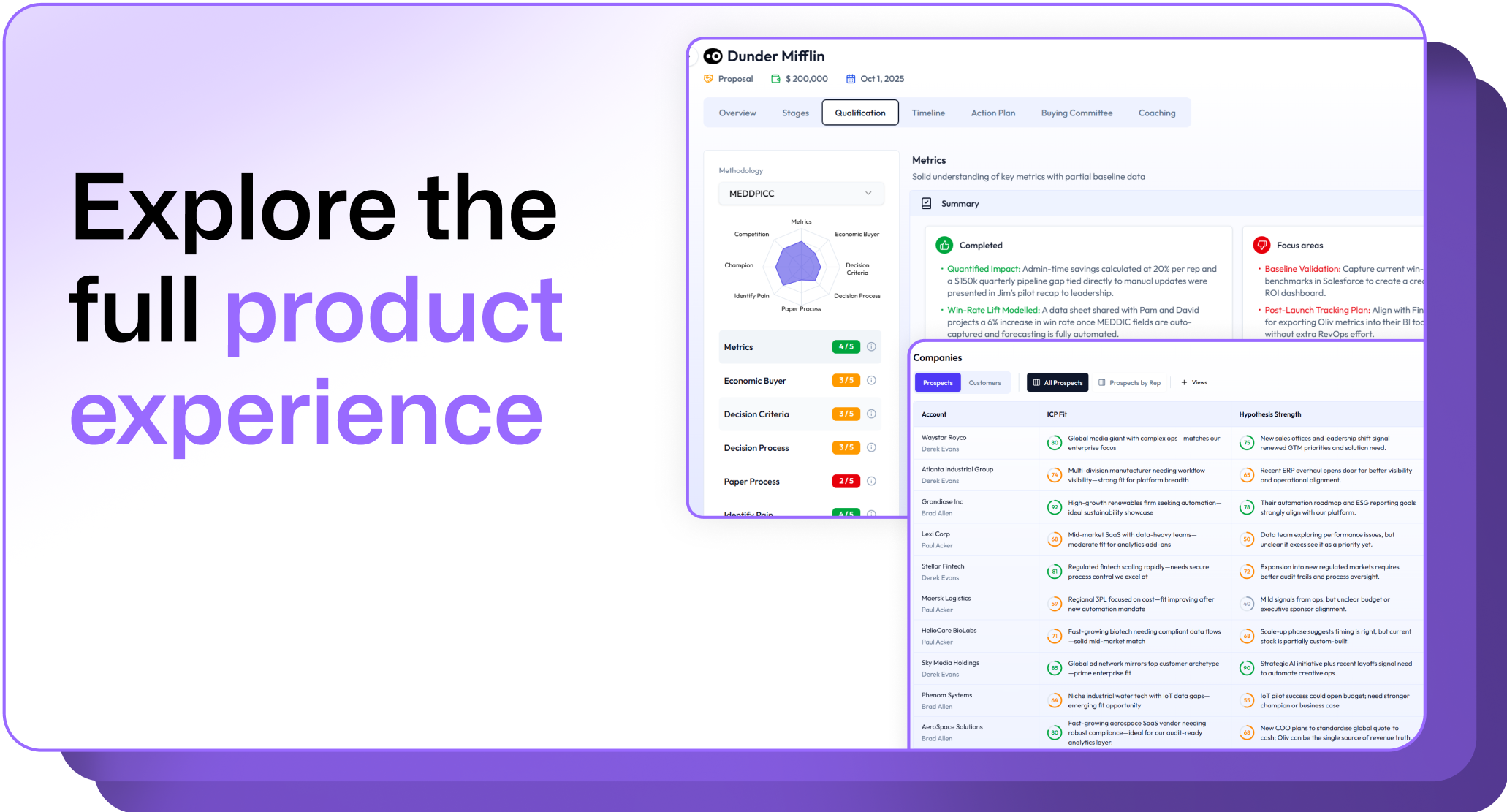
.avif)







.png)
.png)
.png)