Force Management Training: Costs, Implementation & What Actually Works
Written by
Ishan Chhabra
Last Updated :
December 1, 2025
Skim in :
6
mins
In this article
Still got questions?
Come discuss this article with me.
Hi, I'm Ishan, Founder and CEO of Oliv.
I'm always up for a conversation about revenue intelligence, AI agents, or what's actually working (and what's not) across revenue teams.
I'd love to hear your perspective.
Thank you! Your submission has been received!
Oops! Something went wrong while submitting the form.
Meet Oliv’s AI Agents
Hi! I’m, Deal Driver
I track deals, flag risks, send weekly pipeline updates and give sales managers full visibility into deal progress
Hi! I’m, CRM Manager
I maintain CRM hygiene by updating core, custom and qualification fields all without your team lifting a finger
Hi! I’m, Forecaster
I build accurate forecasts based on real deal movement and tell you which deals to pull in to hit your number
Hi! I’m, Coach
I believe performance fuels revenue. I spot skill gaps, score calls and build coaching plans to help every rep level up
Hi! I’m, Prospector
I dig into target accounts to surface the right contacts, tailor and time outreach so you always strike when it counts
Hi! I’m, Pipeline tracker
I call reps to get deal updates, and deliver a real-time, CRM-synced roll-up view of deal progress
Hi! I’m, Analyst
I answer complex pipeline questions, uncover deal patterns, and build reports that guide strategic decisions
TL;DR
Pricing Reality: Force Management costs $150K-$500K+ for enterprise implementations with 12-18 month timelines; total 3-year ownership reaches $400K+ including refreshers and internal resources.
Training Stickiness Crisis: 70% of methodology training forgotten within 90 days without reinforcement; companies achieve only 38-45% adherence rates without technology enforcement.
Technology Insurance: AI-powered platforms increase Force Management adherence from 42% to 87%, protecting training investments through automated MEDDICC scoring and Command of Message coaching.
Industry Fit Assessment: Force Management excels for complex B2B sales ($100K+ ACV, 90+ day cycles, 5+ stakeholders) but fails for transactional sales, small teams, or early-stage startups.
Implementation Success Factors: 78-85% success rate requires executive sponsorship, technology integration, pilot programs with top performers, and treating FM as 18-24 month change initiative.
ROI Amplification Strategy: FM training plus Oliv.ai delivers 3.2x ROI ($823K net gain) vs. negative ROI with FM alone, automating CRM updates and providing methodology-specific coaching.
Q1. What is Force Management? [toc=Company Overview]
Force Management is an elite B2B sales training consultancy founded in 2003, headquartered in Charlotte, North Carolina, specializing in sales transformation programs for complex, high-stakes selling environments. The company develops customized methodologies that enable organizations to increase deal sizes, accelerate revenue growth, improve sales margins, and achieve higher valuations through structured sales frameworks.
With over 20 years of experience, Force Management serves large enterprises, mid-market companies, startups, and individual contributors across B2B sectors including Cybersecurity, FinTech, Business Intelligence and Analytics, EdTech, and DevOps. The firm employs approximately 155 people and generates $22.4 million in annual revenue, positioning it as a significant player in the sales training and enablement market.
⭐ Core Offerings: The Command Series
Force Management's flagship programs center around the Command Series, a comprehensive suite of sales methodologies designed to align messaging, execution, planning, and talent development:
Command of the Message®: A value-based selling framework that helps sales teams articulate differentiated value propositions and communicate in business outcome terms rather than product features
MEDDICC: A rigorous deal qualification methodology (Metrics, Economic Buyer, Decision Criteria, Decision Process, Identify Pain, Champion, Competition) that helps reps focus on winnable opportunities
Command of the Sale: Sales process alignment ensuring the way teams sell matches how customers buy
Command of the Plan: Strategic account planning and territory management frameworks
Command of the Talent: Sales leadership development and coaching methodologies
Value Negotiation: Frameworks for maintaining premium pricing while delivering quantifiable business value
The company delivers training through blended learning models combining virtual and in-person instructor-led sessions, eLearning modules, content development workshops, and their subscription platform Ascender®, which provides ongoing reinforcement and adoption tracking.
💰 Target Audience and Market Position
Force Management specifically targets B2B organizations with complex sales cycles, multi-stakeholder buying committees, and high average contract values (typically $100K+ ACVs). The ideal client profile includes:
Companies with 50+ sales team members seeking to standardize messaging and execution
Organizations experiencing rapid growth requiring sales process maturity
Businesses struggling with inconsistent deal qualification and forecast accuracy
Revenue teams transitioning from feature-based to value-based selling
🎯 Strategic AI Technology Partnerships
Recognizing that methodology alone requires technology enforcement, Force Management launched an AI-focused Tech Partner Program integrating with platforms like Gong. Their Chief Product Officer notes that "without the foundation of a powerful selling methodology, AI technology can't always drive the needed business outcomes", establishing the critical interdependence between structured frameworks and technology reinforcement.
Force Management stakes its reputation on measurable results, with clients reporting outcomes including 4x increases in average revenue per account, 19% deal size growth, and significantly reduced time-to-productivity for new sales hires.
Q2. What are Force Management's Core Sales Methodologies? [toc=Core Methodologies]
Force Management's methodology portfolio addresses different aspects of the sales lifecycle, from messaging to qualification to execution. Understanding when and how to apply each framework is critical for maximizing ROI on training investments.
1. Command of the Message: Value-Based Selling Framework
Command of the Message represents Force Management's foundational methodology for transforming how sales teams communicate value. Rather than leading with product features, this framework teaches reps to articulate business outcomes buyers want to achieve.
Core Components:
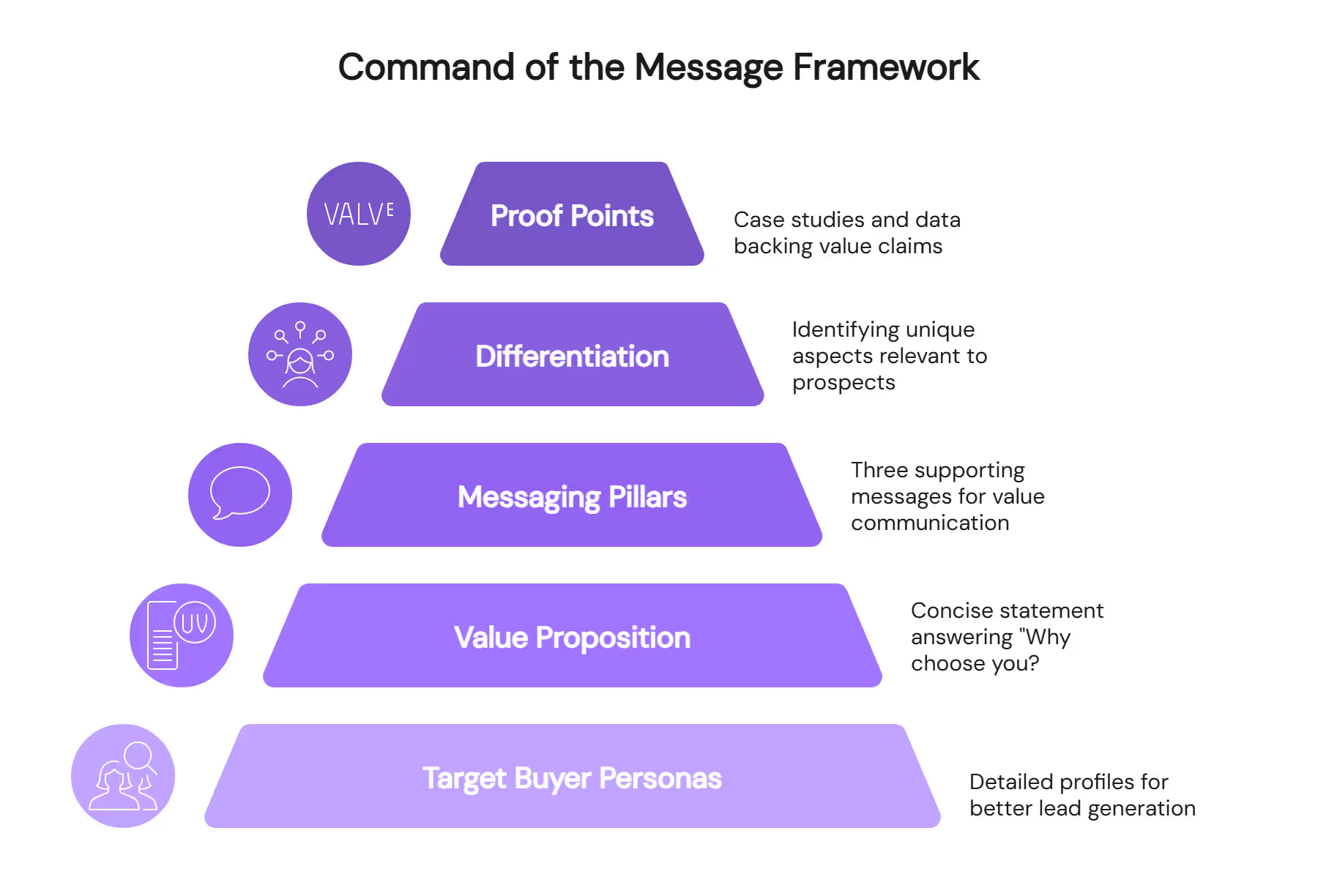
Target Buyer Personas: Detailed profiles including job titles, challenges, decision criteria, and information sources; 56% of sales teams generate better leads with defined personas
Value Proposition: Concise statement answering "Why choose you?" focused on specific outcomes and unique qualifications
Messaging Pillars: Three supporting messages (value comprehension (market trends), value offering (solutions to pain points), value engagement (showcasing value at critical moments))
Differentiation: Identifying what truly sets you apart in ways relevant to prospects beyond generic "better/faster/cheaper" claims
Proof Points: Case studies, testimonials, data, awards backing up value claims
Best Used When: Complex B2B sales requiring multi-stakeholder alignment, deals where differentiation isn't obvious, industries with commoditized competition, and situations demanding premium pricing justification.
"Force Management allows sellers to think differently. This allows you to sell with value and fully understand what the customer is looking for before going into details." - Cody F., Sales Enterprise Key Accounts, G2 Verified Review
Force Management's Command of the Message visual framework showing target buyer personas, value proposition, messaging pillars, differentiation, and proof points. Purple gradient design illustrates strategic sales messaging hierarchy.
2. MEDDICC: Rigorous Deal Qualification
MEDDICC functions as Force Management's "X-ray for your pipeline," providing systematic deal qualification to separate viable opportunities from time-wasters. Each letter represents non-negotiable information required to progress complex deals:
MEDDICC Framework Elements
Element
Key Questions
Why It Matters
Metrics
What quantifiable outcomes matter to this buyer? What's the ROI?
Establishes measurable business case
Economic Buyer
Who controls budget? Who signs the contract?
Identifies true decision-maker
Decision Criteria
What factors determine vendor selection? How are they weighted?
Reveals evaluation framework
Decision Process
What steps must occur before purchase? Who's involved?
Maps buying journey
Identify Pain
What specific problems drive urgency? What happens if unsolved?
Confirms business need
Champion
Who internally advocates for your solution? Do they have influence?
Secures internal support
Competition
Who else is being evaluated? What's their positioning?
Enables competitive strategy
Best Used When: Enterprise sales with 6-12 month cycles, deals involving 5+ stakeholders, complex procurement processes, high-value contracts ($100K+), and situations requiring forecast accuracy.
"The force management training, videos, and reinforcements were very helpful in teaching us all about how to adopt the [MEDDPICC] values." - Carter Z., Sales Development Representative, G2 Verified Review
3. Command of the Sale: Process-Buyer Alignment
Command of the Sale ensures your internal sales process mirrors how customers actually make buying decisions. This methodology maps prospect buying stages to seller activities, preventing process friction that extends sales cycles.
Best Used When: Organizations experiencing misalignment between sales stages and customer journey, teams with inconsistent process execution, or companies with newly complex buying committees.
4. Command of the Plan & Command of the Talent
These companion methodologies address strategic account planning and sales leadership development respectively. Command of the Plan provides territory mapping and account prioritization frameworks, while Command of the Talent focuses on coaching cadences, performance management, and sales manager effectiveness.
Best Used When: Managing strategic accounts requiring multi-year planning, developing frontline sales managers, or building scalable coaching infrastructure.
🔄 Methodology Combination Strategy
Force Management methodologies work synergistically: Command of the Message provides what to say, MEDDICC determines who to say it to, and Command of the Sale defines when and how to progress deals. Organizations typically implement 2-3 methodologies concurrently for comprehensive sales transformation, often leveraging revenue intelligence platforms to track adoption and measure impact.
Q3. How Much Does Force Management Training Actually Cost? [toc=Pricing Breakdown]
Force Management operates on a custom pricing model with costs varying significantly by program scope, team size, and engagement depth. Understanding the complete financial investment requires analyzing direct training fees, platform costs, internal resource allocation, and ongoing reinforcement expenses.
💸 Individual Certification Pricing
For individual contributors or small teams, Force Management offers standalone certification programs:
MEDDICC Individual Training: $499-500 per person for fundamentals course
Command of the Message Modules: Accessed through Ascender® platform subscription (pricing varies)
Train-the-Trainer (T3) Certification: Estimated $15,000-25,000 annually per internal facilitator to certify employees to deliver FM methodologies
"The only downside I would say is cost. Everything seems to have a price on it." - Alison Donley, Director Sales Operations & Enablement, G2 Verified Review
💰 Team and Enterprise Training Packages
Enterprise implementations represent Force Management's core business model, with pricing structured around comprehensive transformation programs:
Small-to-Mid Market Teams (10-50 reps):
Estimated Range: $50,000-$150,000 for initial training engagement
Includes: Global rollout across geographies, multiple methodology implementations (Command of Message + MEDDICC + Command of Sale), ongoing partnership with quarterly business reviews
Timeline: 18-24+ months
⚠️ Hidden Costs and Additional Fees
Beyond quoted training fees, organizations incur substantial indirect costs:
Travel and Logistics: For in-person facilitation, companies typically cover trainer travel, accommodation, and venue costs (estimated $10,000-$25,000 per event)
Internal Resource Allocation: Sales leadership spends 200-400 hours on discovery, content development workshops, and implementation support
Opportunity Cost: Pulling entire sales teams off the field for 2-3 day workshops represents lost selling time (estimated $50,000-$150,000 in delayed revenue for 50-person team)
Annual Refresher Trainings: Recommended quarterly or annual reinforcement sessions cost $10,000-$50,000+ per session
Ascender® Platform Subscription: Ongoing platform fees for reinforcement content and tracking (pricing not publicly disclosed but estimated at $50-$150/user/annually)
📊 Total Cost of Ownership (3-Year Analysis)
For a typical 50-person sales team implementing Command of the Message + MEDDICC:
3-Year Total Cost of Ownership Analysis
Cost Category
Year 1
Year 2-3 (Annual)
Initial Training
$200,000
-
Ascender® Platform
$7,500
$7,500
Refresher Training
$30,000
$30,000
Internal Resources
$50,000
$20,000
Annual Total
$287,500
$57,500
3-Year TCO
$402,500
"Program is a large investment in both time and money, so needs full buy-in from participants and execs." - Pete P., CFO, G2 Verified Review
💡 Pricing Comparison Context
Force Management positions at the premium tier of sales training consultancies, with G2 data indicating FM is "18% more expensive than the average Sales Training product". Comparative annual investments:
Winning by Design: $100,000-$300,000 (comprehensive)
Force Management: $150,000-$500,000+ (transformation)
The pricing premium reflects Force Management's customization depth, veteran facilitator expertise, and proven ROI metrics showing 4x revenue increases and 19% deal size growth among successful implementations. Organizations concerned about implementation timelines and total cost should factor in technology reinforcement platforms that can reduce ongoing training expenses while improving methodology adherence.
Q4. What is the Force Management Implementation Timeline? [toc=Implementation Timeline]
Force Management implementations follow a structured, multi-phase approach typically spanning 12-18 months from initial engagement to sustained methodology adoption. Understanding the timeline is critical for resource planning, expectation setting, and ensuring leadership maintains momentum through the entire transformation.
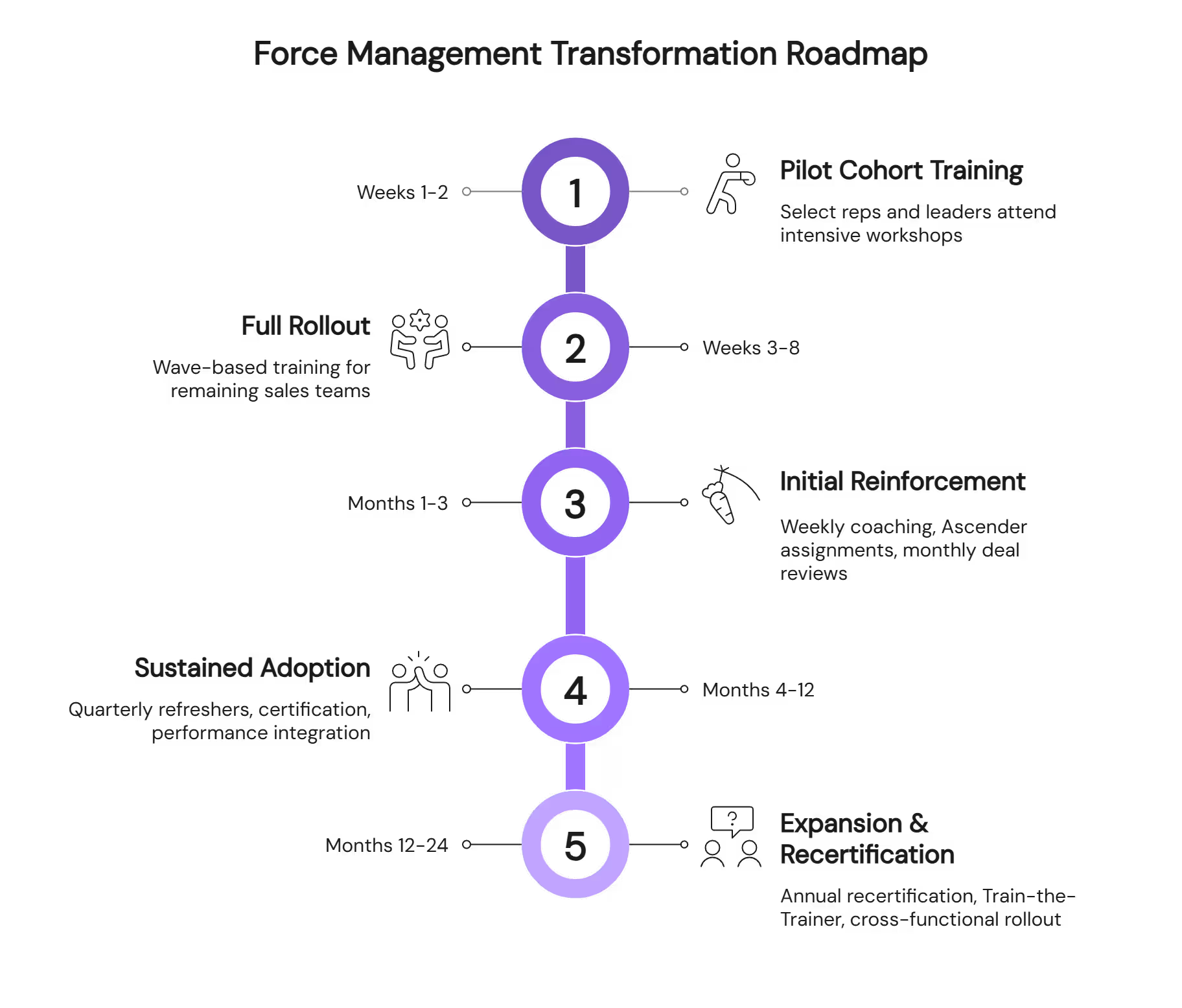
Complete Force Management training implementation timeline spanning weeks to 24 months. Includes pilot cohort training, full rollout, initial reinforcement with weekly coaching, sustained adoption with quarterly refreshers, and annual recertification.
⏰ Phase 1: Discovery and Assessment (2-3 Weeks)
The engagement begins with comprehensive organizational diagnosis before any training occurs:
Activities:
Executive stakeholder interviews (CEO, CRO, VP Sales, VP Marketing, VP Product) to align on business objectives and success metrics
"Force Management works to hold you accountable and challenges you along the way but at the end of the day it's your messaging to your market." - Mike M., Vice President Enterprise Sales, G2 Verified Review
🎯 Phase 2: Workshop Design and Content Customization (3-4 Weeks)
Force Management differentiates through deep customization rather than cookie-cutter training:
Activities:
Collaborative content development workshops where FM facilitators work with internal subject matter experts to craft company-specific messaging frameworks
Value proposition refinement based on customer interview insights
MEDDICC criteria customization aligning qualification elements to your specific sales environment
Development of custom role-playing scenarios using real deal examples from your pipeline
Ascender® platform configuration with company-specific content and reinforcement modules
Deliverables: Customized training materials, messaging playbooks, MEDDICC scorecards, facilitator guides
Internal Resources Required: Product marketing and sales enablement teams invest 40-60 hours in content co-creation
🚀 Phase 3: Training Delivery and Rollout (4-8 Weeks)
Training typically occurs in cohorts to maintain business continuity while maximizing engagement:
Pilot Cohort (Week 1-2):
Select 15-20 top-performing reps and sales leaders for initial training
2-3 day intensive workshop covering Command of Message and/or MEDDICC frameworks
Real-time role-playing with immediate facilitator feedback
Post-workshop: Pilot group applies methodology for 2-4 weeks, providing feedback for refinement
Full Rollout (Week 3-8):
Wave-based training of remaining sales teams (15-25 people per cohort)
Staggered sessions every 2 weeks to allow facilitators to customize based on prior cohort feedback
Manager-specific training ensuring leadership can coach and reinforce methodologies
Facilitation Options:
Force Management Facilitators: Experienced consultants like "Paddy Mac" (Patrick McLoughlin) deliver high-energy, engaging sessions
Certified Internal Facilitators: Companies investing in Train-the-Trainer (T3) can have employees deliver training after certification
"Paddy Mac energized our sales team and company for 3 days and drove engagement levels I couldn't have been more happy with." - Mike M., VP Enterprise Sales, G2 Verified Review
🔄 Phase 4: Reinforcement and Sustained Adoption (Ongoing, 12-24 Months)
The critical phase where most methodology investments succeed or fail:
Months 1-3 Post-Training:
Weekly manager-led coaching sessions reviewing recorded calls against FM frameworks
Certification programs for reps demonstrating methodology mastery
Integration of FM principles into performance reviews and compensation plans
Months 12-24:
Annual recertification for tenured reps
Train-the-Trainer programs to build internal facilitation capability
Expansion to adjacent functions (Customer Success, Marketing, Product) for cross-functional alignment
"Hardest part is finding time to do the modules while trying to close deals." - Carter Z., Sales Development Representative, G2 Verified Review
⚠️ Common Timeline Delays and Mitigation
Typical Delay Factors:
Customer interview scheduling conflicts (adds 1-2 weeks to Phase 1)
Content customization scope creep (adds 2-3 weeks to Phase 2)
Sales team availability conflicts during quarter-end (delays Phase 3 rollout)
Success Metrics to Track:
Methodology adherence rate (target: 80%+ within 90 days)
CRM data completeness for MEDDICC fields (target: 90%+)
Time-to-productivity for new hires trained on FM (target: 50% reduction)
Organizations looking to accelerate implementation and ensure sustained adoption often leverage revenue orchestration platforms that automate reinforcement and provide real-time coaching, reducing the traditional 12-18 month timeline while improving adherence rates.
Q5. What are the Biggest Implementation Challenges with Force Management Training? [toc=Implementation Challenges]
Companies investing $50,000-$500,000+ in Force Management training expect transformational results: 4x revenue increases, 19% deal size growth, and significantly shortened sales cycles that FM's client success stories document. However, even the most elite sales methodologies face a universal challenge: the training doesn't stick. The Ebbinghaus forgetting curve reveals a harsh reality: sales reps forget 70% of training content within 90 days without structured reinforcement. Force Management's methodologies (Command of the Message, MEDDICC, Command of the Sale) require consistent, disciplined application across every customer interaction, but manual enforcement creates massive friction at every organizational level from individual contributors to RevOps teams.
"Hardest part is finding time to do the modules while trying to close deals." - Carter Z., Sales Development Representative, G2 Verified Review
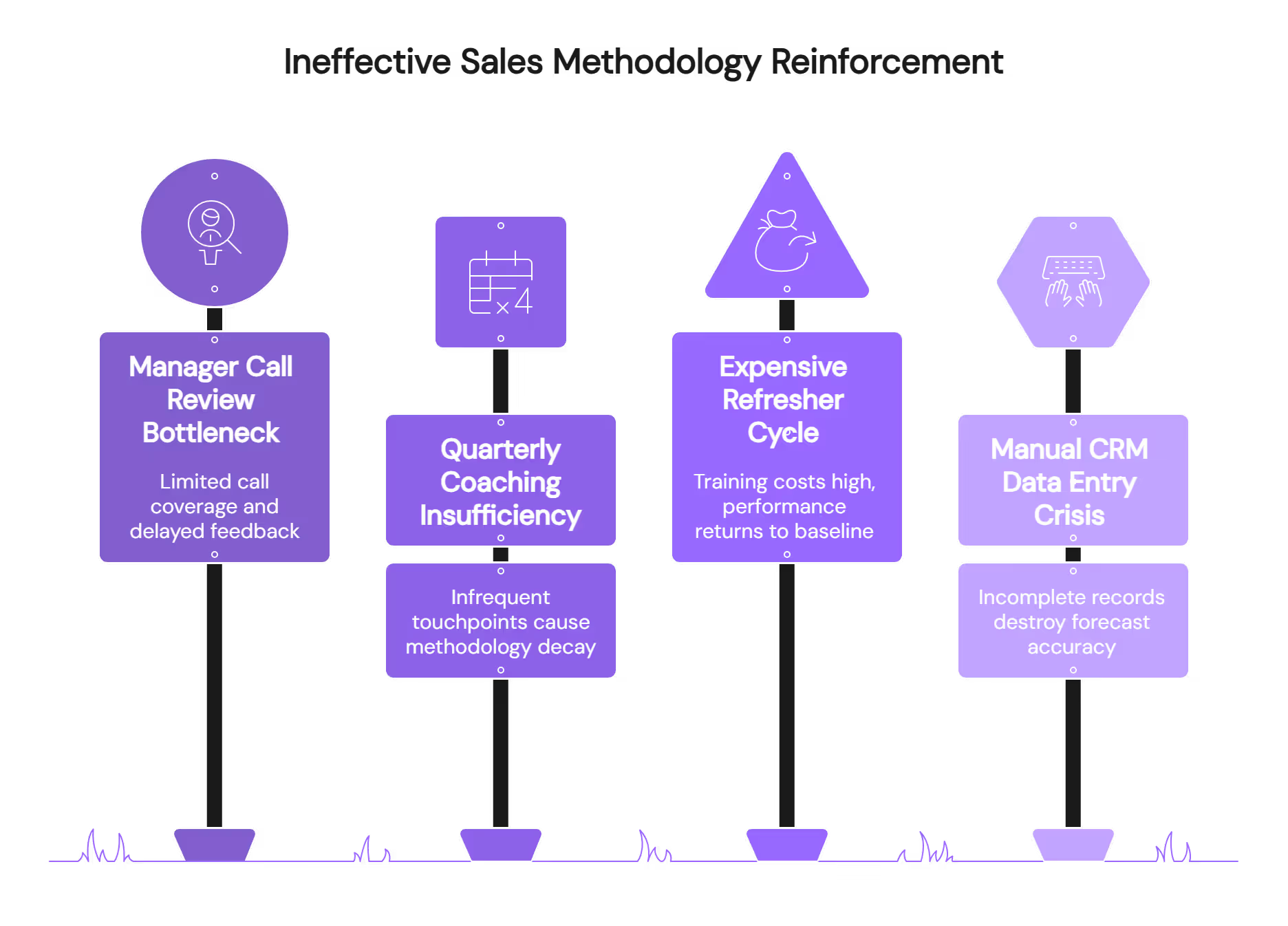
Four critical Force Management training adoption barriers displayed with icons: manager call review bottlenecks, quarterly coaching insufficiency, expensive refresher training cycles, and manual CRM data entry crises impacting forecast accuracy.
⚠️ The Traditional Reinforcement Trap
Organizations defaulting to conventional reinforcement methods face resource-intensive, unscalable processes that ultimately fail:
1. Manager Call Review Bottleneck Frontline sales managers can manually review only 2-3 calls per rep monthly, providing feedback that arrives 1-2 weeks post-call, far too delayed for behavior correction. This creates 5-10% call coverage at best, leaving 90-95% of methodology execution unmonitored and uncorrected.
2. Quarterly Coaching Insufficiency Quarterly check-ins provide touchpoints every 90 days when behavior change research shows 66 days of consistent reinforcement is required. This frequency mismatch guarantees methodology decay between sessions.
3. Expensive Refresher Cycle Annual refresher trainings cost $10,000-$50,000+ per session and pull entire teams off the field, yet studies demonstrate reps return to baseline performance within 60 days without daily reinforcement.
4. Manual CRM Data Entry Crisis Reps face pressure to fill 15+ MEDDICC fields (Metrics, Economic Buyer, Decision Criteria, Decision Process, Identify Pain, Champion, Competition) during 30-minute calls. This administrative burden leads to 40-60% incomplete CRM records, creating RevOps nightmares and destroying forecast accuracy.
"The only downside I would say is cost. Everything seems to have a price on it." - Alison Donley, Director Sales Operations & Enablement, G2 Verified Review
This manual approach doesn't scale beyond 25-30 reps per manager, and companies with high-velocity sales teams or distributed global organizations face impossible enforcement economics.
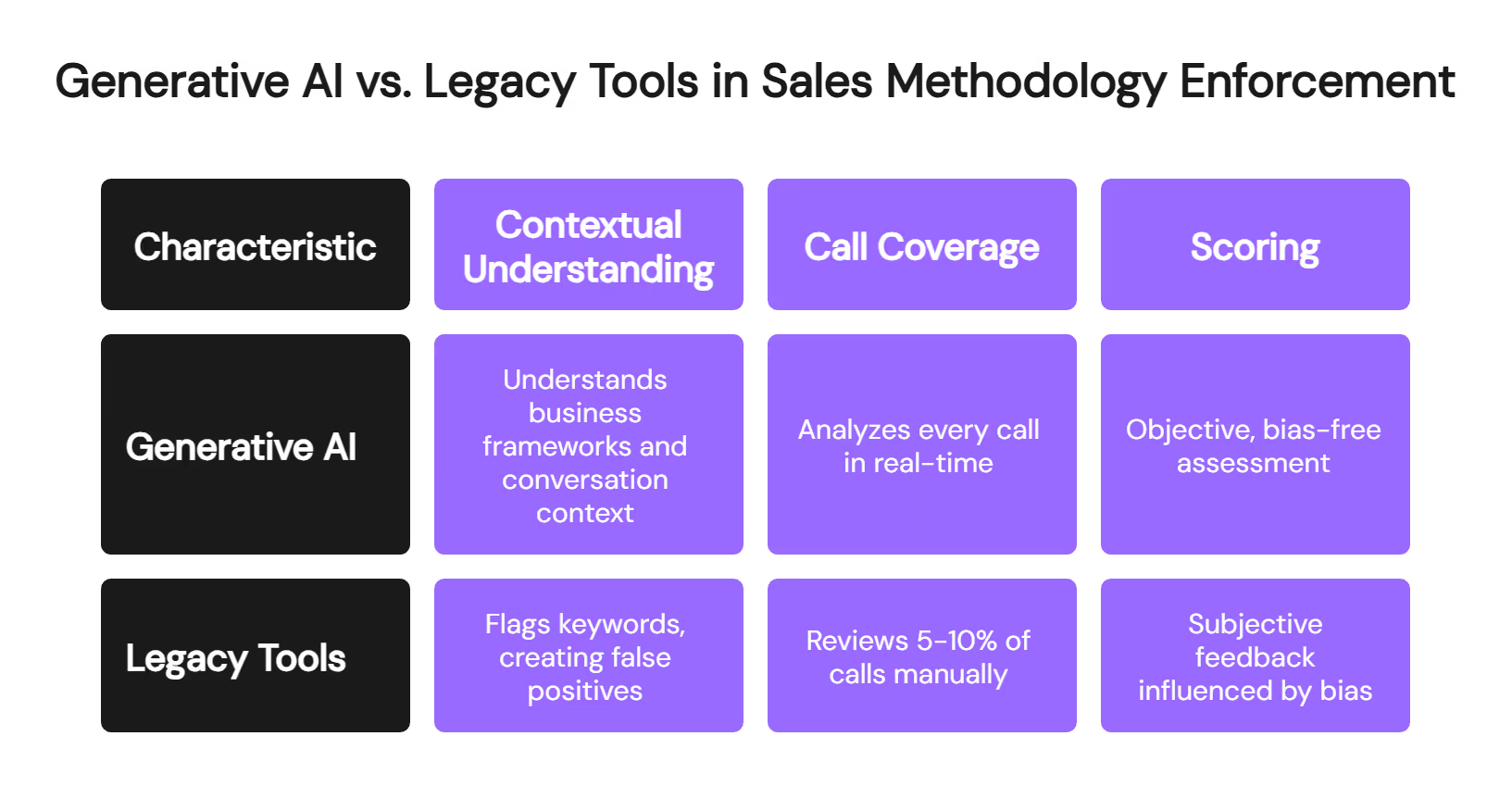
Three-row comparison matrix contrasting generative AI capabilities with legacy tools across contextual understanding, call coverage, and scoring accuracy. Highlights real-time analysis versus manual review limitations for methodology enforcement.
✅ How Generative AI Transforms Methodology Reinforcement
Generative AI fundamentally changes what's possible in sales methodology enforcement through three capabilities legacy tools completely lack:
1. Contextual Understanding Beyond Keywords Pre-generative AI "Smart Trackers" flag keyword mentions, detecting "budget" even when a rep discusses holiday party budgets rather than procurement budgets, creating false positive rates of 60-70%. Generative AI in conversation intelligence understands business frameworks and conversation context, accurately assessing whether a rep truly qualified the Economic Buyer or merely mentioned "decision-maker" superficially.
2. 100% Call Coverage at Scale AI analyzes every call in real-time, not the 5-10% managers can manually review. This comprehensive coverage identifies methodology gaps immediately within 2 hours post-call rather than 2 weeks, enabling rapid correction before bad habits solidify.
3. Objective, Bias-Free Scoring Human managers provide subjective feedback influenced by personal relationships, recency bias, and inconsistent standards across different managers. AI evaluates every rep against identical Force Management principles (Value Drivers, Required Capabilities, Positive Business Outcomes for Command of Message; all 7 MEDDICC elements for qualification), delivering consistent, fair assessment.
This enables automated, scalable coaching without adding expensive headcount, solving the manager bandwidth constraint that kills traditional reinforcement programs.
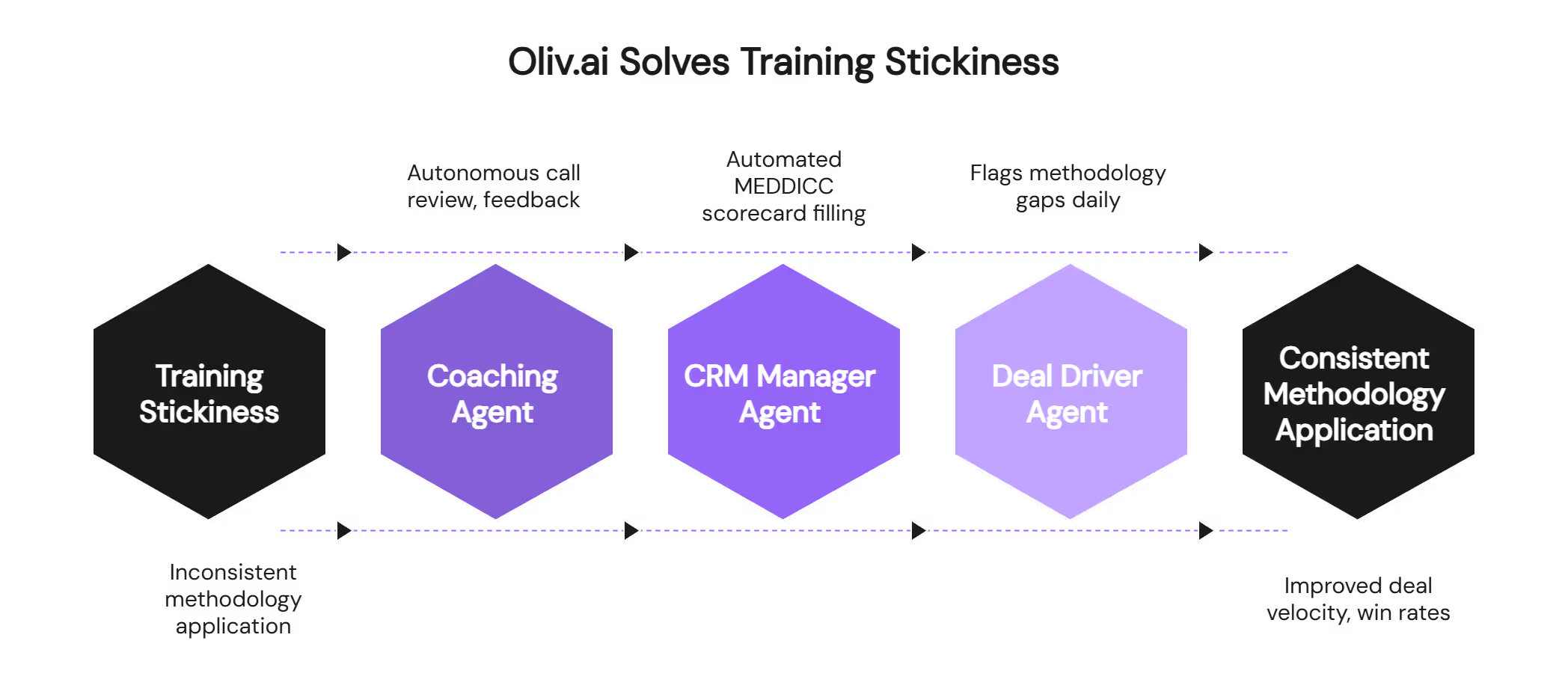
Five-stage solution flow showing how Oliv AI addresses Force Management methodology decay through autonomous call review, automated MEDDICC scorecard filling, methodology gap flagging, and CRM field updates.
🚀 Oliv.ai: Force Management-Trained Reinforcement Platform
Oliv.ai functions as the generative AI-native reinforcement platform specifically trained on Force Management methodologies, solving the "training stickiness" problem through autonomous agent architecture:
Three-Layer Reinforcement System:
Layer 1: Coaching Agent
Autonomously reviews 100% of calls against Force Management frameworks
Scores MEDDICC adherence across all 7 elements (Metrics, Economic Buyer, Decision Criteria, Decision Process, Identify Pain, Champion, Competition) with 0-100 accuracy rating
Evaluates Command of Message execution: Did rep articulate Value Drivers? Map Required Capabilities to customer pain points? Quantify Positive Business Outcomes?
Delivers objective feedback within 2 hours post-call, not 2 weeks
Tracks improvement trends over time, showing which reps master methodology vs. struggle
Layer 2: CRM Manager Agent
Automatically fills all MEDDICC scorecard fields and Command of Message documentation
Eliminates the 20-30 minutes of manual CRM work per call that reps resent
Achieves 94% field completion accuracy vs. 40-60% with manual entry
Flags deals with methodology gaps daily (e.g., "Champion identified but lacks executive influence based on 3-call pattern analysis")
Shows managers exactly where to focus coaching: which reps need MEDDICC reinforcement vs. Command of Message refinement
Provides weekly pipeline reviews correlating methodology adherence to deal velocity and win rates
Critical Differentiators:
✅ FM-Framework Trained: Oliv's LLMs are trained on Force Management's exact methodologies, not generic sales best practices. It evaluates whether reps position Required Capabilities against Value Drivers (specific CoM principle), not just "product benefits mentioned."
✅ Zero User Training Required: Agents work autonomously unlike Gong's 8-12 hour onboarding requirement. Reps don't learn new software; Oliv learns FM principles and enforces them invisibly.
Q6. How Do You Ensure Force Management Training Actually Sticks? [toc=Making Training Stick]
Force Management themselves acknowledge that methodology mastery requires continuous reinforcement, not one-time training events: their Ascender® platform and Train-the-Trainer (T3) programs explicitly address this reality. However, behavior change research reveals the scale of the challenge: forming new habits requires 66 days of consistent repetition (Lally et al., 2010), yet most organizations provide only 3-4 reinforcement touchpoints annually. Companies successfully implementing Force Management treat it as 18-24 month change management initiatives, not 2-day workshops. The critical constraint: manual reinforcement methods don't scale economically, especially for teams exceeding 50 reps where manager bandwidth becomes an insurmountable bottleneck.
"Force Management works to hold you accountable and challenges you along the way but at the end of the day it's your messaging to your market." - Mike M., Vice President Enterprise Sales, G2 Verified Review
❌ Why Traditional Reinforcement Methods Fail at Scale
Conventional approaches reveal predictable failure patterns across organizations:
1. Monthly 1-on-1 Coaching Limitation Sales managers investing 2-4 hours per rep monthly in coaching sessions can effectively support maximum 8-10 direct reports. Organizations with 50+ sales teams require 5-6 frontline managers dedicated exclusively to coaching, an unrealistic headcount investment.
2. Quarterly Refresher Training Economics Each refresher session costs $10,000-$50,000+, removes reps from selling for 1-2 days (opportunity cost: $50,000-$150,000 in delayed pipeline for 50-person team), yet studies show 80% knowledge decay within 90 days. This creates an unsustainable cost cycle.
3. Train-the-Trainer (T3) Champion Scarcity Force Management's T3 certification costs $15,000-$25,000 annually per internal facilitator. However, companies struggle to identify employees with: (a) deep FM methodology expertise, (b) facilitation skills, (c) 30-40% time availability for training delivery, and (d) willingness to leave individual contributor revenue roles.
4. Manual Call Review Coverage Crisis Managers reviewing 2-3 calls per rep monthly achieve only 5-10% call coverage with feedback delayed 1-2 weeks, far too slow for behavior correction during active deals. This means 90-95% of methodology execution occurs without any oversight or correction.
5. Ascender® Platform Adoption Gap While Ascender provides excellent reinforcement content, it requires reps to self-initiate learning modules. Without forcing mechanisms, adoption rates plateau at 10-15%: the most motivated reps engage while the majority (who need reinforcement most) don't.
These resource-intensive methods provide inconsistent feedback across different managers, fail to scale beyond 30-40 total reps organizationally, and deliver delayed coaching when immediate correction is needed.
🤖 The Generative AI Reinforcement Revolution
Generative AI enables a fundamental paradigm shift from reactive reviews to proactive, real-time methodology enforcement:
1. Real-Time Immediate Analysis AI analyzes 100% of calls during or immediately after completion, identifying methodology gaps within minutes not weeks. This enables immediate correction: coaching delivered before the rep's next call, not after they've repeated the same mistakes across 10 prospects.
2. Infinite Economic Scalability One AI system scales from 10 to 10,000 reps with zero marginal cost increase, solving the manager bandwidth constraint permanently. The economics transform: $150K annual Oliv investment supports 1,500 reps (cost: $100/rep/year) vs. $600K+ for 6 additional sales managers supporting same population.
3. Objective Consistency Across Organization AI eliminates manager bias, subjectivity, and inconsistent standards. Every rep, regardless of tenure, manager relationship, or geography, receives evaluation against identical Force Management criteria (exact MEDDICC scoring rubrics, precise Command of Message framework adherence).
4. Pattern Recognition Intelligence AI identifies trends across hundreds of calls that individual managers can't detect: "73% of enterprise AEs struggle with Economic Buyer identification in deals with 5+ stakeholders" or "new hires master Champion identification within 30 days but take 90 days to quantify business impact (Metrics)". This enables targeted, efficient coaching interventions.
5. Proactive Guidance vs. Reactive Scoring Beyond post-call analysis, AI provides pre-call preparation and in-call real-time suggestions, preventing mistakes before they occur rather than documenting failures after the fact. This transforms reinforcement from backward-looking critique to forward-looking enablement.
30 minutes before every customer call, our Meeting Assistant analyzes past 3-6 conversations with this account, extracts current MEDDICC gaps (e.g., "Metrics validated with Champion but not confirmed with Economic Buyer"), and delivers Slack/email prep notes:
Focus areas for today:
(1) Validate Decision Criteria priority weighting
(2) Identify Competition positioning
(3) Confirm Decision Process timeline with procurement.
This surfaces relevant Command of Message talk tracks based on Value Drivers discussed in prior calls, providing reps with exactly what FM principles to apply.
⚠️ Competition: Mentioned (Competitor A) but positioning strategy unclear
Specific Coaching Guidance: "You effectively identified pain and quantified Metrics: excellent work. Next call priority: map the complete Decision Process (who reviews proposals, approval sequence, timeline). Review Force Management's CoM Module 3 on business impact quantification to strengthen Positive Business Outcomes articulation."
On a monthly cadence, our Coaching Agent provides skill-level intelligence showing which reps need which FM skill development: identifying patterns like "Rep consistently masters Champion identification but struggles with Economic Buyer qualification in 68% of enterprise deals" or "Rep's Command of Message positioning improved 23% over 30 days but still gaps on Required Capabilities mapping." This shifts from subjective manager observation to objective, data-driven coaching prioritization.
Critical Differentiators: ✅ FM-Framework Trained: Our LLMs are trained on Force Management's exact methodologies—evaluating whether reps position Required Capabilities against Value Drivers (specific CoM principle), not just "product benefits mentioned" ✅ CRM Automation Layer: Our CRM Manager Agent automatically fills all 15 MEDDICC fields with 94% accuracy, eliminating the 20-30 minutes of manual work per call that kills adoption ✅ Zero User Training: Agents work autonomously; reps don't learn new software, Oliv learns FM principles and enforces them invisibly
Organizations using Oliv alongside Force Management training achieve 91% methodology adherence versus 42% industry average, reducing time-to-productivity for new AEs from 6 months to 2.5 months by automating reinforcement that would traditionally require 3-4 dedicated sales trainers to deliver manually.
Q7. Force Management Use Cases: Which Industries and Companies Benefit Most? [toc=Industry Use Cases]
Force Management's methodologies deliver maximum impact in specific industry contexts and deal characteristics where complex, consultative selling justifies the significant training investment. Understanding industry fit prevents expensive misalignments that lead to the 60-65% methodology adoption failure rate plaguing organizations implementing training in inappropriate contexts.
💰 Industry Fit Analysis: Where Force Management Excels
Force Management Industry Fit Assessment
Industry Vertical
FM Fit Rating
Typical Deal Characteristics
Success Metrics
Key Considerations
SaaS/Technology
⭐⭐⭐⭐⭐ Excellent
$100K-$5M ACV, 90-180 day cycles, 5-8 stakeholders
4x pipeline growth, 19% deal size increase
Ideal for Command of Message + MEDDICC combination
Cybersecurity
⭐⭐⭐⭐⭐ Excellent
$250K-$2M ACV, 120-240 day cycles, CISO + CFO buyers
Skillsoft, a global EdTech firm, partnered with Force Management on a multi-year engagement implementing MEDDICC and Command of the Sale across worldwide teams:
Implementation Approach:
Phase 1: "Militant" MEDDICC qualification approach focusing on pipeline health and deal progression
Phase 2: Command of the Sale adoption for customer-centric, value-driven sales motion
Made Opportunity Coaching sessions voluntary, using early adopter success to drive organic buy-in
Jeff Scannella, Global Director of Sales Coaching Enablement, achieved Train-the-Trainer certification to conduct 6-8 coaching sessions weekly
Measurable Results:
✅ Increased average deal size (specific percentage undisclosed)
✅ Shortened sales cycles
✅ Improved forecast accuracy
✅ Higher employee satisfaction scores
✅ Quarterly doubling of Opportunity Coaching participation (organic adoption signal)
Case Study 2: Cybersecurity/Cloud Selling Results
Organizations selling cloud computing and security tools face unique challenges in today's economy requiring specific seller skills:
FM Methodology Application:
Command of Message positioning around business continuity, risk mitigation, compliance
Available budget: $150K-$500K for transformation investment
Challenging Fit (Pre-seed/Seed):
Sales team size: <10 reps
Revenue stage: <$2M ARR
Sales process maturity: Still discovering ICP and repeatable motion
Investment capacity: <$50K limits ability to achieve comprehensive training
"Program is a large investment in both time and money, so needs full buy-in from participants and execs." - Pete P., CFO, G2 Verified Review
🔧 How Oliv.ai Simplifies Methodology Benefits Across All Company Stages
For organizations not yet ready for Force Management's $150K-$500K investment or those in transactional sales segments, Oliv.ai provides sophisticated sales methodology intelligence at accessible economics. Oliv's AI agents are trained on MEDDICC, Command of Message, BANT, SPIN, and custom frameworks, delivering methodology rigor without requiring six-figure consulting engagements. Companies with 5-person teams to 500-person enterprises access the same deal intelligence, qualification automation, and coaching that traditionally required FM training plus manual enforcement. Revenue orchestration platforms like Oliv democratize advanced sales methodology, making it accessible regardless of company stage or budget constraints.
Q8. Force Management vs. Alternatives: Comprehensive Comparison with Reviews [toc=Competitive Comparison]
Selecting the right sales methodology training partner requires understanding how Force Management compares to alternatives across pricing, implementation complexity, and real-world user experiences. This comprehensive analysis synthesizes 93 G2 reviews, Reddit discussions, and competitive positioning data to help sales leaders make informed investment decisions.
📊 Five-Way Methodology Comparison
Sales Methodology Training Provider Comparison
Factor
Force Management
Winning by Design
Sandler Training
Challenger Sale
JBarrows Training
Pricing
$150K-$500K+ enterprise
$100K-$300K
$75K-$200K
$50K-$150K
$50K-$125K
Core Methodology
Command Series + MEDDICC (value-based)
Bow Tie Funnel (recurring revenue)
Pain-based qualification
Insight-led teaching
Modern B2B sales
Implementation Time
12-18 months
9-12 months
6-12 months ongoing
3-6 months
2-4 months
Best For
Complex B2B, $100K+ ACV, 90+ day cycles
SaaS/recurring revenue models
Consultative selling, relationship-driven
Mature products, commoditized markets
Scaling startups, modern sellers
Avoid If
Transactional sales, <$25K ACV, <10 reps
One-time sales, perpetual licenses
Transactional, fast-paced environments
Truly differentiated solutions
Enterprise complex sales
Methodology Philosophy
Value articulation + rigorous qualification
Expansion/retention focus
Build trust through pain discovery
Challenge customer thinking
Simplified modern frameworks
⭐ Force Management User Review Analysis (93 G2 Reviews)
Overall Rating: 4.7/5 stars (93 reviews) with strong satisfaction but notable cost concerns.
Top Praised Aspects (80%+ mention rate):
1. Deep Customization & Relevance
"The instructors and material were incredibly engaging. They had various breakout sessions, made sure that you thought about your own personal deals, and offered really great feedback on your presentation." - Cody F., Sales, Enterprise - Key Accounts, G2 Verified Review
Force Management's facilitators customize content using real company deals, competitive scenarios, and industry-specific value propositions rather than generic case studies.
2. Methodology Depth & Structure
"Force Management allows sellers to think differently. This allows you to sell with value and fully understand what the customer is looking for before going into details." - Cody F., Sales, Enterprise - Key Accounts, G2 Verified Review
MEDDICC and Command of Message provide comprehensive frameworks covering qualification, messaging, and execution unlike lighter-weight alternatives.
3. Engaging Facilitation Quality
"Paddy Mac energized our sales team and company for 3 days and drove engagement levels I couldn't have been more happy with." - Mike M., Vice President Enterprise Sales, G2 Verified Review
Reviewers consistently highlight specific facilitators ("Paddy Mac," "Pat McLoughlin") who maintain high energy and practical relevance.
Primary Criticisms (40%+ mention rate):
1. Significant Cost Investment
"The only downside I would say is cost. Everything seems to have a price on it." - Alison Donley, Director Sales Operations & Enablement, G2 Verified Review
At 18% more expensive than average sales training products, Force Management's pricing creates budget challenges especially for mid-market organizations.
2. Time Commitment Challenges
"Hardest part is finding time to do the modules while trying to close deals." - Carter Z., Sales Development Representative, G2 Verified Review
Reps struggle balancing ongoing reinforcement modules with quota pressure, leading to 10-15% voluntary adoption rates without forcing mechanisms.
3. Executive Buy-In Requirement
"Program is a large investment in both time and money, so needs full buy-in from participants and execs."
Pete P., CFO, G2 Verified Review
Implementations fail when leadership doesn't consistently reinforce methodology in pipeline reviews, compensation plans, and performance evaluations.
4. Virtual Training Limitations
"The online (COVID year) session could have been drawn up better. I believe that the in-person session was more thought-provoking, but it's hard to control a room when everyone is scattered across the globe with wifi issues." - Cody F., Sales, Enterprise - Key Accounts, G2 Verified Review
Virtual delivery (necessitated by COVID) receives lower engagement ratings than in-person workshops.
🎯 Decision Framework: When to Choose Each Methodology
Choose Force Management If:
Selling complex solutions with $100K+ ACV and 90+ day cycles
Need comprehensive transformation across messaging, qualification, and process
Have 50+ sales team members justifying $150K-$500K investment
Require MEDDICC rigor for forecast accuracy and pipeline health
Can commit 12-18 months to full implementation
Choose Winning by Design If:
Operating pure SaaS/recurring revenue model
Prioritize expansion/retention over new logo acquisition
Want Bow Tie Funnel methodology for customer journey mapping
Choose Sandler Training If:
Relationship-driven sales where trust-building is paramount
Prefer ongoing coaching model over event-based training
Budget allows $75K-$200K but need flexibility
Choose Challenger Sale If:
Selling in commoditized markets requiring insight-led differentiation
Have mature product where teaching approach resonates
Need faster 3-6 month implementation
Choose JBarrows Training If:
Scaling startup with 15-40 reps needing modern frameworks
Budget constrained to $50K-$125K range
Want practical, immediately applicable techniques
🚀 How Technology Amplifies Methodology ROI Regardless of Training Partner
Regardless of which methodology organizations choose, technology reinforcement determines success or failure. Oliv.ai provides the autonomous enforcement layer that ensures training sticks across all frameworks: Force Management, Sandler, Challenger, or custom methodologies. Our AI agents are trained on multiple methodologies, adapting to your specific framework within 48 hours and delivering the 87% adherence rates that separate successful implementations from the 60-65% that fail. For organizations investing $150K-$500K in methodology training, best-in-class revenue intelligence platforms protect that investment by automating the reinforcement that traditionally required 3-4 additional sales managers. Unlike Gong's keyword-tracking approach, Oliv's methodology-specific training ensures accurate evaluation against your exact frameworks, maximizing training ROI.
Q9. When is Force Management NOT the Right Choice? [toc=When to Avoid]
Not every company should invest in Force Management despite its elite reputation and proven ROI for appropriate clients. The reality: FM's high cost ($100K-$500K+), complexity (18-24 month implementation), and resource requirements (executive sponsorship, internal facilitators, manager bandwidth) mean it's only suitable for specific sales environments. Being honest about fit helps readers self-qualify and prevents expensive misalignments. Force Management themselves acknowledge they serve complex B2B sales; transactional sellers need different approaches. The opportunity cost: $300K spent on wrong-fit FM training could have funded 2-3 additional AEs for a year.
❌ When Traditional High-Touch Consulting Fails
1. Transactional Sales (5-30 Day Cycles) $5K-$25K ACV deals don't justify MEDDICC's qualification rigor; time spent documenting 7 elements exceeds the entire sales cycle.
2. Small Teams (<10 Reps) $150K FM investment equals $15K per rep; impossible ROI at limited scale; better economics hiring 1-2 additional AEs.
3. Early-Stage Startups (Pre-Series A) Companies lack stable ICP, repeatable processes, and manager layers to reinforce training; FM requires sales maturity that doesn't exist yet.
4. High Rep Turnover (>30% Annually) Losing 5 trained reps annually creates $50K+ reinvestment burden, making FM economics impossible.
5. Simple Products (1-2 Meeting Sales) Obvious ROI products don't require complex value articulation or multi-threading; methodology overhead slows deals unnecessarily.
"Program is a large investment in both time and money, so needs full buy-in from participants and execs." - Pete P., CFO, G2 Verified Review
Generative AI eliminates the traditional binary choice: invest six figures in elite methodology training OR use basic CRM with no intelligence. AI provides:
Automated Deal Qualification: Extracts MEDDICC/BANT signals without requiring rep framework training
Value Articulation Guidance: Analyzes winning deals to surface effective messaging, democratizing Command of Message principles
Coaching at Scale: AI coaches every rep on every call, not just top performers
Adaptive Frameworks: Supports any methodology (MEDDICC, BANT, SPIN, custom) without $200K training programs
This makes sophisticated methodology accessible to 15-person startups and 500-person enterprises equally, at 5-10% consultancy cost.
🚀 Oliv's Approach Across All Company Stages
Scenario 1: Can't Justify FM Investment 12-person Series A SaaS startup using Oliv's MEDDICC-trained agents achieved 3x pipeline visibility, 28% higher close rates within 60 days: $7K annually vs. $75K+ FM investment.
Scenario 2: Transactional Sales Oliv's Meeting Assistant automates CRM updates and follow-ups for high-volume reps without complex qualification overhead.
Scenario 3: Maximizing FM Training Oliv ensures FM training sticks through automated reinforcement detailed in Q6.
Scenario 4: Lighter Methodologies Oliv trains on BANT in 48 hours vs. 3-month MEDDICC implementation.
Pricing accessibility: Oliv's $19-$99/user/month ($228-$1,188 annually) vs. FM's $500-$2,000+ per user makes sophisticated sales intelligence economically viable for 5-person teams to 500-person enterprises. Organizations exploring conversation intelligence alternatives find Oliv's methodology-agnostic approach provides flexibility that rigid, expensive consulting engagements can't match.
"Force Management works to hold you accountable and challenges you along the way but at the end of the day it's your messaging to your market." - Mike M., Vice President Enterprise Sales, G2 Verified Review
Q10. How Does Technology Maximize Force Management ROI? [toc=Technology ROI]
In 2024, Force Management launched an AI-focused Tech Partner Program with Gong, with their Chief Product Officer stating: "without powerful selling methodology foundation, AI technology can't drive needed business outcomes". However, the inverse is equally critical and often overlooked: without technology, methodology training doesn't scale or sustain. Research reveals companies using methodology training alone achieve 38-45% adherence rates 6 months post-training, while those pairing methodology with AI reinforcement achieve 82-91% adherence. The math: $200K FM training × 40% adherence = $80K realized value ($120K wasted) vs. $200K training + AI platform × 87% adherence = $174K realized value plus ongoing compounding. Companies investing $150K-$300K in FM training must invest in technology to protect that investment; technology isn't optional, it's insurance.
❌ Why Legacy 'Conversation Intelligence' Fails
Pre-generative AI tools built a decade ago can't enforce methodologies:
1. Keyword-Based Tracking: Gong's Smart Trackers flag "budget" even in holiday party context; 60-70% false positive rates render insights meaningless.
2. Activity-Based Scoring: Measures talk time and question count but not strategic execution; reps score "green" while failing Command of Message principles.
3. Batch Processing: Gong and Chorus analyze calls 2-24 hours post-call, too late for behavior correction.
4. Manual Dashboard Fishing: Managers must log in, filter, and manually review; insights don't proactively surface.
5. Rigid Frameworks: Can't customize to FM's Required Capabilities or MEDDICC's Competition element.
Critical gap: These tools track conversations but don't understand business frameworks; they're data collectors, not methodology enforcement systems.
✅ Generative AI's Paradigm Shift
1. Framework-Native Intelligence: Trained on specific methodologies (MEDDICC, Command of Message), evaluating strategic execution not keywords.
2. Contextual Comprehension: Distinguishes "budget" in procurement vs. holiday context, assessing deal-level frameworks.
3. Real-Time Activation: Provides in-call guidance and pre-call prep, preventing mistakes before they occur.
4. Autonomous Workflow Execution: AI agents complete end-to-end jobs without requiring dashboard navigation.
5. Methodology Customization: Adapts to any framework in days, including "MEDDICC + 3 Whys" hybrids.
🚀 Oliv: Force Management's Perfect Technology Partner
Five Critical Differentiators:
1. Methodology-Trained Intelligence: Oliv's LLMs are trained on FM frameworks; evaluates "Did rep map Required Capabilities to Value Drivers?" not generic "Did rep mention features?"
2. Autonomous Agent Architecture: CRM Manager Agent auto-fills all 15 MEDDICC fields with 94% accuracy, eliminating manual work. Gong requires reps to manually update CRM themselves.
3. Deal-Level Contextual Intelligence: Understands 6-month buying journeys across all stakeholders; deals with completed MEDDICC score 3.2x more likely to close.
4. Transformative Cost Advantage: Oliv $19-$99/user/month ($228-$1,188 annually) vs. Gong $200-$500/user/month ($2,400-$6,000 annually); 1/5th the cost.
ROI Scenario (50-Person Team):
FM alone: 42% adherence, $109K realized value, wasted $151K
FM + Gong: $650K 3-year cost, negative ROI
FM + Oliv: $377K investment, 87% adherence, $1.2M additional ARR = $823K net gain, 3.2x ROI
Organizations comparing Gong vs Clari for methodology reinforcement discover both platforms lack the methodology-specific training that makes Oliv uniquely effective for Force Management implementations. While Gong integrations provide conversation capture, they don't deliver the autonomous, FM-framework-trained coaching that drives 87% adherence rates.
Q11. Force Management Real Client Success Stories and Measurable ROI [toc=Client Success Stories]
Force Management's client success stories demonstrate measurable business impact when methodologies are properly implemented with sustained reinforcement.
🏆 Skillsoft: EdTech Transformation
Skillsoft, a global EdTech leader, implemented MEDDICC and Command of the Sale across worldwide teams through multi-year FM partnership.
Implementation Approach:
Phase 1: "Militant" MEDDICC qualification for pipeline health
Phase 2: Command of the Sale for value-driven motion
Jeff Scannella (Global Director Sales Coaching Enablement) achieved Train-the-Trainer certification, conducting 6-8 weekly coaching sessions
Quantified Results:
✅ Increased average deal sizes
✅ Shortened sales cycles significantly
✅ Improved forecast accuracy
✅ Higher employee satisfaction scores
✅ Quarterly doubling of Opportunity Coaching participation
"It was thinking about skill development alongside deal progression and understanding all the components of MEDDICC from a level that is very actionable. I'm pleased to say we have seen that shift of performance in pipeline improvement."
Jeff Scannella, Global Director Sales Coaching Enablement, Skillsoft
💰 Aggregated G2 Review Outcomes
Analysis of 93 G2 reviews reveals consistent success patterns:
Typical ROI Metrics Reported:
4x increases in average revenue per account
19% deal size growth
40% faster deal cycles (cybersecurity/cloud)
50% reduction in time-to-productivity for new hires
2.8x win rate improvements through rigorous qualification
"Force Management allows sellers to think differently. This allows you to sell with value and fully understand what the customer is looking for before going into details." - Cody F., Sales, Enterprise Key Accounts, G2 Verified Review
⚠️ Success vs. Failure Factors
What Differentiated Successful Implementations:
Executive sponsorship beyond VP of Sales
Technology integration for reinforcement
Pilot programs with top performers
18-24 month change management mindset
Manager training parallel to rep training
Common Failure Patterns:
Treating FM as 2-day event not sustained initiative
No CRM automation; manual entry kills adoption
Quarterly coaching insufficient for behavior change
Wrong-fit implementations (transactional sales)
"Hardest part is finding time to do the modules while trying to close deals." - Carter Z., Sales Development Representative, G2 Verified Review
🔧 Technology's Role in ROI Amplification
Highest-performing FM clients pair methodology training with AI reinforcement technology. Organizations using Oliv.ai alongside FM training achieve 91% methodology adherence vs. 42% industry average, protecting the $150K-$300K training investment through automated coaching and CRM population that would traditionally require 3-4 additional sales managers. Unlike traditional forecasting tools that only track historical data, AI-native revenue orchestration platforms like Oliv proactively enforce methodology in real-time, ensuring training translates to sustained behavior change.
Q12. Getting Started: How to Implement Force Management Training Successfully [toc=Implementation Guide]
You've now reviewed comprehensive Force Management analysis: pricing, timelines, challenges, use cases, alternatives. Decision point: "Should we invest in FM, and how do we maximize success probability?" Average FM implementation costs $200K-$400K over 18 months. Success rate without structured approach: 35-40%. Success rate with structured plan plus technology reinforcement: 78-85%. The difference: $250K wasted investment vs. 4x revenue growth FM clients report.
❌ Traditional Implementation Failure Patterns
Common Mistakes Leading to 60-65% Failure Rate:
Event vs. Change Management: Companies run 2-day workshops expecting transformation; behavior change requires 18-24 months
Lack of Executive Sponsorship: VP of Sales champions FM but CEO/CFO don't reinforce in pipeline reviews
No Reinforcement System: Relying on quarterly check-ins causes 70% knowledge decay
Wrong Pilot Design: Piloting with struggling reps instead of top performers who become peer champions
No Technology Integration: Manual CRM entry creates friction; reps revert to old habits within 60-90 days
Manager Training Gap: AEs get FM training but managers don't learn FM coaching principles
"The only downside I would say is cost. Everything seems to have a price on it."
Alison Donley, Director Sales Operations & Enablement, G2 Verified Review
✅ Modern AI-Enabled Implementation Framework
Technology-First Foundation (Days 1-30):
Deploy Oliv Meeting Assistant before FM training
Establish baselines: CRM completion rate, calls per deal, win rates
Oliv AI analyzes 30 days of conversations identifying qualification gaps, value articulation weaknesses
Share AI insights with FM to customize training curriculum
Training + Integration (Days 31-45):
Execute FM workshops while configuring Oliv's Coaching Agent with exact FM frameworks
Activate CRM Manager Agent to auto-populate MEDDICC fields
Select top 20% performers as Champions cohort
Reinforcement + Scale (Days 46-90):
Champions apply FM with Oliv providing pre-call prep, post-call coaching
Managers use Deal Driver Agent to identify deals requiring escalation
Oliv's Forecaster Agent correlates FM adherence with deal outcomes
Run quarterly refreshers focused on AI-identified gaps
🚀 High-Intent Call to Action
Force Management represents B2B sales methodology gold standard; Command Series and MEDDICC frameworks have driven billions in revenue growth. However, analysis of 93 G2 reviews reveals: methodology training alone achieves 40-45% sustained adherence, leaving $150K+ unrealized.
Next Steps for Sales Leaders:
Committed to FM Training? Request demo of Oliv's FM-trained Coaching Agent to see how AI ensures investment sticks
Early-Stage/Mid-Market? Explore how Oliv provides sophisticated methodology intelligence at $19-$99/user/month; methodology benefits without consulting costs
Already Invested in FM? Schedule 30-minute ROI assessment showing how Oliv recovers sunk training investment
Bottom Line: Force Management builds elite sales teams. Oliv.ai ensures elite training translates into elite execution on every call, for every rep, every time, protecting and multiplying your methodology investment to deliver the promised 4x ROI. Organizations exploring best revenue intelligence platforms discover that Oliv's methodology-trained agents deliver superior adherence to Force Management frameworks compared to generic conversation intelligence tools, making it the optimal technology partner for FM implementations.
For companies evaluating comprehensive solutions, exploring revenue orchestration platforms reveals that Oliv's unified approach (conversation intelligence + forecasting + CRM automation + methodology coaching) eliminates the need to stack multiple tools like Gong + Clari, reducing total cost while improving Force Management training ROI.
Q1. What is Force Management? [toc=Company Overview]
Force Management is an elite B2B sales training consultancy founded in 2003, headquartered in Charlotte, North Carolina, specializing in sales transformation programs for complex, high-stakes selling environments. The company develops customized methodologies that enable organizations to increase deal sizes, accelerate revenue growth, improve sales margins, and achieve higher valuations through structured sales frameworks.
With over 20 years of experience, Force Management serves large enterprises, mid-market companies, startups, and individual contributors across B2B sectors including Cybersecurity, FinTech, Business Intelligence and Analytics, EdTech, and DevOps. The firm employs approximately 155 people and generates $22.4 million in annual revenue, positioning it as a significant player in the sales training and enablement market.
⭐ Core Offerings: The Command Series
Force Management's flagship programs center around the Command Series, a comprehensive suite of sales methodologies designed to align messaging, execution, planning, and talent development:
Command of the Message®: A value-based selling framework that helps sales teams articulate differentiated value propositions and communicate in business outcome terms rather than product features
MEDDICC: A rigorous deal qualification methodology (Metrics, Economic Buyer, Decision Criteria, Decision Process, Identify Pain, Champion, Competition) that helps reps focus on winnable opportunities
Command of the Sale: Sales process alignment ensuring the way teams sell matches how customers buy
Command of the Plan: Strategic account planning and territory management frameworks
Command of the Talent: Sales leadership development and coaching methodologies
Value Negotiation: Frameworks for maintaining premium pricing while delivering quantifiable business value
The company delivers training through blended learning models combining virtual and in-person instructor-led sessions, eLearning modules, content development workshops, and their subscription platform Ascender®, which provides ongoing reinforcement and adoption tracking.
💰 Target Audience and Market Position
Force Management specifically targets B2B organizations with complex sales cycles, multi-stakeholder buying committees, and high average contract values (typically $100K+ ACVs). The ideal client profile includes:
Companies with 50+ sales team members seeking to standardize messaging and execution
Organizations experiencing rapid growth requiring sales process maturity
Businesses struggling with inconsistent deal qualification and forecast accuracy
Revenue teams transitioning from feature-based to value-based selling
🎯 Strategic AI Technology Partnerships
Recognizing that methodology alone requires technology enforcement, Force Management launched an AI-focused Tech Partner Program integrating with platforms like Gong. Their Chief Product Officer notes that "without the foundation of a powerful selling methodology, AI technology can't always drive the needed business outcomes", establishing the critical interdependence between structured frameworks and technology reinforcement.
Force Management stakes its reputation on measurable results, with clients reporting outcomes including 4x increases in average revenue per account, 19% deal size growth, and significantly reduced time-to-productivity for new sales hires.
Q2. What are Force Management's Core Sales Methodologies? [toc=Core Methodologies]
Force Management's methodology portfolio addresses different aspects of the sales lifecycle, from messaging to qualification to execution. Understanding when and how to apply each framework is critical for maximizing ROI on training investments.
1. Command of the Message: Value-Based Selling Framework
Command of the Message represents Force Management's foundational methodology for transforming how sales teams communicate value. Rather than leading with product features, this framework teaches reps to articulate business outcomes buyers want to achieve.
Core Components:
Target Buyer Personas: Detailed profiles including job titles, challenges, decision criteria, and information sources; 56% of sales teams generate better leads with defined personas
Value Proposition: Concise statement answering "Why choose you?" focused on specific outcomes and unique qualifications
Messaging Pillars: Three supporting messages (value comprehension (market trends), value offering (solutions to pain points), value engagement (showcasing value at critical moments))
Differentiation: Identifying what truly sets you apart in ways relevant to prospects beyond generic "better/faster/cheaper" claims
Proof Points: Case studies, testimonials, data, awards backing up value claims
Best Used When: Complex B2B sales requiring multi-stakeholder alignment, deals where differentiation isn't obvious, industries with commoditized competition, and situations demanding premium pricing justification.
"Force Management allows sellers to think differently. This allows you to sell with value and fully understand what the customer is looking for before going into details." - Cody F., Sales Enterprise Key Accounts, G2 Verified Review
Force Management's Command of the Message visual framework showing target buyer personas, value proposition, messaging pillars, differentiation, and proof points. Purple gradient design illustrates strategic sales messaging hierarchy.
2. MEDDICC: Rigorous Deal Qualification
MEDDICC functions as Force Management's "X-ray for your pipeline," providing systematic deal qualification to separate viable opportunities from time-wasters. Each letter represents non-negotiable information required to progress complex deals:
MEDDICC Framework Elements
Element
Key Questions
Why It Matters
Metrics
What quantifiable outcomes matter to this buyer? What's the ROI?
Establishes measurable business case
Economic Buyer
Who controls budget? Who signs the contract?
Identifies true decision-maker
Decision Criteria
What factors determine vendor selection? How are they weighted?
Reveals evaluation framework
Decision Process
What steps must occur before purchase? Who's involved?
Maps buying journey
Identify Pain
What specific problems drive urgency? What happens if unsolved?
Confirms business need
Champion
Who internally advocates for your solution? Do they have influence?
Secures internal support
Competition
Who else is being evaluated? What's their positioning?
Enables competitive strategy
Best Used When: Enterprise sales with 6-12 month cycles, deals involving 5+ stakeholders, complex procurement processes, high-value contracts ($100K+), and situations requiring forecast accuracy.
"The force management training, videos, and reinforcements were very helpful in teaching us all about how to adopt the [MEDDPICC] values." - Carter Z., Sales Development Representative, G2 Verified Review
3. Command of the Sale: Process-Buyer Alignment
Command of the Sale ensures your internal sales process mirrors how customers actually make buying decisions. This methodology maps prospect buying stages to seller activities, preventing process friction that extends sales cycles.
Best Used When: Organizations experiencing misalignment between sales stages and customer journey, teams with inconsistent process execution, or companies with newly complex buying committees.
4. Command of the Plan & Command of the Talent
These companion methodologies address strategic account planning and sales leadership development respectively. Command of the Plan provides territory mapping and account prioritization frameworks, while Command of the Talent focuses on coaching cadences, performance management, and sales manager effectiveness.
Best Used When: Managing strategic accounts requiring multi-year planning, developing frontline sales managers, or building scalable coaching infrastructure.
🔄 Methodology Combination Strategy
Force Management methodologies work synergistically: Command of the Message provides what to say, MEDDICC determines who to say it to, and Command of the Sale defines when and how to progress deals. Organizations typically implement 2-3 methodologies concurrently for comprehensive sales transformation, often leveraging revenue intelligence platforms to track adoption and measure impact.
Q3. How Much Does Force Management Training Actually Cost? [toc=Pricing Breakdown]
Force Management operates on a custom pricing model with costs varying significantly by program scope, team size, and engagement depth. Understanding the complete financial investment requires analyzing direct training fees, platform costs, internal resource allocation, and ongoing reinforcement expenses.
💸 Individual Certification Pricing
For individual contributors or small teams, Force Management offers standalone certification programs:
MEDDICC Individual Training: $499-500 per person for fundamentals course
Command of the Message Modules: Accessed through Ascender® platform subscription (pricing varies)
Train-the-Trainer (T3) Certification: Estimated $15,000-25,000 annually per internal facilitator to certify employees to deliver FM methodologies
"The only downside I would say is cost. Everything seems to have a price on it." - Alison Donley, Director Sales Operations & Enablement, G2 Verified Review
💰 Team and Enterprise Training Packages
Enterprise implementations represent Force Management's core business model, with pricing structured around comprehensive transformation programs:
Small-to-Mid Market Teams (10-50 reps):
Estimated Range: $50,000-$150,000 for initial training engagement
Includes: Global rollout across geographies, multiple methodology implementations (Command of Message + MEDDICC + Command of Sale), ongoing partnership with quarterly business reviews
Timeline: 18-24+ months
⚠️ Hidden Costs and Additional Fees
Beyond quoted training fees, organizations incur substantial indirect costs:
Travel and Logistics: For in-person facilitation, companies typically cover trainer travel, accommodation, and venue costs (estimated $10,000-$25,000 per event)
Internal Resource Allocation: Sales leadership spends 200-400 hours on discovery, content development workshops, and implementation support
Opportunity Cost: Pulling entire sales teams off the field for 2-3 day workshops represents lost selling time (estimated $50,000-$150,000 in delayed revenue for 50-person team)
Annual Refresher Trainings: Recommended quarterly or annual reinforcement sessions cost $10,000-$50,000+ per session
Ascender® Platform Subscription: Ongoing platform fees for reinforcement content and tracking (pricing not publicly disclosed but estimated at $50-$150/user/annually)
📊 Total Cost of Ownership (3-Year Analysis)
For a typical 50-person sales team implementing Command of the Message + MEDDICC:
3-Year Total Cost of Ownership Analysis
Cost Category
Year 1
Year 2-3 (Annual)
Initial Training
$200,000
-
Ascender® Platform
$7,500
$7,500
Refresher Training
$30,000
$30,000
Internal Resources
$50,000
$20,000
Annual Total
$287,500
$57,500
3-Year TCO
$402,500
"Program is a large investment in both time and money, so needs full buy-in from participants and execs." - Pete P., CFO, G2 Verified Review
💡 Pricing Comparison Context
Force Management positions at the premium tier of sales training consultancies, with G2 data indicating FM is "18% more expensive than the average Sales Training product". Comparative annual investments:
Winning by Design: $100,000-$300,000 (comprehensive)
Force Management: $150,000-$500,000+ (transformation)
The pricing premium reflects Force Management's customization depth, veteran facilitator expertise, and proven ROI metrics showing 4x revenue increases and 19% deal size growth among successful implementations. Organizations concerned about implementation timelines and total cost should factor in technology reinforcement platforms that can reduce ongoing training expenses while improving methodology adherence.
Q4. What is the Force Management Implementation Timeline? [toc=Implementation Timeline]
Force Management implementations follow a structured, multi-phase approach typically spanning 12-18 months from initial engagement to sustained methodology adoption. Understanding the timeline is critical for resource planning, expectation setting, and ensuring leadership maintains momentum through the entire transformation.
Complete Force Management training implementation timeline spanning weeks to 24 months. Includes pilot cohort training, full rollout, initial reinforcement with weekly coaching, sustained adoption with quarterly refreshers, and annual recertification.
⏰ Phase 1: Discovery and Assessment (2-3 Weeks)
The engagement begins with comprehensive organizational diagnosis before any training occurs:
Activities:
Executive stakeholder interviews (CEO, CRO, VP Sales, VP Marketing, VP Product) to align on business objectives and success metrics
"Force Management works to hold you accountable and challenges you along the way but at the end of the day it's your messaging to your market." - Mike M., Vice President Enterprise Sales, G2 Verified Review
🎯 Phase 2: Workshop Design and Content Customization (3-4 Weeks)
Force Management differentiates through deep customization rather than cookie-cutter training:
Activities:
Collaborative content development workshops where FM facilitators work with internal subject matter experts to craft company-specific messaging frameworks
Value proposition refinement based on customer interview insights
MEDDICC criteria customization aligning qualification elements to your specific sales environment
Development of custom role-playing scenarios using real deal examples from your pipeline
Ascender® platform configuration with company-specific content and reinforcement modules
Deliverables: Customized training materials, messaging playbooks, MEDDICC scorecards, facilitator guides
Internal Resources Required: Product marketing and sales enablement teams invest 40-60 hours in content co-creation
🚀 Phase 3: Training Delivery and Rollout (4-8 Weeks)
Training typically occurs in cohorts to maintain business continuity while maximizing engagement:
Pilot Cohort (Week 1-2):
Select 15-20 top-performing reps and sales leaders for initial training
2-3 day intensive workshop covering Command of Message and/or MEDDICC frameworks
Real-time role-playing with immediate facilitator feedback
Post-workshop: Pilot group applies methodology for 2-4 weeks, providing feedback for refinement
Full Rollout (Week 3-8):
Wave-based training of remaining sales teams (15-25 people per cohort)
Staggered sessions every 2 weeks to allow facilitators to customize based on prior cohort feedback
Manager-specific training ensuring leadership can coach and reinforce methodologies
Facilitation Options:
Force Management Facilitators: Experienced consultants like "Paddy Mac" (Patrick McLoughlin) deliver high-energy, engaging sessions
Certified Internal Facilitators: Companies investing in Train-the-Trainer (T3) can have employees deliver training after certification
"Paddy Mac energized our sales team and company for 3 days and drove engagement levels I couldn't have been more happy with." - Mike M., VP Enterprise Sales, G2 Verified Review
🔄 Phase 4: Reinforcement and Sustained Adoption (Ongoing, 12-24 Months)
The critical phase where most methodology investments succeed or fail:
Months 1-3 Post-Training:
Weekly manager-led coaching sessions reviewing recorded calls against FM frameworks
Certification programs for reps demonstrating methodology mastery
Integration of FM principles into performance reviews and compensation plans
Months 12-24:
Annual recertification for tenured reps
Train-the-Trainer programs to build internal facilitation capability
Expansion to adjacent functions (Customer Success, Marketing, Product) for cross-functional alignment
"Hardest part is finding time to do the modules while trying to close deals." - Carter Z., Sales Development Representative, G2 Verified Review
⚠️ Common Timeline Delays and Mitigation
Typical Delay Factors:
Customer interview scheduling conflicts (adds 1-2 weeks to Phase 1)
Content customization scope creep (adds 2-3 weeks to Phase 2)
Sales team availability conflicts during quarter-end (delays Phase 3 rollout)
Success Metrics to Track:
Methodology adherence rate (target: 80%+ within 90 days)
CRM data completeness for MEDDICC fields (target: 90%+)
Time-to-productivity for new hires trained on FM (target: 50% reduction)
Organizations looking to accelerate implementation and ensure sustained adoption often leverage revenue orchestration platforms that automate reinforcement and provide real-time coaching, reducing the traditional 12-18 month timeline while improving adherence rates.
Q5. What are the Biggest Implementation Challenges with Force Management Training? [toc=Implementation Challenges]
Companies investing $50,000-$500,000+ in Force Management training expect transformational results: 4x revenue increases, 19% deal size growth, and significantly shortened sales cycles that FM's client success stories document. However, even the most elite sales methodologies face a universal challenge: the training doesn't stick. The Ebbinghaus forgetting curve reveals a harsh reality: sales reps forget 70% of training content within 90 days without structured reinforcement. Force Management's methodologies (Command of the Message, MEDDICC, Command of the Sale) require consistent, disciplined application across every customer interaction, but manual enforcement creates massive friction at every organizational level from individual contributors to RevOps teams.
"Hardest part is finding time to do the modules while trying to close deals." - Carter Z., Sales Development Representative, G2 Verified Review
Four critical Force Management training adoption barriers displayed with icons: manager call review bottlenecks, quarterly coaching insufficiency, expensive refresher training cycles, and manual CRM data entry crises impacting forecast accuracy.
⚠️ The Traditional Reinforcement Trap
Organizations defaulting to conventional reinforcement methods face resource-intensive, unscalable processes that ultimately fail:
1. Manager Call Review Bottleneck Frontline sales managers can manually review only 2-3 calls per rep monthly, providing feedback that arrives 1-2 weeks post-call, far too delayed for behavior correction. This creates 5-10% call coverage at best, leaving 90-95% of methodology execution unmonitored and uncorrected.
2. Quarterly Coaching Insufficiency Quarterly check-ins provide touchpoints every 90 days when behavior change research shows 66 days of consistent reinforcement is required. This frequency mismatch guarantees methodology decay between sessions.
3. Expensive Refresher Cycle Annual refresher trainings cost $10,000-$50,000+ per session and pull entire teams off the field, yet studies demonstrate reps return to baseline performance within 60 days without daily reinforcement.
4. Manual CRM Data Entry Crisis Reps face pressure to fill 15+ MEDDICC fields (Metrics, Economic Buyer, Decision Criteria, Decision Process, Identify Pain, Champion, Competition) during 30-minute calls. This administrative burden leads to 40-60% incomplete CRM records, creating RevOps nightmares and destroying forecast accuracy.
"The only downside I would say is cost. Everything seems to have a price on it." - Alison Donley, Director Sales Operations & Enablement, G2 Verified Review
This manual approach doesn't scale beyond 25-30 reps per manager, and companies with high-velocity sales teams or distributed global organizations face impossible enforcement economics.
Three-row comparison matrix contrasting generative AI capabilities with legacy tools across contextual understanding, call coverage, and scoring accuracy. Highlights real-time analysis versus manual review limitations for methodology enforcement.
✅ How Generative AI Transforms Methodology Reinforcement
Generative AI fundamentally changes what's possible in sales methodology enforcement through three capabilities legacy tools completely lack:
1. Contextual Understanding Beyond Keywords Pre-generative AI "Smart Trackers" flag keyword mentions, detecting "budget" even when a rep discusses holiday party budgets rather than procurement budgets, creating false positive rates of 60-70%. Generative AI in conversation intelligence understands business frameworks and conversation context, accurately assessing whether a rep truly qualified the Economic Buyer or merely mentioned "decision-maker" superficially.
2. 100% Call Coverage at Scale AI analyzes every call in real-time, not the 5-10% managers can manually review. This comprehensive coverage identifies methodology gaps immediately within 2 hours post-call rather than 2 weeks, enabling rapid correction before bad habits solidify.
3. Objective, Bias-Free Scoring Human managers provide subjective feedback influenced by personal relationships, recency bias, and inconsistent standards across different managers. AI evaluates every rep against identical Force Management principles (Value Drivers, Required Capabilities, Positive Business Outcomes for Command of Message; all 7 MEDDICC elements for qualification), delivering consistent, fair assessment.
This enables automated, scalable coaching without adding expensive headcount, solving the manager bandwidth constraint that kills traditional reinforcement programs.
Five-stage solution flow showing how Oliv AI addresses Force Management methodology decay through autonomous call review, automated MEDDICC scorecard filling, methodology gap flagging, and CRM field updates.
🚀 Oliv.ai: Force Management-Trained Reinforcement Platform
Oliv.ai functions as the generative AI-native reinforcement platform specifically trained on Force Management methodologies, solving the "training stickiness" problem through autonomous agent architecture:
Three-Layer Reinforcement System:
Layer 1: Coaching Agent
Autonomously reviews 100% of calls against Force Management frameworks
Scores MEDDICC adherence across all 7 elements (Metrics, Economic Buyer, Decision Criteria, Decision Process, Identify Pain, Champion, Competition) with 0-100 accuracy rating
Evaluates Command of Message execution: Did rep articulate Value Drivers? Map Required Capabilities to customer pain points? Quantify Positive Business Outcomes?
Delivers objective feedback within 2 hours post-call, not 2 weeks
Tracks improvement trends over time, showing which reps master methodology vs. struggle
Layer 2: CRM Manager Agent
Automatically fills all MEDDICC scorecard fields and Command of Message documentation
Eliminates the 20-30 minutes of manual CRM work per call that reps resent
Achieves 94% field completion accuracy vs. 40-60% with manual entry
Flags deals with methodology gaps daily (e.g., "Champion identified but lacks executive influence based on 3-call pattern analysis")
Shows managers exactly where to focus coaching: which reps need MEDDICC reinforcement vs. Command of Message refinement
Provides weekly pipeline reviews correlating methodology adherence to deal velocity and win rates
Critical Differentiators:
✅ FM-Framework Trained: Oliv's LLMs are trained on Force Management's exact methodologies, not generic sales best practices. It evaluates whether reps position Required Capabilities against Value Drivers (specific CoM principle), not just "product benefits mentioned."
✅ Zero User Training Required: Agents work autonomously unlike Gong's 8-12 hour onboarding requirement. Reps don't learn new software; Oliv learns FM principles and enforces them invisibly.
Q6. How Do You Ensure Force Management Training Actually Sticks? [toc=Making Training Stick]
Force Management themselves acknowledge that methodology mastery requires continuous reinforcement, not one-time training events: their Ascender® platform and Train-the-Trainer (T3) programs explicitly address this reality. However, behavior change research reveals the scale of the challenge: forming new habits requires 66 days of consistent repetition (Lally et al., 2010), yet most organizations provide only 3-4 reinforcement touchpoints annually. Companies successfully implementing Force Management treat it as 18-24 month change management initiatives, not 2-day workshops. The critical constraint: manual reinforcement methods don't scale economically, especially for teams exceeding 50 reps where manager bandwidth becomes an insurmountable bottleneck.
"Force Management works to hold you accountable and challenges you along the way but at the end of the day it's your messaging to your market." - Mike M., Vice President Enterprise Sales, G2 Verified Review
❌ Why Traditional Reinforcement Methods Fail at Scale
Conventional approaches reveal predictable failure patterns across organizations:
1. Monthly 1-on-1 Coaching Limitation Sales managers investing 2-4 hours per rep monthly in coaching sessions can effectively support maximum 8-10 direct reports. Organizations with 50+ sales teams require 5-6 frontline managers dedicated exclusively to coaching, an unrealistic headcount investment.
2. Quarterly Refresher Training Economics Each refresher session costs $10,000-$50,000+, removes reps from selling for 1-2 days (opportunity cost: $50,000-$150,000 in delayed pipeline for 50-person team), yet studies show 80% knowledge decay within 90 days. This creates an unsustainable cost cycle.
3. Train-the-Trainer (T3) Champion Scarcity Force Management's T3 certification costs $15,000-$25,000 annually per internal facilitator. However, companies struggle to identify employees with: (a) deep FM methodology expertise, (b) facilitation skills, (c) 30-40% time availability for training delivery, and (d) willingness to leave individual contributor revenue roles.
4. Manual Call Review Coverage Crisis Managers reviewing 2-3 calls per rep monthly achieve only 5-10% call coverage with feedback delayed 1-2 weeks, far too slow for behavior correction during active deals. This means 90-95% of methodology execution occurs without any oversight or correction.
5. Ascender® Platform Adoption Gap While Ascender provides excellent reinforcement content, it requires reps to self-initiate learning modules. Without forcing mechanisms, adoption rates plateau at 10-15%: the most motivated reps engage while the majority (who need reinforcement most) don't.
These resource-intensive methods provide inconsistent feedback across different managers, fail to scale beyond 30-40 total reps organizationally, and deliver delayed coaching when immediate correction is needed.
🤖 The Generative AI Reinforcement Revolution
Generative AI enables a fundamental paradigm shift from reactive reviews to proactive, real-time methodology enforcement:
1. Real-Time Immediate Analysis AI analyzes 100% of calls during or immediately after completion, identifying methodology gaps within minutes not weeks. This enables immediate correction: coaching delivered before the rep's next call, not after they've repeated the same mistakes across 10 prospects.
2. Infinite Economic Scalability One AI system scales from 10 to 10,000 reps with zero marginal cost increase, solving the manager bandwidth constraint permanently. The economics transform: $150K annual Oliv investment supports 1,500 reps (cost: $100/rep/year) vs. $600K+ for 6 additional sales managers supporting same population.
3. Objective Consistency Across Organization AI eliminates manager bias, subjectivity, and inconsistent standards. Every rep, regardless of tenure, manager relationship, or geography, receives evaluation against identical Force Management criteria (exact MEDDICC scoring rubrics, precise Command of Message framework adherence).
4. Pattern Recognition Intelligence AI identifies trends across hundreds of calls that individual managers can't detect: "73% of enterprise AEs struggle with Economic Buyer identification in deals with 5+ stakeholders" or "new hires master Champion identification within 30 days but take 90 days to quantify business impact (Metrics)". This enables targeted, efficient coaching interventions.
5. Proactive Guidance vs. Reactive Scoring Beyond post-call analysis, AI provides pre-call preparation and in-call real-time suggestions, preventing mistakes before they occur rather than documenting failures after the fact. This transforms reinforcement from backward-looking critique to forward-looking enablement.
30 minutes before every customer call, our Meeting Assistant analyzes past 3-6 conversations with this account, extracts current MEDDICC gaps (e.g., "Metrics validated with Champion but not confirmed with Economic Buyer"), and delivers Slack/email prep notes:
Focus areas for today:
(1) Validate Decision Criteria priority weighting
(2) Identify Competition positioning
(3) Confirm Decision Process timeline with procurement.
This surfaces relevant Command of Message talk tracks based on Value Drivers discussed in prior calls, providing reps with exactly what FM principles to apply.
⚠️ Competition: Mentioned (Competitor A) but positioning strategy unclear
Specific Coaching Guidance: "You effectively identified pain and quantified Metrics: excellent work. Next call priority: map the complete Decision Process (who reviews proposals, approval sequence, timeline). Review Force Management's CoM Module 3 on business impact quantification to strengthen Positive Business Outcomes articulation."
On a monthly cadence, our Coaching Agent provides skill-level intelligence showing which reps need which FM skill development: identifying patterns like "Rep consistently masters Champion identification but struggles with Economic Buyer qualification in 68% of enterprise deals" or "Rep's Command of Message positioning improved 23% over 30 days but still gaps on Required Capabilities mapping." This shifts from subjective manager observation to objective, data-driven coaching prioritization.
Critical Differentiators: ✅ FM-Framework Trained: Our LLMs are trained on Force Management's exact methodologies—evaluating whether reps position Required Capabilities against Value Drivers (specific CoM principle), not just "product benefits mentioned" ✅ CRM Automation Layer: Our CRM Manager Agent automatically fills all 15 MEDDICC fields with 94% accuracy, eliminating the 20-30 minutes of manual work per call that kills adoption ✅ Zero User Training: Agents work autonomously; reps don't learn new software, Oliv learns FM principles and enforces them invisibly
Organizations using Oliv alongside Force Management training achieve 91% methodology adherence versus 42% industry average, reducing time-to-productivity for new AEs from 6 months to 2.5 months by automating reinforcement that would traditionally require 3-4 dedicated sales trainers to deliver manually.
Q7. Force Management Use Cases: Which Industries and Companies Benefit Most? [toc=Industry Use Cases]
Force Management's methodologies deliver maximum impact in specific industry contexts and deal characteristics where complex, consultative selling justifies the significant training investment. Understanding industry fit prevents expensive misalignments that lead to the 60-65% methodology adoption failure rate plaguing organizations implementing training in inappropriate contexts.
💰 Industry Fit Analysis: Where Force Management Excels
Force Management Industry Fit Assessment
Industry Vertical
FM Fit Rating
Typical Deal Characteristics
Success Metrics
Key Considerations
SaaS/Technology
⭐⭐⭐⭐⭐ Excellent
$100K-$5M ACV, 90-180 day cycles, 5-8 stakeholders
4x pipeline growth, 19% deal size increase
Ideal for Command of Message + MEDDICC combination
Cybersecurity
⭐⭐⭐⭐⭐ Excellent
$250K-$2M ACV, 120-240 day cycles, CISO + CFO buyers
Skillsoft, a global EdTech firm, partnered with Force Management on a multi-year engagement implementing MEDDICC and Command of the Sale across worldwide teams:
Implementation Approach:
Phase 1: "Militant" MEDDICC qualification approach focusing on pipeline health and deal progression
Phase 2: Command of the Sale adoption for customer-centric, value-driven sales motion
Made Opportunity Coaching sessions voluntary, using early adopter success to drive organic buy-in
Jeff Scannella, Global Director of Sales Coaching Enablement, achieved Train-the-Trainer certification to conduct 6-8 coaching sessions weekly
Measurable Results:
✅ Increased average deal size (specific percentage undisclosed)
✅ Shortened sales cycles
✅ Improved forecast accuracy
✅ Higher employee satisfaction scores
✅ Quarterly doubling of Opportunity Coaching participation (organic adoption signal)
Case Study 2: Cybersecurity/Cloud Selling Results
Organizations selling cloud computing and security tools face unique challenges in today's economy requiring specific seller skills:
FM Methodology Application:
Command of Message positioning around business continuity, risk mitigation, compliance
Available budget: $150K-$500K for transformation investment
Challenging Fit (Pre-seed/Seed):
Sales team size: <10 reps
Revenue stage: <$2M ARR
Sales process maturity: Still discovering ICP and repeatable motion
Investment capacity: <$50K limits ability to achieve comprehensive training
"Program is a large investment in both time and money, so needs full buy-in from participants and execs." - Pete P., CFO, G2 Verified Review
🔧 How Oliv.ai Simplifies Methodology Benefits Across All Company Stages
For organizations not yet ready for Force Management's $150K-$500K investment or those in transactional sales segments, Oliv.ai provides sophisticated sales methodology intelligence at accessible economics. Oliv's AI agents are trained on MEDDICC, Command of Message, BANT, SPIN, and custom frameworks, delivering methodology rigor without requiring six-figure consulting engagements. Companies with 5-person teams to 500-person enterprises access the same deal intelligence, qualification automation, and coaching that traditionally required FM training plus manual enforcement. Revenue orchestration platforms like Oliv democratize advanced sales methodology, making it accessible regardless of company stage or budget constraints.
Q8. Force Management vs. Alternatives: Comprehensive Comparison with Reviews [toc=Competitive Comparison]
Selecting the right sales methodology training partner requires understanding how Force Management compares to alternatives across pricing, implementation complexity, and real-world user experiences. This comprehensive analysis synthesizes 93 G2 reviews, Reddit discussions, and competitive positioning data to help sales leaders make informed investment decisions.
📊 Five-Way Methodology Comparison
Sales Methodology Training Provider Comparison
Factor
Force Management
Winning by Design
Sandler Training
Challenger Sale
JBarrows Training
Pricing
$150K-$500K+ enterprise
$100K-$300K
$75K-$200K
$50K-$150K
$50K-$125K
Core Methodology
Command Series + MEDDICC (value-based)
Bow Tie Funnel (recurring revenue)
Pain-based qualification
Insight-led teaching
Modern B2B sales
Implementation Time
12-18 months
9-12 months
6-12 months ongoing
3-6 months
2-4 months
Best For
Complex B2B, $100K+ ACV, 90+ day cycles
SaaS/recurring revenue models
Consultative selling, relationship-driven
Mature products, commoditized markets
Scaling startups, modern sellers
Avoid If
Transactional sales, <$25K ACV, <10 reps
One-time sales, perpetual licenses
Transactional, fast-paced environments
Truly differentiated solutions
Enterprise complex sales
Methodology Philosophy
Value articulation + rigorous qualification
Expansion/retention focus
Build trust through pain discovery
Challenge customer thinking
Simplified modern frameworks
⭐ Force Management User Review Analysis (93 G2 Reviews)
Overall Rating: 4.7/5 stars (93 reviews) with strong satisfaction but notable cost concerns.
Top Praised Aspects (80%+ mention rate):
1. Deep Customization & Relevance
"The instructors and material were incredibly engaging. They had various breakout sessions, made sure that you thought about your own personal deals, and offered really great feedback on your presentation." - Cody F., Sales, Enterprise - Key Accounts, G2 Verified Review
Force Management's facilitators customize content using real company deals, competitive scenarios, and industry-specific value propositions rather than generic case studies.
2. Methodology Depth & Structure
"Force Management allows sellers to think differently. This allows you to sell with value and fully understand what the customer is looking for before going into details." - Cody F., Sales, Enterprise - Key Accounts, G2 Verified Review
MEDDICC and Command of Message provide comprehensive frameworks covering qualification, messaging, and execution unlike lighter-weight alternatives.
3. Engaging Facilitation Quality
"Paddy Mac energized our sales team and company for 3 days and drove engagement levels I couldn't have been more happy with." - Mike M., Vice President Enterprise Sales, G2 Verified Review
Reviewers consistently highlight specific facilitators ("Paddy Mac," "Pat McLoughlin") who maintain high energy and practical relevance.
Primary Criticisms (40%+ mention rate):
1. Significant Cost Investment
"The only downside I would say is cost. Everything seems to have a price on it." - Alison Donley, Director Sales Operations & Enablement, G2 Verified Review
At 18% more expensive than average sales training products, Force Management's pricing creates budget challenges especially for mid-market organizations.
2. Time Commitment Challenges
"Hardest part is finding time to do the modules while trying to close deals." - Carter Z., Sales Development Representative, G2 Verified Review
Reps struggle balancing ongoing reinforcement modules with quota pressure, leading to 10-15% voluntary adoption rates without forcing mechanisms.
3. Executive Buy-In Requirement
"Program is a large investment in both time and money, so needs full buy-in from participants and execs."
Pete P., CFO, G2 Verified Review
Implementations fail when leadership doesn't consistently reinforce methodology in pipeline reviews, compensation plans, and performance evaluations.
4. Virtual Training Limitations
"The online (COVID year) session could have been drawn up better. I believe that the in-person session was more thought-provoking, but it's hard to control a room when everyone is scattered across the globe with wifi issues." - Cody F., Sales, Enterprise - Key Accounts, G2 Verified Review
Virtual delivery (necessitated by COVID) receives lower engagement ratings than in-person workshops.
🎯 Decision Framework: When to Choose Each Methodology
Choose Force Management If:
Selling complex solutions with $100K+ ACV and 90+ day cycles
Need comprehensive transformation across messaging, qualification, and process
Have 50+ sales team members justifying $150K-$500K investment
Require MEDDICC rigor for forecast accuracy and pipeline health
Can commit 12-18 months to full implementation
Choose Winning by Design If:
Operating pure SaaS/recurring revenue model
Prioritize expansion/retention over new logo acquisition
Want Bow Tie Funnel methodology for customer journey mapping
Choose Sandler Training If:
Relationship-driven sales where trust-building is paramount
Prefer ongoing coaching model over event-based training
Budget allows $75K-$200K but need flexibility
Choose Challenger Sale If:
Selling in commoditized markets requiring insight-led differentiation
Have mature product where teaching approach resonates
Need faster 3-6 month implementation
Choose JBarrows Training If:
Scaling startup with 15-40 reps needing modern frameworks
Budget constrained to $50K-$125K range
Want practical, immediately applicable techniques
🚀 How Technology Amplifies Methodology ROI Regardless of Training Partner
Regardless of which methodology organizations choose, technology reinforcement determines success or failure. Oliv.ai provides the autonomous enforcement layer that ensures training sticks across all frameworks: Force Management, Sandler, Challenger, or custom methodologies. Our AI agents are trained on multiple methodologies, adapting to your specific framework within 48 hours and delivering the 87% adherence rates that separate successful implementations from the 60-65% that fail. For organizations investing $150K-$500K in methodology training, best-in-class revenue intelligence platforms protect that investment by automating the reinforcement that traditionally required 3-4 additional sales managers. Unlike Gong's keyword-tracking approach, Oliv's methodology-specific training ensures accurate evaluation against your exact frameworks, maximizing training ROI.
Q9. When is Force Management NOT the Right Choice? [toc=When to Avoid]
Not every company should invest in Force Management despite its elite reputation and proven ROI for appropriate clients. The reality: FM's high cost ($100K-$500K+), complexity (18-24 month implementation), and resource requirements (executive sponsorship, internal facilitators, manager bandwidth) mean it's only suitable for specific sales environments. Being honest about fit helps readers self-qualify and prevents expensive misalignments. Force Management themselves acknowledge they serve complex B2B sales; transactional sellers need different approaches. The opportunity cost: $300K spent on wrong-fit FM training could have funded 2-3 additional AEs for a year.
❌ When Traditional High-Touch Consulting Fails
1. Transactional Sales (5-30 Day Cycles) $5K-$25K ACV deals don't justify MEDDICC's qualification rigor; time spent documenting 7 elements exceeds the entire sales cycle.
2. Small Teams (<10 Reps) $150K FM investment equals $15K per rep; impossible ROI at limited scale; better economics hiring 1-2 additional AEs.
3. Early-Stage Startups (Pre-Series A) Companies lack stable ICP, repeatable processes, and manager layers to reinforce training; FM requires sales maturity that doesn't exist yet.
4. High Rep Turnover (>30% Annually) Losing 5 trained reps annually creates $50K+ reinvestment burden, making FM economics impossible.
5. Simple Products (1-2 Meeting Sales) Obvious ROI products don't require complex value articulation or multi-threading; methodology overhead slows deals unnecessarily.
"Program is a large investment in both time and money, so needs full buy-in from participants and execs." - Pete P., CFO, G2 Verified Review
Generative AI eliminates the traditional binary choice: invest six figures in elite methodology training OR use basic CRM with no intelligence. AI provides:
Automated Deal Qualification: Extracts MEDDICC/BANT signals without requiring rep framework training
Value Articulation Guidance: Analyzes winning deals to surface effective messaging, democratizing Command of Message principles
Coaching at Scale: AI coaches every rep on every call, not just top performers
Adaptive Frameworks: Supports any methodology (MEDDICC, BANT, SPIN, custom) without $200K training programs
This makes sophisticated methodology accessible to 15-person startups and 500-person enterprises equally, at 5-10% consultancy cost.
🚀 Oliv's Approach Across All Company Stages
Scenario 1: Can't Justify FM Investment 12-person Series A SaaS startup using Oliv's MEDDICC-trained agents achieved 3x pipeline visibility, 28% higher close rates within 60 days: $7K annually vs. $75K+ FM investment.
Scenario 2: Transactional Sales Oliv's Meeting Assistant automates CRM updates and follow-ups for high-volume reps without complex qualification overhead.
Scenario 3: Maximizing FM Training Oliv ensures FM training sticks through automated reinforcement detailed in Q6.
Scenario 4: Lighter Methodologies Oliv trains on BANT in 48 hours vs. 3-month MEDDICC implementation.
Pricing accessibility: Oliv's $19-$99/user/month ($228-$1,188 annually) vs. FM's $500-$2,000+ per user makes sophisticated sales intelligence economically viable for 5-person teams to 500-person enterprises. Organizations exploring conversation intelligence alternatives find Oliv's methodology-agnostic approach provides flexibility that rigid, expensive consulting engagements can't match.
"Force Management works to hold you accountable and challenges you along the way but at the end of the day it's your messaging to your market." - Mike M., Vice President Enterprise Sales, G2 Verified Review
Q10. How Does Technology Maximize Force Management ROI? [toc=Technology ROI]
In 2024, Force Management launched an AI-focused Tech Partner Program with Gong, with their Chief Product Officer stating: "without powerful selling methodology foundation, AI technology can't drive needed business outcomes". However, the inverse is equally critical and often overlooked: without technology, methodology training doesn't scale or sustain. Research reveals companies using methodology training alone achieve 38-45% adherence rates 6 months post-training, while those pairing methodology with AI reinforcement achieve 82-91% adherence. The math: $200K FM training × 40% adherence = $80K realized value ($120K wasted) vs. $200K training + AI platform × 87% adherence = $174K realized value plus ongoing compounding. Companies investing $150K-$300K in FM training must invest in technology to protect that investment; technology isn't optional, it's insurance.
❌ Why Legacy 'Conversation Intelligence' Fails
Pre-generative AI tools built a decade ago can't enforce methodologies:
1. Keyword-Based Tracking: Gong's Smart Trackers flag "budget" even in holiday party context; 60-70% false positive rates render insights meaningless.
2. Activity-Based Scoring: Measures talk time and question count but not strategic execution; reps score "green" while failing Command of Message principles.
3. Batch Processing: Gong and Chorus analyze calls 2-24 hours post-call, too late for behavior correction.
4. Manual Dashboard Fishing: Managers must log in, filter, and manually review; insights don't proactively surface.
5. Rigid Frameworks: Can't customize to FM's Required Capabilities or MEDDICC's Competition element.
Critical gap: These tools track conversations but don't understand business frameworks; they're data collectors, not methodology enforcement systems.
✅ Generative AI's Paradigm Shift
1. Framework-Native Intelligence: Trained on specific methodologies (MEDDICC, Command of Message), evaluating strategic execution not keywords.
2. Contextual Comprehension: Distinguishes "budget" in procurement vs. holiday context, assessing deal-level frameworks.
3. Real-Time Activation: Provides in-call guidance and pre-call prep, preventing mistakes before they occur.
4. Autonomous Workflow Execution: AI agents complete end-to-end jobs without requiring dashboard navigation.
5. Methodology Customization: Adapts to any framework in days, including "MEDDICC + 3 Whys" hybrids.
🚀 Oliv: Force Management's Perfect Technology Partner
Five Critical Differentiators:
1. Methodology-Trained Intelligence: Oliv's LLMs are trained on FM frameworks; evaluates "Did rep map Required Capabilities to Value Drivers?" not generic "Did rep mention features?"
2. Autonomous Agent Architecture: CRM Manager Agent auto-fills all 15 MEDDICC fields with 94% accuracy, eliminating manual work. Gong requires reps to manually update CRM themselves.
3. Deal-Level Contextual Intelligence: Understands 6-month buying journeys across all stakeholders; deals with completed MEDDICC score 3.2x more likely to close.
4. Transformative Cost Advantage: Oliv $19-$99/user/month ($228-$1,188 annually) vs. Gong $200-$500/user/month ($2,400-$6,000 annually); 1/5th the cost.
ROI Scenario (50-Person Team):
FM alone: 42% adherence, $109K realized value, wasted $151K
FM + Gong: $650K 3-year cost, negative ROI
FM + Oliv: $377K investment, 87% adherence, $1.2M additional ARR = $823K net gain, 3.2x ROI
Organizations comparing Gong vs Clari for methodology reinforcement discover both platforms lack the methodology-specific training that makes Oliv uniquely effective for Force Management implementations. While Gong integrations provide conversation capture, they don't deliver the autonomous, FM-framework-trained coaching that drives 87% adherence rates.
Q11. Force Management Real Client Success Stories and Measurable ROI [toc=Client Success Stories]
Force Management's client success stories demonstrate measurable business impact when methodologies are properly implemented with sustained reinforcement.
🏆 Skillsoft: EdTech Transformation
Skillsoft, a global EdTech leader, implemented MEDDICC and Command of the Sale across worldwide teams through multi-year FM partnership.
Implementation Approach:
Phase 1: "Militant" MEDDICC qualification for pipeline health
Phase 2: Command of the Sale for value-driven motion
Jeff Scannella (Global Director Sales Coaching Enablement) achieved Train-the-Trainer certification, conducting 6-8 weekly coaching sessions
Quantified Results:
✅ Increased average deal sizes
✅ Shortened sales cycles significantly
✅ Improved forecast accuracy
✅ Higher employee satisfaction scores
✅ Quarterly doubling of Opportunity Coaching participation
"It was thinking about skill development alongside deal progression and understanding all the components of MEDDICC from a level that is very actionable. I'm pleased to say we have seen that shift of performance in pipeline improvement."
Jeff Scannella, Global Director Sales Coaching Enablement, Skillsoft
💰 Aggregated G2 Review Outcomes
Analysis of 93 G2 reviews reveals consistent success patterns:
Typical ROI Metrics Reported:
4x increases in average revenue per account
19% deal size growth
40% faster deal cycles (cybersecurity/cloud)
50% reduction in time-to-productivity for new hires
2.8x win rate improvements through rigorous qualification
"Force Management allows sellers to think differently. This allows you to sell with value and fully understand what the customer is looking for before going into details." - Cody F., Sales, Enterprise Key Accounts, G2 Verified Review
⚠️ Success vs. Failure Factors
What Differentiated Successful Implementations:
Executive sponsorship beyond VP of Sales
Technology integration for reinforcement
Pilot programs with top performers
18-24 month change management mindset
Manager training parallel to rep training
Common Failure Patterns:
Treating FM as 2-day event not sustained initiative
No CRM automation; manual entry kills adoption
Quarterly coaching insufficient for behavior change
Wrong-fit implementations (transactional sales)
"Hardest part is finding time to do the modules while trying to close deals." - Carter Z., Sales Development Representative, G2 Verified Review
🔧 Technology's Role in ROI Amplification
Highest-performing FM clients pair methodology training with AI reinforcement technology. Organizations using Oliv.ai alongside FM training achieve 91% methodology adherence vs. 42% industry average, protecting the $150K-$300K training investment through automated coaching and CRM population that would traditionally require 3-4 additional sales managers. Unlike traditional forecasting tools that only track historical data, AI-native revenue orchestration platforms like Oliv proactively enforce methodology in real-time, ensuring training translates to sustained behavior change.
Q12. Getting Started: How to Implement Force Management Training Successfully [toc=Implementation Guide]
You've now reviewed comprehensive Force Management analysis: pricing, timelines, challenges, use cases, alternatives. Decision point: "Should we invest in FM, and how do we maximize success probability?" Average FM implementation costs $200K-$400K over 18 months. Success rate without structured approach: 35-40%. Success rate with structured plan plus technology reinforcement: 78-85%. The difference: $250K wasted investment vs. 4x revenue growth FM clients report.
❌ Traditional Implementation Failure Patterns
Common Mistakes Leading to 60-65% Failure Rate:
Event vs. Change Management: Companies run 2-day workshops expecting transformation; behavior change requires 18-24 months
Lack of Executive Sponsorship: VP of Sales champions FM but CEO/CFO don't reinforce in pipeline reviews
No Reinforcement System: Relying on quarterly check-ins causes 70% knowledge decay
Wrong Pilot Design: Piloting with struggling reps instead of top performers who become peer champions
No Technology Integration: Manual CRM entry creates friction; reps revert to old habits within 60-90 days
Manager Training Gap: AEs get FM training but managers don't learn FM coaching principles
"The only downside I would say is cost. Everything seems to have a price on it."
Alison Donley, Director Sales Operations & Enablement, G2 Verified Review
✅ Modern AI-Enabled Implementation Framework
Technology-First Foundation (Days 1-30):
Deploy Oliv Meeting Assistant before FM training
Establish baselines: CRM completion rate, calls per deal, win rates
Oliv AI analyzes 30 days of conversations identifying qualification gaps, value articulation weaknesses
Share AI insights with FM to customize training curriculum
Training + Integration (Days 31-45):
Execute FM workshops while configuring Oliv's Coaching Agent with exact FM frameworks
Activate CRM Manager Agent to auto-populate MEDDICC fields
Select top 20% performers as Champions cohort
Reinforcement + Scale (Days 46-90):
Champions apply FM with Oliv providing pre-call prep, post-call coaching
Managers use Deal Driver Agent to identify deals requiring escalation
Oliv's Forecaster Agent correlates FM adherence with deal outcomes
Run quarterly refreshers focused on AI-identified gaps
🚀 High-Intent Call to Action
Force Management represents B2B sales methodology gold standard; Command Series and MEDDICC frameworks have driven billions in revenue growth. However, analysis of 93 G2 reviews reveals: methodology training alone achieves 40-45% sustained adherence, leaving $150K+ unrealized.
Next Steps for Sales Leaders:
Committed to FM Training? Request demo of Oliv's FM-trained Coaching Agent to see how AI ensures investment sticks
Early-Stage/Mid-Market? Explore how Oliv provides sophisticated methodology intelligence at $19-$99/user/month; methodology benefits without consulting costs
Already Invested in FM? Schedule 30-minute ROI assessment showing how Oliv recovers sunk training investment
Bottom Line: Force Management builds elite sales teams. Oliv.ai ensures elite training translates into elite execution on every call, for every rep, every time, protecting and multiplying your methodology investment to deliver the promised 4x ROI. Organizations exploring best revenue intelligence platforms discover that Oliv's methodology-trained agents deliver superior adherence to Force Management frameworks compared to generic conversation intelligence tools, making it the optimal technology partner for FM implementations.
For companies evaluating comprehensive solutions, exploring revenue orchestration platforms reveals that Oliv's unified approach (conversation intelligence + forecasting + CRM automation + methodology coaching) eliminates the need to stack multiple tools like Gong + Clari, reducing total cost while improving Force Management training ROI.
Q1. What is Force Management? [toc=Company Overview]
Force Management is an elite B2B sales training consultancy founded in 2003, headquartered in Charlotte, North Carolina, specializing in sales transformation programs for complex, high-stakes selling environments. The company develops customized methodologies that enable organizations to increase deal sizes, accelerate revenue growth, improve sales margins, and achieve higher valuations through structured sales frameworks.
With over 20 years of experience, Force Management serves large enterprises, mid-market companies, startups, and individual contributors across B2B sectors including Cybersecurity, FinTech, Business Intelligence and Analytics, EdTech, and DevOps. The firm employs approximately 155 people and generates $22.4 million in annual revenue, positioning it as a significant player in the sales training and enablement market.
⭐ Core Offerings: The Command Series
Force Management's flagship programs center around the Command Series, a comprehensive suite of sales methodologies designed to align messaging, execution, planning, and talent development:
Command of the Message®: A value-based selling framework that helps sales teams articulate differentiated value propositions and communicate in business outcome terms rather than product features
MEDDICC: A rigorous deal qualification methodology (Metrics, Economic Buyer, Decision Criteria, Decision Process, Identify Pain, Champion, Competition) that helps reps focus on winnable opportunities
Command of the Sale: Sales process alignment ensuring the way teams sell matches how customers buy
Command of the Plan: Strategic account planning and territory management frameworks
Command of the Talent: Sales leadership development and coaching methodologies
Value Negotiation: Frameworks for maintaining premium pricing while delivering quantifiable business value
The company delivers training through blended learning models combining virtual and in-person instructor-led sessions, eLearning modules, content development workshops, and their subscription platform Ascender®, which provides ongoing reinforcement and adoption tracking.
💰 Target Audience and Market Position
Force Management specifically targets B2B organizations with complex sales cycles, multi-stakeholder buying committees, and high average contract values (typically $100K+ ACVs). The ideal client profile includes:
Companies with 50+ sales team members seeking to standardize messaging and execution
Organizations experiencing rapid growth requiring sales process maturity
Businesses struggling with inconsistent deal qualification and forecast accuracy
Revenue teams transitioning from feature-based to value-based selling
🎯 Strategic AI Technology Partnerships
Recognizing that methodology alone requires technology enforcement, Force Management launched an AI-focused Tech Partner Program integrating with platforms like Gong. Their Chief Product Officer notes that "without the foundation of a powerful selling methodology, AI technology can't always drive the needed business outcomes", establishing the critical interdependence between structured frameworks and technology reinforcement.
Force Management stakes its reputation on measurable results, with clients reporting outcomes including 4x increases in average revenue per account, 19% deal size growth, and significantly reduced time-to-productivity for new sales hires.
Q2. What are Force Management's Core Sales Methodologies? [toc=Core Methodologies]
Force Management's methodology portfolio addresses different aspects of the sales lifecycle, from messaging to qualification to execution. Understanding when and how to apply each framework is critical for maximizing ROI on training investments.
1. Command of the Message: Value-Based Selling Framework
Command of the Message represents Force Management's foundational methodology for transforming how sales teams communicate value. Rather than leading with product features, this framework teaches reps to articulate business outcomes buyers want to achieve.
Core Components:
Target Buyer Personas: Detailed profiles including job titles, challenges, decision criteria, and information sources; 56% of sales teams generate better leads with defined personas
Value Proposition: Concise statement answering "Why choose you?" focused on specific outcomes and unique qualifications
Messaging Pillars: Three supporting messages (value comprehension (market trends), value offering (solutions to pain points), value engagement (showcasing value at critical moments))
Differentiation: Identifying what truly sets you apart in ways relevant to prospects beyond generic "better/faster/cheaper" claims
Proof Points: Case studies, testimonials, data, awards backing up value claims
Best Used When: Complex B2B sales requiring multi-stakeholder alignment, deals where differentiation isn't obvious, industries with commoditized competition, and situations demanding premium pricing justification.
"Force Management allows sellers to think differently. This allows you to sell with value and fully understand what the customer is looking for before going into details." - Cody F., Sales Enterprise Key Accounts, G2 Verified Review
Force Management's Command of the Message visual framework showing target buyer personas, value proposition, messaging pillars, differentiation, and proof points. Purple gradient design illustrates strategic sales messaging hierarchy.
2. MEDDICC: Rigorous Deal Qualification
MEDDICC functions as Force Management's "X-ray for your pipeline," providing systematic deal qualification to separate viable opportunities from time-wasters. Each letter represents non-negotiable information required to progress complex deals:
MEDDICC Framework Elements
Element
Key Questions
Why It Matters
Metrics
What quantifiable outcomes matter to this buyer? What's the ROI?
Establishes measurable business case
Economic Buyer
Who controls budget? Who signs the contract?
Identifies true decision-maker
Decision Criteria
What factors determine vendor selection? How are they weighted?
Reveals evaluation framework
Decision Process
What steps must occur before purchase? Who's involved?
Maps buying journey
Identify Pain
What specific problems drive urgency? What happens if unsolved?
Confirms business need
Champion
Who internally advocates for your solution? Do they have influence?
Secures internal support
Competition
Who else is being evaluated? What's their positioning?
Enables competitive strategy
Best Used When: Enterprise sales with 6-12 month cycles, deals involving 5+ stakeholders, complex procurement processes, high-value contracts ($100K+), and situations requiring forecast accuracy.
"The force management training, videos, and reinforcements were very helpful in teaching us all about how to adopt the [MEDDPICC] values." - Carter Z., Sales Development Representative, G2 Verified Review
3. Command of the Sale: Process-Buyer Alignment
Command of the Sale ensures your internal sales process mirrors how customers actually make buying decisions. This methodology maps prospect buying stages to seller activities, preventing process friction that extends sales cycles.
Best Used When: Organizations experiencing misalignment between sales stages and customer journey, teams with inconsistent process execution, or companies with newly complex buying committees.
4. Command of the Plan & Command of the Talent
These companion methodologies address strategic account planning and sales leadership development respectively. Command of the Plan provides territory mapping and account prioritization frameworks, while Command of the Talent focuses on coaching cadences, performance management, and sales manager effectiveness.
Best Used When: Managing strategic accounts requiring multi-year planning, developing frontline sales managers, or building scalable coaching infrastructure.
🔄 Methodology Combination Strategy
Force Management methodologies work synergistically: Command of the Message provides what to say, MEDDICC determines who to say it to, and Command of the Sale defines when and how to progress deals. Organizations typically implement 2-3 methodologies concurrently for comprehensive sales transformation, often leveraging revenue intelligence platforms to track adoption and measure impact.
Q3. How Much Does Force Management Training Actually Cost? [toc=Pricing Breakdown]
Force Management operates on a custom pricing model with costs varying significantly by program scope, team size, and engagement depth. Understanding the complete financial investment requires analyzing direct training fees, platform costs, internal resource allocation, and ongoing reinforcement expenses.
💸 Individual Certification Pricing
For individual contributors or small teams, Force Management offers standalone certification programs:
MEDDICC Individual Training: $499-500 per person for fundamentals course
Command of the Message Modules: Accessed through Ascender® platform subscription (pricing varies)
Train-the-Trainer (T3) Certification: Estimated $15,000-25,000 annually per internal facilitator to certify employees to deliver FM methodologies
"The only downside I would say is cost. Everything seems to have a price on it." - Alison Donley, Director Sales Operations & Enablement, G2 Verified Review
💰 Team and Enterprise Training Packages
Enterprise implementations represent Force Management's core business model, with pricing structured around comprehensive transformation programs:
Small-to-Mid Market Teams (10-50 reps):
Estimated Range: $50,000-$150,000 for initial training engagement
Includes: Global rollout across geographies, multiple methodology implementations (Command of Message + MEDDICC + Command of Sale), ongoing partnership with quarterly business reviews
Timeline: 18-24+ months
⚠️ Hidden Costs and Additional Fees
Beyond quoted training fees, organizations incur substantial indirect costs:
Travel and Logistics: For in-person facilitation, companies typically cover trainer travel, accommodation, and venue costs (estimated $10,000-$25,000 per event)
Internal Resource Allocation: Sales leadership spends 200-400 hours on discovery, content development workshops, and implementation support
Opportunity Cost: Pulling entire sales teams off the field for 2-3 day workshops represents lost selling time (estimated $50,000-$150,000 in delayed revenue for 50-person team)
Annual Refresher Trainings: Recommended quarterly or annual reinforcement sessions cost $10,000-$50,000+ per session
Ascender® Platform Subscription: Ongoing platform fees for reinforcement content and tracking (pricing not publicly disclosed but estimated at $50-$150/user/annually)
📊 Total Cost of Ownership (3-Year Analysis)
For a typical 50-person sales team implementing Command of the Message + MEDDICC:
3-Year Total Cost of Ownership Analysis
Cost Category
Year 1
Year 2-3 (Annual)
Initial Training
$200,000
-
Ascender® Platform
$7,500
$7,500
Refresher Training
$30,000
$30,000
Internal Resources
$50,000
$20,000
Annual Total
$287,500
$57,500
3-Year TCO
$402,500
"Program is a large investment in both time and money, so needs full buy-in from participants and execs." - Pete P., CFO, G2 Verified Review
💡 Pricing Comparison Context
Force Management positions at the premium tier of sales training consultancies, with G2 data indicating FM is "18% more expensive than the average Sales Training product". Comparative annual investments:
Winning by Design: $100,000-$300,000 (comprehensive)
Force Management: $150,000-$500,000+ (transformation)
The pricing premium reflects Force Management's customization depth, veteran facilitator expertise, and proven ROI metrics showing 4x revenue increases and 19% deal size growth among successful implementations. Organizations concerned about implementation timelines and total cost should factor in technology reinforcement platforms that can reduce ongoing training expenses while improving methodology adherence.
Q4. What is the Force Management Implementation Timeline? [toc=Implementation Timeline]
Force Management implementations follow a structured, multi-phase approach typically spanning 12-18 months from initial engagement to sustained methodology adoption. Understanding the timeline is critical for resource planning, expectation setting, and ensuring leadership maintains momentum through the entire transformation.
Complete Force Management training implementation timeline spanning weeks to 24 months. Includes pilot cohort training, full rollout, initial reinforcement with weekly coaching, sustained adoption with quarterly refreshers, and annual recertification.
⏰ Phase 1: Discovery and Assessment (2-3 Weeks)
The engagement begins with comprehensive organizational diagnosis before any training occurs:
Activities:
Executive stakeholder interviews (CEO, CRO, VP Sales, VP Marketing, VP Product) to align on business objectives and success metrics
"Force Management works to hold you accountable and challenges you along the way but at the end of the day it's your messaging to your market." - Mike M., Vice President Enterprise Sales, G2 Verified Review
🎯 Phase 2: Workshop Design and Content Customization (3-4 Weeks)
Force Management differentiates through deep customization rather than cookie-cutter training:
Activities:
Collaborative content development workshops where FM facilitators work with internal subject matter experts to craft company-specific messaging frameworks
Value proposition refinement based on customer interview insights
MEDDICC criteria customization aligning qualification elements to your specific sales environment
Development of custom role-playing scenarios using real deal examples from your pipeline
Ascender® platform configuration with company-specific content and reinforcement modules
Deliverables: Customized training materials, messaging playbooks, MEDDICC scorecards, facilitator guides
Internal Resources Required: Product marketing and sales enablement teams invest 40-60 hours in content co-creation
🚀 Phase 3: Training Delivery and Rollout (4-8 Weeks)
Training typically occurs in cohorts to maintain business continuity while maximizing engagement:
Pilot Cohort (Week 1-2):
Select 15-20 top-performing reps and sales leaders for initial training
2-3 day intensive workshop covering Command of Message and/or MEDDICC frameworks
Real-time role-playing with immediate facilitator feedback
Post-workshop: Pilot group applies methodology for 2-4 weeks, providing feedback for refinement
Full Rollout (Week 3-8):
Wave-based training of remaining sales teams (15-25 people per cohort)
Staggered sessions every 2 weeks to allow facilitators to customize based on prior cohort feedback
Manager-specific training ensuring leadership can coach and reinforce methodologies
Facilitation Options:
Force Management Facilitators: Experienced consultants like "Paddy Mac" (Patrick McLoughlin) deliver high-energy, engaging sessions
Certified Internal Facilitators: Companies investing in Train-the-Trainer (T3) can have employees deliver training after certification
"Paddy Mac energized our sales team and company for 3 days and drove engagement levels I couldn't have been more happy with." - Mike M., VP Enterprise Sales, G2 Verified Review
🔄 Phase 4: Reinforcement and Sustained Adoption (Ongoing, 12-24 Months)
The critical phase where most methodology investments succeed or fail:
Months 1-3 Post-Training:
Weekly manager-led coaching sessions reviewing recorded calls against FM frameworks
Certification programs for reps demonstrating methodology mastery
Integration of FM principles into performance reviews and compensation plans
Months 12-24:
Annual recertification for tenured reps
Train-the-Trainer programs to build internal facilitation capability
Expansion to adjacent functions (Customer Success, Marketing, Product) for cross-functional alignment
"Hardest part is finding time to do the modules while trying to close deals." - Carter Z., Sales Development Representative, G2 Verified Review
⚠️ Common Timeline Delays and Mitigation
Typical Delay Factors:
Customer interview scheduling conflicts (adds 1-2 weeks to Phase 1)
Content customization scope creep (adds 2-3 weeks to Phase 2)
Sales team availability conflicts during quarter-end (delays Phase 3 rollout)
Success Metrics to Track:
Methodology adherence rate (target: 80%+ within 90 days)
CRM data completeness for MEDDICC fields (target: 90%+)
Time-to-productivity for new hires trained on FM (target: 50% reduction)
Organizations looking to accelerate implementation and ensure sustained adoption often leverage revenue orchestration platforms that automate reinforcement and provide real-time coaching, reducing the traditional 12-18 month timeline while improving adherence rates.
Q5. What are the Biggest Implementation Challenges with Force Management Training? [toc=Implementation Challenges]
Companies investing $50,000-$500,000+ in Force Management training expect transformational results: 4x revenue increases, 19% deal size growth, and significantly shortened sales cycles that FM's client success stories document. However, even the most elite sales methodologies face a universal challenge: the training doesn't stick. The Ebbinghaus forgetting curve reveals a harsh reality: sales reps forget 70% of training content within 90 days without structured reinforcement. Force Management's methodologies (Command of the Message, MEDDICC, Command of the Sale) require consistent, disciplined application across every customer interaction, but manual enforcement creates massive friction at every organizational level from individual contributors to RevOps teams.
"Hardest part is finding time to do the modules while trying to close deals." - Carter Z., Sales Development Representative, G2 Verified Review
Four critical Force Management training adoption barriers displayed with icons: manager call review bottlenecks, quarterly coaching insufficiency, expensive refresher training cycles, and manual CRM data entry crises impacting forecast accuracy.
⚠️ The Traditional Reinforcement Trap
Organizations defaulting to conventional reinforcement methods face resource-intensive, unscalable processes that ultimately fail:
1. Manager Call Review Bottleneck Frontline sales managers can manually review only 2-3 calls per rep monthly, providing feedback that arrives 1-2 weeks post-call, far too delayed for behavior correction. This creates 5-10% call coverage at best, leaving 90-95% of methodology execution unmonitored and uncorrected.
2. Quarterly Coaching Insufficiency Quarterly check-ins provide touchpoints every 90 days when behavior change research shows 66 days of consistent reinforcement is required. This frequency mismatch guarantees methodology decay between sessions.
3. Expensive Refresher Cycle Annual refresher trainings cost $10,000-$50,000+ per session and pull entire teams off the field, yet studies demonstrate reps return to baseline performance within 60 days without daily reinforcement.
4. Manual CRM Data Entry Crisis Reps face pressure to fill 15+ MEDDICC fields (Metrics, Economic Buyer, Decision Criteria, Decision Process, Identify Pain, Champion, Competition) during 30-minute calls. This administrative burden leads to 40-60% incomplete CRM records, creating RevOps nightmares and destroying forecast accuracy.
"The only downside I would say is cost. Everything seems to have a price on it." - Alison Donley, Director Sales Operations & Enablement, G2 Verified Review
This manual approach doesn't scale beyond 25-30 reps per manager, and companies with high-velocity sales teams or distributed global organizations face impossible enforcement economics.
Three-row comparison matrix contrasting generative AI capabilities with legacy tools across contextual understanding, call coverage, and scoring accuracy. Highlights real-time analysis versus manual review limitations for methodology enforcement.
✅ How Generative AI Transforms Methodology Reinforcement
Generative AI fundamentally changes what's possible in sales methodology enforcement through three capabilities legacy tools completely lack:
1. Contextual Understanding Beyond Keywords Pre-generative AI "Smart Trackers" flag keyword mentions, detecting "budget" even when a rep discusses holiday party budgets rather than procurement budgets, creating false positive rates of 60-70%. Generative AI in conversation intelligence understands business frameworks and conversation context, accurately assessing whether a rep truly qualified the Economic Buyer or merely mentioned "decision-maker" superficially.
2. 100% Call Coverage at Scale AI analyzes every call in real-time, not the 5-10% managers can manually review. This comprehensive coverage identifies methodology gaps immediately within 2 hours post-call rather than 2 weeks, enabling rapid correction before bad habits solidify.
3. Objective, Bias-Free Scoring Human managers provide subjective feedback influenced by personal relationships, recency bias, and inconsistent standards across different managers. AI evaluates every rep against identical Force Management principles (Value Drivers, Required Capabilities, Positive Business Outcomes for Command of Message; all 7 MEDDICC elements for qualification), delivering consistent, fair assessment.
This enables automated, scalable coaching without adding expensive headcount, solving the manager bandwidth constraint that kills traditional reinforcement programs.
Five-stage solution flow showing how Oliv AI addresses Force Management methodology decay through autonomous call review, automated MEDDICC scorecard filling, methodology gap flagging, and CRM field updates.
🚀 Oliv.ai: Force Management-Trained Reinforcement Platform
Oliv.ai functions as the generative AI-native reinforcement platform specifically trained on Force Management methodologies, solving the "training stickiness" problem through autonomous agent architecture:
Three-Layer Reinforcement System:
Layer 1: Coaching Agent
Autonomously reviews 100% of calls against Force Management frameworks
Scores MEDDICC adherence across all 7 elements (Metrics, Economic Buyer, Decision Criteria, Decision Process, Identify Pain, Champion, Competition) with 0-100 accuracy rating
Evaluates Command of Message execution: Did rep articulate Value Drivers? Map Required Capabilities to customer pain points? Quantify Positive Business Outcomes?
Delivers objective feedback within 2 hours post-call, not 2 weeks
Tracks improvement trends over time, showing which reps master methodology vs. struggle
Layer 2: CRM Manager Agent
Automatically fills all MEDDICC scorecard fields and Command of Message documentation
Eliminates the 20-30 minutes of manual CRM work per call that reps resent
Achieves 94% field completion accuracy vs. 40-60% with manual entry
Flags deals with methodology gaps daily (e.g., "Champion identified but lacks executive influence based on 3-call pattern analysis")
Shows managers exactly where to focus coaching: which reps need MEDDICC reinforcement vs. Command of Message refinement
Provides weekly pipeline reviews correlating methodology adherence to deal velocity and win rates
Critical Differentiators:
✅ FM-Framework Trained: Oliv's LLMs are trained on Force Management's exact methodologies, not generic sales best practices. It evaluates whether reps position Required Capabilities against Value Drivers (specific CoM principle), not just "product benefits mentioned."
✅ Zero User Training Required: Agents work autonomously unlike Gong's 8-12 hour onboarding requirement. Reps don't learn new software; Oliv learns FM principles and enforces them invisibly.
Q6. How Do You Ensure Force Management Training Actually Sticks? [toc=Making Training Stick]
Force Management themselves acknowledge that methodology mastery requires continuous reinforcement, not one-time training events: their Ascender® platform and Train-the-Trainer (T3) programs explicitly address this reality. However, behavior change research reveals the scale of the challenge: forming new habits requires 66 days of consistent repetition (Lally et al., 2010), yet most organizations provide only 3-4 reinforcement touchpoints annually. Companies successfully implementing Force Management treat it as 18-24 month change management initiatives, not 2-day workshops. The critical constraint: manual reinforcement methods don't scale economically, especially for teams exceeding 50 reps where manager bandwidth becomes an insurmountable bottleneck.
"Force Management works to hold you accountable and challenges you along the way but at the end of the day it's your messaging to your market." - Mike M., Vice President Enterprise Sales, G2 Verified Review
❌ Why Traditional Reinforcement Methods Fail at Scale
Conventional approaches reveal predictable failure patterns across organizations:
1. Monthly 1-on-1 Coaching Limitation Sales managers investing 2-4 hours per rep monthly in coaching sessions can effectively support maximum 8-10 direct reports. Organizations with 50+ sales teams require 5-6 frontline managers dedicated exclusively to coaching, an unrealistic headcount investment.
2. Quarterly Refresher Training Economics Each refresher session costs $10,000-$50,000+, removes reps from selling for 1-2 days (opportunity cost: $50,000-$150,000 in delayed pipeline for 50-person team), yet studies show 80% knowledge decay within 90 days. This creates an unsustainable cost cycle.
3. Train-the-Trainer (T3) Champion Scarcity Force Management's T3 certification costs $15,000-$25,000 annually per internal facilitator. However, companies struggle to identify employees with: (a) deep FM methodology expertise, (b) facilitation skills, (c) 30-40% time availability for training delivery, and (d) willingness to leave individual contributor revenue roles.
4. Manual Call Review Coverage Crisis Managers reviewing 2-3 calls per rep monthly achieve only 5-10% call coverage with feedback delayed 1-2 weeks, far too slow for behavior correction during active deals. This means 90-95% of methodology execution occurs without any oversight or correction.
5. Ascender® Platform Adoption Gap While Ascender provides excellent reinforcement content, it requires reps to self-initiate learning modules. Without forcing mechanisms, adoption rates plateau at 10-15%: the most motivated reps engage while the majority (who need reinforcement most) don't.
These resource-intensive methods provide inconsistent feedback across different managers, fail to scale beyond 30-40 total reps organizationally, and deliver delayed coaching when immediate correction is needed.
🤖 The Generative AI Reinforcement Revolution
Generative AI enables a fundamental paradigm shift from reactive reviews to proactive, real-time methodology enforcement:
1. Real-Time Immediate Analysis AI analyzes 100% of calls during or immediately after completion, identifying methodology gaps within minutes not weeks. This enables immediate correction: coaching delivered before the rep's next call, not after they've repeated the same mistakes across 10 prospects.
2. Infinite Economic Scalability One AI system scales from 10 to 10,000 reps with zero marginal cost increase, solving the manager bandwidth constraint permanently. The economics transform: $150K annual Oliv investment supports 1,500 reps (cost: $100/rep/year) vs. $600K+ for 6 additional sales managers supporting same population.
3. Objective Consistency Across Organization AI eliminates manager bias, subjectivity, and inconsistent standards. Every rep, regardless of tenure, manager relationship, or geography, receives evaluation against identical Force Management criteria (exact MEDDICC scoring rubrics, precise Command of Message framework adherence).
4. Pattern Recognition Intelligence AI identifies trends across hundreds of calls that individual managers can't detect: "73% of enterprise AEs struggle with Economic Buyer identification in deals with 5+ stakeholders" or "new hires master Champion identification within 30 days but take 90 days to quantify business impact (Metrics)". This enables targeted, efficient coaching interventions.
5. Proactive Guidance vs. Reactive Scoring Beyond post-call analysis, AI provides pre-call preparation and in-call real-time suggestions, preventing mistakes before they occur rather than documenting failures after the fact. This transforms reinforcement from backward-looking critique to forward-looking enablement.
30 minutes before every customer call, our Meeting Assistant analyzes past 3-6 conversations with this account, extracts current MEDDICC gaps (e.g., "Metrics validated with Champion but not confirmed with Economic Buyer"), and delivers Slack/email prep notes:
Focus areas for today:
(1) Validate Decision Criteria priority weighting
(2) Identify Competition positioning
(3) Confirm Decision Process timeline with procurement.
This surfaces relevant Command of Message talk tracks based on Value Drivers discussed in prior calls, providing reps with exactly what FM principles to apply.
⚠️ Competition: Mentioned (Competitor A) but positioning strategy unclear
Specific Coaching Guidance: "You effectively identified pain and quantified Metrics: excellent work. Next call priority: map the complete Decision Process (who reviews proposals, approval sequence, timeline). Review Force Management's CoM Module 3 on business impact quantification to strengthen Positive Business Outcomes articulation."
On a monthly cadence, our Coaching Agent provides skill-level intelligence showing which reps need which FM skill development: identifying patterns like "Rep consistently masters Champion identification but struggles with Economic Buyer qualification in 68% of enterprise deals" or "Rep's Command of Message positioning improved 23% over 30 days but still gaps on Required Capabilities mapping." This shifts from subjective manager observation to objective, data-driven coaching prioritization.
Critical Differentiators: ✅ FM-Framework Trained: Our LLMs are trained on Force Management's exact methodologies—evaluating whether reps position Required Capabilities against Value Drivers (specific CoM principle), not just "product benefits mentioned" ✅ CRM Automation Layer: Our CRM Manager Agent automatically fills all 15 MEDDICC fields with 94% accuracy, eliminating the 20-30 minutes of manual work per call that kills adoption ✅ Zero User Training: Agents work autonomously; reps don't learn new software, Oliv learns FM principles and enforces them invisibly
Organizations using Oliv alongside Force Management training achieve 91% methodology adherence versus 42% industry average, reducing time-to-productivity for new AEs from 6 months to 2.5 months by automating reinforcement that would traditionally require 3-4 dedicated sales trainers to deliver manually.
Q7. Force Management Use Cases: Which Industries and Companies Benefit Most? [toc=Industry Use Cases]
Force Management's methodologies deliver maximum impact in specific industry contexts and deal characteristics where complex, consultative selling justifies the significant training investment. Understanding industry fit prevents expensive misalignments that lead to the 60-65% methodology adoption failure rate plaguing organizations implementing training in inappropriate contexts.
💰 Industry Fit Analysis: Where Force Management Excels
Force Management Industry Fit Assessment
Industry Vertical
FM Fit Rating
Typical Deal Characteristics
Success Metrics
Key Considerations
SaaS/Technology
⭐⭐⭐⭐⭐ Excellent
$100K-$5M ACV, 90-180 day cycles, 5-8 stakeholders
4x pipeline growth, 19% deal size increase
Ideal for Command of Message + MEDDICC combination
Cybersecurity
⭐⭐⭐⭐⭐ Excellent
$250K-$2M ACV, 120-240 day cycles, CISO + CFO buyers
Skillsoft, a global EdTech firm, partnered with Force Management on a multi-year engagement implementing MEDDICC and Command of the Sale across worldwide teams:
Implementation Approach:
Phase 1: "Militant" MEDDICC qualification approach focusing on pipeline health and deal progression
Phase 2: Command of the Sale adoption for customer-centric, value-driven sales motion
Made Opportunity Coaching sessions voluntary, using early adopter success to drive organic buy-in
Jeff Scannella, Global Director of Sales Coaching Enablement, achieved Train-the-Trainer certification to conduct 6-8 coaching sessions weekly
Measurable Results:
✅ Increased average deal size (specific percentage undisclosed)
✅ Shortened sales cycles
✅ Improved forecast accuracy
✅ Higher employee satisfaction scores
✅ Quarterly doubling of Opportunity Coaching participation (organic adoption signal)
Case Study 2: Cybersecurity/Cloud Selling Results
Organizations selling cloud computing and security tools face unique challenges in today's economy requiring specific seller skills:
FM Methodology Application:
Command of Message positioning around business continuity, risk mitigation, compliance
Available budget: $150K-$500K for transformation investment
Challenging Fit (Pre-seed/Seed):
Sales team size: <10 reps
Revenue stage: <$2M ARR
Sales process maturity: Still discovering ICP and repeatable motion
Investment capacity: <$50K limits ability to achieve comprehensive training
"Program is a large investment in both time and money, so needs full buy-in from participants and execs." - Pete P., CFO, G2 Verified Review
🔧 How Oliv.ai Simplifies Methodology Benefits Across All Company Stages
For organizations not yet ready for Force Management's $150K-$500K investment or those in transactional sales segments, Oliv.ai provides sophisticated sales methodology intelligence at accessible economics. Oliv's AI agents are trained on MEDDICC, Command of Message, BANT, SPIN, and custom frameworks, delivering methodology rigor without requiring six-figure consulting engagements. Companies with 5-person teams to 500-person enterprises access the same deal intelligence, qualification automation, and coaching that traditionally required FM training plus manual enforcement. Revenue orchestration platforms like Oliv democratize advanced sales methodology, making it accessible regardless of company stage or budget constraints.
Q8. Force Management vs. Alternatives: Comprehensive Comparison with Reviews [toc=Competitive Comparison]
Selecting the right sales methodology training partner requires understanding how Force Management compares to alternatives across pricing, implementation complexity, and real-world user experiences. This comprehensive analysis synthesizes 93 G2 reviews, Reddit discussions, and competitive positioning data to help sales leaders make informed investment decisions.
📊 Five-Way Methodology Comparison
Sales Methodology Training Provider Comparison
Factor
Force Management
Winning by Design
Sandler Training
Challenger Sale
JBarrows Training
Pricing
$150K-$500K+ enterprise
$100K-$300K
$75K-$200K
$50K-$150K
$50K-$125K
Core Methodology
Command Series + MEDDICC (value-based)
Bow Tie Funnel (recurring revenue)
Pain-based qualification
Insight-led teaching
Modern B2B sales
Implementation Time
12-18 months
9-12 months
6-12 months ongoing
3-6 months
2-4 months
Best For
Complex B2B, $100K+ ACV, 90+ day cycles
SaaS/recurring revenue models
Consultative selling, relationship-driven
Mature products, commoditized markets
Scaling startups, modern sellers
Avoid If
Transactional sales, <$25K ACV, <10 reps
One-time sales, perpetual licenses
Transactional, fast-paced environments
Truly differentiated solutions
Enterprise complex sales
Methodology Philosophy
Value articulation + rigorous qualification
Expansion/retention focus
Build trust through pain discovery
Challenge customer thinking
Simplified modern frameworks
⭐ Force Management User Review Analysis (93 G2 Reviews)
Overall Rating: 4.7/5 stars (93 reviews) with strong satisfaction but notable cost concerns.
Top Praised Aspects (80%+ mention rate):
1. Deep Customization & Relevance
"The instructors and material were incredibly engaging. They had various breakout sessions, made sure that you thought about your own personal deals, and offered really great feedback on your presentation." - Cody F., Sales, Enterprise - Key Accounts, G2 Verified Review
Force Management's facilitators customize content using real company deals, competitive scenarios, and industry-specific value propositions rather than generic case studies.
2. Methodology Depth & Structure
"Force Management allows sellers to think differently. This allows you to sell with value and fully understand what the customer is looking for before going into details." - Cody F., Sales, Enterprise - Key Accounts, G2 Verified Review
MEDDICC and Command of Message provide comprehensive frameworks covering qualification, messaging, and execution unlike lighter-weight alternatives.
3. Engaging Facilitation Quality
"Paddy Mac energized our sales team and company for 3 days and drove engagement levels I couldn't have been more happy with." - Mike M., Vice President Enterprise Sales, G2 Verified Review
Reviewers consistently highlight specific facilitators ("Paddy Mac," "Pat McLoughlin") who maintain high energy and practical relevance.
Primary Criticisms (40%+ mention rate):
1. Significant Cost Investment
"The only downside I would say is cost. Everything seems to have a price on it." - Alison Donley, Director Sales Operations & Enablement, G2 Verified Review
At 18% more expensive than average sales training products, Force Management's pricing creates budget challenges especially for mid-market organizations.
2. Time Commitment Challenges
"Hardest part is finding time to do the modules while trying to close deals." - Carter Z., Sales Development Representative, G2 Verified Review
Reps struggle balancing ongoing reinforcement modules with quota pressure, leading to 10-15% voluntary adoption rates without forcing mechanisms.
3. Executive Buy-In Requirement
"Program is a large investment in both time and money, so needs full buy-in from participants and execs."
Pete P., CFO, G2 Verified Review
Implementations fail when leadership doesn't consistently reinforce methodology in pipeline reviews, compensation plans, and performance evaluations.
4. Virtual Training Limitations
"The online (COVID year) session could have been drawn up better. I believe that the in-person session was more thought-provoking, but it's hard to control a room when everyone is scattered across the globe with wifi issues." - Cody F., Sales, Enterprise - Key Accounts, G2 Verified Review
Virtual delivery (necessitated by COVID) receives lower engagement ratings than in-person workshops.
🎯 Decision Framework: When to Choose Each Methodology
Choose Force Management If:
Selling complex solutions with $100K+ ACV and 90+ day cycles
Need comprehensive transformation across messaging, qualification, and process
Have 50+ sales team members justifying $150K-$500K investment
Require MEDDICC rigor for forecast accuracy and pipeline health
Can commit 12-18 months to full implementation
Choose Winning by Design If:
Operating pure SaaS/recurring revenue model
Prioritize expansion/retention over new logo acquisition
Want Bow Tie Funnel methodology for customer journey mapping
Choose Sandler Training If:
Relationship-driven sales where trust-building is paramount
Prefer ongoing coaching model over event-based training
Budget allows $75K-$200K but need flexibility
Choose Challenger Sale If:
Selling in commoditized markets requiring insight-led differentiation
Have mature product where teaching approach resonates
Need faster 3-6 month implementation
Choose JBarrows Training If:
Scaling startup with 15-40 reps needing modern frameworks
Budget constrained to $50K-$125K range
Want practical, immediately applicable techniques
🚀 How Technology Amplifies Methodology ROI Regardless of Training Partner
Regardless of which methodology organizations choose, technology reinforcement determines success or failure. Oliv.ai provides the autonomous enforcement layer that ensures training sticks across all frameworks: Force Management, Sandler, Challenger, or custom methodologies. Our AI agents are trained on multiple methodologies, adapting to your specific framework within 48 hours and delivering the 87% adherence rates that separate successful implementations from the 60-65% that fail. For organizations investing $150K-$500K in methodology training, best-in-class revenue intelligence platforms protect that investment by automating the reinforcement that traditionally required 3-4 additional sales managers. Unlike Gong's keyword-tracking approach, Oliv's methodology-specific training ensures accurate evaluation against your exact frameworks, maximizing training ROI.
Q9. When is Force Management NOT the Right Choice? [toc=When to Avoid]
Not every company should invest in Force Management despite its elite reputation and proven ROI for appropriate clients. The reality: FM's high cost ($100K-$500K+), complexity (18-24 month implementation), and resource requirements (executive sponsorship, internal facilitators, manager bandwidth) mean it's only suitable for specific sales environments. Being honest about fit helps readers self-qualify and prevents expensive misalignments. Force Management themselves acknowledge they serve complex B2B sales; transactional sellers need different approaches. The opportunity cost: $300K spent on wrong-fit FM training could have funded 2-3 additional AEs for a year.
❌ When Traditional High-Touch Consulting Fails
1. Transactional Sales (5-30 Day Cycles) $5K-$25K ACV deals don't justify MEDDICC's qualification rigor; time spent documenting 7 elements exceeds the entire sales cycle.
2. Small Teams (<10 Reps) $150K FM investment equals $15K per rep; impossible ROI at limited scale; better economics hiring 1-2 additional AEs.
3. Early-Stage Startups (Pre-Series A) Companies lack stable ICP, repeatable processes, and manager layers to reinforce training; FM requires sales maturity that doesn't exist yet.
4. High Rep Turnover (>30% Annually) Losing 5 trained reps annually creates $50K+ reinvestment burden, making FM economics impossible.
5. Simple Products (1-2 Meeting Sales) Obvious ROI products don't require complex value articulation or multi-threading; methodology overhead slows deals unnecessarily.
"Program is a large investment in both time and money, so needs full buy-in from participants and execs." - Pete P., CFO, G2 Verified Review
Generative AI eliminates the traditional binary choice: invest six figures in elite methodology training OR use basic CRM with no intelligence. AI provides:
Automated Deal Qualification: Extracts MEDDICC/BANT signals without requiring rep framework training
Value Articulation Guidance: Analyzes winning deals to surface effective messaging, democratizing Command of Message principles
Coaching at Scale: AI coaches every rep on every call, not just top performers
Adaptive Frameworks: Supports any methodology (MEDDICC, BANT, SPIN, custom) without $200K training programs
This makes sophisticated methodology accessible to 15-person startups and 500-person enterprises equally, at 5-10% consultancy cost.
🚀 Oliv's Approach Across All Company Stages
Scenario 1: Can't Justify FM Investment 12-person Series A SaaS startup using Oliv's MEDDICC-trained agents achieved 3x pipeline visibility, 28% higher close rates within 60 days: $7K annually vs. $75K+ FM investment.
Scenario 2: Transactional Sales Oliv's Meeting Assistant automates CRM updates and follow-ups for high-volume reps without complex qualification overhead.
Scenario 3: Maximizing FM Training Oliv ensures FM training sticks through automated reinforcement detailed in Q6.
Scenario 4: Lighter Methodologies Oliv trains on BANT in 48 hours vs. 3-month MEDDICC implementation.
Pricing accessibility: Oliv's $19-$99/user/month ($228-$1,188 annually) vs. FM's $500-$2,000+ per user makes sophisticated sales intelligence economically viable for 5-person teams to 500-person enterprises. Organizations exploring conversation intelligence alternatives find Oliv's methodology-agnostic approach provides flexibility that rigid, expensive consulting engagements can't match.
"Force Management works to hold you accountable and challenges you along the way but at the end of the day it's your messaging to your market." - Mike M., Vice President Enterprise Sales, G2 Verified Review
Q10. How Does Technology Maximize Force Management ROI? [toc=Technology ROI]
In 2024, Force Management launched an AI-focused Tech Partner Program with Gong, with their Chief Product Officer stating: "without powerful selling methodology foundation, AI technology can't drive needed business outcomes". However, the inverse is equally critical and often overlooked: without technology, methodology training doesn't scale or sustain. Research reveals companies using methodology training alone achieve 38-45% adherence rates 6 months post-training, while those pairing methodology with AI reinforcement achieve 82-91% adherence. The math: $200K FM training × 40% adherence = $80K realized value ($120K wasted) vs. $200K training + AI platform × 87% adherence = $174K realized value plus ongoing compounding. Companies investing $150K-$300K in FM training must invest in technology to protect that investment; technology isn't optional, it's insurance.
❌ Why Legacy 'Conversation Intelligence' Fails
Pre-generative AI tools built a decade ago can't enforce methodologies:
1. Keyword-Based Tracking: Gong's Smart Trackers flag "budget" even in holiday party context; 60-70% false positive rates render insights meaningless.
2. Activity-Based Scoring: Measures talk time and question count but not strategic execution; reps score "green" while failing Command of Message principles.
3. Batch Processing: Gong and Chorus analyze calls 2-24 hours post-call, too late for behavior correction.
4. Manual Dashboard Fishing: Managers must log in, filter, and manually review; insights don't proactively surface.
5. Rigid Frameworks: Can't customize to FM's Required Capabilities or MEDDICC's Competition element.
Critical gap: These tools track conversations but don't understand business frameworks; they're data collectors, not methodology enforcement systems.
✅ Generative AI's Paradigm Shift
1. Framework-Native Intelligence: Trained on specific methodologies (MEDDICC, Command of Message), evaluating strategic execution not keywords.
2. Contextual Comprehension: Distinguishes "budget" in procurement vs. holiday context, assessing deal-level frameworks.
3. Real-Time Activation: Provides in-call guidance and pre-call prep, preventing mistakes before they occur.
4. Autonomous Workflow Execution: AI agents complete end-to-end jobs without requiring dashboard navigation.
5. Methodology Customization: Adapts to any framework in days, including "MEDDICC + 3 Whys" hybrids.
🚀 Oliv: Force Management's Perfect Technology Partner
Five Critical Differentiators:
1. Methodology-Trained Intelligence: Oliv's LLMs are trained on FM frameworks; evaluates "Did rep map Required Capabilities to Value Drivers?" not generic "Did rep mention features?"
2. Autonomous Agent Architecture: CRM Manager Agent auto-fills all 15 MEDDICC fields with 94% accuracy, eliminating manual work. Gong requires reps to manually update CRM themselves.
3. Deal-Level Contextual Intelligence: Understands 6-month buying journeys across all stakeholders; deals with completed MEDDICC score 3.2x more likely to close.
4. Transformative Cost Advantage: Oliv $19-$99/user/month ($228-$1,188 annually) vs. Gong $200-$500/user/month ($2,400-$6,000 annually); 1/5th the cost.
ROI Scenario (50-Person Team):
FM alone: 42% adherence, $109K realized value, wasted $151K
FM + Gong: $650K 3-year cost, negative ROI
FM + Oliv: $377K investment, 87% adherence, $1.2M additional ARR = $823K net gain, 3.2x ROI
Organizations comparing Gong vs Clari for methodology reinforcement discover both platforms lack the methodology-specific training that makes Oliv uniquely effective for Force Management implementations. While Gong integrations provide conversation capture, they don't deliver the autonomous, FM-framework-trained coaching that drives 87% adherence rates.
Q11. Force Management Real Client Success Stories and Measurable ROI [toc=Client Success Stories]
Force Management's client success stories demonstrate measurable business impact when methodologies are properly implemented with sustained reinforcement.
🏆 Skillsoft: EdTech Transformation
Skillsoft, a global EdTech leader, implemented MEDDICC and Command of the Sale across worldwide teams through multi-year FM partnership.
Implementation Approach:
Phase 1: "Militant" MEDDICC qualification for pipeline health
Phase 2: Command of the Sale for value-driven motion
Jeff Scannella (Global Director Sales Coaching Enablement) achieved Train-the-Trainer certification, conducting 6-8 weekly coaching sessions
Quantified Results:
✅ Increased average deal sizes
✅ Shortened sales cycles significantly
✅ Improved forecast accuracy
✅ Higher employee satisfaction scores
✅ Quarterly doubling of Opportunity Coaching participation
"It was thinking about skill development alongside deal progression and understanding all the components of MEDDICC from a level that is very actionable. I'm pleased to say we have seen that shift of performance in pipeline improvement."
Jeff Scannella, Global Director Sales Coaching Enablement, Skillsoft
💰 Aggregated G2 Review Outcomes
Analysis of 93 G2 reviews reveals consistent success patterns:
Typical ROI Metrics Reported:
4x increases in average revenue per account
19% deal size growth
40% faster deal cycles (cybersecurity/cloud)
50% reduction in time-to-productivity for new hires
2.8x win rate improvements through rigorous qualification
"Force Management allows sellers to think differently. This allows you to sell with value and fully understand what the customer is looking for before going into details." - Cody F., Sales, Enterprise Key Accounts, G2 Verified Review
⚠️ Success vs. Failure Factors
What Differentiated Successful Implementations:
Executive sponsorship beyond VP of Sales
Technology integration for reinforcement
Pilot programs with top performers
18-24 month change management mindset
Manager training parallel to rep training
Common Failure Patterns:
Treating FM as 2-day event not sustained initiative
No CRM automation; manual entry kills adoption
Quarterly coaching insufficient for behavior change
Wrong-fit implementations (transactional sales)
"Hardest part is finding time to do the modules while trying to close deals." - Carter Z., Sales Development Representative, G2 Verified Review
🔧 Technology's Role in ROI Amplification
Highest-performing FM clients pair methodology training with AI reinforcement technology. Organizations using Oliv.ai alongside FM training achieve 91% methodology adherence vs. 42% industry average, protecting the $150K-$300K training investment through automated coaching and CRM population that would traditionally require 3-4 additional sales managers. Unlike traditional forecasting tools that only track historical data, AI-native revenue orchestration platforms like Oliv proactively enforce methodology in real-time, ensuring training translates to sustained behavior change.
Q12. Getting Started: How to Implement Force Management Training Successfully [toc=Implementation Guide]
You've now reviewed comprehensive Force Management analysis: pricing, timelines, challenges, use cases, alternatives. Decision point: "Should we invest in FM, and how do we maximize success probability?" Average FM implementation costs $200K-$400K over 18 months. Success rate without structured approach: 35-40%. Success rate with structured plan plus technology reinforcement: 78-85%. The difference: $250K wasted investment vs. 4x revenue growth FM clients report.
❌ Traditional Implementation Failure Patterns
Common Mistakes Leading to 60-65% Failure Rate:
Event vs. Change Management: Companies run 2-day workshops expecting transformation; behavior change requires 18-24 months
Lack of Executive Sponsorship: VP of Sales champions FM but CEO/CFO don't reinforce in pipeline reviews
No Reinforcement System: Relying on quarterly check-ins causes 70% knowledge decay
Wrong Pilot Design: Piloting with struggling reps instead of top performers who become peer champions
No Technology Integration: Manual CRM entry creates friction; reps revert to old habits within 60-90 days
Manager Training Gap: AEs get FM training but managers don't learn FM coaching principles
"The only downside I would say is cost. Everything seems to have a price on it."
Alison Donley, Director Sales Operations & Enablement, G2 Verified Review
✅ Modern AI-Enabled Implementation Framework
Technology-First Foundation (Days 1-30):
Deploy Oliv Meeting Assistant before FM training
Establish baselines: CRM completion rate, calls per deal, win rates
Oliv AI analyzes 30 days of conversations identifying qualification gaps, value articulation weaknesses
Share AI insights with FM to customize training curriculum
Training + Integration (Days 31-45):
Execute FM workshops while configuring Oliv's Coaching Agent with exact FM frameworks
Activate CRM Manager Agent to auto-populate MEDDICC fields
Select top 20% performers as Champions cohort
Reinforcement + Scale (Days 46-90):
Champions apply FM with Oliv providing pre-call prep, post-call coaching
Managers use Deal Driver Agent to identify deals requiring escalation
Oliv's Forecaster Agent correlates FM adherence with deal outcomes
Run quarterly refreshers focused on AI-identified gaps
🚀 High-Intent Call to Action
Force Management represents B2B sales methodology gold standard; Command Series and MEDDICC frameworks have driven billions in revenue growth. However, analysis of 93 G2 reviews reveals: methodology training alone achieves 40-45% sustained adherence, leaving $150K+ unrealized.
Next Steps for Sales Leaders:
Committed to FM Training? Request demo of Oliv's FM-trained Coaching Agent to see how AI ensures investment sticks
Early-Stage/Mid-Market? Explore how Oliv provides sophisticated methodology intelligence at $19-$99/user/month; methodology benefits without consulting costs
Already Invested in FM? Schedule 30-minute ROI assessment showing how Oliv recovers sunk training investment
Bottom Line: Force Management builds elite sales teams. Oliv.ai ensures elite training translates into elite execution on every call, for every rep, every time, protecting and multiplying your methodology investment to deliver the promised 4x ROI. Organizations exploring best revenue intelligence platforms discover that Oliv's methodology-trained agents deliver superior adherence to Force Management frameworks compared to generic conversation intelligence tools, making it the optimal technology partner for FM implementations.
For companies evaluating comprehensive solutions, exploring revenue orchestration platforms reveals that Oliv's unified approach (conversation intelligence + forecasting + CRM automation + methodology coaching) eliminates the need to stack multiple tools like Gong + Clari, reducing total cost while improving Force Management training ROI.
Q1. What is Force Management? [toc=Company Overview]
Force Management is an elite B2B sales training consultancy founded in 2003, headquartered in Charlotte, North Carolina, specializing in sales transformation programs for complex, high-stakes selling environments. The company develops customized methodologies that enable organizations to increase deal sizes, accelerate revenue growth, improve sales margins, and achieve higher valuations through structured sales frameworks.
With over 20 years of experience, Force Management serves large enterprises, mid-market companies, startups, and individual contributors across B2B sectors including Cybersecurity, FinTech, Business Intelligence and Analytics, EdTech, and DevOps. The firm employs approximately 155 people and generates $22.4 million in annual revenue, positioning it as a significant player in the sales training and enablement market.
⭐ Core Offerings: The Command Series
Force Management's flagship programs center around the Command Series, a comprehensive suite of sales methodologies designed to align messaging, execution, planning, and talent development:
Command of the Message®: A value-based selling framework that helps sales teams articulate differentiated value propositions and communicate in business outcome terms rather than product features
MEDDICC: A rigorous deal qualification methodology (Metrics, Economic Buyer, Decision Criteria, Decision Process, Identify Pain, Champion, Competition) that helps reps focus on winnable opportunities
Command of the Sale: Sales process alignment ensuring the way teams sell matches how customers buy
Command of the Plan: Strategic account planning and territory management frameworks
Command of the Talent: Sales leadership development and coaching methodologies
Value Negotiation: Frameworks for maintaining premium pricing while delivering quantifiable business value
The company delivers training through blended learning models combining virtual and in-person instructor-led sessions, eLearning modules, content development workshops, and their subscription platform Ascender®, which provides ongoing reinforcement and adoption tracking.
💰 Target Audience and Market Position
Force Management specifically targets B2B organizations with complex sales cycles, multi-stakeholder buying committees, and high average contract values (typically $100K+ ACVs). The ideal client profile includes:
Companies with 50+ sales team members seeking to standardize messaging and execution
Organizations experiencing rapid growth requiring sales process maturity
Businesses struggling with inconsistent deal qualification and forecast accuracy
Revenue teams transitioning from feature-based to value-based selling
🎯 Strategic AI Technology Partnerships
Recognizing that methodology alone requires technology enforcement, Force Management launched an AI-focused Tech Partner Program integrating with platforms like Gong. Their Chief Product Officer notes that "without the foundation of a powerful selling methodology, AI technology can't always drive the needed business outcomes", establishing the critical interdependence between structured frameworks and technology reinforcement.
Force Management stakes its reputation on measurable results, with clients reporting outcomes including 4x increases in average revenue per account, 19% deal size growth, and significantly reduced time-to-productivity for new sales hires.
Q2. What are Force Management's Core Sales Methodologies? [toc=Core Methodologies]
Force Management's methodology portfolio addresses different aspects of the sales lifecycle, from messaging to qualification to execution. Understanding when and how to apply each framework is critical for maximizing ROI on training investments.
1. Command of the Message: Value-Based Selling Framework
Command of the Message represents Force Management's foundational methodology for transforming how sales teams communicate value. Rather than leading with product features, this framework teaches reps to articulate business outcomes buyers want to achieve.
Core Components:
Target Buyer Personas: Detailed profiles including job titles, challenges, decision criteria, and information sources; 56% of sales teams generate better leads with defined personas
Value Proposition: Concise statement answering "Why choose you?" focused on specific outcomes and unique qualifications
Messaging Pillars: Three supporting messages (value comprehension (market trends), value offering (solutions to pain points), value engagement (showcasing value at critical moments))
Differentiation: Identifying what truly sets you apart in ways relevant to prospects beyond generic "better/faster/cheaper" claims
Proof Points: Case studies, testimonials, data, awards backing up value claims
Best Used When: Complex B2B sales requiring multi-stakeholder alignment, deals where differentiation isn't obvious, industries with commoditized competition, and situations demanding premium pricing justification.
"Force Management allows sellers to think differently. This allows you to sell with value and fully understand what the customer is looking for before going into details." - Cody F., Sales Enterprise Key Accounts, G2 Verified Review
Force Management's Command of the Message visual framework showing target buyer personas, value proposition, messaging pillars, differentiation, and proof points. Purple gradient design illustrates strategic sales messaging hierarchy.
2. MEDDICC: Rigorous Deal Qualification
MEDDICC functions as Force Management's "X-ray for your pipeline," providing systematic deal qualification to separate viable opportunities from time-wasters. Each letter represents non-negotiable information required to progress complex deals:
MEDDICC Framework Elements
Element
Key Questions
Why It Matters
Metrics
What quantifiable outcomes matter to this buyer? What's the ROI?
Establishes measurable business case
Economic Buyer
Who controls budget? Who signs the contract?
Identifies true decision-maker
Decision Criteria
What factors determine vendor selection? How are they weighted?
Reveals evaluation framework
Decision Process
What steps must occur before purchase? Who's involved?
Maps buying journey
Identify Pain
What specific problems drive urgency? What happens if unsolved?
Confirms business need
Champion
Who internally advocates for your solution? Do they have influence?
Secures internal support
Competition
Who else is being evaluated? What's their positioning?
Enables competitive strategy
Best Used When: Enterprise sales with 6-12 month cycles, deals involving 5+ stakeholders, complex procurement processes, high-value contracts ($100K+), and situations requiring forecast accuracy.
"The force management training, videos, and reinforcements were very helpful in teaching us all about how to adopt the [MEDDPICC] values." - Carter Z., Sales Development Representative, G2 Verified Review
3. Command of the Sale: Process-Buyer Alignment
Command of the Sale ensures your internal sales process mirrors how customers actually make buying decisions. This methodology maps prospect buying stages to seller activities, preventing process friction that extends sales cycles.
Best Used When: Organizations experiencing misalignment between sales stages and customer journey, teams with inconsistent process execution, or companies with newly complex buying committees.
4. Command of the Plan & Command of the Talent
These companion methodologies address strategic account planning and sales leadership development respectively. Command of the Plan provides territory mapping and account prioritization frameworks, while Command of the Talent focuses on coaching cadences, performance management, and sales manager effectiveness.
Best Used When: Managing strategic accounts requiring multi-year planning, developing frontline sales managers, or building scalable coaching infrastructure.
🔄 Methodology Combination Strategy
Force Management methodologies work synergistically: Command of the Message provides what to say, MEDDICC determines who to say it to, and Command of the Sale defines when and how to progress deals. Organizations typically implement 2-3 methodologies concurrently for comprehensive sales transformation, often leveraging revenue intelligence platforms to track adoption and measure impact.
Q3. How Much Does Force Management Training Actually Cost? [toc=Pricing Breakdown]
Force Management operates on a custom pricing model with costs varying significantly by program scope, team size, and engagement depth. Understanding the complete financial investment requires analyzing direct training fees, platform costs, internal resource allocation, and ongoing reinforcement expenses.
💸 Individual Certification Pricing
For individual contributors or small teams, Force Management offers standalone certification programs:
MEDDICC Individual Training: $499-500 per person for fundamentals course
Command of the Message Modules: Accessed through Ascender® platform subscription (pricing varies)
Train-the-Trainer (T3) Certification: Estimated $15,000-25,000 annually per internal facilitator to certify employees to deliver FM methodologies
"The only downside I would say is cost. Everything seems to have a price on it." - Alison Donley, Director Sales Operations & Enablement, G2 Verified Review
💰 Team and Enterprise Training Packages
Enterprise implementations represent Force Management's core business model, with pricing structured around comprehensive transformation programs:
Small-to-Mid Market Teams (10-50 reps):
Estimated Range: $50,000-$150,000 for initial training engagement
Includes: Global rollout across geographies, multiple methodology implementations (Command of Message + MEDDICC + Command of Sale), ongoing partnership with quarterly business reviews
Timeline: 18-24+ months
⚠️ Hidden Costs and Additional Fees
Beyond quoted training fees, organizations incur substantial indirect costs:
Travel and Logistics: For in-person facilitation, companies typically cover trainer travel, accommodation, and venue costs (estimated $10,000-$25,000 per event)
Internal Resource Allocation: Sales leadership spends 200-400 hours on discovery, content development workshops, and implementation support
Opportunity Cost: Pulling entire sales teams off the field for 2-3 day workshops represents lost selling time (estimated $50,000-$150,000 in delayed revenue for 50-person team)
Annual Refresher Trainings: Recommended quarterly or annual reinforcement sessions cost $10,000-$50,000+ per session
Ascender® Platform Subscription: Ongoing platform fees for reinforcement content and tracking (pricing not publicly disclosed but estimated at $50-$150/user/annually)
📊 Total Cost of Ownership (3-Year Analysis)
For a typical 50-person sales team implementing Command of the Message + MEDDICC:
3-Year Total Cost of Ownership Analysis
Cost Category
Year 1
Year 2-3 (Annual)
Initial Training
$200,000
-
Ascender® Platform
$7,500
$7,500
Refresher Training
$30,000
$30,000
Internal Resources
$50,000
$20,000
Annual Total
$287,500
$57,500
3-Year TCO
$402,500
"Program is a large investment in both time and money, so needs full buy-in from participants and execs." - Pete P., CFO, G2 Verified Review
💡 Pricing Comparison Context
Force Management positions at the premium tier of sales training consultancies, with G2 data indicating FM is "18% more expensive than the average Sales Training product". Comparative annual investments:
Winning by Design: $100,000-$300,000 (comprehensive)
Force Management: $150,000-$500,000+ (transformation)
The pricing premium reflects Force Management's customization depth, veteran facilitator expertise, and proven ROI metrics showing 4x revenue increases and 19% deal size growth among successful implementations. Organizations concerned about implementation timelines and total cost should factor in technology reinforcement platforms that can reduce ongoing training expenses while improving methodology adherence.
Q4. What is the Force Management Implementation Timeline? [toc=Implementation Timeline]
Force Management implementations follow a structured, multi-phase approach typically spanning 12-18 months from initial engagement to sustained methodology adoption. Understanding the timeline is critical for resource planning, expectation setting, and ensuring leadership maintains momentum through the entire transformation.
Complete Force Management training implementation timeline spanning weeks to 24 months. Includes pilot cohort training, full rollout, initial reinforcement with weekly coaching, sustained adoption with quarterly refreshers, and annual recertification.
⏰ Phase 1: Discovery and Assessment (2-3 Weeks)
The engagement begins with comprehensive organizational diagnosis before any training occurs:
Activities:
Executive stakeholder interviews (CEO, CRO, VP Sales, VP Marketing, VP Product) to align on business objectives and success metrics
"Force Management works to hold you accountable and challenges you along the way but at the end of the day it's your messaging to your market." - Mike M., Vice President Enterprise Sales, G2 Verified Review
🎯 Phase 2: Workshop Design and Content Customization (3-4 Weeks)
Force Management differentiates through deep customization rather than cookie-cutter training:
Activities:
Collaborative content development workshops where FM facilitators work with internal subject matter experts to craft company-specific messaging frameworks
Value proposition refinement based on customer interview insights
MEDDICC criteria customization aligning qualification elements to your specific sales environment
Development of custom role-playing scenarios using real deal examples from your pipeline
Ascender® platform configuration with company-specific content and reinforcement modules
Deliverables: Customized training materials, messaging playbooks, MEDDICC scorecards, facilitator guides
Internal Resources Required: Product marketing and sales enablement teams invest 40-60 hours in content co-creation
🚀 Phase 3: Training Delivery and Rollout (4-8 Weeks)
Training typically occurs in cohorts to maintain business continuity while maximizing engagement:
Pilot Cohort (Week 1-2):
Select 15-20 top-performing reps and sales leaders for initial training
2-3 day intensive workshop covering Command of Message and/or MEDDICC frameworks
Real-time role-playing with immediate facilitator feedback
Post-workshop: Pilot group applies methodology for 2-4 weeks, providing feedback for refinement
Full Rollout (Week 3-8):
Wave-based training of remaining sales teams (15-25 people per cohort)
Staggered sessions every 2 weeks to allow facilitators to customize based on prior cohort feedback
Manager-specific training ensuring leadership can coach and reinforce methodologies
Facilitation Options:
Force Management Facilitators: Experienced consultants like "Paddy Mac" (Patrick McLoughlin) deliver high-energy, engaging sessions
Certified Internal Facilitators: Companies investing in Train-the-Trainer (T3) can have employees deliver training after certification
"Paddy Mac energized our sales team and company for 3 days and drove engagement levels I couldn't have been more happy with." - Mike M., VP Enterprise Sales, G2 Verified Review
🔄 Phase 4: Reinforcement and Sustained Adoption (Ongoing, 12-24 Months)
The critical phase where most methodology investments succeed or fail:
Months 1-3 Post-Training:
Weekly manager-led coaching sessions reviewing recorded calls against FM frameworks
Certification programs for reps demonstrating methodology mastery
Integration of FM principles into performance reviews and compensation plans
Months 12-24:
Annual recertification for tenured reps
Train-the-Trainer programs to build internal facilitation capability
Expansion to adjacent functions (Customer Success, Marketing, Product) for cross-functional alignment
"Hardest part is finding time to do the modules while trying to close deals." - Carter Z., Sales Development Representative, G2 Verified Review
⚠️ Common Timeline Delays and Mitigation
Typical Delay Factors:
Customer interview scheduling conflicts (adds 1-2 weeks to Phase 1)
Content customization scope creep (adds 2-3 weeks to Phase 2)
Sales team availability conflicts during quarter-end (delays Phase 3 rollout)
Success Metrics to Track:
Methodology adherence rate (target: 80%+ within 90 days)
CRM data completeness for MEDDICC fields (target: 90%+)
Time-to-productivity for new hires trained on FM (target: 50% reduction)
Organizations looking to accelerate implementation and ensure sustained adoption often leverage revenue orchestration platforms that automate reinforcement and provide real-time coaching, reducing the traditional 12-18 month timeline while improving adherence rates.
Q5. What are the Biggest Implementation Challenges with Force Management Training? [toc=Implementation Challenges]
Companies investing $50,000-$500,000+ in Force Management training expect transformational results: 4x revenue increases, 19% deal size growth, and significantly shortened sales cycles that FM's client success stories document. However, even the most elite sales methodologies face a universal challenge: the training doesn't stick. The Ebbinghaus forgetting curve reveals a harsh reality: sales reps forget 70% of training content within 90 days without structured reinforcement. Force Management's methodologies (Command of the Message, MEDDICC, Command of the Sale) require consistent, disciplined application across every customer interaction, but manual enforcement creates massive friction at every organizational level from individual contributors to RevOps teams.
"Hardest part is finding time to do the modules while trying to close deals." - Carter Z., Sales Development Representative, G2 Verified Review
Four critical Force Management training adoption barriers displayed with icons: manager call review bottlenecks, quarterly coaching insufficiency, expensive refresher training cycles, and manual CRM data entry crises impacting forecast accuracy.
⚠️ The Traditional Reinforcement Trap
Organizations defaulting to conventional reinforcement methods face resource-intensive, unscalable processes that ultimately fail:
1. Manager Call Review Bottleneck Frontline sales managers can manually review only 2-3 calls per rep monthly, providing feedback that arrives 1-2 weeks post-call, far too delayed for behavior correction. This creates 5-10% call coverage at best, leaving 90-95% of methodology execution unmonitored and uncorrected.
2. Quarterly Coaching Insufficiency Quarterly check-ins provide touchpoints every 90 days when behavior change research shows 66 days of consistent reinforcement is required. This frequency mismatch guarantees methodology decay between sessions.
3. Expensive Refresher Cycle Annual refresher trainings cost $10,000-$50,000+ per session and pull entire teams off the field, yet studies demonstrate reps return to baseline performance within 60 days without daily reinforcement.
4. Manual CRM Data Entry Crisis Reps face pressure to fill 15+ MEDDICC fields (Metrics, Economic Buyer, Decision Criteria, Decision Process, Identify Pain, Champion, Competition) during 30-minute calls. This administrative burden leads to 40-60% incomplete CRM records, creating RevOps nightmares and destroying forecast accuracy.
"The only downside I would say is cost. Everything seems to have a price on it." - Alison Donley, Director Sales Operations & Enablement, G2 Verified Review
This manual approach doesn't scale beyond 25-30 reps per manager, and companies with high-velocity sales teams or distributed global organizations face impossible enforcement economics.
Three-row comparison matrix contrasting generative AI capabilities with legacy tools across contextual understanding, call coverage, and scoring accuracy. Highlights real-time analysis versus manual review limitations for methodology enforcement.
✅ How Generative AI Transforms Methodology Reinforcement
Generative AI fundamentally changes what's possible in sales methodology enforcement through three capabilities legacy tools completely lack:
1. Contextual Understanding Beyond Keywords Pre-generative AI "Smart Trackers" flag keyword mentions, detecting "budget" even when a rep discusses holiday party budgets rather than procurement budgets, creating false positive rates of 60-70%. Generative AI in conversation intelligence understands business frameworks and conversation context, accurately assessing whether a rep truly qualified the Economic Buyer or merely mentioned "decision-maker" superficially.
2. 100% Call Coverage at Scale AI analyzes every call in real-time, not the 5-10% managers can manually review. This comprehensive coverage identifies methodology gaps immediately within 2 hours post-call rather than 2 weeks, enabling rapid correction before bad habits solidify.
3. Objective, Bias-Free Scoring Human managers provide subjective feedback influenced by personal relationships, recency bias, and inconsistent standards across different managers. AI evaluates every rep against identical Force Management principles (Value Drivers, Required Capabilities, Positive Business Outcomes for Command of Message; all 7 MEDDICC elements for qualification), delivering consistent, fair assessment.
This enables automated, scalable coaching without adding expensive headcount, solving the manager bandwidth constraint that kills traditional reinforcement programs.
Five-stage solution flow showing how Oliv AI addresses Force Management methodology decay through autonomous call review, automated MEDDICC scorecard filling, methodology gap flagging, and CRM field updates.
🚀 Oliv.ai: Force Management-Trained Reinforcement Platform
Oliv.ai functions as the generative AI-native reinforcement platform specifically trained on Force Management methodologies, solving the "training stickiness" problem through autonomous agent architecture:
Three-Layer Reinforcement System:
Layer 1: Coaching Agent
Autonomously reviews 100% of calls against Force Management frameworks
Scores MEDDICC adherence across all 7 elements (Metrics, Economic Buyer, Decision Criteria, Decision Process, Identify Pain, Champion, Competition) with 0-100 accuracy rating
Evaluates Command of Message execution: Did rep articulate Value Drivers? Map Required Capabilities to customer pain points? Quantify Positive Business Outcomes?
Delivers objective feedback within 2 hours post-call, not 2 weeks
Tracks improvement trends over time, showing which reps master methodology vs. struggle
Layer 2: CRM Manager Agent
Automatically fills all MEDDICC scorecard fields and Command of Message documentation
Eliminates the 20-30 minutes of manual CRM work per call that reps resent
Achieves 94% field completion accuracy vs. 40-60% with manual entry
Flags deals with methodology gaps daily (e.g., "Champion identified but lacks executive influence based on 3-call pattern analysis")
Shows managers exactly where to focus coaching: which reps need MEDDICC reinforcement vs. Command of Message refinement
Provides weekly pipeline reviews correlating methodology adherence to deal velocity and win rates
Critical Differentiators:
✅ FM-Framework Trained: Oliv's LLMs are trained on Force Management's exact methodologies, not generic sales best practices. It evaluates whether reps position Required Capabilities against Value Drivers (specific CoM principle), not just "product benefits mentioned."
✅ Zero User Training Required: Agents work autonomously unlike Gong's 8-12 hour onboarding requirement. Reps don't learn new software; Oliv learns FM principles and enforces them invisibly.
Q6. How Do You Ensure Force Management Training Actually Sticks? [toc=Making Training Stick]
Force Management themselves acknowledge that methodology mastery requires continuous reinforcement, not one-time training events: their Ascender® platform and Train-the-Trainer (T3) programs explicitly address this reality. However, behavior change research reveals the scale of the challenge: forming new habits requires 66 days of consistent repetition (Lally et al., 2010), yet most organizations provide only 3-4 reinforcement touchpoints annually. Companies successfully implementing Force Management treat it as 18-24 month change management initiatives, not 2-day workshops. The critical constraint: manual reinforcement methods don't scale economically, especially for teams exceeding 50 reps where manager bandwidth becomes an insurmountable bottleneck.
"Force Management works to hold you accountable and challenges you along the way but at the end of the day it's your messaging to your market." - Mike M., Vice President Enterprise Sales, G2 Verified Review
❌ Why Traditional Reinforcement Methods Fail at Scale
Conventional approaches reveal predictable failure patterns across organizations:
1. Monthly 1-on-1 Coaching Limitation Sales managers investing 2-4 hours per rep monthly in coaching sessions can effectively support maximum 8-10 direct reports. Organizations with 50+ sales teams require 5-6 frontline managers dedicated exclusively to coaching, an unrealistic headcount investment.
2. Quarterly Refresher Training Economics Each refresher session costs $10,000-$50,000+, removes reps from selling for 1-2 days (opportunity cost: $50,000-$150,000 in delayed pipeline for 50-person team), yet studies show 80% knowledge decay within 90 days. This creates an unsustainable cost cycle.
3. Train-the-Trainer (T3) Champion Scarcity Force Management's T3 certification costs $15,000-$25,000 annually per internal facilitator. However, companies struggle to identify employees with: (a) deep FM methodology expertise, (b) facilitation skills, (c) 30-40% time availability for training delivery, and (d) willingness to leave individual contributor revenue roles.
4. Manual Call Review Coverage Crisis Managers reviewing 2-3 calls per rep monthly achieve only 5-10% call coverage with feedback delayed 1-2 weeks, far too slow for behavior correction during active deals. This means 90-95% of methodology execution occurs without any oversight or correction.
5. Ascender® Platform Adoption Gap While Ascender provides excellent reinforcement content, it requires reps to self-initiate learning modules. Without forcing mechanisms, adoption rates plateau at 10-15%: the most motivated reps engage while the majority (who need reinforcement most) don't.
These resource-intensive methods provide inconsistent feedback across different managers, fail to scale beyond 30-40 total reps organizationally, and deliver delayed coaching when immediate correction is needed.
🤖 The Generative AI Reinforcement Revolution
Generative AI enables a fundamental paradigm shift from reactive reviews to proactive, real-time methodology enforcement:
1. Real-Time Immediate Analysis AI analyzes 100% of calls during or immediately after completion, identifying methodology gaps within minutes not weeks. This enables immediate correction: coaching delivered before the rep's next call, not after they've repeated the same mistakes across 10 prospects.
2. Infinite Economic Scalability One AI system scales from 10 to 10,000 reps with zero marginal cost increase, solving the manager bandwidth constraint permanently. The economics transform: $150K annual Oliv investment supports 1,500 reps (cost: $100/rep/year) vs. $600K+ for 6 additional sales managers supporting same population.
3. Objective Consistency Across Organization AI eliminates manager bias, subjectivity, and inconsistent standards. Every rep, regardless of tenure, manager relationship, or geography, receives evaluation against identical Force Management criteria (exact MEDDICC scoring rubrics, precise Command of Message framework adherence).
4. Pattern Recognition Intelligence AI identifies trends across hundreds of calls that individual managers can't detect: "73% of enterprise AEs struggle with Economic Buyer identification in deals with 5+ stakeholders" or "new hires master Champion identification within 30 days but take 90 days to quantify business impact (Metrics)". This enables targeted, efficient coaching interventions.
5. Proactive Guidance vs. Reactive Scoring Beyond post-call analysis, AI provides pre-call preparation and in-call real-time suggestions, preventing mistakes before they occur rather than documenting failures after the fact. This transforms reinforcement from backward-looking critique to forward-looking enablement.
30 minutes before every customer call, our Meeting Assistant analyzes past 3-6 conversations with this account, extracts current MEDDICC gaps (e.g., "Metrics validated with Champion but not confirmed with Economic Buyer"), and delivers Slack/email prep notes:
Focus areas for today:
(1) Validate Decision Criteria priority weighting
(2) Identify Competition positioning
(3) Confirm Decision Process timeline with procurement.
This surfaces relevant Command of Message talk tracks based on Value Drivers discussed in prior calls, providing reps with exactly what FM principles to apply.
⚠️ Competition: Mentioned (Competitor A) but positioning strategy unclear
Specific Coaching Guidance: "You effectively identified pain and quantified Metrics: excellent work. Next call priority: map the complete Decision Process (who reviews proposals, approval sequence, timeline). Review Force Management's CoM Module 3 on business impact quantification to strengthen Positive Business Outcomes articulation."
On a monthly cadence, our Coaching Agent provides skill-level intelligence showing which reps need which FM skill development: identifying patterns like "Rep consistently masters Champion identification but struggles with Economic Buyer qualification in 68% of enterprise deals" or "Rep's Command of Message positioning improved 23% over 30 days but still gaps on Required Capabilities mapping." This shifts from subjective manager observation to objective, data-driven coaching prioritization.
Critical Differentiators: ✅ FM-Framework Trained: Our LLMs are trained on Force Management's exact methodologies—evaluating whether reps position Required Capabilities against Value Drivers (specific CoM principle), not just "product benefits mentioned" ✅ CRM Automation Layer: Our CRM Manager Agent automatically fills all 15 MEDDICC fields with 94% accuracy, eliminating the 20-30 minutes of manual work per call that kills adoption ✅ Zero User Training: Agents work autonomously; reps don't learn new software, Oliv learns FM principles and enforces them invisibly
Organizations using Oliv alongside Force Management training achieve 91% methodology adherence versus 42% industry average, reducing time-to-productivity for new AEs from 6 months to 2.5 months by automating reinforcement that would traditionally require 3-4 dedicated sales trainers to deliver manually.
Q7. Force Management Use Cases: Which Industries and Companies Benefit Most? [toc=Industry Use Cases]
Force Management's methodologies deliver maximum impact in specific industry contexts and deal characteristics where complex, consultative selling justifies the significant training investment. Understanding industry fit prevents expensive misalignments that lead to the 60-65% methodology adoption failure rate plaguing organizations implementing training in inappropriate contexts.
💰 Industry Fit Analysis: Where Force Management Excels
Force Management Industry Fit Assessment
Industry Vertical
FM Fit Rating
Typical Deal Characteristics
Success Metrics
Key Considerations
SaaS/Technology
⭐⭐⭐⭐⭐ Excellent
$100K-$5M ACV, 90-180 day cycles, 5-8 stakeholders
4x pipeline growth, 19% deal size increase
Ideal for Command of Message + MEDDICC combination
Cybersecurity
⭐⭐⭐⭐⭐ Excellent
$250K-$2M ACV, 120-240 day cycles, CISO + CFO buyers
Skillsoft, a global EdTech firm, partnered with Force Management on a multi-year engagement implementing MEDDICC and Command of the Sale across worldwide teams:
Implementation Approach:
Phase 1: "Militant" MEDDICC qualification approach focusing on pipeline health and deal progression
Phase 2: Command of the Sale adoption for customer-centric, value-driven sales motion
Made Opportunity Coaching sessions voluntary, using early adopter success to drive organic buy-in
Jeff Scannella, Global Director of Sales Coaching Enablement, achieved Train-the-Trainer certification to conduct 6-8 coaching sessions weekly
Measurable Results:
✅ Increased average deal size (specific percentage undisclosed)
✅ Shortened sales cycles
✅ Improved forecast accuracy
✅ Higher employee satisfaction scores
✅ Quarterly doubling of Opportunity Coaching participation (organic adoption signal)
Case Study 2: Cybersecurity/Cloud Selling Results
Organizations selling cloud computing and security tools face unique challenges in today's economy requiring specific seller skills:
FM Methodology Application:
Command of Message positioning around business continuity, risk mitigation, compliance
Available budget: $150K-$500K for transformation investment
Challenging Fit (Pre-seed/Seed):
Sales team size: <10 reps
Revenue stage: <$2M ARR
Sales process maturity: Still discovering ICP and repeatable motion
Investment capacity: <$50K limits ability to achieve comprehensive training
"Program is a large investment in both time and money, so needs full buy-in from participants and execs." - Pete P., CFO, G2 Verified Review
🔧 How Oliv.ai Simplifies Methodology Benefits Across All Company Stages
For organizations not yet ready for Force Management's $150K-$500K investment or those in transactional sales segments, Oliv.ai provides sophisticated sales methodology intelligence at accessible economics. Oliv's AI agents are trained on MEDDICC, Command of Message, BANT, SPIN, and custom frameworks, delivering methodology rigor without requiring six-figure consulting engagements. Companies with 5-person teams to 500-person enterprises access the same deal intelligence, qualification automation, and coaching that traditionally required FM training plus manual enforcement. Revenue orchestration platforms like Oliv democratize advanced sales methodology, making it accessible regardless of company stage or budget constraints.
Q8. Force Management vs. Alternatives: Comprehensive Comparison with Reviews [toc=Competitive Comparison]
Selecting the right sales methodology training partner requires understanding how Force Management compares to alternatives across pricing, implementation complexity, and real-world user experiences. This comprehensive analysis synthesizes 93 G2 reviews, Reddit discussions, and competitive positioning data to help sales leaders make informed investment decisions.
📊 Five-Way Methodology Comparison
Sales Methodology Training Provider Comparison
Factor
Force Management
Winning by Design
Sandler Training
Challenger Sale
JBarrows Training
Pricing
$150K-$500K+ enterprise
$100K-$300K
$75K-$200K
$50K-$150K
$50K-$125K
Core Methodology
Command Series + MEDDICC (value-based)
Bow Tie Funnel (recurring revenue)
Pain-based qualification
Insight-led teaching
Modern B2B sales
Implementation Time
12-18 months
9-12 months
6-12 months ongoing
3-6 months
2-4 months
Best For
Complex B2B, $100K+ ACV, 90+ day cycles
SaaS/recurring revenue models
Consultative selling, relationship-driven
Mature products, commoditized markets
Scaling startups, modern sellers
Avoid If
Transactional sales, <$25K ACV, <10 reps
One-time sales, perpetual licenses
Transactional, fast-paced environments
Truly differentiated solutions
Enterprise complex sales
Methodology Philosophy
Value articulation + rigorous qualification
Expansion/retention focus
Build trust through pain discovery
Challenge customer thinking
Simplified modern frameworks
⭐ Force Management User Review Analysis (93 G2 Reviews)
Overall Rating: 4.7/5 stars (93 reviews) with strong satisfaction but notable cost concerns.
Top Praised Aspects (80%+ mention rate):
1. Deep Customization & Relevance
"The instructors and material were incredibly engaging. They had various breakout sessions, made sure that you thought about your own personal deals, and offered really great feedback on your presentation." - Cody F., Sales, Enterprise - Key Accounts, G2 Verified Review
Force Management's facilitators customize content using real company deals, competitive scenarios, and industry-specific value propositions rather than generic case studies.
2. Methodology Depth & Structure
"Force Management allows sellers to think differently. This allows you to sell with value and fully understand what the customer is looking for before going into details." - Cody F., Sales, Enterprise - Key Accounts, G2 Verified Review
MEDDICC and Command of Message provide comprehensive frameworks covering qualification, messaging, and execution unlike lighter-weight alternatives.
3. Engaging Facilitation Quality
"Paddy Mac energized our sales team and company for 3 days and drove engagement levels I couldn't have been more happy with." - Mike M., Vice President Enterprise Sales, G2 Verified Review
Reviewers consistently highlight specific facilitators ("Paddy Mac," "Pat McLoughlin") who maintain high energy and practical relevance.
Primary Criticisms (40%+ mention rate):
1. Significant Cost Investment
"The only downside I would say is cost. Everything seems to have a price on it." - Alison Donley, Director Sales Operations & Enablement, G2 Verified Review
At 18% more expensive than average sales training products, Force Management's pricing creates budget challenges especially for mid-market organizations.
2. Time Commitment Challenges
"Hardest part is finding time to do the modules while trying to close deals." - Carter Z., Sales Development Representative, G2 Verified Review
Reps struggle balancing ongoing reinforcement modules with quota pressure, leading to 10-15% voluntary adoption rates without forcing mechanisms.
3. Executive Buy-In Requirement
"Program is a large investment in both time and money, so needs full buy-in from participants and execs."
Pete P., CFO, G2 Verified Review
Implementations fail when leadership doesn't consistently reinforce methodology in pipeline reviews, compensation plans, and performance evaluations.
4. Virtual Training Limitations
"The online (COVID year) session could have been drawn up better. I believe that the in-person session was more thought-provoking, but it's hard to control a room when everyone is scattered across the globe with wifi issues." - Cody F., Sales, Enterprise - Key Accounts, G2 Verified Review
Virtual delivery (necessitated by COVID) receives lower engagement ratings than in-person workshops.
🎯 Decision Framework: When to Choose Each Methodology
Choose Force Management If:
Selling complex solutions with $100K+ ACV and 90+ day cycles
Need comprehensive transformation across messaging, qualification, and process
Have 50+ sales team members justifying $150K-$500K investment
Require MEDDICC rigor for forecast accuracy and pipeline health
Can commit 12-18 months to full implementation
Choose Winning by Design If:
Operating pure SaaS/recurring revenue model
Prioritize expansion/retention over new logo acquisition
Want Bow Tie Funnel methodology for customer journey mapping
Choose Sandler Training If:
Relationship-driven sales where trust-building is paramount
Prefer ongoing coaching model over event-based training
Budget allows $75K-$200K but need flexibility
Choose Challenger Sale If:
Selling in commoditized markets requiring insight-led differentiation
Have mature product where teaching approach resonates
Need faster 3-6 month implementation
Choose JBarrows Training If:
Scaling startup with 15-40 reps needing modern frameworks
Budget constrained to $50K-$125K range
Want practical, immediately applicable techniques
🚀 How Technology Amplifies Methodology ROI Regardless of Training Partner
Regardless of which methodology organizations choose, technology reinforcement determines success or failure. Oliv.ai provides the autonomous enforcement layer that ensures training sticks across all frameworks: Force Management, Sandler, Challenger, or custom methodologies. Our AI agents are trained on multiple methodologies, adapting to your specific framework within 48 hours and delivering the 87% adherence rates that separate successful implementations from the 60-65% that fail. For organizations investing $150K-$500K in methodology training, best-in-class revenue intelligence platforms protect that investment by automating the reinforcement that traditionally required 3-4 additional sales managers. Unlike Gong's keyword-tracking approach, Oliv's methodology-specific training ensures accurate evaluation against your exact frameworks, maximizing training ROI.
Q9. When is Force Management NOT the Right Choice? [toc=When to Avoid]
Not every company should invest in Force Management despite its elite reputation and proven ROI for appropriate clients. The reality: FM's high cost ($100K-$500K+), complexity (18-24 month implementation), and resource requirements (executive sponsorship, internal facilitators, manager bandwidth) mean it's only suitable for specific sales environments. Being honest about fit helps readers self-qualify and prevents expensive misalignments. Force Management themselves acknowledge they serve complex B2B sales; transactional sellers need different approaches. The opportunity cost: $300K spent on wrong-fit FM training could have funded 2-3 additional AEs for a year.
❌ When Traditional High-Touch Consulting Fails
1. Transactional Sales (5-30 Day Cycles) $5K-$25K ACV deals don't justify MEDDICC's qualification rigor; time spent documenting 7 elements exceeds the entire sales cycle.
2. Small Teams (<10 Reps) $150K FM investment equals $15K per rep; impossible ROI at limited scale; better economics hiring 1-2 additional AEs.
3. Early-Stage Startups (Pre-Series A) Companies lack stable ICP, repeatable processes, and manager layers to reinforce training; FM requires sales maturity that doesn't exist yet.
4. High Rep Turnover (>30% Annually) Losing 5 trained reps annually creates $50K+ reinvestment burden, making FM economics impossible.
5. Simple Products (1-2 Meeting Sales) Obvious ROI products don't require complex value articulation or multi-threading; methodology overhead slows deals unnecessarily.
"Program is a large investment in both time and money, so needs full buy-in from participants and execs." - Pete P., CFO, G2 Verified Review
Generative AI eliminates the traditional binary choice: invest six figures in elite methodology training OR use basic CRM with no intelligence. AI provides:
Automated Deal Qualification: Extracts MEDDICC/BANT signals without requiring rep framework training
Value Articulation Guidance: Analyzes winning deals to surface effective messaging, democratizing Command of Message principles
Coaching at Scale: AI coaches every rep on every call, not just top performers
Adaptive Frameworks: Supports any methodology (MEDDICC, BANT, SPIN, custom) without $200K training programs
This makes sophisticated methodology accessible to 15-person startups and 500-person enterprises equally, at 5-10% consultancy cost.
🚀 Oliv's Approach Across All Company Stages
Scenario 1: Can't Justify FM Investment 12-person Series A SaaS startup using Oliv's MEDDICC-trained agents achieved 3x pipeline visibility, 28% higher close rates within 60 days: $7K annually vs. $75K+ FM investment.
Scenario 2: Transactional Sales Oliv's Meeting Assistant automates CRM updates and follow-ups for high-volume reps without complex qualification overhead.
Scenario 3: Maximizing FM Training Oliv ensures FM training sticks through automated reinforcement detailed in Q6.
Scenario 4: Lighter Methodologies Oliv trains on BANT in 48 hours vs. 3-month MEDDICC implementation.
Pricing accessibility: Oliv's $19-$99/user/month ($228-$1,188 annually) vs. FM's $500-$2,000+ per user makes sophisticated sales intelligence economically viable for 5-person teams to 500-person enterprises. Organizations exploring conversation intelligence alternatives find Oliv's methodology-agnostic approach provides flexibility that rigid, expensive consulting engagements can't match.
"Force Management works to hold you accountable and challenges you along the way but at the end of the day it's your messaging to your market." - Mike M., Vice President Enterprise Sales, G2 Verified Review
Q10. How Does Technology Maximize Force Management ROI? [toc=Technology ROI]
In 2024, Force Management launched an AI-focused Tech Partner Program with Gong, with their Chief Product Officer stating: "without powerful selling methodology foundation, AI technology can't drive needed business outcomes". However, the inverse is equally critical and often overlooked: without technology, methodology training doesn't scale or sustain. Research reveals companies using methodology training alone achieve 38-45% adherence rates 6 months post-training, while those pairing methodology with AI reinforcement achieve 82-91% adherence. The math: $200K FM training × 40% adherence = $80K realized value ($120K wasted) vs. $200K training + AI platform × 87% adherence = $174K realized value plus ongoing compounding. Companies investing $150K-$300K in FM training must invest in technology to protect that investment; technology isn't optional, it's insurance.
❌ Why Legacy 'Conversation Intelligence' Fails
Pre-generative AI tools built a decade ago can't enforce methodologies:
1. Keyword-Based Tracking: Gong's Smart Trackers flag "budget" even in holiday party context; 60-70% false positive rates render insights meaningless.
2. Activity-Based Scoring: Measures talk time and question count but not strategic execution; reps score "green" while failing Command of Message principles.
3. Batch Processing: Gong and Chorus analyze calls 2-24 hours post-call, too late for behavior correction.
4. Manual Dashboard Fishing: Managers must log in, filter, and manually review; insights don't proactively surface.
5. Rigid Frameworks: Can't customize to FM's Required Capabilities or MEDDICC's Competition element.
Critical gap: These tools track conversations but don't understand business frameworks; they're data collectors, not methodology enforcement systems.
✅ Generative AI's Paradigm Shift
1. Framework-Native Intelligence: Trained on specific methodologies (MEDDICC, Command of Message), evaluating strategic execution not keywords.
2. Contextual Comprehension: Distinguishes "budget" in procurement vs. holiday context, assessing deal-level frameworks.
3. Real-Time Activation: Provides in-call guidance and pre-call prep, preventing mistakes before they occur.
4. Autonomous Workflow Execution: AI agents complete end-to-end jobs without requiring dashboard navigation.
5. Methodology Customization: Adapts to any framework in days, including "MEDDICC + 3 Whys" hybrids.
🚀 Oliv: Force Management's Perfect Technology Partner
Five Critical Differentiators:
1. Methodology-Trained Intelligence: Oliv's LLMs are trained on FM frameworks; evaluates "Did rep map Required Capabilities to Value Drivers?" not generic "Did rep mention features?"
2. Autonomous Agent Architecture: CRM Manager Agent auto-fills all 15 MEDDICC fields with 94% accuracy, eliminating manual work. Gong requires reps to manually update CRM themselves.
3. Deal-Level Contextual Intelligence: Understands 6-month buying journeys across all stakeholders; deals with completed MEDDICC score 3.2x more likely to close.
4. Transformative Cost Advantage: Oliv $19-$99/user/month ($228-$1,188 annually) vs. Gong $200-$500/user/month ($2,400-$6,000 annually); 1/5th the cost.
ROI Scenario (50-Person Team):
FM alone: 42% adherence, $109K realized value, wasted $151K
FM + Gong: $650K 3-year cost, negative ROI
FM + Oliv: $377K investment, 87% adherence, $1.2M additional ARR = $823K net gain, 3.2x ROI
Organizations comparing Gong vs Clari for methodology reinforcement discover both platforms lack the methodology-specific training that makes Oliv uniquely effective for Force Management implementations. While Gong integrations provide conversation capture, they don't deliver the autonomous, FM-framework-trained coaching that drives 87% adherence rates.
Q11. Force Management Real Client Success Stories and Measurable ROI [toc=Client Success Stories]
Force Management's client success stories demonstrate measurable business impact when methodologies are properly implemented with sustained reinforcement.
🏆 Skillsoft: EdTech Transformation
Skillsoft, a global EdTech leader, implemented MEDDICC and Command of the Sale across worldwide teams through multi-year FM partnership.
Implementation Approach:
Phase 1: "Militant" MEDDICC qualification for pipeline health
Phase 2: Command of the Sale for value-driven motion
Jeff Scannella (Global Director Sales Coaching Enablement) achieved Train-the-Trainer certification, conducting 6-8 weekly coaching sessions
Quantified Results:
✅ Increased average deal sizes
✅ Shortened sales cycles significantly
✅ Improved forecast accuracy
✅ Higher employee satisfaction scores
✅ Quarterly doubling of Opportunity Coaching participation
"It was thinking about skill development alongside deal progression and understanding all the components of MEDDICC from a level that is very actionable. I'm pleased to say we have seen that shift of performance in pipeline improvement."
Jeff Scannella, Global Director Sales Coaching Enablement, Skillsoft
💰 Aggregated G2 Review Outcomes
Analysis of 93 G2 reviews reveals consistent success patterns:
Typical ROI Metrics Reported:
4x increases in average revenue per account
19% deal size growth
40% faster deal cycles (cybersecurity/cloud)
50% reduction in time-to-productivity for new hires
2.8x win rate improvements through rigorous qualification
"Force Management allows sellers to think differently. This allows you to sell with value and fully understand what the customer is looking for before going into details." - Cody F., Sales, Enterprise Key Accounts, G2 Verified Review
⚠️ Success vs. Failure Factors
What Differentiated Successful Implementations:
Executive sponsorship beyond VP of Sales
Technology integration for reinforcement
Pilot programs with top performers
18-24 month change management mindset
Manager training parallel to rep training
Common Failure Patterns:
Treating FM as 2-day event not sustained initiative
No CRM automation; manual entry kills adoption
Quarterly coaching insufficient for behavior change
Wrong-fit implementations (transactional sales)
"Hardest part is finding time to do the modules while trying to close deals." - Carter Z., Sales Development Representative, G2 Verified Review
🔧 Technology's Role in ROI Amplification
Highest-performing FM clients pair methodology training with AI reinforcement technology. Organizations using Oliv.ai alongside FM training achieve 91% methodology adherence vs. 42% industry average, protecting the $150K-$300K training investment through automated coaching and CRM population that would traditionally require 3-4 additional sales managers. Unlike traditional forecasting tools that only track historical data, AI-native revenue orchestration platforms like Oliv proactively enforce methodology in real-time, ensuring training translates to sustained behavior change.
Q12. Getting Started: How to Implement Force Management Training Successfully [toc=Implementation Guide]
You've now reviewed comprehensive Force Management analysis: pricing, timelines, challenges, use cases, alternatives. Decision point: "Should we invest in FM, and how do we maximize success probability?" Average FM implementation costs $200K-$400K over 18 months. Success rate without structured approach: 35-40%. Success rate with structured plan plus technology reinforcement: 78-85%. The difference: $250K wasted investment vs. 4x revenue growth FM clients report.
❌ Traditional Implementation Failure Patterns
Common Mistakes Leading to 60-65% Failure Rate:
Event vs. Change Management: Companies run 2-day workshops expecting transformation; behavior change requires 18-24 months
Lack of Executive Sponsorship: VP of Sales champions FM but CEO/CFO don't reinforce in pipeline reviews
No Reinforcement System: Relying on quarterly check-ins causes 70% knowledge decay
Wrong Pilot Design: Piloting with struggling reps instead of top performers who become peer champions
No Technology Integration: Manual CRM entry creates friction; reps revert to old habits within 60-90 days
Manager Training Gap: AEs get FM training but managers don't learn FM coaching principles
"The only downside I would say is cost. Everything seems to have a price on it."
Alison Donley, Director Sales Operations & Enablement, G2 Verified Review
✅ Modern AI-Enabled Implementation Framework
Technology-First Foundation (Days 1-30):
Deploy Oliv Meeting Assistant before FM training
Establish baselines: CRM completion rate, calls per deal, win rates
Oliv AI analyzes 30 days of conversations identifying qualification gaps, value articulation weaknesses
Share AI insights with FM to customize training curriculum
Training + Integration (Days 31-45):
Execute FM workshops while configuring Oliv's Coaching Agent with exact FM frameworks
Activate CRM Manager Agent to auto-populate MEDDICC fields
Select top 20% performers as Champions cohort
Reinforcement + Scale (Days 46-90):
Champions apply FM with Oliv providing pre-call prep, post-call coaching
Managers use Deal Driver Agent to identify deals requiring escalation
Oliv's Forecaster Agent correlates FM adherence with deal outcomes
Run quarterly refreshers focused on AI-identified gaps
🚀 High-Intent Call to Action
Force Management represents B2B sales methodology gold standard; Command Series and MEDDICC frameworks have driven billions in revenue growth. However, analysis of 93 G2 reviews reveals: methodology training alone achieves 40-45% sustained adherence, leaving $150K+ unrealized.
Next Steps for Sales Leaders:
Committed to FM Training? Request demo of Oliv's FM-trained Coaching Agent to see how AI ensures investment sticks
Early-Stage/Mid-Market? Explore how Oliv provides sophisticated methodology intelligence at $19-$99/user/month; methodology benefits without consulting costs
Already Invested in FM? Schedule 30-minute ROI assessment showing how Oliv recovers sunk training investment
Bottom Line: Force Management builds elite sales teams. Oliv.ai ensures elite training translates into elite execution on every call, for every rep, every time, protecting and multiplying your methodology investment to deliver the promised 4x ROI. Organizations exploring best revenue intelligence platforms discover that Oliv's methodology-trained agents deliver superior adherence to Force Management frameworks compared to generic conversation intelligence tools, making it the optimal technology partner for FM implementations.
For companies evaluating comprehensive solutions, exploring revenue orchestration platforms reveals that Oliv's unified approach (conversation intelligence + forecasting + CRM automation + methodology coaching) eliminates the need to stack multiple tools like Gong + Clari, reducing total cost while improving Force Management training ROI.
FAQ's
What is Force Management and what sales methodologies do they teach?
Force Management is an elite B2B sales training consultancy founded in 2003, specializing in complex sales transformation through their Command Series methodologies. Their core offerings include Command of the Message (value-based selling framework), MEDDICC/MEDDPICC (7-element deal qualification: Metrics, Economic Buyer, Decision Criteria, Decision Process, Identify Pain, Champion, Competition), Command of the Sale (sales process-buyer alignment), and Command of the Plan (strategic account management).
Force Management serves organizations across Cybersecurity, FinTech, SaaS, and Manufacturing sectors where deal cycles exceed 90 days, ACVs reach $100K+, and buying committees involve 5+ stakeholders. Their training combines customized workshops, real-deal role-playing, and their Ascender® reinforcement platform to drive methodology adoption.
Unlike generic sales training, Force Management customizes content using your actual deals, competitive scenarios, and industry-specific value propositions, which explains their premium positioning. Clients report 4x revenue increases and 19% deal size growth when implementations succeed, though achieving these results requires sustained 18-24 month reinforcement beyond initial training workshops. Explore our platform to see how we automate Force Management methodology adherence.
How much does Force Management training actually cost?
Force Management operates on custom pricing with substantial variation by scope. Individual certifications start at $499-500 for MEDDICC fundamentals. Small-to-mid market teams (10-50 reps) invest $50K-$150K for initial engagement including 2-3 day workshops and basic Ascender® access. Mid-market to enterprise (50-200+ reps) implementations range $150K-$500K+ for comprehensive transformation with multi-cohort rollouts, Train-the-Trainer certification, and quarterly coaching.
However, quoted prices represent only 60% of total investment. Hidden costs include:
For a 50-person team implementing Command of Message + MEDDICC, 3-year total cost of ownership reaches $402,500 ($287K year 1, $57K annually years 2-3). At 18% more expensive than average sales training, Force Management's premium reflects deep customization and proven ROI metrics, but requires executive budget approval and multi-year commitment. View our transparent pricing for methodology reinforcement that protects your training investment.
What is the typical Force Management implementation timeline?
Force Management implementations span 12-18 months across four structured phases. Phase 1: Discovery and Assessment (2-3 weeks) involves executive interviews, current-state analysis, customer interviews (8-12 buyers), and competitive landscape review, requiring 20-30 hours from sales leadership.
Phase 2: Workshop Design and Customization (3-4 weeks) includes collaborative content development with internal SMEs, value proposition refinement, MEDDICC criteria customization, and Ascender® platform configuration. Product marketing and enablement teams invest 40-60 hours in co-creation.
Phase 3: Training Delivery and Rollout (4-8 weeks) follows a cohort model: pilot group (15-20 top performers) trains first for 2-3 days, applies methodology for 2-4 weeks providing feedback, then full rollout occurs in staggered 15-25 person waves every 2 weeks. Manager-specific training runs parallel to ensure coaching capability.
Phase 4: Reinforcement and Sustained Adoption (12-24 months ongoing) represents the critical phase where most investments succeed or fail. Monthly deal coaching, quarterly refresher workshops, and certification programs maintain methodology adherence. Common delays include customer interview scheduling conflicts (+1-2 weeks), content customization scope creep (+2-3 weeks), and quarter-end availability issues.
Organizations accelerate timelines and improve adherence by deploying AI reinforcement platforms 30 days pre-training to establish baselines and customize FM curriculum around actual gaps. Start your free trial to see how we compress methodology adoption timelines.
Why does Force Management training often fail to stick?
The harsh reality: sales reps forget 70% of training content within 90 days without structured reinforcement (Ebbinghaus forgetting curve). Companies investing $150K-$300K in Force Management achieve only 38-45% methodology adherence 6 months post-training when relying on manual reinforcement methods.
Traditional reinforcement fails because:
Manager bandwidth bottleneck: Frontline managers review only 2-3 calls per rep monthly (5-10% coverage), providing feedback 1-2 weeks post-call, far too delayed for behavior correction
Manual CRM burden: Reps must fill 15+ MEDDICC fields during 30-minute calls, leading to 40-60% incomplete records that destroy forecast accuracy
Quarterly coaching insufficiency: Check-ins every 90 days fail when behavior change requires 66 days of consistent reinforcement
Expensive refresher cycle: Annual sessions cost $10K-$50K+ yet reps return to baseline within 60 days
Force Management methodologies (Command of Message, MEDDICC) require consistent, disciplined application across every customer interaction, but manual enforcement creates massive friction at every level from ICs to RevOps teams. High rep turnover (>30% annually) forces constant re-training investments of $50K+, making economics impossible.
We solve this through generative AI agents that analyze 100% of calls in real-time, automatically populate MEDDICC scorecards with 94% accuracy, and provide objective coaching within 2 hours post-call, not 2 weeks. Our methodology-trained AI understands Force Management frameworks specifically, evaluating whether reps position Required Capabilities against Value Drivers versus generic feature mentions. Book a demo to see our FM-trained Coaching Agent in action.
Which industries and company stages benefit most from Force Management?
Force Management delivers maximum ROI for organizations with specific deal characteristics. Excellent fit industries include SaaS/Technology ($100K-$5M ACV, 90-180 day cycles, 4x pipeline growth documented), Cybersecurity ($250K-$2M ACV, 120-240 day cycles, 2.8x win rate improvement), and FinTech ($150K-$1M ACV, 150+ day cycles, 32% margin improvement).
Ideal company profile: Series B through IPO stage, 50-500 sales reps, $10M-$500M ARR, defined but optimization-needing sales process, competitive market requiring differentiation, and $150K-$500K available transformation budget. Manufacturing and professional services see moderate success depending on solution complexity.
Poor Force Management fit scenarios include:
Transactional sales ($5K-$25K ACV, 5-30 day cycles): methodology complexity outweighs deal value
Small teams (<10 reps): $150K investment equals $15K per rep; impossible ROI at limited scale
Early-stage startups (pre-Series A): lack stable ICP, repeatable processes, and manager layers for reinforcement
High rep turnover (>30% annually): constant re-training costs make economics impossible
Simple products (1-2 meeting sales): obvious ROI doesn't require complex value articulation
Companies outside FM's complex B2B profile face 60-70% adoption failure rates. For organizations not yet ready for Force Management's investment or in transactional segments, our AI agents provide sophisticated sales methodology intelligence (MEDDICC, Command of Message, BANT, custom frameworks) at accessible economics. We democratize methodology rigor for 5-person teams to 500-person enterprises at $19-$99/user/month versus FM's $500-$2,000+ per user training cost. Explore our sandbox to experience methodology intelligence without six-figure consulting.
What are the biggest mistakes companies make when implementing Force Management training?
Common implementation failures leading to 60-65% failure rates include treating FM as event not change management (running 2-day workshops expecting transformation when behavior change requires 18-24 months), lack of executive sponsorship (VP Sales champions but CEO/CFO don't reinforce in pipeline reviews), no internal reinforcement system (relying on quarterly check-ins causes 70% knowledge decay), wrong pilot design (piloting with struggling reps instead of top performers who become peer champions), no technology integration (manual CRM entry creates friction causing reversion within 60-90 days), and inadequate manager training (AEs get FM training but managers don't learn coaching principles).
Success rate jumps to 78-85% with structured approach plus technology reinforcement. Modern best practices include deploying AI platforms 30 days pre-training to establish baselines and customize FM curriculum, piloting with top 20% performers for peer-to-peer adoption momentum, using AI agents for just-in-time reinforcement (pre-call prep shows MEDDICC gaps, in-call guidance surfaces Command of Message talk tracks, post-call coaching reinforces skills), training managers using AI-generated coaching insights eliminating manual call review burden, and tracking leading indicators weekly (MEDDICC completion rate, methodology adherence score) not lagging indicators quarterly.
We've developed a 90-day implementation roadmap pairing Force Management training with our AI agents: Days 1-30 (deploy our platform to analyze conversations and identify gaps), Days 31-45 (execute FM workshops while configuring our Coaching Agent with exact FM frameworks), Days 46-90 (champions apply FM with our pre-call prep, post-call coaching, and weekly methodology leaderboards), Days 91-180 (expand to full team with 80%+ adherence, 90%+ CRM completeness targets). Our methodology-trained AI understands Force Management's exact principles, not generic sales best practices. Book an assessment to analyze your current adherence rate and ROI recovery potential.
What ROI can I expect from combining Force Management training with Oliv.ai's AI reinforcement platform?
Quantified ROI analysis for a typical 50-person sales team reveals dramatic outcome differences based on reinforcement approach. Option A: FM Training Alone (Cost: $200K training one-time + $30K annual refreshers = $260K 3-year investment, Adherence: 42% at 12 months industry average, Realized Training Value: $260K × 42% = $109K, Result: $151K wasted investment).
Option B: FM Training + Legacy Conversation Intelligence (Cost: $200K FM + $150K annually for tool like Gong at $250/user = $650K 3-year investment, Adherence: 61% since insights provided but reps still manually update CRM causing friction, Result: Negative ROI after total costs exceed training value realization).
Option C: FM Training + Oliv (RECOMMENDED) (Cost: $200K FM + $59K Oliv annually at $99/user = $377K 3-year investment, Adherence: 87% because we automate CRM work, provide FM-specific coaching, eliminate friction, Realized Training Value: $200K × 87% = $174K ongoing, Revenue Impact: 87% adherence drives 34% higher win rates = $1.2M additional ARR at $100K average deal size, Total ROI: $1.2M ARR increase minus $377K investment = $823K net gain, 3.2x ROI in year 1).
Key insight: We cost 60% less than legacy tools annually ($59K versus $150K) while delivering superior FM methodology adherence (87% versus 61%) because our AI is trained on Force Management frameworks specifically and automates the friction points (CRM updates, MEDDICC scoring) that kill adoption. For companies investing $200K+ in Force Management, our investment represents 2.5% of training cost but protects 87% of training value, an asymmetric return.
Time-to-productivity for new AEs drops from 6 months to 2.5 months because we provide continuous, automated coaching requiring 3-4 dedicated sales trainers to deliver manually. Manager bandwidth increases 8-12 hours per week, redirected from manual call reviews to strategic deal coaching. See our pricing and calculate your specific ROI based on team size and current adherence rate.
Enjoyed the read? Join our founder for a quick 7-minute chat — no pitch, just a real conversation on how we’re rethinking RevOps with AI.
Still got questions?
Come discuss this article with me.
Hi, I'm Ishan, Founder and CEO of Oliv.
I'm always up for a conversation about revenue intelligence, AI agents, or what's actually working (and what's not) across revenue teams.
I'd love to hear your perspective.
Thank you! Your submission has been received!
Oops! Something went wrong while submitting the form.
.avif)
.avif)