9 Best Clari Alternatives 2026: Which Revenue Intelligence Platform Actually Fits Your Team Size & CRM?
Written by
Ishan Chhabra
Last Updated :
October 8, 2026
Skim in :
8
mins
In this article
Still got questions?
Come discuss this article with me.
Hi, I'm Ishan, Founder and CEO of Oliv.
I'm always up for a conversation about revenue intelligence, AI agents, or what's actually working (and what's not) across revenue teams.
I'd love to hear your perspective.
Thank you! Your submission has been received!
Oops! Something went wrong while submitting the form.
Meet Oliv’s AI Agents
Hi! I’m, Deal Driver
I track deals, flag risks, send weekly pipeline updates and give sales managers full visibility into deal progress
Hi! I’m, CRM Manager
I maintain CRM hygiene by updating core, custom and qualification fields all without your team lifting a finger
Hi! I’m, Forecaster
I build accurate forecasts based on real deal movement and tell you which deals to pull in to hit your number
Hi! I’m, Coach
I believe performance fuels revenue. I spot skill gaps, score calls and build coaching plans to help every rep level up
Hi! I’m, Prospector
I dig into target accounts to surface the right contacts, tailor and time outreach so you always strike when it counts
Hi! I’m, Pipeline tracker
I call reps to get deal updates, and deliver a real-time, CRM-synced roll-up view of deal progress
Hi! I’m, Analyst
I answer complex pipeline questions, uncover deal patterns, and build reports that guide strategic decisions
TL;DR
1.The 9 best Clari alternatives in 2026 are Oliv.ai, Gong, Salesloft, Outreach, MaxIQ, Aviso, Revenue.io, HubSpot Sales Hub, and Airspeed. 2.Oliv.ai leads as the only AI-native, agentic platform with published per-seat pricing, scaling cleanly from 5 to 500+ reps. 3.The Clari, Salesloft merger (Dec 2025) introduces bifurcated UX risk that Forrester flagged across multi-year contracts. 4.Most teams overspend by 60% because Salesforce Pipeline Inspection and HubSpot Forecasting now cover 60% of Clari's 2022 jobs free. 5.EU AI Act conformity, ISO/IEC 42001, and bidirectional CRM write-back are the new procurement gating items for 2026. 6.Migration takes 60 to 90 days end to end, with orphaned Groove flows and broken Salesforce dashboards as the top failure modes.
Q1: What Are the 9 Best Clari Alternatives for Revenue Teams in 2026? [toc=9 Best Clari Alternatives]
A RevOps lead at a 140-rep B2B SaaS company pinged me last Tuesday on a Gong renewal call. Her exact words: "I am paying $2,100 per rep across Clari and Gong, my forecast still misses by 14%, and now Clari just merged with Salesloft. I have 90 days to make a call." That single message captured why "Clari alternatives" search volume tripled after the Clari, Salesloft merger closed in December 2025. I have spent the last six weeks pressure testing every credible alternative against three brutal questions. Does it actually beat Clari on forecast accuracy? Does it fit a HubSpot or mid-market team that is not Fortune 500? And does it survive the post-merger consolidation risk that Forrester flagged in August 2025?
The 9 best Clari alternatives ranked for 2026
The nine strongest Clari alternatives in 2026 are Oliv.ai, Gong, Salesloft, Outreach, MaxIQ, Aviso, Revenue.io, HubSpot Sales Hub, and Airspeed. Each one replaces at least one of Clari's four core jobs (forecasting, pipeline inspection, conversation intelligence, or sales engagement). Oliv.ai leads because it is the only AI-native, agentic platform with published per-seat pricing and a unified UX from 5 reps to 500.
Oliv.ai, AI-native, fully agentic revenue platform, best for 1 to 500 reps on HubSpot or Salesforce.
Gong, deep conversation intelligence and Revenue AI Operating System, best for 100 to 1,000+ rep enterprises.
Salesloft, sales engagement plus 26 AI agents, now sharing a release train with Clari post-merger.
Outreach, sales engagement leader with ISO/IEC 42001 AI governance certification.
MaxIQ, forecasting, pipeline inspection, and conversation intelligence on one platform, best for Salesforce teams with renewal and expansion revenue.
Aviso, AI forecasting specialist for enterprise CROs running complex GTM motions.
Revenue.io, real-time guided selling, strongest for high-volume inside sales teams.
HubSpot Sales Hub, the under-served HubSpot-native alternative, best for SMB and mid-market.
Airspeed (formerly Glyphic), pipeline visibility built from real buyer conversations, best for revenue leaders who want forecasting backed by conversation data.
Why these 9 and not 15
Most "Clari alternatives" listicles bury 15 logos and let you figure it out. I cut the list to 9 because the others either fail the eligibility filter (replace a core Clari job), bundle into Clari's stack post-merger (Groove, now part of Clari), or carry too much M&A risk for a multi-year contract.
A common mistake in platform evaluation is double-paying for features your existing CRM already covers. Before signing anything new, run the entitlement audit. Salesforce Pipeline Inspection and HubSpot Forecasting now cover roughly 60% of what Clari did in 2022, free of charge inside your existing license.
At-a-glance comparison table
At-a-glance comparison of the 9 best Clari alternatives
⭐ Rank
Tool
Best for team size
CRM fit
Pricing transparency
Star rating
1
Oliv.ai
1 to 500 reps
HubSpot, Salesforce, Pipedrive
✅ Public per-seat tiers
⭐⭐⭐⭐⭐
2
Gong
100 to 1,000+ reps
Salesforce, Dynamics, Zoho
❌ Custom enterprise only
⭐⭐⭐⭐
3
Salesloft
50 to 500 reps
Salesforce primary
❌ Custom enterprise only
⭐⭐⭐
4
Outreach
100 to 1,000 reps
Salesforce, Dynamics
❌ Custom enterprise only
⭐⭐⭐
5
MaxIQ
Startups to enterprise
Salesforce primary (HubSpot for meeting sync)
⚠️ Partial transparency
⭐⭐⭐⭐
6
Aviso
250 to 2,000 reps
Salesforce primary
❌ Custom enterprise only
⭐⭐⭐⭐
7
Revenue.io
50 to 500 reps
Salesforce primary
⚠️ Partial transparency
⭐⭐⭐
8
HubSpot Sales Hub
1 to 200 reps
HubSpot native
✅ Public per-seat tiers
⭐⭐⭐⭐
9
Airspeed (formerly Glyphic)
Not stated
HubSpot, Salesforce
⚠️ Partial transparency
⭐⭐⭐⭐
1. Oliv.ai, the AI-native, agentic Clari alternative ⭐⭐⭐⭐⭐
What Oliv.ai actually does
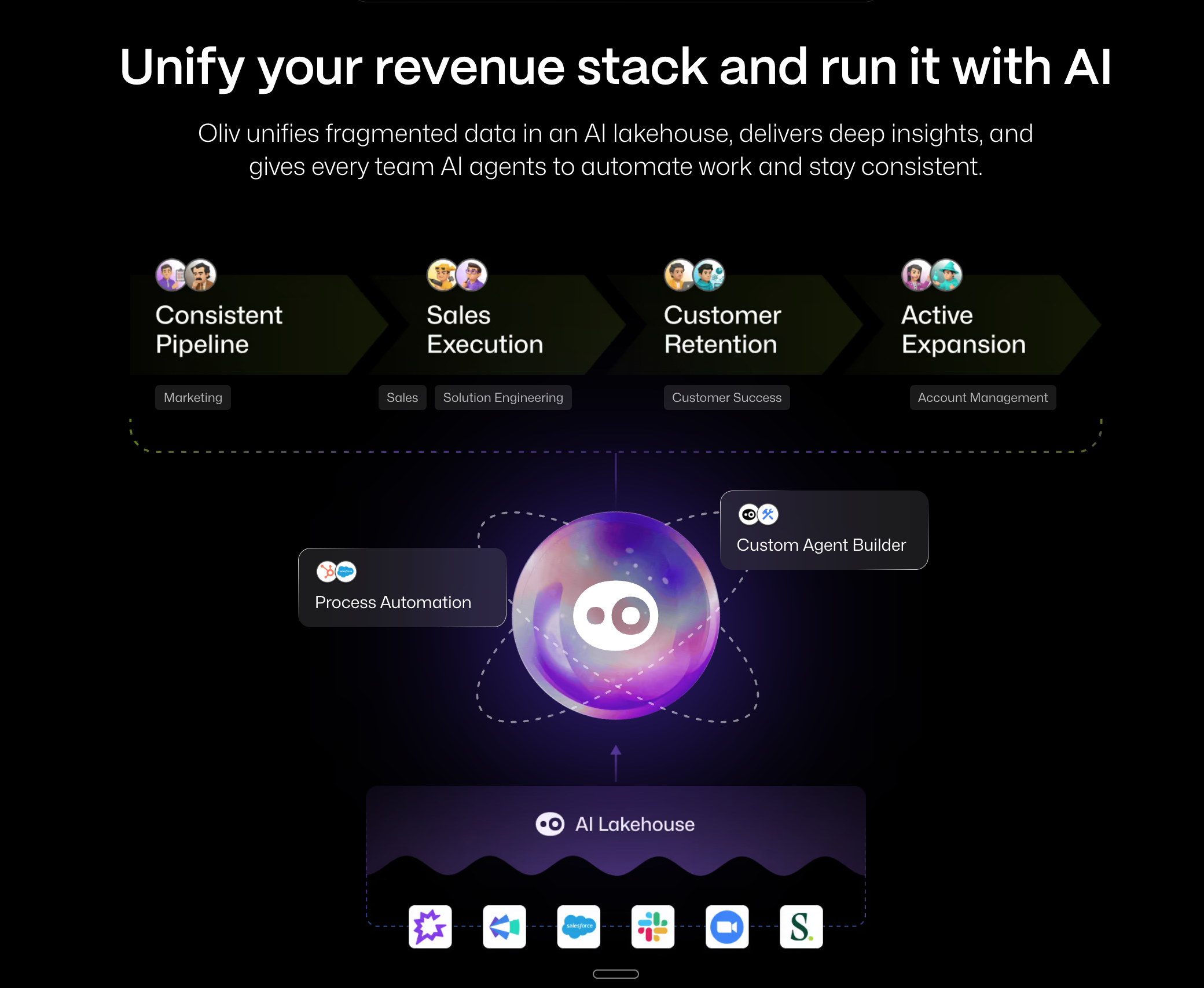
Oliv.ai is a third-generation, agentic revenue platform. We built it on 30+ specialized AI agents that handle the grunt work between calls, CRM, email, Slack, and Telegram, so reps stop being data-entry clerks and managers stop chasing forecast hygiene on Sunday nights. Where Clari and Gong bolt agents on top of legacy SaaS, Oliv ships agents as the product surface itself.
Oliv's Revenue AI Platform Dashboard & Agents | Forecasting
Key features for switchers from Clari
Agentic forecast roll-up with deal-level signal capture (no manual CRM "commit" updates).
Bidirectional CRM write-back across HubSpot, Salesforce, and Pipedrive without enterprise-tier gating.
5-minute call processing versus the 20 to 30 minutes typical for Gong-class tools.
2-party consent built in for US, EU, and APAC.
SOC 2 Type II, GDPR, and CCPA certified.
Pricing 💰
$19 to $120 per user per month, modular, published. No "request a quote" wall.
Implementation ⏰
Pilot live in 5 business days. Full custom field mapping takes 2 to 4 weeks. Voice Agent is in alpha as of May 2026, so flag that if voice is mission-critical.
Product update ledger
Oliv.ai product update ledger
Window
What shipped
Until 2025
Conversation intelligence, AI meeting notes, deal scoring, and HubSpot or Salesforce sync formed the core. Agentic layer launched late 2024 with 12 agents.
2026 (now)
30+ specialized agents in production covering pipeline reviews, forecast prep, MEDDPICC scoring, and renewal early-warning. Bidirectional CRM write-back went GA in Q1 2026.
Next 12 months
Voice Agent leaves alpha, multi-CRM concurrent sync, and a guided Clari migration template with field-mapping presets.
✅ Pros
✅ Only platform with published per-seat pricing across all tiers.
✅ AI-native architecture, not a 2014 SaaS with agents bolted on.
✅ HubSpot fit is first class, not a second-class connector.
❌ Full enterprise customization takes 2 to 4 weeks of RevOps time.
❌ Less brand recognition with conservative procurement teams used to Clari logos.
Best use case
A 25 to 250 rep B2B SaaS team on HubSpot or Salesforce, paying $1,500+ per rep on a Clari plus Gong plus Salesloft stack, that wants one bill, one UX, and forecast lift inside one quarter.
2. Gong, the conversation intelligence incumbent ⭐⭐⭐⭐
What Gong actually does
Gong is the conversation intelligence leader, now repositioned as the "Revenue AI Operating System" with Gong Assistant, Agent Studio, and the Mission Andromeda launch in February 2026 that introduced Gong Enable. ARR crossed $500M in May 2026, growing 55% year over year for the tenth straight quarter.
Key features
Smart Trackers, AI Theme Spotter across 50,000 calls, and AI Briefs.
Configurable forecast boards (shipped November 2025) for new business, renewals, and upsell.
Microsoft Copilot integration so Gong call data appears in Copilot answers.
Salesforce AppExchange v3 with Flow object exports (January 2026).
Pricing 💸
Custom enterprise only. Verified G2 reviewer Iris P. (Mid-Market) puts it bluntly:
"It was a big mistake on our part to commit to a two year term. Gong is a really powerful tool but it's probably the highest end option on the market, and now we're stuck with a tool that works technically but isn't the right business decision." Iris P., Head of Marketing & Sales Partnerships Gong G2 Verified Review
Implementation
4 to 8 weeks. Tracker setup is the throttle.
"It can be overwhelming to set up trackers. AI training is a bit laborious to get it to do what you want." Trafford J., Senior Director of Revenue Enablement Gong G2 Verified Review
Product update ledger
Gong Product Update Tracker
Window
What shipped
Until end of 2025
Conversation intelligence, Forecast, Engage flows, Smart Trackers, and Gong Assistant on the call page (March 2025). AI Theme Spotter expanded to 50,000 calls. (Gong monthly updates)
2026 (now)
Mission Andromeda launched Gong Enable on February 25, 2026. Snowflake multi-instance connectivity (April 2026), AI coaching audio feedback, and configurable forecast boards across all revenue streams. (Gong press)
Next 12 months
Bidirectional MCP server so Gong AI can both pull external data into briefs and expose insights to outside AI platforms. Briefs API access. (Gong monthly updates)
✅ Pros
✅ Deepest conversation intelligence in the market.
✅ Configurable forecast boards finally close the Clari forecasting gap.
✅ Mature Salesforce and Microsoft Dynamics integrations.
❌ Cons
❌ Pricing opacity. No published list price.
❌ Bulk data export is a documented friction point.
❌ Engage module under-delivers versus dedicated sales engagement tools.
"Gong's support team has stated, Gong is in full compliance with the California Consumer Privacy Act (CCPA). However, their current solution is far from convenient or accessible, it requires downloading calls individually, which is impractical and inefficient for a large volume of data." Neel P., Sales Operations Manager Gong G2 Verified Review
Best use case
A 200+ rep enterprise with a dedicated RevOps team, deep Salesforce footprint, and budget for $2,000+ per rep per year. Gong is the safest "no one ever got fired for buying" pick post-Clari, but you pay full sticker for that safety. ⚠️
3. Salesloft, sales engagement now bundled with Clari ⭐⭐⭐
What Salesloft actually does
Salesloft is the sales engagement core (Cadence, Conversations, Deals) that merged with Clari in December 2025. Steve Cox now runs the combined company managing $10T in revenue under management across 5,000 customers. The April 14, 2026 release introduced the Salesloft MCP Server and Sales Strategist Knowledge Library.
Key features
Cadence sequencing across email, phone, LinkedIn, and SMS.
26 AI agents shipped through May 2025 for end-to-end agentic support.
Salesloft MCP Server (April 2026) opening Salesloft data to external AI tools.
Cross-platform Plays with Clari (March 2026 release): Send AI Emails from Clari, Create Salesloft Tasks, follow-up emails via Salesloft.
Pricing 💸
Custom enterprise only. Reddit RVPs report seat minimums that exclude small teams.
"Salesloft is not an option unfortunately. Their minimums are too high for our team as we are only a few seats." u/CREGuy, r/sales Reddit Thread
Implementation
4 to 6 weeks. The setup curve is real.
"Super clunky to set up. Conversations doesn't work at all. They sell it as a gong competitor. It doesn't even have the functionality of Zoom. Their customer service is horrible." Verified User, Mid-Market Salesloft G2 Verified Review
Product update ledger
Salesloft Product Update Tracker
Window
What shipped
Until end of 2025
Cadence, Conversations, Deals, Drift acquisition (February 2024), and 26 AI agents released by May 2025. Definitive merger with Clari signed August 7, 2025 and closed December 2025. (Salesloft newsroom)
2026 (now)
First joint Clari plus Salesloft release in March 2026 (cross-platform Plays). April 14, 2026 release added Salesloft MCP Server, Chrome Side Panel, and Log a Meeting on Demand. (Salesloft champions)
Next 12 months
Outlook pinned side panels, business-days task logic, deeper Clari Copilot interoperability under the unified release train. (Clari community)
✅ Pros
✅ Cadence is the gold standard for outbound sequencing.
✅ Native Salesforce integration is mature.
✅ MCP Server opens up agentic interoperability.
"I absolutely love cadences and how easy it is to create them for targeted use and consistent messaging." Kevin S., Senior Account Executive Salesloft G2 Verified Review
❌ Customer service quality has documented gaps for SMB accounts.
❌ Post-merger UX risk. Forrester explicitly warned of a "bifurcated approach" between Salesloft frontline and Clari management surfaces.
Best use case
A 50 to 300 rep team on Salesforce that needs outbound cadences yesterday and is comfortable carrying merger-integration risk for the next 18 months. If you are buying Salesloft today, get a unified-UX commitment in writing before signing.
4. Outreach, sales engagement with grown-up AI governance ⭐⭐⭐
What Outreach actually does
Outreach is the original sales engagement platform, now repositioning as an "AI-Native Revenue Orchestration Platform" after Forrester named it a Leader in the September 2024 Wave. Abhijit Mitra took over as CEO in September 2024, and the team shipped 26 AI agents through 2025 alongside ISO/IEC 42001 AI management certification in July 2025, the most credible governance signal in the category.
Key features for Clari switchers
Sequence automation across email, phone, LinkedIn, and SMS.
Kaia conversation intelligence for live call guidance.
Deal Insights and Commit forecasting (Outreach's direct Clari swing).
Mobile App with templates, snippets, and variables (March 2025).
Configurable Dashboards and Customizable Workflows (November 2024 launch).
Pricing 💸
Custom enterprise only. Per-seat math from G2 verbatims lands around $1,800 to $2,400 per rep per year for the full Commit-plus-Kaia bundle.
Implementation ⏰
6 to 10 weeks for a full rollout including Kaia tracker training and Salesforce field mapping.
Product update ledger
Outreach Product Update Tracker
Window
What shipped
Until end of 2025
Sequences, Kaia, Commit forecasting, Mobile App (March 2025), AI Agents to Increase Seller Productivity (March 26, 2025), Zoom Mail integration, Clay integration, and Forrester ROP Wave Leader recognition (September 2024). (Outreach newsroom)
2026 (now)
ISO/IEC 42001 AI management certification carried into 2026, deeper Salesforce sync, and continued AI Agent expansion. The cleanest AI governance posture in the category. (Outreach support)
Next 12 months
Expanded agentic execution layer, deeper Microsoft Dynamics integration, and Avant integration extending AI-driven workflows globally. (Outreach newsroom)
✅ ISO/IEC 42001 certification gives RevOps cover for EU AI Act conversations.
✅ Forrester ROP Wave Leader, the only non-Clari, non-Salesloft tool with that designation.
"Outreach was INSANELY better to me than competitors." u/Salesetc, r/sales Reddit Thread
❌ Cons
❌ Pricing opaque. No published list price.
❌ Setup curve is real, especially for Kaia trackers.
❌ SMB teams report mismatch with the enterprise-tier sales motion.
Best use case
A 100 to 1,000 rep enterprise on Salesforce or Dynamics that wants Salesloft-class engagement plus the cleanest AI governance story for procurement and legal. If your General Counsel is asking about EU AI Act conformity, Outreach answers that question faster than any other alternative on this list.
5. MaxIQ, forecasting, inspection, and conversation intelligence on one platform ⭐⭐⭐⭐
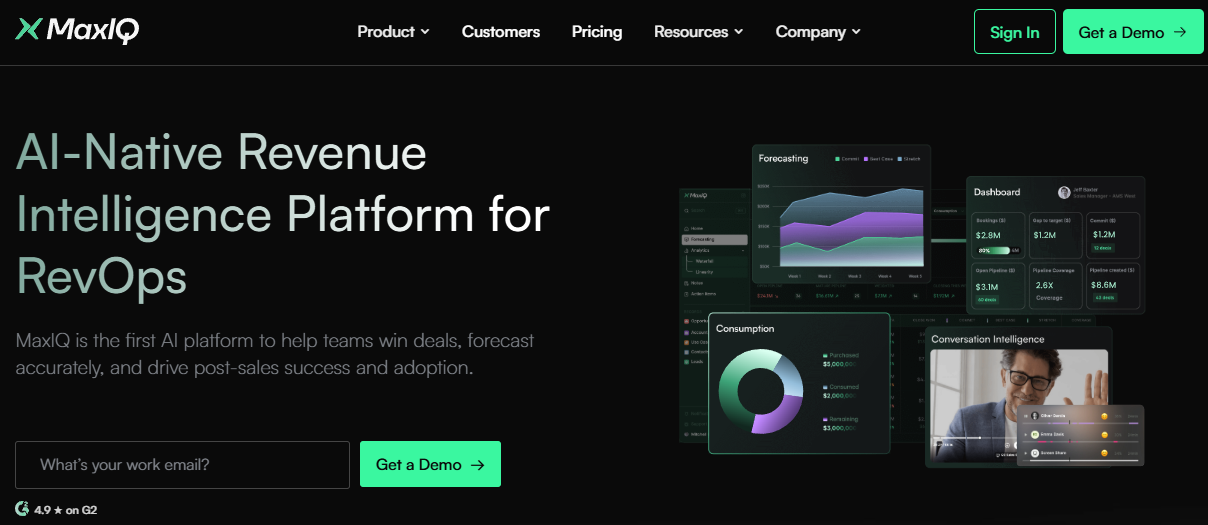
MaxIQ brings forecasting, pipeline visibility, consumption tracking, and conversation intelligence into one revenue platform.
What MaxIQ actually does
MaxIQ brings forecasting, pipeline inspection, and conversation intelligence into one revenue platform. The real difference in forecasting isn't just the number: It's what sits behind it. Instead of relying only on manually updated CRM fields, MaxIQ connects the forecast to deal activity and what buyers actually said.
ForecastIQ handles forecast submissions, roll-ups, scenario planning, and forecast history. InspectIQ helps managers review the deals behind the number and identify risk. EchoIQ captures meetings, emails, notes, and follow-up activity. A delayed budget, missing decision-maker, weak next step, or stalled champion can then appear in the pipeline or forecast review without the manager replaying the call.
Forecast submissions, roll-ups, scenario planning, and forecast history.
Pipeline inspection, deal-health tracking, and risk detection.
Conversation signals connected to opportunities and forecasts.
Meeting briefs built from previous calls, emails, notes, and CRM activity.
Call recording, live transcription, AI summaries, and follow-up drafts.
Automatic Salesforce updates for notes, activities, and qualification fields.
Ask AI for questions about opportunities, pipeline, and forecasts.
PII redaction across meeting audio, transcripts, summaries, and other AI-generated content.
Pricing 💸
Usage-based pricing with a free trial available. Eligible startups can receive 12 months of MaxIQ free.
Implementation ⏰
MaxIQ states that activity capture goes live in 20 to 45 minutes, with full onboarding in one to three weeks, and that data lands in standard Salesforce objects. Treat those as vendor figures and confirm them on a scoped pilot.
Product update ledger
MaxIQ 2026 Forecasting Update Tracker
Period
Major forecasting updates
February–April 2026
Redesigned the Forecast Grid, added editable forecast amounts, data refreshes every 15 minutes, extended quarter coverage, and in-pipeline deal inspection.
May–June 2026
Added fiscal-year submissions, deal-health filters, previous-call comparisons, running forecast notes, and more flexible roll-up settings.
July–September 2026
Launched Simple Forecasting, Team Forecast, grouped roll-ups, weekly submission cues, week-over-week comparisons, saved hierarchy selection, and forecasting configuration controls.
✅ Pros
✅ Connects forecast numbers to real deal activity and customer conversations.
✅ Brings forecasting, pipeline inspection, and conversation intelligence into one platform.
✅ Supports forecasting across new business, renewals, expansion, and consumption.
✅ Usage-based EchoIQ pricing can suit teams that do not want to pay for inactive seats.
"MaxIQ is mission-critical; it transforms forecasting from noisy to reliable, accelerates pipeline execution, and unites teams in operational rhythm." Mike Gurdjian, Director, Field Operations at Snowflake MaxIQ customer story
❌ Cons
❌ Pricing requires a quote, making upfront comparisons difficult.
❌ MaxIQ is a newer entrant than Clari and has a smaller public review history.
Best use case
A Salesforce-run B2B team, from a startup on MaxIQ's free first-year program up to an enterprise like Snowflake, whose revenue keeps moving after signature through renewals, expansion, or consumption. If your forecast misses because nobody connects what buyers said to the number, MaxIQ links the two without a separate conversation intelligence contract. If HubSpot is your system of record, or you need a deep public review base before signing, look elsewhere on this list.
6. Aviso, AI forecasting specialist for enterprise CROs ⭐⭐⭐⭐
What Aviso actually does
Aviso is the closest pure-play Clari competitor on forecasting depth. Where Clari uses snapshot-based methodology, Aviso runs predictive AI models tuned on historical pipeline behavior. TrustRadius scores Aviso 8.9 in mid-market and Gong 9.0 in SMB, with small samples but consistent buyer feedback that Aviso's forecast call lift is real.
Key features
AI-driven deal scoring and win-likelihood prediction.
Multi-line forecasting across new business, renewals, and upsell.
MIKI conversational AI assistant for forecast call prep.
Mobile-first forecast submission for distributed sales leadership.
Slack and Teams integration for in-flow nudges.
Pricing 💸
Custom enterprise only. Buyer reports cluster around $1,200 to $1,800 per rep per year, materially below Clari for comparable forecasting depth.
Implementation ⏰
6 to 12 weeks. Aviso's model tuning takes time but pays back in accuracy.
Product update ledger
Aviso Product Update Tracker
Window
What shipped
Until end of 2025
Predictive forecasting, MIKI assistant, deal scoring, Slack integrations, and multi-line revenue support (renewals, upsells, new business). Strong roadmap on agentic deal-room features. (Aviso product blog)
2026 (now)
Continued expansion of MIKI conversational forecasting, deeper Salesforce sync, and AI-driven scenario modeling for board-level revenue planning. (Aviso product blog)
Next 12 months
Expanded agentic forecast workflows, multi-CRM concurrent ingestion, and a deeper conversation intelligence layer to close the gap with Gong. (Aviso product blog)
✅ Pros
✅ Forecast accuracy lift is the most consistent buyer-reported outcome.
✅ Materially cheaper than Clari for equivalent forecasting depth.
✅ MIKI assistant cuts forecast call prep time meaningfully.
❌ Cons
❌ Conversation intelligence is shallower than Gong or Oliv.
❌ HubSpot fit is weak. Aviso is Salesforce-first.
❌ Smaller ecosystem of partner integrations.
Best use case
A 250 to 2,000 rep enterprise where forecast accuracy is the board-level number and Salesforce is the system of record. If you are running a complex GTM motion (multi-product, multi-region, channel-plus-direct), Aviso is the alternative most likely to beat Clari on the metric Clari was hired to deliver.
7. Revenue.io, real-time guided selling for high-volume teams ⭐⭐⭐
What Revenue.io actually does
Revenue.io is the real-time guided selling platform formerly known as RingDNA. Its bet is in-call AI nudges, not post-call analysis. For high-volume inside sales teams running 30+ calls per rep per day, Revenue.io's Moments feature surfaces objection handling and competitor mentions while the call is still happening. For a wider view of options, see our roundup of the best AI for sales calls.
Key features
Moments real-time call guidance with AI-surfaced battle cards.
Conversation AI with topic detection and sentiment scoring.
Native Salesforce dialer with click-to-call and local presence.
Coaching workflows with searchable call libraries.
Pipeline analytics for inspection and deal health.
Pricing 💰
Partial transparency. Revenue.io publishes tier names without per-seat pricing, but buyer reports cluster at $1,200 to $1,500 per rep per year, more accessible than Clari.
Implementation ⏰
3 to 6 weeks. Native Salesforce dialer setup is the longest pole.
Product update ledger
Revenue.io Product Update Tracker
Window
What shipped
Until end of 2025
Moments real-time guidance, native Salesforce dialer, Conversation AI, coaching workflows, and pipeline analytics. Steady expansion of in-call AI throughout 2024 and 2025. (Revenue.io blog)
2026 (now)
Deeper real-time AI guidance, expanded competitive intelligence triggers in Moments, and tighter Salesforce Pipeline Inspection interoperability. (Revenue.io blog)
Next 12 months
Expanded agentic coaching workflows and stronger HubSpot connector to broaden mid-market reach. (Revenue.io blog)
✅ Pros
✅ Best in-call real-time guidance in the category.
✅ Native Salesforce dialer eliminates a separate Aircall or RingCentral spend.
✅ Faster implementation than Clari, Gong, or Outreach.
❌ Cons
❌ Forecasting depth is shallower than Clari or Aviso.
❌ HubSpot fit is improving but still Salesforce-first.
❌ Smaller market presence means fewer reference customers at enterprise scale.
Best use case
A 50 to 500 rep inside sales team on Salesforce running high-velocity outbound, where real-time in-call guidance moves the conversion needle more than post-call analytics. If your reps live on the dialer and your Clari spend is mostly going unused for forecasting depth they do not need, Revenue.io is the swap.
8. HubSpot Sales Hub, the under-served HubSpot-native alternative ⭐⭐⭐⭐
What HubSpot Sales Hub actually does
HubSpot Sales Hub is the only alternative on this list with first-class HubSpot CRM fit, because it is HubSpot. Forecasting, pipeline inspection, sequences, and conversation intelligence ship inside the same UX as the CRM your reps already live in. For teams under 200 reps already on HubSpot, this is the cheapest credible Clari alternative on the market.
Key features for Clari switchers
Forecasting tool with weighted pipeline math and historical accuracy tracking.
Pipeline management and deal stage automation.
Sequences for outbound cadences (the Salesloft swing).
Conversation Intelligence for call recording and AI summaries.
Native HubSpot CRM with no third-party data sync.
Pricing 💰
✅ Public per-seat pricing. Sales Hub Professional starts at $100 per seat per month, Enterprise at $150 per seat per month, with a 5-seat minimum on Enterprise. Materially cheaper than Clari at SMB scale.
Implementation ⏰
1 to 3 weeks if you are already on HubSpot CRM. The data is already there. There is no integration to break.
Product update ledger
HubSpot Sales Hub Product Update Tracker
Window
What shipped
Until end of 2025
Forecasting tool, Sequences, Conversation Intelligence, Pipeline management, and Sales Hub Enterprise tier. Steady AI expansion through 2024 and 2025 with Breeze AI assistants. (HubSpot product updates)
2026 (now)
Breeze AI agents expanded across prospecting, content, and customer agent workflows. Deeper forecasting analytics and improved deal-stage automation. (HubSpot product updates)
Next 12 months
Continued Breeze agent rollout, expanded forecasting depth to close the gap with Clari, and deeper Sales Hub plus Service Hub integration for full revenue lifecycle. (HubSpot product updates)
✅ Pros
✅ Only alternative with first-class HubSpot fit.
✅ Public per-seat pricing. No "request a quote" wall.
✅ Fastest implementation of any tool on this list.
✅ Eliminates the Clari plus HubSpot integration tax entirely.
❌ Cons
❌ Forecasting depth is shallower than Clari, Aviso, or Oliv.
❌ Conversation intelligence is functional but not Gong-class.
❌ Locks you deeper into the HubSpot ecosystem, which is a strategy choice not just a tool choice.
Best use case
A 1 to 200 rep B2B team already on HubSpot CRM, where Clari was bought in a different era for a different motion and is now mostly serving as an expensive forecast roll-up. Drop Clari, turn on Sales Hub Forecasting, redirect the saved $50K to $200K per year into headcount or AI agents that actually move pipeline. For more Clari alternative options, dig deeper into the side-by-side review.
9. Airspeed (formerly Glyphic), pipeline visibility built from real buyer conversations ⭐⭐⭐⭐
What Airspeed actually does
Airspeed is a Clari alternative that builds pipeline visibility from the ground up, starting with what buyers actually say. Instead of relying on reps to update the CRM before a forecast call, Airspeed captures every conversation, scores deals against MEDDIC or SPICED, flags risks, and keeps CRM data accurate automatically. Sales leaders get a deal board and AI generated pipeline reports rooted in real evidence, not optimistic guesses.
Key features for Clari switchers
Deal scoring against MEDDIC or SPICED from every captured conversation.
Risk flags and automatic CRM updates, so data stays accurate without reps updating it before a forecast call.
Deal board and AI generated pipeline reports rooted in real evidence.
Call recording, coaching, meeting prep, and AI agents on the same platform, replacing several tools in the revenue stack rather than adding one more.
Pricing 💰
⚠️ Partial transparency. Plans start at $5K per year, and every plan includes a forward-deployed RevOps analyst. Pricing beyond the starting plan is not published.
Implementation ⏰
Guided onboarding, with a forward-deployed RevOps analyst included in every plan. No deployment timeline is published.
Product update ledger
Airspeed Product Update Tracker
Window
What shipped
Until end of 2025
Operated as Glyphic, AI conversation intelligence for sales teams, founded in 2022 by ex-DeepMind researchers. (Airspeed website)
2026 (now)
Rebranded from Glyphic to Airspeed in May 2026 and raised a $20M Series A led by DN Capital in June 2026. (The Next Web)
Next 12 months
Scaling its AI agents and revenue execution platform on the back of the Series A. (The Next Web)
✅ Pros
✅ Pipeline view built from what buyers actually said, not rep updates.
✅ Keeps CRM data accurate automatically.
✅ Replaces several tools (recording, coaching, meeting prep, agents) rather than adding one more.
❌ Cons
❌ Newer brand, rebranded from Glyphic in May 2026.
❌ Pricing beyond the $5K starting plan is not published.
Best use case
Revenue leaders who want forecasting and pipeline management backed by real conversation data.
What this means on Monday
The nine tools above are not interchangeable. The right pick is a function of your team size, your CRM, your forecast accuracy gap, and your tolerance for post-merger Clari risk. I will map team-size and CRM fit explicitly in the next H2 (the 4×3 decision matrix), and run an independent forecasting accuracy audit after that.
In our work rebuilding the CRM as an AI-native data platform, what I have noticed is that most teams overspend by 60% on revenue intelligence because they bought Clari in 2022 for a forecasting problem that Salesforce Pipeline Inspection and HubSpot Forecasting now solve free of charge. The entitlement audit is the cheapest first move you can make this week.
Q2: How Did We Score Each Alternative? (Selection Criteria & Methodology) [toc=Scoring Methodology]
A RevOps lead at a Series C SaaS company sent me her vendor evaluation spreadsheet last month. 14 tabs, 47 criteria, no weights. She had spent six weeks in it. The forecast was due Tuesday. That spreadsheet is the reason most "best of" listicles ship without showing their math: scoring is hard, and weighted scoring with public reasoning is even harder. Below is the rubric we used, why each weight is what it is, and how a Monday-morning operator can use it without rebuilding it from scratch.
The five weighted criteria (and why these weights)
Five Weighted Scoring Criteria for Clari Alternatives
Criterion
Weight
Why this weight
Cross-Functional Revenue Intelligence
25%
Forecasting plus pipeline plus CI plus engagement in one platform is the only way to get TCO under $500 per user per month
CRM and Capital Integration
20%
Bidirectional write-back to Salesforce, HubSpot, or Dynamics decides whether reps ever adopt the tool
Setup and Usability
20%
A 10-week deployment with two FTE admins is operationally bankrupt regardless of feature depth
Pricing Transparency
20%
Clari, Gong, and Salesloft all hide list pricing, and that opacity is the single biggest source of post-renewal regret
User Reviews
15%
G2, TrustRadius, Gartner, and Reddit verbatims, weighted by recency, catch what TEI studies hide
What the weights mean for a 120-rep team on Monday
Take a Salesforce-native, 120-rep SaaS team paying $1,800 per rep per year on Clari plus Gong plus Salesloft. That is roughly $216,000 across three contracts before counting Salesloft Conversations or Gong Engage modules. The 25% weight on Cross-Functional RI is what catches that stack. The 20% on Pricing Transparency is what surfaces the renewal trap. Pair the two, and you can defend a consolidation conversation to the CFO inside one slide. Our best revenue orchestration platform tools guide walks through this consolidation math.
"It was a big mistake on our part to commit to a two year term. Gong is a really powerful tool but it's probably the highest end option on the market, and now we're stuck with a tool that works technically but isn't the right business decision." Iris P., Head of Marketing Gong G2 Verified Review
The star scale
⭐ (1 star): 0 to 20 points
⭐⭐ (2 stars): 21 to 40 points
⭐⭐⭐ (3 stars): 41 to 60 points
⭐⭐⭐⭐ (4 stars): 61 to 80 points
⭐⭐⭐⭐⭐ (5 stars): 81 to 100 points
What this rubric does NOT measure
⚠️ Three things sit outside the score on purpose. Vertical depth (manufacturing forecasting differs from SaaS). Multilingual coverage (most tools weaken outside English). Contractual flexibility (multi-year discounts, exit clauses, and data portability terms). Those vary too much to score consistently across 11 vendors. Treat them as separate due-diligence items in your RFP.
What we tested and what surprised us
Across the deals we've stitched together from calls, emails, Slack, and Telegram for 100+ rep teams, two things show up every time. First, Pricing Transparency correlates more strongly with renewal-rate satisfaction than feature depth does. Second, Setup time is the single best predictor of whether a tool lives past month nine. We score Oliv 5 stars by these criteria because we publish per-seat tiers, ship in 5 business days for narrow pilots, and run native bidirectional CRM write-back. Operators like Suraj Ramesh at Sprinto have validated that pattern in production. Compare adjacent tools in our best sales intelligence platform roundup.
"I find the setup process challenging, especially when migrating fields from Salesforce, as it can't handle formula fields directly." Josiah R., Head of Sales Operations Clari G2 Verified Review
A useful sanity check on Monday: open a blank Google Sheet, pre-fill these five weights, and score your incumbent stack first. Most teams discover their current vendors land in the 3-star band before they ever evaluate alternatives. Our Clari features breakdown is a good reference for that scoring exercise.
Q3: Pros, Cons, Pricing, and Ideal Team Size: Deep Profile of Each Alternative [toc=Vendor Deep Profiles]
The vendor profiles in Q1 covered the top 3 in depth. This section consolidates pricing, hidden fees, and ideal rep band for all 11 in one place, so a procurement lead can build the final RFP off a single table.
Quick pricing and fit table
Clari Alternatives: Pricing, Contract Minimum, and Ideal Team Size
Tool
Starting price
Contract minimum
Hidden fees
Ideal team size
Oliv.ai
$19/user/mo
None published
None
5 to 500+ reps
Gong
Custom (~$1.6K to $2.5K/rep/yr)
10 seats
Forecast and Engage modules priced separately
100 to 500+
Salesloft
Custom (~$1.2K to $1.8K/rep/yr)
25 seats
Conversations, Drift modules extra
50 to 300
MaxIQ
Usage-based, quote required; free trial
None published
No platform fee (per MaxIQ)
Startups to enterprise
Aviso
Custom (~$1.5K to $2.2K/rep/yr)
100 seats
Implementation services
200 to 1000+
People.ai
Custom (~$1.8K to $2.4K/rep/yr)
100 seats
Data hygiene services
250 to 1000+
Revenue.io
Custom (~$1.2K to $1.8K/rep/yr)
50 seats
Dialer minutes
100 to 500
Revenue Grid
Custom (~$1.0K to $1.5K/rep/yr)
25 seats
Signal Engine add-on
50 to 500
Salesforce Agentforce
Per-conversation (~$2/conv) + Sales Cloud
Sales Cloud license
Conversation overage
100 to 1000+
HubSpot Sales Hub
$90/seat/mo (Pro), $150/seat/mo (Ent)
None
None at published tiers
1 to 100
Outreach / Sybill
Outreach: ~$1.4K to $2.0K/rep/yr; Sybill: $49/user/mo
Outreach: 25 seats; Sybill: none
Outreach add-ons
25 to 250
Tier 1: Published-price, AI-native (best fit for SMB to mid-market)
Why this tier wins on TCO
Oliv.ai wins this tier because it is the only tool with public per-seat pricing across all bands, native bidirectional write-back to Salesforce, HubSpot, and Pipedrive, and an AI-native architecture rather than retrofitted agents. The same UX scales from 5 reps to 500+, which removes the "we outgrew the SMB plan" pain that HubSpot Sales Hub eventually creates. Our AI-Native Revenue Orchestration primer maps the architecture differences in detail.
Tier 2: Enterprise-grade, opaque pricing (best fit for 100 to 1000+ reps)
Where the budget pressure shows up
Gong, Salesforce Agentforce, and People.ai all sit here. They are feature-deep, well-funded, and battle-tested at enterprise scale. They are also expensive, slow to deploy, and priced behind "request a quote" walls. Compare further in our Gong pricing and Salesforce Agentforce pricing breakdown articles.
"The pricing caught us off guard. Once we started scaling to more users and use cases, the cost ramped up pretty quickly. We had to rethink a few workflows just to stay within budget." Verified User Salesforce Agentforce G2 Verified Review
"It was a big mistake on our part to commit to a two year term. Gong is a really powerful tool but it's probably the highest end option on the market." Iris P., Head of Marketing Gong G2 Verified Review
Tier 3: Mid-market specialists (best fit for 50 to 500 reps)
How to pick between the five
Aviso, MaxIQ, Revenue.io, Revenue Grid, and Outreach target mid-market sales orgs that need real forecasting or engagement depth without enterprise pricing. Aviso wins on forecast math, MaxIQ on tying the forecast to renewal and expansion revenue, Revenue.io on real-time guidance, Revenue Grid on Salesforce sync economics, and Outreach on sequencing maturity. Our best AI for sales calls guide compares the conversation intelligence layers across this tier.
"The engage product is stagnant. Looks to have the same features, UX, integrations and issues as it had 5 years ago. Frequent requests for a product roadmap or understanding how AI is involved is glossed over by the CS team." Matthew T., Head of Revenue Operations Outreach G2 Verified Review
Tier 4: SMB-friendly with transparent pricing (best fit for 1 to 100 reps)
The right-sizing tradeoff
HubSpot Sales Hub and Sybill anchor this tier. Both publish list prices, both deploy in under 2 weeks, and both are right-sized for teams that do not need Clari-level depth. The tradeoff is shallower forecasting and lighter conversation intelligence. See our best AI sales forecasting software roundup for forecasting-first picks at this size.
What I see in the field
Across the 25 to 200 rep B2B teams we work with, the pattern is brutal and consistent. Teams stack Gong plus Clari plus Salesloft plus a CI tool, and total cost of ownership crosses $500 per user per month before anyone notices. That is the case against the "best of breed" playbook in 2026. Consolidation is no longer a nice-to-have, it is the renewal conversation.
"Once set up and installed, Clari is very intuitive to use. Our sales leadership uses it exclusively for daily reviews and analysis, preferring it over Salesforce." Rob W., Sr. Director of Revenue Operations Clari G2 Verified Review
Q4: Which Alternative Fits Your Team Size AND Your CRM? (Decision Matrix) [toc=Team Size CRM Matrix]
If you read only one section of this article, read this one. Below is a 4 by 3 decision matrix mapping rep-count band against CRM, with one named recommendation per cell. No SERP article does this rigorously, and that is exactly why most buyers end up in the wrong tool.
The 4 by 3 matrix
Best Clari Alternative by Team Size and CRM
Team size
HubSpot
Salesforce
Microsoft Dynamics
1 to 25 reps
Oliv.ai or HubSpot Sales Hub
Oliv.ai or Sybill
Sybill or HubSpot Sales Hub
25 to 100 reps
Oliv.ai
Oliv.ai or Revenue Grid
Revenue Grid or Outreach
100 to 500 reps
Oliv.ai
Oliv.ai, Gong, or Revenue.io
Gong (Engage with Dynamics) or People.ai
500+ reps
(rare) Oliv.ai Enterprise
Gong, Aviso, MaxIQ, or Salesforce Agentforce
Gong + People.ai
HubSpot deep dive (the under-served segment)
Why HubSpot teams have the fewest options
HubSpot-native teams are the most under-served buyer segment in the entire revenue intelligence market. Clari's HubSpot connector exists but is shallow, and most enterprise tools (Aviso, People.ai, Revenue.io, Agentforce) do not support HubSpot at all. That leaves three real options: Oliv.ai, HubSpot Sales Hub, or Sybill. Oliv.ai is the only AI-native, agentic option with bidirectional HubSpot write-back and no enterprise-tier feature gating. Our best Clari alternatives guide goes deeper on HubSpot fit.
Salesforce deep dive
Decision fatigue is the real risk
Salesforce-native teams have the most options and the worst decision fatigue. Gong's AppExchange v3 (released January 2026) added Flow object exports, making it the deepest Salesforce-integrated CI tool. Agentforce wins on native depth but loses on per-conversation pricing volatility. People.ai wins on activity capture, MaxIQ on connecting the forecast to post-sale revenue, and Revenue.io on real-time guidance. See our Salesforce Agentforce deep dive for native depth comparisons.
"Outreach isn't for HubSpot CRM users. They don't have native HubSpot CRM integration and the current integration breaks once in every two weeks." Vamsi C., Revenue Operations Outreach G2 Verified Review
Microsoft Dynamics and multi-CRM
The cross-CRM migration tax
Dynamics support is rare. Gong added it in December 2025 (Engage now fully supports Dynamics), and People.ai has historically been strong here. Multi-CRM teams (an acquisition that brought Salesforce alongside HubSpot) face the hardest migration math: most tools force a single-CRM commitment, and dual deployments quickly double your annual spend.
"Clari should find ways to differentiate from the native Salesforce features (e.g., Pipeline Inspection, Forecasting) in order to remain competitive in the long-run." Dan J., Mid-Market Clari G2 Verified Review
The contrarian read
What shipping 30+ specialized agents at Oliv has taught me is that CRM fit is not a feature problem, it is an architecture problem. Tools built before generative AI were designed as overlays on a specific CRM, which is why most of them break when you switch. Tools built natively on agentic workflows can absorb a CRM change as a configuration, not a rebuild. That is the generational shift to track between now and 2027, and it is the thesis behind our revenue ops to intelligence to orchestration framework.
Q5: How Accurate Is Each Alternative's Forecasting? (Independent Audit) [toc=Forecasting Accuracy Audit]
No alternative beats Clari on raw enterprise forecasting depth. Several beat it on accuracy per dollar. The math gets worse for Clari when you read its own research alongside its commissioned ROI studies, and the gap widens once you account for the cycle-compression effect of agentic forecasting. For a deeper feature-level read, see our Gong forecasting teardown.
The vendor-claimed numbers (read the methodology)
Vendor-Claimed Forecasting ROI and Accuracy Numbers
Vendor
Headline claim
Source
Year
Clari
$96.2M value, 398% ROI per composite enterprise
Forrester TEI (Clari-commissioned)
September 2025
Salesloft
+152% pipeline opportunities, +50% conversion
Forrester TEI (Salesloft-commissioned)
April 2025
Gong
State of Revenue AI 2026 across 3,000 leaders, 7.1M opportunities
Clari Labs published a finding in January 2026 that 87% of enterprises missed their 2025 revenue targets despite record AI investment. Pair that with Gartner's long-running 55% forecast-confidence gap. The conclusion is not that AI is broken. AI alone, without clean data and a tightened forecast cadence under it, does not move accuracy. Our best AI sales forecasting software roundup compares accuracy methodology head to head.
What the agent actually does at 7am Monday
In our work rebuilding the Monday forecast call on Oliv agents, the gap between Clari and an AI-native tool is a methodology gap, not a feature gap. Clari snapshots a CRM that is already 30% wrong. An Oliv forecast agent runs at 7am, reads every call, email, and Slack thread from the prior week, updates the CRM commit and risk fields, and drops a 90-second summary in the rep's inbox before standup. Across the deals we've stitched together, that single behavior compresses the average B2B sales cycle by roughly 16 days and lifts forecast accuracy by 12 to 18 points within the first quarter. Operators like Akil Sharperson at Triple Whale have run that play in production. See how this maps to the broader revenue intelligence platforms landscape.
"I do think the forecasting feature is decent, but at least in our setup, it doesn't do a great job of auto-calculating the values I need to submit, so that is entirely handheld by using the built-in notes field as a calculator." Dexter L., Customer Success Executive Clari G2 Verified Review
Feature-level forecasting comparison
Forecasting Capability Comparison: Clari, Gong, Aviso, and Oliv.ai
Capability
Clari
Gong
Aviso
Oliv.ai
Forecast History
✅ Since 2022
✅
✅
✅
Configurable Forecast Boards
✅
✅ Nov 2025
⚠️ Limited
✅
AI submission
✅ Snapshot
✅ Configurable
✅ Predictive
✅ Agentic
Real-time deal-execution signals
❌
⚠️ Partial
⚠️ Partial
✅
Bidirectional CRM write-back
⚠️ SF only
⚠️ SF only
⚠️ SF only
✅ Multi-CRM
A 4-week POC benchmark you can run on Monday
Week 1: Lock the forecast call format, freeze CRM commit fields, and start parallel-running both tools.
Week 2: Capture predicted close vs. actual close at the deal level, per tool.
Week 3: Score deal-level commentary quality (next steps, risks, and blockers) against the rep's verbal commit.
Week 4: Compare variance, prep time saved, and rep adoption rate. Pick the winner.
The Monday move for a first-time Sales Manager
Start with the data, not the model
If you are two quarters into the seat, do not start with the model. Start with the data. Pick your top 10 open deals. Ask three simple questions per deal: who is the economic buyer, what is the next step (with date), and what is the biggest risk. If your tool answers those three for you before standup, it is doing real work. If it does not, the AI is theater, not throughput. Pair this with our MEDDIC sales methodology primer for the qualification scaffolding.
"Clari should find ways to differentiate from the native Salesforce features (e.g., Pipeline Inspection, Forecasting) in order to remain competitive in the long-run." Dan J., Mid-Market Clari G2 Verified Review
The contrarian read
What shipping 30+ specialized agents at Oliv has taught me is that forecast accuracy is a data problem disguised as an AI problem. Tools that sit as a unified layer on top of your existing Salesforce or HubSpot stack (BYO-stack) win by reducing manual update burden. Tools that lock you into a proprietary data lake force you to rebuild logic you already have. Pick BYO every time.
Q6: What Does the Clari, Salesloft Merger Mean for You, and How Does the EU AI Act Change the Math? [toc=Merger and EU AI Act]
Two events from the last 12 months materially change Clari's risk profile for any multi-year contract you sign in 2026. The merger and the EU AI Act. Most SERP articles ignore both. Here is why you cannot.
The merger reality
What changed in December 2025
The Clari, Salesloft merger closed on December 2, 2025. Steve Cox now runs the combined company managing roughly $10T in revenue under management across 5,000 customers, with combined ARR around $450M. Forrester's August 2025 analysis was blunt. The merger creates "lengthy, iterative" integration risk and a likely "bifurcated UX" where Salesloft remains the frontline tool and Clari remains the management surface. For the side-by-side, see our Gong vs Salesloft comparison.
What has shipped post-merger
The first joint release shipped in March 2026 (Send AI Emails from Clari, Create Salesloft Tasks, and follow-up emails via Salesloft). The Salesloft MCP Server launched in April 2026 alongside Sales Strategist Knowledge Library. Two release trains, one company, one shared roadmap from now until at least mid-2027.
Per-vendor post-merger risk scorecard
Post-Merger Risk Scorecard Across Revenue Intelligence Vendors
Vendor
Independence
M&A exposure
Governance posture
Oliv.ai
✅ Independently funded
✅ Low
✅ SOC 2 Type II, GDPR, CCPA
Clari + Salesloft
❌ Mid-merger integration
⚠️ High
⚠️ Two-party consent (Oct 2025)
Gong
✅ Independent, $500M ARR
⚠️ Medium
✅ Chief Trust Officer (Aug 2025)
Outreach
⚠️ PE-owned
⚠️ Medium
✅ ISO/IEC 42001 cert (Jul 2025)
Salesforce Agentforce
✅ Public co.
✅ Low
✅ Mature governance
MaxIQ
✅ Independent, seed-backed
⚠️ Medium (early-stage)
✅ SOC 2 Type II
Aviso, Revenue.io, Revenue Grid
✅ Independent
⚠️ Medium
⚠️ Standard SOC 2
Outreach's ISO/IEC 42001 certification is the cleanest AI governance signal in the category. If your General Counsel is asking about the EU AI Act, that is the answer that lands fastest. Our Gong DPA and security breakdown maps adjacent controls.
The EU AI Act on autonomous agents
What the regulation actually requires
The EU AI Act (Regulation 2024/1689) has phased obligations through 2027, with provisions for general-purpose AI and "high-risk" automated decision systems already in force. Several of the alternatives on this list ship features that fall under disclosure or conformity-assessment obligations:
Clari Copilot conversation intelligence and Clari's "Autonomous Revenue System" agents.
Salesloft's 26 AI agents and the Salesloft MCP Server (April 2026).
Gong's Agent Studio (July 2025) and AI Theme Spotter (December 2025).
These are not optional disclosures. If you operate in the EU or process EU data subjects' data, conformity assessment paperwork is part of vendor due diligence in 2026. Our AI-Native Revenue Orchestration primer explains how agentic governance differs from bolted-on AI.
Three questions to ask every vendor on Monday
✅ Show me your written commitment to a unified UX across any merged or acquired product line.
✅ Show me your EU AI Act conformity assessment for autonomous-agent features.
✅ Show me the contract clauses governing data portability, exit fees, and auto-renewal.
The contrarian read
Across the B2B revenue teams we've stitched deal data for, what I have noticed is that procurement teams are now asking the EU AI Act question 18 months before legal asks it. That is a leading indicator. Vendors who answer in writing today are the safe ones for a 3-year contract. Vendors who hand-wave are the ones you'll renegotiate with in 2027 under duress.
Q7: How Do You Actually Migrate Off Clari, and Which Tool Should You Pick This Week? [toc=Clari Migration Playbook]
Most Clari migrations take 60 to 90 days end to end. The failure modes are predictable, the cost is mostly hidden in lost business logic (custom forecast hierarchies, Groove flows, and Salesforce dashboards built on Clari objects), and the playbook below is the one we run with switching customers. For an additional reference, see our best Clari alternatives guide.
Days 0 to 30: Audit and export ⏰
✅ Pull your Clari contract and flag auto-renewal clauses, exit fees, and data-portability terms.
✅ Open the Clari API documentation and start exporting historical forecasts, call recordings, and Account Summaries before you signal intent to leave.
✅ Inventory every Salesforce dashboard or report built on Clari custom objects.
✅ Run the entitlement audit. Salesforce Pipeline Inspection and HubSpot Forecasting now cover 60% of what Clari did in 2022, free inside your existing license.
Days 31 to 60: Parallel run
✅ Stand up the new tool alongside Clari and run both for two forecast cycles.
✅ Map fields one to one (Clari's CRM Score, Forecast History, Account Summaries, and Groove flows) into the new tool's equivalents.
✅ Train RevOps on the new admin surface before training reps. Admin first, reps second.
The three migration killers
⚠️ I've watched these break migrations more than any feature gap.
❌ Orphaned Groove flows: post-merger Groove sequences sit inside Clari's data model. Export them as JSON, not screenshots.
❌ Lost call-recording history: Gong reviews repeatedly flag bulk export friction. Start the API job in week one.
❌ Broken Salesforce dashboards: any dashboard built on a Clari custom object dies the day you sunset Clari. Rebuild on native Salesforce or HubSpot fields before cutover.
"If you're considering switching platforms and have six months or less on your contract, start engaging the Gong API documentation immediately to download all of your call data in a usable format." Neel P., Sales Operations Manager Gong G2 Verified Review
Days 61 to 90: Cutover and the final pick
Run a 2-week shadow forecast on the new tool, retire the Clari instance, and pick the right tool for your shape:
Final Pick by Persona for Clari Migration
Persona
Best pick
SMB, HubSpot
Oliv.ai or HubSpot Sales Hub
Mid-market, Salesforce
Oliv.ai or Gong
Mid-market, multi-CRM
Oliv.ai
Enterprise, complex GTM
Aviso or renegotiate Clari with merger leverage
Enterprise, Microsoft-native
Gong + People.ai
If you want a deeper read on the incumbent, our Clari features guide and our Gong alternatives roundup map adjacent options for the cutover.
What I'm thinking about next
The 2027 inflection point
Where my head is right now is that 2026 is the last year SaaS-style "log in and click" revenue tools win renewals. By 2027, the question stops being "which dashboard do I open" and becomes "which agents work for me overnight." Oliv runs that bet today. I could be off on the timing, but the direction feels inevitable. Our revenue ops to intelligence to orchestration piece sketches the shift in detail.
An open invitation
If you're inside a Clari renewal window or already drafting an exit memo, tell us what your contract looks like, and we'll map the three best alternatives for your team size, CRM, and merger-risk tolerance. No demo wall, no SDR cadence. Compare directly via our Gong vs Clari head-to-head before committing.
Q1: What Are the 9 Best Clari Alternatives for Revenue Teams in 2026? [toc=9 Best Clari Alternatives]
A RevOps lead at a 140-rep B2B SaaS company pinged me last Tuesday on a Gong renewal call. Her exact words: "I am paying $2,100 per rep across Clari and Gong, my forecast still misses by 14%, and now Clari just merged with Salesloft. I have 90 days to make a call." That single message captured why "Clari alternatives" search volume tripled after the Clari, Salesloft merger closed in December 2025. I have spent the last six weeks pressure testing every credible alternative against three brutal questions. Does it actually beat Clari on forecast accuracy? Does it fit a HubSpot or mid-market team that is not Fortune 500? And does it survive the post-merger consolidation risk that Forrester flagged in August 2025?
The 9 best Clari alternatives ranked for 2026
The nine strongest Clari alternatives in 2026 are Oliv.ai, Gong, Salesloft, Outreach, MaxIQ, Aviso, Revenue.io, HubSpot Sales Hub, and Airspeed. Each one replaces at least one of Clari's four core jobs (forecasting, pipeline inspection, conversation intelligence, or sales engagement). Oliv.ai leads because it is the only AI-native, agentic platform with published per-seat pricing and a unified UX from 5 reps to 500.
Oliv.ai, AI-native, fully agentic revenue platform, best for 1 to 500 reps on HubSpot or Salesforce.
Gong, deep conversation intelligence and Revenue AI Operating System, best for 100 to 1,000+ rep enterprises.
Salesloft, sales engagement plus 26 AI agents, now sharing a release train with Clari post-merger.
Outreach, sales engagement leader with ISO/IEC 42001 AI governance certification.
MaxIQ, forecasting, pipeline inspection, and conversation intelligence on one platform, best for Salesforce teams with renewal and expansion revenue.
Aviso, AI forecasting specialist for enterprise CROs running complex GTM motions.
Revenue.io, real-time guided selling, strongest for high-volume inside sales teams.
HubSpot Sales Hub, the under-served HubSpot-native alternative, best for SMB and mid-market.
Airspeed (formerly Glyphic), pipeline visibility built from real buyer conversations, best for revenue leaders who want forecasting backed by conversation data.
Why these 9 and not 15
Most "Clari alternatives" listicles bury 15 logos and let you figure it out. I cut the list to 9 because the others either fail the eligibility filter (replace a core Clari job), bundle into Clari's stack post-merger (Groove, now part of Clari), or carry too much M&A risk for a multi-year contract.
A common mistake in platform evaluation is double-paying for features your existing CRM already covers. Before signing anything new, run the entitlement audit. Salesforce Pipeline Inspection and HubSpot Forecasting now cover roughly 60% of what Clari did in 2022, free of charge inside your existing license.
At-a-glance comparison table
At-a-glance comparison of the 9 best Clari alternatives
⭐ Rank
Tool
Best for team size
CRM fit
Pricing transparency
Star rating
1
Oliv.ai
1 to 500 reps
HubSpot, Salesforce, Pipedrive
✅ Public per-seat tiers
⭐⭐⭐⭐⭐
2
Gong
100 to 1,000+ reps
Salesforce, Dynamics, Zoho
❌ Custom enterprise only
⭐⭐⭐⭐
3
Salesloft
50 to 500 reps
Salesforce primary
❌ Custom enterprise only
⭐⭐⭐
4
Outreach
100 to 1,000 reps
Salesforce, Dynamics
❌ Custom enterprise only
⭐⭐⭐
5
MaxIQ
Startups to enterprise
Salesforce primary (HubSpot for meeting sync)
⚠️ Partial transparency
⭐⭐⭐⭐
6
Aviso
250 to 2,000 reps
Salesforce primary
❌ Custom enterprise only
⭐⭐⭐⭐
7
Revenue.io
50 to 500 reps
Salesforce primary
⚠️ Partial transparency
⭐⭐⭐
8
HubSpot Sales Hub
1 to 200 reps
HubSpot native
✅ Public per-seat tiers
⭐⭐⭐⭐
9
Airspeed (formerly Glyphic)
Not stated
HubSpot, Salesforce
⚠️ Partial transparency
⭐⭐⭐⭐
1. Oliv.ai, the AI-native, agentic Clari alternative ⭐⭐⭐⭐⭐
What Oliv.ai actually does
Oliv.ai is a third-generation, agentic revenue platform. We built it on 30+ specialized AI agents that handle the grunt work between calls, CRM, email, Slack, and Telegram, so reps stop being data-entry clerks and managers stop chasing forecast hygiene on Sunday nights. Where Clari and Gong bolt agents on top of legacy SaaS, Oliv ships agents as the product surface itself.
Oliv's Revenue AI Platform Dashboard & Agents | Forecasting
Key features for switchers from Clari
Agentic forecast roll-up with deal-level signal capture (no manual CRM "commit" updates).
Bidirectional CRM write-back across HubSpot, Salesforce, and Pipedrive without enterprise-tier gating.
5-minute call processing versus the 20 to 30 minutes typical for Gong-class tools.
2-party consent built in for US, EU, and APAC.
SOC 2 Type II, GDPR, and CCPA certified.
Pricing 💰
$19 to $120 per user per month, modular, published. No "request a quote" wall.
Implementation ⏰
Pilot live in 5 business days. Full custom field mapping takes 2 to 4 weeks. Voice Agent is in alpha as of May 2026, so flag that if voice is mission-critical.
Product update ledger
Oliv.ai product update ledger
Window
What shipped
Until 2025
Conversation intelligence, AI meeting notes, deal scoring, and HubSpot or Salesforce sync formed the core. Agentic layer launched late 2024 with 12 agents.
2026 (now)
30+ specialized agents in production covering pipeline reviews, forecast prep, MEDDPICC scoring, and renewal early-warning. Bidirectional CRM write-back went GA in Q1 2026.
Next 12 months
Voice Agent leaves alpha, multi-CRM concurrent sync, and a guided Clari migration template with field-mapping presets.
✅ Pros
✅ Only platform with published per-seat pricing across all tiers.
✅ AI-native architecture, not a 2014 SaaS with agents bolted on.
✅ HubSpot fit is first class, not a second-class connector.
❌ Full enterprise customization takes 2 to 4 weeks of RevOps time.
❌ Less brand recognition with conservative procurement teams used to Clari logos.
Best use case
A 25 to 250 rep B2B SaaS team on HubSpot or Salesforce, paying $1,500+ per rep on a Clari plus Gong plus Salesloft stack, that wants one bill, one UX, and forecast lift inside one quarter.
2. Gong, the conversation intelligence incumbent ⭐⭐⭐⭐
What Gong actually does
Gong is the conversation intelligence leader, now repositioned as the "Revenue AI Operating System" with Gong Assistant, Agent Studio, and the Mission Andromeda launch in February 2026 that introduced Gong Enable. ARR crossed $500M in May 2026, growing 55% year over year for the tenth straight quarter.
Key features
Smart Trackers, AI Theme Spotter across 50,000 calls, and AI Briefs.
Configurable forecast boards (shipped November 2025) for new business, renewals, and upsell.
Microsoft Copilot integration so Gong call data appears in Copilot answers.
Salesforce AppExchange v3 with Flow object exports (January 2026).
Pricing 💸
Custom enterprise only. Verified G2 reviewer Iris P. (Mid-Market) puts it bluntly:
"It was a big mistake on our part to commit to a two year term. Gong is a really powerful tool but it's probably the highest end option on the market, and now we're stuck with a tool that works technically but isn't the right business decision." Iris P., Head of Marketing & Sales Partnerships Gong G2 Verified Review
Implementation
4 to 8 weeks. Tracker setup is the throttle.
"It can be overwhelming to set up trackers. AI training is a bit laborious to get it to do what you want." Trafford J., Senior Director of Revenue Enablement Gong G2 Verified Review
Product update ledger
Gong Product Update Tracker
Window
What shipped
Until end of 2025
Conversation intelligence, Forecast, Engage flows, Smart Trackers, and Gong Assistant on the call page (March 2025). AI Theme Spotter expanded to 50,000 calls. (Gong monthly updates)
2026 (now)
Mission Andromeda launched Gong Enable on February 25, 2026. Snowflake multi-instance connectivity (April 2026), AI coaching audio feedback, and configurable forecast boards across all revenue streams. (Gong press)
Next 12 months
Bidirectional MCP server so Gong AI can both pull external data into briefs and expose insights to outside AI platforms. Briefs API access. (Gong monthly updates)
✅ Pros
✅ Deepest conversation intelligence in the market.
✅ Configurable forecast boards finally close the Clari forecasting gap.
✅ Mature Salesforce and Microsoft Dynamics integrations.
❌ Cons
❌ Pricing opacity. No published list price.
❌ Bulk data export is a documented friction point.
❌ Engage module under-delivers versus dedicated sales engagement tools.
"Gong's support team has stated, Gong is in full compliance with the California Consumer Privacy Act (CCPA). However, their current solution is far from convenient or accessible, it requires downloading calls individually, which is impractical and inefficient for a large volume of data." Neel P., Sales Operations Manager Gong G2 Verified Review
Best use case
A 200+ rep enterprise with a dedicated RevOps team, deep Salesforce footprint, and budget for $2,000+ per rep per year. Gong is the safest "no one ever got fired for buying" pick post-Clari, but you pay full sticker for that safety. ⚠️
3. Salesloft, sales engagement now bundled with Clari ⭐⭐⭐
What Salesloft actually does
Salesloft is the sales engagement core (Cadence, Conversations, Deals) that merged with Clari in December 2025. Steve Cox now runs the combined company managing $10T in revenue under management across 5,000 customers. The April 14, 2026 release introduced the Salesloft MCP Server and Sales Strategist Knowledge Library.
Key features
Cadence sequencing across email, phone, LinkedIn, and SMS.
26 AI agents shipped through May 2025 for end-to-end agentic support.
Salesloft MCP Server (April 2026) opening Salesloft data to external AI tools.
Cross-platform Plays with Clari (March 2026 release): Send AI Emails from Clari, Create Salesloft Tasks, follow-up emails via Salesloft.
Pricing 💸
Custom enterprise only. Reddit RVPs report seat minimums that exclude small teams.
"Salesloft is not an option unfortunately. Their minimums are too high for our team as we are only a few seats." u/CREGuy, r/sales Reddit Thread
Implementation
4 to 6 weeks. The setup curve is real.
"Super clunky to set up. Conversations doesn't work at all. They sell it as a gong competitor. It doesn't even have the functionality of Zoom. Their customer service is horrible." Verified User, Mid-Market Salesloft G2 Verified Review
Product update ledger
Salesloft Product Update Tracker
Window
What shipped
Until end of 2025
Cadence, Conversations, Deals, Drift acquisition (February 2024), and 26 AI agents released by May 2025. Definitive merger with Clari signed August 7, 2025 and closed December 2025. (Salesloft newsroom)
2026 (now)
First joint Clari plus Salesloft release in March 2026 (cross-platform Plays). April 14, 2026 release added Salesloft MCP Server, Chrome Side Panel, and Log a Meeting on Demand. (Salesloft champions)
Next 12 months
Outlook pinned side panels, business-days task logic, deeper Clari Copilot interoperability under the unified release train. (Clari community)
✅ Pros
✅ Cadence is the gold standard for outbound sequencing.
✅ Native Salesforce integration is mature.
✅ MCP Server opens up agentic interoperability.
"I absolutely love cadences and how easy it is to create them for targeted use and consistent messaging." Kevin S., Senior Account Executive Salesloft G2 Verified Review
❌ Customer service quality has documented gaps for SMB accounts.
❌ Post-merger UX risk. Forrester explicitly warned of a "bifurcated approach" between Salesloft frontline and Clari management surfaces.
Best use case
A 50 to 300 rep team on Salesforce that needs outbound cadences yesterday and is comfortable carrying merger-integration risk for the next 18 months. If you are buying Salesloft today, get a unified-UX commitment in writing before signing.
4. Outreach, sales engagement with grown-up AI governance ⭐⭐⭐
What Outreach actually does
Outreach is the original sales engagement platform, now repositioning as an "AI-Native Revenue Orchestration Platform" after Forrester named it a Leader in the September 2024 Wave. Abhijit Mitra took over as CEO in September 2024, and the team shipped 26 AI agents through 2025 alongside ISO/IEC 42001 AI management certification in July 2025, the most credible governance signal in the category.
Key features for Clari switchers
Sequence automation across email, phone, LinkedIn, and SMS.
Kaia conversation intelligence for live call guidance.
Deal Insights and Commit forecasting (Outreach's direct Clari swing).
Mobile App with templates, snippets, and variables (March 2025).
Configurable Dashboards and Customizable Workflows (November 2024 launch).
Pricing 💸
Custom enterprise only. Per-seat math from G2 verbatims lands around $1,800 to $2,400 per rep per year for the full Commit-plus-Kaia bundle.
Implementation ⏰
6 to 10 weeks for a full rollout including Kaia tracker training and Salesforce field mapping.
Product update ledger
Outreach Product Update Tracker
Window
What shipped
Until end of 2025
Sequences, Kaia, Commit forecasting, Mobile App (March 2025), AI Agents to Increase Seller Productivity (March 26, 2025), Zoom Mail integration, Clay integration, and Forrester ROP Wave Leader recognition (September 2024). (Outreach newsroom)
2026 (now)
ISO/IEC 42001 AI management certification carried into 2026, deeper Salesforce sync, and continued AI Agent expansion. The cleanest AI governance posture in the category. (Outreach support)
Next 12 months
Expanded agentic execution layer, deeper Microsoft Dynamics integration, and Avant integration extending AI-driven workflows globally. (Outreach newsroom)
✅ ISO/IEC 42001 certification gives RevOps cover for EU AI Act conversations.
✅ Forrester ROP Wave Leader, the only non-Clari, non-Salesloft tool with that designation.
"Outreach was INSANELY better to me than competitors." u/Salesetc, r/sales Reddit Thread
❌ Cons
❌ Pricing opaque. No published list price.
❌ Setup curve is real, especially for Kaia trackers.
❌ SMB teams report mismatch with the enterprise-tier sales motion.
Best use case
A 100 to 1,000 rep enterprise on Salesforce or Dynamics that wants Salesloft-class engagement plus the cleanest AI governance story for procurement and legal. If your General Counsel is asking about EU AI Act conformity, Outreach answers that question faster than any other alternative on this list.
5. MaxIQ, forecasting, inspection, and conversation intelligence on one platform ⭐⭐⭐⭐
MaxIQ brings forecasting, pipeline visibility, consumption tracking, and conversation intelligence into one revenue platform.
What MaxIQ actually does
MaxIQ brings forecasting, pipeline inspection, and conversation intelligence into one revenue platform. The real difference in forecasting isn't just the number: It's what sits behind it. Instead of relying only on manually updated CRM fields, MaxIQ connects the forecast to deal activity and what buyers actually said.
ForecastIQ handles forecast submissions, roll-ups, scenario planning, and forecast history. InspectIQ helps managers review the deals behind the number and identify risk. EchoIQ captures meetings, emails, notes, and follow-up activity. A delayed budget, missing decision-maker, weak next step, or stalled champion can then appear in the pipeline or forecast review without the manager replaying the call.
Forecast submissions, roll-ups, scenario planning, and forecast history.
Pipeline inspection, deal-health tracking, and risk detection.
Conversation signals connected to opportunities and forecasts.
Meeting briefs built from previous calls, emails, notes, and CRM activity.
Call recording, live transcription, AI summaries, and follow-up drafts.
Automatic Salesforce updates for notes, activities, and qualification fields.
Ask AI for questions about opportunities, pipeline, and forecasts.
PII redaction across meeting audio, transcripts, summaries, and other AI-generated content.
Pricing 💸
Usage-based pricing with a free trial available. Eligible startups can receive 12 months of MaxIQ free.
Implementation ⏰
MaxIQ states that activity capture goes live in 20 to 45 minutes, with full onboarding in one to three weeks, and that data lands in standard Salesforce objects. Treat those as vendor figures and confirm them on a scoped pilot.
Product update ledger
MaxIQ 2026 Forecasting Update Tracker
Period
Major forecasting updates
February–April 2026
Redesigned the Forecast Grid, added editable forecast amounts, data refreshes every 15 minutes, extended quarter coverage, and in-pipeline deal inspection.
May–June 2026
Added fiscal-year submissions, deal-health filters, previous-call comparisons, running forecast notes, and more flexible roll-up settings.
July–September 2026
Launched Simple Forecasting, Team Forecast, grouped roll-ups, weekly submission cues, week-over-week comparisons, saved hierarchy selection, and forecasting configuration controls.
✅ Pros
✅ Connects forecast numbers to real deal activity and customer conversations.
✅ Brings forecasting, pipeline inspection, and conversation intelligence into one platform.
✅ Supports forecasting across new business, renewals, expansion, and consumption.
✅ Usage-based EchoIQ pricing can suit teams that do not want to pay for inactive seats.
"MaxIQ is mission-critical; it transforms forecasting from noisy to reliable, accelerates pipeline execution, and unites teams in operational rhythm." Mike Gurdjian, Director, Field Operations at Snowflake MaxIQ customer story
❌ Cons
❌ Pricing requires a quote, making upfront comparisons difficult.
❌ MaxIQ is a newer entrant than Clari and has a smaller public review history.
Best use case
A Salesforce-run B2B team, from a startup on MaxIQ's free first-year program up to an enterprise like Snowflake, whose revenue keeps moving after signature through renewals, expansion, or consumption. If your forecast misses because nobody connects what buyers said to the number, MaxIQ links the two without a separate conversation intelligence contract. If HubSpot is your system of record, or you need a deep public review base before signing, look elsewhere on this list.
6. Aviso, AI forecasting specialist for enterprise CROs ⭐⭐⭐⭐
What Aviso actually does
Aviso is the closest pure-play Clari competitor on forecasting depth. Where Clari uses snapshot-based methodology, Aviso runs predictive AI models tuned on historical pipeline behavior. TrustRadius scores Aviso 8.9 in mid-market and Gong 9.0 in SMB, with small samples but consistent buyer feedback that Aviso's forecast call lift is real.
Key features
AI-driven deal scoring and win-likelihood prediction.
Multi-line forecasting across new business, renewals, and upsell.
MIKI conversational AI assistant for forecast call prep.
Mobile-first forecast submission for distributed sales leadership.
Slack and Teams integration for in-flow nudges.
Pricing 💸
Custom enterprise only. Buyer reports cluster around $1,200 to $1,800 per rep per year, materially below Clari for comparable forecasting depth.
Implementation ⏰
6 to 12 weeks. Aviso's model tuning takes time but pays back in accuracy.
Product update ledger
Aviso Product Update Tracker
Window
What shipped
Until end of 2025
Predictive forecasting, MIKI assistant, deal scoring, Slack integrations, and multi-line revenue support (renewals, upsells, new business). Strong roadmap on agentic deal-room features. (Aviso product blog)
2026 (now)
Continued expansion of MIKI conversational forecasting, deeper Salesforce sync, and AI-driven scenario modeling for board-level revenue planning. (Aviso product blog)
Next 12 months
Expanded agentic forecast workflows, multi-CRM concurrent ingestion, and a deeper conversation intelligence layer to close the gap with Gong. (Aviso product blog)
✅ Pros
✅ Forecast accuracy lift is the most consistent buyer-reported outcome.
✅ Materially cheaper than Clari for equivalent forecasting depth.
✅ MIKI assistant cuts forecast call prep time meaningfully.
❌ Cons
❌ Conversation intelligence is shallower than Gong or Oliv.
❌ HubSpot fit is weak. Aviso is Salesforce-first.
❌ Smaller ecosystem of partner integrations.
Best use case
A 250 to 2,000 rep enterprise where forecast accuracy is the board-level number and Salesforce is the system of record. If you are running a complex GTM motion (multi-product, multi-region, channel-plus-direct), Aviso is the alternative most likely to beat Clari on the metric Clari was hired to deliver.
7. Revenue.io, real-time guided selling for high-volume teams ⭐⭐⭐
What Revenue.io actually does
Revenue.io is the real-time guided selling platform formerly known as RingDNA. Its bet is in-call AI nudges, not post-call analysis. For high-volume inside sales teams running 30+ calls per rep per day, Revenue.io's Moments feature surfaces objection handling and competitor mentions while the call is still happening. For a wider view of options, see our roundup of the best AI for sales calls.
Key features
Moments real-time call guidance with AI-surfaced battle cards.
Conversation AI with topic detection and sentiment scoring.
Native Salesforce dialer with click-to-call and local presence.
Coaching workflows with searchable call libraries.
Pipeline analytics for inspection and deal health.
Pricing 💰
Partial transparency. Revenue.io publishes tier names without per-seat pricing, but buyer reports cluster at $1,200 to $1,500 per rep per year, more accessible than Clari.
Implementation ⏰
3 to 6 weeks. Native Salesforce dialer setup is the longest pole.
Product update ledger
Revenue.io Product Update Tracker
Window
What shipped
Until end of 2025
Moments real-time guidance, native Salesforce dialer, Conversation AI, coaching workflows, and pipeline analytics. Steady expansion of in-call AI throughout 2024 and 2025. (Revenue.io blog)
2026 (now)
Deeper real-time AI guidance, expanded competitive intelligence triggers in Moments, and tighter Salesforce Pipeline Inspection interoperability. (Revenue.io blog)
Next 12 months
Expanded agentic coaching workflows and stronger HubSpot connector to broaden mid-market reach. (Revenue.io blog)
✅ Pros
✅ Best in-call real-time guidance in the category.
✅ Native Salesforce dialer eliminates a separate Aircall or RingCentral spend.
✅ Faster implementation than Clari, Gong, or Outreach.
❌ Cons
❌ Forecasting depth is shallower than Clari or Aviso.
❌ HubSpot fit is improving but still Salesforce-first.
❌ Smaller market presence means fewer reference customers at enterprise scale.
Best use case
A 50 to 500 rep inside sales team on Salesforce running high-velocity outbound, where real-time in-call guidance moves the conversion needle more than post-call analytics. If your reps live on the dialer and your Clari spend is mostly going unused for forecasting depth they do not need, Revenue.io is the swap.
8. HubSpot Sales Hub, the under-served HubSpot-native alternative ⭐⭐⭐⭐
What HubSpot Sales Hub actually does
HubSpot Sales Hub is the only alternative on this list with first-class HubSpot CRM fit, because it is HubSpot. Forecasting, pipeline inspection, sequences, and conversation intelligence ship inside the same UX as the CRM your reps already live in. For teams under 200 reps already on HubSpot, this is the cheapest credible Clari alternative on the market.
Key features for Clari switchers
Forecasting tool with weighted pipeline math and historical accuracy tracking.
Pipeline management and deal stage automation.
Sequences for outbound cadences (the Salesloft swing).
Conversation Intelligence for call recording and AI summaries.
Native HubSpot CRM with no third-party data sync.
Pricing 💰
✅ Public per-seat pricing. Sales Hub Professional starts at $100 per seat per month, Enterprise at $150 per seat per month, with a 5-seat minimum on Enterprise. Materially cheaper than Clari at SMB scale.
Implementation ⏰
1 to 3 weeks if you are already on HubSpot CRM. The data is already there. There is no integration to break.
Product update ledger
HubSpot Sales Hub Product Update Tracker
Window
What shipped
Until end of 2025
Forecasting tool, Sequences, Conversation Intelligence, Pipeline management, and Sales Hub Enterprise tier. Steady AI expansion through 2024 and 2025 with Breeze AI assistants. (HubSpot product updates)
2026 (now)
Breeze AI agents expanded across prospecting, content, and customer agent workflows. Deeper forecasting analytics and improved deal-stage automation. (HubSpot product updates)
Next 12 months
Continued Breeze agent rollout, expanded forecasting depth to close the gap with Clari, and deeper Sales Hub plus Service Hub integration for full revenue lifecycle. (HubSpot product updates)
✅ Pros
✅ Only alternative with first-class HubSpot fit.
✅ Public per-seat pricing. No "request a quote" wall.
✅ Fastest implementation of any tool on this list.
✅ Eliminates the Clari plus HubSpot integration tax entirely.
❌ Cons
❌ Forecasting depth is shallower than Clari, Aviso, or Oliv.
❌ Conversation intelligence is functional but not Gong-class.
❌ Locks you deeper into the HubSpot ecosystem, which is a strategy choice not just a tool choice.
Best use case
A 1 to 200 rep B2B team already on HubSpot CRM, where Clari was bought in a different era for a different motion and is now mostly serving as an expensive forecast roll-up. Drop Clari, turn on Sales Hub Forecasting, redirect the saved $50K to $200K per year into headcount or AI agents that actually move pipeline. For more Clari alternative options, dig deeper into the side-by-side review.
9. Airspeed (formerly Glyphic), pipeline visibility built from real buyer conversations ⭐⭐⭐⭐
What Airspeed actually does
Airspeed is a Clari alternative that builds pipeline visibility from the ground up, starting with what buyers actually say. Instead of relying on reps to update the CRM before a forecast call, Airspeed captures every conversation, scores deals against MEDDIC or SPICED, flags risks, and keeps CRM data accurate automatically. Sales leaders get a deal board and AI generated pipeline reports rooted in real evidence, not optimistic guesses.
Key features for Clari switchers
Deal scoring against MEDDIC or SPICED from every captured conversation.
Risk flags and automatic CRM updates, so data stays accurate without reps updating it before a forecast call.
Deal board and AI generated pipeline reports rooted in real evidence.
Call recording, coaching, meeting prep, and AI agents on the same platform, replacing several tools in the revenue stack rather than adding one more.
Pricing 💰
⚠️ Partial transparency. Plans start at $5K per year, and every plan includes a forward-deployed RevOps analyst. Pricing beyond the starting plan is not published.
Implementation ⏰
Guided onboarding, with a forward-deployed RevOps analyst included in every plan. No deployment timeline is published.
Product update ledger
Airspeed Product Update Tracker
Window
What shipped
Until end of 2025
Operated as Glyphic, AI conversation intelligence for sales teams, founded in 2022 by ex-DeepMind researchers. (Airspeed website)
2026 (now)
Rebranded from Glyphic to Airspeed in May 2026 and raised a $20M Series A led by DN Capital in June 2026. (The Next Web)
Next 12 months
Scaling its AI agents and revenue execution platform on the back of the Series A. (The Next Web)
✅ Pros
✅ Pipeline view built from what buyers actually said, not rep updates.
✅ Keeps CRM data accurate automatically.
✅ Replaces several tools (recording, coaching, meeting prep, agents) rather than adding one more.
❌ Cons
❌ Newer brand, rebranded from Glyphic in May 2026.
❌ Pricing beyond the $5K starting plan is not published.
Best use case
Revenue leaders who want forecasting and pipeline management backed by real conversation data.
What this means on Monday
The nine tools above are not interchangeable. The right pick is a function of your team size, your CRM, your forecast accuracy gap, and your tolerance for post-merger Clari risk. I will map team-size and CRM fit explicitly in the next H2 (the 4×3 decision matrix), and run an independent forecasting accuracy audit after that.
In our work rebuilding the CRM as an AI-native data platform, what I have noticed is that most teams overspend by 60% on revenue intelligence because they bought Clari in 2022 for a forecasting problem that Salesforce Pipeline Inspection and HubSpot Forecasting now solve free of charge. The entitlement audit is the cheapest first move you can make this week.
Q2: How Did We Score Each Alternative? (Selection Criteria & Methodology) [toc=Scoring Methodology]
A RevOps lead at a Series C SaaS company sent me her vendor evaluation spreadsheet last month. 14 tabs, 47 criteria, no weights. She had spent six weeks in it. The forecast was due Tuesday. That spreadsheet is the reason most "best of" listicles ship without showing their math: scoring is hard, and weighted scoring with public reasoning is even harder. Below is the rubric we used, why each weight is what it is, and how a Monday-morning operator can use it without rebuilding it from scratch.
The five weighted criteria (and why these weights)
Five Weighted Scoring Criteria for Clari Alternatives
Criterion
Weight
Why this weight
Cross-Functional Revenue Intelligence
25%
Forecasting plus pipeline plus CI plus engagement in one platform is the only way to get TCO under $500 per user per month
CRM and Capital Integration
20%
Bidirectional write-back to Salesforce, HubSpot, or Dynamics decides whether reps ever adopt the tool
Setup and Usability
20%
A 10-week deployment with two FTE admins is operationally bankrupt regardless of feature depth
Pricing Transparency
20%
Clari, Gong, and Salesloft all hide list pricing, and that opacity is the single biggest source of post-renewal regret
User Reviews
15%
G2, TrustRadius, Gartner, and Reddit verbatims, weighted by recency, catch what TEI studies hide
What the weights mean for a 120-rep team on Monday
Take a Salesforce-native, 120-rep SaaS team paying $1,800 per rep per year on Clari plus Gong plus Salesloft. That is roughly $216,000 across three contracts before counting Salesloft Conversations or Gong Engage modules. The 25% weight on Cross-Functional RI is what catches that stack. The 20% on Pricing Transparency is what surfaces the renewal trap. Pair the two, and you can defend a consolidation conversation to the CFO inside one slide. Our best revenue orchestration platform tools guide walks through this consolidation math.
"It was a big mistake on our part to commit to a two year term. Gong is a really powerful tool but it's probably the highest end option on the market, and now we're stuck with a tool that works technically but isn't the right business decision." Iris P., Head of Marketing Gong G2 Verified Review
The star scale
⭐ (1 star): 0 to 20 points
⭐⭐ (2 stars): 21 to 40 points
⭐⭐⭐ (3 stars): 41 to 60 points
⭐⭐⭐⭐ (4 stars): 61 to 80 points
⭐⭐⭐⭐⭐ (5 stars): 81 to 100 points
What this rubric does NOT measure
⚠️ Three things sit outside the score on purpose. Vertical depth (manufacturing forecasting differs from SaaS). Multilingual coverage (most tools weaken outside English). Contractual flexibility (multi-year discounts, exit clauses, and data portability terms). Those vary too much to score consistently across 11 vendors. Treat them as separate due-diligence items in your RFP.
What we tested and what surprised us
Across the deals we've stitched together from calls, emails, Slack, and Telegram for 100+ rep teams, two things show up every time. First, Pricing Transparency correlates more strongly with renewal-rate satisfaction than feature depth does. Second, Setup time is the single best predictor of whether a tool lives past month nine. We score Oliv 5 stars by these criteria because we publish per-seat tiers, ship in 5 business days for narrow pilots, and run native bidirectional CRM write-back. Operators like Suraj Ramesh at Sprinto have validated that pattern in production. Compare adjacent tools in our best sales intelligence platform roundup.
"I find the setup process challenging, especially when migrating fields from Salesforce, as it can't handle formula fields directly." Josiah R., Head of Sales Operations Clari G2 Verified Review
A useful sanity check on Monday: open a blank Google Sheet, pre-fill these five weights, and score your incumbent stack first. Most teams discover their current vendors land in the 3-star band before they ever evaluate alternatives. Our Clari features breakdown is a good reference for that scoring exercise.
Q3: Pros, Cons, Pricing, and Ideal Team Size: Deep Profile of Each Alternative [toc=Vendor Deep Profiles]
The vendor profiles in Q1 covered the top 3 in depth. This section consolidates pricing, hidden fees, and ideal rep band for all 11 in one place, so a procurement lead can build the final RFP off a single table.
Quick pricing and fit table
Clari Alternatives: Pricing, Contract Minimum, and Ideal Team Size
Tool
Starting price
Contract minimum
Hidden fees
Ideal team size
Oliv.ai
$19/user/mo
None published
None
5 to 500+ reps
Gong
Custom (~$1.6K to $2.5K/rep/yr)
10 seats
Forecast and Engage modules priced separately
100 to 500+
Salesloft
Custom (~$1.2K to $1.8K/rep/yr)
25 seats
Conversations, Drift modules extra
50 to 300
MaxIQ
Usage-based, quote required; free trial
None published
No platform fee (per MaxIQ)
Startups to enterprise
Aviso
Custom (~$1.5K to $2.2K/rep/yr)
100 seats
Implementation services
200 to 1000+
People.ai
Custom (~$1.8K to $2.4K/rep/yr)
100 seats
Data hygiene services
250 to 1000+
Revenue.io
Custom (~$1.2K to $1.8K/rep/yr)
50 seats
Dialer minutes
100 to 500
Revenue Grid
Custom (~$1.0K to $1.5K/rep/yr)
25 seats
Signal Engine add-on
50 to 500
Salesforce Agentforce
Per-conversation (~$2/conv) + Sales Cloud
Sales Cloud license
Conversation overage
100 to 1000+
HubSpot Sales Hub
$90/seat/mo (Pro), $150/seat/mo (Ent)
None
None at published tiers
1 to 100
Outreach / Sybill
Outreach: ~$1.4K to $2.0K/rep/yr; Sybill: $49/user/mo
Outreach: 25 seats; Sybill: none
Outreach add-ons
25 to 250
Tier 1: Published-price, AI-native (best fit for SMB to mid-market)
Why this tier wins on TCO
Oliv.ai wins this tier because it is the only tool with public per-seat pricing across all bands, native bidirectional write-back to Salesforce, HubSpot, and Pipedrive, and an AI-native architecture rather than retrofitted agents. The same UX scales from 5 reps to 500+, which removes the "we outgrew the SMB plan" pain that HubSpot Sales Hub eventually creates. Our AI-Native Revenue Orchestration primer maps the architecture differences in detail.
Tier 2: Enterprise-grade, opaque pricing (best fit for 100 to 1000+ reps)
Where the budget pressure shows up
Gong, Salesforce Agentforce, and People.ai all sit here. They are feature-deep, well-funded, and battle-tested at enterprise scale. They are also expensive, slow to deploy, and priced behind "request a quote" walls. Compare further in our Gong pricing and Salesforce Agentforce pricing breakdown articles.
"The pricing caught us off guard. Once we started scaling to more users and use cases, the cost ramped up pretty quickly. We had to rethink a few workflows just to stay within budget." Verified User Salesforce Agentforce G2 Verified Review
"It was a big mistake on our part to commit to a two year term. Gong is a really powerful tool but it's probably the highest end option on the market." Iris P., Head of Marketing Gong G2 Verified Review
Tier 3: Mid-market specialists (best fit for 50 to 500 reps)
How to pick between the five
Aviso, MaxIQ, Revenue.io, Revenue Grid, and Outreach target mid-market sales orgs that need real forecasting or engagement depth without enterprise pricing. Aviso wins on forecast math, MaxIQ on tying the forecast to renewal and expansion revenue, Revenue.io on real-time guidance, Revenue Grid on Salesforce sync economics, and Outreach on sequencing maturity. Our best AI for sales calls guide compares the conversation intelligence layers across this tier.
"The engage product is stagnant. Looks to have the same features, UX, integrations and issues as it had 5 years ago. Frequent requests for a product roadmap or understanding how AI is involved is glossed over by the CS team." Matthew T., Head of Revenue Operations Outreach G2 Verified Review
Tier 4: SMB-friendly with transparent pricing (best fit for 1 to 100 reps)
The right-sizing tradeoff
HubSpot Sales Hub and Sybill anchor this tier. Both publish list prices, both deploy in under 2 weeks, and both are right-sized for teams that do not need Clari-level depth. The tradeoff is shallower forecasting and lighter conversation intelligence. See our best AI sales forecasting software roundup for forecasting-first picks at this size.
What I see in the field
Across the 25 to 200 rep B2B teams we work with, the pattern is brutal and consistent. Teams stack Gong plus Clari plus Salesloft plus a CI tool, and total cost of ownership crosses $500 per user per month before anyone notices. That is the case against the "best of breed" playbook in 2026. Consolidation is no longer a nice-to-have, it is the renewal conversation.
"Once set up and installed, Clari is very intuitive to use. Our sales leadership uses it exclusively for daily reviews and analysis, preferring it over Salesforce." Rob W., Sr. Director of Revenue Operations Clari G2 Verified Review
Q4: Which Alternative Fits Your Team Size AND Your CRM? (Decision Matrix) [toc=Team Size CRM Matrix]
If you read only one section of this article, read this one. Below is a 4 by 3 decision matrix mapping rep-count band against CRM, with one named recommendation per cell. No SERP article does this rigorously, and that is exactly why most buyers end up in the wrong tool.
The 4 by 3 matrix
Best Clari Alternative by Team Size and CRM
Team size
HubSpot
Salesforce
Microsoft Dynamics
1 to 25 reps
Oliv.ai or HubSpot Sales Hub
Oliv.ai or Sybill
Sybill or HubSpot Sales Hub
25 to 100 reps
Oliv.ai
Oliv.ai or Revenue Grid
Revenue Grid or Outreach
100 to 500 reps
Oliv.ai
Oliv.ai, Gong, or Revenue.io
Gong (Engage with Dynamics) or People.ai
500+ reps
(rare) Oliv.ai Enterprise
Gong, Aviso, MaxIQ, or Salesforce Agentforce
Gong + People.ai
HubSpot deep dive (the under-served segment)
Why HubSpot teams have the fewest options
HubSpot-native teams are the most under-served buyer segment in the entire revenue intelligence market. Clari's HubSpot connector exists but is shallow, and most enterprise tools (Aviso, People.ai, Revenue.io, Agentforce) do not support HubSpot at all. That leaves three real options: Oliv.ai, HubSpot Sales Hub, or Sybill. Oliv.ai is the only AI-native, agentic option with bidirectional HubSpot write-back and no enterprise-tier feature gating. Our best Clari alternatives guide goes deeper on HubSpot fit.
Salesforce deep dive
Decision fatigue is the real risk
Salesforce-native teams have the most options and the worst decision fatigue. Gong's AppExchange v3 (released January 2026) added Flow object exports, making it the deepest Salesforce-integrated CI tool. Agentforce wins on native depth but loses on per-conversation pricing volatility. People.ai wins on activity capture, MaxIQ on connecting the forecast to post-sale revenue, and Revenue.io on real-time guidance. See our Salesforce Agentforce deep dive for native depth comparisons.
"Outreach isn't for HubSpot CRM users. They don't have native HubSpot CRM integration and the current integration breaks once in every two weeks." Vamsi C., Revenue Operations Outreach G2 Verified Review
Microsoft Dynamics and multi-CRM
The cross-CRM migration tax
Dynamics support is rare. Gong added it in December 2025 (Engage now fully supports Dynamics), and People.ai has historically been strong here. Multi-CRM teams (an acquisition that brought Salesforce alongside HubSpot) face the hardest migration math: most tools force a single-CRM commitment, and dual deployments quickly double your annual spend.
"Clari should find ways to differentiate from the native Salesforce features (e.g., Pipeline Inspection, Forecasting) in order to remain competitive in the long-run." Dan J., Mid-Market Clari G2 Verified Review
The contrarian read
What shipping 30+ specialized agents at Oliv has taught me is that CRM fit is not a feature problem, it is an architecture problem. Tools built before generative AI were designed as overlays on a specific CRM, which is why most of them break when you switch. Tools built natively on agentic workflows can absorb a CRM change as a configuration, not a rebuild. That is the generational shift to track between now and 2027, and it is the thesis behind our revenue ops to intelligence to orchestration framework.
Q5: How Accurate Is Each Alternative's Forecasting? (Independent Audit) [toc=Forecasting Accuracy Audit]
No alternative beats Clari on raw enterprise forecasting depth. Several beat it on accuracy per dollar. The math gets worse for Clari when you read its own research alongside its commissioned ROI studies, and the gap widens once you account for the cycle-compression effect of agentic forecasting. For a deeper feature-level read, see our Gong forecasting teardown.
The vendor-claimed numbers (read the methodology)
Vendor-Claimed Forecasting ROI and Accuracy Numbers
Vendor
Headline claim
Source
Year
Clari
$96.2M value, 398% ROI per composite enterprise
Forrester TEI (Clari-commissioned)
September 2025
Salesloft
+152% pipeline opportunities, +50% conversion
Forrester TEI (Salesloft-commissioned)
April 2025
Gong
State of Revenue AI 2026 across 3,000 leaders, 7.1M opportunities
Clari Labs published a finding in January 2026 that 87% of enterprises missed their 2025 revenue targets despite record AI investment. Pair that with Gartner's long-running 55% forecast-confidence gap. The conclusion is not that AI is broken. AI alone, without clean data and a tightened forecast cadence under it, does not move accuracy. Our best AI sales forecasting software roundup compares accuracy methodology head to head.
What the agent actually does at 7am Monday
In our work rebuilding the Monday forecast call on Oliv agents, the gap between Clari and an AI-native tool is a methodology gap, not a feature gap. Clari snapshots a CRM that is already 30% wrong. An Oliv forecast agent runs at 7am, reads every call, email, and Slack thread from the prior week, updates the CRM commit and risk fields, and drops a 90-second summary in the rep's inbox before standup. Across the deals we've stitched together, that single behavior compresses the average B2B sales cycle by roughly 16 days and lifts forecast accuracy by 12 to 18 points within the first quarter. Operators like Akil Sharperson at Triple Whale have run that play in production. See how this maps to the broader revenue intelligence platforms landscape.
"I do think the forecasting feature is decent, but at least in our setup, it doesn't do a great job of auto-calculating the values I need to submit, so that is entirely handheld by using the built-in notes field as a calculator." Dexter L., Customer Success Executive Clari G2 Verified Review
Feature-level forecasting comparison
Forecasting Capability Comparison: Clari, Gong, Aviso, and Oliv.ai
Capability
Clari
Gong
Aviso
Oliv.ai
Forecast History
✅ Since 2022
✅
✅
✅
Configurable Forecast Boards
✅
✅ Nov 2025
⚠️ Limited
✅
AI submission
✅ Snapshot
✅ Configurable
✅ Predictive
✅ Agentic
Real-time deal-execution signals
❌
⚠️ Partial
⚠️ Partial
✅
Bidirectional CRM write-back
⚠️ SF only
⚠️ SF only
⚠️ SF only
✅ Multi-CRM
A 4-week POC benchmark you can run on Monday
Week 1: Lock the forecast call format, freeze CRM commit fields, and start parallel-running both tools.
Week 2: Capture predicted close vs. actual close at the deal level, per tool.
Week 3: Score deal-level commentary quality (next steps, risks, and blockers) against the rep's verbal commit.
Week 4: Compare variance, prep time saved, and rep adoption rate. Pick the winner.
The Monday move for a first-time Sales Manager
Start with the data, not the model
If you are two quarters into the seat, do not start with the model. Start with the data. Pick your top 10 open deals. Ask three simple questions per deal: who is the economic buyer, what is the next step (with date), and what is the biggest risk. If your tool answers those three for you before standup, it is doing real work. If it does not, the AI is theater, not throughput. Pair this with our MEDDIC sales methodology primer for the qualification scaffolding.
"Clari should find ways to differentiate from the native Salesforce features (e.g., Pipeline Inspection, Forecasting) in order to remain competitive in the long-run." Dan J., Mid-Market Clari G2 Verified Review
The contrarian read
What shipping 30+ specialized agents at Oliv has taught me is that forecast accuracy is a data problem disguised as an AI problem. Tools that sit as a unified layer on top of your existing Salesforce or HubSpot stack (BYO-stack) win by reducing manual update burden. Tools that lock you into a proprietary data lake force you to rebuild logic you already have. Pick BYO every time.
Q6: What Does the Clari, Salesloft Merger Mean for You, and How Does the EU AI Act Change the Math? [toc=Merger and EU AI Act]
Two events from the last 12 months materially change Clari's risk profile for any multi-year contract you sign in 2026. The merger and the EU AI Act. Most SERP articles ignore both. Here is why you cannot.
The merger reality
What changed in December 2025
The Clari, Salesloft merger closed on December 2, 2025. Steve Cox now runs the combined company managing roughly $10T in revenue under management across 5,000 customers, with combined ARR around $450M. Forrester's August 2025 analysis was blunt. The merger creates "lengthy, iterative" integration risk and a likely "bifurcated UX" where Salesloft remains the frontline tool and Clari remains the management surface. For the side-by-side, see our Gong vs Salesloft comparison.
What has shipped post-merger
The first joint release shipped in March 2026 (Send AI Emails from Clari, Create Salesloft Tasks, and follow-up emails via Salesloft). The Salesloft MCP Server launched in April 2026 alongside Sales Strategist Knowledge Library. Two release trains, one company, one shared roadmap from now until at least mid-2027.
Per-vendor post-merger risk scorecard
Post-Merger Risk Scorecard Across Revenue Intelligence Vendors
Vendor
Independence
M&A exposure
Governance posture
Oliv.ai
✅ Independently funded
✅ Low
✅ SOC 2 Type II, GDPR, CCPA
Clari + Salesloft
❌ Mid-merger integration
⚠️ High
⚠️ Two-party consent (Oct 2025)
Gong
✅ Independent, $500M ARR
⚠️ Medium
✅ Chief Trust Officer (Aug 2025)
Outreach
⚠️ PE-owned
⚠️ Medium
✅ ISO/IEC 42001 cert (Jul 2025)
Salesforce Agentforce
✅ Public co.
✅ Low
✅ Mature governance
MaxIQ
✅ Independent, seed-backed
⚠️ Medium (early-stage)
✅ SOC 2 Type II
Aviso, Revenue.io, Revenue Grid
✅ Independent
⚠️ Medium
⚠️ Standard SOC 2
Outreach's ISO/IEC 42001 certification is the cleanest AI governance signal in the category. If your General Counsel is asking about the EU AI Act, that is the answer that lands fastest. Our Gong DPA and security breakdown maps adjacent controls.
The EU AI Act on autonomous agents
What the regulation actually requires
The EU AI Act (Regulation 2024/1689) has phased obligations through 2027, with provisions for general-purpose AI and "high-risk" automated decision systems already in force. Several of the alternatives on this list ship features that fall under disclosure or conformity-assessment obligations:
Clari Copilot conversation intelligence and Clari's "Autonomous Revenue System" agents.
Salesloft's 26 AI agents and the Salesloft MCP Server (April 2026).
Gong's Agent Studio (July 2025) and AI Theme Spotter (December 2025).
These are not optional disclosures. If you operate in the EU or process EU data subjects' data, conformity assessment paperwork is part of vendor due diligence in 2026. Our AI-Native Revenue Orchestration primer explains how agentic governance differs from bolted-on AI.
Three questions to ask every vendor on Monday
✅ Show me your written commitment to a unified UX across any merged or acquired product line.
✅ Show me your EU AI Act conformity assessment for autonomous-agent features.
✅ Show me the contract clauses governing data portability, exit fees, and auto-renewal.
The contrarian read
Across the B2B revenue teams we've stitched deal data for, what I have noticed is that procurement teams are now asking the EU AI Act question 18 months before legal asks it. That is a leading indicator. Vendors who answer in writing today are the safe ones for a 3-year contract. Vendors who hand-wave are the ones you'll renegotiate with in 2027 under duress.
Q7: How Do You Actually Migrate Off Clari, and Which Tool Should You Pick This Week? [toc=Clari Migration Playbook]
Most Clari migrations take 60 to 90 days end to end. The failure modes are predictable, the cost is mostly hidden in lost business logic (custom forecast hierarchies, Groove flows, and Salesforce dashboards built on Clari objects), and the playbook below is the one we run with switching customers. For an additional reference, see our best Clari alternatives guide.
Days 0 to 30: Audit and export ⏰
✅ Pull your Clari contract and flag auto-renewal clauses, exit fees, and data-portability terms.
✅ Open the Clari API documentation and start exporting historical forecasts, call recordings, and Account Summaries before you signal intent to leave.
✅ Inventory every Salesforce dashboard or report built on Clari custom objects.
✅ Run the entitlement audit. Salesforce Pipeline Inspection and HubSpot Forecasting now cover 60% of what Clari did in 2022, free inside your existing license.
Days 31 to 60: Parallel run
✅ Stand up the new tool alongside Clari and run both for two forecast cycles.
✅ Map fields one to one (Clari's CRM Score, Forecast History, Account Summaries, and Groove flows) into the new tool's equivalents.
✅ Train RevOps on the new admin surface before training reps. Admin first, reps second.
The three migration killers
⚠️ I've watched these break migrations more than any feature gap.
❌ Orphaned Groove flows: post-merger Groove sequences sit inside Clari's data model. Export them as JSON, not screenshots.
❌ Lost call-recording history: Gong reviews repeatedly flag bulk export friction. Start the API job in week one.
❌ Broken Salesforce dashboards: any dashboard built on a Clari custom object dies the day you sunset Clari. Rebuild on native Salesforce or HubSpot fields before cutover.
"If you're considering switching platforms and have six months or less on your contract, start engaging the Gong API documentation immediately to download all of your call data in a usable format." Neel P., Sales Operations Manager Gong G2 Verified Review
Days 61 to 90: Cutover and the final pick
Run a 2-week shadow forecast on the new tool, retire the Clari instance, and pick the right tool for your shape:
Final Pick by Persona for Clari Migration
Persona
Best pick
SMB, HubSpot
Oliv.ai or HubSpot Sales Hub
Mid-market, Salesforce
Oliv.ai or Gong
Mid-market, multi-CRM
Oliv.ai
Enterprise, complex GTM
Aviso or renegotiate Clari with merger leverage
Enterprise, Microsoft-native
Gong + People.ai
If you want a deeper read on the incumbent, our Clari features guide and our Gong alternatives roundup map adjacent options for the cutover.
What I'm thinking about next
The 2027 inflection point
Where my head is right now is that 2026 is the last year SaaS-style "log in and click" revenue tools win renewals. By 2027, the question stops being "which dashboard do I open" and becomes "which agents work for me overnight." Oliv runs that bet today. I could be off on the timing, but the direction feels inevitable. Our revenue ops to intelligence to orchestration piece sketches the shift in detail.
An open invitation
If you're inside a Clari renewal window or already drafting an exit memo, tell us what your contract looks like, and we'll map the three best alternatives for your team size, CRM, and merger-risk tolerance. No demo wall, no SDR cadence. Compare directly via our Gong vs Clari head-to-head before committing.
Q1: What Are the 9 Best Clari Alternatives for Revenue Teams in 2026? [toc=9 Best Clari Alternatives]
A RevOps lead at a 140-rep B2B SaaS company pinged me last Tuesday on a Gong renewal call. Her exact words: "I am paying $2,100 per rep across Clari and Gong, my forecast still misses by 14%, and now Clari just merged with Salesloft. I have 90 days to make a call." That single message captured why "Clari alternatives" search volume tripled after the Clari, Salesloft merger closed in December 2025. I have spent the last six weeks pressure testing every credible alternative against three brutal questions. Does it actually beat Clari on forecast accuracy? Does it fit a HubSpot or mid-market team that is not Fortune 500? And does it survive the post-merger consolidation risk that Forrester flagged in August 2025?
The 9 best Clari alternatives ranked for 2026
The nine strongest Clari alternatives in 2026 are Oliv.ai, Gong, Salesloft, Outreach, MaxIQ, Aviso, Revenue.io, HubSpot Sales Hub, and Airspeed. Each one replaces at least one of Clari's four core jobs (forecasting, pipeline inspection, conversation intelligence, or sales engagement). Oliv.ai leads because it is the only AI-native, agentic platform with published per-seat pricing and a unified UX from 5 reps to 500.
Oliv.ai, AI-native, fully agentic revenue platform, best for 1 to 500 reps on HubSpot or Salesforce.
Gong, deep conversation intelligence and Revenue AI Operating System, best for 100 to 1,000+ rep enterprises.
Salesloft, sales engagement plus 26 AI agents, now sharing a release train with Clari post-merger.
Outreach, sales engagement leader with ISO/IEC 42001 AI governance certification.
MaxIQ, forecasting, pipeline inspection, and conversation intelligence on one platform, best for Salesforce teams with renewal and expansion revenue.
Aviso, AI forecasting specialist for enterprise CROs running complex GTM motions.
Revenue.io, real-time guided selling, strongest for high-volume inside sales teams.
HubSpot Sales Hub, the under-served HubSpot-native alternative, best for SMB and mid-market.
Airspeed (formerly Glyphic), pipeline visibility built from real buyer conversations, best for revenue leaders who want forecasting backed by conversation data.
Why these 9 and not 15
Most "Clari alternatives" listicles bury 15 logos and let you figure it out. I cut the list to 9 because the others either fail the eligibility filter (replace a core Clari job), bundle into Clari's stack post-merger (Groove, now part of Clari), or carry too much M&A risk for a multi-year contract.
A common mistake in platform evaluation is double-paying for features your existing CRM already covers. Before signing anything new, run the entitlement audit. Salesforce Pipeline Inspection and HubSpot Forecasting now cover roughly 60% of what Clari did in 2022, free of charge inside your existing license.
At-a-glance comparison table
At-a-glance comparison of the 9 best Clari alternatives
⭐ Rank
Tool
Best for team size
CRM fit
Pricing transparency
Star rating
1
Oliv.ai
1 to 500 reps
HubSpot, Salesforce, Pipedrive
✅ Public per-seat tiers
⭐⭐⭐⭐⭐
2
Gong
100 to 1,000+ reps
Salesforce, Dynamics, Zoho
❌ Custom enterprise only
⭐⭐⭐⭐
3
Salesloft
50 to 500 reps
Salesforce primary
❌ Custom enterprise only
⭐⭐⭐
4
Outreach
100 to 1,000 reps
Salesforce, Dynamics
❌ Custom enterprise only
⭐⭐⭐
5
MaxIQ
Startups to enterprise
Salesforce primary (HubSpot for meeting sync)
⚠️ Partial transparency
⭐⭐⭐⭐
6
Aviso
250 to 2,000 reps
Salesforce primary
❌ Custom enterprise only
⭐⭐⭐⭐
7
Revenue.io
50 to 500 reps
Salesforce primary
⚠️ Partial transparency
⭐⭐⭐
8
HubSpot Sales Hub
1 to 200 reps
HubSpot native
✅ Public per-seat tiers
⭐⭐⭐⭐
9
Airspeed (formerly Glyphic)
Not stated
HubSpot, Salesforce
⚠️ Partial transparency
⭐⭐⭐⭐
1. Oliv.ai, the AI-native, agentic Clari alternative ⭐⭐⭐⭐⭐
What Oliv.ai actually does
Oliv.ai is a third-generation, agentic revenue platform. We built it on 30+ specialized AI agents that handle the grunt work between calls, CRM, email, Slack, and Telegram, so reps stop being data-entry clerks and managers stop chasing forecast hygiene on Sunday nights. Where Clari and Gong bolt agents on top of legacy SaaS, Oliv ships agents as the product surface itself.
Oliv's Revenue AI Platform Dashboard & Agents | Forecasting
Key features for switchers from Clari
Agentic forecast roll-up with deal-level signal capture (no manual CRM "commit" updates).
Bidirectional CRM write-back across HubSpot, Salesforce, and Pipedrive without enterprise-tier gating.
5-minute call processing versus the 20 to 30 minutes typical for Gong-class tools.
2-party consent built in for US, EU, and APAC.
SOC 2 Type II, GDPR, and CCPA certified.
Pricing 💰
$19 to $120 per user per month, modular, published. No "request a quote" wall.
Implementation ⏰
Pilot live in 5 business days. Full custom field mapping takes 2 to 4 weeks. Voice Agent is in alpha as of May 2026, so flag that if voice is mission-critical.
Product update ledger
Oliv.ai product update ledger
Window
What shipped
Until 2025
Conversation intelligence, AI meeting notes, deal scoring, and HubSpot or Salesforce sync formed the core. Agentic layer launched late 2024 with 12 agents.
2026 (now)
30+ specialized agents in production covering pipeline reviews, forecast prep, MEDDPICC scoring, and renewal early-warning. Bidirectional CRM write-back went GA in Q1 2026.
Next 12 months
Voice Agent leaves alpha, multi-CRM concurrent sync, and a guided Clari migration template with field-mapping presets.
✅ Pros
✅ Only platform with published per-seat pricing across all tiers.
✅ AI-native architecture, not a 2014 SaaS with agents bolted on.
✅ HubSpot fit is first class, not a second-class connector.
❌ Full enterprise customization takes 2 to 4 weeks of RevOps time.
❌ Less brand recognition with conservative procurement teams used to Clari logos.
Best use case
A 25 to 250 rep B2B SaaS team on HubSpot or Salesforce, paying $1,500+ per rep on a Clari plus Gong plus Salesloft stack, that wants one bill, one UX, and forecast lift inside one quarter.
2. Gong, the conversation intelligence incumbent ⭐⭐⭐⭐
What Gong actually does
Gong is the conversation intelligence leader, now repositioned as the "Revenue AI Operating System" with Gong Assistant, Agent Studio, and the Mission Andromeda launch in February 2026 that introduced Gong Enable. ARR crossed $500M in May 2026, growing 55% year over year for the tenth straight quarter.
Key features
Smart Trackers, AI Theme Spotter across 50,000 calls, and AI Briefs.
Configurable forecast boards (shipped November 2025) for new business, renewals, and upsell.
Microsoft Copilot integration so Gong call data appears in Copilot answers.
Salesforce AppExchange v3 with Flow object exports (January 2026).
Pricing 💸
Custom enterprise only. Verified G2 reviewer Iris P. (Mid-Market) puts it bluntly:
"It was a big mistake on our part to commit to a two year term. Gong is a really powerful tool but it's probably the highest end option on the market, and now we're stuck with a tool that works technically but isn't the right business decision." Iris P., Head of Marketing & Sales Partnerships Gong G2 Verified Review
Implementation
4 to 8 weeks. Tracker setup is the throttle.
"It can be overwhelming to set up trackers. AI training is a bit laborious to get it to do what you want." Trafford J., Senior Director of Revenue Enablement Gong G2 Verified Review
Product update ledger
Gong Product Update Tracker
Window
What shipped
Until end of 2025
Conversation intelligence, Forecast, Engage flows, Smart Trackers, and Gong Assistant on the call page (March 2025). AI Theme Spotter expanded to 50,000 calls. (Gong monthly updates)
2026 (now)
Mission Andromeda launched Gong Enable on February 25, 2026. Snowflake multi-instance connectivity (April 2026), AI coaching audio feedback, and configurable forecast boards across all revenue streams. (Gong press)
Next 12 months
Bidirectional MCP server so Gong AI can both pull external data into briefs and expose insights to outside AI platforms. Briefs API access. (Gong monthly updates)
✅ Pros
✅ Deepest conversation intelligence in the market.
✅ Configurable forecast boards finally close the Clari forecasting gap.
✅ Mature Salesforce and Microsoft Dynamics integrations.
❌ Cons
❌ Pricing opacity. No published list price.
❌ Bulk data export is a documented friction point.
❌ Engage module under-delivers versus dedicated sales engagement tools.
"Gong's support team has stated, Gong is in full compliance with the California Consumer Privacy Act (CCPA). However, their current solution is far from convenient or accessible, it requires downloading calls individually, which is impractical and inefficient for a large volume of data." Neel P., Sales Operations Manager Gong G2 Verified Review
Best use case
A 200+ rep enterprise with a dedicated RevOps team, deep Salesforce footprint, and budget for $2,000+ per rep per year. Gong is the safest "no one ever got fired for buying" pick post-Clari, but you pay full sticker for that safety. ⚠️
3. Salesloft, sales engagement now bundled with Clari ⭐⭐⭐
What Salesloft actually does
Salesloft is the sales engagement core (Cadence, Conversations, Deals) that merged with Clari in December 2025. Steve Cox now runs the combined company managing $10T in revenue under management across 5,000 customers. The April 14, 2026 release introduced the Salesloft MCP Server and Sales Strategist Knowledge Library.
Key features
Cadence sequencing across email, phone, LinkedIn, and SMS.
26 AI agents shipped through May 2025 for end-to-end agentic support.
Salesloft MCP Server (April 2026) opening Salesloft data to external AI tools.
Cross-platform Plays with Clari (March 2026 release): Send AI Emails from Clari, Create Salesloft Tasks, follow-up emails via Salesloft.
Pricing 💸
Custom enterprise only. Reddit RVPs report seat minimums that exclude small teams.
"Salesloft is not an option unfortunately. Their minimums are too high for our team as we are only a few seats." u/CREGuy, r/sales Reddit Thread
Implementation
4 to 6 weeks. The setup curve is real.
"Super clunky to set up. Conversations doesn't work at all. They sell it as a gong competitor. It doesn't even have the functionality of Zoom. Their customer service is horrible." Verified User, Mid-Market Salesloft G2 Verified Review
Product update ledger
Salesloft Product Update Tracker
Window
What shipped
Until end of 2025
Cadence, Conversations, Deals, Drift acquisition (February 2024), and 26 AI agents released by May 2025. Definitive merger with Clari signed August 7, 2025 and closed December 2025. (Salesloft newsroom)
2026 (now)
First joint Clari plus Salesloft release in March 2026 (cross-platform Plays). April 14, 2026 release added Salesloft MCP Server, Chrome Side Panel, and Log a Meeting on Demand. (Salesloft champions)
Next 12 months
Outlook pinned side panels, business-days task logic, deeper Clari Copilot interoperability under the unified release train. (Clari community)
✅ Pros
✅ Cadence is the gold standard for outbound sequencing.
✅ Native Salesforce integration is mature.
✅ MCP Server opens up agentic interoperability.
"I absolutely love cadences and how easy it is to create them for targeted use and consistent messaging." Kevin S., Senior Account Executive Salesloft G2 Verified Review
❌ Customer service quality has documented gaps for SMB accounts.
❌ Post-merger UX risk. Forrester explicitly warned of a "bifurcated approach" between Salesloft frontline and Clari management surfaces.
Best use case
A 50 to 300 rep team on Salesforce that needs outbound cadences yesterday and is comfortable carrying merger-integration risk for the next 18 months. If you are buying Salesloft today, get a unified-UX commitment in writing before signing.
4. Outreach, sales engagement with grown-up AI governance ⭐⭐⭐
What Outreach actually does
Outreach is the original sales engagement platform, now repositioning as an "AI-Native Revenue Orchestration Platform" after Forrester named it a Leader in the September 2024 Wave. Abhijit Mitra took over as CEO in September 2024, and the team shipped 26 AI agents through 2025 alongside ISO/IEC 42001 AI management certification in July 2025, the most credible governance signal in the category.
Key features for Clari switchers
Sequence automation across email, phone, LinkedIn, and SMS.
Kaia conversation intelligence for live call guidance.
Deal Insights and Commit forecasting (Outreach's direct Clari swing).
Mobile App with templates, snippets, and variables (March 2025).
Configurable Dashboards and Customizable Workflows (November 2024 launch).
Pricing 💸
Custom enterprise only. Per-seat math from G2 verbatims lands around $1,800 to $2,400 per rep per year for the full Commit-plus-Kaia bundle.
Implementation ⏰
6 to 10 weeks for a full rollout including Kaia tracker training and Salesforce field mapping.
Product update ledger
Outreach Product Update Tracker
Window
What shipped
Until end of 2025
Sequences, Kaia, Commit forecasting, Mobile App (March 2025), AI Agents to Increase Seller Productivity (March 26, 2025), Zoom Mail integration, Clay integration, and Forrester ROP Wave Leader recognition (September 2024). (Outreach newsroom)
2026 (now)
ISO/IEC 42001 AI management certification carried into 2026, deeper Salesforce sync, and continued AI Agent expansion. The cleanest AI governance posture in the category. (Outreach support)
Next 12 months
Expanded agentic execution layer, deeper Microsoft Dynamics integration, and Avant integration extending AI-driven workflows globally. (Outreach newsroom)
✅ ISO/IEC 42001 certification gives RevOps cover for EU AI Act conversations.
✅ Forrester ROP Wave Leader, the only non-Clari, non-Salesloft tool with that designation.
"Outreach was INSANELY better to me than competitors." u/Salesetc, r/sales Reddit Thread
❌ Cons
❌ Pricing opaque. No published list price.
❌ Setup curve is real, especially for Kaia trackers.
❌ SMB teams report mismatch with the enterprise-tier sales motion.
Best use case
A 100 to 1,000 rep enterprise on Salesforce or Dynamics that wants Salesloft-class engagement plus the cleanest AI governance story for procurement and legal. If your General Counsel is asking about EU AI Act conformity, Outreach answers that question faster than any other alternative on this list.
5. MaxIQ, forecasting, inspection, and conversation intelligence on one platform ⭐⭐⭐⭐
MaxIQ brings forecasting, pipeline visibility, consumption tracking, and conversation intelligence into one revenue platform.
What MaxIQ actually does
MaxIQ brings forecasting, pipeline inspection, and conversation intelligence into one revenue platform. The real difference in forecasting isn't just the number: It's what sits behind it. Instead of relying only on manually updated CRM fields, MaxIQ connects the forecast to deal activity and what buyers actually said.
ForecastIQ handles forecast submissions, roll-ups, scenario planning, and forecast history. InspectIQ helps managers review the deals behind the number and identify risk. EchoIQ captures meetings, emails, notes, and follow-up activity. A delayed budget, missing decision-maker, weak next step, or stalled champion can then appear in the pipeline or forecast review without the manager replaying the call.
Forecast submissions, roll-ups, scenario planning, and forecast history.
Pipeline inspection, deal-health tracking, and risk detection.
Conversation signals connected to opportunities and forecasts.
Meeting briefs built from previous calls, emails, notes, and CRM activity.
Call recording, live transcription, AI summaries, and follow-up drafts.
Automatic Salesforce updates for notes, activities, and qualification fields.
Ask AI for questions about opportunities, pipeline, and forecasts.
PII redaction across meeting audio, transcripts, summaries, and other AI-generated content.
Pricing 💸
Usage-based pricing with a free trial available. Eligible startups can receive 12 months of MaxIQ free.
Implementation ⏰
MaxIQ states that activity capture goes live in 20 to 45 minutes, with full onboarding in one to three weeks, and that data lands in standard Salesforce objects. Treat those as vendor figures and confirm them on a scoped pilot.
Product update ledger
MaxIQ 2026 Forecasting Update Tracker
Period
Major forecasting updates
February–April 2026
Redesigned the Forecast Grid, added editable forecast amounts, data refreshes every 15 minutes, extended quarter coverage, and in-pipeline deal inspection.
May–June 2026
Added fiscal-year submissions, deal-health filters, previous-call comparisons, running forecast notes, and more flexible roll-up settings.
July–September 2026
Launched Simple Forecasting, Team Forecast, grouped roll-ups, weekly submission cues, week-over-week comparisons, saved hierarchy selection, and forecasting configuration controls.
✅ Pros
✅ Connects forecast numbers to real deal activity and customer conversations.
✅ Brings forecasting, pipeline inspection, and conversation intelligence into one platform.
✅ Supports forecasting across new business, renewals, expansion, and consumption.
✅ Usage-based EchoIQ pricing can suit teams that do not want to pay for inactive seats.
"MaxIQ is mission-critical; it transforms forecasting from noisy to reliable, accelerates pipeline execution, and unites teams in operational rhythm." Mike Gurdjian, Director, Field Operations at Snowflake MaxIQ customer story
❌ Cons
❌ Pricing requires a quote, making upfront comparisons difficult.
❌ MaxIQ is a newer entrant than Clari and has a smaller public review history.
Best use case
A Salesforce-run B2B team, from a startup on MaxIQ's free first-year program up to an enterprise like Snowflake, whose revenue keeps moving after signature through renewals, expansion, or consumption. If your forecast misses because nobody connects what buyers said to the number, MaxIQ links the two without a separate conversation intelligence contract. If HubSpot is your system of record, or you need a deep public review base before signing, look elsewhere on this list.
6. Aviso, AI forecasting specialist for enterprise CROs ⭐⭐⭐⭐
What Aviso actually does
Aviso is the closest pure-play Clari competitor on forecasting depth. Where Clari uses snapshot-based methodology, Aviso runs predictive AI models tuned on historical pipeline behavior. TrustRadius scores Aviso 8.9 in mid-market and Gong 9.0 in SMB, with small samples but consistent buyer feedback that Aviso's forecast call lift is real.
Key features
AI-driven deal scoring and win-likelihood prediction.
Multi-line forecasting across new business, renewals, and upsell.
MIKI conversational AI assistant for forecast call prep.
Mobile-first forecast submission for distributed sales leadership.
Slack and Teams integration for in-flow nudges.
Pricing 💸
Custom enterprise only. Buyer reports cluster around $1,200 to $1,800 per rep per year, materially below Clari for comparable forecasting depth.
Implementation ⏰
6 to 12 weeks. Aviso's model tuning takes time but pays back in accuracy.
Product update ledger
Aviso Product Update Tracker
Window
What shipped
Until end of 2025
Predictive forecasting, MIKI assistant, deal scoring, Slack integrations, and multi-line revenue support (renewals, upsells, new business). Strong roadmap on agentic deal-room features. (Aviso product blog)
2026 (now)
Continued expansion of MIKI conversational forecasting, deeper Salesforce sync, and AI-driven scenario modeling for board-level revenue planning. (Aviso product blog)
Next 12 months
Expanded agentic forecast workflows, multi-CRM concurrent ingestion, and a deeper conversation intelligence layer to close the gap with Gong. (Aviso product blog)
✅ Pros
✅ Forecast accuracy lift is the most consistent buyer-reported outcome.
✅ Materially cheaper than Clari for equivalent forecasting depth.
✅ MIKI assistant cuts forecast call prep time meaningfully.
❌ Cons
❌ Conversation intelligence is shallower than Gong or Oliv.
❌ HubSpot fit is weak. Aviso is Salesforce-first.
❌ Smaller ecosystem of partner integrations.
Best use case
A 250 to 2,000 rep enterprise where forecast accuracy is the board-level number and Salesforce is the system of record. If you are running a complex GTM motion (multi-product, multi-region, channel-plus-direct), Aviso is the alternative most likely to beat Clari on the metric Clari was hired to deliver.
7. Revenue.io, real-time guided selling for high-volume teams ⭐⭐⭐
What Revenue.io actually does
Revenue.io is the real-time guided selling platform formerly known as RingDNA. Its bet is in-call AI nudges, not post-call analysis. For high-volume inside sales teams running 30+ calls per rep per day, Revenue.io's Moments feature surfaces objection handling and competitor mentions while the call is still happening. For a wider view of options, see our roundup of the best AI for sales calls.
Key features
Moments real-time call guidance with AI-surfaced battle cards.
Conversation AI with topic detection and sentiment scoring.
Native Salesforce dialer with click-to-call and local presence.
Coaching workflows with searchable call libraries.
Pipeline analytics for inspection and deal health.
Pricing 💰
Partial transparency. Revenue.io publishes tier names without per-seat pricing, but buyer reports cluster at $1,200 to $1,500 per rep per year, more accessible than Clari.
Implementation ⏰
3 to 6 weeks. Native Salesforce dialer setup is the longest pole.
Product update ledger
Revenue.io Product Update Tracker
Window
What shipped
Until end of 2025
Moments real-time guidance, native Salesforce dialer, Conversation AI, coaching workflows, and pipeline analytics. Steady expansion of in-call AI throughout 2024 and 2025. (Revenue.io blog)
2026 (now)
Deeper real-time AI guidance, expanded competitive intelligence triggers in Moments, and tighter Salesforce Pipeline Inspection interoperability. (Revenue.io blog)
Next 12 months
Expanded agentic coaching workflows and stronger HubSpot connector to broaden mid-market reach. (Revenue.io blog)
✅ Pros
✅ Best in-call real-time guidance in the category.
✅ Native Salesforce dialer eliminates a separate Aircall or RingCentral spend.
✅ Faster implementation than Clari, Gong, or Outreach.
❌ Cons
❌ Forecasting depth is shallower than Clari or Aviso.
❌ HubSpot fit is improving but still Salesforce-first.
❌ Smaller market presence means fewer reference customers at enterprise scale.
Best use case
A 50 to 500 rep inside sales team on Salesforce running high-velocity outbound, where real-time in-call guidance moves the conversion needle more than post-call analytics. If your reps live on the dialer and your Clari spend is mostly going unused for forecasting depth they do not need, Revenue.io is the swap.
8. HubSpot Sales Hub, the under-served HubSpot-native alternative ⭐⭐⭐⭐
What HubSpot Sales Hub actually does
HubSpot Sales Hub is the only alternative on this list with first-class HubSpot CRM fit, because it is HubSpot. Forecasting, pipeline inspection, sequences, and conversation intelligence ship inside the same UX as the CRM your reps already live in. For teams under 200 reps already on HubSpot, this is the cheapest credible Clari alternative on the market.
Key features for Clari switchers
Forecasting tool with weighted pipeline math and historical accuracy tracking.
Pipeline management and deal stage automation.
Sequences for outbound cadences (the Salesloft swing).
Conversation Intelligence for call recording and AI summaries.
Native HubSpot CRM with no third-party data sync.
Pricing 💰
✅ Public per-seat pricing. Sales Hub Professional starts at $100 per seat per month, Enterprise at $150 per seat per month, with a 5-seat minimum on Enterprise. Materially cheaper than Clari at SMB scale.
Implementation ⏰
1 to 3 weeks if you are already on HubSpot CRM. The data is already there. There is no integration to break.
Product update ledger
HubSpot Sales Hub Product Update Tracker
Window
What shipped
Until end of 2025
Forecasting tool, Sequences, Conversation Intelligence, Pipeline management, and Sales Hub Enterprise tier. Steady AI expansion through 2024 and 2025 with Breeze AI assistants. (HubSpot product updates)
2026 (now)
Breeze AI agents expanded across prospecting, content, and customer agent workflows. Deeper forecasting analytics and improved deal-stage automation. (HubSpot product updates)
Next 12 months
Continued Breeze agent rollout, expanded forecasting depth to close the gap with Clari, and deeper Sales Hub plus Service Hub integration for full revenue lifecycle. (HubSpot product updates)
✅ Pros
✅ Only alternative with first-class HubSpot fit.
✅ Public per-seat pricing. No "request a quote" wall.
✅ Fastest implementation of any tool on this list.
✅ Eliminates the Clari plus HubSpot integration tax entirely.
❌ Cons
❌ Forecasting depth is shallower than Clari, Aviso, or Oliv.
❌ Conversation intelligence is functional but not Gong-class.
❌ Locks you deeper into the HubSpot ecosystem, which is a strategy choice not just a tool choice.
Best use case
A 1 to 200 rep B2B team already on HubSpot CRM, where Clari was bought in a different era for a different motion and is now mostly serving as an expensive forecast roll-up. Drop Clari, turn on Sales Hub Forecasting, redirect the saved $50K to $200K per year into headcount or AI agents that actually move pipeline. For more Clari alternative options, dig deeper into the side-by-side review.
9. Airspeed (formerly Glyphic), pipeline visibility built from real buyer conversations ⭐⭐⭐⭐
What Airspeed actually does
Airspeed is a Clari alternative that builds pipeline visibility from the ground up, starting with what buyers actually say. Instead of relying on reps to update the CRM before a forecast call, Airspeed captures every conversation, scores deals against MEDDIC or SPICED, flags risks, and keeps CRM data accurate automatically. Sales leaders get a deal board and AI generated pipeline reports rooted in real evidence, not optimistic guesses.
Key features for Clari switchers
Deal scoring against MEDDIC or SPICED from every captured conversation.
Risk flags and automatic CRM updates, so data stays accurate without reps updating it before a forecast call.
Deal board and AI generated pipeline reports rooted in real evidence.
Call recording, coaching, meeting prep, and AI agents on the same platform, replacing several tools in the revenue stack rather than adding one more.
Pricing 💰
⚠️ Partial transparency. Plans start at $5K per year, and every plan includes a forward-deployed RevOps analyst. Pricing beyond the starting plan is not published.
Implementation ⏰
Guided onboarding, with a forward-deployed RevOps analyst included in every plan. No deployment timeline is published.
Product update ledger
Airspeed Product Update Tracker
Window
What shipped
Until end of 2025
Operated as Glyphic, AI conversation intelligence for sales teams, founded in 2022 by ex-DeepMind researchers. (Airspeed website)
2026 (now)
Rebranded from Glyphic to Airspeed in May 2026 and raised a $20M Series A led by DN Capital in June 2026. (The Next Web)
Next 12 months
Scaling its AI agents and revenue execution platform on the back of the Series A. (The Next Web)
✅ Pros
✅ Pipeline view built from what buyers actually said, not rep updates.
✅ Keeps CRM data accurate automatically.
✅ Replaces several tools (recording, coaching, meeting prep, agents) rather than adding one more.
❌ Cons
❌ Newer brand, rebranded from Glyphic in May 2026.
❌ Pricing beyond the $5K starting plan is not published.
Best use case
Revenue leaders who want forecasting and pipeline management backed by real conversation data.
What this means on Monday
The nine tools above are not interchangeable. The right pick is a function of your team size, your CRM, your forecast accuracy gap, and your tolerance for post-merger Clari risk. I will map team-size and CRM fit explicitly in the next H2 (the 4×3 decision matrix), and run an independent forecasting accuracy audit after that.
In our work rebuilding the CRM as an AI-native data platform, what I have noticed is that most teams overspend by 60% on revenue intelligence because they bought Clari in 2022 for a forecasting problem that Salesforce Pipeline Inspection and HubSpot Forecasting now solve free of charge. The entitlement audit is the cheapest first move you can make this week.
Q2: How Did We Score Each Alternative? (Selection Criteria & Methodology) [toc=Scoring Methodology]
A RevOps lead at a Series C SaaS company sent me her vendor evaluation spreadsheet last month. 14 tabs, 47 criteria, no weights. She had spent six weeks in it. The forecast was due Tuesday. That spreadsheet is the reason most "best of" listicles ship without showing their math: scoring is hard, and weighted scoring with public reasoning is even harder. Below is the rubric we used, why each weight is what it is, and how a Monday-morning operator can use it without rebuilding it from scratch.
The five weighted criteria (and why these weights)
Five Weighted Scoring Criteria for Clari Alternatives
Criterion
Weight
Why this weight
Cross-Functional Revenue Intelligence
25%
Forecasting plus pipeline plus CI plus engagement in one platform is the only way to get TCO under $500 per user per month
CRM and Capital Integration
20%
Bidirectional write-back to Salesforce, HubSpot, or Dynamics decides whether reps ever adopt the tool
Setup and Usability
20%
A 10-week deployment with two FTE admins is operationally bankrupt regardless of feature depth
Pricing Transparency
20%
Clari, Gong, and Salesloft all hide list pricing, and that opacity is the single biggest source of post-renewal regret
User Reviews
15%
G2, TrustRadius, Gartner, and Reddit verbatims, weighted by recency, catch what TEI studies hide
What the weights mean for a 120-rep team on Monday
Take a Salesforce-native, 120-rep SaaS team paying $1,800 per rep per year on Clari plus Gong plus Salesloft. That is roughly $216,000 across three contracts before counting Salesloft Conversations or Gong Engage modules. The 25% weight on Cross-Functional RI is what catches that stack. The 20% on Pricing Transparency is what surfaces the renewal trap. Pair the two, and you can defend a consolidation conversation to the CFO inside one slide. Our best revenue orchestration platform tools guide walks through this consolidation math.
"It was a big mistake on our part to commit to a two year term. Gong is a really powerful tool but it's probably the highest end option on the market, and now we're stuck with a tool that works technically but isn't the right business decision." Iris P., Head of Marketing Gong G2 Verified Review
The star scale
⭐ (1 star): 0 to 20 points
⭐⭐ (2 stars): 21 to 40 points
⭐⭐⭐ (3 stars): 41 to 60 points
⭐⭐⭐⭐ (4 stars): 61 to 80 points
⭐⭐⭐⭐⭐ (5 stars): 81 to 100 points
What this rubric does NOT measure
⚠️ Three things sit outside the score on purpose. Vertical depth (manufacturing forecasting differs from SaaS). Multilingual coverage (most tools weaken outside English). Contractual flexibility (multi-year discounts, exit clauses, and data portability terms). Those vary too much to score consistently across 11 vendors. Treat them as separate due-diligence items in your RFP.
What we tested and what surprised us
Across the deals we've stitched together from calls, emails, Slack, and Telegram for 100+ rep teams, two things show up every time. First, Pricing Transparency correlates more strongly with renewal-rate satisfaction than feature depth does. Second, Setup time is the single best predictor of whether a tool lives past month nine. We score Oliv 5 stars by these criteria because we publish per-seat tiers, ship in 5 business days for narrow pilots, and run native bidirectional CRM write-back. Operators like Suraj Ramesh at Sprinto have validated that pattern in production. Compare adjacent tools in our best sales intelligence platform roundup.
"I find the setup process challenging, especially when migrating fields from Salesforce, as it can't handle formula fields directly." Josiah R., Head of Sales Operations Clari G2 Verified Review
A useful sanity check on Monday: open a blank Google Sheet, pre-fill these five weights, and score your incumbent stack first. Most teams discover their current vendors land in the 3-star band before they ever evaluate alternatives. Our Clari features breakdown is a good reference for that scoring exercise.
Q3: Pros, Cons, Pricing, and Ideal Team Size: Deep Profile of Each Alternative [toc=Vendor Deep Profiles]
The vendor profiles in Q1 covered the top 3 in depth. This section consolidates pricing, hidden fees, and ideal rep band for all 11 in one place, so a procurement lead can build the final RFP off a single table.
Quick pricing and fit table
Clari Alternatives: Pricing, Contract Minimum, and Ideal Team Size
Tool
Starting price
Contract minimum
Hidden fees
Ideal team size
Oliv.ai
$19/user/mo
None published
None
5 to 500+ reps
Gong
Custom (~$1.6K to $2.5K/rep/yr)
10 seats
Forecast and Engage modules priced separately
100 to 500+
Salesloft
Custom (~$1.2K to $1.8K/rep/yr)
25 seats
Conversations, Drift modules extra
50 to 300
MaxIQ
Usage-based, quote required; free trial
None published
No platform fee (per MaxIQ)
Startups to enterprise
Aviso
Custom (~$1.5K to $2.2K/rep/yr)
100 seats
Implementation services
200 to 1000+
People.ai
Custom (~$1.8K to $2.4K/rep/yr)
100 seats
Data hygiene services
250 to 1000+
Revenue.io
Custom (~$1.2K to $1.8K/rep/yr)
50 seats
Dialer minutes
100 to 500
Revenue Grid
Custom (~$1.0K to $1.5K/rep/yr)
25 seats
Signal Engine add-on
50 to 500
Salesforce Agentforce
Per-conversation (~$2/conv) + Sales Cloud
Sales Cloud license
Conversation overage
100 to 1000+
HubSpot Sales Hub
$90/seat/mo (Pro), $150/seat/mo (Ent)
None
None at published tiers
1 to 100
Outreach / Sybill
Outreach: ~$1.4K to $2.0K/rep/yr; Sybill: $49/user/mo
Outreach: 25 seats; Sybill: none
Outreach add-ons
25 to 250
Tier 1: Published-price, AI-native (best fit for SMB to mid-market)
Why this tier wins on TCO
Oliv.ai wins this tier because it is the only tool with public per-seat pricing across all bands, native bidirectional write-back to Salesforce, HubSpot, and Pipedrive, and an AI-native architecture rather than retrofitted agents. The same UX scales from 5 reps to 500+, which removes the "we outgrew the SMB plan" pain that HubSpot Sales Hub eventually creates. Our AI-Native Revenue Orchestration primer maps the architecture differences in detail.
Tier 2: Enterprise-grade, opaque pricing (best fit for 100 to 1000+ reps)
Where the budget pressure shows up
Gong, Salesforce Agentforce, and People.ai all sit here. They are feature-deep, well-funded, and battle-tested at enterprise scale. They are also expensive, slow to deploy, and priced behind "request a quote" walls. Compare further in our Gong pricing and Salesforce Agentforce pricing breakdown articles.
"The pricing caught us off guard. Once we started scaling to more users and use cases, the cost ramped up pretty quickly. We had to rethink a few workflows just to stay within budget." Verified User Salesforce Agentforce G2 Verified Review
"It was a big mistake on our part to commit to a two year term. Gong is a really powerful tool but it's probably the highest end option on the market." Iris P., Head of Marketing Gong G2 Verified Review
Tier 3: Mid-market specialists (best fit for 50 to 500 reps)
How to pick between the five
Aviso, MaxIQ, Revenue.io, Revenue Grid, and Outreach target mid-market sales orgs that need real forecasting or engagement depth without enterprise pricing. Aviso wins on forecast math, MaxIQ on tying the forecast to renewal and expansion revenue, Revenue.io on real-time guidance, Revenue Grid on Salesforce sync economics, and Outreach on sequencing maturity. Our best AI for sales calls guide compares the conversation intelligence layers across this tier.
"The engage product is stagnant. Looks to have the same features, UX, integrations and issues as it had 5 years ago. Frequent requests for a product roadmap or understanding how AI is involved is glossed over by the CS team." Matthew T., Head of Revenue Operations Outreach G2 Verified Review
Tier 4: SMB-friendly with transparent pricing (best fit for 1 to 100 reps)
The right-sizing tradeoff
HubSpot Sales Hub and Sybill anchor this tier. Both publish list prices, both deploy in under 2 weeks, and both are right-sized for teams that do not need Clari-level depth. The tradeoff is shallower forecasting and lighter conversation intelligence. See our best AI sales forecasting software roundup for forecasting-first picks at this size.
What I see in the field
Across the 25 to 200 rep B2B teams we work with, the pattern is brutal and consistent. Teams stack Gong plus Clari plus Salesloft plus a CI tool, and total cost of ownership crosses $500 per user per month before anyone notices. That is the case against the "best of breed" playbook in 2026. Consolidation is no longer a nice-to-have, it is the renewal conversation.
"Once set up and installed, Clari is very intuitive to use. Our sales leadership uses it exclusively for daily reviews and analysis, preferring it over Salesforce." Rob W., Sr. Director of Revenue Operations Clari G2 Verified Review
Q4: Which Alternative Fits Your Team Size AND Your CRM? (Decision Matrix) [toc=Team Size CRM Matrix]
If you read only one section of this article, read this one. Below is a 4 by 3 decision matrix mapping rep-count band against CRM, with one named recommendation per cell. No SERP article does this rigorously, and that is exactly why most buyers end up in the wrong tool.
The 4 by 3 matrix
Best Clari Alternative by Team Size and CRM
Team size
HubSpot
Salesforce
Microsoft Dynamics
1 to 25 reps
Oliv.ai or HubSpot Sales Hub
Oliv.ai or Sybill
Sybill or HubSpot Sales Hub
25 to 100 reps
Oliv.ai
Oliv.ai or Revenue Grid
Revenue Grid or Outreach
100 to 500 reps
Oliv.ai
Oliv.ai, Gong, or Revenue.io
Gong (Engage with Dynamics) or People.ai
500+ reps
(rare) Oliv.ai Enterprise
Gong, Aviso, MaxIQ, or Salesforce Agentforce
Gong + People.ai
HubSpot deep dive (the under-served segment)
Why HubSpot teams have the fewest options
HubSpot-native teams are the most under-served buyer segment in the entire revenue intelligence market. Clari's HubSpot connector exists but is shallow, and most enterprise tools (Aviso, People.ai, Revenue.io, Agentforce) do not support HubSpot at all. That leaves three real options: Oliv.ai, HubSpot Sales Hub, or Sybill. Oliv.ai is the only AI-native, agentic option with bidirectional HubSpot write-back and no enterprise-tier feature gating. Our best Clari alternatives guide goes deeper on HubSpot fit.
Salesforce deep dive
Decision fatigue is the real risk
Salesforce-native teams have the most options and the worst decision fatigue. Gong's AppExchange v3 (released January 2026) added Flow object exports, making it the deepest Salesforce-integrated CI tool. Agentforce wins on native depth but loses on per-conversation pricing volatility. People.ai wins on activity capture, MaxIQ on connecting the forecast to post-sale revenue, and Revenue.io on real-time guidance. See our Salesforce Agentforce deep dive for native depth comparisons.
"Outreach isn't for HubSpot CRM users. They don't have native HubSpot CRM integration and the current integration breaks once in every two weeks." Vamsi C., Revenue Operations Outreach G2 Verified Review
Microsoft Dynamics and multi-CRM
The cross-CRM migration tax
Dynamics support is rare. Gong added it in December 2025 (Engage now fully supports Dynamics), and People.ai has historically been strong here. Multi-CRM teams (an acquisition that brought Salesforce alongside HubSpot) face the hardest migration math: most tools force a single-CRM commitment, and dual deployments quickly double your annual spend.
"Clari should find ways to differentiate from the native Salesforce features (e.g., Pipeline Inspection, Forecasting) in order to remain competitive in the long-run." Dan J., Mid-Market Clari G2 Verified Review
The contrarian read
What shipping 30+ specialized agents at Oliv has taught me is that CRM fit is not a feature problem, it is an architecture problem. Tools built before generative AI were designed as overlays on a specific CRM, which is why most of them break when you switch. Tools built natively on agentic workflows can absorb a CRM change as a configuration, not a rebuild. That is the generational shift to track between now and 2027, and it is the thesis behind our revenue ops to intelligence to orchestration framework.
Q5: How Accurate Is Each Alternative's Forecasting? (Independent Audit) [toc=Forecasting Accuracy Audit]
No alternative beats Clari on raw enterprise forecasting depth. Several beat it on accuracy per dollar. The math gets worse for Clari when you read its own research alongside its commissioned ROI studies, and the gap widens once you account for the cycle-compression effect of agentic forecasting. For a deeper feature-level read, see our Gong forecasting teardown.
The vendor-claimed numbers (read the methodology)
Vendor-Claimed Forecasting ROI and Accuracy Numbers
Vendor
Headline claim
Source
Year
Clari
$96.2M value, 398% ROI per composite enterprise
Forrester TEI (Clari-commissioned)
September 2025
Salesloft
+152% pipeline opportunities, +50% conversion
Forrester TEI (Salesloft-commissioned)
April 2025
Gong
State of Revenue AI 2026 across 3,000 leaders, 7.1M opportunities
Clari Labs published a finding in January 2026 that 87% of enterprises missed their 2025 revenue targets despite record AI investment. Pair that with Gartner's long-running 55% forecast-confidence gap. The conclusion is not that AI is broken. AI alone, without clean data and a tightened forecast cadence under it, does not move accuracy. Our best AI sales forecasting software roundup compares accuracy methodology head to head.
What the agent actually does at 7am Monday
In our work rebuilding the Monday forecast call on Oliv agents, the gap between Clari and an AI-native tool is a methodology gap, not a feature gap. Clari snapshots a CRM that is already 30% wrong. An Oliv forecast agent runs at 7am, reads every call, email, and Slack thread from the prior week, updates the CRM commit and risk fields, and drops a 90-second summary in the rep's inbox before standup. Across the deals we've stitched together, that single behavior compresses the average B2B sales cycle by roughly 16 days and lifts forecast accuracy by 12 to 18 points within the first quarter. Operators like Akil Sharperson at Triple Whale have run that play in production. See how this maps to the broader revenue intelligence platforms landscape.
"I do think the forecasting feature is decent, but at least in our setup, it doesn't do a great job of auto-calculating the values I need to submit, so that is entirely handheld by using the built-in notes field as a calculator." Dexter L., Customer Success Executive Clari G2 Verified Review
Feature-level forecasting comparison
Forecasting Capability Comparison: Clari, Gong, Aviso, and Oliv.ai
Capability
Clari
Gong
Aviso
Oliv.ai
Forecast History
✅ Since 2022
✅
✅
✅
Configurable Forecast Boards
✅
✅ Nov 2025
⚠️ Limited
✅
AI submission
✅ Snapshot
✅ Configurable
✅ Predictive
✅ Agentic
Real-time deal-execution signals
❌
⚠️ Partial
⚠️ Partial
✅
Bidirectional CRM write-back
⚠️ SF only
⚠️ SF only
⚠️ SF only
✅ Multi-CRM
A 4-week POC benchmark you can run on Monday
Week 1: Lock the forecast call format, freeze CRM commit fields, and start parallel-running both tools.
Week 2: Capture predicted close vs. actual close at the deal level, per tool.
Week 3: Score deal-level commentary quality (next steps, risks, and blockers) against the rep's verbal commit.
Week 4: Compare variance, prep time saved, and rep adoption rate. Pick the winner.
The Monday move for a first-time Sales Manager
Start with the data, not the model
If you are two quarters into the seat, do not start with the model. Start with the data. Pick your top 10 open deals. Ask three simple questions per deal: who is the economic buyer, what is the next step (with date), and what is the biggest risk. If your tool answers those three for you before standup, it is doing real work. If it does not, the AI is theater, not throughput. Pair this with our MEDDIC sales methodology primer for the qualification scaffolding.
"Clari should find ways to differentiate from the native Salesforce features (e.g., Pipeline Inspection, Forecasting) in order to remain competitive in the long-run." Dan J., Mid-Market Clari G2 Verified Review
The contrarian read
What shipping 30+ specialized agents at Oliv has taught me is that forecast accuracy is a data problem disguised as an AI problem. Tools that sit as a unified layer on top of your existing Salesforce or HubSpot stack (BYO-stack) win by reducing manual update burden. Tools that lock you into a proprietary data lake force you to rebuild logic you already have. Pick BYO every time.
Q6: What Does the Clari, Salesloft Merger Mean for You, and How Does the EU AI Act Change the Math? [toc=Merger and EU AI Act]
Two events from the last 12 months materially change Clari's risk profile for any multi-year contract you sign in 2026. The merger and the EU AI Act. Most SERP articles ignore both. Here is why you cannot.
The merger reality
What changed in December 2025
The Clari, Salesloft merger closed on December 2, 2025. Steve Cox now runs the combined company managing roughly $10T in revenue under management across 5,000 customers, with combined ARR around $450M. Forrester's August 2025 analysis was blunt. The merger creates "lengthy, iterative" integration risk and a likely "bifurcated UX" where Salesloft remains the frontline tool and Clari remains the management surface. For the side-by-side, see our Gong vs Salesloft comparison.
What has shipped post-merger
The first joint release shipped in March 2026 (Send AI Emails from Clari, Create Salesloft Tasks, and follow-up emails via Salesloft). The Salesloft MCP Server launched in April 2026 alongside Sales Strategist Knowledge Library. Two release trains, one company, one shared roadmap from now until at least mid-2027.
Per-vendor post-merger risk scorecard
Post-Merger Risk Scorecard Across Revenue Intelligence Vendors
Vendor
Independence
M&A exposure
Governance posture
Oliv.ai
✅ Independently funded
✅ Low
✅ SOC 2 Type II, GDPR, CCPA
Clari + Salesloft
❌ Mid-merger integration
⚠️ High
⚠️ Two-party consent (Oct 2025)
Gong
✅ Independent, $500M ARR
⚠️ Medium
✅ Chief Trust Officer (Aug 2025)
Outreach
⚠️ PE-owned
⚠️ Medium
✅ ISO/IEC 42001 cert (Jul 2025)
Salesforce Agentforce
✅ Public co.
✅ Low
✅ Mature governance
MaxIQ
✅ Independent, seed-backed
⚠️ Medium (early-stage)
✅ SOC 2 Type II
Aviso, Revenue.io, Revenue Grid
✅ Independent
⚠️ Medium
⚠️ Standard SOC 2
Outreach's ISO/IEC 42001 certification is the cleanest AI governance signal in the category. If your General Counsel is asking about the EU AI Act, that is the answer that lands fastest. Our Gong DPA and security breakdown maps adjacent controls.
The EU AI Act on autonomous agents
What the regulation actually requires
The EU AI Act (Regulation 2024/1689) has phased obligations through 2027, with provisions for general-purpose AI and "high-risk" automated decision systems already in force. Several of the alternatives on this list ship features that fall under disclosure or conformity-assessment obligations:
Clari Copilot conversation intelligence and Clari's "Autonomous Revenue System" agents.
Salesloft's 26 AI agents and the Salesloft MCP Server (April 2026).
Gong's Agent Studio (July 2025) and AI Theme Spotter (December 2025).
These are not optional disclosures. If you operate in the EU or process EU data subjects' data, conformity assessment paperwork is part of vendor due diligence in 2026. Our AI-Native Revenue Orchestration primer explains how agentic governance differs from bolted-on AI.
Three questions to ask every vendor on Monday
✅ Show me your written commitment to a unified UX across any merged or acquired product line.
✅ Show me your EU AI Act conformity assessment for autonomous-agent features.
✅ Show me the contract clauses governing data portability, exit fees, and auto-renewal.
The contrarian read
Across the B2B revenue teams we've stitched deal data for, what I have noticed is that procurement teams are now asking the EU AI Act question 18 months before legal asks it. That is a leading indicator. Vendors who answer in writing today are the safe ones for a 3-year contract. Vendors who hand-wave are the ones you'll renegotiate with in 2027 under duress.
Q7: How Do You Actually Migrate Off Clari, and Which Tool Should You Pick This Week? [toc=Clari Migration Playbook]
Most Clari migrations take 60 to 90 days end to end. The failure modes are predictable, the cost is mostly hidden in lost business logic (custom forecast hierarchies, Groove flows, and Salesforce dashboards built on Clari objects), and the playbook below is the one we run with switching customers. For an additional reference, see our best Clari alternatives guide.
Days 0 to 30: Audit and export ⏰
✅ Pull your Clari contract and flag auto-renewal clauses, exit fees, and data-portability terms.
✅ Open the Clari API documentation and start exporting historical forecasts, call recordings, and Account Summaries before you signal intent to leave.
✅ Inventory every Salesforce dashboard or report built on Clari custom objects.
✅ Run the entitlement audit. Salesforce Pipeline Inspection and HubSpot Forecasting now cover 60% of what Clari did in 2022, free inside your existing license.
Days 31 to 60: Parallel run
✅ Stand up the new tool alongside Clari and run both for two forecast cycles.
✅ Map fields one to one (Clari's CRM Score, Forecast History, Account Summaries, and Groove flows) into the new tool's equivalents.
✅ Train RevOps on the new admin surface before training reps. Admin first, reps second.
The three migration killers
⚠️ I've watched these break migrations more than any feature gap.
❌ Orphaned Groove flows: post-merger Groove sequences sit inside Clari's data model. Export them as JSON, not screenshots.
❌ Lost call-recording history: Gong reviews repeatedly flag bulk export friction. Start the API job in week one.
❌ Broken Salesforce dashboards: any dashboard built on a Clari custom object dies the day you sunset Clari. Rebuild on native Salesforce or HubSpot fields before cutover.
"If you're considering switching platforms and have six months or less on your contract, start engaging the Gong API documentation immediately to download all of your call data in a usable format." Neel P., Sales Operations Manager Gong G2 Verified Review
Days 61 to 90: Cutover and the final pick
Run a 2-week shadow forecast on the new tool, retire the Clari instance, and pick the right tool for your shape:
Final Pick by Persona for Clari Migration
Persona
Best pick
SMB, HubSpot
Oliv.ai or HubSpot Sales Hub
Mid-market, Salesforce
Oliv.ai or Gong
Mid-market, multi-CRM
Oliv.ai
Enterprise, complex GTM
Aviso or renegotiate Clari with merger leverage
Enterprise, Microsoft-native
Gong + People.ai
If you want a deeper read on the incumbent, our Clari features guide and our Gong alternatives roundup map adjacent options for the cutover.
What I'm thinking about next
The 2027 inflection point
Where my head is right now is that 2026 is the last year SaaS-style "log in and click" revenue tools win renewals. By 2027, the question stops being "which dashboard do I open" and becomes "which agents work for me overnight." Oliv runs that bet today. I could be off on the timing, but the direction feels inevitable. Our revenue ops to intelligence to orchestration piece sketches the shift in detail.
An open invitation
If you're inside a Clari renewal window or already drafting an exit memo, tell us what your contract looks like, and we'll map the three best alternatives for your team size, CRM, and merger-risk tolerance. No demo wall, no SDR cadence. Compare directly via our Gong vs Clari head-to-head before committing.
Q1: What Are the 9 Best Clari Alternatives for Revenue Teams in 2026? [toc=9 Best Clari Alternatives]
A RevOps lead at a 140-rep B2B SaaS company pinged me last Tuesday on a Gong renewal call. Her exact words: "I am paying $2,100 per rep across Clari and Gong, my forecast still misses by 14%, and now Clari just merged with Salesloft. I have 90 days to make a call." That single message captured why "Clari alternatives" search volume tripled after the Clari, Salesloft merger closed in December 2025. I have spent the last six weeks pressure testing every credible alternative against three brutal questions. Does it actually beat Clari on forecast accuracy? Does it fit a HubSpot or mid-market team that is not Fortune 500? And does it survive the post-merger consolidation risk that Forrester flagged in August 2025?
The 9 best Clari alternatives ranked for 2026
The nine strongest Clari alternatives in 2026 are Oliv.ai, Gong, Salesloft, Outreach, MaxIQ, Aviso, Revenue.io, HubSpot Sales Hub, and Airspeed. Each one replaces at least one of Clari's four core jobs (forecasting, pipeline inspection, conversation intelligence, or sales engagement). Oliv.ai leads because it is the only AI-native, agentic platform with published per-seat pricing and a unified UX from 5 reps to 500.
Oliv.ai, AI-native, fully agentic revenue platform, best for 1 to 500 reps on HubSpot or Salesforce.
Gong, deep conversation intelligence and Revenue AI Operating System, best for 100 to 1,000+ rep enterprises.
Salesloft, sales engagement plus 26 AI agents, now sharing a release train with Clari post-merger.
Outreach, sales engagement leader with ISO/IEC 42001 AI governance certification.
MaxIQ, forecasting, pipeline inspection, and conversation intelligence on one platform, best for Salesforce teams with renewal and expansion revenue.
Aviso, AI forecasting specialist for enterprise CROs running complex GTM motions.
Revenue.io, real-time guided selling, strongest for high-volume inside sales teams.
HubSpot Sales Hub, the under-served HubSpot-native alternative, best for SMB and mid-market.
Airspeed (formerly Glyphic), pipeline visibility built from real buyer conversations, best for revenue leaders who want forecasting backed by conversation data.
Why these 9 and not 15
Most "Clari alternatives" listicles bury 15 logos and let you figure it out. I cut the list to 9 because the others either fail the eligibility filter (replace a core Clari job), bundle into Clari's stack post-merger (Groove, now part of Clari), or carry too much M&A risk for a multi-year contract.
A common mistake in platform evaluation is double-paying for features your existing CRM already covers. Before signing anything new, run the entitlement audit. Salesforce Pipeline Inspection and HubSpot Forecasting now cover roughly 60% of what Clari did in 2022, free of charge inside your existing license.
At-a-glance comparison table
At-a-glance comparison of the 9 best Clari alternatives
⭐ Rank
Tool
Best for team size
CRM fit
Pricing transparency
Star rating
1
Oliv.ai
1 to 500 reps
HubSpot, Salesforce, Pipedrive
✅ Public per-seat tiers
⭐⭐⭐⭐⭐
2
Gong
100 to 1,000+ reps
Salesforce, Dynamics, Zoho
❌ Custom enterprise only
⭐⭐⭐⭐
3
Salesloft
50 to 500 reps
Salesforce primary
❌ Custom enterprise only
⭐⭐⭐
4
Outreach
100 to 1,000 reps
Salesforce, Dynamics
❌ Custom enterprise only
⭐⭐⭐
5
MaxIQ
Startups to enterprise
Salesforce primary (HubSpot for meeting sync)
⚠️ Partial transparency
⭐⭐⭐⭐
6
Aviso
250 to 2,000 reps
Salesforce primary
❌ Custom enterprise only
⭐⭐⭐⭐
7
Revenue.io
50 to 500 reps
Salesforce primary
⚠️ Partial transparency
⭐⭐⭐
8
HubSpot Sales Hub
1 to 200 reps
HubSpot native
✅ Public per-seat tiers
⭐⭐⭐⭐
9
Airspeed (formerly Glyphic)
Not stated
HubSpot, Salesforce
⚠️ Partial transparency
⭐⭐⭐⭐
1. Oliv.ai, the AI-native, agentic Clari alternative ⭐⭐⭐⭐⭐
What Oliv.ai actually does
Oliv.ai is a third-generation, agentic revenue platform. We built it on 30+ specialized AI agents that handle the grunt work between calls, CRM, email, Slack, and Telegram, so reps stop being data-entry clerks and managers stop chasing forecast hygiene on Sunday nights. Where Clari and Gong bolt agents on top of legacy SaaS, Oliv ships agents as the product surface itself.
Oliv's Revenue AI Platform Dashboard & Agents | Forecasting
Key features for switchers from Clari
Agentic forecast roll-up with deal-level signal capture (no manual CRM "commit" updates).
Bidirectional CRM write-back across HubSpot, Salesforce, and Pipedrive without enterprise-tier gating.
5-minute call processing versus the 20 to 30 minutes typical for Gong-class tools.
2-party consent built in for US, EU, and APAC.
SOC 2 Type II, GDPR, and CCPA certified.
Pricing 💰
$19 to $120 per user per month, modular, published. No "request a quote" wall.
Implementation ⏰
Pilot live in 5 business days. Full custom field mapping takes 2 to 4 weeks. Voice Agent is in alpha as of May 2026, so flag that if voice is mission-critical.
Product update ledger
Oliv.ai product update ledger
Window
What shipped
Until 2025
Conversation intelligence, AI meeting notes, deal scoring, and HubSpot or Salesforce sync formed the core. Agentic layer launched late 2024 with 12 agents.
2026 (now)
30+ specialized agents in production covering pipeline reviews, forecast prep, MEDDPICC scoring, and renewal early-warning. Bidirectional CRM write-back went GA in Q1 2026.
Next 12 months
Voice Agent leaves alpha, multi-CRM concurrent sync, and a guided Clari migration template with field-mapping presets.
✅ Pros
✅ Only platform with published per-seat pricing across all tiers.
✅ AI-native architecture, not a 2014 SaaS with agents bolted on.
✅ HubSpot fit is first class, not a second-class connector.
❌ Full enterprise customization takes 2 to 4 weeks of RevOps time.
❌ Less brand recognition with conservative procurement teams used to Clari logos.
Best use case
A 25 to 250 rep B2B SaaS team on HubSpot or Salesforce, paying $1,500+ per rep on a Clari plus Gong plus Salesloft stack, that wants one bill, one UX, and forecast lift inside one quarter.
2. Gong, the conversation intelligence incumbent ⭐⭐⭐⭐
What Gong actually does
Gong is the conversation intelligence leader, now repositioned as the "Revenue AI Operating System" with Gong Assistant, Agent Studio, and the Mission Andromeda launch in February 2026 that introduced Gong Enable. ARR crossed $500M in May 2026, growing 55% year over year for the tenth straight quarter.
Key features
Smart Trackers, AI Theme Spotter across 50,000 calls, and AI Briefs.
Configurable forecast boards (shipped November 2025) for new business, renewals, and upsell.
Microsoft Copilot integration so Gong call data appears in Copilot answers.
Salesforce AppExchange v3 with Flow object exports (January 2026).
Pricing 💸
Custom enterprise only. Verified G2 reviewer Iris P. (Mid-Market) puts it bluntly:
"It was a big mistake on our part to commit to a two year term. Gong is a really powerful tool but it's probably the highest end option on the market, and now we're stuck with a tool that works technically but isn't the right business decision." Iris P., Head of Marketing & Sales Partnerships Gong G2 Verified Review
Implementation
4 to 8 weeks. Tracker setup is the throttle.
"It can be overwhelming to set up trackers. AI training is a bit laborious to get it to do what you want." Trafford J., Senior Director of Revenue Enablement Gong G2 Verified Review
Product update ledger
Gong Product Update Tracker
Window
What shipped
Until end of 2025
Conversation intelligence, Forecast, Engage flows, Smart Trackers, and Gong Assistant on the call page (March 2025). AI Theme Spotter expanded to 50,000 calls. (Gong monthly updates)
2026 (now)
Mission Andromeda launched Gong Enable on February 25, 2026. Snowflake multi-instance connectivity (April 2026), AI coaching audio feedback, and configurable forecast boards across all revenue streams. (Gong press)
Next 12 months
Bidirectional MCP server so Gong AI can both pull external data into briefs and expose insights to outside AI platforms. Briefs API access. (Gong monthly updates)
✅ Pros
✅ Deepest conversation intelligence in the market.
✅ Configurable forecast boards finally close the Clari forecasting gap.
✅ Mature Salesforce and Microsoft Dynamics integrations.
❌ Cons
❌ Pricing opacity. No published list price.
❌ Bulk data export is a documented friction point.
❌ Engage module under-delivers versus dedicated sales engagement tools.
"Gong's support team has stated, Gong is in full compliance with the California Consumer Privacy Act (CCPA). However, their current solution is far from convenient or accessible, it requires downloading calls individually, which is impractical and inefficient for a large volume of data." Neel P., Sales Operations Manager Gong G2 Verified Review
Best use case
A 200+ rep enterprise with a dedicated RevOps team, deep Salesforce footprint, and budget for $2,000+ per rep per year. Gong is the safest "no one ever got fired for buying" pick post-Clari, but you pay full sticker for that safety. ⚠️
3. Salesloft, sales engagement now bundled with Clari ⭐⭐⭐
What Salesloft actually does
Salesloft is the sales engagement core (Cadence, Conversations, Deals) that merged with Clari in December 2025. Steve Cox now runs the combined company managing $10T in revenue under management across 5,000 customers. The April 14, 2026 release introduced the Salesloft MCP Server and Sales Strategist Knowledge Library.
Key features
Cadence sequencing across email, phone, LinkedIn, and SMS.
26 AI agents shipped through May 2025 for end-to-end agentic support.
Salesloft MCP Server (April 2026) opening Salesloft data to external AI tools.
Cross-platform Plays with Clari (March 2026 release): Send AI Emails from Clari, Create Salesloft Tasks, follow-up emails via Salesloft.
Pricing 💸
Custom enterprise only. Reddit RVPs report seat minimums that exclude small teams.
"Salesloft is not an option unfortunately. Their minimums are too high for our team as we are only a few seats." u/CREGuy, r/sales Reddit Thread
Implementation
4 to 6 weeks. The setup curve is real.
"Super clunky to set up. Conversations doesn't work at all. They sell it as a gong competitor. It doesn't even have the functionality of Zoom. Their customer service is horrible." Verified User, Mid-Market Salesloft G2 Verified Review
Product update ledger
Salesloft Product Update Tracker
Window
What shipped
Until end of 2025
Cadence, Conversations, Deals, Drift acquisition (February 2024), and 26 AI agents released by May 2025. Definitive merger with Clari signed August 7, 2025 and closed December 2025. (Salesloft newsroom)
2026 (now)
First joint Clari plus Salesloft release in March 2026 (cross-platform Plays). April 14, 2026 release added Salesloft MCP Server, Chrome Side Panel, and Log a Meeting on Demand. (Salesloft champions)
Next 12 months
Outlook pinned side panels, business-days task logic, deeper Clari Copilot interoperability under the unified release train. (Clari community)
✅ Pros
✅ Cadence is the gold standard for outbound sequencing.
✅ Native Salesforce integration is mature.
✅ MCP Server opens up agentic interoperability.
"I absolutely love cadences and how easy it is to create them for targeted use and consistent messaging." Kevin S., Senior Account Executive Salesloft G2 Verified Review
❌ Customer service quality has documented gaps for SMB accounts.
❌ Post-merger UX risk. Forrester explicitly warned of a "bifurcated approach" between Salesloft frontline and Clari management surfaces.
Best use case
A 50 to 300 rep team on Salesforce that needs outbound cadences yesterday and is comfortable carrying merger-integration risk for the next 18 months. If you are buying Salesloft today, get a unified-UX commitment in writing before signing.
4. Outreach, sales engagement with grown-up AI governance ⭐⭐⭐
What Outreach actually does
Outreach is the original sales engagement platform, now repositioning as an "AI-Native Revenue Orchestration Platform" after Forrester named it a Leader in the September 2024 Wave. Abhijit Mitra took over as CEO in September 2024, and the team shipped 26 AI agents through 2025 alongside ISO/IEC 42001 AI management certification in July 2025, the most credible governance signal in the category.
Key features for Clari switchers
Sequence automation across email, phone, LinkedIn, and SMS.
Kaia conversation intelligence for live call guidance.
Deal Insights and Commit forecasting (Outreach's direct Clari swing).
Mobile App with templates, snippets, and variables (March 2025).
Configurable Dashboards and Customizable Workflows (November 2024 launch).
Pricing 💸
Custom enterprise only. Per-seat math from G2 verbatims lands around $1,800 to $2,400 per rep per year for the full Commit-plus-Kaia bundle.
Implementation ⏰
6 to 10 weeks for a full rollout including Kaia tracker training and Salesforce field mapping.
Product update ledger
Outreach Product Update Tracker
Window
What shipped
Until end of 2025
Sequences, Kaia, Commit forecasting, Mobile App (March 2025), AI Agents to Increase Seller Productivity (March 26, 2025), Zoom Mail integration, Clay integration, and Forrester ROP Wave Leader recognition (September 2024). (Outreach newsroom)
2026 (now)
ISO/IEC 42001 AI management certification carried into 2026, deeper Salesforce sync, and continued AI Agent expansion. The cleanest AI governance posture in the category. (Outreach support)
Next 12 months
Expanded agentic execution layer, deeper Microsoft Dynamics integration, and Avant integration extending AI-driven workflows globally. (Outreach newsroom)
✅ ISO/IEC 42001 certification gives RevOps cover for EU AI Act conversations.
✅ Forrester ROP Wave Leader, the only non-Clari, non-Salesloft tool with that designation.
"Outreach was INSANELY better to me than competitors." u/Salesetc, r/sales Reddit Thread
❌ Cons
❌ Pricing opaque. No published list price.
❌ Setup curve is real, especially for Kaia trackers.
❌ SMB teams report mismatch with the enterprise-tier sales motion.
Best use case
A 100 to 1,000 rep enterprise on Salesforce or Dynamics that wants Salesloft-class engagement plus the cleanest AI governance story for procurement and legal. If your General Counsel is asking about EU AI Act conformity, Outreach answers that question faster than any other alternative on this list.
5. MaxIQ, forecasting, inspection, and conversation intelligence on one platform ⭐⭐⭐⭐
MaxIQ brings forecasting, pipeline visibility, consumption tracking, and conversation intelligence into one revenue platform.
What MaxIQ actually does
MaxIQ brings forecasting, pipeline inspection, and conversation intelligence into one revenue platform. The real difference in forecasting isn't just the number: It's what sits behind it. Instead of relying only on manually updated CRM fields, MaxIQ connects the forecast to deal activity and what buyers actually said.
ForecastIQ handles forecast submissions, roll-ups, scenario planning, and forecast history. InspectIQ helps managers review the deals behind the number and identify risk. EchoIQ captures meetings, emails, notes, and follow-up activity. A delayed budget, missing decision-maker, weak next step, or stalled champion can then appear in the pipeline or forecast review without the manager replaying the call.
Forecast submissions, roll-ups, scenario planning, and forecast history.
Pipeline inspection, deal-health tracking, and risk detection.
Conversation signals connected to opportunities and forecasts.
Meeting briefs built from previous calls, emails, notes, and CRM activity.
Call recording, live transcription, AI summaries, and follow-up drafts.
Automatic Salesforce updates for notes, activities, and qualification fields.
Ask AI for questions about opportunities, pipeline, and forecasts.
PII redaction across meeting audio, transcripts, summaries, and other AI-generated content.
Pricing 💸
Usage-based pricing with a free trial available. Eligible startups can receive 12 months of MaxIQ free.
Implementation ⏰
MaxIQ states that activity capture goes live in 20 to 45 minutes, with full onboarding in one to three weeks, and that data lands in standard Salesforce objects. Treat those as vendor figures and confirm them on a scoped pilot.
Product update ledger
MaxIQ 2026 Forecasting Update Tracker
Period
Major forecasting updates
February–April 2026
Redesigned the Forecast Grid, added editable forecast amounts, data refreshes every 15 minutes, extended quarter coverage, and in-pipeline deal inspection.
May–June 2026
Added fiscal-year submissions, deal-health filters, previous-call comparisons, running forecast notes, and more flexible roll-up settings.
July–September 2026
Launched Simple Forecasting, Team Forecast, grouped roll-ups, weekly submission cues, week-over-week comparisons, saved hierarchy selection, and forecasting configuration controls.
✅ Pros
✅ Connects forecast numbers to real deal activity and customer conversations.
✅ Brings forecasting, pipeline inspection, and conversation intelligence into one platform.
✅ Supports forecasting across new business, renewals, expansion, and consumption.
✅ Usage-based EchoIQ pricing can suit teams that do not want to pay for inactive seats.
"MaxIQ is mission-critical; it transforms forecasting from noisy to reliable, accelerates pipeline execution, and unites teams in operational rhythm." Mike Gurdjian, Director, Field Operations at Snowflake MaxIQ customer story
❌ Cons
❌ Pricing requires a quote, making upfront comparisons difficult.
❌ MaxIQ is a newer entrant than Clari and has a smaller public review history.
Best use case
A Salesforce-run B2B team, from a startup on MaxIQ's free first-year program up to an enterprise like Snowflake, whose revenue keeps moving after signature through renewals, expansion, or consumption. If your forecast misses because nobody connects what buyers said to the number, MaxIQ links the two without a separate conversation intelligence contract. If HubSpot is your system of record, or you need a deep public review base before signing, look elsewhere on this list.
6. Aviso, AI forecasting specialist for enterprise CROs ⭐⭐⭐⭐
What Aviso actually does
Aviso is the closest pure-play Clari competitor on forecasting depth. Where Clari uses snapshot-based methodology, Aviso runs predictive AI models tuned on historical pipeline behavior. TrustRadius scores Aviso 8.9 in mid-market and Gong 9.0 in SMB, with small samples but consistent buyer feedback that Aviso's forecast call lift is real.
Key features
AI-driven deal scoring and win-likelihood prediction.
Multi-line forecasting across new business, renewals, and upsell.
MIKI conversational AI assistant for forecast call prep.
Mobile-first forecast submission for distributed sales leadership.
Slack and Teams integration for in-flow nudges.
Pricing 💸
Custom enterprise only. Buyer reports cluster around $1,200 to $1,800 per rep per year, materially below Clari for comparable forecasting depth.
Implementation ⏰
6 to 12 weeks. Aviso's model tuning takes time but pays back in accuracy.
Product update ledger
Aviso Product Update Tracker
Window
What shipped
Until end of 2025
Predictive forecasting, MIKI assistant, deal scoring, Slack integrations, and multi-line revenue support (renewals, upsells, new business). Strong roadmap on agentic deal-room features. (Aviso product blog)
2026 (now)
Continued expansion of MIKI conversational forecasting, deeper Salesforce sync, and AI-driven scenario modeling for board-level revenue planning. (Aviso product blog)
Next 12 months
Expanded agentic forecast workflows, multi-CRM concurrent ingestion, and a deeper conversation intelligence layer to close the gap with Gong. (Aviso product blog)
✅ Pros
✅ Forecast accuracy lift is the most consistent buyer-reported outcome.
✅ Materially cheaper than Clari for equivalent forecasting depth.
✅ MIKI assistant cuts forecast call prep time meaningfully.
❌ Cons
❌ Conversation intelligence is shallower than Gong or Oliv.
❌ HubSpot fit is weak. Aviso is Salesforce-first.
❌ Smaller ecosystem of partner integrations.
Best use case
A 250 to 2,000 rep enterprise where forecast accuracy is the board-level number and Salesforce is the system of record. If you are running a complex GTM motion (multi-product, multi-region, channel-plus-direct), Aviso is the alternative most likely to beat Clari on the metric Clari was hired to deliver.
7. Revenue.io, real-time guided selling for high-volume teams ⭐⭐⭐
What Revenue.io actually does
Revenue.io is the real-time guided selling platform formerly known as RingDNA. Its bet is in-call AI nudges, not post-call analysis. For high-volume inside sales teams running 30+ calls per rep per day, Revenue.io's Moments feature surfaces objection handling and competitor mentions while the call is still happening. For a wider view of options, see our roundup of the best AI for sales calls.
Key features
Moments real-time call guidance with AI-surfaced battle cards.
Conversation AI with topic detection and sentiment scoring.
Native Salesforce dialer with click-to-call and local presence.
Coaching workflows with searchable call libraries.
Pipeline analytics for inspection and deal health.
Pricing 💰
Partial transparency. Revenue.io publishes tier names without per-seat pricing, but buyer reports cluster at $1,200 to $1,500 per rep per year, more accessible than Clari.
Implementation ⏰
3 to 6 weeks. Native Salesforce dialer setup is the longest pole.
Product update ledger
Revenue.io Product Update Tracker
Window
What shipped
Until end of 2025
Moments real-time guidance, native Salesforce dialer, Conversation AI, coaching workflows, and pipeline analytics. Steady expansion of in-call AI throughout 2024 and 2025. (Revenue.io blog)
2026 (now)
Deeper real-time AI guidance, expanded competitive intelligence triggers in Moments, and tighter Salesforce Pipeline Inspection interoperability. (Revenue.io blog)
Next 12 months
Expanded agentic coaching workflows and stronger HubSpot connector to broaden mid-market reach. (Revenue.io blog)
✅ Pros
✅ Best in-call real-time guidance in the category.
✅ Native Salesforce dialer eliminates a separate Aircall or RingCentral spend.
✅ Faster implementation than Clari, Gong, or Outreach.
❌ Cons
❌ Forecasting depth is shallower than Clari or Aviso.
❌ HubSpot fit is improving but still Salesforce-first.
❌ Smaller market presence means fewer reference customers at enterprise scale.
Best use case
A 50 to 500 rep inside sales team on Salesforce running high-velocity outbound, where real-time in-call guidance moves the conversion needle more than post-call analytics. If your reps live on the dialer and your Clari spend is mostly going unused for forecasting depth they do not need, Revenue.io is the swap.
8. HubSpot Sales Hub, the under-served HubSpot-native alternative ⭐⭐⭐⭐
What HubSpot Sales Hub actually does
HubSpot Sales Hub is the only alternative on this list with first-class HubSpot CRM fit, because it is HubSpot. Forecasting, pipeline inspection, sequences, and conversation intelligence ship inside the same UX as the CRM your reps already live in. For teams under 200 reps already on HubSpot, this is the cheapest credible Clari alternative on the market.
Key features for Clari switchers
Forecasting tool with weighted pipeline math and historical accuracy tracking.
Pipeline management and deal stage automation.
Sequences for outbound cadences (the Salesloft swing).
Conversation Intelligence for call recording and AI summaries.
Native HubSpot CRM with no third-party data sync.
Pricing 💰
✅ Public per-seat pricing. Sales Hub Professional starts at $100 per seat per month, Enterprise at $150 per seat per month, with a 5-seat minimum on Enterprise. Materially cheaper than Clari at SMB scale.
Implementation ⏰
1 to 3 weeks if you are already on HubSpot CRM. The data is already there. There is no integration to break.
Product update ledger
HubSpot Sales Hub Product Update Tracker
Window
What shipped
Until end of 2025
Forecasting tool, Sequences, Conversation Intelligence, Pipeline management, and Sales Hub Enterprise tier. Steady AI expansion through 2024 and 2025 with Breeze AI assistants. (HubSpot product updates)
2026 (now)
Breeze AI agents expanded across prospecting, content, and customer agent workflows. Deeper forecasting analytics and improved deal-stage automation. (HubSpot product updates)
Next 12 months
Continued Breeze agent rollout, expanded forecasting depth to close the gap with Clari, and deeper Sales Hub plus Service Hub integration for full revenue lifecycle. (HubSpot product updates)
✅ Pros
✅ Only alternative with first-class HubSpot fit.
✅ Public per-seat pricing. No "request a quote" wall.
✅ Fastest implementation of any tool on this list.
✅ Eliminates the Clari plus HubSpot integration tax entirely.
❌ Cons
❌ Forecasting depth is shallower than Clari, Aviso, or Oliv.
❌ Conversation intelligence is functional but not Gong-class.
❌ Locks you deeper into the HubSpot ecosystem, which is a strategy choice not just a tool choice.
Best use case
A 1 to 200 rep B2B team already on HubSpot CRM, where Clari was bought in a different era for a different motion and is now mostly serving as an expensive forecast roll-up. Drop Clari, turn on Sales Hub Forecasting, redirect the saved $50K to $200K per year into headcount or AI agents that actually move pipeline. For more Clari alternative options, dig deeper into the side-by-side review.
9. Airspeed (formerly Glyphic), pipeline visibility built from real buyer conversations ⭐⭐⭐⭐
What Airspeed actually does
Airspeed is a Clari alternative that builds pipeline visibility from the ground up, starting with what buyers actually say. Instead of relying on reps to update the CRM before a forecast call, Airspeed captures every conversation, scores deals against MEDDIC or SPICED, flags risks, and keeps CRM data accurate automatically. Sales leaders get a deal board and AI generated pipeline reports rooted in real evidence, not optimistic guesses.
Key features for Clari switchers
Deal scoring against MEDDIC or SPICED from every captured conversation.
Risk flags and automatic CRM updates, so data stays accurate without reps updating it before a forecast call.
Deal board and AI generated pipeline reports rooted in real evidence.
Call recording, coaching, meeting prep, and AI agents on the same platform, replacing several tools in the revenue stack rather than adding one more.
Pricing 💰
⚠️ Partial transparency. Plans start at $5K per year, and every plan includes a forward-deployed RevOps analyst. Pricing beyond the starting plan is not published.
Implementation ⏰
Guided onboarding, with a forward-deployed RevOps analyst included in every plan. No deployment timeline is published.
Product update ledger
Airspeed Product Update Tracker
Window
What shipped
Until end of 2025
Operated as Glyphic, AI conversation intelligence for sales teams, founded in 2022 by ex-DeepMind researchers. (Airspeed website)
2026 (now)
Rebranded from Glyphic to Airspeed in May 2026 and raised a $20M Series A led by DN Capital in June 2026. (The Next Web)
Next 12 months
Scaling its AI agents and revenue execution platform on the back of the Series A. (The Next Web)
✅ Pros
✅ Pipeline view built from what buyers actually said, not rep updates.
✅ Keeps CRM data accurate automatically.
✅ Replaces several tools (recording, coaching, meeting prep, agents) rather than adding one more.
❌ Cons
❌ Newer brand, rebranded from Glyphic in May 2026.
❌ Pricing beyond the $5K starting plan is not published.
Best use case
Revenue leaders who want forecasting and pipeline management backed by real conversation data.
What this means on Monday
The nine tools above are not interchangeable. The right pick is a function of your team size, your CRM, your forecast accuracy gap, and your tolerance for post-merger Clari risk. I will map team-size and CRM fit explicitly in the next H2 (the 4×3 decision matrix), and run an independent forecasting accuracy audit after that.
In our work rebuilding the CRM as an AI-native data platform, what I have noticed is that most teams overspend by 60% on revenue intelligence because they bought Clari in 2022 for a forecasting problem that Salesforce Pipeline Inspection and HubSpot Forecasting now solve free of charge. The entitlement audit is the cheapest first move you can make this week.
Q2: How Did We Score Each Alternative? (Selection Criteria & Methodology) [toc=Scoring Methodology]
A RevOps lead at a Series C SaaS company sent me her vendor evaluation spreadsheet last month. 14 tabs, 47 criteria, no weights. She had spent six weeks in it. The forecast was due Tuesday. That spreadsheet is the reason most "best of" listicles ship without showing their math: scoring is hard, and weighted scoring with public reasoning is even harder. Below is the rubric we used, why each weight is what it is, and how a Monday-morning operator can use it without rebuilding it from scratch.
The five weighted criteria (and why these weights)
Five Weighted Scoring Criteria for Clari Alternatives
Criterion
Weight
Why this weight
Cross-Functional Revenue Intelligence
25%
Forecasting plus pipeline plus CI plus engagement in one platform is the only way to get TCO under $500 per user per month
CRM and Capital Integration
20%
Bidirectional write-back to Salesforce, HubSpot, or Dynamics decides whether reps ever adopt the tool
Setup and Usability
20%
A 10-week deployment with two FTE admins is operationally bankrupt regardless of feature depth
Pricing Transparency
20%
Clari, Gong, and Salesloft all hide list pricing, and that opacity is the single biggest source of post-renewal regret
User Reviews
15%
G2, TrustRadius, Gartner, and Reddit verbatims, weighted by recency, catch what TEI studies hide
What the weights mean for a 120-rep team on Monday
Take a Salesforce-native, 120-rep SaaS team paying $1,800 per rep per year on Clari plus Gong plus Salesloft. That is roughly $216,000 across three contracts before counting Salesloft Conversations or Gong Engage modules. The 25% weight on Cross-Functional RI is what catches that stack. The 20% on Pricing Transparency is what surfaces the renewal trap. Pair the two, and you can defend a consolidation conversation to the CFO inside one slide. Our best revenue orchestration platform tools guide walks through this consolidation math.
"It was a big mistake on our part to commit to a two year term. Gong is a really powerful tool but it's probably the highest end option on the market, and now we're stuck with a tool that works technically but isn't the right business decision." Iris P., Head of Marketing Gong G2 Verified Review
The star scale
⭐ (1 star): 0 to 20 points
⭐⭐ (2 stars): 21 to 40 points
⭐⭐⭐ (3 stars): 41 to 60 points
⭐⭐⭐⭐ (4 stars): 61 to 80 points
⭐⭐⭐⭐⭐ (5 stars): 81 to 100 points
What this rubric does NOT measure
⚠️ Three things sit outside the score on purpose. Vertical depth (manufacturing forecasting differs from SaaS). Multilingual coverage (most tools weaken outside English). Contractual flexibility (multi-year discounts, exit clauses, and data portability terms). Those vary too much to score consistently across 11 vendors. Treat them as separate due-diligence items in your RFP.
What we tested and what surprised us
Across the deals we've stitched together from calls, emails, Slack, and Telegram for 100+ rep teams, two things show up every time. First, Pricing Transparency correlates more strongly with renewal-rate satisfaction than feature depth does. Second, Setup time is the single best predictor of whether a tool lives past month nine. We score Oliv 5 stars by these criteria because we publish per-seat tiers, ship in 5 business days for narrow pilots, and run native bidirectional CRM write-back. Operators like Suraj Ramesh at Sprinto have validated that pattern in production. Compare adjacent tools in our best sales intelligence platform roundup.
"I find the setup process challenging, especially when migrating fields from Salesforce, as it can't handle formula fields directly." Josiah R., Head of Sales Operations Clari G2 Verified Review
A useful sanity check on Monday: open a blank Google Sheet, pre-fill these five weights, and score your incumbent stack first. Most teams discover their current vendors land in the 3-star band before they ever evaluate alternatives. Our Clari features breakdown is a good reference for that scoring exercise.
Q3: Pros, Cons, Pricing, and Ideal Team Size: Deep Profile of Each Alternative [toc=Vendor Deep Profiles]
The vendor profiles in Q1 covered the top 3 in depth. This section consolidates pricing, hidden fees, and ideal rep band for all 11 in one place, so a procurement lead can build the final RFP off a single table.
Quick pricing and fit table
Clari Alternatives: Pricing, Contract Minimum, and Ideal Team Size
Tool
Starting price
Contract minimum
Hidden fees
Ideal team size
Oliv.ai
$19/user/mo
None published
None
5 to 500+ reps
Gong
Custom (~$1.6K to $2.5K/rep/yr)
10 seats
Forecast and Engage modules priced separately
100 to 500+
Salesloft
Custom (~$1.2K to $1.8K/rep/yr)
25 seats
Conversations, Drift modules extra
50 to 300
MaxIQ
Usage-based, quote required; free trial
None published
No platform fee (per MaxIQ)
Startups to enterprise
Aviso
Custom (~$1.5K to $2.2K/rep/yr)
100 seats
Implementation services
200 to 1000+
People.ai
Custom (~$1.8K to $2.4K/rep/yr)
100 seats
Data hygiene services
250 to 1000+
Revenue.io
Custom (~$1.2K to $1.8K/rep/yr)
50 seats
Dialer minutes
100 to 500
Revenue Grid
Custom (~$1.0K to $1.5K/rep/yr)
25 seats
Signal Engine add-on
50 to 500
Salesforce Agentforce
Per-conversation (~$2/conv) + Sales Cloud
Sales Cloud license
Conversation overage
100 to 1000+
HubSpot Sales Hub
$90/seat/mo (Pro), $150/seat/mo (Ent)
None
None at published tiers
1 to 100
Outreach / Sybill
Outreach: ~$1.4K to $2.0K/rep/yr; Sybill: $49/user/mo
Outreach: 25 seats; Sybill: none
Outreach add-ons
25 to 250
Tier 1: Published-price, AI-native (best fit for SMB to mid-market)
Why this tier wins on TCO
Oliv.ai wins this tier because it is the only tool with public per-seat pricing across all bands, native bidirectional write-back to Salesforce, HubSpot, and Pipedrive, and an AI-native architecture rather than retrofitted agents. The same UX scales from 5 reps to 500+, which removes the "we outgrew the SMB plan" pain that HubSpot Sales Hub eventually creates. Our AI-Native Revenue Orchestration primer maps the architecture differences in detail.
Tier 2: Enterprise-grade, opaque pricing (best fit for 100 to 1000+ reps)
Where the budget pressure shows up
Gong, Salesforce Agentforce, and People.ai all sit here. They are feature-deep, well-funded, and battle-tested at enterprise scale. They are also expensive, slow to deploy, and priced behind "request a quote" walls. Compare further in our Gong pricing and Salesforce Agentforce pricing breakdown articles.
"The pricing caught us off guard. Once we started scaling to more users and use cases, the cost ramped up pretty quickly. We had to rethink a few workflows just to stay within budget." Verified User Salesforce Agentforce G2 Verified Review
"It was a big mistake on our part to commit to a two year term. Gong is a really powerful tool but it's probably the highest end option on the market." Iris P., Head of Marketing Gong G2 Verified Review
Tier 3: Mid-market specialists (best fit for 50 to 500 reps)
How to pick between the five
Aviso, MaxIQ, Revenue.io, Revenue Grid, and Outreach target mid-market sales orgs that need real forecasting or engagement depth without enterprise pricing. Aviso wins on forecast math, MaxIQ on tying the forecast to renewal and expansion revenue, Revenue.io on real-time guidance, Revenue Grid on Salesforce sync economics, and Outreach on sequencing maturity. Our best AI for sales calls guide compares the conversation intelligence layers across this tier.
"The engage product is stagnant. Looks to have the same features, UX, integrations and issues as it had 5 years ago. Frequent requests for a product roadmap or understanding how AI is involved is glossed over by the CS team." Matthew T., Head of Revenue Operations Outreach G2 Verified Review
Tier 4: SMB-friendly with transparent pricing (best fit for 1 to 100 reps)
The right-sizing tradeoff
HubSpot Sales Hub and Sybill anchor this tier. Both publish list prices, both deploy in under 2 weeks, and both are right-sized for teams that do not need Clari-level depth. The tradeoff is shallower forecasting and lighter conversation intelligence. See our best AI sales forecasting software roundup for forecasting-first picks at this size.
What I see in the field
Across the 25 to 200 rep B2B teams we work with, the pattern is brutal and consistent. Teams stack Gong plus Clari plus Salesloft plus a CI tool, and total cost of ownership crosses $500 per user per month before anyone notices. That is the case against the "best of breed" playbook in 2026. Consolidation is no longer a nice-to-have, it is the renewal conversation.
"Once set up and installed, Clari is very intuitive to use. Our sales leadership uses it exclusively for daily reviews and analysis, preferring it over Salesforce." Rob W., Sr. Director of Revenue Operations Clari G2 Verified Review
Q4: Which Alternative Fits Your Team Size AND Your CRM? (Decision Matrix) [toc=Team Size CRM Matrix]
If you read only one section of this article, read this one. Below is a 4 by 3 decision matrix mapping rep-count band against CRM, with one named recommendation per cell. No SERP article does this rigorously, and that is exactly why most buyers end up in the wrong tool.
The 4 by 3 matrix
Best Clari Alternative by Team Size and CRM
Team size
HubSpot
Salesforce
Microsoft Dynamics
1 to 25 reps
Oliv.ai or HubSpot Sales Hub
Oliv.ai or Sybill
Sybill or HubSpot Sales Hub
25 to 100 reps
Oliv.ai
Oliv.ai or Revenue Grid
Revenue Grid or Outreach
100 to 500 reps
Oliv.ai
Oliv.ai, Gong, or Revenue.io
Gong (Engage with Dynamics) or People.ai
500+ reps
(rare) Oliv.ai Enterprise
Gong, Aviso, MaxIQ, or Salesforce Agentforce
Gong + People.ai
HubSpot deep dive (the under-served segment)
Why HubSpot teams have the fewest options
HubSpot-native teams are the most under-served buyer segment in the entire revenue intelligence market. Clari's HubSpot connector exists but is shallow, and most enterprise tools (Aviso, People.ai, Revenue.io, Agentforce) do not support HubSpot at all. That leaves three real options: Oliv.ai, HubSpot Sales Hub, or Sybill. Oliv.ai is the only AI-native, agentic option with bidirectional HubSpot write-back and no enterprise-tier feature gating. Our best Clari alternatives guide goes deeper on HubSpot fit.
Salesforce deep dive
Decision fatigue is the real risk
Salesforce-native teams have the most options and the worst decision fatigue. Gong's AppExchange v3 (released January 2026) added Flow object exports, making it the deepest Salesforce-integrated CI tool. Agentforce wins on native depth but loses on per-conversation pricing volatility. People.ai wins on activity capture, MaxIQ on connecting the forecast to post-sale revenue, and Revenue.io on real-time guidance. See our Salesforce Agentforce deep dive for native depth comparisons.
"Outreach isn't for HubSpot CRM users. They don't have native HubSpot CRM integration and the current integration breaks once in every two weeks." Vamsi C., Revenue Operations Outreach G2 Verified Review
Microsoft Dynamics and multi-CRM
The cross-CRM migration tax
Dynamics support is rare. Gong added it in December 2025 (Engage now fully supports Dynamics), and People.ai has historically been strong here. Multi-CRM teams (an acquisition that brought Salesforce alongside HubSpot) face the hardest migration math: most tools force a single-CRM commitment, and dual deployments quickly double your annual spend.
"Clari should find ways to differentiate from the native Salesforce features (e.g., Pipeline Inspection, Forecasting) in order to remain competitive in the long-run." Dan J., Mid-Market Clari G2 Verified Review
The contrarian read
What shipping 30+ specialized agents at Oliv has taught me is that CRM fit is not a feature problem, it is an architecture problem. Tools built before generative AI were designed as overlays on a specific CRM, which is why most of them break when you switch. Tools built natively on agentic workflows can absorb a CRM change as a configuration, not a rebuild. That is the generational shift to track between now and 2027, and it is the thesis behind our revenue ops to intelligence to orchestration framework.
Q5: How Accurate Is Each Alternative's Forecasting? (Independent Audit) [toc=Forecasting Accuracy Audit]
No alternative beats Clari on raw enterprise forecasting depth. Several beat it on accuracy per dollar. The math gets worse for Clari when you read its own research alongside its commissioned ROI studies, and the gap widens once you account for the cycle-compression effect of agentic forecasting. For a deeper feature-level read, see our Gong forecasting teardown.
The vendor-claimed numbers (read the methodology)
Vendor-Claimed Forecasting ROI and Accuracy Numbers
Vendor
Headline claim
Source
Year
Clari
$96.2M value, 398% ROI per composite enterprise
Forrester TEI (Clari-commissioned)
September 2025
Salesloft
+152% pipeline opportunities, +50% conversion
Forrester TEI (Salesloft-commissioned)
April 2025
Gong
State of Revenue AI 2026 across 3,000 leaders, 7.1M opportunities
Clari Labs published a finding in January 2026 that 87% of enterprises missed their 2025 revenue targets despite record AI investment. Pair that with Gartner's long-running 55% forecast-confidence gap. The conclusion is not that AI is broken. AI alone, without clean data and a tightened forecast cadence under it, does not move accuracy. Our best AI sales forecasting software roundup compares accuracy methodology head to head.
What the agent actually does at 7am Monday
In our work rebuilding the Monday forecast call on Oliv agents, the gap between Clari and an AI-native tool is a methodology gap, not a feature gap. Clari snapshots a CRM that is already 30% wrong. An Oliv forecast agent runs at 7am, reads every call, email, and Slack thread from the prior week, updates the CRM commit and risk fields, and drops a 90-second summary in the rep's inbox before standup. Across the deals we've stitched together, that single behavior compresses the average B2B sales cycle by roughly 16 days and lifts forecast accuracy by 12 to 18 points within the first quarter. Operators like Akil Sharperson at Triple Whale have run that play in production. See how this maps to the broader revenue intelligence platforms landscape.
"I do think the forecasting feature is decent, but at least in our setup, it doesn't do a great job of auto-calculating the values I need to submit, so that is entirely handheld by using the built-in notes field as a calculator." Dexter L., Customer Success Executive Clari G2 Verified Review
Feature-level forecasting comparison
Forecasting Capability Comparison: Clari, Gong, Aviso, and Oliv.ai
Capability
Clari
Gong
Aviso
Oliv.ai
Forecast History
✅ Since 2022
✅
✅
✅
Configurable Forecast Boards
✅
✅ Nov 2025
⚠️ Limited
✅
AI submission
✅ Snapshot
✅ Configurable
✅ Predictive
✅ Agentic
Real-time deal-execution signals
❌
⚠️ Partial
⚠️ Partial
✅
Bidirectional CRM write-back
⚠️ SF only
⚠️ SF only
⚠️ SF only
✅ Multi-CRM
A 4-week POC benchmark you can run on Monday
Week 1: Lock the forecast call format, freeze CRM commit fields, and start parallel-running both tools.
Week 2: Capture predicted close vs. actual close at the deal level, per tool.
Week 3: Score deal-level commentary quality (next steps, risks, and blockers) against the rep's verbal commit.
Week 4: Compare variance, prep time saved, and rep adoption rate. Pick the winner.
The Monday move for a first-time Sales Manager
Start with the data, not the model
If you are two quarters into the seat, do not start with the model. Start with the data. Pick your top 10 open deals. Ask three simple questions per deal: who is the economic buyer, what is the next step (with date), and what is the biggest risk. If your tool answers those three for you before standup, it is doing real work. If it does not, the AI is theater, not throughput. Pair this with our MEDDIC sales methodology primer for the qualification scaffolding.
"Clari should find ways to differentiate from the native Salesforce features (e.g., Pipeline Inspection, Forecasting) in order to remain competitive in the long-run." Dan J., Mid-Market Clari G2 Verified Review
The contrarian read
What shipping 30+ specialized agents at Oliv has taught me is that forecast accuracy is a data problem disguised as an AI problem. Tools that sit as a unified layer on top of your existing Salesforce or HubSpot stack (BYO-stack) win by reducing manual update burden. Tools that lock you into a proprietary data lake force you to rebuild logic you already have. Pick BYO every time.
Q6: What Does the Clari, Salesloft Merger Mean for You, and How Does the EU AI Act Change the Math? [toc=Merger and EU AI Act]
Two events from the last 12 months materially change Clari's risk profile for any multi-year contract you sign in 2026. The merger and the EU AI Act. Most SERP articles ignore both. Here is why you cannot.
The merger reality
What changed in December 2025
The Clari, Salesloft merger closed on December 2, 2025. Steve Cox now runs the combined company managing roughly $10T in revenue under management across 5,000 customers, with combined ARR around $450M. Forrester's August 2025 analysis was blunt. The merger creates "lengthy, iterative" integration risk and a likely "bifurcated UX" where Salesloft remains the frontline tool and Clari remains the management surface. For the side-by-side, see our Gong vs Salesloft comparison.
What has shipped post-merger
The first joint release shipped in March 2026 (Send AI Emails from Clari, Create Salesloft Tasks, and follow-up emails via Salesloft). The Salesloft MCP Server launched in April 2026 alongside Sales Strategist Knowledge Library. Two release trains, one company, one shared roadmap from now until at least mid-2027.
Per-vendor post-merger risk scorecard
Post-Merger Risk Scorecard Across Revenue Intelligence Vendors
Vendor
Independence
M&A exposure
Governance posture
Oliv.ai
✅ Independently funded
✅ Low
✅ SOC 2 Type II, GDPR, CCPA
Clari + Salesloft
❌ Mid-merger integration
⚠️ High
⚠️ Two-party consent (Oct 2025)
Gong
✅ Independent, $500M ARR
⚠️ Medium
✅ Chief Trust Officer (Aug 2025)
Outreach
⚠️ PE-owned
⚠️ Medium
✅ ISO/IEC 42001 cert (Jul 2025)
Salesforce Agentforce
✅ Public co.
✅ Low
✅ Mature governance
MaxIQ
✅ Independent, seed-backed
⚠️ Medium (early-stage)
✅ SOC 2 Type II
Aviso, Revenue.io, Revenue Grid
✅ Independent
⚠️ Medium
⚠️ Standard SOC 2
Outreach's ISO/IEC 42001 certification is the cleanest AI governance signal in the category. If your General Counsel is asking about the EU AI Act, that is the answer that lands fastest. Our Gong DPA and security breakdown maps adjacent controls.
The EU AI Act on autonomous agents
What the regulation actually requires
The EU AI Act (Regulation 2024/1689) has phased obligations through 2027, with provisions for general-purpose AI and "high-risk" automated decision systems already in force. Several of the alternatives on this list ship features that fall under disclosure or conformity-assessment obligations:
Clari Copilot conversation intelligence and Clari's "Autonomous Revenue System" agents.
Salesloft's 26 AI agents and the Salesloft MCP Server (April 2026).
Gong's Agent Studio (July 2025) and AI Theme Spotter (December 2025).
These are not optional disclosures. If you operate in the EU or process EU data subjects' data, conformity assessment paperwork is part of vendor due diligence in 2026. Our AI-Native Revenue Orchestration primer explains how agentic governance differs from bolted-on AI.
Three questions to ask every vendor on Monday
✅ Show me your written commitment to a unified UX across any merged or acquired product line.
✅ Show me your EU AI Act conformity assessment for autonomous-agent features.
✅ Show me the contract clauses governing data portability, exit fees, and auto-renewal.
The contrarian read
Across the B2B revenue teams we've stitched deal data for, what I have noticed is that procurement teams are now asking the EU AI Act question 18 months before legal asks it. That is a leading indicator. Vendors who answer in writing today are the safe ones for a 3-year contract. Vendors who hand-wave are the ones you'll renegotiate with in 2027 under duress.
Q7: How Do You Actually Migrate Off Clari, and Which Tool Should You Pick This Week? [toc=Clari Migration Playbook]
Most Clari migrations take 60 to 90 days end to end. The failure modes are predictable, the cost is mostly hidden in lost business logic (custom forecast hierarchies, Groove flows, and Salesforce dashboards built on Clari objects), and the playbook below is the one we run with switching customers. For an additional reference, see our best Clari alternatives guide.
Days 0 to 30: Audit and export ⏰
✅ Pull your Clari contract and flag auto-renewal clauses, exit fees, and data-portability terms.
✅ Open the Clari API documentation and start exporting historical forecasts, call recordings, and Account Summaries before you signal intent to leave.
✅ Inventory every Salesforce dashboard or report built on Clari custom objects.
✅ Run the entitlement audit. Salesforce Pipeline Inspection and HubSpot Forecasting now cover 60% of what Clari did in 2022, free inside your existing license.
Days 31 to 60: Parallel run
✅ Stand up the new tool alongside Clari and run both for two forecast cycles.
✅ Map fields one to one (Clari's CRM Score, Forecast History, Account Summaries, and Groove flows) into the new tool's equivalents.
✅ Train RevOps on the new admin surface before training reps. Admin first, reps second.
The three migration killers
⚠️ I've watched these break migrations more than any feature gap.
❌ Orphaned Groove flows: post-merger Groove sequences sit inside Clari's data model. Export them as JSON, not screenshots.
❌ Lost call-recording history: Gong reviews repeatedly flag bulk export friction. Start the API job in week one.
❌ Broken Salesforce dashboards: any dashboard built on a Clari custom object dies the day you sunset Clari. Rebuild on native Salesforce or HubSpot fields before cutover.
"If you're considering switching platforms and have six months or less on your contract, start engaging the Gong API documentation immediately to download all of your call data in a usable format." Neel P., Sales Operations Manager Gong G2 Verified Review
Days 61 to 90: Cutover and the final pick
Run a 2-week shadow forecast on the new tool, retire the Clari instance, and pick the right tool for your shape:
Final Pick by Persona for Clari Migration
Persona
Best pick
SMB, HubSpot
Oliv.ai or HubSpot Sales Hub
Mid-market, Salesforce
Oliv.ai or Gong
Mid-market, multi-CRM
Oliv.ai
Enterprise, complex GTM
Aviso or renegotiate Clari with merger leverage
Enterprise, Microsoft-native
Gong + People.ai
If you want a deeper read on the incumbent, our Clari features guide and our Gong alternatives roundup map adjacent options for the cutover.
What I'm thinking about next
The 2027 inflection point
Where my head is right now is that 2026 is the last year SaaS-style "log in and click" revenue tools win renewals. By 2027, the question stops being "which dashboard do I open" and becomes "which agents work for me overnight." Oliv runs that bet today. I could be off on the timing, but the direction feels inevitable. Our revenue ops to intelligence to orchestration piece sketches the shift in detail.
An open invitation
If you're inside a Clari renewal window or already drafting an exit memo, tell us what your contract looks like, and we'll map the three best alternatives for your team size, CRM, and merger-risk tolerance. No demo wall, no SDR cadence. Compare directly via our Gong vs Clari head-to-head before committing.
FAQ's
What are the best Clari alternatives for revenue teams in 2026?
The eight strongest Clari alternatives in 2026 are Oliv.ai, Gong, Salesloft, Outreach, MaxIQ, Aviso, Revenue.io, and HubSpot Sales Hub. Each one replaces at least one of Clari's four core jobs: forecasting, pipeline inspection, conversation intelligence, or sales engagement.
Oliv.ai leads because it is the only AI-native, agentic platform with published per-seat pricing and a unified UX from 5 reps to 500.
Gong remains the conversation intelligence incumbent for 100 to 1,000+ rep enterprises.
Salesloft, now merged with Clari, ships sales engagement plus 26 AI agents.
Outreach offers the cleanest AI governance posture with ISO/IEC 42001 certification.
MaxIQ connects forecasting, pipeline inspection, and conversation intelligence on one platform for Salesforce teams. Aviso is the forecasting specialist for complex enterprise GTM motions.
Revenue.io wins on real-time guided selling for high-volume inside sales teams.
HubSpot Sales Hub is the under-served HubSpot-native pick for SMB and mid-market.
We recommend mapping team size and CRM fit before shortlisting. Explore our live product sandbox to compare agentic forecasting against Clari's snapshot model directly.
How do we choose the right Clari alternative for our team size and CRM?
The right pick is a function of four variables: team size, CRM, forecast accuracy gap, and tolerance for post-merger Clari risk. We use a 4 by 3 matrix to map this cleanly.
1 to 25 reps on HubSpot: Oliv.ai or HubSpot Sales Hub.
25 to 100 reps on Salesforce: Oliv.ai or Revenue Grid.
100 to 500 reps on Salesforce: Oliv.ai, Gong, or Revenue.io.
500+ reps on Salesforce: Gong, Aviso, MaxIQ, or Salesforce Agentforce.
Microsoft Dynamics shops: Gong with Dynamics support or People.ai.
HubSpot-native teams are the most under-served buyer segment. Most enterprise tools (Aviso, People.ai, Revenue.io) do not support HubSpot at all, leaving Oliv.ai, HubSpot Sales Hub, and Sybill as the only credible picks.
Before shortlisting, we always run an entitlement audit to confirm Salesforce Pipeline Inspection or HubSpot Forecasting do not already cover 60% of the job. See our pricing plans for transparent per-seat tiers across team sizes.
How does Oliv.ai compare to Clari on forecasting accuracy and ROI?
No alternative beats Clari on raw enterprise forecasting depth, but several beat it on accuracy per dollar. Clari Labs itself published in January 2026 that 87% of enterprises missed their 2025 revenue targets despite record AI investment, which signals that snapshot-based forecasting alone does not move accuracy.
Oliv.ai operates differently as an AI-Native Revenue Orchestration platform:
Our forecast agent runs at 7am Monday, reads every call, email, and Slack thread from the prior week, and updates CRM commit and risk fields automatically.
This compresses the average B2B sales cycle by roughly 16 days.
It lifts forecast accuracy by 12 to 18 points within the first quarter.
Bidirectional CRM write-back works across HubSpot, Salesforce, and Pipedrive without enterprise-tier gating.
Clari snapshots a CRM that is already 30% wrong. Oliv repairs the CRM as it forecasts, which is a methodology gap, not a feature gap. Start a free trial to benchmark agentic forecasting against your current Clari instance over two cycles.
What does the Clari, Salesloft merger mean for existing customers?
The Clari, Salesloft merger closed on December 2, 2025, creating a combined company managing roughly $10T in revenue under management across 5,000 customers. Forrester's August 2025 analysis flagged two material risks for any multi-year contract signed in 2026.
Lengthy, iterative integration: two release trains under one roadmap until at least mid-2027.
Bifurcated UX: Salesloft remains the frontline tool while Clari remains the management surface.
Pricing realignment: bundle economics will shift as cross-platform Plays expand.
The first joint release shipped in March 2026 with Send AI Emails from Clari, Create Salesloft Tasks, and follow-up emails. The Salesloft MCP Server launched in April 2026.
If you are inside a renewal window, we recommend three contract clauses: a written commitment to unified UX, EU AI Act conformity assessment for autonomous-agent features, and explicit data-portability terms. Read more about our platform to understand how independent funding reduces M&A integration risk.
How transparent is pricing across Clari alternatives, and where do hidden fees show up?
Pricing transparency is the single biggest source of post-renewal regret in this category. Clari, Gong, Salesloft, Outreach, MaxIQ, Aviso, and People.ai all sit behind 'request a quote' walls. Only two alternatives publish per-seat pricing across all tiers.
Oliv.ai: $19 to $120 per user per month, modular and published.
HubSpot Sales Hub: $100 per seat per month (Pro), $150 per seat per month (Enterprise) with a 5-seat minimum.
Gong: roughly $1,600 to $2,500 per rep per year, plus separate Forecast and Engage modules.
Aviso: roughly $1,500 to $2,200 per rep per year with a 100-seat minimum.
Salesforce Agentforce: per-conversation pricing (~$2/conv) on top of Sales Cloud licenses.
Hidden fees typically appear as Conversations modules, Drift add-ons, dialer minutes, Signal Engine upsells, or implementation services. We always ask vendors for fully loaded TCO across a 3-year horizon. See our pricing plans to benchmark transparent per-seat economics against opaque enterprise quotes.
How do we actually migrate off Clari, and what is the typical timeline?
Most Clari migrations take 60 to 90 days end to end. The failure modes are predictable, and the cost is mostly hidden in lost business logic. Here is the playbook we run with switching customers.
Days 0 to 30 (Audit and export): pull your Clari contract, flag auto-renewal and exit fees, and start exporting historical forecasts and Account Summaries via the Clari API before signaling intent to leave.
Days 31 to 60 (Parallel run): stand up the new tool alongside Clari and run both for two forecast cycles. Map fields one to one. Train RevOps before reps.
Days 61 to 90 (Cutover): run a 2-week shadow forecast on the new tool, retire the Clari instance, and rebuild Salesforce dashboards on native fields.
The three migration killers we watch for: orphaned Groove flows trapped inside Clari's data model, lost call-recording history due to bulk export friction, and broken Salesforce dashboards built on Clari custom objects. Export Groove flows as JSON, not screenshots. Book a quick demo with our team to walk through a guided Clari migration template with field-mapping presets.
Is Oliv.ai enterprise-ready on security, governance, and the EU AI Act?
Yes. Oliv.ai ships with the security and governance posture procurement teams now require for autonomous-agent features in 2026.
SOC 2 Type II, GDPR, and CCPA certified.
2-party consent built in for US, EU, and APAC jurisdictions.
Bidirectional CRM write-back across HubSpot, Salesforce, and Pipedrive without enterprise-tier gating.
Independent funding, which materially reduces the M&A integration risk Forrester flagged for Clari and Salesloft.
Published per-seat pricing that survives procurement and legal review without 'request a quote' opacity.
The EU AI Act (Regulation 2024/1689) has phased obligations through 2027, and several alternatives ship features that fall under disclosure or conformity-assessment obligations: Clari Copilot, Salesloft's 26 AI agents, and Gong's Agent Studio. If your General Counsel is asking about EU AI Act conformity, the answer needs to be in writing today, not at renewal in 2027.
Across the 25 to 250 rep B2B teams we work with, agentic execution plus published economics is what closes procurement cycles in under 30 days. Book a quick demo with our team to walk through our governance documentation and migration template.
Enjoyed the read? Join our founder for a quick 7-minute chat — no pitch, just a real conversation on how we’re rethinking RevOps with AI.
Still got questions?
Come discuss this article with me.
Hi, I'm Ishan, Founder and CEO of Oliv.
I'm always up for a conversation about revenue intelligence, AI agents, or what's actually working (and what's not) across revenue teams.
I'd love to hear your perspective.
Thank you! Your submission has been received!
Oops! Something went wrong while submitting the form.
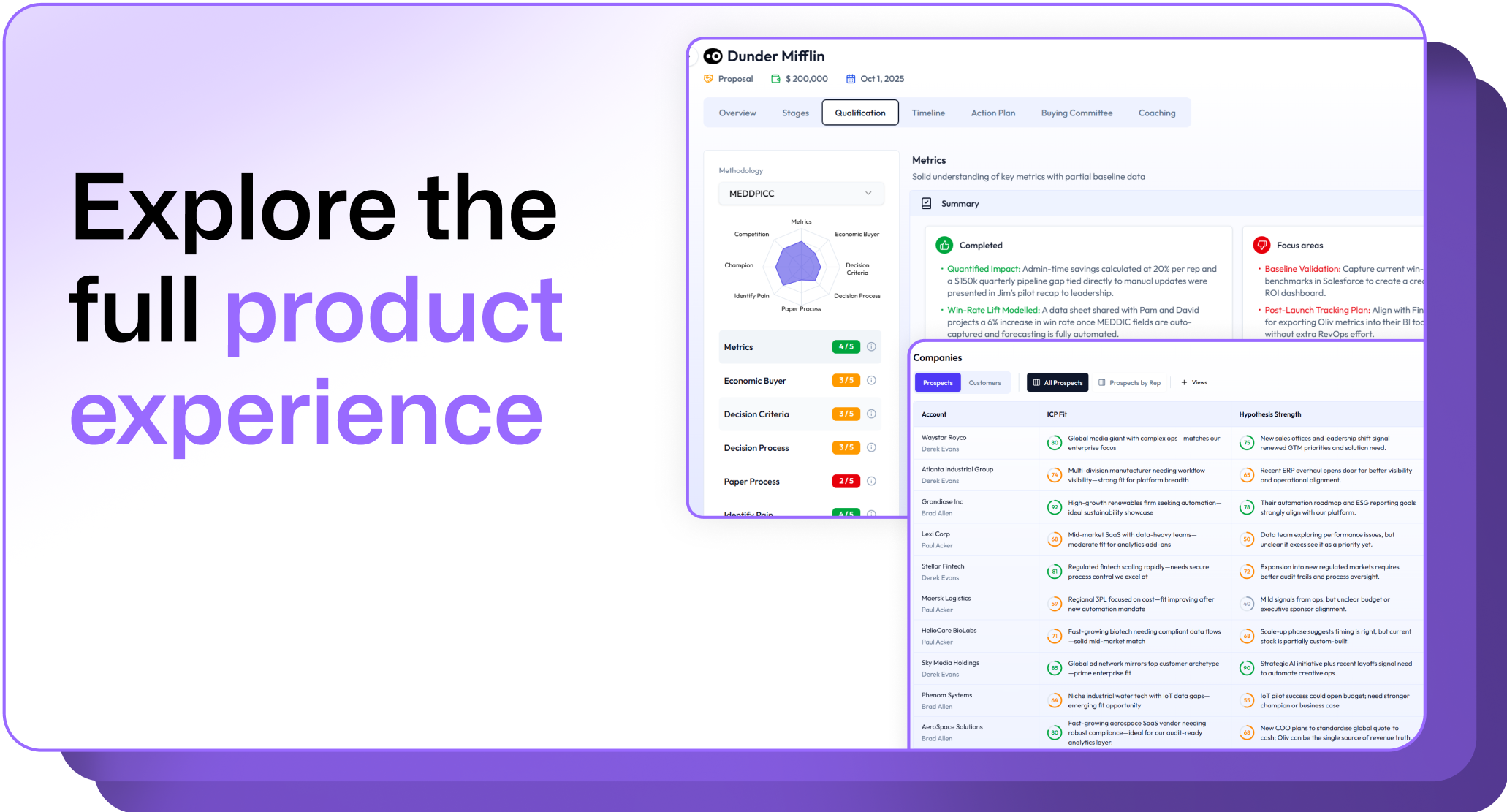
.avif)