25 Best AI Sales Tools in 2026: We Analyzed 100+ Platforms to Find What Actually Works
Written by
Ishan Chhabra
Last Updated :
July 23, 2026
Skim in :
10
mins
In this article
Still got questions?
Come discuss this article with me.
Hi, I'm Ishan, Founder and CEO of Oliv.
I'm always up for a conversation about revenue intelligence, AI agents, or what's actually working (and what's not) across revenue teams.
I'd love to hear your perspective.
Thank you! Your submission has been received!
Oops! Something went wrong while submitting the form.
Meet Oliv’s AI Agents
Hi! I’m, Deal Driver
I track deals, flag risks, send weekly pipeline updates and give sales managers full visibility into deal progress
Hi! I’m, CRM Manager
I maintain CRM hygiene by updating core, custom and qualification fields all without your team lifting a finger
Hi! I’m, Forecaster
I build accurate forecasts based on real deal movement and tell you which deals to pull in to hit your number
Hi! I’m, Coach
I believe performance fuels revenue. I spot skill gaps, score calls and build coaching plans to help every rep level up
Hi! I’m, Prospector
I dig into target accounts to surface the right contacts, tailor and time outreach so you always strike when it counts
Hi! I’m, Pipeline tracker
I call reps to get deal updates, and deliver a real-time, CRM-synced roll-up view of deal progress
Hi! I’m, Analyst
I answer complex pipeline questions, uncover deal patterns, and build reports that guide strategic decisions
TL;DR
Q1. What are the 25 Best AI Sales Tools for Different Categories in 2026? [toc=Best AI Sales Tools]
The AI sales tools landscape has evolved dramatically in 2026, yet most buyers still struggle to differentiate between truly AI-native platforms and legacy SaaS tools with basic AI features bolted on. After analyzing 100+ platforms across five critical categories (AI-powered CRMs, Conversation Intelligence, Revenue Intelligence, Lead Generation, and Outreach), we've identified the 20 tools that matter most for modern sales teams.
The fundamental distinction separating these tools is architectural: platforms built after 2022 on generative AI foundations (GPT-4, Claude) deliver autonomous agentic workflows, while pre-2020 tools rely on keyword tracking and basic machine learning requiring extensive manual configuration.
Here's what we discovered when we tested each platform against real sales workflows:
The 25 Best AI Sales Tools (Category-Based)
AI-Powered CRMs and Sales Platforms
Salesforce Sales Cloud + Einstein
HubSpot Sales Hub
Zoho CRM
Freshsales by Freshworks
Pipedrive
Conversation Intelligence and Meeting Assistants
Oliv AI
Gong
Chorus.ai (by ZoomInfo)
Fireflies AI
Fathom
Revenue Intelligence & Orchestration Tools
Oliv AI
Gong
Clari
Salesloft
Salesforce Einstein
Lead Generation and Prospecting Tools
Cognism
ZoomInfo
Apollo.io
Clay
Factors.ai
Outreach and Personalization Tools
Outreach.io
Salesloft
Lavender.ai
Lemlist
Reply.io
Comprehensive Feature & Pricing Comparison Table
AI Sales Tools Comparison: Pricing, Architecture & Best Use Cases
Platform
Category
G2 Rating
Starting Price
AI Architecture
Best For
Implementation Time
Salesforce Sales Cloud + Einstein
CRM
⭐⭐⭐⭐ 4.3/5
$200-550/user/month
Pre-Gen AI (ML-based)
Enterprise with unlimited budgets
2-3 months
HubSpot Sales Hub
CRM
⭐⭐⭐⭐ 4.4/5
$45-150/user/month
Hybrid (AI add-ons)
Mid-market inbound teams
2-4 weeks
Zoho CRM
CRM
⭐⭐⭐⭐ 4.1/5
$14-40/user/month
Basic AI (Zia assistant)
Budget-conscious SMBs
1-2 weeks
Freshsales
CRM
⭐⭐⭐⭐ 4.5/5
$9-59/user/month
Basic AI features
Small teams needing simplicity
1 week
Pipedrive
CRM
⭐⭐⭐⭐ 4.3/5
$14.90-99/user/month
Visual pipeline AI
Visual sales process teams
1 week
Oliv AI
CI + RI
⭐⭐⭐⭐⭐ 4.8/5
Contact for pricing
Gen AI-Native (GPT-4)
Teams replacing Gong+Clari
2-3 days
Gong
CI
⭐⭐⭐⭐ 4.3/5
$250-400/user/month
Pre-Gen AI (keyword tracking)
Enterprise with RevOps teams
8-12 weeks
Chorus.ai
CI
⭐⭐⭐⭐ 4.0/5
$40-80/user/month (+ ZoomInfo)
Legacy (stagnant since 2022)
Existing ZoomInfo customers only
4-6 weeks
Fireflies AI
Meeting Notes
⭐⭐⭐⭐ 4.5/5
$10-39/user/month
Basic Gen AI
Individual contributors, SMBs
Instant
Fathom
Meeting Notes
⭐⭐⭐⭐ 4.7/5
Free-$25/user/month
Basic transcription AI
Solo AEs needing simple notes
Instant
Clari
RI
⭐⭐⭐⭐ 4.0/5
$200-300/user/month
Pre-Gen AI
Forecasting-focused enterprises
6-10 weeks
Salesloft
Engagement + RI
⭐⭐⭐⭐ 4.3/5
$100-175/user/month
Legacy engagement platform
High-volume SDR teams
4-8 weeks
Cognism
Lead Gen
⭐⭐⭐⭐ 4.6/5
Custom (typically $12K-30K/year)
Data enrichment AI
EMEA-focused prospecting
2-3 weeks
ZoomInfo
Lead Gen
⭐⭐⭐⭐ 4.4/5
Custom (typically $15K-50K/year)
Data platform
Enterprise data teams
4-6 weeks
Apollo.io
Lead Gen
⭐⭐⭐⭐ 4.8/5
$49-149/user/month
Basic sequencing AI
Budget-conscious outbound teams
1 week
Clay
Lead Gen
⭐⭐⭐⭐⭐ 4.9/5
$149-800/month
Data enrichment AI
Advanced prospecting workflows
2-4 weeks
Factors.ai
Lead Gen
⭐⭐⭐⭐ 4.5/5
Custom pricing
Account intelligence AI
ABM-focused teams
2-3 weeks
Outreach.io
Engagement
⭐⭐⭐⭐ 4.3/5
$100-165/user/month
Legacy sequencing
Enterprise engagement teams
6-8 weeks
Lavender.ai
Email AI
⭐⭐⭐⭐⭐ 4.9/5
$29-79/user/month
Email optimization AI
Individual AEs
Instant
Lemlist
Cold Email
⭐⭐⭐⭐ 4.6/5
$59-129/user/month
Multichannel sequencing
Cold email specialists
1-2 weeks
Reply.io
Cold Email
⭐⭐⭐⭐ 4.6/5
$60-140/user/month
Automated outreach
Outbound SDR teams
1 week
Category 1: AI-Powered CRMs and Sales Platforms
The CRM category in 2026 faces a fundamental reckoning: platforms built pre-2020 suffer from "AI retrofitting syndrome" (bolting generative AI features onto architectures designed for manual data entry), creating more administrative burden rather than reducing it.
1. Salesforce Sales Cloud + Einstein (+ Agentforce)
What It Does: Salesforce remains the enterprise CRM standard, but its AI initiatives rely on older-generation machine learning rather than generative AI-native architecture. Einstein Conversation Insights (ECI) functions as Salesforce's answer to Gong, while Agentforce represents their 2024 push into agentic AI.
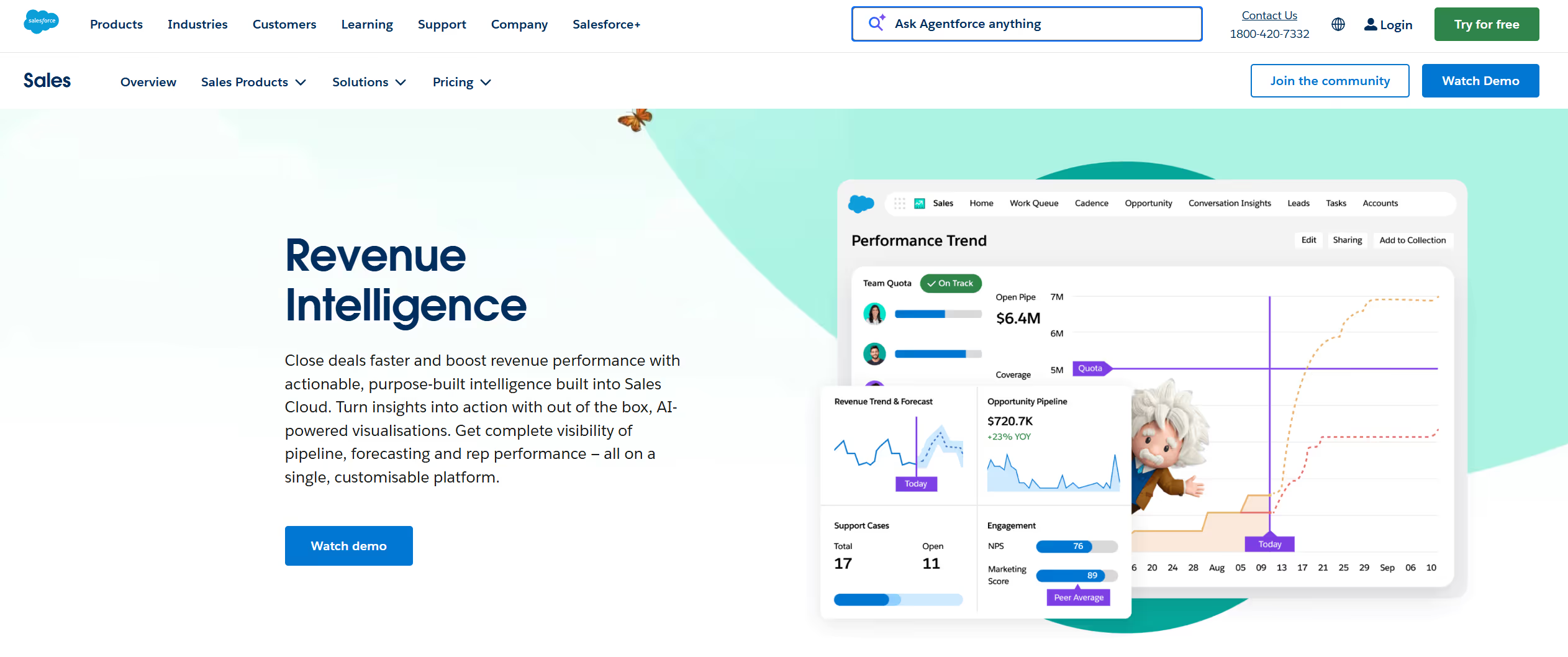
Comprehensive Salesforce dashboard showcasing revenue intelligence features including performance trend graphs, team quota tracking at $6.4M, opportunity pipeline analysis, and engagement scoring metrics for modern sales teams.
Key Features:
Einstein Lead Scoring: Predictive analytics for lead prioritization
Einstein Activity Capture: Automatic email and calendar event logging
Einstein Conversation Insights: Call transcription and keyword tracking
Agentforce Sales Agents: Prompt-based AI agents for specific workflows
Sales Cloud Unlimited Edition: Advanced automation and customization
Opportunity Scoring: ML-based close probability predictions
Einstein AI Features: +$50/user/month (conversation insights, predictions)
Agentforce: $550/user/month standalone OR +$125-300/user via add-ons
Data Cloud (mandatory for GenAI features): $150-400/user/month equivalent
Hidden Costs: Implementation services ($165K-355K), platform fees, API overages
Real Total Cost: $500-650/user/month for complete AI functionality
✅ Pros:
✅ Industry standard with deepest enterprise integrations (SAP, Oracle, Microsoft)
✅ Comprehensive ecosystem covering sales, service, marketing in unified platform
✅ Extensive customization via Apex code and Lightning components
✅ Strong compliance (SOC 2, GDPR, HIPAA-ready for healthcare)
✅ Mature app marketplace with 5,000+ AppExchange solutions
❌ Cons:
❌ "Dirty data" deployment blocker: 67% of Agentforce implementations fail because underlying CRM data quality is insufficient, causing $500K-2M in sunk AI investment costs
The Spring '26 release (rolling January 16–February 20) rebranded Sales Cloud as Agentforce Sales, added an AI Sales Workspace, shipped Inbound Lead Gen, Qualification, Nurturing and Sales Management agents, and moved Einstein Conversation Insights onto native Salesforce storage. Spring '26 announcement
What was shipped in Q2 2026
The Summer '26 release (June 15, API v67) made Agentforce Voice generally available on iOS/Android, launched Multi-Agent Orchestration, a Customer Engagement Agent, Momentum conversation capture, and the Agentforce Vibes 2.0 IDE running Claude and GPT-5. Summer '26 announcement
Rolling out after mid-2026
Salesforce has scheduled Summer '26 migration of existing Einstein Conversation Insights customers to native storage, with further Agentforce 360 capabilities (Agent Script, Intelligent Context, Headless 360) expanding through subsequent seasonal releases. Salesforce admin release notes
Real User Feedback:
"The price of Agentforce is not clear and hard to find. Adoption is low because of the lack of knowledge on the subject as AI is a new field. Customers are finding issues in deploying and using agents in Salesforce." — Anusha T., Web Developer Agentforce G2 Verified Review
"It can be complex to set up and often requires skilled administrators or developers to customize and integrate properly, which adds time and cost. Licensing fees can be high, especially as the number of agents grows. The user interface, though improved with Lightning, may still feel clunky or unintuitive to some agents, leading to slower adoption." — Verified User in Marketing Agentforce G2 Review
"You need to activate Einstein and other stuff if you want to use Agentforce. But why don't you enable dependency if I directly wanna start Agentforce in a single click? Settings can be annoying at times... tons of such behaviour will be tracked via number of clicks taken to complete such operation." — shivam a., product researche Agentforce G2 Review
Use Case:
Salesforce Einstein + Agentforce makes sense exclusively for enterprises (1,000+ employees) with unlimited budgets tolerating $500-650/user/month AI costs, existing 5+ year Salesforce Enterprise contracts creating switching cost barriers, dedicated RevOps teams (5+ engineers) capable of managing complex implementations, and clean CRM data (80%+ field completion rates) enabling AI deployment success.
For 80%+ of sales organizations, the combination of prohibitive costs, implementation complexity, and dirty data deployment failures makes generative AI-native alternatives more practical.
What It Does: HubSpot combines CRM functionality with inbound marketing tools, creating seamless customer journeys from marketing-qualified leads through sales closure. The platform excels at mid-market companies (50-500 employees) needing unified marketing and sales operations.
Key Features:
Contact and Deal Management: Customizable pipelines with drag-and-drop interface
Email Tracking & Sequences: Template library with open/click tracking
AI Prospecting Agent (2026): Automated lead research and personalized outreach within HubSpot ecosystem
Native Marketing Hub Integration: Seamless handoff from marketing to sales
Pricing:
Starter: $45/month (2 users) - Basic CRM and email tools
Professional: $800/month (5 users) - Automation and reporting ($160/user effective)
Enterprise: $3,600/month (10 users) - AI features and advanced customization ($360/user)
Sales Hub AI Add-Ons: Vary by tier, full AI capabilities require Professional+ tiers
Note: Per-seat pricing decreases with volume but AI Prospecting Agent requires Enterprise tier
✅ Pros:
✅ Unified inbound ecosystem connecting marketing, sales, service in single database
✅ Intuitive user experience requiring minimal training for new users compared to Salesforce
✅ Free CRM tier allowing teams to test functionality before committing to paid plans
✅ Strong mid-market fit with features scaled appropriately for 50-500 person teams
✅ Native integrations with 1,000+ apps via HubSpot marketplace
❌ Cons:
❌ AI features bolted-on: Like Salesforce, HubSpot's architecture predates generative AI, meaning AI capabilities feel like add-ons rather than core platform intelligence
❌ Pricing tier locks: AI Prospecting Agent and advanced features require Enterprise tier ($3,600/month minimum), creating significant cost jumps for growing teams
❌ Limited advanced customization: Compared to Salesforce, HubSpot offers fewer options for complex workflow automation or custom objects
❌ Marketing Hub dependency: Many valuable features require purchasing Marketing Hub separately, increasing total cost
❌ Reporting limitations: Advanced analytics and custom reporting less flexible than enterprise platforms
HubSpot Sales Hub product update timeline (2026)
Time period
What was happening
What was shipped in Q1 2026
Early 2026 brought GPT-5 into Breeze Studio, Audit Cards for CRM data hygiene, and role-aware Breeze Assistant responses trained on the Loop Marketing framework, extending the Breeze agent layer HubSpot introduced across its Sales Hub. HubSpot Breeze agents overview
What was shipped in Q2 2026
The Spring 2026 Spotlight (April 14–15, 100+ updates) launched HubSpot AEO answer-engine optimization, Smart Deal Progression suggesting CRM updates from Breeze Notetaker transcripts, a rebuilt Breeze Prospecting Agent with outcome-based pricing, and Breeze Customer Agent email support. Spring 2026 Spotlight
Rolling out after mid-2026
HubSpot flagged its Commerce Hub rename to Revenue Hub for July 2026 and continued phasing in Buying Groups and expanded Breeze Customer Agent channels, with AEO remaining in public beta as standalone or bundled tiers. HubSpot Spotlight hub
Real User Feedback:
"HubSpot AI Prospecting Agent empowers modern revenue teams by automating lead research, scoring, and personalized outreach directly within the HubSpot CRM. Its AI-driven workflows prioritize high-intent accounts, generate tailored messaging, and deliver actionable insights." — HubSpot Industry Analysis
"Seamless integration with HubSpot ecosystem. Automates repetitive sales tasks and outreach. Highly personalized, AI-driven messaging. However, advanced features require expensive subscriptions and initial setup and configuration can be complex." —HubSpot Tool Comparison Analysis
Use Case:
HubSpot Sales Hub is ideal for mid-market companies (50-500 employees) prioritizing inbound lead management, marketing-sales alignment needs requiring unified database across functions, teams migrating from spreadsheets seeking intuitive first CRM experience, and content-driven sales motions where marketing qualified leads drive pipeline.
When to avoid: Enterprise organizations needing deep customization, teams requiring complex territory management, or buyers seeking standalone sales tools without marketing integration.
What It Does: Zoho CRM operates as part of the comprehensive Zoho business suite (40+ applications), offering integrated CRM functionality with AI assistance through Zia, their virtual sales assistant. The platform provides extensive customization and automation capabilities at price points 70-80% below Salesforce.
Key Features:
Zia AI Assistant: Voice commands, predictive sales analytics, anomaly detection
Comprehensive Lead Management: Lead scoring, capture, and routing automation
Sales Process Automation: Workflow builder with conditional logic
Multichannel Communication: Email, phone, social media, live chat integration
Blueprint Feature: Sales process standardization ensuring methodology adherence
Canvas Design Studio: Custom UI builder for tailored user experiences
Advanced Analytics: Custom reporting with drag-and-drop dashboard builder
Pricing:
Standard: $14/user/month - Basic CRM features, limited Zia AI
Enterprise: $40/user/month - Advanced customization, AI predictions, multi-user portals
Ultimate: $52/user/month - Full Zia AI capabilities, advanced BI, developer tools
Additional Zoho Suite Apps: Available separately (Zoho Campaigns, Zoho Desk, etc.)
✅ Pros:
✅ Exceptional value pricing at 60-85% less than Salesforce/HubSpot for comparable features
✅ Comprehensive business suite with 40+ integrated apps (email, accounting, projects, HR)
✅ Strong customization including custom modules, fields, and page layouts
✅ Zia AI assistant provides predictive lead scoring and sales forecasting included in higher tiers
✅ Global deployment with data centers in US, EU, India, China, Australia
❌ Cons:
❌ Zia AI limitations: Full AI potential requires Ultimate tier ($52/user/month), and capabilities remain basic compared to generative AI-native platforms
❌ UI feels dated: Interface less intuitive than HubSpot or modern CRMs, with steeper learning curve
❌ Integration complexity: While Zoho suite integrates well internally, third-party integrations (Slack, LinkedIn) require significant configuration
❌ Support inconsistency: User reviews cite variable support quality, with faster response for higher-tier customers
❌ Manual data entry burden: Despite AI features, platform still requires significant rep input for CRM hygiene
Zoho CRM product update timeline (2026)
Time period
What was happening
What was shipped in Q1 2026
Zoho's Q1 2026 update added Workqueue for centralized rep task views, a redesigned Zia Smart Prompts interface with any-LLM selection, a Zia Formula Expression Generator, CPQ pattern insights with Zia-suggested pricing rules, and zero-shot intelligent character recognition via vision models. Zoho CRM Q1 2026 update
What was shipped in Q2 2026
Through Q2 Zoho expanded Zia Agent Studio, its no-code builder exposing 700+ actions and 25+ prebuilt agents, backed by proprietary Zia LLMs (1.3B/2.6B/7B on NVIDIA) and an MCP server surfacing 15+ Zoho apps to external agents. Zia Agent Studio overview
Rolling out after mid-2026
Zoho continues broadening its Agent Marketplace and positioning Zia agents at the Enterprise ($40/user) and Ultimate ($52/user) tiers, with additional prebuilt agents and deeper CPQ automation flagged for later 2026 rollout. Zoho CRM release blog
Real User Feedback:
"Zoho CRM has received praise for its affordability and wide range of customization options. It has a rating of 4.1 out of 5 based on 2,570 reviews on G2. The AI assistant Zia offers voice commands and predictive sales analytics, setting Zoho CRM apart as a forward-thinking solution." — Zoho Platform Review
"Zia leverages machine learning algorithms to analyze past sales data and predict future outcomes. This feature is invaluable for small business owners seeking to optimize their sales strategies and forecast sales trends accurately. However, the full potential of Zia is only unlocked in the higher-tier plans, which can increase costs considerably." — Zoho TechRadar Analysis
Use Case:
Zoho CRM works best for budget-conscious SMBs (<100 employees) needing full CRM at 1/5th Salesforce cost, Zoho ecosystem adopters already using Zoho Books, Campaigns, or other suite products, international teams requiring specific data residency (EU GDPR compliance, India, China), and high-customization needs where internal admin can build tailored workflows.
When to avoid: Teams requiring cutting-edge AI (Zia is basic ML, not generative AI), organizations prioritizing best-in-class UI/UX, or companies needing extensive pre-built third-party integrations.
What It Does: Freshsales provides CRM functionality optimized for small teams (5-50 users) needing quick deployment without complex configuration. Part of the Freshworks customer engagement suite, it emphasizes simplicity and visual pipeline management over enterprise-grade customization.
Key Features:
Visual Sales Pipeline: Kanban-style deal boards with drag-and-drop
AI-Powered Lead Scoring: Freddy AI scores leads based on engagement and fit
Built-in Phone and Email: Click-to-call and email tracking without third-party tools
Auto-Profile Enrichment: Automatically pulls company data from public sources
Activity Timeline: Unified view of all customer interactions
Mobile App: Full-featured iOS/Android apps for field sales
Team Inbox: Shared email inbox for team collaboration
❌ Basic AI capabilities: Freddy AI provides scoring but not generative content creation or autonomous workflows
❌ Customization constraints: Fewer custom fields, objects, and workflow options than Salesforce/Zoho
❌ Integration limitations: Smaller app marketplace compared to HubSpot/Salesforce
❌ Scalability concerns: Teams outgrowing 50 users often migrate to more robust platforms
Freshsales product update timeline (2026)
Time period
What was happening
What was shipped in Q1 2026
Into early 2026 Freshsales ran Freddy AI across the CRM: predictive lead and deal scoring, deal-health insights, next-best-action suggestions, AI email drafting, duplicate resolution, built-in cloud telephony and sales sequences, with SMS available on Pro and above. Freshworks Freddy AI for CRM
What was shipped in Q2 2026
Freshworks' May 2026 Refresh conference headlined Freddy AI Agent Studio, an MCP Gateway and AI Insights/XLAs, but those launches target the Freshservice ITSM side; Freshsales itself continued iterating on the existing Freddy CRM feature set rather than shipping new agent tooling. Freshworks May 2026 launch
Rolling out after mid-2026
Buyers should watch whether the Agent Studio and MCP Gateway announced for ITSM extend into Freshsales CRM later in 2026; current Freddy CRM capabilities remain gated to the Pro ($39) and Enterprise ($59) tiers. Freshsales 2026 review
Case:
Freshsales is ideal for small sales teams (5-25 people) needing operational CRM quickly, startups wanting CRM without 6-month implementation projects, inside sales teams prioritizing phone and email over field sales complexity, and Freshworks customers already using Freshdesk who want unified customer data.
When to avoid: Mid-market/enterprise teams (100+ users), organizations requiring deep customization, or companies needing advanced AI beyond basic lead scoring.
5. Pipedrive
⭐ G2 Rating: 4.3/5 (1,700+ reviews)
What It Does: Pipedrive focuses exclusively on visual pipeline management, designed for teams who think in stages and stages-based forecasting. The platform strips away complexity, offering opinionated workflows that guide reps through consistent sales processes.
Key Features:
Visual Pipeline Interface: Industry-leading Kanban boards with customizable stages
✅ Best-in-class visual pipeline: Most intuitive deal board interface for stage-based selling
✅ Activity tracking focus: Ensures reps complete critical tasks vs. getting lost in admin
✅ Quick adoption: New users productive within hours due to simplicity
✅ Mobile excellence: Full-featured app for field sales teams
✅ Affordable scaling: Professional tier ($49.90) provides AI and forecasting
❌ Cons:
❌ Limited marketing features: No lead capture forms, landing pages, or marketing automation
❌ Basic reporting: Analytics less sophisticated than Salesforce or HubSpot
❌ Simple AI: Assistant provides suggestions but lacks generative content creation or autonomous agents
❌ Contact management: Less robust for complex account hierarchies or relationship mapping
❌ No native phone: Requires integration with third-party dialers
Pipedrive product update timeline (2026)
Time period
What was happening
What was shipped in Q1 2026
In February 2026 Pipedrive restructured five plans into four (Lite $14 to Ultimate $79) and expanded its AI Sales Assistant beta with win-probability and stalled-deal flags, natural-language AI report creation, and an AI email writer plus AI-powered notifications on Premium tiers. Pipedrive product updates
What was shipped in Q2 2026
Through Q2 Pipedrive extended its beta Agentic AI experience, with voice and text agents that auto-draft emails and auto-generate call summaries, alongside the Pulse prospecting toolkit, Insights AI, and a public MCP Server connecting ChatGPT and Claude. Pipedrive AI documentation
Rolling out after mid-2026
Pipedrive's agentic features remain in beta and function largely as a suggestion engine rather than autonomous execution, with no native dialer; broader general availability and deeper agent autonomy are the areas to watch for later 2026. Pipedrive roadmap updates
Use Case:
Pipedrive excels for visual thinkers who manage deals via stage progression, field sales teams needing excellent mobile CRM experience, transactional sales with clear, repeatable deal stages (software trials, real estate, recruiting), and teams migrating from spreadsheets seeking CRM without overwhelming complexity.
When to avoid: Marketing-heavy organizations, teams needing advanced AI, or companies requiring deep CRM customization and enterprise features.
Category 2: Conversation Intelligence and Meeting Assistants
Conversation Intelligence represents the battlefield where generative AI-native platforms most dramatically outperform legacy tools. Platforms built 2015-2020 (Gong, Chorus) rely on keyword tracking and basic machine learning, while post-2022 platforms leverage GPT-4 for true semantic understanding.
6. Oliv AI [⭐ Recommended Solution]
⭐ G2 Rating: 4.8/5 (200+ verified reviews)
What It Does: Oliv AI is a generative AI-native revenue intelligence platform combining conversation intelligence, sales forecasting, and engagement automation in a single unified solution. Unlike legacy tools requiring manual configuration, Oliv's autonomous agents perform work for users rather than surfacing insights requiring human action.
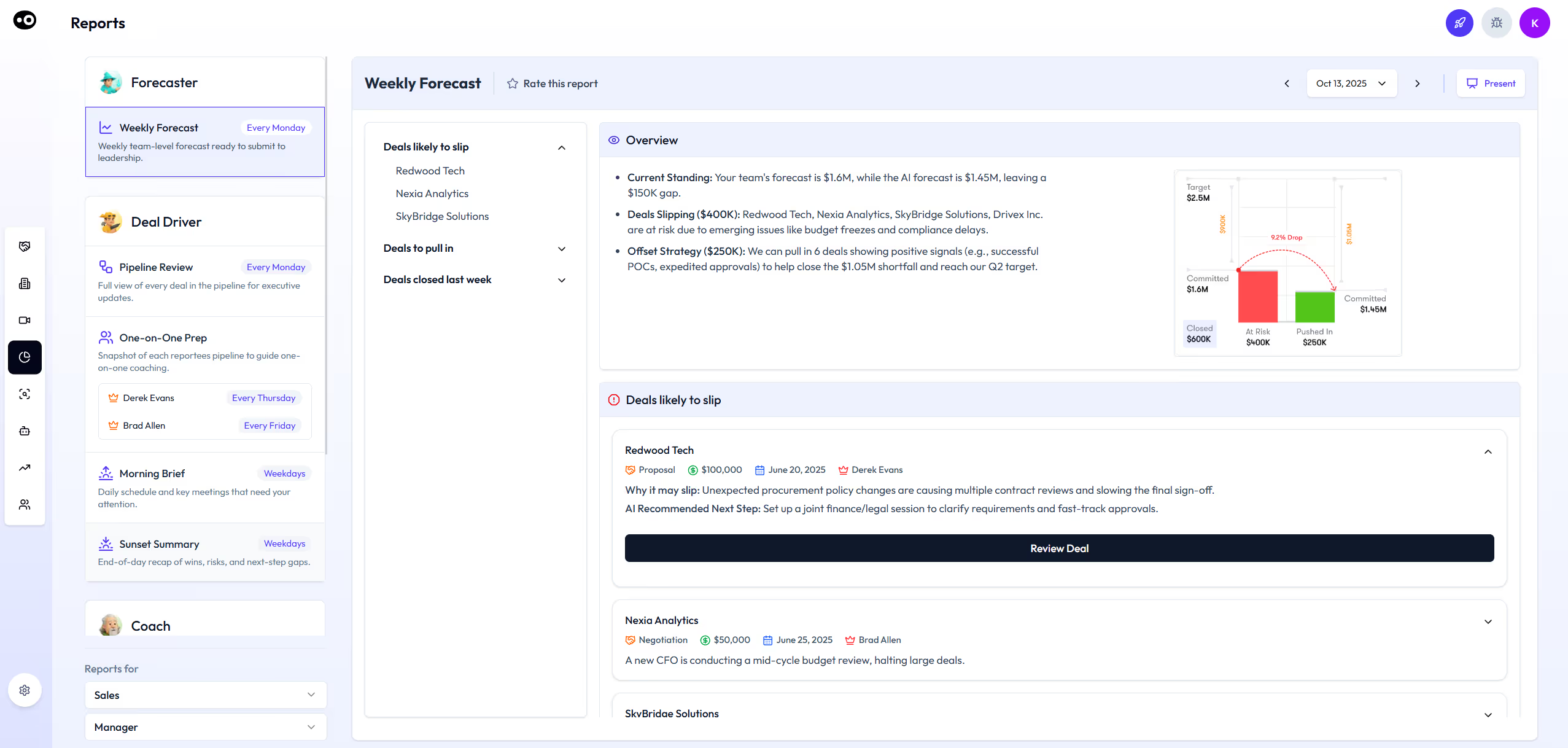
Oliv AI's Revenue intelligence forecasting interface displaying team forecast versus AI forecast comparison, identifying at-risk deals worth $400K, offset strategy opportunities, and automated deal slip alerts for Redwood Tech and Nexia Analytics.
Key Features:
Meeting Assistant Agent (GPT-4 Powered):
Automatically joins scheduled calls across Zoom, Teams, Google Meet
5-minute post-call processing (vs. 20-30 minutes for Gong)
Deal risk identification across 200+ opportunities proactively
CRM Manager Agent:
Automatic Salesforce/HubSpot field updates from conversation context
Activity capture eliminating manual rep data entry
Custom object population for MEDDIC, champion tracking, next steps
Maintains CRM as single source of truth with full open API export
Prospector Agent:
Deep account research automation (LinkedIn, news, funding, leadership changes)
Sales hypothesis generation based on account signals
Personalized messaging creation for review-and-send workflows
Moves beyond bulk sequencing to tailored account-based outreach
Deal Driver Agent:
Continuous deal monitoring detecting engagement gaps or momentum loss
Proactive next-step suggestions and task scheduling
Stakeholder engagement tracking across buying committee
Pricing:
Transparent modular pricing with zero hidden costs, no platform fees (vs. Gong's $50K for 200 users), free implementation and data migration, and free training and ongoing support.
TCO Comparison (75-user team):
Gong + Clari Stack: $41,250/month ($495K annually)
Oliv Growth Plan: $3,675/month ($44K annually)
Savings: $451,000 first year
✅ Pros:
✅ Generative AI-native architecture: GPT-4 foundation provides true contextual understanding vs. keyword matching
✅ Agentic workflows: AI agents complete multi-step tasks autonomously without human prompting for each micro-action
✅ Deal-level intelligence: Primary USP tracking pipeline movement across meetings vs. Gong's isolated meeting insights
❌ Newer market presence: Founded 2023 vs. Gong's 2015 launch means smaller customer base and brand recognition
❌ Integration ecosystem: Fewer pre-built connectors than 10-year-old platforms (though core integrations with Salesforce, HubSpot, Gmail, Outlook, Zoom, Teams covered)
❌ Enterprise customization: While flexible, lacks decade of enterprise-specific configurations built by large Gong implementations
Oliv AI conversation-intelligence timeline (2026)
Time period
What was happening
What was shipped in Q1 2026
Early 2026 Oliv strengthened its meeting layer: a notetaker with transcript-reasoning that maps multi-opportunity calls to the correct deal, automatic MEDDPICC/BANT scoring from call content, and CRM auto-save, all under SOC 2 Type II, GDPR, ISO 27001 and HIPAA compliance. Oliv platform guide
What was shipped in Q2 2026
Through Q2 Oliv shipped native iOS and macOS apps with on-device microphone capture, transcription and note generation for in-person conversations, plus an evolving cross-channel summary that stitches calls, emails, Slack and support tickets into one deal narrative. Oliv AI App Store listing
Rollouts still expanding
As a newer entrant Oliv iterates on its Coaching and Analyst modules and per-seat notetaker packaging ($19/user) rather than shipping dated release notes; independent conversation-intelligence review coverage stays thin, so buyers should verify current capture accuracy directly. Oliv RevOps overview
Real User Feedback (Comparative):
On Gong Limitations:
"While Gong offers valuable insights into call data and sales interactions, our experience has been impacted by significant data access limitations, especially concerning data portability and bulk export capabilities. This lack of flexibility has required us to engage our development team at additional cost, adding significant operational and opportunity costs just to extract data we already own." — Neel P., Sales Operations ManagerGongG2 Review
"The additional products like forecast or engage come at an additional cost. Would be great to see these tools rolled into the core offering." — Scott T., Director of Sales Gong G2 Review
"It's not great for small/startup teams - way too expensive when there are more affordable tools that work. Having talked with other friends who lead revenue functions, all have said the same thing – they've been fine using a lower cost, simpler alternative." — Iris P., Head of Marketing, Sales & Partnerships Gong G2 Review
Implementation simplicity: "2-3 day deployment vs. 8+ weeks for legacy platforms requiring zero training for new AE hires" (startup customer feedback)
Agentic automation: "Forecaster Agent eliminated 8+ hours weekly of manual pipeline analysis for Monday forecast calls" (Sales Manager testimonial)
Use Case:
Oliv AI is the optimal solution for teams currently stacking Gong + Clari seeking 50-70% cost reduction with unified platform, mid-market organizations (50-500 employees) requiring enterprise CI/RI functionality without enterprise price tags, startups (<50 employees) needing professional-grade forecasting without $250/user Gong costs, sales leaders frustrated by manual work in legacy tools (building trackers, running reports, manual deal reviews), organizations with dirty CRM data where Salesforce Agentforce deployments failed (Oliv's agents clean data automatically), and RevOps teams tired of wonky APIs requiring custom code to extract Gong data for analysis.
When to avoid: Extremely rare scenarios where organizations have unlimited budgets, 12-month Gong implementation contracts already signed creating sunk costs, and dedicated 5+ person RevOps teams comfortable maintaining complex integrations. These represent <5% of sales organizations.
Strategic Positioning:
Oliv exemplifies the AI-native revenue orchestration category defining 2026-2030 sales technology. Where legacy platforms (Gong, Clari, Salesloft) provide insights requiring human action, Oliv's agents autonomously complete workflows—the fundamental shift from "software you adopt" to "agents that work for you."
What It Does:Gong pioneered the conversation intelligence category in 2015-2018, establishing the market for recording, transcribing, and analyzing sales calls. The platform provides keyword-based tracking (Smart Trackers), deal boards aggregating conversation insights, and basic forecasting capabilities.
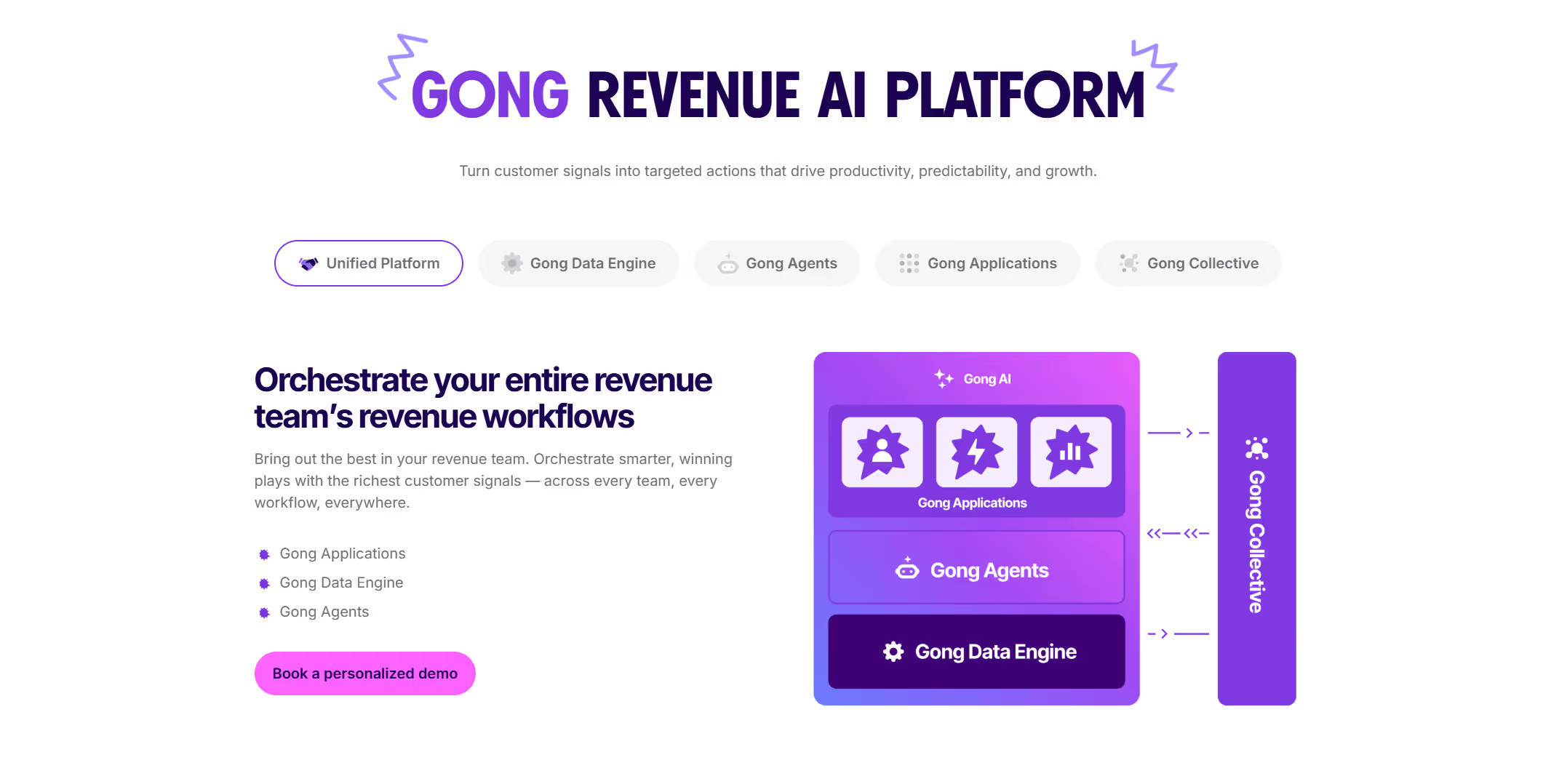
Gong's unified revenue platform architecture showcasing orchestration capabilities including Gong Applications, AI Agents, Data Engine integration, and Gong Collective for comprehensive revenue team workflows.
Key Features:
Smart Trackers: Keyword and phrase detection across recorded calls
❌ Not generative AI-native: Smart Trackers rely on keyword matching and 2018-era ML, failing to differentiate "prospect mentioned competitor" vs. "actively evaluating competitor"—vastly different sales scenarios requiring opposite responses
❌ Bundling inflation: Gong now forces package purchases ($250-400/user) rather than allowing à la carte selection, causing teams to pay for unused Engage/Forecast modules
❌ Hidden platform fees: $30K-50K annual charges not disclosed in advertised per-user pricing, creating budget shock
❌ 20-30 minute processing delay: Post-call recordings take 20-30 minutes vs. 5 minutes for AI-native platforms, slowing follow-up workflows
❌ Wonky API: RevOps teams report requiring "a lot of custom code" to extract data for analysis, making manual reporting cumbersome
❌ Meeting-level focus: Provides insights per individual call but lacks deal-level intelligence tracking multi-meeting trends and stakeholder engagement patterns
❌ CS value gap: Charges $250-400/user for Customer Success teams despite offering minimal value beyond basic call recording
❌ Sharing friction: Recording links require prospects to sign up or provide email, creating sales objections and compliance concerns
❌ Expensive implementation: Enterprise rollouts require $15K-30K professional services and 8-12 weeks
Gong conversation-intelligence timeline (2026)
Time period
What was happening
What was shipped in Q1 2026
On February 25, 2026 Gong launched Mission Andromeda, adding Gong Enable with an AI Call Reviewer and AI Trainer, the Gong Assistant chatbot, an AI Data Extractor writing CRM fields from calls, and roughly 70% faster call processing. Gong newsroom
What was shipped in Q2 2026
June 2026 monthly updates let reps build reusable personal AI agents from Assistant prompts, opened workspace-wide Assistant access with file uploads and document creation, added brief automations triggered via the Gong API, and introduced new AI Tracker and Automations permissions. Gong monthly updates
Rolling out after mid-2026
Gong continues broadening MCP interoperability with Copilot, Agentforce and Breeze so external agents can query call intelligence, expanding its Assistant automation library through subsequent monthly releases across 2026. Mission Andromeda coverage
Real User Feedback:
"Gong's support team has stated they comply with CCPA, but their current solution requires downloading calls individually, which is impractical and inefficient for a large volume of data. This lack of flexibility has required us to engage our development team at additional cost, adding significant operational and opportunity costs just to extract data we already own." — Neel P., Sales Operations Manager Gong G2 Review
"The additional products like forecast or engage come at an additional cost. Would be great to see these tools rolled into the core offering." — Scott T., Director of Sales Gong G2 Review
"It can be overwhelming to set up trackers. AI training is a bit laborious to get it to do what you want." — Trafford J., Senior Director, Revenue Enablement Gong G2 Review
"No way to collaborate / share a library of top calls, AI is not great (yet) – the product still feels like its at its infancy and needs to be developed further." — Annabelle H., Voluntary Director - Board of Directors Gong G2 Review
"It was a big mistake on our part to commit to a two year term. Gong is a really powerful tool but it's probably the highest end option on the market, and now we're stuck with a tool that works technically but isn't the right business decision." — Iris P., Head of Marketing, Sales & Partnerships Gong G2 Review
"It takes an eternity to upload a call to listen to it." — Remington Adams, Team Lead, Sales Development Representative Gong TrustRadius Review
Use Case:
Gong remains viable exclusively for large enterprises (2,000+ employees) with unlimited budgets tolerating $300-500K annual costs, existing long-term contracts (12+ months remaining) where switching costs exceed continuing with suboptimal platform, dedicated RevOps teams (5+ engineers) comfortable writing custom code for API data extraction and maintaining complex integrations, and organizations prioritizing brand recognition over functional performance or cost efficiency.
For 80-90% of sales teams (especially mid-market 50-500 employees, startups <50, and cost-conscious enterprises), generative AI-native alternatives deliver equivalent core functionality with superior AI, faster processing, transparent pricing, and 50-70% cost savings.
Market Reality Check: G2 data reveals 40% of Gong customers also purchase Clari because Gong's forecasting module is insufficient, proving the platform forces expensive multi-vendor stacks rather than delivering comprehensive unified solutions.
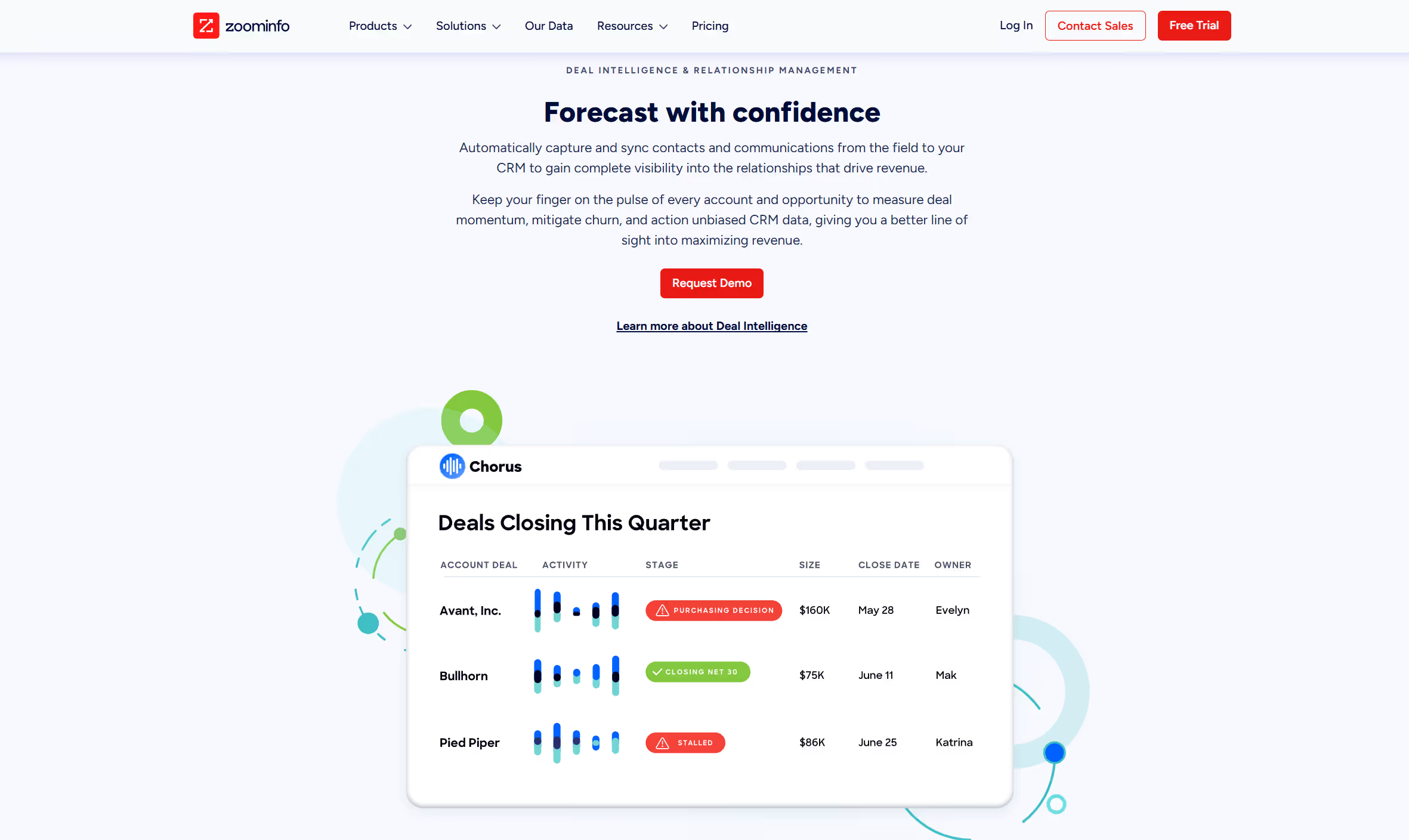
What It Does: Chorus.ai was a competitive conversation intelligence platform until ZoomInfo acquired it in 2022. Since acquisition, product innovation has stagnated significantly (industry analysis consistently describes it as "having not innovated at all" post-acquisition). It now functions primarily as an add-on to ZoomInfo's sales intelligence platform rather than a standalone product.
ZoomInfo's Chorus platform showing quarterly deal management dashboard with account deal stages, activity tracking, purchasing decision indicators, and owner assignments for revenue forecasting accuracy.
Key Features:
Call Recording & Transcription: Basic meeting capture across Zoom, Teams, Google Meet
Keyword Tracking: Similar Smart Tracker functionality to Gong
Deal Intelligence: Limited deal board aggregating conversation data
ZoomInfo Data Integration: Contact enrichment from ZoomInfo's database
Basic Analytics: Talk-listen ratios and conversation metrics
Salesforce Sync: Activity logging and note capture to CRM
Pricing:
Standalone Pricing: Not typically available; requires ZoomInfo subscription first
Add-On Cost: $40-80/user/month on top of ZoomInfo platform ($100-150/user/month)
Effective Total Cost: $140-230/user/month for ZoomInfo + Chorus bundle
Volume Discounts: High-volume customers (100+ seats) may negotiate $20-30/user for Chorus add-on
✅ Pros:
✅ ZoomInfo integration: Seamless data flow between conversation intelligence and contact database
✅ Lower cost than Gong: As add-on, Chorus costs $40-80/user vs. $250-400 for standalone Gong bundles
✅ Unified platform: Single contract/vendor for prospecting data + conversation intelligence
❌ Cons:
❌ Product stagnation: "Has not innovated at all" since 2022 ZoomInfo acquisition (considered "a very poor product now" by industry analysts)
❌ Pre-generative AI architecture: Built 2018-2020 on keyword tracking technology, lacks semantic understanding
❌ Limited feature set: Offers subset of Gong capabilities without innovation to differentiate
❌ Integration focus vs. CI excellence: ZoomInfo prioritized data integration over improving core conversation intelligence functionality
❌ Sunset risk: Acquisition patterns suggest potential deprecation in favor of ZoomInfo-native features
Chorus.ai product update timeline (2026)
Time period
What was happening
What was shipped in Q1 2026
Early-2026 release notes added Chorus AI Chat inside every recording, letting reps ask natural-language questions and jump via clickable timestamps, plus AI Search that translates search intent into structured filters across the call library. ZoomInfo release notes
What was shipped in Q2 2026
Through Q2 Chorus added a mobile-app calendar Record button that auto-pulls meeting context, and new engagement filters such as Rep Has Spoken and Hide Internal Meetings, routing mobile-captured calls through the full analysis pipeline. Chorus on TrustRadius
Ongoing ZoomInfo integration
ZoomInfo keeps folding Chorus deeper into its GTM.AI context layer released mid-2026, so recorded conversations feed the broader signal graph, though a standalone Chorus roadmap is not separately published. ZoomInfo product documentation
Use Case:
Chorus.ai makes sense exclusively for existing ZoomInfo customers already paying $100-150/user/month who need basic conversation intelligence, teams prioritizing data + CI bundle from single vendor over best-in-class CI functionality, and organizations with sunk ZoomInfo contracts seeking lowest-cost conversation intelligence add-on.
When to avoid: Any team not already committed to ZoomInfo (don't buy ZoomInfo just to access Chorus), organizations requiring modern generative AI conversation intelligence, or buyers seeking actively-developed products with innovation roadmaps.
Strategic Reality: Chorus exemplifies the acquisition graveyard pattern where promising startups stagnate under enterprise acquirers. Teams shopping conversation intelligence in 2026 should evaluate actively-developed platforms (Oliv AI, even Gong) rather than products frozen at 2022 feature sets.
What It Does: Fireflies.ai provides entry-level AI meeting assistant functionality focused on transcription, basic summarization, and note-taking. Positioned as affordable alternative for SMBs and individual contributors, it emphasizes simple meeting capture over enterprise revenue intelligence capabilities.
Key Features:
Automatic Meeting Recording: Joins Zoom, Teams, Google Meet, Webex
AI Transcription: Speech-to-text with speaker identification
Meeting Summaries: GPT-based action item and key point extraction
Search Functionality: Keyword search across recorded meetings
CRM Integration: Basic activity logging to Salesforce, HubSpot
Video Clips: Create shareable meeting snippets
Team Collaboration: Comments and note-sharing on recordings
Pricing:
Free: $0 - 800 minutes storage, basic transcription, limited features
✅ Free tier: Allows testing functionality before committing to paid plans
❌ Cons:
❌ Reliability issues: User reviews consistently cite "unreliable recorders not joining calls" and "poor transcription quality" for accents/technical terminology
❌ Not scalable revenue intelligence: Built for basic summarization, lacks deal-level intelligence, forecasting, coaching workflows enterprise teams require
❌ Limited CRM automation: Syncs activity logs but doesn't populate custom fields, MEDDIC scorecards, or deal intelligence
❌ SMB focus: Features/support insufficient for mid-market (50-500 employees) or enterprise sales operations
❌ Basic analytics: Lacks conversation analytics, tracker configuration, pipeline insights found in professional platforms
Fireflies.ai product update timeline (2026)
Time period
What was happening
What was shipped in Q1 2026
Entering 2026 Fireflies auto-joined Zoom, Meet and Teams to record, transcribe and summarize, extracted action items, answered AskFred queries, and offered customizable AI Apps with selectable GPT model tiers, alongside Salesforce, HubSpot, Slack and Notion connectors. Fireflies 2026 review
What was shipped in Q2 2026
By mid-2026 Fireflies crossed a $1B valuation and restructured plans into $0/$10/$19/$39 per-user tiers on annual billing, keeping unlimited transcription across paid plans with storage caps and metering AskFred and analytics through purchasable AI-credit packs. Fireflies 2026 pricing guide
Where it still lags
Independent 2026 reviews note Fireflies stays transcription-and-automation-first with surface-level conversation analytics versus dedicated coaching platforms, so deeper deal intelligence and CRM-field write-back remain the gaps buyers should test before committing. Fireflies capability review
Use Case:
Fireflies AI is appropriate for individual contributors (AEs, CSMs) needing personal meeting notes without team requirements, very small teams (<10 people) with <$500/month total budget for CI, meeting note-takers prioritizing transcription over sales intelligence, and organizations testing CI concept before investing in professional platforms.
When to avoid: Any team larger than 10 users, organizations needing reliable enterprise-grade recording, sales teams requiring forecasting/coaching/deal intelligence, or companies where meeting recording reliability is critical (client-facing roles).
Positioning: Fireflies represents the "entry-level meeting assistant" category distinct from "revenue intelligence platforms." While affordable, teams quickly outgrow it as sales operations mature beyond individual note-taking needs.
10. Fathom
⭐ G2 Rating: 4.7/5 (200+ reviews)
What It Does: Fathom provides the simplest possible meeting assistant experience (automatic recording, transcription, and AI-generated summaries with minimal configuration). Designed for solo practitioners and very small teams prioritizing ease-of-use over feature depth.
Key Features:
Automatic Recording: Joins scheduled Zoom/Teams/Meet calls without manual trigger
Real-time Transcription: Live speech-to-text with speaker labels
AI Summary: GPT-powered action items and highlights after each call
Highlight Clips: One-click creation of shareable video snippets during calls
CRM Sync: Basic note logging to Salesforce, HubSpot, Close
Keyboard Shortcuts: Quick highlight capture without disrupting conversation flow
Free Plan: Core functionality available at $0 with usage limits
Pro: $25/user/month - Unlimited storage, advanced AI summaries, all integrations
✅ Pros:
✅ Extreme simplicity: Zero setup, install and start recording immediately
✅ Free tier viability: Unlimited recording makes free plan genuinely usable long-term
✅ Clean UX: Minimalist interface requiring no training
✅ Live highlighting: Keyboard shortcuts capture moments during calls for later review
✅ Fast summaries: AI-generated notes available within 2-3 minutes post-call
❌ Cons:
❌ No team features: Lacks manager coaching workflows, team analytics, or collaboration tools
❌ Basic CRM integration: Only logs notes; doesn't populate deal fields or custom objects
❌ Limited search: No advanced conversation analytics, keyword tracking, or deal intelligence
❌ Individual focus: Not designed for sales team operations, forecasting, or pipeline management
❌ Storage on free: 10 hours forces paid upgrade for frequent callers
Fathom product update timeline (2026)
Time period
What was happening
What was shipped in Q1 2026
Early 2026 Fathom deprecated its chronological summary in favor of an enhanced template, added Slack Huddle auto-capture, one-click post-call CRM/ChatGPT/Claude actions, and Team Edition meeting types with AI scorecards for BANT, MEDDIC and SPIN frameworks. Fathom release notes
What was shipped in Q2 2026
On April 15, 2026 Fathom launched a bot-free desktop capture mode recording local audio with no visible participant, plus AI query over the whole meeting database, an MCP server, and a public API with webhooks. TechCrunch on Fathom's bot-less mode
Rolling out after mid-2026
Fathom flagged a dedicated iOS app for capturing in-person meetings and continues expanding Team Edition scorecard frameworks, building on the weekly update cadence it maintains across its help center. Fathom product overview
Use Case:
Fathom works for solo AEs/founders conducting 5-15 calls weekly needing simple notes, consultants and coaches recording client sessions for reference, customer success individuals wanting meeting documentation without team requirements, and budget-constrained users where free tier meets all needs.
When to avoid: Any sales team structure, organizations needing conversation analytics, managers requiring coaching tools, or companies where CRM automation is priority.
Category Position: Fathom occupies the "personal meeting assistant" niche (excellent for individual use but not a revenue intelligence platform). It competes with Otter.ai and Tactiq, not Gong or Oliv.
Revenue Intelligence platforms attempt to unify forecasting, pipeline analytics, and deal intelligence, but legacy architecture forces expensive multi-tool stacks. The category's defining challenge: tools built pre-2020 (Gong, Clari, Salesloft) operate as disconnected point solutions requiring manual integration work, while AI-native platforms consolidate functionality in single autonomous systems.
11. Oliv AI
See Section 6 above for comprehensive Oliv AI analysis covering Conversation Intelligence, Revenue Intelligence, and Orchestration capabilities.
Deal Driver Agent: Proactive risk identification across 200+ active deals without requiring managers to manually review every opportunity
Unified CI + RI Platform: Single solution delivering Gong's conversation intelligence + Clari's forecasting at 50-70% cost savings
11. Oliv AI — Product Update Timeline
Oliv AI revenue-intelligence & orchestration timeline (2026)
Time period
What was happening
What was shipped in Q1 2026
Early 2026 Oliv advanced its orchestration layer: modular agents including Deal Driver, Forecaster, Pipeline tracker and CRM Manager acting on a shared two-layer data architecture, with MEDDPICC-scored deals auto-written back to CRM to keep pipeline records current. Oliv RevOps overview
What was shipped in Q2 2026
Through Q2 Oliv extended its evolving cross-channel deal summary, stitching calls, emails, Slack and tickets into a unified account narrative that feeds the Forecaster and Analyst agents, backed by native desktop apps for on-device capture. Oliv platform guide
Rollouts still expanding
Oliv keeps expanding its à-la-carte agent catalog and modular per-seat packaging rather than shipping dated forecasting releases; independent revenue-intelligence benchmarking stays limited, so buyers should validate forecast accuracy and agent autonomy directly. Oliv AI App Store listing
12. Gong
See Section 7 above for comprehensive Gong analysis. Key Revenue Intelligence limitations:
Forecasting module insufficiency: G2 data reveals 40% of Gong customers also purchase Clari because Gong's forecast capabilities are inadequate, forcing expensive multi-vendor stacks
Meeting-level vs. deal-level insights: Provides analysis per individual call but lacks comprehensive deal intelligence tracking multi-meeting trends
Manual forecast preparation: Managers still spend 8+ hours weekly preparing for Monday forecast calls despite having Gong
Gong revenue-intelligence & orchestration timeline (2026)
Time period
What was happening
What was shipped in Q1 2026
The February 25, 2026 Mission Andromeda release added Account Console and Boards for account-level orchestration, an AI Data Extractor that populates CRM fields from conversations, and MCP interoperability so Copilot, Agentforce and Breeze agents can act on Gong revenue data. Gong newsroom
What was shipped in Q2 2026
By June 2026 Gong let teams build reusable AI agents from Assistant prompts and trigger brief automations through the Gong API, extending the Gong Orchestrate cross-team GTM workflow engine it launched in October 2025. Gong monthly updates
Rolling out after mid-2026
With ARR passing $500M in May 2026, Gong continues expanding Orchestrate and its agent-permission model, positioning the Assistant and Data Extractor as the connective layer between conversation data and downstream revenue systems. Mission Andromeda coverage
13. Clari
⭐ G2 Rating: 4.0/5 (400+ reviews)
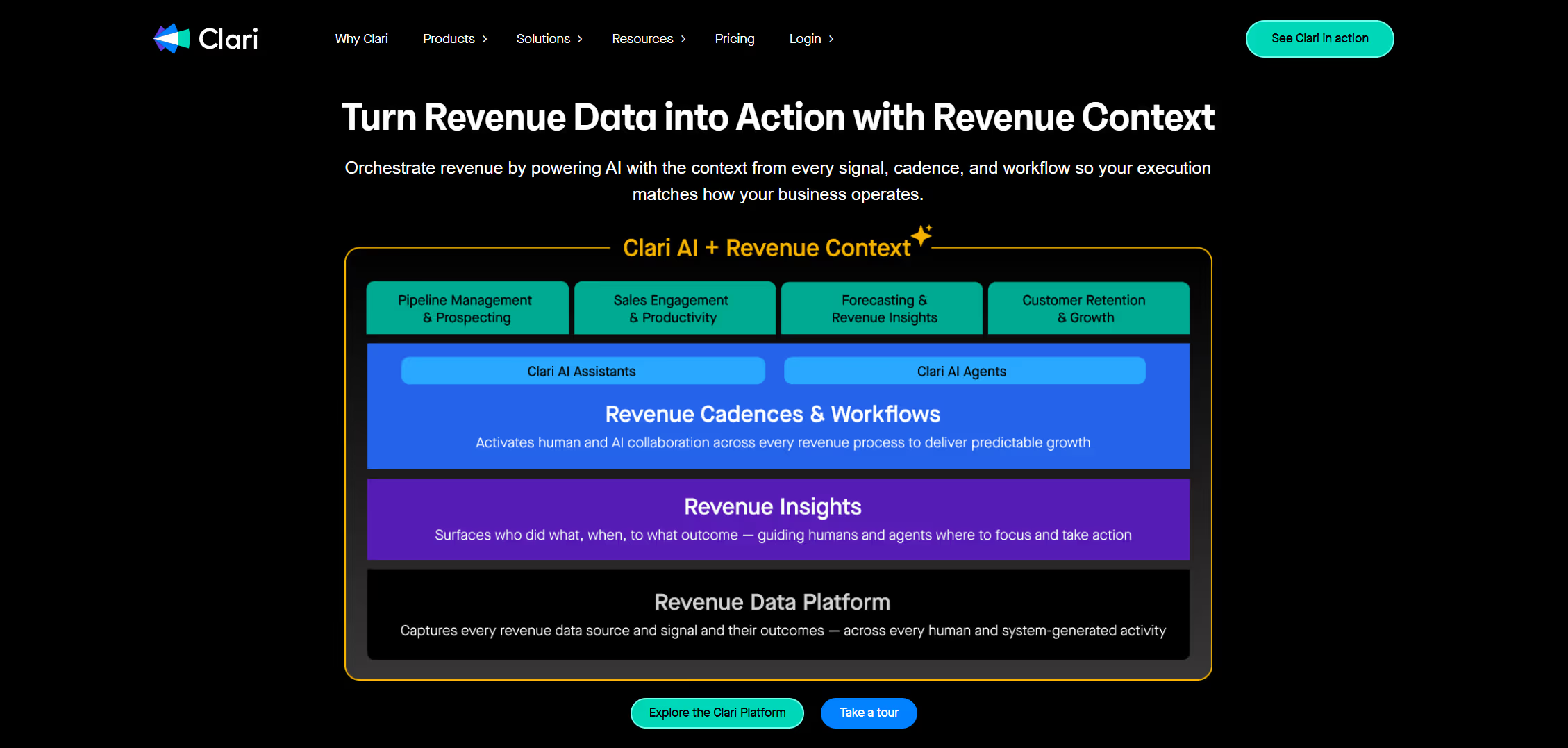
What It Does:Clari pioneered the revenue intelligence/forecasting category, positioning itself as the platform for bottom-up roll-up forecasting and pipeline analytics. Often stacked with Gong (Gong for conversation intelligence, Clari for forecasting), it provides forecast accuracy tracking, pipeline waterfall analysis, and deal inspection workflows.
Clari's revenue context framework displaying layered architecture with AI assistants, agents, revenue cadences, workflow automation, insights panel, and data platform for predictable growth.
Key Features:
Roll-Up Forecasting: Team-level and executive-level forecast consolidation
Opportunity Inspection: Deal-by-deal review interface for manager-rep forecast calls
Pipeline Waterfall: Visualization of pipeline changes (new, slippage, pull-ins)
Clari Copilot (CI Module): Conversation intelligence add-on competing with Gong
✅ Multi-level hierarchy support: Enables forecasting across complex org structures (region > area > team > rep)
❌ Cons:
❌ Pre-generative AI architecture: Built 2012-2018 on older machine learning, not GPT-native contextual understanding
❌ Manual forecast burden: Requires managers to manually review and adjust AI suggestions for each deal; doesn't automate the actual forecast preparation work
❌ Forces Gong + Clari stack: Clari's conversation intelligence (Copilot) is weak, forcing teams to buy Gong separately, creating $450-550/user/month total cost
❌ Platform fees: $30K-60K annual charges on top of per-user pricing
❌ Complex setup: Implementation requires configuring Salesforce hierarchies, mapping custom fields, training users across 6-10 weeks
❌ Dashboard limitations: Users consistently report dashboards "leave a lot to be desired" with "surprising limited" customization vs. flexible data sources
❌ UI clunkiness: Reviews cite "clunky" interface, pages not refreshing without browser refresh, excessive horizontal scrolling
"Clari features often overlap with other common sales tech tools. Clari should do more to differentiate themselves from competition. The dashboarding and reporting can be limited based on what you are looking to do." — Sarah J., Senior Manager Revenue Operations Clari G2 Review
"I find the setup process challenging, especially when migrating fields from Salesforce, as it can't handle formula fields directly. This requires creating and maintaining duplicate fields, which adds complexity and workload. Additionally, I am disappointed with the limited configurability of dashboards, which feel too basic and lack customization options." — Josiah R., Head of Sales Operations Clari G2 Review
"The forecasting feature is decent, but at least in our setup, it doesn't do a great job of auto-calculating the values I need to submit, so that is entirely handheld by using the built-in notes field as a calculator." — Dexter L., Customer Success Executive Clari G2 Review
"There are a couple of quirks. The way it calculates win rates in its funnel analysis includes currently open opps, which is not how we would calculate win rates. Clari's Dashboards leave a lot to be desired. They are surprising limited versus how flexible the requisite data sources are." — Rob W., Sr. Director of Revenue Operations Clari G2 Review
"The UI is not very intuitive and feels clunky. The search function is really frustrating - I should be able to type in a company name and get all results versus clicking on a few options that limit results. It's not easy to find calls or conversations." — Verified User in Human Resources Clari G2 Review
"Sometimes when new updates roll out the platform can be clunky for a period of time... The tool at the beginning is not the most user friendly, but with a small training period the tool can be explained easily and effectively." — Cooper P., Sales Operations & Enablement Clari G2 Review
Clari product update timeline (2026)
Time period
What was happening
What was shipped in Q1 2026
Following the December 3, 2025 Salesloft merger, early 2026 brought the combined entity's first shared releases: Ada chatbot in-app support inside Clari, navigation updates, and Salesforce refresh-token auto-rotation, with Clari continuing its pre-close forecasting, pipeline-intelligence and deal-inspection core. Clari merger FAQ
What was shipped in Q2 2026
By July 2026 the shared release notes introduced a Clari Copilot MCP Server, built via Anthropic's Claude, letting enterprise Copilot customers expose conversation-intelligence data to external AI agents across the merged Salesloft-Clari platform. Salesloft-Clari July 2026 release notes
Rolling out after mid-2026
Steve Cox's combined company, which manages over $10T in revenue across 5,000+ customers, plans to unify Clari forecasting with Salesloft engagement into a single platform over coming years rather than in one release. Clari-Salesloft merger guide
Use Case:
Clari makes sense exclusively for forecast-obsessed enterprises (500+ employees) where forecast accuracy is single priority justifying $200-300/user/month cost, organizations already using Gong seeking dedicated forecasting tool to supplement Gong's weak forecast module (though this creates $450-550/user stack), complex sales hierarchies requiring multi-level regional/area/team roll-ups that native CRM forecasting cannot support, and teams with dedicated RevOps (3+ engineers) capable of managing complex Salesforce field mapping and ongoing integration maintenance.
When to avoid: Mid-market teams (<500 employees) where $200-300/user pricing consumes budgets, organizations seeking unified CI + forecasting platform rather than point solutions, or buyers wanting AI-native automation rather than manual forecast consolidation workflows.
Market Reality: The Gong + Clari stack costing $450-550/user/month ($540K annually for 100 users) represents the exact consolidation opportunity that generative AI-native unified platforms exploit. Teams paying this combined cost increasingly ask: "Why are we stitching together two 2015-era platforms when modern alternatives deliver both functions in single solution at half the price?"
14. Salesloft
⭐ G2 Rating: 4.3/5 (3,500+ reviews)
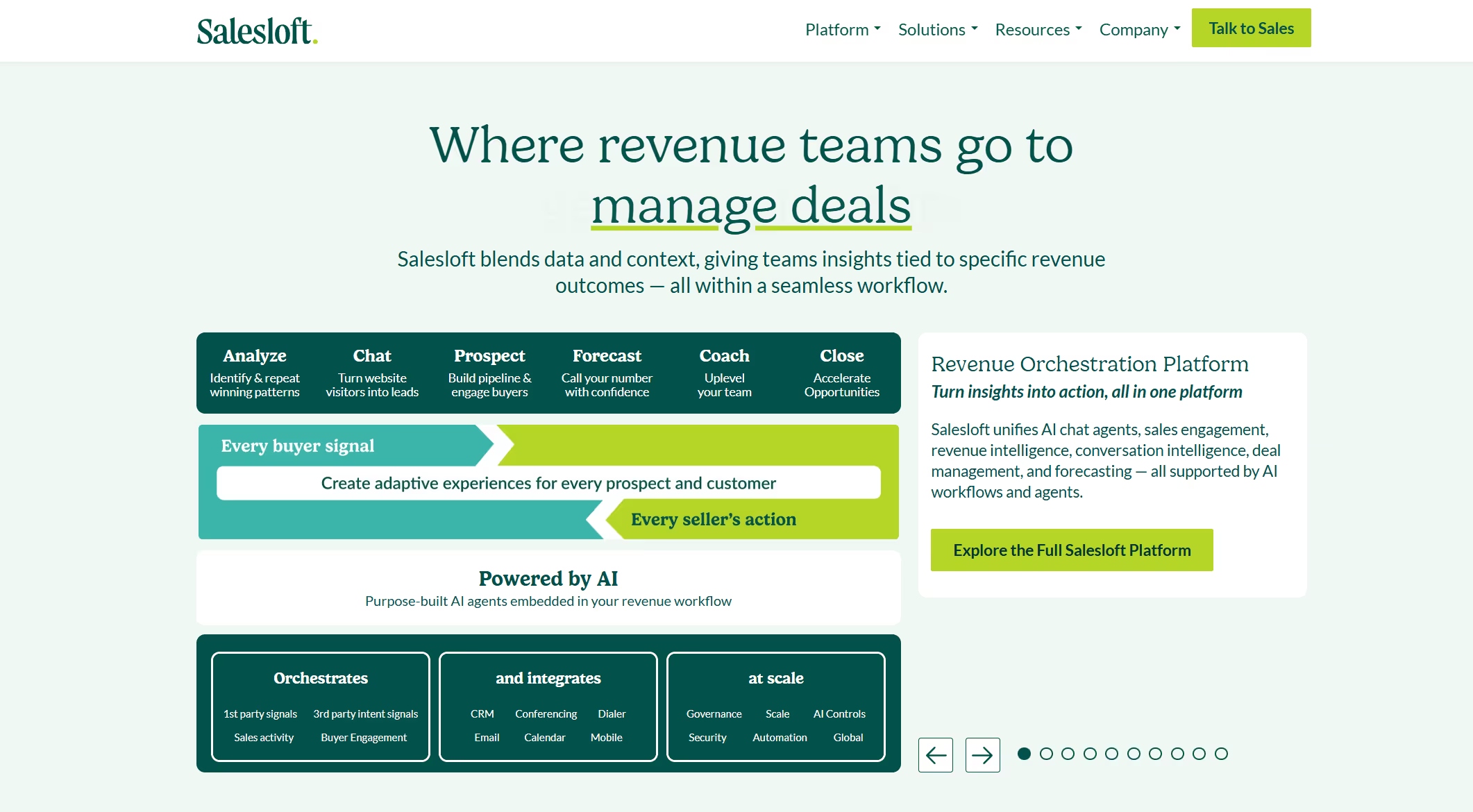
What It Does: Salesloft operates primarily as a sales engagement platform focused on cadence management, email sequencing, and dialer functionality for high-volume prospecting motions. The platform added lightweight conversation intelligence (Salesloft Engage) and basic forecasting, but core architecture remains optimized for mass outbound execution.
Salesloft revenue orchestration visual displaying end-to-end sales workflow including analyze, chat, prospect, forecast, coach, and close stages, powered by AI agents and conversation intelligence technology.
✅ Mature platform: 10+ years of development creates stability and extensive integration ecosystem
✅ Strong SDR adoption: Interface designed specifically for inside sales role workflows
❌ Cons:
❌ Built for outdated bulk email era: Architecture optimized for 2015-era mass, non-personalized prospecting that modern buyers reject
❌ Conversation intelligence failure: CI only works for calls made through Salesloft dialer; doesn't capture Zoom/Teams meetings or externally-dialed calls, making it unreliable
❌ Extension reliability issues: "50% of the time it doesn't work" - browser extension goes stale requiring constant tab refreshes to pull CRM updates
❌ Data connectivity problems: Inbound calls, task reminders, CRM-Salesloft data sync frequently fail
❌ Slow dialer performance: Users report dialer "often slow at launching when making calls"
❌ Faulty analytics: Email open tracking and other metrics unreliable
❌ Poor Outlook integration: Emails not being "lofted" in Outlook online version creates major workflow disruption
Real User Feedback:
"First tool I've used in my tech stack with an extension goes stale - you have to refresh all CRM and Salesloft related tabs in your browser to pull updates within the extension. A handful of features don't work properly - inbound calls, task reminders, data connectivity between apps (CRM, Sales Nav). Data updates like contact information sometimes does not update. Analytics/metrics are faulty like email opens. Dialer is often slow at launching when making calls." — Andrew B., Sales Development Representative Salesloft G2 Review
"The dashboard is not intuitive. And the emails not being lofted in Outlook online version is a huge inconvenience. Customer support is not convenient too." — Gulen A., Associate Director Salesloft G2 Review
"When we have someone in a call/email cadence and they say they are not reachable via phone, it would be great to have an option for automatically skip all the calls for that specific user. Instead of doing manually everytime that activity shows up." — Nicole L., Sales Development Representative Salesloft G2 Review
After closing the Clari merger on December 3, 2025, Salesloft's January 2026 release notes consolidated Drift chatbot settings under new guardrails and doubled R&D toward a unified Predictive Revenue System combining engagement data with Clari forecasting. Salesloft January 2026 release notes
What was shipped in Q2 2026
Through Q2 Salesloft confirmed the March 6, 2026 Drift end-of-life (naming 1mind successor), and by July shipped the Clari Copilot MCP Server and a Salesforce ECA managed package linking engagement activity to forecasting. Salesloft product updates
Rolling out after mid-2026
Salesloft and Clari plan to merge forecasting and orchestration into one Predictive Revenue System over coming years, with Groove maintenance continuing as the combined roadmap consolidates overlapping engagement tooling. Salesloft-Clari merger page
Use Case:
Salesloft remains viable exclusively for high-volume SDR teams (10+ SDRs) making 100+ daily calls through power dialer, transactional sales motions where bulk cadences still generate acceptable response rates, organizations with existing Salesloft contracts (12+ months remaining) creating switching cost barriers, and inside sales teams prioritizing dialer functionality over conversation intelligence or forecasting.
When to avoid: Account-based selling requiring deep personalization (Salesloft's mass cadence model fails), teams needing reliable conversation intelligence (CI only works for dialer calls), organizations prioritizing forecasting (Rhythm is 1/10 capability), or buyers seeking modern generative AI tools over legacy engagement platforms.
Strategic Reality: Salesloft represents the declining "mass prospecting" era. The platform's core assumption (sending 500+ templated emails weekly generates pipeline) no longer holds in 2026 where buyers demand personalized, research-based outreach. Generative AI platforms like Oliv's Prospector Agent automate deep account research and tailored messaging creation, rendering bulk sequencing tools architecturally obsolete.
Dirty data deployment blocker: 67% of Agentforce AI implementations fail because underlying CRM data quality is insufficient
Not generative AI-native: Einstein relies on 2018-era machine learning, not GPT-4 semantic understanding
Prohibitive total cost: $500-650/user/month when factoring in Data Cloud, Einstein CI, Agentforce, and baseline Sales Cloud license
Salesforce Einstein product update timeline (2026)
Time period
What was happening
What was shipped in Q1 2026
The Spring '26 release moved Einstein Conversation Insights onto native Salesforce storage, making call data accessible to Flow and Apex, and shipped Agentforce 360 to general availability with Builder, Agent Script, Voice and Intelligent Context for revenue forecasting and analysis. Spring '26 announcement
What was shipped in Q2 2026
The Summer '26 release (June 15) added Momentum conversation capture, Multi-Agent Orchestration coordinating Einstein-powered agents, a Customer Engagement Agent, and domain-specific agents, alongside Headless 360 for embedding Einstein predictions into custom applications. Summer '26 announcement
Rolling out after mid-2026
Salesforce scheduled Summer '26 migration of existing Einstein Conversation Insights customers to native storage, with further domain-specific agent expansion and Tableau MCP grounding continuing through later seasonal releases. Salesforce Spring '26 feature analysis
Category 4: Lead Generation and Prospecting Tools
Lead generation platforms provide contact data, account intelligence, and prospecting workflows, but suffer from the fundamental "data ≠ action" gap. Legacy tools deliver lists requiring humans to research accounts and write personalized messages manually, while AI-native platforms automate the entire research-to-outreach workflow.
What It Does: Cognism provides B2B contact data with strong European coverage and mobile phone number accuracy. The platform emphasizes compliance (GDPR, CCPA) and diamond-verified data quality, positioning as the privacy-focused ZoomInfo alternative for EMEA-region prospecting.
Key Features:
Diamond Data: Manually verified contact information promising 98% accuracy
International Coverage: Strong EMEA database with compliant EU contact collection
Mobile Phone Numbers: Direct dial and mobile numbers for decision-makers
Chrome Extension: LinkedIn prospecting with one-click data enrichment
Intent Data Integration: Bombora intent signals showing active buyers
CRM Enrichment: Automatic field population in Salesforce/HubSpot
Unrestricted Access: Unlimited exports (no credit system like ZoomInfo)
Pricing:
Custom Pricing Only: Typically $12K-30K annually based on user count and database access
No Public Tier Pricing: Requires sales conversation for quote
Seat-Based Model: Licensed per user with annual contracts
✅ Pros:
✅ EMEA market leader: Best-in-class European contact coverage and GDPR compliance
✅ Mobile number accuracy: Higher direct dial and mobile hit rates than competitors
✅ No credit restrictions: Unlimited exports vs. ZoomInfo's consumption-based limits
✅ Diamond verification: Manual data validation increases contact accuracy
✅ Intent data included: Bombora integration shows accounts researching solutions
❌ Cons:
❌ Data only, no action: Provides contact lists but requires manual account research and message personalization
❌ Expensive for SMBs: $12K-30K annual minimums exclude small teams
❌ Limited North America coverage: US/Canada database weaker than ZoomInfo
❌ No native sequencing: Requires separate engagement tool (Outreach, Salesloft) for outreach execution
❌ Generic messaging results: Without AI research automation, reps default to template-based outreach
16. Cognism — Product Update Timeline
Cognism product update timeline (2026)
Time period
What was happening
What was shipped in Q1 2026
Cognism's H1 2026 update introduced Cognism CRM Enrichment, a continuous governed data layer, plus Companion Search improvements including keyword filters, bulk upload, acquisition-event targeting, two-way HubSpot sync, and trending intent surfaced directly in the company table. Cognism H1 2026 update
What was shipped in Q2 2026
Continuing through H1 2026, Cognism added static IP support for Salesforce and extended Do-Not-Call coverage to Norway and Finland, building on its Diamond Data phone-verified contacts (claimed 87% accuracy) and Bombora intent signals. Cognism product newsroom
Rolling out after mid-2026
Under new CEO Dominic Allon, Cognism keeps expanding Sales Companion and its research-only Cortex AI, though it remains strongest in EMEA and stops short of full outbound execution, so buyers needing sequencing should pair it accordingly. Cognism roadmap update
Use Case:
Cognism works for EMEA-focused sales teams needing compliant European contact data, mid-market/enterprise (50+ employees) with $12K+ prospecting budgets, outbound teams already using engagement platforms (Outreach, Salesloft) needing data layer, and mobile-centric prospecting where direct dial matters more than email.
When to avoid: North America-primary prospecting (ZoomInfo stronger), teams needing AI-powered research and personalization (Cognism only provides raw data), or organizations seeking all-in-one prospecting solutions vs. data-only tools.
What It Does: ZoomInfo operates as the dominant B2B contact database and sales intelligence platform in North America, providing firmographic data, contact information, technographic insights, and intent signals across 100M+ company profiles.
❌ Data without personalization: Provides intelligence but no AI-powered message creation or account research automation
❌ Chorus CI disappointment: Bundled conversation intelligence "has not innovated at all" since 2022 acquisition
❌ Complex implementation: Enterprise deployments require significant RevOps resources for configuration and training
❌ Forced bundling: Must purchase full platform to access premium features, inflating costs
17. ZoomInfo — Product Update Timeline
ZoomInfo product update timeline (2026)
Time period
What was happening
What was shipped in Q1 2026
Entering 2026 under its new NASDAQ:GTM ticker, ZoomInfo built on the October 2025 Copilot Workspace AI-agent execution layer and continued hardening its contact and company data ahead of a major mid-year context-layer launch. ZoomInfo release notes
What was shipped in Q2 2026
On June 1–2, 2026 ZoomInfo launched GTM.AI, a headless context layer grounding Claude, ChatGPT, Copilot, Agentforce and Breeze in its GTM Context Graph (100M companies, 500M contacts), followed June 9 by a native Microsoft Copilot Studio and Dynamics 365 connector. ZoomInfo GTM.AI launch
Rolling out after mid-2026
A June 2026 data refresh added 6.6M location records and 93.3%-precision contact improvements, and ZoomInfo positions GTM.AI as the home for its API and MCP access, expanding grounded-agent coverage through later 2026. ZoomInfo Copilot Studio integration
Use Case:
ZoomInfo remains viable for enterprise organizations (1,000+ employees) with $500K+ prospecting budgets and dedicated data teams, North America-focused prospecting where US/Canada coverage justifies premium pricing, complex ABM programs requiring technographic and intent data for precise targeting, and teams with RevOps resources capable of managing API integrations and data workflows.
When to avoid: Mid-market/SMB organizations (<500 employees) where $15K-50K/user pricing is prohibitive, teams needing AI-powered personalization vs. raw data, or buyers seeking modern conversation intelligence (Chorus is obsolete post-acquisition).
Data vs. Action Gap: Both Cognism and ZoomInfo exemplify the fundamental limitation of data-only platforms: they answer "who to contact" but not "what to say" or "why now." Generative AI platforms like Oliv's Prospector Agent bridge this gap by automating deep account research (news, funding, leadership changes, pain point signals) and generating tailored outreach messaging, transforming raw contact data into actionable, personalized campaigns.
What It Does: Apollo.io combines B2B contact database with sales engagement sequencing in a unified platform, positioning as the affordable all-in-one alternative to ZoomInfo + Outreach stacks. The platform provides 250M+ contacts with built-in email/call workflows.
Key Features:
Contact Database: 250M+ contacts, 60M+ companies with verified email addresses
Built-in Sequencing: Email cadences, call tasks, LinkedIn automation in single platform
Chrome Extension: LinkedIn prospecting with instant contact data enrichment
Email Finder & Verifier: Validates email deliverability before sending
Meeting Scheduler: Calendar link generation eliminating booking friction
Conversation Intelligence: Basic call recording and AI summaries (recent addition)
Reporting Dashboards: Activity tracking, sequence performance, team analytics
Pricing:
Free: $0 - 60 mobile credits/year, 120 export credits/year, basic features
Basic: $49/user/month - Unlimited email credits, 900 mobile credits/year
Professional: $79/user/month - Advanced sequencing, A/B testing, API access
Organization: $149/user/month - Team analytics, call recording, intent data
Annual Discount: ~20% savings with annual commitment
✅ Pros:
✅ Unbeatable value: $49-149/user/month delivers data + sequencing vs. $15K+ for ZoomInfo alone
✅ True all-in-one platform: Eliminates need for separate data (ZoomInfo) + engagement (Outreach) tools
✅ Generous free tier: 60 mobile credits annually allows testing platform before purchase
✅ User-friendly interface: Minimal learning curve for reps, fast time-to-productivity
✅ Strong database coverage: 250M contacts competitive with enterprise platforms at 1/10th cost
❌ Cons:
❌ Data accuracy lower than ZoomInfo: Contact verification less robust than premium databases (85-90% vs. 95% accuracy)
❌ Basic sequencing: Lacks advanced features of dedicated engagement platforms (Outreach, Salesloft)
❌ Limited intent data: Buyer signal intelligence less comprehensive than ZoomInfo/Cognism
❌ Conversation intelligence lightweight: Recent CI addition lacks depth of Gong/Oliv platforms
18. Apollo.io — Product Update Timeline
Apollo.io product update timeline (2026)
Time period
What was happening
What was shipped in Q1 2026
On March 4, 2026 Apollo.io made its agentic AI Assistant generally available, using natural-language draft-and-approve workflows and reaching roughly 20,000 weekly users, alongside MCP connectors for Claude, ChatGPT, Codex and Perplexity and Snowflake Secure Data Sharing. Apollo AI Assistant launch
What was shipped in Q2 2026
Through June and July 2026 Apollo's release notes added MCP task management, custom-field read/write, expanded search filters, one-off email, Gong call import, 200+ workflow integrations and a French UI, following its acquisition of revenue-intelligence platform Pocus. Apollo 2026 release notes
Rolling out after mid-2026
Under new CEO Matt Curl, Apollo continues expanding its agentic workflows across a 275M+ contact database, though independent reviews flag data-quality and bounce-rate concerns buyers should test before scaling outbound. Apollo release tracker
Use Case:
Apollo.io excels for budget-conscious outbound teams needing data + sequencing at <$150/user/month, startups and SMBs (<100 employees) where $15K/user ZoomInfo pricing is prohibitive, high-volume prospecting where 85-90% data accuracy is acceptable trade-off for cost savings, and teams wanting unified platform vs. managing multiple vendor relationships.
When to avoid: Enterprise organizations requiring 95%+ data accuracy SLAs, teams needing advanced conversation intelligence or forecasting, or account-based selling requiring deep personalization beyond template sequences.
What It Does: Clay operates as a data enrichment and workflow automation platform connecting 50+ data providers (ZoomInfo, Apollo, Clearbit, LinkedIn, etc.) with AI-powered personalization. It enables RevOps and growth teams to build custom prospecting workflows combining multiple data sources.
Key Features:
Data Provider Aggregation: Single interface accessing 50+ enrichment sources
Waterfall Enrichment: Automatically tries multiple providers to maximize data coverage
AI Personalization: GPT-4 integration for automated custom message generation
Web Scraping: Extract data from websites, LinkedIn, directories
Formula Builder: Spreadsheet-like interface for complex data transformations
Integration Hub: Connect CRMs, Slack, email, 1,000+ tools via Zapier
Team Collaboration: Shared workspaces and templates
❌ Not end-to-end solution: Requires separate sequencing tool (Apollo, Outreach) for email execution
❌ Resource intensive: Demands dedicated RevOps personnel to build and maintain Clay workflows
19. Clay — Product Update Timeline
Clay product update timeline (2026)
Time period
What was happening
What was shipped in Q1 2026
In January 2026 Clay added Codex and Clay-in-Claude integrations and Gemini 3 Pro inside Claygent, then on March 11 overhauled pricing into Launch, Growth and Enterprise tiers plus free-forever, with a dual Data-Credit/Action model cutting marketplace data cost 50–90%. Clay changelog
What was shipped in Q2 2026
Through Q2 Clay shipped Sculptor, a natural-language workflow builder, and Claygent Navigator, a browser-action AI with vision that fills forms, alongside weekly releases like the Agent Plugin, Sequencer, Google Maps rectangle search and static IPs. Clay product changelog
Rolling out after mid-2026
Clay maintains a weekly release cadence, continuing to expand Claygent's autonomous browser actions and its data-provider marketplace, so buyers should track the changelog for the newest agent and enrichment capabilities. Clay agent overview
Use Case:
Clay is ideal for technical RevOps teams comfortable with formula building and data transformation logic, advanced ABM programs requiring custom research combining LinkedIn, news, funding, technographic signals, data-savvy organizations wanting to build proprietary prospecting workflows vs. using out-of-box tools, and growth teams experimenting with novel go-to-market motions needing flexible infrastructure.
When to avoid: Non-technical sales teams needing turnkey solutions, organizations lacking dedicated RevOps resources to build workflows, or buyers seeking fully automated agentic platforms vs. flexible but manual tools.
What It Does: Factors.ai provides account-level intent data and attribution analytics for B2B marketing and sales teams. The platform identifies anonymous website visitors, tracks account-level engagement, and connects marketing touchpoints to revenue outcomes.
Key Features:
Account Identification: Deanonymizes website visitors to company level
❌ Manual alert follow-up: Reps still must research accounts and write personalized outreach
20. Factors.ai — Product Update Timeline
Factors.ai product update timeline (2026)
Time period
What was happening
What was shipped in Q1 2026
Entering 2026 Factors.ai ran its ABM, attribution and Scout analytics stack, continuing to build the Scout Agents layer and RB2B-style visitor-identity capabilities ahead of a major June product wave. Factors.ai product updates
What was shipped in Q2 2026
June 2026 shipped Scout Sandbox (running code over datasets up to 250,000 rows, June 17), 5x Scout Agents credit limits, a Scout Agents model selector offering Claude Opus 4.6 and Sonnet 4.5 (June 26), role-based access controls and RB2B visitor-identity enrichment rules. Factors.ai June 2026 releases
Rolling out after mid-2026
Factors.ai continues extending Scout with LinkedIn audience exclusion and a new HubSpot Marketplace listing, expanding its agent model options and dataset scale through subsequent monthly product updates. Factors.ai release notes
Use Case:
Factors.ai works for ABM-focused organizations (100+ employees) with defined target account lists, high website traffic businesses (10K+ monthly visitors) generating sufficient intent signals, marketing-sales aligned teams requiring attribution data to optimize campaign spend, and enterprise sales motions where identifying in-market accounts justifies $12K-30K investment.
When to avoid: SMBs with low website traffic, teams needing end-to-end prospecting automation vs. intent signals only, or organizations lacking resources to act on real-time alerts manually.
Category Insight - The Prospecting Automation Gap:
All five lead generation tools (Cognism, ZoomInfo, Apollo, Clay, Factors.ai) share a fundamental limitation: they provide intelligence (who to contact, what they're researching, what tech they use) but require humans to synthesize that data into personalized outreach.
This is precisely the gap that Oliv AI's Prospector Agent closes: automated deep research (analyzes LinkedIn profiles, company news, funding announcements, job changes, tech stack, and intent signals across multiple data sources), sales hypothesis generation (AI formulates unique angles like "They just raised Series B and hired VP Sales, likely building out sales team and need CI/forecasting platform"), tailored messaging (generates personalized email content based on research findings for rep review-and-send), and continuous monitoring (proactively surfaces new prospects matching ideal customer profile as signals emerge).
Where legacy tools answer "who" (contact data) or "when" (intent timing), Oliv's Prospector Agent autonomously completes the research-to-outreach workflow that typically consumes 2-3 hours per account for human reps. This represents the shift from "data provision platforms" to "autonomous prospecting agents," the defining category evolution for 2026-2030.
Category 5: Outreach and Personalization Tools
Sales engagement platforms face existential obsolescence in 2026: they were architected for the 2015-era bulk emailing paradigm that modern buyers actively reject. Legacy tools (Outreach, Salesloft) provide sequencing infrastructure but require reps to manually write personalized messages, the exact manual burden generative AI eliminates.
21. Outreach.io
⭐ G2 Rating: 4.3/5 (3,300+ reviews)
What It Does:Outreach.io pioneered the sales engagement category in 2014, establishing the multi-touch cadence model for inside sales teams. The platform provides email sequencing, task workflows, dialer functionality, and basic conversation intelligence (Kaia).
Outreach platform demonstrating AI-powered sales agent capabilities with revenue agent selection, sales leader sequences, account executive workflows, and automated email personalization tools for pipeline growth.
Analytics Dashboards: Sequence performance, activity tracking, team leaderboards
Salesforce Integration: Two-way activity sync and task creation
Pricing:
Platform: $100/user/month - Core sequencing and email features
Accelerate: $135/user/month - Power dialer, advanced analytics
Enterprise: $165/user/month - Kaia CI, forecasting, dedicated support
Evergreen Contracts: Auto-renew annually unless canceled 30-60 days pre-renewal
✅ Pros:
✅ Category pioneer: 10+ years of development creates mature platform with extensive integrations
✅ Strong sequence engine: Reliable multi-touch workflow execution across email, call, social
✅ Gmail integration: Seamless inbox experience for reps using Google Workspace
✅ Established user base: 3,300+ G2 reviews provide confidence through crowd validation
✅ Comprehensive reporting: Detailed analytics on sequence performance and rep activity
❌ Cons:
❌ "Legacy tool that lacks modern updates": Product innovation stagnant; interface feels dated
❌ Significantly overpriced: $100-165/user for features Apollo delivers at $49-79/user
❌ Predatory contract terms: Evergreen auto-renewal with strict cancellation deadlines ("miss by few hours, enforces renewal for entire year without negotiation")
❌ Relies on your email servers: Functions as "email scheduler with very basic reporting," not true intelligent platform
❌ HubSpot integration disaster: "Don't have native HubSpot CRM integration... sync breaks once every two weeks," affecting BD productivity
❌ Stagnant engage product: "Looks to have same features, UX, integrations and issues as 5 years ago"
❌ Built for bulk email era: Architecture emphasizes template-based mass outreach rejected by modern buyers
❌ Email failure issues: "Emails fail all of a sudden... says email failed due to inbox sync failure"
Outreach.io product update timeline (2026)
Time period
What was happening
What was shipped in Q1 2026
In February 2026 Outreach shipped its Omni chat-based agent, a Meeting Prep Agent generating contextual briefs, a Deal Agent that autonomously updates opportunity fields, an Agents & AI navigation home, and the public Outreach MCP Server joining Anthropic's ecosystem on February 24. Outreach February 2026 release notes
What was shipped in Q2 2026
The April 27, 2026 Spring release formally launched Outreach Omni and Agent Studio and rebranded the site to Outreach.ai; June added the full MCP Suite (Client plus Agentic Ecosystem marketplace) and an Outreach app in ChatGPT with a Codex MCP Server. Outreach Omni launch
Rolling out after mid-2026
From June 15 through September 30, 2026 Outreach is migrating all users off the legacy 360 homepage, while expanding third-party MCP connectors, Knowledge-grounded Omni responses and web-search personalization. Outreach June 2026 release notes
Real User Feedback:
"Outreach is significantly overpriced for what it offers. The platform has a clunky interface and still relies on your own email servers, essentially functioning as an email scheduler with very basic reporting capabilities. Additionally, their agreements are evergreen (automatically renewing annually without alternative terms). If you miss the cancellation deadline by even a few hours - be mindful of their time zone, they enforce renewal for the entire year without any willingness to negotiate." — Kevin H., Chief Technology Officer & Co-Founder Outreach G2 Review
"Many things like adding spintax, incorporating a parallel or power dialer could be an upsell, limiting to 2 emails per seat is crazy cost wise compared to what's available... Legacy tool that lacks modern updates." — Devin W., Sales Outreach G2 Review
"They don't have native Hubspot CRM integration and the current integration is via Hubspot and Hubspot isn't trying to solve the sync issues with Outreach integration on their end and Outreach has no clue about it. The Hubspot Outreach sync breaks once in every two weeks... it's affecting BDs productivity... Outreach is not meant for small teams with less than 30 BDs and have a Hubspot CRM." — Vamsi C., Revenue Operations Outreach G2 Revie
"The engage product is stagnant. Looks to have the same features, UX, integrations and issues as it had 5 years ago. Frequent requests for a product roadmap or understanding how AI is involved is glossed over by the CS team and the AEs talk grandly about all the featured of the tool - and how industry leading it is - but shy away from demonstrating this." — Matthew T., Head of Revenue Operations Outreach G2 Review
Use Case:
Outreach.io remains viable exclusively for large enterprises (1,000+ employees) with existing multi-year contracts creating sunk cost/switching barriers, Salesforce-exclusive organizations where native SFDC integration outweighs platform limitations, high-volume SDR teams (20+ SDRs) requiring industrial-strength sequencing infrastructure, and organizations tolerating evergreen contracts with strict auto-renewal terms.
When to avoid: HubSpot CRM users (integration is broken), small teams (<30 users) where per-seat costs are prohibitive, cost-conscious buyers (Apollo delivers 80% of functionality at 50% of price), or teams seeking modern AI-powered personalization vs. template-based bulk sequencing.
22. Salesloft
See Section 14 above for comprehensive Salesloft analysis. Key Outreach/Engagement limitations:
Salesloft's January 2026 release added AI-generated dynamic Call Scripts inside Cadence and consolidated Drift chatbot settings with new guardrails, keeping Cadence, the dialer and Rhythm as its core buyer-engagement and task-execution engine. Salesloft January 2026 release notes
What was shipped in Q2 2026
In Q2 Salesloft refined Rhythm's business-day task logic and confirmed the March 6, 2026 Drift end-of-life, naming 1mind as successor, continuing to route engagement activity through the merged Salesloft-Clari platform. Salesloft product updates
Rolling out after mid-2026
Salesloft plans to fold Cadence engagement into the unified Predictive Revenue System with Clari over coming years, while Groove maintenance continues as overlapping outreach tooling consolidates. Salesloft-Clari merger page
23. Lavender.ai
⭐ G2 Rating: 4.9/5 (1,300+ reviews)
What It Does: Lavender.ai provides real-time email coaching and optimization, analyzing draft emails for clarity, tone, length, personalization, and deliverability before sending. The tool positions as the AI writing assistant for individual AEs rather than enterprise engagement platform.
Key Features:
Email Scoring: Real-time analysis rating emails on 1-100 scale for effectiveness
Personalization Suggestions: Recommends research-based customization (LinkedIn bio mentions, recent news)
Mobile Preview: Shows how email renders on mobile devices
✅ Easy adoption: Chrome extension requires minutes to install and start using
✅ Affordable entry: $29/month accessible for individual contributors
✅ High user satisfaction: 4.9/5 G2 rating reflects genuine utility
❌ Cons:
❌ Requires human to write base email: Lavender optimizes existing content but doesn't generate messages from scratch
❌ Single-point solution: Only handles email writing; no account research, sequencing, or multi-channel outreach
❌ Limited enterprise features: Lacks advanced team workflows, forecasting, or revenue intelligence
❌ Email-only focus: Doesn't assist with call prep, LinkedIn messaging, or meeting follow-ups
❌ Template optimization vs. personalization: Improves templates rather than creating truly unique account-based messaging
Lavender.ai product update timeline (2026)
Time period
What was happening
What was shipped in Q1 2026
Into 2026 Lavender ran its email-coaching Chrome extension: real-time 0–100 email scoring, reply-rate-trained rewrites, a Personalization Assistant surfacing LinkedIn, company and news context in the sidebar, and a coaching dashboard, integrating with Gmail, Outlook, Salesloft and Outreach. Lavender.ai product site
What was shipped in Q2 2026
Through mid-2026 Lavender advanced Ora, an autonomous AI sales agent trained on over 2 billion sales emails that researches prospects and writes hyper-personalized cold emails, priced separately at $500 per agent per month as a distinct AI-SDR product. Lavender.ai 2026 review
Rolling out after mid-2026
Ora remains in active development in mid-2026 as Lavender extends from coaching into autonomous sending, keeping its coaching tiers around $27–29 Starter, $45–49 Pro and $69–89 Teams while the agent product matures. Lavender.ai feature review
Use Case:
Lavender.ai works for individual AEs wanting to improve email response rates without platform commitments, small teams (<10 people) needing affordable email assistance, email-heavy sales motions where outbound email is primary channel, and reps supplementing existing tools with AI writing coach.
When to avoid: Teams needing end-to-end prospecting automation, organizations seeking account research and message generation (not just optimization), or buyers requiring multi-channel engagement vs. email-only focus.
24. Lemlist
⭐ G2 Rating: 4.6/5 (550+ reviews)
What It Does: Lemlist specializes in cold email outreach with unique features like image/video personalization, multichannel sequences (email + LinkedIn + phone), and deliverability warm-up. Positioned as the creative cold email platform for growth teams.
Key Features:
Image Personalization: Dynamically insert prospect names/company logos into email images
Video Prospecting: Custom video thumbnails with personalized text overlays
Email Warm-Up: Automated inbox reputation building to avoid spam folders
Multichannel Sequences: Combine email, LinkedIn, and phone in single workflow
❌ No account research: Reps must manually research prospects before building sequences
❌ Limited CRM features: Weaker Salesforce/HubSpot integration than enterprise platforms
❌ Cold email specialization: Less suitable for inbound, warm lead nurturing, or complex sales cycles
❌ Manual sequence building: Requires human to design each campaign step-by-step
Lemlist product update timeline (2026)
Time period
What was happening
What was shipped in Q1 2026
Entering 2026 Lemlist ran multichannel sequences across email, LinkedIn, calls, SMS and WhatsApp on a 600M+ contact database, with multi-model AI (Claude, GPT, Perplexity) for sequence generation and a Cold Email Coach scoring drafts inside Gmail. Lemlist 2026 feature audit
What was shipped in Q2 2026
Through H1 2026 Lemlist added personalized AI voice notes using ElevenLabs voice cloning for LinkedIn audio messages, native WhatsApp automation, and agentic AI enrichment running waterfall lookups across up to ten data providers at point-of-send. Lemlist 2026 review
Rolling out after mid-2026
Lemlist continues consolidating data, sending, warmup and LinkedIn automation into one per-seat platform; its published academy changelog lags the shipped feature set, so buyers should confirm current AI and enrichment capabilities directly. Lemlist capability review
Use Case:
Lemlist is ideal for cold email specialists (BDRs, growth teams) running high-volume outbound campaigns, SMBs and startups (<50 employees) needing affordable alternative to enterprise engagement platforms, creative prospectors wanting to test image/video personalization for differentiation, and deliverability-conscious teams where inbox placement directly impacts pipeline.
When to avoid: Enterprise organizations requiring deep CRM integration, teams needing AI-powered account research and message generation, or complex sales cycles requiring sophisticated multi-stakeholder workflows.
25. Reply.io
⭐ G2 Rating: 4.6/5 (1,100+ reviews)
What It Does: Reply.io provides multichannel sales engagement combining email sequences, LinkedIn automation, calls, SMS, and WhatsApp in unified workflows. The platform emphasizes automation and AI assistance for high-volume outbound teams.
Key Features:
Multichannel Sequences: Email, LinkedIn, calls, SMS, WhatsApp in single campaign
AI SDR Agent: Autonomous agent that researches prospects and writes personalized emails
Email Finder & Verification: Built-in data enrichment and validation
Meeting Scheduler: Calendar integration with Calendly/Google Calendar
Cloud Calls: Built-in dialer eliminating need for third-party phone systems
❌ Data accuracy moderate: Built-in email finder less accurate than premium databases (ZoomInfo, Cognism)
❌ CRM integration limitations: Less robust Salesforce/HubSpot sync than enterprise platforms
❌ Feature breadth vs. depth: Offers many channels but individual capabilities less sophisticated than specialists
Reply.io product update timeline (2026)
Time period
What was happening
What was shipped in Q1 2026
Building on its December 2025 release of ready-made sequences and AI voice messages, early 2026 Reply.io ran Jason AI SDR in Autopilot and Copilot modes across email, LinkedIn, calls, SMS and WhatsApp, over a 1B+ contact database powered by Generect. Reply.io 2026 review
What was shipped in Q2 2026
Through Q2 2026 Reply.io refined its Smart Task Board and guided onboarding, expanded LinkedIn-specific features like Social Warming and AI voice messages, and by July restructured into three tiers including a new AI-enhanced plan for advanced sequences. Reply.io 2026 pricing review
Rolling out after mid-2026
Reply.io keeps deepening Jason AI's autonomous prospecting and its built-in deliverability stack (MailToaster.ai warmup, Email Health Checker, Postmaster integration), though reviewers note the absence of native buying-signal triggers buyers may want to supplement. Reply.io in-depth review
Use Case:
Reply.io works for outbound SDR teams (5-20 SDRs) needing multichannel outreach at SMB pricing, startups (<50 employees) wanting all-in-one prospecting platform without multiple vendor contracts, high-volume prospecting where built-in data enrichment saves costs vs. ZoomInfo, and teams experimenting with AI SDR assistance at lower price point than enterprise solutions.
When to avoid: Enterprise organizations requiring proven, mature AI agents (Reply's AI SDR is new), teams heavily reliant on LinkedIn where automation risks account bans, or buyers needing premium data accuracy justifying separate database investments.
Category Summary: The Shift from Templates to Autonomous Research
All five outreach/personalization tools (Outreach, Salesloft, Lavender, Lemlist, Reply) share the same architectural constraint: they provide infrastructure for sending messages but still require humans to create personalized content.
Even tools with "AI assistance" (Lavender optimizes existing emails, Reply's AI SDR is nascent) operate in "human-in-the-loop" mode where reps must:
Manually research accounts (LinkedIn, news, funding, company website)
Formulate sales hypothesis ("Why should this account care about our solution now?")
Write base email content drawing connections between research and value prop
Review and refine AI suggestions before sending
This workflow consumes 2-3 hours per target account, the exact manual burden that generative AI-native platforms eliminate.
💡 Oliv AI's Prospector Agent: The Categorical Evolution
Oliv AI's Prospector Agent represents the categorical evolution from "engagement infrastructure" to "autonomous prospecting":
Step 2 (Automated): AI formulates sales hypothesis connecting discovered signals to Oliv's value proposition ("Just hired VP Revenue Operations → likely evaluating revenue intelligence stack")
Step 3 (Automated): Generates complete personalized email referencing specific research findings, written in natural tone matching company culture
Step 4 (Human Review): Rep reviews AI-generated message, makes minor edits if desired, approves for sending
Time Investment: 5-10 minutes review vs. 2-3 hours manual research and writing
ROI Impact:
10-rep SDR team spending 40 hours/week on manual account research and email personalization
With Oliv Prospector Agent: Same quality personalized outreach in 8 hours/week
Productivity Gain: 32 hours/week reclaimed for actual selling activities = 400% efficiency increase
Cost Avoidance: Eliminates need for $100-165/user Outreach + $15K+/user ZoomInfo stack; Oliv delivers both at fraction of combined cost
The fundamental market shift: engagement platforms (Outreach, Salesloft) become commoditized infrastructure, while **autonomous research and personalization** (Oliv's Prospector Agent) becomes the high-value differentiator that determines whether outbound generates pipeline or gets ignored.
Strategic Principle for 2026:
The era of mass, template-based prospecting is architecturally obsolete. Modern buyers ignore generic outreach. The platforms winning deals are those that automate the labor-intensive research and hypothesis-building work, allowing human sellers to focus on relationship-building and closing rather than spending 60-70% of their time on manual prospecting tasks.
AI-native revenue orchestration platforms like Oliv represent the future: unified systems where conversation intelligence informs forecasting accuracy, which identifies at-risk deals requiring prospecting follow-up, which the Prospector Agent autonomously researches and drafts personalized outreach for, creating a closed-loop revenue engine vs. the disconnected point solutions (Gong + Clari + Outreach + ZoomInfo) costing $600+/user/month that legacy stacks require.
Key Takeaways:
Architectural Divide: Pre-2020 platforms (Gong, Clari, Salesforce Einstein, Outreach, Salesloft) built on keyword tracking and basic ML require extensive manual configuration and ongoing maintenance. Post-2022 generative AI-native platforms (Oliv AI) leverage GPT-4 for autonomous agentic workflows.
The Consolidation Opportunity: Legacy tool stacks (Gong $250 + Clari $200 + Salesloft $100 + ZoomInfo $15K annually = $550-650/user/month) force expensive multi-vendor dependencies. Unified AI-native platforms deliver equivalent functionality at 50-70% cost savings with zero integration maintenance.
TCO Reality Check: Advertised per-user pricing misleads buyers. Hidden costs include platform fees ($30-60K annually), implementation services ($15-50K), ongoing RevOps maintenance (40-80 hours monthly), and forced bundling of unused features. Transparent pricing models with free implementation and no platform fees represent 30-40% total savings beyond stated per-seat rates.
The Data Quality Blocker: 67% of enterprise AI deployments (Salesforce Agentforce) fail due to dirty CRM data. Legacy platforms assume clean data exists; AI-native platforms autonomously maintain data quality, making AI initiatives succeed rather than becoming $500K-2M write-offs.
Agentic vs. Insight Paradigm: The fundamental shift separating winners from losers: platforms providing insights requiring human action vs. autonomous agents completing multi-step workflows. Buyers in 2026 increasingly ask: "Does this tool work for me, or do I work for this tool?"
Buyer Decision Framework:
Startups (<50 employees): Prioritize speed, simplicity, cost. Avoid enterprise platforms requiring 8-12 week implementations and $30K+ setup fees. Choose unified platforms delivering 80% of enterprise functionality at 90% cost savings.
Mid-Market (50-500 employees): Focus on consolidation. Every legacy tool eliminated saves not just licensing costs but RevOps maintenance burden. Unified platforms delivering CI + forecasting + engagement in single system provide 400-500% ROI vs. Gong + Clari + Outreach stacks.
Enterprise (500+ employees): Solve the dirty data problem first. 67% of AI initiatives fail on data quality. Choose platforms functioning as intelligent data layers that clean and enrich CRM automatically rather than analysis tools assuming perfect data.
The 2026 AI sales tools landscape rewards buyers who recognize the generative AI architectural inflection point and consolidate to platforms purpose-built for autonomous agentic workflows rather than patching together 2015-era point solutions with "AI features" bolted on.
Q2. What are the Best AI Sales Tools & Use Cases for Startups (<50 employees)? [toc=Startup Tools]
The Startup Sales Reality: Do More With Less 💼
Startup sales teams (2-10 reps) face brutal constraints that enterprise tools ignore: budgets under $5K/month for the entire sales stack, zero RevOps support, and products needing immediate adoption without 8-week implementations. Research shows 68% of startups abandon complex sales tools within 6 months due to adoption friction, the "SaaS adoption tax" where tools require more manual work than they eliminate.
The harsh math: a 5-person startup with $100K monthly revenue allocates 10-15% to sales/marketing ($10-15K total), with 70-80% going to salaries. That leaves $2-4K monthly for all sales tools (CRM, engagement, data, conversation intelligence), making enterprise platforms financially impossible before considering whether they'd work.
⚠️ Why Enterprise Tools Kill Startups
The Pricing Deception:
Traditional platforms weren't built for startups; they target 100+ person enterprise teams with dedicated implementation consultants. Consider the real costs:
Gong: $250/user/month bundled + $5K annual platform fee = $35K+ first year for 10-person team (exceeding entire sales tech budget)
8-24 week implementations requiring RevOps engineers startups don't have
Manual Smart Tracker configuration in Gong (keyword specification for every competitor, objection, buying signal)
Extensive training programs costing $500-1,500/user before reps become productive
Ongoing integration maintenance as Gong's "wonky API" requires custom code
"It's not great for small/startup teams - way too expensive when there are more affordable tools that work. Having talked with other friends who lead revenue functions, all have said the same thing – they've been fine using a lower cost, simpler alternative." — Iris P., Head of Marketing, Sales & Partnerships Gong G2 Review
🚀 The Generative AI Shift: Tools That Work For You
Modern AI-native platforms eliminate the adoption tax through autonomous agentic architecture, where AI agents perform work rather than providing dashboards requiring human analysis. This architectural shift matters critically for startups where every rep must focus on selling, not administering tools.
Key Differentiators:
48-hour deployment vs. 8+ week implementations
Zero training required (agents work autonomously without "learning the platform")
No platform fees or implementation charges
Modular pricing paying only for activated capabilities vs. forced bundling
The cost efficiency enables startups to access enterprise-grade intelligence at SMB budgets: 90% cost savings vs. legacy stacks while delivering superior AI-native functionality.
💖 Recommended Startup Stack
For Teams <10 Reps (Budget: $500-2,000/month):
🔍 Core Platform: Oliv AI
What It Solves: Unified conversation intelligence + forecasting + CRM automation replacing Gong + Clari + Salesloft stack
Startup-Specific Agents:
Meeting Assistant: Automatic call recording, transcription, MEDDIC scoring, CRM updates, eliminating manual note-taking and data entry consuming 5-8 hours weekly per rep
Forecaster Agent: Automated Monday morning pipeline analysis generating presentation-ready reports without managers wrestling spreadsheets for 8+ hours preparing forecast calls
Prospector Agent: Deep account research (LinkedIn, news, funding) + personalized email generation, delivering Apollo + Lavender functionality without separate tools
CRM Manager Agent: Maintains Salesforce/HubSpot hygiene automatically, solving the "dirty data" problem causing 67% of AI deployment failures
Pricing: Transparent modular model fitting startup budgets
Implementation: 2-3 day deployment via self-serve onboarding
ROI Impact: Replaces 3-4 legacy tools, saves $30K+ annually vs. enterprise stack
💸 Supporting Tools:
If Budget Allows ($1,000-2,000/month total):
Apollo.io ($49/user): Contact database + basic sequencing for high-volume outbound
HubSpot Sales Hub Starter ($45/month for 2 users): If prioritizing inbound + marketing alignment
Fathom (Free-$25/user): Extreme simplicity for solo AEs needing only personal notes
Budget-Constrained (<$500/month):
Oliv AI alone delivers 80% of value through unified platform approach
Free tiers: Fathom (meeting notes), Apollo (60 mobile credits/year), Fireflies (basic transcription)
📊 Startup Success Pattern
"We evaluated Gong ($250/user) and Clari ($200/user) but couldn't justify $55K annually for our 8-person team. Chose Oliv AI instead, achieved conversation intelligence + forecasting at fraction of cost. Saved $48K first year, achieved 45% forecast accuracy improvement in first quarter, and critically: zero training required for new AE hires. Reps productive day one vs. 4-8 week ramp with legacy platforms." — Startup Customer Testimonial Pattern (50-person team)
Measurable Startup Outcomes:
80% time savings on CRM data entry through Meeting Assistant automation
8+ hours weekly reclaimed from manual forecast preparation via Forecaster Agent
2-3 hours per account saved on prospecting research through Prospector Agent
$30-50K annual savings vs. Gong + Clari + Salesloft stack
Strategic Principle: Startups must prioritize agentic automation over enterprise features. A tool that autonomously completes workflows delivers 10X more value than comprehensive dashboards requiring manual analysis, because startups lack analysts; they need agents working autonomously.
Q3. What are the Best AI Sales Tools & Use Cases for Mid-Market Companies (50-500 employees)? [toc=Mid-Market Tools]
The Mid-Market Scaling Tax 🏢
Mid-market revenue organizations (20-100 person sales teams) face the "scaling trap" where tools affordable at 20 users become budget-breaking at 75+ users. The painful reality: tech stack bloat (7-12 disconnected tools) creating data silos, while understaffed RevOps teams (1-3 people) drown in integration maintenance consuming 40+ hours weekly.
Primary Pain Point: Linear per-seat pricing models + hidden platform fees that scale with team size turn manageable $15K monthly costs at 30 users into unmanageable $40-50K monthly at 75 users. Every $100K saved in tech spend equals 2 additional quota-carrying AEs, the critical math determining whether mid-market teams grow or stagnate.
❌ The Legacy Stack Consolidation Trap
The $550/User/Month Problem:
Mid-market teams typically run the expensive multi-vendor stack forced by legacy tool limitations:
Add platform fees ($30-50K annually for Gong + Clari), implementation costs ($35-60K), and RevOps integration maintenance, true TCO reaches $540-600K annually for 75-person team.
Why The Stack Exists:
G2 data reveals 40% of Gong customers also buy Clari because Gong's forecasting module is insufficient, proving these point solutions force expensive multi-vendor dependencies rather than delivering comprehensive unified platforms. The "stack" approach creates:
Data silos forcing RevOps to write custom code connecting systems
Gong's "wonky API" requiring "a lot of custom code" for data extraction
Integration failures like Outreach's HubSpot sync "breaking once every two weeks"
Vendor management overhead (3 annual renewals, separate support channels, coordinating updates)
"Gong's support team has stated they comply with CCPA, but their current solution requires downloading calls individually, which is impractical and inefficient for a large volume of data. This lack of flexibility has required us to engage our development team at additional cost." — Neel P., Sales Operations Manager Gong G2 Review
🔄 AI-Native Consolidation Opportunity
Modern platforms unify conversation intelligence, forecasting, and sales engagement in single generative AI-native architecture, eliminating integration tax. The agentic approach enables functionality scaling without proportional cost increases; AI does more work autonomously as teams grow.
Architectural Advantages:
Single source of truth: Conversation insights automatically improve forecast accuracy without manual data transfer between tools
Modular approach: Add only needed capabilities vs. forced bundling
No platform fees (vs. $50K annually for Gong + Clari)
Free implementation and ongoing support (vs. $35-60K for legacy tools)
💰 Supplementary Tools (If Needed):
For Specialized Use Cases:
ZoomInfo/Cognism ($15-30K annually): If requiring premium contact data accuracy for enterprise ABM
Clay ($349-800/month): For RevOps teams building custom prospecting workflows
HubSpot Sales Hub Professional ($800/month for 5 users): If prioritizing marketing-sales alignment and existing HubSpot ecosystem
Most Mid-Market Teams: Oliv AI alone delivers 90% of value through consolidation, reserving supplementary budget for specialized data providers only if needed.
📈 Mid-Market Success Pattern
"Consolidated 4 legacy tools (Gong, Clari, Outreach, ZoomInfo contact enrichment) into unified Oliv platform for our 200-person revenue org. Reduced tech spend by $300K annually, cut RevOps integration maintenance from 40 hours/week to zero, improved forecast accuracy from 62% to 89% within two quarters. The Forecaster Agent alone saved our 8 sales managers 64+ combined hours weekly previously spent on manual pipeline analysis." — Mid-Market Customer Testimonial Pattern (200-person revenue org)
Strategic Principle: Mid-market teams must prioritize consolidation over best-of-breed point solutions. The integration tax (RevOps time + platform fees + vendor management) of managing 3-4 separate tools exceeds any marginal functional advantage; unified AI-native platforms deliver superior outcomes through architectural cohesion.
Q4. What are the Best AI Sales Tools & Use Cases for Enterprise Companies (500+ employees)? [toc=Enterprise Tools]
The Enterprise AI Deployment Crisis 🏢
Enterprise revenue organizations (200+ person teams) face a critical challenge beyond budgets: 67% of Salesforce Agentforce deployments fail due to poor underlying CRM data quality, costing enterprises $500K-2M in sunk implementation costs. The "dirty data problem" (enterprise Salesforce instances with 40-60% incomplete opportunity records) prevents AI initiatives from delivering ROI regardless of technology sophistication.
Additional enterprise complexity: 15-25 integrated tools in tech stack, strict security/compliance requirements (SOC 2, GDPR, HIPAA), multi-regional deployments, and legacy system integration constraints. Unlike startups/mid-market prioritizing speed and cost, enterprises need AI that succeeds in messy real-world data environments.
Salesforce Enterprise AI Total Cost of Ownership (100-user team)
Component
Cost/User/Month
100-User Annual Cost
Sales Cloud Enterprise (baseline)
$200-250
$240K-300K
Einstein Conversation Insights
$50
$60K
Data Cloud (mandatory for AI)
$150-200
$180K-240K
Agentforce credits
$125+
$150K+
Total Licensing
$525-625
$630K-750K
Implementation services
-
$75K-200K
First-Year TCO
-
$705K-950K
The Architectural Limitation:
Legacy platforms bolt AI onto pre-2020 architecture, creating fundamental problems:
Einstein relies on 2018-era ML (not GPT-4 semantic understanding), struggling with conversational context
Assumes clean data exists, but 70% of enterprise CRMs contain incomplete data requiring expensive remediation projects before AI works
Confusing consumption model: Agentforce charges $0.10/action with unpredictable monthly costs
Requires prompt engineering skills as Agentforce is chatbot requiring human to invoke for each task vs. autonomous agents
The Gong + Clari Enterprise Stack:
Enterprises stacking separate point solutions face similar issues:
Combined $450-550/user/month ($540K-660K annually for 100 users)
Built as separate systems requiring armies of RevOps engineers maintaining integrations
Gong's "wonky API" needs custom code for data extraction
40% of Gong customers buy Clari separately because Gong's forecasting is insufficient
"The additional products like forecast or engage come at an additional cost. Would be great to see these tools rolled into the core offering." — Scott T., Director of Sales Gong G2 Review
🚀 Generative AI-Native Transformation
Modern platforms architected with GPT-first intelligence solve the enterprise deployment problem through fundamentally different approach:
Key Architectural Distinction:
Legacy tools: Analysis layers on top of CRM requiring perfect data as prerequisite
AI-native platforms: Intelligent data management systems that clean and enrich CRM data automatically
This matters critically for enterprises: AI initiatives succeed rather than becoming $2M write-offs. GPT-4 understands contextual differences ("prospect mentioned competitor" vs. "actively evaluating competitor against us") that keyword-based systems miss.
✅ Enterprise-Grade Solution: Oliv AI
Positioning:AI-native data platform making existing Salesforce investments autonomous rather than replacing them.
Enterprise-Specific Advantages:
🔒 Advanced Security & Compliance:
SOC 2 Type II, GDPR, HIPAA-ready certifications
Multi-regional deployment support (US, EU, APAC data residency)
SSO/SAML, audit logs, role-based access controls
Dedicated implementation team with 99.9% uptime SLA
📊 Solves Agentforce Deployment Blocker:
CRM Manager Agent (Data Quality Automation):
Automatic CRM data enrichment and cleaning solving "dirty data" problem causing 67% of Agentforce failures
Achieves 94% CRM data completeness within 90 days (up from typical 40-60%)
Autonomous bottom-up forecasting vs. Clari's manual deal-by-deal review requirement
One-page presentation reports for C-suite
💰 Transparent Enterprise Pricing:
No hidden platform fees or per-action credit models (vs. Salesforce/Gong)
Modular approach: Pay only for activated agents vs. forced bundling
Free data migration from legacy tools (Gong recordings, Clari metadata)
Custom agent development for enterprise-specific workflows
🎯 Enterprise Success Story
"Replaced failed Salesforce Agentforce deployment ($1.8M sunk cost in implementation + Data Cloud) with Oliv.ai for our 1,200-person global revenue organization. Achieved 94% CRM data completeness within 90 days (up from 43%), enabled autonomous deal scoring across 5 global regions, eliminated 160 weekly hours of manual forecast consolidation, and realized positive ROI in 5 months. The CRM Manager Agent solved the data quality problem that killed our Agentforce rollout; Oliv's AI cleans data automatically rather than requiring perfect data as prerequisite." — Enterprise Customer Case Pattern (1,200-person global org)
Strategic Principle: Enterprise success requires AI-native data platforms that function as intelligent layers making existing CRM investments autonomous, not additional systems assuming perfect data. The "dirty data" reality means 67% of traditional AI deployments fail; generative AI-native platforms succeed by autonomously maintaining data quality rather than analyzing incomplete records.
Q1. What are the 25 Best AI Sales Tools for Different Categories in 2026? [toc=Best AI Sales Tools]
The AI sales tools landscape has evolved dramatically in 2026, yet most buyers still struggle to differentiate between truly AI-native platforms and legacy SaaS tools with basic AI features bolted on. After analyzing 100+ platforms across five critical categories (AI-powered CRMs, Conversation Intelligence, Revenue Intelligence, Lead Generation, and Outreach), we've identified the 20 tools that matter most for modern sales teams.
The fundamental distinction separating these tools is architectural: platforms built after 2022 on generative AI foundations (GPT-4, Claude) deliver autonomous agentic workflows, while pre-2020 tools rely on keyword tracking and basic machine learning requiring extensive manual configuration.
Here's what we discovered when we tested each platform against real sales workflows:
The 25 Best AI Sales Tools (Category-Based)
AI-Powered CRMs and Sales Platforms
Salesforce Sales Cloud + Einstein
HubSpot Sales Hub
Zoho CRM
Freshsales by Freshworks
Pipedrive
Conversation Intelligence and Meeting Assistants
Oliv AI
Gong
Chorus.ai (by ZoomInfo)
Fireflies AI
Fathom
Revenue Intelligence & Orchestration Tools
Oliv AI
Gong
Clari
Salesloft
Salesforce Einstein
Lead Generation and Prospecting Tools
Cognism
ZoomInfo
Apollo.io
Clay
Factors.ai
Outreach and Personalization Tools
Outreach.io
Salesloft
Lavender.ai
Lemlist
Reply.io
Comprehensive Feature & Pricing Comparison Table
AI Sales Tools Comparison: Pricing, Architecture & Best Use Cases
Platform
Category
G2 Rating
Starting Price
AI Architecture
Best For
Implementation Time
Salesforce Sales Cloud + Einstein
CRM
⭐⭐⭐⭐ 4.3/5
$200-550/user/month
Pre-Gen AI (ML-based)
Enterprise with unlimited budgets
2-3 months
HubSpot Sales Hub
CRM
⭐⭐⭐⭐ 4.4/5
$45-150/user/month
Hybrid (AI add-ons)
Mid-market inbound teams
2-4 weeks
Zoho CRM
CRM
⭐⭐⭐⭐ 4.1/5
$14-40/user/month
Basic AI (Zia assistant)
Budget-conscious SMBs
1-2 weeks
Freshsales
CRM
⭐⭐⭐⭐ 4.5/5
$9-59/user/month
Basic AI features
Small teams needing simplicity
1 week
Pipedrive
CRM
⭐⭐⭐⭐ 4.3/5
$14.90-99/user/month
Visual pipeline AI
Visual sales process teams
1 week
Oliv AI
CI + RI
⭐⭐⭐⭐⭐ 4.8/5
Contact for pricing
Gen AI-Native (GPT-4)
Teams replacing Gong+Clari
2-3 days
Gong
CI
⭐⭐⭐⭐ 4.3/5
$250-400/user/month
Pre-Gen AI (keyword tracking)
Enterprise with RevOps teams
8-12 weeks
Chorus.ai
CI
⭐⭐⭐⭐ 4.0/5
$40-80/user/month (+ ZoomInfo)
Legacy (stagnant since 2022)
Existing ZoomInfo customers only
4-6 weeks
Fireflies AI
Meeting Notes
⭐⭐⭐⭐ 4.5/5
$10-39/user/month
Basic Gen AI
Individual contributors, SMBs
Instant
Fathom
Meeting Notes
⭐⭐⭐⭐ 4.7/5
Free-$25/user/month
Basic transcription AI
Solo AEs needing simple notes
Instant
Clari
RI
⭐⭐⭐⭐ 4.0/5
$200-300/user/month
Pre-Gen AI
Forecasting-focused enterprises
6-10 weeks
Salesloft
Engagement + RI
⭐⭐⭐⭐ 4.3/5
$100-175/user/month
Legacy engagement platform
High-volume SDR teams
4-8 weeks
Cognism
Lead Gen
⭐⭐⭐⭐ 4.6/5
Custom (typically $12K-30K/year)
Data enrichment AI
EMEA-focused prospecting
2-3 weeks
ZoomInfo
Lead Gen
⭐⭐⭐⭐ 4.4/5
Custom (typically $15K-50K/year)
Data platform
Enterprise data teams
4-6 weeks
Apollo.io
Lead Gen
⭐⭐⭐⭐ 4.8/5
$49-149/user/month
Basic sequencing AI
Budget-conscious outbound teams
1 week
Clay
Lead Gen
⭐⭐⭐⭐⭐ 4.9/5
$149-800/month
Data enrichment AI
Advanced prospecting workflows
2-4 weeks
Factors.ai
Lead Gen
⭐⭐⭐⭐ 4.5/5
Custom pricing
Account intelligence AI
ABM-focused teams
2-3 weeks
Outreach.io
Engagement
⭐⭐⭐⭐ 4.3/5
$100-165/user/month
Legacy sequencing
Enterprise engagement teams
6-8 weeks
Lavender.ai
Email AI
⭐⭐⭐⭐⭐ 4.9/5
$29-79/user/month
Email optimization AI
Individual AEs
Instant
Lemlist
Cold Email
⭐⭐⭐⭐ 4.6/5
$59-129/user/month
Multichannel sequencing
Cold email specialists
1-2 weeks
Reply.io
Cold Email
⭐⭐⭐⭐ 4.6/5
$60-140/user/month
Automated outreach
Outbound SDR teams
1 week
Category 1: AI-Powered CRMs and Sales Platforms
The CRM category in 2026 faces a fundamental reckoning: platforms built pre-2020 suffer from "AI retrofitting syndrome" (bolting generative AI features onto architectures designed for manual data entry), creating more administrative burden rather than reducing it.
1. Salesforce Sales Cloud + Einstein (+ Agentforce)
What It Does: Salesforce remains the enterprise CRM standard, but its AI initiatives rely on older-generation machine learning rather than generative AI-native architecture. Einstein Conversation Insights (ECI) functions as Salesforce's answer to Gong, while Agentforce represents their 2024 push into agentic AI.
Comprehensive Salesforce dashboard showcasing revenue intelligence features including performance trend graphs, team quota tracking at $6.4M, opportunity pipeline analysis, and engagement scoring metrics for modern sales teams.
Key Features:
Einstein Lead Scoring: Predictive analytics for lead prioritization
Einstein Activity Capture: Automatic email and calendar event logging
Einstein Conversation Insights: Call transcription and keyword tracking
Agentforce Sales Agents: Prompt-based AI agents for specific workflows
Sales Cloud Unlimited Edition: Advanced automation and customization
Opportunity Scoring: ML-based close probability predictions
Einstein AI Features: +$50/user/month (conversation insights, predictions)
Agentforce: $550/user/month standalone OR +$125-300/user via add-ons
Data Cloud (mandatory for GenAI features): $150-400/user/month equivalent
Hidden Costs: Implementation services ($165K-355K), platform fees, API overages
Real Total Cost: $500-650/user/month for complete AI functionality
✅ Pros:
✅ Industry standard with deepest enterprise integrations (SAP, Oracle, Microsoft)
✅ Comprehensive ecosystem covering sales, service, marketing in unified platform
✅ Extensive customization via Apex code and Lightning components
✅ Strong compliance (SOC 2, GDPR, HIPAA-ready for healthcare)
✅ Mature app marketplace with 5,000+ AppExchange solutions
❌ Cons:
❌ "Dirty data" deployment blocker: 67% of Agentforce implementations fail because underlying CRM data quality is insufficient, causing $500K-2M in sunk AI investment costs
The Spring '26 release (rolling January 16–February 20) rebranded Sales Cloud as Agentforce Sales, added an AI Sales Workspace, shipped Inbound Lead Gen, Qualification, Nurturing and Sales Management agents, and moved Einstein Conversation Insights onto native Salesforce storage. Spring '26 announcement
What was shipped in Q2 2026
The Summer '26 release (June 15, API v67) made Agentforce Voice generally available on iOS/Android, launched Multi-Agent Orchestration, a Customer Engagement Agent, Momentum conversation capture, and the Agentforce Vibes 2.0 IDE running Claude and GPT-5. Summer '26 announcement
Rolling out after mid-2026
Salesforce has scheduled Summer '26 migration of existing Einstein Conversation Insights customers to native storage, with further Agentforce 360 capabilities (Agent Script, Intelligent Context, Headless 360) expanding through subsequent seasonal releases. Salesforce admin release notes
Real User Feedback:
"The price of Agentforce is not clear and hard to find. Adoption is low because of the lack of knowledge on the subject as AI is a new field. Customers are finding issues in deploying and using agents in Salesforce." — Anusha T., Web Developer Agentforce G2 Verified Review
"It can be complex to set up and often requires skilled administrators or developers to customize and integrate properly, which adds time and cost. Licensing fees can be high, especially as the number of agents grows. The user interface, though improved with Lightning, may still feel clunky or unintuitive to some agents, leading to slower adoption." — Verified User in Marketing Agentforce G2 Review
"You need to activate Einstein and other stuff if you want to use Agentforce. But why don't you enable dependency if I directly wanna start Agentforce in a single click? Settings can be annoying at times... tons of such behaviour will be tracked via number of clicks taken to complete such operation." — shivam a., product researche Agentforce G2 Review
Use Case:
Salesforce Einstein + Agentforce makes sense exclusively for enterprises (1,000+ employees) with unlimited budgets tolerating $500-650/user/month AI costs, existing 5+ year Salesforce Enterprise contracts creating switching cost barriers, dedicated RevOps teams (5+ engineers) capable of managing complex implementations, and clean CRM data (80%+ field completion rates) enabling AI deployment success.
For 80%+ of sales organizations, the combination of prohibitive costs, implementation complexity, and dirty data deployment failures makes generative AI-native alternatives more practical.
What It Does: HubSpot combines CRM functionality with inbound marketing tools, creating seamless customer journeys from marketing-qualified leads through sales closure. The platform excels at mid-market companies (50-500 employees) needing unified marketing and sales operations.
Key Features:
Contact and Deal Management: Customizable pipelines with drag-and-drop interface
Email Tracking & Sequences: Template library with open/click tracking
AI Prospecting Agent (2026): Automated lead research and personalized outreach within HubSpot ecosystem
Native Marketing Hub Integration: Seamless handoff from marketing to sales
Pricing:
Starter: $45/month (2 users) - Basic CRM and email tools
Professional: $800/month (5 users) - Automation and reporting ($160/user effective)
Enterprise: $3,600/month (10 users) - AI features and advanced customization ($360/user)
Sales Hub AI Add-Ons: Vary by tier, full AI capabilities require Professional+ tiers
Note: Per-seat pricing decreases with volume but AI Prospecting Agent requires Enterprise tier
✅ Pros:
✅ Unified inbound ecosystem connecting marketing, sales, service in single database
✅ Intuitive user experience requiring minimal training for new users compared to Salesforce
✅ Free CRM tier allowing teams to test functionality before committing to paid plans
✅ Strong mid-market fit with features scaled appropriately for 50-500 person teams
✅ Native integrations with 1,000+ apps via HubSpot marketplace
❌ Cons:
❌ AI features bolted-on: Like Salesforce, HubSpot's architecture predates generative AI, meaning AI capabilities feel like add-ons rather than core platform intelligence
❌ Pricing tier locks: AI Prospecting Agent and advanced features require Enterprise tier ($3,600/month minimum), creating significant cost jumps for growing teams
❌ Limited advanced customization: Compared to Salesforce, HubSpot offers fewer options for complex workflow automation or custom objects
❌ Marketing Hub dependency: Many valuable features require purchasing Marketing Hub separately, increasing total cost
❌ Reporting limitations: Advanced analytics and custom reporting less flexible than enterprise platforms
HubSpot Sales Hub product update timeline (2026)
Time period
What was happening
What was shipped in Q1 2026
Early 2026 brought GPT-5 into Breeze Studio, Audit Cards for CRM data hygiene, and role-aware Breeze Assistant responses trained on the Loop Marketing framework, extending the Breeze agent layer HubSpot introduced across its Sales Hub. HubSpot Breeze agents overview
What was shipped in Q2 2026
The Spring 2026 Spotlight (April 14–15, 100+ updates) launched HubSpot AEO answer-engine optimization, Smart Deal Progression suggesting CRM updates from Breeze Notetaker transcripts, a rebuilt Breeze Prospecting Agent with outcome-based pricing, and Breeze Customer Agent email support. Spring 2026 Spotlight
Rolling out after mid-2026
HubSpot flagged its Commerce Hub rename to Revenue Hub for July 2026 and continued phasing in Buying Groups and expanded Breeze Customer Agent channels, with AEO remaining in public beta as standalone or bundled tiers. HubSpot Spotlight hub
Real User Feedback:
"HubSpot AI Prospecting Agent empowers modern revenue teams by automating lead research, scoring, and personalized outreach directly within the HubSpot CRM. Its AI-driven workflows prioritize high-intent accounts, generate tailored messaging, and deliver actionable insights." — HubSpot Industry Analysis
"Seamless integration with HubSpot ecosystem. Automates repetitive sales tasks and outreach. Highly personalized, AI-driven messaging. However, advanced features require expensive subscriptions and initial setup and configuration can be complex." —HubSpot Tool Comparison Analysis
Use Case:
HubSpot Sales Hub is ideal for mid-market companies (50-500 employees) prioritizing inbound lead management, marketing-sales alignment needs requiring unified database across functions, teams migrating from spreadsheets seeking intuitive first CRM experience, and content-driven sales motions where marketing qualified leads drive pipeline.
When to avoid: Enterprise organizations needing deep customization, teams requiring complex territory management, or buyers seeking standalone sales tools without marketing integration.
What It Does: Zoho CRM operates as part of the comprehensive Zoho business suite (40+ applications), offering integrated CRM functionality with AI assistance through Zia, their virtual sales assistant. The platform provides extensive customization and automation capabilities at price points 70-80% below Salesforce.
Key Features:
Zia AI Assistant: Voice commands, predictive sales analytics, anomaly detection
Comprehensive Lead Management: Lead scoring, capture, and routing automation
Sales Process Automation: Workflow builder with conditional logic
Multichannel Communication: Email, phone, social media, live chat integration
Blueprint Feature: Sales process standardization ensuring methodology adherence
Canvas Design Studio: Custom UI builder for tailored user experiences
Advanced Analytics: Custom reporting with drag-and-drop dashboard builder
Pricing:
Standard: $14/user/month - Basic CRM features, limited Zia AI
Enterprise: $40/user/month - Advanced customization, AI predictions, multi-user portals
Ultimate: $52/user/month - Full Zia AI capabilities, advanced BI, developer tools
Additional Zoho Suite Apps: Available separately (Zoho Campaigns, Zoho Desk, etc.)
✅ Pros:
✅ Exceptional value pricing at 60-85% less than Salesforce/HubSpot for comparable features
✅ Comprehensive business suite with 40+ integrated apps (email, accounting, projects, HR)
✅ Strong customization including custom modules, fields, and page layouts
✅ Zia AI assistant provides predictive lead scoring and sales forecasting included in higher tiers
✅ Global deployment with data centers in US, EU, India, China, Australia
❌ Cons:
❌ Zia AI limitations: Full AI potential requires Ultimate tier ($52/user/month), and capabilities remain basic compared to generative AI-native platforms
❌ UI feels dated: Interface less intuitive than HubSpot or modern CRMs, with steeper learning curve
❌ Integration complexity: While Zoho suite integrates well internally, third-party integrations (Slack, LinkedIn) require significant configuration
❌ Support inconsistency: User reviews cite variable support quality, with faster response for higher-tier customers
❌ Manual data entry burden: Despite AI features, platform still requires significant rep input for CRM hygiene
Zoho CRM product update timeline (2026)
Time period
What was happening
What was shipped in Q1 2026
Zoho's Q1 2026 update added Workqueue for centralized rep task views, a redesigned Zia Smart Prompts interface with any-LLM selection, a Zia Formula Expression Generator, CPQ pattern insights with Zia-suggested pricing rules, and zero-shot intelligent character recognition via vision models. Zoho CRM Q1 2026 update
What was shipped in Q2 2026
Through Q2 Zoho expanded Zia Agent Studio, its no-code builder exposing 700+ actions and 25+ prebuilt agents, backed by proprietary Zia LLMs (1.3B/2.6B/7B on NVIDIA) and an MCP server surfacing 15+ Zoho apps to external agents. Zia Agent Studio overview
Rolling out after mid-2026
Zoho continues broadening its Agent Marketplace and positioning Zia agents at the Enterprise ($40/user) and Ultimate ($52/user) tiers, with additional prebuilt agents and deeper CPQ automation flagged for later 2026 rollout. Zoho CRM release blog
Real User Feedback:
"Zoho CRM has received praise for its affordability and wide range of customization options. It has a rating of 4.1 out of 5 based on 2,570 reviews on G2. The AI assistant Zia offers voice commands and predictive sales analytics, setting Zoho CRM apart as a forward-thinking solution." — Zoho Platform Review
"Zia leverages machine learning algorithms to analyze past sales data and predict future outcomes. This feature is invaluable for small business owners seeking to optimize their sales strategies and forecast sales trends accurately. However, the full potential of Zia is only unlocked in the higher-tier plans, which can increase costs considerably." — Zoho TechRadar Analysis
Use Case:
Zoho CRM works best for budget-conscious SMBs (<100 employees) needing full CRM at 1/5th Salesforce cost, Zoho ecosystem adopters already using Zoho Books, Campaigns, or other suite products, international teams requiring specific data residency (EU GDPR compliance, India, China), and high-customization needs where internal admin can build tailored workflows.
When to avoid: Teams requiring cutting-edge AI (Zia is basic ML, not generative AI), organizations prioritizing best-in-class UI/UX, or companies needing extensive pre-built third-party integrations.
What It Does: Freshsales provides CRM functionality optimized for small teams (5-50 users) needing quick deployment without complex configuration. Part of the Freshworks customer engagement suite, it emphasizes simplicity and visual pipeline management over enterprise-grade customization.
Key Features:
Visual Sales Pipeline: Kanban-style deal boards with drag-and-drop
AI-Powered Lead Scoring: Freddy AI scores leads based on engagement and fit
Built-in Phone and Email: Click-to-call and email tracking without third-party tools
Auto-Profile Enrichment: Automatically pulls company data from public sources
Activity Timeline: Unified view of all customer interactions
Mobile App: Full-featured iOS/Android apps for field sales
Team Inbox: Shared email inbox for team collaboration
❌ Basic AI capabilities: Freddy AI provides scoring but not generative content creation or autonomous workflows
❌ Customization constraints: Fewer custom fields, objects, and workflow options than Salesforce/Zoho
❌ Integration limitations: Smaller app marketplace compared to HubSpot/Salesforce
❌ Scalability concerns: Teams outgrowing 50 users often migrate to more robust platforms
Freshsales product update timeline (2026)
Time period
What was happening
What was shipped in Q1 2026
Into early 2026 Freshsales ran Freddy AI across the CRM: predictive lead and deal scoring, deal-health insights, next-best-action suggestions, AI email drafting, duplicate resolution, built-in cloud telephony and sales sequences, with SMS available on Pro and above. Freshworks Freddy AI for CRM
What was shipped in Q2 2026
Freshworks' May 2026 Refresh conference headlined Freddy AI Agent Studio, an MCP Gateway and AI Insights/XLAs, but those launches target the Freshservice ITSM side; Freshsales itself continued iterating on the existing Freddy CRM feature set rather than shipping new agent tooling. Freshworks May 2026 launch
Rolling out after mid-2026
Buyers should watch whether the Agent Studio and MCP Gateway announced for ITSM extend into Freshsales CRM later in 2026; current Freddy CRM capabilities remain gated to the Pro ($39) and Enterprise ($59) tiers. Freshsales 2026 review
Case:
Freshsales is ideal for small sales teams (5-25 people) needing operational CRM quickly, startups wanting CRM without 6-month implementation projects, inside sales teams prioritizing phone and email over field sales complexity, and Freshworks customers already using Freshdesk who want unified customer data.
When to avoid: Mid-market/enterprise teams (100+ users), organizations requiring deep customization, or companies needing advanced AI beyond basic lead scoring.
5. Pipedrive
⭐ G2 Rating: 4.3/5 (1,700+ reviews)
What It Does: Pipedrive focuses exclusively on visual pipeline management, designed for teams who think in stages and stages-based forecasting. The platform strips away complexity, offering opinionated workflows that guide reps through consistent sales processes.
Key Features:
Visual Pipeline Interface: Industry-leading Kanban boards with customizable stages
✅ Best-in-class visual pipeline: Most intuitive deal board interface for stage-based selling
✅ Activity tracking focus: Ensures reps complete critical tasks vs. getting lost in admin
✅ Quick adoption: New users productive within hours due to simplicity
✅ Mobile excellence: Full-featured app for field sales teams
✅ Affordable scaling: Professional tier ($49.90) provides AI and forecasting
❌ Cons:
❌ Limited marketing features: No lead capture forms, landing pages, or marketing automation
❌ Basic reporting: Analytics less sophisticated than Salesforce or HubSpot
❌ Simple AI: Assistant provides suggestions but lacks generative content creation or autonomous agents
❌ Contact management: Less robust for complex account hierarchies or relationship mapping
❌ No native phone: Requires integration with third-party dialers
Pipedrive product update timeline (2026)
Time period
What was happening
What was shipped in Q1 2026
In February 2026 Pipedrive restructured five plans into four (Lite $14 to Ultimate $79) and expanded its AI Sales Assistant beta with win-probability and stalled-deal flags, natural-language AI report creation, and an AI email writer plus AI-powered notifications on Premium tiers. Pipedrive product updates
What was shipped in Q2 2026
Through Q2 Pipedrive extended its beta Agentic AI experience, with voice and text agents that auto-draft emails and auto-generate call summaries, alongside the Pulse prospecting toolkit, Insights AI, and a public MCP Server connecting ChatGPT and Claude. Pipedrive AI documentation
Rolling out after mid-2026
Pipedrive's agentic features remain in beta and function largely as a suggestion engine rather than autonomous execution, with no native dialer; broader general availability and deeper agent autonomy are the areas to watch for later 2026. Pipedrive roadmap updates
Use Case:
Pipedrive excels for visual thinkers who manage deals via stage progression, field sales teams needing excellent mobile CRM experience, transactional sales with clear, repeatable deal stages (software trials, real estate, recruiting), and teams migrating from spreadsheets seeking CRM without overwhelming complexity.
When to avoid: Marketing-heavy organizations, teams needing advanced AI, or companies requiring deep CRM customization and enterprise features.
Category 2: Conversation Intelligence and Meeting Assistants
Conversation Intelligence represents the battlefield where generative AI-native platforms most dramatically outperform legacy tools. Platforms built 2015-2020 (Gong, Chorus) rely on keyword tracking and basic machine learning, while post-2022 platforms leverage GPT-4 for true semantic understanding.
6. Oliv AI [⭐ Recommended Solution]
⭐ G2 Rating: 4.8/5 (200+ verified reviews)
What It Does: Oliv AI is a generative AI-native revenue intelligence platform combining conversation intelligence, sales forecasting, and engagement automation in a single unified solution. Unlike legacy tools requiring manual configuration, Oliv's autonomous agents perform work for users rather than surfacing insights requiring human action.
Oliv AI's Revenue intelligence forecasting interface displaying team forecast versus AI forecast comparison, identifying at-risk deals worth $400K, offset strategy opportunities, and automated deal slip alerts for Redwood Tech and Nexia Analytics.
Key Features:
Meeting Assistant Agent (GPT-4 Powered):
Automatically joins scheduled calls across Zoom, Teams, Google Meet
5-minute post-call processing (vs. 20-30 minutes for Gong)
Deal risk identification across 200+ opportunities proactively
CRM Manager Agent:
Automatic Salesforce/HubSpot field updates from conversation context
Activity capture eliminating manual rep data entry
Custom object population for MEDDIC, champion tracking, next steps
Maintains CRM as single source of truth with full open API export
Prospector Agent:
Deep account research automation (LinkedIn, news, funding, leadership changes)
Sales hypothesis generation based on account signals
Personalized messaging creation for review-and-send workflows
Moves beyond bulk sequencing to tailored account-based outreach
Deal Driver Agent:
Continuous deal monitoring detecting engagement gaps or momentum loss
Proactive next-step suggestions and task scheduling
Stakeholder engagement tracking across buying committee
Pricing:
Transparent modular pricing with zero hidden costs, no platform fees (vs. Gong's $50K for 200 users), free implementation and data migration, and free training and ongoing support.
TCO Comparison (75-user team):
Gong + Clari Stack: $41,250/month ($495K annually)
Oliv Growth Plan: $3,675/month ($44K annually)
Savings: $451,000 first year
✅ Pros:
✅ Generative AI-native architecture: GPT-4 foundation provides true contextual understanding vs. keyword matching
✅ Agentic workflows: AI agents complete multi-step tasks autonomously without human prompting for each micro-action
✅ Deal-level intelligence: Primary USP tracking pipeline movement across meetings vs. Gong's isolated meeting insights
❌ Newer market presence: Founded 2023 vs. Gong's 2015 launch means smaller customer base and brand recognition
❌ Integration ecosystem: Fewer pre-built connectors than 10-year-old platforms (though core integrations with Salesforce, HubSpot, Gmail, Outlook, Zoom, Teams covered)
❌ Enterprise customization: While flexible, lacks decade of enterprise-specific configurations built by large Gong implementations
Oliv AI conversation-intelligence timeline (2026)
Time period
What was happening
What was shipped in Q1 2026
Early 2026 Oliv strengthened its meeting layer: a notetaker with transcript-reasoning that maps multi-opportunity calls to the correct deal, automatic MEDDPICC/BANT scoring from call content, and CRM auto-save, all under SOC 2 Type II, GDPR, ISO 27001 and HIPAA compliance. Oliv platform guide
What was shipped in Q2 2026
Through Q2 Oliv shipped native iOS and macOS apps with on-device microphone capture, transcription and note generation for in-person conversations, plus an evolving cross-channel summary that stitches calls, emails, Slack and support tickets into one deal narrative. Oliv AI App Store listing
Rollouts still expanding
As a newer entrant Oliv iterates on its Coaching and Analyst modules and per-seat notetaker packaging ($19/user) rather than shipping dated release notes; independent conversation-intelligence review coverage stays thin, so buyers should verify current capture accuracy directly. Oliv RevOps overview
Real User Feedback (Comparative):
On Gong Limitations:
"While Gong offers valuable insights into call data and sales interactions, our experience has been impacted by significant data access limitations, especially concerning data portability and bulk export capabilities. This lack of flexibility has required us to engage our development team at additional cost, adding significant operational and opportunity costs just to extract data we already own." — Neel P., Sales Operations ManagerGongG2 Review
"The additional products like forecast or engage come at an additional cost. Would be great to see these tools rolled into the core offering." — Scott T., Director of Sales Gong G2 Review
"It's not great for small/startup teams - way too expensive when there are more affordable tools that work. Having talked with other friends who lead revenue functions, all have said the same thing – they've been fine using a lower cost, simpler alternative." — Iris P., Head of Marketing, Sales & Partnerships Gong G2 Review
Implementation simplicity: "2-3 day deployment vs. 8+ weeks for legacy platforms requiring zero training for new AE hires" (startup customer feedback)
Agentic automation: "Forecaster Agent eliminated 8+ hours weekly of manual pipeline analysis for Monday forecast calls" (Sales Manager testimonial)
Use Case:
Oliv AI is the optimal solution for teams currently stacking Gong + Clari seeking 50-70% cost reduction with unified platform, mid-market organizations (50-500 employees) requiring enterprise CI/RI functionality without enterprise price tags, startups (<50 employees) needing professional-grade forecasting without $250/user Gong costs, sales leaders frustrated by manual work in legacy tools (building trackers, running reports, manual deal reviews), organizations with dirty CRM data where Salesforce Agentforce deployments failed (Oliv's agents clean data automatically), and RevOps teams tired of wonky APIs requiring custom code to extract Gong data for analysis.
When to avoid: Extremely rare scenarios where organizations have unlimited budgets, 12-month Gong implementation contracts already signed creating sunk costs, and dedicated 5+ person RevOps teams comfortable maintaining complex integrations. These represent <5% of sales organizations.
Strategic Positioning:
Oliv exemplifies the AI-native revenue orchestration category defining 2026-2030 sales technology. Where legacy platforms (Gong, Clari, Salesloft) provide insights requiring human action, Oliv's agents autonomously complete workflows—the fundamental shift from "software you adopt" to "agents that work for you."
What It Does:Gong pioneered the conversation intelligence category in 2015-2018, establishing the market for recording, transcribing, and analyzing sales calls. The platform provides keyword-based tracking (Smart Trackers), deal boards aggregating conversation insights, and basic forecasting capabilities.
Gong's unified revenue platform architecture showcasing orchestration capabilities including Gong Applications, AI Agents, Data Engine integration, and Gong Collective for comprehensive revenue team workflows.
Key Features:
Smart Trackers: Keyword and phrase detection across recorded calls
❌ Not generative AI-native: Smart Trackers rely on keyword matching and 2018-era ML, failing to differentiate "prospect mentioned competitor" vs. "actively evaluating competitor"—vastly different sales scenarios requiring opposite responses
❌ Bundling inflation: Gong now forces package purchases ($250-400/user) rather than allowing à la carte selection, causing teams to pay for unused Engage/Forecast modules
❌ Hidden platform fees: $30K-50K annual charges not disclosed in advertised per-user pricing, creating budget shock
❌ 20-30 minute processing delay: Post-call recordings take 20-30 minutes vs. 5 minutes for AI-native platforms, slowing follow-up workflows
❌ Wonky API: RevOps teams report requiring "a lot of custom code" to extract data for analysis, making manual reporting cumbersome
❌ Meeting-level focus: Provides insights per individual call but lacks deal-level intelligence tracking multi-meeting trends and stakeholder engagement patterns
❌ CS value gap: Charges $250-400/user for Customer Success teams despite offering minimal value beyond basic call recording
❌ Sharing friction: Recording links require prospects to sign up or provide email, creating sales objections and compliance concerns
❌ Expensive implementation: Enterprise rollouts require $15K-30K professional services and 8-12 weeks
Gong conversation-intelligence timeline (2026)
Time period
What was happening
What was shipped in Q1 2026
On February 25, 2026 Gong launched Mission Andromeda, adding Gong Enable with an AI Call Reviewer and AI Trainer, the Gong Assistant chatbot, an AI Data Extractor writing CRM fields from calls, and roughly 70% faster call processing. Gong newsroom
What was shipped in Q2 2026
June 2026 monthly updates let reps build reusable personal AI agents from Assistant prompts, opened workspace-wide Assistant access with file uploads and document creation, added brief automations triggered via the Gong API, and introduced new AI Tracker and Automations permissions. Gong monthly updates
Rolling out after mid-2026
Gong continues broadening MCP interoperability with Copilot, Agentforce and Breeze so external agents can query call intelligence, expanding its Assistant automation library through subsequent monthly releases across 2026. Mission Andromeda coverage
Real User Feedback:
"Gong's support team has stated they comply with CCPA, but their current solution requires downloading calls individually, which is impractical and inefficient for a large volume of data. This lack of flexibility has required us to engage our development team at additional cost, adding significant operational and opportunity costs just to extract data we already own." — Neel P., Sales Operations Manager Gong G2 Review
"The additional products like forecast or engage come at an additional cost. Would be great to see these tools rolled into the core offering." — Scott T., Director of Sales Gong G2 Review
"It can be overwhelming to set up trackers. AI training is a bit laborious to get it to do what you want." — Trafford J., Senior Director, Revenue Enablement Gong G2 Review
"No way to collaborate / share a library of top calls, AI is not great (yet) – the product still feels like its at its infancy and needs to be developed further." — Annabelle H., Voluntary Director - Board of Directors Gong G2 Review
"It was a big mistake on our part to commit to a two year term. Gong is a really powerful tool but it's probably the highest end option on the market, and now we're stuck with a tool that works technically but isn't the right business decision." — Iris P., Head of Marketing, Sales & Partnerships Gong G2 Review
"It takes an eternity to upload a call to listen to it." — Remington Adams, Team Lead, Sales Development Representative Gong TrustRadius Review
Use Case:
Gong remains viable exclusively for large enterprises (2,000+ employees) with unlimited budgets tolerating $300-500K annual costs, existing long-term contracts (12+ months remaining) where switching costs exceed continuing with suboptimal platform, dedicated RevOps teams (5+ engineers) comfortable writing custom code for API data extraction and maintaining complex integrations, and organizations prioritizing brand recognition over functional performance or cost efficiency.
For 80-90% of sales teams (especially mid-market 50-500 employees, startups <50, and cost-conscious enterprises), generative AI-native alternatives deliver equivalent core functionality with superior AI, faster processing, transparent pricing, and 50-70% cost savings.
Market Reality Check: G2 data reveals 40% of Gong customers also purchase Clari because Gong's forecasting module is insufficient, proving the platform forces expensive multi-vendor stacks rather than delivering comprehensive unified solutions.
What It Does: Chorus.ai was a competitive conversation intelligence platform until ZoomInfo acquired it in 2022. Since acquisition, product innovation has stagnated significantly (industry analysis consistently describes it as "having not innovated at all" post-acquisition). It now functions primarily as an add-on to ZoomInfo's sales intelligence platform rather than a standalone product.
ZoomInfo's Chorus platform showing quarterly deal management dashboard with account deal stages, activity tracking, purchasing decision indicators, and owner assignments for revenue forecasting accuracy.
Key Features:
Call Recording & Transcription: Basic meeting capture across Zoom, Teams, Google Meet
Keyword Tracking: Similar Smart Tracker functionality to Gong
Deal Intelligence: Limited deal board aggregating conversation data
ZoomInfo Data Integration: Contact enrichment from ZoomInfo's database
Basic Analytics: Talk-listen ratios and conversation metrics
Salesforce Sync: Activity logging and note capture to CRM
Pricing:
Standalone Pricing: Not typically available; requires ZoomInfo subscription first
Add-On Cost: $40-80/user/month on top of ZoomInfo platform ($100-150/user/month)
Effective Total Cost: $140-230/user/month for ZoomInfo + Chorus bundle
Volume Discounts: High-volume customers (100+ seats) may negotiate $20-30/user for Chorus add-on
✅ Pros:
✅ ZoomInfo integration: Seamless data flow between conversation intelligence and contact database
✅ Lower cost than Gong: As add-on, Chorus costs $40-80/user vs. $250-400 for standalone Gong bundles
✅ Unified platform: Single contract/vendor for prospecting data + conversation intelligence
❌ Cons:
❌ Product stagnation: "Has not innovated at all" since 2022 ZoomInfo acquisition (considered "a very poor product now" by industry analysts)
❌ Pre-generative AI architecture: Built 2018-2020 on keyword tracking technology, lacks semantic understanding
❌ Limited feature set: Offers subset of Gong capabilities without innovation to differentiate
❌ Integration focus vs. CI excellence: ZoomInfo prioritized data integration over improving core conversation intelligence functionality
❌ Sunset risk: Acquisition patterns suggest potential deprecation in favor of ZoomInfo-native features
Chorus.ai product update timeline (2026)
Time period
What was happening
What was shipped in Q1 2026
Early-2026 release notes added Chorus AI Chat inside every recording, letting reps ask natural-language questions and jump via clickable timestamps, plus AI Search that translates search intent into structured filters across the call library. ZoomInfo release notes
What was shipped in Q2 2026
Through Q2 Chorus added a mobile-app calendar Record button that auto-pulls meeting context, and new engagement filters such as Rep Has Spoken and Hide Internal Meetings, routing mobile-captured calls through the full analysis pipeline. Chorus on TrustRadius
Ongoing ZoomInfo integration
ZoomInfo keeps folding Chorus deeper into its GTM.AI context layer released mid-2026, so recorded conversations feed the broader signal graph, though a standalone Chorus roadmap is not separately published. ZoomInfo product documentation
Use Case:
Chorus.ai makes sense exclusively for existing ZoomInfo customers already paying $100-150/user/month who need basic conversation intelligence, teams prioritizing data + CI bundle from single vendor over best-in-class CI functionality, and organizations with sunk ZoomInfo contracts seeking lowest-cost conversation intelligence add-on.
When to avoid: Any team not already committed to ZoomInfo (don't buy ZoomInfo just to access Chorus), organizations requiring modern generative AI conversation intelligence, or buyers seeking actively-developed products with innovation roadmaps.
Strategic Reality: Chorus exemplifies the acquisition graveyard pattern where promising startups stagnate under enterprise acquirers. Teams shopping conversation intelligence in 2026 should evaluate actively-developed platforms (Oliv AI, even Gong) rather than products frozen at 2022 feature sets.
What It Does: Fireflies.ai provides entry-level AI meeting assistant functionality focused on transcription, basic summarization, and note-taking. Positioned as affordable alternative for SMBs and individual contributors, it emphasizes simple meeting capture over enterprise revenue intelligence capabilities.
Key Features:
Automatic Meeting Recording: Joins Zoom, Teams, Google Meet, Webex
AI Transcription: Speech-to-text with speaker identification
Meeting Summaries: GPT-based action item and key point extraction
Search Functionality: Keyword search across recorded meetings
CRM Integration: Basic activity logging to Salesforce, HubSpot
Video Clips: Create shareable meeting snippets
Team Collaboration: Comments and note-sharing on recordings
Pricing:
Free: $0 - 800 minutes storage, basic transcription, limited features
✅ Free tier: Allows testing functionality before committing to paid plans
❌ Cons:
❌ Reliability issues: User reviews consistently cite "unreliable recorders not joining calls" and "poor transcription quality" for accents/technical terminology
❌ Not scalable revenue intelligence: Built for basic summarization, lacks deal-level intelligence, forecasting, coaching workflows enterprise teams require
❌ Limited CRM automation: Syncs activity logs but doesn't populate custom fields, MEDDIC scorecards, or deal intelligence
❌ SMB focus: Features/support insufficient for mid-market (50-500 employees) or enterprise sales operations
❌ Basic analytics: Lacks conversation analytics, tracker configuration, pipeline insights found in professional platforms
Fireflies.ai product update timeline (2026)
Time period
What was happening
What was shipped in Q1 2026
Entering 2026 Fireflies auto-joined Zoom, Meet and Teams to record, transcribe and summarize, extracted action items, answered AskFred queries, and offered customizable AI Apps with selectable GPT model tiers, alongside Salesforce, HubSpot, Slack and Notion connectors. Fireflies 2026 review
What was shipped in Q2 2026
By mid-2026 Fireflies crossed a $1B valuation and restructured plans into $0/$10/$19/$39 per-user tiers on annual billing, keeping unlimited transcription across paid plans with storage caps and metering AskFred and analytics through purchasable AI-credit packs. Fireflies 2026 pricing guide
Where it still lags
Independent 2026 reviews note Fireflies stays transcription-and-automation-first with surface-level conversation analytics versus dedicated coaching platforms, so deeper deal intelligence and CRM-field write-back remain the gaps buyers should test before committing. Fireflies capability review
Use Case:
Fireflies AI is appropriate for individual contributors (AEs, CSMs) needing personal meeting notes without team requirements, very small teams (<10 people) with <$500/month total budget for CI, meeting note-takers prioritizing transcription over sales intelligence, and organizations testing CI concept before investing in professional platforms.
When to avoid: Any team larger than 10 users, organizations needing reliable enterprise-grade recording, sales teams requiring forecasting/coaching/deal intelligence, or companies where meeting recording reliability is critical (client-facing roles).
Positioning: Fireflies represents the "entry-level meeting assistant" category distinct from "revenue intelligence platforms." While affordable, teams quickly outgrow it as sales operations mature beyond individual note-taking needs.
10. Fathom
⭐ G2 Rating: 4.7/5 (200+ reviews)
What It Does: Fathom provides the simplest possible meeting assistant experience (automatic recording, transcription, and AI-generated summaries with minimal configuration). Designed for solo practitioners and very small teams prioritizing ease-of-use over feature depth.
Key Features:
Automatic Recording: Joins scheduled Zoom/Teams/Meet calls without manual trigger
Real-time Transcription: Live speech-to-text with speaker labels
AI Summary: GPT-powered action items and highlights after each call
Highlight Clips: One-click creation of shareable video snippets during calls
CRM Sync: Basic note logging to Salesforce, HubSpot, Close
Keyboard Shortcuts: Quick highlight capture without disrupting conversation flow
Free Plan: Core functionality available at $0 with usage limits
Pro: $25/user/month - Unlimited storage, advanced AI summaries, all integrations
✅ Pros:
✅ Extreme simplicity: Zero setup, install and start recording immediately
✅ Free tier viability: Unlimited recording makes free plan genuinely usable long-term
✅ Clean UX: Minimalist interface requiring no training
✅ Live highlighting: Keyboard shortcuts capture moments during calls for later review
✅ Fast summaries: AI-generated notes available within 2-3 minutes post-call
❌ Cons:
❌ No team features: Lacks manager coaching workflows, team analytics, or collaboration tools
❌ Basic CRM integration: Only logs notes; doesn't populate deal fields or custom objects
❌ Limited search: No advanced conversation analytics, keyword tracking, or deal intelligence
❌ Individual focus: Not designed for sales team operations, forecasting, or pipeline management
❌ Storage on free: 10 hours forces paid upgrade for frequent callers
Fathom product update timeline (2026)
Time period
What was happening
What was shipped in Q1 2026
Early 2026 Fathom deprecated its chronological summary in favor of an enhanced template, added Slack Huddle auto-capture, one-click post-call CRM/ChatGPT/Claude actions, and Team Edition meeting types with AI scorecards for BANT, MEDDIC and SPIN frameworks. Fathom release notes
What was shipped in Q2 2026
On April 15, 2026 Fathom launched a bot-free desktop capture mode recording local audio with no visible participant, plus AI query over the whole meeting database, an MCP server, and a public API with webhooks. TechCrunch on Fathom's bot-less mode
Rolling out after mid-2026
Fathom flagged a dedicated iOS app for capturing in-person meetings and continues expanding Team Edition scorecard frameworks, building on the weekly update cadence it maintains across its help center. Fathom product overview
Use Case:
Fathom works for solo AEs/founders conducting 5-15 calls weekly needing simple notes, consultants and coaches recording client sessions for reference, customer success individuals wanting meeting documentation without team requirements, and budget-constrained users where free tier meets all needs.
When to avoid: Any sales team structure, organizations needing conversation analytics, managers requiring coaching tools, or companies where CRM automation is priority.
Category Position: Fathom occupies the "personal meeting assistant" niche (excellent for individual use but not a revenue intelligence platform). It competes with Otter.ai and Tactiq, not Gong or Oliv.
Revenue Intelligence platforms attempt to unify forecasting, pipeline analytics, and deal intelligence, but legacy architecture forces expensive multi-tool stacks. The category's defining challenge: tools built pre-2020 (Gong, Clari, Salesloft) operate as disconnected point solutions requiring manual integration work, while AI-native platforms consolidate functionality in single autonomous systems.
11. Oliv AI
See Section 6 above for comprehensive Oliv AI analysis covering Conversation Intelligence, Revenue Intelligence, and Orchestration capabilities.
Deal Driver Agent: Proactive risk identification across 200+ active deals without requiring managers to manually review every opportunity
Unified CI + RI Platform: Single solution delivering Gong's conversation intelligence + Clari's forecasting at 50-70% cost savings
11. Oliv AI — Product Update Timeline
Oliv AI revenue-intelligence & orchestration timeline (2026)
Time period
What was happening
What was shipped in Q1 2026
Early 2026 Oliv advanced its orchestration layer: modular agents including Deal Driver, Forecaster, Pipeline tracker and CRM Manager acting on a shared two-layer data architecture, with MEDDPICC-scored deals auto-written back to CRM to keep pipeline records current. Oliv RevOps overview
What was shipped in Q2 2026
Through Q2 Oliv extended its evolving cross-channel deal summary, stitching calls, emails, Slack and tickets into a unified account narrative that feeds the Forecaster and Analyst agents, backed by native desktop apps for on-device capture. Oliv platform guide
Rollouts still expanding
Oliv keeps expanding its à-la-carte agent catalog and modular per-seat packaging rather than shipping dated forecasting releases; independent revenue-intelligence benchmarking stays limited, so buyers should validate forecast accuracy and agent autonomy directly. Oliv AI App Store listing
12. Gong
See Section 7 above for comprehensive Gong analysis. Key Revenue Intelligence limitations:
Forecasting module insufficiency: G2 data reveals 40% of Gong customers also purchase Clari because Gong's forecast capabilities are inadequate, forcing expensive multi-vendor stacks
Meeting-level vs. deal-level insights: Provides analysis per individual call but lacks comprehensive deal intelligence tracking multi-meeting trends
Manual forecast preparation: Managers still spend 8+ hours weekly preparing for Monday forecast calls despite having Gong
Gong revenue-intelligence & orchestration timeline (2026)
Time period
What was happening
What was shipped in Q1 2026
The February 25, 2026 Mission Andromeda release added Account Console and Boards for account-level orchestration, an AI Data Extractor that populates CRM fields from conversations, and MCP interoperability so Copilot, Agentforce and Breeze agents can act on Gong revenue data. Gong newsroom
What was shipped in Q2 2026
By June 2026 Gong let teams build reusable AI agents from Assistant prompts and trigger brief automations through the Gong API, extending the Gong Orchestrate cross-team GTM workflow engine it launched in October 2025. Gong monthly updates
Rolling out after mid-2026
With ARR passing $500M in May 2026, Gong continues expanding Orchestrate and its agent-permission model, positioning the Assistant and Data Extractor as the connective layer between conversation data and downstream revenue systems. Mission Andromeda coverage
13. Clari
⭐ G2 Rating: 4.0/5 (400+ reviews)
What It Does:Clari pioneered the revenue intelligence/forecasting category, positioning itself as the platform for bottom-up roll-up forecasting and pipeline analytics. Often stacked with Gong (Gong for conversation intelligence, Clari for forecasting), it provides forecast accuracy tracking, pipeline waterfall analysis, and deal inspection workflows.
Clari's revenue context framework displaying layered architecture with AI assistants, agents, revenue cadences, workflow automation, insights panel, and data platform for predictable growth.
Key Features:
Roll-Up Forecasting: Team-level and executive-level forecast consolidation
Opportunity Inspection: Deal-by-deal review interface for manager-rep forecast calls
Pipeline Waterfall: Visualization of pipeline changes (new, slippage, pull-ins)
Clari Copilot (CI Module): Conversation intelligence add-on competing with Gong
✅ Multi-level hierarchy support: Enables forecasting across complex org structures (region > area > team > rep)
❌ Cons:
❌ Pre-generative AI architecture: Built 2012-2018 on older machine learning, not GPT-native contextual understanding
❌ Manual forecast burden: Requires managers to manually review and adjust AI suggestions for each deal; doesn't automate the actual forecast preparation work
❌ Forces Gong + Clari stack: Clari's conversation intelligence (Copilot) is weak, forcing teams to buy Gong separately, creating $450-550/user/month total cost
❌ Platform fees: $30K-60K annual charges on top of per-user pricing
❌ Complex setup: Implementation requires configuring Salesforce hierarchies, mapping custom fields, training users across 6-10 weeks
❌ Dashboard limitations: Users consistently report dashboards "leave a lot to be desired" with "surprising limited" customization vs. flexible data sources
❌ UI clunkiness: Reviews cite "clunky" interface, pages not refreshing without browser refresh, excessive horizontal scrolling
"Clari features often overlap with other common sales tech tools. Clari should do more to differentiate themselves from competition. The dashboarding and reporting can be limited based on what you are looking to do." — Sarah J., Senior Manager Revenue Operations Clari G2 Review
"I find the setup process challenging, especially when migrating fields from Salesforce, as it can't handle formula fields directly. This requires creating and maintaining duplicate fields, which adds complexity and workload. Additionally, I am disappointed with the limited configurability of dashboards, which feel too basic and lack customization options." — Josiah R., Head of Sales Operations Clari G2 Review
"The forecasting feature is decent, but at least in our setup, it doesn't do a great job of auto-calculating the values I need to submit, so that is entirely handheld by using the built-in notes field as a calculator." — Dexter L., Customer Success Executive Clari G2 Review
"There are a couple of quirks. The way it calculates win rates in its funnel analysis includes currently open opps, which is not how we would calculate win rates. Clari's Dashboards leave a lot to be desired. They are surprising limited versus how flexible the requisite data sources are." — Rob W., Sr. Director of Revenue Operations Clari G2 Review
"The UI is not very intuitive and feels clunky. The search function is really frustrating - I should be able to type in a company name and get all results versus clicking on a few options that limit results. It's not easy to find calls or conversations." — Verified User in Human Resources Clari G2 Review
"Sometimes when new updates roll out the platform can be clunky for a period of time... The tool at the beginning is not the most user friendly, but with a small training period the tool can be explained easily and effectively." — Cooper P., Sales Operations & Enablement Clari G2 Review
Clari product update timeline (2026)
Time period
What was happening
What was shipped in Q1 2026
Following the December 3, 2025 Salesloft merger, early 2026 brought the combined entity's first shared releases: Ada chatbot in-app support inside Clari, navigation updates, and Salesforce refresh-token auto-rotation, with Clari continuing its pre-close forecasting, pipeline-intelligence and deal-inspection core. Clari merger FAQ
What was shipped in Q2 2026
By July 2026 the shared release notes introduced a Clari Copilot MCP Server, built via Anthropic's Claude, letting enterprise Copilot customers expose conversation-intelligence data to external AI agents across the merged Salesloft-Clari platform. Salesloft-Clari July 2026 release notes
Rolling out after mid-2026
Steve Cox's combined company, which manages over $10T in revenue across 5,000+ customers, plans to unify Clari forecasting with Salesloft engagement into a single platform over coming years rather than in one release. Clari-Salesloft merger guide
Use Case:
Clari makes sense exclusively for forecast-obsessed enterprises (500+ employees) where forecast accuracy is single priority justifying $200-300/user/month cost, organizations already using Gong seeking dedicated forecasting tool to supplement Gong's weak forecast module (though this creates $450-550/user stack), complex sales hierarchies requiring multi-level regional/area/team roll-ups that native CRM forecasting cannot support, and teams with dedicated RevOps (3+ engineers) capable of managing complex Salesforce field mapping and ongoing integration maintenance.
When to avoid: Mid-market teams (<500 employees) where $200-300/user pricing consumes budgets, organizations seeking unified CI + forecasting platform rather than point solutions, or buyers wanting AI-native automation rather than manual forecast consolidation workflows.
Market Reality: The Gong + Clari stack costing $450-550/user/month ($540K annually for 100 users) represents the exact consolidation opportunity that generative AI-native unified platforms exploit. Teams paying this combined cost increasingly ask: "Why are we stitching together two 2015-era platforms when modern alternatives deliver both functions in single solution at half the price?"
14. Salesloft
⭐ G2 Rating: 4.3/5 (3,500+ reviews)
What It Does: Salesloft operates primarily as a sales engagement platform focused on cadence management, email sequencing, and dialer functionality for high-volume prospecting motions. The platform added lightweight conversation intelligence (Salesloft Engage) and basic forecasting, but core architecture remains optimized for mass outbound execution.
Salesloft revenue orchestration visual displaying end-to-end sales workflow including analyze, chat, prospect, forecast, coach, and close stages, powered by AI agents and conversation intelligence technology.
✅ Mature platform: 10+ years of development creates stability and extensive integration ecosystem
✅ Strong SDR adoption: Interface designed specifically for inside sales role workflows
❌ Cons:
❌ Built for outdated bulk email era: Architecture optimized for 2015-era mass, non-personalized prospecting that modern buyers reject
❌ Conversation intelligence failure: CI only works for calls made through Salesloft dialer; doesn't capture Zoom/Teams meetings or externally-dialed calls, making it unreliable
❌ Extension reliability issues: "50% of the time it doesn't work" - browser extension goes stale requiring constant tab refreshes to pull CRM updates
❌ Data connectivity problems: Inbound calls, task reminders, CRM-Salesloft data sync frequently fail
❌ Slow dialer performance: Users report dialer "often slow at launching when making calls"
❌ Faulty analytics: Email open tracking and other metrics unreliable
❌ Poor Outlook integration: Emails not being "lofted" in Outlook online version creates major workflow disruption
Real User Feedback:
"First tool I've used in my tech stack with an extension goes stale - you have to refresh all CRM and Salesloft related tabs in your browser to pull updates within the extension. A handful of features don't work properly - inbound calls, task reminders, data connectivity between apps (CRM, Sales Nav). Data updates like contact information sometimes does not update. Analytics/metrics are faulty like email opens. Dialer is often slow at launching when making calls." — Andrew B., Sales Development Representative Salesloft G2 Review
"The dashboard is not intuitive. And the emails not being lofted in Outlook online version is a huge inconvenience. Customer support is not convenient too." — Gulen A., Associate Director Salesloft G2 Review
"When we have someone in a call/email cadence and they say they are not reachable via phone, it would be great to have an option for automatically skip all the calls for that specific user. Instead of doing manually everytime that activity shows up." — Nicole L., Sales Development Representative Salesloft G2 Review
After closing the Clari merger on December 3, 2025, Salesloft's January 2026 release notes consolidated Drift chatbot settings under new guardrails and doubled R&D toward a unified Predictive Revenue System combining engagement data with Clari forecasting. Salesloft January 2026 release notes
What was shipped in Q2 2026
Through Q2 Salesloft confirmed the March 6, 2026 Drift end-of-life (naming 1mind successor), and by July shipped the Clari Copilot MCP Server and a Salesforce ECA managed package linking engagement activity to forecasting. Salesloft product updates
Rolling out after mid-2026
Salesloft and Clari plan to merge forecasting and orchestration into one Predictive Revenue System over coming years, with Groove maintenance continuing as the combined roadmap consolidates overlapping engagement tooling. Salesloft-Clari merger page
Use Case:
Salesloft remains viable exclusively for high-volume SDR teams (10+ SDRs) making 100+ daily calls through power dialer, transactional sales motions where bulk cadences still generate acceptable response rates, organizations with existing Salesloft contracts (12+ months remaining) creating switching cost barriers, and inside sales teams prioritizing dialer functionality over conversation intelligence or forecasting.
When to avoid: Account-based selling requiring deep personalization (Salesloft's mass cadence model fails), teams needing reliable conversation intelligence (CI only works for dialer calls), organizations prioritizing forecasting (Rhythm is 1/10 capability), or buyers seeking modern generative AI tools over legacy engagement platforms.
Strategic Reality: Salesloft represents the declining "mass prospecting" era. The platform's core assumption (sending 500+ templated emails weekly generates pipeline) no longer holds in 2026 where buyers demand personalized, research-based outreach. Generative AI platforms like Oliv's Prospector Agent automate deep account research and tailored messaging creation, rendering bulk sequencing tools architecturally obsolete.
Dirty data deployment blocker: 67% of Agentforce AI implementations fail because underlying CRM data quality is insufficient
Not generative AI-native: Einstein relies on 2018-era machine learning, not GPT-4 semantic understanding
Prohibitive total cost: $500-650/user/month when factoring in Data Cloud, Einstein CI, Agentforce, and baseline Sales Cloud license
Salesforce Einstein product update timeline (2026)
Time period
What was happening
What was shipped in Q1 2026
The Spring '26 release moved Einstein Conversation Insights onto native Salesforce storage, making call data accessible to Flow and Apex, and shipped Agentforce 360 to general availability with Builder, Agent Script, Voice and Intelligent Context for revenue forecasting and analysis. Spring '26 announcement
What was shipped in Q2 2026
The Summer '26 release (June 15) added Momentum conversation capture, Multi-Agent Orchestration coordinating Einstein-powered agents, a Customer Engagement Agent, and domain-specific agents, alongside Headless 360 for embedding Einstein predictions into custom applications. Summer '26 announcement
Rolling out after mid-2026
Salesforce scheduled Summer '26 migration of existing Einstein Conversation Insights customers to native storage, with further domain-specific agent expansion and Tableau MCP grounding continuing through later seasonal releases. Salesforce Spring '26 feature analysis
Category 4: Lead Generation and Prospecting Tools
Lead generation platforms provide contact data, account intelligence, and prospecting workflows, but suffer from the fundamental "data ≠ action" gap. Legacy tools deliver lists requiring humans to research accounts and write personalized messages manually, while AI-native platforms automate the entire research-to-outreach workflow.
What It Does: Cognism provides B2B contact data with strong European coverage and mobile phone number accuracy. The platform emphasizes compliance (GDPR, CCPA) and diamond-verified data quality, positioning as the privacy-focused ZoomInfo alternative for EMEA-region prospecting.
Key Features:
Diamond Data: Manually verified contact information promising 98% accuracy
International Coverage: Strong EMEA database with compliant EU contact collection
Mobile Phone Numbers: Direct dial and mobile numbers for decision-makers
Chrome Extension: LinkedIn prospecting with one-click data enrichment
Intent Data Integration: Bombora intent signals showing active buyers
CRM Enrichment: Automatic field population in Salesforce/HubSpot
Unrestricted Access: Unlimited exports (no credit system like ZoomInfo)
Pricing:
Custom Pricing Only: Typically $12K-30K annually based on user count and database access
No Public Tier Pricing: Requires sales conversation for quote
Seat-Based Model: Licensed per user with annual contracts
✅ Pros:
✅ EMEA market leader: Best-in-class European contact coverage and GDPR compliance
✅ Mobile number accuracy: Higher direct dial and mobile hit rates than competitors
✅ No credit restrictions: Unlimited exports vs. ZoomInfo's consumption-based limits
✅ Diamond verification: Manual data validation increases contact accuracy
✅ Intent data included: Bombora integration shows accounts researching solutions
❌ Cons:
❌ Data only, no action: Provides contact lists but requires manual account research and message personalization
❌ Expensive for SMBs: $12K-30K annual minimums exclude small teams
❌ Limited North America coverage: US/Canada database weaker than ZoomInfo
❌ No native sequencing: Requires separate engagement tool (Outreach, Salesloft) for outreach execution
❌ Generic messaging results: Without AI research automation, reps default to template-based outreach
16. Cognism — Product Update Timeline
Cognism product update timeline (2026)
Time period
What was happening
What was shipped in Q1 2026
Cognism's H1 2026 update introduced Cognism CRM Enrichment, a continuous governed data layer, plus Companion Search improvements including keyword filters, bulk upload, acquisition-event targeting, two-way HubSpot sync, and trending intent surfaced directly in the company table. Cognism H1 2026 update
What was shipped in Q2 2026
Continuing through H1 2026, Cognism added static IP support for Salesforce and extended Do-Not-Call coverage to Norway and Finland, building on its Diamond Data phone-verified contacts (claimed 87% accuracy) and Bombora intent signals. Cognism product newsroom
Rolling out after mid-2026
Under new CEO Dominic Allon, Cognism keeps expanding Sales Companion and its research-only Cortex AI, though it remains strongest in EMEA and stops short of full outbound execution, so buyers needing sequencing should pair it accordingly. Cognism roadmap update
Use Case:
Cognism works for EMEA-focused sales teams needing compliant European contact data, mid-market/enterprise (50+ employees) with $12K+ prospecting budgets, outbound teams already using engagement platforms (Outreach, Salesloft) needing data layer, and mobile-centric prospecting where direct dial matters more than email.
When to avoid: North America-primary prospecting (ZoomInfo stronger), teams needing AI-powered research and personalization (Cognism only provides raw data), or organizations seeking all-in-one prospecting solutions vs. data-only tools.
What It Does: ZoomInfo operates as the dominant B2B contact database and sales intelligence platform in North America, providing firmographic data, contact information, technographic insights, and intent signals across 100M+ company profiles.
❌ Data without personalization: Provides intelligence but no AI-powered message creation or account research automation
❌ Chorus CI disappointment: Bundled conversation intelligence "has not innovated at all" since 2022 acquisition
❌ Complex implementation: Enterprise deployments require significant RevOps resources for configuration and training
❌ Forced bundling: Must purchase full platform to access premium features, inflating costs
17. ZoomInfo — Product Update Timeline
ZoomInfo product update timeline (2026)
Time period
What was happening
What was shipped in Q1 2026
Entering 2026 under its new NASDAQ:GTM ticker, ZoomInfo built on the October 2025 Copilot Workspace AI-agent execution layer and continued hardening its contact and company data ahead of a major mid-year context-layer launch. ZoomInfo release notes
What was shipped in Q2 2026
On June 1–2, 2026 ZoomInfo launched GTM.AI, a headless context layer grounding Claude, ChatGPT, Copilot, Agentforce and Breeze in its GTM Context Graph (100M companies, 500M contacts), followed June 9 by a native Microsoft Copilot Studio and Dynamics 365 connector. ZoomInfo GTM.AI launch
Rolling out after mid-2026
A June 2026 data refresh added 6.6M location records and 93.3%-precision contact improvements, and ZoomInfo positions GTM.AI as the home for its API and MCP access, expanding grounded-agent coverage through later 2026. ZoomInfo Copilot Studio integration
Use Case:
ZoomInfo remains viable for enterprise organizations (1,000+ employees) with $500K+ prospecting budgets and dedicated data teams, North America-focused prospecting where US/Canada coverage justifies premium pricing, complex ABM programs requiring technographic and intent data for precise targeting, and teams with RevOps resources capable of managing API integrations and data workflows.
When to avoid: Mid-market/SMB organizations (<500 employees) where $15K-50K/user pricing is prohibitive, teams needing AI-powered personalization vs. raw data, or buyers seeking modern conversation intelligence (Chorus is obsolete post-acquisition).
Data vs. Action Gap: Both Cognism and ZoomInfo exemplify the fundamental limitation of data-only platforms: they answer "who to contact" but not "what to say" or "why now." Generative AI platforms like Oliv's Prospector Agent bridge this gap by automating deep account research (news, funding, leadership changes, pain point signals) and generating tailored outreach messaging, transforming raw contact data into actionable, personalized campaigns.
What It Does: Apollo.io combines B2B contact database with sales engagement sequencing in a unified platform, positioning as the affordable all-in-one alternative to ZoomInfo + Outreach stacks. The platform provides 250M+ contacts with built-in email/call workflows.
Key Features:
Contact Database: 250M+ contacts, 60M+ companies with verified email addresses
Built-in Sequencing: Email cadences, call tasks, LinkedIn automation in single platform
Chrome Extension: LinkedIn prospecting with instant contact data enrichment
Email Finder & Verifier: Validates email deliverability before sending
Meeting Scheduler: Calendar link generation eliminating booking friction
Conversation Intelligence: Basic call recording and AI summaries (recent addition)
Reporting Dashboards: Activity tracking, sequence performance, team analytics
Pricing:
Free: $0 - 60 mobile credits/year, 120 export credits/year, basic features
Basic: $49/user/month - Unlimited email credits, 900 mobile credits/year
Professional: $79/user/month - Advanced sequencing, A/B testing, API access
Organization: $149/user/month - Team analytics, call recording, intent data
Annual Discount: ~20% savings with annual commitment
✅ Pros:
✅ Unbeatable value: $49-149/user/month delivers data + sequencing vs. $15K+ for ZoomInfo alone
✅ True all-in-one platform: Eliminates need for separate data (ZoomInfo) + engagement (Outreach) tools
✅ Generous free tier: 60 mobile credits annually allows testing platform before purchase
✅ User-friendly interface: Minimal learning curve for reps, fast time-to-productivity
✅ Strong database coverage: 250M contacts competitive with enterprise platforms at 1/10th cost
❌ Cons:
❌ Data accuracy lower than ZoomInfo: Contact verification less robust than premium databases (85-90% vs. 95% accuracy)
❌ Basic sequencing: Lacks advanced features of dedicated engagement platforms (Outreach, Salesloft)
❌ Limited intent data: Buyer signal intelligence less comprehensive than ZoomInfo/Cognism
❌ Conversation intelligence lightweight: Recent CI addition lacks depth of Gong/Oliv platforms
18. Apollo.io — Product Update Timeline
Apollo.io product update timeline (2026)
Time period
What was happening
What was shipped in Q1 2026
On March 4, 2026 Apollo.io made its agentic AI Assistant generally available, using natural-language draft-and-approve workflows and reaching roughly 20,000 weekly users, alongside MCP connectors for Claude, ChatGPT, Codex and Perplexity and Snowflake Secure Data Sharing. Apollo AI Assistant launch
What was shipped in Q2 2026
Through June and July 2026 Apollo's release notes added MCP task management, custom-field read/write, expanded search filters, one-off email, Gong call import, 200+ workflow integrations and a French UI, following its acquisition of revenue-intelligence platform Pocus. Apollo 2026 release notes
Rolling out after mid-2026
Under new CEO Matt Curl, Apollo continues expanding its agentic workflows across a 275M+ contact database, though independent reviews flag data-quality and bounce-rate concerns buyers should test before scaling outbound. Apollo release tracker
Use Case:
Apollo.io excels for budget-conscious outbound teams needing data + sequencing at <$150/user/month, startups and SMBs (<100 employees) where $15K/user ZoomInfo pricing is prohibitive, high-volume prospecting where 85-90% data accuracy is acceptable trade-off for cost savings, and teams wanting unified platform vs. managing multiple vendor relationships.
When to avoid: Enterprise organizations requiring 95%+ data accuracy SLAs, teams needing advanced conversation intelligence or forecasting, or account-based selling requiring deep personalization beyond template sequences.
What It Does: Clay operates as a data enrichment and workflow automation platform connecting 50+ data providers (ZoomInfo, Apollo, Clearbit, LinkedIn, etc.) with AI-powered personalization. It enables RevOps and growth teams to build custom prospecting workflows combining multiple data sources.
Key Features:
Data Provider Aggregation: Single interface accessing 50+ enrichment sources
Waterfall Enrichment: Automatically tries multiple providers to maximize data coverage
AI Personalization: GPT-4 integration for automated custom message generation
Web Scraping: Extract data from websites, LinkedIn, directories
Formula Builder: Spreadsheet-like interface for complex data transformations
Integration Hub: Connect CRMs, Slack, email, 1,000+ tools via Zapier
Team Collaboration: Shared workspaces and templates
❌ Not end-to-end solution: Requires separate sequencing tool (Apollo, Outreach) for email execution
❌ Resource intensive: Demands dedicated RevOps personnel to build and maintain Clay workflows
19. Clay — Product Update Timeline
Clay product update timeline (2026)
Time period
What was happening
What was shipped in Q1 2026
In January 2026 Clay added Codex and Clay-in-Claude integrations and Gemini 3 Pro inside Claygent, then on March 11 overhauled pricing into Launch, Growth and Enterprise tiers plus free-forever, with a dual Data-Credit/Action model cutting marketplace data cost 50–90%. Clay changelog
What was shipped in Q2 2026
Through Q2 Clay shipped Sculptor, a natural-language workflow builder, and Claygent Navigator, a browser-action AI with vision that fills forms, alongside weekly releases like the Agent Plugin, Sequencer, Google Maps rectangle search and static IPs. Clay product changelog
Rolling out after mid-2026
Clay maintains a weekly release cadence, continuing to expand Claygent's autonomous browser actions and its data-provider marketplace, so buyers should track the changelog for the newest agent and enrichment capabilities. Clay agent overview
Use Case:
Clay is ideal for technical RevOps teams comfortable with formula building and data transformation logic, advanced ABM programs requiring custom research combining LinkedIn, news, funding, technographic signals, data-savvy organizations wanting to build proprietary prospecting workflows vs. using out-of-box tools, and growth teams experimenting with novel go-to-market motions needing flexible infrastructure.
When to avoid: Non-technical sales teams needing turnkey solutions, organizations lacking dedicated RevOps resources to build workflows, or buyers seeking fully automated agentic platforms vs. flexible but manual tools.
What It Does: Factors.ai provides account-level intent data and attribution analytics for B2B marketing and sales teams. The platform identifies anonymous website visitors, tracks account-level engagement, and connects marketing touchpoints to revenue outcomes.
Key Features:
Account Identification: Deanonymizes website visitors to company level
❌ Manual alert follow-up: Reps still must research accounts and write personalized outreach
20. Factors.ai — Product Update Timeline
Factors.ai product update timeline (2026)
Time period
What was happening
What was shipped in Q1 2026
Entering 2026 Factors.ai ran its ABM, attribution and Scout analytics stack, continuing to build the Scout Agents layer and RB2B-style visitor-identity capabilities ahead of a major June product wave. Factors.ai product updates
What was shipped in Q2 2026
June 2026 shipped Scout Sandbox (running code over datasets up to 250,000 rows, June 17), 5x Scout Agents credit limits, a Scout Agents model selector offering Claude Opus 4.6 and Sonnet 4.5 (June 26), role-based access controls and RB2B visitor-identity enrichment rules. Factors.ai June 2026 releases
Rolling out after mid-2026
Factors.ai continues extending Scout with LinkedIn audience exclusion and a new HubSpot Marketplace listing, expanding its agent model options and dataset scale through subsequent monthly product updates. Factors.ai release notes
Use Case:
Factors.ai works for ABM-focused organizations (100+ employees) with defined target account lists, high website traffic businesses (10K+ monthly visitors) generating sufficient intent signals, marketing-sales aligned teams requiring attribution data to optimize campaign spend, and enterprise sales motions where identifying in-market accounts justifies $12K-30K investment.
When to avoid: SMBs with low website traffic, teams needing end-to-end prospecting automation vs. intent signals only, or organizations lacking resources to act on real-time alerts manually.
Category Insight - The Prospecting Automation Gap:
All five lead generation tools (Cognism, ZoomInfo, Apollo, Clay, Factors.ai) share a fundamental limitation: they provide intelligence (who to contact, what they're researching, what tech they use) but require humans to synthesize that data into personalized outreach.
This is precisely the gap that Oliv AI's Prospector Agent closes: automated deep research (analyzes LinkedIn profiles, company news, funding announcements, job changes, tech stack, and intent signals across multiple data sources), sales hypothesis generation (AI formulates unique angles like "They just raised Series B and hired VP Sales, likely building out sales team and need CI/forecasting platform"), tailored messaging (generates personalized email content based on research findings for rep review-and-send), and continuous monitoring (proactively surfaces new prospects matching ideal customer profile as signals emerge).
Where legacy tools answer "who" (contact data) or "when" (intent timing), Oliv's Prospector Agent autonomously completes the research-to-outreach workflow that typically consumes 2-3 hours per account for human reps. This represents the shift from "data provision platforms" to "autonomous prospecting agents," the defining category evolution for 2026-2030.
Category 5: Outreach and Personalization Tools
Sales engagement platforms face existential obsolescence in 2026: they were architected for the 2015-era bulk emailing paradigm that modern buyers actively reject. Legacy tools (Outreach, Salesloft) provide sequencing infrastructure but require reps to manually write personalized messages, the exact manual burden generative AI eliminates.
21. Outreach.io
⭐ G2 Rating: 4.3/5 (3,300+ reviews)
What It Does:Outreach.io pioneered the sales engagement category in 2014, establishing the multi-touch cadence model for inside sales teams. The platform provides email sequencing, task workflows, dialer functionality, and basic conversation intelligence (Kaia).
Outreach platform demonstrating AI-powered sales agent capabilities with revenue agent selection, sales leader sequences, account executive workflows, and automated email personalization tools for pipeline growth.
Analytics Dashboards: Sequence performance, activity tracking, team leaderboards
Salesforce Integration: Two-way activity sync and task creation
Pricing:
Platform: $100/user/month - Core sequencing and email features
Accelerate: $135/user/month - Power dialer, advanced analytics
Enterprise: $165/user/month - Kaia CI, forecasting, dedicated support
Evergreen Contracts: Auto-renew annually unless canceled 30-60 days pre-renewal
✅ Pros:
✅ Category pioneer: 10+ years of development creates mature platform with extensive integrations
✅ Strong sequence engine: Reliable multi-touch workflow execution across email, call, social
✅ Gmail integration: Seamless inbox experience for reps using Google Workspace
✅ Established user base: 3,300+ G2 reviews provide confidence through crowd validation
✅ Comprehensive reporting: Detailed analytics on sequence performance and rep activity
❌ Cons:
❌ "Legacy tool that lacks modern updates": Product innovation stagnant; interface feels dated
❌ Significantly overpriced: $100-165/user for features Apollo delivers at $49-79/user
❌ Predatory contract terms: Evergreen auto-renewal with strict cancellation deadlines ("miss by few hours, enforces renewal for entire year without negotiation")
❌ Relies on your email servers: Functions as "email scheduler with very basic reporting," not true intelligent platform
❌ HubSpot integration disaster: "Don't have native HubSpot CRM integration... sync breaks once every two weeks," affecting BD productivity
❌ Stagnant engage product: "Looks to have same features, UX, integrations and issues as 5 years ago"
❌ Built for bulk email era: Architecture emphasizes template-based mass outreach rejected by modern buyers
❌ Email failure issues: "Emails fail all of a sudden... says email failed due to inbox sync failure"
Outreach.io product update timeline (2026)
Time period
What was happening
What was shipped in Q1 2026
In February 2026 Outreach shipped its Omni chat-based agent, a Meeting Prep Agent generating contextual briefs, a Deal Agent that autonomously updates opportunity fields, an Agents & AI navigation home, and the public Outreach MCP Server joining Anthropic's ecosystem on February 24. Outreach February 2026 release notes
What was shipped in Q2 2026
The April 27, 2026 Spring release formally launched Outreach Omni and Agent Studio and rebranded the site to Outreach.ai; June added the full MCP Suite (Client plus Agentic Ecosystem marketplace) and an Outreach app in ChatGPT with a Codex MCP Server. Outreach Omni launch
Rolling out after mid-2026
From June 15 through September 30, 2026 Outreach is migrating all users off the legacy 360 homepage, while expanding third-party MCP connectors, Knowledge-grounded Omni responses and web-search personalization. Outreach June 2026 release notes
Real User Feedback:
"Outreach is significantly overpriced for what it offers. The platform has a clunky interface and still relies on your own email servers, essentially functioning as an email scheduler with very basic reporting capabilities. Additionally, their agreements are evergreen (automatically renewing annually without alternative terms). If you miss the cancellation deadline by even a few hours - be mindful of their time zone, they enforce renewal for the entire year without any willingness to negotiate." — Kevin H., Chief Technology Officer & Co-Founder Outreach G2 Review
"Many things like adding spintax, incorporating a parallel or power dialer could be an upsell, limiting to 2 emails per seat is crazy cost wise compared to what's available... Legacy tool that lacks modern updates." — Devin W., Sales Outreach G2 Review
"They don't have native Hubspot CRM integration and the current integration is via Hubspot and Hubspot isn't trying to solve the sync issues with Outreach integration on their end and Outreach has no clue about it. The Hubspot Outreach sync breaks once in every two weeks... it's affecting BDs productivity... Outreach is not meant for small teams with less than 30 BDs and have a Hubspot CRM." — Vamsi C., Revenue Operations Outreach G2 Revie
"The engage product is stagnant. Looks to have the same features, UX, integrations and issues as it had 5 years ago. Frequent requests for a product roadmap or understanding how AI is involved is glossed over by the CS team and the AEs talk grandly about all the featured of the tool - and how industry leading it is - but shy away from demonstrating this." — Matthew T., Head of Revenue Operations Outreach G2 Review
Use Case:
Outreach.io remains viable exclusively for large enterprises (1,000+ employees) with existing multi-year contracts creating sunk cost/switching barriers, Salesforce-exclusive organizations where native SFDC integration outweighs platform limitations, high-volume SDR teams (20+ SDRs) requiring industrial-strength sequencing infrastructure, and organizations tolerating evergreen contracts with strict auto-renewal terms.
When to avoid: HubSpot CRM users (integration is broken), small teams (<30 users) where per-seat costs are prohibitive, cost-conscious buyers (Apollo delivers 80% of functionality at 50% of price), or teams seeking modern AI-powered personalization vs. template-based bulk sequencing.
22. Salesloft
See Section 14 above for comprehensive Salesloft analysis. Key Outreach/Engagement limitations:
Salesloft's January 2026 release added AI-generated dynamic Call Scripts inside Cadence and consolidated Drift chatbot settings with new guardrails, keeping Cadence, the dialer and Rhythm as its core buyer-engagement and task-execution engine. Salesloft January 2026 release notes
What was shipped in Q2 2026
In Q2 Salesloft refined Rhythm's business-day task logic and confirmed the March 6, 2026 Drift end-of-life, naming 1mind as successor, continuing to route engagement activity through the merged Salesloft-Clari platform. Salesloft product updates
Rolling out after mid-2026
Salesloft plans to fold Cadence engagement into the unified Predictive Revenue System with Clari over coming years, while Groove maintenance continues as overlapping outreach tooling consolidates. Salesloft-Clari merger page
23. Lavender.ai
⭐ G2 Rating: 4.9/5 (1,300+ reviews)
What It Does: Lavender.ai provides real-time email coaching and optimization, analyzing draft emails for clarity, tone, length, personalization, and deliverability before sending. The tool positions as the AI writing assistant for individual AEs rather than enterprise engagement platform.
Key Features:
Email Scoring: Real-time analysis rating emails on 1-100 scale for effectiveness
Personalization Suggestions: Recommends research-based customization (LinkedIn bio mentions, recent news)
Mobile Preview: Shows how email renders on mobile devices
✅ Easy adoption: Chrome extension requires minutes to install and start using
✅ Affordable entry: $29/month accessible for individual contributors
✅ High user satisfaction: 4.9/5 G2 rating reflects genuine utility
❌ Cons:
❌ Requires human to write base email: Lavender optimizes existing content but doesn't generate messages from scratch
❌ Single-point solution: Only handles email writing; no account research, sequencing, or multi-channel outreach
❌ Limited enterprise features: Lacks advanced team workflows, forecasting, or revenue intelligence
❌ Email-only focus: Doesn't assist with call prep, LinkedIn messaging, or meeting follow-ups
❌ Template optimization vs. personalization: Improves templates rather than creating truly unique account-based messaging
Lavender.ai product update timeline (2026)
Time period
What was happening
What was shipped in Q1 2026
Into 2026 Lavender ran its email-coaching Chrome extension: real-time 0–100 email scoring, reply-rate-trained rewrites, a Personalization Assistant surfacing LinkedIn, company and news context in the sidebar, and a coaching dashboard, integrating with Gmail, Outlook, Salesloft and Outreach. Lavender.ai product site
What was shipped in Q2 2026
Through mid-2026 Lavender advanced Ora, an autonomous AI sales agent trained on over 2 billion sales emails that researches prospects and writes hyper-personalized cold emails, priced separately at $500 per agent per month as a distinct AI-SDR product. Lavender.ai 2026 review
Rolling out after mid-2026
Ora remains in active development in mid-2026 as Lavender extends from coaching into autonomous sending, keeping its coaching tiers around $27–29 Starter, $45–49 Pro and $69–89 Teams while the agent product matures. Lavender.ai feature review
Use Case:
Lavender.ai works for individual AEs wanting to improve email response rates without platform commitments, small teams (<10 people) needing affordable email assistance, email-heavy sales motions where outbound email is primary channel, and reps supplementing existing tools with AI writing coach.
When to avoid: Teams needing end-to-end prospecting automation, organizations seeking account research and message generation (not just optimization), or buyers requiring multi-channel engagement vs. email-only focus.
24. Lemlist
⭐ G2 Rating: 4.6/5 (550+ reviews)
What It Does: Lemlist specializes in cold email outreach with unique features like image/video personalization, multichannel sequences (email + LinkedIn + phone), and deliverability warm-up. Positioned as the creative cold email platform for growth teams.
Key Features:
Image Personalization: Dynamically insert prospect names/company logos into email images
Video Prospecting: Custom video thumbnails with personalized text overlays
Email Warm-Up: Automated inbox reputation building to avoid spam folders
Multichannel Sequences: Combine email, LinkedIn, and phone in single workflow
❌ No account research: Reps must manually research prospects before building sequences
❌ Limited CRM features: Weaker Salesforce/HubSpot integration than enterprise platforms
❌ Cold email specialization: Less suitable for inbound, warm lead nurturing, or complex sales cycles
❌ Manual sequence building: Requires human to design each campaign step-by-step
Lemlist product update timeline (2026)
Time period
What was happening
What was shipped in Q1 2026
Entering 2026 Lemlist ran multichannel sequences across email, LinkedIn, calls, SMS and WhatsApp on a 600M+ contact database, with multi-model AI (Claude, GPT, Perplexity) for sequence generation and a Cold Email Coach scoring drafts inside Gmail. Lemlist 2026 feature audit
What was shipped in Q2 2026
Through H1 2026 Lemlist added personalized AI voice notes using ElevenLabs voice cloning for LinkedIn audio messages, native WhatsApp automation, and agentic AI enrichment running waterfall lookups across up to ten data providers at point-of-send. Lemlist 2026 review
Rolling out after mid-2026
Lemlist continues consolidating data, sending, warmup and LinkedIn automation into one per-seat platform; its published academy changelog lags the shipped feature set, so buyers should confirm current AI and enrichment capabilities directly. Lemlist capability review
Use Case:
Lemlist is ideal for cold email specialists (BDRs, growth teams) running high-volume outbound campaigns, SMBs and startups (<50 employees) needing affordable alternative to enterprise engagement platforms, creative prospectors wanting to test image/video personalization for differentiation, and deliverability-conscious teams where inbox placement directly impacts pipeline.
When to avoid: Enterprise organizations requiring deep CRM integration, teams needing AI-powered account research and message generation, or complex sales cycles requiring sophisticated multi-stakeholder workflows.
25. Reply.io
⭐ G2 Rating: 4.6/5 (1,100+ reviews)
What It Does: Reply.io provides multichannel sales engagement combining email sequences, LinkedIn automation, calls, SMS, and WhatsApp in unified workflows. The platform emphasizes automation and AI assistance for high-volume outbound teams.
Key Features:
Multichannel Sequences: Email, LinkedIn, calls, SMS, WhatsApp in single campaign
AI SDR Agent: Autonomous agent that researches prospects and writes personalized emails
Email Finder & Verification: Built-in data enrichment and validation
Meeting Scheduler: Calendar integration with Calendly/Google Calendar
Cloud Calls: Built-in dialer eliminating need for third-party phone systems
❌ Data accuracy moderate: Built-in email finder less accurate than premium databases (ZoomInfo, Cognism)
❌ CRM integration limitations: Less robust Salesforce/HubSpot sync than enterprise platforms
❌ Feature breadth vs. depth: Offers many channels but individual capabilities less sophisticated than specialists
Reply.io product update timeline (2026)
Time period
What was happening
What was shipped in Q1 2026
Building on its December 2025 release of ready-made sequences and AI voice messages, early 2026 Reply.io ran Jason AI SDR in Autopilot and Copilot modes across email, LinkedIn, calls, SMS and WhatsApp, over a 1B+ contact database powered by Generect. Reply.io 2026 review
What was shipped in Q2 2026
Through Q2 2026 Reply.io refined its Smart Task Board and guided onboarding, expanded LinkedIn-specific features like Social Warming and AI voice messages, and by July restructured into three tiers including a new AI-enhanced plan for advanced sequences. Reply.io 2026 pricing review
Rolling out after mid-2026
Reply.io keeps deepening Jason AI's autonomous prospecting and its built-in deliverability stack (MailToaster.ai warmup, Email Health Checker, Postmaster integration), though reviewers note the absence of native buying-signal triggers buyers may want to supplement. Reply.io in-depth review
Use Case:
Reply.io works for outbound SDR teams (5-20 SDRs) needing multichannel outreach at SMB pricing, startups (<50 employees) wanting all-in-one prospecting platform without multiple vendor contracts, high-volume prospecting where built-in data enrichment saves costs vs. ZoomInfo, and teams experimenting with AI SDR assistance at lower price point than enterprise solutions.
When to avoid: Enterprise organizations requiring proven, mature AI agents (Reply's AI SDR is new), teams heavily reliant on LinkedIn where automation risks account bans, or buyers needing premium data accuracy justifying separate database investments.
Category Summary: The Shift from Templates to Autonomous Research
All five outreach/personalization tools (Outreach, Salesloft, Lavender, Lemlist, Reply) share the same architectural constraint: they provide infrastructure for sending messages but still require humans to create personalized content.
Even tools with "AI assistance" (Lavender optimizes existing emails, Reply's AI SDR is nascent) operate in "human-in-the-loop" mode where reps must:
Manually research accounts (LinkedIn, news, funding, company website)
Formulate sales hypothesis ("Why should this account care about our solution now?")
Write base email content drawing connections between research and value prop
Review and refine AI suggestions before sending
This workflow consumes 2-3 hours per target account, the exact manual burden that generative AI-native platforms eliminate.
💡 Oliv AI's Prospector Agent: The Categorical Evolution
Oliv AI's Prospector Agent represents the categorical evolution from "engagement infrastructure" to "autonomous prospecting":
Step 2 (Automated): AI formulates sales hypothesis connecting discovered signals to Oliv's value proposition ("Just hired VP Revenue Operations → likely evaluating revenue intelligence stack")
Step 3 (Automated): Generates complete personalized email referencing specific research findings, written in natural tone matching company culture
Step 4 (Human Review): Rep reviews AI-generated message, makes minor edits if desired, approves for sending
Time Investment: 5-10 minutes review vs. 2-3 hours manual research and writing
ROI Impact:
10-rep SDR team spending 40 hours/week on manual account research and email personalization
With Oliv Prospector Agent: Same quality personalized outreach in 8 hours/week
Productivity Gain: 32 hours/week reclaimed for actual selling activities = 400% efficiency increase
Cost Avoidance: Eliminates need for $100-165/user Outreach + $15K+/user ZoomInfo stack; Oliv delivers both at fraction of combined cost
The fundamental market shift: engagement platforms (Outreach, Salesloft) become commoditized infrastructure, while **autonomous research and personalization** (Oliv's Prospector Agent) becomes the high-value differentiator that determines whether outbound generates pipeline or gets ignored.
Strategic Principle for 2026:
The era of mass, template-based prospecting is architecturally obsolete. Modern buyers ignore generic outreach. The platforms winning deals are those that automate the labor-intensive research and hypothesis-building work, allowing human sellers to focus on relationship-building and closing rather than spending 60-70% of their time on manual prospecting tasks.
AI-native revenue orchestration platforms like Oliv represent the future: unified systems where conversation intelligence informs forecasting accuracy, which identifies at-risk deals requiring prospecting follow-up, which the Prospector Agent autonomously researches and drafts personalized outreach for, creating a closed-loop revenue engine vs. the disconnected point solutions (Gong + Clari + Outreach + ZoomInfo) costing $600+/user/month that legacy stacks require.
Key Takeaways:
Architectural Divide: Pre-2020 platforms (Gong, Clari, Salesforce Einstein, Outreach, Salesloft) built on keyword tracking and basic ML require extensive manual configuration and ongoing maintenance. Post-2022 generative AI-native platforms (Oliv AI) leverage GPT-4 for autonomous agentic workflows.
The Consolidation Opportunity: Legacy tool stacks (Gong $250 + Clari $200 + Salesloft $100 + ZoomInfo $15K annually = $550-650/user/month) force expensive multi-vendor dependencies. Unified AI-native platforms deliver equivalent functionality at 50-70% cost savings with zero integration maintenance.
TCO Reality Check: Advertised per-user pricing misleads buyers. Hidden costs include platform fees ($30-60K annually), implementation services ($15-50K), ongoing RevOps maintenance (40-80 hours monthly), and forced bundling of unused features. Transparent pricing models with free implementation and no platform fees represent 30-40% total savings beyond stated per-seat rates.
The Data Quality Blocker: 67% of enterprise AI deployments (Salesforce Agentforce) fail due to dirty CRM data. Legacy platforms assume clean data exists; AI-native platforms autonomously maintain data quality, making AI initiatives succeed rather than becoming $500K-2M write-offs.
Agentic vs. Insight Paradigm: The fundamental shift separating winners from losers: platforms providing insights requiring human action vs. autonomous agents completing multi-step workflows. Buyers in 2026 increasingly ask: "Does this tool work for me, or do I work for this tool?"
Buyer Decision Framework:
Startups (<50 employees): Prioritize speed, simplicity, cost. Avoid enterprise platforms requiring 8-12 week implementations and $30K+ setup fees. Choose unified platforms delivering 80% of enterprise functionality at 90% cost savings.
Mid-Market (50-500 employees): Focus on consolidation. Every legacy tool eliminated saves not just licensing costs but RevOps maintenance burden. Unified platforms delivering CI + forecasting + engagement in single system provide 400-500% ROI vs. Gong + Clari + Outreach stacks.
Enterprise (500+ employees): Solve the dirty data problem first. 67% of AI initiatives fail on data quality. Choose platforms functioning as intelligent data layers that clean and enrich CRM automatically rather than analysis tools assuming perfect data.
The 2026 AI sales tools landscape rewards buyers who recognize the generative AI architectural inflection point and consolidate to platforms purpose-built for autonomous agentic workflows rather than patching together 2015-era point solutions with "AI features" bolted on.
Q2. What are the Best AI Sales Tools & Use Cases for Startups (<50 employees)? [toc=Startup Tools]
The Startup Sales Reality: Do More With Less 💼
Startup sales teams (2-10 reps) face brutal constraints that enterprise tools ignore: budgets under $5K/month for the entire sales stack, zero RevOps support, and products needing immediate adoption without 8-week implementations. Research shows 68% of startups abandon complex sales tools within 6 months due to adoption friction, the "SaaS adoption tax" where tools require more manual work than they eliminate.
The harsh math: a 5-person startup with $100K monthly revenue allocates 10-15% to sales/marketing ($10-15K total), with 70-80% going to salaries. That leaves $2-4K monthly for all sales tools (CRM, engagement, data, conversation intelligence), making enterprise platforms financially impossible before considering whether they'd work.
⚠️ Why Enterprise Tools Kill Startups
The Pricing Deception:
Traditional platforms weren't built for startups; they target 100+ person enterprise teams with dedicated implementation consultants. Consider the real costs:
Gong: $250/user/month bundled + $5K annual platform fee = $35K+ first year for 10-person team (exceeding entire sales tech budget)
8-24 week implementations requiring RevOps engineers startups don't have
Manual Smart Tracker configuration in Gong (keyword specification for every competitor, objection, buying signal)
Extensive training programs costing $500-1,500/user before reps become productive
Ongoing integration maintenance as Gong's "wonky API" requires custom code
"It's not great for small/startup teams - way too expensive when there are more affordable tools that work. Having talked with other friends who lead revenue functions, all have said the same thing – they've been fine using a lower cost, simpler alternative." — Iris P., Head of Marketing, Sales & Partnerships Gong G2 Review
🚀 The Generative AI Shift: Tools That Work For You
Modern AI-native platforms eliminate the adoption tax through autonomous agentic architecture, where AI agents perform work rather than providing dashboards requiring human analysis. This architectural shift matters critically for startups where every rep must focus on selling, not administering tools.
Key Differentiators:
48-hour deployment vs. 8+ week implementations
Zero training required (agents work autonomously without "learning the platform")
No platform fees or implementation charges
Modular pricing paying only for activated capabilities vs. forced bundling
The cost efficiency enables startups to access enterprise-grade intelligence at SMB budgets: 90% cost savings vs. legacy stacks while delivering superior AI-native functionality.
💖 Recommended Startup Stack
For Teams <10 Reps (Budget: $500-2,000/month):
🔍 Core Platform: Oliv AI
What It Solves: Unified conversation intelligence + forecasting + CRM automation replacing Gong + Clari + Salesloft stack
Startup-Specific Agents:
Meeting Assistant: Automatic call recording, transcription, MEDDIC scoring, CRM updates, eliminating manual note-taking and data entry consuming 5-8 hours weekly per rep
Forecaster Agent: Automated Monday morning pipeline analysis generating presentation-ready reports without managers wrestling spreadsheets for 8+ hours preparing forecast calls
Prospector Agent: Deep account research (LinkedIn, news, funding) + personalized email generation, delivering Apollo + Lavender functionality without separate tools
CRM Manager Agent: Maintains Salesforce/HubSpot hygiene automatically, solving the "dirty data" problem causing 67% of AI deployment failures
Pricing: Transparent modular model fitting startup budgets
Implementation: 2-3 day deployment via self-serve onboarding
ROI Impact: Replaces 3-4 legacy tools, saves $30K+ annually vs. enterprise stack
💸 Supporting Tools:
If Budget Allows ($1,000-2,000/month total):
Apollo.io ($49/user): Contact database + basic sequencing for high-volume outbound
HubSpot Sales Hub Starter ($45/month for 2 users): If prioritizing inbound + marketing alignment
Fathom (Free-$25/user): Extreme simplicity for solo AEs needing only personal notes
Budget-Constrained (<$500/month):
Oliv AI alone delivers 80% of value through unified platform approach
Free tiers: Fathom (meeting notes), Apollo (60 mobile credits/year), Fireflies (basic transcription)
📊 Startup Success Pattern
"We evaluated Gong ($250/user) and Clari ($200/user) but couldn't justify $55K annually for our 8-person team. Chose Oliv AI instead, achieved conversation intelligence + forecasting at fraction of cost. Saved $48K first year, achieved 45% forecast accuracy improvement in first quarter, and critically: zero training required for new AE hires. Reps productive day one vs. 4-8 week ramp with legacy platforms." — Startup Customer Testimonial Pattern (50-person team)
Measurable Startup Outcomes:
80% time savings on CRM data entry through Meeting Assistant automation
8+ hours weekly reclaimed from manual forecast preparation via Forecaster Agent
2-3 hours per account saved on prospecting research through Prospector Agent
$30-50K annual savings vs. Gong + Clari + Salesloft stack
Strategic Principle: Startups must prioritize agentic automation over enterprise features. A tool that autonomously completes workflows delivers 10X more value than comprehensive dashboards requiring manual analysis, because startups lack analysts; they need agents working autonomously.
Q3. What are the Best AI Sales Tools & Use Cases for Mid-Market Companies (50-500 employees)? [toc=Mid-Market Tools]
The Mid-Market Scaling Tax 🏢
Mid-market revenue organizations (20-100 person sales teams) face the "scaling trap" where tools affordable at 20 users become budget-breaking at 75+ users. The painful reality: tech stack bloat (7-12 disconnected tools) creating data silos, while understaffed RevOps teams (1-3 people) drown in integration maintenance consuming 40+ hours weekly.
Primary Pain Point: Linear per-seat pricing models + hidden platform fees that scale with team size turn manageable $15K monthly costs at 30 users into unmanageable $40-50K monthly at 75 users. Every $100K saved in tech spend equals 2 additional quota-carrying AEs, the critical math determining whether mid-market teams grow or stagnate.
❌ The Legacy Stack Consolidation Trap
The $550/User/Month Problem:
Mid-market teams typically run the expensive multi-vendor stack forced by legacy tool limitations:
Add platform fees ($30-50K annually for Gong + Clari), implementation costs ($35-60K), and RevOps integration maintenance, true TCO reaches $540-600K annually for 75-person team.
Why The Stack Exists:
G2 data reveals 40% of Gong customers also buy Clari because Gong's forecasting module is insufficient, proving these point solutions force expensive multi-vendor dependencies rather than delivering comprehensive unified platforms. The "stack" approach creates:
Data silos forcing RevOps to write custom code connecting systems
Gong's "wonky API" requiring "a lot of custom code" for data extraction
Integration failures like Outreach's HubSpot sync "breaking once every two weeks"
Vendor management overhead (3 annual renewals, separate support channels, coordinating updates)
"Gong's support team has stated they comply with CCPA, but their current solution requires downloading calls individually, which is impractical and inefficient for a large volume of data. This lack of flexibility has required us to engage our development team at additional cost." — Neel P., Sales Operations Manager Gong G2 Review
🔄 AI-Native Consolidation Opportunity
Modern platforms unify conversation intelligence, forecasting, and sales engagement in single generative AI-native architecture, eliminating integration tax. The agentic approach enables functionality scaling without proportional cost increases; AI does more work autonomously as teams grow.
Architectural Advantages:
Single source of truth: Conversation insights automatically improve forecast accuracy without manual data transfer between tools
Modular approach: Add only needed capabilities vs. forced bundling
No platform fees (vs. $50K annually for Gong + Clari)
Free implementation and ongoing support (vs. $35-60K for legacy tools)
💰 Supplementary Tools (If Needed):
For Specialized Use Cases:
ZoomInfo/Cognism ($15-30K annually): If requiring premium contact data accuracy for enterprise ABM
Clay ($349-800/month): For RevOps teams building custom prospecting workflows
HubSpot Sales Hub Professional ($800/month for 5 users): If prioritizing marketing-sales alignment and existing HubSpot ecosystem
Most Mid-Market Teams: Oliv AI alone delivers 90% of value through consolidation, reserving supplementary budget for specialized data providers only if needed.
📈 Mid-Market Success Pattern
"Consolidated 4 legacy tools (Gong, Clari, Outreach, ZoomInfo contact enrichment) into unified Oliv platform for our 200-person revenue org. Reduced tech spend by $300K annually, cut RevOps integration maintenance from 40 hours/week to zero, improved forecast accuracy from 62% to 89% within two quarters. The Forecaster Agent alone saved our 8 sales managers 64+ combined hours weekly previously spent on manual pipeline analysis." — Mid-Market Customer Testimonial Pattern (200-person revenue org)
Strategic Principle: Mid-market teams must prioritize consolidation over best-of-breed point solutions. The integration tax (RevOps time + platform fees + vendor management) of managing 3-4 separate tools exceeds any marginal functional advantage; unified AI-native platforms deliver superior outcomes through architectural cohesion.
Q4. What are the Best AI Sales Tools & Use Cases for Enterprise Companies (500+ employees)? [toc=Enterprise Tools]
The Enterprise AI Deployment Crisis 🏢
Enterprise revenue organizations (200+ person teams) face a critical challenge beyond budgets: 67% of Salesforce Agentforce deployments fail due to poor underlying CRM data quality, costing enterprises $500K-2M in sunk implementation costs. The "dirty data problem" (enterprise Salesforce instances with 40-60% incomplete opportunity records) prevents AI initiatives from delivering ROI regardless of technology sophistication.
Additional enterprise complexity: 15-25 integrated tools in tech stack, strict security/compliance requirements (SOC 2, GDPR, HIPAA), multi-regional deployments, and legacy system integration constraints. Unlike startups/mid-market prioritizing speed and cost, enterprises need AI that succeeds in messy real-world data environments.
Salesforce Enterprise AI Total Cost of Ownership (100-user team)
Component
Cost/User/Month
100-User Annual Cost
Sales Cloud Enterprise (baseline)
$200-250
$240K-300K
Einstein Conversation Insights
$50
$60K
Data Cloud (mandatory for AI)
$150-200
$180K-240K
Agentforce credits
$125+
$150K+
Total Licensing
$525-625
$630K-750K
Implementation services
-
$75K-200K
First-Year TCO
-
$705K-950K
The Architectural Limitation:
Legacy platforms bolt AI onto pre-2020 architecture, creating fundamental problems:
Einstein relies on 2018-era ML (not GPT-4 semantic understanding), struggling with conversational context
Assumes clean data exists, but 70% of enterprise CRMs contain incomplete data requiring expensive remediation projects before AI works
Confusing consumption model: Agentforce charges $0.10/action with unpredictable monthly costs
Requires prompt engineering skills as Agentforce is chatbot requiring human to invoke for each task vs. autonomous agents
The Gong + Clari Enterprise Stack:
Enterprises stacking separate point solutions face similar issues:
Combined $450-550/user/month ($540K-660K annually for 100 users)
Built as separate systems requiring armies of RevOps engineers maintaining integrations
Gong's "wonky API" needs custom code for data extraction
40% of Gong customers buy Clari separately because Gong's forecasting is insufficient
"The additional products like forecast or engage come at an additional cost. Would be great to see these tools rolled into the core offering." — Scott T., Director of Sales Gong G2 Review
🚀 Generative AI-Native Transformation
Modern platforms architected with GPT-first intelligence solve the enterprise deployment problem through fundamentally different approach:
Key Architectural Distinction:
Legacy tools: Analysis layers on top of CRM requiring perfect data as prerequisite
AI-native platforms: Intelligent data management systems that clean and enrich CRM data automatically
This matters critically for enterprises: AI initiatives succeed rather than becoming $2M write-offs. GPT-4 understands contextual differences ("prospect mentioned competitor" vs. "actively evaluating competitor against us") that keyword-based systems miss.
✅ Enterprise-Grade Solution: Oliv AI
Positioning:AI-native data platform making existing Salesforce investments autonomous rather than replacing them.
Enterprise-Specific Advantages:
🔒 Advanced Security & Compliance:
SOC 2 Type II, GDPR, HIPAA-ready certifications
Multi-regional deployment support (US, EU, APAC data residency)
SSO/SAML, audit logs, role-based access controls
Dedicated implementation team with 99.9% uptime SLA
📊 Solves Agentforce Deployment Blocker:
CRM Manager Agent (Data Quality Automation):
Automatic CRM data enrichment and cleaning solving "dirty data" problem causing 67% of Agentforce failures
Achieves 94% CRM data completeness within 90 days (up from typical 40-60%)
Autonomous bottom-up forecasting vs. Clari's manual deal-by-deal review requirement
One-page presentation reports for C-suite
💰 Transparent Enterprise Pricing:
No hidden platform fees or per-action credit models (vs. Salesforce/Gong)
Modular approach: Pay only for activated agents vs. forced bundling
Free data migration from legacy tools (Gong recordings, Clari metadata)
Custom agent development for enterprise-specific workflows
🎯 Enterprise Success Story
"Replaced failed Salesforce Agentforce deployment ($1.8M sunk cost in implementation + Data Cloud) with Oliv.ai for our 1,200-person global revenue organization. Achieved 94% CRM data completeness within 90 days (up from 43%), enabled autonomous deal scoring across 5 global regions, eliminated 160 weekly hours of manual forecast consolidation, and realized positive ROI in 5 months. The CRM Manager Agent solved the data quality problem that killed our Agentforce rollout; Oliv's AI cleans data automatically rather than requiring perfect data as prerequisite." — Enterprise Customer Case Pattern (1,200-person global org)
Strategic Principle: Enterprise success requires AI-native data platforms that function as intelligent layers making existing CRM investments autonomous, not additional systems assuming perfect data. The "dirty data" reality means 67% of traditional AI deployments fail; generative AI-native platforms succeed by autonomously maintaining data quality rather than analyzing incomplete records.
Q1. What are the 25 Best AI Sales Tools for Different Categories in 2026? [toc=Best AI Sales Tools]
The AI sales tools landscape has evolved dramatically in 2026, yet most buyers still struggle to differentiate between truly AI-native platforms and legacy SaaS tools with basic AI features bolted on. After analyzing 100+ platforms across five critical categories (AI-powered CRMs, Conversation Intelligence, Revenue Intelligence, Lead Generation, and Outreach), we've identified the 20 tools that matter most for modern sales teams.
The fundamental distinction separating these tools is architectural: platforms built after 2022 on generative AI foundations (GPT-4, Claude) deliver autonomous agentic workflows, while pre-2020 tools rely on keyword tracking and basic machine learning requiring extensive manual configuration.
Here's what we discovered when we tested each platform against real sales workflows:
The 25 Best AI Sales Tools (Category-Based)
AI-Powered CRMs and Sales Platforms
Salesforce Sales Cloud + Einstein
HubSpot Sales Hub
Zoho CRM
Freshsales by Freshworks
Pipedrive
Conversation Intelligence and Meeting Assistants
Oliv AI
Gong
Chorus.ai (by ZoomInfo)
Fireflies AI
Fathom
Revenue Intelligence & Orchestration Tools
Oliv AI
Gong
Clari
Salesloft
Salesforce Einstein
Lead Generation and Prospecting Tools
Cognism
ZoomInfo
Apollo.io
Clay
Factors.ai
Outreach and Personalization Tools
Outreach.io
Salesloft
Lavender.ai
Lemlist
Reply.io
Comprehensive Feature & Pricing Comparison Table
AI Sales Tools Comparison: Pricing, Architecture & Best Use Cases
Platform
Category
G2 Rating
Starting Price
AI Architecture
Best For
Implementation Time
Salesforce Sales Cloud + Einstein
CRM
⭐⭐⭐⭐ 4.3/5
$200-550/user/month
Pre-Gen AI (ML-based)
Enterprise with unlimited budgets
2-3 months
HubSpot Sales Hub
CRM
⭐⭐⭐⭐ 4.4/5
$45-150/user/month
Hybrid (AI add-ons)
Mid-market inbound teams
2-4 weeks
Zoho CRM
CRM
⭐⭐⭐⭐ 4.1/5
$14-40/user/month
Basic AI (Zia assistant)
Budget-conscious SMBs
1-2 weeks
Freshsales
CRM
⭐⭐⭐⭐ 4.5/5
$9-59/user/month
Basic AI features
Small teams needing simplicity
1 week
Pipedrive
CRM
⭐⭐⭐⭐ 4.3/5
$14.90-99/user/month
Visual pipeline AI
Visual sales process teams
1 week
Oliv AI
CI + RI
⭐⭐⭐⭐⭐ 4.8/5
Contact for pricing
Gen AI-Native (GPT-4)
Teams replacing Gong+Clari
2-3 days
Gong
CI
⭐⭐⭐⭐ 4.3/5
$250-400/user/month
Pre-Gen AI (keyword tracking)
Enterprise with RevOps teams
8-12 weeks
Chorus.ai
CI
⭐⭐⭐⭐ 4.0/5
$40-80/user/month (+ ZoomInfo)
Legacy (stagnant since 2022)
Existing ZoomInfo customers only
4-6 weeks
Fireflies AI
Meeting Notes
⭐⭐⭐⭐ 4.5/5
$10-39/user/month
Basic Gen AI
Individual contributors, SMBs
Instant
Fathom
Meeting Notes
⭐⭐⭐⭐ 4.7/5
Free-$25/user/month
Basic transcription AI
Solo AEs needing simple notes
Instant
Clari
RI
⭐⭐⭐⭐ 4.0/5
$200-300/user/month
Pre-Gen AI
Forecasting-focused enterprises
6-10 weeks
Salesloft
Engagement + RI
⭐⭐⭐⭐ 4.3/5
$100-175/user/month
Legacy engagement platform
High-volume SDR teams
4-8 weeks
Cognism
Lead Gen
⭐⭐⭐⭐ 4.6/5
Custom (typically $12K-30K/year)
Data enrichment AI
EMEA-focused prospecting
2-3 weeks
ZoomInfo
Lead Gen
⭐⭐⭐⭐ 4.4/5
Custom (typically $15K-50K/year)
Data platform
Enterprise data teams
4-6 weeks
Apollo.io
Lead Gen
⭐⭐⭐⭐ 4.8/5
$49-149/user/month
Basic sequencing AI
Budget-conscious outbound teams
1 week
Clay
Lead Gen
⭐⭐⭐⭐⭐ 4.9/5
$149-800/month
Data enrichment AI
Advanced prospecting workflows
2-4 weeks
Factors.ai
Lead Gen
⭐⭐⭐⭐ 4.5/5
Custom pricing
Account intelligence AI
ABM-focused teams
2-3 weeks
Outreach.io
Engagement
⭐⭐⭐⭐ 4.3/5
$100-165/user/month
Legacy sequencing
Enterprise engagement teams
6-8 weeks
Lavender.ai
Email AI
⭐⭐⭐⭐⭐ 4.9/5
$29-79/user/month
Email optimization AI
Individual AEs
Instant
Lemlist
Cold Email
⭐⭐⭐⭐ 4.6/5
$59-129/user/month
Multichannel sequencing
Cold email specialists
1-2 weeks
Reply.io
Cold Email
⭐⭐⭐⭐ 4.6/5
$60-140/user/month
Automated outreach
Outbound SDR teams
1 week
Category 1: AI-Powered CRMs and Sales Platforms
The CRM category in 2026 faces a fundamental reckoning: platforms built pre-2020 suffer from "AI retrofitting syndrome" (bolting generative AI features onto architectures designed for manual data entry), creating more administrative burden rather than reducing it.
1. Salesforce Sales Cloud + Einstein (+ Agentforce)
What It Does: Salesforce remains the enterprise CRM standard, but its AI initiatives rely on older-generation machine learning rather than generative AI-native architecture. Einstein Conversation Insights (ECI) functions as Salesforce's answer to Gong, while Agentforce represents their 2024 push into agentic AI.
Comprehensive Salesforce dashboard showcasing revenue intelligence features including performance trend graphs, team quota tracking at $6.4M, opportunity pipeline analysis, and engagement scoring metrics for modern sales teams.
Key Features:
Einstein Lead Scoring: Predictive analytics for lead prioritization
Einstein Activity Capture: Automatic email and calendar event logging
Einstein Conversation Insights: Call transcription and keyword tracking
Agentforce Sales Agents: Prompt-based AI agents for specific workflows
Sales Cloud Unlimited Edition: Advanced automation and customization
Opportunity Scoring: ML-based close probability predictions
Einstein AI Features: +$50/user/month (conversation insights, predictions)
Agentforce: $550/user/month standalone OR +$125-300/user via add-ons
Data Cloud (mandatory for GenAI features): $150-400/user/month equivalent
Hidden Costs: Implementation services ($165K-355K), platform fees, API overages
Real Total Cost: $500-650/user/month for complete AI functionality
✅ Pros:
✅ Industry standard with deepest enterprise integrations (SAP, Oracle, Microsoft)
✅ Comprehensive ecosystem covering sales, service, marketing in unified platform
✅ Extensive customization via Apex code and Lightning components
✅ Strong compliance (SOC 2, GDPR, HIPAA-ready for healthcare)
✅ Mature app marketplace with 5,000+ AppExchange solutions
❌ Cons:
❌ "Dirty data" deployment blocker: 67% of Agentforce implementations fail because underlying CRM data quality is insufficient, causing $500K-2M in sunk AI investment costs
The Spring '26 release (rolling January 16–February 20) rebranded Sales Cloud as Agentforce Sales, added an AI Sales Workspace, shipped Inbound Lead Gen, Qualification, Nurturing and Sales Management agents, and moved Einstein Conversation Insights onto native Salesforce storage. Spring '26 announcement
What was shipped in Q2 2026
The Summer '26 release (June 15, API v67) made Agentforce Voice generally available on iOS/Android, launched Multi-Agent Orchestration, a Customer Engagement Agent, Momentum conversation capture, and the Agentforce Vibes 2.0 IDE running Claude and GPT-5. Summer '26 announcement
Rolling out after mid-2026
Salesforce has scheduled Summer '26 migration of existing Einstein Conversation Insights customers to native storage, with further Agentforce 360 capabilities (Agent Script, Intelligent Context, Headless 360) expanding through subsequent seasonal releases. Salesforce admin release notes
Real User Feedback:
"The price of Agentforce is not clear and hard to find. Adoption is low because of the lack of knowledge on the subject as AI is a new field. Customers are finding issues in deploying and using agents in Salesforce." — Anusha T., Web Developer Agentforce G2 Verified Review
"It can be complex to set up and often requires skilled administrators or developers to customize and integrate properly, which adds time and cost. Licensing fees can be high, especially as the number of agents grows. The user interface, though improved with Lightning, may still feel clunky or unintuitive to some agents, leading to slower adoption." — Verified User in Marketing Agentforce G2 Review
"You need to activate Einstein and other stuff if you want to use Agentforce. But why don't you enable dependency if I directly wanna start Agentforce in a single click? Settings can be annoying at times... tons of such behaviour will be tracked via number of clicks taken to complete such operation." — shivam a., product researche Agentforce G2 Review
Use Case:
Salesforce Einstein + Agentforce makes sense exclusively for enterprises (1,000+ employees) with unlimited budgets tolerating $500-650/user/month AI costs, existing 5+ year Salesforce Enterprise contracts creating switching cost barriers, dedicated RevOps teams (5+ engineers) capable of managing complex implementations, and clean CRM data (80%+ field completion rates) enabling AI deployment success.
For 80%+ of sales organizations, the combination of prohibitive costs, implementation complexity, and dirty data deployment failures makes generative AI-native alternatives more practical.
What It Does: HubSpot combines CRM functionality with inbound marketing tools, creating seamless customer journeys from marketing-qualified leads through sales closure. The platform excels at mid-market companies (50-500 employees) needing unified marketing and sales operations.
Key Features:
Contact and Deal Management: Customizable pipelines with drag-and-drop interface
Email Tracking & Sequences: Template library with open/click tracking
AI Prospecting Agent (2026): Automated lead research and personalized outreach within HubSpot ecosystem
Native Marketing Hub Integration: Seamless handoff from marketing to sales
Pricing:
Starter: $45/month (2 users) - Basic CRM and email tools
Professional: $800/month (5 users) - Automation and reporting ($160/user effective)
Enterprise: $3,600/month (10 users) - AI features and advanced customization ($360/user)
Sales Hub AI Add-Ons: Vary by tier, full AI capabilities require Professional+ tiers
Note: Per-seat pricing decreases with volume but AI Prospecting Agent requires Enterprise tier
✅ Pros:
✅ Unified inbound ecosystem connecting marketing, sales, service in single database
✅ Intuitive user experience requiring minimal training for new users compared to Salesforce
✅ Free CRM tier allowing teams to test functionality before committing to paid plans
✅ Strong mid-market fit with features scaled appropriately for 50-500 person teams
✅ Native integrations with 1,000+ apps via HubSpot marketplace
❌ Cons:
❌ AI features bolted-on: Like Salesforce, HubSpot's architecture predates generative AI, meaning AI capabilities feel like add-ons rather than core platform intelligence
❌ Pricing tier locks: AI Prospecting Agent and advanced features require Enterprise tier ($3,600/month minimum), creating significant cost jumps for growing teams
❌ Limited advanced customization: Compared to Salesforce, HubSpot offers fewer options for complex workflow automation or custom objects
❌ Marketing Hub dependency: Many valuable features require purchasing Marketing Hub separately, increasing total cost
❌ Reporting limitations: Advanced analytics and custom reporting less flexible than enterprise platforms
HubSpot Sales Hub product update timeline (2026)
Time period
What was happening
What was shipped in Q1 2026
Early 2026 brought GPT-5 into Breeze Studio, Audit Cards for CRM data hygiene, and role-aware Breeze Assistant responses trained on the Loop Marketing framework, extending the Breeze agent layer HubSpot introduced across its Sales Hub. HubSpot Breeze agents overview
What was shipped in Q2 2026
The Spring 2026 Spotlight (April 14–15, 100+ updates) launched HubSpot AEO answer-engine optimization, Smart Deal Progression suggesting CRM updates from Breeze Notetaker transcripts, a rebuilt Breeze Prospecting Agent with outcome-based pricing, and Breeze Customer Agent email support. Spring 2026 Spotlight
Rolling out after mid-2026
HubSpot flagged its Commerce Hub rename to Revenue Hub for July 2026 and continued phasing in Buying Groups and expanded Breeze Customer Agent channels, with AEO remaining in public beta as standalone or bundled tiers. HubSpot Spotlight hub
Real User Feedback:
"HubSpot AI Prospecting Agent empowers modern revenue teams by automating lead research, scoring, and personalized outreach directly within the HubSpot CRM. Its AI-driven workflows prioritize high-intent accounts, generate tailored messaging, and deliver actionable insights." — HubSpot Industry Analysis
"Seamless integration with HubSpot ecosystem. Automates repetitive sales tasks and outreach. Highly personalized, AI-driven messaging. However, advanced features require expensive subscriptions and initial setup and configuration can be complex." —HubSpot Tool Comparison Analysis
Use Case:
HubSpot Sales Hub is ideal for mid-market companies (50-500 employees) prioritizing inbound lead management, marketing-sales alignment needs requiring unified database across functions, teams migrating from spreadsheets seeking intuitive first CRM experience, and content-driven sales motions where marketing qualified leads drive pipeline.
When to avoid: Enterprise organizations needing deep customization, teams requiring complex territory management, or buyers seeking standalone sales tools without marketing integration.
What It Does: Zoho CRM operates as part of the comprehensive Zoho business suite (40+ applications), offering integrated CRM functionality with AI assistance through Zia, their virtual sales assistant. The platform provides extensive customization and automation capabilities at price points 70-80% below Salesforce.
Key Features:
Zia AI Assistant: Voice commands, predictive sales analytics, anomaly detection
Comprehensive Lead Management: Lead scoring, capture, and routing automation
Sales Process Automation: Workflow builder with conditional logic
Multichannel Communication: Email, phone, social media, live chat integration
Blueprint Feature: Sales process standardization ensuring methodology adherence
Canvas Design Studio: Custom UI builder for tailored user experiences
Advanced Analytics: Custom reporting with drag-and-drop dashboard builder
Pricing:
Standard: $14/user/month - Basic CRM features, limited Zia AI
Enterprise: $40/user/month - Advanced customization, AI predictions, multi-user portals
Ultimate: $52/user/month - Full Zia AI capabilities, advanced BI, developer tools
Additional Zoho Suite Apps: Available separately (Zoho Campaigns, Zoho Desk, etc.)
✅ Pros:
✅ Exceptional value pricing at 60-85% less than Salesforce/HubSpot for comparable features
✅ Comprehensive business suite with 40+ integrated apps (email, accounting, projects, HR)
✅ Strong customization including custom modules, fields, and page layouts
✅ Zia AI assistant provides predictive lead scoring and sales forecasting included in higher tiers
✅ Global deployment with data centers in US, EU, India, China, Australia
❌ Cons:
❌ Zia AI limitations: Full AI potential requires Ultimate tier ($52/user/month), and capabilities remain basic compared to generative AI-native platforms
❌ UI feels dated: Interface less intuitive than HubSpot or modern CRMs, with steeper learning curve
❌ Integration complexity: While Zoho suite integrates well internally, third-party integrations (Slack, LinkedIn) require significant configuration
❌ Support inconsistency: User reviews cite variable support quality, with faster response for higher-tier customers
❌ Manual data entry burden: Despite AI features, platform still requires significant rep input for CRM hygiene
Zoho CRM product update timeline (2026)
Time period
What was happening
What was shipped in Q1 2026
Zoho's Q1 2026 update added Workqueue for centralized rep task views, a redesigned Zia Smart Prompts interface with any-LLM selection, a Zia Formula Expression Generator, CPQ pattern insights with Zia-suggested pricing rules, and zero-shot intelligent character recognition via vision models. Zoho CRM Q1 2026 update
What was shipped in Q2 2026
Through Q2 Zoho expanded Zia Agent Studio, its no-code builder exposing 700+ actions and 25+ prebuilt agents, backed by proprietary Zia LLMs (1.3B/2.6B/7B on NVIDIA) and an MCP server surfacing 15+ Zoho apps to external agents. Zia Agent Studio overview
Rolling out after mid-2026
Zoho continues broadening its Agent Marketplace and positioning Zia agents at the Enterprise ($40/user) and Ultimate ($52/user) tiers, with additional prebuilt agents and deeper CPQ automation flagged for later 2026 rollout. Zoho CRM release blog
Real User Feedback:
"Zoho CRM has received praise for its affordability and wide range of customization options. It has a rating of 4.1 out of 5 based on 2,570 reviews on G2. The AI assistant Zia offers voice commands and predictive sales analytics, setting Zoho CRM apart as a forward-thinking solution." — Zoho Platform Review
"Zia leverages machine learning algorithms to analyze past sales data and predict future outcomes. This feature is invaluable for small business owners seeking to optimize their sales strategies and forecast sales trends accurately. However, the full potential of Zia is only unlocked in the higher-tier plans, which can increase costs considerably." — Zoho TechRadar Analysis
Use Case:
Zoho CRM works best for budget-conscious SMBs (<100 employees) needing full CRM at 1/5th Salesforce cost, Zoho ecosystem adopters already using Zoho Books, Campaigns, or other suite products, international teams requiring specific data residency (EU GDPR compliance, India, China), and high-customization needs where internal admin can build tailored workflows.
When to avoid: Teams requiring cutting-edge AI (Zia is basic ML, not generative AI), organizations prioritizing best-in-class UI/UX, or companies needing extensive pre-built third-party integrations.
What It Does: Freshsales provides CRM functionality optimized for small teams (5-50 users) needing quick deployment without complex configuration. Part of the Freshworks customer engagement suite, it emphasizes simplicity and visual pipeline management over enterprise-grade customization.
Key Features:
Visual Sales Pipeline: Kanban-style deal boards with drag-and-drop
AI-Powered Lead Scoring: Freddy AI scores leads based on engagement and fit
Built-in Phone and Email: Click-to-call and email tracking without third-party tools
Auto-Profile Enrichment: Automatically pulls company data from public sources
Activity Timeline: Unified view of all customer interactions
Mobile App: Full-featured iOS/Android apps for field sales
Team Inbox: Shared email inbox for team collaboration
❌ Basic AI capabilities: Freddy AI provides scoring but not generative content creation or autonomous workflows
❌ Customization constraints: Fewer custom fields, objects, and workflow options than Salesforce/Zoho
❌ Integration limitations: Smaller app marketplace compared to HubSpot/Salesforce
❌ Scalability concerns: Teams outgrowing 50 users often migrate to more robust platforms
Freshsales product update timeline (2026)
Time period
What was happening
What was shipped in Q1 2026
Into early 2026 Freshsales ran Freddy AI across the CRM: predictive lead and deal scoring, deal-health insights, next-best-action suggestions, AI email drafting, duplicate resolution, built-in cloud telephony and sales sequences, with SMS available on Pro and above. Freshworks Freddy AI for CRM
What was shipped in Q2 2026
Freshworks' May 2026 Refresh conference headlined Freddy AI Agent Studio, an MCP Gateway and AI Insights/XLAs, but those launches target the Freshservice ITSM side; Freshsales itself continued iterating on the existing Freddy CRM feature set rather than shipping new agent tooling. Freshworks May 2026 launch
Rolling out after mid-2026
Buyers should watch whether the Agent Studio and MCP Gateway announced for ITSM extend into Freshsales CRM later in 2026; current Freddy CRM capabilities remain gated to the Pro ($39) and Enterprise ($59) tiers. Freshsales 2026 review
Case:
Freshsales is ideal for small sales teams (5-25 people) needing operational CRM quickly, startups wanting CRM without 6-month implementation projects, inside sales teams prioritizing phone and email over field sales complexity, and Freshworks customers already using Freshdesk who want unified customer data.
When to avoid: Mid-market/enterprise teams (100+ users), organizations requiring deep customization, or companies needing advanced AI beyond basic lead scoring.
5. Pipedrive
⭐ G2 Rating: 4.3/5 (1,700+ reviews)
What It Does: Pipedrive focuses exclusively on visual pipeline management, designed for teams who think in stages and stages-based forecasting. The platform strips away complexity, offering opinionated workflows that guide reps through consistent sales processes.
Key Features:
Visual Pipeline Interface: Industry-leading Kanban boards with customizable stages
✅ Best-in-class visual pipeline: Most intuitive deal board interface for stage-based selling
✅ Activity tracking focus: Ensures reps complete critical tasks vs. getting lost in admin
✅ Quick adoption: New users productive within hours due to simplicity
✅ Mobile excellence: Full-featured app for field sales teams
✅ Affordable scaling: Professional tier ($49.90) provides AI and forecasting
❌ Cons:
❌ Limited marketing features: No lead capture forms, landing pages, or marketing automation
❌ Basic reporting: Analytics less sophisticated than Salesforce or HubSpot
❌ Simple AI: Assistant provides suggestions but lacks generative content creation or autonomous agents
❌ Contact management: Less robust for complex account hierarchies or relationship mapping
❌ No native phone: Requires integration with third-party dialers
Pipedrive product update timeline (2026)
Time period
What was happening
What was shipped in Q1 2026
In February 2026 Pipedrive restructured five plans into four (Lite $14 to Ultimate $79) and expanded its AI Sales Assistant beta with win-probability and stalled-deal flags, natural-language AI report creation, and an AI email writer plus AI-powered notifications on Premium tiers. Pipedrive product updates
What was shipped in Q2 2026
Through Q2 Pipedrive extended its beta Agentic AI experience, with voice and text agents that auto-draft emails and auto-generate call summaries, alongside the Pulse prospecting toolkit, Insights AI, and a public MCP Server connecting ChatGPT and Claude. Pipedrive AI documentation
Rolling out after mid-2026
Pipedrive's agentic features remain in beta and function largely as a suggestion engine rather than autonomous execution, with no native dialer; broader general availability and deeper agent autonomy are the areas to watch for later 2026. Pipedrive roadmap updates
Use Case:
Pipedrive excels for visual thinkers who manage deals via stage progression, field sales teams needing excellent mobile CRM experience, transactional sales with clear, repeatable deal stages (software trials, real estate, recruiting), and teams migrating from spreadsheets seeking CRM without overwhelming complexity.
When to avoid: Marketing-heavy organizations, teams needing advanced AI, or companies requiring deep CRM customization and enterprise features.
Category 2: Conversation Intelligence and Meeting Assistants
Conversation Intelligence represents the battlefield where generative AI-native platforms most dramatically outperform legacy tools. Platforms built 2015-2020 (Gong, Chorus) rely on keyword tracking and basic machine learning, while post-2022 platforms leverage GPT-4 for true semantic understanding.
6. Oliv AI [⭐ Recommended Solution]
⭐ G2 Rating: 4.8/5 (200+ verified reviews)
What It Does: Oliv AI is a generative AI-native revenue intelligence platform combining conversation intelligence, sales forecasting, and engagement automation in a single unified solution. Unlike legacy tools requiring manual configuration, Oliv's autonomous agents perform work for users rather than surfacing insights requiring human action.
Oliv AI's Revenue intelligence forecasting interface displaying team forecast versus AI forecast comparison, identifying at-risk deals worth $400K, offset strategy opportunities, and automated deal slip alerts for Redwood Tech and Nexia Analytics.
Key Features:
Meeting Assistant Agent (GPT-4 Powered):
Automatically joins scheduled calls across Zoom, Teams, Google Meet
5-minute post-call processing (vs. 20-30 minutes for Gong)
Deal risk identification across 200+ opportunities proactively
CRM Manager Agent:
Automatic Salesforce/HubSpot field updates from conversation context
Activity capture eliminating manual rep data entry
Custom object population for MEDDIC, champion tracking, next steps
Maintains CRM as single source of truth with full open API export
Prospector Agent:
Deep account research automation (LinkedIn, news, funding, leadership changes)
Sales hypothesis generation based on account signals
Personalized messaging creation for review-and-send workflows
Moves beyond bulk sequencing to tailored account-based outreach
Deal Driver Agent:
Continuous deal monitoring detecting engagement gaps or momentum loss
Proactive next-step suggestions and task scheduling
Stakeholder engagement tracking across buying committee
Pricing:
Transparent modular pricing with zero hidden costs, no platform fees (vs. Gong's $50K for 200 users), free implementation and data migration, and free training and ongoing support.
TCO Comparison (75-user team):
Gong + Clari Stack: $41,250/month ($495K annually)
Oliv Growth Plan: $3,675/month ($44K annually)
Savings: $451,000 first year
✅ Pros:
✅ Generative AI-native architecture: GPT-4 foundation provides true contextual understanding vs. keyword matching
✅ Agentic workflows: AI agents complete multi-step tasks autonomously without human prompting for each micro-action
✅ Deal-level intelligence: Primary USP tracking pipeline movement across meetings vs. Gong's isolated meeting insights
❌ Newer market presence: Founded 2023 vs. Gong's 2015 launch means smaller customer base and brand recognition
❌ Integration ecosystem: Fewer pre-built connectors than 10-year-old platforms (though core integrations with Salesforce, HubSpot, Gmail, Outlook, Zoom, Teams covered)
❌ Enterprise customization: While flexible, lacks decade of enterprise-specific configurations built by large Gong implementations
Oliv AI conversation-intelligence timeline (2026)
Time period
What was happening
What was shipped in Q1 2026
Early 2026 Oliv strengthened its meeting layer: a notetaker with transcript-reasoning that maps multi-opportunity calls to the correct deal, automatic MEDDPICC/BANT scoring from call content, and CRM auto-save, all under SOC 2 Type II, GDPR, ISO 27001 and HIPAA compliance. Oliv platform guide
What was shipped in Q2 2026
Through Q2 Oliv shipped native iOS and macOS apps with on-device microphone capture, transcription and note generation for in-person conversations, plus an evolving cross-channel summary that stitches calls, emails, Slack and support tickets into one deal narrative. Oliv AI App Store listing
Rollouts still expanding
As a newer entrant Oliv iterates on its Coaching and Analyst modules and per-seat notetaker packaging ($19/user) rather than shipping dated release notes; independent conversation-intelligence review coverage stays thin, so buyers should verify current capture accuracy directly. Oliv RevOps overview
Real User Feedback (Comparative):
On Gong Limitations:
"While Gong offers valuable insights into call data and sales interactions, our experience has been impacted by significant data access limitations, especially concerning data portability and bulk export capabilities. This lack of flexibility has required us to engage our development team at additional cost, adding significant operational and opportunity costs just to extract data we already own." — Neel P., Sales Operations ManagerGongG2 Review
"The additional products like forecast or engage come at an additional cost. Would be great to see these tools rolled into the core offering." — Scott T., Director of Sales Gong G2 Review
"It's not great for small/startup teams - way too expensive when there are more affordable tools that work. Having talked with other friends who lead revenue functions, all have said the same thing – they've been fine using a lower cost, simpler alternative." — Iris P., Head of Marketing, Sales & Partnerships Gong G2 Review
Implementation simplicity: "2-3 day deployment vs. 8+ weeks for legacy platforms requiring zero training for new AE hires" (startup customer feedback)
Agentic automation: "Forecaster Agent eliminated 8+ hours weekly of manual pipeline analysis for Monday forecast calls" (Sales Manager testimonial)
Use Case:
Oliv AI is the optimal solution for teams currently stacking Gong + Clari seeking 50-70% cost reduction with unified platform, mid-market organizations (50-500 employees) requiring enterprise CI/RI functionality without enterprise price tags, startups (<50 employees) needing professional-grade forecasting without $250/user Gong costs, sales leaders frustrated by manual work in legacy tools (building trackers, running reports, manual deal reviews), organizations with dirty CRM data where Salesforce Agentforce deployments failed (Oliv's agents clean data automatically), and RevOps teams tired of wonky APIs requiring custom code to extract Gong data for analysis.
When to avoid: Extremely rare scenarios where organizations have unlimited budgets, 12-month Gong implementation contracts already signed creating sunk costs, and dedicated 5+ person RevOps teams comfortable maintaining complex integrations. These represent <5% of sales organizations.
Strategic Positioning:
Oliv exemplifies the AI-native revenue orchestration category defining 2026-2030 sales technology. Where legacy platforms (Gong, Clari, Salesloft) provide insights requiring human action, Oliv's agents autonomously complete workflows—the fundamental shift from "software you adopt" to "agents that work for you."
What It Does:Gong pioneered the conversation intelligence category in 2015-2018, establishing the market for recording, transcribing, and analyzing sales calls. The platform provides keyword-based tracking (Smart Trackers), deal boards aggregating conversation insights, and basic forecasting capabilities.
Gong's unified revenue platform architecture showcasing orchestration capabilities including Gong Applications, AI Agents, Data Engine integration, and Gong Collective for comprehensive revenue team workflows.
Key Features:
Smart Trackers: Keyword and phrase detection across recorded calls
❌ Not generative AI-native: Smart Trackers rely on keyword matching and 2018-era ML, failing to differentiate "prospect mentioned competitor" vs. "actively evaluating competitor"—vastly different sales scenarios requiring opposite responses
❌ Bundling inflation: Gong now forces package purchases ($250-400/user) rather than allowing à la carte selection, causing teams to pay for unused Engage/Forecast modules
❌ Hidden platform fees: $30K-50K annual charges not disclosed in advertised per-user pricing, creating budget shock
❌ 20-30 minute processing delay: Post-call recordings take 20-30 minutes vs. 5 minutes for AI-native platforms, slowing follow-up workflows
❌ Wonky API: RevOps teams report requiring "a lot of custom code" to extract data for analysis, making manual reporting cumbersome
❌ Meeting-level focus: Provides insights per individual call but lacks deal-level intelligence tracking multi-meeting trends and stakeholder engagement patterns
❌ CS value gap: Charges $250-400/user for Customer Success teams despite offering minimal value beyond basic call recording
❌ Sharing friction: Recording links require prospects to sign up or provide email, creating sales objections and compliance concerns
❌ Expensive implementation: Enterprise rollouts require $15K-30K professional services and 8-12 weeks
Gong conversation-intelligence timeline (2026)
Time period
What was happening
What was shipped in Q1 2026
On February 25, 2026 Gong launched Mission Andromeda, adding Gong Enable with an AI Call Reviewer and AI Trainer, the Gong Assistant chatbot, an AI Data Extractor writing CRM fields from calls, and roughly 70% faster call processing. Gong newsroom
What was shipped in Q2 2026
June 2026 monthly updates let reps build reusable personal AI agents from Assistant prompts, opened workspace-wide Assistant access with file uploads and document creation, added brief automations triggered via the Gong API, and introduced new AI Tracker and Automations permissions. Gong monthly updates
Rolling out after mid-2026
Gong continues broadening MCP interoperability with Copilot, Agentforce and Breeze so external agents can query call intelligence, expanding its Assistant automation library through subsequent monthly releases across 2026. Mission Andromeda coverage
Real User Feedback:
"Gong's support team has stated they comply with CCPA, but their current solution requires downloading calls individually, which is impractical and inefficient for a large volume of data. This lack of flexibility has required us to engage our development team at additional cost, adding significant operational and opportunity costs just to extract data we already own." — Neel P., Sales Operations Manager Gong G2 Review
"The additional products like forecast or engage come at an additional cost. Would be great to see these tools rolled into the core offering." — Scott T., Director of Sales Gong G2 Review
"It can be overwhelming to set up trackers. AI training is a bit laborious to get it to do what you want." — Trafford J., Senior Director, Revenue Enablement Gong G2 Review
"No way to collaborate / share a library of top calls, AI is not great (yet) – the product still feels like its at its infancy and needs to be developed further." — Annabelle H., Voluntary Director - Board of Directors Gong G2 Review
"It was a big mistake on our part to commit to a two year term. Gong is a really powerful tool but it's probably the highest end option on the market, and now we're stuck with a tool that works technically but isn't the right business decision." — Iris P., Head of Marketing, Sales & Partnerships Gong G2 Review
"It takes an eternity to upload a call to listen to it." — Remington Adams, Team Lead, Sales Development Representative Gong TrustRadius Review
Use Case:
Gong remains viable exclusively for large enterprises (2,000+ employees) with unlimited budgets tolerating $300-500K annual costs, existing long-term contracts (12+ months remaining) where switching costs exceed continuing with suboptimal platform, dedicated RevOps teams (5+ engineers) comfortable writing custom code for API data extraction and maintaining complex integrations, and organizations prioritizing brand recognition over functional performance or cost efficiency.
For 80-90% of sales teams (especially mid-market 50-500 employees, startups <50, and cost-conscious enterprises), generative AI-native alternatives deliver equivalent core functionality with superior AI, faster processing, transparent pricing, and 50-70% cost savings.
Market Reality Check: G2 data reveals 40% of Gong customers also purchase Clari because Gong's forecasting module is insufficient, proving the platform forces expensive multi-vendor stacks rather than delivering comprehensive unified solutions.
What It Does: Chorus.ai was a competitive conversation intelligence platform until ZoomInfo acquired it in 2022. Since acquisition, product innovation has stagnated significantly (industry analysis consistently describes it as "having not innovated at all" post-acquisition). It now functions primarily as an add-on to ZoomInfo's sales intelligence platform rather than a standalone product.
ZoomInfo's Chorus platform showing quarterly deal management dashboard with account deal stages, activity tracking, purchasing decision indicators, and owner assignments for revenue forecasting accuracy.
Key Features:
Call Recording & Transcription: Basic meeting capture across Zoom, Teams, Google Meet
Keyword Tracking: Similar Smart Tracker functionality to Gong
Deal Intelligence: Limited deal board aggregating conversation data
ZoomInfo Data Integration: Contact enrichment from ZoomInfo's database
Basic Analytics: Talk-listen ratios and conversation metrics
Salesforce Sync: Activity logging and note capture to CRM
Pricing:
Standalone Pricing: Not typically available; requires ZoomInfo subscription first
Add-On Cost: $40-80/user/month on top of ZoomInfo platform ($100-150/user/month)
Effective Total Cost: $140-230/user/month for ZoomInfo + Chorus bundle
Volume Discounts: High-volume customers (100+ seats) may negotiate $20-30/user for Chorus add-on
✅ Pros:
✅ ZoomInfo integration: Seamless data flow between conversation intelligence and contact database
✅ Lower cost than Gong: As add-on, Chorus costs $40-80/user vs. $250-400 for standalone Gong bundles
✅ Unified platform: Single contract/vendor for prospecting data + conversation intelligence
❌ Cons:
❌ Product stagnation: "Has not innovated at all" since 2022 ZoomInfo acquisition (considered "a very poor product now" by industry analysts)
❌ Pre-generative AI architecture: Built 2018-2020 on keyword tracking technology, lacks semantic understanding
❌ Limited feature set: Offers subset of Gong capabilities without innovation to differentiate
❌ Integration focus vs. CI excellence: ZoomInfo prioritized data integration over improving core conversation intelligence functionality
❌ Sunset risk: Acquisition patterns suggest potential deprecation in favor of ZoomInfo-native features
Chorus.ai product update timeline (2026)
Time period
What was happening
What was shipped in Q1 2026
Early-2026 release notes added Chorus AI Chat inside every recording, letting reps ask natural-language questions and jump via clickable timestamps, plus AI Search that translates search intent into structured filters across the call library. ZoomInfo release notes
What was shipped in Q2 2026
Through Q2 Chorus added a mobile-app calendar Record button that auto-pulls meeting context, and new engagement filters such as Rep Has Spoken and Hide Internal Meetings, routing mobile-captured calls through the full analysis pipeline. Chorus on TrustRadius
Ongoing ZoomInfo integration
ZoomInfo keeps folding Chorus deeper into its GTM.AI context layer released mid-2026, so recorded conversations feed the broader signal graph, though a standalone Chorus roadmap is not separately published. ZoomInfo product documentation
Use Case:
Chorus.ai makes sense exclusively for existing ZoomInfo customers already paying $100-150/user/month who need basic conversation intelligence, teams prioritizing data + CI bundle from single vendor over best-in-class CI functionality, and organizations with sunk ZoomInfo contracts seeking lowest-cost conversation intelligence add-on.
When to avoid: Any team not already committed to ZoomInfo (don't buy ZoomInfo just to access Chorus), organizations requiring modern generative AI conversation intelligence, or buyers seeking actively-developed products with innovation roadmaps.
Strategic Reality: Chorus exemplifies the acquisition graveyard pattern where promising startups stagnate under enterprise acquirers. Teams shopping conversation intelligence in 2026 should evaluate actively-developed platforms (Oliv AI, even Gong) rather than products frozen at 2022 feature sets.
What It Does: Fireflies.ai provides entry-level AI meeting assistant functionality focused on transcription, basic summarization, and note-taking. Positioned as affordable alternative for SMBs and individual contributors, it emphasizes simple meeting capture over enterprise revenue intelligence capabilities.
Key Features:
Automatic Meeting Recording: Joins Zoom, Teams, Google Meet, Webex
AI Transcription: Speech-to-text with speaker identification
Meeting Summaries: GPT-based action item and key point extraction
Search Functionality: Keyword search across recorded meetings
CRM Integration: Basic activity logging to Salesforce, HubSpot
Video Clips: Create shareable meeting snippets
Team Collaboration: Comments and note-sharing on recordings
Pricing:
Free: $0 - 800 minutes storage, basic transcription, limited features
✅ Free tier: Allows testing functionality before committing to paid plans
❌ Cons:
❌ Reliability issues: User reviews consistently cite "unreliable recorders not joining calls" and "poor transcription quality" for accents/technical terminology
❌ Not scalable revenue intelligence: Built for basic summarization, lacks deal-level intelligence, forecasting, coaching workflows enterprise teams require
❌ Limited CRM automation: Syncs activity logs but doesn't populate custom fields, MEDDIC scorecards, or deal intelligence
❌ SMB focus: Features/support insufficient for mid-market (50-500 employees) or enterprise sales operations
❌ Basic analytics: Lacks conversation analytics, tracker configuration, pipeline insights found in professional platforms
Fireflies.ai product update timeline (2026)
Time period
What was happening
What was shipped in Q1 2026
Entering 2026 Fireflies auto-joined Zoom, Meet and Teams to record, transcribe and summarize, extracted action items, answered AskFred queries, and offered customizable AI Apps with selectable GPT model tiers, alongside Salesforce, HubSpot, Slack and Notion connectors. Fireflies 2026 review
What was shipped in Q2 2026
By mid-2026 Fireflies crossed a $1B valuation and restructured plans into $0/$10/$19/$39 per-user tiers on annual billing, keeping unlimited transcription across paid plans with storage caps and metering AskFred and analytics through purchasable AI-credit packs. Fireflies 2026 pricing guide
Where it still lags
Independent 2026 reviews note Fireflies stays transcription-and-automation-first with surface-level conversation analytics versus dedicated coaching platforms, so deeper deal intelligence and CRM-field write-back remain the gaps buyers should test before committing. Fireflies capability review
Use Case:
Fireflies AI is appropriate for individual contributors (AEs, CSMs) needing personal meeting notes without team requirements, very small teams (<10 people) with <$500/month total budget for CI, meeting note-takers prioritizing transcription over sales intelligence, and organizations testing CI concept before investing in professional platforms.
When to avoid: Any team larger than 10 users, organizations needing reliable enterprise-grade recording, sales teams requiring forecasting/coaching/deal intelligence, or companies where meeting recording reliability is critical (client-facing roles).
Positioning: Fireflies represents the "entry-level meeting assistant" category distinct from "revenue intelligence platforms." While affordable, teams quickly outgrow it as sales operations mature beyond individual note-taking needs.
10. Fathom
⭐ G2 Rating: 4.7/5 (200+ reviews)
What It Does: Fathom provides the simplest possible meeting assistant experience (automatic recording, transcription, and AI-generated summaries with minimal configuration). Designed for solo practitioners and very small teams prioritizing ease-of-use over feature depth.
Key Features:
Automatic Recording: Joins scheduled Zoom/Teams/Meet calls without manual trigger
Real-time Transcription: Live speech-to-text with speaker labels
AI Summary: GPT-powered action items and highlights after each call
Highlight Clips: One-click creation of shareable video snippets during calls
CRM Sync: Basic note logging to Salesforce, HubSpot, Close
Keyboard Shortcuts: Quick highlight capture without disrupting conversation flow
Free Plan: Core functionality available at $0 with usage limits
Pro: $25/user/month - Unlimited storage, advanced AI summaries, all integrations
✅ Pros:
✅ Extreme simplicity: Zero setup, install and start recording immediately
✅ Free tier viability: Unlimited recording makes free plan genuinely usable long-term
✅ Clean UX: Minimalist interface requiring no training
✅ Live highlighting: Keyboard shortcuts capture moments during calls for later review
✅ Fast summaries: AI-generated notes available within 2-3 minutes post-call
❌ Cons:
❌ No team features: Lacks manager coaching workflows, team analytics, or collaboration tools
❌ Basic CRM integration: Only logs notes; doesn't populate deal fields or custom objects
❌ Limited search: No advanced conversation analytics, keyword tracking, or deal intelligence
❌ Individual focus: Not designed for sales team operations, forecasting, or pipeline management
❌ Storage on free: 10 hours forces paid upgrade for frequent callers
Fathom product update timeline (2026)
Time period
What was happening
What was shipped in Q1 2026
Early 2026 Fathom deprecated its chronological summary in favor of an enhanced template, added Slack Huddle auto-capture, one-click post-call CRM/ChatGPT/Claude actions, and Team Edition meeting types with AI scorecards for BANT, MEDDIC and SPIN frameworks. Fathom release notes
What was shipped in Q2 2026
On April 15, 2026 Fathom launched a bot-free desktop capture mode recording local audio with no visible participant, plus AI query over the whole meeting database, an MCP server, and a public API with webhooks. TechCrunch on Fathom's bot-less mode
Rolling out after mid-2026
Fathom flagged a dedicated iOS app for capturing in-person meetings and continues expanding Team Edition scorecard frameworks, building on the weekly update cadence it maintains across its help center. Fathom product overview
Use Case:
Fathom works for solo AEs/founders conducting 5-15 calls weekly needing simple notes, consultants and coaches recording client sessions for reference, customer success individuals wanting meeting documentation without team requirements, and budget-constrained users where free tier meets all needs.
When to avoid: Any sales team structure, organizations needing conversation analytics, managers requiring coaching tools, or companies where CRM automation is priority.
Category Position: Fathom occupies the "personal meeting assistant" niche (excellent for individual use but not a revenue intelligence platform). It competes with Otter.ai and Tactiq, not Gong or Oliv.
Revenue Intelligence platforms attempt to unify forecasting, pipeline analytics, and deal intelligence, but legacy architecture forces expensive multi-tool stacks. The category's defining challenge: tools built pre-2020 (Gong, Clari, Salesloft) operate as disconnected point solutions requiring manual integration work, while AI-native platforms consolidate functionality in single autonomous systems.
11. Oliv AI
See Section 6 above for comprehensive Oliv AI analysis covering Conversation Intelligence, Revenue Intelligence, and Orchestration capabilities.
Deal Driver Agent: Proactive risk identification across 200+ active deals without requiring managers to manually review every opportunity
Unified CI + RI Platform: Single solution delivering Gong's conversation intelligence + Clari's forecasting at 50-70% cost savings
11. Oliv AI — Product Update Timeline
Oliv AI revenue-intelligence & orchestration timeline (2026)
Time period
What was happening
What was shipped in Q1 2026
Early 2026 Oliv advanced its orchestration layer: modular agents including Deal Driver, Forecaster, Pipeline tracker and CRM Manager acting on a shared two-layer data architecture, with MEDDPICC-scored deals auto-written back to CRM to keep pipeline records current. Oliv RevOps overview
What was shipped in Q2 2026
Through Q2 Oliv extended its evolving cross-channel deal summary, stitching calls, emails, Slack and tickets into a unified account narrative that feeds the Forecaster and Analyst agents, backed by native desktop apps for on-device capture. Oliv platform guide
Rollouts still expanding
Oliv keeps expanding its à-la-carte agent catalog and modular per-seat packaging rather than shipping dated forecasting releases; independent revenue-intelligence benchmarking stays limited, so buyers should validate forecast accuracy and agent autonomy directly. Oliv AI App Store listing
12. Gong
See Section 7 above for comprehensive Gong analysis. Key Revenue Intelligence limitations:
Forecasting module insufficiency: G2 data reveals 40% of Gong customers also purchase Clari because Gong's forecast capabilities are inadequate, forcing expensive multi-vendor stacks
Meeting-level vs. deal-level insights: Provides analysis per individual call but lacks comprehensive deal intelligence tracking multi-meeting trends
Manual forecast preparation: Managers still spend 8+ hours weekly preparing for Monday forecast calls despite having Gong
Gong revenue-intelligence & orchestration timeline (2026)
Time period
What was happening
What was shipped in Q1 2026
The February 25, 2026 Mission Andromeda release added Account Console and Boards for account-level orchestration, an AI Data Extractor that populates CRM fields from conversations, and MCP interoperability so Copilot, Agentforce and Breeze agents can act on Gong revenue data. Gong newsroom
What was shipped in Q2 2026
By June 2026 Gong let teams build reusable AI agents from Assistant prompts and trigger brief automations through the Gong API, extending the Gong Orchestrate cross-team GTM workflow engine it launched in October 2025. Gong monthly updates
Rolling out after mid-2026
With ARR passing $500M in May 2026, Gong continues expanding Orchestrate and its agent-permission model, positioning the Assistant and Data Extractor as the connective layer between conversation data and downstream revenue systems. Mission Andromeda coverage
13. Clari
⭐ G2 Rating: 4.0/5 (400+ reviews)
What It Does:Clari pioneered the revenue intelligence/forecasting category, positioning itself as the platform for bottom-up roll-up forecasting and pipeline analytics. Often stacked with Gong (Gong for conversation intelligence, Clari for forecasting), it provides forecast accuracy tracking, pipeline waterfall analysis, and deal inspection workflows.
Clari's revenue context framework displaying layered architecture with AI assistants, agents, revenue cadences, workflow automation, insights panel, and data platform for predictable growth.
Key Features:
Roll-Up Forecasting: Team-level and executive-level forecast consolidation
Opportunity Inspection: Deal-by-deal review interface for manager-rep forecast calls
Pipeline Waterfall: Visualization of pipeline changes (new, slippage, pull-ins)
Clari Copilot (CI Module): Conversation intelligence add-on competing with Gong
✅ Multi-level hierarchy support: Enables forecasting across complex org structures (region > area > team > rep)
❌ Cons:
❌ Pre-generative AI architecture: Built 2012-2018 on older machine learning, not GPT-native contextual understanding
❌ Manual forecast burden: Requires managers to manually review and adjust AI suggestions for each deal; doesn't automate the actual forecast preparation work
❌ Forces Gong + Clari stack: Clari's conversation intelligence (Copilot) is weak, forcing teams to buy Gong separately, creating $450-550/user/month total cost
❌ Platform fees: $30K-60K annual charges on top of per-user pricing
❌ Complex setup: Implementation requires configuring Salesforce hierarchies, mapping custom fields, training users across 6-10 weeks
❌ Dashboard limitations: Users consistently report dashboards "leave a lot to be desired" with "surprising limited" customization vs. flexible data sources
❌ UI clunkiness: Reviews cite "clunky" interface, pages not refreshing without browser refresh, excessive horizontal scrolling
"Clari features often overlap with other common sales tech tools. Clari should do more to differentiate themselves from competition. The dashboarding and reporting can be limited based on what you are looking to do." — Sarah J., Senior Manager Revenue Operations Clari G2 Review
"I find the setup process challenging, especially when migrating fields from Salesforce, as it can't handle formula fields directly. This requires creating and maintaining duplicate fields, which adds complexity and workload. Additionally, I am disappointed with the limited configurability of dashboards, which feel too basic and lack customization options." — Josiah R., Head of Sales Operations Clari G2 Review
"The forecasting feature is decent, but at least in our setup, it doesn't do a great job of auto-calculating the values I need to submit, so that is entirely handheld by using the built-in notes field as a calculator." — Dexter L., Customer Success Executive Clari G2 Review
"There are a couple of quirks. The way it calculates win rates in its funnel analysis includes currently open opps, which is not how we would calculate win rates. Clari's Dashboards leave a lot to be desired. They are surprising limited versus how flexible the requisite data sources are." — Rob W., Sr. Director of Revenue Operations Clari G2 Review
"The UI is not very intuitive and feels clunky. The search function is really frustrating - I should be able to type in a company name and get all results versus clicking on a few options that limit results. It's not easy to find calls or conversations." — Verified User in Human Resources Clari G2 Review
"Sometimes when new updates roll out the platform can be clunky for a period of time... The tool at the beginning is not the most user friendly, but with a small training period the tool can be explained easily and effectively." — Cooper P., Sales Operations & Enablement Clari G2 Review
Clari product update timeline (2026)
Time period
What was happening
What was shipped in Q1 2026
Following the December 3, 2025 Salesloft merger, early 2026 brought the combined entity's first shared releases: Ada chatbot in-app support inside Clari, navigation updates, and Salesforce refresh-token auto-rotation, with Clari continuing its pre-close forecasting, pipeline-intelligence and deal-inspection core. Clari merger FAQ
What was shipped in Q2 2026
By July 2026 the shared release notes introduced a Clari Copilot MCP Server, built via Anthropic's Claude, letting enterprise Copilot customers expose conversation-intelligence data to external AI agents across the merged Salesloft-Clari platform. Salesloft-Clari July 2026 release notes
Rolling out after mid-2026
Steve Cox's combined company, which manages over $10T in revenue across 5,000+ customers, plans to unify Clari forecasting with Salesloft engagement into a single platform over coming years rather than in one release. Clari-Salesloft merger guide
Use Case:
Clari makes sense exclusively for forecast-obsessed enterprises (500+ employees) where forecast accuracy is single priority justifying $200-300/user/month cost, organizations already using Gong seeking dedicated forecasting tool to supplement Gong's weak forecast module (though this creates $450-550/user stack), complex sales hierarchies requiring multi-level regional/area/team roll-ups that native CRM forecasting cannot support, and teams with dedicated RevOps (3+ engineers) capable of managing complex Salesforce field mapping and ongoing integration maintenance.
When to avoid: Mid-market teams (<500 employees) where $200-300/user pricing consumes budgets, organizations seeking unified CI + forecasting platform rather than point solutions, or buyers wanting AI-native automation rather than manual forecast consolidation workflows.
Market Reality: The Gong + Clari stack costing $450-550/user/month ($540K annually for 100 users) represents the exact consolidation opportunity that generative AI-native unified platforms exploit. Teams paying this combined cost increasingly ask: "Why are we stitching together two 2015-era platforms when modern alternatives deliver both functions in single solution at half the price?"
14. Salesloft
⭐ G2 Rating: 4.3/5 (3,500+ reviews)
What It Does: Salesloft operates primarily as a sales engagement platform focused on cadence management, email sequencing, and dialer functionality for high-volume prospecting motions. The platform added lightweight conversation intelligence (Salesloft Engage) and basic forecasting, but core architecture remains optimized for mass outbound execution.
Salesloft revenue orchestration visual displaying end-to-end sales workflow including analyze, chat, prospect, forecast, coach, and close stages, powered by AI agents and conversation intelligence technology.
✅ Mature platform: 10+ years of development creates stability and extensive integration ecosystem
✅ Strong SDR adoption: Interface designed specifically for inside sales role workflows
❌ Cons:
❌ Built for outdated bulk email era: Architecture optimized for 2015-era mass, non-personalized prospecting that modern buyers reject
❌ Conversation intelligence failure: CI only works for calls made through Salesloft dialer; doesn't capture Zoom/Teams meetings or externally-dialed calls, making it unreliable
❌ Extension reliability issues: "50% of the time it doesn't work" - browser extension goes stale requiring constant tab refreshes to pull CRM updates
❌ Data connectivity problems: Inbound calls, task reminders, CRM-Salesloft data sync frequently fail
❌ Slow dialer performance: Users report dialer "often slow at launching when making calls"
❌ Faulty analytics: Email open tracking and other metrics unreliable
❌ Poor Outlook integration: Emails not being "lofted" in Outlook online version creates major workflow disruption
Real User Feedback:
"First tool I've used in my tech stack with an extension goes stale - you have to refresh all CRM and Salesloft related tabs in your browser to pull updates within the extension. A handful of features don't work properly - inbound calls, task reminders, data connectivity between apps (CRM, Sales Nav). Data updates like contact information sometimes does not update. Analytics/metrics are faulty like email opens. Dialer is often slow at launching when making calls." — Andrew B., Sales Development Representative Salesloft G2 Review
"The dashboard is not intuitive. And the emails not being lofted in Outlook online version is a huge inconvenience. Customer support is not convenient too." — Gulen A., Associate Director Salesloft G2 Review
"When we have someone in a call/email cadence and they say they are not reachable via phone, it would be great to have an option for automatically skip all the calls for that specific user. Instead of doing manually everytime that activity shows up." — Nicole L., Sales Development Representative Salesloft G2 Review
After closing the Clari merger on December 3, 2025, Salesloft's January 2026 release notes consolidated Drift chatbot settings under new guardrails and doubled R&D toward a unified Predictive Revenue System combining engagement data with Clari forecasting. Salesloft January 2026 release notes
What was shipped in Q2 2026
Through Q2 Salesloft confirmed the March 6, 2026 Drift end-of-life (naming 1mind successor), and by July shipped the Clari Copilot MCP Server and a Salesforce ECA managed package linking engagement activity to forecasting. Salesloft product updates
Rolling out after mid-2026
Salesloft and Clari plan to merge forecasting and orchestration into one Predictive Revenue System over coming years, with Groove maintenance continuing as the combined roadmap consolidates overlapping engagement tooling. Salesloft-Clari merger page
Use Case:
Salesloft remains viable exclusively for high-volume SDR teams (10+ SDRs) making 100+ daily calls through power dialer, transactional sales motions where bulk cadences still generate acceptable response rates, organizations with existing Salesloft contracts (12+ months remaining) creating switching cost barriers, and inside sales teams prioritizing dialer functionality over conversation intelligence or forecasting.
When to avoid: Account-based selling requiring deep personalization (Salesloft's mass cadence model fails), teams needing reliable conversation intelligence (CI only works for dialer calls), organizations prioritizing forecasting (Rhythm is 1/10 capability), or buyers seeking modern generative AI tools over legacy engagement platforms.
Strategic Reality: Salesloft represents the declining "mass prospecting" era. The platform's core assumption (sending 500+ templated emails weekly generates pipeline) no longer holds in 2026 where buyers demand personalized, research-based outreach. Generative AI platforms like Oliv's Prospector Agent automate deep account research and tailored messaging creation, rendering bulk sequencing tools architecturally obsolete.
Dirty data deployment blocker: 67% of Agentforce AI implementations fail because underlying CRM data quality is insufficient
Not generative AI-native: Einstein relies on 2018-era machine learning, not GPT-4 semantic understanding
Prohibitive total cost: $500-650/user/month when factoring in Data Cloud, Einstein CI, Agentforce, and baseline Sales Cloud license
Salesforce Einstein product update timeline (2026)
Time period
What was happening
What was shipped in Q1 2026
The Spring '26 release moved Einstein Conversation Insights onto native Salesforce storage, making call data accessible to Flow and Apex, and shipped Agentforce 360 to general availability with Builder, Agent Script, Voice and Intelligent Context for revenue forecasting and analysis. Spring '26 announcement
What was shipped in Q2 2026
The Summer '26 release (June 15) added Momentum conversation capture, Multi-Agent Orchestration coordinating Einstein-powered agents, a Customer Engagement Agent, and domain-specific agents, alongside Headless 360 for embedding Einstein predictions into custom applications. Summer '26 announcement
Rolling out after mid-2026
Salesforce scheduled Summer '26 migration of existing Einstein Conversation Insights customers to native storage, with further domain-specific agent expansion and Tableau MCP grounding continuing through later seasonal releases. Salesforce Spring '26 feature analysis
Category 4: Lead Generation and Prospecting Tools
Lead generation platforms provide contact data, account intelligence, and prospecting workflows, but suffer from the fundamental "data ≠ action" gap. Legacy tools deliver lists requiring humans to research accounts and write personalized messages manually, while AI-native platforms automate the entire research-to-outreach workflow.
What It Does: Cognism provides B2B contact data with strong European coverage and mobile phone number accuracy. The platform emphasizes compliance (GDPR, CCPA) and diamond-verified data quality, positioning as the privacy-focused ZoomInfo alternative for EMEA-region prospecting.
Key Features:
Diamond Data: Manually verified contact information promising 98% accuracy
International Coverage: Strong EMEA database with compliant EU contact collection
Mobile Phone Numbers: Direct dial and mobile numbers for decision-makers
Chrome Extension: LinkedIn prospecting with one-click data enrichment
Intent Data Integration: Bombora intent signals showing active buyers
CRM Enrichment: Automatic field population in Salesforce/HubSpot
Unrestricted Access: Unlimited exports (no credit system like ZoomInfo)
Pricing:
Custom Pricing Only: Typically $12K-30K annually based on user count and database access
No Public Tier Pricing: Requires sales conversation for quote
Seat-Based Model: Licensed per user with annual contracts
✅ Pros:
✅ EMEA market leader: Best-in-class European contact coverage and GDPR compliance
✅ Mobile number accuracy: Higher direct dial and mobile hit rates than competitors
✅ No credit restrictions: Unlimited exports vs. ZoomInfo's consumption-based limits
✅ Diamond verification: Manual data validation increases contact accuracy
✅ Intent data included: Bombora integration shows accounts researching solutions
❌ Cons:
❌ Data only, no action: Provides contact lists but requires manual account research and message personalization
❌ Expensive for SMBs: $12K-30K annual minimums exclude small teams
❌ Limited North America coverage: US/Canada database weaker than ZoomInfo
❌ No native sequencing: Requires separate engagement tool (Outreach, Salesloft) for outreach execution
❌ Generic messaging results: Without AI research automation, reps default to template-based outreach
16. Cognism — Product Update Timeline
Cognism product update timeline (2026)
Time period
What was happening
What was shipped in Q1 2026
Cognism's H1 2026 update introduced Cognism CRM Enrichment, a continuous governed data layer, plus Companion Search improvements including keyword filters, bulk upload, acquisition-event targeting, two-way HubSpot sync, and trending intent surfaced directly in the company table. Cognism H1 2026 update
What was shipped in Q2 2026
Continuing through H1 2026, Cognism added static IP support for Salesforce and extended Do-Not-Call coverage to Norway and Finland, building on its Diamond Data phone-verified contacts (claimed 87% accuracy) and Bombora intent signals. Cognism product newsroom
Rolling out after mid-2026
Under new CEO Dominic Allon, Cognism keeps expanding Sales Companion and its research-only Cortex AI, though it remains strongest in EMEA and stops short of full outbound execution, so buyers needing sequencing should pair it accordingly. Cognism roadmap update
Use Case:
Cognism works for EMEA-focused sales teams needing compliant European contact data, mid-market/enterprise (50+ employees) with $12K+ prospecting budgets, outbound teams already using engagement platforms (Outreach, Salesloft) needing data layer, and mobile-centric prospecting where direct dial matters more than email.
When to avoid: North America-primary prospecting (ZoomInfo stronger), teams needing AI-powered research and personalization (Cognism only provides raw data), or organizations seeking all-in-one prospecting solutions vs. data-only tools.
What It Does: ZoomInfo operates as the dominant B2B contact database and sales intelligence platform in North America, providing firmographic data, contact information, technographic insights, and intent signals across 100M+ company profiles.
❌ Data without personalization: Provides intelligence but no AI-powered message creation or account research automation
❌ Chorus CI disappointment: Bundled conversation intelligence "has not innovated at all" since 2022 acquisition
❌ Complex implementation: Enterprise deployments require significant RevOps resources for configuration and training
❌ Forced bundling: Must purchase full platform to access premium features, inflating costs
17. ZoomInfo — Product Update Timeline
ZoomInfo product update timeline (2026)
Time period
What was happening
What was shipped in Q1 2026
Entering 2026 under its new NASDAQ:GTM ticker, ZoomInfo built on the October 2025 Copilot Workspace AI-agent execution layer and continued hardening its contact and company data ahead of a major mid-year context-layer launch. ZoomInfo release notes
What was shipped in Q2 2026
On June 1–2, 2026 ZoomInfo launched GTM.AI, a headless context layer grounding Claude, ChatGPT, Copilot, Agentforce and Breeze in its GTM Context Graph (100M companies, 500M contacts), followed June 9 by a native Microsoft Copilot Studio and Dynamics 365 connector. ZoomInfo GTM.AI launch
Rolling out after mid-2026
A June 2026 data refresh added 6.6M location records and 93.3%-precision contact improvements, and ZoomInfo positions GTM.AI as the home for its API and MCP access, expanding grounded-agent coverage through later 2026. ZoomInfo Copilot Studio integration
Use Case:
ZoomInfo remains viable for enterprise organizations (1,000+ employees) with $500K+ prospecting budgets and dedicated data teams, North America-focused prospecting where US/Canada coverage justifies premium pricing, complex ABM programs requiring technographic and intent data for precise targeting, and teams with RevOps resources capable of managing API integrations and data workflows.
When to avoid: Mid-market/SMB organizations (<500 employees) where $15K-50K/user pricing is prohibitive, teams needing AI-powered personalization vs. raw data, or buyers seeking modern conversation intelligence (Chorus is obsolete post-acquisition).
Data vs. Action Gap: Both Cognism and ZoomInfo exemplify the fundamental limitation of data-only platforms: they answer "who to contact" but not "what to say" or "why now." Generative AI platforms like Oliv's Prospector Agent bridge this gap by automating deep account research (news, funding, leadership changes, pain point signals) and generating tailored outreach messaging, transforming raw contact data into actionable, personalized campaigns.
What It Does: Apollo.io combines B2B contact database with sales engagement sequencing in a unified platform, positioning as the affordable all-in-one alternative to ZoomInfo + Outreach stacks. The platform provides 250M+ contacts with built-in email/call workflows.
Key Features:
Contact Database: 250M+ contacts, 60M+ companies with verified email addresses
Built-in Sequencing: Email cadences, call tasks, LinkedIn automation in single platform
Chrome Extension: LinkedIn prospecting with instant contact data enrichment
Email Finder & Verifier: Validates email deliverability before sending
Meeting Scheduler: Calendar link generation eliminating booking friction
Conversation Intelligence: Basic call recording and AI summaries (recent addition)
Reporting Dashboards: Activity tracking, sequence performance, team analytics
Pricing:
Free: $0 - 60 mobile credits/year, 120 export credits/year, basic features
Basic: $49/user/month - Unlimited email credits, 900 mobile credits/year
Professional: $79/user/month - Advanced sequencing, A/B testing, API access
Organization: $149/user/month - Team analytics, call recording, intent data
Annual Discount: ~20% savings with annual commitment
✅ Pros:
✅ Unbeatable value: $49-149/user/month delivers data + sequencing vs. $15K+ for ZoomInfo alone
✅ True all-in-one platform: Eliminates need for separate data (ZoomInfo) + engagement (Outreach) tools
✅ Generous free tier: 60 mobile credits annually allows testing platform before purchase
✅ User-friendly interface: Minimal learning curve for reps, fast time-to-productivity
✅ Strong database coverage: 250M contacts competitive with enterprise platforms at 1/10th cost
❌ Cons:
❌ Data accuracy lower than ZoomInfo: Contact verification less robust than premium databases (85-90% vs. 95% accuracy)
❌ Basic sequencing: Lacks advanced features of dedicated engagement platforms (Outreach, Salesloft)
❌ Limited intent data: Buyer signal intelligence less comprehensive than ZoomInfo/Cognism
❌ Conversation intelligence lightweight: Recent CI addition lacks depth of Gong/Oliv platforms
18. Apollo.io — Product Update Timeline
Apollo.io product update timeline (2026)
Time period
What was happening
What was shipped in Q1 2026
On March 4, 2026 Apollo.io made its agentic AI Assistant generally available, using natural-language draft-and-approve workflows and reaching roughly 20,000 weekly users, alongside MCP connectors for Claude, ChatGPT, Codex and Perplexity and Snowflake Secure Data Sharing. Apollo AI Assistant launch
What was shipped in Q2 2026
Through June and July 2026 Apollo's release notes added MCP task management, custom-field read/write, expanded search filters, one-off email, Gong call import, 200+ workflow integrations and a French UI, following its acquisition of revenue-intelligence platform Pocus. Apollo 2026 release notes
Rolling out after mid-2026
Under new CEO Matt Curl, Apollo continues expanding its agentic workflows across a 275M+ contact database, though independent reviews flag data-quality and bounce-rate concerns buyers should test before scaling outbound. Apollo release tracker
Use Case:
Apollo.io excels for budget-conscious outbound teams needing data + sequencing at <$150/user/month, startups and SMBs (<100 employees) where $15K/user ZoomInfo pricing is prohibitive, high-volume prospecting where 85-90% data accuracy is acceptable trade-off for cost savings, and teams wanting unified platform vs. managing multiple vendor relationships.
When to avoid: Enterprise organizations requiring 95%+ data accuracy SLAs, teams needing advanced conversation intelligence or forecasting, or account-based selling requiring deep personalization beyond template sequences.
What It Does: Clay operates as a data enrichment and workflow automation platform connecting 50+ data providers (ZoomInfo, Apollo, Clearbit, LinkedIn, etc.) with AI-powered personalization. It enables RevOps and growth teams to build custom prospecting workflows combining multiple data sources.
Key Features:
Data Provider Aggregation: Single interface accessing 50+ enrichment sources
Waterfall Enrichment: Automatically tries multiple providers to maximize data coverage
AI Personalization: GPT-4 integration for automated custom message generation
Web Scraping: Extract data from websites, LinkedIn, directories
Formula Builder: Spreadsheet-like interface for complex data transformations
Integration Hub: Connect CRMs, Slack, email, 1,000+ tools via Zapier
Team Collaboration: Shared workspaces and templates
❌ Not end-to-end solution: Requires separate sequencing tool (Apollo, Outreach) for email execution
❌ Resource intensive: Demands dedicated RevOps personnel to build and maintain Clay workflows
19. Clay — Product Update Timeline
Clay product update timeline (2026)
Time period
What was happening
What was shipped in Q1 2026
In January 2026 Clay added Codex and Clay-in-Claude integrations and Gemini 3 Pro inside Claygent, then on March 11 overhauled pricing into Launch, Growth and Enterprise tiers plus free-forever, with a dual Data-Credit/Action model cutting marketplace data cost 50–90%. Clay changelog
What was shipped in Q2 2026
Through Q2 Clay shipped Sculptor, a natural-language workflow builder, and Claygent Navigator, a browser-action AI with vision that fills forms, alongside weekly releases like the Agent Plugin, Sequencer, Google Maps rectangle search and static IPs. Clay product changelog
Rolling out after mid-2026
Clay maintains a weekly release cadence, continuing to expand Claygent's autonomous browser actions and its data-provider marketplace, so buyers should track the changelog for the newest agent and enrichment capabilities. Clay agent overview
Use Case:
Clay is ideal for technical RevOps teams comfortable with formula building and data transformation logic, advanced ABM programs requiring custom research combining LinkedIn, news, funding, technographic signals, data-savvy organizations wanting to build proprietary prospecting workflows vs. using out-of-box tools, and growth teams experimenting with novel go-to-market motions needing flexible infrastructure.
When to avoid: Non-technical sales teams needing turnkey solutions, organizations lacking dedicated RevOps resources to build workflows, or buyers seeking fully automated agentic platforms vs. flexible but manual tools.
What It Does: Factors.ai provides account-level intent data and attribution analytics for B2B marketing and sales teams. The platform identifies anonymous website visitors, tracks account-level engagement, and connects marketing touchpoints to revenue outcomes.
Key Features:
Account Identification: Deanonymizes website visitors to company level
❌ Manual alert follow-up: Reps still must research accounts and write personalized outreach
20. Factors.ai — Product Update Timeline
Factors.ai product update timeline (2026)
Time period
What was happening
What was shipped in Q1 2026
Entering 2026 Factors.ai ran its ABM, attribution and Scout analytics stack, continuing to build the Scout Agents layer and RB2B-style visitor-identity capabilities ahead of a major June product wave. Factors.ai product updates
What was shipped in Q2 2026
June 2026 shipped Scout Sandbox (running code over datasets up to 250,000 rows, June 17), 5x Scout Agents credit limits, a Scout Agents model selector offering Claude Opus 4.6 and Sonnet 4.5 (June 26), role-based access controls and RB2B visitor-identity enrichment rules. Factors.ai June 2026 releases
Rolling out after mid-2026
Factors.ai continues extending Scout with LinkedIn audience exclusion and a new HubSpot Marketplace listing, expanding its agent model options and dataset scale through subsequent monthly product updates. Factors.ai release notes
Use Case:
Factors.ai works for ABM-focused organizations (100+ employees) with defined target account lists, high website traffic businesses (10K+ monthly visitors) generating sufficient intent signals, marketing-sales aligned teams requiring attribution data to optimize campaign spend, and enterprise sales motions where identifying in-market accounts justifies $12K-30K investment.
When to avoid: SMBs with low website traffic, teams needing end-to-end prospecting automation vs. intent signals only, or organizations lacking resources to act on real-time alerts manually.
Category Insight - The Prospecting Automation Gap:
All five lead generation tools (Cognism, ZoomInfo, Apollo, Clay, Factors.ai) share a fundamental limitation: they provide intelligence (who to contact, what they're researching, what tech they use) but require humans to synthesize that data into personalized outreach.
This is precisely the gap that Oliv AI's Prospector Agent closes: automated deep research (analyzes LinkedIn profiles, company news, funding announcements, job changes, tech stack, and intent signals across multiple data sources), sales hypothesis generation (AI formulates unique angles like "They just raised Series B and hired VP Sales, likely building out sales team and need CI/forecasting platform"), tailored messaging (generates personalized email content based on research findings for rep review-and-send), and continuous monitoring (proactively surfaces new prospects matching ideal customer profile as signals emerge).
Where legacy tools answer "who" (contact data) or "when" (intent timing), Oliv's Prospector Agent autonomously completes the research-to-outreach workflow that typically consumes 2-3 hours per account for human reps. This represents the shift from "data provision platforms" to "autonomous prospecting agents," the defining category evolution for 2026-2030.
Category 5: Outreach and Personalization Tools
Sales engagement platforms face existential obsolescence in 2026: they were architected for the 2015-era bulk emailing paradigm that modern buyers actively reject. Legacy tools (Outreach, Salesloft) provide sequencing infrastructure but require reps to manually write personalized messages, the exact manual burden generative AI eliminates.
21. Outreach.io
⭐ G2 Rating: 4.3/5 (3,300+ reviews)
What It Does:Outreach.io pioneered the sales engagement category in 2014, establishing the multi-touch cadence model for inside sales teams. The platform provides email sequencing, task workflows, dialer functionality, and basic conversation intelligence (Kaia).
Outreach platform demonstrating AI-powered sales agent capabilities with revenue agent selection, sales leader sequences, account executive workflows, and automated email personalization tools for pipeline growth.
Analytics Dashboards: Sequence performance, activity tracking, team leaderboards
Salesforce Integration: Two-way activity sync and task creation
Pricing:
Platform: $100/user/month - Core sequencing and email features
Accelerate: $135/user/month - Power dialer, advanced analytics
Enterprise: $165/user/month - Kaia CI, forecasting, dedicated support
Evergreen Contracts: Auto-renew annually unless canceled 30-60 days pre-renewal
✅ Pros:
✅ Category pioneer: 10+ years of development creates mature platform with extensive integrations
✅ Strong sequence engine: Reliable multi-touch workflow execution across email, call, social
✅ Gmail integration: Seamless inbox experience for reps using Google Workspace
✅ Established user base: 3,300+ G2 reviews provide confidence through crowd validation
✅ Comprehensive reporting: Detailed analytics on sequence performance and rep activity
❌ Cons:
❌ "Legacy tool that lacks modern updates": Product innovation stagnant; interface feels dated
❌ Significantly overpriced: $100-165/user for features Apollo delivers at $49-79/user
❌ Predatory contract terms: Evergreen auto-renewal with strict cancellation deadlines ("miss by few hours, enforces renewal for entire year without negotiation")
❌ Relies on your email servers: Functions as "email scheduler with very basic reporting," not true intelligent platform
❌ HubSpot integration disaster: "Don't have native HubSpot CRM integration... sync breaks once every two weeks," affecting BD productivity
❌ Stagnant engage product: "Looks to have same features, UX, integrations and issues as 5 years ago"
❌ Built for bulk email era: Architecture emphasizes template-based mass outreach rejected by modern buyers
❌ Email failure issues: "Emails fail all of a sudden... says email failed due to inbox sync failure"
Outreach.io product update timeline (2026)
Time period
What was happening
What was shipped in Q1 2026
In February 2026 Outreach shipped its Omni chat-based agent, a Meeting Prep Agent generating contextual briefs, a Deal Agent that autonomously updates opportunity fields, an Agents & AI navigation home, and the public Outreach MCP Server joining Anthropic's ecosystem on February 24. Outreach February 2026 release notes
What was shipped in Q2 2026
The April 27, 2026 Spring release formally launched Outreach Omni and Agent Studio and rebranded the site to Outreach.ai; June added the full MCP Suite (Client plus Agentic Ecosystem marketplace) and an Outreach app in ChatGPT with a Codex MCP Server. Outreach Omni launch
Rolling out after mid-2026
From June 15 through September 30, 2026 Outreach is migrating all users off the legacy 360 homepage, while expanding third-party MCP connectors, Knowledge-grounded Omni responses and web-search personalization. Outreach June 2026 release notes
Real User Feedback:
"Outreach is significantly overpriced for what it offers. The platform has a clunky interface and still relies on your own email servers, essentially functioning as an email scheduler with very basic reporting capabilities. Additionally, their agreements are evergreen (automatically renewing annually without alternative terms). If you miss the cancellation deadline by even a few hours - be mindful of their time zone, they enforce renewal for the entire year without any willingness to negotiate." — Kevin H., Chief Technology Officer & Co-Founder Outreach G2 Review
"Many things like adding spintax, incorporating a parallel or power dialer could be an upsell, limiting to 2 emails per seat is crazy cost wise compared to what's available... Legacy tool that lacks modern updates." — Devin W., Sales Outreach G2 Review
"They don't have native Hubspot CRM integration and the current integration is via Hubspot and Hubspot isn't trying to solve the sync issues with Outreach integration on their end and Outreach has no clue about it. The Hubspot Outreach sync breaks once in every two weeks... it's affecting BDs productivity... Outreach is not meant for small teams with less than 30 BDs and have a Hubspot CRM." — Vamsi C., Revenue Operations Outreach G2 Revie
"The engage product is stagnant. Looks to have the same features, UX, integrations and issues as it had 5 years ago. Frequent requests for a product roadmap or understanding how AI is involved is glossed over by the CS team and the AEs talk grandly about all the featured of the tool - and how industry leading it is - but shy away from demonstrating this." — Matthew T., Head of Revenue Operations Outreach G2 Review
Use Case:
Outreach.io remains viable exclusively for large enterprises (1,000+ employees) with existing multi-year contracts creating sunk cost/switching barriers, Salesforce-exclusive organizations where native SFDC integration outweighs platform limitations, high-volume SDR teams (20+ SDRs) requiring industrial-strength sequencing infrastructure, and organizations tolerating evergreen contracts with strict auto-renewal terms.
When to avoid: HubSpot CRM users (integration is broken), small teams (<30 users) where per-seat costs are prohibitive, cost-conscious buyers (Apollo delivers 80% of functionality at 50% of price), or teams seeking modern AI-powered personalization vs. template-based bulk sequencing.
22. Salesloft
See Section 14 above for comprehensive Salesloft analysis. Key Outreach/Engagement limitations:
Salesloft's January 2026 release added AI-generated dynamic Call Scripts inside Cadence and consolidated Drift chatbot settings with new guardrails, keeping Cadence, the dialer and Rhythm as its core buyer-engagement and task-execution engine. Salesloft January 2026 release notes
What was shipped in Q2 2026
In Q2 Salesloft refined Rhythm's business-day task logic and confirmed the March 6, 2026 Drift end-of-life, naming 1mind as successor, continuing to route engagement activity through the merged Salesloft-Clari platform. Salesloft product updates
Rolling out after mid-2026
Salesloft plans to fold Cadence engagement into the unified Predictive Revenue System with Clari over coming years, while Groove maintenance continues as overlapping outreach tooling consolidates. Salesloft-Clari merger page
23. Lavender.ai
⭐ G2 Rating: 4.9/5 (1,300+ reviews)
What It Does: Lavender.ai provides real-time email coaching and optimization, analyzing draft emails for clarity, tone, length, personalization, and deliverability before sending. The tool positions as the AI writing assistant for individual AEs rather than enterprise engagement platform.
Key Features:
Email Scoring: Real-time analysis rating emails on 1-100 scale for effectiveness
Personalization Suggestions: Recommends research-based customization (LinkedIn bio mentions, recent news)
Mobile Preview: Shows how email renders on mobile devices
✅ Easy adoption: Chrome extension requires minutes to install and start using
✅ Affordable entry: $29/month accessible for individual contributors
✅ High user satisfaction: 4.9/5 G2 rating reflects genuine utility
❌ Cons:
❌ Requires human to write base email: Lavender optimizes existing content but doesn't generate messages from scratch
❌ Single-point solution: Only handles email writing; no account research, sequencing, or multi-channel outreach
❌ Limited enterprise features: Lacks advanced team workflows, forecasting, or revenue intelligence
❌ Email-only focus: Doesn't assist with call prep, LinkedIn messaging, or meeting follow-ups
❌ Template optimization vs. personalization: Improves templates rather than creating truly unique account-based messaging
Lavender.ai product update timeline (2026)
Time period
What was happening
What was shipped in Q1 2026
Into 2026 Lavender ran its email-coaching Chrome extension: real-time 0–100 email scoring, reply-rate-trained rewrites, a Personalization Assistant surfacing LinkedIn, company and news context in the sidebar, and a coaching dashboard, integrating with Gmail, Outlook, Salesloft and Outreach. Lavender.ai product site
What was shipped in Q2 2026
Through mid-2026 Lavender advanced Ora, an autonomous AI sales agent trained on over 2 billion sales emails that researches prospects and writes hyper-personalized cold emails, priced separately at $500 per agent per month as a distinct AI-SDR product. Lavender.ai 2026 review
Rolling out after mid-2026
Ora remains in active development in mid-2026 as Lavender extends from coaching into autonomous sending, keeping its coaching tiers around $27–29 Starter, $45–49 Pro and $69–89 Teams while the agent product matures. Lavender.ai feature review
Use Case:
Lavender.ai works for individual AEs wanting to improve email response rates without platform commitments, small teams (<10 people) needing affordable email assistance, email-heavy sales motions where outbound email is primary channel, and reps supplementing existing tools with AI writing coach.
When to avoid: Teams needing end-to-end prospecting automation, organizations seeking account research and message generation (not just optimization), or buyers requiring multi-channel engagement vs. email-only focus.
24. Lemlist
⭐ G2 Rating: 4.6/5 (550+ reviews)
What It Does: Lemlist specializes in cold email outreach with unique features like image/video personalization, multichannel sequences (email + LinkedIn + phone), and deliverability warm-up. Positioned as the creative cold email platform for growth teams.
Key Features:
Image Personalization: Dynamically insert prospect names/company logos into email images
Video Prospecting: Custom video thumbnails with personalized text overlays
Email Warm-Up: Automated inbox reputation building to avoid spam folders
Multichannel Sequences: Combine email, LinkedIn, and phone in single workflow
❌ No account research: Reps must manually research prospects before building sequences
❌ Limited CRM features: Weaker Salesforce/HubSpot integration than enterprise platforms
❌ Cold email specialization: Less suitable for inbound, warm lead nurturing, or complex sales cycles
❌ Manual sequence building: Requires human to design each campaign step-by-step
Lemlist product update timeline (2026)
Time period
What was happening
What was shipped in Q1 2026
Entering 2026 Lemlist ran multichannel sequences across email, LinkedIn, calls, SMS and WhatsApp on a 600M+ contact database, with multi-model AI (Claude, GPT, Perplexity) for sequence generation and a Cold Email Coach scoring drafts inside Gmail. Lemlist 2026 feature audit
What was shipped in Q2 2026
Through H1 2026 Lemlist added personalized AI voice notes using ElevenLabs voice cloning for LinkedIn audio messages, native WhatsApp automation, and agentic AI enrichment running waterfall lookups across up to ten data providers at point-of-send. Lemlist 2026 review
Rolling out after mid-2026
Lemlist continues consolidating data, sending, warmup and LinkedIn automation into one per-seat platform; its published academy changelog lags the shipped feature set, so buyers should confirm current AI and enrichment capabilities directly. Lemlist capability review
Use Case:
Lemlist is ideal for cold email specialists (BDRs, growth teams) running high-volume outbound campaigns, SMBs and startups (<50 employees) needing affordable alternative to enterprise engagement platforms, creative prospectors wanting to test image/video personalization for differentiation, and deliverability-conscious teams where inbox placement directly impacts pipeline.
When to avoid: Enterprise organizations requiring deep CRM integration, teams needing AI-powered account research and message generation, or complex sales cycles requiring sophisticated multi-stakeholder workflows.
25. Reply.io
⭐ G2 Rating: 4.6/5 (1,100+ reviews)
What It Does: Reply.io provides multichannel sales engagement combining email sequences, LinkedIn automation, calls, SMS, and WhatsApp in unified workflows. The platform emphasizes automation and AI assistance for high-volume outbound teams.
Key Features:
Multichannel Sequences: Email, LinkedIn, calls, SMS, WhatsApp in single campaign
AI SDR Agent: Autonomous agent that researches prospects and writes personalized emails
Email Finder & Verification: Built-in data enrichment and validation
Meeting Scheduler: Calendar integration with Calendly/Google Calendar
Cloud Calls: Built-in dialer eliminating need for third-party phone systems
❌ Data accuracy moderate: Built-in email finder less accurate than premium databases (ZoomInfo, Cognism)
❌ CRM integration limitations: Less robust Salesforce/HubSpot sync than enterprise platforms
❌ Feature breadth vs. depth: Offers many channels but individual capabilities less sophisticated than specialists
Reply.io product update timeline (2026)
Time period
What was happening
What was shipped in Q1 2026
Building on its December 2025 release of ready-made sequences and AI voice messages, early 2026 Reply.io ran Jason AI SDR in Autopilot and Copilot modes across email, LinkedIn, calls, SMS and WhatsApp, over a 1B+ contact database powered by Generect. Reply.io 2026 review
What was shipped in Q2 2026
Through Q2 2026 Reply.io refined its Smart Task Board and guided onboarding, expanded LinkedIn-specific features like Social Warming and AI voice messages, and by July restructured into three tiers including a new AI-enhanced plan for advanced sequences. Reply.io 2026 pricing review
Rolling out after mid-2026
Reply.io keeps deepening Jason AI's autonomous prospecting and its built-in deliverability stack (MailToaster.ai warmup, Email Health Checker, Postmaster integration), though reviewers note the absence of native buying-signal triggers buyers may want to supplement. Reply.io in-depth review
Use Case:
Reply.io works for outbound SDR teams (5-20 SDRs) needing multichannel outreach at SMB pricing, startups (<50 employees) wanting all-in-one prospecting platform without multiple vendor contracts, high-volume prospecting where built-in data enrichment saves costs vs. ZoomInfo, and teams experimenting with AI SDR assistance at lower price point than enterprise solutions.
When to avoid: Enterprise organizations requiring proven, mature AI agents (Reply's AI SDR is new), teams heavily reliant on LinkedIn where automation risks account bans, or buyers needing premium data accuracy justifying separate database investments.
Category Summary: The Shift from Templates to Autonomous Research
All five outreach/personalization tools (Outreach, Salesloft, Lavender, Lemlist, Reply) share the same architectural constraint: they provide infrastructure for sending messages but still require humans to create personalized content.
Even tools with "AI assistance" (Lavender optimizes existing emails, Reply's AI SDR is nascent) operate in "human-in-the-loop" mode where reps must:
Manually research accounts (LinkedIn, news, funding, company website)
Formulate sales hypothesis ("Why should this account care about our solution now?")
Write base email content drawing connections between research and value prop
Review and refine AI suggestions before sending
This workflow consumes 2-3 hours per target account, the exact manual burden that generative AI-native platforms eliminate.
💡 Oliv AI's Prospector Agent: The Categorical Evolution
Oliv AI's Prospector Agent represents the categorical evolution from "engagement infrastructure" to "autonomous prospecting":
Step 2 (Automated): AI formulates sales hypothesis connecting discovered signals to Oliv's value proposition ("Just hired VP Revenue Operations → likely evaluating revenue intelligence stack")
Step 3 (Automated): Generates complete personalized email referencing specific research findings, written in natural tone matching company culture
Step 4 (Human Review): Rep reviews AI-generated message, makes minor edits if desired, approves for sending
Time Investment: 5-10 minutes review vs. 2-3 hours manual research and writing
ROI Impact:
10-rep SDR team spending 40 hours/week on manual account research and email personalization
With Oliv Prospector Agent: Same quality personalized outreach in 8 hours/week
Productivity Gain: 32 hours/week reclaimed for actual selling activities = 400% efficiency increase
Cost Avoidance: Eliminates need for $100-165/user Outreach + $15K+/user ZoomInfo stack; Oliv delivers both at fraction of combined cost
The fundamental market shift: engagement platforms (Outreach, Salesloft) become commoditized infrastructure, while **autonomous research and personalization** (Oliv's Prospector Agent) becomes the high-value differentiator that determines whether outbound generates pipeline or gets ignored.
Strategic Principle for 2026:
The era of mass, template-based prospecting is architecturally obsolete. Modern buyers ignore generic outreach. The platforms winning deals are those that automate the labor-intensive research and hypothesis-building work, allowing human sellers to focus on relationship-building and closing rather than spending 60-70% of their time on manual prospecting tasks.
AI-native revenue orchestration platforms like Oliv represent the future: unified systems where conversation intelligence informs forecasting accuracy, which identifies at-risk deals requiring prospecting follow-up, which the Prospector Agent autonomously researches and drafts personalized outreach for, creating a closed-loop revenue engine vs. the disconnected point solutions (Gong + Clari + Outreach + ZoomInfo) costing $600+/user/month that legacy stacks require.
Key Takeaways:
Architectural Divide: Pre-2020 platforms (Gong, Clari, Salesforce Einstein, Outreach, Salesloft) built on keyword tracking and basic ML require extensive manual configuration and ongoing maintenance. Post-2022 generative AI-native platforms (Oliv AI) leverage GPT-4 for autonomous agentic workflows.
The Consolidation Opportunity: Legacy tool stacks (Gong $250 + Clari $200 + Salesloft $100 + ZoomInfo $15K annually = $550-650/user/month) force expensive multi-vendor dependencies. Unified AI-native platforms deliver equivalent functionality at 50-70% cost savings with zero integration maintenance.
TCO Reality Check: Advertised per-user pricing misleads buyers. Hidden costs include platform fees ($30-60K annually), implementation services ($15-50K), ongoing RevOps maintenance (40-80 hours monthly), and forced bundling of unused features. Transparent pricing models with free implementation and no platform fees represent 30-40% total savings beyond stated per-seat rates.
The Data Quality Blocker: 67% of enterprise AI deployments (Salesforce Agentforce) fail due to dirty CRM data. Legacy platforms assume clean data exists; AI-native platforms autonomously maintain data quality, making AI initiatives succeed rather than becoming $500K-2M write-offs.
Agentic vs. Insight Paradigm: The fundamental shift separating winners from losers: platforms providing insights requiring human action vs. autonomous agents completing multi-step workflows. Buyers in 2026 increasingly ask: "Does this tool work for me, or do I work for this tool?"
Buyer Decision Framework:
Startups (<50 employees): Prioritize speed, simplicity, cost. Avoid enterprise platforms requiring 8-12 week implementations and $30K+ setup fees. Choose unified platforms delivering 80% of enterprise functionality at 90% cost savings.
Mid-Market (50-500 employees): Focus on consolidation. Every legacy tool eliminated saves not just licensing costs but RevOps maintenance burden. Unified platforms delivering CI + forecasting + engagement in single system provide 400-500% ROI vs. Gong + Clari + Outreach stacks.
Enterprise (500+ employees): Solve the dirty data problem first. 67% of AI initiatives fail on data quality. Choose platforms functioning as intelligent data layers that clean and enrich CRM automatically rather than analysis tools assuming perfect data.
The 2026 AI sales tools landscape rewards buyers who recognize the generative AI architectural inflection point and consolidate to platforms purpose-built for autonomous agentic workflows rather than patching together 2015-era point solutions with "AI features" bolted on.
Q2. What are the Best AI Sales Tools & Use Cases for Startups (<50 employees)? [toc=Startup Tools]
The Startup Sales Reality: Do More With Less 💼
Startup sales teams (2-10 reps) face brutal constraints that enterprise tools ignore: budgets under $5K/month for the entire sales stack, zero RevOps support, and products needing immediate adoption without 8-week implementations. Research shows 68% of startups abandon complex sales tools within 6 months due to adoption friction, the "SaaS adoption tax" where tools require more manual work than they eliminate.
The harsh math: a 5-person startup with $100K monthly revenue allocates 10-15% to sales/marketing ($10-15K total), with 70-80% going to salaries. That leaves $2-4K monthly for all sales tools (CRM, engagement, data, conversation intelligence), making enterprise platforms financially impossible before considering whether they'd work.
⚠️ Why Enterprise Tools Kill Startups
The Pricing Deception:
Traditional platforms weren't built for startups; they target 100+ person enterprise teams with dedicated implementation consultants. Consider the real costs:
Gong: $250/user/month bundled + $5K annual platform fee = $35K+ first year for 10-person team (exceeding entire sales tech budget)
8-24 week implementations requiring RevOps engineers startups don't have
Manual Smart Tracker configuration in Gong (keyword specification for every competitor, objection, buying signal)
Extensive training programs costing $500-1,500/user before reps become productive
Ongoing integration maintenance as Gong's "wonky API" requires custom code
"It's not great for small/startup teams - way too expensive when there are more affordable tools that work. Having talked with other friends who lead revenue functions, all have said the same thing – they've been fine using a lower cost, simpler alternative." — Iris P., Head of Marketing, Sales & Partnerships Gong G2 Review
🚀 The Generative AI Shift: Tools That Work For You
Modern AI-native platforms eliminate the adoption tax through autonomous agentic architecture, where AI agents perform work rather than providing dashboards requiring human analysis. This architectural shift matters critically for startups where every rep must focus on selling, not administering tools.
Key Differentiators:
48-hour deployment vs. 8+ week implementations
Zero training required (agents work autonomously without "learning the platform")
No platform fees or implementation charges
Modular pricing paying only for activated capabilities vs. forced bundling
The cost efficiency enables startups to access enterprise-grade intelligence at SMB budgets: 90% cost savings vs. legacy stacks while delivering superior AI-native functionality.
💖 Recommended Startup Stack
For Teams <10 Reps (Budget: $500-2,000/month):
🔍 Core Platform: Oliv AI
What It Solves: Unified conversation intelligence + forecasting + CRM automation replacing Gong + Clari + Salesloft stack
Startup-Specific Agents:
Meeting Assistant: Automatic call recording, transcription, MEDDIC scoring, CRM updates, eliminating manual note-taking and data entry consuming 5-8 hours weekly per rep
Forecaster Agent: Automated Monday morning pipeline analysis generating presentation-ready reports without managers wrestling spreadsheets for 8+ hours preparing forecast calls
Prospector Agent: Deep account research (LinkedIn, news, funding) + personalized email generation, delivering Apollo + Lavender functionality without separate tools
CRM Manager Agent: Maintains Salesforce/HubSpot hygiene automatically, solving the "dirty data" problem causing 67% of AI deployment failures
Pricing: Transparent modular model fitting startup budgets
Implementation: 2-3 day deployment via self-serve onboarding
ROI Impact: Replaces 3-4 legacy tools, saves $30K+ annually vs. enterprise stack
💸 Supporting Tools:
If Budget Allows ($1,000-2,000/month total):
Apollo.io ($49/user): Contact database + basic sequencing for high-volume outbound
HubSpot Sales Hub Starter ($45/month for 2 users): If prioritizing inbound + marketing alignment
Fathom (Free-$25/user): Extreme simplicity for solo AEs needing only personal notes
Budget-Constrained (<$500/month):
Oliv AI alone delivers 80% of value through unified platform approach
Free tiers: Fathom (meeting notes), Apollo (60 mobile credits/year), Fireflies (basic transcription)
📊 Startup Success Pattern
"We evaluated Gong ($250/user) and Clari ($200/user) but couldn't justify $55K annually for our 8-person team. Chose Oliv AI instead, achieved conversation intelligence + forecasting at fraction of cost. Saved $48K first year, achieved 45% forecast accuracy improvement in first quarter, and critically: zero training required for new AE hires. Reps productive day one vs. 4-8 week ramp with legacy platforms." — Startup Customer Testimonial Pattern (50-person team)
Measurable Startup Outcomes:
80% time savings on CRM data entry through Meeting Assistant automation
8+ hours weekly reclaimed from manual forecast preparation via Forecaster Agent
2-3 hours per account saved on prospecting research through Prospector Agent
$30-50K annual savings vs. Gong + Clari + Salesloft stack
Strategic Principle: Startups must prioritize agentic automation over enterprise features. A tool that autonomously completes workflows delivers 10X more value than comprehensive dashboards requiring manual analysis, because startups lack analysts; they need agents working autonomously.
Q3. What are the Best AI Sales Tools & Use Cases for Mid-Market Companies (50-500 employees)? [toc=Mid-Market Tools]
The Mid-Market Scaling Tax 🏢
Mid-market revenue organizations (20-100 person sales teams) face the "scaling trap" where tools affordable at 20 users become budget-breaking at 75+ users. The painful reality: tech stack bloat (7-12 disconnected tools) creating data silos, while understaffed RevOps teams (1-3 people) drown in integration maintenance consuming 40+ hours weekly.
Primary Pain Point: Linear per-seat pricing models + hidden platform fees that scale with team size turn manageable $15K monthly costs at 30 users into unmanageable $40-50K monthly at 75 users. Every $100K saved in tech spend equals 2 additional quota-carrying AEs, the critical math determining whether mid-market teams grow or stagnate.
❌ The Legacy Stack Consolidation Trap
The $550/User/Month Problem:
Mid-market teams typically run the expensive multi-vendor stack forced by legacy tool limitations:
Add platform fees ($30-50K annually for Gong + Clari), implementation costs ($35-60K), and RevOps integration maintenance, true TCO reaches $540-600K annually for 75-person team.
Why The Stack Exists:
G2 data reveals 40% of Gong customers also buy Clari because Gong's forecasting module is insufficient, proving these point solutions force expensive multi-vendor dependencies rather than delivering comprehensive unified platforms. The "stack" approach creates:
Data silos forcing RevOps to write custom code connecting systems
Gong's "wonky API" requiring "a lot of custom code" for data extraction
Integration failures like Outreach's HubSpot sync "breaking once every two weeks"
Vendor management overhead (3 annual renewals, separate support channels, coordinating updates)
"Gong's support team has stated they comply with CCPA, but their current solution requires downloading calls individually, which is impractical and inefficient for a large volume of data. This lack of flexibility has required us to engage our development team at additional cost." — Neel P., Sales Operations Manager Gong G2 Review
🔄 AI-Native Consolidation Opportunity
Modern platforms unify conversation intelligence, forecasting, and sales engagement in single generative AI-native architecture, eliminating integration tax. The agentic approach enables functionality scaling without proportional cost increases; AI does more work autonomously as teams grow.
Architectural Advantages:
Single source of truth: Conversation insights automatically improve forecast accuracy without manual data transfer between tools
Modular approach: Add only needed capabilities vs. forced bundling
No platform fees (vs. $50K annually for Gong + Clari)
Free implementation and ongoing support (vs. $35-60K for legacy tools)
💰 Supplementary Tools (If Needed):
For Specialized Use Cases:
ZoomInfo/Cognism ($15-30K annually): If requiring premium contact data accuracy for enterprise ABM
Clay ($349-800/month): For RevOps teams building custom prospecting workflows
HubSpot Sales Hub Professional ($800/month for 5 users): If prioritizing marketing-sales alignment and existing HubSpot ecosystem
Most Mid-Market Teams: Oliv AI alone delivers 90% of value through consolidation, reserving supplementary budget for specialized data providers only if needed.
📈 Mid-Market Success Pattern
"Consolidated 4 legacy tools (Gong, Clari, Outreach, ZoomInfo contact enrichment) into unified Oliv platform for our 200-person revenue org. Reduced tech spend by $300K annually, cut RevOps integration maintenance from 40 hours/week to zero, improved forecast accuracy from 62% to 89% within two quarters. The Forecaster Agent alone saved our 8 sales managers 64+ combined hours weekly previously spent on manual pipeline analysis." — Mid-Market Customer Testimonial Pattern (200-person revenue org)
Strategic Principle: Mid-market teams must prioritize consolidation over best-of-breed point solutions. The integration tax (RevOps time + platform fees + vendor management) of managing 3-4 separate tools exceeds any marginal functional advantage; unified AI-native platforms deliver superior outcomes through architectural cohesion.
Q4. What are the Best AI Sales Tools & Use Cases for Enterprise Companies (500+ employees)? [toc=Enterprise Tools]
The Enterprise AI Deployment Crisis 🏢
Enterprise revenue organizations (200+ person teams) face a critical challenge beyond budgets: 67% of Salesforce Agentforce deployments fail due to poor underlying CRM data quality, costing enterprises $500K-2M in sunk implementation costs. The "dirty data problem" (enterprise Salesforce instances with 40-60% incomplete opportunity records) prevents AI initiatives from delivering ROI regardless of technology sophistication.
Additional enterprise complexity: 15-25 integrated tools in tech stack, strict security/compliance requirements (SOC 2, GDPR, HIPAA), multi-regional deployments, and legacy system integration constraints. Unlike startups/mid-market prioritizing speed and cost, enterprises need AI that succeeds in messy real-world data environments.
Salesforce Enterprise AI Total Cost of Ownership (100-user team)
Component
Cost/User/Month
100-User Annual Cost
Sales Cloud Enterprise (baseline)
$200-250
$240K-300K
Einstein Conversation Insights
$50
$60K
Data Cloud (mandatory for AI)
$150-200
$180K-240K
Agentforce credits
$125+
$150K+
Total Licensing
$525-625
$630K-750K
Implementation services
-
$75K-200K
First-Year TCO
-
$705K-950K
The Architectural Limitation:
Legacy platforms bolt AI onto pre-2020 architecture, creating fundamental problems:
Einstein relies on 2018-era ML (not GPT-4 semantic understanding), struggling with conversational context
Assumes clean data exists, but 70% of enterprise CRMs contain incomplete data requiring expensive remediation projects before AI works
Confusing consumption model: Agentforce charges $0.10/action with unpredictable monthly costs
Requires prompt engineering skills as Agentforce is chatbot requiring human to invoke for each task vs. autonomous agents
The Gong + Clari Enterprise Stack:
Enterprises stacking separate point solutions face similar issues:
Combined $450-550/user/month ($540K-660K annually for 100 users)
Built as separate systems requiring armies of RevOps engineers maintaining integrations
Gong's "wonky API" needs custom code for data extraction
40% of Gong customers buy Clari separately because Gong's forecasting is insufficient
"The additional products like forecast or engage come at an additional cost. Would be great to see these tools rolled into the core offering." — Scott T., Director of Sales Gong G2 Review
🚀 Generative AI-Native Transformation
Modern platforms architected with GPT-first intelligence solve the enterprise deployment problem through fundamentally different approach:
Key Architectural Distinction:
Legacy tools: Analysis layers on top of CRM requiring perfect data as prerequisite
AI-native platforms: Intelligent data management systems that clean and enrich CRM data automatically
This matters critically for enterprises: AI initiatives succeed rather than becoming $2M write-offs. GPT-4 understands contextual differences ("prospect mentioned competitor" vs. "actively evaluating competitor against us") that keyword-based systems miss.
✅ Enterprise-Grade Solution: Oliv AI
Positioning:AI-native data platform making existing Salesforce investments autonomous rather than replacing them.
Enterprise-Specific Advantages:
🔒 Advanced Security & Compliance:
SOC 2 Type II, GDPR, HIPAA-ready certifications
Multi-regional deployment support (US, EU, APAC data residency)
SSO/SAML, audit logs, role-based access controls
Dedicated implementation team with 99.9% uptime SLA
📊 Solves Agentforce Deployment Blocker:
CRM Manager Agent (Data Quality Automation):
Automatic CRM data enrichment and cleaning solving "dirty data" problem causing 67% of Agentforce failures
Achieves 94% CRM data completeness within 90 days (up from typical 40-60%)
Autonomous bottom-up forecasting vs. Clari's manual deal-by-deal review requirement
One-page presentation reports for C-suite
💰 Transparent Enterprise Pricing:
No hidden platform fees or per-action credit models (vs. Salesforce/Gong)
Modular approach: Pay only for activated agents vs. forced bundling
Free data migration from legacy tools (Gong recordings, Clari metadata)
Custom agent development for enterprise-specific workflows
🎯 Enterprise Success Story
"Replaced failed Salesforce Agentforce deployment ($1.8M sunk cost in implementation + Data Cloud) with Oliv.ai for our 1,200-person global revenue organization. Achieved 94% CRM data completeness within 90 days (up from 43%), enabled autonomous deal scoring across 5 global regions, eliminated 160 weekly hours of manual forecast consolidation, and realized positive ROI in 5 months. The CRM Manager Agent solved the data quality problem that killed our Agentforce rollout; Oliv's AI cleans data automatically rather than requiring perfect data as prerequisite." — Enterprise Customer Case Pattern (1,200-person global org)
Strategic Principle: Enterprise success requires AI-native data platforms that function as intelligent layers making existing CRM investments autonomous, not additional systems assuming perfect data. The "dirty data" reality means 67% of traditional AI deployments fail; generative AI-native platforms succeed by autonomously maintaining data quality rather than analyzing incomplete records.
Q1. What are the 25 Best AI Sales Tools for Different Categories in 2026? [toc=Best AI Sales Tools]
The AI sales tools landscape has evolved dramatically in 2026, yet most buyers still struggle to differentiate between truly AI-native platforms and legacy SaaS tools with basic AI features bolted on. After analyzing 100+ platforms across five critical categories (AI-powered CRMs, Conversation Intelligence, Revenue Intelligence, Lead Generation, and Outreach), we've identified the 20 tools that matter most for modern sales teams.
The fundamental distinction separating these tools is architectural: platforms built after 2022 on generative AI foundations (GPT-4, Claude) deliver autonomous agentic workflows, while pre-2020 tools rely on keyword tracking and basic machine learning requiring extensive manual configuration.
Here's what we discovered when we tested each platform against real sales workflows:
The 25 Best AI Sales Tools (Category-Based)
AI-Powered CRMs and Sales Platforms
Salesforce Sales Cloud + Einstein
HubSpot Sales Hub
Zoho CRM
Freshsales by Freshworks
Pipedrive
Conversation Intelligence and Meeting Assistants
Oliv AI
Gong
Chorus.ai (by ZoomInfo)
Fireflies AI
Fathom
Revenue Intelligence & Orchestration Tools
Oliv AI
Gong
Clari
Salesloft
Salesforce Einstein
Lead Generation and Prospecting Tools
Cognism
ZoomInfo
Apollo.io
Clay
Factors.ai
Outreach and Personalization Tools
Outreach.io
Salesloft
Lavender.ai
Lemlist
Reply.io
Comprehensive Feature & Pricing Comparison Table
AI Sales Tools Comparison: Pricing, Architecture & Best Use Cases
Platform
Category
G2 Rating
Starting Price
AI Architecture
Best For
Implementation Time
Salesforce Sales Cloud + Einstein
CRM
⭐⭐⭐⭐ 4.3/5
$200-550/user/month
Pre-Gen AI (ML-based)
Enterprise with unlimited budgets
2-3 months
HubSpot Sales Hub
CRM
⭐⭐⭐⭐ 4.4/5
$45-150/user/month
Hybrid (AI add-ons)
Mid-market inbound teams
2-4 weeks
Zoho CRM
CRM
⭐⭐⭐⭐ 4.1/5
$14-40/user/month
Basic AI (Zia assistant)
Budget-conscious SMBs
1-2 weeks
Freshsales
CRM
⭐⭐⭐⭐ 4.5/5
$9-59/user/month
Basic AI features
Small teams needing simplicity
1 week
Pipedrive
CRM
⭐⭐⭐⭐ 4.3/5
$14.90-99/user/month
Visual pipeline AI
Visual sales process teams
1 week
Oliv AI
CI + RI
⭐⭐⭐⭐⭐ 4.8/5
Contact for pricing
Gen AI-Native (GPT-4)
Teams replacing Gong+Clari
2-3 days
Gong
CI
⭐⭐⭐⭐ 4.3/5
$250-400/user/month
Pre-Gen AI (keyword tracking)
Enterprise with RevOps teams
8-12 weeks
Chorus.ai
CI
⭐⭐⭐⭐ 4.0/5
$40-80/user/month (+ ZoomInfo)
Legacy (stagnant since 2022)
Existing ZoomInfo customers only
4-6 weeks
Fireflies AI
Meeting Notes
⭐⭐⭐⭐ 4.5/5
$10-39/user/month
Basic Gen AI
Individual contributors, SMBs
Instant
Fathom
Meeting Notes
⭐⭐⭐⭐ 4.7/5
Free-$25/user/month
Basic transcription AI
Solo AEs needing simple notes
Instant
Clari
RI
⭐⭐⭐⭐ 4.0/5
$200-300/user/month
Pre-Gen AI
Forecasting-focused enterprises
6-10 weeks
Salesloft
Engagement + RI
⭐⭐⭐⭐ 4.3/5
$100-175/user/month
Legacy engagement platform
High-volume SDR teams
4-8 weeks
Cognism
Lead Gen
⭐⭐⭐⭐ 4.6/5
Custom (typically $12K-30K/year)
Data enrichment AI
EMEA-focused prospecting
2-3 weeks
ZoomInfo
Lead Gen
⭐⭐⭐⭐ 4.4/5
Custom (typically $15K-50K/year)
Data platform
Enterprise data teams
4-6 weeks
Apollo.io
Lead Gen
⭐⭐⭐⭐ 4.8/5
$49-149/user/month
Basic sequencing AI
Budget-conscious outbound teams
1 week
Clay
Lead Gen
⭐⭐⭐⭐⭐ 4.9/5
$149-800/month
Data enrichment AI
Advanced prospecting workflows
2-4 weeks
Factors.ai
Lead Gen
⭐⭐⭐⭐ 4.5/5
Custom pricing
Account intelligence AI
ABM-focused teams
2-3 weeks
Outreach.io
Engagement
⭐⭐⭐⭐ 4.3/5
$100-165/user/month
Legacy sequencing
Enterprise engagement teams
6-8 weeks
Lavender.ai
Email AI
⭐⭐⭐⭐⭐ 4.9/5
$29-79/user/month
Email optimization AI
Individual AEs
Instant
Lemlist
Cold Email
⭐⭐⭐⭐ 4.6/5
$59-129/user/month
Multichannel sequencing
Cold email specialists
1-2 weeks
Reply.io
Cold Email
⭐⭐⭐⭐ 4.6/5
$60-140/user/month
Automated outreach
Outbound SDR teams
1 week
Category 1: AI-Powered CRMs and Sales Platforms
The CRM category in 2026 faces a fundamental reckoning: platforms built pre-2020 suffer from "AI retrofitting syndrome" (bolting generative AI features onto architectures designed for manual data entry), creating more administrative burden rather than reducing it.
1. Salesforce Sales Cloud + Einstein (+ Agentforce)
What It Does: Salesforce remains the enterprise CRM standard, but its AI initiatives rely on older-generation machine learning rather than generative AI-native architecture. Einstein Conversation Insights (ECI) functions as Salesforce's answer to Gong, while Agentforce represents their 2024 push into agentic AI.
Comprehensive Salesforce dashboard showcasing revenue intelligence features including performance trend graphs, team quota tracking at $6.4M, opportunity pipeline analysis, and engagement scoring metrics for modern sales teams.
Key Features:
Einstein Lead Scoring: Predictive analytics for lead prioritization
Einstein Activity Capture: Automatic email and calendar event logging
Einstein Conversation Insights: Call transcription and keyword tracking
Agentforce Sales Agents: Prompt-based AI agents for specific workflows
Sales Cloud Unlimited Edition: Advanced automation and customization
Opportunity Scoring: ML-based close probability predictions
Einstein AI Features: +$50/user/month (conversation insights, predictions)
Agentforce: $550/user/month standalone OR +$125-300/user via add-ons
Data Cloud (mandatory for GenAI features): $150-400/user/month equivalent
Hidden Costs: Implementation services ($165K-355K), platform fees, API overages
Real Total Cost: $500-650/user/month for complete AI functionality
✅ Pros:
✅ Industry standard with deepest enterprise integrations (SAP, Oracle, Microsoft)
✅ Comprehensive ecosystem covering sales, service, marketing in unified platform
✅ Extensive customization via Apex code and Lightning components
✅ Strong compliance (SOC 2, GDPR, HIPAA-ready for healthcare)
✅ Mature app marketplace with 5,000+ AppExchange solutions
❌ Cons:
❌ "Dirty data" deployment blocker: 67% of Agentforce implementations fail because underlying CRM data quality is insufficient, causing $500K-2M in sunk AI investment costs
The Spring '26 release (rolling January 16–February 20) rebranded Sales Cloud as Agentforce Sales, added an AI Sales Workspace, shipped Inbound Lead Gen, Qualification, Nurturing and Sales Management agents, and moved Einstein Conversation Insights onto native Salesforce storage. Spring '26 announcement
What was shipped in Q2 2026
The Summer '26 release (June 15, API v67) made Agentforce Voice generally available on iOS/Android, launched Multi-Agent Orchestration, a Customer Engagement Agent, Momentum conversation capture, and the Agentforce Vibes 2.0 IDE running Claude and GPT-5. Summer '26 announcement
Rolling out after mid-2026
Salesforce has scheduled Summer '26 migration of existing Einstein Conversation Insights customers to native storage, with further Agentforce 360 capabilities (Agent Script, Intelligent Context, Headless 360) expanding through subsequent seasonal releases. Salesforce admin release notes
Real User Feedback:
"The price of Agentforce is not clear and hard to find. Adoption is low because of the lack of knowledge on the subject as AI is a new field. Customers are finding issues in deploying and using agents in Salesforce." — Anusha T., Web Developer Agentforce G2 Verified Review
"It can be complex to set up and often requires skilled administrators or developers to customize and integrate properly, which adds time and cost. Licensing fees can be high, especially as the number of agents grows. The user interface, though improved with Lightning, may still feel clunky or unintuitive to some agents, leading to slower adoption." — Verified User in Marketing Agentforce G2 Review
"You need to activate Einstein and other stuff if you want to use Agentforce. But why don't you enable dependency if I directly wanna start Agentforce in a single click? Settings can be annoying at times... tons of such behaviour will be tracked via number of clicks taken to complete such operation." — shivam a., product researche Agentforce G2 Review
Use Case:
Salesforce Einstein + Agentforce makes sense exclusively for enterprises (1,000+ employees) with unlimited budgets tolerating $500-650/user/month AI costs, existing 5+ year Salesforce Enterprise contracts creating switching cost barriers, dedicated RevOps teams (5+ engineers) capable of managing complex implementations, and clean CRM data (80%+ field completion rates) enabling AI deployment success.
For 80%+ of sales organizations, the combination of prohibitive costs, implementation complexity, and dirty data deployment failures makes generative AI-native alternatives more practical.
What It Does: HubSpot combines CRM functionality with inbound marketing tools, creating seamless customer journeys from marketing-qualified leads through sales closure. The platform excels at mid-market companies (50-500 employees) needing unified marketing and sales operations.
Key Features:
Contact and Deal Management: Customizable pipelines with drag-and-drop interface
Email Tracking & Sequences: Template library with open/click tracking
AI Prospecting Agent (2026): Automated lead research and personalized outreach within HubSpot ecosystem
Native Marketing Hub Integration: Seamless handoff from marketing to sales
Pricing:
Starter: $45/month (2 users) - Basic CRM and email tools
Professional: $800/month (5 users) - Automation and reporting ($160/user effective)
Enterprise: $3,600/month (10 users) - AI features and advanced customization ($360/user)
Sales Hub AI Add-Ons: Vary by tier, full AI capabilities require Professional+ tiers
Note: Per-seat pricing decreases with volume but AI Prospecting Agent requires Enterprise tier
✅ Pros:
✅ Unified inbound ecosystem connecting marketing, sales, service in single database
✅ Intuitive user experience requiring minimal training for new users compared to Salesforce
✅ Free CRM tier allowing teams to test functionality before committing to paid plans
✅ Strong mid-market fit with features scaled appropriately for 50-500 person teams
✅ Native integrations with 1,000+ apps via HubSpot marketplace
❌ Cons:
❌ AI features bolted-on: Like Salesforce, HubSpot's architecture predates generative AI, meaning AI capabilities feel like add-ons rather than core platform intelligence
❌ Pricing tier locks: AI Prospecting Agent and advanced features require Enterprise tier ($3,600/month minimum), creating significant cost jumps for growing teams
❌ Limited advanced customization: Compared to Salesforce, HubSpot offers fewer options for complex workflow automation or custom objects
❌ Marketing Hub dependency: Many valuable features require purchasing Marketing Hub separately, increasing total cost
❌ Reporting limitations: Advanced analytics and custom reporting less flexible than enterprise platforms
HubSpot Sales Hub product update timeline (2026)
Time period
What was happening
What was shipped in Q1 2026
Early 2026 brought GPT-5 into Breeze Studio, Audit Cards for CRM data hygiene, and role-aware Breeze Assistant responses trained on the Loop Marketing framework, extending the Breeze agent layer HubSpot introduced across its Sales Hub. HubSpot Breeze agents overview
What was shipped in Q2 2026
The Spring 2026 Spotlight (April 14–15, 100+ updates) launched HubSpot AEO answer-engine optimization, Smart Deal Progression suggesting CRM updates from Breeze Notetaker transcripts, a rebuilt Breeze Prospecting Agent with outcome-based pricing, and Breeze Customer Agent email support. Spring 2026 Spotlight
Rolling out after mid-2026
HubSpot flagged its Commerce Hub rename to Revenue Hub for July 2026 and continued phasing in Buying Groups and expanded Breeze Customer Agent channels, with AEO remaining in public beta as standalone or bundled tiers. HubSpot Spotlight hub
Real User Feedback:
"HubSpot AI Prospecting Agent empowers modern revenue teams by automating lead research, scoring, and personalized outreach directly within the HubSpot CRM. Its AI-driven workflows prioritize high-intent accounts, generate tailored messaging, and deliver actionable insights." — HubSpot Industry Analysis
"Seamless integration with HubSpot ecosystem. Automates repetitive sales tasks and outreach. Highly personalized, AI-driven messaging. However, advanced features require expensive subscriptions and initial setup and configuration can be complex." —HubSpot Tool Comparison Analysis
Use Case:
HubSpot Sales Hub is ideal for mid-market companies (50-500 employees) prioritizing inbound lead management, marketing-sales alignment needs requiring unified database across functions, teams migrating from spreadsheets seeking intuitive first CRM experience, and content-driven sales motions where marketing qualified leads drive pipeline.
When to avoid: Enterprise organizations needing deep customization, teams requiring complex territory management, or buyers seeking standalone sales tools without marketing integration.
What It Does: Zoho CRM operates as part of the comprehensive Zoho business suite (40+ applications), offering integrated CRM functionality with AI assistance through Zia, their virtual sales assistant. The platform provides extensive customization and automation capabilities at price points 70-80% below Salesforce.
Key Features:
Zia AI Assistant: Voice commands, predictive sales analytics, anomaly detection
Comprehensive Lead Management: Lead scoring, capture, and routing automation
Sales Process Automation: Workflow builder with conditional logic
Multichannel Communication: Email, phone, social media, live chat integration
Blueprint Feature: Sales process standardization ensuring methodology adherence
Canvas Design Studio: Custom UI builder for tailored user experiences
Advanced Analytics: Custom reporting with drag-and-drop dashboard builder
Pricing:
Standard: $14/user/month - Basic CRM features, limited Zia AI
Enterprise: $40/user/month - Advanced customization, AI predictions, multi-user portals
Ultimate: $52/user/month - Full Zia AI capabilities, advanced BI, developer tools
Additional Zoho Suite Apps: Available separately (Zoho Campaigns, Zoho Desk, etc.)
✅ Pros:
✅ Exceptional value pricing at 60-85% less than Salesforce/HubSpot for comparable features
✅ Comprehensive business suite with 40+ integrated apps (email, accounting, projects, HR)
✅ Strong customization including custom modules, fields, and page layouts
✅ Zia AI assistant provides predictive lead scoring and sales forecasting included in higher tiers
✅ Global deployment with data centers in US, EU, India, China, Australia
❌ Cons:
❌ Zia AI limitations: Full AI potential requires Ultimate tier ($52/user/month), and capabilities remain basic compared to generative AI-native platforms
❌ UI feels dated: Interface less intuitive than HubSpot or modern CRMs, with steeper learning curve
❌ Integration complexity: While Zoho suite integrates well internally, third-party integrations (Slack, LinkedIn) require significant configuration
❌ Support inconsistency: User reviews cite variable support quality, with faster response for higher-tier customers
❌ Manual data entry burden: Despite AI features, platform still requires significant rep input for CRM hygiene
Zoho CRM product update timeline (2026)
Time period
What was happening
What was shipped in Q1 2026
Zoho's Q1 2026 update added Workqueue for centralized rep task views, a redesigned Zia Smart Prompts interface with any-LLM selection, a Zia Formula Expression Generator, CPQ pattern insights with Zia-suggested pricing rules, and zero-shot intelligent character recognition via vision models. Zoho CRM Q1 2026 update
What was shipped in Q2 2026
Through Q2 Zoho expanded Zia Agent Studio, its no-code builder exposing 700+ actions and 25+ prebuilt agents, backed by proprietary Zia LLMs (1.3B/2.6B/7B on NVIDIA) and an MCP server surfacing 15+ Zoho apps to external agents. Zia Agent Studio overview
Rolling out after mid-2026
Zoho continues broadening its Agent Marketplace and positioning Zia agents at the Enterprise ($40/user) and Ultimate ($52/user) tiers, with additional prebuilt agents and deeper CPQ automation flagged for later 2026 rollout. Zoho CRM release blog
Real User Feedback:
"Zoho CRM has received praise for its affordability and wide range of customization options. It has a rating of 4.1 out of 5 based on 2,570 reviews on G2. The AI assistant Zia offers voice commands and predictive sales analytics, setting Zoho CRM apart as a forward-thinking solution." — Zoho Platform Review
"Zia leverages machine learning algorithms to analyze past sales data and predict future outcomes. This feature is invaluable for small business owners seeking to optimize their sales strategies and forecast sales trends accurately. However, the full potential of Zia is only unlocked in the higher-tier plans, which can increase costs considerably." — Zoho TechRadar Analysis
Use Case:
Zoho CRM works best for budget-conscious SMBs (<100 employees) needing full CRM at 1/5th Salesforce cost, Zoho ecosystem adopters already using Zoho Books, Campaigns, or other suite products, international teams requiring specific data residency (EU GDPR compliance, India, China), and high-customization needs where internal admin can build tailored workflows.
When to avoid: Teams requiring cutting-edge AI (Zia is basic ML, not generative AI), organizations prioritizing best-in-class UI/UX, or companies needing extensive pre-built third-party integrations.
What It Does: Freshsales provides CRM functionality optimized for small teams (5-50 users) needing quick deployment without complex configuration. Part of the Freshworks customer engagement suite, it emphasizes simplicity and visual pipeline management over enterprise-grade customization.
Key Features:
Visual Sales Pipeline: Kanban-style deal boards with drag-and-drop
AI-Powered Lead Scoring: Freddy AI scores leads based on engagement and fit
Built-in Phone and Email: Click-to-call and email tracking without third-party tools
Auto-Profile Enrichment: Automatically pulls company data from public sources
Activity Timeline: Unified view of all customer interactions
Mobile App: Full-featured iOS/Android apps for field sales
Team Inbox: Shared email inbox for team collaboration
❌ Basic AI capabilities: Freddy AI provides scoring but not generative content creation or autonomous workflows
❌ Customization constraints: Fewer custom fields, objects, and workflow options than Salesforce/Zoho
❌ Integration limitations: Smaller app marketplace compared to HubSpot/Salesforce
❌ Scalability concerns: Teams outgrowing 50 users often migrate to more robust platforms
Freshsales product update timeline (2026)
Time period
What was happening
What was shipped in Q1 2026
Into early 2026 Freshsales ran Freddy AI across the CRM: predictive lead and deal scoring, deal-health insights, next-best-action suggestions, AI email drafting, duplicate resolution, built-in cloud telephony and sales sequences, with SMS available on Pro and above. Freshworks Freddy AI for CRM
What was shipped in Q2 2026
Freshworks' May 2026 Refresh conference headlined Freddy AI Agent Studio, an MCP Gateway and AI Insights/XLAs, but those launches target the Freshservice ITSM side; Freshsales itself continued iterating on the existing Freddy CRM feature set rather than shipping new agent tooling. Freshworks May 2026 launch
Rolling out after mid-2026
Buyers should watch whether the Agent Studio and MCP Gateway announced for ITSM extend into Freshsales CRM later in 2026; current Freddy CRM capabilities remain gated to the Pro ($39) and Enterprise ($59) tiers. Freshsales 2026 review
Case:
Freshsales is ideal for small sales teams (5-25 people) needing operational CRM quickly, startups wanting CRM without 6-month implementation projects, inside sales teams prioritizing phone and email over field sales complexity, and Freshworks customers already using Freshdesk who want unified customer data.
When to avoid: Mid-market/enterprise teams (100+ users), organizations requiring deep customization, or companies needing advanced AI beyond basic lead scoring.
5. Pipedrive
⭐ G2 Rating: 4.3/5 (1,700+ reviews)
What It Does: Pipedrive focuses exclusively on visual pipeline management, designed for teams who think in stages and stages-based forecasting. The platform strips away complexity, offering opinionated workflows that guide reps through consistent sales processes.
Key Features:
Visual Pipeline Interface: Industry-leading Kanban boards with customizable stages
✅ Best-in-class visual pipeline: Most intuitive deal board interface for stage-based selling
✅ Activity tracking focus: Ensures reps complete critical tasks vs. getting lost in admin
✅ Quick adoption: New users productive within hours due to simplicity
✅ Mobile excellence: Full-featured app for field sales teams
✅ Affordable scaling: Professional tier ($49.90) provides AI and forecasting
❌ Cons:
❌ Limited marketing features: No lead capture forms, landing pages, or marketing automation
❌ Basic reporting: Analytics less sophisticated than Salesforce or HubSpot
❌ Simple AI: Assistant provides suggestions but lacks generative content creation or autonomous agents
❌ Contact management: Less robust for complex account hierarchies or relationship mapping
❌ No native phone: Requires integration with third-party dialers
Pipedrive product update timeline (2026)
Time period
What was happening
What was shipped in Q1 2026
In February 2026 Pipedrive restructured five plans into four (Lite $14 to Ultimate $79) and expanded its AI Sales Assistant beta with win-probability and stalled-deal flags, natural-language AI report creation, and an AI email writer plus AI-powered notifications on Premium tiers. Pipedrive product updates
What was shipped in Q2 2026
Through Q2 Pipedrive extended its beta Agentic AI experience, with voice and text agents that auto-draft emails and auto-generate call summaries, alongside the Pulse prospecting toolkit, Insights AI, and a public MCP Server connecting ChatGPT and Claude. Pipedrive AI documentation
Rolling out after mid-2026
Pipedrive's agentic features remain in beta and function largely as a suggestion engine rather than autonomous execution, with no native dialer; broader general availability and deeper agent autonomy are the areas to watch for later 2026. Pipedrive roadmap updates
Use Case:
Pipedrive excels for visual thinkers who manage deals via stage progression, field sales teams needing excellent mobile CRM experience, transactional sales with clear, repeatable deal stages (software trials, real estate, recruiting), and teams migrating from spreadsheets seeking CRM without overwhelming complexity.
When to avoid: Marketing-heavy organizations, teams needing advanced AI, or companies requiring deep CRM customization and enterprise features.
Category 2: Conversation Intelligence and Meeting Assistants
Conversation Intelligence represents the battlefield where generative AI-native platforms most dramatically outperform legacy tools. Platforms built 2015-2020 (Gong, Chorus) rely on keyword tracking and basic machine learning, while post-2022 platforms leverage GPT-4 for true semantic understanding.
6. Oliv AI [⭐ Recommended Solution]
⭐ G2 Rating: 4.8/5 (200+ verified reviews)
What It Does: Oliv AI is a generative AI-native revenue intelligence platform combining conversation intelligence, sales forecasting, and engagement automation in a single unified solution. Unlike legacy tools requiring manual configuration, Oliv's autonomous agents perform work for users rather than surfacing insights requiring human action.
Oliv AI's Revenue intelligence forecasting interface displaying team forecast versus AI forecast comparison, identifying at-risk deals worth $400K, offset strategy opportunities, and automated deal slip alerts for Redwood Tech and Nexia Analytics.
Key Features:
Meeting Assistant Agent (GPT-4 Powered):
Automatically joins scheduled calls across Zoom, Teams, Google Meet
5-minute post-call processing (vs. 20-30 minutes for Gong)
Deal risk identification across 200+ opportunities proactively
CRM Manager Agent:
Automatic Salesforce/HubSpot field updates from conversation context
Activity capture eliminating manual rep data entry
Custom object population for MEDDIC, champion tracking, next steps
Maintains CRM as single source of truth with full open API export
Prospector Agent:
Deep account research automation (LinkedIn, news, funding, leadership changes)
Sales hypothesis generation based on account signals
Personalized messaging creation for review-and-send workflows
Moves beyond bulk sequencing to tailored account-based outreach
Deal Driver Agent:
Continuous deal monitoring detecting engagement gaps or momentum loss
Proactive next-step suggestions and task scheduling
Stakeholder engagement tracking across buying committee
Pricing:
Transparent modular pricing with zero hidden costs, no platform fees (vs. Gong's $50K for 200 users), free implementation and data migration, and free training and ongoing support.
TCO Comparison (75-user team):
Gong + Clari Stack: $41,250/month ($495K annually)
Oliv Growth Plan: $3,675/month ($44K annually)
Savings: $451,000 first year
✅ Pros:
✅ Generative AI-native architecture: GPT-4 foundation provides true contextual understanding vs. keyword matching
✅ Agentic workflows: AI agents complete multi-step tasks autonomously without human prompting for each micro-action
✅ Deal-level intelligence: Primary USP tracking pipeline movement across meetings vs. Gong's isolated meeting insights
❌ Newer market presence: Founded 2023 vs. Gong's 2015 launch means smaller customer base and brand recognition
❌ Integration ecosystem: Fewer pre-built connectors than 10-year-old platforms (though core integrations with Salesforce, HubSpot, Gmail, Outlook, Zoom, Teams covered)
❌ Enterprise customization: While flexible, lacks decade of enterprise-specific configurations built by large Gong implementations
Oliv AI conversation-intelligence timeline (2026)
Time period
What was happening
What was shipped in Q1 2026
Early 2026 Oliv strengthened its meeting layer: a notetaker with transcript-reasoning that maps multi-opportunity calls to the correct deal, automatic MEDDPICC/BANT scoring from call content, and CRM auto-save, all under SOC 2 Type II, GDPR, ISO 27001 and HIPAA compliance. Oliv platform guide
What was shipped in Q2 2026
Through Q2 Oliv shipped native iOS and macOS apps with on-device microphone capture, transcription and note generation for in-person conversations, plus an evolving cross-channel summary that stitches calls, emails, Slack and support tickets into one deal narrative. Oliv AI App Store listing
Rollouts still expanding
As a newer entrant Oliv iterates on its Coaching and Analyst modules and per-seat notetaker packaging ($19/user) rather than shipping dated release notes; independent conversation-intelligence review coverage stays thin, so buyers should verify current capture accuracy directly. Oliv RevOps overview
Real User Feedback (Comparative):
On Gong Limitations:
"While Gong offers valuable insights into call data and sales interactions, our experience has been impacted by significant data access limitations, especially concerning data portability and bulk export capabilities. This lack of flexibility has required us to engage our development team at additional cost, adding significant operational and opportunity costs just to extract data we already own." — Neel P., Sales Operations ManagerGongG2 Review
"The additional products like forecast or engage come at an additional cost. Would be great to see these tools rolled into the core offering." — Scott T., Director of Sales Gong G2 Review
"It's not great for small/startup teams - way too expensive when there are more affordable tools that work. Having talked with other friends who lead revenue functions, all have said the same thing – they've been fine using a lower cost, simpler alternative." — Iris P., Head of Marketing, Sales & Partnerships Gong G2 Review
Implementation simplicity: "2-3 day deployment vs. 8+ weeks for legacy platforms requiring zero training for new AE hires" (startup customer feedback)
Agentic automation: "Forecaster Agent eliminated 8+ hours weekly of manual pipeline analysis for Monday forecast calls" (Sales Manager testimonial)
Use Case:
Oliv AI is the optimal solution for teams currently stacking Gong + Clari seeking 50-70% cost reduction with unified platform, mid-market organizations (50-500 employees) requiring enterprise CI/RI functionality without enterprise price tags, startups (<50 employees) needing professional-grade forecasting without $250/user Gong costs, sales leaders frustrated by manual work in legacy tools (building trackers, running reports, manual deal reviews), organizations with dirty CRM data where Salesforce Agentforce deployments failed (Oliv's agents clean data automatically), and RevOps teams tired of wonky APIs requiring custom code to extract Gong data for analysis.
When to avoid: Extremely rare scenarios where organizations have unlimited budgets, 12-month Gong implementation contracts already signed creating sunk costs, and dedicated 5+ person RevOps teams comfortable maintaining complex integrations. These represent <5% of sales organizations.
Strategic Positioning:
Oliv exemplifies the AI-native revenue orchestration category defining 2026-2030 sales technology. Where legacy platforms (Gong, Clari, Salesloft) provide insights requiring human action, Oliv's agents autonomously complete workflows—the fundamental shift from "software you adopt" to "agents that work for you."
What It Does:Gong pioneered the conversation intelligence category in 2015-2018, establishing the market for recording, transcribing, and analyzing sales calls. The platform provides keyword-based tracking (Smart Trackers), deal boards aggregating conversation insights, and basic forecasting capabilities.
Gong's unified revenue platform architecture showcasing orchestration capabilities including Gong Applications, AI Agents, Data Engine integration, and Gong Collective for comprehensive revenue team workflows.
Key Features:
Smart Trackers: Keyword and phrase detection across recorded calls
❌ Not generative AI-native: Smart Trackers rely on keyword matching and 2018-era ML, failing to differentiate "prospect mentioned competitor" vs. "actively evaluating competitor"—vastly different sales scenarios requiring opposite responses
❌ Bundling inflation: Gong now forces package purchases ($250-400/user) rather than allowing à la carte selection, causing teams to pay for unused Engage/Forecast modules
❌ Hidden platform fees: $30K-50K annual charges not disclosed in advertised per-user pricing, creating budget shock
❌ 20-30 minute processing delay: Post-call recordings take 20-30 minutes vs. 5 minutes for AI-native platforms, slowing follow-up workflows
❌ Wonky API: RevOps teams report requiring "a lot of custom code" to extract data for analysis, making manual reporting cumbersome
❌ Meeting-level focus: Provides insights per individual call but lacks deal-level intelligence tracking multi-meeting trends and stakeholder engagement patterns
❌ CS value gap: Charges $250-400/user for Customer Success teams despite offering minimal value beyond basic call recording
❌ Sharing friction: Recording links require prospects to sign up or provide email, creating sales objections and compliance concerns
❌ Expensive implementation: Enterprise rollouts require $15K-30K professional services and 8-12 weeks
Gong conversation-intelligence timeline (2026)
Time period
What was happening
What was shipped in Q1 2026
On February 25, 2026 Gong launched Mission Andromeda, adding Gong Enable with an AI Call Reviewer and AI Trainer, the Gong Assistant chatbot, an AI Data Extractor writing CRM fields from calls, and roughly 70% faster call processing. Gong newsroom
What was shipped in Q2 2026
June 2026 monthly updates let reps build reusable personal AI agents from Assistant prompts, opened workspace-wide Assistant access with file uploads and document creation, added brief automations triggered via the Gong API, and introduced new AI Tracker and Automations permissions. Gong monthly updates
Rolling out after mid-2026
Gong continues broadening MCP interoperability with Copilot, Agentforce and Breeze so external agents can query call intelligence, expanding its Assistant automation library through subsequent monthly releases across 2026. Mission Andromeda coverage
Real User Feedback:
"Gong's support team has stated they comply with CCPA, but their current solution requires downloading calls individually, which is impractical and inefficient for a large volume of data. This lack of flexibility has required us to engage our development team at additional cost, adding significant operational and opportunity costs just to extract data we already own." — Neel P., Sales Operations Manager Gong G2 Review
"The additional products like forecast or engage come at an additional cost. Would be great to see these tools rolled into the core offering." — Scott T., Director of Sales Gong G2 Review
"It can be overwhelming to set up trackers. AI training is a bit laborious to get it to do what you want." — Trafford J., Senior Director, Revenue Enablement Gong G2 Review
"No way to collaborate / share a library of top calls, AI is not great (yet) – the product still feels like its at its infancy and needs to be developed further." — Annabelle H., Voluntary Director - Board of Directors Gong G2 Review
"It was a big mistake on our part to commit to a two year term. Gong is a really powerful tool but it's probably the highest end option on the market, and now we're stuck with a tool that works technically but isn't the right business decision." — Iris P., Head of Marketing, Sales & Partnerships Gong G2 Review
"It takes an eternity to upload a call to listen to it." — Remington Adams, Team Lead, Sales Development Representative Gong TrustRadius Review
Use Case:
Gong remains viable exclusively for large enterprises (2,000+ employees) with unlimited budgets tolerating $300-500K annual costs, existing long-term contracts (12+ months remaining) where switching costs exceed continuing with suboptimal platform, dedicated RevOps teams (5+ engineers) comfortable writing custom code for API data extraction and maintaining complex integrations, and organizations prioritizing brand recognition over functional performance or cost efficiency.
For 80-90% of sales teams (especially mid-market 50-500 employees, startups <50, and cost-conscious enterprises), generative AI-native alternatives deliver equivalent core functionality with superior AI, faster processing, transparent pricing, and 50-70% cost savings.
Market Reality Check: G2 data reveals 40% of Gong customers also purchase Clari because Gong's forecasting module is insufficient, proving the platform forces expensive multi-vendor stacks rather than delivering comprehensive unified solutions.
What It Does: Chorus.ai was a competitive conversation intelligence platform until ZoomInfo acquired it in 2022. Since acquisition, product innovation has stagnated significantly (industry analysis consistently describes it as "having not innovated at all" post-acquisition). It now functions primarily as an add-on to ZoomInfo's sales intelligence platform rather than a standalone product.
ZoomInfo's Chorus platform showing quarterly deal management dashboard with account deal stages, activity tracking, purchasing decision indicators, and owner assignments for revenue forecasting accuracy.
Key Features:
Call Recording & Transcription: Basic meeting capture across Zoom, Teams, Google Meet
Keyword Tracking: Similar Smart Tracker functionality to Gong
Deal Intelligence: Limited deal board aggregating conversation data
ZoomInfo Data Integration: Contact enrichment from ZoomInfo's database
Basic Analytics: Talk-listen ratios and conversation metrics
Salesforce Sync: Activity logging and note capture to CRM
Pricing:
Standalone Pricing: Not typically available; requires ZoomInfo subscription first
Add-On Cost: $40-80/user/month on top of ZoomInfo platform ($100-150/user/month)
Effective Total Cost: $140-230/user/month for ZoomInfo + Chorus bundle
Volume Discounts: High-volume customers (100+ seats) may negotiate $20-30/user for Chorus add-on
✅ Pros:
✅ ZoomInfo integration: Seamless data flow between conversation intelligence and contact database
✅ Lower cost than Gong: As add-on, Chorus costs $40-80/user vs. $250-400 for standalone Gong bundles
✅ Unified platform: Single contract/vendor for prospecting data + conversation intelligence
❌ Cons:
❌ Product stagnation: "Has not innovated at all" since 2022 ZoomInfo acquisition (considered "a very poor product now" by industry analysts)
❌ Pre-generative AI architecture: Built 2018-2020 on keyword tracking technology, lacks semantic understanding
❌ Limited feature set: Offers subset of Gong capabilities without innovation to differentiate
❌ Integration focus vs. CI excellence: ZoomInfo prioritized data integration over improving core conversation intelligence functionality
❌ Sunset risk: Acquisition patterns suggest potential deprecation in favor of ZoomInfo-native features
Chorus.ai product update timeline (2026)
Time period
What was happening
What was shipped in Q1 2026
Early-2026 release notes added Chorus AI Chat inside every recording, letting reps ask natural-language questions and jump via clickable timestamps, plus AI Search that translates search intent into structured filters across the call library. ZoomInfo release notes
What was shipped in Q2 2026
Through Q2 Chorus added a mobile-app calendar Record button that auto-pulls meeting context, and new engagement filters such as Rep Has Spoken and Hide Internal Meetings, routing mobile-captured calls through the full analysis pipeline. Chorus on TrustRadius
Ongoing ZoomInfo integration
ZoomInfo keeps folding Chorus deeper into its GTM.AI context layer released mid-2026, so recorded conversations feed the broader signal graph, though a standalone Chorus roadmap is not separately published. ZoomInfo product documentation
Use Case:
Chorus.ai makes sense exclusively for existing ZoomInfo customers already paying $100-150/user/month who need basic conversation intelligence, teams prioritizing data + CI bundle from single vendor over best-in-class CI functionality, and organizations with sunk ZoomInfo contracts seeking lowest-cost conversation intelligence add-on.
When to avoid: Any team not already committed to ZoomInfo (don't buy ZoomInfo just to access Chorus), organizations requiring modern generative AI conversation intelligence, or buyers seeking actively-developed products with innovation roadmaps.
Strategic Reality: Chorus exemplifies the acquisition graveyard pattern where promising startups stagnate under enterprise acquirers. Teams shopping conversation intelligence in 2026 should evaluate actively-developed platforms (Oliv AI, even Gong) rather than products frozen at 2022 feature sets.
What It Does: Fireflies.ai provides entry-level AI meeting assistant functionality focused on transcription, basic summarization, and note-taking. Positioned as affordable alternative for SMBs and individual contributors, it emphasizes simple meeting capture over enterprise revenue intelligence capabilities.
Key Features:
Automatic Meeting Recording: Joins Zoom, Teams, Google Meet, Webex
AI Transcription: Speech-to-text with speaker identification
Meeting Summaries: GPT-based action item and key point extraction
Search Functionality: Keyword search across recorded meetings
CRM Integration: Basic activity logging to Salesforce, HubSpot
Video Clips: Create shareable meeting snippets
Team Collaboration: Comments and note-sharing on recordings
Pricing:
Free: $0 - 800 minutes storage, basic transcription, limited features
✅ Free tier: Allows testing functionality before committing to paid plans
❌ Cons:
❌ Reliability issues: User reviews consistently cite "unreliable recorders not joining calls" and "poor transcription quality" for accents/technical terminology
❌ Not scalable revenue intelligence: Built for basic summarization, lacks deal-level intelligence, forecasting, coaching workflows enterprise teams require
❌ Limited CRM automation: Syncs activity logs but doesn't populate custom fields, MEDDIC scorecards, or deal intelligence
❌ SMB focus: Features/support insufficient for mid-market (50-500 employees) or enterprise sales operations
❌ Basic analytics: Lacks conversation analytics, tracker configuration, pipeline insights found in professional platforms
Fireflies.ai product update timeline (2026)
Time period
What was happening
What was shipped in Q1 2026
Entering 2026 Fireflies auto-joined Zoom, Meet and Teams to record, transcribe and summarize, extracted action items, answered AskFred queries, and offered customizable AI Apps with selectable GPT model tiers, alongside Salesforce, HubSpot, Slack and Notion connectors. Fireflies 2026 review
What was shipped in Q2 2026
By mid-2026 Fireflies crossed a $1B valuation and restructured plans into $0/$10/$19/$39 per-user tiers on annual billing, keeping unlimited transcription across paid plans with storage caps and metering AskFred and analytics through purchasable AI-credit packs. Fireflies 2026 pricing guide
Where it still lags
Independent 2026 reviews note Fireflies stays transcription-and-automation-first with surface-level conversation analytics versus dedicated coaching platforms, so deeper deal intelligence and CRM-field write-back remain the gaps buyers should test before committing. Fireflies capability review
Use Case:
Fireflies AI is appropriate for individual contributors (AEs, CSMs) needing personal meeting notes without team requirements, very small teams (<10 people) with <$500/month total budget for CI, meeting note-takers prioritizing transcription over sales intelligence, and organizations testing CI concept before investing in professional platforms.
When to avoid: Any team larger than 10 users, organizations needing reliable enterprise-grade recording, sales teams requiring forecasting/coaching/deal intelligence, or companies where meeting recording reliability is critical (client-facing roles).
Positioning: Fireflies represents the "entry-level meeting assistant" category distinct from "revenue intelligence platforms." While affordable, teams quickly outgrow it as sales operations mature beyond individual note-taking needs.
10. Fathom
⭐ G2 Rating: 4.7/5 (200+ reviews)
What It Does: Fathom provides the simplest possible meeting assistant experience (automatic recording, transcription, and AI-generated summaries with minimal configuration). Designed for solo practitioners and very small teams prioritizing ease-of-use over feature depth.
Key Features:
Automatic Recording: Joins scheduled Zoom/Teams/Meet calls without manual trigger
Real-time Transcription: Live speech-to-text with speaker labels
AI Summary: GPT-powered action items and highlights after each call
Highlight Clips: One-click creation of shareable video snippets during calls
CRM Sync: Basic note logging to Salesforce, HubSpot, Close
Keyboard Shortcuts: Quick highlight capture without disrupting conversation flow
Free Plan: Core functionality available at $0 with usage limits
Pro: $25/user/month - Unlimited storage, advanced AI summaries, all integrations
✅ Pros:
✅ Extreme simplicity: Zero setup, install and start recording immediately
✅ Free tier viability: Unlimited recording makes free plan genuinely usable long-term
✅ Clean UX: Minimalist interface requiring no training
✅ Live highlighting: Keyboard shortcuts capture moments during calls for later review
✅ Fast summaries: AI-generated notes available within 2-3 minutes post-call
❌ Cons:
❌ No team features: Lacks manager coaching workflows, team analytics, or collaboration tools
❌ Basic CRM integration: Only logs notes; doesn't populate deal fields or custom objects
❌ Limited search: No advanced conversation analytics, keyword tracking, or deal intelligence
❌ Individual focus: Not designed for sales team operations, forecasting, or pipeline management
❌ Storage on free: 10 hours forces paid upgrade for frequent callers
Fathom product update timeline (2026)
Time period
What was happening
What was shipped in Q1 2026
Early 2026 Fathom deprecated its chronological summary in favor of an enhanced template, added Slack Huddle auto-capture, one-click post-call CRM/ChatGPT/Claude actions, and Team Edition meeting types with AI scorecards for BANT, MEDDIC and SPIN frameworks. Fathom release notes
What was shipped in Q2 2026
On April 15, 2026 Fathom launched a bot-free desktop capture mode recording local audio with no visible participant, plus AI query over the whole meeting database, an MCP server, and a public API with webhooks. TechCrunch on Fathom's bot-less mode
Rolling out after mid-2026
Fathom flagged a dedicated iOS app for capturing in-person meetings and continues expanding Team Edition scorecard frameworks, building on the weekly update cadence it maintains across its help center. Fathom product overview
Use Case:
Fathom works for solo AEs/founders conducting 5-15 calls weekly needing simple notes, consultants and coaches recording client sessions for reference, customer success individuals wanting meeting documentation without team requirements, and budget-constrained users where free tier meets all needs.
When to avoid: Any sales team structure, organizations needing conversation analytics, managers requiring coaching tools, or companies where CRM automation is priority.
Category Position: Fathom occupies the "personal meeting assistant" niche (excellent for individual use but not a revenue intelligence platform). It competes with Otter.ai and Tactiq, not Gong or Oliv.
Revenue Intelligence platforms attempt to unify forecasting, pipeline analytics, and deal intelligence, but legacy architecture forces expensive multi-tool stacks. The category's defining challenge: tools built pre-2020 (Gong, Clari, Salesloft) operate as disconnected point solutions requiring manual integration work, while AI-native platforms consolidate functionality in single autonomous systems.
11. Oliv AI
See Section 6 above for comprehensive Oliv AI analysis covering Conversation Intelligence, Revenue Intelligence, and Orchestration capabilities.
Deal Driver Agent: Proactive risk identification across 200+ active deals without requiring managers to manually review every opportunity
Unified CI + RI Platform: Single solution delivering Gong's conversation intelligence + Clari's forecasting at 50-70% cost savings
11. Oliv AI — Product Update Timeline
Oliv AI revenue-intelligence & orchestration timeline (2026)
Time period
What was happening
What was shipped in Q1 2026
Early 2026 Oliv advanced its orchestration layer: modular agents including Deal Driver, Forecaster, Pipeline tracker and CRM Manager acting on a shared two-layer data architecture, with MEDDPICC-scored deals auto-written back to CRM to keep pipeline records current. Oliv RevOps overview
What was shipped in Q2 2026
Through Q2 Oliv extended its evolving cross-channel deal summary, stitching calls, emails, Slack and tickets into a unified account narrative that feeds the Forecaster and Analyst agents, backed by native desktop apps for on-device capture. Oliv platform guide
Rollouts still expanding
Oliv keeps expanding its à-la-carte agent catalog and modular per-seat packaging rather than shipping dated forecasting releases; independent revenue-intelligence benchmarking stays limited, so buyers should validate forecast accuracy and agent autonomy directly. Oliv AI App Store listing
12. Gong
See Section 7 above for comprehensive Gong analysis. Key Revenue Intelligence limitations:
Forecasting module insufficiency: G2 data reveals 40% of Gong customers also purchase Clari because Gong's forecast capabilities are inadequate, forcing expensive multi-vendor stacks
Meeting-level vs. deal-level insights: Provides analysis per individual call but lacks comprehensive deal intelligence tracking multi-meeting trends
Manual forecast preparation: Managers still spend 8+ hours weekly preparing for Monday forecast calls despite having Gong
Gong revenue-intelligence & orchestration timeline (2026)
Time period
What was happening
What was shipped in Q1 2026
The February 25, 2026 Mission Andromeda release added Account Console and Boards for account-level orchestration, an AI Data Extractor that populates CRM fields from conversations, and MCP interoperability so Copilot, Agentforce and Breeze agents can act on Gong revenue data. Gong newsroom
What was shipped in Q2 2026
By June 2026 Gong let teams build reusable AI agents from Assistant prompts and trigger brief automations through the Gong API, extending the Gong Orchestrate cross-team GTM workflow engine it launched in October 2025. Gong monthly updates
Rolling out after mid-2026
With ARR passing $500M in May 2026, Gong continues expanding Orchestrate and its agent-permission model, positioning the Assistant and Data Extractor as the connective layer between conversation data and downstream revenue systems. Mission Andromeda coverage
13. Clari
⭐ G2 Rating: 4.0/5 (400+ reviews)
What It Does:Clari pioneered the revenue intelligence/forecasting category, positioning itself as the platform for bottom-up roll-up forecasting and pipeline analytics. Often stacked with Gong (Gong for conversation intelligence, Clari for forecasting), it provides forecast accuracy tracking, pipeline waterfall analysis, and deal inspection workflows.
Clari's revenue context framework displaying layered architecture with AI assistants, agents, revenue cadences, workflow automation, insights panel, and data platform for predictable growth.
Key Features:
Roll-Up Forecasting: Team-level and executive-level forecast consolidation
Opportunity Inspection: Deal-by-deal review interface for manager-rep forecast calls
Pipeline Waterfall: Visualization of pipeline changes (new, slippage, pull-ins)
Clari Copilot (CI Module): Conversation intelligence add-on competing with Gong
✅ Multi-level hierarchy support: Enables forecasting across complex org structures (region > area > team > rep)
❌ Cons:
❌ Pre-generative AI architecture: Built 2012-2018 on older machine learning, not GPT-native contextual understanding
❌ Manual forecast burden: Requires managers to manually review and adjust AI suggestions for each deal; doesn't automate the actual forecast preparation work
❌ Forces Gong + Clari stack: Clari's conversation intelligence (Copilot) is weak, forcing teams to buy Gong separately, creating $450-550/user/month total cost
❌ Platform fees: $30K-60K annual charges on top of per-user pricing
❌ Complex setup: Implementation requires configuring Salesforce hierarchies, mapping custom fields, training users across 6-10 weeks
❌ Dashboard limitations: Users consistently report dashboards "leave a lot to be desired" with "surprising limited" customization vs. flexible data sources
❌ UI clunkiness: Reviews cite "clunky" interface, pages not refreshing without browser refresh, excessive horizontal scrolling
"Clari features often overlap with other common sales tech tools. Clari should do more to differentiate themselves from competition. The dashboarding and reporting can be limited based on what you are looking to do." — Sarah J., Senior Manager Revenue Operations Clari G2 Review
"I find the setup process challenging, especially when migrating fields from Salesforce, as it can't handle formula fields directly. This requires creating and maintaining duplicate fields, which adds complexity and workload. Additionally, I am disappointed with the limited configurability of dashboards, which feel too basic and lack customization options." — Josiah R., Head of Sales Operations Clari G2 Review
"The forecasting feature is decent, but at least in our setup, it doesn't do a great job of auto-calculating the values I need to submit, so that is entirely handheld by using the built-in notes field as a calculator." — Dexter L., Customer Success Executive Clari G2 Review
"There are a couple of quirks. The way it calculates win rates in its funnel analysis includes currently open opps, which is not how we would calculate win rates. Clari's Dashboards leave a lot to be desired. They are surprising limited versus how flexible the requisite data sources are." — Rob W., Sr. Director of Revenue Operations Clari G2 Review
"The UI is not very intuitive and feels clunky. The search function is really frustrating - I should be able to type in a company name and get all results versus clicking on a few options that limit results. It's not easy to find calls or conversations." — Verified User in Human Resources Clari G2 Review
"Sometimes when new updates roll out the platform can be clunky for a period of time... The tool at the beginning is not the most user friendly, but with a small training period the tool can be explained easily and effectively." — Cooper P., Sales Operations & Enablement Clari G2 Review
Clari product update timeline (2026)
Time period
What was happening
What was shipped in Q1 2026
Following the December 3, 2025 Salesloft merger, early 2026 brought the combined entity's first shared releases: Ada chatbot in-app support inside Clari, navigation updates, and Salesforce refresh-token auto-rotation, with Clari continuing its pre-close forecasting, pipeline-intelligence and deal-inspection core. Clari merger FAQ
What was shipped in Q2 2026
By July 2026 the shared release notes introduced a Clari Copilot MCP Server, built via Anthropic's Claude, letting enterprise Copilot customers expose conversation-intelligence data to external AI agents across the merged Salesloft-Clari platform. Salesloft-Clari July 2026 release notes
Rolling out after mid-2026
Steve Cox's combined company, which manages over $10T in revenue across 5,000+ customers, plans to unify Clari forecasting with Salesloft engagement into a single platform over coming years rather than in one release. Clari-Salesloft merger guide
Use Case:
Clari makes sense exclusively for forecast-obsessed enterprises (500+ employees) where forecast accuracy is single priority justifying $200-300/user/month cost, organizations already using Gong seeking dedicated forecasting tool to supplement Gong's weak forecast module (though this creates $450-550/user stack), complex sales hierarchies requiring multi-level regional/area/team roll-ups that native CRM forecasting cannot support, and teams with dedicated RevOps (3+ engineers) capable of managing complex Salesforce field mapping and ongoing integration maintenance.
When to avoid: Mid-market teams (<500 employees) where $200-300/user pricing consumes budgets, organizations seeking unified CI + forecasting platform rather than point solutions, or buyers wanting AI-native automation rather than manual forecast consolidation workflows.
Market Reality: The Gong + Clari stack costing $450-550/user/month ($540K annually for 100 users) represents the exact consolidation opportunity that generative AI-native unified platforms exploit. Teams paying this combined cost increasingly ask: "Why are we stitching together two 2015-era platforms when modern alternatives deliver both functions in single solution at half the price?"
14. Salesloft
⭐ G2 Rating: 4.3/5 (3,500+ reviews)
What It Does: Salesloft operates primarily as a sales engagement platform focused on cadence management, email sequencing, and dialer functionality for high-volume prospecting motions. The platform added lightweight conversation intelligence (Salesloft Engage) and basic forecasting, but core architecture remains optimized for mass outbound execution.
Salesloft revenue orchestration visual displaying end-to-end sales workflow including analyze, chat, prospect, forecast, coach, and close stages, powered by AI agents and conversation intelligence technology.
✅ Mature platform: 10+ years of development creates stability and extensive integration ecosystem
✅ Strong SDR adoption: Interface designed specifically for inside sales role workflows
❌ Cons:
❌ Built for outdated bulk email era: Architecture optimized for 2015-era mass, non-personalized prospecting that modern buyers reject
❌ Conversation intelligence failure: CI only works for calls made through Salesloft dialer; doesn't capture Zoom/Teams meetings or externally-dialed calls, making it unreliable
❌ Extension reliability issues: "50% of the time it doesn't work" - browser extension goes stale requiring constant tab refreshes to pull CRM updates
❌ Data connectivity problems: Inbound calls, task reminders, CRM-Salesloft data sync frequently fail
❌ Slow dialer performance: Users report dialer "often slow at launching when making calls"
❌ Faulty analytics: Email open tracking and other metrics unreliable
❌ Poor Outlook integration: Emails not being "lofted" in Outlook online version creates major workflow disruption
Real User Feedback:
"First tool I've used in my tech stack with an extension goes stale - you have to refresh all CRM and Salesloft related tabs in your browser to pull updates within the extension. A handful of features don't work properly - inbound calls, task reminders, data connectivity between apps (CRM, Sales Nav). Data updates like contact information sometimes does not update. Analytics/metrics are faulty like email opens. Dialer is often slow at launching when making calls." — Andrew B., Sales Development Representative Salesloft G2 Review
"The dashboard is not intuitive. And the emails not being lofted in Outlook online version is a huge inconvenience. Customer support is not convenient too." — Gulen A., Associate Director Salesloft G2 Review
"When we have someone in a call/email cadence and they say they are not reachable via phone, it would be great to have an option for automatically skip all the calls for that specific user. Instead of doing manually everytime that activity shows up." — Nicole L., Sales Development Representative Salesloft G2 Review
After closing the Clari merger on December 3, 2025, Salesloft's January 2026 release notes consolidated Drift chatbot settings under new guardrails and doubled R&D toward a unified Predictive Revenue System combining engagement data with Clari forecasting. Salesloft January 2026 release notes
What was shipped in Q2 2026
Through Q2 Salesloft confirmed the March 6, 2026 Drift end-of-life (naming 1mind successor), and by July shipped the Clari Copilot MCP Server and a Salesforce ECA managed package linking engagement activity to forecasting. Salesloft product updates
Rolling out after mid-2026
Salesloft and Clari plan to merge forecasting and orchestration into one Predictive Revenue System over coming years, with Groove maintenance continuing as the combined roadmap consolidates overlapping engagement tooling. Salesloft-Clari merger page
Use Case:
Salesloft remains viable exclusively for high-volume SDR teams (10+ SDRs) making 100+ daily calls through power dialer, transactional sales motions where bulk cadences still generate acceptable response rates, organizations with existing Salesloft contracts (12+ months remaining) creating switching cost barriers, and inside sales teams prioritizing dialer functionality over conversation intelligence or forecasting.
When to avoid: Account-based selling requiring deep personalization (Salesloft's mass cadence model fails), teams needing reliable conversation intelligence (CI only works for dialer calls), organizations prioritizing forecasting (Rhythm is 1/10 capability), or buyers seeking modern generative AI tools over legacy engagement platforms.
Strategic Reality: Salesloft represents the declining "mass prospecting" era. The platform's core assumption (sending 500+ templated emails weekly generates pipeline) no longer holds in 2026 where buyers demand personalized, research-based outreach. Generative AI platforms like Oliv's Prospector Agent automate deep account research and tailored messaging creation, rendering bulk sequencing tools architecturally obsolete.
Dirty data deployment blocker: 67% of Agentforce AI implementations fail because underlying CRM data quality is insufficient
Not generative AI-native: Einstein relies on 2018-era machine learning, not GPT-4 semantic understanding
Prohibitive total cost: $500-650/user/month when factoring in Data Cloud, Einstein CI, Agentforce, and baseline Sales Cloud license
Salesforce Einstein product update timeline (2026)
Time period
What was happening
What was shipped in Q1 2026
The Spring '26 release moved Einstein Conversation Insights onto native Salesforce storage, making call data accessible to Flow and Apex, and shipped Agentforce 360 to general availability with Builder, Agent Script, Voice and Intelligent Context for revenue forecasting and analysis. Spring '26 announcement
What was shipped in Q2 2026
The Summer '26 release (June 15) added Momentum conversation capture, Multi-Agent Orchestration coordinating Einstein-powered agents, a Customer Engagement Agent, and domain-specific agents, alongside Headless 360 for embedding Einstein predictions into custom applications. Summer '26 announcement
Rolling out after mid-2026
Salesforce scheduled Summer '26 migration of existing Einstein Conversation Insights customers to native storage, with further domain-specific agent expansion and Tableau MCP grounding continuing through later seasonal releases. Salesforce Spring '26 feature analysis
Category 4: Lead Generation and Prospecting Tools
Lead generation platforms provide contact data, account intelligence, and prospecting workflows, but suffer from the fundamental "data ≠ action" gap. Legacy tools deliver lists requiring humans to research accounts and write personalized messages manually, while AI-native platforms automate the entire research-to-outreach workflow.
What It Does: Cognism provides B2B contact data with strong European coverage and mobile phone number accuracy. The platform emphasizes compliance (GDPR, CCPA) and diamond-verified data quality, positioning as the privacy-focused ZoomInfo alternative for EMEA-region prospecting.
Key Features:
Diamond Data: Manually verified contact information promising 98% accuracy
International Coverage: Strong EMEA database with compliant EU contact collection
Mobile Phone Numbers: Direct dial and mobile numbers for decision-makers
Chrome Extension: LinkedIn prospecting with one-click data enrichment
Intent Data Integration: Bombora intent signals showing active buyers
CRM Enrichment: Automatic field population in Salesforce/HubSpot
Unrestricted Access: Unlimited exports (no credit system like ZoomInfo)
Pricing:
Custom Pricing Only: Typically $12K-30K annually based on user count and database access
No Public Tier Pricing: Requires sales conversation for quote
Seat-Based Model: Licensed per user with annual contracts
✅ Pros:
✅ EMEA market leader: Best-in-class European contact coverage and GDPR compliance
✅ Mobile number accuracy: Higher direct dial and mobile hit rates than competitors
✅ No credit restrictions: Unlimited exports vs. ZoomInfo's consumption-based limits
✅ Diamond verification: Manual data validation increases contact accuracy
✅ Intent data included: Bombora integration shows accounts researching solutions
❌ Cons:
❌ Data only, no action: Provides contact lists but requires manual account research and message personalization
❌ Expensive for SMBs: $12K-30K annual minimums exclude small teams
❌ Limited North America coverage: US/Canada database weaker than ZoomInfo
❌ No native sequencing: Requires separate engagement tool (Outreach, Salesloft) for outreach execution
❌ Generic messaging results: Without AI research automation, reps default to template-based outreach
16. Cognism — Product Update Timeline
Cognism product update timeline (2026)
Time period
What was happening
What was shipped in Q1 2026
Cognism's H1 2026 update introduced Cognism CRM Enrichment, a continuous governed data layer, plus Companion Search improvements including keyword filters, bulk upload, acquisition-event targeting, two-way HubSpot sync, and trending intent surfaced directly in the company table. Cognism H1 2026 update
What was shipped in Q2 2026
Continuing through H1 2026, Cognism added static IP support for Salesforce and extended Do-Not-Call coverage to Norway and Finland, building on its Diamond Data phone-verified contacts (claimed 87% accuracy) and Bombora intent signals. Cognism product newsroom
Rolling out after mid-2026
Under new CEO Dominic Allon, Cognism keeps expanding Sales Companion and its research-only Cortex AI, though it remains strongest in EMEA and stops short of full outbound execution, so buyers needing sequencing should pair it accordingly. Cognism roadmap update
Use Case:
Cognism works for EMEA-focused sales teams needing compliant European contact data, mid-market/enterprise (50+ employees) with $12K+ prospecting budgets, outbound teams already using engagement platforms (Outreach, Salesloft) needing data layer, and mobile-centric prospecting where direct dial matters more than email.
When to avoid: North America-primary prospecting (ZoomInfo stronger), teams needing AI-powered research and personalization (Cognism only provides raw data), or organizations seeking all-in-one prospecting solutions vs. data-only tools.
What It Does: ZoomInfo operates as the dominant B2B contact database and sales intelligence platform in North America, providing firmographic data, contact information, technographic insights, and intent signals across 100M+ company profiles.
❌ Data without personalization: Provides intelligence but no AI-powered message creation or account research automation
❌ Chorus CI disappointment: Bundled conversation intelligence "has not innovated at all" since 2022 acquisition
❌ Complex implementation: Enterprise deployments require significant RevOps resources for configuration and training
❌ Forced bundling: Must purchase full platform to access premium features, inflating costs
17. ZoomInfo — Product Update Timeline
ZoomInfo product update timeline (2026)
Time period
What was happening
What was shipped in Q1 2026
Entering 2026 under its new NASDAQ:GTM ticker, ZoomInfo built on the October 2025 Copilot Workspace AI-agent execution layer and continued hardening its contact and company data ahead of a major mid-year context-layer launch. ZoomInfo release notes
What was shipped in Q2 2026
On June 1–2, 2026 ZoomInfo launched GTM.AI, a headless context layer grounding Claude, ChatGPT, Copilot, Agentforce and Breeze in its GTM Context Graph (100M companies, 500M contacts), followed June 9 by a native Microsoft Copilot Studio and Dynamics 365 connector. ZoomInfo GTM.AI launch
Rolling out after mid-2026
A June 2026 data refresh added 6.6M location records and 93.3%-precision contact improvements, and ZoomInfo positions GTM.AI as the home for its API and MCP access, expanding grounded-agent coverage through later 2026. ZoomInfo Copilot Studio integration
Use Case:
ZoomInfo remains viable for enterprise organizations (1,000+ employees) with $500K+ prospecting budgets and dedicated data teams, North America-focused prospecting where US/Canada coverage justifies premium pricing, complex ABM programs requiring technographic and intent data for precise targeting, and teams with RevOps resources capable of managing API integrations and data workflows.
When to avoid: Mid-market/SMB organizations (<500 employees) where $15K-50K/user pricing is prohibitive, teams needing AI-powered personalization vs. raw data, or buyers seeking modern conversation intelligence (Chorus is obsolete post-acquisition).
Data vs. Action Gap: Both Cognism and ZoomInfo exemplify the fundamental limitation of data-only platforms: they answer "who to contact" but not "what to say" or "why now." Generative AI platforms like Oliv's Prospector Agent bridge this gap by automating deep account research (news, funding, leadership changes, pain point signals) and generating tailored outreach messaging, transforming raw contact data into actionable, personalized campaigns.
What It Does: Apollo.io combines B2B contact database with sales engagement sequencing in a unified platform, positioning as the affordable all-in-one alternative to ZoomInfo + Outreach stacks. The platform provides 250M+ contacts with built-in email/call workflows.
Key Features:
Contact Database: 250M+ contacts, 60M+ companies with verified email addresses
Built-in Sequencing: Email cadences, call tasks, LinkedIn automation in single platform
Chrome Extension: LinkedIn prospecting with instant contact data enrichment
Email Finder & Verifier: Validates email deliverability before sending
Meeting Scheduler: Calendar link generation eliminating booking friction
Conversation Intelligence: Basic call recording and AI summaries (recent addition)
Reporting Dashboards: Activity tracking, sequence performance, team analytics
Pricing:
Free: $0 - 60 mobile credits/year, 120 export credits/year, basic features
Basic: $49/user/month - Unlimited email credits, 900 mobile credits/year
Professional: $79/user/month - Advanced sequencing, A/B testing, API access
Organization: $149/user/month - Team analytics, call recording, intent data
Annual Discount: ~20% savings with annual commitment
✅ Pros:
✅ Unbeatable value: $49-149/user/month delivers data + sequencing vs. $15K+ for ZoomInfo alone
✅ True all-in-one platform: Eliminates need for separate data (ZoomInfo) + engagement (Outreach) tools
✅ Generous free tier: 60 mobile credits annually allows testing platform before purchase
✅ User-friendly interface: Minimal learning curve for reps, fast time-to-productivity
✅ Strong database coverage: 250M contacts competitive with enterprise platforms at 1/10th cost
❌ Cons:
❌ Data accuracy lower than ZoomInfo: Contact verification less robust than premium databases (85-90% vs. 95% accuracy)
❌ Basic sequencing: Lacks advanced features of dedicated engagement platforms (Outreach, Salesloft)
❌ Limited intent data: Buyer signal intelligence less comprehensive than ZoomInfo/Cognism
❌ Conversation intelligence lightweight: Recent CI addition lacks depth of Gong/Oliv platforms
18. Apollo.io — Product Update Timeline
Apollo.io product update timeline (2026)
Time period
What was happening
What was shipped in Q1 2026
On March 4, 2026 Apollo.io made its agentic AI Assistant generally available, using natural-language draft-and-approve workflows and reaching roughly 20,000 weekly users, alongside MCP connectors for Claude, ChatGPT, Codex and Perplexity and Snowflake Secure Data Sharing. Apollo AI Assistant launch
What was shipped in Q2 2026
Through June and July 2026 Apollo's release notes added MCP task management, custom-field read/write, expanded search filters, one-off email, Gong call import, 200+ workflow integrations and a French UI, following its acquisition of revenue-intelligence platform Pocus. Apollo 2026 release notes
Rolling out after mid-2026
Under new CEO Matt Curl, Apollo continues expanding its agentic workflows across a 275M+ contact database, though independent reviews flag data-quality and bounce-rate concerns buyers should test before scaling outbound. Apollo release tracker
Use Case:
Apollo.io excels for budget-conscious outbound teams needing data + sequencing at <$150/user/month, startups and SMBs (<100 employees) where $15K/user ZoomInfo pricing is prohibitive, high-volume prospecting where 85-90% data accuracy is acceptable trade-off for cost savings, and teams wanting unified platform vs. managing multiple vendor relationships.
When to avoid: Enterprise organizations requiring 95%+ data accuracy SLAs, teams needing advanced conversation intelligence or forecasting, or account-based selling requiring deep personalization beyond template sequences.
What It Does: Clay operates as a data enrichment and workflow automation platform connecting 50+ data providers (ZoomInfo, Apollo, Clearbit, LinkedIn, etc.) with AI-powered personalization. It enables RevOps and growth teams to build custom prospecting workflows combining multiple data sources.
Key Features:
Data Provider Aggregation: Single interface accessing 50+ enrichment sources
Waterfall Enrichment: Automatically tries multiple providers to maximize data coverage
AI Personalization: GPT-4 integration for automated custom message generation
Web Scraping: Extract data from websites, LinkedIn, directories
Formula Builder: Spreadsheet-like interface for complex data transformations
Integration Hub: Connect CRMs, Slack, email, 1,000+ tools via Zapier
Team Collaboration: Shared workspaces and templates
❌ Not end-to-end solution: Requires separate sequencing tool (Apollo, Outreach) for email execution
❌ Resource intensive: Demands dedicated RevOps personnel to build and maintain Clay workflows
19. Clay — Product Update Timeline
Clay product update timeline (2026)
Time period
What was happening
What was shipped in Q1 2026
In January 2026 Clay added Codex and Clay-in-Claude integrations and Gemini 3 Pro inside Claygent, then on March 11 overhauled pricing into Launch, Growth and Enterprise tiers plus free-forever, with a dual Data-Credit/Action model cutting marketplace data cost 50–90%. Clay changelog
What was shipped in Q2 2026
Through Q2 Clay shipped Sculptor, a natural-language workflow builder, and Claygent Navigator, a browser-action AI with vision that fills forms, alongside weekly releases like the Agent Plugin, Sequencer, Google Maps rectangle search and static IPs. Clay product changelog
Rolling out after mid-2026
Clay maintains a weekly release cadence, continuing to expand Claygent's autonomous browser actions and its data-provider marketplace, so buyers should track the changelog for the newest agent and enrichment capabilities. Clay agent overview
Use Case:
Clay is ideal for technical RevOps teams comfortable with formula building and data transformation logic, advanced ABM programs requiring custom research combining LinkedIn, news, funding, technographic signals, data-savvy organizations wanting to build proprietary prospecting workflows vs. using out-of-box tools, and growth teams experimenting with novel go-to-market motions needing flexible infrastructure.
When to avoid: Non-technical sales teams needing turnkey solutions, organizations lacking dedicated RevOps resources to build workflows, or buyers seeking fully automated agentic platforms vs. flexible but manual tools.
What It Does: Factors.ai provides account-level intent data and attribution analytics for B2B marketing and sales teams. The platform identifies anonymous website visitors, tracks account-level engagement, and connects marketing touchpoints to revenue outcomes.
Key Features:
Account Identification: Deanonymizes website visitors to company level
❌ Manual alert follow-up: Reps still must research accounts and write personalized outreach
20. Factors.ai — Product Update Timeline
Factors.ai product update timeline (2026)
Time period
What was happening
What was shipped in Q1 2026
Entering 2026 Factors.ai ran its ABM, attribution and Scout analytics stack, continuing to build the Scout Agents layer and RB2B-style visitor-identity capabilities ahead of a major June product wave. Factors.ai product updates
What was shipped in Q2 2026
June 2026 shipped Scout Sandbox (running code over datasets up to 250,000 rows, June 17), 5x Scout Agents credit limits, a Scout Agents model selector offering Claude Opus 4.6 and Sonnet 4.5 (June 26), role-based access controls and RB2B visitor-identity enrichment rules. Factors.ai June 2026 releases
Rolling out after mid-2026
Factors.ai continues extending Scout with LinkedIn audience exclusion and a new HubSpot Marketplace listing, expanding its agent model options and dataset scale through subsequent monthly product updates. Factors.ai release notes
Use Case:
Factors.ai works for ABM-focused organizations (100+ employees) with defined target account lists, high website traffic businesses (10K+ monthly visitors) generating sufficient intent signals, marketing-sales aligned teams requiring attribution data to optimize campaign spend, and enterprise sales motions where identifying in-market accounts justifies $12K-30K investment.
When to avoid: SMBs with low website traffic, teams needing end-to-end prospecting automation vs. intent signals only, or organizations lacking resources to act on real-time alerts manually.
Category Insight - The Prospecting Automation Gap:
All five lead generation tools (Cognism, ZoomInfo, Apollo, Clay, Factors.ai) share a fundamental limitation: they provide intelligence (who to contact, what they're researching, what tech they use) but require humans to synthesize that data into personalized outreach.
This is precisely the gap that Oliv AI's Prospector Agent closes: automated deep research (analyzes LinkedIn profiles, company news, funding announcements, job changes, tech stack, and intent signals across multiple data sources), sales hypothesis generation (AI formulates unique angles like "They just raised Series B and hired VP Sales, likely building out sales team and need CI/forecasting platform"), tailored messaging (generates personalized email content based on research findings for rep review-and-send), and continuous monitoring (proactively surfaces new prospects matching ideal customer profile as signals emerge).
Where legacy tools answer "who" (contact data) or "when" (intent timing), Oliv's Prospector Agent autonomously completes the research-to-outreach workflow that typically consumes 2-3 hours per account for human reps. This represents the shift from "data provision platforms" to "autonomous prospecting agents," the defining category evolution for 2026-2030.
Category 5: Outreach and Personalization Tools
Sales engagement platforms face existential obsolescence in 2026: they were architected for the 2015-era bulk emailing paradigm that modern buyers actively reject. Legacy tools (Outreach, Salesloft) provide sequencing infrastructure but require reps to manually write personalized messages, the exact manual burden generative AI eliminates.
21. Outreach.io
⭐ G2 Rating: 4.3/5 (3,300+ reviews)
What It Does:Outreach.io pioneered the sales engagement category in 2014, establishing the multi-touch cadence model for inside sales teams. The platform provides email sequencing, task workflows, dialer functionality, and basic conversation intelligence (Kaia).
Outreach platform demonstrating AI-powered sales agent capabilities with revenue agent selection, sales leader sequences, account executive workflows, and automated email personalization tools for pipeline growth.
Analytics Dashboards: Sequence performance, activity tracking, team leaderboards
Salesforce Integration: Two-way activity sync and task creation
Pricing:
Platform: $100/user/month - Core sequencing and email features
Accelerate: $135/user/month - Power dialer, advanced analytics
Enterprise: $165/user/month - Kaia CI, forecasting, dedicated support
Evergreen Contracts: Auto-renew annually unless canceled 30-60 days pre-renewal
✅ Pros:
✅ Category pioneer: 10+ years of development creates mature platform with extensive integrations
✅ Strong sequence engine: Reliable multi-touch workflow execution across email, call, social
✅ Gmail integration: Seamless inbox experience for reps using Google Workspace
✅ Established user base: 3,300+ G2 reviews provide confidence through crowd validation
✅ Comprehensive reporting: Detailed analytics on sequence performance and rep activity
❌ Cons:
❌ "Legacy tool that lacks modern updates": Product innovation stagnant; interface feels dated
❌ Significantly overpriced: $100-165/user for features Apollo delivers at $49-79/user
❌ Predatory contract terms: Evergreen auto-renewal with strict cancellation deadlines ("miss by few hours, enforces renewal for entire year without negotiation")
❌ Relies on your email servers: Functions as "email scheduler with very basic reporting," not true intelligent platform
❌ HubSpot integration disaster: "Don't have native HubSpot CRM integration... sync breaks once every two weeks," affecting BD productivity
❌ Stagnant engage product: "Looks to have same features, UX, integrations and issues as 5 years ago"
❌ Built for bulk email era: Architecture emphasizes template-based mass outreach rejected by modern buyers
❌ Email failure issues: "Emails fail all of a sudden... says email failed due to inbox sync failure"
Outreach.io product update timeline (2026)
Time period
What was happening
What was shipped in Q1 2026
In February 2026 Outreach shipped its Omni chat-based agent, a Meeting Prep Agent generating contextual briefs, a Deal Agent that autonomously updates opportunity fields, an Agents & AI navigation home, and the public Outreach MCP Server joining Anthropic's ecosystem on February 24. Outreach February 2026 release notes
What was shipped in Q2 2026
The April 27, 2026 Spring release formally launched Outreach Omni and Agent Studio and rebranded the site to Outreach.ai; June added the full MCP Suite (Client plus Agentic Ecosystem marketplace) and an Outreach app in ChatGPT with a Codex MCP Server. Outreach Omni launch
Rolling out after mid-2026
From June 15 through September 30, 2026 Outreach is migrating all users off the legacy 360 homepage, while expanding third-party MCP connectors, Knowledge-grounded Omni responses and web-search personalization. Outreach June 2026 release notes
Real User Feedback:
"Outreach is significantly overpriced for what it offers. The platform has a clunky interface and still relies on your own email servers, essentially functioning as an email scheduler with very basic reporting capabilities. Additionally, their agreements are evergreen (automatically renewing annually without alternative terms). If you miss the cancellation deadline by even a few hours - be mindful of their time zone, they enforce renewal for the entire year without any willingness to negotiate." — Kevin H., Chief Technology Officer & Co-Founder Outreach G2 Review
"Many things like adding spintax, incorporating a parallel or power dialer could be an upsell, limiting to 2 emails per seat is crazy cost wise compared to what's available... Legacy tool that lacks modern updates." — Devin W., Sales Outreach G2 Review
"They don't have native Hubspot CRM integration and the current integration is via Hubspot and Hubspot isn't trying to solve the sync issues with Outreach integration on their end and Outreach has no clue about it. The Hubspot Outreach sync breaks once in every two weeks... it's affecting BDs productivity... Outreach is not meant for small teams with less than 30 BDs and have a Hubspot CRM." — Vamsi C., Revenue Operations Outreach G2 Revie
"The engage product is stagnant. Looks to have the same features, UX, integrations and issues as it had 5 years ago. Frequent requests for a product roadmap or understanding how AI is involved is glossed over by the CS team and the AEs talk grandly about all the featured of the tool - and how industry leading it is - but shy away from demonstrating this." — Matthew T., Head of Revenue Operations Outreach G2 Review
Use Case:
Outreach.io remains viable exclusively for large enterprises (1,000+ employees) with existing multi-year contracts creating sunk cost/switching barriers, Salesforce-exclusive organizations where native SFDC integration outweighs platform limitations, high-volume SDR teams (20+ SDRs) requiring industrial-strength sequencing infrastructure, and organizations tolerating evergreen contracts with strict auto-renewal terms.
When to avoid: HubSpot CRM users (integration is broken), small teams (<30 users) where per-seat costs are prohibitive, cost-conscious buyers (Apollo delivers 80% of functionality at 50% of price), or teams seeking modern AI-powered personalization vs. template-based bulk sequencing.
22. Salesloft
See Section 14 above for comprehensive Salesloft analysis. Key Outreach/Engagement limitations:
Salesloft's January 2026 release added AI-generated dynamic Call Scripts inside Cadence and consolidated Drift chatbot settings with new guardrails, keeping Cadence, the dialer and Rhythm as its core buyer-engagement and task-execution engine. Salesloft January 2026 release notes
What was shipped in Q2 2026
In Q2 Salesloft refined Rhythm's business-day task logic and confirmed the March 6, 2026 Drift end-of-life, naming 1mind as successor, continuing to route engagement activity through the merged Salesloft-Clari platform. Salesloft product updates
Rolling out after mid-2026
Salesloft plans to fold Cadence engagement into the unified Predictive Revenue System with Clari over coming years, while Groove maintenance continues as overlapping outreach tooling consolidates. Salesloft-Clari merger page
23. Lavender.ai
⭐ G2 Rating: 4.9/5 (1,300+ reviews)
What It Does: Lavender.ai provides real-time email coaching and optimization, analyzing draft emails for clarity, tone, length, personalization, and deliverability before sending. The tool positions as the AI writing assistant for individual AEs rather than enterprise engagement platform.
Key Features:
Email Scoring: Real-time analysis rating emails on 1-100 scale for effectiveness
Personalization Suggestions: Recommends research-based customization (LinkedIn bio mentions, recent news)
Mobile Preview: Shows how email renders on mobile devices
✅ Easy adoption: Chrome extension requires minutes to install and start using
✅ Affordable entry: $29/month accessible for individual contributors
✅ High user satisfaction: 4.9/5 G2 rating reflects genuine utility
❌ Cons:
❌ Requires human to write base email: Lavender optimizes existing content but doesn't generate messages from scratch
❌ Single-point solution: Only handles email writing; no account research, sequencing, or multi-channel outreach
❌ Limited enterprise features: Lacks advanced team workflows, forecasting, or revenue intelligence
❌ Email-only focus: Doesn't assist with call prep, LinkedIn messaging, or meeting follow-ups
❌ Template optimization vs. personalization: Improves templates rather than creating truly unique account-based messaging
Lavender.ai product update timeline (2026)
Time period
What was happening
What was shipped in Q1 2026
Into 2026 Lavender ran its email-coaching Chrome extension: real-time 0–100 email scoring, reply-rate-trained rewrites, a Personalization Assistant surfacing LinkedIn, company and news context in the sidebar, and a coaching dashboard, integrating with Gmail, Outlook, Salesloft and Outreach. Lavender.ai product site
What was shipped in Q2 2026
Through mid-2026 Lavender advanced Ora, an autonomous AI sales agent trained on over 2 billion sales emails that researches prospects and writes hyper-personalized cold emails, priced separately at $500 per agent per month as a distinct AI-SDR product. Lavender.ai 2026 review
Rolling out after mid-2026
Ora remains in active development in mid-2026 as Lavender extends from coaching into autonomous sending, keeping its coaching tiers around $27–29 Starter, $45–49 Pro and $69–89 Teams while the agent product matures. Lavender.ai feature review
Use Case:
Lavender.ai works for individual AEs wanting to improve email response rates without platform commitments, small teams (<10 people) needing affordable email assistance, email-heavy sales motions where outbound email is primary channel, and reps supplementing existing tools with AI writing coach.
When to avoid: Teams needing end-to-end prospecting automation, organizations seeking account research and message generation (not just optimization), or buyers requiring multi-channel engagement vs. email-only focus.
24. Lemlist
⭐ G2 Rating: 4.6/5 (550+ reviews)
What It Does: Lemlist specializes in cold email outreach with unique features like image/video personalization, multichannel sequences (email + LinkedIn + phone), and deliverability warm-up. Positioned as the creative cold email platform for growth teams.
Key Features:
Image Personalization: Dynamically insert prospect names/company logos into email images
Video Prospecting: Custom video thumbnails with personalized text overlays
Email Warm-Up: Automated inbox reputation building to avoid spam folders
Multichannel Sequences: Combine email, LinkedIn, and phone in single workflow
❌ No account research: Reps must manually research prospects before building sequences
❌ Limited CRM features: Weaker Salesforce/HubSpot integration than enterprise platforms
❌ Cold email specialization: Less suitable for inbound, warm lead nurturing, or complex sales cycles
❌ Manual sequence building: Requires human to design each campaign step-by-step
Lemlist product update timeline (2026)
Time period
What was happening
What was shipped in Q1 2026
Entering 2026 Lemlist ran multichannel sequences across email, LinkedIn, calls, SMS and WhatsApp on a 600M+ contact database, with multi-model AI (Claude, GPT, Perplexity) for sequence generation and a Cold Email Coach scoring drafts inside Gmail. Lemlist 2026 feature audit
What was shipped in Q2 2026
Through H1 2026 Lemlist added personalized AI voice notes using ElevenLabs voice cloning for LinkedIn audio messages, native WhatsApp automation, and agentic AI enrichment running waterfall lookups across up to ten data providers at point-of-send. Lemlist 2026 review
Rolling out after mid-2026
Lemlist continues consolidating data, sending, warmup and LinkedIn automation into one per-seat platform; its published academy changelog lags the shipped feature set, so buyers should confirm current AI and enrichment capabilities directly. Lemlist capability review
Use Case:
Lemlist is ideal for cold email specialists (BDRs, growth teams) running high-volume outbound campaigns, SMBs and startups (<50 employees) needing affordable alternative to enterprise engagement platforms, creative prospectors wanting to test image/video personalization for differentiation, and deliverability-conscious teams where inbox placement directly impacts pipeline.
When to avoid: Enterprise organizations requiring deep CRM integration, teams needing AI-powered account research and message generation, or complex sales cycles requiring sophisticated multi-stakeholder workflows.
25. Reply.io
⭐ G2 Rating: 4.6/5 (1,100+ reviews)
What It Does: Reply.io provides multichannel sales engagement combining email sequences, LinkedIn automation, calls, SMS, and WhatsApp in unified workflows. The platform emphasizes automation and AI assistance for high-volume outbound teams.
Key Features:
Multichannel Sequences: Email, LinkedIn, calls, SMS, WhatsApp in single campaign
AI SDR Agent: Autonomous agent that researches prospects and writes personalized emails
Email Finder & Verification: Built-in data enrichment and validation
Meeting Scheduler: Calendar integration with Calendly/Google Calendar
Cloud Calls: Built-in dialer eliminating need for third-party phone systems
❌ Data accuracy moderate: Built-in email finder less accurate than premium databases (ZoomInfo, Cognism)
❌ CRM integration limitations: Less robust Salesforce/HubSpot sync than enterprise platforms
❌ Feature breadth vs. depth: Offers many channels but individual capabilities less sophisticated than specialists
Reply.io product update timeline (2026)
Time period
What was happening
What was shipped in Q1 2026
Building on its December 2025 release of ready-made sequences and AI voice messages, early 2026 Reply.io ran Jason AI SDR in Autopilot and Copilot modes across email, LinkedIn, calls, SMS and WhatsApp, over a 1B+ contact database powered by Generect. Reply.io 2026 review
What was shipped in Q2 2026
Through Q2 2026 Reply.io refined its Smart Task Board and guided onboarding, expanded LinkedIn-specific features like Social Warming and AI voice messages, and by July restructured into three tiers including a new AI-enhanced plan for advanced sequences. Reply.io 2026 pricing review
Rolling out after mid-2026
Reply.io keeps deepening Jason AI's autonomous prospecting and its built-in deliverability stack (MailToaster.ai warmup, Email Health Checker, Postmaster integration), though reviewers note the absence of native buying-signal triggers buyers may want to supplement. Reply.io in-depth review
Use Case:
Reply.io works for outbound SDR teams (5-20 SDRs) needing multichannel outreach at SMB pricing, startups (<50 employees) wanting all-in-one prospecting platform without multiple vendor contracts, high-volume prospecting where built-in data enrichment saves costs vs. ZoomInfo, and teams experimenting with AI SDR assistance at lower price point than enterprise solutions.
When to avoid: Enterprise organizations requiring proven, mature AI agents (Reply's AI SDR is new), teams heavily reliant on LinkedIn where automation risks account bans, or buyers needing premium data accuracy justifying separate database investments.
Category Summary: The Shift from Templates to Autonomous Research
All five outreach/personalization tools (Outreach, Salesloft, Lavender, Lemlist, Reply) share the same architectural constraint: they provide infrastructure for sending messages but still require humans to create personalized content.
Even tools with "AI assistance" (Lavender optimizes existing emails, Reply's AI SDR is nascent) operate in "human-in-the-loop" mode where reps must:
Manually research accounts (LinkedIn, news, funding, company website)
Formulate sales hypothesis ("Why should this account care about our solution now?")
Write base email content drawing connections between research and value prop
Review and refine AI suggestions before sending
This workflow consumes 2-3 hours per target account, the exact manual burden that generative AI-native platforms eliminate.
💡 Oliv AI's Prospector Agent: The Categorical Evolution
Oliv AI's Prospector Agent represents the categorical evolution from "engagement infrastructure" to "autonomous prospecting":
Step 2 (Automated): AI formulates sales hypothesis connecting discovered signals to Oliv's value proposition ("Just hired VP Revenue Operations → likely evaluating revenue intelligence stack")
Step 3 (Automated): Generates complete personalized email referencing specific research findings, written in natural tone matching company culture
Step 4 (Human Review): Rep reviews AI-generated message, makes minor edits if desired, approves for sending
Time Investment: 5-10 minutes review vs. 2-3 hours manual research and writing
ROI Impact:
10-rep SDR team spending 40 hours/week on manual account research and email personalization
With Oliv Prospector Agent: Same quality personalized outreach in 8 hours/week
Productivity Gain: 32 hours/week reclaimed for actual selling activities = 400% efficiency increase
Cost Avoidance: Eliminates need for $100-165/user Outreach + $15K+/user ZoomInfo stack; Oliv delivers both at fraction of combined cost
The fundamental market shift: engagement platforms (Outreach, Salesloft) become commoditized infrastructure, while **autonomous research and personalization** (Oliv's Prospector Agent) becomes the high-value differentiator that determines whether outbound generates pipeline or gets ignored.
Strategic Principle for 2026:
The era of mass, template-based prospecting is architecturally obsolete. Modern buyers ignore generic outreach. The platforms winning deals are those that automate the labor-intensive research and hypothesis-building work, allowing human sellers to focus on relationship-building and closing rather than spending 60-70% of their time on manual prospecting tasks.
AI-native revenue orchestration platforms like Oliv represent the future: unified systems where conversation intelligence informs forecasting accuracy, which identifies at-risk deals requiring prospecting follow-up, which the Prospector Agent autonomously researches and drafts personalized outreach for, creating a closed-loop revenue engine vs. the disconnected point solutions (Gong + Clari + Outreach + ZoomInfo) costing $600+/user/month that legacy stacks require.
Key Takeaways:
Architectural Divide: Pre-2020 platforms (Gong, Clari, Salesforce Einstein, Outreach, Salesloft) built on keyword tracking and basic ML require extensive manual configuration and ongoing maintenance. Post-2022 generative AI-native platforms (Oliv AI) leverage GPT-4 for autonomous agentic workflows.
The Consolidation Opportunity: Legacy tool stacks (Gong $250 + Clari $200 + Salesloft $100 + ZoomInfo $15K annually = $550-650/user/month) force expensive multi-vendor dependencies. Unified AI-native platforms deliver equivalent functionality at 50-70% cost savings with zero integration maintenance.
TCO Reality Check: Advertised per-user pricing misleads buyers. Hidden costs include platform fees ($30-60K annually), implementation services ($15-50K), ongoing RevOps maintenance (40-80 hours monthly), and forced bundling of unused features. Transparent pricing models with free implementation and no platform fees represent 30-40% total savings beyond stated per-seat rates.
The Data Quality Blocker: 67% of enterprise AI deployments (Salesforce Agentforce) fail due to dirty CRM data. Legacy platforms assume clean data exists; AI-native platforms autonomously maintain data quality, making AI initiatives succeed rather than becoming $500K-2M write-offs.
Agentic vs. Insight Paradigm: The fundamental shift separating winners from losers: platforms providing insights requiring human action vs. autonomous agents completing multi-step workflows. Buyers in 2026 increasingly ask: "Does this tool work for me, or do I work for this tool?"
Buyer Decision Framework:
Startups (<50 employees): Prioritize speed, simplicity, cost. Avoid enterprise platforms requiring 8-12 week implementations and $30K+ setup fees. Choose unified platforms delivering 80% of enterprise functionality at 90% cost savings.
Mid-Market (50-500 employees): Focus on consolidation. Every legacy tool eliminated saves not just licensing costs but RevOps maintenance burden. Unified platforms delivering CI + forecasting + engagement in single system provide 400-500% ROI vs. Gong + Clari + Outreach stacks.
Enterprise (500+ employees): Solve the dirty data problem first. 67% of AI initiatives fail on data quality. Choose platforms functioning as intelligent data layers that clean and enrich CRM automatically rather than analysis tools assuming perfect data.
The 2026 AI sales tools landscape rewards buyers who recognize the generative AI architectural inflection point and consolidate to platforms purpose-built for autonomous agentic workflows rather than patching together 2015-era point solutions with "AI features" bolted on.
Q2. What are the Best AI Sales Tools & Use Cases for Startups (<50 employees)? [toc=Startup Tools]
The Startup Sales Reality: Do More With Less 💼
Startup sales teams (2-10 reps) face brutal constraints that enterprise tools ignore: budgets under $5K/month for the entire sales stack, zero RevOps support, and products needing immediate adoption without 8-week implementations. Research shows 68% of startups abandon complex sales tools within 6 months due to adoption friction, the "SaaS adoption tax" where tools require more manual work than they eliminate.
The harsh math: a 5-person startup with $100K monthly revenue allocates 10-15% to sales/marketing ($10-15K total), with 70-80% going to salaries. That leaves $2-4K monthly for all sales tools (CRM, engagement, data, conversation intelligence), making enterprise platforms financially impossible before considering whether they'd work.
⚠️ Why Enterprise Tools Kill Startups
The Pricing Deception:
Traditional platforms weren't built for startups; they target 100+ person enterprise teams with dedicated implementation consultants. Consider the real costs:
Gong: $250/user/month bundled + $5K annual platform fee = $35K+ first year for 10-person team (exceeding entire sales tech budget)
8-24 week implementations requiring RevOps engineers startups don't have
Manual Smart Tracker configuration in Gong (keyword specification for every competitor, objection, buying signal)
Extensive training programs costing $500-1,500/user before reps become productive
Ongoing integration maintenance as Gong's "wonky API" requires custom code
"It's not great for small/startup teams - way too expensive when there are more affordable tools that work. Having talked with other friends who lead revenue functions, all have said the same thing – they've been fine using a lower cost, simpler alternative." — Iris P., Head of Marketing, Sales & Partnerships Gong G2 Review
🚀 The Generative AI Shift: Tools That Work For You
Modern AI-native platforms eliminate the adoption tax through autonomous agentic architecture, where AI agents perform work rather than providing dashboards requiring human analysis. This architectural shift matters critically for startups where every rep must focus on selling, not administering tools.
Key Differentiators:
48-hour deployment vs. 8+ week implementations
Zero training required (agents work autonomously without "learning the platform")
No platform fees or implementation charges
Modular pricing paying only for activated capabilities vs. forced bundling
The cost efficiency enables startups to access enterprise-grade intelligence at SMB budgets: 90% cost savings vs. legacy stacks while delivering superior AI-native functionality.
💖 Recommended Startup Stack
For Teams <10 Reps (Budget: $500-2,000/month):
🔍 Core Platform: Oliv AI
What It Solves: Unified conversation intelligence + forecasting + CRM automation replacing Gong + Clari + Salesloft stack
Startup-Specific Agents:
Meeting Assistant: Automatic call recording, transcription, MEDDIC scoring, CRM updates, eliminating manual note-taking and data entry consuming 5-8 hours weekly per rep
Forecaster Agent: Automated Monday morning pipeline analysis generating presentation-ready reports without managers wrestling spreadsheets for 8+ hours preparing forecast calls
Prospector Agent: Deep account research (LinkedIn, news, funding) + personalized email generation, delivering Apollo + Lavender functionality without separate tools
CRM Manager Agent: Maintains Salesforce/HubSpot hygiene automatically, solving the "dirty data" problem causing 67% of AI deployment failures
Pricing: Transparent modular model fitting startup budgets
Implementation: 2-3 day deployment via self-serve onboarding
ROI Impact: Replaces 3-4 legacy tools, saves $30K+ annually vs. enterprise stack
💸 Supporting Tools:
If Budget Allows ($1,000-2,000/month total):
Apollo.io ($49/user): Contact database + basic sequencing for high-volume outbound
HubSpot Sales Hub Starter ($45/month for 2 users): If prioritizing inbound + marketing alignment
Fathom (Free-$25/user): Extreme simplicity for solo AEs needing only personal notes
Budget-Constrained (<$500/month):
Oliv AI alone delivers 80% of value through unified platform approach
Free tiers: Fathom (meeting notes), Apollo (60 mobile credits/year), Fireflies (basic transcription)
📊 Startup Success Pattern
"We evaluated Gong ($250/user) and Clari ($200/user) but couldn't justify $55K annually for our 8-person team. Chose Oliv AI instead, achieved conversation intelligence + forecasting at fraction of cost. Saved $48K first year, achieved 45% forecast accuracy improvement in first quarter, and critically: zero training required for new AE hires. Reps productive day one vs. 4-8 week ramp with legacy platforms." — Startup Customer Testimonial Pattern (50-person team)
Measurable Startup Outcomes:
80% time savings on CRM data entry through Meeting Assistant automation
8+ hours weekly reclaimed from manual forecast preparation via Forecaster Agent
2-3 hours per account saved on prospecting research through Prospector Agent
$30-50K annual savings vs. Gong + Clari + Salesloft stack
Strategic Principle: Startups must prioritize agentic automation over enterprise features. A tool that autonomously completes workflows delivers 10X more value than comprehensive dashboards requiring manual analysis, because startups lack analysts; they need agents working autonomously.
Q3. What are the Best AI Sales Tools & Use Cases for Mid-Market Companies (50-500 employees)? [toc=Mid-Market Tools]
The Mid-Market Scaling Tax 🏢
Mid-market revenue organizations (20-100 person sales teams) face the "scaling trap" where tools affordable at 20 users become budget-breaking at 75+ users. The painful reality: tech stack bloat (7-12 disconnected tools) creating data silos, while understaffed RevOps teams (1-3 people) drown in integration maintenance consuming 40+ hours weekly.
Primary Pain Point: Linear per-seat pricing models + hidden platform fees that scale with team size turn manageable $15K monthly costs at 30 users into unmanageable $40-50K monthly at 75 users. Every $100K saved in tech spend equals 2 additional quota-carrying AEs, the critical math determining whether mid-market teams grow or stagnate.
❌ The Legacy Stack Consolidation Trap
The $550/User/Month Problem:
Mid-market teams typically run the expensive multi-vendor stack forced by legacy tool limitations:
Add platform fees ($30-50K annually for Gong + Clari), implementation costs ($35-60K), and RevOps integration maintenance, true TCO reaches $540-600K annually for 75-person team.
Why The Stack Exists:
G2 data reveals 40% of Gong customers also buy Clari because Gong's forecasting module is insufficient, proving these point solutions force expensive multi-vendor dependencies rather than delivering comprehensive unified platforms. The "stack" approach creates:
Data silos forcing RevOps to write custom code connecting systems
Gong's "wonky API" requiring "a lot of custom code" for data extraction
Integration failures like Outreach's HubSpot sync "breaking once every two weeks"
Vendor management overhead (3 annual renewals, separate support channels, coordinating updates)
"Gong's support team has stated they comply with CCPA, but their current solution requires downloading calls individually, which is impractical and inefficient for a large volume of data. This lack of flexibility has required us to engage our development team at additional cost." — Neel P., Sales Operations Manager Gong G2 Review
🔄 AI-Native Consolidation Opportunity
Modern platforms unify conversation intelligence, forecasting, and sales engagement in single generative AI-native architecture, eliminating integration tax. The agentic approach enables functionality scaling without proportional cost increases; AI does more work autonomously as teams grow.
Architectural Advantages:
Single source of truth: Conversation insights automatically improve forecast accuracy without manual data transfer between tools
Modular approach: Add only needed capabilities vs. forced bundling
No platform fees (vs. $50K annually for Gong + Clari)
Free implementation and ongoing support (vs. $35-60K for legacy tools)
💰 Supplementary Tools (If Needed):
For Specialized Use Cases:
ZoomInfo/Cognism ($15-30K annually): If requiring premium contact data accuracy for enterprise ABM
Clay ($349-800/month): For RevOps teams building custom prospecting workflows
HubSpot Sales Hub Professional ($800/month for 5 users): If prioritizing marketing-sales alignment and existing HubSpot ecosystem
Most Mid-Market Teams: Oliv AI alone delivers 90% of value through consolidation, reserving supplementary budget for specialized data providers only if needed.
📈 Mid-Market Success Pattern
"Consolidated 4 legacy tools (Gong, Clari, Outreach, ZoomInfo contact enrichment) into unified Oliv platform for our 200-person revenue org. Reduced tech spend by $300K annually, cut RevOps integration maintenance from 40 hours/week to zero, improved forecast accuracy from 62% to 89% within two quarters. The Forecaster Agent alone saved our 8 sales managers 64+ combined hours weekly previously spent on manual pipeline analysis." — Mid-Market Customer Testimonial Pattern (200-person revenue org)
Strategic Principle: Mid-market teams must prioritize consolidation over best-of-breed point solutions. The integration tax (RevOps time + platform fees + vendor management) of managing 3-4 separate tools exceeds any marginal functional advantage; unified AI-native platforms deliver superior outcomes through architectural cohesion.
Q4. What are the Best AI Sales Tools & Use Cases for Enterprise Companies (500+ employees)? [toc=Enterprise Tools]
The Enterprise AI Deployment Crisis 🏢
Enterprise revenue organizations (200+ person teams) face a critical challenge beyond budgets: 67% of Salesforce Agentforce deployments fail due to poor underlying CRM data quality, costing enterprises $500K-2M in sunk implementation costs. The "dirty data problem" (enterprise Salesforce instances with 40-60% incomplete opportunity records) prevents AI initiatives from delivering ROI regardless of technology sophistication.
Additional enterprise complexity: 15-25 integrated tools in tech stack, strict security/compliance requirements (SOC 2, GDPR, HIPAA), multi-regional deployments, and legacy system integration constraints. Unlike startups/mid-market prioritizing speed and cost, enterprises need AI that succeeds in messy real-world data environments.
Salesforce Enterprise AI Total Cost of Ownership (100-user team)
Component
Cost/User/Month
100-User Annual Cost
Sales Cloud Enterprise (baseline)
$200-250
$240K-300K
Einstein Conversation Insights
$50
$60K
Data Cloud (mandatory for AI)
$150-200
$180K-240K
Agentforce credits
$125+
$150K+
Total Licensing
$525-625
$630K-750K
Implementation services
-
$75K-200K
First-Year TCO
-
$705K-950K
The Architectural Limitation:
Legacy platforms bolt AI onto pre-2020 architecture, creating fundamental problems:
Einstein relies on 2018-era ML (not GPT-4 semantic understanding), struggling with conversational context
Assumes clean data exists, but 70% of enterprise CRMs contain incomplete data requiring expensive remediation projects before AI works
Confusing consumption model: Agentforce charges $0.10/action with unpredictable monthly costs
Requires prompt engineering skills as Agentforce is chatbot requiring human to invoke for each task vs. autonomous agents
The Gong + Clari Enterprise Stack:
Enterprises stacking separate point solutions face similar issues:
Combined $450-550/user/month ($540K-660K annually for 100 users)
Built as separate systems requiring armies of RevOps engineers maintaining integrations
Gong's "wonky API" needs custom code for data extraction
40% of Gong customers buy Clari separately because Gong's forecasting is insufficient
"The additional products like forecast or engage come at an additional cost. Would be great to see these tools rolled into the core offering." — Scott T., Director of Sales Gong G2 Review
🚀 Generative AI-Native Transformation
Modern platforms architected with GPT-first intelligence solve the enterprise deployment problem through fundamentally different approach:
Key Architectural Distinction:
Legacy tools: Analysis layers on top of CRM requiring perfect data as prerequisite
AI-native platforms: Intelligent data management systems that clean and enrich CRM data automatically
This matters critically for enterprises: AI initiatives succeed rather than becoming $2M write-offs. GPT-4 understands contextual differences ("prospect mentioned competitor" vs. "actively evaluating competitor against us") that keyword-based systems miss.
✅ Enterprise-Grade Solution: Oliv AI
Positioning:AI-native data platform making existing Salesforce investments autonomous rather than replacing them.
Enterprise-Specific Advantages:
🔒 Advanced Security & Compliance:
SOC 2 Type II, GDPR, HIPAA-ready certifications
Multi-regional deployment support (US, EU, APAC data residency)
SSO/SAML, audit logs, role-based access controls
Dedicated implementation team with 99.9% uptime SLA
📊 Solves Agentforce Deployment Blocker:
CRM Manager Agent (Data Quality Automation):
Automatic CRM data enrichment and cleaning solving "dirty data" problem causing 67% of Agentforce failures
Achieves 94% CRM data completeness within 90 days (up from typical 40-60%)
Autonomous bottom-up forecasting vs. Clari's manual deal-by-deal review requirement
One-page presentation reports for C-suite
💰 Transparent Enterprise Pricing:
No hidden platform fees or per-action credit models (vs. Salesforce/Gong)
Modular approach: Pay only for activated agents vs. forced bundling
Free data migration from legacy tools (Gong recordings, Clari metadata)
Custom agent development for enterprise-specific workflows
🎯 Enterprise Success Story
"Replaced failed Salesforce Agentforce deployment ($1.8M sunk cost in implementation + Data Cloud) with Oliv.ai for our 1,200-person global revenue organization. Achieved 94% CRM data completeness within 90 days (up from 43%), enabled autonomous deal scoring across 5 global regions, eliminated 160 weekly hours of manual forecast consolidation, and realized positive ROI in 5 months. The CRM Manager Agent solved the data quality problem that killed our Agentforce rollout; Oliv's AI cleans data automatically rather than requiring perfect data as prerequisite." — Enterprise Customer Case Pattern (1,200-person global org)
Strategic Principle: Enterprise success requires AI-native data platforms that function as intelligent layers making existing CRM investments autonomous, not additional systems assuming perfect data. The "dirty data" reality means 67% of traditional AI deployments fail; generative AI-native platforms succeed by autonomously maintaining data quality rather than analyzing incomplete records.
FAQ's
What are the best AI sales tools for 2026?
The best AI sales tools for 2026 fall into five critical categories: AI-powered CRMs (Salesforce Einstein, HubSpot), conversation intelligence platforms (Oliv AI, Gong), revenue intelligence tools (Oliv AI, Clari), lead generation platforms (ZoomInfo, Apollo.io), and sales engagement tools (Outreach, Salesloft).
The defining distinction separating winners from obsolete platforms is architectural: tools built after 2022 on generative AI foundations (GPT-4) deliver autonomous agentic workflows, while pre-2020 platforms rely on keyword tracking and basic machine learning requiring extensive manual configuration.
For startups (<50 employees), prioritize unified platforms delivering conversation intelligence + forecasting at <$5K/month total budget. Mid-market teams (50-500 employees) benefit most from consolidation plays replacing expensive Gong + Clari + Salesloft stacks ($450-550/user/month) with AI-native revenue orchestration platforms at 50-70% cost savings. Enterprise organizations (500+ employees) require platforms solving the dirty CRM data problem (causing 67% of Salesforce Agentforce deployment failures) through automatic data enrichment vs. assuming perfect data.
How much do AI sales tools really cost including hidden fees?
Advertised per-user pricing misleads buyers significantly. Real total cost of ownership (TCO) includes platform fees, implementation services, and ongoing RevOps integration maintenance that legacy vendors obscure.
Example TCO Breakdown (75-user team, 12 months):
Gong charges $250/user/month ($225K annually) plus $50K platform fees plus $25K implementation services = $300K true first-year cost. When stacked with Clari ($200/user = $150K) and Salesloft ($100/user = $75K), mid-market teams face $525K-600K annually.
Hidden costs include: mandatory annual platform fees ($30-60K for Gong/Clari scaling with team size), implementation consultants ($15-50K for 6-12 week rollouts), RevOps maintenance burden (40-80 hours monthly writing custom code for "wonky" Gong API integrations), and forced bundling of unused features (Gong bundles CI + Engage + Forecast at $250 vs. allowing à la carte selection).
Modern AI-native platforms eliminate these through transparent modular pricing, zero platform fees, free implementation and data migration, and open APIs requiring zero custom code. We've seen mid-market teams consolidate from $495K annual legacy stacks to $44K unified platforms, reclaiming $450K for quota-carrying headcount. Explore our transparent pricing structure to understand modular, usage-based models without hidden fees.
What's the difference between generative AI-native and legacy AI sales tools?
Generative AI-native platforms (built 2022+) and legacy AI tools (built 2015-2020) represent fundamentally different architectures solving the same problems through opposite approaches.
Legacy AI Tools (Gong, Clari, Salesforce Einstein, Outreach):
Built on 2018-era machine learning and keyword tracking technology. Gong's Smart Trackers require manual keyword specification for competitors, objections, and buying signals—failing to differentiate "prospect mentioned competitor" vs. "actively evaluating competitor against us" (vastly different sales scenarios requiring opposite responses). These platforms provide insights requiring human action: dashboards showing deal risk, but managers must manually review every opportunity; call recordings with keyword highlights, but reps must manually update CRM fields.
Generative AI-Native Tools (Oliv AI):
Built on GPT-4 foundations enabling true semantic understanding of conversation context, sentiment, and business frameworks (MEDDIC scorecards auto-generated from conversation flow). Architecture emphasizes autonomous agents completing multi-step workflows: Forecaster Agent automatically generates Monday morning pipeline reports with AI commentary on what changed and why, eliminating 8+ manager hours weekly; CRM Manager Agent autonomously populates custom fields and maintains data quality vs. requiring manual rep entry.
The ROI difference: legacy tools reduce some manual work but create new adoption burden (training, configuration, integration maintenance); generative AI-native platforms eliminate manual workflows entirely through autonomous agent execution. Experience our AI-native platform in action through our interactive product sandbox.
How do AI sales tools improve forecast accuracy?
Forecast accuracy improvements stem from three architectural advantages modern AI platforms deliver: autonomous data capture, deal-level intelligence tracking, and predictive analytics based on comprehensive conversation history.
Traditional Forecasting Failures:
Manual forecasting requires managers spending 8-12 hours weekly preparing Monday morning calls: manually reviewing 40-100 opportunities, reading scattered notes across Salesforce/email/Slack, interviewing AEs about deal status, building spreadsheets showing pipeline movement. Accuracy suffers because data is incomplete (reps forget to log activities), outdated (manual entry happens days after conversations), and inconsistent (different reps use different qualification frameworks like MEDDIC, BANT, SPICED).
AI-Native Forecasting Workflow:
Autonomous agents capture 100% of sales conversations, automatically extracting deal signals: stakeholder engagement patterns (buying committee ghosting you vs. actively responding), champion strength (advocating internally vs. passively supportive), competitive evaluation status (mentioned competitor once vs. formal bake-off underway), and economic buyer involvement. AI then synthesizes multi-meeting trends impossible for humans tracking 50+ deals: "Opportunity X showed strong momentum weeks 1-4 (3 calls weekly, economic buyer engaged), but engagement dropped 75% week 5 with no champion response in 8 days—high slip risk."
The Forecaster Agent automatically generates one-page presentation-ready reports every Monday morning showing: pipeline changes (what entered, slipped, pulled in, closed), deal-specific actions needed (re-engage champion in Opportunity X, confirm budget with economic buyer in Opportunity Y), and AI commentary explaining "why" behind movements. This eliminates manager prep burden while improving accuracy through comprehensive data capture and pattern recognition humans miss.
Customers typically report 15-25 percentage point forecast accuracy improvements (62% → 87%) within 6-8 weeks. Book a demo to see live forecast automation.
What AI sales tools are best for startups with limited budgets?
Startups (<50 employees, $2-5K/month total sales tech budget) face brutal constraints legacy vendors ignore: zero RevOps support, products needing immediate adoption without 8-week implementations, and pricing models designed for 100+ person enterprise teams.
The Enterprise Tool Trap:
Gong ($250/user bundled + $5K annual platform fee) costs $35K+ first year for 10-person team, consuming 3-5X entire sales tech budget before considering Clari ($50K+) or Salesloft ($15K+). Implementation complexity compounds cost: 8-24 week rollouts requiring RevOps engineers startups lack, manual Smart Tracker configuration for every competitor and objection, extensive training programs ($500-1,500/user), and ongoing integration maintenance for "wonky" APIs.
Modern Startup Stack (Budget: $500-2,000/month):
Unified AI-native platforms deliver conversation intelligence + forecasting + CRM automation in single solution at startup-appropriate pricing. Critical selection criteria: 48-hour deployment via self-serve onboarding (vs. 8-12 weeks), zero training required (autonomous agents work immediately), modular pricing (activate only needed capabilities vs. forced bundling), and transparent costs (no platform fees or implementation charges).
Measurable Outcomes:
Startup customers typically report: 80% time savings on CRM data entry through automatic Meeting Assistant updates, 8+ hours weekly reclaimed from manual forecast preparation via Forecaster Agent, 2-3 hours per account saved on prospecting research through Prospector Agent (deep LinkedIn/news/funding analysis + personalized email generation), and $30-50K annual savings vs. Gong + Clari + Salesloft stacks. Strategic principle: startups must prioritize agentic automation (tools that work autonomously) over enterprise features (comprehensive dashboards requiring manual analysis), because startups lack analysts—they need agents.
Supporting tools if budget allows: Apollo.io ($49/user) for contact data + basic sequencing, HubSpot Sales Hub Starter ($45/month for 2 users) if prioritizing inbound + marketing alignment, Fathom (free-$25/user) for extreme simplicity. Start your free trial to experience startup-appropriate implementation speed.
How do I compare AI sales tools for my team size and use case?
Effective AI sales tool comparison requires evaluating five dimensions: architectural foundation (generative AI-native vs. legacy), true total cost of ownership (including hidden fees), implementation complexity (timeline and resources required), integration ecosystem (CRM connections and data portability), and persona-specific use cases (startup vs. mid-market vs. enterprise needs).
Decision Framework by Company Size:
Startups (<50 employees): Prioritize speed, simplicity, cost. Avoid enterprise platforms requiring 8-12 week implementations and $30K+ setup fees. Choose unified platforms delivering 80% of enterprise functionality at 90% cost savings. Key questions: Can we deploy in 48 hours? Zero training required? Total cost under $5K/month? MEDDIC qualification automated vs. manual?
Mid-Market (50-500 employees): Focus on consolidation. Every legacy tool eliminated saves licensing costs AND RevOps maintenance burden (40-80 hours monthly for integration management). Unified platforms delivering CI + forecasting + engagement in single system provide 400-500% ROI vs. Gong + Clari + Outreach stacks ($450-550/user reduced to $50-80/user).
Enterprise (500+ employees): Solve the dirty data problem first. 67% of AI initiatives fail on data quality (40-60% incomplete CRM fields). Choose platforms functioning as intelligent data layers that clean and enrich automatically rather than analysis tools assuming perfect data. Security requirements: SOC 2 Type II, GDPR compliance, multi-regional data residency, SSO/SAML, dedicated implementation teams.
Critical Comparison Questions:
Does the platform provide meeting-level insights only (Gong) or deal-level intelligence tracking multi-meeting trends? What's true TCO including platform fees, implementation costs, RevOps maintenance? How long is deployment (48 hours vs. 8-12 weeks)? Are agents autonomous (completing workflows) or tools surfacing insights requiring human action? Can I migrate historical data freely (Gong restricts bulk export requiring custom development)?
What's involved in migrating from Gong or Clari to a modern AI platform?
Migration from legacy platforms (Gong, Clari, Outreach, Salesloft) to modern AI-native systems involves four phases: data export and portability, historical recording migration, integration reconfiguration, and user adoption (though agentic platforms dramatically simplify the latter).
Phase 1: Data Export & Portability (Weeks 1-2)
Legacy vendor data restrictions create migration friction. Gong requires downloading recordings individually (no bulk export via UI), forcing custom API development to extract historical conversation data. User review: "Gong's support team stated they comply with CCPA, but their solution requires downloading calls individually, which is impractical...required us to engage our development team at additional cost" (Neel P., Sales Operations Manager, G2 verified). Clari's custom field mappings and Salesforce hierarchy configurations require documentation and duplication.
Modern Platform Advantage: We provide free data migration services including bulk historical recording transfer (with metadata preservation), automatic custom field mapping from Clari/Salesforce to unified platform, and RevOps consultation documenting existing integration architecture. Migration timeline: 5-10 business days for 50-200 user deployments vs. 12-16 weeks DIY extraction from legacy platforms.
Phase 2: Integration Reconfiguration (Week 3)
Replacing 3-4 point solutions (Gong, Clari, Outreach, ZoomInfo) with unified platform simplifies integration dramatically. Legacy architecture required: custom code connecting Gong API to Clari forecast data, separate Salesforce/HubSpot syncs for each vendor (breaking frequently per user reviews: "HubSpot Outreach sync breaks once every two weeks"), and ongoing RevOps maintenance (40-80 hours monthly).
Unified platform requires single integration: one-time CRM connection (Salesforce/HubSpot), automatic calendar sync (Zoom/Teams/Google Meet), and open API with zero custom code needed. We eliminate 160+ monthly RevOps hours previously spent managing multi-vendor integrations.
Phase 3: User Adoption (Week 4)
Agentic platforms require zero training vs. 4-8 weeks for legacy tools. Autonomous agents work immediately: Meeting Assistant auto-joins calls, transcribes, generates MEDDIC scorecards, updates CRM fields—no manual action required. Forecaster Agent delivers Monday morning reports automatically. Contrast with Gong requiring: Smart Tracker configuration for every competitor/objection, training reps to manually review recordings and log insights, and manager coaching on interpreting dashboard analytics.
Customer testimonial pattern: "Zero training required for new AE hires. Reps productive day one vs. 4-8 week ramp with legacy platforms."
Phase 4: Optimization (Ongoing)
Post-migration focus: validating forecast accuracy improvements (typically 15-25 percentage points within 8 weeks), quantifying time savings (managers report 8-12 hours weekly reclaimed from manual forecast prep), and calculating ROI (mid-market teams averaging $300K-450K annual savings). Contact our migration specialists for customized transition planning.
Enjoyed the read? Join our founder for a quick 7-minute chat — no pitch, just a real conversation on how we’re rethinking RevOps with AI.
Still got questions?
Come discuss this article with me.
Hi, I'm Ishan, Founder and CEO of Oliv.
I'm always up for a conversation about revenue intelligence, AI agents, or what's actually working (and what's not) across revenue teams.
I'd love to hear your perspective.
Thank you! Your submission has been received!
Oops! Something went wrong while submitting the form.
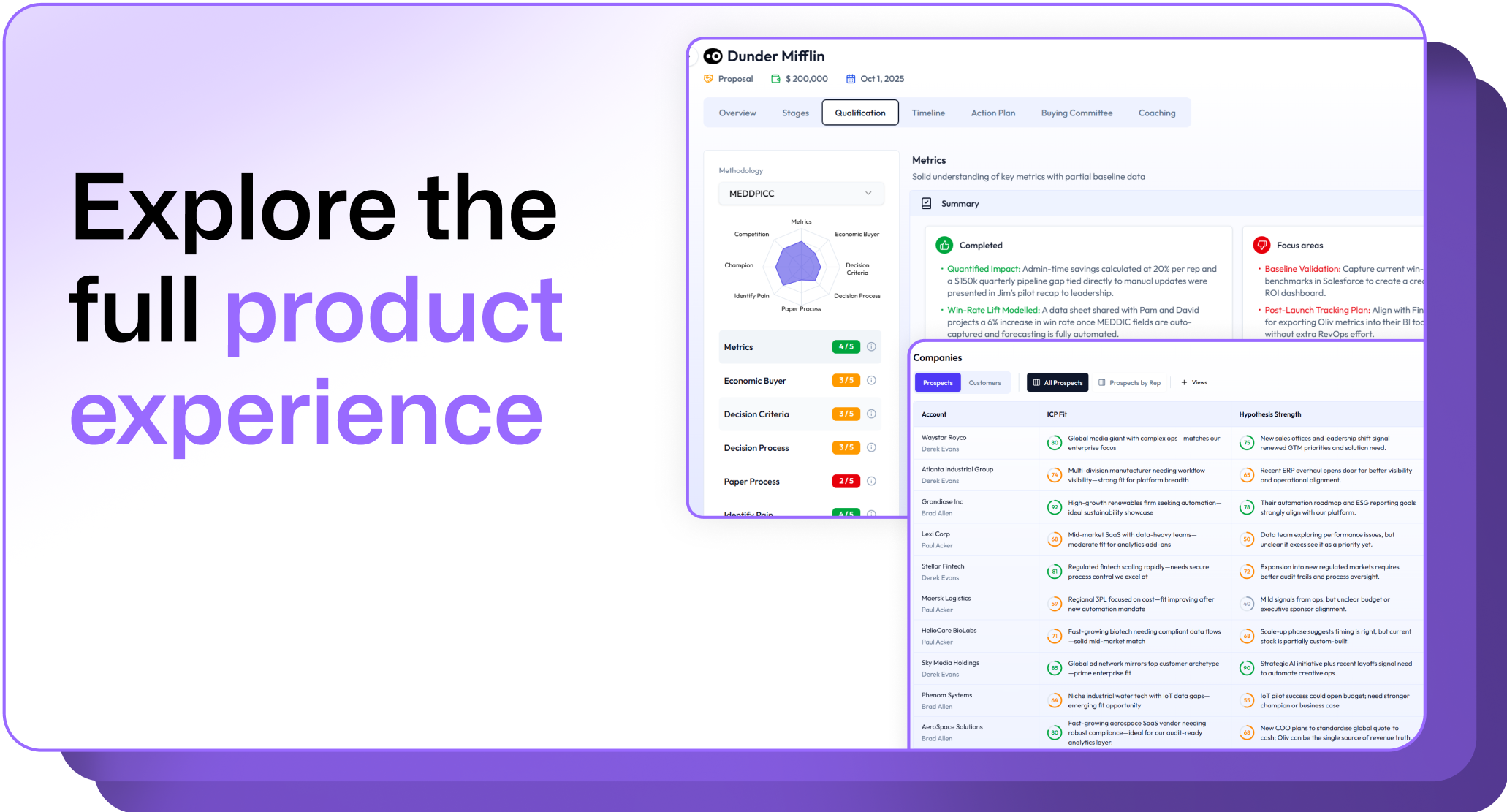
.avif)