What is Avoma Platform? Features, Use Cases, Pricing & Alternatives
Written by
Ishan Chhabra
Last Updated :
December 10, 2025
Skim in :
6
mins
In this article
Still got questions?
Come discuss this article with me.
Hi, I'm Ishan, Founder and CEO of Oliv.
I'm always up for a conversation about revenue intelligence, AI agents, or what's actually working (and what's not) across revenue teams.
I'd love to hear your perspective.
Thank you! Your submission has been received!
Oops! Something went wrong while submitting the form.
Meet Oliv’s AI Agents
Hi! I’m, Deal Driver
I track deals, flag risks, send weekly pipeline updates and give sales managers full visibility into deal progress
Hi! I’m, CRM Manager
I maintain CRM hygiene by updating core, custom and qualification fields all without your team lifting a finger
Hi! I’m, Forecaster
I build accurate forecasts based on real deal movement and tell you which deals to pull in to hit your number
Hi! I’m, Coach
I believe performance fuels revenue. I spot skill gaps, score calls and build coaching plans to help every rep level up
Hi! I’m, Prospector
I dig into target accounts to surface the right contacts, tailor and time outreach so you always strike when it counts
Hi! I’m, Pipeline tracker
I call reps to get deal updates, and deliver a real-time, CRM-synced roll-up view of deal progress
Hi! I’m, Analyst
I answer complex pipeline questions, uncover deal patterns, and build reports that guide strategic decisions
TL;DR
Reliability concerns dominate user feedback: Recorders frequently fail to join calls on time or drop mid-meeting, creating conversation capture gaps that undermine core value.
$100/seat pricing misleads total cost: Teams need additional forecasting tools ($50-100/seat extra), plus 2-4 weeks training overhead creates $150-200 real stack cost per user.
Pre-generative AI architecture limits intelligence: Basic keyword matching and generic summarization require extensive manual editing—managers still review call libraries for coaching insights.
Contract inflexibility creates financial risk: Users report paying for double the seats needed (87 purchased, 48 active) with repeated renegotiation refusals from Avoma.
AI-native alternatives deliver superior ROI: Oliv AI provides deal-level intelligence with autonomous agents at $19-89/user—saving $24K+ annually for 50-user teams with zero training required.
Meeting-level vs deal-level intelligence gap: Avoma treats conversations independently; modern platforms synthesize insights across calls, emails, meetings throughout entire sales cycles.
Q1. What is Avoma Platform? [toc=Platform Overview]
Avoma is an all-in-one AI meeting assistant and conversation intelligence platform founded in 2017, designed to automate note-taking, transcription, and conversation analysis for revenue teams. The platform combines four core modules: AI Meeting Assistant (automated recording and transcription), Scheduler & Lead Router (meeting booking and lead distribution), Conversation Intelligence (call scoring and analytics), and Revenue Intelligence (deal risk tracking and CRM automation). Positioned as a budget-friendly alternative to enterprise platforms like Gong, Avoma targets small-to-medium businesses with fewer than 200 employees, offering pricing starting at approximately $19/user/month with no platform fees.
❌ The Pre-Generative AI Reality
Avoma represents the previous generation of conversation intelligence platforms built on keyword matching and rule-based automation rather than modern generative AI. This architectural limitation creates fundamental reliability and data quality issues that users consistently report. The platform's recorders frequently fail to join calls on time or drop randomly mid-meeting, creating critical gaps in conversation capture.
"We see it show up late, drop from calls randomly and sometimes just not show up. If there are two account holders on one call, we have seen it show up twice." — Aleshia R., Client Director G2 Verified Review
Transcription accuracy struggles significantly, with users reporting approximately 80% accuracy compared to modern standards of 95%+. Speaker identification errors frequently misattribute quotes to the wrong participants, undermining coaching effectiveness.
"I think sometimes its highly inaccurate - does not pick up the right notes - or the right person speaking - it does not accurately capture sometimes and it sometimes misquoting the wrong person on the call." — Verified User in Consulting G2 Verified Review
The platform's intelligence remains limited to basic summarization—essentially functioning as a glorified note-taker rather than a true conversation intelligence system. Analysis operates at the meeting level, treating each conversation independently without synthesizing patterns across the entire buyer journey.
✅ The Generative AI Transformation
Modern conversation intelligence requires contextual understanding far beyond keyword tracking. Generative AI-native platforms leverage fine-tuned Large Language Models that comprehend sentiment in business context, automatically extract methodology frameworks like MEDDIC and BANT, detect implicit buying signals (e.g., "we need this operational by Q2" indicates timeline urgency and budget confirmation), and synthesize insights across multiple meetings, emails, and activities throughout the entire sales cycle. This enables autonomous agent workflows that proactively deliver insights rather than requiring manual dashboard monitoring and call library reviews—a fundamental shift in revenue intelligence architecture.
🚀 How Oliv.ai Delivers AI-Native Intelligence
Oliv is built GPT-first with deal-level intelligence (not meeting-level snippets). The platform delivers 99.9% recording reliability with 5-10 minute transcript processing—eliminating Avoma's documented recorder failures and delays. Key autonomous agents include:
Meeting Assistant Agent: Delivers automated prep notes 30 minutes before calls (analyzing past interactions, extracting key takeaways, identifying recommended next steps), eliminating manual research
Deal Driver Agent: Provides proactive deal risk alerts with specific issues identified (e.g., "Deal X: 3 rescheduled meetings, no executive engagement in 4 weeks")
CRM Manager Agent: Auto-creates accounts/contacts, enriches records with LinkedIn data, updates deal notes after every meeting—zero manual data entry required
Analyst Agent: Executes complex strategic queries in plain English (e.g., "show deals where Competitor X appeared and we lost, by loss reason") with visual dashboards
Oliv's modular pricing starts at $19/user for basic intelligence, with specialized agents available à la carte ($29-199 per role) versus Avoma's fixed $100/seat.
"It sometimes takes a little while for the Avoma note taker to join a meeting. Sometimes the speaker names aren't captured." — Amrit D., Customer Success Manager G2 Verified Review
Q2. What Are Avoma's Core Features and Capabilities? [toc=Core Features]
Avoma's platform architecture consists of four integrated modules designed to cover the complete meeting workflow and revenue operations cycle. Understanding each module's capabilities—and limitations—is essential for sales leaders evaluating conversation intelligence investments.
Four-panel diagram showcasing Avoma's core platform modules including AI meeting assistant for automated recording and transcription, scheduler with lead routing, conversation intelligence for call analysis, and revenue intelligence delivering automated CRM updates and deal risk tracking.
📋 Four-Module Overview
1. AI Meeting Assistant ($19/user/month): Provides automatic meeting recording, live transcription in 40+ languages, AI-generated note-taking with custom templates, smart chapters for topic navigation, follow-up email drafts, and basic CRM data entry.
2. Scheduler & Lead Router ($19/user/month add-on): Automates 1:1 and round-robin scheduling, lead qualification from web forms, inbound routing with complex distribution rules, and outbound handoff between SDRs and AEs.
3. Conversation Intelligence ($59/user/month): Adds AI-driven conversation analysis with smart trackers for keywords/topics, talk ratio monitoring, sentiment scoring, engagement insights, and AI-generated coaching scorecards for identifying rep skill gaps.
4. Revenue Intelligence ($79/user/month): Includes automated CRM field updates for MEDDIC/BANT/SPICED frameworks, deal risk analysis and alerts, pipeline health tracking, roll-up forecasting reports, and optional AI-powered win-loss analysis.
Avoma promises quantified benefits: 4+ hours saved per week, 40% win rate improvement, and 30% faster quota attainment.
⚠️ Reliability & Data Quality Issues
Users consistently report fundamental execution failures. Recorders fail to join calls on time, creating missed conversation opportunities. Transcription quality struggles with non-native English speakers and technical terminology, requiring extensive manual editing before notes can be shared with stakeholders.
"The actual transcript isn't all that great/clean. I mean it's fine - but nothing to write home about." — Verified Healthcare User G2 Verified Review
"It can still be a little fluky with some transcriptions and does seem challenged at times when I speak with non native English speakers." — KJ J., Senior Talent Recruiter G2 Verified Review
Speaker identification errors misattribute quotes to wrong participants, undermining the coaching use case. Basic AI summarization provides generic bullet points—users report spending more time correcting inaccurate notes than they would have spent taking them manually. The platform operates with a 5-meeting concurrency cap, creating bottlenecks for teams with overlapping calls.
✅ The Evolution to Contextual Intelligence
Modern platforms leverage generative AI for semantic understanding, not literal keyword matching. Advanced systems detect implicit buying signals automatically (e.g., "our CFO is asking questions" signals executive engagement), analyze competitive positioning strength with recommended responses, score methodology compliance (MEDDIC/BANT/SPICED) without manual configuration, and proactively alert managers to at-risk deals with specific recommended actions—not generic "at risk" labels. This represents the shift to revenue orchestration platforms that take autonomous action.
🎯 Oliv's Superior Feature Execution
Meeting Assistant Agent delivers automated prep notes 30 minutes before calls, real-time MEDDIC/BANT/SPICED scoring during conversations with automatic CRM field population, and instant post-call CRM updates with enriched context—eliminating all manual work.
Conversation Intelligence operates at deal-level, analyzing patterns across all touchpoints (calls + emails + meetings + LinkedIn activity) to generate unified deal summaries—a "single source of truth" versus Avoma's isolated meeting-level snippets.
Revenue Intelligence Agents:
Forecaster Agent ($49/manager): Produces weekly call/upside/commit roll-ups with AI-generated commentary on what changed (new deals added, deals slipped), what's at risk with specific flags ("Deal X: 3 rescheduled meetings, no executive engagement"), and what's needed to hit targets—eliminating manual forecast compilation
Deal Driver Agent ($199/manager): Proactively flags deals requiring immediate attention with specific issues identified, enabling managers to intervene before opportunities are lost
Analyst Agent ($4,999 org-wide): Executes ad-hoc strategic queries ("show stalled deals in legal review") with curated datasets and visual dashboards
Oliv processes unlimited concurrent meetings versus Avoma's 5-meeting cap.
"We are paying for double the amount of seats that we need. We only have 48 active users and are paying for 87... Multiple times they flat out refused [to renegotiate]." — Jessica W., IT Specialist G2 Verified Review
Q3. How Does Avoma's AI Meeting Assistant Work? [toc=Meeting Assistant Setup]
Avoma's AI Meeting Assistant serves as the foundational layer of the platform, handling recording, transcription, and basic note-taking across video conferencing platforms. Understanding the technical setup, capabilities, and documented limitations helps revenue leaders assess deployment readiness and compare with modern AI meeting assistants.
🔧 Recording Setup & Integration
Avoma's recording bot joins meetings automatically on Zoom, Microsoft Teams, and Google Meet once calendar integration is configured. Setup requires connecting your Google Calendar or Outlook calendar to Avoma's system, which typically takes 15-30 minutes. The bot appears as "Avoma Notetaker" in participant lists, announcing "This meeting is being recorded" after joining.
CRM Integration: Avoma connects bidirectionally with Salesforce and HubSpot, automatically logging meeting recordings, transcripts, and AI-generated summaries to appropriate contact, deal, or company records. Field mapping configuration allows custom CRM fields to be populated based on conversation content—similar to Gong's integration approach but with more manual configuration required.
Dialer Integration: Compatible with HubSpot Dialer, Aircall, and Dialpad, enabling automatic recording of phone conversations in addition to video meetings.
🌍 Language Support Specifications
Avoma supports 40+ languages including English, Spanish, Mandarin Chinese, Hindi, French, German, Japanese, Arabic, Portuguese, and 30+ additional languages. However, transcription accuracy varies significantly by language—users report challenges with non-native English speakers and dialectal variations.
The platform provides real-time live transcription during calls, allowing participants to follow along. However, processing for final AI-generated summaries and smart chapters typically requires additional time after the meeting concludes.
⚙️ Technical Capabilities & Limitations
Recording Features:
Automatic video and audio capture
Cloud-based storage with playback capabilities
Timestamp-synced transcripts (click paragraph to jump to recording moment)
Smart chapters automatically organizing conversation by topic
Concurrent meeting limit: 5 meetings maximum
Note-Taking Automation:
AI-generated meeting summaries with custom templates
Manual editing capabilities for transcript corrections
❌ Documented Reliability Issues
User feedback consistently highlights execution failures that undermine the core value proposition:
"I wish the 'this call will be recorded' message was sooner in the call. I find it annoying when I'm talking with a client and it says that a minute or so into the meeting." — Kara J., Customer Success Manager G2 Verified Review
"On asking to join impromptu, sometimes it take a few minutes to join." — Nikita N., Co-Founder G2 Verified Review
The 5-meeting concurrency cap creates bottlenecks for growing teams with overlapping calls. Storage limitations and delayed processing impact real-time use cases.
✅ How Oliv.ai Simplifies Meeting Intelligence
Oliv automates the entire meeting workflow with superior reliability: 99.9% uptime guarantee with enterprise-grade failover infrastructure, unlimited concurrent meetings at all pricing tiers, 5-10 minute processing delivering transcripts nearly instantly, and 40+ language support with contextual understanding (not just word-for-word transcription). The Meeting Assistant Agent delivers prep notes 30 minutes before calls automatically, eliminating manual CRM review. Setup completes in 1-2 days with zero training required—agents work immediately without user adoption curves, similar to the simplified implementation modern platforms offer compared to legacy tools.
Q4. What Are Avoma's Conversation Intelligence Capabilities? [toc=Conversation Intelligence]
Avoma's Conversation Intelligence tier ($59/user/month) adds analytical capabilities beyond basic transcription, aiming to help sales managers identify rep skill gaps, track competitive mentions, and monitor deal progression signals. However, the platform's keyword-based approach reveals significant limitations compared to modern contextual AI systems like those discussed in Gong's analytics capabilities.
📊 Conversation Intelligence Features
Avoma's CI module includes:
Smart Trackers: Keyword and topic tracking for competitor mentions, pricing discussions, objection keywords, and custom business terms
Talk Ratio Analysis: Monitors rep vs. prospect speaking time to identify monologuing issues
Engagement Insights: Question frequency, longest monologue detection, filler word tracking
AI-Generated Coaching Scorecards: Customizable rubrics for evaluating rep performance on discovery, objection handling, and closing techniques
Managers can configure smart trackers to receive notifications when specific keywords appear in calls, enabling competitive intelligence tracking and methodology compliance monitoring.
❌ Rule-Based Intelligence Limitations
Avoma's keyword tracking operates on literal matching—it detects when "competitor X" is mentioned but lacks contextual understanding of whether it's a serious competitive threat or dismissive comment. This creates false positives requiring manual review to interpret actual significance.
Sentiment analysis provides generic positive/negative scoring without business context. For example, frustrated tone about a current vendor (which creates buying opportunity) gets flagged generically as "negative sentiment" rather than recognizing it as a purchase signal—a limitation not found in modern revenue orchestration platforms.
"I find the AI call scoring to be gimmicky and provides little value - but that might be because I have not done enough to set up my scoring templates?" — Miles W., Senior Manager, Customer Success G2 Verified Review
Coaching scorecards require extensive manual configuration of rubrics and still necessitate manager call library review. Despite automation promises, managers spend hours listening to recordings to provide meaningful coaching feedback because automated scoring lacks nuance.
"Sometimes the transcripts aren't 100% accurate. This is okay if I am the one reviewing them, but if I have to send to a colleague or manager to review, sometimes it is time consuming to clarify or amend the errors." — Maddy H., Learning and Development Specialist G2 Verified Review
✅ Generative AI's Contextual Advantage
Modern systems understand semantic meaning and business context, not just keywords. They automatically detect implicit buying signals (e.g., "we need this operational by Q2" = timeline urgency + budget confirmation), analyze competitive positioning strength with recommended differentiation talking points, score MEDDIC/BANT/SPICED methodology compliance without manual configuration, and proactively alert managers to specific coaching opportunities (e.g., "Rep Y struggling with discovery: avg 2 questions per call vs team benchmark of 8")—capabilities central to revenue intelligence evolution.
Progressive roadmap illustrating conversation intelligence evolution from limited keyword tracking lacking contextual understanding through coaching agents, analyst agents, and deal-level intelligence to contextual AI understanding delivering semantic meaning and business context through generative AI technology transformation.
🎯 Oliv's Agentic Conversation Intelligence
Coaching Agent automatically scores every call against custom rubrics, identifies specific skill gaps with timestamped examples (discovery quality, objection handling, demo effectiveness), and delivers weekly coaching insights directly to manager inboxes—zero manual call review required
Analyst Agent executes complex queries like "show all deals where Competitor X appeared and we lost, broken down by loss reason" with visual dashboards, deal-specific recording links, and AI-generated interpretive commentary on patterns—replacing weeks of manual report building.
Deal-Level Intelligence synthesizes insights across all touchpoints (calls + emails + meetings + LinkedIn activity) to generate unified deal summaries, auto-populated MEDDIC scorecards updated after each interaction, and next-step recommendations tied to deal stage and buyer signals.
Avoma CI vs Oliv AI Agents Comparison
Feature
Avoma CI
Oliv AI Agents
Intelligence Type
Keyword matching
Contextual understanding
Analysis Scope
Meeting-level
Deal-level synthesis
Manager Workflow
Manual call review
Zero review required
Coaching Delivery
Dashboard checking
Proactive inbox alerts
Q5. What Are Avoma's Revenue Intelligence Features? [toc=Revenue Intelligence]
Avoma's Revenue Intelligence tier ($79/user/month) represents the platform's most advanced offering, designed to help RevOps and sales managers maintain CRM data hygiene, identify at-risk deals, and prepare forecasts with conversation-derived insights. The module includes automated CRM field updates based on conversation extraction, deal risk scoring with activity gap detection, pipeline health tracking, win-loss analysis frameworks, and forecasting support. It supports methodology tracking for MEDDIC, BANT, SPICED, and NEAT through custom field mapping—similar to Clari's features but with more manual intervention required.
❌ Manual Intervention Requirements
Avoma's CRM automation captures basic meeting data (attendees, duration, topics discussed) but requires extensive field mapping configuration and ongoing accuracy monitoring. Deal risk scoring operates on simple rules (e.g., no activity in 14 days, negative sentiment keywords) without understanding deal context or stage-appropriate timelines. Forecasting "support" means managers still manually compile weekly forecasts using Avoma's data as one input—no automated rollup or AI-generated commentary.
"We are paying for double the amount of seats that we need. We only have 48 active users and are paying for 87... Multiple times they flat out refused [to renegotiate]." — Jessica W., IT Specialist G2 Verified Review
Win-loss analysis requires manual deal tagging and loss reason categorization. MEDDIC/BANT/SPICED framework data must be manually extracted from notes and populated into custom CRM fields—undermining the automation promise.
✅ Agentic Revenue Intelligence Evolution
Modern RI platforms autonomously execute end-to-end workflows: (1) Auto-update CRMs with enriched context (conversation themes, buyer concerns, methodology scoring, recommended next steps), (2) Generate bottom-up forecasts with AI commentary on what changed week-over-week and what actions are needed to hit targets, (3) Run win-loss analyses automatically by analyzing conversation patterns across closed deals, (4) Proactively flag deals requiring intervention based on multi-signal analysis with specific recommended actions—the fundamental shift from revenue intelligence to orchestration.
🎯 Oliv's Autonomous RI Agents
💰 CRM Manager Agent ($29/rep): Creates missing accounts/contacts automatically, enriches records with LinkedIn data, updates deal notes with synthesized insights after every meeting, populates MEDDIC/BANT/SPICED fields based on conversation analysis—maintaining spotless data hygiene without rep effort
📊 Forecaster Agent ($49/manager): Produces weekly call/upside/commit roll-ups with AI-generated commentary on what changed (new deals added, deals slipped), what's at risk with specific flags ("Deal X: 3 rescheduled meetings, no executive engagement"), and what's needed to hit targets—completely eliminating manual forecast compilation.
⚠️ Deal Driver Agent ($199/manager): Analyzes entire pipeline daily, flags deals requiring immediate attention with specific issues identified, provides weekly progress breakdowns showing deal velocity and health trends.
📈 Analyst Agent ($4,999 org-wide unlimited queries): Answers ad-hoc strategic questions ("which deals are stalled in legal review?") with curated datasets, visual dashboards, and interpretive AI commentary—replacing manual report building.
💸 Total Cost Advantage
While Avoma charges $79/seat for basic RI, companies typically need additional forecasting tools like Clari alternatives ($50-100/seat), creating $150-200/seat total cost. Oliv's modular approach delivers comprehensive RI at $19-49/user plus manager-specific agents ($49-199 per manager), saving $78,600-96,600 annually for a 50-user team (40 reps + 10 managers).
Q6. What Are Avoma's Primary Use Cases by Role? [toc=Use Cases by Role]
Understanding how different revenue team roles interact with Avoma reveals the platform's practical value—and critical gaps—across the sales organization. Each persona requires specific capabilities that determine whether conversation intelligence delivers genuine productivity gains or creates additional administrative overhead, especially compared to modern agentic alternatives.
Matrix visualization mapping Avoma use cases across sales roles by automation level, displaying high role-specific applications like account executives manually reviewing calls, sales managers using coaching agents, revenue operations building dashboards, and customer success leveraging sentiment tracking.
👔 Sales Managers
Coaching Workflow: Despite coaching scorecards, managers must manually review call libraries to extract meaningful coaching insights. Smart trackers flag keyword mentions, but lack contextual understanding requires human interpretation.
"I find the AI call scoring to be gimmicky and provides little value - but that might be because I have not done enough to set up my scoring templates?" — Miles W., Senior Manager, Customer Success G2 Verified Review
Forecast Preparation: Avoma provides data input, but managers still manually compile weekly forecasts using spreadsheets and multiple data sources—a stark contrast to platforms offering automated forecasting like Gong.
Pipeline Reviews: Dashboard-based insights require interpretation—deal risk alerts operate on simple activity rules without business context.
💼 Account Executives
Pre-Call Prep: Manual review of past meeting notes and CRM records remains necessary—no automated prep briefings delivered before calls.
During-Call Experience: Live transcription visible with smart tracker keyword alerts. However, speaker identification errors frequently misattribute quotes.
Post-Call Follow-Up: AI-generated summaries require extensive editing before sharing with stakeholders. Action items need verification for accuracy.
"Sometimes the transcripts aren't 100% accurate. This is okay if I am the one reviewing them, but if I have to send to a colleague or manager to review, sometimes it is time consuming to clarify or amend the errors." — Maddy H., Learning and Development Specialist G2 Verified Review
CRM Updates: Automated logging helps, but field accuracy requires manual checking and corrections.
📊 Revenue Operations
CRM Data Hygiene: Automated meeting logging provides partial coverage but remains incomplete—requires ongoing monitoring and cleanup.
Reporting & Analytics: Conversation data enriches reports, but manual dashboard building needed for strategic insights.
Methodology Compliance: MEDDIC/BANT/SPICED fields must be configured, validated, and manually extracted from notes.
🤝 Customer Success
Account Health Monitoring: Sentiment tracking across customer calls provides basic signals for engagement trends.
Churn Risk Identification: Activity gap detection and negative sentiment alerts flag potential issues, though context-free.
QBR Preparation: Meeting summaries provide input, but manual compilation required for comprehensive business reviews.
AEs get Meeting Assistant (automated prep 30 min before calls), Researcher (account intelligence and hypothesis), CRM Manager (zero manual updates).
RevOps get Analyst Agent (ad-hoc queries without manual reports).
Each role gets precisely what they need without paying for unused capabilities—modular agent selection per role versus fixed seat pricing, enabling revenue orchestration at scale.
Q7. How Much Does Avoma Cost? (Pricing, Hidden Costs & Total Ownership) [toc=Pricing & Total Cost]
Avoma's pricing structure positions the platform as a budget-friendly conversation intelligence alternative, but understanding the complete financial picture requires examining contract terms, hidden implementation costs, and total ownership reality beyond advertised seat prices—especially when compared to enterprise platforms like Gong.
💰 Pricing Structure
AI Meeting Assistant: $19/user/month (basic recording and transcription only)
Annual commitment required for listed rates. Monthly billing available at ~20% premium. Key positioning: "budget-friendly Gong alternative" with no platform fees—a major differentiator from enterprise platforms charging $150-250/seat plus mandatory setup fees.
❌ Hidden Costs & Contract Inflexibility
Users report being locked into paying for double the seats needed. Implementation requires significant overhead: training users to edit inaccurate transcripts, configuring smart trackers manually, setting up CRM field mappings—typically 2-4 weeks adoption curve.
"We are paying for double the amount of seats that we need. We only have 48 active users and are paying for 87... Multiple times they flat out refused [to renegotiate]." — Jessica W., IT Specialist G2 Verified Review
Many teams discover they need additional tools: forecasting platforms like Clari ($50-100/seat) because Avoma's "forecasting support" isn't autonomous, eroding affordability from $79 to $150-200 total stack cost per seat.
Poor reliability creates productivity tax—time spent troubleshooting missed recordings, correcting inaccurate transcripts (80% accuracy requires significant editing), and manually filling conversation gaps when recordings drop mid-call.
✅ Modern Modular Pricing Philosophy
Agent architectures enable paying only for agents solving specific jobs—not monolithic software licenses. BDRs don't need forecasting agents, individual contributors don't need coaching oversight tools. Transparent monthly billing with flexible scaling eliminates contract lock-in risks—a fundamental shift in revenue intelligence pricing models.
🎯 Oliv's Value Proposition
Starter ($19/user): Unlimited recording, transcription, AI summaries—matches Avoma's entry price with superior reliability (99.9% vs documented failures)
Standard ($49/user): Role-specific meeting insights, tailored follow-ups, meeting prep
Supreme ($89/user): Deal-level intelligence with MEDDIC/BANT/SPICED auto-scoring, automated CRM updates, deal insights 30 min before meetings
Modular Agents à la carte:
CRM Manager: $29/rep (eliminates all manual CRM work)
Initial Setup: 15-30 minutes to connect CRM (Salesforce/HubSpot) and conferencing platforms (Zoom/Teams/Google Meet).
User Training Requirements: 2-3 hours per user to learn note editing, smart tracker configuration, and coaching scorecard setup.
Adoption Curve: Typically 2-4 weeks until team achieves consistent usage—requires ongoing configuration refinement, significantly longer than modern implementations.
Configuration Needs (manual admin work):
Smart tracker keyword lists for competitor mentions, pricing discussions, objections
Coaching scorecard rubrics customized to sales methodologies
CRM field mappings for MEDDIC/BANT/SPICED framework tracking
Custom templates for meeting summaries and follow-up emails
⚠️ Ongoing Maintenance Overhead
"Sometimes the speaker names aren't captured. I wish that could be more accurate." — Amrit D., Customer Success Manager G2 Verified Review
Teams must continuously monitor automated CRM updates for accuracy and correct errors, review and refine smart tracker keywords producing false positives/negatives, troubleshoot recording failures (documented recurring issue), and manage seat allocation to avoid contract overpayment.
🌍 Enterprise Deployment Considerations
Multi-Region Challenges: 40+ languages supported but transcription quality varies significantly for non-native English speakers and dialectal variations.
Concurrency Limitations: 5 concurrent meeting cap creates bottlenecks for large teams with overlapping calls—enterprise tier negotiation may be required.
Limited API Access: Custom integration capabilities restricted compared to platforms offering comprehensive API documentation.
✅ Oliv's Enterprise-Grade Alternative
Oliv provides 1-2 day setup with zero training required—agents work autonomously without user learning curves. Enterprise security built-in across all tiers: SOC 2, GDPR, HIPAA-ready, multi-region data residency. 99.9% reliability with automatic failover eliminates troubleshooting overhead. No ongoing maintenance—agents self-optimize based on usage patterns. Unlimited concurrent meetings at all tiers. Comprehensive API access for custom workflows, representing the next generation of revenue orchestration.
Q9. What Are the Best Avoma Alternatives in 2025? [toc=Best Alternatives]
Revenue teams frustrated with Avoma's reliability issues, poor transcription accuracy, and contract inflexibility are evaluating platforms across three distinct categories: (1) AI-native agentic platforms (Oliv AI) with autonomous workflow execution, (2) Enterprise legacy platforms (Gong at ~$250/seat, Clari, Chorus) offering depth but at prohibitive costs with 3-6 month implementations, (3) Simple transcription tools (Fireflies at $39/seat, Otter, Fathom) providing reliable recording without conversation intelligence—a landscape detailed in comprehensive alternatives guides.
❌ Traditional Alternatives' Limitations
Gong (~$250/seat bundled) delivers enterprise-grade analytics but: built on pre-generative AI keyword tracking, requires 3-6 month implementations with dedicated project teams, charges mandatory platform fees and per-seat module costs, operates reactively (users check dashboards—no proactive delivery), creates complex pricing obscuring true ownership costs ($150-350/seat depending on modules)—as analyzed in Gong pricing breakdowns.
"I find the AI call scoring to be gimmicky and provides little value - but that might be because I have not done enough to set up my scoring templates?" — Miles W., Senior Manager, Customer Success G2 Verified Review
Fireflies ($39/seat) provides genuinely reliable transcription but offers zero conversation intelligence (no call scoring, coaching, sentiment analysis), no CRM automation beyond basic meeting logging, no forecasting—purely note-taking replacement.
Common Pattern: All require manual configuration, extensive training, ongoing human oversight—they surface data but humans must interpret and act, unlike modern agentic platforms.
✅ Why AI-Native Architecture Matters
First-generation CI platforms (Gong, Avoma, Chorus, built 2015-2019) were architected before generative AI existed, relying on pattern recognition and keyword matching. They require humans to: configure rules/trackers, interpret dashboards, review call libraries for coaching, manually compile forecasts, take all CRM actions.
Second-generation agentic platforms leverage fine-tuned LLMs for true contextual understanding (semantic meaning, business context awareness, emotional intelligence tied to deal signals) and autonomous execution—agents complete workflows end-to-end without human intervention. This eliminates the "SaaS software you must adopt and train teams to use" paradigm, replacing it with "agents that work autonomously while you focus on selling"—the fundamental shift to revenue orchestration.
🎯 Oliv AI: The Modern Alternative
Only generative AI-native platform built on agent architecture from day one. Delivers enterprise capabilities at mid-market prices: $19-89/user (40-64% less than Gong's $150-250). Implements in 1-2 days versus weeks/months (zero training—agents work immediately).
Five Core Differentiators:
Deal-level intelligence across calls/emails/meetings versus meeting-level snippets (unified "single source of truth")
Proactive insight delivery: Prep notes 30 min before calls automatically, coaching insights to manager inboxes weekly, deal risk alerts daily—no checking required
Autonomous execution: CRM Manager updates records without rep action, Forecaster generates weekly roll-ups without manager compilation
99.9% reliability with unlimited concurrent meetings versus Avoma's documented failures and 5-meeting cap
True contextual understanding: Detects implicit buying signals, understands sentiment in business context, auto-scores MEDDIC without configuration
Platform Comparison: Avoma vs Oliv AI vs Gong vs Fireflies
Platform
Price
AI Tech
Implementation
Best For
Oliv AI
$19-89/user
Generative AI-native
1-2 days
Unified RI
Gong
~$250/user
Pre-gen AI
3-6 months
Enterprise budget
Avoma
~$100/user
Legacy AI
1-2 weeks
Micro SMBs
Fireflies
$39/user
Basic transcription
Same day
Note-taking only
Q10. Avoma vs Oliv AI: Which Platform Should You Choose? [toc=Avoma vs Oliv]
Sales leaders evaluating Avoma typically seek affordable conversation intelligence to replace manual note-taking and avoid Gong's enterprise costs ($250/seat). However, the real decision isn't "Avoma versus Oliv"—it's "pre-generative AI keyword tracking versus AI-native agentic intelligence" or "software you must adopt versus agents that work autonomously"—a distinction explored in platform comparisons.
❌ Avoma's Documented Limitations
Positioned as budget-friendly CI for SMBs at $100/seat with no platform fees, built on pre-generative AI technology from 2017. Reliability issues extensively documented: recorders fail to join calls on time, drop randomly mid-call, or appear twice when multiple users on same call.
"We see it show up late, drop from calls randomly and sometimes just not show up. If there are two account holders on one call, we have seen it show up twice." — Aleshia R., Client Director G2 Verified Review
Transcription quality struggles: ~80% accuracy versus modern 95% standards, poor speaker identification misattributing quotes, requires extensive manual editing before sharing notes.
"I think sometimes its highly inaccurate - does not pick up the right notes - or the right person speaking - it does not accurately capture sometimes and it sometimes misquoting the wrong person on the call." — Verified User in Consulting G2 Verified Review
Intelligence limited to basic keyword matching and generic summarization. Smart trackers detect literal keyword mentions without contextual understanding. Manual processes dominate: managers review call libraries for coaching despite automated scorecards, reps edit transcripts and verify CRM updates, RevOps manually compile forecasts.
Contract inflexibility: Verified user paying for 87 seats with only 48 active, company repeatedly refused renegotiation—sunk cost without ROI.
✅ Paradigm Shift: Traditional SaaS vs Agentic AI
Avoma represents "Traditional SaaS"—software platforms teams must adopt, configure extensively, train users on, and manually operate through ongoing oversight. Users become software administrators managing complex systems.
Oliv represents "Agentic AI"—autonomous agents executing workflows end-to-end without human oversight, eliminating adoption burden. Users remain focused on selling while agents handle operational work—the core of revenue orchestration evolution.
🎯 Oliv's Advantages Across Every Dimension
💰 Reliability: 99.9% uptime with enterprise failover versus Avoma's documented failures; 5-10 minute processing versus delays; unlimited concurrent meetings versus 5-meeting cap.
🧠 Intelligence Depth: Deal-level synthesis across calls/emails/meetings creating unified "single source of truth" versus meeting-level isolated snippets; MEDDIC/BANT/SPICED auto-scoring after every interaction versus manual framework tracking.
⚡ Automation: Meeting Assistant delivers prep notes 30 min before calls versus manual CRM review; CRM Manager auto-creates accounts/contacts, enriches records, updates deal notes—zero rep effort versus manual data entry; Forecaster generates weekly roll-ups with AI commentary versus manual spreadsheet compilation.
💸 Pricing: Modular at $19-89/user plus à la carte manager agents ($49-199 per manager) versus fixed $100/seat; transparent monthly/annual options versus inflexible contracts; total cost for 50-user team = $60,540 Oliv versus $84,900 Avoma + stacking = $24,360 annual savings (28.7%).
⏰ Implementation: 1-2 days with zero training versus 2-4 weeks adoption curve.
📋 Decision Framework
Choose Avoma only if: micro SMB (<15 employees) with extreme budget constraints, very basic transcription needs only, tolerance for reliability issues.
Choose Oliv AI if: need reliable conversation capture, want deal-level intelligence, seek autonomous agents, desire modular pricing, require comprehensive RI in single platform—delivering next-generation revenue orchestration.
Q1. What is Avoma Platform? [toc=Platform Overview]
Avoma is an all-in-one AI meeting assistant and conversation intelligence platform founded in 2017, designed to automate note-taking, transcription, and conversation analysis for revenue teams. The platform combines four core modules: AI Meeting Assistant (automated recording and transcription), Scheduler & Lead Router (meeting booking and lead distribution), Conversation Intelligence (call scoring and analytics), and Revenue Intelligence (deal risk tracking and CRM automation). Positioned as a budget-friendly alternative to enterprise platforms like Gong, Avoma targets small-to-medium businesses with fewer than 200 employees, offering pricing starting at approximately $19/user/month with no platform fees.
❌ The Pre-Generative AI Reality
Avoma represents the previous generation of conversation intelligence platforms built on keyword matching and rule-based automation rather than modern generative AI. This architectural limitation creates fundamental reliability and data quality issues that users consistently report. The platform's recorders frequently fail to join calls on time or drop randomly mid-meeting, creating critical gaps in conversation capture.
"We see it show up late, drop from calls randomly and sometimes just not show up. If there are two account holders on one call, we have seen it show up twice." — Aleshia R., Client Director G2 Verified Review
Transcription accuracy struggles significantly, with users reporting approximately 80% accuracy compared to modern standards of 95%+. Speaker identification errors frequently misattribute quotes to the wrong participants, undermining coaching effectiveness.
"I think sometimes its highly inaccurate - does not pick up the right notes - or the right person speaking - it does not accurately capture sometimes and it sometimes misquoting the wrong person on the call." — Verified User in Consulting G2 Verified Review
The platform's intelligence remains limited to basic summarization—essentially functioning as a glorified note-taker rather than a true conversation intelligence system. Analysis operates at the meeting level, treating each conversation independently without synthesizing patterns across the entire buyer journey.
✅ The Generative AI Transformation
Modern conversation intelligence requires contextual understanding far beyond keyword tracking. Generative AI-native platforms leverage fine-tuned Large Language Models that comprehend sentiment in business context, automatically extract methodology frameworks like MEDDIC and BANT, detect implicit buying signals (e.g., "we need this operational by Q2" indicates timeline urgency and budget confirmation), and synthesize insights across multiple meetings, emails, and activities throughout the entire sales cycle. This enables autonomous agent workflows that proactively deliver insights rather than requiring manual dashboard monitoring and call library reviews—a fundamental shift in revenue intelligence architecture.
🚀 How Oliv.ai Delivers AI-Native Intelligence
Oliv is built GPT-first with deal-level intelligence (not meeting-level snippets). The platform delivers 99.9% recording reliability with 5-10 minute transcript processing—eliminating Avoma's documented recorder failures and delays. Key autonomous agents include:
Meeting Assistant Agent: Delivers automated prep notes 30 minutes before calls (analyzing past interactions, extracting key takeaways, identifying recommended next steps), eliminating manual research
Deal Driver Agent: Provides proactive deal risk alerts with specific issues identified (e.g., "Deal X: 3 rescheduled meetings, no executive engagement in 4 weeks")
CRM Manager Agent: Auto-creates accounts/contacts, enriches records with LinkedIn data, updates deal notes after every meeting—zero manual data entry required
Analyst Agent: Executes complex strategic queries in plain English (e.g., "show deals where Competitor X appeared and we lost, by loss reason") with visual dashboards
Oliv's modular pricing starts at $19/user for basic intelligence, with specialized agents available à la carte ($29-199 per role) versus Avoma's fixed $100/seat.
"It sometimes takes a little while for the Avoma note taker to join a meeting. Sometimes the speaker names aren't captured." — Amrit D., Customer Success Manager G2 Verified Review
Q2. What Are Avoma's Core Features and Capabilities? [toc=Core Features]
Avoma's platform architecture consists of four integrated modules designed to cover the complete meeting workflow and revenue operations cycle. Understanding each module's capabilities—and limitations—is essential for sales leaders evaluating conversation intelligence investments.
Four-panel diagram showcasing Avoma's core platform modules including AI meeting assistant for automated recording and transcription, scheduler with lead routing, conversation intelligence for call analysis, and revenue intelligence delivering automated CRM updates and deal risk tracking.
📋 Four-Module Overview
1. AI Meeting Assistant ($19/user/month): Provides automatic meeting recording, live transcription in 40+ languages, AI-generated note-taking with custom templates, smart chapters for topic navigation, follow-up email drafts, and basic CRM data entry.
2. Scheduler & Lead Router ($19/user/month add-on): Automates 1:1 and round-robin scheduling, lead qualification from web forms, inbound routing with complex distribution rules, and outbound handoff between SDRs and AEs.
3. Conversation Intelligence ($59/user/month): Adds AI-driven conversation analysis with smart trackers for keywords/topics, talk ratio monitoring, sentiment scoring, engagement insights, and AI-generated coaching scorecards for identifying rep skill gaps.
4. Revenue Intelligence ($79/user/month): Includes automated CRM field updates for MEDDIC/BANT/SPICED frameworks, deal risk analysis and alerts, pipeline health tracking, roll-up forecasting reports, and optional AI-powered win-loss analysis.
Avoma promises quantified benefits: 4+ hours saved per week, 40% win rate improvement, and 30% faster quota attainment.
⚠️ Reliability & Data Quality Issues
Users consistently report fundamental execution failures. Recorders fail to join calls on time, creating missed conversation opportunities. Transcription quality struggles with non-native English speakers and technical terminology, requiring extensive manual editing before notes can be shared with stakeholders.
"The actual transcript isn't all that great/clean. I mean it's fine - but nothing to write home about." — Verified Healthcare User G2 Verified Review
"It can still be a little fluky with some transcriptions and does seem challenged at times when I speak with non native English speakers." — KJ J., Senior Talent Recruiter G2 Verified Review
Speaker identification errors misattribute quotes to wrong participants, undermining the coaching use case. Basic AI summarization provides generic bullet points—users report spending more time correcting inaccurate notes than they would have spent taking them manually. The platform operates with a 5-meeting concurrency cap, creating bottlenecks for teams with overlapping calls.
✅ The Evolution to Contextual Intelligence
Modern platforms leverage generative AI for semantic understanding, not literal keyword matching. Advanced systems detect implicit buying signals automatically (e.g., "our CFO is asking questions" signals executive engagement), analyze competitive positioning strength with recommended responses, score methodology compliance (MEDDIC/BANT/SPICED) without manual configuration, and proactively alert managers to at-risk deals with specific recommended actions—not generic "at risk" labels. This represents the shift to revenue orchestration platforms that take autonomous action.
🎯 Oliv's Superior Feature Execution
Meeting Assistant Agent delivers automated prep notes 30 minutes before calls, real-time MEDDIC/BANT/SPICED scoring during conversations with automatic CRM field population, and instant post-call CRM updates with enriched context—eliminating all manual work.
Conversation Intelligence operates at deal-level, analyzing patterns across all touchpoints (calls + emails + meetings + LinkedIn activity) to generate unified deal summaries—a "single source of truth" versus Avoma's isolated meeting-level snippets.
Revenue Intelligence Agents:
Forecaster Agent ($49/manager): Produces weekly call/upside/commit roll-ups with AI-generated commentary on what changed (new deals added, deals slipped), what's at risk with specific flags ("Deal X: 3 rescheduled meetings, no executive engagement"), and what's needed to hit targets—eliminating manual forecast compilation
Deal Driver Agent ($199/manager): Proactively flags deals requiring immediate attention with specific issues identified, enabling managers to intervene before opportunities are lost
Analyst Agent ($4,999 org-wide): Executes ad-hoc strategic queries ("show stalled deals in legal review") with curated datasets and visual dashboards
Oliv processes unlimited concurrent meetings versus Avoma's 5-meeting cap.
"We are paying for double the amount of seats that we need. We only have 48 active users and are paying for 87... Multiple times they flat out refused [to renegotiate]." — Jessica W., IT Specialist G2 Verified Review
Q3. How Does Avoma's AI Meeting Assistant Work? [toc=Meeting Assistant Setup]
Avoma's AI Meeting Assistant serves as the foundational layer of the platform, handling recording, transcription, and basic note-taking across video conferencing platforms. Understanding the technical setup, capabilities, and documented limitations helps revenue leaders assess deployment readiness and compare with modern AI meeting assistants.
🔧 Recording Setup & Integration
Avoma's recording bot joins meetings automatically on Zoom, Microsoft Teams, and Google Meet once calendar integration is configured. Setup requires connecting your Google Calendar or Outlook calendar to Avoma's system, which typically takes 15-30 minutes. The bot appears as "Avoma Notetaker" in participant lists, announcing "This meeting is being recorded" after joining.
CRM Integration: Avoma connects bidirectionally with Salesforce and HubSpot, automatically logging meeting recordings, transcripts, and AI-generated summaries to appropriate contact, deal, or company records. Field mapping configuration allows custom CRM fields to be populated based on conversation content—similar to Gong's integration approach but with more manual configuration required.
Dialer Integration: Compatible with HubSpot Dialer, Aircall, and Dialpad, enabling automatic recording of phone conversations in addition to video meetings.
🌍 Language Support Specifications
Avoma supports 40+ languages including English, Spanish, Mandarin Chinese, Hindi, French, German, Japanese, Arabic, Portuguese, and 30+ additional languages. However, transcription accuracy varies significantly by language—users report challenges with non-native English speakers and dialectal variations.
The platform provides real-time live transcription during calls, allowing participants to follow along. However, processing for final AI-generated summaries and smart chapters typically requires additional time after the meeting concludes.
⚙️ Technical Capabilities & Limitations
Recording Features:
Automatic video and audio capture
Cloud-based storage with playback capabilities
Timestamp-synced transcripts (click paragraph to jump to recording moment)
Smart chapters automatically organizing conversation by topic
Concurrent meeting limit: 5 meetings maximum
Note-Taking Automation:
AI-generated meeting summaries with custom templates
Manual editing capabilities for transcript corrections
❌ Documented Reliability Issues
User feedback consistently highlights execution failures that undermine the core value proposition:
"I wish the 'this call will be recorded' message was sooner in the call. I find it annoying when I'm talking with a client and it says that a minute or so into the meeting." — Kara J., Customer Success Manager G2 Verified Review
"On asking to join impromptu, sometimes it take a few minutes to join." — Nikita N., Co-Founder G2 Verified Review
The 5-meeting concurrency cap creates bottlenecks for growing teams with overlapping calls. Storage limitations and delayed processing impact real-time use cases.
✅ How Oliv.ai Simplifies Meeting Intelligence
Oliv automates the entire meeting workflow with superior reliability: 99.9% uptime guarantee with enterprise-grade failover infrastructure, unlimited concurrent meetings at all pricing tiers, 5-10 minute processing delivering transcripts nearly instantly, and 40+ language support with contextual understanding (not just word-for-word transcription). The Meeting Assistant Agent delivers prep notes 30 minutes before calls automatically, eliminating manual CRM review. Setup completes in 1-2 days with zero training required—agents work immediately without user adoption curves, similar to the simplified implementation modern platforms offer compared to legacy tools.
Q4. What Are Avoma's Conversation Intelligence Capabilities? [toc=Conversation Intelligence]
Avoma's Conversation Intelligence tier ($59/user/month) adds analytical capabilities beyond basic transcription, aiming to help sales managers identify rep skill gaps, track competitive mentions, and monitor deal progression signals. However, the platform's keyword-based approach reveals significant limitations compared to modern contextual AI systems like those discussed in Gong's analytics capabilities.
📊 Conversation Intelligence Features
Avoma's CI module includes:
Smart Trackers: Keyword and topic tracking for competitor mentions, pricing discussions, objection keywords, and custom business terms
Talk Ratio Analysis: Monitors rep vs. prospect speaking time to identify monologuing issues
Engagement Insights: Question frequency, longest monologue detection, filler word tracking
AI-Generated Coaching Scorecards: Customizable rubrics for evaluating rep performance on discovery, objection handling, and closing techniques
Managers can configure smart trackers to receive notifications when specific keywords appear in calls, enabling competitive intelligence tracking and methodology compliance monitoring.
❌ Rule-Based Intelligence Limitations
Avoma's keyword tracking operates on literal matching—it detects when "competitor X" is mentioned but lacks contextual understanding of whether it's a serious competitive threat or dismissive comment. This creates false positives requiring manual review to interpret actual significance.
Sentiment analysis provides generic positive/negative scoring without business context. For example, frustrated tone about a current vendor (which creates buying opportunity) gets flagged generically as "negative sentiment" rather than recognizing it as a purchase signal—a limitation not found in modern revenue orchestration platforms.
"I find the AI call scoring to be gimmicky and provides little value - but that might be because I have not done enough to set up my scoring templates?" — Miles W., Senior Manager, Customer Success G2 Verified Review
Coaching scorecards require extensive manual configuration of rubrics and still necessitate manager call library review. Despite automation promises, managers spend hours listening to recordings to provide meaningful coaching feedback because automated scoring lacks nuance.
"Sometimes the transcripts aren't 100% accurate. This is okay if I am the one reviewing them, but if I have to send to a colleague or manager to review, sometimes it is time consuming to clarify or amend the errors." — Maddy H., Learning and Development Specialist G2 Verified Review
✅ Generative AI's Contextual Advantage
Modern systems understand semantic meaning and business context, not just keywords. They automatically detect implicit buying signals (e.g., "we need this operational by Q2" = timeline urgency + budget confirmation), analyze competitive positioning strength with recommended differentiation talking points, score MEDDIC/BANT/SPICED methodology compliance without manual configuration, and proactively alert managers to specific coaching opportunities (e.g., "Rep Y struggling with discovery: avg 2 questions per call vs team benchmark of 8")—capabilities central to revenue intelligence evolution.
Progressive roadmap illustrating conversation intelligence evolution from limited keyword tracking lacking contextual understanding through coaching agents, analyst agents, and deal-level intelligence to contextual AI understanding delivering semantic meaning and business context through generative AI technology transformation.
🎯 Oliv's Agentic Conversation Intelligence
Coaching Agent automatically scores every call against custom rubrics, identifies specific skill gaps with timestamped examples (discovery quality, objection handling, demo effectiveness), and delivers weekly coaching insights directly to manager inboxes—zero manual call review required
Analyst Agent executes complex queries like "show all deals where Competitor X appeared and we lost, broken down by loss reason" with visual dashboards, deal-specific recording links, and AI-generated interpretive commentary on patterns—replacing weeks of manual report building.
Deal-Level Intelligence synthesizes insights across all touchpoints (calls + emails + meetings + LinkedIn activity) to generate unified deal summaries, auto-populated MEDDIC scorecards updated after each interaction, and next-step recommendations tied to deal stage and buyer signals.
Avoma CI vs Oliv AI Agents Comparison
Feature
Avoma CI
Oliv AI Agents
Intelligence Type
Keyword matching
Contextual understanding
Analysis Scope
Meeting-level
Deal-level synthesis
Manager Workflow
Manual call review
Zero review required
Coaching Delivery
Dashboard checking
Proactive inbox alerts
Q5. What Are Avoma's Revenue Intelligence Features? [toc=Revenue Intelligence]
Avoma's Revenue Intelligence tier ($79/user/month) represents the platform's most advanced offering, designed to help RevOps and sales managers maintain CRM data hygiene, identify at-risk deals, and prepare forecasts with conversation-derived insights. The module includes automated CRM field updates based on conversation extraction, deal risk scoring with activity gap detection, pipeline health tracking, win-loss analysis frameworks, and forecasting support. It supports methodology tracking for MEDDIC, BANT, SPICED, and NEAT through custom field mapping—similar to Clari's features but with more manual intervention required.
❌ Manual Intervention Requirements
Avoma's CRM automation captures basic meeting data (attendees, duration, topics discussed) but requires extensive field mapping configuration and ongoing accuracy monitoring. Deal risk scoring operates on simple rules (e.g., no activity in 14 days, negative sentiment keywords) without understanding deal context or stage-appropriate timelines. Forecasting "support" means managers still manually compile weekly forecasts using Avoma's data as one input—no automated rollup or AI-generated commentary.
"We are paying for double the amount of seats that we need. We only have 48 active users and are paying for 87... Multiple times they flat out refused [to renegotiate]." — Jessica W., IT Specialist G2 Verified Review
Win-loss analysis requires manual deal tagging and loss reason categorization. MEDDIC/BANT/SPICED framework data must be manually extracted from notes and populated into custom CRM fields—undermining the automation promise.
✅ Agentic Revenue Intelligence Evolution
Modern RI platforms autonomously execute end-to-end workflows: (1) Auto-update CRMs with enriched context (conversation themes, buyer concerns, methodology scoring, recommended next steps), (2) Generate bottom-up forecasts with AI commentary on what changed week-over-week and what actions are needed to hit targets, (3) Run win-loss analyses automatically by analyzing conversation patterns across closed deals, (4) Proactively flag deals requiring intervention based on multi-signal analysis with specific recommended actions—the fundamental shift from revenue intelligence to orchestration.
🎯 Oliv's Autonomous RI Agents
💰 CRM Manager Agent ($29/rep): Creates missing accounts/contacts automatically, enriches records with LinkedIn data, updates deal notes with synthesized insights after every meeting, populates MEDDIC/BANT/SPICED fields based on conversation analysis—maintaining spotless data hygiene without rep effort
📊 Forecaster Agent ($49/manager): Produces weekly call/upside/commit roll-ups with AI-generated commentary on what changed (new deals added, deals slipped), what's at risk with specific flags ("Deal X: 3 rescheduled meetings, no executive engagement"), and what's needed to hit targets—completely eliminating manual forecast compilation.
⚠️ Deal Driver Agent ($199/manager): Analyzes entire pipeline daily, flags deals requiring immediate attention with specific issues identified, provides weekly progress breakdowns showing deal velocity and health trends.
📈 Analyst Agent ($4,999 org-wide unlimited queries): Answers ad-hoc strategic questions ("which deals are stalled in legal review?") with curated datasets, visual dashboards, and interpretive AI commentary—replacing manual report building.
💸 Total Cost Advantage
While Avoma charges $79/seat for basic RI, companies typically need additional forecasting tools like Clari alternatives ($50-100/seat), creating $150-200/seat total cost. Oliv's modular approach delivers comprehensive RI at $19-49/user plus manager-specific agents ($49-199 per manager), saving $78,600-96,600 annually for a 50-user team (40 reps + 10 managers).
Q6. What Are Avoma's Primary Use Cases by Role? [toc=Use Cases by Role]
Understanding how different revenue team roles interact with Avoma reveals the platform's practical value—and critical gaps—across the sales organization. Each persona requires specific capabilities that determine whether conversation intelligence delivers genuine productivity gains or creates additional administrative overhead, especially compared to modern agentic alternatives.
Matrix visualization mapping Avoma use cases across sales roles by automation level, displaying high role-specific applications like account executives manually reviewing calls, sales managers using coaching agents, revenue operations building dashboards, and customer success leveraging sentiment tracking.
👔 Sales Managers
Coaching Workflow: Despite coaching scorecards, managers must manually review call libraries to extract meaningful coaching insights. Smart trackers flag keyword mentions, but lack contextual understanding requires human interpretation.
"I find the AI call scoring to be gimmicky and provides little value - but that might be because I have not done enough to set up my scoring templates?" — Miles W., Senior Manager, Customer Success G2 Verified Review
Forecast Preparation: Avoma provides data input, but managers still manually compile weekly forecasts using spreadsheets and multiple data sources—a stark contrast to platforms offering automated forecasting like Gong.
Pipeline Reviews: Dashboard-based insights require interpretation—deal risk alerts operate on simple activity rules without business context.
💼 Account Executives
Pre-Call Prep: Manual review of past meeting notes and CRM records remains necessary—no automated prep briefings delivered before calls.
During-Call Experience: Live transcription visible with smart tracker keyword alerts. However, speaker identification errors frequently misattribute quotes.
Post-Call Follow-Up: AI-generated summaries require extensive editing before sharing with stakeholders. Action items need verification for accuracy.
"Sometimes the transcripts aren't 100% accurate. This is okay if I am the one reviewing them, but if I have to send to a colleague or manager to review, sometimes it is time consuming to clarify or amend the errors." — Maddy H., Learning and Development Specialist G2 Verified Review
CRM Updates: Automated logging helps, but field accuracy requires manual checking and corrections.
📊 Revenue Operations
CRM Data Hygiene: Automated meeting logging provides partial coverage but remains incomplete—requires ongoing monitoring and cleanup.
Reporting & Analytics: Conversation data enriches reports, but manual dashboard building needed for strategic insights.
Methodology Compliance: MEDDIC/BANT/SPICED fields must be configured, validated, and manually extracted from notes.
🤝 Customer Success
Account Health Monitoring: Sentiment tracking across customer calls provides basic signals for engagement trends.
Churn Risk Identification: Activity gap detection and negative sentiment alerts flag potential issues, though context-free.
QBR Preparation: Meeting summaries provide input, but manual compilation required for comprehensive business reviews.
AEs get Meeting Assistant (automated prep 30 min before calls), Researcher (account intelligence and hypothesis), CRM Manager (zero manual updates).
RevOps get Analyst Agent (ad-hoc queries without manual reports).
Each role gets precisely what they need without paying for unused capabilities—modular agent selection per role versus fixed seat pricing, enabling revenue orchestration at scale.
Q7. How Much Does Avoma Cost? (Pricing, Hidden Costs & Total Ownership) [toc=Pricing & Total Cost]
Avoma's pricing structure positions the platform as a budget-friendly conversation intelligence alternative, but understanding the complete financial picture requires examining contract terms, hidden implementation costs, and total ownership reality beyond advertised seat prices—especially when compared to enterprise platforms like Gong.
💰 Pricing Structure
AI Meeting Assistant: $19/user/month (basic recording and transcription only)
Annual commitment required for listed rates. Monthly billing available at ~20% premium. Key positioning: "budget-friendly Gong alternative" with no platform fees—a major differentiator from enterprise platforms charging $150-250/seat plus mandatory setup fees.
❌ Hidden Costs & Contract Inflexibility
Users report being locked into paying for double the seats needed. Implementation requires significant overhead: training users to edit inaccurate transcripts, configuring smart trackers manually, setting up CRM field mappings—typically 2-4 weeks adoption curve.
"We are paying for double the amount of seats that we need. We only have 48 active users and are paying for 87... Multiple times they flat out refused [to renegotiate]." — Jessica W., IT Specialist G2 Verified Review
Many teams discover they need additional tools: forecasting platforms like Clari ($50-100/seat) because Avoma's "forecasting support" isn't autonomous, eroding affordability from $79 to $150-200 total stack cost per seat.
Poor reliability creates productivity tax—time spent troubleshooting missed recordings, correcting inaccurate transcripts (80% accuracy requires significant editing), and manually filling conversation gaps when recordings drop mid-call.
✅ Modern Modular Pricing Philosophy
Agent architectures enable paying only for agents solving specific jobs—not monolithic software licenses. BDRs don't need forecasting agents, individual contributors don't need coaching oversight tools. Transparent monthly billing with flexible scaling eliminates contract lock-in risks—a fundamental shift in revenue intelligence pricing models.
🎯 Oliv's Value Proposition
Starter ($19/user): Unlimited recording, transcription, AI summaries—matches Avoma's entry price with superior reliability (99.9% vs documented failures)
Standard ($49/user): Role-specific meeting insights, tailored follow-ups, meeting prep
Supreme ($89/user): Deal-level intelligence with MEDDIC/BANT/SPICED auto-scoring, automated CRM updates, deal insights 30 min before meetings
Modular Agents à la carte:
CRM Manager: $29/rep (eliminates all manual CRM work)
Initial Setup: 15-30 minutes to connect CRM (Salesforce/HubSpot) and conferencing platforms (Zoom/Teams/Google Meet).
User Training Requirements: 2-3 hours per user to learn note editing, smart tracker configuration, and coaching scorecard setup.
Adoption Curve: Typically 2-4 weeks until team achieves consistent usage—requires ongoing configuration refinement, significantly longer than modern implementations.
Configuration Needs (manual admin work):
Smart tracker keyword lists for competitor mentions, pricing discussions, objections
Coaching scorecard rubrics customized to sales methodologies
CRM field mappings for MEDDIC/BANT/SPICED framework tracking
Custom templates for meeting summaries and follow-up emails
⚠️ Ongoing Maintenance Overhead
"Sometimes the speaker names aren't captured. I wish that could be more accurate." — Amrit D., Customer Success Manager G2 Verified Review
Teams must continuously monitor automated CRM updates for accuracy and correct errors, review and refine smart tracker keywords producing false positives/negatives, troubleshoot recording failures (documented recurring issue), and manage seat allocation to avoid contract overpayment.
🌍 Enterprise Deployment Considerations
Multi-Region Challenges: 40+ languages supported but transcription quality varies significantly for non-native English speakers and dialectal variations.
Concurrency Limitations: 5 concurrent meeting cap creates bottlenecks for large teams with overlapping calls—enterprise tier negotiation may be required.
Limited API Access: Custom integration capabilities restricted compared to platforms offering comprehensive API documentation.
✅ Oliv's Enterprise-Grade Alternative
Oliv provides 1-2 day setup with zero training required—agents work autonomously without user learning curves. Enterprise security built-in across all tiers: SOC 2, GDPR, HIPAA-ready, multi-region data residency. 99.9% reliability with automatic failover eliminates troubleshooting overhead. No ongoing maintenance—agents self-optimize based on usage patterns. Unlimited concurrent meetings at all tiers. Comprehensive API access for custom workflows, representing the next generation of revenue orchestration.
Q9. What Are the Best Avoma Alternatives in 2025? [toc=Best Alternatives]
Revenue teams frustrated with Avoma's reliability issues, poor transcription accuracy, and contract inflexibility are evaluating platforms across three distinct categories: (1) AI-native agentic platforms (Oliv AI) with autonomous workflow execution, (2) Enterprise legacy platforms (Gong at ~$250/seat, Clari, Chorus) offering depth but at prohibitive costs with 3-6 month implementations, (3) Simple transcription tools (Fireflies at $39/seat, Otter, Fathom) providing reliable recording without conversation intelligence—a landscape detailed in comprehensive alternatives guides.
❌ Traditional Alternatives' Limitations
Gong (~$250/seat bundled) delivers enterprise-grade analytics but: built on pre-generative AI keyword tracking, requires 3-6 month implementations with dedicated project teams, charges mandatory platform fees and per-seat module costs, operates reactively (users check dashboards—no proactive delivery), creates complex pricing obscuring true ownership costs ($150-350/seat depending on modules)—as analyzed in Gong pricing breakdowns.
"I find the AI call scoring to be gimmicky and provides little value - but that might be because I have not done enough to set up my scoring templates?" — Miles W., Senior Manager, Customer Success G2 Verified Review
Fireflies ($39/seat) provides genuinely reliable transcription but offers zero conversation intelligence (no call scoring, coaching, sentiment analysis), no CRM automation beyond basic meeting logging, no forecasting—purely note-taking replacement.
Common Pattern: All require manual configuration, extensive training, ongoing human oversight—they surface data but humans must interpret and act, unlike modern agentic platforms.
✅ Why AI-Native Architecture Matters
First-generation CI platforms (Gong, Avoma, Chorus, built 2015-2019) were architected before generative AI existed, relying on pattern recognition and keyword matching. They require humans to: configure rules/trackers, interpret dashboards, review call libraries for coaching, manually compile forecasts, take all CRM actions.
Second-generation agentic platforms leverage fine-tuned LLMs for true contextual understanding (semantic meaning, business context awareness, emotional intelligence tied to deal signals) and autonomous execution—agents complete workflows end-to-end without human intervention. This eliminates the "SaaS software you must adopt and train teams to use" paradigm, replacing it with "agents that work autonomously while you focus on selling"—the fundamental shift to revenue orchestration.
🎯 Oliv AI: The Modern Alternative
Only generative AI-native platform built on agent architecture from day one. Delivers enterprise capabilities at mid-market prices: $19-89/user (40-64% less than Gong's $150-250). Implements in 1-2 days versus weeks/months (zero training—agents work immediately).
Five Core Differentiators:
Deal-level intelligence across calls/emails/meetings versus meeting-level snippets (unified "single source of truth")
Proactive insight delivery: Prep notes 30 min before calls automatically, coaching insights to manager inboxes weekly, deal risk alerts daily—no checking required
Autonomous execution: CRM Manager updates records without rep action, Forecaster generates weekly roll-ups without manager compilation
99.9% reliability with unlimited concurrent meetings versus Avoma's documented failures and 5-meeting cap
True contextual understanding: Detects implicit buying signals, understands sentiment in business context, auto-scores MEDDIC without configuration
Platform Comparison: Avoma vs Oliv AI vs Gong vs Fireflies
Platform
Price
AI Tech
Implementation
Best For
Oliv AI
$19-89/user
Generative AI-native
1-2 days
Unified RI
Gong
~$250/user
Pre-gen AI
3-6 months
Enterprise budget
Avoma
~$100/user
Legacy AI
1-2 weeks
Micro SMBs
Fireflies
$39/user
Basic transcription
Same day
Note-taking only
Q10. Avoma vs Oliv AI: Which Platform Should You Choose? [toc=Avoma vs Oliv]
Sales leaders evaluating Avoma typically seek affordable conversation intelligence to replace manual note-taking and avoid Gong's enterprise costs ($250/seat). However, the real decision isn't "Avoma versus Oliv"—it's "pre-generative AI keyword tracking versus AI-native agentic intelligence" or "software you must adopt versus agents that work autonomously"—a distinction explored in platform comparisons.
❌ Avoma's Documented Limitations
Positioned as budget-friendly CI for SMBs at $100/seat with no platform fees, built on pre-generative AI technology from 2017. Reliability issues extensively documented: recorders fail to join calls on time, drop randomly mid-call, or appear twice when multiple users on same call.
"We see it show up late, drop from calls randomly and sometimes just not show up. If there are two account holders on one call, we have seen it show up twice." — Aleshia R., Client Director G2 Verified Review
Transcription quality struggles: ~80% accuracy versus modern 95% standards, poor speaker identification misattributing quotes, requires extensive manual editing before sharing notes.
"I think sometimes its highly inaccurate - does not pick up the right notes - or the right person speaking - it does not accurately capture sometimes and it sometimes misquoting the wrong person on the call." — Verified User in Consulting G2 Verified Review
Intelligence limited to basic keyword matching and generic summarization. Smart trackers detect literal keyword mentions without contextual understanding. Manual processes dominate: managers review call libraries for coaching despite automated scorecards, reps edit transcripts and verify CRM updates, RevOps manually compile forecasts.
Contract inflexibility: Verified user paying for 87 seats with only 48 active, company repeatedly refused renegotiation—sunk cost without ROI.
✅ Paradigm Shift: Traditional SaaS vs Agentic AI
Avoma represents "Traditional SaaS"—software platforms teams must adopt, configure extensively, train users on, and manually operate through ongoing oversight. Users become software administrators managing complex systems.
Oliv represents "Agentic AI"—autonomous agents executing workflows end-to-end without human oversight, eliminating adoption burden. Users remain focused on selling while agents handle operational work—the core of revenue orchestration evolution.
🎯 Oliv's Advantages Across Every Dimension
💰 Reliability: 99.9% uptime with enterprise failover versus Avoma's documented failures; 5-10 minute processing versus delays; unlimited concurrent meetings versus 5-meeting cap.
🧠 Intelligence Depth: Deal-level synthesis across calls/emails/meetings creating unified "single source of truth" versus meeting-level isolated snippets; MEDDIC/BANT/SPICED auto-scoring after every interaction versus manual framework tracking.
⚡ Automation: Meeting Assistant delivers prep notes 30 min before calls versus manual CRM review; CRM Manager auto-creates accounts/contacts, enriches records, updates deal notes—zero rep effort versus manual data entry; Forecaster generates weekly roll-ups with AI commentary versus manual spreadsheet compilation.
💸 Pricing: Modular at $19-89/user plus à la carte manager agents ($49-199 per manager) versus fixed $100/seat; transparent monthly/annual options versus inflexible contracts; total cost for 50-user team = $60,540 Oliv versus $84,900 Avoma + stacking = $24,360 annual savings (28.7%).
⏰ Implementation: 1-2 days with zero training versus 2-4 weeks adoption curve.
📋 Decision Framework
Choose Avoma only if: micro SMB (<15 employees) with extreme budget constraints, very basic transcription needs only, tolerance for reliability issues.
Choose Oliv AI if: need reliable conversation capture, want deal-level intelligence, seek autonomous agents, desire modular pricing, require comprehensive RI in single platform—delivering next-generation revenue orchestration.
Q1. What is Avoma Platform? [toc=Platform Overview]
Avoma is an all-in-one AI meeting assistant and conversation intelligence platform founded in 2017, designed to automate note-taking, transcription, and conversation analysis for revenue teams. The platform combines four core modules: AI Meeting Assistant (automated recording and transcription), Scheduler & Lead Router (meeting booking and lead distribution), Conversation Intelligence (call scoring and analytics), and Revenue Intelligence (deal risk tracking and CRM automation). Positioned as a budget-friendly alternative to enterprise platforms like Gong, Avoma targets small-to-medium businesses with fewer than 200 employees, offering pricing starting at approximately $19/user/month with no platform fees.
❌ The Pre-Generative AI Reality
Avoma represents the previous generation of conversation intelligence platforms built on keyword matching and rule-based automation rather than modern generative AI. This architectural limitation creates fundamental reliability and data quality issues that users consistently report. The platform's recorders frequently fail to join calls on time or drop randomly mid-meeting, creating critical gaps in conversation capture.
"We see it show up late, drop from calls randomly and sometimes just not show up. If there are two account holders on one call, we have seen it show up twice." — Aleshia R., Client Director G2 Verified Review
Transcription accuracy struggles significantly, with users reporting approximately 80% accuracy compared to modern standards of 95%+. Speaker identification errors frequently misattribute quotes to the wrong participants, undermining coaching effectiveness.
"I think sometimes its highly inaccurate - does not pick up the right notes - or the right person speaking - it does not accurately capture sometimes and it sometimes misquoting the wrong person on the call." — Verified User in Consulting G2 Verified Review
The platform's intelligence remains limited to basic summarization—essentially functioning as a glorified note-taker rather than a true conversation intelligence system. Analysis operates at the meeting level, treating each conversation independently without synthesizing patterns across the entire buyer journey.
✅ The Generative AI Transformation
Modern conversation intelligence requires contextual understanding far beyond keyword tracking. Generative AI-native platforms leverage fine-tuned Large Language Models that comprehend sentiment in business context, automatically extract methodology frameworks like MEDDIC and BANT, detect implicit buying signals (e.g., "we need this operational by Q2" indicates timeline urgency and budget confirmation), and synthesize insights across multiple meetings, emails, and activities throughout the entire sales cycle. This enables autonomous agent workflows that proactively deliver insights rather than requiring manual dashboard monitoring and call library reviews—a fundamental shift in revenue intelligence architecture.
🚀 How Oliv.ai Delivers AI-Native Intelligence
Oliv is built GPT-first with deal-level intelligence (not meeting-level snippets). The platform delivers 99.9% recording reliability with 5-10 minute transcript processing—eliminating Avoma's documented recorder failures and delays. Key autonomous agents include:
Meeting Assistant Agent: Delivers automated prep notes 30 minutes before calls (analyzing past interactions, extracting key takeaways, identifying recommended next steps), eliminating manual research
Deal Driver Agent: Provides proactive deal risk alerts with specific issues identified (e.g., "Deal X: 3 rescheduled meetings, no executive engagement in 4 weeks")
CRM Manager Agent: Auto-creates accounts/contacts, enriches records with LinkedIn data, updates deal notes after every meeting—zero manual data entry required
Analyst Agent: Executes complex strategic queries in plain English (e.g., "show deals where Competitor X appeared and we lost, by loss reason") with visual dashboards
Oliv's modular pricing starts at $19/user for basic intelligence, with specialized agents available à la carte ($29-199 per role) versus Avoma's fixed $100/seat.
"It sometimes takes a little while for the Avoma note taker to join a meeting. Sometimes the speaker names aren't captured." — Amrit D., Customer Success Manager G2 Verified Review
Q2. What Are Avoma's Core Features and Capabilities? [toc=Core Features]
Avoma's platform architecture consists of four integrated modules designed to cover the complete meeting workflow and revenue operations cycle. Understanding each module's capabilities—and limitations—is essential for sales leaders evaluating conversation intelligence investments.
Four-panel diagram showcasing Avoma's core platform modules including AI meeting assistant for automated recording and transcription, scheduler with lead routing, conversation intelligence for call analysis, and revenue intelligence delivering automated CRM updates and deal risk tracking.
📋 Four-Module Overview
1. AI Meeting Assistant ($19/user/month): Provides automatic meeting recording, live transcription in 40+ languages, AI-generated note-taking with custom templates, smart chapters for topic navigation, follow-up email drafts, and basic CRM data entry.
2. Scheduler & Lead Router ($19/user/month add-on): Automates 1:1 and round-robin scheduling, lead qualification from web forms, inbound routing with complex distribution rules, and outbound handoff between SDRs and AEs.
3. Conversation Intelligence ($59/user/month): Adds AI-driven conversation analysis with smart trackers for keywords/topics, talk ratio monitoring, sentiment scoring, engagement insights, and AI-generated coaching scorecards for identifying rep skill gaps.
4. Revenue Intelligence ($79/user/month): Includes automated CRM field updates for MEDDIC/BANT/SPICED frameworks, deal risk analysis and alerts, pipeline health tracking, roll-up forecasting reports, and optional AI-powered win-loss analysis.
Avoma promises quantified benefits: 4+ hours saved per week, 40% win rate improvement, and 30% faster quota attainment.
⚠️ Reliability & Data Quality Issues
Users consistently report fundamental execution failures. Recorders fail to join calls on time, creating missed conversation opportunities. Transcription quality struggles with non-native English speakers and technical terminology, requiring extensive manual editing before notes can be shared with stakeholders.
"The actual transcript isn't all that great/clean. I mean it's fine - but nothing to write home about." — Verified Healthcare User G2 Verified Review
"It can still be a little fluky with some transcriptions and does seem challenged at times when I speak with non native English speakers." — KJ J., Senior Talent Recruiter G2 Verified Review
Speaker identification errors misattribute quotes to wrong participants, undermining the coaching use case. Basic AI summarization provides generic bullet points—users report spending more time correcting inaccurate notes than they would have spent taking them manually. The platform operates with a 5-meeting concurrency cap, creating bottlenecks for teams with overlapping calls.
✅ The Evolution to Contextual Intelligence
Modern platforms leverage generative AI for semantic understanding, not literal keyword matching. Advanced systems detect implicit buying signals automatically (e.g., "our CFO is asking questions" signals executive engagement), analyze competitive positioning strength with recommended responses, score methodology compliance (MEDDIC/BANT/SPICED) without manual configuration, and proactively alert managers to at-risk deals with specific recommended actions—not generic "at risk" labels. This represents the shift to revenue orchestration platforms that take autonomous action.
🎯 Oliv's Superior Feature Execution
Meeting Assistant Agent delivers automated prep notes 30 minutes before calls, real-time MEDDIC/BANT/SPICED scoring during conversations with automatic CRM field population, and instant post-call CRM updates with enriched context—eliminating all manual work.
Conversation Intelligence operates at deal-level, analyzing patterns across all touchpoints (calls + emails + meetings + LinkedIn activity) to generate unified deal summaries—a "single source of truth" versus Avoma's isolated meeting-level snippets.
Revenue Intelligence Agents:
Forecaster Agent ($49/manager): Produces weekly call/upside/commit roll-ups with AI-generated commentary on what changed (new deals added, deals slipped), what's at risk with specific flags ("Deal X: 3 rescheduled meetings, no executive engagement"), and what's needed to hit targets—eliminating manual forecast compilation
Deal Driver Agent ($199/manager): Proactively flags deals requiring immediate attention with specific issues identified, enabling managers to intervene before opportunities are lost
Analyst Agent ($4,999 org-wide): Executes ad-hoc strategic queries ("show stalled deals in legal review") with curated datasets and visual dashboards
Oliv processes unlimited concurrent meetings versus Avoma's 5-meeting cap.
"We are paying for double the amount of seats that we need. We only have 48 active users and are paying for 87... Multiple times they flat out refused [to renegotiate]." — Jessica W., IT Specialist G2 Verified Review
Q3. How Does Avoma's AI Meeting Assistant Work? [toc=Meeting Assistant Setup]
Avoma's AI Meeting Assistant serves as the foundational layer of the platform, handling recording, transcription, and basic note-taking across video conferencing platforms. Understanding the technical setup, capabilities, and documented limitations helps revenue leaders assess deployment readiness and compare with modern AI meeting assistants.
🔧 Recording Setup & Integration
Avoma's recording bot joins meetings automatically on Zoom, Microsoft Teams, and Google Meet once calendar integration is configured. Setup requires connecting your Google Calendar or Outlook calendar to Avoma's system, which typically takes 15-30 minutes. The bot appears as "Avoma Notetaker" in participant lists, announcing "This meeting is being recorded" after joining.
CRM Integration: Avoma connects bidirectionally with Salesforce and HubSpot, automatically logging meeting recordings, transcripts, and AI-generated summaries to appropriate contact, deal, or company records. Field mapping configuration allows custom CRM fields to be populated based on conversation content—similar to Gong's integration approach but with more manual configuration required.
Dialer Integration: Compatible with HubSpot Dialer, Aircall, and Dialpad, enabling automatic recording of phone conversations in addition to video meetings.
🌍 Language Support Specifications
Avoma supports 40+ languages including English, Spanish, Mandarin Chinese, Hindi, French, German, Japanese, Arabic, Portuguese, and 30+ additional languages. However, transcription accuracy varies significantly by language—users report challenges with non-native English speakers and dialectal variations.
The platform provides real-time live transcription during calls, allowing participants to follow along. However, processing for final AI-generated summaries and smart chapters typically requires additional time after the meeting concludes.
⚙️ Technical Capabilities & Limitations
Recording Features:
Automatic video and audio capture
Cloud-based storage with playback capabilities
Timestamp-synced transcripts (click paragraph to jump to recording moment)
Smart chapters automatically organizing conversation by topic
Concurrent meeting limit: 5 meetings maximum
Note-Taking Automation:
AI-generated meeting summaries with custom templates
Manual editing capabilities for transcript corrections
❌ Documented Reliability Issues
User feedback consistently highlights execution failures that undermine the core value proposition:
"I wish the 'this call will be recorded' message was sooner in the call. I find it annoying when I'm talking with a client and it says that a minute or so into the meeting." — Kara J., Customer Success Manager G2 Verified Review
"On asking to join impromptu, sometimes it take a few minutes to join." — Nikita N., Co-Founder G2 Verified Review
The 5-meeting concurrency cap creates bottlenecks for growing teams with overlapping calls. Storage limitations and delayed processing impact real-time use cases.
✅ How Oliv.ai Simplifies Meeting Intelligence
Oliv automates the entire meeting workflow with superior reliability: 99.9% uptime guarantee with enterprise-grade failover infrastructure, unlimited concurrent meetings at all pricing tiers, 5-10 minute processing delivering transcripts nearly instantly, and 40+ language support with contextual understanding (not just word-for-word transcription). The Meeting Assistant Agent delivers prep notes 30 minutes before calls automatically, eliminating manual CRM review. Setup completes in 1-2 days with zero training required—agents work immediately without user adoption curves, similar to the simplified implementation modern platforms offer compared to legacy tools.
Q4. What Are Avoma's Conversation Intelligence Capabilities? [toc=Conversation Intelligence]
Avoma's Conversation Intelligence tier ($59/user/month) adds analytical capabilities beyond basic transcription, aiming to help sales managers identify rep skill gaps, track competitive mentions, and monitor deal progression signals. However, the platform's keyword-based approach reveals significant limitations compared to modern contextual AI systems like those discussed in Gong's analytics capabilities.
📊 Conversation Intelligence Features
Avoma's CI module includes:
Smart Trackers: Keyword and topic tracking for competitor mentions, pricing discussions, objection keywords, and custom business terms
Talk Ratio Analysis: Monitors rep vs. prospect speaking time to identify monologuing issues
Engagement Insights: Question frequency, longest monologue detection, filler word tracking
AI-Generated Coaching Scorecards: Customizable rubrics for evaluating rep performance on discovery, objection handling, and closing techniques
Managers can configure smart trackers to receive notifications when specific keywords appear in calls, enabling competitive intelligence tracking and methodology compliance monitoring.
❌ Rule-Based Intelligence Limitations
Avoma's keyword tracking operates on literal matching—it detects when "competitor X" is mentioned but lacks contextual understanding of whether it's a serious competitive threat or dismissive comment. This creates false positives requiring manual review to interpret actual significance.
Sentiment analysis provides generic positive/negative scoring without business context. For example, frustrated tone about a current vendor (which creates buying opportunity) gets flagged generically as "negative sentiment" rather than recognizing it as a purchase signal—a limitation not found in modern revenue orchestration platforms.
"I find the AI call scoring to be gimmicky and provides little value - but that might be because I have not done enough to set up my scoring templates?" — Miles W., Senior Manager, Customer Success G2 Verified Review
Coaching scorecards require extensive manual configuration of rubrics and still necessitate manager call library review. Despite automation promises, managers spend hours listening to recordings to provide meaningful coaching feedback because automated scoring lacks nuance.
"Sometimes the transcripts aren't 100% accurate. This is okay if I am the one reviewing them, but if I have to send to a colleague or manager to review, sometimes it is time consuming to clarify or amend the errors." — Maddy H., Learning and Development Specialist G2 Verified Review
✅ Generative AI's Contextual Advantage
Modern systems understand semantic meaning and business context, not just keywords. They automatically detect implicit buying signals (e.g., "we need this operational by Q2" = timeline urgency + budget confirmation), analyze competitive positioning strength with recommended differentiation talking points, score MEDDIC/BANT/SPICED methodology compliance without manual configuration, and proactively alert managers to specific coaching opportunities (e.g., "Rep Y struggling with discovery: avg 2 questions per call vs team benchmark of 8")—capabilities central to revenue intelligence evolution.
Progressive roadmap illustrating conversation intelligence evolution from limited keyword tracking lacking contextual understanding through coaching agents, analyst agents, and deal-level intelligence to contextual AI understanding delivering semantic meaning and business context through generative AI technology transformation.
🎯 Oliv's Agentic Conversation Intelligence
Coaching Agent automatically scores every call against custom rubrics, identifies specific skill gaps with timestamped examples (discovery quality, objection handling, demo effectiveness), and delivers weekly coaching insights directly to manager inboxes—zero manual call review required
Analyst Agent executes complex queries like "show all deals where Competitor X appeared and we lost, broken down by loss reason" with visual dashboards, deal-specific recording links, and AI-generated interpretive commentary on patterns—replacing weeks of manual report building.
Deal-Level Intelligence synthesizes insights across all touchpoints (calls + emails + meetings + LinkedIn activity) to generate unified deal summaries, auto-populated MEDDIC scorecards updated after each interaction, and next-step recommendations tied to deal stage and buyer signals.
Avoma CI vs Oliv AI Agents Comparison
Feature
Avoma CI
Oliv AI Agents
Intelligence Type
Keyword matching
Contextual understanding
Analysis Scope
Meeting-level
Deal-level synthesis
Manager Workflow
Manual call review
Zero review required
Coaching Delivery
Dashboard checking
Proactive inbox alerts
Q5. What Are Avoma's Revenue Intelligence Features? [toc=Revenue Intelligence]
Avoma's Revenue Intelligence tier ($79/user/month) represents the platform's most advanced offering, designed to help RevOps and sales managers maintain CRM data hygiene, identify at-risk deals, and prepare forecasts with conversation-derived insights. The module includes automated CRM field updates based on conversation extraction, deal risk scoring with activity gap detection, pipeline health tracking, win-loss analysis frameworks, and forecasting support. It supports methodology tracking for MEDDIC, BANT, SPICED, and NEAT through custom field mapping—similar to Clari's features but with more manual intervention required.
❌ Manual Intervention Requirements
Avoma's CRM automation captures basic meeting data (attendees, duration, topics discussed) but requires extensive field mapping configuration and ongoing accuracy monitoring. Deal risk scoring operates on simple rules (e.g., no activity in 14 days, negative sentiment keywords) without understanding deal context or stage-appropriate timelines. Forecasting "support" means managers still manually compile weekly forecasts using Avoma's data as one input—no automated rollup or AI-generated commentary.
"We are paying for double the amount of seats that we need. We only have 48 active users and are paying for 87... Multiple times they flat out refused [to renegotiate]." — Jessica W., IT Specialist G2 Verified Review
Win-loss analysis requires manual deal tagging and loss reason categorization. MEDDIC/BANT/SPICED framework data must be manually extracted from notes and populated into custom CRM fields—undermining the automation promise.
✅ Agentic Revenue Intelligence Evolution
Modern RI platforms autonomously execute end-to-end workflows: (1) Auto-update CRMs with enriched context (conversation themes, buyer concerns, methodology scoring, recommended next steps), (2) Generate bottom-up forecasts with AI commentary on what changed week-over-week and what actions are needed to hit targets, (3) Run win-loss analyses automatically by analyzing conversation patterns across closed deals, (4) Proactively flag deals requiring intervention based on multi-signal analysis with specific recommended actions—the fundamental shift from revenue intelligence to orchestration.
🎯 Oliv's Autonomous RI Agents
💰 CRM Manager Agent ($29/rep): Creates missing accounts/contacts automatically, enriches records with LinkedIn data, updates deal notes with synthesized insights after every meeting, populates MEDDIC/BANT/SPICED fields based on conversation analysis—maintaining spotless data hygiene without rep effort
📊 Forecaster Agent ($49/manager): Produces weekly call/upside/commit roll-ups with AI-generated commentary on what changed (new deals added, deals slipped), what's at risk with specific flags ("Deal X: 3 rescheduled meetings, no executive engagement"), and what's needed to hit targets—completely eliminating manual forecast compilation.
⚠️ Deal Driver Agent ($199/manager): Analyzes entire pipeline daily, flags deals requiring immediate attention with specific issues identified, provides weekly progress breakdowns showing deal velocity and health trends.
📈 Analyst Agent ($4,999 org-wide unlimited queries): Answers ad-hoc strategic questions ("which deals are stalled in legal review?") with curated datasets, visual dashboards, and interpretive AI commentary—replacing manual report building.
💸 Total Cost Advantage
While Avoma charges $79/seat for basic RI, companies typically need additional forecasting tools like Clari alternatives ($50-100/seat), creating $150-200/seat total cost. Oliv's modular approach delivers comprehensive RI at $19-49/user plus manager-specific agents ($49-199 per manager), saving $78,600-96,600 annually for a 50-user team (40 reps + 10 managers).
Q6. What Are Avoma's Primary Use Cases by Role? [toc=Use Cases by Role]
Understanding how different revenue team roles interact with Avoma reveals the platform's practical value—and critical gaps—across the sales organization. Each persona requires specific capabilities that determine whether conversation intelligence delivers genuine productivity gains or creates additional administrative overhead, especially compared to modern agentic alternatives.
Matrix visualization mapping Avoma use cases across sales roles by automation level, displaying high role-specific applications like account executives manually reviewing calls, sales managers using coaching agents, revenue operations building dashboards, and customer success leveraging sentiment tracking.
👔 Sales Managers
Coaching Workflow: Despite coaching scorecards, managers must manually review call libraries to extract meaningful coaching insights. Smart trackers flag keyword mentions, but lack contextual understanding requires human interpretation.
"I find the AI call scoring to be gimmicky and provides little value - but that might be because I have not done enough to set up my scoring templates?" — Miles W., Senior Manager, Customer Success G2 Verified Review
Forecast Preparation: Avoma provides data input, but managers still manually compile weekly forecasts using spreadsheets and multiple data sources—a stark contrast to platforms offering automated forecasting like Gong.
Pipeline Reviews: Dashboard-based insights require interpretation—deal risk alerts operate on simple activity rules without business context.
💼 Account Executives
Pre-Call Prep: Manual review of past meeting notes and CRM records remains necessary—no automated prep briefings delivered before calls.
During-Call Experience: Live transcription visible with smart tracker keyword alerts. However, speaker identification errors frequently misattribute quotes.
Post-Call Follow-Up: AI-generated summaries require extensive editing before sharing with stakeholders. Action items need verification for accuracy.
"Sometimes the transcripts aren't 100% accurate. This is okay if I am the one reviewing them, but if I have to send to a colleague or manager to review, sometimes it is time consuming to clarify or amend the errors." — Maddy H., Learning and Development Specialist G2 Verified Review
CRM Updates: Automated logging helps, but field accuracy requires manual checking and corrections.
📊 Revenue Operations
CRM Data Hygiene: Automated meeting logging provides partial coverage but remains incomplete—requires ongoing monitoring and cleanup.
Reporting & Analytics: Conversation data enriches reports, but manual dashboard building needed for strategic insights.
Methodology Compliance: MEDDIC/BANT/SPICED fields must be configured, validated, and manually extracted from notes.
🤝 Customer Success
Account Health Monitoring: Sentiment tracking across customer calls provides basic signals for engagement trends.
Churn Risk Identification: Activity gap detection and negative sentiment alerts flag potential issues, though context-free.
QBR Preparation: Meeting summaries provide input, but manual compilation required for comprehensive business reviews.
AEs get Meeting Assistant (automated prep 30 min before calls), Researcher (account intelligence and hypothesis), CRM Manager (zero manual updates).
RevOps get Analyst Agent (ad-hoc queries without manual reports).
Each role gets precisely what they need without paying for unused capabilities—modular agent selection per role versus fixed seat pricing, enabling revenue orchestration at scale.
Q7. How Much Does Avoma Cost? (Pricing, Hidden Costs & Total Ownership) [toc=Pricing & Total Cost]
Avoma's pricing structure positions the platform as a budget-friendly conversation intelligence alternative, but understanding the complete financial picture requires examining contract terms, hidden implementation costs, and total ownership reality beyond advertised seat prices—especially when compared to enterprise platforms like Gong.
💰 Pricing Structure
AI Meeting Assistant: $19/user/month (basic recording and transcription only)
Annual commitment required for listed rates. Monthly billing available at ~20% premium. Key positioning: "budget-friendly Gong alternative" with no platform fees—a major differentiator from enterprise platforms charging $150-250/seat plus mandatory setup fees.
❌ Hidden Costs & Contract Inflexibility
Users report being locked into paying for double the seats needed. Implementation requires significant overhead: training users to edit inaccurate transcripts, configuring smart trackers manually, setting up CRM field mappings—typically 2-4 weeks adoption curve.
"We are paying for double the amount of seats that we need. We only have 48 active users and are paying for 87... Multiple times they flat out refused [to renegotiate]." — Jessica W., IT Specialist G2 Verified Review
Many teams discover they need additional tools: forecasting platforms like Clari ($50-100/seat) because Avoma's "forecasting support" isn't autonomous, eroding affordability from $79 to $150-200 total stack cost per seat.
Poor reliability creates productivity tax—time spent troubleshooting missed recordings, correcting inaccurate transcripts (80% accuracy requires significant editing), and manually filling conversation gaps when recordings drop mid-call.
✅ Modern Modular Pricing Philosophy
Agent architectures enable paying only for agents solving specific jobs—not monolithic software licenses. BDRs don't need forecasting agents, individual contributors don't need coaching oversight tools. Transparent monthly billing with flexible scaling eliminates contract lock-in risks—a fundamental shift in revenue intelligence pricing models.
🎯 Oliv's Value Proposition
Starter ($19/user): Unlimited recording, transcription, AI summaries—matches Avoma's entry price with superior reliability (99.9% vs documented failures)
Standard ($49/user): Role-specific meeting insights, tailored follow-ups, meeting prep
Supreme ($89/user): Deal-level intelligence with MEDDIC/BANT/SPICED auto-scoring, automated CRM updates, deal insights 30 min before meetings
Modular Agents à la carte:
CRM Manager: $29/rep (eliminates all manual CRM work)
Initial Setup: 15-30 minutes to connect CRM (Salesforce/HubSpot) and conferencing platforms (Zoom/Teams/Google Meet).
User Training Requirements: 2-3 hours per user to learn note editing, smart tracker configuration, and coaching scorecard setup.
Adoption Curve: Typically 2-4 weeks until team achieves consistent usage—requires ongoing configuration refinement, significantly longer than modern implementations.
Configuration Needs (manual admin work):
Smart tracker keyword lists for competitor mentions, pricing discussions, objections
Coaching scorecard rubrics customized to sales methodologies
CRM field mappings for MEDDIC/BANT/SPICED framework tracking
Custom templates for meeting summaries and follow-up emails
⚠️ Ongoing Maintenance Overhead
"Sometimes the speaker names aren't captured. I wish that could be more accurate." — Amrit D., Customer Success Manager G2 Verified Review
Teams must continuously monitor automated CRM updates for accuracy and correct errors, review and refine smart tracker keywords producing false positives/negatives, troubleshoot recording failures (documented recurring issue), and manage seat allocation to avoid contract overpayment.
🌍 Enterprise Deployment Considerations
Multi-Region Challenges: 40+ languages supported but transcription quality varies significantly for non-native English speakers and dialectal variations.
Concurrency Limitations: 5 concurrent meeting cap creates bottlenecks for large teams with overlapping calls—enterprise tier negotiation may be required.
Limited API Access: Custom integration capabilities restricted compared to platforms offering comprehensive API documentation.
✅ Oliv's Enterprise-Grade Alternative
Oliv provides 1-2 day setup with zero training required—agents work autonomously without user learning curves. Enterprise security built-in across all tiers: SOC 2, GDPR, HIPAA-ready, multi-region data residency. 99.9% reliability with automatic failover eliminates troubleshooting overhead. No ongoing maintenance—agents self-optimize based on usage patterns. Unlimited concurrent meetings at all tiers. Comprehensive API access for custom workflows, representing the next generation of revenue orchestration.
Q9. What Are the Best Avoma Alternatives in 2025? [toc=Best Alternatives]
Revenue teams frustrated with Avoma's reliability issues, poor transcription accuracy, and contract inflexibility are evaluating platforms across three distinct categories: (1) AI-native agentic platforms (Oliv AI) with autonomous workflow execution, (2) Enterprise legacy platforms (Gong at ~$250/seat, Clari, Chorus) offering depth but at prohibitive costs with 3-6 month implementations, (3) Simple transcription tools (Fireflies at $39/seat, Otter, Fathom) providing reliable recording without conversation intelligence—a landscape detailed in comprehensive alternatives guides.
❌ Traditional Alternatives' Limitations
Gong (~$250/seat bundled) delivers enterprise-grade analytics but: built on pre-generative AI keyword tracking, requires 3-6 month implementations with dedicated project teams, charges mandatory platform fees and per-seat module costs, operates reactively (users check dashboards—no proactive delivery), creates complex pricing obscuring true ownership costs ($150-350/seat depending on modules)—as analyzed in Gong pricing breakdowns.
"I find the AI call scoring to be gimmicky and provides little value - but that might be because I have not done enough to set up my scoring templates?" — Miles W., Senior Manager, Customer Success G2 Verified Review
Fireflies ($39/seat) provides genuinely reliable transcription but offers zero conversation intelligence (no call scoring, coaching, sentiment analysis), no CRM automation beyond basic meeting logging, no forecasting—purely note-taking replacement.
Common Pattern: All require manual configuration, extensive training, ongoing human oversight—they surface data but humans must interpret and act, unlike modern agentic platforms.
✅ Why AI-Native Architecture Matters
First-generation CI platforms (Gong, Avoma, Chorus, built 2015-2019) were architected before generative AI existed, relying on pattern recognition and keyword matching. They require humans to: configure rules/trackers, interpret dashboards, review call libraries for coaching, manually compile forecasts, take all CRM actions.
Second-generation agentic platforms leverage fine-tuned LLMs for true contextual understanding (semantic meaning, business context awareness, emotional intelligence tied to deal signals) and autonomous execution—agents complete workflows end-to-end without human intervention. This eliminates the "SaaS software you must adopt and train teams to use" paradigm, replacing it with "agents that work autonomously while you focus on selling"—the fundamental shift to revenue orchestration.
🎯 Oliv AI: The Modern Alternative
Only generative AI-native platform built on agent architecture from day one. Delivers enterprise capabilities at mid-market prices: $19-89/user (40-64% less than Gong's $150-250). Implements in 1-2 days versus weeks/months (zero training—agents work immediately).
Five Core Differentiators:
Deal-level intelligence across calls/emails/meetings versus meeting-level snippets (unified "single source of truth")
Proactive insight delivery: Prep notes 30 min before calls automatically, coaching insights to manager inboxes weekly, deal risk alerts daily—no checking required
Autonomous execution: CRM Manager updates records without rep action, Forecaster generates weekly roll-ups without manager compilation
99.9% reliability with unlimited concurrent meetings versus Avoma's documented failures and 5-meeting cap
True contextual understanding: Detects implicit buying signals, understands sentiment in business context, auto-scores MEDDIC without configuration
Platform Comparison: Avoma vs Oliv AI vs Gong vs Fireflies
Platform
Price
AI Tech
Implementation
Best For
Oliv AI
$19-89/user
Generative AI-native
1-2 days
Unified RI
Gong
~$250/user
Pre-gen AI
3-6 months
Enterprise budget
Avoma
~$100/user
Legacy AI
1-2 weeks
Micro SMBs
Fireflies
$39/user
Basic transcription
Same day
Note-taking only
Q10. Avoma vs Oliv AI: Which Platform Should You Choose? [toc=Avoma vs Oliv]
Sales leaders evaluating Avoma typically seek affordable conversation intelligence to replace manual note-taking and avoid Gong's enterprise costs ($250/seat). However, the real decision isn't "Avoma versus Oliv"—it's "pre-generative AI keyword tracking versus AI-native agentic intelligence" or "software you must adopt versus agents that work autonomously"—a distinction explored in platform comparisons.
❌ Avoma's Documented Limitations
Positioned as budget-friendly CI for SMBs at $100/seat with no platform fees, built on pre-generative AI technology from 2017. Reliability issues extensively documented: recorders fail to join calls on time, drop randomly mid-call, or appear twice when multiple users on same call.
"We see it show up late, drop from calls randomly and sometimes just not show up. If there are two account holders on one call, we have seen it show up twice." — Aleshia R., Client Director G2 Verified Review
Transcription quality struggles: ~80% accuracy versus modern 95% standards, poor speaker identification misattributing quotes, requires extensive manual editing before sharing notes.
"I think sometimes its highly inaccurate - does not pick up the right notes - or the right person speaking - it does not accurately capture sometimes and it sometimes misquoting the wrong person on the call." — Verified User in Consulting G2 Verified Review
Intelligence limited to basic keyword matching and generic summarization. Smart trackers detect literal keyword mentions without contextual understanding. Manual processes dominate: managers review call libraries for coaching despite automated scorecards, reps edit transcripts and verify CRM updates, RevOps manually compile forecasts.
Contract inflexibility: Verified user paying for 87 seats with only 48 active, company repeatedly refused renegotiation—sunk cost without ROI.
✅ Paradigm Shift: Traditional SaaS vs Agentic AI
Avoma represents "Traditional SaaS"—software platforms teams must adopt, configure extensively, train users on, and manually operate through ongoing oversight. Users become software administrators managing complex systems.
Oliv represents "Agentic AI"—autonomous agents executing workflows end-to-end without human oversight, eliminating adoption burden. Users remain focused on selling while agents handle operational work—the core of revenue orchestration evolution.
🎯 Oliv's Advantages Across Every Dimension
💰 Reliability: 99.9% uptime with enterprise failover versus Avoma's documented failures; 5-10 minute processing versus delays; unlimited concurrent meetings versus 5-meeting cap.
🧠 Intelligence Depth: Deal-level synthesis across calls/emails/meetings creating unified "single source of truth" versus meeting-level isolated snippets; MEDDIC/BANT/SPICED auto-scoring after every interaction versus manual framework tracking.
⚡ Automation: Meeting Assistant delivers prep notes 30 min before calls versus manual CRM review; CRM Manager auto-creates accounts/contacts, enriches records, updates deal notes—zero rep effort versus manual data entry; Forecaster generates weekly roll-ups with AI commentary versus manual spreadsheet compilation.
💸 Pricing: Modular at $19-89/user plus à la carte manager agents ($49-199 per manager) versus fixed $100/seat; transparent monthly/annual options versus inflexible contracts; total cost for 50-user team = $60,540 Oliv versus $84,900 Avoma + stacking = $24,360 annual savings (28.7%).
⏰ Implementation: 1-2 days with zero training versus 2-4 weeks adoption curve.
📋 Decision Framework
Choose Avoma only if: micro SMB (<15 employees) with extreme budget constraints, very basic transcription needs only, tolerance for reliability issues.
Choose Oliv AI if: need reliable conversation capture, want deal-level intelligence, seek autonomous agents, desire modular pricing, require comprehensive RI in single platform—delivering next-generation revenue orchestration.
Q1. What is Avoma Platform? [toc=Platform Overview]
Avoma is an all-in-one AI meeting assistant and conversation intelligence platform founded in 2017, designed to automate note-taking, transcription, and conversation analysis for revenue teams. The platform combines four core modules: AI Meeting Assistant (automated recording and transcription), Scheduler & Lead Router (meeting booking and lead distribution), Conversation Intelligence (call scoring and analytics), and Revenue Intelligence (deal risk tracking and CRM automation). Positioned as a budget-friendly alternative to enterprise platforms like Gong, Avoma targets small-to-medium businesses with fewer than 200 employees, offering pricing starting at approximately $19/user/month with no platform fees.
❌ The Pre-Generative AI Reality
Avoma represents the previous generation of conversation intelligence platforms built on keyword matching and rule-based automation rather than modern generative AI. This architectural limitation creates fundamental reliability and data quality issues that users consistently report. The platform's recorders frequently fail to join calls on time or drop randomly mid-meeting, creating critical gaps in conversation capture.
"We see it show up late, drop from calls randomly and sometimes just not show up. If there are two account holders on one call, we have seen it show up twice." — Aleshia R., Client Director G2 Verified Review
Transcription accuracy struggles significantly, with users reporting approximately 80% accuracy compared to modern standards of 95%+. Speaker identification errors frequently misattribute quotes to the wrong participants, undermining coaching effectiveness.
"I think sometimes its highly inaccurate - does not pick up the right notes - or the right person speaking - it does not accurately capture sometimes and it sometimes misquoting the wrong person on the call." — Verified User in Consulting G2 Verified Review
The platform's intelligence remains limited to basic summarization—essentially functioning as a glorified note-taker rather than a true conversation intelligence system. Analysis operates at the meeting level, treating each conversation independently without synthesizing patterns across the entire buyer journey.
✅ The Generative AI Transformation
Modern conversation intelligence requires contextual understanding far beyond keyword tracking. Generative AI-native platforms leverage fine-tuned Large Language Models that comprehend sentiment in business context, automatically extract methodology frameworks like MEDDIC and BANT, detect implicit buying signals (e.g., "we need this operational by Q2" indicates timeline urgency and budget confirmation), and synthesize insights across multiple meetings, emails, and activities throughout the entire sales cycle. This enables autonomous agent workflows that proactively deliver insights rather than requiring manual dashboard monitoring and call library reviews—a fundamental shift in revenue intelligence architecture.
🚀 How Oliv.ai Delivers AI-Native Intelligence
Oliv is built GPT-first with deal-level intelligence (not meeting-level snippets). The platform delivers 99.9% recording reliability with 5-10 minute transcript processing—eliminating Avoma's documented recorder failures and delays. Key autonomous agents include:
Meeting Assistant Agent: Delivers automated prep notes 30 minutes before calls (analyzing past interactions, extracting key takeaways, identifying recommended next steps), eliminating manual research
Deal Driver Agent: Provides proactive deal risk alerts with specific issues identified (e.g., "Deal X: 3 rescheduled meetings, no executive engagement in 4 weeks")
CRM Manager Agent: Auto-creates accounts/contacts, enriches records with LinkedIn data, updates deal notes after every meeting—zero manual data entry required
Analyst Agent: Executes complex strategic queries in plain English (e.g., "show deals where Competitor X appeared and we lost, by loss reason") with visual dashboards
Oliv's modular pricing starts at $19/user for basic intelligence, with specialized agents available à la carte ($29-199 per role) versus Avoma's fixed $100/seat.
"It sometimes takes a little while for the Avoma note taker to join a meeting. Sometimes the speaker names aren't captured." — Amrit D., Customer Success Manager G2 Verified Review
Q2. What Are Avoma's Core Features and Capabilities? [toc=Core Features]
Avoma's platform architecture consists of four integrated modules designed to cover the complete meeting workflow and revenue operations cycle. Understanding each module's capabilities—and limitations—is essential for sales leaders evaluating conversation intelligence investments.
Four-panel diagram showcasing Avoma's core platform modules including AI meeting assistant for automated recording and transcription, scheduler with lead routing, conversation intelligence for call analysis, and revenue intelligence delivering automated CRM updates and deal risk tracking.
📋 Four-Module Overview
1. AI Meeting Assistant ($19/user/month): Provides automatic meeting recording, live transcription in 40+ languages, AI-generated note-taking with custom templates, smart chapters for topic navigation, follow-up email drafts, and basic CRM data entry.
2. Scheduler & Lead Router ($19/user/month add-on): Automates 1:1 and round-robin scheduling, lead qualification from web forms, inbound routing with complex distribution rules, and outbound handoff between SDRs and AEs.
3. Conversation Intelligence ($59/user/month): Adds AI-driven conversation analysis with smart trackers for keywords/topics, talk ratio monitoring, sentiment scoring, engagement insights, and AI-generated coaching scorecards for identifying rep skill gaps.
4. Revenue Intelligence ($79/user/month): Includes automated CRM field updates for MEDDIC/BANT/SPICED frameworks, deal risk analysis and alerts, pipeline health tracking, roll-up forecasting reports, and optional AI-powered win-loss analysis.
Avoma promises quantified benefits: 4+ hours saved per week, 40% win rate improvement, and 30% faster quota attainment.
⚠️ Reliability & Data Quality Issues
Users consistently report fundamental execution failures. Recorders fail to join calls on time, creating missed conversation opportunities. Transcription quality struggles with non-native English speakers and technical terminology, requiring extensive manual editing before notes can be shared with stakeholders.
"The actual transcript isn't all that great/clean. I mean it's fine - but nothing to write home about." — Verified Healthcare User G2 Verified Review
"It can still be a little fluky with some transcriptions and does seem challenged at times when I speak with non native English speakers." — KJ J., Senior Talent Recruiter G2 Verified Review
Speaker identification errors misattribute quotes to wrong participants, undermining the coaching use case. Basic AI summarization provides generic bullet points—users report spending more time correcting inaccurate notes than they would have spent taking them manually. The platform operates with a 5-meeting concurrency cap, creating bottlenecks for teams with overlapping calls.
✅ The Evolution to Contextual Intelligence
Modern platforms leverage generative AI for semantic understanding, not literal keyword matching. Advanced systems detect implicit buying signals automatically (e.g., "our CFO is asking questions" signals executive engagement), analyze competitive positioning strength with recommended responses, score methodology compliance (MEDDIC/BANT/SPICED) without manual configuration, and proactively alert managers to at-risk deals with specific recommended actions—not generic "at risk" labels. This represents the shift to revenue orchestration platforms that take autonomous action.
🎯 Oliv's Superior Feature Execution
Meeting Assistant Agent delivers automated prep notes 30 minutes before calls, real-time MEDDIC/BANT/SPICED scoring during conversations with automatic CRM field population, and instant post-call CRM updates with enriched context—eliminating all manual work.
Conversation Intelligence operates at deal-level, analyzing patterns across all touchpoints (calls + emails + meetings + LinkedIn activity) to generate unified deal summaries—a "single source of truth" versus Avoma's isolated meeting-level snippets.
Revenue Intelligence Agents:
Forecaster Agent ($49/manager): Produces weekly call/upside/commit roll-ups with AI-generated commentary on what changed (new deals added, deals slipped), what's at risk with specific flags ("Deal X: 3 rescheduled meetings, no executive engagement"), and what's needed to hit targets—eliminating manual forecast compilation
Deal Driver Agent ($199/manager): Proactively flags deals requiring immediate attention with specific issues identified, enabling managers to intervene before opportunities are lost
Analyst Agent ($4,999 org-wide): Executes ad-hoc strategic queries ("show stalled deals in legal review") with curated datasets and visual dashboards
Oliv processes unlimited concurrent meetings versus Avoma's 5-meeting cap.
"We are paying for double the amount of seats that we need. We only have 48 active users and are paying for 87... Multiple times they flat out refused [to renegotiate]." — Jessica W., IT Specialist G2 Verified Review
Q3. How Does Avoma's AI Meeting Assistant Work? [toc=Meeting Assistant Setup]
Avoma's AI Meeting Assistant serves as the foundational layer of the platform, handling recording, transcription, and basic note-taking across video conferencing platforms. Understanding the technical setup, capabilities, and documented limitations helps revenue leaders assess deployment readiness and compare with modern AI meeting assistants.
🔧 Recording Setup & Integration
Avoma's recording bot joins meetings automatically on Zoom, Microsoft Teams, and Google Meet once calendar integration is configured. Setup requires connecting your Google Calendar or Outlook calendar to Avoma's system, which typically takes 15-30 minutes. The bot appears as "Avoma Notetaker" in participant lists, announcing "This meeting is being recorded" after joining.
CRM Integration: Avoma connects bidirectionally with Salesforce and HubSpot, automatically logging meeting recordings, transcripts, and AI-generated summaries to appropriate contact, deal, or company records. Field mapping configuration allows custom CRM fields to be populated based on conversation content—similar to Gong's integration approach but with more manual configuration required.
Dialer Integration: Compatible with HubSpot Dialer, Aircall, and Dialpad, enabling automatic recording of phone conversations in addition to video meetings.
🌍 Language Support Specifications
Avoma supports 40+ languages including English, Spanish, Mandarin Chinese, Hindi, French, German, Japanese, Arabic, Portuguese, and 30+ additional languages. However, transcription accuracy varies significantly by language—users report challenges with non-native English speakers and dialectal variations.
The platform provides real-time live transcription during calls, allowing participants to follow along. However, processing for final AI-generated summaries and smart chapters typically requires additional time after the meeting concludes.
⚙️ Technical Capabilities & Limitations
Recording Features:
Automatic video and audio capture
Cloud-based storage with playback capabilities
Timestamp-synced transcripts (click paragraph to jump to recording moment)
Smart chapters automatically organizing conversation by topic
Concurrent meeting limit: 5 meetings maximum
Note-Taking Automation:
AI-generated meeting summaries with custom templates
Manual editing capabilities for transcript corrections
❌ Documented Reliability Issues
User feedback consistently highlights execution failures that undermine the core value proposition:
"I wish the 'this call will be recorded' message was sooner in the call. I find it annoying when I'm talking with a client and it says that a minute or so into the meeting." — Kara J., Customer Success Manager G2 Verified Review
"On asking to join impromptu, sometimes it take a few minutes to join." — Nikita N., Co-Founder G2 Verified Review
The 5-meeting concurrency cap creates bottlenecks for growing teams with overlapping calls. Storage limitations and delayed processing impact real-time use cases.
✅ How Oliv.ai Simplifies Meeting Intelligence
Oliv automates the entire meeting workflow with superior reliability: 99.9% uptime guarantee with enterprise-grade failover infrastructure, unlimited concurrent meetings at all pricing tiers, 5-10 minute processing delivering transcripts nearly instantly, and 40+ language support with contextual understanding (not just word-for-word transcription). The Meeting Assistant Agent delivers prep notes 30 minutes before calls automatically, eliminating manual CRM review. Setup completes in 1-2 days with zero training required—agents work immediately without user adoption curves, similar to the simplified implementation modern platforms offer compared to legacy tools.
Q4. What Are Avoma's Conversation Intelligence Capabilities? [toc=Conversation Intelligence]
Avoma's Conversation Intelligence tier ($59/user/month) adds analytical capabilities beyond basic transcription, aiming to help sales managers identify rep skill gaps, track competitive mentions, and monitor deal progression signals. However, the platform's keyword-based approach reveals significant limitations compared to modern contextual AI systems like those discussed in Gong's analytics capabilities.
📊 Conversation Intelligence Features
Avoma's CI module includes:
Smart Trackers: Keyword and topic tracking for competitor mentions, pricing discussions, objection keywords, and custom business terms
Talk Ratio Analysis: Monitors rep vs. prospect speaking time to identify monologuing issues
Engagement Insights: Question frequency, longest monologue detection, filler word tracking
AI-Generated Coaching Scorecards: Customizable rubrics for evaluating rep performance on discovery, objection handling, and closing techniques
Managers can configure smart trackers to receive notifications when specific keywords appear in calls, enabling competitive intelligence tracking and methodology compliance monitoring.
❌ Rule-Based Intelligence Limitations
Avoma's keyword tracking operates on literal matching—it detects when "competitor X" is mentioned but lacks contextual understanding of whether it's a serious competitive threat or dismissive comment. This creates false positives requiring manual review to interpret actual significance.
Sentiment analysis provides generic positive/negative scoring without business context. For example, frustrated tone about a current vendor (which creates buying opportunity) gets flagged generically as "negative sentiment" rather than recognizing it as a purchase signal—a limitation not found in modern revenue orchestration platforms.
"I find the AI call scoring to be gimmicky and provides little value - but that might be because I have not done enough to set up my scoring templates?" — Miles W., Senior Manager, Customer Success G2 Verified Review
Coaching scorecards require extensive manual configuration of rubrics and still necessitate manager call library review. Despite automation promises, managers spend hours listening to recordings to provide meaningful coaching feedback because automated scoring lacks nuance.
"Sometimes the transcripts aren't 100% accurate. This is okay if I am the one reviewing them, but if I have to send to a colleague or manager to review, sometimes it is time consuming to clarify or amend the errors." — Maddy H., Learning and Development Specialist G2 Verified Review
✅ Generative AI's Contextual Advantage
Modern systems understand semantic meaning and business context, not just keywords. They automatically detect implicit buying signals (e.g., "we need this operational by Q2" = timeline urgency + budget confirmation), analyze competitive positioning strength with recommended differentiation talking points, score MEDDIC/BANT/SPICED methodology compliance without manual configuration, and proactively alert managers to specific coaching opportunities (e.g., "Rep Y struggling with discovery: avg 2 questions per call vs team benchmark of 8")—capabilities central to revenue intelligence evolution.
Progressive roadmap illustrating conversation intelligence evolution from limited keyword tracking lacking contextual understanding through coaching agents, analyst agents, and deal-level intelligence to contextual AI understanding delivering semantic meaning and business context through generative AI technology transformation.
🎯 Oliv's Agentic Conversation Intelligence
Coaching Agent automatically scores every call against custom rubrics, identifies specific skill gaps with timestamped examples (discovery quality, objection handling, demo effectiveness), and delivers weekly coaching insights directly to manager inboxes—zero manual call review required
Analyst Agent executes complex queries like "show all deals where Competitor X appeared and we lost, broken down by loss reason" with visual dashboards, deal-specific recording links, and AI-generated interpretive commentary on patterns—replacing weeks of manual report building.
Deal-Level Intelligence synthesizes insights across all touchpoints (calls + emails + meetings + LinkedIn activity) to generate unified deal summaries, auto-populated MEDDIC scorecards updated after each interaction, and next-step recommendations tied to deal stage and buyer signals.
Avoma CI vs Oliv AI Agents Comparison
Feature
Avoma CI
Oliv AI Agents
Intelligence Type
Keyword matching
Contextual understanding
Analysis Scope
Meeting-level
Deal-level synthesis
Manager Workflow
Manual call review
Zero review required
Coaching Delivery
Dashboard checking
Proactive inbox alerts
Q5. What Are Avoma's Revenue Intelligence Features? [toc=Revenue Intelligence]
Avoma's Revenue Intelligence tier ($79/user/month) represents the platform's most advanced offering, designed to help RevOps and sales managers maintain CRM data hygiene, identify at-risk deals, and prepare forecasts with conversation-derived insights. The module includes automated CRM field updates based on conversation extraction, deal risk scoring with activity gap detection, pipeline health tracking, win-loss analysis frameworks, and forecasting support. It supports methodology tracking for MEDDIC, BANT, SPICED, and NEAT through custom field mapping—similar to Clari's features but with more manual intervention required.
❌ Manual Intervention Requirements
Avoma's CRM automation captures basic meeting data (attendees, duration, topics discussed) but requires extensive field mapping configuration and ongoing accuracy monitoring. Deal risk scoring operates on simple rules (e.g., no activity in 14 days, negative sentiment keywords) without understanding deal context or stage-appropriate timelines. Forecasting "support" means managers still manually compile weekly forecasts using Avoma's data as one input—no automated rollup or AI-generated commentary.
"We are paying for double the amount of seats that we need. We only have 48 active users and are paying for 87... Multiple times they flat out refused [to renegotiate]." — Jessica W., IT Specialist G2 Verified Review
Win-loss analysis requires manual deal tagging and loss reason categorization. MEDDIC/BANT/SPICED framework data must be manually extracted from notes and populated into custom CRM fields—undermining the automation promise.
✅ Agentic Revenue Intelligence Evolution
Modern RI platforms autonomously execute end-to-end workflows: (1) Auto-update CRMs with enriched context (conversation themes, buyer concerns, methodology scoring, recommended next steps), (2) Generate bottom-up forecasts with AI commentary on what changed week-over-week and what actions are needed to hit targets, (3) Run win-loss analyses automatically by analyzing conversation patterns across closed deals, (4) Proactively flag deals requiring intervention based on multi-signal analysis with specific recommended actions—the fundamental shift from revenue intelligence to orchestration.
🎯 Oliv's Autonomous RI Agents
💰 CRM Manager Agent ($29/rep): Creates missing accounts/contacts automatically, enriches records with LinkedIn data, updates deal notes with synthesized insights after every meeting, populates MEDDIC/BANT/SPICED fields based on conversation analysis—maintaining spotless data hygiene without rep effort
📊 Forecaster Agent ($49/manager): Produces weekly call/upside/commit roll-ups with AI-generated commentary on what changed (new deals added, deals slipped), what's at risk with specific flags ("Deal X: 3 rescheduled meetings, no executive engagement"), and what's needed to hit targets—completely eliminating manual forecast compilation.
⚠️ Deal Driver Agent ($199/manager): Analyzes entire pipeline daily, flags deals requiring immediate attention with specific issues identified, provides weekly progress breakdowns showing deal velocity and health trends.
📈 Analyst Agent ($4,999 org-wide unlimited queries): Answers ad-hoc strategic questions ("which deals are stalled in legal review?") with curated datasets, visual dashboards, and interpretive AI commentary—replacing manual report building.
💸 Total Cost Advantage
While Avoma charges $79/seat for basic RI, companies typically need additional forecasting tools like Clari alternatives ($50-100/seat), creating $150-200/seat total cost. Oliv's modular approach delivers comprehensive RI at $19-49/user plus manager-specific agents ($49-199 per manager), saving $78,600-96,600 annually for a 50-user team (40 reps + 10 managers).
Q6. What Are Avoma's Primary Use Cases by Role? [toc=Use Cases by Role]
Understanding how different revenue team roles interact with Avoma reveals the platform's practical value—and critical gaps—across the sales organization. Each persona requires specific capabilities that determine whether conversation intelligence delivers genuine productivity gains or creates additional administrative overhead, especially compared to modern agentic alternatives.
Matrix visualization mapping Avoma use cases across sales roles by automation level, displaying high role-specific applications like account executives manually reviewing calls, sales managers using coaching agents, revenue operations building dashboards, and customer success leveraging sentiment tracking.
👔 Sales Managers
Coaching Workflow: Despite coaching scorecards, managers must manually review call libraries to extract meaningful coaching insights. Smart trackers flag keyword mentions, but lack contextual understanding requires human interpretation.
"I find the AI call scoring to be gimmicky and provides little value - but that might be because I have not done enough to set up my scoring templates?" — Miles W., Senior Manager, Customer Success G2 Verified Review
Forecast Preparation: Avoma provides data input, but managers still manually compile weekly forecasts using spreadsheets and multiple data sources—a stark contrast to platforms offering automated forecasting like Gong.
Pipeline Reviews: Dashboard-based insights require interpretation—deal risk alerts operate on simple activity rules without business context.
💼 Account Executives
Pre-Call Prep: Manual review of past meeting notes and CRM records remains necessary—no automated prep briefings delivered before calls.
During-Call Experience: Live transcription visible with smart tracker keyword alerts. However, speaker identification errors frequently misattribute quotes.
Post-Call Follow-Up: AI-generated summaries require extensive editing before sharing with stakeholders. Action items need verification for accuracy.
"Sometimes the transcripts aren't 100% accurate. This is okay if I am the one reviewing them, but if I have to send to a colleague or manager to review, sometimes it is time consuming to clarify or amend the errors." — Maddy H., Learning and Development Specialist G2 Verified Review
CRM Updates: Automated logging helps, but field accuracy requires manual checking and corrections.
📊 Revenue Operations
CRM Data Hygiene: Automated meeting logging provides partial coverage but remains incomplete—requires ongoing monitoring and cleanup.
Reporting & Analytics: Conversation data enriches reports, but manual dashboard building needed for strategic insights.
Methodology Compliance: MEDDIC/BANT/SPICED fields must be configured, validated, and manually extracted from notes.
🤝 Customer Success
Account Health Monitoring: Sentiment tracking across customer calls provides basic signals for engagement trends.
Churn Risk Identification: Activity gap detection and negative sentiment alerts flag potential issues, though context-free.
QBR Preparation: Meeting summaries provide input, but manual compilation required for comprehensive business reviews.
AEs get Meeting Assistant (automated prep 30 min before calls), Researcher (account intelligence and hypothesis), CRM Manager (zero manual updates).
RevOps get Analyst Agent (ad-hoc queries without manual reports).
Each role gets precisely what they need without paying for unused capabilities—modular agent selection per role versus fixed seat pricing, enabling revenue orchestration at scale.
Q7. How Much Does Avoma Cost? (Pricing, Hidden Costs & Total Ownership) [toc=Pricing & Total Cost]
Avoma's pricing structure positions the platform as a budget-friendly conversation intelligence alternative, but understanding the complete financial picture requires examining contract terms, hidden implementation costs, and total ownership reality beyond advertised seat prices—especially when compared to enterprise platforms like Gong.
💰 Pricing Structure
AI Meeting Assistant: $19/user/month (basic recording and transcription only)
Annual commitment required for listed rates. Monthly billing available at ~20% premium. Key positioning: "budget-friendly Gong alternative" with no platform fees—a major differentiator from enterprise platforms charging $150-250/seat plus mandatory setup fees.
❌ Hidden Costs & Contract Inflexibility
Users report being locked into paying for double the seats needed. Implementation requires significant overhead: training users to edit inaccurate transcripts, configuring smart trackers manually, setting up CRM field mappings—typically 2-4 weeks adoption curve.
"We are paying for double the amount of seats that we need. We only have 48 active users and are paying for 87... Multiple times they flat out refused [to renegotiate]." — Jessica W., IT Specialist G2 Verified Review
Many teams discover they need additional tools: forecasting platforms like Clari ($50-100/seat) because Avoma's "forecasting support" isn't autonomous, eroding affordability from $79 to $150-200 total stack cost per seat.
Poor reliability creates productivity tax—time spent troubleshooting missed recordings, correcting inaccurate transcripts (80% accuracy requires significant editing), and manually filling conversation gaps when recordings drop mid-call.
✅ Modern Modular Pricing Philosophy
Agent architectures enable paying only for agents solving specific jobs—not monolithic software licenses. BDRs don't need forecasting agents, individual contributors don't need coaching oversight tools. Transparent monthly billing with flexible scaling eliminates contract lock-in risks—a fundamental shift in revenue intelligence pricing models.
🎯 Oliv's Value Proposition
Starter ($19/user): Unlimited recording, transcription, AI summaries—matches Avoma's entry price with superior reliability (99.9% vs documented failures)
Standard ($49/user): Role-specific meeting insights, tailored follow-ups, meeting prep
Supreme ($89/user): Deal-level intelligence with MEDDIC/BANT/SPICED auto-scoring, automated CRM updates, deal insights 30 min before meetings
Modular Agents à la carte:
CRM Manager: $29/rep (eliminates all manual CRM work)
Initial Setup: 15-30 minutes to connect CRM (Salesforce/HubSpot) and conferencing platforms (Zoom/Teams/Google Meet).
User Training Requirements: 2-3 hours per user to learn note editing, smart tracker configuration, and coaching scorecard setup.
Adoption Curve: Typically 2-4 weeks until team achieves consistent usage—requires ongoing configuration refinement, significantly longer than modern implementations.
Configuration Needs (manual admin work):
Smart tracker keyword lists for competitor mentions, pricing discussions, objections
Coaching scorecard rubrics customized to sales methodologies
CRM field mappings for MEDDIC/BANT/SPICED framework tracking
Custom templates for meeting summaries and follow-up emails
⚠️ Ongoing Maintenance Overhead
"Sometimes the speaker names aren't captured. I wish that could be more accurate." — Amrit D., Customer Success Manager G2 Verified Review
Teams must continuously monitor automated CRM updates for accuracy and correct errors, review and refine smart tracker keywords producing false positives/negatives, troubleshoot recording failures (documented recurring issue), and manage seat allocation to avoid contract overpayment.
🌍 Enterprise Deployment Considerations
Multi-Region Challenges: 40+ languages supported but transcription quality varies significantly for non-native English speakers and dialectal variations.
Concurrency Limitations: 5 concurrent meeting cap creates bottlenecks for large teams with overlapping calls—enterprise tier negotiation may be required.
Limited API Access: Custom integration capabilities restricted compared to platforms offering comprehensive API documentation.
✅ Oliv's Enterprise-Grade Alternative
Oliv provides 1-2 day setup with zero training required—agents work autonomously without user learning curves. Enterprise security built-in across all tiers: SOC 2, GDPR, HIPAA-ready, multi-region data residency. 99.9% reliability with automatic failover eliminates troubleshooting overhead. No ongoing maintenance—agents self-optimize based on usage patterns. Unlimited concurrent meetings at all tiers. Comprehensive API access for custom workflows, representing the next generation of revenue orchestration.
Q9. What Are the Best Avoma Alternatives in 2025? [toc=Best Alternatives]
Revenue teams frustrated with Avoma's reliability issues, poor transcription accuracy, and contract inflexibility are evaluating platforms across three distinct categories: (1) AI-native agentic platforms (Oliv AI) with autonomous workflow execution, (2) Enterprise legacy platforms (Gong at ~$250/seat, Clari, Chorus) offering depth but at prohibitive costs with 3-6 month implementations, (3) Simple transcription tools (Fireflies at $39/seat, Otter, Fathom) providing reliable recording without conversation intelligence—a landscape detailed in comprehensive alternatives guides.
❌ Traditional Alternatives' Limitations
Gong (~$250/seat bundled) delivers enterprise-grade analytics but: built on pre-generative AI keyword tracking, requires 3-6 month implementations with dedicated project teams, charges mandatory platform fees and per-seat module costs, operates reactively (users check dashboards—no proactive delivery), creates complex pricing obscuring true ownership costs ($150-350/seat depending on modules)—as analyzed in Gong pricing breakdowns.
"I find the AI call scoring to be gimmicky and provides little value - but that might be because I have not done enough to set up my scoring templates?" — Miles W., Senior Manager, Customer Success G2 Verified Review
Fireflies ($39/seat) provides genuinely reliable transcription but offers zero conversation intelligence (no call scoring, coaching, sentiment analysis), no CRM automation beyond basic meeting logging, no forecasting—purely note-taking replacement.
Common Pattern: All require manual configuration, extensive training, ongoing human oversight—they surface data but humans must interpret and act, unlike modern agentic platforms.
✅ Why AI-Native Architecture Matters
First-generation CI platforms (Gong, Avoma, Chorus, built 2015-2019) were architected before generative AI existed, relying on pattern recognition and keyword matching. They require humans to: configure rules/trackers, interpret dashboards, review call libraries for coaching, manually compile forecasts, take all CRM actions.
Second-generation agentic platforms leverage fine-tuned LLMs for true contextual understanding (semantic meaning, business context awareness, emotional intelligence tied to deal signals) and autonomous execution—agents complete workflows end-to-end without human intervention. This eliminates the "SaaS software you must adopt and train teams to use" paradigm, replacing it with "agents that work autonomously while you focus on selling"—the fundamental shift to revenue orchestration.
🎯 Oliv AI: The Modern Alternative
Only generative AI-native platform built on agent architecture from day one. Delivers enterprise capabilities at mid-market prices: $19-89/user (40-64% less than Gong's $150-250). Implements in 1-2 days versus weeks/months (zero training—agents work immediately).
Five Core Differentiators:
Deal-level intelligence across calls/emails/meetings versus meeting-level snippets (unified "single source of truth")
Proactive insight delivery: Prep notes 30 min before calls automatically, coaching insights to manager inboxes weekly, deal risk alerts daily—no checking required
Autonomous execution: CRM Manager updates records without rep action, Forecaster generates weekly roll-ups without manager compilation
99.9% reliability with unlimited concurrent meetings versus Avoma's documented failures and 5-meeting cap
True contextual understanding: Detects implicit buying signals, understands sentiment in business context, auto-scores MEDDIC without configuration
Platform Comparison: Avoma vs Oliv AI vs Gong vs Fireflies
Platform
Price
AI Tech
Implementation
Best For
Oliv AI
$19-89/user
Generative AI-native
1-2 days
Unified RI
Gong
~$250/user
Pre-gen AI
3-6 months
Enterprise budget
Avoma
~$100/user
Legacy AI
1-2 weeks
Micro SMBs
Fireflies
$39/user
Basic transcription
Same day
Note-taking only
Q10. Avoma vs Oliv AI: Which Platform Should You Choose? [toc=Avoma vs Oliv]
Sales leaders evaluating Avoma typically seek affordable conversation intelligence to replace manual note-taking and avoid Gong's enterprise costs ($250/seat). However, the real decision isn't "Avoma versus Oliv"—it's "pre-generative AI keyword tracking versus AI-native agentic intelligence" or "software you must adopt versus agents that work autonomously"—a distinction explored in platform comparisons.
❌ Avoma's Documented Limitations
Positioned as budget-friendly CI for SMBs at $100/seat with no platform fees, built on pre-generative AI technology from 2017. Reliability issues extensively documented: recorders fail to join calls on time, drop randomly mid-call, or appear twice when multiple users on same call.
"We see it show up late, drop from calls randomly and sometimes just not show up. If there are two account holders on one call, we have seen it show up twice." — Aleshia R., Client Director G2 Verified Review
Transcription quality struggles: ~80% accuracy versus modern 95% standards, poor speaker identification misattributing quotes, requires extensive manual editing before sharing notes.
"I think sometimes its highly inaccurate - does not pick up the right notes - or the right person speaking - it does not accurately capture sometimes and it sometimes misquoting the wrong person on the call." — Verified User in Consulting G2 Verified Review
Intelligence limited to basic keyword matching and generic summarization. Smart trackers detect literal keyword mentions without contextual understanding. Manual processes dominate: managers review call libraries for coaching despite automated scorecards, reps edit transcripts and verify CRM updates, RevOps manually compile forecasts.
Contract inflexibility: Verified user paying for 87 seats with only 48 active, company repeatedly refused renegotiation—sunk cost without ROI.
✅ Paradigm Shift: Traditional SaaS vs Agentic AI
Avoma represents "Traditional SaaS"—software platforms teams must adopt, configure extensively, train users on, and manually operate through ongoing oversight. Users become software administrators managing complex systems.
Oliv represents "Agentic AI"—autonomous agents executing workflows end-to-end without human oversight, eliminating adoption burden. Users remain focused on selling while agents handle operational work—the core of revenue orchestration evolution.
🎯 Oliv's Advantages Across Every Dimension
💰 Reliability: 99.9% uptime with enterprise failover versus Avoma's documented failures; 5-10 minute processing versus delays; unlimited concurrent meetings versus 5-meeting cap.
🧠 Intelligence Depth: Deal-level synthesis across calls/emails/meetings creating unified "single source of truth" versus meeting-level isolated snippets; MEDDIC/BANT/SPICED auto-scoring after every interaction versus manual framework tracking.
⚡ Automation: Meeting Assistant delivers prep notes 30 min before calls versus manual CRM review; CRM Manager auto-creates accounts/contacts, enriches records, updates deal notes—zero rep effort versus manual data entry; Forecaster generates weekly roll-ups with AI commentary versus manual spreadsheet compilation.
💸 Pricing: Modular at $19-89/user plus à la carte manager agents ($49-199 per manager) versus fixed $100/seat; transparent monthly/annual options versus inflexible contracts; total cost for 50-user team = $60,540 Oliv versus $84,900 Avoma + stacking = $24,360 annual savings (28.7%).
⏰ Implementation: 1-2 days with zero training versus 2-4 weeks adoption curve.
📋 Decision Framework
Choose Avoma only if: micro SMB (<15 employees) with extreme budget constraints, very basic transcription needs only, tolerance for reliability issues.
Choose Oliv AI if: need reliable conversation capture, want deal-level intelligence, seek autonomous agents, desire modular pricing, require comprehensive RI in single platform—delivering next-generation revenue orchestration.
FAQ's
Is Avoma reliable for enterprise sales teams?
Avoma's reliability remains a significant concern for enterprise deployments based on verified user feedback. The platform struggles with fundamental execution—recorders frequently fail to join calls on time, drop randomly mid-meeting, or appear twice when multiple team members attend the same call. These failures create critical conversation capture gaps that undermine deal intelligence and coaching effectiveness.
Transcription accuracy averages around 80% versus modern standards of 95%+, with particular struggles handling non-native English speakers and complex terminology. Speaker identification errors frequently misattribute quotes to wrong participants. Users report spending more time correcting inaccurate transcripts than they would have spent taking manual notes.
For enterprise teams requiring mission-critical reliability, we recommend evaluating AI-native alternatives like Oliv that deliver 99.9% uptime guarantees with enterprise failover infrastructure, 5-10 minute transcript processing, and unlimited concurrent meetings—eliminating the documented reliability issues plaguing Avoma's legacy architecture.
What's the real total cost of Avoma beyond advertised pricing?
Avoma's advertised $79/seat for Revenue Intelligence tier misleads total ownership costs significantly:
Hidden cost factors include:
Additional forecasting tools required ($50-100/seat) because Avoma's "forecasting support" isn't autonomous—managers still manually compile weekly forecasts
2-4 weeks training and adoption overhead for users learning note editing, smart tracker configuration, and CRM field mapping
Contract inflexibility forcing payment for unused seats—verified users report paying for 87 seats with only 48 active, with companies refusing renegotiation
Real stack cost: $150-200 per seat when including tool stacking requirements.
For transparent pricing, Oliv's modular approach delivers comprehensive revenue intelligence through specialized agents at $19-89/user plus manager-specific agents ($49-199 per manager, not per seat)—saving $78,600-96,600 annually for typical 50-user teams.
How does Avoma's conversation intelligence compare to modern AI platforms?
Avoma's conversation intelligence operates on pre-generative AI keyword matching built in 2017, creating fundamental capability gaps versus modern contextual AI systems:
Avoma's limitations:
Literal keyword detection without contextual understanding—flags when "competitor X" appears but can't differentiate serious threat from dismissive comment
Generic sentiment scoring without business context—frustrated tone about current vendor (buying opportunity) gets flagged as generic "negative"
Meeting-level analysis treating each conversation independently without synthesizing patterns across buyer journey
Manual coaching workflows—managers still review call libraries despite automated scorecards
Modern AI-native platforms like Oliv's agentic intelligence leverage fine-tuned LLMs for true contextual understanding, detecting implicit buying signals automatically and operating at deal-level across calls, emails, and meetings throughout entire sales cycles. Coaching Agents automatically score every call and deliver weekly insights to manager inboxes—zero manual review required.
What are the documented user complaints about Avoma?
Verified G2 reviews consistently highlight specific failure patterns across Avoma's core functionality:
Reliability failures:
"We see it show up late, drop from calls randomly and sometimes just not show up"
"If there are two account holders on one call, we have seen it show up twice"
Recordings frequently miss critical meeting portions
Transcription quality issues:
"The actual transcript isn't all that great/clean... nothing to write home about"
"Does not pick up the right person speaking... misquoting the wrong person"
"Fluky with some transcriptions... challenged with non native English speakers"
Contract inflexibility:
"We are paying for double the amount of seats... 87 seats purchased, only 48 active... repeatedly refused [to renegotiate]"
Intelligence limitations:
"AI call scoring is gimmicky and provides little value"
For platforms addressing these documented pain points, review modern alternatives comparison showcasing solutions with 99.9% reliability and autonomous intelligence.
Does Avoma work for small teams with limited budgets?
Avoma positions itself as budget-friendly for SMBs, but several factors undermine this value proposition for smaller teams:
Budget considerations:
Entry tier at $19/user provides only basic recording/transcription—no conversation intelligence or coaching
Meaningful features require $79/seat Revenue Intelligence tier ($4,740/year for 5-user team)
Contract inflexibility creates risk—users locked into paying for unused seats without renegotiation options
Additional tools needed (forecasting, analytics) push total cost to $150-200/seat
Small team challenges:
2-4 weeks training overhead disproportionately impacts small teams lacking dedicated enablement resources
5-meeting concurrency cap creates bottlenecks as teams grow
Reliability issues (missed recordings) have bigger impact when each deal matters critically
Better value: Oliv's modular pricing starts at $19/user with actual intelligence included, zero training required (agents work immediately), and flexible monthly contracts allowing teams to scale up/down freely—significantly better ROI for budget-conscious small teams.
How long does Avoma implementation take?
Avoma's implementation timeline consists of multiple phases with significant hidden overhead:
User training requirements: 2-3 hours per user learning note editing, smart tracker configuration, coaching scorecard setup, and CRM field mapping.
Configuration overhead:
Building smart tracker keyword lists for competitors, pricing discussions, objections
Creating custom coaching scorecard rubrics aligned to sales methodologies
Mapping CRM fields for MEDDIC/BANT/SPICED framework tracking
Establishing custom templates for meeting summaries
Adoption curve: Typically 2-4 weeks until team achieves consistent usage and configuration refinement stabilizes.
Total implementation reality: 3-5 weeks from contract signing to productive team usage.
Faster alternative: Modern implementations like Oliv complete in 1-2 days with zero training required—agents work autonomously immediately, eliminating adoption curves and configuration overhead entirely.
What's the difference between Avoma and Gong?
Avoma and Gong represent different market segments despite both offering conversation intelligence:
Both platforms require manual configuration, extensive training, and ongoing human oversight—they surface data but humans must interpret and act.
Modern alternative: Oliv AI vs traditional platforms showcases how generative AI-native architecture delivers enterprise intelligence at mid-market prices ($19-89/user) with autonomous execution—agents complete workflows without human intervention.
Enjoyed the read? Join our founder for a quick 7-minute chat — no pitch, just a real conversation on how we’re rethinking RevOps with AI.
Still got questions?
Come discuss this article with me.
Hi, I'm Ishan, Founder and CEO of Oliv.
I'm always up for a conversation about revenue intelligence, AI agents, or what's actually working (and what's not) across revenue teams.
I'd love to hear your perspective.
Thank you! Your submission has been received!
Oops! Something went wrong while submitting the form.
.avif)







.avif)
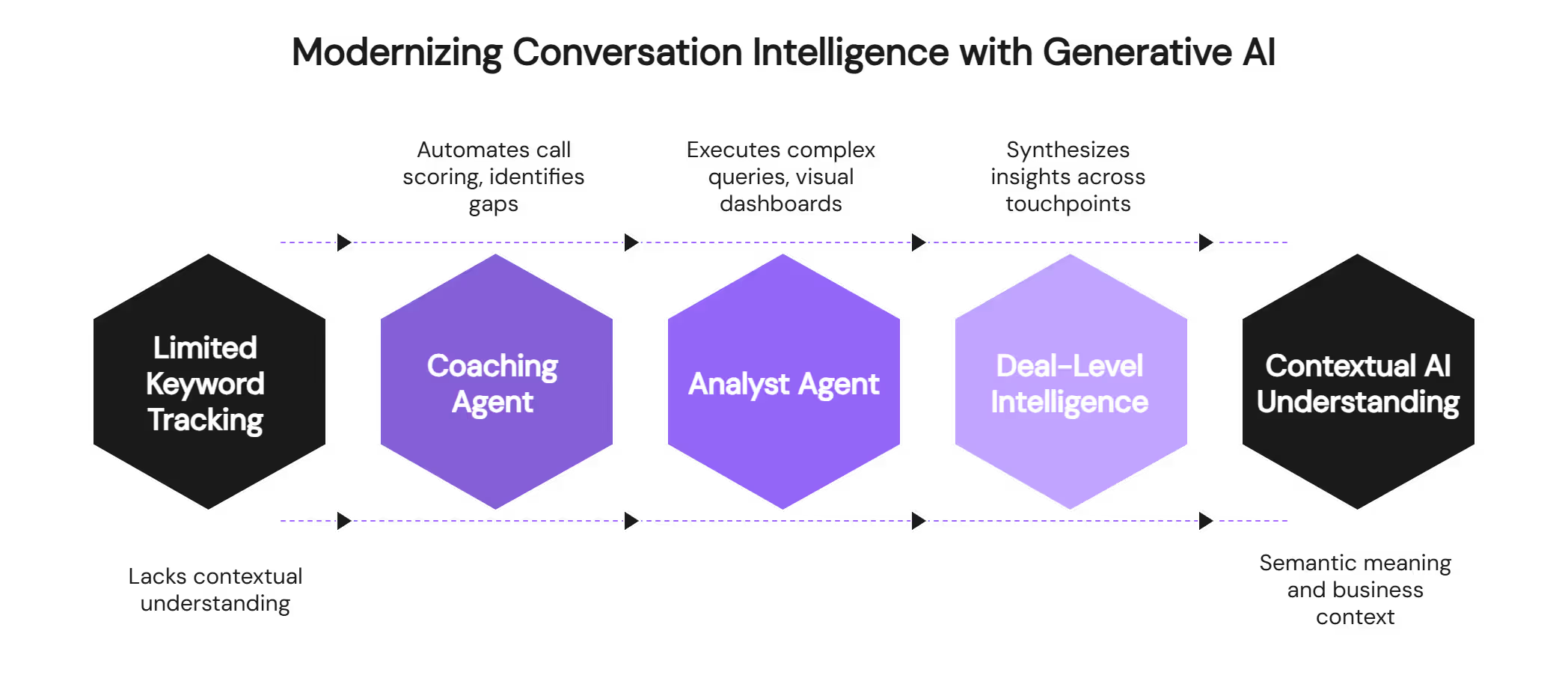
.avif)