Agentforce Use Cases Analyzed: Sales, Support & RevOps Applications [2026 Guide]
Written by
Ishan Chhabra
Last Updated :
December 8, 2025
Skim in :
7
mins
In this article
Still got questions?
Come discuss this article with me.
Hi, I'm Ishan, Founder and CEO of Oliv.
I'm always up for a conversation about revenue intelligence, AI agents, or what's actually working (and what's not) across revenue teams.
I'd love to hear your perspective.
Thank you! Your submission has been received!
Oops! Something went wrong while submitting the form.
Meet Oliv’s AI Agents
Hi! I’m, Deal Driver
I track deals, flag risks, send weekly pipeline updates and give sales managers full visibility into deal progress
Hi! I’m, CRM Manager
I maintain CRM hygiene by updating core, custom and qualification fields all without your team lifting a finger
Hi! I’m, Forecaster
I build accurate forecasts based on real deal movement and tell you which deals to pull in to hit your number
Hi! I’m, Coach
I believe performance fuels revenue. I spot skill gaps, score calls and build coaching plans to help every rep level up
Hi! I’m, Prospector
I dig into target accounts to surface the right contacts, tailor and time outreach so you always strike when it counts
Hi! I’m, Pipeline tracker
I call reps to get deal updates, and deliver a real-time, CRM-synced roll-up view of deal progress
Hi! I’m, Analyst
I answer complex pipeline questions, uncover deal patterns, and build reports that guide strategic decisions
TL;DR
B2C Architecture Misalignment: Agentforce was built for transactional B2C service operations; B2B sales teams face sub-20% adoption due to chat-based UX and missing MEDDPICC/buying committee tracking.
Data Quality Catch-22: 77% of B2B deployments fail because Agentforce requires clean CRM data but provides no cleansing capability—dirty data guarantees inaccurate AI outputs.
True TCO Reality: 50-person teams pay $447K-$600K annually (not advertised $75K) due to mandatory Data Cloud, consulting, and layered license requirements.
Implementation Timelines: Enterprise B2B deployments average 6-9 months vs. 2-4 weeks for AI-native platforms that autonomously clean data and integrate existing tool stacks.
Prioritization Framework: Start with Quick Win service use cases (FAQ deflection, scheduling); delay complex sales automation until 80%+ CRM adoption and RevOps maturity achieved.
AI-Native Alternative: Platforms like Oliv.ai deliver autonomous CRM management, multi-channel activity capture, and MEDDPICC-native forecasting without Data Cloud dependencies at transparent modular pricing.
Q1: What Is Salesforce Agentforce and Why Should Revenue Teams Care? [toc=What Is Agentforce]
Salesforce Agentforce represents the company's latest AI evolution, launched in 2024 as the successor to Einstein AI capabilities. Built on the Atlas Reasoning Engine and integrating with Salesforce Data Cloud, Agentforce aims to deliver autonomous AI agents capable of handling tasks ranging from customer service automation to sales prospecting.
🏗️ Core Architecture and Components
Agentforce operates through several key components that power its AI functionality:
Atlas Reasoning Engine: The underlying AI layer that processes natural language, retrieves relevant data, and determines appropriate actions
Agent Builder: A low-code interface allowing admins to create custom agents using prompts, topics, and actions
Data Cloud Integration: Connects to Salesforce's data infrastructure (often required as a prerequisite) to provide context for AI reasoning
Pre-Built Agents: Out-of-the-box solutions including Service Agent, Sales Development Representative (SDR) Agent, Sales Coach Agent, and Personal Shopper Agent
The platform follows a "topic and action" model where agents identify user intent (topics) and execute corresponding workflows (actions) through Salesforce Flows or Apex code.
💡 Why Revenue Teams Are Paying Attention
Revenue leaders are evaluating Agentforce for three primary reasons: automation of repetitive sales tasks, enhanced customer service capabilities, and the promise of AI-driven insights. The platform theoretically addresses persistent pain points like manual CRM data entry, inconsistent follow-ups, and time-consuming call summarization.
However, real-world feedback reveals a more nuanced picture. As one Salesforce Administrator noted:
"Agentforce helps to automate repetitive tasks, like drafting responses, logging activities and creating summaries. It allows more time for complicated issues and helping customers." Anusha T., Web Developer, Small Business [G2 Verified Review]
Yet implementation complexity remains a significant barrier:
"It can be complex to set up and often requires skilled administrators or developers to customize and integrate properly, which adds time and cost. Licensing fees can be high, especially as the number of agents grows." Verified User, Enterprise Marketing [G2 Verified Review]
⚠️ The Critical Context for B2B Teams
Agentforce was architected primarily for B2C service operations, managing high-volume customer inquiries, order tracking, and product recommendations. This design focus creates misalignment for complex B2B sales environments where relationship-building, multi-stakeholder deals, and consultative selling dominate.
The platform's effectiveness hinges entirely on clean, structured CRM data, a prerequisite many B2B organizations struggle to maintain. Unlike truly autonomous AI systems, Agentforce agents rely on chat-based interfaces requiring manual user interaction, then manual transfer of information into workflows.
One Reddit user captured the deployment reality:
"The need to buy data cloud to go with agent force is putting many off. This isn't a minor expense." r/salesforce [Reddit Thread]
For revenue teams evaluating AI investments, understanding Agentforce's architectural origins, deployment requirements, and cost structure beyond published pricing is essential before committing to implementation.
Q2: Top Agentforce Use Cases for Sales Teams (with Expected ROI) [toc=Sales Use Cases]
Sales teams lose 70% of their time to administrative overhead: logging activities, researching prospects, drafting follow-ups, and updating CRM fields. Agentforce promises to reclaim these hours through AI automation across SDR workflows, opportunity management, and sales coaching.
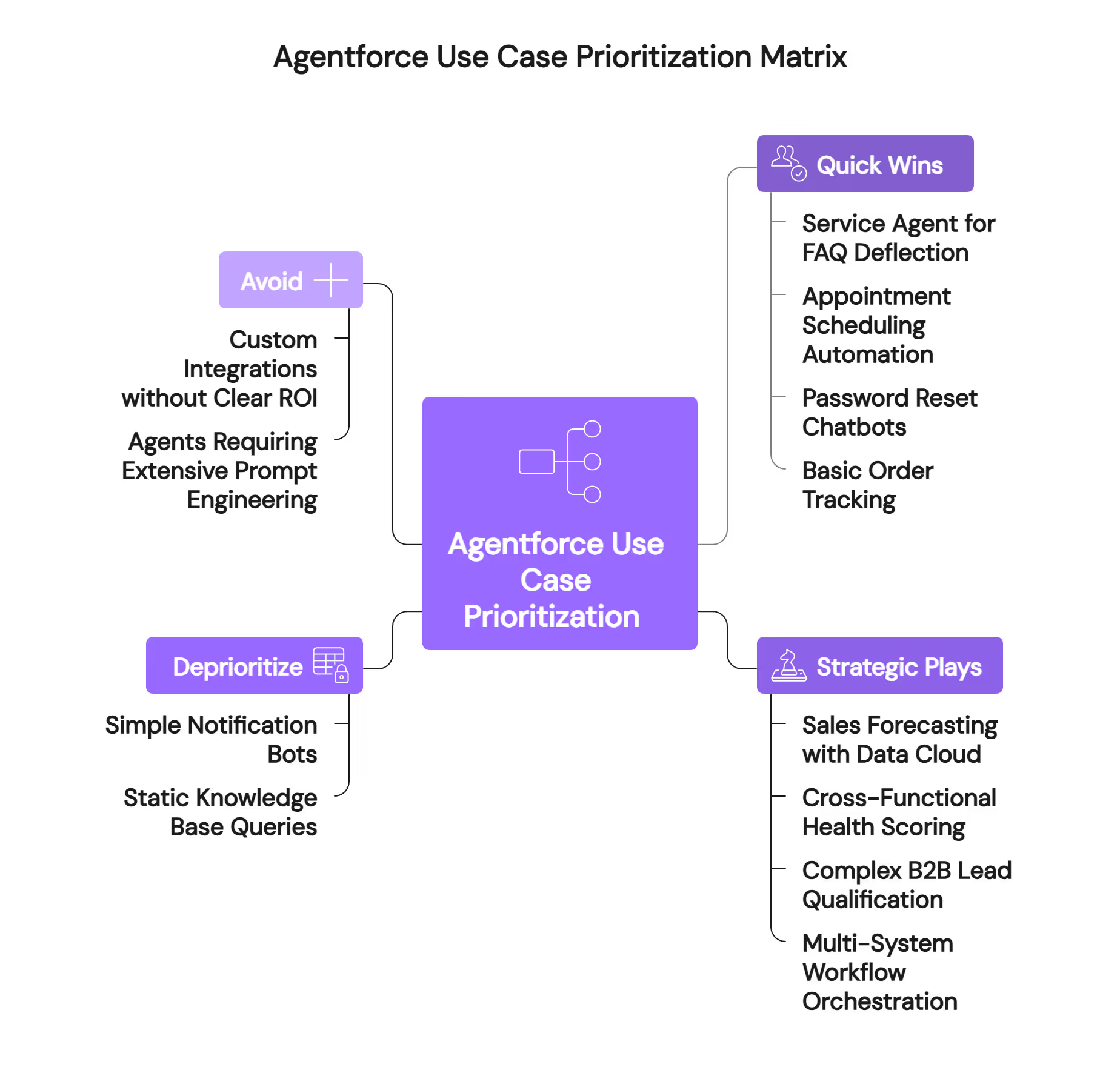
Decision framework visualizing Agentforce implementation priorities across four quadrants, helping RevOps teams determine which service automation, sales forecasting, and workflow use cases deliver highest business value versus complexity.
📧 Lead Qualification and Email Automation
The Agentforce SDR Agent theoretically automates prospecting by engaging leads through personalized emails, answering product questions, and scheduling meetings based on CRM data. Salesforce markets time savings of 5+ hours per week per rep through automated email drafting and response handling.
Traditional SaaS limitations quickly surface in B2B contexts. Agentforce's email generation relies on pre-defined templates and rule-based logic rather than deep contextual understanding of deal nuances. The system struggles to differentiate between a casual mention of a competitor versus active evaluation, leading to generic, impersonal outreach that buyers ignore.
🔄 Activity Logging and CRM Updates
Einstein Activity Capture, the foundation underlying Agentforce's CRM automation, attempts to log emails, calls, and meetings automatically. The marketed benefit: 40% reduction in manual data entry.
The reality? Activity Capture uses outdated rule-based logic that consistently fails in enterprise scenarios. When duplicate accounts exist (a common B2B situation), the system cannot determine which account or opportunity to associate activities with, causing chronic data misalignment. Email data gets stored in separate AWS instances rather than natively in Salesforce, preventing downstream analysis. Critical interactions via Slack, Telegram, or other modern communication channels go completely untracked.
As a Senior Sales Representative observed:
"The price of Agentforce is not clear and hard to find. Adoption is low because of the lack of knowledge on the subject as AI is a new field. Customers are finding issues in deploying and using agents in Salesforce." Anusha T., Web Developer [G2 Verified Review]
✅ How AI-Native Platforms Deliver Real ROI
Modern Generative AI-native platforms eliminate these friction points through autonomous, context-aware agents. Rather than chat interfaces requiring manual data transfer, truly agentic systems work within existing workflows, automatically logging activities, updating CRM fields, and triggering next actions without rep involvement.
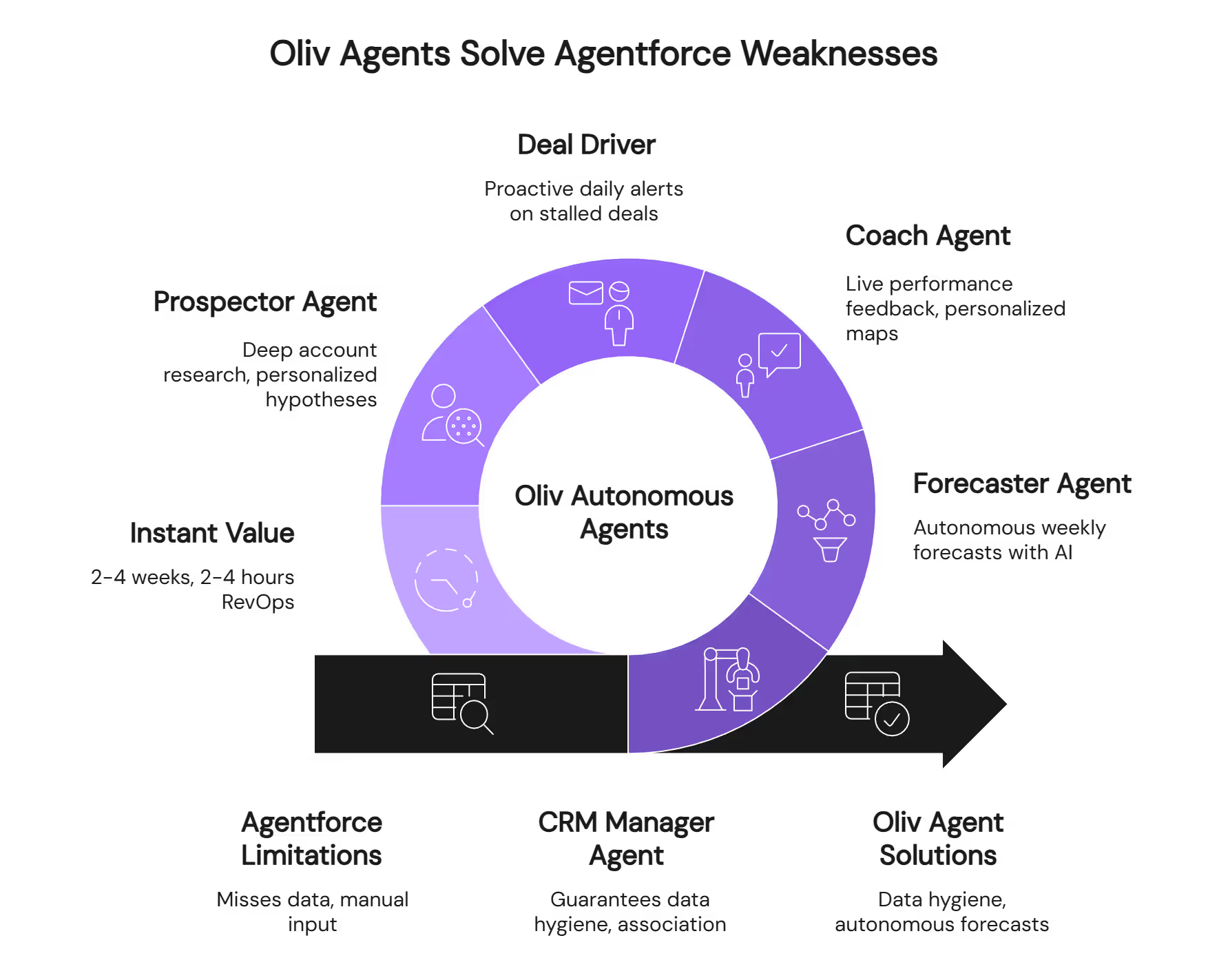
Circular diagram illustrating how AI-native Oliv agents autonomously address Agentforce weaknesses in data hygiene, forecasting, coaching, prospecting, and implementation, delivering instant value through generative AI-powered revenue orchestration.
Oliv.ai's CRM Manager Agent uses LLM-based reasoning to correctly associate every activity even with duplicate accounts, achieving genuine 40% reduction in manual entry.
The Meeting Assistant Agent autonomously handles pre-call research, live note-taking, and post-call follow-up emails, all synced to CRM without disrupting the seller's focus. The Deal Driver Agent proactively flags stalled deals daily with specific intervention recommendations, eliminating dashboard hunting.
Unlike Agentforce's template-driven approach, Oliv's Prospector Agent automates deep account research, builds personalized sales hypotheses, and crafts tailored outreach, addressing the failure of bulk, non-personalized messaging that characterizes legacy tools. Teams adopting AI-native revenue orchestration platforms report measurable improvements in forecast accuracy and deal velocity.
A mid-market SaaS company reduced AE admin time by 12 hours per week within 30 days of Oliv deployment, compared to 6+ month Agentforce implementations with sub-20% adoption rates due to workflow disruption.
Q3: Essential Agentforce Use Cases for Support and Customer Success Teams [toc=Support Use Cases]
Agentforce demonstrates its strongest capabilities in customer service and support operations, the domain for which it was primarily architected. B2C companies successfully deploy Service Agents for high-volume inquiry management, order tracking, and self-service deflection.
💬 24/7 Customer Service Automation
The Agentforce Service Agent handles common support scenarios including FAQ responses, password resets, account inquiries, and basic troubleshooting. Organizations report 30-40% case deflection rates when agents are properly configured with comprehensive knowledge bases and well-structured prompts.
One administrator shared positive service experience:
"What immediately stands out about Salesforce Agentforce is its innovative approach to agent assistance. It empowers the agent to handle complex situations based on a prompt provided directly within the workflow. This directly translates to improved customer Support interactions." Alessandro N., Salesforce Administrator, Mid-Market [G2 Verified Review]
However, effectiveness requires significant upfront investment:
"My primary concern is the significant learning curve involved in truly optimizing Agentforce. Effectively crafting prompts demands a specific skill set often called 'prompt engineering.' This means organizations will need to invest considerably in training, potentially create specialized roles, and thoroughly plan for integration." Alessandro N., Salesforce Administrator [G2 Verified Review]
📦 Order Tracking, Returns, and Product Recommendations
For e-commerce and retail operations, Agentforce automates order status inquiries, return processing, and refund requests by connecting to order management systems. The Personal Shopper Agent provides product recommendations based on purchase history and browsing behavior.
These use cases excel in B2C contexts with structured product catalogs and transactional relationships. B2B Customer Success teams managing complex accounts, multi-year contracts, and relationship-driven renewals find limited value in these transactional-focused capabilities, as detailed in comprehensive Agentforce reviews.
📅 Appointment Scheduling and Calendar Management
Agentforce can schedule appointments, send reminders, and manage technician dispatch for field service operations. Integration with Salesforce Field Service Lightning enables automated routing based on technician availability, skills, and location.
A Help Desk Associate noted basic functionality works well:
"The simple process of handling a live chat or a ticket, also the efficiency and accuracy of the timing to handle a chat in sales force is easier." Marwin N., Help Desk Associate, Enterprise [G2 Verified Review]
But limitations surface at scale:
"While taking multiple chats it has few issues as in the notification is smaller, also if any translation from English to any language it is a bit slow." Marwin N., Help Desk Associate [G2 Verified Review]
🎯 How AI-Native CS Solutions Differ
For B2B Customer Success teams, Oliv.ai focuses on retention and expansion through specialized agents. The Health Monitor Agent tracks customer engagement signals, usage patterns, and renewal risks across all touchpoints. The Retention Forecaster Agent identifies accounts requiring intervention before churn becomes inevitable, enabling proactive outreach rather than reactive firefighting.
Unlike Agentforce's transactional service focus, these agents understand the complex, relationship-driven nature of B2B account management. Organizations evaluating alternatives to Agentforce prioritize platforms that deliver insights driving measurable retention improvements through AI-native revenue orchestration.
Q4: Cross-Functional Agentforce Use Cases That Benefit Multiple Teams [toc=Cross-Functional Use Cases]
The highest-value AI implementations deliver insights spanning Sales, Customer Success, Marketing, and RevOps, eliminating data silos and enabling coordinated revenue strategies. Agentforce attempts cross-functional orchestration through Data Cloud integration, though B2B organizations face significant architectural and cost barriers.
🏥 Customer Health Monitoring (CS + Sales + RevOps)
Comprehensive account health scoring requires aggregating signals from multiple systems:
Support metrics: Ticket volume, resolution time, escalation frequency, CSAT scores
Product usage: Feature adoption, login frequency, usage trends vs. baseline
Financial signals: Payment timeliness, contract value, expansion history
Agentforce can create health scores by connecting to Data Cloud and analyzing these streams through Einstein Analytics. However, implementation requires extensive data modeling, clean source data, and prompt engineering to generate actionable insights versus generic risk scores.
One admin highlighted the complexity barrier:
"Can be complex to set up and often requires skilled administrators or developers to customize and integrate properly, which adds time and cost." Verified User, Enterprise Marketing [G2 Verified Review]
🔄 Renewal and Expansion Prediction (Sales + CS)
Identifying upsell and cross-sell opportunities demands understanding usage patterns, stakeholder satisfaction, competitive threats, and contract timing. Agentforce's Einstein Forecasting attempts predictive modeling but suffers from fundamental dependence on manually updated CRM data.
When CRM hygiene is poor, the norm for B2B teams, forecasts become unreliable. As one Reddit user noted:
"Data cloud credits and potentially mulesoft credits run out fast." r/salesforce [Reddit Thread]
📊 Unified Activity Tracking Across Customer Journey
Complete visibility requires capturing interactions from calls, emails, Slack, support tickets, product analytics, and marketing touches. Agentforce's Activity Capture frequently misses interactions outside email/calendar, Slack conversations, Telegram exchanges, or dialer activity, creating incomplete timelines that all revenue teams rely upon.
A Senior Associate experienced implementation gaps:
"The UI felt a bit clunky at times, especially when trying to manage multiple prompts or agent versions. Also, the pricing caught us off guard. Once we started scaling to more users and use cases, the cost ramped up pretty quickly." Ayushmaan Y., Senior Associate, Enterprise [G2 Verified Review]
✅ How AI-Native Platforms Unify Cross-Functional Intelligence
Modern Generative AI platforms eliminate these integration challenges by automatically aggregating data from all GTM tools, CRM, conversation intelligence, engagement platforms, support systems, dialers, into a unified intelligence layer. Oliv.ai's AI Data Platform automatically normalizes data across sources (Gong, Outreach, Slack, Telegram, JustCall), delivering cross-functional account health insights without expensive Data Cloud subscriptions or months of data modeling.
Organizations adopting AI-native revenue orchestration platforms report unified visibility across all customer touchpoints, enabling coordinated intervention strategies that traditional siloed tools cannot deliver.
Agentforce's effectiveness varies significantly by industry, with strongest adoption in B2C sectors where high-volume, transactional interactions align with its architectural design.
🏥 Healthcare: Patient Engagement and Appointment Management
Healthcare organizations deploy Agentforce Service Agents for specific use cases:
Appointment scheduling and reminders: Automated booking, rescheduling, and SMS/email reminders reducing no-show rates by 15-25%
Prescription refill requests: Patients can request refills via chatbot, which routes to pharmacy systems
Insurance verification: Basic eligibility checks and coverage confirmations
Symptom triage: Guided questionnaires directing patients to appropriate care levels
⚠️ HIPAA Compliance Concerns: Healthcare IT teams report challenges ensuring Agentforce configurations meet strict data privacy requirements, particularly when integrating with electronic health record (EHR) systems. Prompt engineering must avoid inadvertent PHI exposure.
💰 Financial Services: Account Inquiries and Fraud Alerts
Banks and financial institutions leverage Agentforce for customer service automation:
Balance and transaction inquiries: Real-time account status updates via secure chat
Loan application status: Automated updates on application processing stages
Fraud detection alerts: Proactive notifications when suspicious activity is detected
Regulatory compliance support: Guided workflows ensuring adherence to KYC/AML requirements
💸 Cost Barrier: Financial institutions require extensive security audits and compliance validation, adding 3-6 months to deployment timelines and significant consulting costs.
🛍️ Retail: Inventory, Orders, and Personalization
Retail represents Agentforce's strongest domain, particularly for e-commerce operations:
Product availability queries: Real-time inventory checks across locations
Order tracking and returns: Automated status updates, return label generation, refund processing
Personalized shopping recommendations: AI-driven product suggestions based on browsing/purchase history
Size and fit guidance: Virtual shopping assistants reducing return rates
One small business user noted mixed results:
"Powerful but Complex... All-in-one workspace for client info, policies, and tasks. Automation of follow-ups and reminders. But can be complex to set up and customize. Expensive, especially for smaller teams." Shubham G., Senior BDM, Small Business [G2 Verified Review]
🏭 Manufacturing: Supply Chain and Technical Support
Manufacturing companies deploy agents for customer-facing operations:
Order status and shipment tracking: Real-time updates on production and logistics
Supply chain visibility: Proactive alerts on delays or material shortages
Technical support escalation: Initial troubleshooting before routing to specialized engineers
Warranty and RMA processing: Automated return merchandise authorization workflows
⏰ Implementation Reality: Manufacturing deployments average 6-9 months due to complex ERP integrations and custom workflow requirements.
✅ Industry-Agnostic AI Platforms
While Agentforce requires industry-specific customization and lengthy implementations, AI-native platforms like Oliv.ai deliver value across industries through autonomous agents that adapt to any B2B sales process, regardless of vertical, with 2-4 week deployment timelines and transparent, modular pricing.
Q6: Real-World Agentforce Examples: Before vs. After Scenarios [toc=Real-World Examples]
Understanding Agentforce's practical impact requires examining concrete workflow transformations. These scenarios illustrate time savings potential alongside implementation realities.
📞 Case Study 1: SDR Daily Workflow Transformation
Before Agentforce (Manual Process):
7:00-8:30 AM: Manually research 10-15 prospects across LinkedIn, company websites, news sources (90 min)
8:30-11:00 AM: Draft personalized outreach emails using templates, customize based on research (150 min)
11:00-12:00 PM: Log all activities in CRM, update lead status fields (60 min)
Afternoon: Follow up on responses, schedule meetings, update CRM again
Total admin time: 4-5 hours daily (50-60% of workday)
After Agentforce (Theoretical Automation):
SDR Agent researches prospects and drafts emails automatically
Activity Capture logs emails and updates CRM fields
Meeting scheduling handled via agent-calendar integration
Projected time savings: 3-4 hours daily
⚠️ Implementation Reality: One Reddit user shared:
"Most of these use cases have been under two hours from inception to ready to test... but all of the apex, flows, and automation happening in the background was already done for you." r/salesforce [Reddit Thread]
The "quick setup" masks months of prior workflow automation work. Organizations without existing Salesforce automation infrastructure face 3-6 month implementation timelines.
🎧 Case Study 2: Customer Service Response Time Reduction
Before Agentforce:
Average first response time: 8-12 minutes during business hours
After-hours inquiries wait until next business day (12-24 hour delays)
Tier 1 agents handle 40-50 tickets daily, spending 15-20 min per ticket
60% of tickets involve repetitive questions (password resets, order status, return policies)
After Agentforce:
24/7 automated responses for common inquiries (instant response)
35-40% ticket deflection rate for simple issues
Human agents focus on complex cases requiring judgment
One administrator confirmed effectiveness but noted complexity:
"I hugely prefer agentforce support to the humans they had previously." r/salesforce [Reddit Thread]
However, another reported challenges:
"Implementing right now, very basic use case where Agentforce does a summary of cases and some knowledge info... Agentforce can't access knowledge articles on my Org." r/salesforce [Reddit Thread]
After: Agentforce monitors health scores, alerts on engagement drops, theoretically enabling proactive intervention.
Reality: Effectiveness depends entirely on clean CRM data, the prerequisite most B2B teams lack.
✅ The AI-Native Alternative
AI-native platforms deliver these benefits without months of implementation or data prerequisites. Oliv.ai's autonomous agents work immediately within existing workflows, delivering measurable productivity gains within 30 days versus uncertain 6+ month Agentforce deployments. Teams comparing revenue intelligence platforms prioritize solutions offering rapid time-to-value without extensive consulting dependencies.
Q7: How to Prioritize: Which Agentforce Use Cases to Implement First [toc=Use Case Prioritization]
Not all Agentforce use cases deliver equal value, and implementation complexity varies dramatically. Organizations must prioritize based on current maturity, data readiness, and resource constraints to avoid costly false starts.
📊 The Use Case Prioritization Matrix
Effective prioritization balances business impact against implementation complexity:
Agentforce Use Case Prioritization Framework
Quick Wins (High Value, Low Complexity)
Strategic Plays (High Value, High Complexity)
- Service Agent for FAQ deflection - Appointment scheduling automation - Password reset chatbots - Basic order tracking
- Sales forecasting with Data Cloud - Cross-functional health scoring - Complex B2B lead qualification - Multi-system workflow orchestration
Lower Priority Agentforce Use Cases
Deprioritize (Low Value, Low Complexity)
Avoid (Low Value, High Complexity)
- Simple notification bots - Static knowledge base queries
- Custom integrations without clear ROI - Agents requiring extensive prompt engineering for marginal gains
⭐ Recommendation: Start with Quick Win service automation before attempting complex sales use cases requiring clean CRM data.
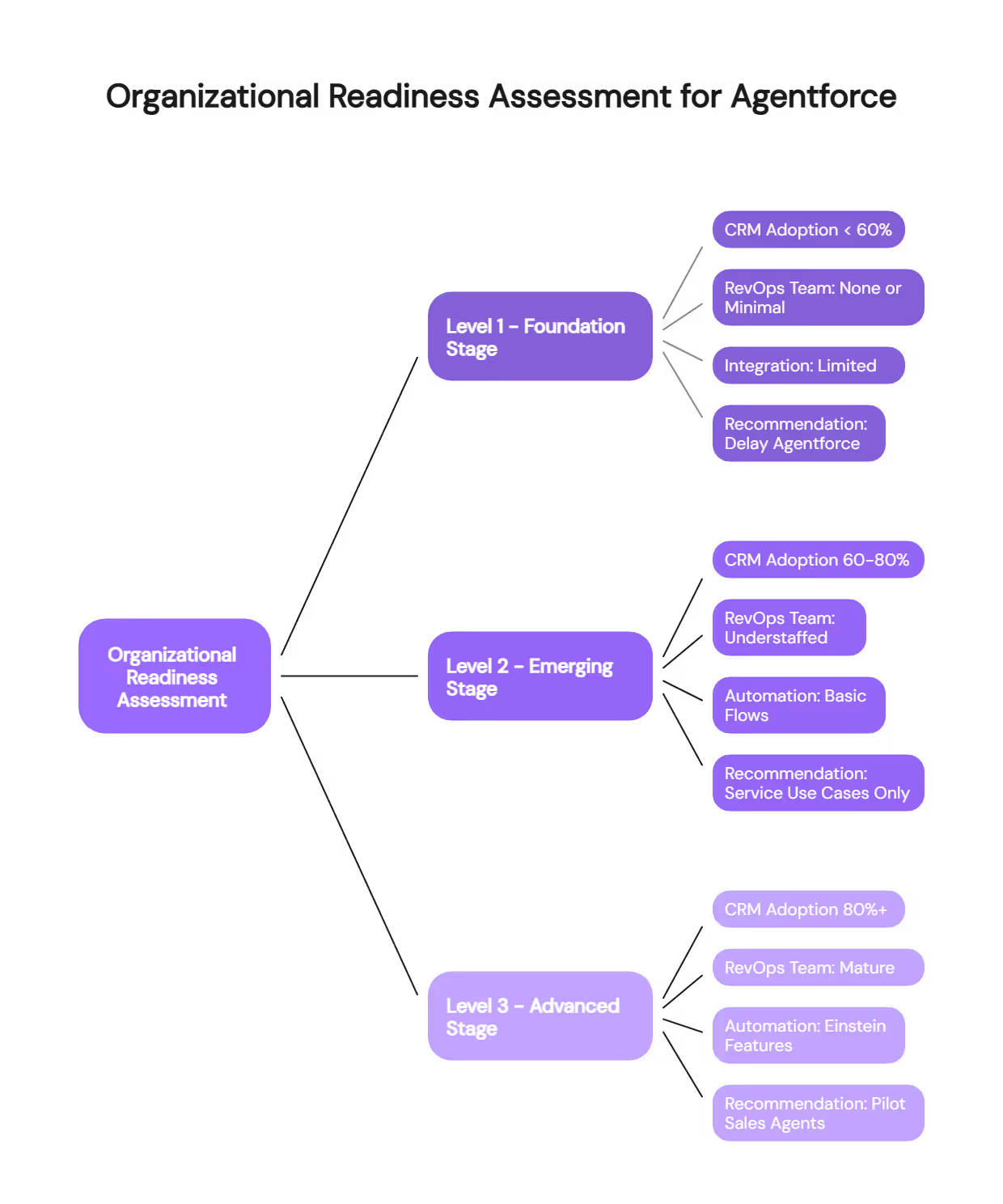
Three-tier maturity framework illustrating CRM adoption thresholds, RevOps team requirements, and automation prerequisites needed before deploying Agentforce use cases, with stage-specific recommendations for service versus sales agent implementations.
✅ Assessing Your Organization's Readiness Level
Before implementation, honestly evaluate your data and organizational maturity:
Level 1 - Foundation Stage:
CRM adoption below 60%, inconsistent data entry
No dedicated RevOps team
Limited integration between sales tools
Recommendation: Delay Agentforce; focus on basic CRM hygiene first
Level 2 - Emerging Stage:
60-80% CRM adoption, moderate data quality
Basic Salesforce automation (flows, workflows)
RevOps team exists but understaffed
Recommendation: Start with service use cases only; avoid sales automation
Recommendation: Pilot sales-focused agents with realistic 6-9 month timelines
One Reddit user captured the readiness trap:
"Nobody is willing to pull the trigger on a large engagement because it's going to be expensive and nobody is going to know the outcome." r/salesforce [Reddit Thread]
⏰ Recommended Implementation Sequence
SMB (Small-Medium Business):
Service chatbot for common inquiries (Month 1-2)
Appointment scheduling automation (Month 3)
Evaluate ROI before expanding (Month 4-6)
Enterprise:
Pilot service agent in single department (Quarter 1)
Expand to additional service use cases (Quarter 2)
Assess sales use case viability based on data quality audit (Quarter 3)
Limited sales pilot with clean data subset only (Quarter 4+)
⚠️ Prerequisites Checklist
Before launching any use case category:
Data Requirements:
CRM data accuracy audit completed (>85% field completion)
Duplicate account resolution process established
Activity capture tested and validated across all communication channels
Technical Requirements:
Data Cloud subscription budgeted (mandatory for most use cases)
Integration architecture mapped and approved
Prompt engineering resources identified
Organizational Requirements:
Executive sponsorship secured with realistic timeline expectations (6+ months)
Change management plan for user adoption
Budget for $50K+ implementation consulting
💡 The AI-Native Simplification: AI-native platforms like Oliv.ai eliminate complex prioritization matrices by delivering value across all use cases simultaneously through autonomous agents that work regardless of CRM maturity, with 2-4 week deployments requiring minimal RevOps configuration time.
Q8: Critical RevOps Considerations: Integration, Data Quality, and Total Cost [toc=RevOps Considerations]
RevOps leaders face the operational reality of vetting AI platforms beyond marketing promises. Agentforce's viability depends entirely on integration complexity, data infrastructure prerequisites, actual total cost of ownership, and realistic deployment timelines.
💸 The Hidden Cost Reality
Traditional SaaS platforms like Agentforce advertise attractive entry pricing ($125/user/month for agents) that obscures true TCO:
Layered Cost Structure:
Base requirement: Sales Cloud licenses ($200-$250/user/month) Mandatory add-on: Data Cloud subscription ($150/user/month minimum)
Agent licenses: Agentforce for Sales ($125-$550/user/month depending on tier)
Additional modules: Revenue Intelligence ($220/user/month) if forecasting needed
Credit consumption: Opaque per-action pricing ($0.10 per conversation/action)
Implementation consulting: $50,000-$150,000+ for enterprise deployments spanning 6-9 months
Real TCO calculation for 50-person sales team:
Published pricing suggests: $125/user × 50 = $6,250/month ($75K annually)
With consulting/implementation: $500,000-$600,000 first-year total
One Reddit user confirmed the sticker shock:
"Be prepared to deal with Flexi Credits, Data Cloud credits... The pricing model is changing very shortly, to be token based." r/salesforce [Reddit Thread]
Organizations evaluating Agentforce pricing must account for these hidden layers when calculating true investment requirements.
⚠️ The Data Quality Prerequisite Problem
Agentforce's fundamental architectural flaw: it requires clean CRM data but provides zero capability to clean that data. This creates a catch-22 for B2B organizations where poor data quality has been historically tolerated because deals closed regardless of CRM hygiene.
The 77% Failure Rate: B2B Agentforce deployments fail or underdeliver at alarming rates because rule-based Einstein Activity Capture cannot handle common scenarios like duplicate accounts, missing contact records, or incomplete opportunity data. When garbage data feeds AI models, outputs become unusable, eroding trust and adoption.
Another admin captured the debugging burden:
"Lots of clicking to get select the right options. UX needs improvement. Everything opens in a new browser tabs clustering the browser. Lots of jumping back and forth between tabs to enable settings." Verified User, Consulting, Enterprise [G2 Verified Review]
✅ What Modern RevOps Teams Actually Need
AI platforms must solve data quality problems, not assume they're already solved. Requirements include:
Legacy AI vs AI-Native Revenue Orchestration Comparison
Legacy Approach (Agentforce)
AI-Native Approach (Oliv.ai)
Requires Data Cloud ($150+/user/month)
Unified AI Data Platform included
6-9 month implementation timelines
2-4 week deployment
$50K+ consulting dependencies
Free implementation, 2-4 hours RevOps time
Assumes clean CRM data
Autonomous data cleansing via Generative AI
Opaque credit-based pricing
Transparent modular pricing, zero platform fees
🎯 The Oliv.ai RevOps Advantage
Oliv's AI Data Platform unifies scattered data from all GTM tools, Gong, Outreach, Slack, Telegram, dialers, with automatic CRM synchronization [INSERT AGENT IMAGE HERE]. The CRM Manager Agent uses LLM-based reasoning to correctly associate activities even with duplicate accounts, autonomously update MEDDPICC/BANT qualification fields, and maintain data hygiene in real-time.
Decision Framework: Calculate true TCO including mandatory dependencies. Verify data quality prerequisites honestly. Assess consultant dependencies and implementation timelines. A 50-person team comparing platforms faces $600K/year for Agentforce versus modular Oliv pricing delivering superior B2B-specific functionality with transparent costs. Teams evaluating revenue intelligence alternatives prioritize platforms eliminating hidden cost layers.
Q9: What Are the Key Limitations of Agentforce for B2B Sales Environments? [toc=Agentforce Limitations]
While Agentforce delivers value in B2C service contexts, B2B sales teams encounter significant architectural, operational, and functional constraints that limit effectiveness.
❌ Architectural Limitations: B2C Design for B2B Needs
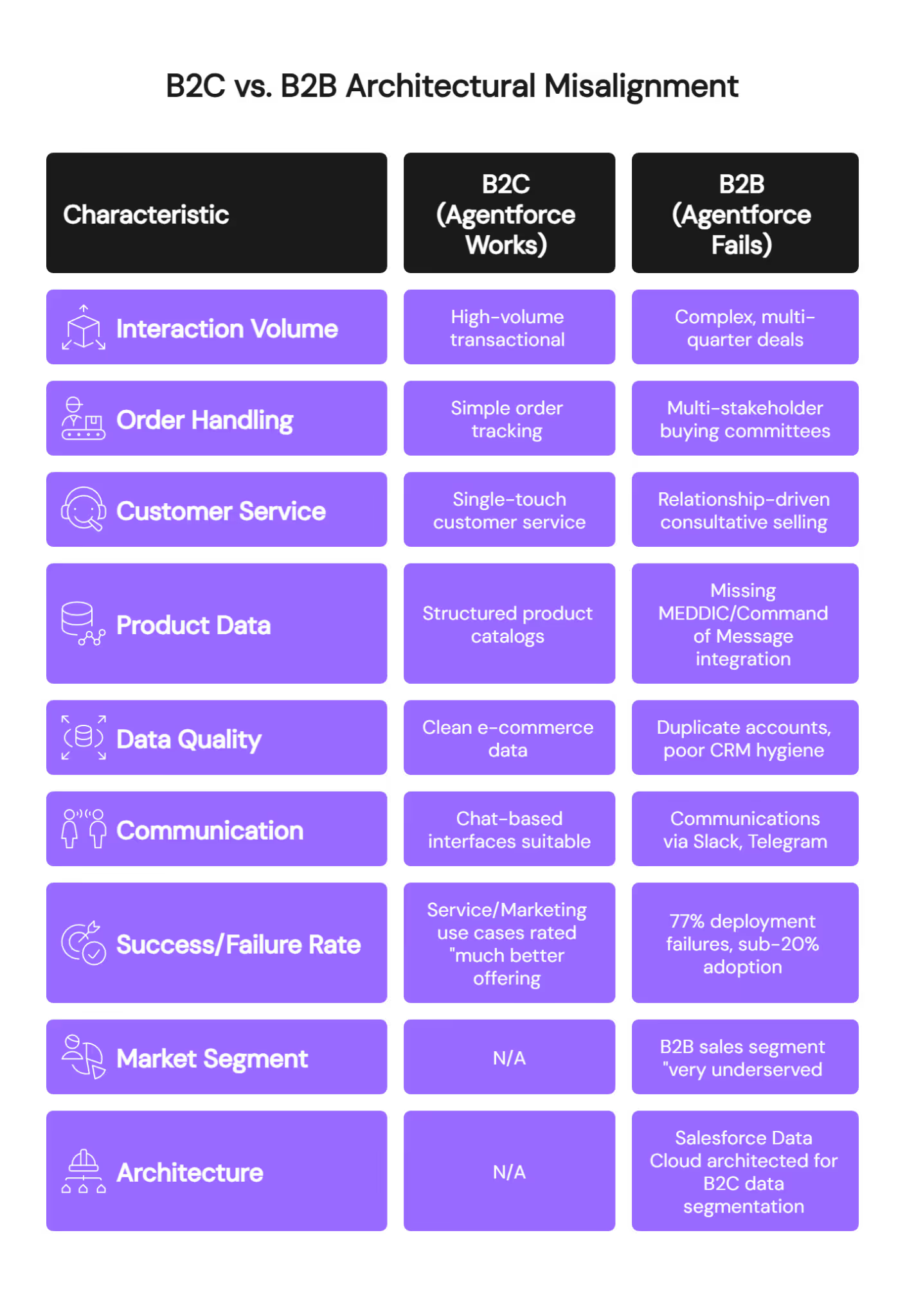
Agentforce was conceived and built primarily for B2C companies managing high-volume, transactional customer service interactions. This foundational design creates misalignment for B2B sales:
Chat-Based vs. Autonomous Architecture:
Agentforce agents require manual user interaction through chat interfaces
Users must extract information, then manually transfer it elsewhere in workflows
Sub-20% adoption rates common due to workflow disruption
"My primary concern is the significant learning curve involved in truly optimizing Agentforce. Effectively crafting prompts demands a specific skill set often called 'prompt engineering.' Organizations will need to invest considerably in training, potentially create specialized roles." Alessandro N., Salesforce Administrator [G2 Verified Review]
Comprehensive comparison table contrasting Agentforce's B2C-optimized architecture with B2B sales requirements, highlighting success rate differences, data quality dependencies, communication gaps, and the 77% deployment failure rate in enterprise environments.
💰 Cost and Complexity Barriers
Prohibitive Total Cost: The layered pricing structure (Sales Cloud + Data Cloud + Agentforce + Revenue Intelligence) pushes per-user costs to $500-$650/month, economically unviable for mid-market companies.
Implementation Timelines: Enterprise B2B deployments average 6-9 months due to data preparation, integration complexity, and prompt engineering requirements.
A Reddit user confirmed adoption hesitancy:
"Potentially very cool, but I see it being a product that very few companies adopt (at least until they nail down their pricing model for it)." r/salesforce [Reddit Thread]
⚠️ Data Quality Dependency
The single largest limitation: Agentforce cannot function without clean, structured CRM data. Organizations with:
Below 80% CRM adoption rates
Inconsistent field completion
Duplicate account/contact records
Limited automation maturity
...should delay Agentforce implementation until foundational data governance is established. Attempting deployment with poor data quality guarantees failure.
Organizations without dedicated RevOps teams to manage ongoing prompt engineering and troubleshooting
Companies with CRM adoption below 70% or significant data quality issues
Teams requiring integration with non-Salesforce tools like Slack, Telegram, or specialized dialers (Activity Capture misses these entirely)
Budget-constrained SMBs unable to afford mandatory Data Cloud subscriptions
One product researcher summarized the debugging reality:
"Settings can be annoying at times. For example, you need to activate einstein and other stuff if you want to use agentforce. But why don't you enable dependency if I directly wanna start agentforce in a single click?" shivam a., product researcher [G2 Verified Review]
✅ The Alternative for B2B Teams
B2B organizations should evaluate AI-native platforms purpose-built for complex sales environments. Oliv.ai delivers autonomous CRM management, multi-channel activity capture (including Slack/Telegram), and MEDDPICC-native forecasting without mandatory expensive infrastructure, at transparent, modular pricing suited for growing revenue teams. Organizations comparing Agentforce alternatives prioritize solutions eliminating architectural constraints.
Q10: The AI-Native Alternative: How Modern Platforms Deliver What Legacy AI Cannot [toc=AI-Native Alternative]
Revenue leaders face a fundamental architectural choice: invest in legacy platforms retrofitting AI onto pre-2020 infrastructure, or adopt purpose-built Generative AI-native platforms designed for autonomous revenue workflows.
🔄 The Obsolescence of Pre-Generative AI Tools
Platforms like Agentforce, Einstein, Gong (built 2015-2019), and Clari represent first-generation AI, machine learning models requiring extensive manual configuration, rule-based logic prone to errors, and chat interfaces disrupting rather than enhancing workflows.
Legacy Limitations:
Fragmented tool stacks: Sales Cloud + Einstein Conversation Insights + Revenue Intelligence + Agentforce = 4+ separate licenses with disjointed UX
Manual workflow disruption: Chat-based agents require users to extract information and manually transfer to next steps
Rule-based brittleness: Activity Capture fails with duplicate records; forecasting unreliable with dirty data
"Steep learning curve for new users. Slow performance if not optimized. Overwhelming with too many features at once." Shubham G., Senior BDM [G2 Verified Review]
✅ The AI-Native Architectural Advantage
Modern platforms built "Generative AI-first" eliminate legacy constraints through autonomous agent architecture:
Legacy AI vs AI-Native Revenue Orchestration Platform Comparison
Feature
Legacy AI (Agentforce)
AI-Native (Oliv.ai)
User Interface
Chat-based manual interaction
Autonomous background execution
Tool Integration
4+ fragmented tools/licenses
Unified intelligence layer
Data Requirements
Requires clean data prerequisite
Cleans data autonomously via LLMs
Implementation Timeline
6-9 month deployments
2-4 week deployments
Total Cost
$500-$650/user/month all-in
Transparent modular pricing
Adoption Rates
Sub-25% adoption rates
90%+ adoption within 30 days
🚀 Oliv.ai: The AI-Native Revenue Orchestration Leader
Oliv represents the category evolution from Revenue Intelligence (reactive reporting) to AI-Native Revenue Orchestration (autonomous execution)
Twelve Specialized Agents Operating Autonomously:
CRM Manager Agent: LLM-based activity association, automatic field updates, data cleansing even with duplicates
Meeting Assistant Agent: Pre-call research, live transcription, post-call follow-up emails, zero manual steps
Forecaster Agent: Weekly presentation-ready reports with AI commentary on at-risk deals
Deal Driver Agent: Daily stalled deal alerts with intervention recommendations
Coach Agent: Live deal analysis creating personalized skill-gap maps and micro-coaching prescriptions
Prospector/Researcher Agent: Deep account research, sales hypothesis generation, personalized outreach
Health Monitor & Retention Forecaster: Customer engagement tracking and churn prediction for CS teams
Integration Without Complexity: The AI Data Platform automatically unifies Gong, Outreach, Slack, Telegram, JustCall, and dialers, delivering 360° deal visibility without expensive middleware or Data Cloud subscriptions.
90%+ organic adoption within 30 days (vs. sub-25% for Agentforce)
40% reduction in CRM data entry time through autonomous field updates
25% faster deal cycles via proactive intervention on stalled opportunities
90% forecast accuracy improvement using autonomous pipeline analysis
Total cost 50-60% lower than comparable legacy stacks
⏰ The Strategic Decision: Legacy AI platforms require 6-12 month implementations, ongoing consultant dependencies, and deliver uncertain ROI. AI-native platforms like Oliv report measurable productivity gains within the first 30 days, high organic adoption, and transparent costs eliminating budget surprises. Organizations comparing revenue orchestration platforms prioritize solutions delivering immediate value.
The question isn't whether to adopt AI, it's which architectural approach will define your competitive advantage in the Generative AI era.
Q1: What Is Salesforce Agentforce and Why Should Revenue Teams Care? [toc=What Is Agentforce]
Salesforce Agentforce represents the company's latest AI evolution, launched in 2024 as the successor to Einstein AI capabilities. Built on the Atlas Reasoning Engine and integrating with Salesforce Data Cloud, Agentforce aims to deliver autonomous AI agents capable of handling tasks ranging from customer service automation to sales prospecting.
🏗️ Core Architecture and Components
Agentforce operates through several key components that power its AI functionality:
Atlas Reasoning Engine: The underlying AI layer that processes natural language, retrieves relevant data, and determines appropriate actions
Agent Builder: A low-code interface allowing admins to create custom agents using prompts, topics, and actions
Data Cloud Integration: Connects to Salesforce's data infrastructure (often required as a prerequisite) to provide context for AI reasoning
Pre-Built Agents: Out-of-the-box solutions including Service Agent, Sales Development Representative (SDR) Agent, Sales Coach Agent, and Personal Shopper Agent
The platform follows a "topic and action" model where agents identify user intent (topics) and execute corresponding workflows (actions) through Salesforce Flows or Apex code.
💡 Why Revenue Teams Are Paying Attention
Revenue leaders are evaluating Agentforce for three primary reasons: automation of repetitive sales tasks, enhanced customer service capabilities, and the promise of AI-driven insights. The platform theoretically addresses persistent pain points like manual CRM data entry, inconsistent follow-ups, and time-consuming call summarization.
However, real-world feedback reveals a more nuanced picture. As one Salesforce Administrator noted:
"Agentforce helps to automate repetitive tasks, like drafting responses, logging activities and creating summaries. It allows more time for complicated issues and helping customers." Anusha T., Web Developer, Small Business [G2 Verified Review]
Yet implementation complexity remains a significant barrier:
"It can be complex to set up and often requires skilled administrators or developers to customize and integrate properly, which adds time and cost. Licensing fees can be high, especially as the number of agents grows." Verified User, Enterprise Marketing [G2 Verified Review]
⚠️ The Critical Context for B2B Teams
Agentforce was architected primarily for B2C service operations, managing high-volume customer inquiries, order tracking, and product recommendations. This design focus creates misalignment for complex B2B sales environments where relationship-building, multi-stakeholder deals, and consultative selling dominate.
The platform's effectiveness hinges entirely on clean, structured CRM data, a prerequisite many B2B organizations struggle to maintain. Unlike truly autonomous AI systems, Agentforce agents rely on chat-based interfaces requiring manual user interaction, then manual transfer of information into workflows.
One Reddit user captured the deployment reality:
"The need to buy data cloud to go with agent force is putting many off. This isn't a minor expense." r/salesforce [Reddit Thread]
For revenue teams evaluating AI investments, understanding Agentforce's architectural origins, deployment requirements, and cost structure beyond published pricing is essential before committing to implementation.
Q2: Top Agentforce Use Cases for Sales Teams (with Expected ROI) [toc=Sales Use Cases]
Sales teams lose 70% of their time to administrative overhead: logging activities, researching prospects, drafting follow-ups, and updating CRM fields. Agentforce promises to reclaim these hours through AI automation across SDR workflows, opportunity management, and sales coaching.
Decision framework visualizing Agentforce implementation priorities across four quadrants, helping RevOps teams determine which service automation, sales forecasting, and workflow use cases deliver highest business value versus complexity.
📧 Lead Qualification and Email Automation
The Agentforce SDR Agent theoretically automates prospecting by engaging leads through personalized emails, answering product questions, and scheduling meetings based on CRM data. Salesforce markets time savings of 5+ hours per week per rep through automated email drafting and response handling.
Traditional SaaS limitations quickly surface in B2B contexts. Agentforce's email generation relies on pre-defined templates and rule-based logic rather than deep contextual understanding of deal nuances. The system struggles to differentiate between a casual mention of a competitor versus active evaluation, leading to generic, impersonal outreach that buyers ignore.
🔄 Activity Logging and CRM Updates
Einstein Activity Capture, the foundation underlying Agentforce's CRM automation, attempts to log emails, calls, and meetings automatically. The marketed benefit: 40% reduction in manual data entry.
The reality? Activity Capture uses outdated rule-based logic that consistently fails in enterprise scenarios. When duplicate accounts exist (a common B2B situation), the system cannot determine which account or opportunity to associate activities with, causing chronic data misalignment. Email data gets stored in separate AWS instances rather than natively in Salesforce, preventing downstream analysis. Critical interactions via Slack, Telegram, or other modern communication channels go completely untracked.
As a Senior Sales Representative observed:
"The price of Agentforce is not clear and hard to find. Adoption is low because of the lack of knowledge on the subject as AI is a new field. Customers are finding issues in deploying and using agents in Salesforce." Anusha T., Web Developer [G2 Verified Review]
✅ How AI-Native Platforms Deliver Real ROI
Modern Generative AI-native platforms eliminate these friction points through autonomous, context-aware agents. Rather than chat interfaces requiring manual data transfer, truly agentic systems work within existing workflows, automatically logging activities, updating CRM fields, and triggering next actions without rep involvement.
Circular diagram illustrating how AI-native Oliv agents autonomously address Agentforce weaknesses in data hygiene, forecasting, coaching, prospecting, and implementation, delivering instant value through generative AI-powered revenue orchestration.
Oliv.ai's CRM Manager Agent uses LLM-based reasoning to correctly associate every activity even with duplicate accounts, achieving genuine 40% reduction in manual entry.
The Meeting Assistant Agent autonomously handles pre-call research, live note-taking, and post-call follow-up emails, all synced to CRM without disrupting the seller's focus. The Deal Driver Agent proactively flags stalled deals daily with specific intervention recommendations, eliminating dashboard hunting.
Unlike Agentforce's template-driven approach, Oliv's Prospector Agent automates deep account research, builds personalized sales hypotheses, and crafts tailored outreach, addressing the failure of bulk, non-personalized messaging that characterizes legacy tools. Teams adopting AI-native revenue orchestration platforms report measurable improvements in forecast accuracy and deal velocity.
A mid-market SaaS company reduced AE admin time by 12 hours per week within 30 days of Oliv deployment, compared to 6+ month Agentforce implementations with sub-20% adoption rates due to workflow disruption.
Q3: Essential Agentforce Use Cases for Support and Customer Success Teams [toc=Support Use Cases]
Agentforce demonstrates its strongest capabilities in customer service and support operations, the domain for which it was primarily architected. B2C companies successfully deploy Service Agents for high-volume inquiry management, order tracking, and self-service deflection.
💬 24/7 Customer Service Automation
The Agentforce Service Agent handles common support scenarios including FAQ responses, password resets, account inquiries, and basic troubleshooting. Organizations report 30-40% case deflection rates when agents are properly configured with comprehensive knowledge bases and well-structured prompts.
One administrator shared positive service experience:
"What immediately stands out about Salesforce Agentforce is its innovative approach to agent assistance. It empowers the agent to handle complex situations based on a prompt provided directly within the workflow. This directly translates to improved customer Support interactions." Alessandro N., Salesforce Administrator, Mid-Market [G2 Verified Review]
However, effectiveness requires significant upfront investment:
"My primary concern is the significant learning curve involved in truly optimizing Agentforce. Effectively crafting prompts demands a specific skill set often called 'prompt engineering.' This means organizations will need to invest considerably in training, potentially create specialized roles, and thoroughly plan for integration." Alessandro N., Salesforce Administrator [G2 Verified Review]
📦 Order Tracking, Returns, and Product Recommendations
For e-commerce and retail operations, Agentforce automates order status inquiries, return processing, and refund requests by connecting to order management systems. The Personal Shopper Agent provides product recommendations based on purchase history and browsing behavior.
These use cases excel in B2C contexts with structured product catalogs and transactional relationships. B2B Customer Success teams managing complex accounts, multi-year contracts, and relationship-driven renewals find limited value in these transactional-focused capabilities, as detailed in comprehensive Agentforce reviews.
📅 Appointment Scheduling and Calendar Management
Agentforce can schedule appointments, send reminders, and manage technician dispatch for field service operations. Integration with Salesforce Field Service Lightning enables automated routing based on technician availability, skills, and location.
A Help Desk Associate noted basic functionality works well:
"The simple process of handling a live chat or a ticket, also the efficiency and accuracy of the timing to handle a chat in sales force is easier." Marwin N., Help Desk Associate, Enterprise [G2 Verified Review]
But limitations surface at scale:
"While taking multiple chats it has few issues as in the notification is smaller, also if any translation from English to any language it is a bit slow." Marwin N., Help Desk Associate [G2 Verified Review]
🎯 How AI-Native CS Solutions Differ
For B2B Customer Success teams, Oliv.ai focuses on retention and expansion through specialized agents. The Health Monitor Agent tracks customer engagement signals, usage patterns, and renewal risks across all touchpoints. The Retention Forecaster Agent identifies accounts requiring intervention before churn becomes inevitable, enabling proactive outreach rather than reactive firefighting.
Unlike Agentforce's transactional service focus, these agents understand the complex, relationship-driven nature of B2B account management. Organizations evaluating alternatives to Agentforce prioritize platforms that deliver insights driving measurable retention improvements through AI-native revenue orchestration.
Q4: Cross-Functional Agentforce Use Cases That Benefit Multiple Teams [toc=Cross-Functional Use Cases]
The highest-value AI implementations deliver insights spanning Sales, Customer Success, Marketing, and RevOps, eliminating data silos and enabling coordinated revenue strategies. Agentforce attempts cross-functional orchestration through Data Cloud integration, though B2B organizations face significant architectural and cost barriers.
🏥 Customer Health Monitoring (CS + Sales + RevOps)
Comprehensive account health scoring requires aggregating signals from multiple systems:
Support metrics: Ticket volume, resolution time, escalation frequency, CSAT scores
Product usage: Feature adoption, login frequency, usage trends vs. baseline
Financial signals: Payment timeliness, contract value, expansion history
Agentforce can create health scores by connecting to Data Cloud and analyzing these streams through Einstein Analytics. However, implementation requires extensive data modeling, clean source data, and prompt engineering to generate actionable insights versus generic risk scores.
One admin highlighted the complexity barrier:
"Can be complex to set up and often requires skilled administrators or developers to customize and integrate properly, which adds time and cost." Verified User, Enterprise Marketing [G2 Verified Review]
🔄 Renewal and Expansion Prediction (Sales + CS)
Identifying upsell and cross-sell opportunities demands understanding usage patterns, stakeholder satisfaction, competitive threats, and contract timing. Agentforce's Einstein Forecasting attempts predictive modeling but suffers from fundamental dependence on manually updated CRM data.
When CRM hygiene is poor, the norm for B2B teams, forecasts become unreliable. As one Reddit user noted:
"Data cloud credits and potentially mulesoft credits run out fast." r/salesforce [Reddit Thread]
📊 Unified Activity Tracking Across Customer Journey
Complete visibility requires capturing interactions from calls, emails, Slack, support tickets, product analytics, and marketing touches. Agentforce's Activity Capture frequently misses interactions outside email/calendar, Slack conversations, Telegram exchanges, or dialer activity, creating incomplete timelines that all revenue teams rely upon.
A Senior Associate experienced implementation gaps:
"The UI felt a bit clunky at times, especially when trying to manage multiple prompts or agent versions. Also, the pricing caught us off guard. Once we started scaling to more users and use cases, the cost ramped up pretty quickly." Ayushmaan Y., Senior Associate, Enterprise [G2 Verified Review]
✅ How AI-Native Platforms Unify Cross-Functional Intelligence
Modern Generative AI platforms eliminate these integration challenges by automatically aggregating data from all GTM tools, CRM, conversation intelligence, engagement platforms, support systems, dialers, into a unified intelligence layer. Oliv.ai's AI Data Platform automatically normalizes data across sources (Gong, Outreach, Slack, Telegram, JustCall), delivering cross-functional account health insights without expensive Data Cloud subscriptions or months of data modeling.
Organizations adopting AI-native revenue orchestration platforms report unified visibility across all customer touchpoints, enabling coordinated intervention strategies that traditional siloed tools cannot deliver.
Agentforce's effectiveness varies significantly by industry, with strongest adoption in B2C sectors where high-volume, transactional interactions align with its architectural design.
🏥 Healthcare: Patient Engagement and Appointment Management
Healthcare organizations deploy Agentforce Service Agents for specific use cases:
Appointment scheduling and reminders: Automated booking, rescheduling, and SMS/email reminders reducing no-show rates by 15-25%
Prescription refill requests: Patients can request refills via chatbot, which routes to pharmacy systems
Insurance verification: Basic eligibility checks and coverage confirmations
Symptom triage: Guided questionnaires directing patients to appropriate care levels
⚠️ HIPAA Compliance Concerns: Healthcare IT teams report challenges ensuring Agentforce configurations meet strict data privacy requirements, particularly when integrating with electronic health record (EHR) systems. Prompt engineering must avoid inadvertent PHI exposure.
💰 Financial Services: Account Inquiries and Fraud Alerts
Banks and financial institutions leverage Agentforce for customer service automation:
Balance and transaction inquiries: Real-time account status updates via secure chat
Loan application status: Automated updates on application processing stages
Fraud detection alerts: Proactive notifications when suspicious activity is detected
Regulatory compliance support: Guided workflows ensuring adherence to KYC/AML requirements
💸 Cost Barrier: Financial institutions require extensive security audits and compliance validation, adding 3-6 months to deployment timelines and significant consulting costs.
🛍️ Retail: Inventory, Orders, and Personalization
Retail represents Agentforce's strongest domain, particularly for e-commerce operations:
Product availability queries: Real-time inventory checks across locations
Order tracking and returns: Automated status updates, return label generation, refund processing
Personalized shopping recommendations: AI-driven product suggestions based on browsing/purchase history
Size and fit guidance: Virtual shopping assistants reducing return rates
One small business user noted mixed results:
"Powerful but Complex... All-in-one workspace for client info, policies, and tasks. Automation of follow-ups and reminders. But can be complex to set up and customize. Expensive, especially for smaller teams." Shubham G., Senior BDM, Small Business [G2 Verified Review]
🏭 Manufacturing: Supply Chain and Technical Support
Manufacturing companies deploy agents for customer-facing operations:
Order status and shipment tracking: Real-time updates on production and logistics
Supply chain visibility: Proactive alerts on delays or material shortages
Technical support escalation: Initial troubleshooting before routing to specialized engineers
Warranty and RMA processing: Automated return merchandise authorization workflows
⏰ Implementation Reality: Manufacturing deployments average 6-9 months due to complex ERP integrations and custom workflow requirements.
✅ Industry-Agnostic AI Platforms
While Agentforce requires industry-specific customization and lengthy implementations, AI-native platforms like Oliv.ai deliver value across industries through autonomous agents that adapt to any B2B sales process, regardless of vertical, with 2-4 week deployment timelines and transparent, modular pricing.
Q6: Real-World Agentforce Examples: Before vs. After Scenarios [toc=Real-World Examples]
Understanding Agentforce's practical impact requires examining concrete workflow transformations. These scenarios illustrate time savings potential alongside implementation realities.
📞 Case Study 1: SDR Daily Workflow Transformation
Before Agentforce (Manual Process):
7:00-8:30 AM: Manually research 10-15 prospects across LinkedIn, company websites, news sources (90 min)
8:30-11:00 AM: Draft personalized outreach emails using templates, customize based on research (150 min)
11:00-12:00 PM: Log all activities in CRM, update lead status fields (60 min)
Afternoon: Follow up on responses, schedule meetings, update CRM again
Total admin time: 4-5 hours daily (50-60% of workday)
After Agentforce (Theoretical Automation):
SDR Agent researches prospects and drafts emails automatically
Activity Capture logs emails and updates CRM fields
Meeting scheduling handled via agent-calendar integration
Projected time savings: 3-4 hours daily
⚠️ Implementation Reality: One Reddit user shared:
"Most of these use cases have been under two hours from inception to ready to test... but all of the apex, flows, and automation happening in the background was already done for you." r/salesforce [Reddit Thread]
The "quick setup" masks months of prior workflow automation work. Organizations without existing Salesforce automation infrastructure face 3-6 month implementation timelines.
🎧 Case Study 2: Customer Service Response Time Reduction
Before Agentforce:
Average first response time: 8-12 minutes during business hours
After-hours inquiries wait until next business day (12-24 hour delays)
Tier 1 agents handle 40-50 tickets daily, spending 15-20 min per ticket
60% of tickets involve repetitive questions (password resets, order status, return policies)
After Agentforce:
24/7 automated responses for common inquiries (instant response)
35-40% ticket deflection rate for simple issues
Human agents focus on complex cases requiring judgment
One administrator confirmed effectiveness but noted complexity:
"I hugely prefer agentforce support to the humans they had previously." r/salesforce [Reddit Thread]
However, another reported challenges:
"Implementing right now, very basic use case where Agentforce does a summary of cases and some knowledge info... Agentforce can't access knowledge articles on my Org." r/salesforce [Reddit Thread]
After: Agentforce monitors health scores, alerts on engagement drops, theoretically enabling proactive intervention.
Reality: Effectiveness depends entirely on clean CRM data, the prerequisite most B2B teams lack.
✅ The AI-Native Alternative
AI-native platforms deliver these benefits without months of implementation or data prerequisites. Oliv.ai's autonomous agents work immediately within existing workflows, delivering measurable productivity gains within 30 days versus uncertain 6+ month Agentforce deployments. Teams comparing revenue intelligence platforms prioritize solutions offering rapid time-to-value without extensive consulting dependencies.
Q7: How to Prioritize: Which Agentforce Use Cases to Implement First [toc=Use Case Prioritization]
Not all Agentforce use cases deliver equal value, and implementation complexity varies dramatically. Organizations must prioritize based on current maturity, data readiness, and resource constraints to avoid costly false starts.
📊 The Use Case Prioritization Matrix
Effective prioritization balances business impact against implementation complexity:
Agentforce Use Case Prioritization Framework
Quick Wins (High Value, Low Complexity)
Strategic Plays (High Value, High Complexity)
- Service Agent for FAQ deflection - Appointment scheduling automation - Password reset chatbots - Basic order tracking
- Sales forecasting with Data Cloud - Cross-functional health scoring - Complex B2B lead qualification - Multi-system workflow orchestration
Lower Priority Agentforce Use Cases
Deprioritize (Low Value, Low Complexity)
Avoid (Low Value, High Complexity)
- Simple notification bots - Static knowledge base queries
- Custom integrations without clear ROI - Agents requiring extensive prompt engineering for marginal gains
⭐ Recommendation: Start with Quick Win service automation before attempting complex sales use cases requiring clean CRM data.
Three-tier maturity framework illustrating CRM adoption thresholds, RevOps team requirements, and automation prerequisites needed before deploying Agentforce use cases, with stage-specific recommendations for service versus sales agent implementations.
✅ Assessing Your Organization's Readiness Level
Before implementation, honestly evaluate your data and organizational maturity:
Level 1 - Foundation Stage:
CRM adoption below 60%, inconsistent data entry
No dedicated RevOps team
Limited integration between sales tools
Recommendation: Delay Agentforce; focus on basic CRM hygiene first
Level 2 - Emerging Stage:
60-80% CRM adoption, moderate data quality
Basic Salesforce automation (flows, workflows)
RevOps team exists but understaffed
Recommendation: Start with service use cases only; avoid sales automation
Recommendation: Pilot sales-focused agents with realistic 6-9 month timelines
One Reddit user captured the readiness trap:
"Nobody is willing to pull the trigger on a large engagement because it's going to be expensive and nobody is going to know the outcome." r/salesforce [Reddit Thread]
⏰ Recommended Implementation Sequence
SMB (Small-Medium Business):
Service chatbot for common inquiries (Month 1-2)
Appointment scheduling automation (Month 3)
Evaluate ROI before expanding (Month 4-6)
Enterprise:
Pilot service agent in single department (Quarter 1)
Expand to additional service use cases (Quarter 2)
Assess sales use case viability based on data quality audit (Quarter 3)
Limited sales pilot with clean data subset only (Quarter 4+)
⚠️ Prerequisites Checklist
Before launching any use case category:
Data Requirements:
CRM data accuracy audit completed (>85% field completion)
Duplicate account resolution process established
Activity capture tested and validated across all communication channels
Technical Requirements:
Data Cloud subscription budgeted (mandatory for most use cases)
Integration architecture mapped and approved
Prompt engineering resources identified
Organizational Requirements:
Executive sponsorship secured with realistic timeline expectations (6+ months)
Change management plan for user adoption
Budget for $50K+ implementation consulting
💡 The AI-Native Simplification: AI-native platforms like Oliv.ai eliminate complex prioritization matrices by delivering value across all use cases simultaneously through autonomous agents that work regardless of CRM maturity, with 2-4 week deployments requiring minimal RevOps configuration time.
Q8: Critical RevOps Considerations: Integration, Data Quality, and Total Cost [toc=RevOps Considerations]
RevOps leaders face the operational reality of vetting AI platforms beyond marketing promises. Agentforce's viability depends entirely on integration complexity, data infrastructure prerequisites, actual total cost of ownership, and realistic deployment timelines.
💸 The Hidden Cost Reality
Traditional SaaS platforms like Agentforce advertise attractive entry pricing ($125/user/month for agents) that obscures true TCO:
Layered Cost Structure:
Base requirement: Sales Cloud licenses ($200-$250/user/month) Mandatory add-on: Data Cloud subscription ($150/user/month minimum)
Agent licenses: Agentforce for Sales ($125-$550/user/month depending on tier)
Additional modules: Revenue Intelligence ($220/user/month) if forecasting needed
Credit consumption: Opaque per-action pricing ($0.10 per conversation/action)
Implementation consulting: $50,000-$150,000+ for enterprise deployments spanning 6-9 months
Real TCO calculation for 50-person sales team:
Published pricing suggests: $125/user × 50 = $6,250/month ($75K annually)
With consulting/implementation: $500,000-$600,000 first-year total
One Reddit user confirmed the sticker shock:
"Be prepared to deal with Flexi Credits, Data Cloud credits... The pricing model is changing very shortly, to be token based." r/salesforce [Reddit Thread]
Organizations evaluating Agentforce pricing must account for these hidden layers when calculating true investment requirements.
⚠️ The Data Quality Prerequisite Problem
Agentforce's fundamental architectural flaw: it requires clean CRM data but provides zero capability to clean that data. This creates a catch-22 for B2B organizations where poor data quality has been historically tolerated because deals closed regardless of CRM hygiene.
The 77% Failure Rate: B2B Agentforce deployments fail or underdeliver at alarming rates because rule-based Einstein Activity Capture cannot handle common scenarios like duplicate accounts, missing contact records, or incomplete opportunity data. When garbage data feeds AI models, outputs become unusable, eroding trust and adoption.
Another admin captured the debugging burden:
"Lots of clicking to get select the right options. UX needs improvement. Everything opens in a new browser tabs clustering the browser. Lots of jumping back and forth between tabs to enable settings." Verified User, Consulting, Enterprise [G2 Verified Review]
✅ What Modern RevOps Teams Actually Need
AI platforms must solve data quality problems, not assume they're already solved. Requirements include:
Legacy AI vs AI-Native Revenue Orchestration Comparison
Legacy Approach (Agentforce)
AI-Native Approach (Oliv.ai)
Requires Data Cloud ($150+/user/month)
Unified AI Data Platform included
6-9 month implementation timelines
2-4 week deployment
$50K+ consulting dependencies
Free implementation, 2-4 hours RevOps time
Assumes clean CRM data
Autonomous data cleansing via Generative AI
Opaque credit-based pricing
Transparent modular pricing, zero platform fees
🎯 The Oliv.ai RevOps Advantage
Oliv's AI Data Platform unifies scattered data from all GTM tools, Gong, Outreach, Slack, Telegram, dialers, with automatic CRM synchronization [INSERT AGENT IMAGE HERE]. The CRM Manager Agent uses LLM-based reasoning to correctly associate activities even with duplicate accounts, autonomously update MEDDPICC/BANT qualification fields, and maintain data hygiene in real-time.
Decision Framework: Calculate true TCO including mandatory dependencies. Verify data quality prerequisites honestly. Assess consultant dependencies and implementation timelines. A 50-person team comparing platforms faces $600K/year for Agentforce versus modular Oliv pricing delivering superior B2B-specific functionality with transparent costs. Teams evaluating revenue intelligence alternatives prioritize platforms eliminating hidden cost layers.
Q9: What Are the Key Limitations of Agentforce for B2B Sales Environments? [toc=Agentforce Limitations]
While Agentforce delivers value in B2C service contexts, B2B sales teams encounter significant architectural, operational, and functional constraints that limit effectiveness.
❌ Architectural Limitations: B2C Design for B2B Needs
Agentforce was conceived and built primarily for B2C companies managing high-volume, transactional customer service interactions. This foundational design creates misalignment for B2B sales:
Chat-Based vs. Autonomous Architecture:
Agentforce agents require manual user interaction through chat interfaces
Users must extract information, then manually transfer it elsewhere in workflows
Sub-20% adoption rates common due to workflow disruption
"My primary concern is the significant learning curve involved in truly optimizing Agentforce. Effectively crafting prompts demands a specific skill set often called 'prompt engineering.' Organizations will need to invest considerably in training, potentially create specialized roles." Alessandro N., Salesforce Administrator [G2 Verified Review]
Comprehensive comparison table contrasting Agentforce's B2C-optimized architecture with B2B sales requirements, highlighting success rate differences, data quality dependencies, communication gaps, and the 77% deployment failure rate in enterprise environments.
💰 Cost and Complexity Barriers
Prohibitive Total Cost: The layered pricing structure (Sales Cloud + Data Cloud + Agentforce + Revenue Intelligence) pushes per-user costs to $500-$650/month, economically unviable for mid-market companies.
Implementation Timelines: Enterprise B2B deployments average 6-9 months due to data preparation, integration complexity, and prompt engineering requirements.
A Reddit user confirmed adoption hesitancy:
"Potentially very cool, but I see it being a product that very few companies adopt (at least until they nail down their pricing model for it)." r/salesforce [Reddit Thread]
⚠️ Data Quality Dependency
The single largest limitation: Agentforce cannot function without clean, structured CRM data. Organizations with:
Below 80% CRM adoption rates
Inconsistent field completion
Duplicate account/contact records
Limited automation maturity
...should delay Agentforce implementation until foundational data governance is established. Attempting deployment with poor data quality guarantees failure.
Organizations without dedicated RevOps teams to manage ongoing prompt engineering and troubleshooting
Companies with CRM adoption below 70% or significant data quality issues
Teams requiring integration with non-Salesforce tools like Slack, Telegram, or specialized dialers (Activity Capture misses these entirely)
Budget-constrained SMBs unable to afford mandatory Data Cloud subscriptions
One product researcher summarized the debugging reality:
"Settings can be annoying at times. For example, you need to activate einstein and other stuff if you want to use agentforce. But why don't you enable dependency if I directly wanna start agentforce in a single click?" shivam a., product researcher [G2 Verified Review]
✅ The Alternative for B2B Teams
B2B organizations should evaluate AI-native platforms purpose-built for complex sales environments. Oliv.ai delivers autonomous CRM management, multi-channel activity capture (including Slack/Telegram), and MEDDPICC-native forecasting without mandatory expensive infrastructure, at transparent, modular pricing suited for growing revenue teams. Organizations comparing Agentforce alternatives prioritize solutions eliminating architectural constraints.
Q10: The AI-Native Alternative: How Modern Platforms Deliver What Legacy AI Cannot [toc=AI-Native Alternative]
Revenue leaders face a fundamental architectural choice: invest in legacy platforms retrofitting AI onto pre-2020 infrastructure, or adopt purpose-built Generative AI-native platforms designed for autonomous revenue workflows.
🔄 The Obsolescence of Pre-Generative AI Tools
Platforms like Agentforce, Einstein, Gong (built 2015-2019), and Clari represent first-generation AI, machine learning models requiring extensive manual configuration, rule-based logic prone to errors, and chat interfaces disrupting rather than enhancing workflows.
Legacy Limitations:
Fragmented tool stacks: Sales Cloud + Einstein Conversation Insights + Revenue Intelligence + Agentforce = 4+ separate licenses with disjointed UX
Manual workflow disruption: Chat-based agents require users to extract information and manually transfer to next steps
Rule-based brittleness: Activity Capture fails with duplicate records; forecasting unreliable with dirty data
"Steep learning curve for new users. Slow performance if not optimized. Overwhelming with too many features at once." Shubham G., Senior BDM [G2 Verified Review]
✅ The AI-Native Architectural Advantage
Modern platforms built "Generative AI-first" eliminate legacy constraints through autonomous agent architecture:
Legacy AI vs AI-Native Revenue Orchestration Platform Comparison
Feature
Legacy AI (Agentforce)
AI-Native (Oliv.ai)
User Interface
Chat-based manual interaction
Autonomous background execution
Tool Integration
4+ fragmented tools/licenses
Unified intelligence layer
Data Requirements
Requires clean data prerequisite
Cleans data autonomously via LLMs
Implementation Timeline
6-9 month deployments
2-4 week deployments
Total Cost
$500-$650/user/month all-in
Transparent modular pricing
Adoption Rates
Sub-25% adoption rates
90%+ adoption within 30 days
🚀 Oliv.ai: The AI-Native Revenue Orchestration Leader
Oliv represents the category evolution from Revenue Intelligence (reactive reporting) to AI-Native Revenue Orchestration (autonomous execution)
Twelve Specialized Agents Operating Autonomously:
CRM Manager Agent: LLM-based activity association, automatic field updates, data cleansing even with duplicates
Meeting Assistant Agent: Pre-call research, live transcription, post-call follow-up emails, zero manual steps
Forecaster Agent: Weekly presentation-ready reports with AI commentary on at-risk deals
Deal Driver Agent: Daily stalled deal alerts with intervention recommendations
Coach Agent: Live deal analysis creating personalized skill-gap maps and micro-coaching prescriptions
Prospector/Researcher Agent: Deep account research, sales hypothesis generation, personalized outreach
Health Monitor & Retention Forecaster: Customer engagement tracking and churn prediction for CS teams
Integration Without Complexity: The AI Data Platform automatically unifies Gong, Outreach, Slack, Telegram, JustCall, and dialers, delivering 360° deal visibility without expensive middleware or Data Cloud subscriptions.
90%+ organic adoption within 30 days (vs. sub-25% for Agentforce)
40% reduction in CRM data entry time through autonomous field updates
25% faster deal cycles via proactive intervention on stalled opportunities
90% forecast accuracy improvement using autonomous pipeline analysis
Total cost 50-60% lower than comparable legacy stacks
⏰ The Strategic Decision: Legacy AI platforms require 6-12 month implementations, ongoing consultant dependencies, and deliver uncertain ROI. AI-native platforms like Oliv report measurable productivity gains within the first 30 days, high organic adoption, and transparent costs eliminating budget surprises. Organizations comparing revenue orchestration platforms prioritize solutions delivering immediate value.
The question isn't whether to adopt AI, it's which architectural approach will define your competitive advantage in the Generative AI era.
Q1: What Is Salesforce Agentforce and Why Should Revenue Teams Care? [toc=What Is Agentforce]
Salesforce Agentforce represents the company's latest AI evolution, launched in 2024 as the successor to Einstein AI capabilities. Built on the Atlas Reasoning Engine and integrating with Salesforce Data Cloud, Agentforce aims to deliver autonomous AI agents capable of handling tasks ranging from customer service automation to sales prospecting.
🏗️ Core Architecture and Components
Agentforce operates through several key components that power its AI functionality:
Atlas Reasoning Engine: The underlying AI layer that processes natural language, retrieves relevant data, and determines appropriate actions
Agent Builder: A low-code interface allowing admins to create custom agents using prompts, topics, and actions
Data Cloud Integration: Connects to Salesforce's data infrastructure (often required as a prerequisite) to provide context for AI reasoning
Pre-Built Agents: Out-of-the-box solutions including Service Agent, Sales Development Representative (SDR) Agent, Sales Coach Agent, and Personal Shopper Agent
The platform follows a "topic and action" model where agents identify user intent (topics) and execute corresponding workflows (actions) through Salesforce Flows or Apex code.
💡 Why Revenue Teams Are Paying Attention
Revenue leaders are evaluating Agentforce for three primary reasons: automation of repetitive sales tasks, enhanced customer service capabilities, and the promise of AI-driven insights. The platform theoretically addresses persistent pain points like manual CRM data entry, inconsistent follow-ups, and time-consuming call summarization.
However, real-world feedback reveals a more nuanced picture. As one Salesforce Administrator noted:
"Agentforce helps to automate repetitive tasks, like drafting responses, logging activities and creating summaries. It allows more time for complicated issues and helping customers." Anusha T., Web Developer, Small Business [G2 Verified Review]
Yet implementation complexity remains a significant barrier:
"It can be complex to set up and often requires skilled administrators or developers to customize and integrate properly, which adds time and cost. Licensing fees can be high, especially as the number of agents grows." Verified User, Enterprise Marketing [G2 Verified Review]
⚠️ The Critical Context for B2B Teams
Agentforce was architected primarily for B2C service operations, managing high-volume customer inquiries, order tracking, and product recommendations. This design focus creates misalignment for complex B2B sales environments where relationship-building, multi-stakeholder deals, and consultative selling dominate.
The platform's effectiveness hinges entirely on clean, structured CRM data, a prerequisite many B2B organizations struggle to maintain. Unlike truly autonomous AI systems, Agentforce agents rely on chat-based interfaces requiring manual user interaction, then manual transfer of information into workflows.
One Reddit user captured the deployment reality:
"The need to buy data cloud to go with agent force is putting many off. This isn't a minor expense." r/salesforce [Reddit Thread]
For revenue teams evaluating AI investments, understanding Agentforce's architectural origins, deployment requirements, and cost structure beyond published pricing is essential before committing to implementation.
Q2: Top Agentforce Use Cases for Sales Teams (with Expected ROI) [toc=Sales Use Cases]
Sales teams lose 70% of their time to administrative overhead: logging activities, researching prospects, drafting follow-ups, and updating CRM fields. Agentforce promises to reclaim these hours through AI automation across SDR workflows, opportunity management, and sales coaching.
Decision framework visualizing Agentforce implementation priorities across four quadrants, helping RevOps teams determine which service automation, sales forecasting, and workflow use cases deliver highest business value versus complexity.
📧 Lead Qualification and Email Automation
The Agentforce SDR Agent theoretically automates prospecting by engaging leads through personalized emails, answering product questions, and scheduling meetings based on CRM data. Salesforce markets time savings of 5+ hours per week per rep through automated email drafting and response handling.
Traditional SaaS limitations quickly surface in B2B contexts. Agentforce's email generation relies on pre-defined templates and rule-based logic rather than deep contextual understanding of deal nuances. The system struggles to differentiate between a casual mention of a competitor versus active evaluation, leading to generic, impersonal outreach that buyers ignore.
🔄 Activity Logging and CRM Updates
Einstein Activity Capture, the foundation underlying Agentforce's CRM automation, attempts to log emails, calls, and meetings automatically. The marketed benefit: 40% reduction in manual data entry.
The reality? Activity Capture uses outdated rule-based logic that consistently fails in enterprise scenarios. When duplicate accounts exist (a common B2B situation), the system cannot determine which account or opportunity to associate activities with, causing chronic data misalignment. Email data gets stored in separate AWS instances rather than natively in Salesforce, preventing downstream analysis. Critical interactions via Slack, Telegram, or other modern communication channels go completely untracked.
As a Senior Sales Representative observed:
"The price of Agentforce is not clear and hard to find. Adoption is low because of the lack of knowledge on the subject as AI is a new field. Customers are finding issues in deploying and using agents in Salesforce." Anusha T., Web Developer [G2 Verified Review]
✅ How AI-Native Platforms Deliver Real ROI
Modern Generative AI-native platforms eliminate these friction points through autonomous, context-aware agents. Rather than chat interfaces requiring manual data transfer, truly agentic systems work within existing workflows, automatically logging activities, updating CRM fields, and triggering next actions without rep involvement.
Circular diagram illustrating how AI-native Oliv agents autonomously address Agentforce weaknesses in data hygiene, forecasting, coaching, prospecting, and implementation, delivering instant value through generative AI-powered revenue orchestration.
Oliv.ai's CRM Manager Agent uses LLM-based reasoning to correctly associate every activity even with duplicate accounts, achieving genuine 40% reduction in manual entry.
The Meeting Assistant Agent autonomously handles pre-call research, live note-taking, and post-call follow-up emails, all synced to CRM without disrupting the seller's focus. The Deal Driver Agent proactively flags stalled deals daily with specific intervention recommendations, eliminating dashboard hunting.
Unlike Agentforce's template-driven approach, Oliv's Prospector Agent automates deep account research, builds personalized sales hypotheses, and crafts tailored outreach, addressing the failure of bulk, non-personalized messaging that characterizes legacy tools. Teams adopting AI-native revenue orchestration platforms report measurable improvements in forecast accuracy and deal velocity.
A mid-market SaaS company reduced AE admin time by 12 hours per week within 30 days of Oliv deployment, compared to 6+ month Agentforce implementations with sub-20% adoption rates due to workflow disruption.
Q3: Essential Agentforce Use Cases for Support and Customer Success Teams [toc=Support Use Cases]
Agentforce demonstrates its strongest capabilities in customer service and support operations, the domain for which it was primarily architected. B2C companies successfully deploy Service Agents for high-volume inquiry management, order tracking, and self-service deflection.
💬 24/7 Customer Service Automation
The Agentforce Service Agent handles common support scenarios including FAQ responses, password resets, account inquiries, and basic troubleshooting. Organizations report 30-40% case deflection rates when agents are properly configured with comprehensive knowledge bases and well-structured prompts.
One administrator shared positive service experience:
"What immediately stands out about Salesforce Agentforce is its innovative approach to agent assistance. It empowers the agent to handle complex situations based on a prompt provided directly within the workflow. This directly translates to improved customer Support interactions." Alessandro N., Salesforce Administrator, Mid-Market [G2 Verified Review]
However, effectiveness requires significant upfront investment:
"My primary concern is the significant learning curve involved in truly optimizing Agentforce. Effectively crafting prompts demands a specific skill set often called 'prompt engineering.' This means organizations will need to invest considerably in training, potentially create specialized roles, and thoroughly plan for integration." Alessandro N., Salesforce Administrator [G2 Verified Review]
📦 Order Tracking, Returns, and Product Recommendations
For e-commerce and retail operations, Agentforce automates order status inquiries, return processing, and refund requests by connecting to order management systems. The Personal Shopper Agent provides product recommendations based on purchase history and browsing behavior.
These use cases excel in B2C contexts with structured product catalogs and transactional relationships. B2B Customer Success teams managing complex accounts, multi-year contracts, and relationship-driven renewals find limited value in these transactional-focused capabilities, as detailed in comprehensive Agentforce reviews.
📅 Appointment Scheduling and Calendar Management
Agentforce can schedule appointments, send reminders, and manage technician dispatch for field service operations. Integration with Salesforce Field Service Lightning enables automated routing based on technician availability, skills, and location.
A Help Desk Associate noted basic functionality works well:
"The simple process of handling a live chat or a ticket, also the efficiency and accuracy of the timing to handle a chat in sales force is easier." Marwin N., Help Desk Associate, Enterprise [G2 Verified Review]
But limitations surface at scale:
"While taking multiple chats it has few issues as in the notification is smaller, also if any translation from English to any language it is a bit slow." Marwin N., Help Desk Associate [G2 Verified Review]
🎯 How AI-Native CS Solutions Differ
For B2B Customer Success teams, Oliv.ai focuses on retention and expansion through specialized agents. The Health Monitor Agent tracks customer engagement signals, usage patterns, and renewal risks across all touchpoints. The Retention Forecaster Agent identifies accounts requiring intervention before churn becomes inevitable, enabling proactive outreach rather than reactive firefighting.
Unlike Agentforce's transactional service focus, these agents understand the complex, relationship-driven nature of B2B account management. Organizations evaluating alternatives to Agentforce prioritize platforms that deliver insights driving measurable retention improvements through AI-native revenue orchestration.
Q4: Cross-Functional Agentforce Use Cases That Benefit Multiple Teams [toc=Cross-Functional Use Cases]
The highest-value AI implementations deliver insights spanning Sales, Customer Success, Marketing, and RevOps, eliminating data silos and enabling coordinated revenue strategies. Agentforce attempts cross-functional orchestration through Data Cloud integration, though B2B organizations face significant architectural and cost barriers.
🏥 Customer Health Monitoring (CS + Sales + RevOps)
Comprehensive account health scoring requires aggregating signals from multiple systems:
Support metrics: Ticket volume, resolution time, escalation frequency, CSAT scores
Product usage: Feature adoption, login frequency, usage trends vs. baseline
Financial signals: Payment timeliness, contract value, expansion history
Agentforce can create health scores by connecting to Data Cloud and analyzing these streams through Einstein Analytics. However, implementation requires extensive data modeling, clean source data, and prompt engineering to generate actionable insights versus generic risk scores.
One admin highlighted the complexity barrier:
"Can be complex to set up and often requires skilled administrators or developers to customize and integrate properly, which adds time and cost." Verified User, Enterprise Marketing [G2 Verified Review]
🔄 Renewal and Expansion Prediction (Sales + CS)
Identifying upsell and cross-sell opportunities demands understanding usage patterns, stakeholder satisfaction, competitive threats, and contract timing. Agentforce's Einstein Forecasting attempts predictive modeling but suffers from fundamental dependence on manually updated CRM data.
When CRM hygiene is poor, the norm for B2B teams, forecasts become unreliable. As one Reddit user noted:
"Data cloud credits and potentially mulesoft credits run out fast." r/salesforce [Reddit Thread]
📊 Unified Activity Tracking Across Customer Journey
Complete visibility requires capturing interactions from calls, emails, Slack, support tickets, product analytics, and marketing touches. Agentforce's Activity Capture frequently misses interactions outside email/calendar, Slack conversations, Telegram exchanges, or dialer activity, creating incomplete timelines that all revenue teams rely upon.
A Senior Associate experienced implementation gaps:
"The UI felt a bit clunky at times, especially when trying to manage multiple prompts or agent versions. Also, the pricing caught us off guard. Once we started scaling to more users and use cases, the cost ramped up pretty quickly." Ayushmaan Y., Senior Associate, Enterprise [G2 Verified Review]
✅ How AI-Native Platforms Unify Cross-Functional Intelligence
Modern Generative AI platforms eliminate these integration challenges by automatically aggregating data from all GTM tools, CRM, conversation intelligence, engagement platforms, support systems, dialers, into a unified intelligence layer. Oliv.ai's AI Data Platform automatically normalizes data across sources (Gong, Outreach, Slack, Telegram, JustCall), delivering cross-functional account health insights without expensive Data Cloud subscriptions or months of data modeling.
Organizations adopting AI-native revenue orchestration platforms report unified visibility across all customer touchpoints, enabling coordinated intervention strategies that traditional siloed tools cannot deliver.
Agentforce's effectiveness varies significantly by industry, with strongest adoption in B2C sectors where high-volume, transactional interactions align with its architectural design.
🏥 Healthcare: Patient Engagement and Appointment Management
Healthcare organizations deploy Agentforce Service Agents for specific use cases:
Appointment scheduling and reminders: Automated booking, rescheduling, and SMS/email reminders reducing no-show rates by 15-25%
Prescription refill requests: Patients can request refills via chatbot, which routes to pharmacy systems
Insurance verification: Basic eligibility checks and coverage confirmations
Symptom triage: Guided questionnaires directing patients to appropriate care levels
⚠️ HIPAA Compliance Concerns: Healthcare IT teams report challenges ensuring Agentforce configurations meet strict data privacy requirements, particularly when integrating with electronic health record (EHR) systems. Prompt engineering must avoid inadvertent PHI exposure.
💰 Financial Services: Account Inquiries and Fraud Alerts
Banks and financial institutions leverage Agentforce for customer service automation:
Balance and transaction inquiries: Real-time account status updates via secure chat
Loan application status: Automated updates on application processing stages
Fraud detection alerts: Proactive notifications when suspicious activity is detected
Regulatory compliance support: Guided workflows ensuring adherence to KYC/AML requirements
💸 Cost Barrier: Financial institutions require extensive security audits and compliance validation, adding 3-6 months to deployment timelines and significant consulting costs.
🛍️ Retail: Inventory, Orders, and Personalization
Retail represents Agentforce's strongest domain, particularly for e-commerce operations:
Product availability queries: Real-time inventory checks across locations
Order tracking and returns: Automated status updates, return label generation, refund processing
Personalized shopping recommendations: AI-driven product suggestions based on browsing/purchase history
Size and fit guidance: Virtual shopping assistants reducing return rates
One small business user noted mixed results:
"Powerful but Complex... All-in-one workspace for client info, policies, and tasks. Automation of follow-ups and reminders. But can be complex to set up and customize. Expensive, especially for smaller teams." Shubham G., Senior BDM, Small Business [G2 Verified Review]
🏭 Manufacturing: Supply Chain and Technical Support
Manufacturing companies deploy agents for customer-facing operations:
Order status and shipment tracking: Real-time updates on production and logistics
Supply chain visibility: Proactive alerts on delays or material shortages
Technical support escalation: Initial troubleshooting before routing to specialized engineers
Warranty and RMA processing: Automated return merchandise authorization workflows
⏰ Implementation Reality: Manufacturing deployments average 6-9 months due to complex ERP integrations and custom workflow requirements.
✅ Industry-Agnostic AI Platforms
While Agentforce requires industry-specific customization and lengthy implementations, AI-native platforms like Oliv.ai deliver value across industries through autonomous agents that adapt to any B2B sales process, regardless of vertical, with 2-4 week deployment timelines and transparent, modular pricing.
Q6: Real-World Agentforce Examples: Before vs. After Scenarios [toc=Real-World Examples]
Understanding Agentforce's practical impact requires examining concrete workflow transformations. These scenarios illustrate time savings potential alongside implementation realities.
📞 Case Study 1: SDR Daily Workflow Transformation
Before Agentforce (Manual Process):
7:00-8:30 AM: Manually research 10-15 prospects across LinkedIn, company websites, news sources (90 min)
8:30-11:00 AM: Draft personalized outreach emails using templates, customize based on research (150 min)
11:00-12:00 PM: Log all activities in CRM, update lead status fields (60 min)
Afternoon: Follow up on responses, schedule meetings, update CRM again
Total admin time: 4-5 hours daily (50-60% of workday)
After Agentforce (Theoretical Automation):
SDR Agent researches prospects and drafts emails automatically
Activity Capture logs emails and updates CRM fields
Meeting scheduling handled via agent-calendar integration
Projected time savings: 3-4 hours daily
⚠️ Implementation Reality: One Reddit user shared:
"Most of these use cases have been under two hours from inception to ready to test... but all of the apex, flows, and automation happening in the background was already done for you." r/salesforce [Reddit Thread]
The "quick setup" masks months of prior workflow automation work. Organizations without existing Salesforce automation infrastructure face 3-6 month implementation timelines.
🎧 Case Study 2: Customer Service Response Time Reduction
Before Agentforce:
Average first response time: 8-12 minutes during business hours
After-hours inquiries wait until next business day (12-24 hour delays)
Tier 1 agents handle 40-50 tickets daily, spending 15-20 min per ticket
60% of tickets involve repetitive questions (password resets, order status, return policies)
After Agentforce:
24/7 automated responses for common inquiries (instant response)
35-40% ticket deflection rate for simple issues
Human agents focus on complex cases requiring judgment
One administrator confirmed effectiveness but noted complexity:
"I hugely prefer agentforce support to the humans they had previously." r/salesforce [Reddit Thread]
However, another reported challenges:
"Implementing right now, very basic use case where Agentforce does a summary of cases and some knowledge info... Agentforce can't access knowledge articles on my Org." r/salesforce [Reddit Thread]
After: Agentforce monitors health scores, alerts on engagement drops, theoretically enabling proactive intervention.
Reality: Effectiveness depends entirely on clean CRM data, the prerequisite most B2B teams lack.
✅ The AI-Native Alternative
AI-native platforms deliver these benefits without months of implementation or data prerequisites. Oliv.ai's autonomous agents work immediately within existing workflows, delivering measurable productivity gains within 30 days versus uncertain 6+ month Agentforce deployments. Teams comparing revenue intelligence platforms prioritize solutions offering rapid time-to-value without extensive consulting dependencies.
Q7: How to Prioritize: Which Agentforce Use Cases to Implement First [toc=Use Case Prioritization]
Not all Agentforce use cases deliver equal value, and implementation complexity varies dramatically. Organizations must prioritize based on current maturity, data readiness, and resource constraints to avoid costly false starts.
📊 The Use Case Prioritization Matrix
Effective prioritization balances business impact against implementation complexity:
Agentforce Use Case Prioritization Framework
Quick Wins (High Value, Low Complexity)
Strategic Plays (High Value, High Complexity)
- Service Agent for FAQ deflection - Appointment scheduling automation - Password reset chatbots - Basic order tracking
- Sales forecasting with Data Cloud - Cross-functional health scoring - Complex B2B lead qualification - Multi-system workflow orchestration
Lower Priority Agentforce Use Cases
Deprioritize (Low Value, Low Complexity)
Avoid (Low Value, High Complexity)
- Simple notification bots - Static knowledge base queries
- Custom integrations without clear ROI - Agents requiring extensive prompt engineering for marginal gains
⭐ Recommendation: Start with Quick Win service automation before attempting complex sales use cases requiring clean CRM data.
Three-tier maturity framework illustrating CRM adoption thresholds, RevOps team requirements, and automation prerequisites needed before deploying Agentforce use cases, with stage-specific recommendations for service versus sales agent implementations.
✅ Assessing Your Organization's Readiness Level
Before implementation, honestly evaluate your data and organizational maturity:
Level 1 - Foundation Stage:
CRM adoption below 60%, inconsistent data entry
No dedicated RevOps team
Limited integration between sales tools
Recommendation: Delay Agentforce; focus on basic CRM hygiene first
Level 2 - Emerging Stage:
60-80% CRM adoption, moderate data quality
Basic Salesforce automation (flows, workflows)
RevOps team exists but understaffed
Recommendation: Start with service use cases only; avoid sales automation
Recommendation: Pilot sales-focused agents with realistic 6-9 month timelines
One Reddit user captured the readiness trap:
"Nobody is willing to pull the trigger on a large engagement because it's going to be expensive and nobody is going to know the outcome." r/salesforce [Reddit Thread]
⏰ Recommended Implementation Sequence
SMB (Small-Medium Business):
Service chatbot for common inquiries (Month 1-2)
Appointment scheduling automation (Month 3)
Evaluate ROI before expanding (Month 4-6)
Enterprise:
Pilot service agent in single department (Quarter 1)
Expand to additional service use cases (Quarter 2)
Assess sales use case viability based on data quality audit (Quarter 3)
Limited sales pilot with clean data subset only (Quarter 4+)
⚠️ Prerequisites Checklist
Before launching any use case category:
Data Requirements:
CRM data accuracy audit completed (>85% field completion)
Duplicate account resolution process established
Activity capture tested and validated across all communication channels
Technical Requirements:
Data Cloud subscription budgeted (mandatory for most use cases)
Integration architecture mapped and approved
Prompt engineering resources identified
Organizational Requirements:
Executive sponsorship secured with realistic timeline expectations (6+ months)
Change management plan for user adoption
Budget for $50K+ implementation consulting
💡 The AI-Native Simplification: AI-native platforms like Oliv.ai eliminate complex prioritization matrices by delivering value across all use cases simultaneously through autonomous agents that work regardless of CRM maturity, with 2-4 week deployments requiring minimal RevOps configuration time.
Q8: Critical RevOps Considerations: Integration, Data Quality, and Total Cost [toc=RevOps Considerations]
RevOps leaders face the operational reality of vetting AI platforms beyond marketing promises. Agentforce's viability depends entirely on integration complexity, data infrastructure prerequisites, actual total cost of ownership, and realistic deployment timelines.
💸 The Hidden Cost Reality
Traditional SaaS platforms like Agentforce advertise attractive entry pricing ($125/user/month for agents) that obscures true TCO:
Layered Cost Structure:
Base requirement: Sales Cloud licenses ($200-$250/user/month) Mandatory add-on: Data Cloud subscription ($150/user/month minimum)
Agent licenses: Agentforce for Sales ($125-$550/user/month depending on tier)
Additional modules: Revenue Intelligence ($220/user/month) if forecasting needed
Credit consumption: Opaque per-action pricing ($0.10 per conversation/action)
Implementation consulting: $50,000-$150,000+ for enterprise deployments spanning 6-9 months
Real TCO calculation for 50-person sales team:
Published pricing suggests: $125/user × 50 = $6,250/month ($75K annually)
With consulting/implementation: $500,000-$600,000 first-year total
One Reddit user confirmed the sticker shock:
"Be prepared to deal with Flexi Credits, Data Cloud credits... The pricing model is changing very shortly, to be token based." r/salesforce [Reddit Thread]
Organizations evaluating Agentforce pricing must account for these hidden layers when calculating true investment requirements.
⚠️ The Data Quality Prerequisite Problem
Agentforce's fundamental architectural flaw: it requires clean CRM data but provides zero capability to clean that data. This creates a catch-22 for B2B organizations where poor data quality has been historically tolerated because deals closed regardless of CRM hygiene.
The 77% Failure Rate: B2B Agentforce deployments fail or underdeliver at alarming rates because rule-based Einstein Activity Capture cannot handle common scenarios like duplicate accounts, missing contact records, or incomplete opportunity data. When garbage data feeds AI models, outputs become unusable, eroding trust and adoption.
Another admin captured the debugging burden:
"Lots of clicking to get select the right options. UX needs improvement. Everything opens in a new browser tabs clustering the browser. Lots of jumping back and forth between tabs to enable settings." Verified User, Consulting, Enterprise [G2 Verified Review]
✅ What Modern RevOps Teams Actually Need
AI platforms must solve data quality problems, not assume they're already solved. Requirements include:
Legacy AI vs AI-Native Revenue Orchestration Comparison
Legacy Approach (Agentforce)
AI-Native Approach (Oliv.ai)
Requires Data Cloud ($150+/user/month)
Unified AI Data Platform included
6-9 month implementation timelines
2-4 week deployment
$50K+ consulting dependencies
Free implementation, 2-4 hours RevOps time
Assumes clean CRM data
Autonomous data cleansing via Generative AI
Opaque credit-based pricing
Transparent modular pricing, zero platform fees
🎯 The Oliv.ai RevOps Advantage
Oliv's AI Data Platform unifies scattered data from all GTM tools, Gong, Outreach, Slack, Telegram, dialers, with automatic CRM synchronization [INSERT AGENT IMAGE HERE]. The CRM Manager Agent uses LLM-based reasoning to correctly associate activities even with duplicate accounts, autonomously update MEDDPICC/BANT qualification fields, and maintain data hygiene in real-time.
Decision Framework: Calculate true TCO including mandatory dependencies. Verify data quality prerequisites honestly. Assess consultant dependencies and implementation timelines. A 50-person team comparing platforms faces $600K/year for Agentforce versus modular Oliv pricing delivering superior B2B-specific functionality with transparent costs. Teams evaluating revenue intelligence alternatives prioritize platforms eliminating hidden cost layers.
Q9: What Are the Key Limitations of Agentforce for B2B Sales Environments? [toc=Agentforce Limitations]
While Agentforce delivers value in B2C service contexts, B2B sales teams encounter significant architectural, operational, and functional constraints that limit effectiveness.
❌ Architectural Limitations: B2C Design for B2B Needs
Agentforce was conceived and built primarily for B2C companies managing high-volume, transactional customer service interactions. This foundational design creates misalignment for B2B sales:
Chat-Based vs. Autonomous Architecture:
Agentforce agents require manual user interaction through chat interfaces
Users must extract information, then manually transfer it elsewhere in workflows
Sub-20% adoption rates common due to workflow disruption
"My primary concern is the significant learning curve involved in truly optimizing Agentforce. Effectively crafting prompts demands a specific skill set often called 'prompt engineering.' Organizations will need to invest considerably in training, potentially create specialized roles." Alessandro N., Salesforce Administrator [G2 Verified Review]
Comprehensive comparison table contrasting Agentforce's B2C-optimized architecture with B2B sales requirements, highlighting success rate differences, data quality dependencies, communication gaps, and the 77% deployment failure rate in enterprise environments.
💰 Cost and Complexity Barriers
Prohibitive Total Cost: The layered pricing structure (Sales Cloud + Data Cloud + Agentforce + Revenue Intelligence) pushes per-user costs to $500-$650/month, economically unviable for mid-market companies.
Implementation Timelines: Enterprise B2B deployments average 6-9 months due to data preparation, integration complexity, and prompt engineering requirements.
A Reddit user confirmed adoption hesitancy:
"Potentially very cool, but I see it being a product that very few companies adopt (at least until they nail down their pricing model for it)." r/salesforce [Reddit Thread]
⚠️ Data Quality Dependency
The single largest limitation: Agentforce cannot function without clean, structured CRM data. Organizations with:
Below 80% CRM adoption rates
Inconsistent field completion
Duplicate account/contact records
Limited automation maturity
...should delay Agentforce implementation until foundational data governance is established. Attempting deployment with poor data quality guarantees failure.
Organizations without dedicated RevOps teams to manage ongoing prompt engineering and troubleshooting
Companies with CRM adoption below 70% or significant data quality issues
Teams requiring integration with non-Salesforce tools like Slack, Telegram, or specialized dialers (Activity Capture misses these entirely)
Budget-constrained SMBs unable to afford mandatory Data Cloud subscriptions
One product researcher summarized the debugging reality:
"Settings can be annoying at times. For example, you need to activate einstein and other stuff if you want to use agentforce. But why don't you enable dependency if I directly wanna start agentforce in a single click?" shivam a., product researcher [G2 Verified Review]
✅ The Alternative for B2B Teams
B2B organizations should evaluate AI-native platforms purpose-built for complex sales environments. Oliv.ai delivers autonomous CRM management, multi-channel activity capture (including Slack/Telegram), and MEDDPICC-native forecasting without mandatory expensive infrastructure, at transparent, modular pricing suited for growing revenue teams. Organizations comparing Agentforce alternatives prioritize solutions eliminating architectural constraints.
Q10: The AI-Native Alternative: How Modern Platforms Deliver What Legacy AI Cannot [toc=AI-Native Alternative]
Revenue leaders face a fundamental architectural choice: invest in legacy platforms retrofitting AI onto pre-2020 infrastructure, or adopt purpose-built Generative AI-native platforms designed for autonomous revenue workflows.
🔄 The Obsolescence of Pre-Generative AI Tools
Platforms like Agentforce, Einstein, Gong (built 2015-2019), and Clari represent first-generation AI, machine learning models requiring extensive manual configuration, rule-based logic prone to errors, and chat interfaces disrupting rather than enhancing workflows.
Legacy Limitations:
Fragmented tool stacks: Sales Cloud + Einstein Conversation Insights + Revenue Intelligence + Agentforce = 4+ separate licenses with disjointed UX
Manual workflow disruption: Chat-based agents require users to extract information and manually transfer to next steps
Rule-based brittleness: Activity Capture fails with duplicate records; forecasting unreliable with dirty data
"Steep learning curve for new users. Slow performance if not optimized. Overwhelming with too many features at once." Shubham G., Senior BDM [G2 Verified Review]
✅ The AI-Native Architectural Advantage
Modern platforms built "Generative AI-first" eliminate legacy constraints through autonomous agent architecture:
Legacy AI vs AI-Native Revenue Orchestration Platform Comparison
Feature
Legacy AI (Agentforce)
AI-Native (Oliv.ai)
User Interface
Chat-based manual interaction
Autonomous background execution
Tool Integration
4+ fragmented tools/licenses
Unified intelligence layer
Data Requirements
Requires clean data prerequisite
Cleans data autonomously via LLMs
Implementation Timeline
6-9 month deployments
2-4 week deployments
Total Cost
$500-$650/user/month all-in
Transparent modular pricing
Adoption Rates
Sub-25% adoption rates
90%+ adoption within 30 days
🚀 Oliv.ai: The AI-Native Revenue Orchestration Leader
Oliv represents the category evolution from Revenue Intelligence (reactive reporting) to AI-Native Revenue Orchestration (autonomous execution)
Twelve Specialized Agents Operating Autonomously:
CRM Manager Agent: LLM-based activity association, automatic field updates, data cleansing even with duplicates
Meeting Assistant Agent: Pre-call research, live transcription, post-call follow-up emails, zero manual steps
Forecaster Agent: Weekly presentation-ready reports with AI commentary on at-risk deals
Deal Driver Agent: Daily stalled deal alerts with intervention recommendations
Coach Agent: Live deal analysis creating personalized skill-gap maps and micro-coaching prescriptions
Prospector/Researcher Agent: Deep account research, sales hypothesis generation, personalized outreach
Health Monitor & Retention Forecaster: Customer engagement tracking and churn prediction for CS teams
Integration Without Complexity: The AI Data Platform automatically unifies Gong, Outreach, Slack, Telegram, JustCall, and dialers, delivering 360° deal visibility without expensive middleware or Data Cloud subscriptions.
90%+ organic adoption within 30 days (vs. sub-25% for Agentforce)
40% reduction in CRM data entry time through autonomous field updates
25% faster deal cycles via proactive intervention on stalled opportunities
90% forecast accuracy improvement using autonomous pipeline analysis
Total cost 50-60% lower than comparable legacy stacks
⏰ The Strategic Decision: Legacy AI platforms require 6-12 month implementations, ongoing consultant dependencies, and deliver uncertain ROI. AI-native platforms like Oliv report measurable productivity gains within the first 30 days, high organic adoption, and transparent costs eliminating budget surprises. Organizations comparing revenue orchestration platforms prioritize solutions delivering immediate value.
The question isn't whether to adopt AI, it's which architectural approach will define your competitive advantage in the Generative AI era.
Q1: What Is Salesforce Agentforce and Why Should Revenue Teams Care? [toc=What Is Agentforce]
Salesforce Agentforce represents the company's latest AI evolution, launched in 2024 as the successor to Einstein AI capabilities. Built on the Atlas Reasoning Engine and integrating with Salesforce Data Cloud, Agentforce aims to deliver autonomous AI agents capable of handling tasks ranging from customer service automation to sales prospecting.
🏗️ Core Architecture and Components
Agentforce operates through several key components that power its AI functionality:
Atlas Reasoning Engine: The underlying AI layer that processes natural language, retrieves relevant data, and determines appropriate actions
Agent Builder: A low-code interface allowing admins to create custom agents using prompts, topics, and actions
Data Cloud Integration: Connects to Salesforce's data infrastructure (often required as a prerequisite) to provide context for AI reasoning
Pre-Built Agents: Out-of-the-box solutions including Service Agent, Sales Development Representative (SDR) Agent, Sales Coach Agent, and Personal Shopper Agent
The platform follows a "topic and action" model where agents identify user intent (topics) and execute corresponding workflows (actions) through Salesforce Flows or Apex code.
💡 Why Revenue Teams Are Paying Attention
Revenue leaders are evaluating Agentforce for three primary reasons: automation of repetitive sales tasks, enhanced customer service capabilities, and the promise of AI-driven insights. The platform theoretically addresses persistent pain points like manual CRM data entry, inconsistent follow-ups, and time-consuming call summarization.
However, real-world feedback reveals a more nuanced picture. As one Salesforce Administrator noted:
"Agentforce helps to automate repetitive tasks, like drafting responses, logging activities and creating summaries. It allows more time for complicated issues and helping customers." Anusha T., Web Developer, Small Business [G2 Verified Review]
Yet implementation complexity remains a significant barrier:
"It can be complex to set up and often requires skilled administrators or developers to customize and integrate properly, which adds time and cost. Licensing fees can be high, especially as the number of agents grows." Verified User, Enterprise Marketing [G2 Verified Review]
⚠️ The Critical Context for B2B Teams
Agentforce was architected primarily for B2C service operations, managing high-volume customer inquiries, order tracking, and product recommendations. This design focus creates misalignment for complex B2B sales environments where relationship-building, multi-stakeholder deals, and consultative selling dominate.
The platform's effectiveness hinges entirely on clean, structured CRM data, a prerequisite many B2B organizations struggle to maintain. Unlike truly autonomous AI systems, Agentforce agents rely on chat-based interfaces requiring manual user interaction, then manual transfer of information into workflows.
One Reddit user captured the deployment reality:
"The need to buy data cloud to go with agent force is putting many off. This isn't a minor expense." r/salesforce [Reddit Thread]
For revenue teams evaluating AI investments, understanding Agentforce's architectural origins, deployment requirements, and cost structure beyond published pricing is essential before committing to implementation.
Q2: Top Agentforce Use Cases for Sales Teams (with Expected ROI) [toc=Sales Use Cases]
Sales teams lose 70% of their time to administrative overhead: logging activities, researching prospects, drafting follow-ups, and updating CRM fields. Agentforce promises to reclaim these hours through AI automation across SDR workflows, opportunity management, and sales coaching.
Decision framework visualizing Agentforce implementation priorities across four quadrants, helping RevOps teams determine which service automation, sales forecasting, and workflow use cases deliver highest business value versus complexity.
📧 Lead Qualification and Email Automation
The Agentforce SDR Agent theoretically automates prospecting by engaging leads through personalized emails, answering product questions, and scheduling meetings based on CRM data. Salesforce markets time savings of 5+ hours per week per rep through automated email drafting and response handling.
Traditional SaaS limitations quickly surface in B2B contexts. Agentforce's email generation relies on pre-defined templates and rule-based logic rather than deep contextual understanding of deal nuances. The system struggles to differentiate between a casual mention of a competitor versus active evaluation, leading to generic, impersonal outreach that buyers ignore.
🔄 Activity Logging and CRM Updates
Einstein Activity Capture, the foundation underlying Agentforce's CRM automation, attempts to log emails, calls, and meetings automatically. The marketed benefit: 40% reduction in manual data entry.
The reality? Activity Capture uses outdated rule-based logic that consistently fails in enterprise scenarios. When duplicate accounts exist (a common B2B situation), the system cannot determine which account or opportunity to associate activities with, causing chronic data misalignment. Email data gets stored in separate AWS instances rather than natively in Salesforce, preventing downstream analysis. Critical interactions via Slack, Telegram, or other modern communication channels go completely untracked.
As a Senior Sales Representative observed:
"The price of Agentforce is not clear and hard to find. Adoption is low because of the lack of knowledge on the subject as AI is a new field. Customers are finding issues in deploying and using agents in Salesforce." Anusha T., Web Developer [G2 Verified Review]
✅ How AI-Native Platforms Deliver Real ROI
Modern Generative AI-native platforms eliminate these friction points through autonomous, context-aware agents. Rather than chat interfaces requiring manual data transfer, truly agentic systems work within existing workflows, automatically logging activities, updating CRM fields, and triggering next actions without rep involvement.
Circular diagram illustrating how AI-native Oliv agents autonomously address Agentforce weaknesses in data hygiene, forecasting, coaching, prospecting, and implementation, delivering instant value through generative AI-powered revenue orchestration.
Oliv.ai's CRM Manager Agent uses LLM-based reasoning to correctly associate every activity even with duplicate accounts, achieving genuine 40% reduction in manual entry.
The Meeting Assistant Agent autonomously handles pre-call research, live note-taking, and post-call follow-up emails, all synced to CRM without disrupting the seller's focus. The Deal Driver Agent proactively flags stalled deals daily with specific intervention recommendations, eliminating dashboard hunting.
Unlike Agentforce's template-driven approach, Oliv's Prospector Agent automates deep account research, builds personalized sales hypotheses, and crafts tailored outreach, addressing the failure of bulk, non-personalized messaging that characterizes legacy tools. Teams adopting AI-native revenue orchestration platforms report measurable improvements in forecast accuracy and deal velocity.
A mid-market SaaS company reduced AE admin time by 12 hours per week within 30 days of Oliv deployment, compared to 6+ month Agentforce implementations with sub-20% adoption rates due to workflow disruption.
Q3: Essential Agentforce Use Cases for Support and Customer Success Teams [toc=Support Use Cases]
Agentforce demonstrates its strongest capabilities in customer service and support operations, the domain for which it was primarily architected. B2C companies successfully deploy Service Agents for high-volume inquiry management, order tracking, and self-service deflection.
💬 24/7 Customer Service Automation
The Agentforce Service Agent handles common support scenarios including FAQ responses, password resets, account inquiries, and basic troubleshooting. Organizations report 30-40% case deflection rates when agents are properly configured with comprehensive knowledge bases and well-structured prompts.
One administrator shared positive service experience:
"What immediately stands out about Salesforce Agentforce is its innovative approach to agent assistance. It empowers the agent to handle complex situations based on a prompt provided directly within the workflow. This directly translates to improved customer Support interactions." Alessandro N., Salesforce Administrator, Mid-Market [G2 Verified Review]
However, effectiveness requires significant upfront investment:
"My primary concern is the significant learning curve involved in truly optimizing Agentforce. Effectively crafting prompts demands a specific skill set often called 'prompt engineering.' This means organizations will need to invest considerably in training, potentially create specialized roles, and thoroughly plan for integration." Alessandro N., Salesforce Administrator [G2 Verified Review]
📦 Order Tracking, Returns, and Product Recommendations
For e-commerce and retail operations, Agentforce automates order status inquiries, return processing, and refund requests by connecting to order management systems. The Personal Shopper Agent provides product recommendations based on purchase history and browsing behavior.
These use cases excel in B2C contexts with structured product catalogs and transactional relationships. B2B Customer Success teams managing complex accounts, multi-year contracts, and relationship-driven renewals find limited value in these transactional-focused capabilities, as detailed in comprehensive Agentforce reviews.
📅 Appointment Scheduling and Calendar Management
Agentforce can schedule appointments, send reminders, and manage technician dispatch for field service operations. Integration with Salesforce Field Service Lightning enables automated routing based on technician availability, skills, and location.
A Help Desk Associate noted basic functionality works well:
"The simple process of handling a live chat or a ticket, also the efficiency and accuracy of the timing to handle a chat in sales force is easier." Marwin N., Help Desk Associate, Enterprise [G2 Verified Review]
But limitations surface at scale:
"While taking multiple chats it has few issues as in the notification is smaller, also if any translation from English to any language it is a bit slow." Marwin N., Help Desk Associate [G2 Verified Review]
🎯 How AI-Native CS Solutions Differ
For B2B Customer Success teams, Oliv.ai focuses on retention and expansion through specialized agents. The Health Monitor Agent tracks customer engagement signals, usage patterns, and renewal risks across all touchpoints. The Retention Forecaster Agent identifies accounts requiring intervention before churn becomes inevitable, enabling proactive outreach rather than reactive firefighting.
Unlike Agentforce's transactional service focus, these agents understand the complex, relationship-driven nature of B2B account management. Organizations evaluating alternatives to Agentforce prioritize platforms that deliver insights driving measurable retention improvements through AI-native revenue orchestration.
Q4: Cross-Functional Agentforce Use Cases That Benefit Multiple Teams [toc=Cross-Functional Use Cases]
The highest-value AI implementations deliver insights spanning Sales, Customer Success, Marketing, and RevOps, eliminating data silos and enabling coordinated revenue strategies. Agentforce attempts cross-functional orchestration through Data Cloud integration, though B2B organizations face significant architectural and cost barriers.
🏥 Customer Health Monitoring (CS + Sales + RevOps)
Comprehensive account health scoring requires aggregating signals from multiple systems:
Support metrics: Ticket volume, resolution time, escalation frequency, CSAT scores
Product usage: Feature adoption, login frequency, usage trends vs. baseline
Financial signals: Payment timeliness, contract value, expansion history
Agentforce can create health scores by connecting to Data Cloud and analyzing these streams through Einstein Analytics. However, implementation requires extensive data modeling, clean source data, and prompt engineering to generate actionable insights versus generic risk scores.
One admin highlighted the complexity barrier:
"Can be complex to set up and often requires skilled administrators or developers to customize and integrate properly, which adds time and cost." Verified User, Enterprise Marketing [G2 Verified Review]
🔄 Renewal and Expansion Prediction (Sales + CS)
Identifying upsell and cross-sell opportunities demands understanding usage patterns, stakeholder satisfaction, competitive threats, and contract timing. Agentforce's Einstein Forecasting attempts predictive modeling but suffers from fundamental dependence on manually updated CRM data.
When CRM hygiene is poor, the norm for B2B teams, forecasts become unreliable. As one Reddit user noted:
"Data cloud credits and potentially mulesoft credits run out fast." r/salesforce [Reddit Thread]
📊 Unified Activity Tracking Across Customer Journey
Complete visibility requires capturing interactions from calls, emails, Slack, support tickets, product analytics, and marketing touches. Agentforce's Activity Capture frequently misses interactions outside email/calendar, Slack conversations, Telegram exchanges, or dialer activity, creating incomplete timelines that all revenue teams rely upon.
A Senior Associate experienced implementation gaps:
"The UI felt a bit clunky at times, especially when trying to manage multiple prompts or agent versions. Also, the pricing caught us off guard. Once we started scaling to more users and use cases, the cost ramped up pretty quickly." Ayushmaan Y., Senior Associate, Enterprise [G2 Verified Review]
✅ How AI-Native Platforms Unify Cross-Functional Intelligence
Modern Generative AI platforms eliminate these integration challenges by automatically aggregating data from all GTM tools, CRM, conversation intelligence, engagement platforms, support systems, dialers, into a unified intelligence layer. Oliv.ai's AI Data Platform automatically normalizes data across sources (Gong, Outreach, Slack, Telegram, JustCall), delivering cross-functional account health insights without expensive Data Cloud subscriptions or months of data modeling.
Organizations adopting AI-native revenue orchestration platforms report unified visibility across all customer touchpoints, enabling coordinated intervention strategies that traditional siloed tools cannot deliver.
Agentforce's effectiveness varies significantly by industry, with strongest adoption in B2C sectors where high-volume, transactional interactions align with its architectural design.
🏥 Healthcare: Patient Engagement and Appointment Management
Healthcare organizations deploy Agentforce Service Agents for specific use cases:
Appointment scheduling and reminders: Automated booking, rescheduling, and SMS/email reminders reducing no-show rates by 15-25%
Prescription refill requests: Patients can request refills via chatbot, which routes to pharmacy systems
Insurance verification: Basic eligibility checks and coverage confirmations
Symptom triage: Guided questionnaires directing patients to appropriate care levels
⚠️ HIPAA Compliance Concerns: Healthcare IT teams report challenges ensuring Agentforce configurations meet strict data privacy requirements, particularly when integrating with electronic health record (EHR) systems. Prompt engineering must avoid inadvertent PHI exposure.
💰 Financial Services: Account Inquiries and Fraud Alerts
Banks and financial institutions leverage Agentforce for customer service automation:
Balance and transaction inquiries: Real-time account status updates via secure chat
Loan application status: Automated updates on application processing stages
Fraud detection alerts: Proactive notifications when suspicious activity is detected
Regulatory compliance support: Guided workflows ensuring adherence to KYC/AML requirements
💸 Cost Barrier: Financial institutions require extensive security audits and compliance validation, adding 3-6 months to deployment timelines and significant consulting costs.
🛍️ Retail: Inventory, Orders, and Personalization
Retail represents Agentforce's strongest domain, particularly for e-commerce operations:
Product availability queries: Real-time inventory checks across locations
Order tracking and returns: Automated status updates, return label generation, refund processing
Personalized shopping recommendations: AI-driven product suggestions based on browsing/purchase history
Size and fit guidance: Virtual shopping assistants reducing return rates
One small business user noted mixed results:
"Powerful but Complex... All-in-one workspace for client info, policies, and tasks. Automation of follow-ups and reminders. But can be complex to set up and customize. Expensive, especially for smaller teams." Shubham G., Senior BDM, Small Business [G2 Verified Review]
🏭 Manufacturing: Supply Chain and Technical Support
Manufacturing companies deploy agents for customer-facing operations:
Order status and shipment tracking: Real-time updates on production and logistics
Supply chain visibility: Proactive alerts on delays or material shortages
Technical support escalation: Initial troubleshooting before routing to specialized engineers
Warranty and RMA processing: Automated return merchandise authorization workflows
⏰ Implementation Reality: Manufacturing deployments average 6-9 months due to complex ERP integrations and custom workflow requirements.
✅ Industry-Agnostic AI Platforms
While Agentforce requires industry-specific customization and lengthy implementations, AI-native platforms like Oliv.ai deliver value across industries through autonomous agents that adapt to any B2B sales process, regardless of vertical, with 2-4 week deployment timelines and transparent, modular pricing.
Q6: Real-World Agentforce Examples: Before vs. After Scenarios [toc=Real-World Examples]
Understanding Agentforce's practical impact requires examining concrete workflow transformations. These scenarios illustrate time savings potential alongside implementation realities.
📞 Case Study 1: SDR Daily Workflow Transformation
Before Agentforce (Manual Process):
7:00-8:30 AM: Manually research 10-15 prospects across LinkedIn, company websites, news sources (90 min)
8:30-11:00 AM: Draft personalized outreach emails using templates, customize based on research (150 min)
11:00-12:00 PM: Log all activities in CRM, update lead status fields (60 min)
Afternoon: Follow up on responses, schedule meetings, update CRM again
Total admin time: 4-5 hours daily (50-60% of workday)
After Agentforce (Theoretical Automation):
SDR Agent researches prospects and drafts emails automatically
Activity Capture logs emails and updates CRM fields
Meeting scheduling handled via agent-calendar integration
Projected time savings: 3-4 hours daily
⚠️ Implementation Reality: One Reddit user shared:
"Most of these use cases have been under two hours from inception to ready to test... but all of the apex, flows, and automation happening in the background was already done for you." r/salesforce [Reddit Thread]
The "quick setup" masks months of prior workflow automation work. Organizations without existing Salesforce automation infrastructure face 3-6 month implementation timelines.
🎧 Case Study 2: Customer Service Response Time Reduction
Before Agentforce:
Average first response time: 8-12 minutes during business hours
After-hours inquiries wait until next business day (12-24 hour delays)
Tier 1 agents handle 40-50 tickets daily, spending 15-20 min per ticket
60% of tickets involve repetitive questions (password resets, order status, return policies)
After Agentforce:
24/7 automated responses for common inquiries (instant response)
35-40% ticket deflection rate for simple issues
Human agents focus on complex cases requiring judgment
One administrator confirmed effectiveness but noted complexity:
"I hugely prefer agentforce support to the humans they had previously." r/salesforce [Reddit Thread]
However, another reported challenges:
"Implementing right now, very basic use case where Agentforce does a summary of cases and some knowledge info... Agentforce can't access knowledge articles on my Org." r/salesforce [Reddit Thread]
After: Agentforce monitors health scores, alerts on engagement drops, theoretically enabling proactive intervention.
Reality: Effectiveness depends entirely on clean CRM data, the prerequisite most B2B teams lack.
✅ The AI-Native Alternative
AI-native platforms deliver these benefits without months of implementation or data prerequisites. Oliv.ai's autonomous agents work immediately within existing workflows, delivering measurable productivity gains within 30 days versus uncertain 6+ month Agentforce deployments. Teams comparing revenue intelligence platforms prioritize solutions offering rapid time-to-value without extensive consulting dependencies.
Q7: How to Prioritize: Which Agentforce Use Cases to Implement First [toc=Use Case Prioritization]
Not all Agentforce use cases deliver equal value, and implementation complexity varies dramatically. Organizations must prioritize based on current maturity, data readiness, and resource constraints to avoid costly false starts.
📊 The Use Case Prioritization Matrix
Effective prioritization balances business impact against implementation complexity:
Agentforce Use Case Prioritization Framework
Quick Wins (High Value, Low Complexity)
Strategic Plays (High Value, High Complexity)
- Service Agent for FAQ deflection - Appointment scheduling automation - Password reset chatbots - Basic order tracking
- Sales forecasting with Data Cloud - Cross-functional health scoring - Complex B2B lead qualification - Multi-system workflow orchestration
Lower Priority Agentforce Use Cases
Deprioritize (Low Value, Low Complexity)
Avoid (Low Value, High Complexity)
- Simple notification bots - Static knowledge base queries
- Custom integrations without clear ROI - Agents requiring extensive prompt engineering for marginal gains
⭐ Recommendation: Start with Quick Win service automation before attempting complex sales use cases requiring clean CRM data.
Three-tier maturity framework illustrating CRM adoption thresholds, RevOps team requirements, and automation prerequisites needed before deploying Agentforce use cases, with stage-specific recommendations for service versus sales agent implementations.
✅ Assessing Your Organization's Readiness Level
Before implementation, honestly evaluate your data and organizational maturity:
Level 1 - Foundation Stage:
CRM adoption below 60%, inconsistent data entry
No dedicated RevOps team
Limited integration between sales tools
Recommendation: Delay Agentforce; focus on basic CRM hygiene first
Level 2 - Emerging Stage:
60-80% CRM adoption, moderate data quality
Basic Salesforce automation (flows, workflows)
RevOps team exists but understaffed
Recommendation: Start with service use cases only; avoid sales automation
Recommendation: Pilot sales-focused agents with realistic 6-9 month timelines
One Reddit user captured the readiness trap:
"Nobody is willing to pull the trigger on a large engagement because it's going to be expensive and nobody is going to know the outcome." r/salesforce [Reddit Thread]
⏰ Recommended Implementation Sequence
SMB (Small-Medium Business):
Service chatbot for common inquiries (Month 1-2)
Appointment scheduling automation (Month 3)
Evaluate ROI before expanding (Month 4-6)
Enterprise:
Pilot service agent in single department (Quarter 1)
Expand to additional service use cases (Quarter 2)
Assess sales use case viability based on data quality audit (Quarter 3)
Limited sales pilot with clean data subset only (Quarter 4+)
⚠️ Prerequisites Checklist
Before launching any use case category:
Data Requirements:
CRM data accuracy audit completed (>85% field completion)
Duplicate account resolution process established
Activity capture tested and validated across all communication channels
Technical Requirements:
Data Cloud subscription budgeted (mandatory for most use cases)
Integration architecture mapped and approved
Prompt engineering resources identified
Organizational Requirements:
Executive sponsorship secured with realistic timeline expectations (6+ months)
Change management plan for user adoption
Budget for $50K+ implementation consulting
💡 The AI-Native Simplification: AI-native platforms like Oliv.ai eliminate complex prioritization matrices by delivering value across all use cases simultaneously through autonomous agents that work regardless of CRM maturity, with 2-4 week deployments requiring minimal RevOps configuration time.
Q8: Critical RevOps Considerations: Integration, Data Quality, and Total Cost [toc=RevOps Considerations]
RevOps leaders face the operational reality of vetting AI platforms beyond marketing promises. Agentforce's viability depends entirely on integration complexity, data infrastructure prerequisites, actual total cost of ownership, and realistic deployment timelines.
💸 The Hidden Cost Reality
Traditional SaaS platforms like Agentforce advertise attractive entry pricing ($125/user/month for agents) that obscures true TCO:
Layered Cost Structure:
Base requirement: Sales Cloud licenses ($200-$250/user/month) Mandatory add-on: Data Cloud subscription ($150/user/month minimum)
Agent licenses: Agentforce for Sales ($125-$550/user/month depending on tier)
Additional modules: Revenue Intelligence ($220/user/month) if forecasting needed
Credit consumption: Opaque per-action pricing ($0.10 per conversation/action)
Implementation consulting: $50,000-$150,000+ for enterprise deployments spanning 6-9 months
Real TCO calculation for 50-person sales team:
Published pricing suggests: $125/user × 50 = $6,250/month ($75K annually)
With consulting/implementation: $500,000-$600,000 first-year total
One Reddit user confirmed the sticker shock:
"Be prepared to deal with Flexi Credits, Data Cloud credits... The pricing model is changing very shortly, to be token based." r/salesforce [Reddit Thread]
Organizations evaluating Agentforce pricing must account for these hidden layers when calculating true investment requirements.
⚠️ The Data Quality Prerequisite Problem
Agentforce's fundamental architectural flaw: it requires clean CRM data but provides zero capability to clean that data. This creates a catch-22 for B2B organizations where poor data quality has been historically tolerated because deals closed regardless of CRM hygiene.
The 77% Failure Rate: B2B Agentforce deployments fail or underdeliver at alarming rates because rule-based Einstein Activity Capture cannot handle common scenarios like duplicate accounts, missing contact records, or incomplete opportunity data. When garbage data feeds AI models, outputs become unusable, eroding trust and adoption.
Another admin captured the debugging burden:
"Lots of clicking to get select the right options. UX needs improvement. Everything opens in a new browser tabs clustering the browser. Lots of jumping back and forth between tabs to enable settings." Verified User, Consulting, Enterprise [G2 Verified Review]
✅ What Modern RevOps Teams Actually Need
AI platforms must solve data quality problems, not assume they're already solved. Requirements include:
Legacy AI vs AI-Native Revenue Orchestration Comparison
Legacy Approach (Agentforce)
AI-Native Approach (Oliv.ai)
Requires Data Cloud ($150+/user/month)
Unified AI Data Platform included
6-9 month implementation timelines
2-4 week deployment
$50K+ consulting dependencies
Free implementation, 2-4 hours RevOps time
Assumes clean CRM data
Autonomous data cleansing via Generative AI
Opaque credit-based pricing
Transparent modular pricing, zero platform fees
🎯 The Oliv.ai RevOps Advantage
Oliv's AI Data Platform unifies scattered data from all GTM tools, Gong, Outreach, Slack, Telegram, dialers, with automatic CRM synchronization [INSERT AGENT IMAGE HERE]. The CRM Manager Agent uses LLM-based reasoning to correctly associate activities even with duplicate accounts, autonomously update MEDDPICC/BANT qualification fields, and maintain data hygiene in real-time.
Decision Framework: Calculate true TCO including mandatory dependencies. Verify data quality prerequisites honestly. Assess consultant dependencies and implementation timelines. A 50-person team comparing platforms faces $600K/year for Agentforce versus modular Oliv pricing delivering superior B2B-specific functionality with transparent costs. Teams evaluating revenue intelligence alternatives prioritize platforms eliminating hidden cost layers.
Q9: What Are the Key Limitations of Agentforce for B2B Sales Environments? [toc=Agentforce Limitations]
While Agentforce delivers value in B2C service contexts, B2B sales teams encounter significant architectural, operational, and functional constraints that limit effectiveness.
❌ Architectural Limitations: B2C Design for B2B Needs
Agentforce was conceived and built primarily for B2C companies managing high-volume, transactional customer service interactions. This foundational design creates misalignment for B2B sales:
Chat-Based vs. Autonomous Architecture:
Agentforce agents require manual user interaction through chat interfaces
Users must extract information, then manually transfer it elsewhere in workflows
Sub-20% adoption rates common due to workflow disruption
"My primary concern is the significant learning curve involved in truly optimizing Agentforce. Effectively crafting prompts demands a specific skill set often called 'prompt engineering.' Organizations will need to invest considerably in training, potentially create specialized roles." Alessandro N., Salesforce Administrator [G2 Verified Review]
Comprehensive comparison table contrasting Agentforce's B2C-optimized architecture with B2B sales requirements, highlighting success rate differences, data quality dependencies, communication gaps, and the 77% deployment failure rate in enterprise environments.
💰 Cost and Complexity Barriers
Prohibitive Total Cost: The layered pricing structure (Sales Cloud + Data Cloud + Agentforce + Revenue Intelligence) pushes per-user costs to $500-$650/month, economically unviable for mid-market companies.
Implementation Timelines: Enterprise B2B deployments average 6-9 months due to data preparation, integration complexity, and prompt engineering requirements.
A Reddit user confirmed adoption hesitancy:
"Potentially very cool, but I see it being a product that very few companies adopt (at least until they nail down their pricing model for it)." r/salesforce [Reddit Thread]
⚠️ Data Quality Dependency
The single largest limitation: Agentforce cannot function without clean, structured CRM data. Organizations with:
Below 80% CRM adoption rates
Inconsistent field completion
Duplicate account/contact records
Limited automation maturity
...should delay Agentforce implementation until foundational data governance is established. Attempting deployment with poor data quality guarantees failure.
Organizations without dedicated RevOps teams to manage ongoing prompt engineering and troubleshooting
Companies with CRM adoption below 70% or significant data quality issues
Teams requiring integration with non-Salesforce tools like Slack, Telegram, or specialized dialers (Activity Capture misses these entirely)
Budget-constrained SMBs unable to afford mandatory Data Cloud subscriptions
One product researcher summarized the debugging reality:
"Settings can be annoying at times. For example, you need to activate einstein and other stuff if you want to use agentforce. But why don't you enable dependency if I directly wanna start agentforce in a single click?" shivam a., product researcher [G2 Verified Review]
✅ The Alternative for B2B Teams
B2B organizations should evaluate AI-native platforms purpose-built for complex sales environments. Oliv.ai delivers autonomous CRM management, multi-channel activity capture (including Slack/Telegram), and MEDDPICC-native forecasting without mandatory expensive infrastructure, at transparent, modular pricing suited for growing revenue teams. Organizations comparing Agentforce alternatives prioritize solutions eliminating architectural constraints.
Q10: The AI-Native Alternative: How Modern Platforms Deliver What Legacy AI Cannot [toc=AI-Native Alternative]
Revenue leaders face a fundamental architectural choice: invest in legacy platforms retrofitting AI onto pre-2020 infrastructure, or adopt purpose-built Generative AI-native platforms designed for autonomous revenue workflows.
🔄 The Obsolescence of Pre-Generative AI Tools
Platforms like Agentforce, Einstein, Gong (built 2015-2019), and Clari represent first-generation AI, machine learning models requiring extensive manual configuration, rule-based logic prone to errors, and chat interfaces disrupting rather than enhancing workflows.
Legacy Limitations:
Fragmented tool stacks: Sales Cloud + Einstein Conversation Insights + Revenue Intelligence + Agentforce = 4+ separate licenses with disjointed UX
Manual workflow disruption: Chat-based agents require users to extract information and manually transfer to next steps
Rule-based brittleness: Activity Capture fails with duplicate records; forecasting unreliable with dirty data
"Steep learning curve for new users. Slow performance if not optimized. Overwhelming with too many features at once." Shubham G., Senior BDM [G2 Verified Review]
✅ The AI-Native Architectural Advantage
Modern platforms built "Generative AI-first" eliminate legacy constraints through autonomous agent architecture:
Legacy AI vs AI-Native Revenue Orchestration Platform Comparison
Feature
Legacy AI (Agentforce)
AI-Native (Oliv.ai)
User Interface
Chat-based manual interaction
Autonomous background execution
Tool Integration
4+ fragmented tools/licenses
Unified intelligence layer
Data Requirements
Requires clean data prerequisite
Cleans data autonomously via LLMs
Implementation Timeline
6-9 month deployments
2-4 week deployments
Total Cost
$500-$650/user/month all-in
Transparent modular pricing
Adoption Rates
Sub-25% adoption rates
90%+ adoption within 30 days
🚀 Oliv.ai: The AI-Native Revenue Orchestration Leader
Oliv represents the category evolution from Revenue Intelligence (reactive reporting) to AI-Native Revenue Orchestration (autonomous execution)
Twelve Specialized Agents Operating Autonomously:
CRM Manager Agent: LLM-based activity association, automatic field updates, data cleansing even with duplicates
Meeting Assistant Agent: Pre-call research, live transcription, post-call follow-up emails, zero manual steps
Forecaster Agent: Weekly presentation-ready reports with AI commentary on at-risk deals
Deal Driver Agent: Daily stalled deal alerts with intervention recommendations
Coach Agent: Live deal analysis creating personalized skill-gap maps and micro-coaching prescriptions
Prospector/Researcher Agent: Deep account research, sales hypothesis generation, personalized outreach
Health Monitor & Retention Forecaster: Customer engagement tracking and churn prediction for CS teams
Integration Without Complexity: The AI Data Platform automatically unifies Gong, Outreach, Slack, Telegram, JustCall, and dialers, delivering 360° deal visibility without expensive middleware or Data Cloud subscriptions.
90%+ organic adoption within 30 days (vs. sub-25% for Agentforce)
40% reduction in CRM data entry time through autonomous field updates
25% faster deal cycles via proactive intervention on stalled opportunities
90% forecast accuracy improvement using autonomous pipeline analysis
Total cost 50-60% lower than comparable legacy stacks
⏰ The Strategic Decision: Legacy AI platforms require 6-12 month implementations, ongoing consultant dependencies, and deliver uncertain ROI. AI-native platforms like Oliv report measurable productivity gains within the first 30 days, high organic adoption, and transparent costs eliminating budget surprises. Organizations comparing revenue orchestration platforms prioritize solutions delivering immediate value.
The question isn't whether to adopt AI, it's which architectural approach will define your competitive advantage in the Generative AI era.
FAQ's
What are the most effective Agentforce use cases for B2B sales teams?
Agentforce delivers strongest results in B2C service operations (FAQ deflection, order tracking, appointment scheduling) where high-volume, transactional interactions align with its architectural design. For B2B sales teams, however, effectiveness is significantly limited.
The platform attempts sales automation through Einstein Activity Capture (CRM logging), Einstein Conversation Insights (call analysis), SDR Agent (prospecting), and Sales Coach Agent (role-play training). However, these capabilities suffer from fundamental constraints: chat-based interfaces requiring manual data transfer, rule-based logic that fails with duplicate CRM records, and dependence on clean data that most B2B organizations lack.
B2B teams see higher ROI starting with Quick Win service use cases before attempting complex sales automation. Organizations with below 80% CRM adoption, inconsistent data governance, or limited RevOps resources should delay sales-focused implementations entirely. Explore our AI-native revenue orchestration platform that autonomously handles CRM hygiene and workflow automation without these prerequisites.
How much does Agentforce actually cost when you include all mandatory components?
Published Agentforce pricing advertises $125-$550/user/month for agent licenses, but true total cost of ownership includes multiple mandatory layers that most buyers discover only after procurement begins.
A 50-person sales team's actual annual cost breakdown:
Base Sales Cloud licenses: $200-$250/user/month ($150,000/year)
Mandatory Data Cloud subscription: $150/user/month minimum ($90,000/year)
Credit-based per-action fees: $0.10/conversation (variable, often $20K-$40K annually)
This totals $497,000-$637,000 first-year cost, not the $75,000 suggested by agent licensing alone. Additionally, 6-9 month deployment timelines delay ROI realization significantly. We offer transparent modular pricing with zero platform fees, free implementation, and 2-4 week deployments. View our straightforward pricing structure to compare true TCO.
Why do so many Agentforce deployments fail in B2B sales environments?
The 77% failure rate for B2B Agentforce implementations stems from a fundamental architectural mismatch: the platform requires clean, structured CRM data as a prerequisite but provides no capability to clean that data autonomously.
B2B sales teams historically tolerated poor CRM hygiene because deals closed regardless of data quality. When Agentforce's AI models ingest incomplete opportunity records, duplicate accounts, or missing contact information, outputs become unreliable, eroding user trust. Einstein Activity Capture, the foundation for CRM automation, uses brittle rule-based logic that cannot handle common enterprise scenarios like duplicate accounts or communications outside email/calendar (Slack, Telegram, dialer interactions).
Additionally, Agentforce's chat-based interface disrupts workflows rather than enhancing them—users must manually engage the agent, extract information, then transfer it elsewhere. This creates adoption resistance, with sub-20% utilization rates common even after expensive deployments.
We solve the dirty data problem at its source. Our CRM Manager Agent uses Generative AI to autonomously clean, deduplicate, and enrich records in real-time, correctly associating activities even with duplicate accounts. Book a demo to see how autonomous data management eliminates the prerequisite that causes Agentforce failures.
Which Agentforce use cases should we prioritize for implementation first?
Effective prioritization depends on balancing business impact against your organization's current maturity level. We recommend a readiness-based sequencing approach.
For SMBs (Foundation/Emerging Stage): Start with Quick Win service use cases: FAQ deflection chatbots, appointment scheduling automation, and password reset bots. These deliver 30-40% case deflection with minimal data quality requirements. Avoid sales automation entirely until CRM adoption exceeds 70% and basic Salesforce workflow automation is stable.
For Enterprises (Advanced Stage): Pilot service agents in a single department (Quarter 1-2), expand to additional service use cases (Quarter 3), then cautiously assess sales automation viability only after completing a data quality audit. If CRM adoption is below 80% or duplicate account issues exist, sales use cases will likely fail regardless of budget invested.
Critical prerequisites before any implementation: Data accuracy audit showing >85% field completion, duplicate resolution process established, Data Cloud budget secured ($150+/user/month mandatory), prompt engineering resources identified, and realistic 6-9 month timeline expectations set with executives.
Our platform eliminates complex prioritization matrices by delivering value across all use cases simultaneously—autonomous agents work regardless of CRM maturity, with 2-4 week deployments. Explore our live sandbox to see immediate functionality without months of data preparation.
What are the key differences between Agentforce and AI-native revenue orchestration platforms?
The distinction lies in architectural foundation: Agentforce retrofits AI capabilities onto pre-generative AI infrastructure (built 2015-2019), while AI-native platforms like ours are purpose-built from inception for autonomous Generative AI workflows.
Legacy AI approach (Agentforce): Chat-based interfaces requiring manual user interaction, fragmented tool stacks demanding 4+ separate licenses (Sales Cloud + Einstein CI + Revenue Intelligence + Agentforce), rule-based logic failing with duplicate records, assumption of clean data, 6-9 month implementations, and opaque credit-based pricing pushing total costs to $500-$650/user/month.
AI-native approach: Autonomous background execution without workflow disruption, unified intelligence layer eliminating tool fragmentation, LLM-based reasoning handling data complexity, autonomous data cleansing as core capability, 2-4 week deployments, and transparent modular pricing. We've observed 90%+ adoption within 30 days versus sub-25% for chat-based legacy platforms.
The strategic question for revenue leaders isn't whether to adopt AI—it's which architectural approach will define competitive advantage. Pre-AI platforms optimized for manual user adoption cannot deliver the autonomous workflows modern B2B sales demands. Start your free trial to experience the AI-native difference immediately.
Does Agentforce work for complex B2B enterprise sales with long deal cycles?
Agentforce faces significant limitations in complex B2B contexts due to its foundational design for transactional B2C service operations. The platform lacks native integration with enterprise B2B sales methodologies (MEDDIC, MEDDPICC, Command of the Message) and cannot effectively track multi-stakeholder buying committees across 3-12 month deal cycles.
Architectural constraints for enterprise sales: Chat-based agents disrupt rep workflows rather than enhancing them; limited competitive intelligence beyond basic keyword tracking; inability to capture interactions outside email/calendar (missing Slack, Telegram, specialized dialer communications crucial for relationship mapping); and Einstein Forecasting's reliance on manually updated CRM data producing unreliable predictions when data quality is poor.
When NOT to use Agentforce: Organizations with CRM adoption below 70%, companies lacking dedicated RevOps teams for ongoing prompt engineering, teams requiring integration with non-Salesforce communication tools, or budget-constrained mid-market companies unable to afford mandatory $150/user/month Data Cloud subscriptions plus $50K+ consulting fees.
We built our platform specifically for complex B2B sales. Our twelve specialized agents (CRM Manager, Forecaster, Deal Driver, Coach, Prospector, Health Monitor) operate autonomously in the background, integrating all communication channels including Slack and Telegram. The Forecaster Agent delivers MEDDPICC-native analysis without requiring manual CRM updates. Book a consultation to discuss your specific enterprise sales complexity.
Why should revenue leaders choose AI-native revenue orchestration over established platforms like Salesforce?
The strategic decision centers on architectural fitness for the Generative AI era. Established platforms like Salesforce, Gong (built 2015-2019), and Clari represent first-generation AI—machine learning models requiring extensive manual configuration, fragmented tool stacks demanding multiple licenses, and chat interfaces adding complexity rather than reducing it.
The cost of technological debt: Legacy platforms retrofitting AI onto pre-2020 infrastructure require 6-9 month implementations, ongoing consultant dependencies ($50K-$150K annually), mandatory expensive infrastructure (Data Cloud at $150/user/month), and deliver uncertain ROI with sub-25% adoption rates. These platforms were architected when "AI" meant rules-based automation and manual user adoption—fundamentally misaligned with autonomous Generative AI capabilities available today.
AI-native architectural advantages: Purpose-built platforms deliver autonomous background execution without workflow disruption, unified intelligence eliminating 4+ separate tool licenses, autonomous data cleansing as core capability (not prerequisite), 2-4 week deployments with immediate productivity gains, transparent modular pricing at 50-60% lower total cost, and 90%+ adoption within 30 days because agents work for users rather than requiring users to work the tools.
The strategic question: Will you invest in platforms optimized for the pre-AI era, requiring your team to adapt workflows to technology limitations? Or will you adopt purpose-built AI-native revenue orchestration delivering the autonomous workflows modern B2B sales demands?
Revenue leaders choosing platforms architected for the Generative AI era report measurable competitive advantages in forecast accuracy, deal velocity, and rep productivity. Start your AI-native revenue orchestration trial to experience autonomous workflows delivering immediate value without months of preparation.
Enjoyed the read? Join our founder for a quick 7-minute chat — no pitch, just a real conversation on how we’re rethinking RevOps with AI.
Still got questions?
Come discuss this article with me.
Hi, I'm Ishan, Founder and CEO of Oliv.
I'm always up for a conversation about revenue intelligence, AI agents, or what's actually working (and what's not) across revenue teams.
I'd love to hear your perspective.
Thank you! Your submission has been received!
Oops! Something went wrong while submitting the form.
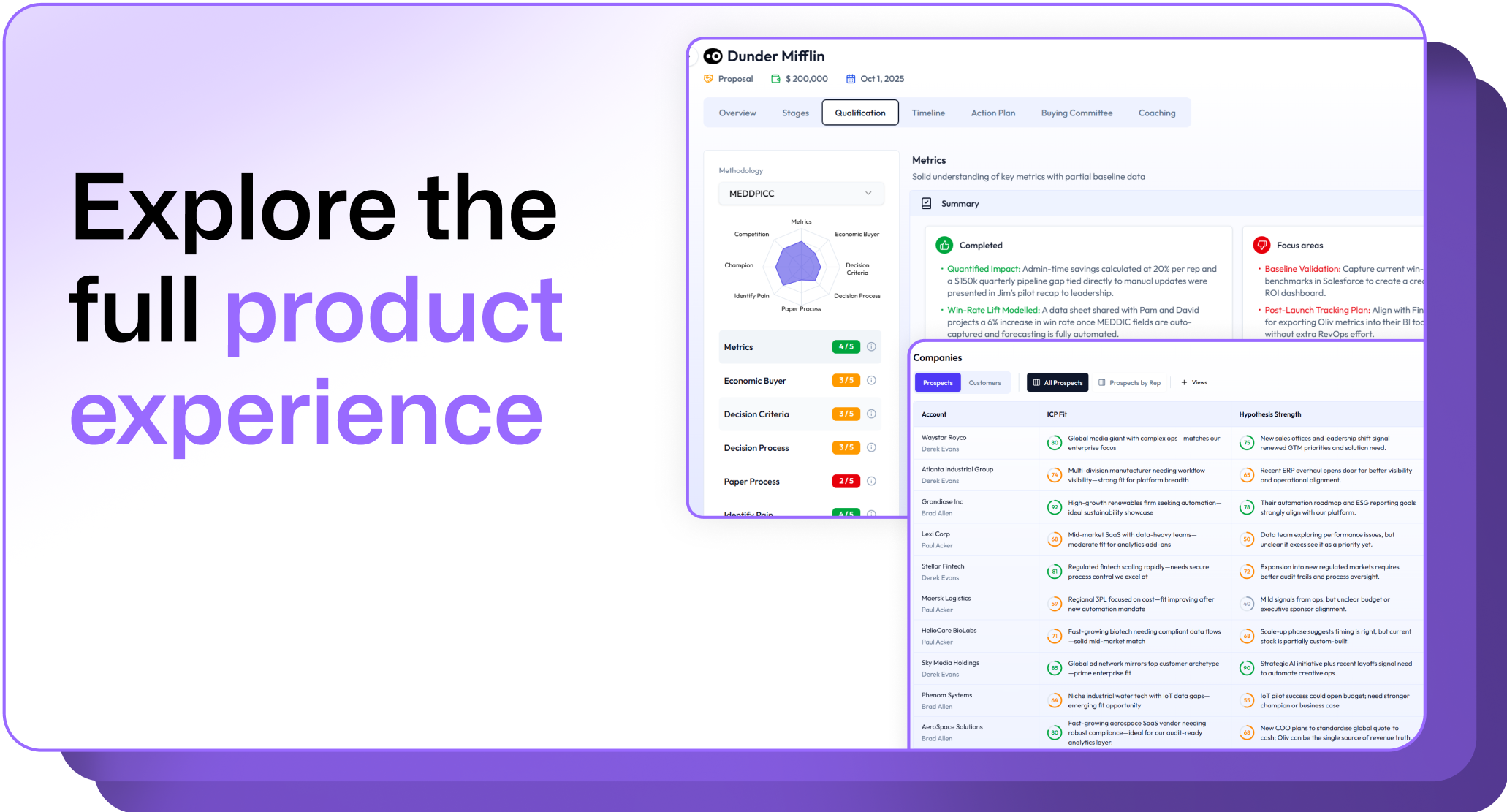
.avif)
.avif)