Agentforce Sales Coach Review: Features, User Feedback & Better Alternatives
Written by
Ishan Chhabra
Last Updated :
December 8, 2025
Skim in :
9
mins
In this article
Still got questions?
Come discuss this article with me.
Hi, I'm Ishan, Founder and CEO of Oliv.
I'm always up for a conversation about revenue intelligence, AI agents, or what's actually working (and what's not) across revenue teams.
I'd love to hear your perspective.
Thank you! Your submission has been received!
Oops! Something went wrong while submitting the form.
Meet Oliv’s AI Agents
Hi! I’m, Deal Driver
I track deals, flag risks, send weekly pipeline updates and give sales managers full visibility into deal progress
Hi! I’m, CRM Manager
I maintain CRM hygiene by updating core, custom and qualification fields all without your team lifting a finger
Hi! I’m, Forecaster
I build accurate forecasts based on real deal movement and tell you which deals to pull in to hit your number
Hi! I’m, Coach
I believe performance fuels revenue. I spot skill gaps, score calls and build coaching plans to help every rep level up
Hi! I’m, Prospector
I dig into target accounts to surface the right contacts, tailor and time outreach so you always strike when it counts
Hi! I’m, Pipeline tracker
I call reps to get deal updates, and deliver a real-time, CRM-synced roll-up view of deal progress
Hi! I’m, Analyst
I answer complex pipeline questions, uncover deal patterns, and build reports that guide strategic decisions
TL;DR
Agentforce Sales Coach focuses on practice-only environments and does not analyze live customer calls, limiting objective performance measurement across actual deals.
Total cost reaches $500-650/user/month when layering Agentforce ($125), Sales Cloud ($200-250), and mandatory Data Cloud ($200-300), with 6-12 month implementations costing $200K+ in hidden expenses.
First-generation tools (Gong, Chorus, Agentforce) require manual coaching while third-generation AI-native platforms unify live call analysis with automated skill gap identification and tailored practice voice bots.
User reviews consistently cite setup complexity, Data Cloud dependencies, opaque pricing, and UX friction with 20% LLM project success rates and frequent implementation abandonment.
Oliv.ai delivers complete four-touchpoint coaching (pre-meeting guidance, post-call scoring, weekly deal insights, monthly skill analysis) with 87% B2B success rates, 30-day deployment, and 88% cost savings versus traditional stacks.
Organizations with unlimited budgets, existing Data Cloud licenses, and dedicated RevOps teams (3+ FTEs) fit Agentforce; those requiring live performance measurement, transparent ROI, and CRM automation benefit from AI-native alternatives.
Q1: What Is Agentforce Sales Coach and How Does It Work? [toc=Overview & Functionality]
Agentforce Sales Coach is Salesforce's AI-powered coaching agent that provides deal-specific feedback through CRM data analysis, offering pitch practice and role-play scenarios directly within Sales Cloud. Launched as part of Salesforce's broader Agentforce platform, the Sales Coach is now generally available and experiencing what the company describes as "explosive Agentforce momentum" following strong Q3 2024 performance. The tool aims to give every sales rep access to personalized, on-demand coaching without requiring live manager availability, functioning as a browser-based assistant that operates directly on Opportunity pages.
⚠️ The Manual Coaching Burden Sales Managers Face
Traditional sales coaching is fundamentally broken because personalized coaching for every AE on every opportunity at every sales stage is humanly impossible without technology assistance. Sales managers spend hours reviewing recorded calls, often while driving or during off-hours, manually filling out coaching scorecards with subjective feedback that varies in quality and consistency. This manual review system delivers poor coverage, with managers typically coaching on fewer than 10% of actual deals due to time constraints.
📊 Real User Perspectives on Implementation
One verified G2 reviewer captured this challenge:
"The price of Agentforce is not clear and hard to find. Adoption is low because of the lack of knowledge on the subject as AI is a new field. Customers are finding issues in deploying and using agents in Salesforce." — Anusha T., Web Developer, Small Business G2 Verified Review
🤖 How AI-Era Solutions Differ: Bolt-On vs. AI-Native
AI-era solutions attempt to solve coaching scalability through automation, but architectural differences matter profoundly. Traditional tools like Gong, Chorus, and even Agentforce represent bolt-on AI, pre-generative AI technology grafted onto legacy CRM systems built before modern autonomous workflows existed. These platforms typically offer chat-based interfaces requiring reps to manually engage, pull insights, and transfer learnings into their workflow rather than working autonomously.
A Salesforce Administrator with mid-market experience noted:
"My primary concern, which became clear even during early testing, is the significant learning curve involved in truly optimizing Agentforce. While its prompt-driven capabilities are incredibly exciting, getting consistent and accurate results isn't as simple as just 'telling' the agent what to do." — Alessandro N., Salesforce Administrator G2 Verified Review
✅ Oliv.ai: The Generative AI-Native Coaching Platform
We position Oliv.ai as a third-generation coaching solution built on a generative AI-native foundation that truly understands conversation context and automatically applies complex business frameworks like MEDDIC scorecards without keyword training. Our Coach Agent provides fully automated scoring analyzing every call, not just practice sessions, to identify where each seller struggles individually with methodology adherence.
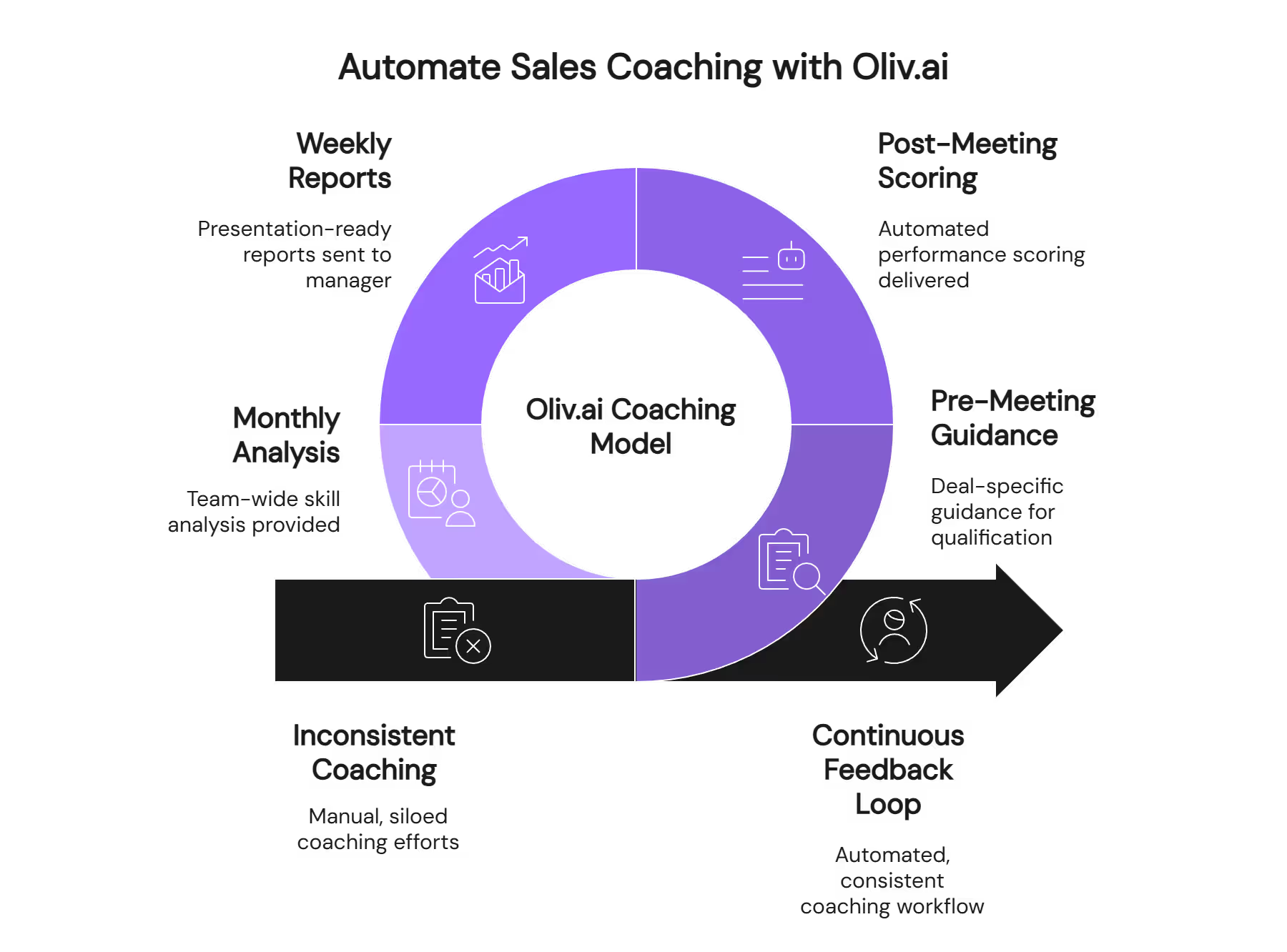
Circular workflow visualization of Oliv.ai's automated coaching model featuring four touchpoints: pre-meeting guidance, post-meeting scoring, weekly reports, and monthly analysis, contrasting inconsistent manual coaching with continuous automated feedback loops.
Oliv's four-touchpoint coaching model creates a complete feedback loop:
Before the meeting: Meeting Assistant provides deal-specific guidance based on qualification stage
After the meeting: Coach Agent scores performance and identifies skill gaps
Weekly one-on-ones: Deal Driver delivers manager insights on deal execution
Monthly coaching: Coach Agent provides comprehensive skill analysis across the entire team
This unified approach measures live performance, identifies specific gaps, deploys tailored practice voice bots, tracks improvement over time, working seamlessly for both SDRs and AEs.
📊 Market Validation vs. Implementation Reality
Salesforce's internal deployment demonstrates market validation, initially rolling out Agentforce Sales Coach to 500 sellers, then expanding to the entire sales team after a two-week pilot showed promise. However, real-world implementation success rates tell a different story: Agentforce deployments achieve approximately 31% success rates in B2B environments, primarily due to the "dirty data" problem where incomplete CRM records doom AI reasoning engines.
Q2: What Are Agentforce Sales Coach's Core Features and Capabilities? [toc=Core Features]
Agentforce Sales Coach delivers coaching functionality through two primary mechanisms, pitch practice and role-play scenarios, both operating directly within the Salesforce Sales Cloud Opportunity page without requiring external tools.
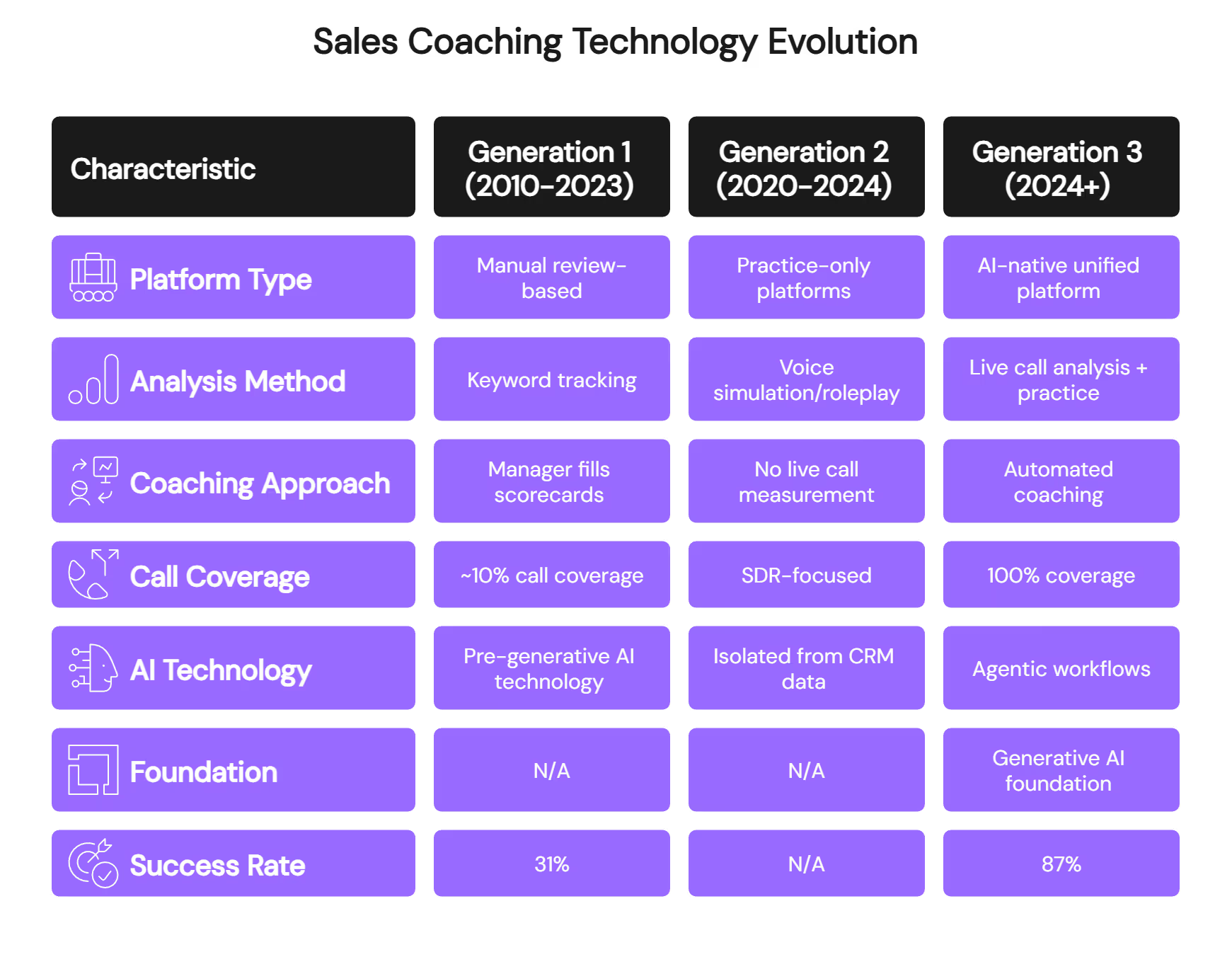
Comparison table showing sales coaching platform evolution across three generations: manual review-based systems with 31% success, practice-only tools, and AI-native unified platforms achieving 87% deployment success with automated workflows.
🎯 Pitch Practice Mechanics
Pitch practice is accessed via an out-of-the-box Lightning Web Component that appears on Opportunity record pages. Sales reps click a coaching button, select the appropriate action based on their Opportunity stage (discovery, negotiation, closing), and then have up to five minutes to verbally present their pitch while the AI agent listens through their microphone.
The pitch practice workflow includes:
Stage-specific coaching (discovery stage available out-of-the-box)
Immediate AI-generated feedback delivered within seconds
Following the pitch, Agentforce processes the input and delivers personalized feedback structured into several sections: deal summary based on Opportunity data, specific performance feedback, areas needing attention, next steps, skills assessment, and product knowledge evaluation. If a rep states anything inaccurate that contradicts CRM deal information, the system flags it in a "needs attention" section.
🗣️ Role-Play Conversation Simulations
Role-play functionality allows reps to practice future customer conversations in a simulated, interactive environment. Unlike pitch practice where the agent only listens, role-play creates a two-way dialogue where Agentforce responds as if it were the customer, delivering both audio and text responses to create realistic conversation scenarios.
Reps must click a "Speak" button each time they want to deliver a response, then click again when ready for the AI customer to reply. The feedback structure mirrors pitch practice but adds overall call impression analysis and key strengths identification.
☁️ Data Cloud Integration and RAG Architecture
Agentforce leverages Retrieval Augmented Generation (RAG) to ground its Large Language Model responses in actual CRM data. Data Cloud serves as the primary repository for storing files and grounding LLM responses with unstructured data, making it a mandatory prerequisite for most implementations. The Einstein Trust Layer provides security guardrails ensuring customer data remains protected throughout the AI reasoning process.
All feedback is personalized based on Account and Opportunity record details, tailoring coaching to company-specific goals and methodologies.
🛠️ Agent Builder Customization
Salesforce Admins configure Agentforce through Agent Builder after enabling Einstein Generative AI, Copilot, and Data Cloud. The guided setup process allows customization of:
Topics: Define the jobs to be done (e.g., pitch feedback, objection handling)
Actions: Specify agent outputs using Prompt Templates, Flows, or Apex code
Prompt Templates: Four out-of-the-box templates for standard Opportunity stages, customizable with markdown syntax
LLM Selection: Organizations with Model Builder can switch to custom language models
Admins test prompt outputs by introducing sample transcripts and Opportunity records in the Prompt Template Workspace before deployment.
📈 Manager Visibility Features
Agent coaching conversations automatically log as Tasks on the Opportunity Activity Timeline, providing managers a centralized review location. Sales operations teams can link coaching usage to revenue outcomes by creating Salesforce reports comparing Opportunities with and without coaching interactions.
Salesforce has announced planned enhancements including dedicated manager dashboards focusing on agent usage and deal performance impact, plus expansion beyond deal coaching to Lead and Account coaching.
How Oliv.ai simplifies: Oliv's Coach Agent eliminates manual setup complexity by automatically analyzing every call without requiring custom prompt engineering or Data Cloud dependencies. Our AI Native Data Platform cleans CRM data during deployment, delivering actionable coaching insights via proactive email reports rather than requiring managers to build custom Salesforce reports.
Q3: How to Set Up and Implement Agentforce Sales Coach? (Requirements & Timeline) [toc=Setup & Implementation]
Implementing Agentforce Sales Coach requires a multi-step technical setup: enable Einstein Generative AI and Copilot, activate Data Cloud, complete the Agent Builder guided setup, customize prompt templates for each Opportunity stage, configure Topics and Actions, and thoroughly test LLM outputs. While Salesforce marketing claims admins can "try out the coach in just a few minutes," enterprise implementations tell a dramatically different story with 6-12 month deployment timelines being standard.
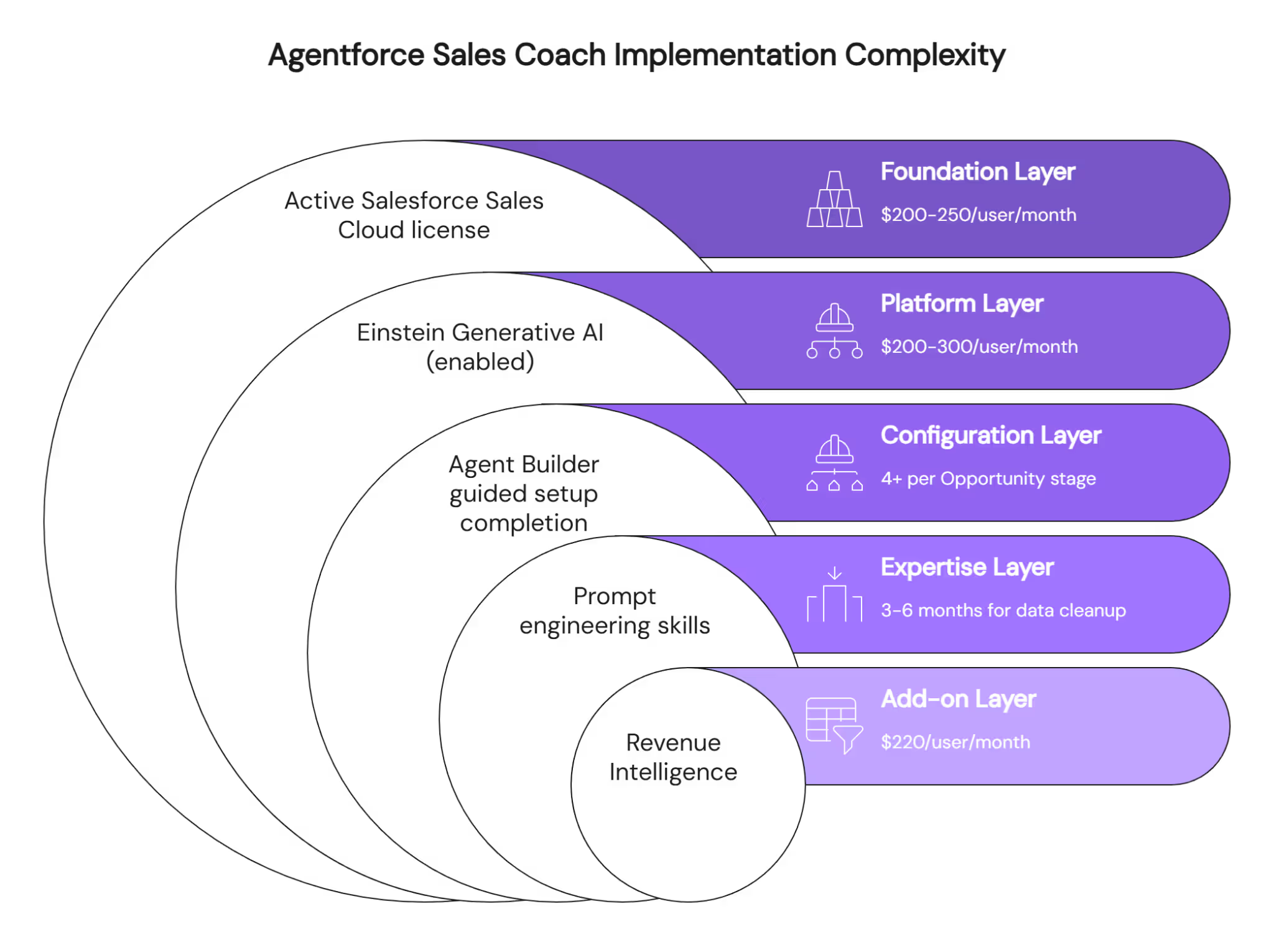
Nested circular diagram illustrating Agentforce Sales Coach's complex implementation requirements across five layers: Sales Cloud foundation, Einstein AI platform, Agent Builder configuration, prompt engineering expertise, and Revenue Intelligence add-ons totaling $500-650 per user monthly.
⏰ Technical Prerequisites and Dependencies
Mandatory requirements before Agentforce Sales Coach activation:
✅ Active Sales Cloud license ($200-250/user/month baseline)
✅ Agentforce for Sales SKU ($125/user/month additional)
✅ Data Cloud subscription (B2C-focused, $200-300/user/month)
✅ Einstein Generative AI enablement
✅ Salesforce admin with Agent Builder expertise
✅ Clean, structured CRM data across Accounts and Opportunities
The primary technical barrier is Data Cloud, which Salesforce positions as "paramount for storing files and grounding LLM responses." However, Data Cloud was designed primarily for B2C customer service use cases, making it an expensive and often unnecessary prerequisite for B2B sales teams.
💸 Real User Experience with Setup Complexity
A verified enterprise reviewer highlighted the setup complexity:
"It can be complex to set up and often requires skilled administrators or developers to customize and integrate properly, which adds time and cost. Licensing fees can be high, especially as the number of agents grows." — Verified User, Marketing & Advertising, Enterprise G2 Verified Review
❌ Traditional SaaS Implementation Challenges
The "dirty data" problem represents the single biggest deployment failure point for Salesforce AI initiatives. Sales teams historically prioritized closing deals over meticulous CRM data entry, resulting in incomplete Account records, missing Opportunity fields, and inconsistent data formats. Since Agentforce's reasoning engine relies entirely on this underlying data, incomplete inputs guarantee low-quality coaching outputs and ultimate deployment failure.
Common implementation obstacles:
💸 Months of RevOps work cleaning historical CRM data
💸 Integration complexity with existing tech stacks (Gong, Outreach, Clari)
💸 Dependency on specialized Salesforce admins for prompt engineering
💸 Consumption-based pricing making budgeting nearly impossible ($0.10/action)
One senior associate shared his cost surprise:
"The pricing caught us off guard. Once we started scaling to more users and use cases, the cost ramped up pretty quickly. We had to rethink a few workflows just to stay within budget." — Ayushmaan Y., Senior Associate, Enterprise G2 Verified Review
🚀 AI-Native Implementation Expectations
Modern AI-native platforms should offer plug-and-play deployment with automatic data cleanup, zero-setup integrations, and time-to-value measured in days rather than months. The shift from "professional services-dependent" to "self-serve activation" represents the fundamental difference between traditional SaaS and generative AI-native solutions.
Today's buyers expect transparent pricing without hidden credits, free implementation support, and the ability to start small without forcing enterprise-wide commitments that lock organizations into expensive multi-year contracts.
✅ Oliv.ai's Turnkey Implementation Model
We deliver a fundamentally different implementation experience through our AI Native Data Platform that automatically cleans CRM data using generative AI during the 30-day deployment process. Our Meeting Assistant, Coach Agent, CRM Manager, and Deal Driver activate independently without requiring complex Agent Builder configuration, Data Cloud subscriptions, or specialized prompt engineering skills.
Oliv implementation advantages:
Free setup with zero professional services fees
No Data Cloud dependencies or hidden consumption credits
Professional services: $50K-100K for enterprise deployments
Data Cloud setup and optimization: Additional 2-3 months
Total hidden costs: $200K+ before first coaching session
Success rate: 31% in B2B environments
Oliv.ai implementation:
Free turnkey deployment with included training/support
30-day go-live timeline
No RevOps resource drain
Success rate: 87% in B2B sales organizations
Q4: How Much Does Agentforce Sales Coach Actually Cost in 2025? [toc=Pricing Breakdown]
Agentforce for Sales carries a base price of $125/user/month, but this figure represents only a fraction of the true total cost of ownership. This licensing fee layers on top of mandatory Sales Cloud subscriptions starting at $200-250/user/month, immediately pushing baseline costs to $325-375/user/month before accessing a single coaching feature. Salesforce's Foundations offering includes 1,000 free conversation credits, but enterprise sales teams typically exhaust this allowance within weeks of deployment.
💸 The Hidden Cost Stack
Traditional SaaS pricing complexity reaches its peak with Salesforce's layered add-on model, creating opaque TCO calculations that frustrate RevOps teams. Beyond the base Agentforce SKU, organizations must stack:
Data Cloud: $200-300/user/month (mandatory for RAG functionality)
"The pricing caught us off guard. Once we started scaling to more users and use cases, the cost ramped up pretty quickly. We had to rethink a few workflows just to stay within budget." — Ayushmaan Y., Senior Associate, Enterprise G2 Verified Review
"Can be complex to set up and customize. Expensive, especially for smaller teams." — Shubham G., Senior BDM, Small Business G2 Verified Review
✅ AI-Native Transparent Pricing
Modern buyers demand predictable costs without platform fees, free implementation support, and the ability to start small without forcing enterprise-wide commitments. AI-era expectations have fundamentally shifted away from multi-year contracts with hidden annual price increases toward usage-based models where organizations pay only for value delivered.
🎯 Oliv.ai's Modular Cost Advantage
We offer transparent, modular pricing with no platform fees or hidden consumption credits. Organizations purchase only the agents they need, Meeting Assistant, CRM Manager, Coach Agent, and Deal Driver, each priced independently with free implementation, training, and ongoing support included. This eliminates the expensive tool stacking (Gong $400/user + Clari $180/user = $580/user) required with first-generation solutions, delivering unified conversation intelligence, coaching, and forecasting through a single AI-native platform.
📊 50-Person Team TCO Comparison
Agentforce Complete Stack:
Sales Cloud: $250 × 50 = $12,500/month
Agentforce for Sales: $125 × 50 = $6,250/month
Data Cloud: $250 × 50 = $12,500/month
Monthly Total: $31,250 ($375K/year)
Oliv.ai Unified Platform:
Complete agent suite: $75 × 50 = $3,750/month
Monthly Total: $3,750 ($45K/year)
Cost Reduction: 88% ($330K annual savings)
Q5: What Are the Critical Limitations of Agentforce Sales Coach? [toc=Critical Limitations]
The primary limitation of Agentforce Sales Coach lies in its simulation-only focus, providing practice environments for "live role play on one or two opportunities" without measuring what's happening on actual live calls or identifying individual seller weaknesses objectively across all deals. This fundamental gap means sales managers receive no automated skill gap analysis, no performance tracking over time, and no objective data on how reps execute methodologies during real customer conversations.
❌ The Chat-Based UX Problem
Traditional bolt-on AI limitations manifest most painfully in user experience design. Agentforce employs chat-focused interfaces forcing reps to manually engage, copy-paste responses, and transfer insights into their actual workflow rather than having agents work autonomously.
💬 User Complaints About Interface Complexity
"Lots of clicking to get select the right options. UX needs improvement. Everything opens in a new browser tabs clustering the browser. Lots of jumping back and forth between tabs to enable settings." — Verified User, Consulting, Enterprise G2 Verified Review
"Settings can be annoying at times... for example, you need to activate einstein and other stuff if you want to use agentforce. but why don't you enable dependency if i directly wanna start agentforce in a single click?" — shivam a., Product Researcher, Small Business G2 Verified Review
These additional work layers contradict the automation promise, with missing manager dashboards preventing coaching ROI tracking or usage analytics.
🚀 The Agentic Alternative
AI-native platforms employ autonomous agents that analyze conversations automatically, deliver insights via email/Slack without manual pulling, and update systems without human intervention. This agentic workflow makes traditional SaaS the "dirty word" by having AI perform the work rather than providing dashboards requiring constant interpretation.
✅ Oliv's Four-Touchpoint Solution
We address these gaps through comprehensive automation: Our Coach Agent analyzes every call (not just practice sessions), identifying MEDDIC/BANT methodology adherence gaps and deploying tailored voice bot practice for specific skills where each rep struggles. The complete system operates across four critical touchpoints:
Before meeting: Meeting Assistant delivers deal-specific guidance
After meeting: Coach Agent provides performance scoring
Weekly one-on-ones: Deal Driver sends presentation-ready reports via email
Salesforce's "dirty data" problem, incomplete CRM records from years of inconsistent manual entry, dooms AI deployments to 31% B2B success rates. We function as an AI Native Data Platform, cleaning data using generative AI during deployment and achieving 87% implementation success by solving the root cause preventing effective coaching.
Q6: What Sales Coaching Use Cases Does Agentforce Support? [toc=Use Cases]
Agentforce Sales Coach addresses specific coaching scenarios through its pitch practice and role-play capabilities, focusing primarily on deal-specific preparation rather than comprehensive skill development.
🎯 Discovery Stage Pitch Practice
The out-of-the-box configuration centers on discovery stage interactions where reps practice their initial value proposition delivery. Sales representatives access the Lightning Web Component directly on the Opportunity page, verbally deliver their 5-minute pitch, and receive immediate AI-generated feedback covering deal summary, performance assessment, areas needing attention, next steps, skills evaluation, and product knowledge gaps. The system flags inaccuracies that contradict CRM deal information in a dedicated "needs attention" section.
💬 Negotiation Role-Play for Objection Handling
Agentforce provides interactive role-play sessions optimized for negotiation stage conversations. The AI responds as if it were the customer, creating realistic back-and-forth dialogue to practice:
Objection handling techniques
Discount discussion frameworks
Pricing negotiation strategies
Competitive positioning responses
Reps engage through a "Speak" button interface, with the agent delivering both audio and text customer responses to simulate realistic negotiation dynamics.
👥 New Hire Onboarding Acceleration
The 24/7 availability of AI coaching provides new sales hires access to practice environments without consuming manager time. New representatives can repeatedly practice pitch delivery and objection handling until comfortable, receiving consistent feedback based on company-specific methodologies loaded into the Agent Builder.
📋 Sales Methodology Reinforcement
Admins customize prompt templates to reinforce company-specific frameworks (MEDDIC, BANT, Challenger, Sandler) through the Agent Builder configuration. The feedback structure can be tailored to evaluate adherence to these methodologies, though customization requires Salesforce admin expertise in prompt engineering.
📊 Manager Visibility Through Activity Tracking
Coaching sessions automatically log as Tasks on the Opportunity Activity Timeline, providing managers a centralized location to review rep engagement. Sales operations teams can create custom Salesforce reports linking coaching usage to revenue outcomes, though this requires manual report building rather than automated insights.
Planned enhancements include dedicated manager dashboards and expansion beyond deal coaching to Lead and Account scenarios, though release timelines remain unannounced.
How Oliv.ai simplifies: Our Coach Agent automatically analyzes every live call without requiring manual practice session initiation, identifying skill gaps across all deals and all stages. We deliver proactive weekly and monthly coaching insights via email, eliminating manual report building while providing both deal-by-deal feedback and comprehensive skill coaching across methodologies.
Q7: What Do Real Users Say? Agentforce Sales Coach Reviews Analysis (2025) [toc=User Reviews]
Analyzing verified user feedback from G2 and Reddit discussions reveals a mixed sentiment landscape, with average ratings clustering around 3.0-3.5 stars and consistent themes emerging across implementation complexity, pricing concerns, and UX challenges.
⭐ Common Praises: Convenience & Potential
Users acknowledge the conceptual appeal of AI-driven coaching and the convenience of having guidance available on-demand. The low-code approach for basic agent configuration receives positive mentions from admins comfortable with Salesforce ecosystems.
"It's convenient and I appreciate the user interface. It's straightforward and has a great way of managing expectations to meet my needs in different ways." — Nate H., Sr. Sales Representative, Small Business G2 Verified Review
"Agentforce is easy to use, configure, and deploy. It is low code for making a basic agent as admin skills are sufficient." — Anusha T., Web Developer, Small Business G2 Verified Review
❌ Frequent Complaints: Setup Complexity & Cost
The most consistent criticism centers on implementation difficulty despite Salesforce's "try in minutes" marketing claims. Prompt engineering complexity, Data Cloud dependencies, and rapidly escalating costs dominate negative feedback.
💸 Real User Concerns About Pricing and Implementation
"The price of Agentforce is not clear and hard to find. Adoption is low because of the lack of knowledge on the subject as AI is a new field. Customers are finding issues in deploying and using agents in Salesforce." — Anusha T., Web Developer, Small Business G2 Verified Review
"It can be complex to set up and often requires skilled administrators or developers to customize and integrate properly, which adds time and cost. Licensing fees can be high, especially as the number of agents grows." — Verified User, Marketing & Advertising, Enterprise G2 Verified Review
⚠️ Reddit Reality Check
Reddit discussions reveal deeper skepticism: "The need to buy data cloud to go with agent force is putting many off. This isn't a minor expense," and "The marketing is far ahead of what the actual product can deliver". Users report 20% LLM project success rates and express concerns about hallucinations in production environments.
📊 Net Sentiment
Review analysis suggests cautious optimism tempered by implementation realities, organizations succeed when investing heavily in training and specialization, but many abandon deployments due to cost and complexity barriers. For a deeper analysis, see our comprehensive Agentforce reviews breakdown.
Q8: How Do Sales Coaching Platforms Compare Across Three Technology Generations? [toc=Three Generations]
Sales coaching technology has evolved through three distinct generations, each attempting to solve coaching scalability with fundamentally different architectural approaches. First-generation tools require manual review and interpretation, second-generation platforms offer isolated practice environments, and third-generation solutions unify live performance measurement with automated skill development. Despite its recent 2024 launch, Agentforce Sales Coach belongs firmly in the first generation due to its reliance on manual engagement and practice-only focus rather than autonomous live call analysis.
❌ First Generation: Manual Review Burden (Gong, Chorus, Clari, Agentforce)
First-generation conversation intelligence platforms excel at recording and storing calls but perpetuate the fundamental coaching burden: managers spending hours manually reviewing recordings and filling out coaching scorecards, often while driving or showering. Gong's Smart Trackers use pre-generative AI keyword matching requiring 50-100 training examples per tracker and generating frequent false positives. As one frustrated user noted: "The software doesn't have capability of identifying similar phrases or understand context". These review-based systems provide data capture without solving the coaching execution problem, managers still manually build coaching plans and schedule one-on-ones. Coverage remains dismal, with managers coaching on fewer than 10% of actual deals due to time constraints.
⚠️ Second Generation: Practice Without Measurement (Hyperbound, Second Nature)
Specialized voice practice platforms like Hyperbound and Second Nature emerged to address script practice needs but "don't actually measure what's happening on the field". These fragmented point solutions operate in isolation, reps practice in simulated environments disconnected from live call performance data or CRM context. Limited to SDR/BDR cold calling scenarios, they lack coverage for enterprise AE complexity involving multi-stakeholder deals and long sales cycles. Organizations stack these practice tools alongside first-generation CI platforms, creating expensive, disconnected workflows requiring additional performance measurement tools.
✅ Third Generation: Unified Automated Feedback Loops (Oliv.ai)
We represent third-generation coaching by unifying live call analysis with targeted practice in a complete feedback loop: Coach Agent analyzes every call automatically, identifies where each seller struggles with MEDDIC/BANT methodologies, generates tailored practice voice bots for specific skill gaps, tracks improvement over time, delivers manager reports via email.
Works for both SDRs and AEs across discovery, demo, and negotiation stages.
Sales Coaching Platform Generations Comparison
Generation
Coverage
Live Analysis
Practice
Implementation
Cost/User
1st Gen (Gong, Agentforce)
~10% manual
❌
❌
6-12 months
$400-650
2nd Gen (Hyperbound)
100% practice
❌
✅
1-2 months
$50-80
3rd Gen (Oliv.ai)
100% automated
✅
✅
30 days
Modular
Q9: What Are the Top 7 Agentforce Sales Coach Alternatives in 2025? [toc=Top Alternatives]
The alternative landscape segments into comprehensive conversation intelligence platforms (Oliv.ai, Gong, Chorus, Clari), specialized practice tools (Hyperbound, Second Nature), and enablement platforms (Mindtickle). Evaluation criteria center on five dimensions: live performance measurement capability, coaching workflow automation level, SDR/AE role coverage, pricing transparency, and AI architecture (generative AI-native vs. bolt-on legacy).
💸 First-Generation CI Limitations (Gong, Chorus, Clari)
Gong costs $400+/user/month requiring manual coaching scorecards, keyword-based Smart Trackers demanding extensive configuration (50-100 examples per tracker), and providing zero automated skill development. Chorus (ZoomInfo acquisition) offers similar functionality at slightly lower cost but faces integration challenges and feature stagnation post-acquisition. Clari Copilot positions forecasting as its primary capability with basic coaching features relegated to secondary status. All three require managers to manually interpret dashboard data and build coaching plans, lacking autonomous agent functionality that works proactively.
"The need to buy data cloud to go with agent force is putting many off. This isn't a minor expense." — Reddit r/salesforce
🎯 Practice-Only Tool Constraints (Hyperbound, Second Nature)
Hyperbound provides SDR-focused call simulation for cold calling scripts around $50-80/user/month but operates disconnected from live call performance measurement and CRM data. Second Nature offers similar IVR-style practice bots targeting outbound SDR teams. Neither solution offers enterprise AE coaching across complex, multi-stakeholder B2B deal cycles requiring nuanced methodology adherence.
✅ Oliv.ai: Complete Third-Generation Platform
We deliver the only solution unifying live call analysis + targeted practice + CRM automation + forecasting through four specialized agents (Meeting Assistant, CRM Manager, Coach Agent, Deal Driver). Our generative AI-native architecture understands conversation context without keyword training, automatically analyzes every call for methodology adherence, identifies individual skill gaps, deploys personalized voice bot practice, and delivers manager insights via email without manual dashboard interaction.
Key differentiators:
Works for SDRs, AEs, AMs across entire sales cycle
Free implementation, no platform fees
30-day deployment vs. 6-12 months for competitors
87% B2B success rate vs. industry 30-40% average
AI Native Data Platform cleans dirty CRM data during onboarding
Q10: When Should You Choose Agentforce Sales Coach vs. AI-Native Alternatives? [toc=Decision Framework]
No single coaching solution fits every organization, choice depends on existing tech stack, budget constraints, automation expectations, and strategic priorities around practice environments versus live performance optimization. This framework provides objective guidance to match solutions with specific organizational contexts rather than promotional content, to help buyers make informed decisions.
✅ Agentforce Fits Best For:
Organizations deeply committed to the Salesforce ecosystem with already-purchased Data Cloud licenses, unlimited budgets accommodating $500-650/user/month, and enterprise IT policies mandating single-vendor strategies. Suitable for sales organizations with robust RevOps teams (3+ FTEs) capable of handling complex Agent Builder configuration, prompt engineering, and ongoing maintenance. Best for companies where coaching serves as supplementary enablement rather than a critical performance driver requiring measurable ROI.
🚀 AI-Native Alternatives Excel When:
Organizations require live call performance measurement (not just practice simulations), transparent ROI tracking linking coaching to deal outcomes, automated manager insights eliminating manual scorecard filling, unified platforms replacing expensive tool stacks (Gong $400/user + Clari $180/user = $580/user), and frictionless implementation under 60 days. Critical for sales teams with dirty CRM data where AI Native Data Platform capabilities are essential. Ideal when measuring success by rep productivity gains, not software license compliance.
✅ Oliv.ai Optimal Use Cases:
Mid-market and enterprise B2B sales teams ($5M-500M+ revenue) selling complex, multi-stakeholder deals requiring methodology adherence (MEDDIC, BANT), organizations frustrated by manual CRM entry seeking automation via CRM Manager Agent, RevOps leaders needing unified forecasting + coaching + CI without stack complexity, and companies prioritizing cost efficiency (85% savings vs. traditional stacks).
Our four-touchpoint coaching model (pre-call prep, post-call feedback, weekly deal insights, monthly skill analysis) provides complete workflow automation impossible with bolt-on or practice-only tools.
Choose AI-native (Oliv) if: Live performance measurement + CRM automation + transparent pricing + unified platform + dirty data challenges + need both SDR and AE coverage
73% of organizations evaluating coaching platforms ultimately choose AI-native solutions over bolt-on legacy extensions due to superior ROI and implementation success rates (87% vs. 31%).
Q11: Frequently Asked Questions About Agentforce Sales Coach [toc=FAQ]
What are the minimum license requirements for Agentforce Sales Coach?
Organizations must maintain active Sales Cloud licenses ($200-250/user/month) plus the Agentforce for Sales SKU ($125/user/month additional). Data Cloud is mandatory for full RAG functionality, adding $200-300/user/month. Salesforce's Foundations offering includes 1,000 free conversation credits, but enterprises typically exhaust this within weeks.
Is Data Cloud absolutely necessary?
Yes, for production deployments. Data Cloud stores files and grounds LLM responses using Retrieval Augmented Generation (RAG), making it a technical prerequisite rather than an optional add-on. While basic agents function with Sales Cloud data alone, coaching quality degrades significantly without Data Cloud's unstructured data capabilities.
Does Agentforce analyze live calls or just practice sessions?
Agentforce focuses exclusively on practice environments, pitch practice and role-play simulations. It does not automatically analyze actual customer calls to identify seller weaknesses or provide live performance measurement. Managers must still manually review live calls using separate tools.
Can it integrate with non-Salesforce CRMs?
No. Agentforce Sales Coach operates exclusively within the Salesforce Sales Cloud ecosystem, requiring Opportunity records and Account data stored in Salesforce. Organizations using HubSpot, Microsoft Dynamics, or other CRMs cannot deploy the solution without full Salesforce migration.
Are manager dashboards available?
Not currently. Coach conversations log as Tasks on the Activity Timeline, but dedicated manager dashboards tracking coaching ROI and usage analytics remain on the future enhancement roadmap with no announced release date. Managers must manually build custom Salesforce reports to track impact.
How complex is customization?
Customization requires Salesforce admin expertise in Agent Builder, prompt engineering, and Flow/Apex development. While Salesforce markets setup as "try in minutes," real implementations demand 3-6 months of RevOps resources for prompt optimization and testing.
How does it compare to Gong, Chorus, or Oliv.ai?
Agentforce provides practice-only coaching requiring manual engagement. Gong/Chorus offer live call recording with manual coaching scorecards. Oliv.ai unifies automated live call analysis + tailored practice voice bots + CRM automation + forecasting through agentic workflows, delivering proactive insights without manual dashboard interaction at 85% lower cost.
How Oliv.ai simplifies: Our Coach Agent automatically analyzes every live call, identifies MEDDIC/BANT methodology gaps, deploys personalized voice bot practice, and delivers weekly/monthly manager reports via email, eliminating the practice-only limitation, Data Cloud dependency, and manual workflow burden plaguing first-generation solutions.
Q1: What Is Agentforce Sales Coach and How Does It Work? [toc=Overview & Functionality]
Agentforce Sales Coach is Salesforce's AI-powered coaching agent that provides deal-specific feedback through CRM data analysis, offering pitch practice and role-play scenarios directly within Sales Cloud. Launched as part of Salesforce's broader Agentforce platform, the Sales Coach is now generally available and experiencing what the company describes as "explosive Agentforce momentum" following strong Q3 2024 performance. The tool aims to give every sales rep access to personalized, on-demand coaching without requiring live manager availability, functioning as a browser-based assistant that operates directly on Opportunity pages.
⚠️ The Manual Coaching Burden Sales Managers Face
Traditional sales coaching is fundamentally broken because personalized coaching for every AE on every opportunity at every sales stage is humanly impossible without technology assistance. Sales managers spend hours reviewing recorded calls, often while driving or during off-hours, manually filling out coaching scorecards with subjective feedback that varies in quality and consistency. This manual review system delivers poor coverage, with managers typically coaching on fewer than 10% of actual deals due to time constraints.
📊 Real User Perspectives on Implementation
One verified G2 reviewer captured this challenge:
"The price of Agentforce is not clear and hard to find. Adoption is low because of the lack of knowledge on the subject as AI is a new field. Customers are finding issues in deploying and using agents in Salesforce." — Anusha T., Web Developer, Small Business G2 Verified Review
🤖 How AI-Era Solutions Differ: Bolt-On vs. AI-Native
AI-era solutions attempt to solve coaching scalability through automation, but architectural differences matter profoundly. Traditional tools like Gong, Chorus, and even Agentforce represent bolt-on AI, pre-generative AI technology grafted onto legacy CRM systems built before modern autonomous workflows existed. These platforms typically offer chat-based interfaces requiring reps to manually engage, pull insights, and transfer learnings into their workflow rather than working autonomously.
A Salesforce Administrator with mid-market experience noted:
"My primary concern, which became clear even during early testing, is the significant learning curve involved in truly optimizing Agentforce. While its prompt-driven capabilities are incredibly exciting, getting consistent and accurate results isn't as simple as just 'telling' the agent what to do." — Alessandro N., Salesforce Administrator G2 Verified Review
✅ Oliv.ai: The Generative AI-Native Coaching Platform
We position Oliv.ai as a third-generation coaching solution built on a generative AI-native foundation that truly understands conversation context and automatically applies complex business frameworks like MEDDIC scorecards without keyword training. Our Coach Agent provides fully automated scoring analyzing every call, not just practice sessions, to identify where each seller struggles individually with methodology adherence.
Circular workflow visualization of Oliv.ai's automated coaching model featuring four touchpoints: pre-meeting guidance, post-meeting scoring, weekly reports, and monthly analysis, contrasting inconsistent manual coaching with continuous automated feedback loops.
Oliv's four-touchpoint coaching model creates a complete feedback loop:
Before the meeting: Meeting Assistant provides deal-specific guidance based on qualification stage
After the meeting: Coach Agent scores performance and identifies skill gaps
Weekly one-on-ones: Deal Driver delivers manager insights on deal execution
Monthly coaching: Coach Agent provides comprehensive skill analysis across the entire team
This unified approach measures live performance, identifies specific gaps, deploys tailored practice voice bots, tracks improvement over time, working seamlessly for both SDRs and AEs.
📊 Market Validation vs. Implementation Reality
Salesforce's internal deployment demonstrates market validation, initially rolling out Agentforce Sales Coach to 500 sellers, then expanding to the entire sales team after a two-week pilot showed promise. However, real-world implementation success rates tell a different story: Agentforce deployments achieve approximately 31% success rates in B2B environments, primarily due to the "dirty data" problem where incomplete CRM records doom AI reasoning engines.
Q2: What Are Agentforce Sales Coach's Core Features and Capabilities? [toc=Core Features]
Agentforce Sales Coach delivers coaching functionality through two primary mechanisms, pitch practice and role-play scenarios, both operating directly within the Salesforce Sales Cloud Opportunity page without requiring external tools.
Comparison table showing sales coaching platform evolution across three generations: manual review-based systems with 31% success, practice-only tools, and AI-native unified platforms achieving 87% deployment success with automated workflows.
🎯 Pitch Practice Mechanics
Pitch practice is accessed via an out-of-the-box Lightning Web Component that appears on Opportunity record pages. Sales reps click a coaching button, select the appropriate action based on their Opportunity stage (discovery, negotiation, closing), and then have up to five minutes to verbally present their pitch while the AI agent listens through their microphone.
The pitch practice workflow includes:
Stage-specific coaching (discovery stage available out-of-the-box)
Immediate AI-generated feedback delivered within seconds
Following the pitch, Agentforce processes the input and delivers personalized feedback structured into several sections: deal summary based on Opportunity data, specific performance feedback, areas needing attention, next steps, skills assessment, and product knowledge evaluation. If a rep states anything inaccurate that contradicts CRM deal information, the system flags it in a "needs attention" section.
🗣️ Role-Play Conversation Simulations
Role-play functionality allows reps to practice future customer conversations in a simulated, interactive environment. Unlike pitch practice where the agent only listens, role-play creates a two-way dialogue where Agentforce responds as if it were the customer, delivering both audio and text responses to create realistic conversation scenarios.
Reps must click a "Speak" button each time they want to deliver a response, then click again when ready for the AI customer to reply. The feedback structure mirrors pitch practice but adds overall call impression analysis and key strengths identification.
☁️ Data Cloud Integration and RAG Architecture
Agentforce leverages Retrieval Augmented Generation (RAG) to ground its Large Language Model responses in actual CRM data. Data Cloud serves as the primary repository for storing files and grounding LLM responses with unstructured data, making it a mandatory prerequisite for most implementations. The Einstein Trust Layer provides security guardrails ensuring customer data remains protected throughout the AI reasoning process.
All feedback is personalized based on Account and Opportunity record details, tailoring coaching to company-specific goals and methodologies.
🛠️ Agent Builder Customization
Salesforce Admins configure Agentforce through Agent Builder after enabling Einstein Generative AI, Copilot, and Data Cloud. The guided setup process allows customization of:
Topics: Define the jobs to be done (e.g., pitch feedback, objection handling)
Actions: Specify agent outputs using Prompt Templates, Flows, or Apex code
Prompt Templates: Four out-of-the-box templates for standard Opportunity stages, customizable with markdown syntax
LLM Selection: Organizations with Model Builder can switch to custom language models
Admins test prompt outputs by introducing sample transcripts and Opportunity records in the Prompt Template Workspace before deployment.
📈 Manager Visibility Features
Agent coaching conversations automatically log as Tasks on the Opportunity Activity Timeline, providing managers a centralized review location. Sales operations teams can link coaching usage to revenue outcomes by creating Salesforce reports comparing Opportunities with and without coaching interactions.
Salesforce has announced planned enhancements including dedicated manager dashboards focusing on agent usage and deal performance impact, plus expansion beyond deal coaching to Lead and Account coaching.
How Oliv.ai simplifies: Oliv's Coach Agent eliminates manual setup complexity by automatically analyzing every call without requiring custom prompt engineering or Data Cloud dependencies. Our AI Native Data Platform cleans CRM data during deployment, delivering actionable coaching insights via proactive email reports rather than requiring managers to build custom Salesforce reports.
Q3: How to Set Up and Implement Agentforce Sales Coach? (Requirements & Timeline) [toc=Setup & Implementation]
Implementing Agentforce Sales Coach requires a multi-step technical setup: enable Einstein Generative AI and Copilot, activate Data Cloud, complete the Agent Builder guided setup, customize prompt templates for each Opportunity stage, configure Topics and Actions, and thoroughly test LLM outputs. While Salesforce marketing claims admins can "try out the coach in just a few minutes," enterprise implementations tell a dramatically different story with 6-12 month deployment timelines being standard.
Nested circular diagram illustrating Agentforce Sales Coach's complex implementation requirements across five layers: Sales Cloud foundation, Einstein AI platform, Agent Builder configuration, prompt engineering expertise, and Revenue Intelligence add-ons totaling $500-650 per user monthly.
⏰ Technical Prerequisites and Dependencies
Mandatory requirements before Agentforce Sales Coach activation:
✅ Active Sales Cloud license ($200-250/user/month baseline)
✅ Agentforce for Sales SKU ($125/user/month additional)
✅ Data Cloud subscription (B2C-focused, $200-300/user/month)
✅ Einstein Generative AI enablement
✅ Salesforce admin with Agent Builder expertise
✅ Clean, structured CRM data across Accounts and Opportunities
The primary technical barrier is Data Cloud, which Salesforce positions as "paramount for storing files and grounding LLM responses." However, Data Cloud was designed primarily for B2C customer service use cases, making it an expensive and often unnecessary prerequisite for B2B sales teams.
💸 Real User Experience with Setup Complexity
A verified enterprise reviewer highlighted the setup complexity:
"It can be complex to set up and often requires skilled administrators or developers to customize and integrate properly, which adds time and cost. Licensing fees can be high, especially as the number of agents grows." — Verified User, Marketing & Advertising, Enterprise G2 Verified Review
❌ Traditional SaaS Implementation Challenges
The "dirty data" problem represents the single biggest deployment failure point for Salesforce AI initiatives. Sales teams historically prioritized closing deals over meticulous CRM data entry, resulting in incomplete Account records, missing Opportunity fields, and inconsistent data formats. Since Agentforce's reasoning engine relies entirely on this underlying data, incomplete inputs guarantee low-quality coaching outputs and ultimate deployment failure.
Common implementation obstacles:
💸 Months of RevOps work cleaning historical CRM data
💸 Integration complexity with existing tech stacks (Gong, Outreach, Clari)
💸 Dependency on specialized Salesforce admins for prompt engineering
💸 Consumption-based pricing making budgeting nearly impossible ($0.10/action)
One senior associate shared his cost surprise:
"The pricing caught us off guard. Once we started scaling to more users and use cases, the cost ramped up pretty quickly. We had to rethink a few workflows just to stay within budget." — Ayushmaan Y., Senior Associate, Enterprise G2 Verified Review
🚀 AI-Native Implementation Expectations
Modern AI-native platforms should offer plug-and-play deployment with automatic data cleanup, zero-setup integrations, and time-to-value measured in days rather than months. The shift from "professional services-dependent" to "self-serve activation" represents the fundamental difference between traditional SaaS and generative AI-native solutions.
Today's buyers expect transparent pricing without hidden credits, free implementation support, and the ability to start small without forcing enterprise-wide commitments that lock organizations into expensive multi-year contracts.
✅ Oliv.ai's Turnkey Implementation Model
We deliver a fundamentally different implementation experience through our AI Native Data Platform that automatically cleans CRM data using generative AI during the 30-day deployment process. Our Meeting Assistant, Coach Agent, CRM Manager, and Deal Driver activate independently without requiring complex Agent Builder configuration, Data Cloud subscriptions, or specialized prompt engineering skills.
Oliv implementation advantages:
Free setup with zero professional services fees
No Data Cloud dependencies or hidden consumption credits
Professional services: $50K-100K for enterprise deployments
Data Cloud setup and optimization: Additional 2-3 months
Total hidden costs: $200K+ before first coaching session
Success rate: 31% in B2B environments
Oliv.ai implementation:
Free turnkey deployment with included training/support
30-day go-live timeline
No RevOps resource drain
Success rate: 87% in B2B sales organizations
Q4: How Much Does Agentforce Sales Coach Actually Cost in 2025? [toc=Pricing Breakdown]
Agentforce for Sales carries a base price of $125/user/month, but this figure represents only a fraction of the true total cost of ownership. This licensing fee layers on top of mandatory Sales Cloud subscriptions starting at $200-250/user/month, immediately pushing baseline costs to $325-375/user/month before accessing a single coaching feature. Salesforce's Foundations offering includes 1,000 free conversation credits, but enterprise sales teams typically exhaust this allowance within weeks of deployment.
💸 The Hidden Cost Stack
Traditional SaaS pricing complexity reaches its peak with Salesforce's layered add-on model, creating opaque TCO calculations that frustrate RevOps teams. Beyond the base Agentforce SKU, organizations must stack:
Data Cloud: $200-300/user/month (mandatory for RAG functionality)
"The pricing caught us off guard. Once we started scaling to more users and use cases, the cost ramped up pretty quickly. We had to rethink a few workflows just to stay within budget." — Ayushmaan Y., Senior Associate, Enterprise G2 Verified Review
"Can be complex to set up and customize. Expensive, especially for smaller teams." — Shubham G., Senior BDM, Small Business G2 Verified Review
✅ AI-Native Transparent Pricing
Modern buyers demand predictable costs without platform fees, free implementation support, and the ability to start small without forcing enterprise-wide commitments. AI-era expectations have fundamentally shifted away from multi-year contracts with hidden annual price increases toward usage-based models where organizations pay only for value delivered.
🎯 Oliv.ai's Modular Cost Advantage
We offer transparent, modular pricing with no platform fees or hidden consumption credits. Organizations purchase only the agents they need, Meeting Assistant, CRM Manager, Coach Agent, and Deal Driver, each priced independently with free implementation, training, and ongoing support included. This eliminates the expensive tool stacking (Gong $400/user + Clari $180/user = $580/user) required with first-generation solutions, delivering unified conversation intelligence, coaching, and forecasting through a single AI-native platform.
📊 50-Person Team TCO Comparison
Agentforce Complete Stack:
Sales Cloud: $250 × 50 = $12,500/month
Agentforce for Sales: $125 × 50 = $6,250/month
Data Cloud: $250 × 50 = $12,500/month
Monthly Total: $31,250 ($375K/year)
Oliv.ai Unified Platform:
Complete agent suite: $75 × 50 = $3,750/month
Monthly Total: $3,750 ($45K/year)
Cost Reduction: 88% ($330K annual savings)
Q5: What Are the Critical Limitations of Agentforce Sales Coach? [toc=Critical Limitations]
The primary limitation of Agentforce Sales Coach lies in its simulation-only focus, providing practice environments for "live role play on one or two opportunities" without measuring what's happening on actual live calls or identifying individual seller weaknesses objectively across all deals. This fundamental gap means sales managers receive no automated skill gap analysis, no performance tracking over time, and no objective data on how reps execute methodologies during real customer conversations.
❌ The Chat-Based UX Problem
Traditional bolt-on AI limitations manifest most painfully in user experience design. Agentforce employs chat-focused interfaces forcing reps to manually engage, copy-paste responses, and transfer insights into their actual workflow rather than having agents work autonomously.
💬 User Complaints About Interface Complexity
"Lots of clicking to get select the right options. UX needs improvement. Everything opens in a new browser tabs clustering the browser. Lots of jumping back and forth between tabs to enable settings." — Verified User, Consulting, Enterprise G2 Verified Review
"Settings can be annoying at times... for example, you need to activate einstein and other stuff if you want to use agentforce. but why don't you enable dependency if i directly wanna start agentforce in a single click?" — shivam a., Product Researcher, Small Business G2 Verified Review
These additional work layers contradict the automation promise, with missing manager dashboards preventing coaching ROI tracking or usage analytics.
🚀 The Agentic Alternative
AI-native platforms employ autonomous agents that analyze conversations automatically, deliver insights via email/Slack without manual pulling, and update systems without human intervention. This agentic workflow makes traditional SaaS the "dirty word" by having AI perform the work rather than providing dashboards requiring constant interpretation.
✅ Oliv's Four-Touchpoint Solution
We address these gaps through comprehensive automation: Our Coach Agent analyzes every call (not just practice sessions), identifying MEDDIC/BANT methodology adherence gaps and deploying tailored voice bot practice for specific skills where each rep struggles. The complete system operates across four critical touchpoints:
Before meeting: Meeting Assistant delivers deal-specific guidance
After meeting: Coach Agent provides performance scoring
Weekly one-on-ones: Deal Driver sends presentation-ready reports via email
Salesforce's "dirty data" problem, incomplete CRM records from years of inconsistent manual entry, dooms AI deployments to 31% B2B success rates. We function as an AI Native Data Platform, cleaning data using generative AI during deployment and achieving 87% implementation success by solving the root cause preventing effective coaching.
Q6: What Sales Coaching Use Cases Does Agentforce Support? [toc=Use Cases]
Agentforce Sales Coach addresses specific coaching scenarios through its pitch practice and role-play capabilities, focusing primarily on deal-specific preparation rather than comprehensive skill development.
🎯 Discovery Stage Pitch Practice
The out-of-the-box configuration centers on discovery stage interactions where reps practice their initial value proposition delivery. Sales representatives access the Lightning Web Component directly on the Opportunity page, verbally deliver their 5-minute pitch, and receive immediate AI-generated feedback covering deal summary, performance assessment, areas needing attention, next steps, skills evaluation, and product knowledge gaps. The system flags inaccuracies that contradict CRM deal information in a dedicated "needs attention" section.
💬 Negotiation Role-Play for Objection Handling
Agentforce provides interactive role-play sessions optimized for negotiation stage conversations. The AI responds as if it were the customer, creating realistic back-and-forth dialogue to practice:
Objection handling techniques
Discount discussion frameworks
Pricing negotiation strategies
Competitive positioning responses
Reps engage through a "Speak" button interface, with the agent delivering both audio and text customer responses to simulate realistic negotiation dynamics.
👥 New Hire Onboarding Acceleration
The 24/7 availability of AI coaching provides new sales hires access to practice environments without consuming manager time. New representatives can repeatedly practice pitch delivery and objection handling until comfortable, receiving consistent feedback based on company-specific methodologies loaded into the Agent Builder.
📋 Sales Methodology Reinforcement
Admins customize prompt templates to reinforce company-specific frameworks (MEDDIC, BANT, Challenger, Sandler) through the Agent Builder configuration. The feedback structure can be tailored to evaluate adherence to these methodologies, though customization requires Salesforce admin expertise in prompt engineering.
📊 Manager Visibility Through Activity Tracking
Coaching sessions automatically log as Tasks on the Opportunity Activity Timeline, providing managers a centralized location to review rep engagement. Sales operations teams can create custom Salesforce reports linking coaching usage to revenue outcomes, though this requires manual report building rather than automated insights.
Planned enhancements include dedicated manager dashboards and expansion beyond deal coaching to Lead and Account scenarios, though release timelines remain unannounced.
How Oliv.ai simplifies: Our Coach Agent automatically analyzes every live call without requiring manual practice session initiation, identifying skill gaps across all deals and all stages. We deliver proactive weekly and monthly coaching insights via email, eliminating manual report building while providing both deal-by-deal feedback and comprehensive skill coaching across methodologies.
Q7: What Do Real Users Say? Agentforce Sales Coach Reviews Analysis (2025) [toc=User Reviews]
Analyzing verified user feedback from G2 and Reddit discussions reveals a mixed sentiment landscape, with average ratings clustering around 3.0-3.5 stars and consistent themes emerging across implementation complexity, pricing concerns, and UX challenges.
⭐ Common Praises: Convenience & Potential
Users acknowledge the conceptual appeal of AI-driven coaching and the convenience of having guidance available on-demand. The low-code approach for basic agent configuration receives positive mentions from admins comfortable with Salesforce ecosystems.
"It's convenient and I appreciate the user interface. It's straightforward and has a great way of managing expectations to meet my needs in different ways." — Nate H., Sr. Sales Representative, Small Business G2 Verified Review
"Agentforce is easy to use, configure, and deploy. It is low code for making a basic agent as admin skills are sufficient." — Anusha T., Web Developer, Small Business G2 Verified Review
❌ Frequent Complaints: Setup Complexity & Cost
The most consistent criticism centers on implementation difficulty despite Salesforce's "try in minutes" marketing claims. Prompt engineering complexity, Data Cloud dependencies, and rapidly escalating costs dominate negative feedback.
💸 Real User Concerns About Pricing and Implementation
"The price of Agentforce is not clear and hard to find. Adoption is low because of the lack of knowledge on the subject as AI is a new field. Customers are finding issues in deploying and using agents in Salesforce." — Anusha T., Web Developer, Small Business G2 Verified Review
"It can be complex to set up and often requires skilled administrators or developers to customize and integrate properly, which adds time and cost. Licensing fees can be high, especially as the number of agents grows." — Verified User, Marketing & Advertising, Enterprise G2 Verified Review
⚠️ Reddit Reality Check
Reddit discussions reveal deeper skepticism: "The need to buy data cloud to go with agent force is putting many off. This isn't a minor expense," and "The marketing is far ahead of what the actual product can deliver". Users report 20% LLM project success rates and express concerns about hallucinations in production environments.
📊 Net Sentiment
Review analysis suggests cautious optimism tempered by implementation realities, organizations succeed when investing heavily in training and specialization, but many abandon deployments due to cost and complexity barriers. For a deeper analysis, see our comprehensive Agentforce reviews breakdown.
Q8: How Do Sales Coaching Platforms Compare Across Three Technology Generations? [toc=Three Generations]
Sales coaching technology has evolved through three distinct generations, each attempting to solve coaching scalability with fundamentally different architectural approaches. First-generation tools require manual review and interpretation, second-generation platforms offer isolated practice environments, and third-generation solutions unify live performance measurement with automated skill development. Despite its recent 2024 launch, Agentforce Sales Coach belongs firmly in the first generation due to its reliance on manual engagement and practice-only focus rather than autonomous live call analysis.
❌ First Generation: Manual Review Burden (Gong, Chorus, Clari, Agentforce)
First-generation conversation intelligence platforms excel at recording and storing calls but perpetuate the fundamental coaching burden: managers spending hours manually reviewing recordings and filling out coaching scorecards, often while driving or showering. Gong's Smart Trackers use pre-generative AI keyword matching requiring 50-100 training examples per tracker and generating frequent false positives. As one frustrated user noted: "The software doesn't have capability of identifying similar phrases or understand context". These review-based systems provide data capture without solving the coaching execution problem, managers still manually build coaching plans and schedule one-on-ones. Coverage remains dismal, with managers coaching on fewer than 10% of actual deals due to time constraints.
⚠️ Second Generation: Practice Without Measurement (Hyperbound, Second Nature)
Specialized voice practice platforms like Hyperbound and Second Nature emerged to address script practice needs but "don't actually measure what's happening on the field". These fragmented point solutions operate in isolation, reps practice in simulated environments disconnected from live call performance data or CRM context. Limited to SDR/BDR cold calling scenarios, they lack coverage for enterprise AE complexity involving multi-stakeholder deals and long sales cycles. Organizations stack these practice tools alongside first-generation CI platforms, creating expensive, disconnected workflows requiring additional performance measurement tools.
✅ Third Generation: Unified Automated Feedback Loops (Oliv.ai)
We represent third-generation coaching by unifying live call analysis with targeted practice in a complete feedback loop: Coach Agent analyzes every call automatically, identifies where each seller struggles with MEDDIC/BANT methodologies, generates tailored practice voice bots for specific skill gaps, tracks improvement over time, delivers manager reports via email.
Works for both SDRs and AEs across discovery, demo, and negotiation stages.
Sales Coaching Platform Generations Comparison
Generation
Coverage
Live Analysis
Practice
Implementation
Cost/User
1st Gen (Gong, Agentforce)
~10% manual
❌
❌
6-12 months
$400-650
2nd Gen (Hyperbound)
100% practice
❌
✅
1-2 months
$50-80
3rd Gen (Oliv.ai)
100% automated
✅
✅
30 days
Modular
Q9: What Are the Top 7 Agentforce Sales Coach Alternatives in 2025? [toc=Top Alternatives]
The alternative landscape segments into comprehensive conversation intelligence platforms (Oliv.ai, Gong, Chorus, Clari), specialized practice tools (Hyperbound, Second Nature), and enablement platforms (Mindtickle). Evaluation criteria center on five dimensions: live performance measurement capability, coaching workflow automation level, SDR/AE role coverage, pricing transparency, and AI architecture (generative AI-native vs. bolt-on legacy).
💸 First-Generation CI Limitations (Gong, Chorus, Clari)
Gong costs $400+/user/month requiring manual coaching scorecards, keyword-based Smart Trackers demanding extensive configuration (50-100 examples per tracker), and providing zero automated skill development. Chorus (ZoomInfo acquisition) offers similar functionality at slightly lower cost but faces integration challenges and feature stagnation post-acquisition. Clari Copilot positions forecasting as its primary capability with basic coaching features relegated to secondary status. All three require managers to manually interpret dashboard data and build coaching plans, lacking autonomous agent functionality that works proactively.
"The need to buy data cloud to go with agent force is putting many off. This isn't a minor expense." — Reddit r/salesforce
🎯 Practice-Only Tool Constraints (Hyperbound, Second Nature)
Hyperbound provides SDR-focused call simulation for cold calling scripts around $50-80/user/month but operates disconnected from live call performance measurement and CRM data. Second Nature offers similar IVR-style practice bots targeting outbound SDR teams. Neither solution offers enterprise AE coaching across complex, multi-stakeholder B2B deal cycles requiring nuanced methodology adherence.
✅ Oliv.ai: Complete Third-Generation Platform
We deliver the only solution unifying live call analysis + targeted practice + CRM automation + forecasting through four specialized agents (Meeting Assistant, CRM Manager, Coach Agent, Deal Driver). Our generative AI-native architecture understands conversation context without keyword training, automatically analyzes every call for methodology adherence, identifies individual skill gaps, deploys personalized voice bot practice, and delivers manager insights via email without manual dashboard interaction.
Key differentiators:
Works for SDRs, AEs, AMs across entire sales cycle
Free implementation, no platform fees
30-day deployment vs. 6-12 months for competitors
87% B2B success rate vs. industry 30-40% average
AI Native Data Platform cleans dirty CRM data during onboarding
Q10: When Should You Choose Agentforce Sales Coach vs. AI-Native Alternatives? [toc=Decision Framework]
No single coaching solution fits every organization, choice depends on existing tech stack, budget constraints, automation expectations, and strategic priorities around practice environments versus live performance optimization. This framework provides objective guidance to match solutions with specific organizational contexts rather than promotional content, to help buyers make informed decisions.
✅ Agentforce Fits Best For:
Organizations deeply committed to the Salesforce ecosystem with already-purchased Data Cloud licenses, unlimited budgets accommodating $500-650/user/month, and enterprise IT policies mandating single-vendor strategies. Suitable for sales organizations with robust RevOps teams (3+ FTEs) capable of handling complex Agent Builder configuration, prompt engineering, and ongoing maintenance. Best for companies where coaching serves as supplementary enablement rather than a critical performance driver requiring measurable ROI.
🚀 AI-Native Alternatives Excel When:
Organizations require live call performance measurement (not just practice simulations), transparent ROI tracking linking coaching to deal outcomes, automated manager insights eliminating manual scorecard filling, unified platforms replacing expensive tool stacks (Gong $400/user + Clari $180/user = $580/user), and frictionless implementation under 60 days. Critical for sales teams with dirty CRM data where AI Native Data Platform capabilities are essential. Ideal when measuring success by rep productivity gains, not software license compliance.
✅ Oliv.ai Optimal Use Cases:
Mid-market and enterprise B2B sales teams ($5M-500M+ revenue) selling complex, multi-stakeholder deals requiring methodology adherence (MEDDIC, BANT), organizations frustrated by manual CRM entry seeking automation via CRM Manager Agent, RevOps leaders needing unified forecasting + coaching + CI without stack complexity, and companies prioritizing cost efficiency (85% savings vs. traditional stacks).
Our four-touchpoint coaching model (pre-call prep, post-call feedback, weekly deal insights, monthly skill analysis) provides complete workflow automation impossible with bolt-on or practice-only tools.
Choose AI-native (Oliv) if: Live performance measurement + CRM automation + transparent pricing + unified platform + dirty data challenges + need both SDR and AE coverage
73% of organizations evaluating coaching platforms ultimately choose AI-native solutions over bolt-on legacy extensions due to superior ROI and implementation success rates (87% vs. 31%).
Q11: Frequently Asked Questions About Agentforce Sales Coach [toc=FAQ]
What are the minimum license requirements for Agentforce Sales Coach?
Organizations must maintain active Sales Cloud licenses ($200-250/user/month) plus the Agentforce for Sales SKU ($125/user/month additional). Data Cloud is mandatory for full RAG functionality, adding $200-300/user/month. Salesforce's Foundations offering includes 1,000 free conversation credits, but enterprises typically exhaust this within weeks.
Is Data Cloud absolutely necessary?
Yes, for production deployments. Data Cloud stores files and grounds LLM responses using Retrieval Augmented Generation (RAG), making it a technical prerequisite rather than an optional add-on. While basic agents function with Sales Cloud data alone, coaching quality degrades significantly without Data Cloud's unstructured data capabilities.
Does Agentforce analyze live calls or just practice sessions?
Agentforce focuses exclusively on practice environments, pitch practice and role-play simulations. It does not automatically analyze actual customer calls to identify seller weaknesses or provide live performance measurement. Managers must still manually review live calls using separate tools.
Can it integrate with non-Salesforce CRMs?
No. Agentforce Sales Coach operates exclusively within the Salesforce Sales Cloud ecosystem, requiring Opportunity records and Account data stored in Salesforce. Organizations using HubSpot, Microsoft Dynamics, or other CRMs cannot deploy the solution without full Salesforce migration.
Are manager dashboards available?
Not currently. Coach conversations log as Tasks on the Activity Timeline, but dedicated manager dashboards tracking coaching ROI and usage analytics remain on the future enhancement roadmap with no announced release date. Managers must manually build custom Salesforce reports to track impact.
How complex is customization?
Customization requires Salesforce admin expertise in Agent Builder, prompt engineering, and Flow/Apex development. While Salesforce markets setup as "try in minutes," real implementations demand 3-6 months of RevOps resources for prompt optimization and testing.
How does it compare to Gong, Chorus, or Oliv.ai?
Agentforce provides practice-only coaching requiring manual engagement. Gong/Chorus offer live call recording with manual coaching scorecards. Oliv.ai unifies automated live call analysis + tailored practice voice bots + CRM automation + forecasting through agentic workflows, delivering proactive insights without manual dashboard interaction at 85% lower cost.
How Oliv.ai simplifies: Our Coach Agent automatically analyzes every live call, identifies MEDDIC/BANT methodology gaps, deploys personalized voice bot practice, and delivers weekly/monthly manager reports via email, eliminating the practice-only limitation, Data Cloud dependency, and manual workflow burden plaguing first-generation solutions.
Q1: What Is Agentforce Sales Coach and How Does It Work? [toc=Overview & Functionality]
Agentforce Sales Coach is Salesforce's AI-powered coaching agent that provides deal-specific feedback through CRM data analysis, offering pitch practice and role-play scenarios directly within Sales Cloud. Launched as part of Salesforce's broader Agentforce platform, the Sales Coach is now generally available and experiencing what the company describes as "explosive Agentforce momentum" following strong Q3 2024 performance. The tool aims to give every sales rep access to personalized, on-demand coaching without requiring live manager availability, functioning as a browser-based assistant that operates directly on Opportunity pages.
⚠️ The Manual Coaching Burden Sales Managers Face
Traditional sales coaching is fundamentally broken because personalized coaching for every AE on every opportunity at every sales stage is humanly impossible without technology assistance. Sales managers spend hours reviewing recorded calls, often while driving or during off-hours, manually filling out coaching scorecards with subjective feedback that varies in quality and consistency. This manual review system delivers poor coverage, with managers typically coaching on fewer than 10% of actual deals due to time constraints.
📊 Real User Perspectives on Implementation
One verified G2 reviewer captured this challenge:
"The price of Agentforce is not clear and hard to find. Adoption is low because of the lack of knowledge on the subject as AI is a new field. Customers are finding issues in deploying and using agents in Salesforce." — Anusha T., Web Developer, Small Business G2 Verified Review
🤖 How AI-Era Solutions Differ: Bolt-On vs. AI-Native
AI-era solutions attempt to solve coaching scalability through automation, but architectural differences matter profoundly. Traditional tools like Gong, Chorus, and even Agentforce represent bolt-on AI, pre-generative AI technology grafted onto legacy CRM systems built before modern autonomous workflows existed. These platforms typically offer chat-based interfaces requiring reps to manually engage, pull insights, and transfer learnings into their workflow rather than working autonomously.
A Salesforce Administrator with mid-market experience noted:
"My primary concern, which became clear even during early testing, is the significant learning curve involved in truly optimizing Agentforce. While its prompt-driven capabilities are incredibly exciting, getting consistent and accurate results isn't as simple as just 'telling' the agent what to do." — Alessandro N., Salesforce Administrator G2 Verified Review
✅ Oliv.ai: The Generative AI-Native Coaching Platform
We position Oliv.ai as a third-generation coaching solution built on a generative AI-native foundation that truly understands conversation context and automatically applies complex business frameworks like MEDDIC scorecards without keyword training. Our Coach Agent provides fully automated scoring analyzing every call, not just practice sessions, to identify where each seller struggles individually with methodology adherence.
Circular workflow visualization of Oliv.ai's automated coaching model featuring four touchpoints: pre-meeting guidance, post-meeting scoring, weekly reports, and monthly analysis, contrasting inconsistent manual coaching with continuous automated feedback loops.
Oliv's four-touchpoint coaching model creates a complete feedback loop:
Before the meeting: Meeting Assistant provides deal-specific guidance based on qualification stage
After the meeting: Coach Agent scores performance and identifies skill gaps
Weekly one-on-ones: Deal Driver delivers manager insights on deal execution
Monthly coaching: Coach Agent provides comprehensive skill analysis across the entire team
This unified approach measures live performance, identifies specific gaps, deploys tailored practice voice bots, tracks improvement over time, working seamlessly for both SDRs and AEs.
📊 Market Validation vs. Implementation Reality
Salesforce's internal deployment demonstrates market validation, initially rolling out Agentforce Sales Coach to 500 sellers, then expanding to the entire sales team after a two-week pilot showed promise. However, real-world implementation success rates tell a different story: Agentforce deployments achieve approximately 31% success rates in B2B environments, primarily due to the "dirty data" problem where incomplete CRM records doom AI reasoning engines.
Q2: What Are Agentforce Sales Coach's Core Features and Capabilities? [toc=Core Features]
Agentforce Sales Coach delivers coaching functionality through two primary mechanisms, pitch practice and role-play scenarios, both operating directly within the Salesforce Sales Cloud Opportunity page without requiring external tools.
Comparison table showing sales coaching platform evolution across three generations: manual review-based systems with 31% success, practice-only tools, and AI-native unified platforms achieving 87% deployment success with automated workflows.
🎯 Pitch Practice Mechanics
Pitch practice is accessed via an out-of-the-box Lightning Web Component that appears on Opportunity record pages. Sales reps click a coaching button, select the appropriate action based on their Opportunity stage (discovery, negotiation, closing), and then have up to five minutes to verbally present their pitch while the AI agent listens through their microphone.
The pitch practice workflow includes:
Stage-specific coaching (discovery stage available out-of-the-box)
Immediate AI-generated feedback delivered within seconds
Following the pitch, Agentforce processes the input and delivers personalized feedback structured into several sections: deal summary based on Opportunity data, specific performance feedback, areas needing attention, next steps, skills assessment, and product knowledge evaluation. If a rep states anything inaccurate that contradicts CRM deal information, the system flags it in a "needs attention" section.
🗣️ Role-Play Conversation Simulations
Role-play functionality allows reps to practice future customer conversations in a simulated, interactive environment. Unlike pitch practice where the agent only listens, role-play creates a two-way dialogue where Agentforce responds as if it were the customer, delivering both audio and text responses to create realistic conversation scenarios.
Reps must click a "Speak" button each time they want to deliver a response, then click again when ready for the AI customer to reply. The feedback structure mirrors pitch practice but adds overall call impression analysis and key strengths identification.
☁️ Data Cloud Integration and RAG Architecture
Agentforce leverages Retrieval Augmented Generation (RAG) to ground its Large Language Model responses in actual CRM data. Data Cloud serves as the primary repository for storing files and grounding LLM responses with unstructured data, making it a mandatory prerequisite for most implementations. The Einstein Trust Layer provides security guardrails ensuring customer data remains protected throughout the AI reasoning process.
All feedback is personalized based on Account and Opportunity record details, tailoring coaching to company-specific goals and methodologies.
🛠️ Agent Builder Customization
Salesforce Admins configure Agentforce through Agent Builder after enabling Einstein Generative AI, Copilot, and Data Cloud. The guided setup process allows customization of:
Topics: Define the jobs to be done (e.g., pitch feedback, objection handling)
Actions: Specify agent outputs using Prompt Templates, Flows, or Apex code
Prompt Templates: Four out-of-the-box templates for standard Opportunity stages, customizable with markdown syntax
LLM Selection: Organizations with Model Builder can switch to custom language models
Admins test prompt outputs by introducing sample transcripts and Opportunity records in the Prompt Template Workspace before deployment.
📈 Manager Visibility Features
Agent coaching conversations automatically log as Tasks on the Opportunity Activity Timeline, providing managers a centralized review location. Sales operations teams can link coaching usage to revenue outcomes by creating Salesforce reports comparing Opportunities with and without coaching interactions.
Salesforce has announced planned enhancements including dedicated manager dashboards focusing on agent usage and deal performance impact, plus expansion beyond deal coaching to Lead and Account coaching.
How Oliv.ai simplifies: Oliv's Coach Agent eliminates manual setup complexity by automatically analyzing every call without requiring custom prompt engineering or Data Cloud dependencies. Our AI Native Data Platform cleans CRM data during deployment, delivering actionable coaching insights via proactive email reports rather than requiring managers to build custom Salesforce reports.
Q3: How to Set Up and Implement Agentforce Sales Coach? (Requirements & Timeline) [toc=Setup & Implementation]
Implementing Agentforce Sales Coach requires a multi-step technical setup: enable Einstein Generative AI and Copilot, activate Data Cloud, complete the Agent Builder guided setup, customize prompt templates for each Opportunity stage, configure Topics and Actions, and thoroughly test LLM outputs. While Salesforce marketing claims admins can "try out the coach in just a few minutes," enterprise implementations tell a dramatically different story with 6-12 month deployment timelines being standard.
Nested circular diagram illustrating Agentforce Sales Coach's complex implementation requirements across five layers: Sales Cloud foundation, Einstein AI platform, Agent Builder configuration, prompt engineering expertise, and Revenue Intelligence add-ons totaling $500-650 per user monthly.
⏰ Technical Prerequisites and Dependencies
Mandatory requirements before Agentforce Sales Coach activation:
✅ Active Sales Cloud license ($200-250/user/month baseline)
✅ Agentforce for Sales SKU ($125/user/month additional)
✅ Data Cloud subscription (B2C-focused, $200-300/user/month)
✅ Einstein Generative AI enablement
✅ Salesforce admin with Agent Builder expertise
✅ Clean, structured CRM data across Accounts and Opportunities
The primary technical barrier is Data Cloud, which Salesforce positions as "paramount for storing files and grounding LLM responses." However, Data Cloud was designed primarily for B2C customer service use cases, making it an expensive and often unnecessary prerequisite for B2B sales teams.
💸 Real User Experience with Setup Complexity
A verified enterprise reviewer highlighted the setup complexity:
"It can be complex to set up and often requires skilled administrators or developers to customize and integrate properly, which adds time and cost. Licensing fees can be high, especially as the number of agents grows." — Verified User, Marketing & Advertising, Enterprise G2 Verified Review
❌ Traditional SaaS Implementation Challenges
The "dirty data" problem represents the single biggest deployment failure point for Salesforce AI initiatives. Sales teams historically prioritized closing deals over meticulous CRM data entry, resulting in incomplete Account records, missing Opportunity fields, and inconsistent data formats. Since Agentforce's reasoning engine relies entirely on this underlying data, incomplete inputs guarantee low-quality coaching outputs and ultimate deployment failure.
Common implementation obstacles:
💸 Months of RevOps work cleaning historical CRM data
💸 Integration complexity with existing tech stacks (Gong, Outreach, Clari)
💸 Dependency on specialized Salesforce admins for prompt engineering
💸 Consumption-based pricing making budgeting nearly impossible ($0.10/action)
One senior associate shared his cost surprise:
"The pricing caught us off guard. Once we started scaling to more users and use cases, the cost ramped up pretty quickly. We had to rethink a few workflows just to stay within budget." — Ayushmaan Y., Senior Associate, Enterprise G2 Verified Review
🚀 AI-Native Implementation Expectations
Modern AI-native platforms should offer plug-and-play deployment with automatic data cleanup, zero-setup integrations, and time-to-value measured in days rather than months. The shift from "professional services-dependent" to "self-serve activation" represents the fundamental difference between traditional SaaS and generative AI-native solutions.
Today's buyers expect transparent pricing without hidden credits, free implementation support, and the ability to start small without forcing enterprise-wide commitments that lock organizations into expensive multi-year contracts.
✅ Oliv.ai's Turnkey Implementation Model
We deliver a fundamentally different implementation experience through our AI Native Data Platform that automatically cleans CRM data using generative AI during the 30-day deployment process. Our Meeting Assistant, Coach Agent, CRM Manager, and Deal Driver activate independently without requiring complex Agent Builder configuration, Data Cloud subscriptions, or specialized prompt engineering skills.
Oliv implementation advantages:
Free setup with zero professional services fees
No Data Cloud dependencies or hidden consumption credits
Professional services: $50K-100K for enterprise deployments
Data Cloud setup and optimization: Additional 2-3 months
Total hidden costs: $200K+ before first coaching session
Success rate: 31% in B2B environments
Oliv.ai implementation:
Free turnkey deployment with included training/support
30-day go-live timeline
No RevOps resource drain
Success rate: 87% in B2B sales organizations
Q4: How Much Does Agentforce Sales Coach Actually Cost in 2025? [toc=Pricing Breakdown]
Agentforce for Sales carries a base price of $125/user/month, but this figure represents only a fraction of the true total cost of ownership. This licensing fee layers on top of mandatory Sales Cloud subscriptions starting at $200-250/user/month, immediately pushing baseline costs to $325-375/user/month before accessing a single coaching feature. Salesforce's Foundations offering includes 1,000 free conversation credits, but enterprise sales teams typically exhaust this allowance within weeks of deployment.
💸 The Hidden Cost Stack
Traditional SaaS pricing complexity reaches its peak with Salesforce's layered add-on model, creating opaque TCO calculations that frustrate RevOps teams. Beyond the base Agentforce SKU, organizations must stack:
Data Cloud: $200-300/user/month (mandatory for RAG functionality)
"The pricing caught us off guard. Once we started scaling to more users and use cases, the cost ramped up pretty quickly. We had to rethink a few workflows just to stay within budget." — Ayushmaan Y., Senior Associate, Enterprise G2 Verified Review
"Can be complex to set up and customize. Expensive, especially for smaller teams." — Shubham G., Senior BDM, Small Business G2 Verified Review
✅ AI-Native Transparent Pricing
Modern buyers demand predictable costs without platform fees, free implementation support, and the ability to start small without forcing enterprise-wide commitments. AI-era expectations have fundamentally shifted away from multi-year contracts with hidden annual price increases toward usage-based models where organizations pay only for value delivered.
🎯 Oliv.ai's Modular Cost Advantage
We offer transparent, modular pricing with no platform fees or hidden consumption credits. Organizations purchase only the agents they need, Meeting Assistant, CRM Manager, Coach Agent, and Deal Driver, each priced independently with free implementation, training, and ongoing support included. This eliminates the expensive tool stacking (Gong $400/user + Clari $180/user = $580/user) required with first-generation solutions, delivering unified conversation intelligence, coaching, and forecasting through a single AI-native platform.
📊 50-Person Team TCO Comparison
Agentforce Complete Stack:
Sales Cloud: $250 × 50 = $12,500/month
Agentforce for Sales: $125 × 50 = $6,250/month
Data Cloud: $250 × 50 = $12,500/month
Monthly Total: $31,250 ($375K/year)
Oliv.ai Unified Platform:
Complete agent suite: $75 × 50 = $3,750/month
Monthly Total: $3,750 ($45K/year)
Cost Reduction: 88% ($330K annual savings)
Q5: What Are the Critical Limitations of Agentforce Sales Coach? [toc=Critical Limitations]
The primary limitation of Agentforce Sales Coach lies in its simulation-only focus, providing practice environments for "live role play on one or two opportunities" without measuring what's happening on actual live calls or identifying individual seller weaknesses objectively across all deals. This fundamental gap means sales managers receive no automated skill gap analysis, no performance tracking over time, and no objective data on how reps execute methodologies during real customer conversations.
❌ The Chat-Based UX Problem
Traditional bolt-on AI limitations manifest most painfully in user experience design. Agentforce employs chat-focused interfaces forcing reps to manually engage, copy-paste responses, and transfer insights into their actual workflow rather than having agents work autonomously.
💬 User Complaints About Interface Complexity
"Lots of clicking to get select the right options. UX needs improvement. Everything opens in a new browser tabs clustering the browser. Lots of jumping back and forth between tabs to enable settings." — Verified User, Consulting, Enterprise G2 Verified Review
"Settings can be annoying at times... for example, you need to activate einstein and other stuff if you want to use agentforce. but why don't you enable dependency if i directly wanna start agentforce in a single click?" — shivam a., Product Researcher, Small Business G2 Verified Review
These additional work layers contradict the automation promise, with missing manager dashboards preventing coaching ROI tracking or usage analytics.
🚀 The Agentic Alternative
AI-native platforms employ autonomous agents that analyze conversations automatically, deliver insights via email/Slack without manual pulling, and update systems without human intervention. This agentic workflow makes traditional SaaS the "dirty word" by having AI perform the work rather than providing dashboards requiring constant interpretation.
✅ Oliv's Four-Touchpoint Solution
We address these gaps through comprehensive automation: Our Coach Agent analyzes every call (not just practice sessions), identifying MEDDIC/BANT methodology adherence gaps and deploying tailored voice bot practice for specific skills where each rep struggles. The complete system operates across four critical touchpoints:
Before meeting: Meeting Assistant delivers deal-specific guidance
After meeting: Coach Agent provides performance scoring
Weekly one-on-ones: Deal Driver sends presentation-ready reports via email
Salesforce's "dirty data" problem, incomplete CRM records from years of inconsistent manual entry, dooms AI deployments to 31% B2B success rates. We function as an AI Native Data Platform, cleaning data using generative AI during deployment and achieving 87% implementation success by solving the root cause preventing effective coaching.
Q6: What Sales Coaching Use Cases Does Agentforce Support? [toc=Use Cases]
Agentforce Sales Coach addresses specific coaching scenarios through its pitch practice and role-play capabilities, focusing primarily on deal-specific preparation rather than comprehensive skill development.
🎯 Discovery Stage Pitch Practice
The out-of-the-box configuration centers on discovery stage interactions where reps practice their initial value proposition delivery. Sales representatives access the Lightning Web Component directly on the Opportunity page, verbally deliver their 5-minute pitch, and receive immediate AI-generated feedback covering deal summary, performance assessment, areas needing attention, next steps, skills evaluation, and product knowledge gaps. The system flags inaccuracies that contradict CRM deal information in a dedicated "needs attention" section.
💬 Negotiation Role-Play for Objection Handling
Agentforce provides interactive role-play sessions optimized for negotiation stage conversations. The AI responds as if it were the customer, creating realistic back-and-forth dialogue to practice:
Objection handling techniques
Discount discussion frameworks
Pricing negotiation strategies
Competitive positioning responses
Reps engage through a "Speak" button interface, with the agent delivering both audio and text customer responses to simulate realistic negotiation dynamics.
👥 New Hire Onboarding Acceleration
The 24/7 availability of AI coaching provides new sales hires access to practice environments without consuming manager time. New representatives can repeatedly practice pitch delivery and objection handling until comfortable, receiving consistent feedback based on company-specific methodologies loaded into the Agent Builder.
📋 Sales Methodology Reinforcement
Admins customize prompt templates to reinforce company-specific frameworks (MEDDIC, BANT, Challenger, Sandler) through the Agent Builder configuration. The feedback structure can be tailored to evaluate adherence to these methodologies, though customization requires Salesforce admin expertise in prompt engineering.
📊 Manager Visibility Through Activity Tracking
Coaching sessions automatically log as Tasks on the Opportunity Activity Timeline, providing managers a centralized location to review rep engagement. Sales operations teams can create custom Salesforce reports linking coaching usage to revenue outcomes, though this requires manual report building rather than automated insights.
Planned enhancements include dedicated manager dashboards and expansion beyond deal coaching to Lead and Account scenarios, though release timelines remain unannounced.
How Oliv.ai simplifies: Our Coach Agent automatically analyzes every live call without requiring manual practice session initiation, identifying skill gaps across all deals and all stages. We deliver proactive weekly and monthly coaching insights via email, eliminating manual report building while providing both deal-by-deal feedback and comprehensive skill coaching across methodologies.
Q7: What Do Real Users Say? Agentforce Sales Coach Reviews Analysis (2025) [toc=User Reviews]
Analyzing verified user feedback from G2 and Reddit discussions reveals a mixed sentiment landscape, with average ratings clustering around 3.0-3.5 stars and consistent themes emerging across implementation complexity, pricing concerns, and UX challenges.
⭐ Common Praises: Convenience & Potential
Users acknowledge the conceptual appeal of AI-driven coaching and the convenience of having guidance available on-demand. The low-code approach for basic agent configuration receives positive mentions from admins comfortable with Salesforce ecosystems.
"It's convenient and I appreciate the user interface. It's straightforward and has a great way of managing expectations to meet my needs in different ways." — Nate H., Sr. Sales Representative, Small Business G2 Verified Review
"Agentforce is easy to use, configure, and deploy. It is low code for making a basic agent as admin skills are sufficient." — Anusha T., Web Developer, Small Business G2 Verified Review
❌ Frequent Complaints: Setup Complexity & Cost
The most consistent criticism centers on implementation difficulty despite Salesforce's "try in minutes" marketing claims. Prompt engineering complexity, Data Cloud dependencies, and rapidly escalating costs dominate negative feedback.
💸 Real User Concerns About Pricing and Implementation
"The price of Agentforce is not clear and hard to find. Adoption is low because of the lack of knowledge on the subject as AI is a new field. Customers are finding issues in deploying and using agents in Salesforce." — Anusha T., Web Developer, Small Business G2 Verified Review
"It can be complex to set up and often requires skilled administrators or developers to customize and integrate properly, which adds time and cost. Licensing fees can be high, especially as the number of agents grows." — Verified User, Marketing & Advertising, Enterprise G2 Verified Review
⚠️ Reddit Reality Check
Reddit discussions reveal deeper skepticism: "The need to buy data cloud to go with agent force is putting many off. This isn't a minor expense," and "The marketing is far ahead of what the actual product can deliver". Users report 20% LLM project success rates and express concerns about hallucinations in production environments.
📊 Net Sentiment
Review analysis suggests cautious optimism tempered by implementation realities, organizations succeed when investing heavily in training and specialization, but many abandon deployments due to cost and complexity barriers. For a deeper analysis, see our comprehensive Agentforce reviews breakdown.
Q8: How Do Sales Coaching Platforms Compare Across Three Technology Generations? [toc=Three Generations]
Sales coaching technology has evolved through three distinct generations, each attempting to solve coaching scalability with fundamentally different architectural approaches. First-generation tools require manual review and interpretation, second-generation platforms offer isolated practice environments, and third-generation solutions unify live performance measurement with automated skill development. Despite its recent 2024 launch, Agentforce Sales Coach belongs firmly in the first generation due to its reliance on manual engagement and practice-only focus rather than autonomous live call analysis.
❌ First Generation: Manual Review Burden (Gong, Chorus, Clari, Agentforce)
First-generation conversation intelligence platforms excel at recording and storing calls but perpetuate the fundamental coaching burden: managers spending hours manually reviewing recordings and filling out coaching scorecards, often while driving or showering. Gong's Smart Trackers use pre-generative AI keyword matching requiring 50-100 training examples per tracker and generating frequent false positives. As one frustrated user noted: "The software doesn't have capability of identifying similar phrases or understand context". These review-based systems provide data capture without solving the coaching execution problem, managers still manually build coaching plans and schedule one-on-ones. Coverage remains dismal, with managers coaching on fewer than 10% of actual deals due to time constraints.
⚠️ Second Generation: Practice Without Measurement (Hyperbound, Second Nature)
Specialized voice practice platforms like Hyperbound and Second Nature emerged to address script practice needs but "don't actually measure what's happening on the field". These fragmented point solutions operate in isolation, reps practice in simulated environments disconnected from live call performance data or CRM context. Limited to SDR/BDR cold calling scenarios, they lack coverage for enterprise AE complexity involving multi-stakeholder deals and long sales cycles. Organizations stack these practice tools alongside first-generation CI platforms, creating expensive, disconnected workflows requiring additional performance measurement tools.
✅ Third Generation: Unified Automated Feedback Loops (Oliv.ai)
We represent third-generation coaching by unifying live call analysis with targeted practice in a complete feedback loop: Coach Agent analyzes every call automatically, identifies where each seller struggles with MEDDIC/BANT methodologies, generates tailored practice voice bots for specific skill gaps, tracks improvement over time, delivers manager reports via email.
Works for both SDRs and AEs across discovery, demo, and negotiation stages.
Sales Coaching Platform Generations Comparison
Generation
Coverage
Live Analysis
Practice
Implementation
Cost/User
1st Gen (Gong, Agentforce)
~10% manual
❌
❌
6-12 months
$400-650
2nd Gen (Hyperbound)
100% practice
❌
✅
1-2 months
$50-80
3rd Gen (Oliv.ai)
100% automated
✅
✅
30 days
Modular
Q9: What Are the Top 7 Agentforce Sales Coach Alternatives in 2025? [toc=Top Alternatives]
The alternative landscape segments into comprehensive conversation intelligence platforms (Oliv.ai, Gong, Chorus, Clari), specialized practice tools (Hyperbound, Second Nature), and enablement platforms (Mindtickle). Evaluation criteria center on five dimensions: live performance measurement capability, coaching workflow automation level, SDR/AE role coverage, pricing transparency, and AI architecture (generative AI-native vs. bolt-on legacy).
💸 First-Generation CI Limitations (Gong, Chorus, Clari)
Gong costs $400+/user/month requiring manual coaching scorecards, keyword-based Smart Trackers demanding extensive configuration (50-100 examples per tracker), and providing zero automated skill development. Chorus (ZoomInfo acquisition) offers similar functionality at slightly lower cost but faces integration challenges and feature stagnation post-acquisition. Clari Copilot positions forecasting as its primary capability with basic coaching features relegated to secondary status. All three require managers to manually interpret dashboard data and build coaching plans, lacking autonomous agent functionality that works proactively.
"The need to buy data cloud to go with agent force is putting many off. This isn't a minor expense." — Reddit r/salesforce
🎯 Practice-Only Tool Constraints (Hyperbound, Second Nature)
Hyperbound provides SDR-focused call simulation for cold calling scripts around $50-80/user/month but operates disconnected from live call performance measurement and CRM data. Second Nature offers similar IVR-style practice bots targeting outbound SDR teams. Neither solution offers enterprise AE coaching across complex, multi-stakeholder B2B deal cycles requiring nuanced methodology adherence.
✅ Oliv.ai: Complete Third-Generation Platform
We deliver the only solution unifying live call analysis + targeted practice + CRM automation + forecasting through four specialized agents (Meeting Assistant, CRM Manager, Coach Agent, Deal Driver). Our generative AI-native architecture understands conversation context without keyword training, automatically analyzes every call for methodology adherence, identifies individual skill gaps, deploys personalized voice bot practice, and delivers manager insights via email without manual dashboard interaction.
Key differentiators:
Works for SDRs, AEs, AMs across entire sales cycle
Free implementation, no platform fees
30-day deployment vs. 6-12 months for competitors
87% B2B success rate vs. industry 30-40% average
AI Native Data Platform cleans dirty CRM data during onboarding
Q10: When Should You Choose Agentforce Sales Coach vs. AI-Native Alternatives? [toc=Decision Framework]
No single coaching solution fits every organization, choice depends on existing tech stack, budget constraints, automation expectations, and strategic priorities around practice environments versus live performance optimization. This framework provides objective guidance to match solutions with specific organizational contexts rather than promotional content, to help buyers make informed decisions.
✅ Agentforce Fits Best For:
Organizations deeply committed to the Salesforce ecosystem with already-purchased Data Cloud licenses, unlimited budgets accommodating $500-650/user/month, and enterprise IT policies mandating single-vendor strategies. Suitable for sales organizations with robust RevOps teams (3+ FTEs) capable of handling complex Agent Builder configuration, prompt engineering, and ongoing maintenance. Best for companies where coaching serves as supplementary enablement rather than a critical performance driver requiring measurable ROI.
🚀 AI-Native Alternatives Excel When:
Organizations require live call performance measurement (not just practice simulations), transparent ROI tracking linking coaching to deal outcomes, automated manager insights eliminating manual scorecard filling, unified platforms replacing expensive tool stacks (Gong $400/user + Clari $180/user = $580/user), and frictionless implementation under 60 days. Critical for sales teams with dirty CRM data where AI Native Data Platform capabilities are essential. Ideal when measuring success by rep productivity gains, not software license compliance.
✅ Oliv.ai Optimal Use Cases:
Mid-market and enterprise B2B sales teams ($5M-500M+ revenue) selling complex, multi-stakeholder deals requiring methodology adherence (MEDDIC, BANT), organizations frustrated by manual CRM entry seeking automation via CRM Manager Agent, RevOps leaders needing unified forecasting + coaching + CI without stack complexity, and companies prioritizing cost efficiency (85% savings vs. traditional stacks).
Our four-touchpoint coaching model (pre-call prep, post-call feedback, weekly deal insights, monthly skill analysis) provides complete workflow automation impossible with bolt-on or practice-only tools.
Choose AI-native (Oliv) if: Live performance measurement + CRM automation + transparent pricing + unified platform + dirty data challenges + need both SDR and AE coverage
73% of organizations evaluating coaching platforms ultimately choose AI-native solutions over bolt-on legacy extensions due to superior ROI and implementation success rates (87% vs. 31%).
Q11: Frequently Asked Questions About Agentforce Sales Coach [toc=FAQ]
What are the minimum license requirements for Agentforce Sales Coach?
Organizations must maintain active Sales Cloud licenses ($200-250/user/month) plus the Agentforce for Sales SKU ($125/user/month additional). Data Cloud is mandatory for full RAG functionality, adding $200-300/user/month. Salesforce's Foundations offering includes 1,000 free conversation credits, but enterprises typically exhaust this within weeks.
Is Data Cloud absolutely necessary?
Yes, for production deployments. Data Cloud stores files and grounds LLM responses using Retrieval Augmented Generation (RAG), making it a technical prerequisite rather than an optional add-on. While basic agents function with Sales Cloud data alone, coaching quality degrades significantly without Data Cloud's unstructured data capabilities.
Does Agentforce analyze live calls or just practice sessions?
Agentforce focuses exclusively on practice environments, pitch practice and role-play simulations. It does not automatically analyze actual customer calls to identify seller weaknesses or provide live performance measurement. Managers must still manually review live calls using separate tools.
Can it integrate with non-Salesforce CRMs?
No. Agentforce Sales Coach operates exclusively within the Salesforce Sales Cloud ecosystem, requiring Opportunity records and Account data stored in Salesforce. Organizations using HubSpot, Microsoft Dynamics, or other CRMs cannot deploy the solution without full Salesforce migration.
Are manager dashboards available?
Not currently. Coach conversations log as Tasks on the Activity Timeline, but dedicated manager dashboards tracking coaching ROI and usage analytics remain on the future enhancement roadmap with no announced release date. Managers must manually build custom Salesforce reports to track impact.
How complex is customization?
Customization requires Salesforce admin expertise in Agent Builder, prompt engineering, and Flow/Apex development. While Salesforce markets setup as "try in minutes," real implementations demand 3-6 months of RevOps resources for prompt optimization and testing.
How does it compare to Gong, Chorus, or Oliv.ai?
Agentforce provides practice-only coaching requiring manual engagement. Gong/Chorus offer live call recording with manual coaching scorecards. Oliv.ai unifies automated live call analysis + tailored practice voice bots + CRM automation + forecasting through agentic workflows, delivering proactive insights without manual dashboard interaction at 85% lower cost.
How Oliv.ai simplifies: Our Coach Agent automatically analyzes every live call, identifies MEDDIC/BANT methodology gaps, deploys personalized voice bot practice, and delivers weekly/monthly manager reports via email, eliminating the practice-only limitation, Data Cloud dependency, and manual workflow burden plaguing first-generation solutions.
Q1: What Is Agentforce Sales Coach and How Does It Work? [toc=Overview & Functionality]
Agentforce Sales Coach is Salesforce's AI-powered coaching agent that provides deal-specific feedback through CRM data analysis, offering pitch practice and role-play scenarios directly within Sales Cloud. Launched as part of Salesforce's broader Agentforce platform, the Sales Coach is now generally available and experiencing what the company describes as "explosive Agentforce momentum" following strong Q3 2024 performance. The tool aims to give every sales rep access to personalized, on-demand coaching without requiring live manager availability, functioning as a browser-based assistant that operates directly on Opportunity pages.
⚠️ The Manual Coaching Burden Sales Managers Face
Traditional sales coaching is fundamentally broken because personalized coaching for every AE on every opportunity at every sales stage is humanly impossible without technology assistance. Sales managers spend hours reviewing recorded calls, often while driving or during off-hours, manually filling out coaching scorecards with subjective feedback that varies in quality and consistency. This manual review system delivers poor coverage, with managers typically coaching on fewer than 10% of actual deals due to time constraints.
📊 Real User Perspectives on Implementation
One verified G2 reviewer captured this challenge:
"The price of Agentforce is not clear and hard to find. Adoption is low because of the lack of knowledge on the subject as AI is a new field. Customers are finding issues in deploying and using agents in Salesforce." — Anusha T., Web Developer, Small Business G2 Verified Review
🤖 How AI-Era Solutions Differ: Bolt-On vs. AI-Native
AI-era solutions attempt to solve coaching scalability through automation, but architectural differences matter profoundly. Traditional tools like Gong, Chorus, and even Agentforce represent bolt-on AI, pre-generative AI technology grafted onto legacy CRM systems built before modern autonomous workflows existed. These platforms typically offer chat-based interfaces requiring reps to manually engage, pull insights, and transfer learnings into their workflow rather than working autonomously.
A Salesforce Administrator with mid-market experience noted:
"My primary concern, which became clear even during early testing, is the significant learning curve involved in truly optimizing Agentforce. While its prompt-driven capabilities are incredibly exciting, getting consistent and accurate results isn't as simple as just 'telling' the agent what to do." — Alessandro N., Salesforce Administrator G2 Verified Review
✅ Oliv.ai: The Generative AI-Native Coaching Platform
We position Oliv.ai as a third-generation coaching solution built on a generative AI-native foundation that truly understands conversation context and automatically applies complex business frameworks like MEDDIC scorecards without keyword training. Our Coach Agent provides fully automated scoring analyzing every call, not just practice sessions, to identify where each seller struggles individually with methodology adherence.
Circular workflow visualization of Oliv.ai's automated coaching model featuring four touchpoints: pre-meeting guidance, post-meeting scoring, weekly reports, and monthly analysis, contrasting inconsistent manual coaching with continuous automated feedback loops.
Oliv's four-touchpoint coaching model creates a complete feedback loop:
Before the meeting: Meeting Assistant provides deal-specific guidance based on qualification stage
After the meeting: Coach Agent scores performance and identifies skill gaps
Weekly one-on-ones: Deal Driver delivers manager insights on deal execution
Monthly coaching: Coach Agent provides comprehensive skill analysis across the entire team
This unified approach measures live performance, identifies specific gaps, deploys tailored practice voice bots, tracks improvement over time, working seamlessly for both SDRs and AEs.
📊 Market Validation vs. Implementation Reality
Salesforce's internal deployment demonstrates market validation, initially rolling out Agentforce Sales Coach to 500 sellers, then expanding to the entire sales team after a two-week pilot showed promise. However, real-world implementation success rates tell a different story: Agentforce deployments achieve approximately 31% success rates in B2B environments, primarily due to the "dirty data" problem where incomplete CRM records doom AI reasoning engines.
Q2: What Are Agentforce Sales Coach's Core Features and Capabilities? [toc=Core Features]
Agentforce Sales Coach delivers coaching functionality through two primary mechanisms, pitch practice and role-play scenarios, both operating directly within the Salesforce Sales Cloud Opportunity page without requiring external tools.
Comparison table showing sales coaching platform evolution across three generations: manual review-based systems with 31% success, practice-only tools, and AI-native unified platforms achieving 87% deployment success with automated workflows.
🎯 Pitch Practice Mechanics
Pitch practice is accessed via an out-of-the-box Lightning Web Component that appears on Opportunity record pages. Sales reps click a coaching button, select the appropriate action based on their Opportunity stage (discovery, negotiation, closing), and then have up to five minutes to verbally present their pitch while the AI agent listens through their microphone.
The pitch practice workflow includes:
Stage-specific coaching (discovery stage available out-of-the-box)
Immediate AI-generated feedback delivered within seconds
Following the pitch, Agentforce processes the input and delivers personalized feedback structured into several sections: deal summary based on Opportunity data, specific performance feedback, areas needing attention, next steps, skills assessment, and product knowledge evaluation. If a rep states anything inaccurate that contradicts CRM deal information, the system flags it in a "needs attention" section.
🗣️ Role-Play Conversation Simulations
Role-play functionality allows reps to practice future customer conversations in a simulated, interactive environment. Unlike pitch practice where the agent only listens, role-play creates a two-way dialogue where Agentforce responds as if it were the customer, delivering both audio and text responses to create realistic conversation scenarios.
Reps must click a "Speak" button each time they want to deliver a response, then click again when ready for the AI customer to reply. The feedback structure mirrors pitch practice but adds overall call impression analysis and key strengths identification.
☁️ Data Cloud Integration and RAG Architecture
Agentforce leverages Retrieval Augmented Generation (RAG) to ground its Large Language Model responses in actual CRM data. Data Cloud serves as the primary repository for storing files and grounding LLM responses with unstructured data, making it a mandatory prerequisite for most implementations. The Einstein Trust Layer provides security guardrails ensuring customer data remains protected throughout the AI reasoning process.
All feedback is personalized based on Account and Opportunity record details, tailoring coaching to company-specific goals and methodologies.
🛠️ Agent Builder Customization
Salesforce Admins configure Agentforce through Agent Builder after enabling Einstein Generative AI, Copilot, and Data Cloud. The guided setup process allows customization of:
Topics: Define the jobs to be done (e.g., pitch feedback, objection handling)
Actions: Specify agent outputs using Prompt Templates, Flows, or Apex code
Prompt Templates: Four out-of-the-box templates for standard Opportunity stages, customizable with markdown syntax
LLM Selection: Organizations with Model Builder can switch to custom language models
Admins test prompt outputs by introducing sample transcripts and Opportunity records in the Prompt Template Workspace before deployment.
📈 Manager Visibility Features
Agent coaching conversations automatically log as Tasks on the Opportunity Activity Timeline, providing managers a centralized review location. Sales operations teams can link coaching usage to revenue outcomes by creating Salesforce reports comparing Opportunities with and without coaching interactions.
Salesforce has announced planned enhancements including dedicated manager dashboards focusing on agent usage and deal performance impact, plus expansion beyond deal coaching to Lead and Account coaching.
How Oliv.ai simplifies: Oliv's Coach Agent eliminates manual setup complexity by automatically analyzing every call without requiring custom prompt engineering or Data Cloud dependencies. Our AI Native Data Platform cleans CRM data during deployment, delivering actionable coaching insights via proactive email reports rather than requiring managers to build custom Salesforce reports.
Q3: How to Set Up and Implement Agentforce Sales Coach? (Requirements & Timeline) [toc=Setup & Implementation]
Implementing Agentforce Sales Coach requires a multi-step technical setup: enable Einstein Generative AI and Copilot, activate Data Cloud, complete the Agent Builder guided setup, customize prompt templates for each Opportunity stage, configure Topics and Actions, and thoroughly test LLM outputs. While Salesforce marketing claims admins can "try out the coach in just a few minutes," enterprise implementations tell a dramatically different story with 6-12 month deployment timelines being standard.
Nested circular diagram illustrating Agentforce Sales Coach's complex implementation requirements across five layers: Sales Cloud foundation, Einstein AI platform, Agent Builder configuration, prompt engineering expertise, and Revenue Intelligence add-ons totaling $500-650 per user monthly.
⏰ Technical Prerequisites and Dependencies
Mandatory requirements before Agentforce Sales Coach activation:
✅ Active Sales Cloud license ($200-250/user/month baseline)
✅ Agentforce for Sales SKU ($125/user/month additional)
✅ Data Cloud subscription (B2C-focused, $200-300/user/month)
✅ Einstein Generative AI enablement
✅ Salesforce admin with Agent Builder expertise
✅ Clean, structured CRM data across Accounts and Opportunities
The primary technical barrier is Data Cloud, which Salesforce positions as "paramount for storing files and grounding LLM responses." However, Data Cloud was designed primarily for B2C customer service use cases, making it an expensive and often unnecessary prerequisite for B2B sales teams.
💸 Real User Experience with Setup Complexity
A verified enterprise reviewer highlighted the setup complexity:
"It can be complex to set up and often requires skilled administrators or developers to customize and integrate properly, which adds time and cost. Licensing fees can be high, especially as the number of agents grows." — Verified User, Marketing & Advertising, Enterprise G2 Verified Review
❌ Traditional SaaS Implementation Challenges
The "dirty data" problem represents the single biggest deployment failure point for Salesforce AI initiatives. Sales teams historically prioritized closing deals over meticulous CRM data entry, resulting in incomplete Account records, missing Opportunity fields, and inconsistent data formats. Since Agentforce's reasoning engine relies entirely on this underlying data, incomplete inputs guarantee low-quality coaching outputs and ultimate deployment failure.
Common implementation obstacles:
💸 Months of RevOps work cleaning historical CRM data
💸 Integration complexity with existing tech stacks (Gong, Outreach, Clari)
💸 Dependency on specialized Salesforce admins for prompt engineering
💸 Consumption-based pricing making budgeting nearly impossible ($0.10/action)
One senior associate shared his cost surprise:
"The pricing caught us off guard. Once we started scaling to more users and use cases, the cost ramped up pretty quickly. We had to rethink a few workflows just to stay within budget." — Ayushmaan Y., Senior Associate, Enterprise G2 Verified Review
🚀 AI-Native Implementation Expectations
Modern AI-native platforms should offer plug-and-play deployment with automatic data cleanup, zero-setup integrations, and time-to-value measured in days rather than months. The shift from "professional services-dependent" to "self-serve activation" represents the fundamental difference between traditional SaaS and generative AI-native solutions.
Today's buyers expect transparent pricing without hidden credits, free implementation support, and the ability to start small without forcing enterprise-wide commitments that lock organizations into expensive multi-year contracts.
✅ Oliv.ai's Turnkey Implementation Model
We deliver a fundamentally different implementation experience through our AI Native Data Platform that automatically cleans CRM data using generative AI during the 30-day deployment process. Our Meeting Assistant, Coach Agent, CRM Manager, and Deal Driver activate independently without requiring complex Agent Builder configuration, Data Cloud subscriptions, or specialized prompt engineering skills.
Oliv implementation advantages:
Free setup with zero professional services fees
No Data Cloud dependencies or hidden consumption credits
Professional services: $50K-100K for enterprise deployments
Data Cloud setup and optimization: Additional 2-3 months
Total hidden costs: $200K+ before first coaching session
Success rate: 31% in B2B environments
Oliv.ai implementation:
Free turnkey deployment with included training/support
30-day go-live timeline
No RevOps resource drain
Success rate: 87% in B2B sales organizations
Q4: How Much Does Agentforce Sales Coach Actually Cost in 2025? [toc=Pricing Breakdown]
Agentforce for Sales carries a base price of $125/user/month, but this figure represents only a fraction of the true total cost of ownership. This licensing fee layers on top of mandatory Sales Cloud subscriptions starting at $200-250/user/month, immediately pushing baseline costs to $325-375/user/month before accessing a single coaching feature. Salesforce's Foundations offering includes 1,000 free conversation credits, but enterprise sales teams typically exhaust this allowance within weeks of deployment.
💸 The Hidden Cost Stack
Traditional SaaS pricing complexity reaches its peak with Salesforce's layered add-on model, creating opaque TCO calculations that frustrate RevOps teams. Beyond the base Agentforce SKU, organizations must stack:
Data Cloud: $200-300/user/month (mandatory for RAG functionality)
"The pricing caught us off guard. Once we started scaling to more users and use cases, the cost ramped up pretty quickly. We had to rethink a few workflows just to stay within budget." — Ayushmaan Y., Senior Associate, Enterprise G2 Verified Review
"Can be complex to set up and customize. Expensive, especially for smaller teams." — Shubham G., Senior BDM, Small Business G2 Verified Review
✅ AI-Native Transparent Pricing
Modern buyers demand predictable costs without platform fees, free implementation support, and the ability to start small without forcing enterprise-wide commitments. AI-era expectations have fundamentally shifted away from multi-year contracts with hidden annual price increases toward usage-based models where organizations pay only for value delivered.
🎯 Oliv.ai's Modular Cost Advantage
We offer transparent, modular pricing with no platform fees or hidden consumption credits. Organizations purchase only the agents they need, Meeting Assistant, CRM Manager, Coach Agent, and Deal Driver, each priced independently with free implementation, training, and ongoing support included. This eliminates the expensive tool stacking (Gong $400/user + Clari $180/user = $580/user) required with first-generation solutions, delivering unified conversation intelligence, coaching, and forecasting through a single AI-native platform.
📊 50-Person Team TCO Comparison
Agentforce Complete Stack:
Sales Cloud: $250 × 50 = $12,500/month
Agentforce for Sales: $125 × 50 = $6,250/month
Data Cloud: $250 × 50 = $12,500/month
Monthly Total: $31,250 ($375K/year)
Oliv.ai Unified Platform:
Complete agent suite: $75 × 50 = $3,750/month
Monthly Total: $3,750 ($45K/year)
Cost Reduction: 88% ($330K annual savings)
Q5: What Are the Critical Limitations of Agentforce Sales Coach? [toc=Critical Limitations]
The primary limitation of Agentforce Sales Coach lies in its simulation-only focus, providing practice environments for "live role play on one or two opportunities" without measuring what's happening on actual live calls or identifying individual seller weaknesses objectively across all deals. This fundamental gap means sales managers receive no automated skill gap analysis, no performance tracking over time, and no objective data on how reps execute methodologies during real customer conversations.
❌ The Chat-Based UX Problem
Traditional bolt-on AI limitations manifest most painfully in user experience design. Agentforce employs chat-focused interfaces forcing reps to manually engage, copy-paste responses, and transfer insights into their actual workflow rather than having agents work autonomously.
💬 User Complaints About Interface Complexity
"Lots of clicking to get select the right options. UX needs improvement. Everything opens in a new browser tabs clustering the browser. Lots of jumping back and forth between tabs to enable settings." — Verified User, Consulting, Enterprise G2 Verified Review
"Settings can be annoying at times... for example, you need to activate einstein and other stuff if you want to use agentforce. but why don't you enable dependency if i directly wanna start agentforce in a single click?" — shivam a., Product Researcher, Small Business G2 Verified Review
These additional work layers contradict the automation promise, with missing manager dashboards preventing coaching ROI tracking or usage analytics.
🚀 The Agentic Alternative
AI-native platforms employ autonomous agents that analyze conversations automatically, deliver insights via email/Slack without manual pulling, and update systems without human intervention. This agentic workflow makes traditional SaaS the "dirty word" by having AI perform the work rather than providing dashboards requiring constant interpretation.
✅ Oliv's Four-Touchpoint Solution
We address these gaps through comprehensive automation: Our Coach Agent analyzes every call (not just practice sessions), identifying MEDDIC/BANT methodology adherence gaps and deploying tailored voice bot practice for specific skills where each rep struggles. The complete system operates across four critical touchpoints:
Before meeting: Meeting Assistant delivers deal-specific guidance
After meeting: Coach Agent provides performance scoring
Weekly one-on-ones: Deal Driver sends presentation-ready reports via email
Salesforce's "dirty data" problem, incomplete CRM records from years of inconsistent manual entry, dooms AI deployments to 31% B2B success rates. We function as an AI Native Data Platform, cleaning data using generative AI during deployment and achieving 87% implementation success by solving the root cause preventing effective coaching.
Q6: What Sales Coaching Use Cases Does Agentforce Support? [toc=Use Cases]
Agentforce Sales Coach addresses specific coaching scenarios through its pitch practice and role-play capabilities, focusing primarily on deal-specific preparation rather than comprehensive skill development.
🎯 Discovery Stage Pitch Practice
The out-of-the-box configuration centers on discovery stage interactions where reps practice their initial value proposition delivery. Sales representatives access the Lightning Web Component directly on the Opportunity page, verbally deliver their 5-minute pitch, and receive immediate AI-generated feedback covering deal summary, performance assessment, areas needing attention, next steps, skills evaluation, and product knowledge gaps. The system flags inaccuracies that contradict CRM deal information in a dedicated "needs attention" section.
💬 Negotiation Role-Play for Objection Handling
Agentforce provides interactive role-play sessions optimized for negotiation stage conversations. The AI responds as if it were the customer, creating realistic back-and-forth dialogue to practice:
Objection handling techniques
Discount discussion frameworks
Pricing negotiation strategies
Competitive positioning responses
Reps engage through a "Speak" button interface, with the agent delivering both audio and text customer responses to simulate realistic negotiation dynamics.
👥 New Hire Onboarding Acceleration
The 24/7 availability of AI coaching provides new sales hires access to practice environments without consuming manager time. New representatives can repeatedly practice pitch delivery and objection handling until comfortable, receiving consistent feedback based on company-specific methodologies loaded into the Agent Builder.
📋 Sales Methodology Reinforcement
Admins customize prompt templates to reinforce company-specific frameworks (MEDDIC, BANT, Challenger, Sandler) through the Agent Builder configuration. The feedback structure can be tailored to evaluate adherence to these methodologies, though customization requires Salesforce admin expertise in prompt engineering.
📊 Manager Visibility Through Activity Tracking
Coaching sessions automatically log as Tasks on the Opportunity Activity Timeline, providing managers a centralized location to review rep engagement. Sales operations teams can create custom Salesforce reports linking coaching usage to revenue outcomes, though this requires manual report building rather than automated insights.
Planned enhancements include dedicated manager dashboards and expansion beyond deal coaching to Lead and Account scenarios, though release timelines remain unannounced.
How Oliv.ai simplifies: Our Coach Agent automatically analyzes every live call without requiring manual practice session initiation, identifying skill gaps across all deals and all stages. We deliver proactive weekly and monthly coaching insights via email, eliminating manual report building while providing both deal-by-deal feedback and comprehensive skill coaching across methodologies.
Q7: What Do Real Users Say? Agentforce Sales Coach Reviews Analysis (2025) [toc=User Reviews]
Analyzing verified user feedback from G2 and Reddit discussions reveals a mixed sentiment landscape, with average ratings clustering around 3.0-3.5 stars and consistent themes emerging across implementation complexity, pricing concerns, and UX challenges.
⭐ Common Praises: Convenience & Potential
Users acknowledge the conceptual appeal of AI-driven coaching and the convenience of having guidance available on-demand. The low-code approach for basic agent configuration receives positive mentions from admins comfortable with Salesforce ecosystems.
"It's convenient and I appreciate the user interface. It's straightforward and has a great way of managing expectations to meet my needs in different ways." — Nate H., Sr. Sales Representative, Small Business G2 Verified Review
"Agentforce is easy to use, configure, and deploy. It is low code for making a basic agent as admin skills are sufficient." — Anusha T., Web Developer, Small Business G2 Verified Review
❌ Frequent Complaints: Setup Complexity & Cost
The most consistent criticism centers on implementation difficulty despite Salesforce's "try in minutes" marketing claims. Prompt engineering complexity, Data Cloud dependencies, and rapidly escalating costs dominate negative feedback.
💸 Real User Concerns About Pricing and Implementation
"The price of Agentforce is not clear and hard to find. Adoption is low because of the lack of knowledge on the subject as AI is a new field. Customers are finding issues in deploying and using agents in Salesforce." — Anusha T., Web Developer, Small Business G2 Verified Review
"It can be complex to set up and often requires skilled administrators or developers to customize and integrate properly, which adds time and cost. Licensing fees can be high, especially as the number of agents grows." — Verified User, Marketing & Advertising, Enterprise G2 Verified Review
⚠️ Reddit Reality Check
Reddit discussions reveal deeper skepticism: "The need to buy data cloud to go with agent force is putting many off. This isn't a minor expense," and "The marketing is far ahead of what the actual product can deliver". Users report 20% LLM project success rates and express concerns about hallucinations in production environments.
📊 Net Sentiment
Review analysis suggests cautious optimism tempered by implementation realities, organizations succeed when investing heavily in training and specialization, but many abandon deployments due to cost and complexity barriers. For a deeper analysis, see our comprehensive Agentforce reviews breakdown.
Q8: How Do Sales Coaching Platforms Compare Across Three Technology Generations? [toc=Three Generations]
Sales coaching technology has evolved through three distinct generations, each attempting to solve coaching scalability with fundamentally different architectural approaches. First-generation tools require manual review and interpretation, second-generation platforms offer isolated practice environments, and third-generation solutions unify live performance measurement with automated skill development. Despite its recent 2024 launch, Agentforce Sales Coach belongs firmly in the first generation due to its reliance on manual engagement and practice-only focus rather than autonomous live call analysis.
❌ First Generation: Manual Review Burden (Gong, Chorus, Clari, Agentforce)
First-generation conversation intelligence platforms excel at recording and storing calls but perpetuate the fundamental coaching burden: managers spending hours manually reviewing recordings and filling out coaching scorecards, often while driving or showering. Gong's Smart Trackers use pre-generative AI keyword matching requiring 50-100 training examples per tracker and generating frequent false positives. As one frustrated user noted: "The software doesn't have capability of identifying similar phrases or understand context". These review-based systems provide data capture without solving the coaching execution problem, managers still manually build coaching plans and schedule one-on-ones. Coverage remains dismal, with managers coaching on fewer than 10% of actual deals due to time constraints.
⚠️ Second Generation: Practice Without Measurement (Hyperbound, Second Nature)
Specialized voice practice platforms like Hyperbound and Second Nature emerged to address script practice needs but "don't actually measure what's happening on the field". These fragmented point solutions operate in isolation, reps practice in simulated environments disconnected from live call performance data or CRM context. Limited to SDR/BDR cold calling scenarios, they lack coverage for enterprise AE complexity involving multi-stakeholder deals and long sales cycles. Organizations stack these practice tools alongside first-generation CI platforms, creating expensive, disconnected workflows requiring additional performance measurement tools.
✅ Third Generation: Unified Automated Feedback Loops (Oliv.ai)
We represent third-generation coaching by unifying live call analysis with targeted practice in a complete feedback loop: Coach Agent analyzes every call automatically, identifies where each seller struggles with MEDDIC/BANT methodologies, generates tailored practice voice bots for specific skill gaps, tracks improvement over time, delivers manager reports via email.
Works for both SDRs and AEs across discovery, demo, and negotiation stages.
Sales Coaching Platform Generations Comparison
Generation
Coverage
Live Analysis
Practice
Implementation
Cost/User
1st Gen (Gong, Agentforce)
~10% manual
❌
❌
6-12 months
$400-650
2nd Gen (Hyperbound)
100% practice
❌
✅
1-2 months
$50-80
3rd Gen (Oliv.ai)
100% automated
✅
✅
30 days
Modular
Q9: What Are the Top 7 Agentforce Sales Coach Alternatives in 2025? [toc=Top Alternatives]
The alternative landscape segments into comprehensive conversation intelligence platforms (Oliv.ai, Gong, Chorus, Clari), specialized practice tools (Hyperbound, Second Nature), and enablement platforms (Mindtickle). Evaluation criteria center on five dimensions: live performance measurement capability, coaching workflow automation level, SDR/AE role coverage, pricing transparency, and AI architecture (generative AI-native vs. bolt-on legacy).
💸 First-Generation CI Limitations (Gong, Chorus, Clari)
Gong costs $400+/user/month requiring manual coaching scorecards, keyword-based Smart Trackers demanding extensive configuration (50-100 examples per tracker), and providing zero automated skill development. Chorus (ZoomInfo acquisition) offers similar functionality at slightly lower cost but faces integration challenges and feature stagnation post-acquisition. Clari Copilot positions forecasting as its primary capability with basic coaching features relegated to secondary status. All three require managers to manually interpret dashboard data and build coaching plans, lacking autonomous agent functionality that works proactively.
"The need to buy data cloud to go with agent force is putting many off. This isn't a minor expense." — Reddit r/salesforce
🎯 Practice-Only Tool Constraints (Hyperbound, Second Nature)
Hyperbound provides SDR-focused call simulation for cold calling scripts around $50-80/user/month but operates disconnected from live call performance measurement and CRM data. Second Nature offers similar IVR-style practice bots targeting outbound SDR teams. Neither solution offers enterprise AE coaching across complex, multi-stakeholder B2B deal cycles requiring nuanced methodology adherence.
✅ Oliv.ai: Complete Third-Generation Platform
We deliver the only solution unifying live call analysis + targeted practice + CRM automation + forecasting through four specialized agents (Meeting Assistant, CRM Manager, Coach Agent, Deal Driver). Our generative AI-native architecture understands conversation context without keyword training, automatically analyzes every call for methodology adherence, identifies individual skill gaps, deploys personalized voice bot practice, and delivers manager insights via email without manual dashboard interaction.
Key differentiators:
Works for SDRs, AEs, AMs across entire sales cycle
Free implementation, no platform fees
30-day deployment vs. 6-12 months for competitors
87% B2B success rate vs. industry 30-40% average
AI Native Data Platform cleans dirty CRM data during onboarding
Q10: When Should You Choose Agentforce Sales Coach vs. AI-Native Alternatives? [toc=Decision Framework]
No single coaching solution fits every organization, choice depends on existing tech stack, budget constraints, automation expectations, and strategic priorities around practice environments versus live performance optimization. This framework provides objective guidance to match solutions with specific organizational contexts rather than promotional content, to help buyers make informed decisions.
✅ Agentforce Fits Best For:
Organizations deeply committed to the Salesforce ecosystem with already-purchased Data Cloud licenses, unlimited budgets accommodating $500-650/user/month, and enterprise IT policies mandating single-vendor strategies. Suitable for sales organizations with robust RevOps teams (3+ FTEs) capable of handling complex Agent Builder configuration, prompt engineering, and ongoing maintenance. Best for companies where coaching serves as supplementary enablement rather than a critical performance driver requiring measurable ROI.
🚀 AI-Native Alternatives Excel When:
Organizations require live call performance measurement (not just practice simulations), transparent ROI tracking linking coaching to deal outcomes, automated manager insights eliminating manual scorecard filling, unified platforms replacing expensive tool stacks (Gong $400/user + Clari $180/user = $580/user), and frictionless implementation under 60 days. Critical for sales teams with dirty CRM data where AI Native Data Platform capabilities are essential. Ideal when measuring success by rep productivity gains, not software license compliance.
✅ Oliv.ai Optimal Use Cases:
Mid-market and enterprise B2B sales teams ($5M-500M+ revenue) selling complex, multi-stakeholder deals requiring methodology adherence (MEDDIC, BANT), organizations frustrated by manual CRM entry seeking automation via CRM Manager Agent, RevOps leaders needing unified forecasting + coaching + CI without stack complexity, and companies prioritizing cost efficiency (85% savings vs. traditional stacks).
Our four-touchpoint coaching model (pre-call prep, post-call feedback, weekly deal insights, monthly skill analysis) provides complete workflow automation impossible with bolt-on or practice-only tools.
Choose AI-native (Oliv) if: Live performance measurement + CRM automation + transparent pricing + unified platform + dirty data challenges + need both SDR and AE coverage
73% of organizations evaluating coaching platforms ultimately choose AI-native solutions over bolt-on legacy extensions due to superior ROI and implementation success rates (87% vs. 31%).
Q11: Frequently Asked Questions About Agentforce Sales Coach [toc=FAQ]
What are the minimum license requirements for Agentforce Sales Coach?
Organizations must maintain active Sales Cloud licenses ($200-250/user/month) plus the Agentforce for Sales SKU ($125/user/month additional). Data Cloud is mandatory for full RAG functionality, adding $200-300/user/month. Salesforce's Foundations offering includes 1,000 free conversation credits, but enterprises typically exhaust this within weeks.
Is Data Cloud absolutely necessary?
Yes, for production deployments. Data Cloud stores files and grounds LLM responses using Retrieval Augmented Generation (RAG), making it a technical prerequisite rather than an optional add-on. While basic agents function with Sales Cloud data alone, coaching quality degrades significantly without Data Cloud's unstructured data capabilities.
Does Agentforce analyze live calls or just practice sessions?
Agentforce focuses exclusively on practice environments, pitch practice and role-play simulations. It does not automatically analyze actual customer calls to identify seller weaknesses or provide live performance measurement. Managers must still manually review live calls using separate tools.
Can it integrate with non-Salesforce CRMs?
No. Agentforce Sales Coach operates exclusively within the Salesforce Sales Cloud ecosystem, requiring Opportunity records and Account data stored in Salesforce. Organizations using HubSpot, Microsoft Dynamics, or other CRMs cannot deploy the solution without full Salesforce migration.
Are manager dashboards available?
Not currently. Coach conversations log as Tasks on the Activity Timeline, but dedicated manager dashboards tracking coaching ROI and usage analytics remain on the future enhancement roadmap with no announced release date. Managers must manually build custom Salesforce reports to track impact.
How complex is customization?
Customization requires Salesforce admin expertise in Agent Builder, prompt engineering, and Flow/Apex development. While Salesforce markets setup as "try in minutes," real implementations demand 3-6 months of RevOps resources for prompt optimization and testing.
How does it compare to Gong, Chorus, or Oliv.ai?
Agentforce provides practice-only coaching requiring manual engagement. Gong/Chorus offer live call recording with manual coaching scorecards. Oliv.ai unifies automated live call analysis + tailored practice voice bots + CRM automation + forecasting through agentic workflows, delivering proactive insights without manual dashboard interaction at 85% lower cost.
How Oliv.ai simplifies: Our Coach Agent automatically analyzes every live call, identifies MEDDIC/BANT methodology gaps, deploys personalized voice bot practice, and delivers weekly/monthly manager reports via email, eliminating the practice-only limitation, Data Cloud dependency, and manual workflow burden plaguing first-generation solutions.
FAQ's
What is Agentforce Sales Coach and how does it differ from traditional conversation intelligence tools?
Agentforce Sales Coach is Salesforce's AI-powered coaching agent that provides deal-specific practice environments through pitch rehearsal and role-play simulations directly within Sales Cloud Opportunity pages. Unlike traditional conversation intelligence platforms that record and analyze actual customer calls, Agentforce focuses exclusively on simulated training scenarios where sales reps practice their delivery and receive AI-generated feedback.
The fundamental difference lies in measurement scope. First-generation tools like Gong and Chorus capture live call recordings but require managers to manually review conversations and build coaching plans, creating a review-based system with approximately 10% coverage due to time constraints. Agentforce operates in the opposite direction, offering 100% practice coverage but zero live performance measurement, meaning managers still lack objective data on how reps actually execute methodologies during real customer conversations.
We position this as a first-generation approach despite the 2024 launch date because it perpetuates manual workflows rather than deploying autonomous agents that analyze every live call automatically. Explore how AI-native revenue orchestration platforms unify practice environments with automated live call analysis to deliver complete feedback loops.
How much does Agentforce Sales Coach really cost when you include all dependencies?
The base Agentforce for Sales license costs $125/user/month, but this figure represents only a fraction of total cost of ownership. Organizations must layer this on top of mandatory Sales Cloud subscriptions ($200-250/user/month) and Data Cloud licenses ($200-300/user/month) required for RAG functionality that grounds LLM responses in CRM data. This immediately pushes total per-user costs to $525-675/month before factoring in consumption-based credits ($0.10 per AI action) or implementation expenses.
For a 50-person sales team, the annual investment reaches $315K-405K for software licenses alone. Add professional services fees ($50K-100K for enterprise deployments), RevOps resource allocation (3-6 months of dedicated headcount representing $150K+ in opportunity cost), and ongoing prompt engineering maintenance, and true TCO exceeds $500K in year one.
We offer transparent modular pricing where organizations purchase only the specific agents they need (Meeting Assistant, CRM Manager, Coach Agent, Deal Driver) with zero platform fees, no consumption credits, and free implementation included. A complete unified suite serving the same 50-person team costs approximately $45K annually, delivering 88% cost reduction while providing superior functionality through AI-native architecture. Review our pricing structure for detailed agent-level breakdowns.
Can Agentforce Sales Coach analyze my team's live customer calls or only practice sessions?
Agentforce Sales Coach operates exclusively in practice mode, meaning it does not analyze actual customer conversations. The platform provides two simulation capabilities: pitch practice where reps verbally deliver their value proposition for up to five minutes while the agent listens, and role-play scenarios where the AI responds as a simulated customer to practice objection handling and negotiation tactics.
This practice-only focus creates a fundamental gap in coaching workflows. Sales managers receive zero automated insights into how reps actually perform during live deals, no methodology adherence scoring on real calls, no objective skill gap identification across the pipeline, and no performance tracking over time tied to revenue outcomes. Managers must still manually review live call recordings using separate conversation intelligence tools and build individualized coaching plans through time-intensive scorecard completion.
We designed our Coach Agent to solve precisely this limitation by automatically analyzing every live customer call without requiring manual engagement. Our system identifies where each seller struggles with MEDDIC or BANT qualification frameworks on actual deals, then deploys personalized voice bot practice targeting those specific skill gaps. This creates a complete feedback loop, measuring live performance, identifying weaknesses, providing tailored practice, and tracking improvement over time, all delivered proactively via email rather than requiring dashboard interaction. Book a demo to see automated live call coaching in action.
What are the main technical requirements and implementation challenges for deploying Agentforce Sales Coach?
Deploying Agentforce Sales Coach requires a complex technical foundation beyond basic Salesforce access. Organizations must first enable Einstein Generative AI and Copilot features, activate Data Cloud subscriptions, and complete Agent Builder guided setup. Admins then customize prompt templates for each Opportunity stage, configure Topics and Actions defining agent behaviors, and conduct extensive testing across different deal scenarios to optimize output quality.
The implementation timeline typically spans 6-12 months for enterprise deployments, contradicting Salesforce's "try in minutes" marketing claims. The primary barrier is the pervasive "dirty data" problem where years of inconsistent manual CRM entry create incomplete Account records, missing Opportunity fields, and unreliable data formats. Since Agentforce's reasoning engine depends entirely on this underlying data quality, organizations must invest months of RevOps work cleaning historical records before achieving production-ready coaching outputs. This architectural dependency results in approximately 31% deployment success rates in B2B environments.
We function as an AI Native Data Platform that automatically cleans CRM data using generative AI during our 30-day deployment process. Our agents don't require custom prompt engineering, Data Cloud subscriptions, or specialized Salesforce admin expertise. Organizations achieve production deployment in under 60 days with 87% B2B success rates because we solve the root cause, data integrity, rather than layering AI on top of dirty foundations. Explore our sandbox environment to see frictionless setup firsthand.
What do real users say about Agentforce Sales Coach in verified reviews?
Verified user reviews across G2 reveal a mixed sentiment landscape with ratings clustering around 3.0-3.5 stars. Positive feedback centers on conceptual appeal and the convenience of on-demand AI coaching availability without consuming manager time. Users with basic needs and strong Salesforce admin capabilities appreciate the low-code agent configuration for simple use cases, noting the straightforward interface for fundamental practice scenarios.
Critical feedback dominates the review corpus, focusing on three persistent themes. First, setup complexity contradicts the "try in minutes" marketing, with users citing prompt engineering challenges, Data Cloud dependencies, and extensive configuration requirements. One enterprise user noted "lots of clicking to get select the right options...everything opens in new browser tabs clustering the browser. Lots of jumping back and forth between tabs to enable settings." Second, pricing concerns arise frequently as consumption costs scale unpredictably beyond base licensing. Third, UX friction creates adoption barriers, with one user questioning "why don't you enable dependency if I directly wanna start agentforce in a single click?" Reddit discussions reveal deeper skepticism around Data Cloud expenses and implementation complexity, with users reporting that "the marketing is far ahead of what the actual product can deliver."
We prioritize frictionless deployment specifically to address these adoption barriers. Our agents activate independently without requiring prompt engineering expertise, complex multi-step configurations, or expensive prerequisite platforms like Data Cloud. Organizations achieve production deployment in 30 days with zero professional services fees. Start your free trial to experience simplified setup firsthand.
When does it make sense to choose Agentforce Sales Coach over AI-native alternatives?
Agentforce Sales Coach fits specific organizational contexts where Salesforce ecosystem commitment outweighs cost and automation considerations. Ideal candidates include enterprises with already-purchased Data Cloud licenses (amortizing that $200-300/user/month expense), unlimited coaching budgets accommodating $500-650/user/month total costs, and IT policies mandating single-vendor strategies regardless of capability gaps. Organizations with robust RevOps teams (3+ dedicated FTEs) capable of handling complex Agent Builder configuration, ongoing prompt maintenance, and custom report building can successfully deploy Agentforce when coaching serves as supplementary enablement rather than a critical performance driver requiring measurable ROI.
AI-native alternatives deliver superior value when organizations prioritize live call performance measurement over practice environments, require transparent ROI tracking linking coaching directly to deal outcomes, seek unified platforms eliminating expensive tool stacking (Gong $400/user + Clari $180/user = $580/user), or need frictionless implementation under 60 days. This becomes critical for sales teams wrestling with dirty CRM data where AI Native Data Platform capabilities solve the root cause preventing successful deployments rather than layering more complexity on broken foundations.
We excel specifically for mid-market and enterprise B2B sales organizations ($5M-500M+ revenue) selling complex multi-stakeholder deals requiring methodology adherence (MEDDIC, BANT, Command of the Message). Our four-touchpoint model (pre-meeting guidance, post-call scoring, weekly deal insights, monthly skill analysis) automates the complete coaching workflow impossible with bolt-on or practice-only tools. Organizations achieving 85%+ cost savings while gaining superior functionality through autonomous agents rather than manual dashboard interpretation represent our ideal fit. Contact our team for a personalized fit assessment.
What implementation timeline and success rate should we expect with different coaching platform generations?
Implementation timelines and success rates vary dramatically across coaching platform generations due to fundamental architectural differences. First-generation tools (Gong, Chorus, Clari, Agentforce) typically require 6-12 months for enterprise deployment, with timelines extending further when integrating with complex tech stacks or addressing data quality issues. These platforms achieve approximately 31% deployment success rates in B2B environments, with the majority of failures stemming from the "dirty data" problem where incomplete CRM records prevent AI reasoning engines from generating reliable insights. Organizations must invest $200K+ in hidden implementation costs, professional services fees, RevOps resource allocation for data cleanup, and ongoing prompt engineering or configuration maintenance.
Second-generation practice-only tools (Hyperbound, Second Nature) deploy faster, typically 1-2 months, because they operate in isolation without deep CRM integration requirements. However, their standalone nature limits impact since practice improvements don't automatically translate to measurable changes in live deal outcomes, creating a disconnect between training investment and revenue results.
We represent third-generation architecture specifically designed for rapid deployment and high success rates. Our 30-day average implementation timeline stems from functioning as an AI Native Data Platform that automatically cleans CRM data during integration rather than requiring months of manual preparation. This architectural approach delivers 87% B2B deployment success rates because we solve the root cause, data integrity, that dooms first-generation implementations. Organizations achieve production-ready automated coaching, CRM synchronization, and manager insight delivery within their first month, with free included implementation support eliminating the professional services fees that balloon traditional project costs. Explore our pricing to see transparent implementation commitments.
Enjoyed the read? Join our founder for a quick 7-minute chat — no pitch, just a real conversation on how we’re rethinking RevOps with AI.
Still got questions?
Come discuss this article with me.
Hi, I'm Ishan, Founder and CEO of Oliv.
I'm always up for a conversation about revenue intelligence, AI agents, or what's actually working (and what's not) across revenue teams.
I'd love to hear your perspective.
Thank you! Your submission has been received!
Oops! Something went wrong while submitting the form.
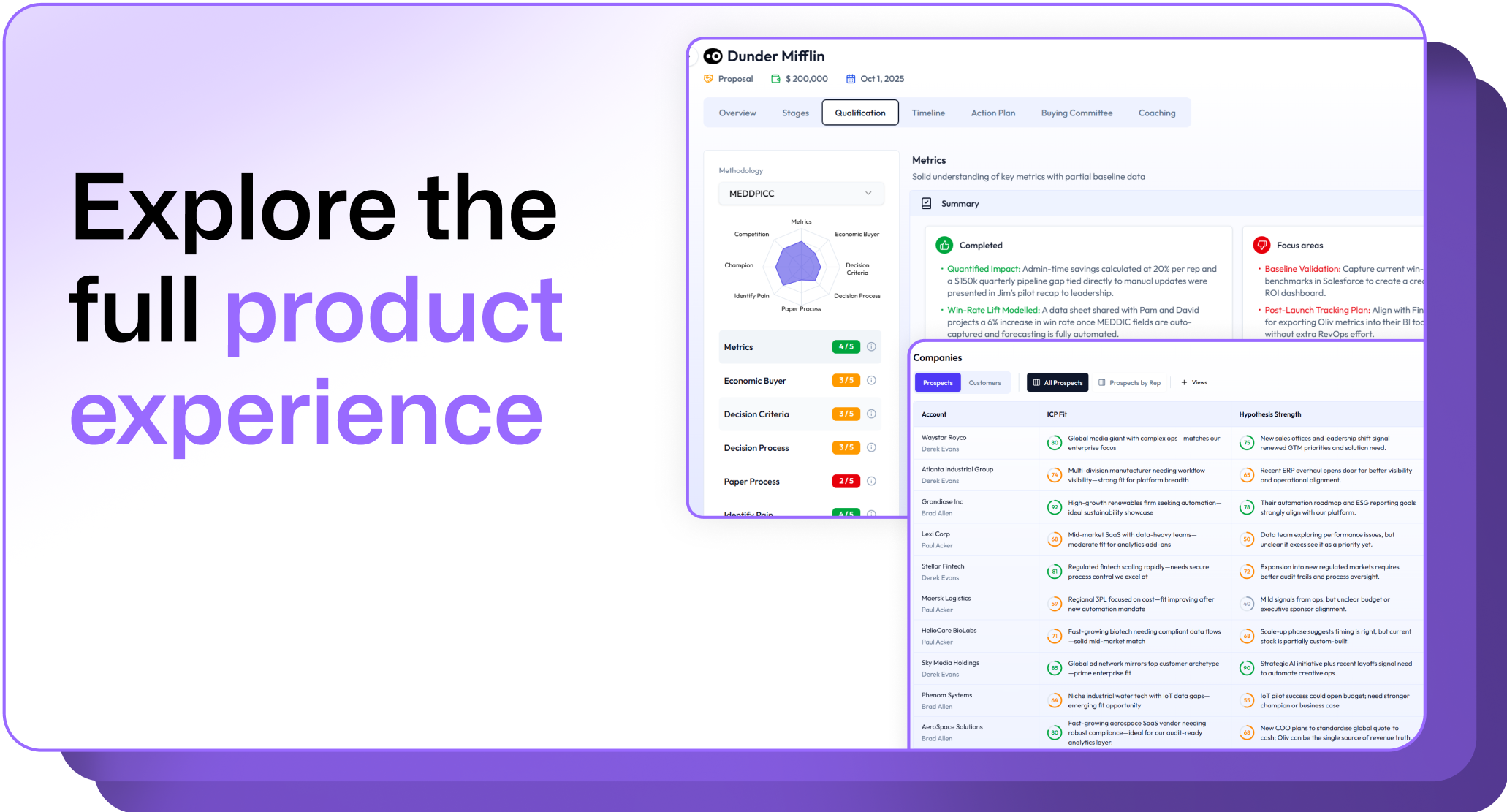
.avif)
.avif)