Mid-Market Revenue AI Buyer's Guide — Governance, Compliance, and Phased Rollout for 200-1000 Employee Companies
Written by
Ishan Chhabra
Last Updated :
April 2, 2026
Skim in :
6
mins
In this article
Still got questions?
Come discuss this article with me.
Hi, I'm Ishan, Founder and CEO of Oliv.
I'm always up for a conversation about revenue intelligence, AI agents, or what's actually working (and what's not) across revenue teams.
I'd love to hear your perspective.
Thank you! Your submission has been received!
Oops! Something went wrong while submitting the form.
Meet Oliv’s AI Agents
Hi! I’m, Deal Driver
I track deals, flag risks, send weekly pipeline updates and give sales managers full visibility into deal progress
Hi! I’m, CRM Manager
I maintain CRM hygiene by updating core, custom and qualification fields all without your team lifting a finger
Hi! I’m, Forecaster
I build accurate forecasts based on real deal movement and tell you which deals to pull in to hit your number
Hi! I’m, Coach
I believe performance fuels revenue. I spot skill gaps, score calls and build coaching plans to help every rep level up
Hi! I’m, Prospector
I dig into target accounts to surface the right contacts, tailor and time outreach so you always strike when it counts
Hi! I’m, Pipeline tracker
I call reps to get deal updates, and deliver a real-time, CRM-synced roll-up view of deal progress
Hi! I’m, Analyst
I answer complex pipeline questions, uncover deal patterns, and build reports that guide strategic decisions
TL;DR
91% of mid-market firms use AI, yet only 12% have governance frameworks; this guide provides a weighted security checklist and phased rollout strategy.
Gong, Clari, and Agentforce are compared across 10 compliance dimensions including SOC 2, GDPR, HIPAA, PCI-DSS, audit trails, and data residency.
A 3-phase rollout framework (managers, reps, then RevOps) with go/no-go gates reduces the 60-70% implementation failure rate common in big-bang deployments.
Oliv delivers 91% TCO savings over Gong ($68K vs. $789K over 3 years) with self-serve compliance documentation and regional hosting included as standard.
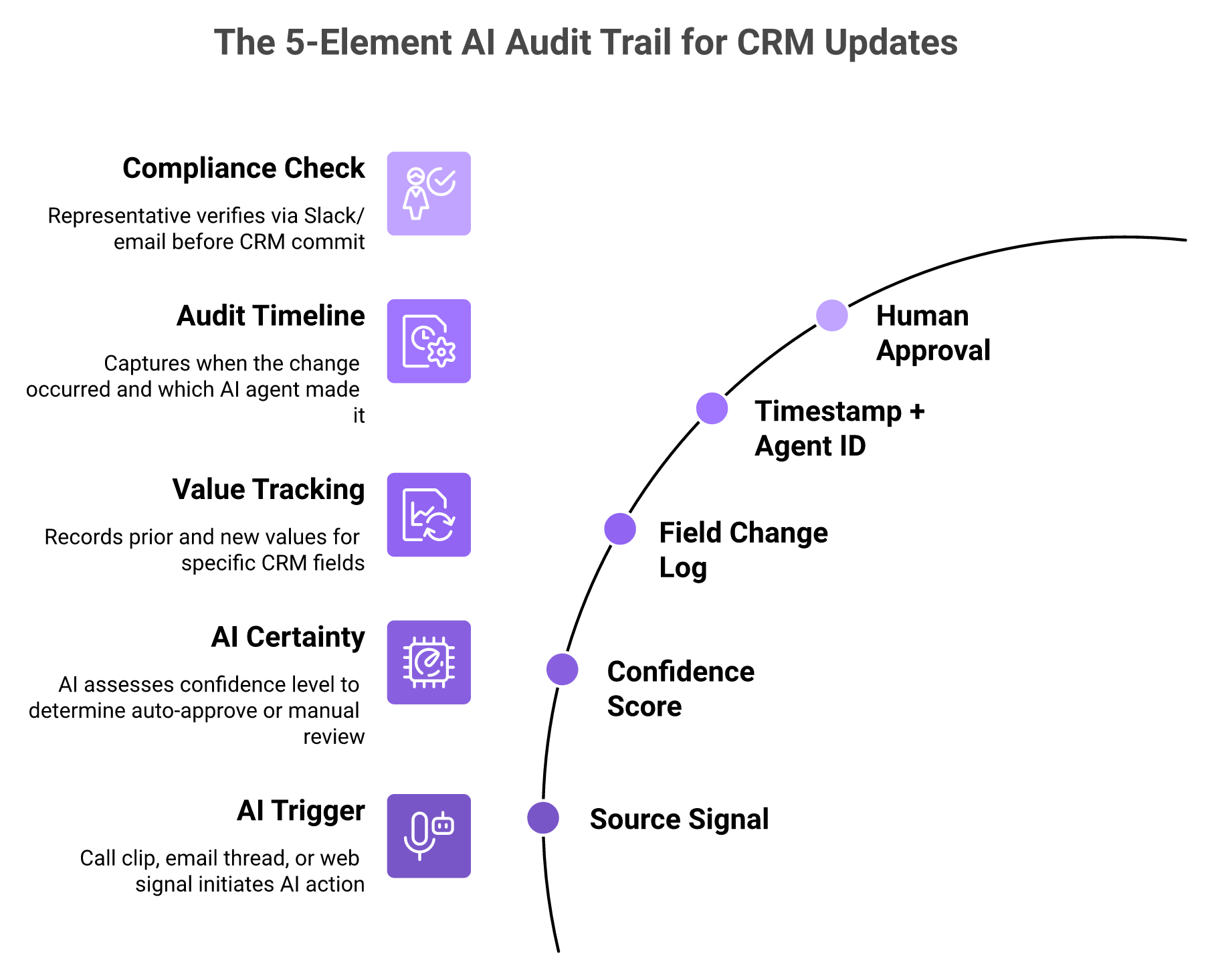
Every AI-initiated CRM write needs five audit trail elements: source signal, confidence score, field change log, timestamp, and human approval status.
A 13-dimension vendor security scoring framework helps RevOps and IT teams evaluate any revenue AI vendor's compliance posture during procurement.
Q1: Why Is Data Governance the #1 Blocker for Mid-Market AI Adoption? [toc=Data Governance Blocker]
⚠️ The Mid-Market Compliance Paradox
Here is a stat that should stop every mid-market CRO in their tracks: 91% of mid-market firms have adopted some form of AI, yet only 12% have a governance framework in place. At 200 to 1,000 employees and $30M to $150M ARR, your organization faces enterprise-grade security demands with startup-grade compliance resources. There is no dedicated CISO. There is no 10-person legal team. Yet your board expects the same rigor as a Fortune 500 company.
Revenue leaders at this stage carry two fears: CRM hallucinations, where AI populates deal fields with fabricated data, and legal liability from AI making inaccurate commitments to prospects. Most implementations fail not because the AI is flawed, but because it is built on "dirty data," meaningless or incomplete CRM records that provide a weak foundation for any reasoning.
❌ Why Legacy Tools Made the Problem Worse
Traditional revenue intelligence platforms were not designed to solve the governance problem; they often amplify it. Gong's Smart Trackers rely on first-generation keyword-matching ML. They flag the word "budget" even when a prospect is talking about their holiday budget, flooding CRM dashboards with noisy, unreliable signals. As one mid-market user put it:
"It can be overwhelming to set up trackers. AI training is a bit laborious to get it to do what you want." Trafford J., Senior Director, Revenue Enablement Gong G2 Verified Review
Salesforce Agentforce takes a different but equally problematic approach; it is heavily chat-based, requiring humans to manually "go and talk to a bot" rather than integrating intelligence into existing workflows. Multiple users confirm the friction:
"Setting it up wasn't as smooth as I expected. The UI felt a bit clunky at times... the pricing caught us off guard. Once we started scaling to more users and use cases, the cost ramped up pretty quickly." Ayushmaan Y., Senior Associate Agentforce G2 Verified Review
Both approaches bolt AI onto dirty data rather than fixing the foundation first.
The mid-market compliance paradox: AI adoption has far outpaced governance readiness, creating a $670K average breach risk.
🔄 The AI-Native Paradigm Shift
The era of "dashcam" recording tools (2015 to 2022) is ending. In those systems, AI recorded the accident but never helped you drive the car safely. Modern revenue AI must clean and ground data before reasoning on it, transforming the CRM from a broken manual-entry system into an autonomous intelligence layer. This is the shift from Revenue Intelligence to what practitioners now call AI-Native Revenue Orchestration.
✅ How Oliv Eliminates Governance Risk
Oliv approaches governance from the ground up through Grounding and Reasoning. Our fine-tuned LLMs operate exclusively within the organization's specific data workspace, eliminating hallucinations by never reasoning beyond verified company data. But the critical differentiator is sequencing: the CRM Manager Agent acts as a data cleanup platform first, normalizing, deduplicating, and enriching CRM records before any AI reasoning begins. This "clean data first" approach ensures every downstream agent operates on a foundation of truth, not garbage.
The average shadow AI breach now costs mid-market companies $670K. For organizations ready to adopt AI without governance risk, Oliv's full compliance posture is available for review at trust.oliv.ai.
Q2: What Compliance Certifications Should You Demand from Revenue AI Vendors? [toc=Compliance Certifications]
Before inviting any revenue AI vendor into your security review, you need a clear checklist of non-negotiable compliance certifications. Each certification covers a distinct dimension of data protection, and mid-market buyers often underestimate how many are relevant to their sales data.
⭐ The Essential Certification Checklist
Essential Compliance Certifications for Revenue AI
Certification
What It Covers
Why It Matters for Revenue AI
SOC 2 Type II
Ongoing controls for security, availability, processing integrity, confidentiality, and privacy
Validates that the vendor continuously protects your CRM data, call recordings, and deal intelligence, not just at a point in time
GDPR
EU data protection regulation covering consent, data subject rights, and data processing agreements (DPAs)
Critical if you record calls with EU-based prospects or store contact data for European accounts
CCPA / CPRA
California consumer privacy rights, including right to deletion and data portability
Required for any team selling into California-based accounts or with California-based employees
ISO 27001
International standard for information security management systems (ISMS)
Demonstrates a mature, audited security program, often required by enterprise procurement teams
HIPAA
Protected Health Information (PHI) handling for healthcare entities
Mandatory if your sales team engages healthcare buyers; requires a Business Associate Agreement (BAA)
PCI-DSS
Payment card industry data security standards
Relevant if prospects share payment or financial details during sales calls
EU AI Act (2026)
Risk-based classification for AI systems, with high-risk requirements taking effect August 2026
Any AI that influences deal stages, scoring, or customer-facing outputs may fall under high-risk classification
⏰ Type I vs. Type II: A Critical Distinction
Many vendors claim "SOC 2 compliance" without specifying the type. SOC 2 Type I is a point-in-time snapshot; it confirms that controls exist on a specific date. SOC 2 Type II evaluates whether those controls operated effectively over a sustained period (typically 6 to 12 months). For mid-market buyers evaluating revenue AI tools, always demand Type II. A vendor that only holds Type I may have passed a single audit without maintaining consistent security practices.
📋 What to Verify Beyond Certifications
Certifications alone do not tell the full story. During vendor evaluation, also confirm:
Data residency options: Where is your data physically stored? Can you select EU, US, or APAC hosting?
Encryption standards: Look for AES-256 encryption at rest and TLS 1.2+ in transit
Sub-processor transparency: Which third parties have access to your data?
Data Processing Agreements (DPAs): Is the DPA readily available, or does it require legal negotiation?
Right to deletion: Can you request complete data removal upon contract termination?
Open export policy: Can you extract all your data (recordings, transcripts, and CRM logs) in a portable format?
One Gong user highlighted why data portability matters:
"The lack of robust data export options has made it hard to justify the platform's cost, especially as it falls short of meeting practical data management needs." Neel P., Sales Operations Manager Gong G2 Verified Review
✅ How Oliv Simplifies Compliance Verification
Oliv holds SOC 2 Type II certification, full GDPR compliance, and CCPA compliance, with all documentation instantly accessible at trust.oliv.ai. Oliv also maintains a full open export policy: upon termination, users receive a complete CSV dump of all meetings and recordings, ensuring complete data portability without lock-in.
Q3: Can Revenue AI Vendors Provide SOC 2 Type II and GDPR Documentation on Demand? [toc=SOC 2 and GDPR Documentation]
⏰ The Procurement Bottleneck Nobody Talks About
Security reviews at mid-market firms routinely take 6 to 9 months, not because the technology is risky, but because IT policies have not kept pace with AI adoption speed. The compliance documentation a vendor produces (or fails to produce) during evaluation directly impacts procurement velocity. Every week spent chasing down a DPA or sub-processor list is a week your team remains stuck on legacy tools.
❌ Legacy Vendor Transparency Gaps
Gong holds an extensive certification portfolio, including SOC 2 Type II, ISO 27001/27017/27018/27701, and PCI-DSS SAQ-D. On paper, that is strong. But the reality for mid-market buyers is more nuanced:
💸 Mandatory Platform Access Fees of $5,000 to $50,000+ and professional service fees of $7,500 to $30,000 before you even access documentation workflows
US-only data centers, creating GDPR complications for global mid-market teams with EU prospects
Documentation access often requires navigating a multi-stage sales cycle rather than self-serve access
"Since we purchased our package, the support model has changed drastically, which is infuriating." Elspeth C., Chief Commercial Officer Gong G2 Verified Review
Clari's compliance posture is less publicly documented, creating additional friction during security reviews. One Head of Sales Operations noted challenges with the setup:
"I find the setup process challenging, especially when migrating fields from Salesforce, as it can't handle formula fields directly. This requires creating and maintaining duplicate fields, which adds complexity." Josiah R., Head of Sales Operations Clari G2 Verified Review
Salesforce Agentforce recently obtained the EU Cloud Code of Conduct compliance, but its Data Cloud dependency adds significant architectural complexity for compliance teams to evaluate.
✅ What "Good" Looks Like in the AI Era
Modern revenue AI vendors should provide:
Self-serve trust centers with instant access to SOC 2 reports, DPAs, and sub-processor lists
Data residency options (EU/US/APAC) selectable during onboarding
Encryption transparency with published standards (AES-256 at rest, TLS 1.2+ in transit)
Regional hosting capabilities to satisfy GDPR data localization requirements
Pre-signed DPAs available before the sales process begins
✅ Oliv's Transparency-First Approach
Oliv is SOC 2 Type II certified, GDPR compliant, and CCPA compliant, with every document instantly accessible at trust.oliv.ai, no sales call required. Data is encrypted AES-256 at rest and TLS 1.2 in transit, with regional hosting options available during onboarding. This eliminates the 6 to 9 month procurement bottleneck that plagues mid-market security reviews.
📋 Documentation Request Template
Use this list when initiating a security review with any revenue AI vendor:
Current SOC 2 Type II report (full report, not summary)
Data Processing Agreement (DPA)
Sub-processor list with data access scope
Data residency documentation and hosting regions
Encryption specifications (at rest and in transit)
Incident response and breach notification policy
Data retention and deletion policies
Business Associate Agreement (BAA), if applicable
Q4: What Audit Trail Requirements Should You Set for AI Writing to Your CRM? [toc=AI Audit Trail Requirements]
⚠️ The "Black Box" Problem
Governance teams across every mid-market company share the same fear: AI silently updating deal stages, overwriting champion objections, or modifying pipeline values with zero human oversight. If an AI agent incorrectly moves a deal from Stage 3 to Stage 5, or overwrites a critical stakeholder note, the CRM stops being your Single Source of Truth and becomes a liability. Every AI-initiated change must be attributable, reversible, and auditable.
❌ Where Competitor Audit Trails Fall Short
Many competitor "agents" fire only inside pre-set flows or require manual triggers for every action, adding administrative work rather than removing it. Gong primarily logs insights as unstructured "Notes" or activities, text blocks that are unsearchable and unusable for RevOps reporting. It does not update actual CRM properties with full audit chains.
The result? RevOps teams face a visibility problem even when data exists:
"What I find least helpful is that some of the features that are reported don't actually tell me where that information is coming from. I.e. Where my weighted number is coming from or how it is being calculated would be helpful." Jezni W., Sales Account Executive Clari G2 Verified Review
"Understanding the pipeline management portion of it is almost impossible. Some people figure it out, but I think most just fumble through." John S., Senior Account Executive Gong G2 Verified Review
Without clear source attribution, compliance teams cannot verify why a field changed or what evidence drove the update.
⭐ The Gold Standard for AI Audit Trails
Every AI-initiated CRM write should log five elements to create a complete evidence chain:
Gold Standard: AI Audit Trail Requirements
Element
What It Records
Why Compliance Teams Need It
Source signal
The call clip, email thread, or web signal that triggered the update
Proves the AI acted on real evidence, not hallucination
Confidence score
How certain the AI was in its interpretation
Lets governance teams set thresholds for auto-approval vs. manual review
Field change log
Specific field changed, prior value, and new value
Enables instant rollback if an error is detected
Timestamp + Agent ID
When the change was made and which AI agent made it
Creates an immutable timeline for auditors
Human approval status
Whether a human verified before the CRM write was committed
This creates an unbroken chain: raw signal, AI reasoning, human verification, and CRM write.
Every AI-initiated CRM write should log these five elements to create a complete, auditable evidence chain.
✅ Oliv's Human-in-the-Loop Governance
Oliv operationalizes this gold standard through its "Nudge" Workflow. When any agent drafts a CRM property update or follow-up email, it sends a Slack or email nudge to the assigned rep to verify and approve before the write is committed. Every field maintains a full evolution history, showing exactly which call clip, email thread, or web signal led to every single data point, ensuring complete accountability for IT and governance teams.
📋 10 Questions to Ask Vendors About Audit Trails
Bring this checklist to every vendor demo:
Does the AI log the source signal (call, email, or web) for every CRM write?
Can I see the confidence score for each AI-generated field update?
Is there a full field change history with prior and new values?
Can reps review and approve updates before they are committed?
Are audit logs exportable for external compliance reviews?
How long are audit logs retained?
Can I set role-based permissions for which agents can write to which fields?
Is there a rollback mechanism for incorrect AI-initiated updates?
Are all agent actions timestamped with a unique agent identifier?
Q5: How Should You Structure a Phased Rollout, Managers First, Then Reps, Then RevOps? [toc=Phased Rollout Framework]
⚠️ Why "Big Bang" Implementations Fail
Mid-market companies that attempt to deploy an entire revenue AI platform in one go fail 60 to 70% of the time. Tool fatigue is real; reps already juggle 5+ applications daily, and adding a monolithic system on top creates friction, not efficiency. Teams experience what practitioners call "Note-Taker Fatigue," where meetings have five AI note-takers but zero completed follow-up tasks. The smarter path is a role-based phased rollout that builds trust incrementally: prove value to managers, extend to reps, and unlock RevOps intelligence.
❌ The Monolithic Deployment Trap
Legacy platforms force all-or-nothing implementations. Gong deployment typically takes 8 to 24 weeks and demands 40 to 140 admin hours for configuration. Worse, the "Unified License" trap means companies pay full price for 100 seats even when 50% of users only need basic recording.
"There's so much in Gong, that we don't use everything. Gong's deal forecasting we don't use." Karel Bos, Head of Sales Gong TrustRadius Verified Review
Clari faces similar adoption challenges; its hierarchy setup relies on CRM's static structure, which does not accommodate mid-year team changes, and requires dedicated Salesforce user licenses for each forecast node.
"The flexibility in setting up hierarchies is lacking, as it relies on CRM's static hierarchy that doesn't accommodate midyear team changes efficiently." Josiah R., Head of Sales Operations Clari G2 Verified Review
✅ The 3-Phase Framework for Mid-Market AI Rollout
3-Phase Mid-Market AI Rollout Framework
Phase
Timeline
Who
What to Deploy
Success Metrics
Phase 1
Weeks 1 to 4
Sales Managers
Pipeline visibility, forecast validation, and deal inspection
Automated CRM updates, meeting prep, and follow-up drafts
CRM field completion rate >85%; 3+ hrs/week saved per rep
Phase 3
Weeks 9 to 12
RevOps
Pipeline analytics, win-loss analysis, and revenue strategy
Pipeline coverage ratio improves; data accuracy >90%
Each phase gate requires a go/no-go decision based on adoption rate and measurable ROI before expanding to the next role group.
A phased rollout with go/no-go gates reduces the 60–70% failure rate of big-bang AI implementations.
✅ Oliv's Modular Agent Architecture
Oliv was built for exactly this kind of phased deployment. Start with the Deal Driver Agent for leadership visibility in Phase 1; managers get instant pipeline inspection without requiring reps to change any behavior. In Phase 2, deploy the CRM Manager Agent to automate data entry and meeting follow-ups for reps. In Phase 3, activate the Analyst Agent for RevOps-level strategy and revenue forecasting. Baseline configuration takes 5 minutes, with users starting on a free intelligence tier; a true zero-risk pilot.
Q6: Can Revenue AI Handle Custom Salesforce Objects and Formulas Without Breaking Sync? [toc=Custom Salesforce Objects]
⏰ The Custom CRM Problem
Mid-market companies invest 100 to 500+ hours customizing their Salesforce or HubSpot instances with specialized objects for implementation tracking, case management, or customer onboarding. When an AI tool cannot respect these custom architectures, data fragments across platforms, creating "bits and pieces" visibility rather than a unified, reportable view. For RevOps leaders, this is a dealbreaker.
❌ Where Legacy Tools Break Down
Gong primarily logs insights as unstructured "Notes" or activity entries; text blocks that are unsearchable and completely unusable for RevOps reporting. It does not update actual CRM properties or custom fields, meaning the intelligence it captures stays trapped outside your reporting infrastructure.
"It's too complicated, and not intuitive at all. Searching for calls is not easy, moving around in the calls is not easy, and understanding the pipeline management portion of it is almost impossible." John S., Senior Account Executive Gong G2 Verified Review
Clari integrates well with standard Salesforce objects but struggles with custom configurations. Formula fields cannot be migrated directly, requiring RevOps teams to create and maintain duplicate fields, adding operational overhead.
"I find the setup process challenging, especially when migrating fields from Salesforce, as it can't handle formula fields directly. This requires creating and maintaining duplicate fields, which adds complexity and workload." Josiah R., Head of Sales Operations Clari G2 Verified Review
Salesforce Einstein requires RevOps teams to manually build complex equations for lead/contact scoring based on older ML, which is resource-intensive and breaks when applied to custom formula fields.
🔄 What AI-Native CRM Integration Looks Like
Modern revenue AI must use contextual reasoning, not brittle rules, to associate activities with the correct custom objects. Instead of hardcoded field mappings that break when a CRM admin renames an object, AI should reason through transcripts and CRM metadata to find the right account, contact, or opportunity, even when duplicates exist.
✅ Oliv's AI-Based Object Association
Oliv uses AI-based object association: LLMs reason through call transcripts, email threads, and CRM data to correctly map activities to the right custom account, contact, or opportunity, even in messy CRMs with duplicates and legacy records. The CRM Manager Agent updates actual CRM properties and custom fields (including MEDDPICC, BANT, FAINT, or SPICED criteria), making every data point fully reportable for RevOps. Trained on 100+ sales methodologies, Oliv populates complex qualification fields directly from conversation context; no manual entry required.
Q7: Does Revenue AI Support HIPAA and PCI Compliance for Regulated Industries? [toc=HIPAA and PCI Compliance]
⚠️ When Compliance Is Not Optional
For mid-market firms in healthcare, financial services, or insurance, data security is not a preference; it is a legal mandate. General-purpose recording tools that store call data on public clouds without Business Associate Agreements (BAAs) are a non-starter. Revenue AI that processes sales calls mentioning Protected Health Information (PHI) or payment card details must meet HIPAA and PCI-DSS requirements, or the organization faces significant regulatory exposure.
💸 The Hidden Compliance Cost Stack
Gong does support HIPAA through SOC 2 Type II HIPAA mapping and offers BAAs. However, the cost adds up quickly for mid-market buyers:
BAA legal review: $1,000 to $3,000 in outside counsel fees
Dedicated regional data residency: $10,000 to $25,000 as an add-on
Platform Access Fees: $5,000 to $50,000+ annually before any per-seat costs
The hidden compliance surcharge can add $15K to $30K to the first year for regulated industries, a significant burden on mid-market budgets.
"It was a big mistake on our part to commit to a two year term. Gong is a really powerful tool but it's probably the highest end option on the market, and now we're stuck with a tool that works technically but isn't the right business decision." Iris P., Head of Marketing, Sales & Partnerships Gong G2 Verified Review
"The price of Agentforce is not clear and hard to find. Adoption is low because of the lack of knowledge on the subject as AI is a new field." Anusha T., Web Developer Agentforce G2 Verified Review
Sales calls involve healthcare buyers or mention PHI
PCI-DSS
Secure handling and redaction of payment card data
Prospects share card numbers or financial details on calls
EU AI Act (Aug 2026)
Risk classification, transparency obligations for high-risk AI
AI influences deal scoring, employment decisions, or credit
✅ Oliv's Regulated-Industry Architecture
Oliv is built for enterprise-grade privacy with HIPAA-ready infrastructure (BAA required), private storage options, and regional data residency included as standard, not as a paid add-on. The prioritized Compliance Sentinel Agent automatically monitors CRM and email activity to redact sensitive information (PCI/GDPR) before it is processed, removing the manual compliance burden from your team.
Q8: How Do Gong, Clari, and Salesforce Agentforce Compare on Compliance and Governance? [toc=Compliance Comparison]
When evaluating revenue AI vendors for mid-market deployment, compliance and governance capabilities vary significantly across platforms. The following reference table consolidates publicly available information and verified user feedback to help CROs and Directors of RevOps make an informed comparison.
⭐ Compliance & Governance Comparison
Compliance and Governance Comparison: Gong vs. Clari vs. Agentforce vs. Oliv
Dimension
Gong
Clari
Salesforce Agentforce
Oliv
SOC 2 Type II
✅ Certified
✅ Certified
✅ (Salesforce platform)
✅ Certified
GDPR
✅ Compliant (US-only data centers create complications for EU teams)
✅ Compliant
✅ Compliant
✅ Compliant with regional hosting
CCPA
✅ Compliant
✅ Compliant
✅ Compliant
✅ Compliant
HIPAA
✅ Supported (BAA available; +$10K to $25K for data residency)
⚠️ Limited public documentation
✅ (Salesforce Health Cloud)
✅ HIPAA-ready (BAA required); private storage included
PCI-DSS
✅ SAQ-D certified
⚠️ Not publicly documented
✅ (Salesforce platform)
✅ Auto-redaction via Compliance Sentinel Agent
EU AI Act Readiness
⚠️ Not publicly stated
⚠️ Not publicly stated
✅ EU Cloud Code of Conduct
✅ Proactive compliance posture
Audit Trails
❌ Unstructured notes; no field-level CRM audit chain
⚠️ Limited to Salesforce sync logs
⚠️ Requires Data Cloud configuration
✅ Full field-level evolution history with source attribution
Data Residency
❌ US-only data centers
⚠️ Not publicly detailed
✅ Multi-region (via Salesforce)
✅ Regional hosting (EU/US/APAC) included
Trust Center Access
⚠️ Requires sales engagement
⚠️ Requires sales engagement
✅ trust.salesforce.com
✅ Self-serve at trust.oliv.ai
Compliance Documentation Cost
💸 Platform fees $5K to $50K+ before access
💸 Requires enterprise contract
💸 Data Cloud subscription required
✅ Free, instant access
📋 Key Takeaways by Vendor
Gong holds the broadest certification portfolio among legacy vendors (SOC 2 Type II, ISO 27001/27017/27018/27701, and PCI-DSS SAQ-D). However, US-only data centers create friction for GDPR-regulated teams, and accessing documentation requires navigating sales cycles with mandatory platform fees.
"The additional products like forecast or engage come at an additional cost. Would be great to see these tools rolled into the core offering." Scott T., Director of Sales Gong G2 Verified Review
Clari integrates well with Salesforce's native compliance infrastructure but has less publicly documented coverage for HIPAA and PCI-DSS. Its compliance posture can create friction during security reviews when IT teams need quick documentation access.
"Some users may find Clari's analytics and forecasting tools complex, requiring significant onboarding and training. Users occasionally report difficulties syncing data seamlessly, especially with custom CRM setups." Bharat K., Revenue Operations Manager Clari G2 Verified Review
Salesforce Agentforce inherits Salesforce's robust platform-level compliance but adds architectural complexity through its Data Cloud dependency. Setup challenges compound the compliance evaluation.
"Can be complex to set up and customize. Expensive, especially for smaller teams. Steep learning curve for new users." Shubham G., Senior BDM Agentforce G2 Verified Review
Oliv provides the most accessible compliance experience for mid-market buyers: self-serve documentation at trust.oliv.ai, regional hosting included at no additional cost, and the Compliance Sentinel Agent for automated PCI/GDPR redaction.
Q9: What Should Your Vendor Security Review Checklist Include for Revenue AI? [toc=Security Review Checklist]
Mid-market security reviews for revenue AI vendors can take 6 to 9 months when IT policies have not caught up with the speed of AI development. The checklist below gives Directors of RevOps and IT a weighted scoring framework to evaluate any vendor's compliance posture systematically.
📋 Vendor Security Review Checklist
Use this framework during procurement. Score each dimension on a 1 to 5 scale (1 = not available, 5 = fully compliant with documentation), then multiply by the weight to get a weighted score.
Vendor Security Review Scoring Framework
#
Evaluation Dimension
Weight
What to Ask the Vendor
1
SOC 2 Type II Attestation
10%
"Provide your most recent SOC 2 Type II report. When was the last audit?"
2
GDPR Compliance
10%
"Where is data stored? Do you support EU regional data residency?"
3
CCPA Compliance
5%
"How do you handle data deletion requests? What is your response SLA?"
4
HIPAA / BAA Availability
10%
"Do you offer a BAA? Is there an additional cost for HIPAA compliance?"
5
PCI-DSS Coverage
5%
"How do you handle payment card data mentioned on sales calls?"
6
Data Encryption
10%
"Is data encrypted at rest and in transit? What encryption standards (AES-256, TLS 1.2+)?"
7
Audit Trail Depth
10%
"Can you show field-level change history with source attribution (call clip, email)?"
8
Data Residency Options
10%
"Do you offer multi-region hosting? Is it included or an add-on?"
9
AI Model Transparency
10%
"How does your AI make decisions? Can we inspect the reasoning chain?"
10
Data Portability
5%
"Can we bulk export all data if we switch vendors? In what format?"
11
EU AI Act Readiness
5%
"How are you preparing for August 2026 high-risk AI classification requirements?"
12
Trust Center Access
5%
"Is compliance documentation self-serve, or does it require a sales conversation?"
13
Enterprise SLA / Support
5%
"What is your critical-issue response time? Is a dedicated CSM included?"
⚠️ Red Flags to Watch For
Compliance documentation gated behind sales calls or NDAs
Data residency available only as a paid add-on
No field-level audit trails for AI-generated CRM updates
Inability to bulk export your own data in a usable format
"This lack of flexibility has required us to engage our development team at additional cost, adding significant operational and opportunity costs just to extract data we already own." Neel P., Sales Operations Manager Gong G2 Verified Review
"The price of Agentforce is not clear and hard to find. Adoption is low because of the lack of knowledge on the subject as AI is a new field." Anusha T., Web Developer Agentforce G2 Verified Review
✅ How Oliv Simplifies the Security Review
Oliv publishes all compliance documentation at trust.oliv.ai, with self-serve, instant access and no sales engagement required. SOC 2, GDPR, and CCPA documentation is available on day one, and regional data residency is included as standard rather than a paid add-on.
Q10: Does Revenue AI Offer Enterprise SLAs and Dedicated Support at 100+ Seats? [toc=Enterprise SLAs and Support]
⏰ Why Mid-Market Teams Need a "Neck to Wring"
Mid-market leaders need a guaranteed human escalation path when a critical forecast fails or a CRM sync breaks the night before a board meeting. They cannot afford 3 to 5 day resolution windows on generic support tickets when pipeline accuracy and deal velocity are at stake. The quality of vendor support directly impacts whether an AI investment succeeds or becomes shelfware.
❌ The Pay-to-Play Support Problem
Legacy platforms treat support as a revenue center, not a customer success function. Gong charges $2,000 to $8,000 annually for priority support and $5,000 to $15,000 for a dedicated Customer Success Manager. Standard support excludes custom integration troubleshooting and advanced analytics consultation.
Worse, after initial onboarding, Gong's Professional Services team often disengages entirely, even when teams are adding new hires who need training:
"Our team is struggling with low adoption, and they won't even spend the time to support us during this transition. We were essentially left with minimal support and no actionable solutions for improving adoption." Anonymous Reviewer Gong G2 Verified Review
"Since we purchased our package, the support model has changed drastically, which is infuriating." Elspeth C., Chief Commercial Officer Gong G2 Verified Review
✅ What Mid-Market SLAs Should Include
Mid-Market SLA Requirements for Revenue AI
SLA Dimension
What to Demand
Critical issue response
4-hour acknowledgment; 24-hour resolution path
Standard response
24-hour turnaround on all tickets
Named support contact
Dedicated CSM or support engineer, not a rotating queue
Quarterly business reviews
Proactive performance review with actionable recommendations
Custom integration support
Assistance with CRM, email, and workflow integrations
Data migration
Free migration from legacy platforms
Escalation path
Defined engineering escalation for critical bugs
✅ Oliv's Concierge-as-Standard Model
Oliv provides concierge support as standard for mid-market teams, with a guaranteed 24-hour turnaround on all messages via Slack, email, or live in-app chat. For organizations at 100+ seats, we offer an AI Strategy Partnership with founder-led strategy sessions to align AI-Native Revenue Orchestration with organizational goals. This is not a support ticket queue; it is a strategic relationship designed to maximize AI-driven revenue outcomes. Free data migration from legacy platforms is included.
Q11: WhatDoes the Total Cost of Compliance Look Like, Gong vs. Clari vs. Oliv? [toc=Total Cost of Compliance]
💰 Why TCO, Not Per-Seat Price, Decides the Winner
When evaluating revenue AI, mid-market CROs must calculate Total Cost of Ownership (TCO), not just per-seat licensing. Compliance adds a hidden cost layer that dramatically inflates the actual spend: platform access fees, BAA review costs, regional data residency charges, priority support tiers, and professional services for implementation. Ignoring these line items during procurement leads to budget overruns and buyer's remorse.
Platform Access Fees: $5,000 to $50,000+ annually (mandatory)
Professional Services: $7,500 to $30,000 for implementation
Priority Support: $2,000 to $8,000/year
Dedicated CSM: $5,000 to $15,000/year
BAA Legal Review: $1,000 to $3,000
Regional Data Residency: $10,000 to $25,000
Stacking Gong (recording) + Clari (forecasting) often exceeds $500/user/month once all platform and implementation fees are included.
"It was a big mistake on our part to commit to a two year term. Gong is a really powerful tool but it's probably the highest end option on the market, and now we're stuck with a tool that works technically but isn't the right business decision." Iris P., Head of Marketing, Sales & Partnerships Gong G2 Verified Review
"The pricing is probably the biggest obstacle and hence we are looking to change." Miodrag, Enterprise Account Executive Gong G2 Verified Review
📊 Why Tool Consolidation Matters
Each vendor in a rev-tech stack compounds the audit surface area. Fewer vendors means fewer security reviews, fewer BAAs to manage, and faster procurement cycles. The median rev-tech stack has already dropped from 8.4 to 5.2 tools as teams recognize that consolidation is not just operationally efficient; it is a compliance strategy.
✅ Oliv's 91% TCO Advantage
Over a 3-year period, the cost difference is stark:
3-Year TCO Comparison: Gong vs. Oliv (100 Users)
Metric
Gong (100 users, 3 years)
Oliv (100 users, 3 years)
Total Cost
$789,300
$68,400
Cost Reduction
-
91%
Hidden Fees
Platform, services, support, BAA, and residency
None; modular pricing, all-inclusive
Oliv's modular pricing means you pay only for the agents you deploy in each rollout phase. No mandatory platform fees, no hidden compliance surcharges, and no multi-year lock-in. As Oliv AI founder Ishan Chhabra puts it: "Legacy RI dashboards are like buying an expensive treadmill; your team still has to do all the running. Oliv is like hiring a personal trainer who does the planning, monitoring, and heavy lifting for you."
Q12: How Should a Mid-Market CRO Build an Internal Business Case for Revenue AI? [toc=Building a Business Case]
Building an internal business case for revenue AI requires satisfying a multi-stakeholder buying committee: CRO (revenue impact), RevOps (operational efficiency), IT/Legal (compliance and security), and CFO (ROI and budget). The following step-by-step framework gives mid-market leaders a repeatable template.
Step 1: Quantify the Current Cost of Inaction
Calculate what manual processes cost today:
Rep time on CRM data entry: Average 4 to 5 hrs/week x hourly fully loaded cost x team size
Forecast inaccuracy: Revenue miss rate x average deal size x pipeline volume
Tool redundancy: Sum of all rev-tech vendor contracts (recording, forecasting, engagement, and analytics)
Compliance audit burden: Hours spent per vendor security review x IT/Legal hourly cost
Define 3 measurable KPIs (e.g., CRM update rate, time saved per rep, and forecast variance)
Require the vendor to provide free or low-cost pilot access; no multi-year commitment
Establish a go/no-go gate at day 30 based on data, not opinion
Step 4: Build the ROI Projection
Present a 3-year TCO comparison that includes all hidden costs (platform fees, implementation, support tiers, and compliance add-ons). Frame savings not just as cost reduction but as reallocation opportunity: budget redirected toward hiring additional reps or deepening AI-Native Revenue Orchestration.
"Clari should find ways to differentiate from the native Salesforce features (e.g. Pipeline Inspection, Forecasting) in order to remain competitive in the long-run." Dan J., Mid-Market Clari G2 Verified Review
"It can be complex to set up and often requires skilled administrators or developers to customize and integrate properly, which adds time and cost. Licensing fees can be high, especially as the number of agents grows." Verified User in Marketing and Advertising Agentforce G2 Verified Review
Step 5: Present the Recommendation
Package your business case as a one-page executive brief with three sections: (1) Current state cost, (2) Proposed solution with pilot results, and (3) 3-year ROI projection. Include compliance documentation links so IT/Legal can self-serve their review.
Oliv simplifies this entire process with a 5-minute setup, a free intelligence tier for zero-risk evaluation, and self-serve compliance documentation at trust.oliv.ai, removing the typical procurement friction that delays revenue AI adoption by 6 to 9 months.
Q1: Why Is Data Governance the #1 Blocker for Mid-Market AI Adoption? [toc=Data Governance Blocker]
⚠️ The Mid-Market Compliance Paradox
Here is a stat that should stop every mid-market CRO in their tracks: 91% of mid-market firms have adopted some form of AI, yet only 12% have a governance framework in place. At 200 to 1,000 employees and $30M to $150M ARR, your organization faces enterprise-grade security demands with startup-grade compliance resources. There is no dedicated CISO. There is no 10-person legal team. Yet your board expects the same rigor as a Fortune 500 company.
Revenue leaders at this stage carry two fears: CRM hallucinations, where AI populates deal fields with fabricated data, and legal liability from AI making inaccurate commitments to prospects. Most implementations fail not because the AI is flawed, but because it is built on "dirty data," meaningless or incomplete CRM records that provide a weak foundation for any reasoning.
❌ Why Legacy Tools Made the Problem Worse
Traditional revenue intelligence platforms were not designed to solve the governance problem; they often amplify it. Gong's Smart Trackers rely on first-generation keyword-matching ML. They flag the word "budget" even when a prospect is talking about their holiday budget, flooding CRM dashboards with noisy, unreliable signals. As one mid-market user put it:
"It can be overwhelming to set up trackers. AI training is a bit laborious to get it to do what you want." Trafford J., Senior Director, Revenue Enablement Gong G2 Verified Review
Salesforce Agentforce takes a different but equally problematic approach; it is heavily chat-based, requiring humans to manually "go and talk to a bot" rather than integrating intelligence into existing workflows. Multiple users confirm the friction:
"Setting it up wasn't as smooth as I expected. The UI felt a bit clunky at times... the pricing caught us off guard. Once we started scaling to more users and use cases, the cost ramped up pretty quickly." Ayushmaan Y., Senior Associate Agentforce G2 Verified Review
Both approaches bolt AI onto dirty data rather than fixing the foundation first.
The mid-market compliance paradox: AI adoption has far outpaced governance readiness, creating a $670K average breach risk.
🔄 The AI-Native Paradigm Shift
The era of "dashcam" recording tools (2015 to 2022) is ending. In those systems, AI recorded the accident but never helped you drive the car safely. Modern revenue AI must clean and ground data before reasoning on it, transforming the CRM from a broken manual-entry system into an autonomous intelligence layer. This is the shift from Revenue Intelligence to what practitioners now call AI-Native Revenue Orchestration.
✅ How Oliv Eliminates Governance Risk
Oliv approaches governance from the ground up through Grounding and Reasoning. Our fine-tuned LLMs operate exclusively within the organization's specific data workspace, eliminating hallucinations by never reasoning beyond verified company data. But the critical differentiator is sequencing: the CRM Manager Agent acts as a data cleanup platform first, normalizing, deduplicating, and enriching CRM records before any AI reasoning begins. This "clean data first" approach ensures every downstream agent operates on a foundation of truth, not garbage.
The average shadow AI breach now costs mid-market companies $670K. For organizations ready to adopt AI without governance risk, Oliv's full compliance posture is available for review at trust.oliv.ai.
Q2: What Compliance Certifications Should You Demand from Revenue AI Vendors? [toc=Compliance Certifications]
Before inviting any revenue AI vendor into your security review, you need a clear checklist of non-negotiable compliance certifications. Each certification covers a distinct dimension of data protection, and mid-market buyers often underestimate how many are relevant to their sales data.
⭐ The Essential Certification Checklist
Essential Compliance Certifications for Revenue AI
Certification
What It Covers
Why It Matters for Revenue AI
SOC 2 Type II
Ongoing controls for security, availability, processing integrity, confidentiality, and privacy
Validates that the vendor continuously protects your CRM data, call recordings, and deal intelligence, not just at a point in time
GDPR
EU data protection regulation covering consent, data subject rights, and data processing agreements (DPAs)
Critical if you record calls with EU-based prospects or store contact data for European accounts
CCPA / CPRA
California consumer privacy rights, including right to deletion and data portability
Required for any team selling into California-based accounts or with California-based employees
ISO 27001
International standard for information security management systems (ISMS)
Demonstrates a mature, audited security program, often required by enterprise procurement teams
HIPAA
Protected Health Information (PHI) handling for healthcare entities
Mandatory if your sales team engages healthcare buyers; requires a Business Associate Agreement (BAA)
PCI-DSS
Payment card industry data security standards
Relevant if prospects share payment or financial details during sales calls
EU AI Act (2026)
Risk-based classification for AI systems, with high-risk requirements taking effect August 2026
Any AI that influences deal stages, scoring, or customer-facing outputs may fall under high-risk classification
⏰ Type I vs. Type II: A Critical Distinction
Many vendors claim "SOC 2 compliance" without specifying the type. SOC 2 Type I is a point-in-time snapshot; it confirms that controls exist on a specific date. SOC 2 Type II evaluates whether those controls operated effectively over a sustained period (typically 6 to 12 months). For mid-market buyers evaluating revenue AI tools, always demand Type II. A vendor that only holds Type I may have passed a single audit without maintaining consistent security practices.
📋 What to Verify Beyond Certifications
Certifications alone do not tell the full story. During vendor evaluation, also confirm:
Data residency options: Where is your data physically stored? Can you select EU, US, or APAC hosting?
Encryption standards: Look for AES-256 encryption at rest and TLS 1.2+ in transit
Sub-processor transparency: Which third parties have access to your data?
Data Processing Agreements (DPAs): Is the DPA readily available, or does it require legal negotiation?
Right to deletion: Can you request complete data removal upon contract termination?
Open export policy: Can you extract all your data (recordings, transcripts, and CRM logs) in a portable format?
One Gong user highlighted why data portability matters:
"The lack of robust data export options has made it hard to justify the platform's cost, especially as it falls short of meeting practical data management needs." Neel P., Sales Operations Manager Gong G2 Verified Review
✅ How Oliv Simplifies Compliance Verification
Oliv holds SOC 2 Type II certification, full GDPR compliance, and CCPA compliance, with all documentation instantly accessible at trust.oliv.ai. Oliv also maintains a full open export policy: upon termination, users receive a complete CSV dump of all meetings and recordings, ensuring complete data portability without lock-in.
Q3: Can Revenue AI Vendors Provide SOC 2 Type II and GDPR Documentation on Demand? [toc=SOC 2 and GDPR Documentation]
⏰ The Procurement Bottleneck Nobody Talks About
Security reviews at mid-market firms routinely take 6 to 9 months, not because the technology is risky, but because IT policies have not kept pace with AI adoption speed. The compliance documentation a vendor produces (or fails to produce) during evaluation directly impacts procurement velocity. Every week spent chasing down a DPA or sub-processor list is a week your team remains stuck on legacy tools.
❌ Legacy Vendor Transparency Gaps
Gong holds an extensive certification portfolio, including SOC 2 Type II, ISO 27001/27017/27018/27701, and PCI-DSS SAQ-D. On paper, that is strong. But the reality for mid-market buyers is more nuanced:
💸 Mandatory Platform Access Fees of $5,000 to $50,000+ and professional service fees of $7,500 to $30,000 before you even access documentation workflows
US-only data centers, creating GDPR complications for global mid-market teams with EU prospects
Documentation access often requires navigating a multi-stage sales cycle rather than self-serve access
"Since we purchased our package, the support model has changed drastically, which is infuriating." Elspeth C., Chief Commercial Officer Gong G2 Verified Review
Clari's compliance posture is less publicly documented, creating additional friction during security reviews. One Head of Sales Operations noted challenges with the setup:
"I find the setup process challenging, especially when migrating fields from Salesforce, as it can't handle formula fields directly. This requires creating and maintaining duplicate fields, which adds complexity." Josiah R., Head of Sales Operations Clari G2 Verified Review
Salesforce Agentforce recently obtained the EU Cloud Code of Conduct compliance, but its Data Cloud dependency adds significant architectural complexity for compliance teams to evaluate.
✅ What "Good" Looks Like in the AI Era
Modern revenue AI vendors should provide:
Self-serve trust centers with instant access to SOC 2 reports, DPAs, and sub-processor lists
Data residency options (EU/US/APAC) selectable during onboarding
Encryption transparency with published standards (AES-256 at rest, TLS 1.2+ in transit)
Regional hosting capabilities to satisfy GDPR data localization requirements
Pre-signed DPAs available before the sales process begins
✅ Oliv's Transparency-First Approach
Oliv is SOC 2 Type II certified, GDPR compliant, and CCPA compliant, with every document instantly accessible at trust.oliv.ai, no sales call required. Data is encrypted AES-256 at rest and TLS 1.2 in transit, with regional hosting options available during onboarding. This eliminates the 6 to 9 month procurement bottleneck that plagues mid-market security reviews.
📋 Documentation Request Template
Use this list when initiating a security review with any revenue AI vendor:
Current SOC 2 Type II report (full report, not summary)
Data Processing Agreement (DPA)
Sub-processor list with data access scope
Data residency documentation and hosting regions
Encryption specifications (at rest and in transit)
Incident response and breach notification policy
Data retention and deletion policies
Business Associate Agreement (BAA), if applicable
Q4: What Audit Trail Requirements Should You Set for AI Writing to Your CRM? [toc=AI Audit Trail Requirements]
⚠️ The "Black Box" Problem
Governance teams across every mid-market company share the same fear: AI silently updating deal stages, overwriting champion objections, or modifying pipeline values with zero human oversight. If an AI agent incorrectly moves a deal from Stage 3 to Stage 5, or overwrites a critical stakeholder note, the CRM stops being your Single Source of Truth and becomes a liability. Every AI-initiated change must be attributable, reversible, and auditable.
❌ Where Competitor Audit Trails Fall Short
Many competitor "agents" fire only inside pre-set flows or require manual triggers for every action, adding administrative work rather than removing it. Gong primarily logs insights as unstructured "Notes" or activities, text blocks that are unsearchable and unusable for RevOps reporting. It does not update actual CRM properties with full audit chains.
The result? RevOps teams face a visibility problem even when data exists:
"What I find least helpful is that some of the features that are reported don't actually tell me where that information is coming from. I.e. Where my weighted number is coming from or how it is being calculated would be helpful." Jezni W., Sales Account Executive Clari G2 Verified Review
"Understanding the pipeline management portion of it is almost impossible. Some people figure it out, but I think most just fumble through." John S., Senior Account Executive Gong G2 Verified Review
Without clear source attribution, compliance teams cannot verify why a field changed or what evidence drove the update.
⭐ The Gold Standard for AI Audit Trails
Every AI-initiated CRM write should log five elements to create a complete evidence chain:
Gold Standard: AI Audit Trail Requirements
Element
What It Records
Why Compliance Teams Need It
Source signal
The call clip, email thread, or web signal that triggered the update
Proves the AI acted on real evidence, not hallucination
Confidence score
How certain the AI was in its interpretation
Lets governance teams set thresholds for auto-approval vs. manual review
Field change log
Specific field changed, prior value, and new value
Enables instant rollback if an error is detected
Timestamp + Agent ID
When the change was made and which AI agent made it
Creates an immutable timeline for auditors
Human approval status
Whether a human verified before the CRM write was committed
This creates an unbroken chain: raw signal, AI reasoning, human verification, and CRM write.
Every AI-initiated CRM write should log these five elements to create a complete, auditable evidence chain.
✅ Oliv's Human-in-the-Loop Governance
Oliv operationalizes this gold standard through its "Nudge" Workflow. When any agent drafts a CRM property update or follow-up email, it sends a Slack or email nudge to the assigned rep to verify and approve before the write is committed. Every field maintains a full evolution history, showing exactly which call clip, email thread, or web signal led to every single data point, ensuring complete accountability for IT and governance teams.
📋 10 Questions to Ask Vendors About Audit Trails
Bring this checklist to every vendor demo:
Does the AI log the source signal (call, email, or web) for every CRM write?
Can I see the confidence score for each AI-generated field update?
Is there a full field change history with prior and new values?
Can reps review and approve updates before they are committed?
Are audit logs exportable for external compliance reviews?
How long are audit logs retained?
Can I set role-based permissions for which agents can write to which fields?
Is there a rollback mechanism for incorrect AI-initiated updates?
Are all agent actions timestamped with a unique agent identifier?
Q5: How Should You Structure a Phased Rollout, Managers First, Then Reps, Then RevOps? [toc=Phased Rollout Framework]
⚠️ Why "Big Bang" Implementations Fail
Mid-market companies that attempt to deploy an entire revenue AI platform in one go fail 60 to 70% of the time. Tool fatigue is real; reps already juggle 5+ applications daily, and adding a monolithic system on top creates friction, not efficiency. Teams experience what practitioners call "Note-Taker Fatigue," where meetings have five AI note-takers but zero completed follow-up tasks. The smarter path is a role-based phased rollout that builds trust incrementally: prove value to managers, extend to reps, and unlock RevOps intelligence.
❌ The Monolithic Deployment Trap
Legacy platforms force all-or-nothing implementations. Gong deployment typically takes 8 to 24 weeks and demands 40 to 140 admin hours for configuration. Worse, the "Unified License" trap means companies pay full price for 100 seats even when 50% of users only need basic recording.
"There's so much in Gong, that we don't use everything. Gong's deal forecasting we don't use." Karel Bos, Head of Sales Gong TrustRadius Verified Review
Clari faces similar adoption challenges; its hierarchy setup relies on CRM's static structure, which does not accommodate mid-year team changes, and requires dedicated Salesforce user licenses for each forecast node.
"The flexibility in setting up hierarchies is lacking, as it relies on CRM's static hierarchy that doesn't accommodate midyear team changes efficiently." Josiah R., Head of Sales Operations Clari G2 Verified Review
✅ The 3-Phase Framework for Mid-Market AI Rollout
3-Phase Mid-Market AI Rollout Framework
Phase
Timeline
Who
What to Deploy
Success Metrics
Phase 1
Weeks 1 to 4
Sales Managers
Pipeline visibility, forecast validation, and deal inspection
Automated CRM updates, meeting prep, and follow-up drafts
CRM field completion rate >85%; 3+ hrs/week saved per rep
Phase 3
Weeks 9 to 12
RevOps
Pipeline analytics, win-loss analysis, and revenue strategy
Pipeline coverage ratio improves; data accuracy >90%
Each phase gate requires a go/no-go decision based on adoption rate and measurable ROI before expanding to the next role group.
A phased rollout with go/no-go gates reduces the 60–70% failure rate of big-bang AI implementations.
✅ Oliv's Modular Agent Architecture
Oliv was built for exactly this kind of phased deployment. Start with the Deal Driver Agent for leadership visibility in Phase 1; managers get instant pipeline inspection without requiring reps to change any behavior. In Phase 2, deploy the CRM Manager Agent to automate data entry and meeting follow-ups for reps. In Phase 3, activate the Analyst Agent for RevOps-level strategy and revenue forecasting. Baseline configuration takes 5 minutes, with users starting on a free intelligence tier; a true zero-risk pilot.
Q6: Can Revenue AI Handle Custom Salesforce Objects and Formulas Without Breaking Sync? [toc=Custom Salesforce Objects]
⏰ The Custom CRM Problem
Mid-market companies invest 100 to 500+ hours customizing their Salesforce or HubSpot instances with specialized objects for implementation tracking, case management, or customer onboarding. When an AI tool cannot respect these custom architectures, data fragments across platforms, creating "bits and pieces" visibility rather than a unified, reportable view. For RevOps leaders, this is a dealbreaker.
❌ Where Legacy Tools Break Down
Gong primarily logs insights as unstructured "Notes" or activity entries; text blocks that are unsearchable and completely unusable for RevOps reporting. It does not update actual CRM properties or custom fields, meaning the intelligence it captures stays trapped outside your reporting infrastructure.
"It's too complicated, and not intuitive at all. Searching for calls is not easy, moving around in the calls is not easy, and understanding the pipeline management portion of it is almost impossible." John S., Senior Account Executive Gong G2 Verified Review
Clari integrates well with standard Salesforce objects but struggles with custom configurations. Formula fields cannot be migrated directly, requiring RevOps teams to create and maintain duplicate fields, adding operational overhead.
"I find the setup process challenging, especially when migrating fields from Salesforce, as it can't handle formula fields directly. This requires creating and maintaining duplicate fields, which adds complexity and workload." Josiah R., Head of Sales Operations Clari G2 Verified Review
Salesforce Einstein requires RevOps teams to manually build complex equations for lead/contact scoring based on older ML, which is resource-intensive and breaks when applied to custom formula fields.
🔄 What AI-Native CRM Integration Looks Like
Modern revenue AI must use contextual reasoning, not brittle rules, to associate activities with the correct custom objects. Instead of hardcoded field mappings that break when a CRM admin renames an object, AI should reason through transcripts and CRM metadata to find the right account, contact, or opportunity, even when duplicates exist.
✅ Oliv's AI-Based Object Association
Oliv uses AI-based object association: LLMs reason through call transcripts, email threads, and CRM data to correctly map activities to the right custom account, contact, or opportunity, even in messy CRMs with duplicates and legacy records. The CRM Manager Agent updates actual CRM properties and custom fields (including MEDDPICC, BANT, FAINT, or SPICED criteria), making every data point fully reportable for RevOps. Trained on 100+ sales methodologies, Oliv populates complex qualification fields directly from conversation context; no manual entry required.
Q7: Does Revenue AI Support HIPAA and PCI Compliance for Regulated Industries? [toc=HIPAA and PCI Compliance]
⚠️ When Compliance Is Not Optional
For mid-market firms in healthcare, financial services, or insurance, data security is not a preference; it is a legal mandate. General-purpose recording tools that store call data on public clouds without Business Associate Agreements (BAAs) are a non-starter. Revenue AI that processes sales calls mentioning Protected Health Information (PHI) or payment card details must meet HIPAA and PCI-DSS requirements, or the organization faces significant regulatory exposure.
💸 The Hidden Compliance Cost Stack
Gong does support HIPAA through SOC 2 Type II HIPAA mapping and offers BAAs. However, the cost adds up quickly for mid-market buyers:
BAA legal review: $1,000 to $3,000 in outside counsel fees
Dedicated regional data residency: $10,000 to $25,000 as an add-on
Platform Access Fees: $5,000 to $50,000+ annually before any per-seat costs
The hidden compliance surcharge can add $15K to $30K to the first year for regulated industries, a significant burden on mid-market budgets.
"It was a big mistake on our part to commit to a two year term. Gong is a really powerful tool but it's probably the highest end option on the market, and now we're stuck with a tool that works technically but isn't the right business decision." Iris P., Head of Marketing, Sales & Partnerships Gong G2 Verified Review
"The price of Agentforce is not clear and hard to find. Adoption is low because of the lack of knowledge on the subject as AI is a new field." Anusha T., Web Developer Agentforce G2 Verified Review
Sales calls involve healthcare buyers or mention PHI
PCI-DSS
Secure handling and redaction of payment card data
Prospects share card numbers or financial details on calls
EU AI Act (Aug 2026)
Risk classification, transparency obligations for high-risk AI
AI influences deal scoring, employment decisions, or credit
✅ Oliv's Regulated-Industry Architecture
Oliv is built for enterprise-grade privacy with HIPAA-ready infrastructure (BAA required), private storage options, and regional data residency included as standard, not as a paid add-on. The prioritized Compliance Sentinel Agent automatically monitors CRM and email activity to redact sensitive information (PCI/GDPR) before it is processed, removing the manual compliance burden from your team.
Q8: How Do Gong, Clari, and Salesforce Agentforce Compare on Compliance and Governance? [toc=Compliance Comparison]
When evaluating revenue AI vendors for mid-market deployment, compliance and governance capabilities vary significantly across platforms. The following reference table consolidates publicly available information and verified user feedback to help CROs and Directors of RevOps make an informed comparison.
⭐ Compliance & Governance Comparison
Compliance and Governance Comparison: Gong vs. Clari vs. Agentforce vs. Oliv
Dimension
Gong
Clari
Salesforce Agentforce
Oliv
SOC 2 Type II
✅ Certified
✅ Certified
✅ (Salesforce platform)
✅ Certified
GDPR
✅ Compliant (US-only data centers create complications for EU teams)
✅ Compliant
✅ Compliant
✅ Compliant with regional hosting
CCPA
✅ Compliant
✅ Compliant
✅ Compliant
✅ Compliant
HIPAA
✅ Supported (BAA available; +$10K to $25K for data residency)
⚠️ Limited public documentation
✅ (Salesforce Health Cloud)
✅ HIPAA-ready (BAA required); private storage included
PCI-DSS
✅ SAQ-D certified
⚠️ Not publicly documented
✅ (Salesforce platform)
✅ Auto-redaction via Compliance Sentinel Agent
EU AI Act Readiness
⚠️ Not publicly stated
⚠️ Not publicly stated
✅ EU Cloud Code of Conduct
✅ Proactive compliance posture
Audit Trails
❌ Unstructured notes; no field-level CRM audit chain
⚠️ Limited to Salesforce sync logs
⚠️ Requires Data Cloud configuration
✅ Full field-level evolution history with source attribution
Data Residency
❌ US-only data centers
⚠️ Not publicly detailed
✅ Multi-region (via Salesforce)
✅ Regional hosting (EU/US/APAC) included
Trust Center Access
⚠️ Requires sales engagement
⚠️ Requires sales engagement
✅ trust.salesforce.com
✅ Self-serve at trust.oliv.ai
Compliance Documentation Cost
💸 Platform fees $5K to $50K+ before access
💸 Requires enterprise contract
💸 Data Cloud subscription required
✅ Free, instant access
📋 Key Takeaways by Vendor
Gong holds the broadest certification portfolio among legacy vendors (SOC 2 Type II, ISO 27001/27017/27018/27701, and PCI-DSS SAQ-D). However, US-only data centers create friction for GDPR-regulated teams, and accessing documentation requires navigating sales cycles with mandatory platform fees.
"The additional products like forecast or engage come at an additional cost. Would be great to see these tools rolled into the core offering." Scott T., Director of Sales Gong G2 Verified Review
Clari integrates well with Salesforce's native compliance infrastructure but has less publicly documented coverage for HIPAA and PCI-DSS. Its compliance posture can create friction during security reviews when IT teams need quick documentation access.
"Some users may find Clari's analytics and forecasting tools complex, requiring significant onboarding and training. Users occasionally report difficulties syncing data seamlessly, especially with custom CRM setups." Bharat K., Revenue Operations Manager Clari G2 Verified Review
Salesforce Agentforce inherits Salesforce's robust platform-level compliance but adds architectural complexity through its Data Cloud dependency. Setup challenges compound the compliance evaluation.
"Can be complex to set up and customize. Expensive, especially for smaller teams. Steep learning curve for new users." Shubham G., Senior BDM Agentforce G2 Verified Review
Oliv provides the most accessible compliance experience for mid-market buyers: self-serve documentation at trust.oliv.ai, regional hosting included at no additional cost, and the Compliance Sentinel Agent for automated PCI/GDPR redaction.
Q9: What Should Your Vendor Security Review Checklist Include for Revenue AI? [toc=Security Review Checklist]
Mid-market security reviews for revenue AI vendors can take 6 to 9 months when IT policies have not caught up with the speed of AI development. The checklist below gives Directors of RevOps and IT a weighted scoring framework to evaluate any vendor's compliance posture systematically.
📋 Vendor Security Review Checklist
Use this framework during procurement. Score each dimension on a 1 to 5 scale (1 = not available, 5 = fully compliant with documentation), then multiply by the weight to get a weighted score.
Vendor Security Review Scoring Framework
#
Evaluation Dimension
Weight
What to Ask the Vendor
1
SOC 2 Type II Attestation
10%
"Provide your most recent SOC 2 Type II report. When was the last audit?"
2
GDPR Compliance
10%
"Where is data stored? Do you support EU regional data residency?"
3
CCPA Compliance
5%
"How do you handle data deletion requests? What is your response SLA?"
4
HIPAA / BAA Availability
10%
"Do you offer a BAA? Is there an additional cost for HIPAA compliance?"
5
PCI-DSS Coverage
5%
"How do you handle payment card data mentioned on sales calls?"
6
Data Encryption
10%
"Is data encrypted at rest and in transit? What encryption standards (AES-256, TLS 1.2+)?"
7
Audit Trail Depth
10%
"Can you show field-level change history with source attribution (call clip, email)?"
8
Data Residency Options
10%
"Do you offer multi-region hosting? Is it included or an add-on?"
9
AI Model Transparency
10%
"How does your AI make decisions? Can we inspect the reasoning chain?"
10
Data Portability
5%
"Can we bulk export all data if we switch vendors? In what format?"
11
EU AI Act Readiness
5%
"How are you preparing for August 2026 high-risk AI classification requirements?"
12
Trust Center Access
5%
"Is compliance documentation self-serve, or does it require a sales conversation?"
13
Enterprise SLA / Support
5%
"What is your critical-issue response time? Is a dedicated CSM included?"
⚠️ Red Flags to Watch For
Compliance documentation gated behind sales calls or NDAs
Data residency available only as a paid add-on
No field-level audit trails for AI-generated CRM updates
Inability to bulk export your own data in a usable format
"This lack of flexibility has required us to engage our development team at additional cost, adding significant operational and opportunity costs just to extract data we already own." Neel P., Sales Operations Manager Gong G2 Verified Review
"The price of Agentforce is not clear and hard to find. Adoption is low because of the lack of knowledge on the subject as AI is a new field." Anusha T., Web Developer Agentforce G2 Verified Review
✅ How Oliv Simplifies the Security Review
Oliv publishes all compliance documentation at trust.oliv.ai, with self-serve, instant access and no sales engagement required. SOC 2, GDPR, and CCPA documentation is available on day one, and regional data residency is included as standard rather than a paid add-on.
Q10: Does Revenue AI Offer Enterprise SLAs and Dedicated Support at 100+ Seats? [toc=Enterprise SLAs and Support]
⏰ Why Mid-Market Teams Need a "Neck to Wring"
Mid-market leaders need a guaranteed human escalation path when a critical forecast fails or a CRM sync breaks the night before a board meeting. They cannot afford 3 to 5 day resolution windows on generic support tickets when pipeline accuracy and deal velocity are at stake. The quality of vendor support directly impacts whether an AI investment succeeds or becomes shelfware.
❌ The Pay-to-Play Support Problem
Legacy platforms treat support as a revenue center, not a customer success function. Gong charges $2,000 to $8,000 annually for priority support and $5,000 to $15,000 for a dedicated Customer Success Manager. Standard support excludes custom integration troubleshooting and advanced analytics consultation.
Worse, after initial onboarding, Gong's Professional Services team often disengages entirely, even when teams are adding new hires who need training:
"Our team is struggling with low adoption, and they won't even spend the time to support us during this transition. We were essentially left with minimal support and no actionable solutions for improving adoption." Anonymous Reviewer Gong G2 Verified Review
"Since we purchased our package, the support model has changed drastically, which is infuriating." Elspeth C., Chief Commercial Officer Gong G2 Verified Review
✅ What Mid-Market SLAs Should Include
Mid-Market SLA Requirements for Revenue AI
SLA Dimension
What to Demand
Critical issue response
4-hour acknowledgment; 24-hour resolution path
Standard response
24-hour turnaround on all tickets
Named support contact
Dedicated CSM or support engineer, not a rotating queue
Quarterly business reviews
Proactive performance review with actionable recommendations
Custom integration support
Assistance with CRM, email, and workflow integrations
Data migration
Free migration from legacy platforms
Escalation path
Defined engineering escalation for critical bugs
✅ Oliv's Concierge-as-Standard Model
Oliv provides concierge support as standard for mid-market teams, with a guaranteed 24-hour turnaround on all messages via Slack, email, or live in-app chat. For organizations at 100+ seats, we offer an AI Strategy Partnership with founder-led strategy sessions to align AI-Native Revenue Orchestration with organizational goals. This is not a support ticket queue; it is a strategic relationship designed to maximize AI-driven revenue outcomes. Free data migration from legacy platforms is included.
Q11: WhatDoes the Total Cost of Compliance Look Like, Gong vs. Clari vs. Oliv? [toc=Total Cost of Compliance]
💰 Why TCO, Not Per-Seat Price, Decides the Winner
When evaluating revenue AI, mid-market CROs must calculate Total Cost of Ownership (TCO), not just per-seat licensing. Compliance adds a hidden cost layer that dramatically inflates the actual spend: platform access fees, BAA review costs, regional data residency charges, priority support tiers, and professional services for implementation. Ignoring these line items during procurement leads to budget overruns and buyer's remorse.
Platform Access Fees: $5,000 to $50,000+ annually (mandatory)
Professional Services: $7,500 to $30,000 for implementation
Priority Support: $2,000 to $8,000/year
Dedicated CSM: $5,000 to $15,000/year
BAA Legal Review: $1,000 to $3,000
Regional Data Residency: $10,000 to $25,000
Stacking Gong (recording) + Clari (forecasting) often exceeds $500/user/month once all platform and implementation fees are included.
"It was a big mistake on our part to commit to a two year term. Gong is a really powerful tool but it's probably the highest end option on the market, and now we're stuck with a tool that works technically but isn't the right business decision." Iris P., Head of Marketing, Sales & Partnerships Gong G2 Verified Review
"The pricing is probably the biggest obstacle and hence we are looking to change." Miodrag, Enterprise Account Executive Gong G2 Verified Review
📊 Why Tool Consolidation Matters
Each vendor in a rev-tech stack compounds the audit surface area. Fewer vendors means fewer security reviews, fewer BAAs to manage, and faster procurement cycles. The median rev-tech stack has already dropped from 8.4 to 5.2 tools as teams recognize that consolidation is not just operationally efficient; it is a compliance strategy.
✅ Oliv's 91% TCO Advantage
Over a 3-year period, the cost difference is stark:
3-Year TCO Comparison: Gong vs. Oliv (100 Users)
Metric
Gong (100 users, 3 years)
Oliv (100 users, 3 years)
Total Cost
$789,300
$68,400
Cost Reduction
-
91%
Hidden Fees
Platform, services, support, BAA, and residency
None; modular pricing, all-inclusive
Oliv's modular pricing means you pay only for the agents you deploy in each rollout phase. No mandatory platform fees, no hidden compliance surcharges, and no multi-year lock-in. As Oliv AI founder Ishan Chhabra puts it: "Legacy RI dashboards are like buying an expensive treadmill; your team still has to do all the running. Oliv is like hiring a personal trainer who does the planning, monitoring, and heavy lifting for you."
Q12: How Should a Mid-Market CRO Build an Internal Business Case for Revenue AI? [toc=Building a Business Case]
Building an internal business case for revenue AI requires satisfying a multi-stakeholder buying committee: CRO (revenue impact), RevOps (operational efficiency), IT/Legal (compliance and security), and CFO (ROI and budget). The following step-by-step framework gives mid-market leaders a repeatable template.
Step 1: Quantify the Current Cost of Inaction
Calculate what manual processes cost today:
Rep time on CRM data entry: Average 4 to 5 hrs/week x hourly fully loaded cost x team size
Forecast inaccuracy: Revenue miss rate x average deal size x pipeline volume
Tool redundancy: Sum of all rev-tech vendor contracts (recording, forecasting, engagement, and analytics)
Compliance audit burden: Hours spent per vendor security review x IT/Legal hourly cost
Define 3 measurable KPIs (e.g., CRM update rate, time saved per rep, and forecast variance)
Require the vendor to provide free or low-cost pilot access; no multi-year commitment
Establish a go/no-go gate at day 30 based on data, not opinion
Step 4: Build the ROI Projection
Present a 3-year TCO comparison that includes all hidden costs (platform fees, implementation, support tiers, and compliance add-ons). Frame savings not just as cost reduction but as reallocation opportunity: budget redirected toward hiring additional reps or deepening AI-Native Revenue Orchestration.
"Clari should find ways to differentiate from the native Salesforce features (e.g. Pipeline Inspection, Forecasting) in order to remain competitive in the long-run." Dan J., Mid-Market Clari G2 Verified Review
"It can be complex to set up and often requires skilled administrators or developers to customize and integrate properly, which adds time and cost. Licensing fees can be high, especially as the number of agents grows." Verified User in Marketing and Advertising Agentforce G2 Verified Review
Step 5: Present the Recommendation
Package your business case as a one-page executive brief with three sections: (1) Current state cost, (2) Proposed solution with pilot results, and (3) 3-year ROI projection. Include compliance documentation links so IT/Legal can self-serve their review.
Oliv simplifies this entire process with a 5-minute setup, a free intelligence tier for zero-risk evaluation, and self-serve compliance documentation at trust.oliv.ai, removing the typical procurement friction that delays revenue AI adoption by 6 to 9 months.
Q1: Why Is Data Governance the #1 Blocker for Mid-Market AI Adoption? [toc=Data Governance Blocker]
⚠️ The Mid-Market Compliance Paradox
Here is a stat that should stop every mid-market CRO in their tracks: 91% of mid-market firms have adopted some form of AI, yet only 12% have a governance framework in place. At 200 to 1,000 employees and $30M to $150M ARR, your organization faces enterprise-grade security demands with startup-grade compliance resources. There is no dedicated CISO. There is no 10-person legal team. Yet your board expects the same rigor as a Fortune 500 company.
Revenue leaders at this stage carry two fears: CRM hallucinations, where AI populates deal fields with fabricated data, and legal liability from AI making inaccurate commitments to prospects. Most implementations fail not because the AI is flawed, but because it is built on "dirty data," meaningless or incomplete CRM records that provide a weak foundation for any reasoning.
❌ Why Legacy Tools Made the Problem Worse
Traditional revenue intelligence platforms were not designed to solve the governance problem; they often amplify it. Gong's Smart Trackers rely on first-generation keyword-matching ML. They flag the word "budget" even when a prospect is talking about their holiday budget, flooding CRM dashboards with noisy, unreliable signals. As one mid-market user put it:
"It can be overwhelming to set up trackers. AI training is a bit laborious to get it to do what you want." Trafford J., Senior Director, Revenue Enablement Gong G2 Verified Review
Salesforce Agentforce takes a different but equally problematic approach; it is heavily chat-based, requiring humans to manually "go and talk to a bot" rather than integrating intelligence into existing workflows. Multiple users confirm the friction:
"Setting it up wasn't as smooth as I expected. The UI felt a bit clunky at times... the pricing caught us off guard. Once we started scaling to more users and use cases, the cost ramped up pretty quickly." Ayushmaan Y., Senior Associate Agentforce G2 Verified Review
Both approaches bolt AI onto dirty data rather than fixing the foundation first.
The mid-market compliance paradox: AI adoption has far outpaced governance readiness, creating a $670K average breach risk.
🔄 The AI-Native Paradigm Shift
The era of "dashcam" recording tools (2015 to 2022) is ending. In those systems, AI recorded the accident but never helped you drive the car safely. Modern revenue AI must clean and ground data before reasoning on it, transforming the CRM from a broken manual-entry system into an autonomous intelligence layer. This is the shift from Revenue Intelligence to what practitioners now call AI-Native Revenue Orchestration.
✅ How Oliv Eliminates Governance Risk
Oliv approaches governance from the ground up through Grounding and Reasoning. Our fine-tuned LLMs operate exclusively within the organization's specific data workspace, eliminating hallucinations by never reasoning beyond verified company data. But the critical differentiator is sequencing: the CRM Manager Agent acts as a data cleanup platform first, normalizing, deduplicating, and enriching CRM records before any AI reasoning begins. This "clean data first" approach ensures every downstream agent operates on a foundation of truth, not garbage.
The average shadow AI breach now costs mid-market companies $670K. For organizations ready to adopt AI without governance risk, Oliv's full compliance posture is available for review at trust.oliv.ai.
Q2: What Compliance Certifications Should You Demand from Revenue AI Vendors? [toc=Compliance Certifications]
Before inviting any revenue AI vendor into your security review, you need a clear checklist of non-negotiable compliance certifications. Each certification covers a distinct dimension of data protection, and mid-market buyers often underestimate how many are relevant to their sales data.
⭐ The Essential Certification Checklist
Essential Compliance Certifications for Revenue AI
Certification
What It Covers
Why It Matters for Revenue AI
SOC 2 Type II
Ongoing controls for security, availability, processing integrity, confidentiality, and privacy
Validates that the vendor continuously protects your CRM data, call recordings, and deal intelligence, not just at a point in time
GDPR
EU data protection regulation covering consent, data subject rights, and data processing agreements (DPAs)
Critical if you record calls with EU-based prospects or store contact data for European accounts
CCPA / CPRA
California consumer privacy rights, including right to deletion and data portability
Required for any team selling into California-based accounts or with California-based employees
ISO 27001
International standard for information security management systems (ISMS)
Demonstrates a mature, audited security program, often required by enterprise procurement teams
HIPAA
Protected Health Information (PHI) handling for healthcare entities
Mandatory if your sales team engages healthcare buyers; requires a Business Associate Agreement (BAA)
PCI-DSS
Payment card industry data security standards
Relevant if prospects share payment or financial details during sales calls
EU AI Act (2026)
Risk-based classification for AI systems, with high-risk requirements taking effect August 2026
Any AI that influences deal stages, scoring, or customer-facing outputs may fall under high-risk classification
⏰ Type I vs. Type II: A Critical Distinction
Many vendors claim "SOC 2 compliance" without specifying the type. SOC 2 Type I is a point-in-time snapshot; it confirms that controls exist on a specific date. SOC 2 Type II evaluates whether those controls operated effectively over a sustained period (typically 6 to 12 months). For mid-market buyers evaluating revenue AI tools, always demand Type II. A vendor that only holds Type I may have passed a single audit without maintaining consistent security practices.
📋 What to Verify Beyond Certifications
Certifications alone do not tell the full story. During vendor evaluation, also confirm:
Data residency options: Where is your data physically stored? Can you select EU, US, or APAC hosting?
Encryption standards: Look for AES-256 encryption at rest and TLS 1.2+ in transit
Sub-processor transparency: Which third parties have access to your data?
Data Processing Agreements (DPAs): Is the DPA readily available, or does it require legal negotiation?
Right to deletion: Can you request complete data removal upon contract termination?
Open export policy: Can you extract all your data (recordings, transcripts, and CRM logs) in a portable format?
One Gong user highlighted why data portability matters:
"The lack of robust data export options has made it hard to justify the platform's cost, especially as it falls short of meeting practical data management needs." Neel P., Sales Operations Manager Gong G2 Verified Review
✅ How Oliv Simplifies Compliance Verification
Oliv holds SOC 2 Type II certification, full GDPR compliance, and CCPA compliance, with all documentation instantly accessible at trust.oliv.ai. Oliv also maintains a full open export policy: upon termination, users receive a complete CSV dump of all meetings and recordings, ensuring complete data portability without lock-in.
Q3: Can Revenue AI Vendors Provide SOC 2 Type II and GDPR Documentation on Demand? [toc=SOC 2 and GDPR Documentation]
⏰ The Procurement Bottleneck Nobody Talks About
Security reviews at mid-market firms routinely take 6 to 9 months, not because the technology is risky, but because IT policies have not kept pace with AI adoption speed. The compliance documentation a vendor produces (or fails to produce) during evaluation directly impacts procurement velocity. Every week spent chasing down a DPA or sub-processor list is a week your team remains stuck on legacy tools.
❌ Legacy Vendor Transparency Gaps
Gong holds an extensive certification portfolio, including SOC 2 Type II, ISO 27001/27017/27018/27701, and PCI-DSS SAQ-D. On paper, that is strong. But the reality for mid-market buyers is more nuanced:
💸 Mandatory Platform Access Fees of $5,000 to $50,000+ and professional service fees of $7,500 to $30,000 before you even access documentation workflows
US-only data centers, creating GDPR complications for global mid-market teams with EU prospects
Documentation access often requires navigating a multi-stage sales cycle rather than self-serve access
"Since we purchased our package, the support model has changed drastically, which is infuriating." Elspeth C., Chief Commercial Officer Gong G2 Verified Review
Clari's compliance posture is less publicly documented, creating additional friction during security reviews. One Head of Sales Operations noted challenges with the setup:
"I find the setup process challenging, especially when migrating fields from Salesforce, as it can't handle formula fields directly. This requires creating and maintaining duplicate fields, which adds complexity." Josiah R., Head of Sales Operations Clari G2 Verified Review
Salesforce Agentforce recently obtained the EU Cloud Code of Conduct compliance, but its Data Cloud dependency adds significant architectural complexity for compliance teams to evaluate.
✅ What "Good" Looks Like in the AI Era
Modern revenue AI vendors should provide:
Self-serve trust centers with instant access to SOC 2 reports, DPAs, and sub-processor lists
Data residency options (EU/US/APAC) selectable during onboarding
Encryption transparency with published standards (AES-256 at rest, TLS 1.2+ in transit)
Regional hosting capabilities to satisfy GDPR data localization requirements
Pre-signed DPAs available before the sales process begins
✅ Oliv's Transparency-First Approach
Oliv is SOC 2 Type II certified, GDPR compliant, and CCPA compliant, with every document instantly accessible at trust.oliv.ai, no sales call required. Data is encrypted AES-256 at rest and TLS 1.2 in transit, with regional hosting options available during onboarding. This eliminates the 6 to 9 month procurement bottleneck that plagues mid-market security reviews.
📋 Documentation Request Template
Use this list when initiating a security review with any revenue AI vendor:
Current SOC 2 Type II report (full report, not summary)
Data Processing Agreement (DPA)
Sub-processor list with data access scope
Data residency documentation and hosting regions
Encryption specifications (at rest and in transit)
Incident response and breach notification policy
Data retention and deletion policies
Business Associate Agreement (BAA), if applicable
Q4: What Audit Trail Requirements Should You Set for AI Writing to Your CRM? [toc=AI Audit Trail Requirements]
⚠️ The "Black Box" Problem
Governance teams across every mid-market company share the same fear: AI silently updating deal stages, overwriting champion objections, or modifying pipeline values with zero human oversight. If an AI agent incorrectly moves a deal from Stage 3 to Stage 5, or overwrites a critical stakeholder note, the CRM stops being your Single Source of Truth and becomes a liability. Every AI-initiated change must be attributable, reversible, and auditable.
❌ Where Competitor Audit Trails Fall Short
Many competitor "agents" fire only inside pre-set flows or require manual triggers for every action, adding administrative work rather than removing it. Gong primarily logs insights as unstructured "Notes" or activities, text blocks that are unsearchable and unusable for RevOps reporting. It does not update actual CRM properties with full audit chains.
The result? RevOps teams face a visibility problem even when data exists:
"What I find least helpful is that some of the features that are reported don't actually tell me where that information is coming from. I.e. Where my weighted number is coming from or how it is being calculated would be helpful." Jezni W., Sales Account Executive Clari G2 Verified Review
"Understanding the pipeline management portion of it is almost impossible. Some people figure it out, but I think most just fumble through." John S., Senior Account Executive Gong G2 Verified Review
Without clear source attribution, compliance teams cannot verify why a field changed or what evidence drove the update.
⭐ The Gold Standard for AI Audit Trails
Every AI-initiated CRM write should log five elements to create a complete evidence chain:
Gold Standard: AI Audit Trail Requirements
Element
What It Records
Why Compliance Teams Need It
Source signal
The call clip, email thread, or web signal that triggered the update
Proves the AI acted on real evidence, not hallucination
Confidence score
How certain the AI was in its interpretation
Lets governance teams set thresholds for auto-approval vs. manual review
Field change log
Specific field changed, prior value, and new value
Enables instant rollback if an error is detected
Timestamp + Agent ID
When the change was made and which AI agent made it
Creates an immutable timeline for auditors
Human approval status
Whether a human verified before the CRM write was committed
This creates an unbroken chain: raw signal, AI reasoning, human verification, and CRM write.
Every AI-initiated CRM write should log these five elements to create a complete, auditable evidence chain.
✅ Oliv's Human-in-the-Loop Governance
Oliv operationalizes this gold standard through its "Nudge" Workflow. When any agent drafts a CRM property update or follow-up email, it sends a Slack or email nudge to the assigned rep to verify and approve before the write is committed. Every field maintains a full evolution history, showing exactly which call clip, email thread, or web signal led to every single data point, ensuring complete accountability for IT and governance teams.
📋 10 Questions to Ask Vendors About Audit Trails
Bring this checklist to every vendor demo:
Does the AI log the source signal (call, email, or web) for every CRM write?
Can I see the confidence score for each AI-generated field update?
Is there a full field change history with prior and new values?
Can reps review and approve updates before they are committed?
Are audit logs exportable for external compliance reviews?
How long are audit logs retained?
Can I set role-based permissions for which agents can write to which fields?
Is there a rollback mechanism for incorrect AI-initiated updates?
Are all agent actions timestamped with a unique agent identifier?
Q5: How Should You Structure a Phased Rollout, Managers First, Then Reps, Then RevOps? [toc=Phased Rollout Framework]
⚠️ Why "Big Bang" Implementations Fail
Mid-market companies that attempt to deploy an entire revenue AI platform in one go fail 60 to 70% of the time. Tool fatigue is real; reps already juggle 5+ applications daily, and adding a monolithic system on top creates friction, not efficiency. Teams experience what practitioners call "Note-Taker Fatigue," where meetings have five AI note-takers but zero completed follow-up tasks. The smarter path is a role-based phased rollout that builds trust incrementally: prove value to managers, extend to reps, and unlock RevOps intelligence.
❌ The Monolithic Deployment Trap
Legacy platforms force all-or-nothing implementations. Gong deployment typically takes 8 to 24 weeks and demands 40 to 140 admin hours for configuration. Worse, the "Unified License" trap means companies pay full price for 100 seats even when 50% of users only need basic recording.
"There's so much in Gong, that we don't use everything. Gong's deal forecasting we don't use." Karel Bos, Head of Sales Gong TrustRadius Verified Review
Clari faces similar adoption challenges; its hierarchy setup relies on CRM's static structure, which does not accommodate mid-year team changes, and requires dedicated Salesforce user licenses for each forecast node.
"The flexibility in setting up hierarchies is lacking, as it relies on CRM's static hierarchy that doesn't accommodate midyear team changes efficiently." Josiah R., Head of Sales Operations Clari G2 Verified Review
✅ The 3-Phase Framework for Mid-Market AI Rollout
3-Phase Mid-Market AI Rollout Framework
Phase
Timeline
Who
What to Deploy
Success Metrics
Phase 1
Weeks 1 to 4
Sales Managers
Pipeline visibility, forecast validation, and deal inspection
Automated CRM updates, meeting prep, and follow-up drafts
CRM field completion rate >85%; 3+ hrs/week saved per rep
Phase 3
Weeks 9 to 12
RevOps
Pipeline analytics, win-loss analysis, and revenue strategy
Pipeline coverage ratio improves; data accuracy >90%
Each phase gate requires a go/no-go decision based on adoption rate and measurable ROI before expanding to the next role group.
A phased rollout with go/no-go gates reduces the 60–70% failure rate of big-bang AI implementations.
✅ Oliv's Modular Agent Architecture
Oliv was built for exactly this kind of phased deployment. Start with the Deal Driver Agent for leadership visibility in Phase 1; managers get instant pipeline inspection without requiring reps to change any behavior. In Phase 2, deploy the CRM Manager Agent to automate data entry and meeting follow-ups for reps. In Phase 3, activate the Analyst Agent for RevOps-level strategy and revenue forecasting. Baseline configuration takes 5 minutes, with users starting on a free intelligence tier; a true zero-risk pilot.
Q6: Can Revenue AI Handle Custom Salesforce Objects and Formulas Without Breaking Sync? [toc=Custom Salesforce Objects]
⏰ The Custom CRM Problem
Mid-market companies invest 100 to 500+ hours customizing their Salesforce or HubSpot instances with specialized objects for implementation tracking, case management, or customer onboarding. When an AI tool cannot respect these custom architectures, data fragments across platforms, creating "bits and pieces" visibility rather than a unified, reportable view. For RevOps leaders, this is a dealbreaker.
❌ Where Legacy Tools Break Down
Gong primarily logs insights as unstructured "Notes" or activity entries; text blocks that are unsearchable and completely unusable for RevOps reporting. It does not update actual CRM properties or custom fields, meaning the intelligence it captures stays trapped outside your reporting infrastructure.
"It's too complicated, and not intuitive at all. Searching for calls is not easy, moving around in the calls is not easy, and understanding the pipeline management portion of it is almost impossible." John S., Senior Account Executive Gong G2 Verified Review
Clari integrates well with standard Salesforce objects but struggles with custom configurations. Formula fields cannot be migrated directly, requiring RevOps teams to create and maintain duplicate fields, adding operational overhead.
"I find the setup process challenging, especially when migrating fields from Salesforce, as it can't handle formula fields directly. This requires creating and maintaining duplicate fields, which adds complexity and workload." Josiah R., Head of Sales Operations Clari G2 Verified Review
Salesforce Einstein requires RevOps teams to manually build complex equations for lead/contact scoring based on older ML, which is resource-intensive and breaks when applied to custom formula fields.
🔄 What AI-Native CRM Integration Looks Like
Modern revenue AI must use contextual reasoning, not brittle rules, to associate activities with the correct custom objects. Instead of hardcoded field mappings that break when a CRM admin renames an object, AI should reason through transcripts and CRM metadata to find the right account, contact, or opportunity, even when duplicates exist.
✅ Oliv's AI-Based Object Association
Oliv uses AI-based object association: LLMs reason through call transcripts, email threads, and CRM data to correctly map activities to the right custom account, contact, or opportunity, even in messy CRMs with duplicates and legacy records. The CRM Manager Agent updates actual CRM properties and custom fields (including MEDDPICC, BANT, FAINT, or SPICED criteria), making every data point fully reportable for RevOps. Trained on 100+ sales methodologies, Oliv populates complex qualification fields directly from conversation context; no manual entry required.
Q7: Does Revenue AI Support HIPAA and PCI Compliance for Regulated Industries? [toc=HIPAA and PCI Compliance]
⚠️ When Compliance Is Not Optional
For mid-market firms in healthcare, financial services, or insurance, data security is not a preference; it is a legal mandate. General-purpose recording tools that store call data on public clouds without Business Associate Agreements (BAAs) are a non-starter. Revenue AI that processes sales calls mentioning Protected Health Information (PHI) or payment card details must meet HIPAA and PCI-DSS requirements, or the organization faces significant regulatory exposure.
💸 The Hidden Compliance Cost Stack
Gong does support HIPAA through SOC 2 Type II HIPAA mapping and offers BAAs. However, the cost adds up quickly for mid-market buyers:
BAA legal review: $1,000 to $3,000 in outside counsel fees
Dedicated regional data residency: $10,000 to $25,000 as an add-on
Platform Access Fees: $5,000 to $50,000+ annually before any per-seat costs
The hidden compliance surcharge can add $15K to $30K to the first year for regulated industries, a significant burden on mid-market budgets.
"It was a big mistake on our part to commit to a two year term. Gong is a really powerful tool but it's probably the highest end option on the market, and now we're stuck with a tool that works technically but isn't the right business decision." Iris P., Head of Marketing, Sales & Partnerships Gong G2 Verified Review
"The price of Agentforce is not clear and hard to find. Adoption is low because of the lack of knowledge on the subject as AI is a new field." Anusha T., Web Developer Agentforce G2 Verified Review
Sales calls involve healthcare buyers or mention PHI
PCI-DSS
Secure handling and redaction of payment card data
Prospects share card numbers or financial details on calls
EU AI Act (Aug 2026)
Risk classification, transparency obligations for high-risk AI
AI influences deal scoring, employment decisions, or credit
✅ Oliv's Regulated-Industry Architecture
Oliv is built for enterprise-grade privacy with HIPAA-ready infrastructure (BAA required), private storage options, and regional data residency included as standard, not as a paid add-on. The prioritized Compliance Sentinel Agent automatically monitors CRM and email activity to redact sensitive information (PCI/GDPR) before it is processed, removing the manual compliance burden from your team.
Q8: How Do Gong, Clari, and Salesforce Agentforce Compare on Compliance and Governance? [toc=Compliance Comparison]
When evaluating revenue AI vendors for mid-market deployment, compliance and governance capabilities vary significantly across platforms. The following reference table consolidates publicly available information and verified user feedback to help CROs and Directors of RevOps make an informed comparison.
⭐ Compliance & Governance Comparison
Compliance and Governance Comparison: Gong vs. Clari vs. Agentforce vs. Oliv
Dimension
Gong
Clari
Salesforce Agentforce
Oliv
SOC 2 Type II
✅ Certified
✅ Certified
✅ (Salesforce platform)
✅ Certified
GDPR
✅ Compliant (US-only data centers create complications for EU teams)
✅ Compliant
✅ Compliant
✅ Compliant with regional hosting
CCPA
✅ Compliant
✅ Compliant
✅ Compliant
✅ Compliant
HIPAA
✅ Supported (BAA available; +$10K to $25K for data residency)
⚠️ Limited public documentation
✅ (Salesforce Health Cloud)
✅ HIPAA-ready (BAA required); private storage included
PCI-DSS
✅ SAQ-D certified
⚠️ Not publicly documented
✅ (Salesforce platform)
✅ Auto-redaction via Compliance Sentinel Agent
EU AI Act Readiness
⚠️ Not publicly stated
⚠️ Not publicly stated
✅ EU Cloud Code of Conduct
✅ Proactive compliance posture
Audit Trails
❌ Unstructured notes; no field-level CRM audit chain
⚠️ Limited to Salesforce sync logs
⚠️ Requires Data Cloud configuration
✅ Full field-level evolution history with source attribution
Data Residency
❌ US-only data centers
⚠️ Not publicly detailed
✅ Multi-region (via Salesforce)
✅ Regional hosting (EU/US/APAC) included
Trust Center Access
⚠️ Requires sales engagement
⚠️ Requires sales engagement
✅ trust.salesforce.com
✅ Self-serve at trust.oliv.ai
Compliance Documentation Cost
💸 Platform fees $5K to $50K+ before access
💸 Requires enterprise contract
💸 Data Cloud subscription required
✅ Free, instant access
📋 Key Takeaways by Vendor
Gong holds the broadest certification portfolio among legacy vendors (SOC 2 Type II, ISO 27001/27017/27018/27701, and PCI-DSS SAQ-D). However, US-only data centers create friction for GDPR-regulated teams, and accessing documentation requires navigating sales cycles with mandatory platform fees.
"The additional products like forecast or engage come at an additional cost. Would be great to see these tools rolled into the core offering." Scott T., Director of Sales Gong G2 Verified Review
Clari integrates well with Salesforce's native compliance infrastructure but has less publicly documented coverage for HIPAA and PCI-DSS. Its compliance posture can create friction during security reviews when IT teams need quick documentation access.
"Some users may find Clari's analytics and forecasting tools complex, requiring significant onboarding and training. Users occasionally report difficulties syncing data seamlessly, especially with custom CRM setups." Bharat K., Revenue Operations Manager Clari G2 Verified Review
Salesforce Agentforce inherits Salesforce's robust platform-level compliance but adds architectural complexity through its Data Cloud dependency. Setup challenges compound the compliance evaluation.
"Can be complex to set up and customize. Expensive, especially for smaller teams. Steep learning curve for new users." Shubham G., Senior BDM Agentforce G2 Verified Review
Oliv provides the most accessible compliance experience for mid-market buyers: self-serve documentation at trust.oliv.ai, regional hosting included at no additional cost, and the Compliance Sentinel Agent for automated PCI/GDPR redaction.
Q9: What Should Your Vendor Security Review Checklist Include for Revenue AI? [toc=Security Review Checklist]
Mid-market security reviews for revenue AI vendors can take 6 to 9 months when IT policies have not caught up with the speed of AI development. The checklist below gives Directors of RevOps and IT a weighted scoring framework to evaluate any vendor's compliance posture systematically.
📋 Vendor Security Review Checklist
Use this framework during procurement. Score each dimension on a 1 to 5 scale (1 = not available, 5 = fully compliant with documentation), then multiply by the weight to get a weighted score.
Vendor Security Review Scoring Framework
#
Evaluation Dimension
Weight
What to Ask the Vendor
1
SOC 2 Type II Attestation
10%
"Provide your most recent SOC 2 Type II report. When was the last audit?"
2
GDPR Compliance
10%
"Where is data stored? Do you support EU regional data residency?"
3
CCPA Compliance
5%
"How do you handle data deletion requests? What is your response SLA?"
4
HIPAA / BAA Availability
10%
"Do you offer a BAA? Is there an additional cost for HIPAA compliance?"
5
PCI-DSS Coverage
5%
"How do you handle payment card data mentioned on sales calls?"
6
Data Encryption
10%
"Is data encrypted at rest and in transit? What encryption standards (AES-256, TLS 1.2+)?"
7
Audit Trail Depth
10%
"Can you show field-level change history with source attribution (call clip, email)?"
8
Data Residency Options
10%
"Do you offer multi-region hosting? Is it included or an add-on?"
9
AI Model Transparency
10%
"How does your AI make decisions? Can we inspect the reasoning chain?"
10
Data Portability
5%
"Can we bulk export all data if we switch vendors? In what format?"
11
EU AI Act Readiness
5%
"How are you preparing for August 2026 high-risk AI classification requirements?"
12
Trust Center Access
5%
"Is compliance documentation self-serve, or does it require a sales conversation?"
13
Enterprise SLA / Support
5%
"What is your critical-issue response time? Is a dedicated CSM included?"
⚠️ Red Flags to Watch For
Compliance documentation gated behind sales calls or NDAs
Data residency available only as a paid add-on
No field-level audit trails for AI-generated CRM updates
Inability to bulk export your own data in a usable format
"This lack of flexibility has required us to engage our development team at additional cost, adding significant operational and opportunity costs just to extract data we already own." Neel P., Sales Operations Manager Gong G2 Verified Review
"The price of Agentforce is not clear and hard to find. Adoption is low because of the lack of knowledge on the subject as AI is a new field." Anusha T., Web Developer Agentforce G2 Verified Review
✅ How Oliv Simplifies the Security Review
Oliv publishes all compliance documentation at trust.oliv.ai, with self-serve, instant access and no sales engagement required. SOC 2, GDPR, and CCPA documentation is available on day one, and regional data residency is included as standard rather than a paid add-on.
Q10: Does Revenue AI Offer Enterprise SLAs and Dedicated Support at 100+ Seats? [toc=Enterprise SLAs and Support]
⏰ Why Mid-Market Teams Need a "Neck to Wring"
Mid-market leaders need a guaranteed human escalation path when a critical forecast fails or a CRM sync breaks the night before a board meeting. They cannot afford 3 to 5 day resolution windows on generic support tickets when pipeline accuracy and deal velocity are at stake. The quality of vendor support directly impacts whether an AI investment succeeds or becomes shelfware.
❌ The Pay-to-Play Support Problem
Legacy platforms treat support as a revenue center, not a customer success function. Gong charges $2,000 to $8,000 annually for priority support and $5,000 to $15,000 for a dedicated Customer Success Manager. Standard support excludes custom integration troubleshooting and advanced analytics consultation.
Worse, after initial onboarding, Gong's Professional Services team often disengages entirely, even when teams are adding new hires who need training:
"Our team is struggling with low adoption, and they won't even spend the time to support us during this transition. We were essentially left with minimal support and no actionable solutions for improving adoption." Anonymous Reviewer Gong G2 Verified Review
"Since we purchased our package, the support model has changed drastically, which is infuriating." Elspeth C., Chief Commercial Officer Gong G2 Verified Review
✅ What Mid-Market SLAs Should Include
Mid-Market SLA Requirements for Revenue AI
SLA Dimension
What to Demand
Critical issue response
4-hour acknowledgment; 24-hour resolution path
Standard response
24-hour turnaround on all tickets
Named support contact
Dedicated CSM or support engineer, not a rotating queue
Quarterly business reviews
Proactive performance review with actionable recommendations
Custom integration support
Assistance with CRM, email, and workflow integrations
Data migration
Free migration from legacy platforms
Escalation path
Defined engineering escalation for critical bugs
✅ Oliv's Concierge-as-Standard Model
Oliv provides concierge support as standard for mid-market teams, with a guaranteed 24-hour turnaround on all messages via Slack, email, or live in-app chat. For organizations at 100+ seats, we offer an AI Strategy Partnership with founder-led strategy sessions to align AI-Native Revenue Orchestration with organizational goals. This is not a support ticket queue; it is a strategic relationship designed to maximize AI-driven revenue outcomes. Free data migration from legacy platforms is included.
Q11: WhatDoes the Total Cost of Compliance Look Like, Gong vs. Clari vs. Oliv? [toc=Total Cost of Compliance]
💰 Why TCO, Not Per-Seat Price, Decides the Winner
When evaluating revenue AI, mid-market CROs must calculate Total Cost of Ownership (TCO), not just per-seat licensing. Compliance adds a hidden cost layer that dramatically inflates the actual spend: platform access fees, BAA review costs, regional data residency charges, priority support tiers, and professional services for implementation. Ignoring these line items during procurement leads to budget overruns and buyer's remorse.
Platform Access Fees: $5,000 to $50,000+ annually (mandatory)
Professional Services: $7,500 to $30,000 for implementation
Priority Support: $2,000 to $8,000/year
Dedicated CSM: $5,000 to $15,000/year
BAA Legal Review: $1,000 to $3,000
Regional Data Residency: $10,000 to $25,000
Stacking Gong (recording) + Clari (forecasting) often exceeds $500/user/month once all platform and implementation fees are included.
"It was a big mistake on our part to commit to a two year term. Gong is a really powerful tool but it's probably the highest end option on the market, and now we're stuck with a tool that works technically but isn't the right business decision." Iris P., Head of Marketing, Sales & Partnerships Gong G2 Verified Review
"The pricing is probably the biggest obstacle and hence we are looking to change." Miodrag, Enterprise Account Executive Gong G2 Verified Review
📊 Why Tool Consolidation Matters
Each vendor in a rev-tech stack compounds the audit surface area. Fewer vendors means fewer security reviews, fewer BAAs to manage, and faster procurement cycles. The median rev-tech stack has already dropped from 8.4 to 5.2 tools as teams recognize that consolidation is not just operationally efficient; it is a compliance strategy.
✅ Oliv's 91% TCO Advantage
Over a 3-year period, the cost difference is stark:
3-Year TCO Comparison: Gong vs. Oliv (100 Users)
Metric
Gong (100 users, 3 years)
Oliv (100 users, 3 years)
Total Cost
$789,300
$68,400
Cost Reduction
-
91%
Hidden Fees
Platform, services, support, BAA, and residency
None; modular pricing, all-inclusive
Oliv's modular pricing means you pay only for the agents you deploy in each rollout phase. No mandatory platform fees, no hidden compliance surcharges, and no multi-year lock-in. As Oliv AI founder Ishan Chhabra puts it: "Legacy RI dashboards are like buying an expensive treadmill; your team still has to do all the running. Oliv is like hiring a personal trainer who does the planning, monitoring, and heavy lifting for you."
Q12: How Should a Mid-Market CRO Build an Internal Business Case for Revenue AI? [toc=Building a Business Case]
Building an internal business case for revenue AI requires satisfying a multi-stakeholder buying committee: CRO (revenue impact), RevOps (operational efficiency), IT/Legal (compliance and security), and CFO (ROI and budget). The following step-by-step framework gives mid-market leaders a repeatable template.
Step 1: Quantify the Current Cost of Inaction
Calculate what manual processes cost today:
Rep time on CRM data entry: Average 4 to 5 hrs/week x hourly fully loaded cost x team size
Forecast inaccuracy: Revenue miss rate x average deal size x pipeline volume
Tool redundancy: Sum of all rev-tech vendor contracts (recording, forecasting, engagement, and analytics)
Compliance audit burden: Hours spent per vendor security review x IT/Legal hourly cost
Define 3 measurable KPIs (e.g., CRM update rate, time saved per rep, and forecast variance)
Require the vendor to provide free or low-cost pilot access; no multi-year commitment
Establish a go/no-go gate at day 30 based on data, not opinion
Step 4: Build the ROI Projection
Present a 3-year TCO comparison that includes all hidden costs (platform fees, implementation, support tiers, and compliance add-ons). Frame savings not just as cost reduction but as reallocation opportunity: budget redirected toward hiring additional reps or deepening AI-Native Revenue Orchestration.
"Clari should find ways to differentiate from the native Salesforce features (e.g. Pipeline Inspection, Forecasting) in order to remain competitive in the long-run." Dan J., Mid-Market Clari G2 Verified Review
"It can be complex to set up and often requires skilled administrators or developers to customize and integrate properly, which adds time and cost. Licensing fees can be high, especially as the number of agents grows." Verified User in Marketing and Advertising Agentforce G2 Verified Review
Step 5: Present the Recommendation
Package your business case as a one-page executive brief with three sections: (1) Current state cost, (2) Proposed solution with pilot results, and (3) 3-year ROI projection. Include compliance documentation links so IT/Legal can self-serve their review.
Oliv simplifies this entire process with a 5-minute setup, a free intelligence tier for zero-risk evaluation, and self-serve compliance documentation at trust.oliv.ai, removing the typical procurement friction that delays revenue AI adoption by 6 to 9 months.
Q1: Why Is Data Governance the #1 Blocker for Mid-Market AI Adoption? [toc=Data Governance Blocker]
⚠️ The Mid-Market Compliance Paradox
Here is a stat that should stop every mid-market CRO in their tracks: 91% of mid-market firms have adopted some form of AI, yet only 12% have a governance framework in place. At 200 to 1,000 employees and $30M to $150M ARR, your organization faces enterprise-grade security demands with startup-grade compliance resources. There is no dedicated CISO. There is no 10-person legal team. Yet your board expects the same rigor as a Fortune 500 company.
Revenue leaders at this stage carry two fears: CRM hallucinations, where AI populates deal fields with fabricated data, and legal liability from AI making inaccurate commitments to prospects. Most implementations fail not because the AI is flawed, but because it is built on "dirty data," meaningless or incomplete CRM records that provide a weak foundation for any reasoning.
❌ Why Legacy Tools Made the Problem Worse
Traditional revenue intelligence platforms were not designed to solve the governance problem; they often amplify it. Gong's Smart Trackers rely on first-generation keyword-matching ML. They flag the word "budget" even when a prospect is talking about their holiday budget, flooding CRM dashboards with noisy, unreliable signals. As one mid-market user put it:
"It can be overwhelming to set up trackers. AI training is a bit laborious to get it to do what you want." Trafford J., Senior Director, Revenue Enablement Gong G2 Verified Review
Salesforce Agentforce takes a different but equally problematic approach; it is heavily chat-based, requiring humans to manually "go and talk to a bot" rather than integrating intelligence into existing workflows. Multiple users confirm the friction:
"Setting it up wasn't as smooth as I expected. The UI felt a bit clunky at times... the pricing caught us off guard. Once we started scaling to more users and use cases, the cost ramped up pretty quickly." Ayushmaan Y., Senior Associate Agentforce G2 Verified Review
Both approaches bolt AI onto dirty data rather than fixing the foundation first.
The mid-market compliance paradox: AI adoption has far outpaced governance readiness, creating a $670K average breach risk.
🔄 The AI-Native Paradigm Shift
The era of "dashcam" recording tools (2015 to 2022) is ending. In those systems, AI recorded the accident but never helped you drive the car safely. Modern revenue AI must clean and ground data before reasoning on it, transforming the CRM from a broken manual-entry system into an autonomous intelligence layer. This is the shift from Revenue Intelligence to what practitioners now call AI-Native Revenue Orchestration.
✅ How Oliv Eliminates Governance Risk
Oliv approaches governance from the ground up through Grounding and Reasoning. Our fine-tuned LLMs operate exclusively within the organization's specific data workspace, eliminating hallucinations by never reasoning beyond verified company data. But the critical differentiator is sequencing: the CRM Manager Agent acts as a data cleanup platform first, normalizing, deduplicating, and enriching CRM records before any AI reasoning begins. This "clean data first" approach ensures every downstream agent operates on a foundation of truth, not garbage.
The average shadow AI breach now costs mid-market companies $670K. For organizations ready to adopt AI without governance risk, Oliv's full compliance posture is available for review at trust.oliv.ai.
Q2: What Compliance Certifications Should You Demand from Revenue AI Vendors? [toc=Compliance Certifications]
Before inviting any revenue AI vendor into your security review, you need a clear checklist of non-negotiable compliance certifications. Each certification covers a distinct dimension of data protection, and mid-market buyers often underestimate how many are relevant to their sales data.
⭐ The Essential Certification Checklist
Essential Compliance Certifications for Revenue AI
Certification
What It Covers
Why It Matters for Revenue AI
SOC 2 Type II
Ongoing controls for security, availability, processing integrity, confidentiality, and privacy
Validates that the vendor continuously protects your CRM data, call recordings, and deal intelligence, not just at a point in time
GDPR
EU data protection regulation covering consent, data subject rights, and data processing agreements (DPAs)
Critical if you record calls with EU-based prospects or store contact data for European accounts
CCPA / CPRA
California consumer privacy rights, including right to deletion and data portability
Required for any team selling into California-based accounts or with California-based employees
ISO 27001
International standard for information security management systems (ISMS)
Demonstrates a mature, audited security program, often required by enterprise procurement teams
HIPAA
Protected Health Information (PHI) handling for healthcare entities
Mandatory if your sales team engages healthcare buyers; requires a Business Associate Agreement (BAA)
PCI-DSS
Payment card industry data security standards
Relevant if prospects share payment or financial details during sales calls
EU AI Act (2026)
Risk-based classification for AI systems, with high-risk requirements taking effect August 2026
Any AI that influences deal stages, scoring, or customer-facing outputs may fall under high-risk classification
⏰ Type I vs. Type II: A Critical Distinction
Many vendors claim "SOC 2 compliance" without specifying the type. SOC 2 Type I is a point-in-time snapshot; it confirms that controls exist on a specific date. SOC 2 Type II evaluates whether those controls operated effectively over a sustained period (typically 6 to 12 months). For mid-market buyers evaluating revenue AI tools, always demand Type II. A vendor that only holds Type I may have passed a single audit without maintaining consistent security practices.
📋 What to Verify Beyond Certifications
Certifications alone do not tell the full story. During vendor evaluation, also confirm:
Data residency options: Where is your data physically stored? Can you select EU, US, or APAC hosting?
Encryption standards: Look for AES-256 encryption at rest and TLS 1.2+ in transit
Sub-processor transparency: Which third parties have access to your data?
Data Processing Agreements (DPAs): Is the DPA readily available, or does it require legal negotiation?
Right to deletion: Can you request complete data removal upon contract termination?
Open export policy: Can you extract all your data (recordings, transcripts, and CRM logs) in a portable format?
One Gong user highlighted why data portability matters:
"The lack of robust data export options has made it hard to justify the platform's cost, especially as it falls short of meeting practical data management needs." Neel P., Sales Operations Manager Gong G2 Verified Review
✅ How Oliv Simplifies Compliance Verification
Oliv holds SOC 2 Type II certification, full GDPR compliance, and CCPA compliance, with all documentation instantly accessible at trust.oliv.ai. Oliv also maintains a full open export policy: upon termination, users receive a complete CSV dump of all meetings and recordings, ensuring complete data portability without lock-in.
Q3: Can Revenue AI Vendors Provide SOC 2 Type II and GDPR Documentation on Demand? [toc=SOC 2 and GDPR Documentation]
⏰ The Procurement Bottleneck Nobody Talks About
Security reviews at mid-market firms routinely take 6 to 9 months, not because the technology is risky, but because IT policies have not kept pace with AI adoption speed. The compliance documentation a vendor produces (or fails to produce) during evaluation directly impacts procurement velocity. Every week spent chasing down a DPA or sub-processor list is a week your team remains stuck on legacy tools.
❌ Legacy Vendor Transparency Gaps
Gong holds an extensive certification portfolio, including SOC 2 Type II, ISO 27001/27017/27018/27701, and PCI-DSS SAQ-D. On paper, that is strong. But the reality for mid-market buyers is more nuanced:
💸 Mandatory Platform Access Fees of $5,000 to $50,000+ and professional service fees of $7,500 to $30,000 before you even access documentation workflows
US-only data centers, creating GDPR complications for global mid-market teams with EU prospects
Documentation access often requires navigating a multi-stage sales cycle rather than self-serve access
"Since we purchased our package, the support model has changed drastically, which is infuriating." Elspeth C., Chief Commercial Officer Gong G2 Verified Review
Clari's compliance posture is less publicly documented, creating additional friction during security reviews. One Head of Sales Operations noted challenges with the setup:
"I find the setup process challenging, especially when migrating fields from Salesforce, as it can't handle formula fields directly. This requires creating and maintaining duplicate fields, which adds complexity." Josiah R., Head of Sales Operations Clari G2 Verified Review
Salesforce Agentforce recently obtained the EU Cloud Code of Conduct compliance, but its Data Cloud dependency adds significant architectural complexity for compliance teams to evaluate.
✅ What "Good" Looks Like in the AI Era
Modern revenue AI vendors should provide:
Self-serve trust centers with instant access to SOC 2 reports, DPAs, and sub-processor lists
Data residency options (EU/US/APAC) selectable during onboarding
Encryption transparency with published standards (AES-256 at rest, TLS 1.2+ in transit)
Regional hosting capabilities to satisfy GDPR data localization requirements
Pre-signed DPAs available before the sales process begins
✅ Oliv's Transparency-First Approach
Oliv is SOC 2 Type II certified, GDPR compliant, and CCPA compliant, with every document instantly accessible at trust.oliv.ai, no sales call required. Data is encrypted AES-256 at rest and TLS 1.2 in transit, with regional hosting options available during onboarding. This eliminates the 6 to 9 month procurement bottleneck that plagues mid-market security reviews.
📋 Documentation Request Template
Use this list when initiating a security review with any revenue AI vendor:
Current SOC 2 Type II report (full report, not summary)
Data Processing Agreement (DPA)
Sub-processor list with data access scope
Data residency documentation and hosting regions
Encryption specifications (at rest and in transit)
Incident response and breach notification policy
Data retention and deletion policies
Business Associate Agreement (BAA), if applicable
Q4: What Audit Trail Requirements Should You Set for AI Writing to Your CRM? [toc=AI Audit Trail Requirements]
⚠️ The "Black Box" Problem
Governance teams across every mid-market company share the same fear: AI silently updating deal stages, overwriting champion objections, or modifying pipeline values with zero human oversight. If an AI agent incorrectly moves a deal from Stage 3 to Stage 5, or overwrites a critical stakeholder note, the CRM stops being your Single Source of Truth and becomes a liability. Every AI-initiated change must be attributable, reversible, and auditable.
❌ Where Competitor Audit Trails Fall Short
Many competitor "agents" fire only inside pre-set flows or require manual triggers for every action, adding administrative work rather than removing it. Gong primarily logs insights as unstructured "Notes" or activities, text blocks that are unsearchable and unusable for RevOps reporting. It does not update actual CRM properties with full audit chains.
The result? RevOps teams face a visibility problem even when data exists:
"What I find least helpful is that some of the features that are reported don't actually tell me where that information is coming from. I.e. Where my weighted number is coming from or how it is being calculated would be helpful." Jezni W., Sales Account Executive Clari G2 Verified Review
"Understanding the pipeline management portion of it is almost impossible. Some people figure it out, but I think most just fumble through." John S., Senior Account Executive Gong G2 Verified Review
Without clear source attribution, compliance teams cannot verify why a field changed or what evidence drove the update.
⭐ The Gold Standard for AI Audit Trails
Every AI-initiated CRM write should log five elements to create a complete evidence chain:
Gold Standard: AI Audit Trail Requirements
Element
What It Records
Why Compliance Teams Need It
Source signal
The call clip, email thread, or web signal that triggered the update
Proves the AI acted on real evidence, not hallucination
Confidence score
How certain the AI was in its interpretation
Lets governance teams set thresholds for auto-approval vs. manual review
Field change log
Specific field changed, prior value, and new value
Enables instant rollback if an error is detected
Timestamp + Agent ID
When the change was made and which AI agent made it
Creates an immutable timeline for auditors
Human approval status
Whether a human verified before the CRM write was committed
This creates an unbroken chain: raw signal, AI reasoning, human verification, and CRM write.
Every AI-initiated CRM write should log these five elements to create a complete, auditable evidence chain.
✅ Oliv's Human-in-the-Loop Governance
Oliv operationalizes this gold standard through its "Nudge" Workflow. When any agent drafts a CRM property update or follow-up email, it sends a Slack or email nudge to the assigned rep to verify and approve before the write is committed. Every field maintains a full evolution history, showing exactly which call clip, email thread, or web signal led to every single data point, ensuring complete accountability for IT and governance teams.
📋 10 Questions to Ask Vendors About Audit Trails
Bring this checklist to every vendor demo:
Does the AI log the source signal (call, email, or web) for every CRM write?
Can I see the confidence score for each AI-generated field update?
Is there a full field change history with prior and new values?
Can reps review and approve updates before they are committed?
Are audit logs exportable for external compliance reviews?
How long are audit logs retained?
Can I set role-based permissions for which agents can write to which fields?
Is there a rollback mechanism for incorrect AI-initiated updates?
Are all agent actions timestamped with a unique agent identifier?
Q5: How Should You Structure a Phased Rollout, Managers First, Then Reps, Then RevOps? [toc=Phased Rollout Framework]
⚠️ Why "Big Bang" Implementations Fail
Mid-market companies that attempt to deploy an entire revenue AI platform in one go fail 60 to 70% of the time. Tool fatigue is real; reps already juggle 5+ applications daily, and adding a monolithic system on top creates friction, not efficiency. Teams experience what practitioners call "Note-Taker Fatigue," where meetings have five AI note-takers but zero completed follow-up tasks. The smarter path is a role-based phased rollout that builds trust incrementally: prove value to managers, extend to reps, and unlock RevOps intelligence.
❌ The Monolithic Deployment Trap
Legacy platforms force all-or-nothing implementations. Gong deployment typically takes 8 to 24 weeks and demands 40 to 140 admin hours for configuration. Worse, the "Unified License" trap means companies pay full price for 100 seats even when 50% of users only need basic recording.
"There's so much in Gong, that we don't use everything. Gong's deal forecasting we don't use." Karel Bos, Head of Sales Gong TrustRadius Verified Review
Clari faces similar adoption challenges; its hierarchy setup relies on CRM's static structure, which does not accommodate mid-year team changes, and requires dedicated Salesforce user licenses for each forecast node.
"The flexibility in setting up hierarchies is lacking, as it relies on CRM's static hierarchy that doesn't accommodate midyear team changes efficiently." Josiah R., Head of Sales Operations Clari G2 Verified Review
✅ The 3-Phase Framework for Mid-Market AI Rollout
3-Phase Mid-Market AI Rollout Framework
Phase
Timeline
Who
What to Deploy
Success Metrics
Phase 1
Weeks 1 to 4
Sales Managers
Pipeline visibility, forecast validation, and deal inspection
Automated CRM updates, meeting prep, and follow-up drafts
CRM field completion rate >85%; 3+ hrs/week saved per rep
Phase 3
Weeks 9 to 12
RevOps
Pipeline analytics, win-loss analysis, and revenue strategy
Pipeline coverage ratio improves; data accuracy >90%
Each phase gate requires a go/no-go decision based on adoption rate and measurable ROI before expanding to the next role group.
A phased rollout with go/no-go gates reduces the 60–70% failure rate of big-bang AI implementations.
✅ Oliv's Modular Agent Architecture
Oliv was built for exactly this kind of phased deployment. Start with the Deal Driver Agent for leadership visibility in Phase 1; managers get instant pipeline inspection without requiring reps to change any behavior. In Phase 2, deploy the CRM Manager Agent to automate data entry and meeting follow-ups for reps. In Phase 3, activate the Analyst Agent for RevOps-level strategy and revenue forecasting. Baseline configuration takes 5 minutes, with users starting on a free intelligence tier; a true zero-risk pilot.
Q6: Can Revenue AI Handle Custom Salesforce Objects and Formulas Without Breaking Sync? [toc=Custom Salesforce Objects]
⏰ The Custom CRM Problem
Mid-market companies invest 100 to 500+ hours customizing their Salesforce or HubSpot instances with specialized objects for implementation tracking, case management, or customer onboarding. When an AI tool cannot respect these custom architectures, data fragments across platforms, creating "bits and pieces" visibility rather than a unified, reportable view. For RevOps leaders, this is a dealbreaker.
❌ Where Legacy Tools Break Down
Gong primarily logs insights as unstructured "Notes" or activity entries; text blocks that are unsearchable and completely unusable for RevOps reporting. It does not update actual CRM properties or custom fields, meaning the intelligence it captures stays trapped outside your reporting infrastructure.
"It's too complicated, and not intuitive at all. Searching for calls is not easy, moving around in the calls is not easy, and understanding the pipeline management portion of it is almost impossible." John S., Senior Account Executive Gong G2 Verified Review
Clari integrates well with standard Salesforce objects but struggles with custom configurations. Formula fields cannot be migrated directly, requiring RevOps teams to create and maintain duplicate fields, adding operational overhead.
"I find the setup process challenging, especially when migrating fields from Salesforce, as it can't handle formula fields directly. This requires creating and maintaining duplicate fields, which adds complexity and workload." Josiah R., Head of Sales Operations Clari G2 Verified Review
Salesforce Einstein requires RevOps teams to manually build complex equations for lead/contact scoring based on older ML, which is resource-intensive and breaks when applied to custom formula fields.
🔄 What AI-Native CRM Integration Looks Like
Modern revenue AI must use contextual reasoning, not brittle rules, to associate activities with the correct custom objects. Instead of hardcoded field mappings that break when a CRM admin renames an object, AI should reason through transcripts and CRM metadata to find the right account, contact, or opportunity, even when duplicates exist.
✅ Oliv's AI-Based Object Association
Oliv uses AI-based object association: LLMs reason through call transcripts, email threads, and CRM data to correctly map activities to the right custom account, contact, or opportunity, even in messy CRMs with duplicates and legacy records. The CRM Manager Agent updates actual CRM properties and custom fields (including MEDDPICC, BANT, FAINT, or SPICED criteria), making every data point fully reportable for RevOps. Trained on 100+ sales methodologies, Oliv populates complex qualification fields directly from conversation context; no manual entry required.
Q7: Does Revenue AI Support HIPAA and PCI Compliance for Regulated Industries? [toc=HIPAA and PCI Compliance]
⚠️ When Compliance Is Not Optional
For mid-market firms in healthcare, financial services, or insurance, data security is not a preference; it is a legal mandate. General-purpose recording tools that store call data on public clouds without Business Associate Agreements (BAAs) are a non-starter. Revenue AI that processes sales calls mentioning Protected Health Information (PHI) or payment card details must meet HIPAA and PCI-DSS requirements, or the organization faces significant regulatory exposure.
💸 The Hidden Compliance Cost Stack
Gong does support HIPAA through SOC 2 Type II HIPAA mapping and offers BAAs. However, the cost adds up quickly for mid-market buyers:
BAA legal review: $1,000 to $3,000 in outside counsel fees
Dedicated regional data residency: $10,000 to $25,000 as an add-on
Platform Access Fees: $5,000 to $50,000+ annually before any per-seat costs
The hidden compliance surcharge can add $15K to $30K to the first year for regulated industries, a significant burden on mid-market budgets.
"It was a big mistake on our part to commit to a two year term. Gong is a really powerful tool but it's probably the highest end option on the market, and now we're stuck with a tool that works technically but isn't the right business decision." Iris P., Head of Marketing, Sales & Partnerships Gong G2 Verified Review
"The price of Agentforce is not clear and hard to find. Adoption is low because of the lack of knowledge on the subject as AI is a new field." Anusha T., Web Developer Agentforce G2 Verified Review
Sales calls involve healthcare buyers or mention PHI
PCI-DSS
Secure handling and redaction of payment card data
Prospects share card numbers or financial details on calls
EU AI Act (Aug 2026)
Risk classification, transparency obligations for high-risk AI
AI influences deal scoring, employment decisions, or credit
✅ Oliv's Regulated-Industry Architecture
Oliv is built for enterprise-grade privacy with HIPAA-ready infrastructure (BAA required), private storage options, and regional data residency included as standard, not as a paid add-on. The prioritized Compliance Sentinel Agent automatically monitors CRM and email activity to redact sensitive information (PCI/GDPR) before it is processed, removing the manual compliance burden from your team.
Q8: How Do Gong, Clari, and Salesforce Agentforce Compare on Compliance and Governance? [toc=Compliance Comparison]
When evaluating revenue AI vendors for mid-market deployment, compliance and governance capabilities vary significantly across platforms. The following reference table consolidates publicly available information and verified user feedback to help CROs and Directors of RevOps make an informed comparison.
⭐ Compliance & Governance Comparison
Compliance and Governance Comparison: Gong vs. Clari vs. Agentforce vs. Oliv
Dimension
Gong
Clari
Salesforce Agentforce
Oliv
SOC 2 Type II
✅ Certified
✅ Certified
✅ (Salesforce platform)
✅ Certified
GDPR
✅ Compliant (US-only data centers create complications for EU teams)
✅ Compliant
✅ Compliant
✅ Compliant with regional hosting
CCPA
✅ Compliant
✅ Compliant
✅ Compliant
✅ Compliant
HIPAA
✅ Supported (BAA available; +$10K to $25K for data residency)
⚠️ Limited public documentation
✅ (Salesforce Health Cloud)
✅ HIPAA-ready (BAA required); private storage included
PCI-DSS
✅ SAQ-D certified
⚠️ Not publicly documented
✅ (Salesforce platform)
✅ Auto-redaction via Compliance Sentinel Agent
EU AI Act Readiness
⚠️ Not publicly stated
⚠️ Not publicly stated
✅ EU Cloud Code of Conduct
✅ Proactive compliance posture
Audit Trails
❌ Unstructured notes; no field-level CRM audit chain
⚠️ Limited to Salesforce sync logs
⚠️ Requires Data Cloud configuration
✅ Full field-level evolution history with source attribution
Data Residency
❌ US-only data centers
⚠️ Not publicly detailed
✅ Multi-region (via Salesforce)
✅ Regional hosting (EU/US/APAC) included
Trust Center Access
⚠️ Requires sales engagement
⚠️ Requires sales engagement
✅ trust.salesforce.com
✅ Self-serve at trust.oliv.ai
Compliance Documentation Cost
💸 Platform fees $5K to $50K+ before access
💸 Requires enterprise contract
💸 Data Cloud subscription required
✅ Free, instant access
📋 Key Takeaways by Vendor
Gong holds the broadest certification portfolio among legacy vendors (SOC 2 Type II, ISO 27001/27017/27018/27701, and PCI-DSS SAQ-D). However, US-only data centers create friction for GDPR-regulated teams, and accessing documentation requires navigating sales cycles with mandatory platform fees.
"The additional products like forecast or engage come at an additional cost. Would be great to see these tools rolled into the core offering." Scott T., Director of Sales Gong G2 Verified Review
Clari integrates well with Salesforce's native compliance infrastructure but has less publicly documented coverage for HIPAA and PCI-DSS. Its compliance posture can create friction during security reviews when IT teams need quick documentation access.
"Some users may find Clari's analytics and forecasting tools complex, requiring significant onboarding and training. Users occasionally report difficulties syncing data seamlessly, especially with custom CRM setups." Bharat K., Revenue Operations Manager Clari G2 Verified Review
Salesforce Agentforce inherits Salesforce's robust platform-level compliance but adds architectural complexity through its Data Cloud dependency. Setup challenges compound the compliance evaluation.
"Can be complex to set up and customize. Expensive, especially for smaller teams. Steep learning curve for new users." Shubham G., Senior BDM Agentforce G2 Verified Review
Oliv provides the most accessible compliance experience for mid-market buyers: self-serve documentation at trust.oliv.ai, regional hosting included at no additional cost, and the Compliance Sentinel Agent for automated PCI/GDPR redaction.
Q9: What Should Your Vendor Security Review Checklist Include for Revenue AI? [toc=Security Review Checklist]
Mid-market security reviews for revenue AI vendors can take 6 to 9 months when IT policies have not caught up with the speed of AI development. The checklist below gives Directors of RevOps and IT a weighted scoring framework to evaluate any vendor's compliance posture systematically.
📋 Vendor Security Review Checklist
Use this framework during procurement. Score each dimension on a 1 to 5 scale (1 = not available, 5 = fully compliant with documentation), then multiply by the weight to get a weighted score.
Vendor Security Review Scoring Framework
#
Evaluation Dimension
Weight
What to Ask the Vendor
1
SOC 2 Type II Attestation
10%
"Provide your most recent SOC 2 Type II report. When was the last audit?"
2
GDPR Compliance
10%
"Where is data stored? Do you support EU regional data residency?"
3
CCPA Compliance
5%
"How do you handle data deletion requests? What is your response SLA?"
4
HIPAA / BAA Availability
10%
"Do you offer a BAA? Is there an additional cost for HIPAA compliance?"
5
PCI-DSS Coverage
5%
"How do you handle payment card data mentioned on sales calls?"
6
Data Encryption
10%
"Is data encrypted at rest and in transit? What encryption standards (AES-256, TLS 1.2+)?"
7
Audit Trail Depth
10%
"Can you show field-level change history with source attribution (call clip, email)?"
8
Data Residency Options
10%
"Do you offer multi-region hosting? Is it included or an add-on?"
9
AI Model Transparency
10%
"How does your AI make decisions? Can we inspect the reasoning chain?"
10
Data Portability
5%
"Can we bulk export all data if we switch vendors? In what format?"
11
EU AI Act Readiness
5%
"How are you preparing for August 2026 high-risk AI classification requirements?"
12
Trust Center Access
5%
"Is compliance documentation self-serve, or does it require a sales conversation?"
13
Enterprise SLA / Support
5%
"What is your critical-issue response time? Is a dedicated CSM included?"
⚠️ Red Flags to Watch For
Compliance documentation gated behind sales calls or NDAs
Data residency available only as a paid add-on
No field-level audit trails for AI-generated CRM updates
Inability to bulk export your own data in a usable format
"This lack of flexibility has required us to engage our development team at additional cost, adding significant operational and opportunity costs just to extract data we already own." Neel P., Sales Operations Manager Gong G2 Verified Review
"The price of Agentforce is not clear and hard to find. Adoption is low because of the lack of knowledge on the subject as AI is a new field." Anusha T., Web Developer Agentforce G2 Verified Review
✅ How Oliv Simplifies the Security Review
Oliv publishes all compliance documentation at trust.oliv.ai, with self-serve, instant access and no sales engagement required. SOC 2, GDPR, and CCPA documentation is available on day one, and regional data residency is included as standard rather than a paid add-on.
Q10: Does Revenue AI Offer Enterprise SLAs and Dedicated Support at 100+ Seats? [toc=Enterprise SLAs and Support]
⏰ Why Mid-Market Teams Need a "Neck to Wring"
Mid-market leaders need a guaranteed human escalation path when a critical forecast fails or a CRM sync breaks the night before a board meeting. They cannot afford 3 to 5 day resolution windows on generic support tickets when pipeline accuracy and deal velocity are at stake. The quality of vendor support directly impacts whether an AI investment succeeds or becomes shelfware.
❌ The Pay-to-Play Support Problem
Legacy platforms treat support as a revenue center, not a customer success function. Gong charges $2,000 to $8,000 annually for priority support and $5,000 to $15,000 for a dedicated Customer Success Manager. Standard support excludes custom integration troubleshooting and advanced analytics consultation.
Worse, after initial onboarding, Gong's Professional Services team often disengages entirely, even when teams are adding new hires who need training:
"Our team is struggling with low adoption, and they won't even spend the time to support us during this transition. We were essentially left with minimal support and no actionable solutions for improving adoption." Anonymous Reviewer Gong G2 Verified Review
"Since we purchased our package, the support model has changed drastically, which is infuriating." Elspeth C., Chief Commercial Officer Gong G2 Verified Review
✅ What Mid-Market SLAs Should Include
Mid-Market SLA Requirements for Revenue AI
SLA Dimension
What to Demand
Critical issue response
4-hour acknowledgment; 24-hour resolution path
Standard response
24-hour turnaround on all tickets
Named support contact
Dedicated CSM or support engineer, not a rotating queue
Quarterly business reviews
Proactive performance review with actionable recommendations
Custom integration support
Assistance with CRM, email, and workflow integrations
Data migration
Free migration from legacy platforms
Escalation path
Defined engineering escalation for critical bugs
✅ Oliv's Concierge-as-Standard Model
Oliv provides concierge support as standard for mid-market teams, with a guaranteed 24-hour turnaround on all messages via Slack, email, or live in-app chat. For organizations at 100+ seats, we offer an AI Strategy Partnership with founder-led strategy sessions to align AI-Native Revenue Orchestration with organizational goals. This is not a support ticket queue; it is a strategic relationship designed to maximize AI-driven revenue outcomes. Free data migration from legacy platforms is included.
Q11: WhatDoes the Total Cost of Compliance Look Like, Gong vs. Clari vs. Oliv? [toc=Total Cost of Compliance]
💰 Why TCO, Not Per-Seat Price, Decides the Winner
When evaluating revenue AI, mid-market CROs must calculate Total Cost of Ownership (TCO), not just per-seat licensing. Compliance adds a hidden cost layer that dramatically inflates the actual spend: platform access fees, BAA review costs, regional data residency charges, priority support tiers, and professional services for implementation. Ignoring these line items during procurement leads to budget overruns and buyer's remorse.
Platform Access Fees: $5,000 to $50,000+ annually (mandatory)
Professional Services: $7,500 to $30,000 for implementation
Priority Support: $2,000 to $8,000/year
Dedicated CSM: $5,000 to $15,000/year
BAA Legal Review: $1,000 to $3,000
Regional Data Residency: $10,000 to $25,000
Stacking Gong (recording) + Clari (forecasting) often exceeds $500/user/month once all platform and implementation fees are included.
"It was a big mistake on our part to commit to a two year term. Gong is a really powerful tool but it's probably the highest end option on the market, and now we're stuck with a tool that works technically but isn't the right business decision." Iris P., Head of Marketing, Sales & Partnerships Gong G2 Verified Review
"The pricing is probably the biggest obstacle and hence we are looking to change." Miodrag, Enterprise Account Executive Gong G2 Verified Review
📊 Why Tool Consolidation Matters
Each vendor in a rev-tech stack compounds the audit surface area. Fewer vendors means fewer security reviews, fewer BAAs to manage, and faster procurement cycles. The median rev-tech stack has already dropped from 8.4 to 5.2 tools as teams recognize that consolidation is not just operationally efficient; it is a compliance strategy.
✅ Oliv's 91% TCO Advantage
Over a 3-year period, the cost difference is stark:
3-Year TCO Comparison: Gong vs. Oliv (100 Users)
Metric
Gong (100 users, 3 years)
Oliv (100 users, 3 years)
Total Cost
$789,300
$68,400
Cost Reduction
-
91%
Hidden Fees
Platform, services, support, BAA, and residency
None; modular pricing, all-inclusive
Oliv's modular pricing means you pay only for the agents you deploy in each rollout phase. No mandatory platform fees, no hidden compliance surcharges, and no multi-year lock-in. As Oliv AI founder Ishan Chhabra puts it: "Legacy RI dashboards are like buying an expensive treadmill; your team still has to do all the running. Oliv is like hiring a personal trainer who does the planning, monitoring, and heavy lifting for you."
Q12: How Should a Mid-Market CRO Build an Internal Business Case for Revenue AI? [toc=Building a Business Case]
Building an internal business case for revenue AI requires satisfying a multi-stakeholder buying committee: CRO (revenue impact), RevOps (operational efficiency), IT/Legal (compliance and security), and CFO (ROI and budget). The following step-by-step framework gives mid-market leaders a repeatable template.
Step 1: Quantify the Current Cost of Inaction
Calculate what manual processes cost today:
Rep time on CRM data entry: Average 4 to 5 hrs/week x hourly fully loaded cost x team size
Forecast inaccuracy: Revenue miss rate x average deal size x pipeline volume
Tool redundancy: Sum of all rev-tech vendor contracts (recording, forecasting, engagement, and analytics)
Compliance audit burden: Hours spent per vendor security review x IT/Legal hourly cost
Define 3 measurable KPIs (e.g., CRM update rate, time saved per rep, and forecast variance)
Require the vendor to provide free or low-cost pilot access; no multi-year commitment
Establish a go/no-go gate at day 30 based on data, not opinion
Step 4: Build the ROI Projection
Present a 3-year TCO comparison that includes all hidden costs (platform fees, implementation, support tiers, and compliance add-ons). Frame savings not just as cost reduction but as reallocation opportunity: budget redirected toward hiring additional reps or deepening AI-Native Revenue Orchestration.
"Clari should find ways to differentiate from the native Salesforce features (e.g. Pipeline Inspection, Forecasting) in order to remain competitive in the long-run." Dan J., Mid-Market Clari G2 Verified Review
"It can be complex to set up and often requires skilled administrators or developers to customize and integrate properly, which adds time and cost. Licensing fees can be high, especially as the number of agents grows." Verified User in Marketing and Advertising Agentforce G2 Verified Review
Step 5: Present the Recommendation
Package your business case as a one-page executive brief with three sections: (1) Current state cost, (2) Proposed solution with pilot results, and (3) 3-year ROI projection. Include compliance documentation links so IT/Legal can self-serve their review.
Oliv simplifies this entire process with a 5-minute setup, a free intelligence tier for zero-risk evaluation, and self-serve compliance documentation at trust.oliv.ai, removing the typical procurement friction that delays revenue AI adoption by 6 to 9 months.
FAQ's
What governance framework should mid-market companies have before adopting revenue AI?
We believe mid-market companies (200 to 1,000 employees, $30M to $150M ARR) need a governance framework that addresses three core areas before deploying any revenue AI: data quality, compliance certifications, and audit trail requirements.
First, your CRM data must be clean. Most AI implementations fail not because the models are flawed, but because they reason on incomplete or meaningless CRM records. We recommend deploying a data cleanup agent before enabling any AI-driven automation.
Second, establish a compliance certification baseline. At minimum, demand SOC 2 Type II, GDPR, and CCPA from any vendor. If your team sells into healthcare or financial services, add HIPAA and PCI-DSS to the checklist.
Third, require field-level audit trails for every AI-initiated CRM write. Every update should log the source signal, confidence score, prior and new values, and human approval status.
Without these foundations, you risk CRM hallucinations, legal liability, and shadow AI breaches that cost mid-market companies an average of $670K. Read more about our platform to see how we approach governance from the ground up through grounded AI and sequenced data cleanup.
Why is SOC 2 Type II certification critical when evaluating revenue AI vendors?
SOC 2 Type II is the gold standard for revenue AI compliance because it validates that a vendor's security controls operated effectively over a sustained period, typically 6 to 12 months. This is fundamentally different from SOC 2 Type I, which is merely a point-in-time snapshot confirming controls exist on a specific date.
For mid-market teams, the distinction matters enormously. A vendor with only Type I may have passed one audit without maintaining consistent practices afterward. When your CRM data, call recordings, and deal intelligence flow through a revenue AI platform, you need proof of continuous security, not a single checkbox.
We also recommend verifying certifications beyond SOC 2, including:
GDPR compliance with EU data residency options
CCPA for teams selling into California
HIPAA with a Business Associate Agreement for healthcare
PCI-DSS for calls involving payment details
EU AI Act readiness for August 2026 requirements
We hold SOC 2 Type II certification, full GDPR, and CCPA compliance, all instantly accessible at trust.oliv.ai. Book a quick demo with our team to walk through our compliance documentation in real time.
What audit trail capabilities should revenue AI provide for every CRM write?
We recommend that every AI-initiated CRM write logs five elements to create a complete, auditable evidence chain:
Source signal: The specific call clip, email thread, or web signal that triggered the update, proving the AI acted on real evidence
Confidence score: How certain the AI was in its interpretation, allowing governance teams to set auto-approval thresholds
Field change log: The specific field changed, its prior value, and the new value for instant rollback capability
Timestamp and Agent ID: Exactly when the change occurred and which AI agent made it, creating an immutable audit timeline
Human approval status: Whether a human verified the update before it was committed, satisfying Human-in-the-Loop compliance requirements
This creates an unbroken chain: raw signal, AI reasoning, human verification, and CRM write. Without these elements, your CRM becomes a black box where AI can silently overwrite deal stages or stakeholder notes with zero accountability.
We operationalize this through our "Nudge" workflow, where agents send Slack or email notifications for rep approval before committing any CRM update. Start a free trial to experience full field-level evolution history with source attribution.
How should mid-market teams structure a phased AI rollout to minimize implementation risk?
We recommend a 3-phase, role-based rollout that builds trust incrementally rather than deploying everything at once. Companies that attempt big-bang implementations fail 60 to 70% of the time due to tool fatigue and adoption resistance.
Phase 1 (Weeks 1 to 4): Sales Managers. Deploy pipeline visibility, forecast validation, and deal inspection. Target greater than 80% manager login rate and a 15%+ drop in forecast variance.
Phase 2 (Weeks 5 to 8): AEs and BDRs. Roll out automated CRM updates, meeting prep, and follow-up drafts. Target CRM field completion rates above 85% and 3+ hours saved per rep per week.
Phase 3 (Weeks 9 to 12): RevOps. Activate pipeline analytics, win-loss analysis, and revenue strategy. Target pipeline coverage improvement and data accuracy above 90%.
Each phase gate requires a go/no-go decision based on adoption rate and measurable ROI before expanding. This approach proves value to leadership first, then extends to reps without forcing behavior change upfront.
Our modular agent architecture was built for exactly this phased deployment. Baseline configuration takes 5 minutes. Explore our live product sandbox to see how each agent activates independently.
What is the true total cost of compliance when deploying revenue AI at mid-market scale?
We find that mid-market CROs dramatically underestimate the total cost of compliance when evaluating revenue AI. Per-seat pricing is only one line item. The hidden cost stack for legacy platforms like Gong includes:
Platform Access Fees: $5,000 to $50,000+ annually (mandatory)
Professional Services: $7,500 to $30,000 for implementation
Priority Support: $2,000 to $8,000 per year
Dedicated CSM: $5,000 to $15,000 per year
BAA Legal Review: $1,000 to $3,000
Regional Data Residency: $10,000 to $25,000 as a paid add-on
Stacking Gong (recording) plus Clari (forecasting) often exceeds $500 per user per month once all fees are included. Over three years at 100 users, that totals $789,300 compared to $68,400 with our platform, a 91% cost reduction.
Tool consolidation is also a compliance strategy. Fewer vendors means fewer security reviews, fewer BAAs to manage, and faster procurement cycles. See our pricing plans for modular, all-inclusive pricing with no hidden compliance surcharges or multi-year lock-in.
How does migrating from Gong or Clari to an AI-native platform reduce compliance overhead?
We see three major compliance overhead reductions when mid-market teams consolidate from legacy tools like Gong and Clari to an AI-native platform built for AI-Native Revenue Orchestration.
Fewer vendor security reviews. Each vendor in your rev-tech stack compounds the audit surface area. Consolidating from separate recording, forecasting, and engagement tools into one platform eliminates redundant SOC 2 reviews, BAA negotiations, and DPA evaluations. The median rev-tech stack has already dropped from 8.4 to 5.2 tools as teams recognize this advantage.
Self-serve compliance documentation. Legacy vendors often gate compliance documentation behind sales calls or NDAs. We publish everything at trust.oliv.ai for instant, self-serve access, reducing procurement timelines from 6 to 9 months to under 30 days.
Included data residency. Gong operates US-only data centers, creating GDPR complications for global teams. We include regional hosting (EU, US, and APAC) as standard at no additional cost.
We also provide free data migration from legacy platforms, including complete transfer of historical call recordings and CRM metadata. Book a quick demo with our team to map out your migration timeline.
How quickly can mid-market teams implement Oliv while meeting enterprise compliance standards?
We designed our implementation process to eliminate the procurement bottleneck that delays most revenue AI deployments by 6 to 9 months. Here is how we compress the timeline:
Day 1: Compliance clearance. SOC 2 Type II, GDPR, and CCPA documentation is available instantly at trust.oliv.ai. No sales call, NDA, or enterprise contract is required to begin your security review. IT and Legal can self-serve immediately.
5-minute baseline configuration. Core setup requires minimal administrative effort. Users can start on a free intelligence tier for zero-risk evaluation, with no multi-year commitment required.
1 to 2 day value realization. The Deal Driver Agent delivers pipeline visibility to managers within the first 48 hours, without requiring reps to change any behavior. This proves value before expanding deployment.
2 to 4 weeks for full customization. Complex model building, custom Salesforce object mapping (including formula fields and MEDDPICC criteria), and workflow integration are completed collaboratively with our concierge support team.
For organizations at 100+ seats, we offer an AI Strategy Partnership with founder-led sessions to align deployment with organizational goals. Start a free trial to experience the speed difference firsthand.
Enjoyed the read? Join our founder for a quick 7-minute chat — no pitch, just a real conversation on how we’re rethinking RevOps with AI.
Still got questions?
Come discuss this article with me.
Hi, I'm Ishan, Founder and CEO of Oliv.
I'm always up for a conversation about revenue intelligence, AI agents, or what's actually working (and what's not) across revenue teams.
I'd love to hear your perspective.
Thank you! Your submission has been received!
Oops! Something went wrong while submitting the form.
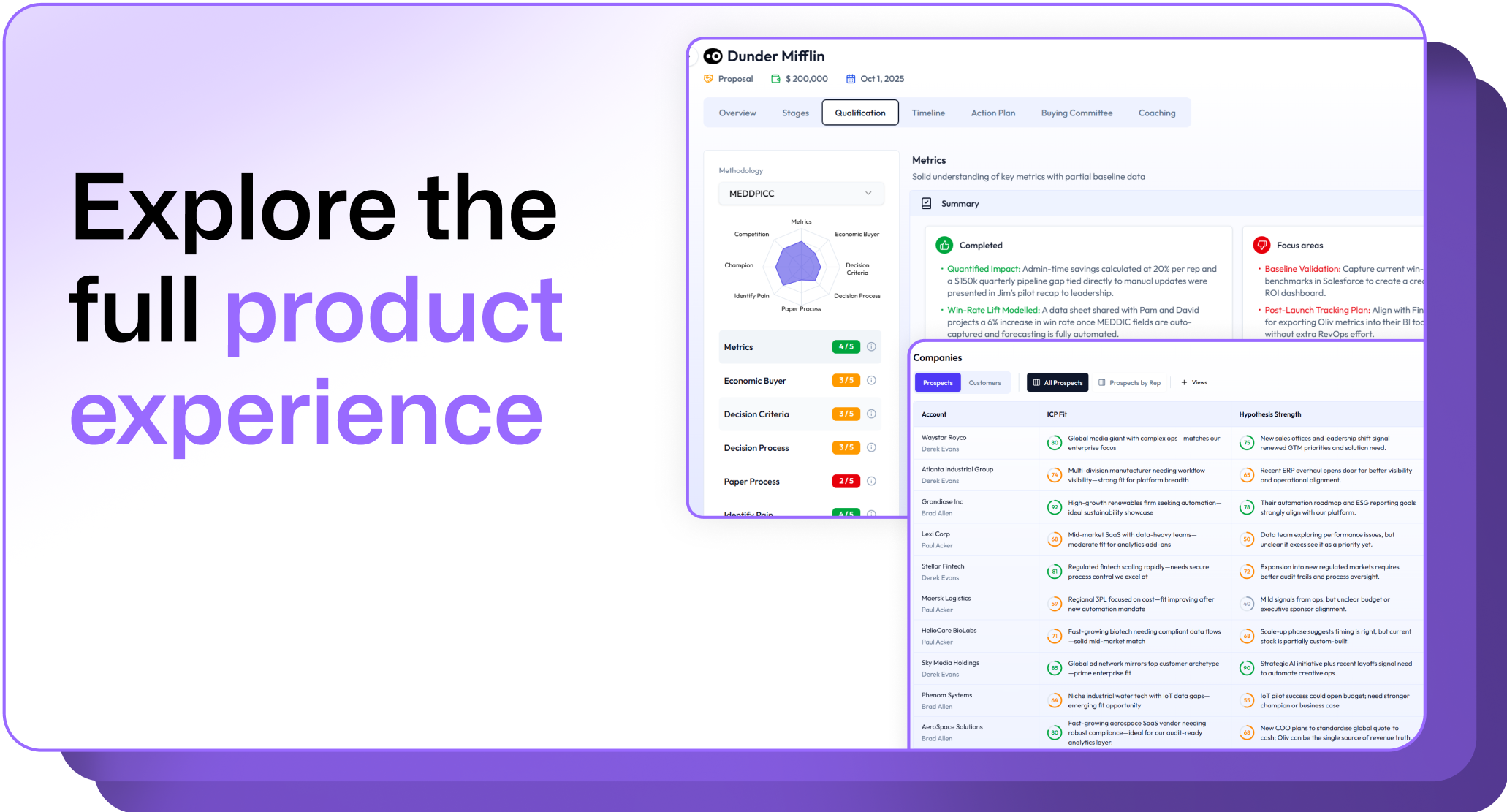
.avif)
.jpg)