10 Best AI-Powered Sales Platforms Compared on Prospecting, Conversation Intelligence, Forecasting, and Agent Autonomy for B2B RevOps Teams
Written by
Ishan Chhabra
Last Updated :
June 17, 2026
Skim in :
7
mins
In this article
Still got questions?
Come discuss this article with me.
Hi, I'm Ishan, Founder and CEO of Oliv.
I'm always up for a conversation about revenue intelligence, AI agents, or what's actually working (and what's not) across revenue teams.
I'd love to hear your perspective.
Thank you! Your submission has been received!
Oops! Something went wrong while submitting the form.
Meet Oliv’s AI Agents
Hi! I’m, Deal Driver
I track deals, flag risks, send weekly pipeline updates and give sales managers full visibility into deal progress
Hi! I’m, CRM Manager
I maintain CRM hygiene by updating core, custom and qualification fields all without your team lifting a finger
Hi! I’m, Forecaster
I build accurate forecasts based on real deal movement and tell you which deals to pull in to hit your number
Hi! I’m, Coach
I believe performance fuels revenue. I spot skill gaps, score calls and build coaching plans to help every rep level up
Hi! I’m, Prospector
I dig into target accounts to surface the right contacts, tailor and time outreach so you always strike when it counts
Hi! I’m, Pipeline tracker
I call reps to get deal updates, and deliver a real-time, CRM-synced roll-up view of deal progress
Hi! I’m, Analyst
I answer complex pipeline questions, uncover deal patterns, and build reports that guide strategic decisions
TL;DR
The 10 best AI-powered sales platforms split into three layers: data collection, intelligence, and agents that actually execute deal-level work.
We score every platform across seven axes, including agent autonomy, conversation intelligence, forecasting, prospecting data quality, and pricing transparency.
The decisive test is whether a tool acts on its own or just records and waits, which is where most note-takers fail within months.
Gong leads call coaching, Clari and Aviso lead forecasting, ZoomInfo and Apollo lead prospecting data, and Avoma fits sub-200-employee budgets.
We treat safety as a feature with a 30-day training window, human-in-the-loop review, and SOC 2, GDPR, and CCPA compliance baked in.
On Monday, name your single biggest pain, shortlist the top two platforms on that axis, run the incognito pricing test, and pilot one.
Q1: What Are the 10 Best AI-Powered Sales Platforms for B2B RevOps Teams in 2026? [toc=1. Best AI Sales Platforms]
The 10 best AI-powered sales platforms for B2B RevOps in 2026 are Oliv AI, Gong, Clari, Outreach, Salesloft, ZoomInfo, Apollo.io, Salesforce Einstein/Agentforce, Avoma, and Aviso. They split into three camps. Deal-level agentic platforms like Oliv AI act inside your workflow. Meeting-level tools like Gong analyze calls. Forecasting tools like Clari inspect pipeline. Each solves a different slice of pipeline drag, ramp lag, and quota attainment.
🏎️ The two-cylinder problem nobody admits
A RevOps lead at a 60-rep mid-market shop once told me her stack ran "like an expensive racing car firing on two cylinders." She had Gong for calls, Clari for forecasts, and Outreach for sequences. None of them talked to each other.
That is the real pain. Most teams do not need another tool. They need the tools to understand the deal, not just the meeting. With over 220 vendors crowding this category, picking is genuinely hard.
So I will be blunt about where I sit. I am the founder of Oliv AI, so I have a horse in this race. I will hand you the scoring rubric in the next section so you can re-weight it yourself.
🍰 How I think about the category: the three-layer cake
Every platform here lives on one of three layers. Knowing the layer tells you what the tool can and cannot do.
Layer 1, data collection: recording and transcription. This is now commodity work. Zoom, Teams, and Google Meet do it natively.
Layer 2, intelligence: large language models (LLMs, software that reads and reasons over text) that track qualification fields and risk.
Layer 3, agents: software that proactively does the work, like drafting a forecast or a follow-up.
Here is the distinction that matters most in 2026. Gong understands a conversation at the meeting level. A deal-level platform tracks the entire sales cycle, including pipeline movement, coaching, and forecasting. That gap is where deals quietly die.
📊 The 10 platforms at a glance
Scores below are mine, across the seven axes in this article. Stars run 1 (weak) to 5 (best-in-class) for that axis. I rate Oliv 5 stars and disclose that bias openly.
The 10 AI-Powered Sales Platforms at a Glance
Platform
Best for
Agent autonomy
Conversation IQ
Forecasting
Prospecting data
1.1 Oliv AI
Deal-level agentic RevOps
⭐⭐⭐⭐⭐
⭐⭐⭐⭐
⭐⭐⭐⭐
⭐⭐⭐⭐
1.2 Gong
Call coaching and CI depth
⭐⭐⭐
⭐⭐⭐⭐⭐
⭐⭐⭐⭐
⭐⭐⭐
1.3 Clari
Enterprise pipeline and forecast
⭐⭐⭐
⭐⭐⭐
⭐⭐⭐⭐⭐
⭐⭐⭐
1.4 Outreach
SDR sequencing at scale
⭐⭐⭐
⭐⭐⭐
⭐⭐⭐
⭐⭐⭐⭐
1.5 Salesloft
Cadence-driven outbound
⭐⭐⭐
⭐⭐⭐
⭐⭐⭐
⭐⭐⭐⭐
1.6 ZoomInfo
Top-of-funnel data and intent
⭐⭐⭐
⭐⭐⭐
⭐⭐⭐
⭐⭐⭐⭐⭐
1.7 Apollo.io
Affordable all-in-one prospecting
⭐⭐⭐
⭐⭐
⭐⭐
⭐⭐⭐⭐
1.8 Einstein/Agentforce
Salesforce-native shops
⭐⭐⭐
⭐⭐⭐
⭐⭐⭐
⭐⭐⭐
1.9 Avoma
Sub-200-employee budgets
⭐⭐
⭐⭐⭐
⭐⭐⭐
⭐⭐
1.10 Aviso
AI forecasting specialists
⭐⭐⭐
⭐⭐⭐
⭐⭐⭐⭐⭐
⭐⭐
Now let me go deep on each. I cover what each does, key features, pricing, a product-update timeline, pros and cons, the ideal use case, and real verified user feedback.
1.1 Oliv AI ⭐⭐⭐⭐⭐
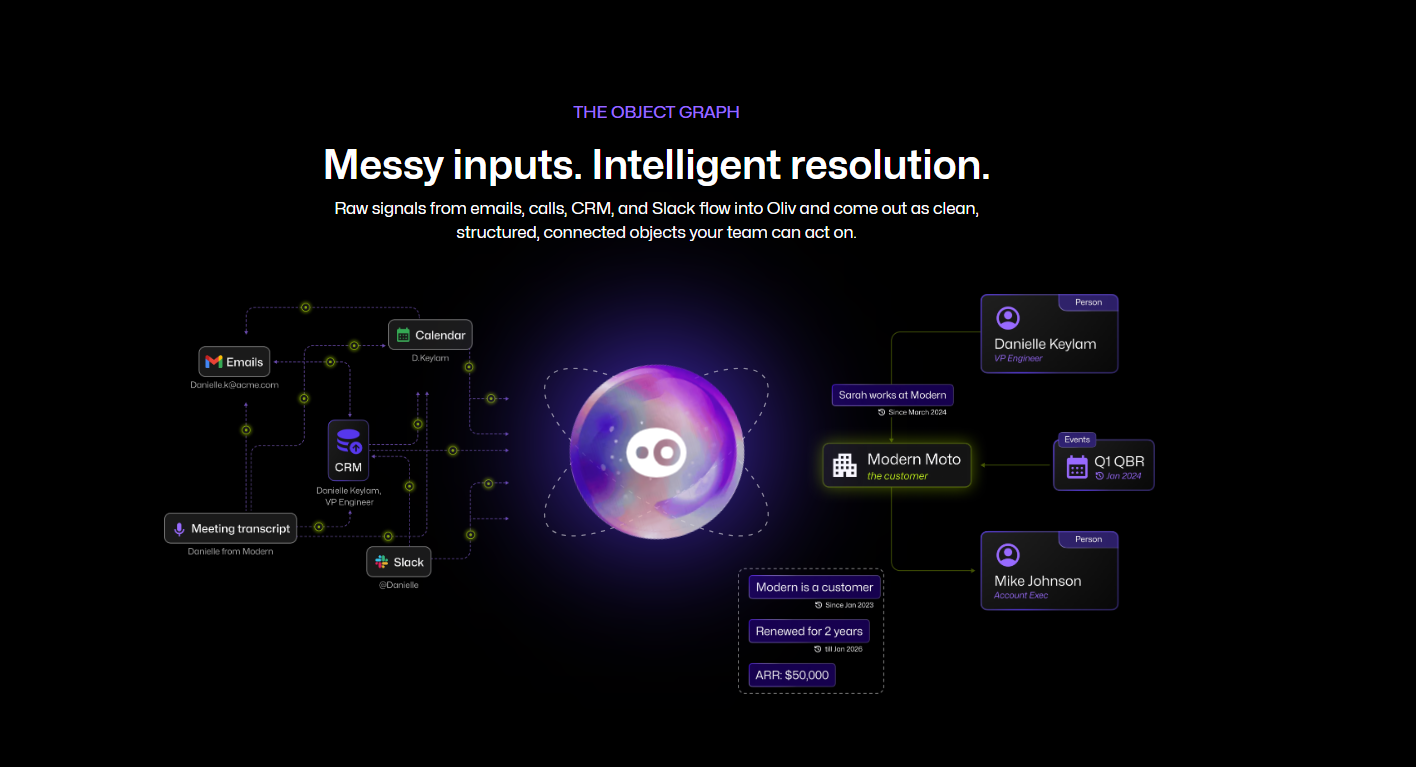
Oliv AI object graph showing messy inputs from email, CRM, calls, and Slack resolved into clean, connected objects, demonstrating deal-level agent autonomy and intelligence.
What it does. Oliv AI is a generative AI-native revenue platform that we built to make your CRM autonomous. Instead of software your reps log into, we deploy agents that do the work. We stitch data from calls, emails, Slack, Telegram, and the web into one 360-degree deal view.
🧩 Key features
30+ specialized AI agents, including a CRM Manager, Forecaster, Deal Driver, Researcher, and Coach agent.
5-minute processing. We deliver recordings and summaries within five minutes of a call ending, versus the 20 to 30 minutes typical of Gong.
AI-based object association. Our models reason through duplicate CRM records to map activity to the right account, where rule-based systems break.
Voice Agent (alpha). It calls reps nightly to capture updates on stalled deals and unrecorded conversations.
💰 Pricing and implementation
Our pricing is modular and seat-based, running from $19 to $120 per user with no mandatory platform fee. Agents can be bought individually, like the CRM Manager at about $29 per rep per month. Setup takes five minutes for the baseline, with core value in one to two days. Full customization runs two to four weeks, and I will not pretend otherwise.
📅 Oliv AI product evolution
Oliv AI Product Evolution
Period
What shipped
Through 2025
Evolved from a first-generation note-taker into an AI data platform, launching 30+ function-named agents (Researcher, Deal Driver) across the agentic revenue intelligence stack.
Now (H1 2026)
Voice Agent in alpha calls reps nightly to capture off-the-record deal updates, plus SOC 2 Type II, GDPR, and CCPA compliance.
Expected next
Deeper standalone CRM capability and wider Telegram and Slack data stitching.
✅ Pros and ❌ cons
✅ Agents do the work, so there is little manual adoption burden.
✅ Transparent, modular pricing with full data export.
❌ As an early-stage company, we lack Gong's decade of brand recognition.
❌ Voice Agent is still in alpha, and full customization takes two to four weeks.
Best use case. Mid-market B2B teams with 15 to 20 day cycles fighting dirty CRM data, ramp lag, and rep-biased forecasts.
"Before switching to Oliv, cleaning up messy CRM fields and guessing at forecasts used to swallow half my week. Oliv fixes the data as it happens." Darius Kim, Head of RevOps, DriftloopOliv AI G2 Verified Review
"With Gong, I have trouble understanding breadth versus depth. Oliv is the first time I've ever been speechless. That's incredible." Akil Sharperson, CSM Leader, Triple WhaleOliv AI G2 Verified Review
1.2 Gong ⭐⭐⭐⭐⭐ (conversation intelligence)
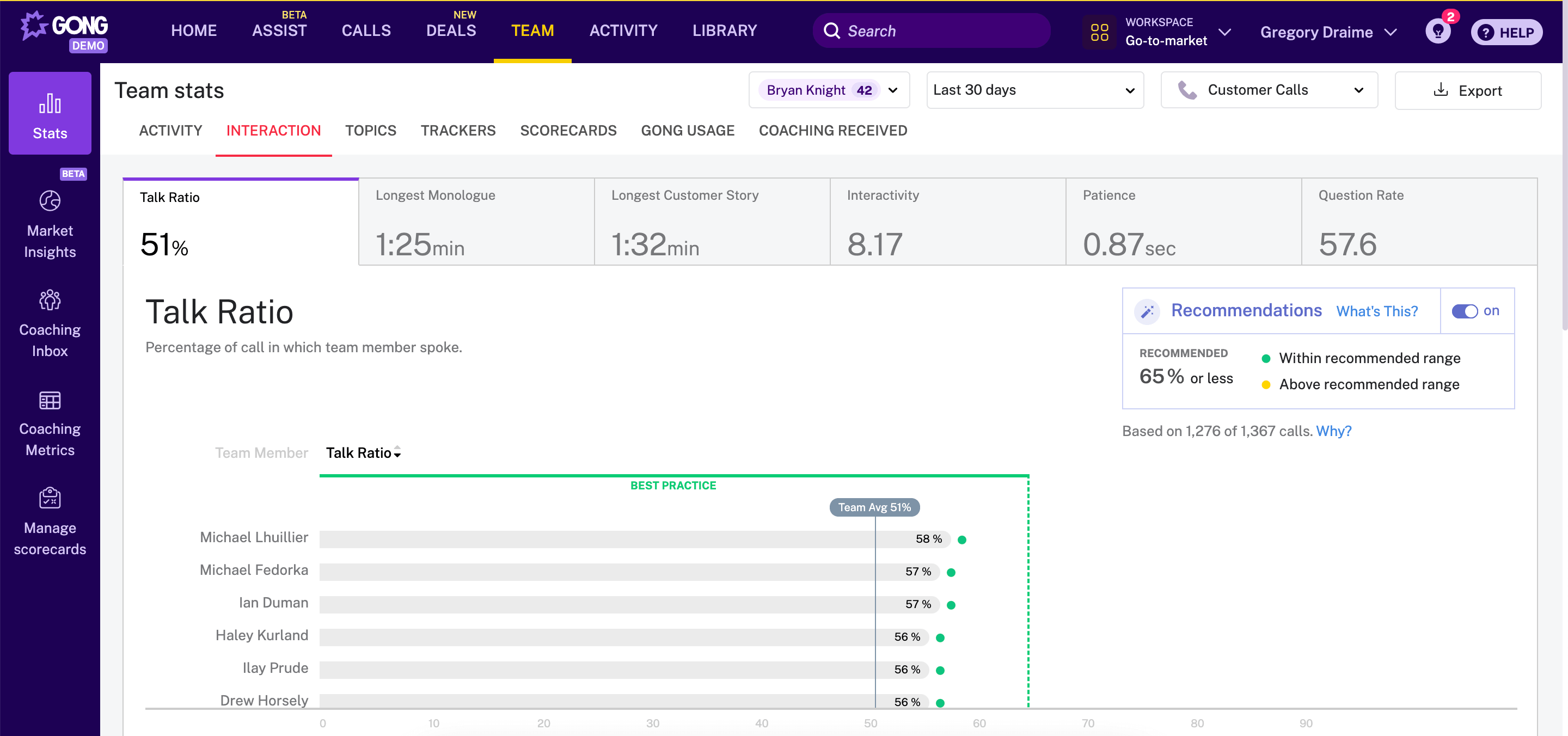
Gong conversation intelligence interface showing rep talk ratio benchmarks and interaction metrics, illustrating call coaching depth that defines its position among AI-powered sales platforms.
What it does. Gong, founded in 2015, is the market benchmark for conversation intelligence. It records, transcribes, and analyzes calls, then layers on deal boards and forecasting. I will say plainly: reps love its UI, and it earned that loyalty. For a deeper look, see our breakdown of Gong's features.
🧩 Key features
Smart Trackers that flag topics and keywords across calls.
Gong Assistant and Ask Anything, a conversational layer for querying calls and accounts.
Forecast and Engage as paid add-on modules.
AI Briefs and Data Extractor that map conversation fields back to the CRM.
💰 Pricing and implementation
Gong does not publish list pricing, and switchers report total cost of ownership reaching $250 to $270 per user per month when bundled, plus platform fees from $5,000 to $50,000. Reviewers consistently call out the expense and rigid multi-year terms. We cover this in detail in our Gong pricing analysis.
📅 Gong product update timeline
Gong Product Update Timeline
Period
What shipped
Until late 2024
Rebranded from Revenue Intelligence to a "Revenue AI Platform," with Smart Trackers, Forecast, and Engage as the core.
Through 2025 to early 2026
Shipped Gong Assistant, Agent Studio, AI Call Reviewer, and the Mission Andromeda "Gong Enable" launch on Feb 25, 2026.
Expected next
Bidirectional MCP (Model Context Protocol) so external AI tools can query Gong and briefs flow via API.
✅ Pros and ❌ cons
✅ Best-in-class conversation intelligence and trackers.
✅ Strong adoption among reps and managers.
❌ High cost and rigid contracts frustrate smaller teams.
❌ Data export is painful, and the API requires custom code for bulk access.
Best use case. Established sales orgs with budget that want deep call coaching and a mature CI suite. If forecasting is your priority, compare it in our Gong vs Clari comparison.
"Gong has become the single source of truth for our sales team. The additional products like Forecast or Engage come at an additional cost." Scott T., Director of SalesGong G2 Verified Review
"It was a big mistake to commit to a two year term. Gong is powerful but it's probably the highest end option on the market, and now we're stuck." Iris P., Head of Marketing and Sales PartnershipsGong G2 Verified Review
"For me, the only business problem Gong solves is the call recordings. It's too complicated, and not intuitive at all." John S., Senior Account ExecutiveGong G2 Verified Review
1.3 Clari ⭐⭐⭐⭐⭐ (forecasting)
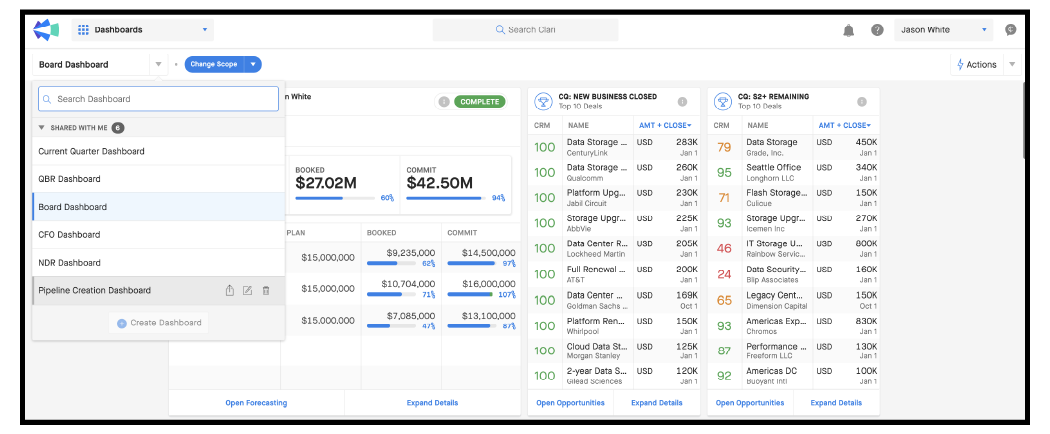
Clari forecasting dashboard presenting booked versus commit numbers, plan attainment, and top deal roll-ups, highlighting enterprise pipeline and forecast accuracy among AI-powered sales platforms.
What it does. Clari, founded in 2012, is built around forecasting and pipeline inspection. It overlays Salesforce to give RevOps and CROs clean roll-ups and deal analytics. After acquiring Groove and announcing a merger with Salesloft in 2025, it now spans engagement too. Our guide to Clari's features goes deeper.
🧩 Key features
Forecasting and pipeline inspection as the founding core.
CRM Score and RevAI for signal-based deal health.
Copilot conversation intelligence, a Forrester Strong Performer.
Groove sales engagement, now folded in.
💰 Pricing and implementation
Clari does not disclose seat pricing publicly. A Forrester study it commissioned reported $96.2 million in value and 398% ROI for enterprise customers. One honest note from a former insider: the sale can involve "overcomplicating the forecasting process so you needed Clari." If you are weighing options, see our best Clari alternatives.
📅 Clari product update timeline
Clari Product Update Timeline
Period
What shipped
Until early 2025
Core forecasting plus the Groove acquisition (Aug 2023) and Copilot CI.
Through 2025 to early 2026
Announced the Salesloft merger (Aug 7, 2025), added AI-based consent detection, and shipped the first cross-platform release in March 2026.
Expected next
Tighter Clari and Salesloft interoperability and in-app notification enhancements.
✅ Pros and ❌ cons
✅ Clean, well-designed forecasting loved by sales leadership.
✅ Makes updating Salesforce far faster for reps once configured.
❌ It adds little value for reps directly, and value depends heavily on your Salesforce config.
❌ Native Salesforce forecasting now overlaps much of it.
Best use case. Enterprise RevOps teams with complex GTM motions needing rigorous forecast roll-ups. For alternatives, explore our AI sales forecasting software guide.
"Clari has great deal analytics and forecasting modules that overlay on our Salesforce. Clari should find ways to differentiate from native Salesforce features to remain competitive." Dan J., Mid-Market userClari G2 Verified Review
"4 months later every one of my reps loves it because it makes updating Salesforce 10x easier. Of course this is based on how your SF is configured." u/ChimpDaddy2015, r/salesReddit Thread
"It is really just a glorified SFDC overlay. Definitely overkill for most companies." u/conaldinho11, r/SalesOperationsReddit Thread
1.4 Outreach ⭐⭐⭐⭐ (sales engagement)
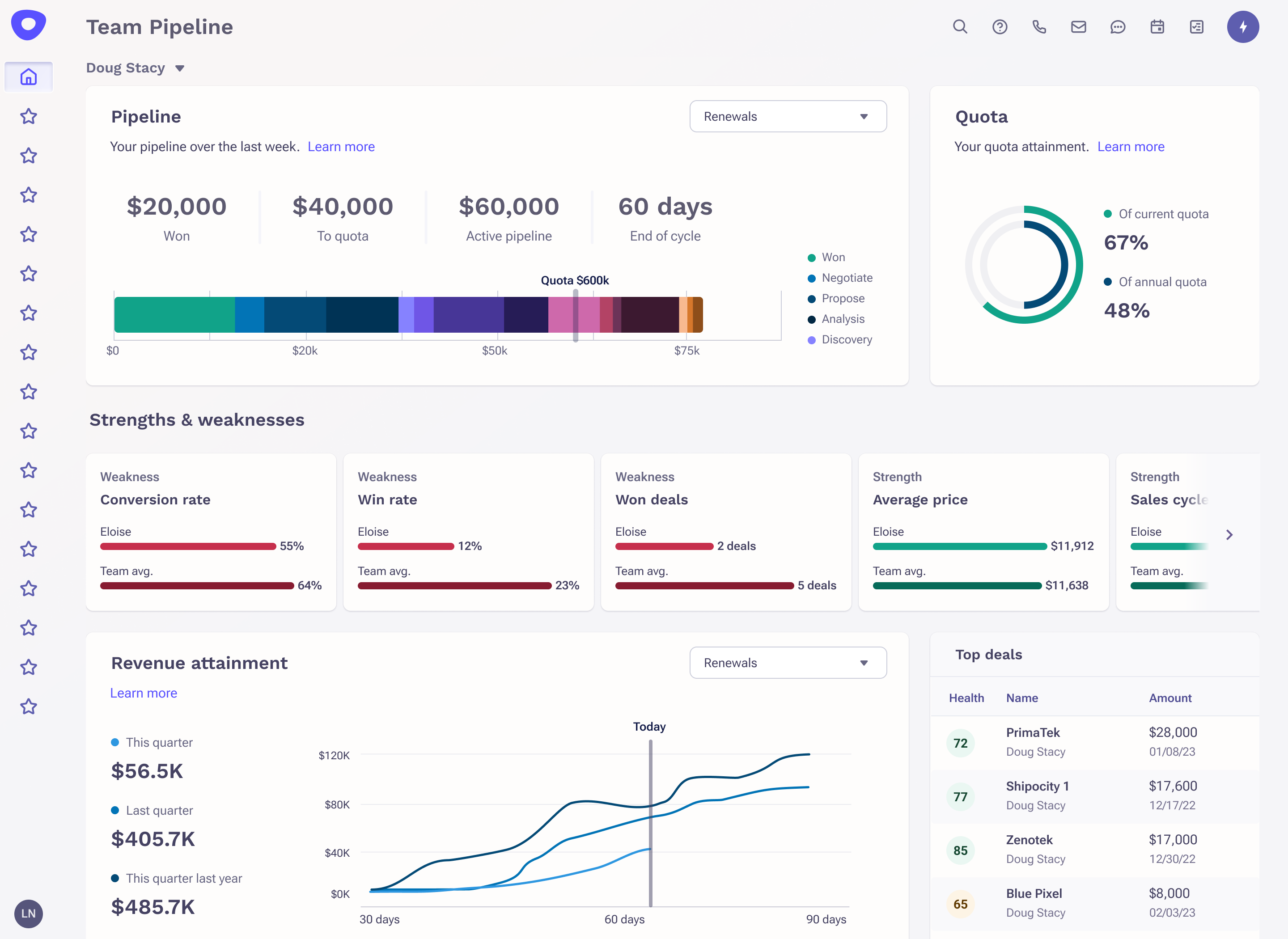
Outreach pipeline and quota dashboard showing rep conversion rates, win rates, and revenue attainment over time, reflecting sales engagement analytics within an AI-powered sales platform comparison.
What it does. Outreach, founded in 2014, is a sales engagement platform built around sequences and dialing. Its core job is helping SDRs manage high-volume outbound and keep prospects moving. See how it stacks up in our Gong vs Outreach comparison.
🧩 Key features
Sequences and cadences for systematic multi-touch outreach.
AI Prospecting and Deal Agents, its newer agent push.
Salesforce sync and email tracking.
Reporting and AB testing for outbound performance.
💰 Pricing and implementation
Outreach does not publish standard list pricing, and reviewers flag it as expensive with evergreen auto-renewing contracts. Onboarding takes time, and several users report glitches and slow support.
📅 Outreach product update timeline
Outreach Product Update Timeline
Period
What shipped
Until late 2024
Named a Forrester Revenue Orchestration Leader (Sep 2024), then launched AI Prospecting Agents (Dec 2024).
Through 2025 to early 2026
Relaunched as an "AI Revenue Workflow Platform," earned ISO/IEC 42001 responsible-AI certification, and joined Anthropic's MCP ecosystem (Feb 2026).
Expected next
"Omni" (Apr 27, 2026) with an Outreach MCP Server, Meeting Prep Agent beta, and Deal Agent enhancements.
✅ Pros and ❌ cons
✅ Strong sequencing and prospect management at scale.
✅ Good Salesforce integration and AB testing.
❌ Dialing lags for high-volume teams, and spam flagging hits 15 to 20% of calls.
❌ Reports are hard to parse, onboarding drags, and the Engage product feels stagnant.
Best use case. SDR-heavy teams that live in outbound sequences and need disciplined cadence management. For broader picks, see our revenue orchestration platform tools.
"Outreach is really really good for emailing, sequencing, and prospect management. Dialing features are not great, and we show as spam 15 to 20% of the time." Ethan R., Sales Development RepresentativeOutreach G2 Verified Review
"The Engage product is stagnant. Looks to have the same features, UX, integrations and issues as it had 5 years ago." Matthew T., Head of Revenue OperationsOutreach G2 Verified Review
"Outreach is significantly overpriced for what it offers. Their agreements are evergreen, automatically renewing annually." Kevin H., CTO and Co-FounderOutreach G2 Verified Review
1.5 Salesloft ⭐⭐⭐⭐
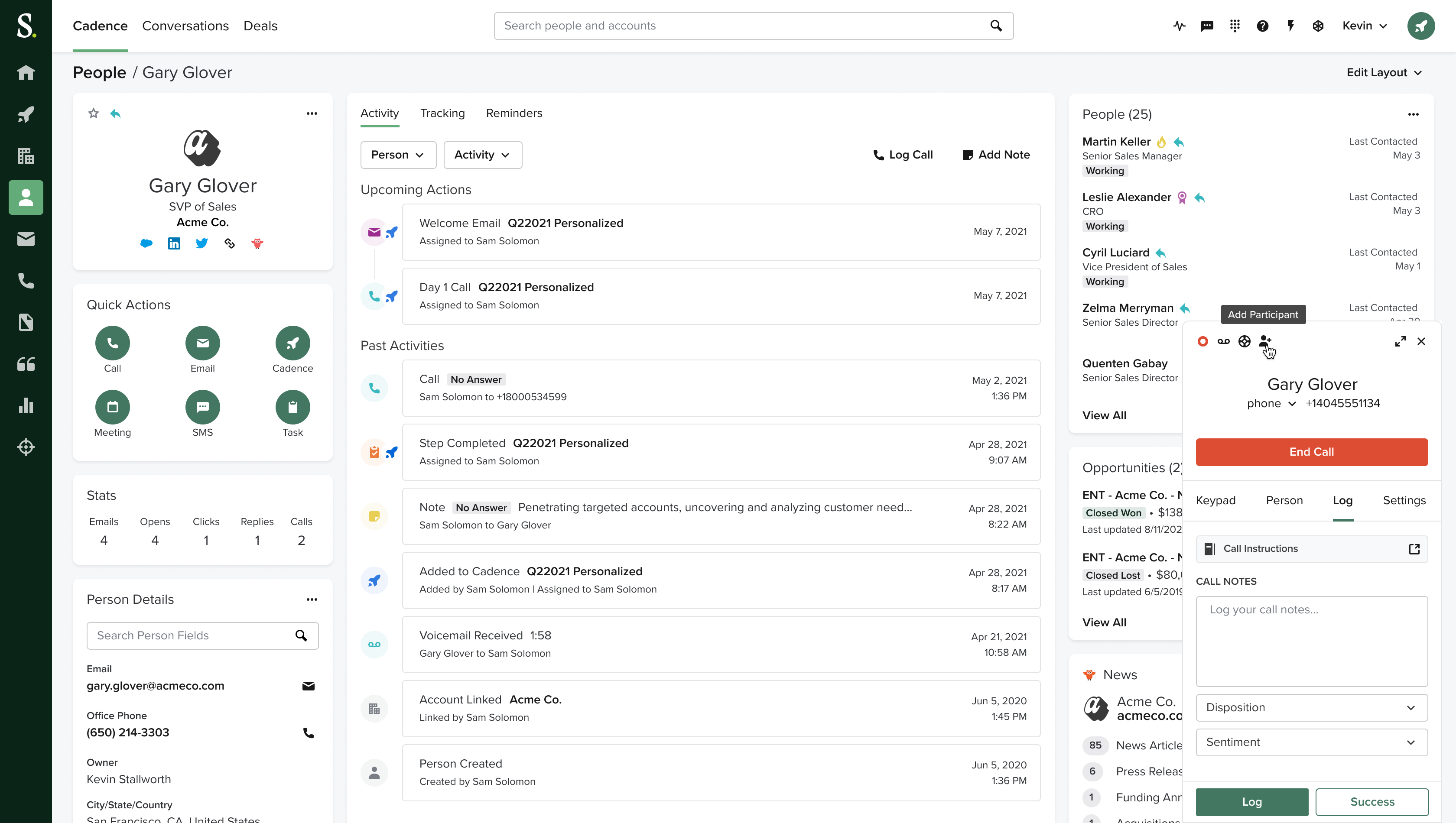
Salesloft sales engagement interface showing a contact's cadence steps, in-call logging panel, and activity history, illustrating cadence-driven outbound on an AI-powered sales platform.
What it does. Salesloft, founded in 2011 in Atlanta, is a sales engagement platform built around Cadence, its sequencing engine. After acquiring Drift and merging with Clari in 2025, it now spans buyer-side conversational AI and seller workflow. Compare it in our Gong vs Salesloft breakdown.
🧩 Key features
Cadence for structured, multi-touch outreach.
Conversations, its conversation-intelligence layer.
26 AI agents for end-to-end agentic support, launched 2025.
Salesforce sync and email tracking.
💰 Pricing and implementation
Salesloft does not publish standard list pricing. Reviewers report frustrating auto-renewal billing and weak support for smaller teams. It is generally cheaper than Outreach and adds SMS support.
📅 Salesloft product update timeline
Salesloft Product Update Timeline
Period
What shipped
Until early 2025
Acquired Drift (Feb 2024) to build an AI revenue orchestration platform.
Through 2025 to early 2026
Launched 15 new AI agents (May 2025), merged with Clari (Aug 2025), and shipped the MCP Server and AI Email Assistant in 2026.
Expected next
Deeper Clari interoperability, CRM AI Summary Write Back, and out-of-office automation.
✅ Pros and ❌ cons
✅ Strong cadence management loved by SDR teams.
✅ Cheaper than Outreach, with SMS support.
❌ Conversations CI is weak and "doesn't even have the functionality of Zoom."
❌ Poor customer service, especially for smaller companies, and clunky setup.
Best use case. Outbound teams that want disciplined cadences at a lower price than Outreach.
"Salesloft has been a game-changer. The cadence feature allows us to tailor outreach to different personas at scale." Nathalie J., Solution Development SpecialistSalesloft G2 Verified Review
"Super clunky to set up. Conversations doesn't work at all. They sell it as a Gong competitor. It doesn't even have the functionality of Zoom." Verified User, Professional Training and CoachingSalesloft G2 Verified Review
"I have been a Salesloft customer for 3 years. They never updated features or technology in that entire period. Stay far away from Salesloft." Craig P., OwnerSalesloft G2 Verified Review
1.6 ZoomInfo (Chorus) ⭐⭐⭐⭐⭐ (prospecting data)
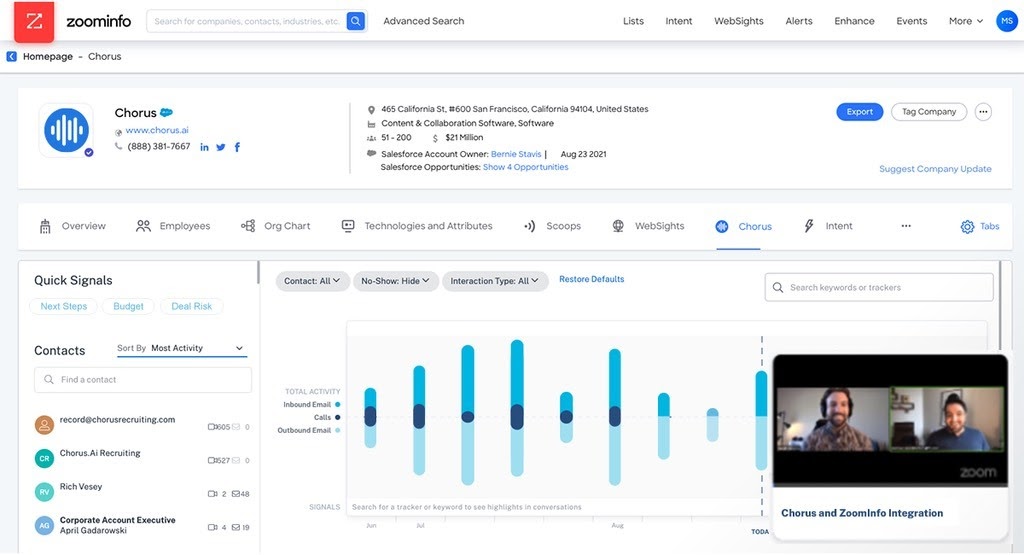
ZoomInfo Chorus company view displaying conversation intelligence signals, call and email activity, and prospecting data, reflecting top-of-funnel coverage compared across AI-powered sales platforms.
What it does. ZoomInfo is the market leader for B2B prospecting data and intent signals. Its conversation-intelligence layer, Chorus, records and analyzes calls for coaching. For top-of-funnel data volume, it sets the benchmark. See our Gong vs Chorus comparison for the CI side.
🧩 Key features
Contact and company database with intent signals.
Chorus for call recording, summaries, and coaching.
Talk-to-listen and filler-word analytics for reps.
Snippet sharing across internal and external teams.
💰 Pricing and implementation
ZoomInfo does not publish flat pricing, and one Gartner reviewer noted Chorus was "very reasonable compared to its largest competitor." Setup is simple if your stack integrates cleanly.
📅 ZoomInfo product update note
ZoomInfo Product Update Note
Period
What shipped
Through 2025
Continued investing in Chorus CI and intent data, and was named a Leader in analyst evaluations for ABM and intent.
Now (2026)
Pushing AI-driven enrichment and signal-to-action workflows for go-to-market teams.
Expected next
Tighter coupling of intent data with automated outreach plays.
✅ Pros and ❌ cons
✅ Best-in-class data volume and intent signals.
✅ Chorus is non-disruptive and easy to use for coaching.
❌ Chorus summaries miss detail and context recognition is limited.
❌ Multiple bundled products make the point of contact confusing.
Best use case. Teams whose dominant pain is top-of-funnel data and prospecting coverage. For call-focused picks, see our best AI for sales calls.
"Chorus by ZoomInfo is a game-changer for sales coaching. It's like having a personal sales coach in my pocket." Mayank M., Customer Success Account ManagerChorus by ZoomInfo G2 Verified Review
"Chorus does a good job with basic call recording. If you are looking for something more advanced, you may be disappointed. The software doesn't understand context." Director of Sales OperationsChorus by ZoomInfo Gartner Verified Review
"I wish the meeting summaries were more detailed. I find that it misses a lot. I can go back into the transcripts but it takes time I don't have." Natalie G., Bilingual Account ManagerChorus by ZoomInfo G2 Verified Review
1.7 Apollo.io ⭐⭐⭐⭐
What it does. Apollo.io is an all-in-one prospecting and engagement platform that bundles a contact database, sequencing, and a dialer at a lower price point. It is the budget-friendly alternative many smaller teams reach for first.
🧩 Key features
B2B contact database with enrichment.
Sequences and dialer for outbound at scale.
Basic conversation analytics for calls.
CRM sync for Salesforce and HubSpot.
💰 Pricing and implementation
Apollo is widely cited as offering similar capabilities to Gong Engage "for a fraction of the price," making it popular with cost-conscious teams. Setup is fast and self-serve.
📅 Apollo.io product update note
Apollo.io Product Update Note
Period
What shipped
Through 2025
Expanded its database and AI writing tools as an affordable all-in-one for SMB and mid-market prospecting.
Now (2026)
Building AI-assisted sequencing and enrichment for go-to-market teams.
Expected next
Deeper AI prospecting agents to compete with Outreach and ZoomInfo.
✅ Pros and ❌ cons
✅ Strong value: prospecting, sequencing, and dialing in one tool.
✅ Fast, self-serve setup for smaller teams.
❌ Data accuracy and CI depth trail ZoomInfo and Gong.
❌ Forecasting and deal-level intelligence are minimal.
Best use case. SMB and early mid-market teams wanting affordable all-in-one prospecting. For a wider list, see our best AI sales tools roundup.
"I highly recommend looking at better options like Outreach, Salesloft, or Apollo. These platforms offer the functionality and integrations for a fraction of the price." Verified Reviewer comparing tools to Gong EngageGong G2 Verified Review
1.8 Salesforce Einstein / Agentforce ⭐⭐⭐
What it does. Einstein and Agentforce are Salesforce's bolted-on AI layers for its CRM. They predict sales outcomes, score leads, and run chat-based agents. The strength is native integration for shops already living in Salesforce. Our Agentforce overview covers it in depth.
🧩 Key features
Einstein lead and opportunity scoring using machine learning.
Activity Capture for logging emails and meetings.
Agentforce chat-based agents for tasks.
Salesforce Data Cloud as a customer data platform.
💰 Pricing and implementation
Switchers report total costs reaching $500 per month after add-ons like Einstein Conversation Insights and Revenue Intelligence. Deployments can take months and depend heavily on clean underlying data. We break this down in our Agentforce pricing breakdown.
📅 Einstein / Agentforce product update note
Einstein / Agentforce Product Update Note
Period
What shipped
Through 2025
Expanded Agentforce agents and Data Cloud, heavily targeting B2C use cases like order returns.
Now (2026)
Pushing agentic features priced around $0.10 per action plus all-inclusive seat options.
Expected next
Deeper agent autonomy across the Salesforce stack.
✅ Pros and ❌ cons
✅ Huge installed base and native Salesforce integration.
✅ Real-time AI insights and lead prioritization.
❌ Agents are chat-focused, so users must talk to them and copy outputs elsewhere.
❌ Rule-based Activity Capture gets confused by duplicate accounts, and deployments fail on dirty data.
Best use case. Salesforce-committed enterprises with clean data and the budget for long implementations. See our best Agentforce alternatives if you want a leaner path.
"The insights generated from AI are brilliant and save a lot of time. Few teething problems, and sometimes the AI doesn't bring back the insights we're looking for." Finance Associate, Consumer GoodsSalesforce Einstein Gartner Verified Review
"It provides a priority list of leads that helps make better sales decisions. However, it has issues related to data storage and migration that need to be addressed." Product Management, Education sectorSalesforce Einstein Gartner Verified Review
1.9 Avoma ⭐⭐⭐
What it does. Avoma is an AI meeting assistant that records, transcribes, and summarizes calls, with light forecasting added on. It is built for smaller teams and primarily serves customers under 200 employees. Our Avoma features guide has the full picture.
🧩 Key features
AI meeting assistant for recording and transcription.
Smart templates and snippets for collaboration.
Conversation search with saved queries.
CRM auto-sync of AI notes.
💰 Pricing and implementation
Avoma is positioned as an affordable note-taker and CI tool for small teams. Setup is fast, though reviewers report the note-taker occasionally joins late or drops from calls.
📅 Avoma product update note
Avoma Product Update Note
Period
What shipped
Through 2025
Maintained its AI meeting assistant core with Gmail Sync (Oct 2025) and Mobile 2.0.
Now (2026)
Continuing CI and forecasting features for SMB teams.
Expected next
Incremental note-taking and forecasting improvements.
✅ Pros and ❌ cons
✅ Smooth, affordable note-taking for small teams.
✅ Accurate transcription and clear meeting summaries.
❌ Transcripts can be inaccurate and misattribute speakers.
❌ The note-taker shows up late or drops from calls, and it struggles to scale past small customers.
Best use case. Sub-200-employee teams wanting affordable meeting notes and basic CI. More feedback lives in our Avoma user reviews roundup.
"The automatic recording and transcription features are very accurate, saving us time and ensuring nothing gets lost in conversation." Amrit D., Customer Success ManagerAvoma G2 Verified Review
"We see it show up late, drop from calls randomly, and sometimes just not show up. If there are two account holders on one call, we have seen it show up twice." Aleshia R., Client DirectorAvoma G2 Verified Review
"Sometimes it's highly inaccurate, does not pick up the right notes or the right person speaking. So it prevents me from trusting it completely." Verified User in ConsultingAvoma G2 Verified Review
1.10 Aviso ⭐⭐⭐⭐⭐ (forecasting)
What it does. Aviso is an AI-first forecasting and revenue intelligence platform aimed at enterprise teams. It predicts deal outcomes and quarter-end numbers using machine learning, competing directly with Clari on forecast accuracy. For more context, see our best revenue intelligence software platforms.
🧩 Key features
AI forecasting with predictive deal scoring.
Pipeline analytics and risk flagging.
Conversation intelligence add-on.
CRM sync for Salesforce.
💰 Pricing and implementation
Aviso uses enterprise custom pricing and is typically deployed by larger RevOps teams. It sits alongside Clari, Gong Forecast, and MaxIQ in dedicated forecasting comparisons.
📅 Aviso product update note
Aviso Product Update Note
Period
What shipped
Through 2025
Advanced AI forecasting and deal-scoring models for enterprise revenue teams.
Now (2026)
Expanding generative AI and agentic forecasting capabilities.
Expected next
Deeper conversational analytics tied to forecast signals.
✅ Pros and ❌ cons
✅ Strong AI-driven forecast accuracy for enterprises.
✅ Predictive deal scoring that flags risk early.
❌ Enterprise focus and custom pricing put it out of reach for smaller teams.
❌ Prospecting and engagement are not its strength.
Best use case. Enterprise RevOps teams that want a dedicated AI forecasting engine.
Q2: How Were These Platforms Scored, and What Is an AI-Powered Sales Platform vs a CRM? [toc=2. Methodology & Definition]
We scored each platform on five weighted criteria totaling 100%, rated 1 to 5 stars. An AI-powered sales platform combines a data layer, an intelligence layer, and an agent layer that acts inside your workflow. A CRM, by contrast, only stores data you must update by hand.
📊 The five criteria and what each pain maps to
Here is the rubric. I built it around the pains RevOps leaders actually raise, not vanity features.
The Five Weighted Scoring Criteria
Criterion
Weight
RevOps pain it answers
Cross-functional and deal-level intelligence
25%
Data scattered across calls, email, and Slack
Agent autonomy and workflow integration
25%
Manual auditing eating a manager's week
Prospecting data quality and forecast accuracy
20%
Rep-biased forecasts averaging 67% accuracy
Setup, usability, and time-to-value
15%
Legacy deployments taking 3 to 6 months
User reviews and pricing transparency
15%
Opaque pricing and forced bundling
⭐ The star bands, and a disclosure I owe you
Scores convert to stars on simple bands. A 0 to 20 score earns 1 star, 21 to 40 earns 2 stars, 41 to 60 earns 3 stars, 61 to 80 earns 4 stars, and 81 to 100 earns 5 stars.
Now the disclosure. Oliv AI is my company, and I rated it 5 stars. So take the rubric, re-weight it for your own pains, and re-score everyone yourself. I would rather earn your trust than win a rigged table. You can sanity-check our claims against our sales intelligence platform breakdown.
🍰 The three-layer cake: what "platform" actually means
I think of every tool as a three-layer cake. The layers tell you what it can really do.
Data layer: captures calls, emails, Slack, and web signals into one place.
Intelligence layer: fine-tuned models (software trained to read sales context) that flag risk and intent.
Agent layer: software that does the work, like drafting a forecast or updating the CRM.
A CRM only holds data you feed it. As I see it, the CRM became a "dumb repository" because selling was never contingent on data entry, so reps skipped it. That is the gap the agent layer fills, and it is the thesis behind the shift from revenue ops to intelligence to orchestration.
🤖 The test: does it act, or just record?
Here is the one question that cuts through the noise. Does the tool act on its own, or does it just record and wait for you?
Note-takers and call recorders sit at the bottom. Many fail within six or seven months because they add work instead of removing it. A real platform, by contrast, runs the work itself. With Oliv, the CRM Manager Agent updates fields and the Forecaster Agent builds the roll-up, no human ferrying required. That "acts versus records" line is the spine of every score below, and it shapes our take on the best revenue intelligence platforms.
Q3: How Does Agent Autonomy Differ Across Platforms, Truly Agentic vs Just Chat? [toc=3. Agent Autonomy Spectrum]
Agent autonomy is the degree to which a platform pursues a goal and executes work without a human carrying data between tools. Most "AI agents" today are still chat. You talk to them, then copy the output somewhere else. Truly agentic tools work inside your workflow like a smart employee, not a vending machine.
🥤 The vending machine versus the smart employee
A vending machine takes one fixed input and drops one fixed output. Most "agents" work exactly like that. You prompt, it answers, and you do the rest.
A smart employee is different. It pursues a goal, hits a snag, and replans. The standard read on AI agents gets this backwards: the chat window is the floor of autonomy, not the ceiling. I could be wrong, but I think chat-only UX is why adoption stalls, a pattern we unpack in our analysis of Agentforce reviews.
📈 The autonomy spectrum, graded
Here is how I grade the category on a simple ladder from record to execute.
The Agent Autonomy Spectrum
Level
What it does
Example tools
L0
Records and transcribes
Avoma, Chorus
L1
Surfaces insights you query
Gong, Clari Copilot
L2
Chat agents you must prompt
Salesforce Agentforce
L3
Drafts work for your approval
Outreach AI, Salesloft agents
L4
Executes deal-level work autonomously
Oliv AI
Salesforce Agentforce sits at L2. As I read it, it is chat-focused, so the user must talk to the agent and then copy data into the real workflow. We compare leaner paths in our best Agentforce alternatives. One reviewer captured the friction plainly.
"You need to activate Einstein and other stuff if you want to use Agentforce. But why don't you enable dependency if I directly wanna start Agentforce in a single click?" Shivam A., Product ResearcherSalesforce Agentforce G2 Verified Review
"It empowers the agent to handle complex situations based on a prompt or guidance provided directly within the workflow. While I'm still in the early stages of exploring all its features, this capability feels like a significant leap forward." Alessandro N., Salesforce AdministratorSalesforce Agentforce G2 Verified Review
🌙 What L4 autonomy frees the team to do
At Oliv AI, we run our own revenue motion close to "1.2 humans plus 20 agents." The agents work nights and weekends. Our Voice Agent even calls reps at night to capture stalled-deal updates.
That changes the math. When agents handle the patrol work, humans do only what humans can: the live customer conversation. I think the next two years move us from SaaS you log into toward agents that work for you, from revenue orchestration to revenue engineering, which is why we built our view of the revenue orchestration platform category.
Q4: Which Platform Wins on Prospecting Data Quality and Conversation Intelligence? [toc=4. Prospecting & Conversation IQ]
ZoomInfo and Apollo.io lead prospecting data volume and intent signals. Gong leads meeting-level conversation intelligence (software that analyzes call content). But outcomes hinge on data quality, deliverability, and speed. Recording is now commoditized, so Oliv AI's roughly 5-minute deal-level intelligence beats Gong's 20 to 30 minute delay.
📉 The "Hello [First_Name]" problem
Picture an SDR firing a sequence at dawn. The first email lands reading "Hello [First_Name]" because the data was stale. Connect rates already sit near 5%, and reply rates near 1%.
Bad data does not just waste a send. It amplifies the damage across thousands of contacts. Raw volume is not the prize. Fresh, compliant data is, a point we make in our roundup of the best AI sales tools.
🗂️ Prospecting data quality, compared
Prospecting Data Quality Compared
Platform
Strength
Watch-out
ZoomInfo
Largest database and intent signals
Bundled products confuse the point of contact
Apollo.io
Affordable all-in-one volume
Accuracy trails ZoomInfo on enrichment
Oliv AI
Compliant, human-reviewed research at scale
Not a raw-volume database play
⏱️ Conversation intelligence: latency and depth
On the CI side, latency matters more than people admit. Gong is the benchmark for depth, but its processing runs 20 to 30 minutes, and reviewers say summaries can miss detail. We compare these tradeoffs in our Gong vs Chorus comparison.
"Chorus does a good job with basic call recording. If you are looking for something more advanced, you may be disappointed. The software doesn't understand context." Director of Sales OperationsChorus by ZoomInfo Gartner Verified Review
"Outreach is really really good for emailing, sequencing, and prospect management. Dialing features are not great, and we show as spam 15 to 20% of the time." Ethan R., Sales Development RepresentativeOutreach G2 Verified Review
🚫 Why we deliberately skip "real-time"
Here is a contrarian stance. At Oliv AI, we do not do anything in-call, in real time, on purpose. The standard category pitch treats live nudges as the headline. I think that gets it backwards.
Recording is commoditized, so we compete on speed-to-intelligence after the call, not gimmicks during it. We process the deal-level summary in about 5 minutes, against Gong's 20 to 30. We also gate agent output behind a training window before it acts, because a wrong nudge at scale is worse than a slightly later one. For call-focused options, see our guide to the best AI for sales calls.
🌅 What this changes in the rep's afternoon
Put it together and the rep's day shifts. Clean, compliant data means fewer "[First_Name]" misfires and safer deliverability. Fast deal-level CI means the follow-up draft is waiting minutes after the call, not after a coffee break.
So the honest answer to "who wins" is: it depends on your bottleneck. Pick ZoomInfo or Apollo for top-of-funnel volume, Gong for deep call coaching, and Oliv AI when you want fast, deal-level intelligence paired with compliant outreach. If forecasting is the priority, weigh the field in our AI sales forecasting software guide.
Q5: Which Platforms Offer the Best Prospecting Data Quality and Deliverability Safety? [toc=5. Data Quality & Deliverability]
ZoomInfo and Apollo.io lead prospecting data volume and intent signals. But data quality and deliverability safety decide outcomes. With connect rates near 5% and email reply rates near 1%, bad data and unsafe sending quietly waste the whole motion. The strong platforms pair fresh data with consent compliance, SOC 2, GDPR, and human review before agents send at scale.
📉 The "Hello [First_Name]" problem, amplified
Picture a sequence going out at dawn with "Hello [First_Name]" in the subject line. The merge field never populated because the record was stale. That single bad row now repeats across thousands of contacts.
Automation does not fix a broken process. It amplifies it. So when connect rates sit at 5% and replies at 1%, every stale or non-compliant record makes the funnel worse, not better.
⏰ The hidden compliance tax
Volume vendors rarely mention the safety cost. Two-party-consent rules (where both sides must agree to recording or contact) and regional privacy law add real delay. Compliance review can tack on 30 to 45 days before a play goes live.
Here is how the data and safety picture compares across the leaders.
Data Quality and Deliverability Safety Compared
Platform
Data and intent strength
Safety watch-out
ZoomInfo
Largest database and intent signals
Context recognition is limited
Apollo.io
Affordable all-in-one volume
Accuracy trails on enrichment
Oliv AI
SOC 2, GDPR, CCPA, human-reviewed research
Not a raw-volume database play
"Chorus does a good job with basic call recording. If you are looking for something more advanced, you may be disappointed. The software doesn't understand context." Director of Sales OperationsChorus by ZoomInfo Gartner Verified Review
"Outreach is really really good for emailing and sequencing. Dialing features are not great, and we show as spam 15 to 20% of the time." Ethan R., Sales Development RepresentativeOutreach G2 Verified Review
🛡️ Safety as a feature, not friction
Here is where I land. Agents that send all night need guardrails, or they amplify mistakes at machine speed. At Oliv AI, we treat safety as a feature, a stance we detail in our guide to the best sales intelligence platform.
That means a 30-day training window before an agent acts on its own. It also means a human-in-the-loop quality gate, where a person reviews output before scale, plus SOC 2 Type II, GDPR, and CCPA compliance baked in. Fresh, accurate, consented data beats raw volume every time, which is why we favor it across the best AI sales tools.
Q6: How Should You Choose the Right Platform for Your Team, Including CPQ, Integration, Build-vs-Buy, and Pricing? [toc=6. Choosing & Pricing]
Choose by your dominant pain and stage. A deal-level agentic platform like Oliv AI fits ramp lag and forecast accuracy. Gong fits call coaching, Clari fits enterprise pipeline, ZoomInfo and Apollo fit top-of-funnel data, and Avoma fits sub-200-employee budgets. Buy integration-first, and watch pricing models closely.
🔌 Where deals actually stall: CPQ and integration
CPQ (configure, price, quote: the step that turns a deal into a priced order) is where momentum dies. So is weak workflow integration. If your tool cannot push clean data back into the CRM, reps stop trusting it.
Gong is a good example of the extraction tax. One operator detailed how pulling your own data out requires custom developer work, a theme we cover in our look at Gong integrations.
"This lack of flexibility has required us to engage our development team at additional cost, just to extract data we already own." Neel P., Sales Operations ManagerGong G2 Verified Review
🛠️ Why building it yourself is a trap
Some teams think they will just build this in-house. I think that is a mistake for most. You are probably not a tooling company, and a home-built agent goes obsolete in months as models change.
The cash math is brutal too. Burn a senior engineer's year on internal tooling and you can lose the equivalent of a $150,000 hire, plus the deals they did not help close.
🧭 Route by role and stage
Here is the quick decision map by your biggest pain.
Platform Routing by Pain and Role
Your pain
Stage or role
Best fit
Ramp lag, forecast accuracy
RevOps, CRO
Oliv AI
Call coaching depth
Enablement, managers
Gong
Enterprise pipeline roll-ups
Enterprise RevOps
Clari
Top-of-funnel volume
SDR teams
ZoomInfo, Apollo
Affordable notes
Sub-200 employees
Avoma
One caveat on Avoma: reviewers report it strains as you scale past small teams, which we explore in our Avoma user reviews roundup.
"We see it show up late, drop from calls randomly, and sometimes just not show up." Aleshia R., Client DirectorAvoma G2 Verified Review
💰 Read the pricing model before you sign
Pricing model matters as much as price. Opaque per-action credits (you pay each time an agent acts, around $0.10 per action) can balloon unpredictably. All-inclusive per-seat is easier to forecast, a contrast we draw in our Agentforce pricing breakdown.
Pricing Models Compared
Model
How it bills
Risk
Per-seat
Flat per user
Predictable
Usage/credit
Per action or credit
Can balloon
Outcome
Per result
Hard to audit
Run the incognito test before buying: open the vendor in a private browser and see if pricing is public. Oliv AI publishes modular $19 to $120 per-user pricing for exactly this reason, in line with the transparency we push for across revenue intelligence software platforms.
Q7: What Should B2B Revenue Teams Do on Monday, Final Recommendations and Action Items? [toc=7. Final Recommendations]
Name your single biggest pain first: pipeline drag, ramp lag, or quota attainment. Then shortlist the two platforms scoring highest on that axis and run the incognito self-test on each. Pilot one with a 30-day agent-training window. For most RevOps teams chasing intelligence-led scale, a deal-level agentic platform like Oliv AI is the highest-leverage first move.
✅ The must-haves, recapped
Do not buy on feature lists. Buy on fit against the seven axes, weighted for your pain. The context is sobering: many sales teams missed their 2025 targets, so another dashboard is not the answer.
Demand three things from any shortlist. Demand deal-level intelligence, real agent autonomy, and clean two-way CRM sync. If a tool only records and waits, it sits at the bottom of the autonomy spectrum, a gap we map in our take on the best revenue intelligence platforms.
🗓️ Your Monday action list
Here is what I would actually do this week.
Write down your one biggest revenue pain in a sentence.
Pick the two platforms that score highest on that axis.
Run the incognito test to check pricing transparency on both.
Start a 30-day pilot using the 10/80/10 rule, where agents handle 80% and humans set up 10% and review 10%.
Measure time-to-value, not feature count.
The differentiators that should break a tie are autonomy, deliverability safety, CPQ fit, and forecast accuracy. Those are where the real money leaks or compounds, especially when you weigh the field of AI sales forecasting software.
🤔 Where my head is right now
Here is the question I am sitting with. I think the next two years move teams from scaling with headcount to scaling with intelligence, pushing revenue-per-rep toward $3 to $5 million, an arc we trace from revenue ops to intelligence to orchestration.
If your job is mostly the task, agents will reshape it. If your job is the customer relationship, agents free you to do more of it. So instead of a hard CTA, I would rather hear what you are building. Tell me your biggest pain, and I will tell you honestly whether Oliv AI is the right first move or not.
Q1: What Are the 10 Best AI-Powered Sales Platforms for B2B RevOps Teams in 2026? [toc=1. Best AI Sales Platforms]
The 10 best AI-powered sales platforms for B2B RevOps in 2026 are Oliv AI, Gong, Clari, Outreach, Salesloft, ZoomInfo, Apollo.io, Salesforce Einstein/Agentforce, Avoma, and Aviso. They split into three camps. Deal-level agentic platforms like Oliv AI act inside your workflow. Meeting-level tools like Gong analyze calls. Forecasting tools like Clari inspect pipeline. Each solves a different slice of pipeline drag, ramp lag, and quota attainment.
🏎️ The two-cylinder problem nobody admits
A RevOps lead at a 60-rep mid-market shop once told me her stack ran "like an expensive racing car firing on two cylinders." She had Gong for calls, Clari for forecasts, and Outreach for sequences. None of them talked to each other.
That is the real pain. Most teams do not need another tool. They need the tools to understand the deal, not just the meeting. With over 220 vendors crowding this category, picking is genuinely hard.
So I will be blunt about where I sit. I am the founder of Oliv AI, so I have a horse in this race. I will hand you the scoring rubric in the next section so you can re-weight it yourself.
🍰 How I think about the category: the three-layer cake
Every platform here lives on one of three layers. Knowing the layer tells you what the tool can and cannot do.
Layer 1, data collection: recording and transcription. This is now commodity work. Zoom, Teams, and Google Meet do it natively.
Layer 2, intelligence: large language models (LLMs, software that reads and reasons over text) that track qualification fields and risk.
Layer 3, agents: software that proactively does the work, like drafting a forecast or a follow-up.
Here is the distinction that matters most in 2026. Gong understands a conversation at the meeting level. A deal-level platform tracks the entire sales cycle, including pipeline movement, coaching, and forecasting. That gap is where deals quietly die.
📊 The 10 platforms at a glance
Scores below are mine, across the seven axes in this article. Stars run 1 (weak) to 5 (best-in-class) for that axis. I rate Oliv 5 stars and disclose that bias openly.
The 10 AI-Powered Sales Platforms at a Glance
Platform
Best for
Agent autonomy
Conversation IQ
Forecasting
Prospecting data
1.1 Oliv AI
Deal-level agentic RevOps
⭐⭐⭐⭐⭐
⭐⭐⭐⭐
⭐⭐⭐⭐
⭐⭐⭐⭐
1.2 Gong
Call coaching and CI depth
⭐⭐⭐
⭐⭐⭐⭐⭐
⭐⭐⭐⭐
⭐⭐⭐
1.3 Clari
Enterprise pipeline and forecast
⭐⭐⭐
⭐⭐⭐
⭐⭐⭐⭐⭐
⭐⭐⭐
1.4 Outreach
SDR sequencing at scale
⭐⭐⭐
⭐⭐⭐
⭐⭐⭐
⭐⭐⭐⭐
1.5 Salesloft
Cadence-driven outbound
⭐⭐⭐
⭐⭐⭐
⭐⭐⭐
⭐⭐⭐⭐
1.6 ZoomInfo
Top-of-funnel data and intent
⭐⭐⭐
⭐⭐⭐
⭐⭐⭐
⭐⭐⭐⭐⭐
1.7 Apollo.io
Affordable all-in-one prospecting
⭐⭐⭐
⭐⭐
⭐⭐
⭐⭐⭐⭐
1.8 Einstein/Agentforce
Salesforce-native shops
⭐⭐⭐
⭐⭐⭐
⭐⭐⭐
⭐⭐⭐
1.9 Avoma
Sub-200-employee budgets
⭐⭐
⭐⭐⭐
⭐⭐⭐
⭐⭐
1.10 Aviso
AI forecasting specialists
⭐⭐⭐
⭐⭐⭐
⭐⭐⭐⭐⭐
⭐⭐
Now let me go deep on each. I cover what each does, key features, pricing, a product-update timeline, pros and cons, the ideal use case, and real verified user feedback.
1.1 Oliv AI ⭐⭐⭐⭐⭐
Oliv AI object graph showing messy inputs from email, CRM, calls, and Slack resolved into clean, connected objects, demonstrating deal-level agent autonomy and intelligence.
What it does. Oliv AI is a generative AI-native revenue platform that we built to make your CRM autonomous. Instead of software your reps log into, we deploy agents that do the work. We stitch data from calls, emails, Slack, Telegram, and the web into one 360-degree deal view.
🧩 Key features
30+ specialized AI agents, including a CRM Manager, Forecaster, Deal Driver, Researcher, and Coach agent.
5-minute processing. We deliver recordings and summaries within five minutes of a call ending, versus the 20 to 30 minutes typical of Gong.
AI-based object association. Our models reason through duplicate CRM records to map activity to the right account, where rule-based systems break.
Voice Agent (alpha). It calls reps nightly to capture updates on stalled deals and unrecorded conversations.
💰 Pricing and implementation
Our pricing is modular and seat-based, running from $19 to $120 per user with no mandatory platform fee. Agents can be bought individually, like the CRM Manager at about $29 per rep per month. Setup takes five minutes for the baseline, with core value in one to two days. Full customization runs two to four weeks, and I will not pretend otherwise.
📅 Oliv AI product evolution
Oliv AI Product Evolution
Period
What shipped
Through 2025
Evolved from a first-generation note-taker into an AI data platform, launching 30+ function-named agents (Researcher, Deal Driver) across the agentic revenue intelligence stack.
Now (H1 2026)
Voice Agent in alpha calls reps nightly to capture off-the-record deal updates, plus SOC 2 Type II, GDPR, and CCPA compliance.
Expected next
Deeper standalone CRM capability and wider Telegram and Slack data stitching.
✅ Pros and ❌ cons
✅ Agents do the work, so there is little manual adoption burden.
✅ Transparent, modular pricing with full data export.
❌ As an early-stage company, we lack Gong's decade of brand recognition.
❌ Voice Agent is still in alpha, and full customization takes two to four weeks.
Best use case. Mid-market B2B teams with 15 to 20 day cycles fighting dirty CRM data, ramp lag, and rep-biased forecasts.
"Before switching to Oliv, cleaning up messy CRM fields and guessing at forecasts used to swallow half my week. Oliv fixes the data as it happens." Darius Kim, Head of RevOps, DriftloopOliv AI G2 Verified Review
"With Gong, I have trouble understanding breadth versus depth. Oliv is the first time I've ever been speechless. That's incredible." Akil Sharperson, CSM Leader, Triple WhaleOliv AI G2 Verified Review
1.2 Gong ⭐⭐⭐⭐⭐ (conversation intelligence)
Gong conversation intelligence interface showing rep talk ratio benchmarks and interaction metrics, illustrating call coaching depth that defines its position among AI-powered sales platforms.
What it does. Gong, founded in 2015, is the market benchmark for conversation intelligence. It records, transcribes, and analyzes calls, then layers on deal boards and forecasting. I will say plainly: reps love its UI, and it earned that loyalty. For a deeper look, see our breakdown of Gong's features.
🧩 Key features
Smart Trackers that flag topics and keywords across calls.
Gong Assistant and Ask Anything, a conversational layer for querying calls and accounts.
Forecast and Engage as paid add-on modules.
AI Briefs and Data Extractor that map conversation fields back to the CRM.
💰 Pricing and implementation
Gong does not publish list pricing, and switchers report total cost of ownership reaching $250 to $270 per user per month when bundled, plus platform fees from $5,000 to $50,000. Reviewers consistently call out the expense and rigid multi-year terms. We cover this in detail in our Gong pricing analysis.
📅 Gong product update timeline
Gong Product Update Timeline
Period
What shipped
Until late 2024
Rebranded from Revenue Intelligence to a "Revenue AI Platform," with Smart Trackers, Forecast, and Engage as the core.
Through 2025 to early 2026
Shipped Gong Assistant, Agent Studio, AI Call Reviewer, and the Mission Andromeda "Gong Enable" launch on Feb 25, 2026.
Expected next
Bidirectional MCP (Model Context Protocol) so external AI tools can query Gong and briefs flow via API.
✅ Pros and ❌ cons
✅ Best-in-class conversation intelligence and trackers.
✅ Strong adoption among reps and managers.
❌ High cost and rigid contracts frustrate smaller teams.
❌ Data export is painful, and the API requires custom code for bulk access.
Best use case. Established sales orgs with budget that want deep call coaching and a mature CI suite. If forecasting is your priority, compare it in our Gong vs Clari comparison.
"Gong has become the single source of truth for our sales team. The additional products like Forecast or Engage come at an additional cost." Scott T., Director of SalesGong G2 Verified Review
"It was a big mistake to commit to a two year term. Gong is powerful but it's probably the highest end option on the market, and now we're stuck." Iris P., Head of Marketing and Sales PartnershipsGong G2 Verified Review
"For me, the only business problem Gong solves is the call recordings. It's too complicated, and not intuitive at all." John S., Senior Account ExecutiveGong G2 Verified Review
1.3 Clari ⭐⭐⭐⭐⭐ (forecasting)
Clari forecasting dashboard presenting booked versus commit numbers, plan attainment, and top deal roll-ups, highlighting enterprise pipeline and forecast accuracy among AI-powered sales platforms.
What it does. Clari, founded in 2012, is built around forecasting and pipeline inspection. It overlays Salesforce to give RevOps and CROs clean roll-ups and deal analytics. After acquiring Groove and announcing a merger with Salesloft in 2025, it now spans engagement too. Our guide to Clari's features goes deeper.
🧩 Key features
Forecasting and pipeline inspection as the founding core.
CRM Score and RevAI for signal-based deal health.
Copilot conversation intelligence, a Forrester Strong Performer.
Groove sales engagement, now folded in.
💰 Pricing and implementation
Clari does not disclose seat pricing publicly. A Forrester study it commissioned reported $96.2 million in value and 398% ROI for enterprise customers. One honest note from a former insider: the sale can involve "overcomplicating the forecasting process so you needed Clari." If you are weighing options, see our best Clari alternatives.
📅 Clari product update timeline
Clari Product Update Timeline
Period
What shipped
Until early 2025
Core forecasting plus the Groove acquisition (Aug 2023) and Copilot CI.
Through 2025 to early 2026
Announced the Salesloft merger (Aug 7, 2025), added AI-based consent detection, and shipped the first cross-platform release in March 2026.
Expected next
Tighter Clari and Salesloft interoperability and in-app notification enhancements.
✅ Pros and ❌ cons
✅ Clean, well-designed forecasting loved by sales leadership.
✅ Makes updating Salesforce far faster for reps once configured.
❌ It adds little value for reps directly, and value depends heavily on your Salesforce config.
❌ Native Salesforce forecasting now overlaps much of it.
Best use case. Enterprise RevOps teams with complex GTM motions needing rigorous forecast roll-ups. For alternatives, explore our AI sales forecasting software guide.
"Clari has great deal analytics and forecasting modules that overlay on our Salesforce. Clari should find ways to differentiate from native Salesforce features to remain competitive." Dan J., Mid-Market userClari G2 Verified Review
"4 months later every one of my reps loves it because it makes updating Salesforce 10x easier. Of course this is based on how your SF is configured." u/ChimpDaddy2015, r/salesReddit Thread
"It is really just a glorified SFDC overlay. Definitely overkill for most companies." u/conaldinho11, r/SalesOperationsReddit Thread
1.4 Outreach ⭐⭐⭐⭐ (sales engagement)
Outreach pipeline and quota dashboard showing rep conversion rates, win rates, and revenue attainment over time, reflecting sales engagement analytics within an AI-powered sales platform comparison.
What it does. Outreach, founded in 2014, is a sales engagement platform built around sequences and dialing. Its core job is helping SDRs manage high-volume outbound and keep prospects moving. See how it stacks up in our Gong vs Outreach comparison.
🧩 Key features
Sequences and cadences for systematic multi-touch outreach.
AI Prospecting and Deal Agents, its newer agent push.
Salesforce sync and email tracking.
Reporting and AB testing for outbound performance.
💰 Pricing and implementation
Outreach does not publish standard list pricing, and reviewers flag it as expensive with evergreen auto-renewing contracts. Onboarding takes time, and several users report glitches and slow support.
📅 Outreach product update timeline
Outreach Product Update Timeline
Period
What shipped
Until late 2024
Named a Forrester Revenue Orchestration Leader (Sep 2024), then launched AI Prospecting Agents (Dec 2024).
Through 2025 to early 2026
Relaunched as an "AI Revenue Workflow Platform," earned ISO/IEC 42001 responsible-AI certification, and joined Anthropic's MCP ecosystem (Feb 2026).
Expected next
"Omni" (Apr 27, 2026) with an Outreach MCP Server, Meeting Prep Agent beta, and Deal Agent enhancements.
✅ Pros and ❌ cons
✅ Strong sequencing and prospect management at scale.
✅ Good Salesforce integration and AB testing.
❌ Dialing lags for high-volume teams, and spam flagging hits 15 to 20% of calls.
❌ Reports are hard to parse, onboarding drags, and the Engage product feels stagnant.
Best use case. SDR-heavy teams that live in outbound sequences and need disciplined cadence management. For broader picks, see our revenue orchestration platform tools.
"Outreach is really really good for emailing, sequencing, and prospect management. Dialing features are not great, and we show as spam 15 to 20% of the time." Ethan R., Sales Development RepresentativeOutreach G2 Verified Review
"The Engage product is stagnant. Looks to have the same features, UX, integrations and issues as it had 5 years ago." Matthew T., Head of Revenue OperationsOutreach G2 Verified Review
"Outreach is significantly overpriced for what it offers. Their agreements are evergreen, automatically renewing annually." Kevin H., CTO and Co-FounderOutreach G2 Verified Review
1.5 Salesloft ⭐⭐⭐⭐
Salesloft sales engagement interface showing a contact's cadence steps, in-call logging panel, and activity history, illustrating cadence-driven outbound on an AI-powered sales platform.
What it does. Salesloft, founded in 2011 in Atlanta, is a sales engagement platform built around Cadence, its sequencing engine. After acquiring Drift and merging with Clari in 2025, it now spans buyer-side conversational AI and seller workflow. Compare it in our Gong vs Salesloft breakdown.
🧩 Key features
Cadence for structured, multi-touch outreach.
Conversations, its conversation-intelligence layer.
26 AI agents for end-to-end agentic support, launched 2025.
Salesforce sync and email tracking.
💰 Pricing and implementation
Salesloft does not publish standard list pricing. Reviewers report frustrating auto-renewal billing and weak support for smaller teams. It is generally cheaper than Outreach and adds SMS support.
📅 Salesloft product update timeline
Salesloft Product Update Timeline
Period
What shipped
Until early 2025
Acquired Drift (Feb 2024) to build an AI revenue orchestration platform.
Through 2025 to early 2026
Launched 15 new AI agents (May 2025), merged with Clari (Aug 2025), and shipped the MCP Server and AI Email Assistant in 2026.
Expected next
Deeper Clari interoperability, CRM AI Summary Write Back, and out-of-office automation.
✅ Pros and ❌ cons
✅ Strong cadence management loved by SDR teams.
✅ Cheaper than Outreach, with SMS support.
❌ Conversations CI is weak and "doesn't even have the functionality of Zoom."
❌ Poor customer service, especially for smaller companies, and clunky setup.
Best use case. Outbound teams that want disciplined cadences at a lower price than Outreach.
"Salesloft has been a game-changer. The cadence feature allows us to tailor outreach to different personas at scale." Nathalie J., Solution Development SpecialistSalesloft G2 Verified Review
"Super clunky to set up. Conversations doesn't work at all. They sell it as a Gong competitor. It doesn't even have the functionality of Zoom." Verified User, Professional Training and CoachingSalesloft G2 Verified Review
"I have been a Salesloft customer for 3 years. They never updated features or technology in that entire period. Stay far away from Salesloft." Craig P., OwnerSalesloft G2 Verified Review
1.6 ZoomInfo (Chorus) ⭐⭐⭐⭐⭐ (prospecting data)
ZoomInfo Chorus company view displaying conversation intelligence signals, call and email activity, and prospecting data, reflecting top-of-funnel coverage compared across AI-powered sales platforms.
What it does. ZoomInfo is the market leader for B2B prospecting data and intent signals. Its conversation-intelligence layer, Chorus, records and analyzes calls for coaching. For top-of-funnel data volume, it sets the benchmark. See our Gong vs Chorus comparison for the CI side.
🧩 Key features
Contact and company database with intent signals.
Chorus for call recording, summaries, and coaching.
Talk-to-listen and filler-word analytics for reps.
Snippet sharing across internal and external teams.
💰 Pricing and implementation
ZoomInfo does not publish flat pricing, and one Gartner reviewer noted Chorus was "very reasonable compared to its largest competitor." Setup is simple if your stack integrates cleanly.
📅 ZoomInfo product update note
ZoomInfo Product Update Note
Period
What shipped
Through 2025
Continued investing in Chorus CI and intent data, and was named a Leader in analyst evaluations for ABM and intent.
Now (2026)
Pushing AI-driven enrichment and signal-to-action workflows for go-to-market teams.
Expected next
Tighter coupling of intent data with automated outreach plays.
✅ Pros and ❌ cons
✅ Best-in-class data volume and intent signals.
✅ Chorus is non-disruptive and easy to use for coaching.
❌ Chorus summaries miss detail and context recognition is limited.
❌ Multiple bundled products make the point of contact confusing.
Best use case. Teams whose dominant pain is top-of-funnel data and prospecting coverage. For call-focused picks, see our best AI for sales calls.
"Chorus by ZoomInfo is a game-changer for sales coaching. It's like having a personal sales coach in my pocket." Mayank M., Customer Success Account ManagerChorus by ZoomInfo G2 Verified Review
"Chorus does a good job with basic call recording. If you are looking for something more advanced, you may be disappointed. The software doesn't understand context." Director of Sales OperationsChorus by ZoomInfo Gartner Verified Review
"I wish the meeting summaries were more detailed. I find that it misses a lot. I can go back into the transcripts but it takes time I don't have." Natalie G., Bilingual Account ManagerChorus by ZoomInfo G2 Verified Review
1.7 Apollo.io ⭐⭐⭐⭐
What it does. Apollo.io is an all-in-one prospecting and engagement platform that bundles a contact database, sequencing, and a dialer at a lower price point. It is the budget-friendly alternative many smaller teams reach for first.
🧩 Key features
B2B contact database with enrichment.
Sequences and dialer for outbound at scale.
Basic conversation analytics for calls.
CRM sync for Salesforce and HubSpot.
💰 Pricing and implementation
Apollo is widely cited as offering similar capabilities to Gong Engage "for a fraction of the price," making it popular with cost-conscious teams. Setup is fast and self-serve.
📅 Apollo.io product update note
Apollo.io Product Update Note
Period
What shipped
Through 2025
Expanded its database and AI writing tools as an affordable all-in-one for SMB and mid-market prospecting.
Now (2026)
Building AI-assisted sequencing and enrichment for go-to-market teams.
Expected next
Deeper AI prospecting agents to compete with Outreach and ZoomInfo.
✅ Pros and ❌ cons
✅ Strong value: prospecting, sequencing, and dialing in one tool.
✅ Fast, self-serve setup for smaller teams.
❌ Data accuracy and CI depth trail ZoomInfo and Gong.
❌ Forecasting and deal-level intelligence are minimal.
Best use case. SMB and early mid-market teams wanting affordable all-in-one prospecting. For a wider list, see our best AI sales tools roundup.
"I highly recommend looking at better options like Outreach, Salesloft, or Apollo. These platforms offer the functionality and integrations for a fraction of the price." Verified Reviewer comparing tools to Gong EngageGong G2 Verified Review
1.8 Salesforce Einstein / Agentforce ⭐⭐⭐
What it does. Einstein and Agentforce are Salesforce's bolted-on AI layers for its CRM. They predict sales outcomes, score leads, and run chat-based agents. The strength is native integration for shops already living in Salesforce. Our Agentforce overview covers it in depth.
🧩 Key features
Einstein lead and opportunity scoring using machine learning.
Activity Capture for logging emails and meetings.
Agentforce chat-based agents for tasks.
Salesforce Data Cloud as a customer data platform.
💰 Pricing and implementation
Switchers report total costs reaching $500 per month after add-ons like Einstein Conversation Insights and Revenue Intelligence. Deployments can take months and depend heavily on clean underlying data. We break this down in our Agentforce pricing breakdown.
📅 Einstein / Agentforce product update note
Einstein / Agentforce Product Update Note
Period
What shipped
Through 2025
Expanded Agentforce agents and Data Cloud, heavily targeting B2C use cases like order returns.
Now (2026)
Pushing agentic features priced around $0.10 per action plus all-inclusive seat options.
Expected next
Deeper agent autonomy across the Salesforce stack.
✅ Pros and ❌ cons
✅ Huge installed base and native Salesforce integration.
✅ Real-time AI insights and lead prioritization.
❌ Agents are chat-focused, so users must talk to them and copy outputs elsewhere.
❌ Rule-based Activity Capture gets confused by duplicate accounts, and deployments fail on dirty data.
Best use case. Salesforce-committed enterprises with clean data and the budget for long implementations. See our best Agentforce alternatives if you want a leaner path.
"The insights generated from AI are brilliant and save a lot of time. Few teething problems, and sometimes the AI doesn't bring back the insights we're looking for." Finance Associate, Consumer GoodsSalesforce Einstein Gartner Verified Review
"It provides a priority list of leads that helps make better sales decisions. However, it has issues related to data storage and migration that need to be addressed." Product Management, Education sectorSalesforce Einstein Gartner Verified Review
1.9 Avoma ⭐⭐⭐
What it does. Avoma is an AI meeting assistant that records, transcribes, and summarizes calls, with light forecasting added on. It is built for smaller teams and primarily serves customers under 200 employees. Our Avoma features guide has the full picture.
🧩 Key features
AI meeting assistant for recording and transcription.
Smart templates and snippets for collaboration.
Conversation search with saved queries.
CRM auto-sync of AI notes.
💰 Pricing and implementation
Avoma is positioned as an affordable note-taker and CI tool for small teams. Setup is fast, though reviewers report the note-taker occasionally joins late or drops from calls.
📅 Avoma product update note
Avoma Product Update Note
Period
What shipped
Through 2025
Maintained its AI meeting assistant core with Gmail Sync (Oct 2025) and Mobile 2.0.
Now (2026)
Continuing CI and forecasting features for SMB teams.
Expected next
Incremental note-taking and forecasting improvements.
✅ Pros and ❌ cons
✅ Smooth, affordable note-taking for small teams.
✅ Accurate transcription and clear meeting summaries.
❌ Transcripts can be inaccurate and misattribute speakers.
❌ The note-taker shows up late or drops from calls, and it struggles to scale past small customers.
Best use case. Sub-200-employee teams wanting affordable meeting notes and basic CI. More feedback lives in our Avoma user reviews roundup.
"The automatic recording and transcription features are very accurate, saving us time and ensuring nothing gets lost in conversation." Amrit D., Customer Success ManagerAvoma G2 Verified Review
"We see it show up late, drop from calls randomly, and sometimes just not show up. If there are two account holders on one call, we have seen it show up twice." Aleshia R., Client DirectorAvoma G2 Verified Review
"Sometimes it's highly inaccurate, does not pick up the right notes or the right person speaking. So it prevents me from trusting it completely." Verified User in ConsultingAvoma G2 Verified Review
1.10 Aviso ⭐⭐⭐⭐⭐ (forecasting)
What it does. Aviso is an AI-first forecasting and revenue intelligence platform aimed at enterprise teams. It predicts deal outcomes and quarter-end numbers using machine learning, competing directly with Clari on forecast accuracy. For more context, see our best revenue intelligence software platforms.
🧩 Key features
AI forecasting with predictive deal scoring.
Pipeline analytics and risk flagging.
Conversation intelligence add-on.
CRM sync for Salesforce.
💰 Pricing and implementation
Aviso uses enterprise custom pricing and is typically deployed by larger RevOps teams. It sits alongside Clari, Gong Forecast, and MaxIQ in dedicated forecasting comparisons.
📅 Aviso product update note
Aviso Product Update Note
Period
What shipped
Through 2025
Advanced AI forecasting and deal-scoring models for enterprise revenue teams.
Now (2026)
Expanding generative AI and agentic forecasting capabilities.
Expected next
Deeper conversational analytics tied to forecast signals.
✅ Pros and ❌ cons
✅ Strong AI-driven forecast accuracy for enterprises.
✅ Predictive deal scoring that flags risk early.
❌ Enterprise focus and custom pricing put it out of reach for smaller teams.
❌ Prospecting and engagement are not its strength.
Best use case. Enterprise RevOps teams that want a dedicated AI forecasting engine.
Q2: How Were These Platforms Scored, and What Is an AI-Powered Sales Platform vs a CRM? [toc=2. Methodology & Definition]
We scored each platform on five weighted criteria totaling 100%, rated 1 to 5 stars. An AI-powered sales platform combines a data layer, an intelligence layer, and an agent layer that acts inside your workflow. A CRM, by contrast, only stores data you must update by hand.
📊 The five criteria and what each pain maps to
Here is the rubric. I built it around the pains RevOps leaders actually raise, not vanity features.
The Five Weighted Scoring Criteria
Criterion
Weight
RevOps pain it answers
Cross-functional and deal-level intelligence
25%
Data scattered across calls, email, and Slack
Agent autonomy and workflow integration
25%
Manual auditing eating a manager's week
Prospecting data quality and forecast accuracy
20%
Rep-biased forecasts averaging 67% accuracy
Setup, usability, and time-to-value
15%
Legacy deployments taking 3 to 6 months
User reviews and pricing transparency
15%
Opaque pricing and forced bundling
⭐ The star bands, and a disclosure I owe you
Scores convert to stars on simple bands. A 0 to 20 score earns 1 star, 21 to 40 earns 2 stars, 41 to 60 earns 3 stars, 61 to 80 earns 4 stars, and 81 to 100 earns 5 stars.
Now the disclosure. Oliv AI is my company, and I rated it 5 stars. So take the rubric, re-weight it for your own pains, and re-score everyone yourself. I would rather earn your trust than win a rigged table. You can sanity-check our claims against our sales intelligence platform breakdown.
🍰 The three-layer cake: what "platform" actually means
I think of every tool as a three-layer cake. The layers tell you what it can really do.
Data layer: captures calls, emails, Slack, and web signals into one place.
Intelligence layer: fine-tuned models (software trained to read sales context) that flag risk and intent.
Agent layer: software that does the work, like drafting a forecast or updating the CRM.
A CRM only holds data you feed it. As I see it, the CRM became a "dumb repository" because selling was never contingent on data entry, so reps skipped it. That is the gap the agent layer fills, and it is the thesis behind the shift from revenue ops to intelligence to orchestration.
🤖 The test: does it act, or just record?
Here is the one question that cuts through the noise. Does the tool act on its own, or does it just record and wait for you?
Note-takers and call recorders sit at the bottom. Many fail within six or seven months because they add work instead of removing it. A real platform, by contrast, runs the work itself. With Oliv, the CRM Manager Agent updates fields and the Forecaster Agent builds the roll-up, no human ferrying required. That "acts versus records" line is the spine of every score below, and it shapes our take on the best revenue intelligence platforms.
Q3: How Does Agent Autonomy Differ Across Platforms, Truly Agentic vs Just Chat? [toc=3. Agent Autonomy Spectrum]
Agent autonomy is the degree to which a platform pursues a goal and executes work without a human carrying data between tools. Most "AI agents" today are still chat. You talk to them, then copy the output somewhere else. Truly agentic tools work inside your workflow like a smart employee, not a vending machine.
🥤 The vending machine versus the smart employee
A vending machine takes one fixed input and drops one fixed output. Most "agents" work exactly like that. You prompt, it answers, and you do the rest.
A smart employee is different. It pursues a goal, hits a snag, and replans. The standard read on AI agents gets this backwards: the chat window is the floor of autonomy, not the ceiling. I could be wrong, but I think chat-only UX is why adoption stalls, a pattern we unpack in our analysis of Agentforce reviews.
📈 The autonomy spectrum, graded
Here is how I grade the category on a simple ladder from record to execute.
The Agent Autonomy Spectrum
Level
What it does
Example tools
L0
Records and transcribes
Avoma, Chorus
L1
Surfaces insights you query
Gong, Clari Copilot
L2
Chat agents you must prompt
Salesforce Agentforce
L3
Drafts work for your approval
Outreach AI, Salesloft agents
L4
Executes deal-level work autonomously
Oliv AI
Salesforce Agentforce sits at L2. As I read it, it is chat-focused, so the user must talk to the agent and then copy data into the real workflow. We compare leaner paths in our best Agentforce alternatives. One reviewer captured the friction plainly.
"You need to activate Einstein and other stuff if you want to use Agentforce. But why don't you enable dependency if I directly wanna start Agentforce in a single click?" Shivam A., Product ResearcherSalesforce Agentforce G2 Verified Review
"It empowers the agent to handle complex situations based on a prompt or guidance provided directly within the workflow. While I'm still in the early stages of exploring all its features, this capability feels like a significant leap forward." Alessandro N., Salesforce AdministratorSalesforce Agentforce G2 Verified Review
🌙 What L4 autonomy frees the team to do
At Oliv AI, we run our own revenue motion close to "1.2 humans plus 20 agents." The agents work nights and weekends. Our Voice Agent even calls reps at night to capture stalled-deal updates.
That changes the math. When agents handle the patrol work, humans do only what humans can: the live customer conversation. I think the next two years move us from SaaS you log into toward agents that work for you, from revenue orchestration to revenue engineering, which is why we built our view of the revenue orchestration platform category.
Q4: Which Platform Wins on Prospecting Data Quality and Conversation Intelligence? [toc=4. Prospecting & Conversation IQ]
ZoomInfo and Apollo.io lead prospecting data volume and intent signals. Gong leads meeting-level conversation intelligence (software that analyzes call content). But outcomes hinge on data quality, deliverability, and speed. Recording is now commoditized, so Oliv AI's roughly 5-minute deal-level intelligence beats Gong's 20 to 30 minute delay.
📉 The "Hello [First_Name]" problem
Picture an SDR firing a sequence at dawn. The first email lands reading "Hello [First_Name]" because the data was stale. Connect rates already sit near 5%, and reply rates near 1%.
Bad data does not just waste a send. It amplifies the damage across thousands of contacts. Raw volume is not the prize. Fresh, compliant data is, a point we make in our roundup of the best AI sales tools.
🗂️ Prospecting data quality, compared
Prospecting Data Quality Compared
Platform
Strength
Watch-out
ZoomInfo
Largest database and intent signals
Bundled products confuse the point of contact
Apollo.io
Affordable all-in-one volume
Accuracy trails ZoomInfo on enrichment
Oliv AI
Compliant, human-reviewed research at scale
Not a raw-volume database play
⏱️ Conversation intelligence: latency and depth
On the CI side, latency matters more than people admit. Gong is the benchmark for depth, but its processing runs 20 to 30 minutes, and reviewers say summaries can miss detail. We compare these tradeoffs in our Gong vs Chorus comparison.
"Chorus does a good job with basic call recording. If you are looking for something more advanced, you may be disappointed. The software doesn't understand context." Director of Sales OperationsChorus by ZoomInfo Gartner Verified Review
"Outreach is really really good for emailing, sequencing, and prospect management. Dialing features are not great, and we show as spam 15 to 20% of the time." Ethan R., Sales Development RepresentativeOutreach G2 Verified Review
🚫 Why we deliberately skip "real-time"
Here is a contrarian stance. At Oliv AI, we do not do anything in-call, in real time, on purpose. The standard category pitch treats live nudges as the headline. I think that gets it backwards.
Recording is commoditized, so we compete on speed-to-intelligence after the call, not gimmicks during it. We process the deal-level summary in about 5 minutes, against Gong's 20 to 30. We also gate agent output behind a training window before it acts, because a wrong nudge at scale is worse than a slightly later one. For call-focused options, see our guide to the best AI for sales calls.
🌅 What this changes in the rep's afternoon
Put it together and the rep's day shifts. Clean, compliant data means fewer "[First_Name]" misfires and safer deliverability. Fast deal-level CI means the follow-up draft is waiting minutes after the call, not after a coffee break.
So the honest answer to "who wins" is: it depends on your bottleneck. Pick ZoomInfo or Apollo for top-of-funnel volume, Gong for deep call coaching, and Oliv AI when you want fast, deal-level intelligence paired with compliant outreach. If forecasting is the priority, weigh the field in our AI sales forecasting software guide.
Q5: Which Platforms Offer the Best Prospecting Data Quality and Deliverability Safety? [toc=5. Data Quality & Deliverability]
ZoomInfo and Apollo.io lead prospecting data volume and intent signals. But data quality and deliverability safety decide outcomes. With connect rates near 5% and email reply rates near 1%, bad data and unsafe sending quietly waste the whole motion. The strong platforms pair fresh data with consent compliance, SOC 2, GDPR, and human review before agents send at scale.
📉 The "Hello [First_Name]" problem, amplified
Picture a sequence going out at dawn with "Hello [First_Name]" in the subject line. The merge field never populated because the record was stale. That single bad row now repeats across thousands of contacts.
Automation does not fix a broken process. It amplifies it. So when connect rates sit at 5% and replies at 1%, every stale or non-compliant record makes the funnel worse, not better.
⏰ The hidden compliance tax
Volume vendors rarely mention the safety cost. Two-party-consent rules (where both sides must agree to recording or contact) and regional privacy law add real delay. Compliance review can tack on 30 to 45 days before a play goes live.
Here is how the data and safety picture compares across the leaders.
Data Quality and Deliverability Safety Compared
Platform
Data and intent strength
Safety watch-out
ZoomInfo
Largest database and intent signals
Context recognition is limited
Apollo.io
Affordable all-in-one volume
Accuracy trails on enrichment
Oliv AI
SOC 2, GDPR, CCPA, human-reviewed research
Not a raw-volume database play
"Chorus does a good job with basic call recording. If you are looking for something more advanced, you may be disappointed. The software doesn't understand context." Director of Sales OperationsChorus by ZoomInfo Gartner Verified Review
"Outreach is really really good for emailing and sequencing. Dialing features are not great, and we show as spam 15 to 20% of the time." Ethan R., Sales Development RepresentativeOutreach G2 Verified Review
🛡️ Safety as a feature, not friction
Here is where I land. Agents that send all night need guardrails, or they amplify mistakes at machine speed. At Oliv AI, we treat safety as a feature, a stance we detail in our guide to the best sales intelligence platform.
That means a 30-day training window before an agent acts on its own. It also means a human-in-the-loop quality gate, where a person reviews output before scale, plus SOC 2 Type II, GDPR, and CCPA compliance baked in. Fresh, accurate, consented data beats raw volume every time, which is why we favor it across the best AI sales tools.
Q6: How Should You Choose the Right Platform for Your Team, Including CPQ, Integration, Build-vs-Buy, and Pricing? [toc=6. Choosing & Pricing]
Choose by your dominant pain and stage. A deal-level agentic platform like Oliv AI fits ramp lag and forecast accuracy. Gong fits call coaching, Clari fits enterprise pipeline, ZoomInfo and Apollo fit top-of-funnel data, and Avoma fits sub-200-employee budgets. Buy integration-first, and watch pricing models closely.
🔌 Where deals actually stall: CPQ and integration
CPQ (configure, price, quote: the step that turns a deal into a priced order) is where momentum dies. So is weak workflow integration. If your tool cannot push clean data back into the CRM, reps stop trusting it.
Gong is a good example of the extraction tax. One operator detailed how pulling your own data out requires custom developer work, a theme we cover in our look at Gong integrations.
"This lack of flexibility has required us to engage our development team at additional cost, just to extract data we already own." Neel P., Sales Operations ManagerGong G2 Verified Review
🛠️ Why building it yourself is a trap
Some teams think they will just build this in-house. I think that is a mistake for most. You are probably not a tooling company, and a home-built agent goes obsolete in months as models change.
The cash math is brutal too. Burn a senior engineer's year on internal tooling and you can lose the equivalent of a $150,000 hire, plus the deals they did not help close.
🧭 Route by role and stage
Here is the quick decision map by your biggest pain.
Platform Routing by Pain and Role
Your pain
Stage or role
Best fit
Ramp lag, forecast accuracy
RevOps, CRO
Oliv AI
Call coaching depth
Enablement, managers
Gong
Enterprise pipeline roll-ups
Enterprise RevOps
Clari
Top-of-funnel volume
SDR teams
ZoomInfo, Apollo
Affordable notes
Sub-200 employees
Avoma
One caveat on Avoma: reviewers report it strains as you scale past small teams, which we explore in our Avoma user reviews roundup.
"We see it show up late, drop from calls randomly, and sometimes just not show up." Aleshia R., Client DirectorAvoma G2 Verified Review
💰 Read the pricing model before you sign
Pricing model matters as much as price. Opaque per-action credits (you pay each time an agent acts, around $0.10 per action) can balloon unpredictably. All-inclusive per-seat is easier to forecast, a contrast we draw in our Agentforce pricing breakdown.
Pricing Models Compared
Model
How it bills
Risk
Per-seat
Flat per user
Predictable
Usage/credit
Per action or credit
Can balloon
Outcome
Per result
Hard to audit
Run the incognito test before buying: open the vendor in a private browser and see if pricing is public. Oliv AI publishes modular $19 to $120 per-user pricing for exactly this reason, in line with the transparency we push for across revenue intelligence software platforms.
Q7: What Should B2B Revenue Teams Do on Monday, Final Recommendations and Action Items? [toc=7. Final Recommendations]
Name your single biggest pain first: pipeline drag, ramp lag, or quota attainment. Then shortlist the two platforms scoring highest on that axis and run the incognito self-test on each. Pilot one with a 30-day agent-training window. For most RevOps teams chasing intelligence-led scale, a deal-level agentic platform like Oliv AI is the highest-leverage first move.
✅ The must-haves, recapped
Do not buy on feature lists. Buy on fit against the seven axes, weighted for your pain. The context is sobering: many sales teams missed their 2025 targets, so another dashboard is not the answer.
Demand three things from any shortlist. Demand deal-level intelligence, real agent autonomy, and clean two-way CRM sync. If a tool only records and waits, it sits at the bottom of the autonomy spectrum, a gap we map in our take on the best revenue intelligence platforms.
🗓️ Your Monday action list
Here is what I would actually do this week.
Write down your one biggest revenue pain in a sentence.
Pick the two platforms that score highest on that axis.
Run the incognito test to check pricing transparency on both.
Start a 30-day pilot using the 10/80/10 rule, where agents handle 80% and humans set up 10% and review 10%.
Measure time-to-value, not feature count.
The differentiators that should break a tie are autonomy, deliverability safety, CPQ fit, and forecast accuracy. Those are where the real money leaks or compounds, especially when you weigh the field of AI sales forecasting software.
🤔 Where my head is right now
Here is the question I am sitting with. I think the next two years move teams from scaling with headcount to scaling with intelligence, pushing revenue-per-rep toward $3 to $5 million, an arc we trace from revenue ops to intelligence to orchestration.
If your job is mostly the task, agents will reshape it. If your job is the customer relationship, agents free you to do more of it. So instead of a hard CTA, I would rather hear what you are building. Tell me your biggest pain, and I will tell you honestly whether Oliv AI is the right first move or not.
Q1: What Are the 10 Best AI-Powered Sales Platforms for B2B RevOps Teams in 2026? [toc=1. Best AI Sales Platforms]
The 10 best AI-powered sales platforms for B2B RevOps in 2026 are Oliv AI, Gong, Clari, Outreach, Salesloft, ZoomInfo, Apollo.io, Salesforce Einstein/Agentforce, Avoma, and Aviso. They split into three camps. Deal-level agentic platforms like Oliv AI act inside your workflow. Meeting-level tools like Gong analyze calls. Forecasting tools like Clari inspect pipeline. Each solves a different slice of pipeline drag, ramp lag, and quota attainment.
🏎️ The two-cylinder problem nobody admits
A RevOps lead at a 60-rep mid-market shop once told me her stack ran "like an expensive racing car firing on two cylinders." She had Gong for calls, Clari for forecasts, and Outreach for sequences. None of them talked to each other.
That is the real pain. Most teams do not need another tool. They need the tools to understand the deal, not just the meeting. With over 220 vendors crowding this category, picking is genuinely hard.
So I will be blunt about where I sit. I am the founder of Oliv AI, so I have a horse in this race. I will hand you the scoring rubric in the next section so you can re-weight it yourself.
🍰 How I think about the category: the three-layer cake
Every platform here lives on one of three layers. Knowing the layer tells you what the tool can and cannot do.
Layer 1, data collection: recording and transcription. This is now commodity work. Zoom, Teams, and Google Meet do it natively.
Layer 2, intelligence: large language models (LLMs, software that reads and reasons over text) that track qualification fields and risk.
Layer 3, agents: software that proactively does the work, like drafting a forecast or a follow-up.
Here is the distinction that matters most in 2026. Gong understands a conversation at the meeting level. A deal-level platform tracks the entire sales cycle, including pipeline movement, coaching, and forecasting. That gap is where deals quietly die.
📊 The 10 platforms at a glance
Scores below are mine, across the seven axes in this article. Stars run 1 (weak) to 5 (best-in-class) for that axis. I rate Oliv 5 stars and disclose that bias openly.
The 10 AI-Powered Sales Platforms at a Glance
Platform
Best for
Agent autonomy
Conversation IQ
Forecasting
Prospecting data
1.1 Oliv AI
Deal-level agentic RevOps
⭐⭐⭐⭐⭐
⭐⭐⭐⭐
⭐⭐⭐⭐
⭐⭐⭐⭐
1.2 Gong
Call coaching and CI depth
⭐⭐⭐
⭐⭐⭐⭐⭐
⭐⭐⭐⭐
⭐⭐⭐
1.3 Clari
Enterprise pipeline and forecast
⭐⭐⭐
⭐⭐⭐
⭐⭐⭐⭐⭐
⭐⭐⭐
1.4 Outreach
SDR sequencing at scale
⭐⭐⭐
⭐⭐⭐
⭐⭐⭐
⭐⭐⭐⭐
1.5 Salesloft
Cadence-driven outbound
⭐⭐⭐
⭐⭐⭐
⭐⭐⭐
⭐⭐⭐⭐
1.6 ZoomInfo
Top-of-funnel data and intent
⭐⭐⭐
⭐⭐⭐
⭐⭐⭐
⭐⭐⭐⭐⭐
1.7 Apollo.io
Affordable all-in-one prospecting
⭐⭐⭐
⭐⭐
⭐⭐
⭐⭐⭐⭐
1.8 Einstein/Agentforce
Salesforce-native shops
⭐⭐⭐
⭐⭐⭐
⭐⭐⭐
⭐⭐⭐
1.9 Avoma
Sub-200-employee budgets
⭐⭐
⭐⭐⭐
⭐⭐⭐
⭐⭐
1.10 Aviso
AI forecasting specialists
⭐⭐⭐
⭐⭐⭐
⭐⭐⭐⭐⭐
⭐⭐
Now let me go deep on each. I cover what each does, key features, pricing, a product-update timeline, pros and cons, the ideal use case, and real verified user feedback.
1.1 Oliv AI ⭐⭐⭐⭐⭐
Oliv AI object graph showing messy inputs from email, CRM, calls, and Slack resolved into clean, connected objects, demonstrating deal-level agent autonomy and intelligence.
What it does. Oliv AI is a generative AI-native revenue platform that we built to make your CRM autonomous. Instead of software your reps log into, we deploy agents that do the work. We stitch data from calls, emails, Slack, Telegram, and the web into one 360-degree deal view.
🧩 Key features
30+ specialized AI agents, including a CRM Manager, Forecaster, Deal Driver, Researcher, and Coach agent.
5-minute processing. We deliver recordings and summaries within five minutes of a call ending, versus the 20 to 30 minutes typical of Gong.
AI-based object association. Our models reason through duplicate CRM records to map activity to the right account, where rule-based systems break.
Voice Agent (alpha). It calls reps nightly to capture updates on stalled deals and unrecorded conversations.
💰 Pricing and implementation
Our pricing is modular and seat-based, running from $19 to $120 per user with no mandatory platform fee. Agents can be bought individually, like the CRM Manager at about $29 per rep per month. Setup takes five minutes for the baseline, with core value in one to two days. Full customization runs two to four weeks, and I will not pretend otherwise.
📅 Oliv AI product evolution
Oliv AI Product Evolution
Period
What shipped
Through 2025
Evolved from a first-generation note-taker into an AI data platform, launching 30+ function-named agents (Researcher, Deal Driver) across the agentic revenue intelligence stack.
Now (H1 2026)
Voice Agent in alpha calls reps nightly to capture off-the-record deal updates, plus SOC 2 Type II, GDPR, and CCPA compliance.
Expected next
Deeper standalone CRM capability and wider Telegram and Slack data stitching.
✅ Pros and ❌ cons
✅ Agents do the work, so there is little manual adoption burden.
✅ Transparent, modular pricing with full data export.
❌ As an early-stage company, we lack Gong's decade of brand recognition.
❌ Voice Agent is still in alpha, and full customization takes two to four weeks.
Best use case. Mid-market B2B teams with 15 to 20 day cycles fighting dirty CRM data, ramp lag, and rep-biased forecasts.
"Before switching to Oliv, cleaning up messy CRM fields and guessing at forecasts used to swallow half my week. Oliv fixes the data as it happens." Darius Kim, Head of RevOps, DriftloopOliv AI G2 Verified Review
"With Gong, I have trouble understanding breadth versus depth. Oliv is the first time I've ever been speechless. That's incredible." Akil Sharperson, CSM Leader, Triple WhaleOliv AI G2 Verified Review
1.2 Gong ⭐⭐⭐⭐⭐ (conversation intelligence)
Gong conversation intelligence interface showing rep talk ratio benchmarks and interaction metrics, illustrating call coaching depth that defines its position among AI-powered sales platforms.
What it does. Gong, founded in 2015, is the market benchmark for conversation intelligence. It records, transcribes, and analyzes calls, then layers on deal boards and forecasting. I will say plainly: reps love its UI, and it earned that loyalty. For a deeper look, see our breakdown of Gong's features.
🧩 Key features
Smart Trackers that flag topics and keywords across calls.
Gong Assistant and Ask Anything, a conversational layer for querying calls and accounts.
Forecast and Engage as paid add-on modules.
AI Briefs and Data Extractor that map conversation fields back to the CRM.
💰 Pricing and implementation
Gong does not publish list pricing, and switchers report total cost of ownership reaching $250 to $270 per user per month when bundled, plus platform fees from $5,000 to $50,000. Reviewers consistently call out the expense and rigid multi-year terms. We cover this in detail in our Gong pricing analysis.
📅 Gong product update timeline
Gong Product Update Timeline
Period
What shipped
Until late 2024
Rebranded from Revenue Intelligence to a "Revenue AI Platform," with Smart Trackers, Forecast, and Engage as the core.
Through 2025 to early 2026
Shipped Gong Assistant, Agent Studio, AI Call Reviewer, and the Mission Andromeda "Gong Enable" launch on Feb 25, 2026.
Expected next
Bidirectional MCP (Model Context Protocol) so external AI tools can query Gong and briefs flow via API.
✅ Pros and ❌ cons
✅ Best-in-class conversation intelligence and trackers.
✅ Strong adoption among reps and managers.
❌ High cost and rigid contracts frustrate smaller teams.
❌ Data export is painful, and the API requires custom code for bulk access.
Best use case. Established sales orgs with budget that want deep call coaching and a mature CI suite. If forecasting is your priority, compare it in our Gong vs Clari comparison.
"Gong has become the single source of truth for our sales team. The additional products like Forecast or Engage come at an additional cost." Scott T., Director of SalesGong G2 Verified Review
"It was a big mistake to commit to a two year term. Gong is powerful but it's probably the highest end option on the market, and now we're stuck." Iris P., Head of Marketing and Sales PartnershipsGong G2 Verified Review
"For me, the only business problem Gong solves is the call recordings. It's too complicated, and not intuitive at all." John S., Senior Account ExecutiveGong G2 Verified Review
1.3 Clari ⭐⭐⭐⭐⭐ (forecasting)
Clari forecasting dashboard presenting booked versus commit numbers, plan attainment, and top deal roll-ups, highlighting enterprise pipeline and forecast accuracy among AI-powered sales platforms.
What it does. Clari, founded in 2012, is built around forecasting and pipeline inspection. It overlays Salesforce to give RevOps and CROs clean roll-ups and deal analytics. After acquiring Groove and announcing a merger with Salesloft in 2025, it now spans engagement too. Our guide to Clari's features goes deeper.
🧩 Key features
Forecasting and pipeline inspection as the founding core.
CRM Score and RevAI for signal-based deal health.
Copilot conversation intelligence, a Forrester Strong Performer.
Groove sales engagement, now folded in.
💰 Pricing and implementation
Clari does not disclose seat pricing publicly. A Forrester study it commissioned reported $96.2 million in value and 398% ROI for enterprise customers. One honest note from a former insider: the sale can involve "overcomplicating the forecasting process so you needed Clari." If you are weighing options, see our best Clari alternatives.
📅 Clari product update timeline
Clari Product Update Timeline
Period
What shipped
Until early 2025
Core forecasting plus the Groove acquisition (Aug 2023) and Copilot CI.
Through 2025 to early 2026
Announced the Salesloft merger (Aug 7, 2025), added AI-based consent detection, and shipped the first cross-platform release in March 2026.
Expected next
Tighter Clari and Salesloft interoperability and in-app notification enhancements.
✅ Pros and ❌ cons
✅ Clean, well-designed forecasting loved by sales leadership.
✅ Makes updating Salesforce far faster for reps once configured.
❌ It adds little value for reps directly, and value depends heavily on your Salesforce config.
❌ Native Salesforce forecasting now overlaps much of it.
Best use case. Enterprise RevOps teams with complex GTM motions needing rigorous forecast roll-ups. For alternatives, explore our AI sales forecasting software guide.
"Clari has great deal analytics and forecasting modules that overlay on our Salesforce. Clari should find ways to differentiate from native Salesforce features to remain competitive." Dan J., Mid-Market userClari G2 Verified Review
"4 months later every one of my reps loves it because it makes updating Salesforce 10x easier. Of course this is based on how your SF is configured." u/ChimpDaddy2015, r/salesReddit Thread
"It is really just a glorified SFDC overlay. Definitely overkill for most companies." u/conaldinho11, r/SalesOperationsReddit Thread
1.4 Outreach ⭐⭐⭐⭐ (sales engagement)
Outreach pipeline and quota dashboard showing rep conversion rates, win rates, and revenue attainment over time, reflecting sales engagement analytics within an AI-powered sales platform comparison.
What it does. Outreach, founded in 2014, is a sales engagement platform built around sequences and dialing. Its core job is helping SDRs manage high-volume outbound and keep prospects moving. See how it stacks up in our Gong vs Outreach comparison.
🧩 Key features
Sequences and cadences for systematic multi-touch outreach.
AI Prospecting and Deal Agents, its newer agent push.
Salesforce sync and email tracking.
Reporting and AB testing for outbound performance.
💰 Pricing and implementation
Outreach does not publish standard list pricing, and reviewers flag it as expensive with evergreen auto-renewing contracts. Onboarding takes time, and several users report glitches and slow support.
📅 Outreach product update timeline
Outreach Product Update Timeline
Period
What shipped
Until late 2024
Named a Forrester Revenue Orchestration Leader (Sep 2024), then launched AI Prospecting Agents (Dec 2024).
Through 2025 to early 2026
Relaunched as an "AI Revenue Workflow Platform," earned ISO/IEC 42001 responsible-AI certification, and joined Anthropic's MCP ecosystem (Feb 2026).
Expected next
"Omni" (Apr 27, 2026) with an Outreach MCP Server, Meeting Prep Agent beta, and Deal Agent enhancements.
✅ Pros and ❌ cons
✅ Strong sequencing and prospect management at scale.
✅ Good Salesforce integration and AB testing.
❌ Dialing lags for high-volume teams, and spam flagging hits 15 to 20% of calls.
❌ Reports are hard to parse, onboarding drags, and the Engage product feels stagnant.
Best use case. SDR-heavy teams that live in outbound sequences and need disciplined cadence management. For broader picks, see our revenue orchestration platform tools.
"Outreach is really really good for emailing, sequencing, and prospect management. Dialing features are not great, and we show as spam 15 to 20% of the time." Ethan R., Sales Development RepresentativeOutreach G2 Verified Review
"The Engage product is stagnant. Looks to have the same features, UX, integrations and issues as it had 5 years ago." Matthew T., Head of Revenue OperationsOutreach G2 Verified Review
"Outreach is significantly overpriced for what it offers. Their agreements are evergreen, automatically renewing annually." Kevin H., CTO and Co-FounderOutreach G2 Verified Review
1.5 Salesloft ⭐⭐⭐⭐
Salesloft sales engagement interface showing a contact's cadence steps, in-call logging panel, and activity history, illustrating cadence-driven outbound on an AI-powered sales platform.
What it does. Salesloft, founded in 2011 in Atlanta, is a sales engagement platform built around Cadence, its sequencing engine. After acquiring Drift and merging with Clari in 2025, it now spans buyer-side conversational AI and seller workflow. Compare it in our Gong vs Salesloft breakdown.
🧩 Key features
Cadence for structured, multi-touch outreach.
Conversations, its conversation-intelligence layer.
26 AI agents for end-to-end agentic support, launched 2025.
Salesforce sync and email tracking.
💰 Pricing and implementation
Salesloft does not publish standard list pricing. Reviewers report frustrating auto-renewal billing and weak support for smaller teams. It is generally cheaper than Outreach and adds SMS support.
📅 Salesloft product update timeline
Salesloft Product Update Timeline
Period
What shipped
Until early 2025
Acquired Drift (Feb 2024) to build an AI revenue orchestration platform.
Through 2025 to early 2026
Launched 15 new AI agents (May 2025), merged with Clari (Aug 2025), and shipped the MCP Server and AI Email Assistant in 2026.
Expected next
Deeper Clari interoperability, CRM AI Summary Write Back, and out-of-office automation.
✅ Pros and ❌ cons
✅ Strong cadence management loved by SDR teams.
✅ Cheaper than Outreach, with SMS support.
❌ Conversations CI is weak and "doesn't even have the functionality of Zoom."
❌ Poor customer service, especially for smaller companies, and clunky setup.
Best use case. Outbound teams that want disciplined cadences at a lower price than Outreach.
"Salesloft has been a game-changer. The cadence feature allows us to tailor outreach to different personas at scale." Nathalie J., Solution Development SpecialistSalesloft G2 Verified Review
"Super clunky to set up. Conversations doesn't work at all. They sell it as a Gong competitor. It doesn't even have the functionality of Zoom." Verified User, Professional Training and CoachingSalesloft G2 Verified Review
"I have been a Salesloft customer for 3 years. They never updated features or technology in that entire period. Stay far away from Salesloft." Craig P., OwnerSalesloft G2 Verified Review
1.6 ZoomInfo (Chorus) ⭐⭐⭐⭐⭐ (prospecting data)
ZoomInfo Chorus company view displaying conversation intelligence signals, call and email activity, and prospecting data, reflecting top-of-funnel coverage compared across AI-powered sales platforms.
What it does. ZoomInfo is the market leader for B2B prospecting data and intent signals. Its conversation-intelligence layer, Chorus, records and analyzes calls for coaching. For top-of-funnel data volume, it sets the benchmark. See our Gong vs Chorus comparison for the CI side.
🧩 Key features
Contact and company database with intent signals.
Chorus for call recording, summaries, and coaching.
Talk-to-listen and filler-word analytics for reps.
Snippet sharing across internal and external teams.
💰 Pricing and implementation
ZoomInfo does not publish flat pricing, and one Gartner reviewer noted Chorus was "very reasonable compared to its largest competitor." Setup is simple if your stack integrates cleanly.
📅 ZoomInfo product update note
ZoomInfo Product Update Note
Period
What shipped
Through 2025
Continued investing in Chorus CI and intent data, and was named a Leader in analyst evaluations for ABM and intent.
Now (2026)
Pushing AI-driven enrichment and signal-to-action workflows for go-to-market teams.
Expected next
Tighter coupling of intent data with automated outreach plays.
✅ Pros and ❌ cons
✅ Best-in-class data volume and intent signals.
✅ Chorus is non-disruptive and easy to use for coaching.
❌ Chorus summaries miss detail and context recognition is limited.
❌ Multiple bundled products make the point of contact confusing.
Best use case. Teams whose dominant pain is top-of-funnel data and prospecting coverage. For call-focused picks, see our best AI for sales calls.
"Chorus by ZoomInfo is a game-changer for sales coaching. It's like having a personal sales coach in my pocket." Mayank M., Customer Success Account ManagerChorus by ZoomInfo G2 Verified Review
"Chorus does a good job with basic call recording. If you are looking for something more advanced, you may be disappointed. The software doesn't understand context." Director of Sales OperationsChorus by ZoomInfo Gartner Verified Review
"I wish the meeting summaries were more detailed. I find that it misses a lot. I can go back into the transcripts but it takes time I don't have." Natalie G., Bilingual Account ManagerChorus by ZoomInfo G2 Verified Review
1.7 Apollo.io ⭐⭐⭐⭐
What it does. Apollo.io is an all-in-one prospecting and engagement platform that bundles a contact database, sequencing, and a dialer at a lower price point. It is the budget-friendly alternative many smaller teams reach for first.
🧩 Key features
B2B contact database with enrichment.
Sequences and dialer for outbound at scale.
Basic conversation analytics for calls.
CRM sync for Salesforce and HubSpot.
💰 Pricing and implementation
Apollo is widely cited as offering similar capabilities to Gong Engage "for a fraction of the price," making it popular with cost-conscious teams. Setup is fast and self-serve.
📅 Apollo.io product update note
Apollo.io Product Update Note
Period
What shipped
Through 2025
Expanded its database and AI writing tools as an affordable all-in-one for SMB and mid-market prospecting.
Now (2026)
Building AI-assisted sequencing and enrichment for go-to-market teams.
Expected next
Deeper AI prospecting agents to compete with Outreach and ZoomInfo.
✅ Pros and ❌ cons
✅ Strong value: prospecting, sequencing, and dialing in one tool.
✅ Fast, self-serve setup for smaller teams.
❌ Data accuracy and CI depth trail ZoomInfo and Gong.
❌ Forecasting and deal-level intelligence are minimal.
Best use case. SMB and early mid-market teams wanting affordable all-in-one prospecting. For a wider list, see our best AI sales tools roundup.
"I highly recommend looking at better options like Outreach, Salesloft, or Apollo. These platforms offer the functionality and integrations for a fraction of the price." Verified Reviewer comparing tools to Gong EngageGong G2 Verified Review
1.8 Salesforce Einstein / Agentforce ⭐⭐⭐
What it does. Einstein and Agentforce are Salesforce's bolted-on AI layers for its CRM. They predict sales outcomes, score leads, and run chat-based agents. The strength is native integration for shops already living in Salesforce. Our Agentforce overview covers it in depth.
🧩 Key features
Einstein lead and opportunity scoring using machine learning.
Activity Capture for logging emails and meetings.
Agentforce chat-based agents for tasks.
Salesforce Data Cloud as a customer data platform.
💰 Pricing and implementation
Switchers report total costs reaching $500 per month after add-ons like Einstein Conversation Insights and Revenue Intelligence. Deployments can take months and depend heavily on clean underlying data. We break this down in our Agentforce pricing breakdown.
📅 Einstein / Agentforce product update note
Einstein / Agentforce Product Update Note
Period
What shipped
Through 2025
Expanded Agentforce agents and Data Cloud, heavily targeting B2C use cases like order returns.
Now (2026)
Pushing agentic features priced around $0.10 per action plus all-inclusive seat options.
Expected next
Deeper agent autonomy across the Salesforce stack.
✅ Pros and ❌ cons
✅ Huge installed base and native Salesforce integration.
✅ Real-time AI insights and lead prioritization.
❌ Agents are chat-focused, so users must talk to them and copy outputs elsewhere.
❌ Rule-based Activity Capture gets confused by duplicate accounts, and deployments fail on dirty data.
Best use case. Salesforce-committed enterprises with clean data and the budget for long implementations. See our best Agentforce alternatives if you want a leaner path.
"The insights generated from AI are brilliant and save a lot of time. Few teething problems, and sometimes the AI doesn't bring back the insights we're looking for." Finance Associate, Consumer GoodsSalesforce Einstein Gartner Verified Review
"It provides a priority list of leads that helps make better sales decisions. However, it has issues related to data storage and migration that need to be addressed." Product Management, Education sectorSalesforce Einstein Gartner Verified Review
1.9 Avoma ⭐⭐⭐
What it does. Avoma is an AI meeting assistant that records, transcribes, and summarizes calls, with light forecasting added on. It is built for smaller teams and primarily serves customers under 200 employees. Our Avoma features guide has the full picture.
🧩 Key features
AI meeting assistant for recording and transcription.
Smart templates and snippets for collaboration.
Conversation search with saved queries.
CRM auto-sync of AI notes.
💰 Pricing and implementation
Avoma is positioned as an affordable note-taker and CI tool for small teams. Setup is fast, though reviewers report the note-taker occasionally joins late or drops from calls.
📅 Avoma product update note
Avoma Product Update Note
Period
What shipped
Through 2025
Maintained its AI meeting assistant core with Gmail Sync (Oct 2025) and Mobile 2.0.
Now (2026)
Continuing CI and forecasting features for SMB teams.
Expected next
Incremental note-taking and forecasting improvements.
✅ Pros and ❌ cons
✅ Smooth, affordable note-taking for small teams.
✅ Accurate transcription and clear meeting summaries.
❌ Transcripts can be inaccurate and misattribute speakers.
❌ The note-taker shows up late or drops from calls, and it struggles to scale past small customers.
Best use case. Sub-200-employee teams wanting affordable meeting notes and basic CI. More feedback lives in our Avoma user reviews roundup.
"The automatic recording and transcription features are very accurate, saving us time and ensuring nothing gets lost in conversation." Amrit D., Customer Success ManagerAvoma G2 Verified Review
"We see it show up late, drop from calls randomly, and sometimes just not show up. If there are two account holders on one call, we have seen it show up twice." Aleshia R., Client DirectorAvoma G2 Verified Review
"Sometimes it's highly inaccurate, does not pick up the right notes or the right person speaking. So it prevents me from trusting it completely." Verified User in ConsultingAvoma G2 Verified Review
1.10 Aviso ⭐⭐⭐⭐⭐ (forecasting)
What it does. Aviso is an AI-first forecasting and revenue intelligence platform aimed at enterprise teams. It predicts deal outcomes and quarter-end numbers using machine learning, competing directly with Clari on forecast accuracy. For more context, see our best revenue intelligence software platforms.
🧩 Key features
AI forecasting with predictive deal scoring.
Pipeline analytics and risk flagging.
Conversation intelligence add-on.
CRM sync for Salesforce.
💰 Pricing and implementation
Aviso uses enterprise custom pricing and is typically deployed by larger RevOps teams. It sits alongside Clari, Gong Forecast, and MaxIQ in dedicated forecasting comparisons.
📅 Aviso product update note
Aviso Product Update Note
Period
What shipped
Through 2025
Advanced AI forecasting and deal-scoring models for enterprise revenue teams.
Now (2026)
Expanding generative AI and agentic forecasting capabilities.
Expected next
Deeper conversational analytics tied to forecast signals.
✅ Pros and ❌ cons
✅ Strong AI-driven forecast accuracy for enterprises.
✅ Predictive deal scoring that flags risk early.
❌ Enterprise focus and custom pricing put it out of reach for smaller teams.
❌ Prospecting and engagement are not its strength.
Best use case. Enterprise RevOps teams that want a dedicated AI forecasting engine.
Q2: How Were These Platforms Scored, and What Is an AI-Powered Sales Platform vs a CRM? [toc=2. Methodology & Definition]
We scored each platform on five weighted criteria totaling 100%, rated 1 to 5 stars. An AI-powered sales platform combines a data layer, an intelligence layer, and an agent layer that acts inside your workflow. A CRM, by contrast, only stores data you must update by hand.
📊 The five criteria and what each pain maps to
Here is the rubric. I built it around the pains RevOps leaders actually raise, not vanity features.
The Five Weighted Scoring Criteria
Criterion
Weight
RevOps pain it answers
Cross-functional and deal-level intelligence
25%
Data scattered across calls, email, and Slack
Agent autonomy and workflow integration
25%
Manual auditing eating a manager's week
Prospecting data quality and forecast accuracy
20%
Rep-biased forecasts averaging 67% accuracy
Setup, usability, and time-to-value
15%
Legacy deployments taking 3 to 6 months
User reviews and pricing transparency
15%
Opaque pricing and forced bundling
⭐ The star bands, and a disclosure I owe you
Scores convert to stars on simple bands. A 0 to 20 score earns 1 star, 21 to 40 earns 2 stars, 41 to 60 earns 3 stars, 61 to 80 earns 4 stars, and 81 to 100 earns 5 stars.
Now the disclosure. Oliv AI is my company, and I rated it 5 stars. So take the rubric, re-weight it for your own pains, and re-score everyone yourself. I would rather earn your trust than win a rigged table. You can sanity-check our claims against our sales intelligence platform breakdown.
🍰 The three-layer cake: what "platform" actually means
I think of every tool as a three-layer cake. The layers tell you what it can really do.
Data layer: captures calls, emails, Slack, and web signals into one place.
Intelligence layer: fine-tuned models (software trained to read sales context) that flag risk and intent.
Agent layer: software that does the work, like drafting a forecast or updating the CRM.
A CRM only holds data you feed it. As I see it, the CRM became a "dumb repository" because selling was never contingent on data entry, so reps skipped it. That is the gap the agent layer fills, and it is the thesis behind the shift from revenue ops to intelligence to orchestration.
🤖 The test: does it act, or just record?
Here is the one question that cuts through the noise. Does the tool act on its own, or does it just record and wait for you?
Note-takers and call recorders sit at the bottom. Many fail within six or seven months because they add work instead of removing it. A real platform, by contrast, runs the work itself. With Oliv, the CRM Manager Agent updates fields and the Forecaster Agent builds the roll-up, no human ferrying required. That "acts versus records" line is the spine of every score below, and it shapes our take on the best revenue intelligence platforms.
Q3: How Does Agent Autonomy Differ Across Platforms, Truly Agentic vs Just Chat? [toc=3. Agent Autonomy Spectrum]
Agent autonomy is the degree to which a platform pursues a goal and executes work without a human carrying data between tools. Most "AI agents" today are still chat. You talk to them, then copy the output somewhere else. Truly agentic tools work inside your workflow like a smart employee, not a vending machine.
🥤 The vending machine versus the smart employee
A vending machine takes one fixed input and drops one fixed output. Most "agents" work exactly like that. You prompt, it answers, and you do the rest.
A smart employee is different. It pursues a goal, hits a snag, and replans. The standard read on AI agents gets this backwards: the chat window is the floor of autonomy, not the ceiling. I could be wrong, but I think chat-only UX is why adoption stalls, a pattern we unpack in our analysis of Agentforce reviews.
📈 The autonomy spectrum, graded
Here is how I grade the category on a simple ladder from record to execute.
The Agent Autonomy Spectrum
Level
What it does
Example tools
L0
Records and transcribes
Avoma, Chorus
L1
Surfaces insights you query
Gong, Clari Copilot
L2
Chat agents you must prompt
Salesforce Agentforce
L3
Drafts work for your approval
Outreach AI, Salesloft agents
L4
Executes deal-level work autonomously
Oliv AI
Salesforce Agentforce sits at L2. As I read it, it is chat-focused, so the user must talk to the agent and then copy data into the real workflow. We compare leaner paths in our best Agentforce alternatives. One reviewer captured the friction plainly.
"You need to activate Einstein and other stuff if you want to use Agentforce. But why don't you enable dependency if I directly wanna start Agentforce in a single click?" Shivam A., Product ResearcherSalesforce Agentforce G2 Verified Review
"It empowers the agent to handle complex situations based on a prompt or guidance provided directly within the workflow. While I'm still in the early stages of exploring all its features, this capability feels like a significant leap forward." Alessandro N., Salesforce AdministratorSalesforce Agentforce G2 Verified Review
🌙 What L4 autonomy frees the team to do
At Oliv AI, we run our own revenue motion close to "1.2 humans plus 20 agents." The agents work nights and weekends. Our Voice Agent even calls reps at night to capture stalled-deal updates.
That changes the math. When agents handle the patrol work, humans do only what humans can: the live customer conversation. I think the next two years move us from SaaS you log into toward agents that work for you, from revenue orchestration to revenue engineering, which is why we built our view of the revenue orchestration platform category.
Q4: Which Platform Wins on Prospecting Data Quality and Conversation Intelligence? [toc=4. Prospecting & Conversation IQ]
ZoomInfo and Apollo.io lead prospecting data volume and intent signals. Gong leads meeting-level conversation intelligence (software that analyzes call content). But outcomes hinge on data quality, deliverability, and speed. Recording is now commoditized, so Oliv AI's roughly 5-minute deal-level intelligence beats Gong's 20 to 30 minute delay.
📉 The "Hello [First_Name]" problem
Picture an SDR firing a sequence at dawn. The first email lands reading "Hello [First_Name]" because the data was stale. Connect rates already sit near 5%, and reply rates near 1%.
Bad data does not just waste a send. It amplifies the damage across thousands of contacts. Raw volume is not the prize. Fresh, compliant data is, a point we make in our roundup of the best AI sales tools.
🗂️ Prospecting data quality, compared
Prospecting Data Quality Compared
Platform
Strength
Watch-out
ZoomInfo
Largest database and intent signals
Bundled products confuse the point of contact
Apollo.io
Affordable all-in-one volume
Accuracy trails ZoomInfo on enrichment
Oliv AI
Compliant, human-reviewed research at scale
Not a raw-volume database play
⏱️ Conversation intelligence: latency and depth
On the CI side, latency matters more than people admit. Gong is the benchmark for depth, but its processing runs 20 to 30 minutes, and reviewers say summaries can miss detail. We compare these tradeoffs in our Gong vs Chorus comparison.
"Chorus does a good job with basic call recording. If you are looking for something more advanced, you may be disappointed. The software doesn't understand context." Director of Sales OperationsChorus by ZoomInfo Gartner Verified Review
"Outreach is really really good for emailing, sequencing, and prospect management. Dialing features are not great, and we show as spam 15 to 20% of the time." Ethan R., Sales Development RepresentativeOutreach G2 Verified Review
🚫 Why we deliberately skip "real-time"
Here is a contrarian stance. At Oliv AI, we do not do anything in-call, in real time, on purpose. The standard category pitch treats live nudges as the headline. I think that gets it backwards.
Recording is commoditized, so we compete on speed-to-intelligence after the call, not gimmicks during it. We process the deal-level summary in about 5 minutes, against Gong's 20 to 30. We also gate agent output behind a training window before it acts, because a wrong nudge at scale is worse than a slightly later one. For call-focused options, see our guide to the best AI for sales calls.
🌅 What this changes in the rep's afternoon
Put it together and the rep's day shifts. Clean, compliant data means fewer "[First_Name]" misfires and safer deliverability. Fast deal-level CI means the follow-up draft is waiting minutes after the call, not after a coffee break.
So the honest answer to "who wins" is: it depends on your bottleneck. Pick ZoomInfo or Apollo for top-of-funnel volume, Gong for deep call coaching, and Oliv AI when you want fast, deal-level intelligence paired with compliant outreach. If forecasting is the priority, weigh the field in our AI sales forecasting software guide.
Q5: Which Platforms Offer the Best Prospecting Data Quality and Deliverability Safety? [toc=5. Data Quality & Deliverability]
ZoomInfo and Apollo.io lead prospecting data volume and intent signals. But data quality and deliverability safety decide outcomes. With connect rates near 5% and email reply rates near 1%, bad data and unsafe sending quietly waste the whole motion. The strong platforms pair fresh data with consent compliance, SOC 2, GDPR, and human review before agents send at scale.
📉 The "Hello [First_Name]" problem, amplified
Picture a sequence going out at dawn with "Hello [First_Name]" in the subject line. The merge field never populated because the record was stale. That single bad row now repeats across thousands of contacts.
Automation does not fix a broken process. It amplifies it. So when connect rates sit at 5% and replies at 1%, every stale or non-compliant record makes the funnel worse, not better.
⏰ The hidden compliance tax
Volume vendors rarely mention the safety cost. Two-party-consent rules (where both sides must agree to recording or contact) and regional privacy law add real delay. Compliance review can tack on 30 to 45 days before a play goes live.
Here is how the data and safety picture compares across the leaders.
Data Quality and Deliverability Safety Compared
Platform
Data and intent strength
Safety watch-out
ZoomInfo
Largest database and intent signals
Context recognition is limited
Apollo.io
Affordable all-in-one volume
Accuracy trails on enrichment
Oliv AI
SOC 2, GDPR, CCPA, human-reviewed research
Not a raw-volume database play
"Chorus does a good job with basic call recording. If you are looking for something more advanced, you may be disappointed. The software doesn't understand context." Director of Sales OperationsChorus by ZoomInfo Gartner Verified Review
"Outreach is really really good for emailing and sequencing. Dialing features are not great, and we show as spam 15 to 20% of the time." Ethan R., Sales Development RepresentativeOutreach G2 Verified Review
🛡️ Safety as a feature, not friction
Here is where I land. Agents that send all night need guardrails, or they amplify mistakes at machine speed. At Oliv AI, we treat safety as a feature, a stance we detail in our guide to the best sales intelligence platform.
That means a 30-day training window before an agent acts on its own. It also means a human-in-the-loop quality gate, where a person reviews output before scale, plus SOC 2 Type II, GDPR, and CCPA compliance baked in. Fresh, accurate, consented data beats raw volume every time, which is why we favor it across the best AI sales tools.
Q6: How Should You Choose the Right Platform for Your Team, Including CPQ, Integration, Build-vs-Buy, and Pricing? [toc=6. Choosing & Pricing]
Choose by your dominant pain and stage. A deal-level agentic platform like Oliv AI fits ramp lag and forecast accuracy. Gong fits call coaching, Clari fits enterprise pipeline, ZoomInfo and Apollo fit top-of-funnel data, and Avoma fits sub-200-employee budgets. Buy integration-first, and watch pricing models closely.
🔌 Where deals actually stall: CPQ and integration
CPQ (configure, price, quote: the step that turns a deal into a priced order) is where momentum dies. So is weak workflow integration. If your tool cannot push clean data back into the CRM, reps stop trusting it.
Gong is a good example of the extraction tax. One operator detailed how pulling your own data out requires custom developer work, a theme we cover in our look at Gong integrations.
"This lack of flexibility has required us to engage our development team at additional cost, just to extract data we already own." Neel P., Sales Operations ManagerGong G2 Verified Review
🛠️ Why building it yourself is a trap
Some teams think they will just build this in-house. I think that is a mistake for most. You are probably not a tooling company, and a home-built agent goes obsolete in months as models change.
The cash math is brutal too. Burn a senior engineer's year on internal tooling and you can lose the equivalent of a $150,000 hire, plus the deals they did not help close.
🧭 Route by role and stage
Here is the quick decision map by your biggest pain.
Platform Routing by Pain and Role
Your pain
Stage or role
Best fit
Ramp lag, forecast accuracy
RevOps, CRO
Oliv AI
Call coaching depth
Enablement, managers
Gong
Enterprise pipeline roll-ups
Enterprise RevOps
Clari
Top-of-funnel volume
SDR teams
ZoomInfo, Apollo
Affordable notes
Sub-200 employees
Avoma
One caveat on Avoma: reviewers report it strains as you scale past small teams, which we explore in our Avoma user reviews roundup.
"We see it show up late, drop from calls randomly, and sometimes just not show up." Aleshia R., Client DirectorAvoma G2 Verified Review
💰 Read the pricing model before you sign
Pricing model matters as much as price. Opaque per-action credits (you pay each time an agent acts, around $0.10 per action) can balloon unpredictably. All-inclusive per-seat is easier to forecast, a contrast we draw in our Agentforce pricing breakdown.
Pricing Models Compared
Model
How it bills
Risk
Per-seat
Flat per user
Predictable
Usage/credit
Per action or credit
Can balloon
Outcome
Per result
Hard to audit
Run the incognito test before buying: open the vendor in a private browser and see if pricing is public. Oliv AI publishes modular $19 to $120 per-user pricing for exactly this reason, in line with the transparency we push for across revenue intelligence software platforms.
Q7: What Should B2B Revenue Teams Do on Monday, Final Recommendations and Action Items? [toc=7. Final Recommendations]
Name your single biggest pain first: pipeline drag, ramp lag, or quota attainment. Then shortlist the two platforms scoring highest on that axis and run the incognito self-test on each. Pilot one with a 30-day agent-training window. For most RevOps teams chasing intelligence-led scale, a deal-level agentic platform like Oliv AI is the highest-leverage first move.
✅ The must-haves, recapped
Do not buy on feature lists. Buy on fit against the seven axes, weighted for your pain. The context is sobering: many sales teams missed their 2025 targets, so another dashboard is not the answer.
Demand three things from any shortlist. Demand deal-level intelligence, real agent autonomy, and clean two-way CRM sync. If a tool only records and waits, it sits at the bottom of the autonomy spectrum, a gap we map in our take on the best revenue intelligence platforms.
🗓️ Your Monday action list
Here is what I would actually do this week.
Write down your one biggest revenue pain in a sentence.
Pick the two platforms that score highest on that axis.
Run the incognito test to check pricing transparency on both.
Start a 30-day pilot using the 10/80/10 rule, where agents handle 80% and humans set up 10% and review 10%.
Measure time-to-value, not feature count.
The differentiators that should break a tie are autonomy, deliverability safety, CPQ fit, and forecast accuracy. Those are where the real money leaks or compounds, especially when you weigh the field of AI sales forecasting software.
🤔 Where my head is right now
Here is the question I am sitting with. I think the next two years move teams from scaling with headcount to scaling with intelligence, pushing revenue-per-rep toward $3 to $5 million, an arc we trace from revenue ops to intelligence to orchestration.
If your job is mostly the task, agents will reshape it. If your job is the customer relationship, agents free you to do more of it. So instead of a hard CTA, I would rather hear what you are building. Tell me your biggest pain, and I will tell you honestly whether Oliv AI is the right first move or not.
Q1: What Are the 10 Best AI-Powered Sales Platforms for B2B RevOps Teams in 2026? [toc=1. Best AI Sales Platforms]
The 10 best AI-powered sales platforms for B2B RevOps in 2026 are Oliv AI, Gong, Clari, Outreach, Salesloft, ZoomInfo, Apollo.io, Salesforce Einstein/Agentforce, Avoma, and Aviso. They split into three camps. Deal-level agentic platforms like Oliv AI act inside your workflow. Meeting-level tools like Gong analyze calls. Forecasting tools like Clari inspect pipeline. Each solves a different slice of pipeline drag, ramp lag, and quota attainment.
🏎️ The two-cylinder problem nobody admits
A RevOps lead at a 60-rep mid-market shop once told me her stack ran "like an expensive racing car firing on two cylinders." She had Gong for calls, Clari for forecasts, and Outreach for sequences. None of them talked to each other.
That is the real pain. Most teams do not need another tool. They need the tools to understand the deal, not just the meeting. With over 220 vendors crowding this category, picking is genuinely hard.
So I will be blunt about where I sit. I am the founder of Oliv AI, so I have a horse in this race. I will hand you the scoring rubric in the next section so you can re-weight it yourself.
🍰 How I think about the category: the three-layer cake
Every platform here lives on one of three layers. Knowing the layer tells you what the tool can and cannot do.
Layer 1, data collection: recording and transcription. This is now commodity work. Zoom, Teams, and Google Meet do it natively.
Layer 2, intelligence: large language models (LLMs, software that reads and reasons over text) that track qualification fields and risk.
Layer 3, agents: software that proactively does the work, like drafting a forecast or a follow-up.
Here is the distinction that matters most in 2026. Gong understands a conversation at the meeting level. A deal-level platform tracks the entire sales cycle, including pipeline movement, coaching, and forecasting. That gap is where deals quietly die.
📊 The 10 platforms at a glance
Scores below are mine, across the seven axes in this article. Stars run 1 (weak) to 5 (best-in-class) for that axis. I rate Oliv 5 stars and disclose that bias openly.
The 10 AI-Powered Sales Platforms at a Glance
Platform
Best for
Agent autonomy
Conversation IQ
Forecasting
Prospecting data
1.1 Oliv AI
Deal-level agentic RevOps
⭐⭐⭐⭐⭐
⭐⭐⭐⭐
⭐⭐⭐⭐
⭐⭐⭐⭐
1.2 Gong
Call coaching and CI depth
⭐⭐⭐
⭐⭐⭐⭐⭐
⭐⭐⭐⭐
⭐⭐⭐
1.3 Clari
Enterprise pipeline and forecast
⭐⭐⭐
⭐⭐⭐
⭐⭐⭐⭐⭐
⭐⭐⭐
1.4 Outreach
SDR sequencing at scale
⭐⭐⭐
⭐⭐⭐
⭐⭐⭐
⭐⭐⭐⭐
1.5 Salesloft
Cadence-driven outbound
⭐⭐⭐
⭐⭐⭐
⭐⭐⭐
⭐⭐⭐⭐
1.6 ZoomInfo
Top-of-funnel data and intent
⭐⭐⭐
⭐⭐⭐
⭐⭐⭐
⭐⭐⭐⭐⭐
1.7 Apollo.io
Affordable all-in-one prospecting
⭐⭐⭐
⭐⭐
⭐⭐
⭐⭐⭐⭐
1.8 Einstein/Agentforce
Salesforce-native shops
⭐⭐⭐
⭐⭐⭐
⭐⭐⭐
⭐⭐⭐
1.9 Avoma
Sub-200-employee budgets
⭐⭐
⭐⭐⭐
⭐⭐⭐
⭐⭐
1.10 Aviso
AI forecasting specialists
⭐⭐⭐
⭐⭐⭐
⭐⭐⭐⭐⭐
⭐⭐
Now let me go deep on each. I cover what each does, key features, pricing, a product-update timeline, pros and cons, the ideal use case, and real verified user feedback.
1.1 Oliv AI ⭐⭐⭐⭐⭐
Oliv AI object graph showing messy inputs from email, CRM, calls, and Slack resolved into clean, connected objects, demonstrating deal-level agent autonomy and intelligence.
What it does. Oliv AI is a generative AI-native revenue platform that we built to make your CRM autonomous. Instead of software your reps log into, we deploy agents that do the work. We stitch data from calls, emails, Slack, Telegram, and the web into one 360-degree deal view.
🧩 Key features
30+ specialized AI agents, including a CRM Manager, Forecaster, Deal Driver, Researcher, and Coach agent.
5-minute processing. We deliver recordings and summaries within five minutes of a call ending, versus the 20 to 30 minutes typical of Gong.
AI-based object association. Our models reason through duplicate CRM records to map activity to the right account, where rule-based systems break.
Voice Agent (alpha). It calls reps nightly to capture updates on stalled deals and unrecorded conversations.
💰 Pricing and implementation
Our pricing is modular and seat-based, running from $19 to $120 per user with no mandatory platform fee. Agents can be bought individually, like the CRM Manager at about $29 per rep per month. Setup takes five minutes for the baseline, with core value in one to two days. Full customization runs two to four weeks, and I will not pretend otherwise.
📅 Oliv AI product evolution
Oliv AI Product Evolution
Period
What shipped
Through 2025
Evolved from a first-generation note-taker into an AI data platform, launching 30+ function-named agents (Researcher, Deal Driver) across the agentic revenue intelligence stack.
Now (H1 2026)
Voice Agent in alpha calls reps nightly to capture off-the-record deal updates, plus SOC 2 Type II, GDPR, and CCPA compliance.
Expected next
Deeper standalone CRM capability and wider Telegram and Slack data stitching.
✅ Pros and ❌ cons
✅ Agents do the work, so there is little manual adoption burden.
✅ Transparent, modular pricing with full data export.
❌ As an early-stage company, we lack Gong's decade of brand recognition.
❌ Voice Agent is still in alpha, and full customization takes two to four weeks.
Best use case. Mid-market B2B teams with 15 to 20 day cycles fighting dirty CRM data, ramp lag, and rep-biased forecasts.
"Before switching to Oliv, cleaning up messy CRM fields and guessing at forecasts used to swallow half my week. Oliv fixes the data as it happens." Darius Kim, Head of RevOps, DriftloopOliv AI G2 Verified Review
"With Gong, I have trouble understanding breadth versus depth. Oliv is the first time I've ever been speechless. That's incredible." Akil Sharperson, CSM Leader, Triple WhaleOliv AI G2 Verified Review
1.2 Gong ⭐⭐⭐⭐⭐ (conversation intelligence)
Gong conversation intelligence interface showing rep talk ratio benchmarks and interaction metrics, illustrating call coaching depth that defines its position among AI-powered sales platforms.
What it does. Gong, founded in 2015, is the market benchmark for conversation intelligence. It records, transcribes, and analyzes calls, then layers on deal boards and forecasting. I will say plainly: reps love its UI, and it earned that loyalty. For a deeper look, see our breakdown of Gong's features.
🧩 Key features
Smart Trackers that flag topics and keywords across calls.
Gong Assistant and Ask Anything, a conversational layer for querying calls and accounts.
Forecast and Engage as paid add-on modules.
AI Briefs and Data Extractor that map conversation fields back to the CRM.
💰 Pricing and implementation
Gong does not publish list pricing, and switchers report total cost of ownership reaching $250 to $270 per user per month when bundled, plus platform fees from $5,000 to $50,000. Reviewers consistently call out the expense and rigid multi-year terms. We cover this in detail in our Gong pricing analysis.
📅 Gong product update timeline
Gong Product Update Timeline
Period
What shipped
Until late 2024
Rebranded from Revenue Intelligence to a "Revenue AI Platform," with Smart Trackers, Forecast, and Engage as the core.
Through 2025 to early 2026
Shipped Gong Assistant, Agent Studio, AI Call Reviewer, and the Mission Andromeda "Gong Enable" launch on Feb 25, 2026.
Expected next
Bidirectional MCP (Model Context Protocol) so external AI tools can query Gong and briefs flow via API.
✅ Pros and ❌ cons
✅ Best-in-class conversation intelligence and trackers.
✅ Strong adoption among reps and managers.
❌ High cost and rigid contracts frustrate smaller teams.
❌ Data export is painful, and the API requires custom code for bulk access.
Best use case. Established sales orgs with budget that want deep call coaching and a mature CI suite. If forecasting is your priority, compare it in our Gong vs Clari comparison.
"Gong has become the single source of truth for our sales team. The additional products like Forecast or Engage come at an additional cost." Scott T., Director of SalesGong G2 Verified Review
"It was a big mistake to commit to a two year term. Gong is powerful but it's probably the highest end option on the market, and now we're stuck." Iris P., Head of Marketing and Sales PartnershipsGong G2 Verified Review
"For me, the only business problem Gong solves is the call recordings. It's too complicated, and not intuitive at all." John S., Senior Account ExecutiveGong G2 Verified Review
1.3 Clari ⭐⭐⭐⭐⭐ (forecasting)
Clari forecasting dashboard presenting booked versus commit numbers, plan attainment, and top deal roll-ups, highlighting enterprise pipeline and forecast accuracy among AI-powered sales platforms.
What it does. Clari, founded in 2012, is built around forecasting and pipeline inspection. It overlays Salesforce to give RevOps and CROs clean roll-ups and deal analytics. After acquiring Groove and announcing a merger with Salesloft in 2025, it now spans engagement too. Our guide to Clari's features goes deeper.
🧩 Key features
Forecasting and pipeline inspection as the founding core.
CRM Score and RevAI for signal-based deal health.
Copilot conversation intelligence, a Forrester Strong Performer.
Groove sales engagement, now folded in.
💰 Pricing and implementation
Clari does not disclose seat pricing publicly. A Forrester study it commissioned reported $96.2 million in value and 398% ROI for enterprise customers. One honest note from a former insider: the sale can involve "overcomplicating the forecasting process so you needed Clari." If you are weighing options, see our best Clari alternatives.
📅 Clari product update timeline
Clari Product Update Timeline
Period
What shipped
Until early 2025
Core forecasting plus the Groove acquisition (Aug 2023) and Copilot CI.
Through 2025 to early 2026
Announced the Salesloft merger (Aug 7, 2025), added AI-based consent detection, and shipped the first cross-platform release in March 2026.
Expected next
Tighter Clari and Salesloft interoperability and in-app notification enhancements.
✅ Pros and ❌ cons
✅ Clean, well-designed forecasting loved by sales leadership.
✅ Makes updating Salesforce far faster for reps once configured.
❌ It adds little value for reps directly, and value depends heavily on your Salesforce config.
❌ Native Salesforce forecasting now overlaps much of it.
Best use case. Enterprise RevOps teams with complex GTM motions needing rigorous forecast roll-ups. For alternatives, explore our AI sales forecasting software guide.
"Clari has great deal analytics and forecasting modules that overlay on our Salesforce. Clari should find ways to differentiate from native Salesforce features to remain competitive." Dan J., Mid-Market userClari G2 Verified Review
"4 months later every one of my reps loves it because it makes updating Salesforce 10x easier. Of course this is based on how your SF is configured." u/ChimpDaddy2015, r/salesReddit Thread
"It is really just a glorified SFDC overlay. Definitely overkill for most companies." u/conaldinho11, r/SalesOperationsReddit Thread
1.4 Outreach ⭐⭐⭐⭐ (sales engagement)
Outreach pipeline and quota dashboard showing rep conversion rates, win rates, and revenue attainment over time, reflecting sales engagement analytics within an AI-powered sales platform comparison.
What it does. Outreach, founded in 2014, is a sales engagement platform built around sequences and dialing. Its core job is helping SDRs manage high-volume outbound and keep prospects moving. See how it stacks up in our Gong vs Outreach comparison.
🧩 Key features
Sequences and cadences for systematic multi-touch outreach.
AI Prospecting and Deal Agents, its newer agent push.
Salesforce sync and email tracking.
Reporting and AB testing for outbound performance.
💰 Pricing and implementation
Outreach does not publish standard list pricing, and reviewers flag it as expensive with evergreen auto-renewing contracts. Onboarding takes time, and several users report glitches and slow support.
📅 Outreach product update timeline
Outreach Product Update Timeline
Period
What shipped
Until late 2024
Named a Forrester Revenue Orchestration Leader (Sep 2024), then launched AI Prospecting Agents (Dec 2024).
Through 2025 to early 2026
Relaunched as an "AI Revenue Workflow Platform," earned ISO/IEC 42001 responsible-AI certification, and joined Anthropic's MCP ecosystem (Feb 2026).
Expected next
"Omni" (Apr 27, 2026) with an Outreach MCP Server, Meeting Prep Agent beta, and Deal Agent enhancements.
✅ Pros and ❌ cons
✅ Strong sequencing and prospect management at scale.
✅ Good Salesforce integration and AB testing.
❌ Dialing lags for high-volume teams, and spam flagging hits 15 to 20% of calls.
❌ Reports are hard to parse, onboarding drags, and the Engage product feels stagnant.
Best use case. SDR-heavy teams that live in outbound sequences and need disciplined cadence management. For broader picks, see our revenue orchestration platform tools.
"Outreach is really really good for emailing, sequencing, and prospect management. Dialing features are not great, and we show as spam 15 to 20% of the time." Ethan R., Sales Development RepresentativeOutreach G2 Verified Review
"The Engage product is stagnant. Looks to have the same features, UX, integrations and issues as it had 5 years ago." Matthew T., Head of Revenue OperationsOutreach G2 Verified Review
"Outreach is significantly overpriced for what it offers. Their agreements are evergreen, automatically renewing annually." Kevin H., CTO and Co-FounderOutreach G2 Verified Review
1.5 Salesloft ⭐⭐⭐⭐
Salesloft sales engagement interface showing a contact's cadence steps, in-call logging panel, and activity history, illustrating cadence-driven outbound on an AI-powered sales platform.
What it does. Salesloft, founded in 2011 in Atlanta, is a sales engagement platform built around Cadence, its sequencing engine. After acquiring Drift and merging with Clari in 2025, it now spans buyer-side conversational AI and seller workflow. Compare it in our Gong vs Salesloft breakdown.
🧩 Key features
Cadence for structured, multi-touch outreach.
Conversations, its conversation-intelligence layer.
26 AI agents for end-to-end agentic support, launched 2025.
Salesforce sync and email tracking.
💰 Pricing and implementation
Salesloft does not publish standard list pricing. Reviewers report frustrating auto-renewal billing and weak support for smaller teams. It is generally cheaper than Outreach and adds SMS support.
📅 Salesloft product update timeline
Salesloft Product Update Timeline
Period
What shipped
Until early 2025
Acquired Drift (Feb 2024) to build an AI revenue orchestration platform.
Through 2025 to early 2026
Launched 15 new AI agents (May 2025), merged with Clari (Aug 2025), and shipped the MCP Server and AI Email Assistant in 2026.
Expected next
Deeper Clari interoperability, CRM AI Summary Write Back, and out-of-office automation.
✅ Pros and ❌ cons
✅ Strong cadence management loved by SDR teams.
✅ Cheaper than Outreach, with SMS support.
❌ Conversations CI is weak and "doesn't even have the functionality of Zoom."
❌ Poor customer service, especially for smaller companies, and clunky setup.
Best use case. Outbound teams that want disciplined cadences at a lower price than Outreach.
"Salesloft has been a game-changer. The cadence feature allows us to tailor outreach to different personas at scale." Nathalie J., Solution Development SpecialistSalesloft G2 Verified Review
"Super clunky to set up. Conversations doesn't work at all. They sell it as a Gong competitor. It doesn't even have the functionality of Zoom." Verified User, Professional Training and CoachingSalesloft G2 Verified Review
"I have been a Salesloft customer for 3 years. They never updated features or technology in that entire period. Stay far away from Salesloft." Craig P., OwnerSalesloft G2 Verified Review
1.6 ZoomInfo (Chorus) ⭐⭐⭐⭐⭐ (prospecting data)
ZoomInfo Chorus company view displaying conversation intelligence signals, call and email activity, and prospecting data, reflecting top-of-funnel coverage compared across AI-powered sales platforms.
What it does. ZoomInfo is the market leader for B2B prospecting data and intent signals. Its conversation-intelligence layer, Chorus, records and analyzes calls for coaching. For top-of-funnel data volume, it sets the benchmark. See our Gong vs Chorus comparison for the CI side.
🧩 Key features
Contact and company database with intent signals.
Chorus for call recording, summaries, and coaching.
Talk-to-listen and filler-word analytics for reps.
Snippet sharing across internal and external teams.
💰 Pricing and implementation
ZoomInfo does not publish flat pricing, and one Gartner reviewer noted Chorus was "very reasonable compared to its largest competitor." Setup is simple if your stack integrates cleanly.
📅 ZoomInfo product update note
ZoomInfo Product Update Note
Period
What shipped
Through 2025
Continued investing in Chorus CI and intent data, and was named a Leader in analyst evaluations for ABM and intent.
Now (2026)
Pushing AI-driven enrichment and signal-to-action workflows for go-to-market teams.
Expected next
Tighter coupling of intent data with automated outreach plays.
✅ Pros and ❌ cons
✅ Best-in-class data volume and intent signals.
✅ Chorus is non-disruptive and easy to use for coaching.
❌ Chorus summaries miss detail and context recognition is limited.
❌ Multiple bundled products make the point of contact confusing.
Best use case. Teams whose dominant pain is top-of-funnel data and prospecting coverage. For call-focused picks, see our best AI for sales calls.
"Chorus by ZoomInfo is a game-changer for sales coaching. It's like having a personal sales coach in my pocket." Mayank M., Customer Success Account ManagerChorus by ZoomInfo G2 Verified Review
"Chorus does a good job with basic call recording. If you are looking for something more advanced, you may be disappointed. The software doesn't understand context." Director of Sales OperationsChorus by ZoomInfo Gartner Verified Review
"I wish the meeting summaries were more detailed. I find that it misses a lot. I can go back into the transcripts but it takes time I don't have." Natalie G., Bilingual Account ManagerChorus by ZoomInfo G2 Verified Review
1.7 Apollo.io ⭐⭐⭐⭐
What it does. Apollo.io is an all-in-one prospecting and engagement platform that bundles a contact database, sequencing, and a dialer at a lower price point. It is the budget-friendly alternative many smaller teams reach for first.
🧩 Key features
B2B contact database with enrichment.
Sequences and dialer for outbound at scale.
Basic conversation analytics for calls.
CRM sync for Salesforce and HubSpot.
💰 Pricing and implementation
Apollo is widely cited as offering similar capabilities to Gong Engage "for a fraction of the price," making it popular with cost-conscious teams. Setup is fast and self-serve.
📅 Apollo.io product update note
Apollo.io Product Update Note
Period
What shipped
Through 2025
Expanded its database and AI writing tools as an affordable all-in-one for SMB and mid-market prospecting.
Now (2026)
Building AI-assisted sequencing and enrichment for go-to-market teams.
Expected next
Deeper AI prospecting agents to compete with Outreach and ZoomInfo.
✅ Pros and ❌ cons
✅ Strong value: prospecting, sequencing, and dialing in one tool.
✅ Fast, self-serve setup for smaller teams.
❌ Data accuracy and CI depth trail ZoomInfo and Gong.
❌ Forecasting and deal-level intelligence are minimal.
Best use case. SMB and early mid-market teams wanting affordable all-in-one prospecting. For a wider list, see our best AI sales tools roundup.
"I highly recommend looking at better options like Outreach, Salesloft, or Apollo. These platforms offer the functionality and integrations for a fraction of the price." Verified Reviewer comparing tools to Gong EngageGong G2 Verified Review
1.8 Salesforce Einstein / Agentforce ⭐⭐⭐
What it does. Einstein and Agentforce are Salesforce's bolted-on AI layers for its CRM. They predict sales outcomes, score leads, and run chat-based agents. The strength is native integration for shops already living in Salesforce. Our Agentforce overview covers it in depth.
🧩 Key features
Einstein lead and opportunity scoring using machine learning.
Activity Capture for logging emails and meetings.
Agentforce chat-based agents for tasks.
Salesforce Data Cloud as a customer data platform.
💰 Pricing and implementation
Switchers report total costs reaching $500 per month after add-ons like Einstein Conversation Insights and Revenue Intelligence. Deployments can take months and depend heavily on clean underlying data. We break this down in our Agentforce pricing breakdown.
📅 Einstein / Agentforce product update note
Einstein / Agentforce Product Update Note
Period
What shipped
Through 2025
Expanded Agentforce agents and Data Cloud, heavily targeting B2C use cases like order returns.
Now (2026)
Pushing agentic features priced around $0.10 per action plus all-inclusive seat options.
Expected next
Deeper agent autonomy across the Salesforce stack.
✅ Pros and ❌ cons
✅ Huge installed base and native Salesforce integration.
✅ Real-time AI insights and lead prioritization.
❌ Agents are chat-focused, so users must talk to them and copy outputs elsewhere.
❌ Rule-based Activity Capture gets confused by duplicate accounts, and deployments fail on dirty data.
Best use case. Salesforce-committed enterprises with clean data and the budget for long implementations. See our best Agentforce alternatives if you want a leaner path.
"The insights generated from AI are brilliant and save a lot of time. Few teething problems, and sometimes the AI doesn't bring back the insights we're looking for." Finance Associate, Consumer GoodsSalesforce Einstein Gartner Verified Review
"It provides a priority list of leads that helps make better sales decisions. However, it has issues related to data storage and migration that need to be addressed." Product Management, Education sectorSalesforce Einstein Gartner Verified Review
1.9 Avoma ⭐⭐⭐
What it does. Avoma is an AI meeting assistant that records, transcribes, and summarizes calls, with light forecasting added on. It is built for smaller teams and primarily serves customers under 200 employees. Our Avoma features guide has the full picture.
🧩 Key features
AI meeting assistant for recording and transcription.
Smart templates and snippets for collaboration.
Conversation search with saved queries.
CRM auto-sync of AI notes.
💰 Pricing and implementation
Avoma is positioned as an affordable note-taker and CI tool for small teams. Setup is fast, though reviewers report the note-taker occasionally joins late or drops from calls.
📅 Avoma product update note
Avoma Product Update Note
Period
What shipped
Through 2025
Maintained its AI meeting assistant core with Gmail Sync (Oct 2025) and Mobile 2.0.
Now (2026)
Continuing CI and forecasting features for SMB teams.
Expected next
Incremental note-taking and forecasting improvements.
✅ Pros and ❌ cons
✅ Smooth, affordable note-taking for small teams.
✅ Accurate transcription and clear meeting summaries.
❌ Transcripts can be inaccurate and misattribute speakers.
❌ The note-taker shows up late or drops from calls, and it struggles to scale past small customers.
Best use case. Sub-200-employee teams wanting affordable meeting notes and basic CI. More feedback lives in our Avoma user reviews roundup.
"The automatic recording and transcription features are very accurate, saving us time and ensuring nothing gets lost in conversation." Amrit D., Customer Success ManagerAvoma G2 Verified Review
"We see it show up late, drop from calls randomly, and sometimes just not show up. If there are two account holders on one call, we have seen it show up twice." Aleshia R., Client DirectorAvoma G2 Verified Review
"Sometimes it's highly inaccurate, does not pick up the right notes or the right person speaking. So it prevents me from trusting it completely." Verified User in ConsultingAvoma G2 Verified Review
1.10 Aviso ⭐⭐⭐⭐⭐ (forecasting)
What it does. Aviso is an AI-first forecasting and revenue intelligence platform aimed at enterprise teams. It predicts deal outcomes and quarter-end numbers using machine learning, competing directly with Clari on forecast accuracy. For more context, see our best revenue intelligence software platforms.
🧩 Key features
AI forecasting with predictive deal scoring.
Pipeline analytics and risk flagging.
Conversation intelligence add-on.
CRM sync for Salesforce.
💰 Pricing and implementation
Aviso uses enterprise custom pricing and is typically deployed by larger RevOps teams. It sits alongside Clari, Gong Forecast, and MaxIQ in dedicated forecasting comparisons.
📅 Aviso product update note
Aviso Product Update Note
Period
What shipped
Through 2025
Advanced AI forecasting and deal-scoring models for enterprise revenue teams.
Now (2026)
Expanding generative AI and agentic forecasting capabilities.
Expected next
Deeper conversational analytics tied to forecast signals.
✅ Pros and ❌ cons
✅ Strong AI-driven forecast accuracy for enterprises.
✅ Predictive deal scoring that flags risk early.
❌ Enterprise focus and custom pricing put it out of reach for smaller teams.
❌ Prospecting and engagement are not its strength.
Best use case. Enterprise RevOps teams that want a dedicated AI forecasting engine.
Q2: How Were These Platforms Scored, and What Is an AI-Powered Sales Platform vs a CRM? [toc=2. Methodology & Definition]
We scored each platform on five weighted criteria totaling 100%, rated 1 to 5 stars. An AI-powered sales platform combines a data layer, an intelligence layer, and an agent layer that acts inside your workflow. A CRM, by contrast, only stores data you must update by hand.
📊 The five criteria and what each pain maps to
Here is the rubric. I built it around the pains RevOps leaders actually raise, not vanity features.
The Five Weighted Scoring Criteria
Criterion
Weight
RevOps pain it answers
Cross-functional and deal-level intelligence
25%
Data scattered across calls, email, and Slack
Agent autonomy and workflow integration
25%
Manual auditing eating a manager's week
Prospecting data quality and forecast accuracy
20%
Rep-biased forecasts averaging 67% accuracy
Setup, usability, and time-to-value
15%
Legacy deployments taking 3 to 6 months
User reviews and pricing transparency
15%
Opaque pricing and forced bundling
⭐ The star bands, and a disclosure I owe you
Scores convert to stars on simple bands. A 0 to 20 score earns 1 star, 21 to 40 earns 2 stars, 41 to 60 earns 3 stars, 61 to 80 earns 4 stars, and 81 to 100 earns 5 stars.
Now the disclosure. Oliv AI is my company, and I rated it 5 stars. So take the rubric, re-weight it for your own pains, and re-score everyone yourself. I would rather earn your trust than win a rigged table. You can sanity-check our claims against our sales intelligence platform breakdown.
🍰 The three-layer cake: what "platform" actually means
I think of every tool as a three-layer cake. The layers tell you what it can really do.
Data layer: captures calls, emails, Slack, and web signals into one place.
Intelligence layer: fine-tuned models (software trained to read sales context) that flag risk and intent.
Agent layer: software that does the work, like drafting a forecast or updating the CRM.
A CRM only holds data you feed it. As I see it, the CRM became a "dumb repository" because selling was never contingent on data entry, so reps skipped it. That is the gap the agent layer fills, and it is the thesis behind the shift from revenue ops to intelligence to orchestration.
🤖 The test: does it act, or just record?
Here is the one question that cuts through the noise. Does the tool act on its own, or does it just record and wait for you?
Note-takers and call recorders sit at the bottom. Many fail within six or seven months because they add work instead of removing it. A real platform, by contrast, runs the work itself. With Oliv, the CRM Manager Agent updates fields and the Forecaster Agent builds the roll-up, no human ferrying required. That "acts versus records" line is the spine of every score below, and it shapes our take on the best revenue intelligence platforms.
Q3: How Does Agent Autonomy Differ Across Platforms, Truly Agentic vs Just Chat? [toc=3. Agent Autonomy Spectrum]
Agent autonomy is the degree to which a platform pursues a goal and executes work without a human carrying data between tools. Most "AI agents" today are still chat. You talk to them, then copy the output somewhere else. Truly agentic tools work inside your workflow like a smart employee, not a vending machine.
🥤 The vending machine versus the smart employee
A vending machine takes one fixed input and drops one fixed output. Most "agents" work exactly like that. You prompt, it answers, and you do the rest.
A smart employee is different. It pursues a goal, hits a snag, and replans. The standard read on AI agents gets this backwards: the chat window is the floor of autonomy, not the ceiling. I could be wrong, but I think chat-only UX is why adoption stalls, a pattern we unpack in our analysis of Agentforce reviews.
📈 The autonomy spectrum, graded
Here is how I grade the category on a simple ladder from record to execute.
The Agent Autonomy Spectrum
Level
What it does
Example tools
L0
Records and transcribes
Avoma, Chorus
L1
Surfaces insights you query
Gong, Clari Copilot
L2
Chat agents you must prompt
Salesforce Agentforce
L3
Drafts work for your approval
Outreach AI, Salesloft agents
L4
Executes deal-level work autonomously
Oliv AI
Salesforce Agentforce sits at L2. As I read it, it is chat-focused, so the user must talk to the agent and then copy data into the real workflow. We compare leaner paths in our best Agentforce alternatives. One reviewer captured the friction plainly.
"You need to activate Einstein and other stuff if you want to use Agentforce. But why don't you enable dependency if I directly wanna start Agentforce in a single click?" Shivam A., Product ResearcherSalesforce Agentforce G2 Verified Review
"It empowers the agent to handle complex situations based on a prompt or guidance provided directly within the workflow. While I'm still in the early stages of exploring all its features, this capability feels like a significant leap forward." Alessandro N., Salesforce AdministratorSalesforce Agentforce G2 Verified Review
🌙 What L4 autonomy frees the team to do
At Oliv AI, we run our own revenue motion close to "1.2 humans plus 20 agents." The agents work nights and weekends. Our Voice Agent even calls reps at night to capture stalled-deal updates.
That changes the math. When agents handle the patrol work, humans do only what humans can: the live customer conversation. I think the next two years move us from SaaS you log into toward agents that work for you, from revenue orchestration to revenue engineering, which is why we built our view of the revenue orchestration platform category.
Q4: Which Platform Wins on Prospecting Data Quality and Conversation Intelligence? [toc=4. Prospecting & Conversation IQ]
ZoomInfo and Apollo.io lead prospecting data volume and intent signals. Gong leads meeting-level conversation intelligence (software that analyzes call content). But outcomes hinge on data quality, deliverability, and speed. Recording is now commoditized, so Oliv AI's roughly 5-minute deal-level intelligence beats Gong's 20 to 30 minute delay.
📉 The "Hello [First_Name]" problem
Picture an SDR firing a sequence at dawn. The first email lands reading "Hello [First_Name]" because the data was stale. Connect rates already sit near 5%, and reply rates near 1%.
Bad data does not just waste a send. It amplifies the damage across thousands of contacts. Raw volume is not the prize. Fresh, compliant data is, a point we make in our roundup of the best AI sales tools.
🗂️ Prospecting data quality, compared
Prospecting Data Quality Compared
Platform
Strength
Watch-out
ZoomInfo
Largest database and intent signals
Bundled products confuse the point of contact
Apollo.io
Affordable all-in-one volume
Accuracy trails ZoomInfo on enrichment
Oliv AI
Compliant, human-reviewed research at scale
Not a raw-volume database play
⏱️ Conversation intelligence: latency and depth
On the CI side, latency matters more than people admit. Gong is the benchmark for depth, but its processing runs 20 to 30 minutes, and reviewers say summaries can miss detail. We compare these tradeoffs in our Gong vs Chorus comparison.
"Chorus does a good job with basic call recording. If you are looking for something more advanced, you may be disappointed. The software doesn't understand context." Director of Sales OperationsChorus by ZoomInfo Gartner Verified Review
"Outreach is really really good for emailing, sequencing, and prospect management. Dialing features are not great, and we show as spam 15 to 20% of the time." Ethan R., Sales Development RepresentativeOutreach G2 Verified Review
🚫 Why we deliberately skip "real-time"
Here is a contrarian stance. At Oliv AI, we do not do anything in-call, in real time, on purpose. The standard category pitch treats live nudges as the headline. I think that gets it backwards.
Recording is commoditized, so we compete on speed-to-intelligence after the call, not gimmicks during it. We process the deal-level summary in about 5 minutes, against Gong's 20 to 30. We also gate agent output behind a training window before it acts, because a wrong nudge at scale is worse than a slightly later one. For call-focused options, see our guide to the best AI for sales calls.
🌅 What this changes in the rep's afternoon
Put it together and the rep's day shifts. Clean, compliant data means fewer "[First_Name]" misfires and safer deliverability. Fast deal-level CI means the follow-up draft is waiting minutes after the call, not after a coffee break.
So the honest answer to "who wins" is: it depends on your bottleneck. Pick ZoomInfo or Apollo for top-of-funnel volume, Gong for deep call coaching, and Oliv AI when you want fast, deal-level intelligence paired with compliant outreach. If forecasting is the priority, weigh the field in our AI sales forecasting software guide.
Q5: Which Platforms Offer the Best Prospecting Data Quality and Deliverability Safety? [toc=5. Data Quality & Deliverability]
ZoomInfo and Apollo.io lead prospecting data volume and intent signals. But data quality and deliverability safety decide outcomes. With connect rates near 5% and email reply rates near 1%, bad data and unsafe sending quietly waste the whole motion. The strong platforms pair fresh data with consent compliance, SOC 2, GDPR, and human review before agents send at scale.
📉 The "Hello [First_Name]" problem, amplified
Picture a sequence going out at dawn with "Hello [First_Name]" in the subject line. The merge field never populated because the record was stale. That single bad row now repeats across thousands of contacts.
Automation does not fix a broken process. It amplifies it. So when connect rates sit at 5% and replies at 1%, every stale or non-compliant record makes the funnel worse, not better.
⏰ The hidden compliance tax
Volume vendors rarely mention the safety cost. Two-party-consent rules (where both sides must agree to recording or contact) and regional privacy law add real delay. Compliance review can tack on 30 to 45 days before a play goes live.
Here is how the data and safety picture compares across the leaders.
Data Quality and Deliverability Safety Compared
Platform
Data and intent strength
Safety watch-out
ZoomInfo
Largest database and intent signals
Context recognition is limited
Apollo.io
Affordable all-in-one volume
Accuracy trails on enrichment
Oliv AI
SOC 2, GDPR, CCPA, human-reviewed research
Not a raw-volume database play
"Chorus does a good job with basic call recording. If you are looking for something more advanced, you may be disappointed. The software doesn't understand context." Director of Sales OperationsChorus by ZoomInfo Gartner Verified Review
"Outreach is really really good for emailing and sequencing. Dialing features are not great, and we show as spam 15 to 20% of the time." Ethan R., Sales Development RepresentativeOutreach G2 Verified Review
🛡️ Safety as a feature, not friction
Here is where I land. Agents that send all night need guardrails, or they amplify mistakes at machine speed. At Oliv AI, we treat safety as a feature, a stance we detail in our guide to the best sales intelligence platform.
That means a 30-day training window before an agent acts on its own. It also means a human-in-the-loop quality gate, where a person reviews output before scale, plus SOC 2 Type II, GDPR, and CCPA compliance baked in. Fresh, accurate, consented data beats raw volume every time, which is why we favor it across the best AI sales tools.
Q6: How Should You Choose the Right Platform for Your Team, Including CPQ, Integration, Build-vs-Buy, and Pricing? [toc=6. Choosing & Pricing]
Choose by your dominant pain and stage. A deal-level agentic platform like Oliv AI fits ramp lag and forecast accuracy. Gong fits call coaching, Clari fits enterprise pipeline, ZoomInfo and Apollo fit top-of-funnel data, and Avoma fits sub-200-employee budgets. Buy integration-first, and watch pricing models closely.
🔌 Where deals actually stall: CPQ and integration
CPQ (configure, price, quote: the step that turns a deal into a priced order) is where momentum dies. So is weak workflow integration. If your tool cannot push clean data back into the CRM, reps stop trusting it.
Gong is a good example of the extraction tax. One operator detailed how pulling your own data out requires custom developer work, a theme we cover in our look at Gong integrations.
"This lack of flexibility has required us to engage our development team at additional cost, just to extract data we already own." Neel P., Sales Operations ManagerGong G2 Verified Review
🛠️ Why building it yourself is a trap
Some teams think they will just build this in-house. I think that is a mistake for most. You are probably not a tooling company, and a home-built agent goes obsolete in months as models change.
The cash math is brutal too. Burn a senior engineer's year on internal tooling and you can lose the equivalent of a $150,000 hire, plus the deals they did not help close.
🧭 Route by role and stage
Here is the quick decision map by your biggest pain.
Platform Routing by Pain and Role
Your pain
Stage or role
Best fit
Ramp lag, forecast accuracy
RevOps, CRO
Oliv AI
Call coaching depth
Enablement, managers
Gong
Enterprise pipeline roll-ups
Enterprise RevOps
Clari
Top-of-funnel volume
SDR teams
ZoomInfo, Apollo
Affordable notes
Sub-200 employees
Avoma
One caveat on Avoma: reviewers report it strains as you scale past small teams, which we explore in our Avoma user reviews roundup.
"We see it show up late, drop from calls randomly, and sometimes just not show up." Aleshia R., Client DirectorAvoma G2 Verified Review
💰 Read the pricing model before you sign
Pricing model matters as much as price. Opaque per-action credits (you pay each time an agent acts, around $0.10 per action) can balloon unpredictably. All-inclusive per-seat is easier to forecast, a contrast we draw in our Agentforce pricing breakdown.
Pricing Models Compared
Model
How it bills
Risk
Per-seat
Flat per user
Predictable
Usage/credit
Per action or credit
Can balloon
Outcome
Per result
Hard to audit
Run the incognito test before buying: open the vendor in a private browser and see if pricing is public. Oliv AI publishes modular $19 to $120 per-user pricing for exactly this reason, in line with the transparency we push for across revenue intelligence software platforms.
Q7: What Should B2B Revenue Teams Do on Monday, Final Recommendations and Action Items? [toc=7. Final Recommendations]
Name your single biggest pain first: pipeline drag, ramp lag, or quota attainment. Then shortlist the two platforms scoring highest on that axis and run the incognito self-test on each. Pilot one with a 30-day agent-training window. For most RevOps teams chasing intelligence-led scale, a deal-level agentic platform like Oliv AI is the highest-leverage first move.
✅ The must-haves, recapped
Do not buy on feature lists. Buy on fit against the seven axes, weighted for your pain. The context is sobering: many sales teams missed their 2025 targets, so another dashboard is not the answer.
Demand three things from any shortlist. Demand deal-level intelligence, real agent autonomy, and clean two-way CRM sync. If a tool only records and waits, it sits at the bottom of the autonomy spectrum, a gap we map in our take on the best revenue intelligence platforms.
🗓️ Your Monday action list
Here is what I would actually do this week.
Write down your one biggest revenue pain in a sentence.
Pick the two platforms that score highest on that axis.
Run the incognito test to check pricing transparency on both.
Start a 30-day pilot using the 10/80/10 rule, where agents handle 80% and humans set up 10% and review 10%.
Measure time-to-value, not feature count.
The differentiators that should break a tie are autonomy, deliverability safety, CPQ fit, and forecast accuracy. Those are where the real money leaks or compounds, especially when you weigh the field of AI sales forecasting software.
🤔 Where my head is right now
Here is the question I am sitting with. I think the next two years move teams from scaling with headcount to scaling with intelligence, pushing revenue-per-rep toward $3 to $5 million, an arc we trace from revenue ops to intelligence to orchestration.
If your job is mostly the task, agents will reshape it. If your job is the customer relationship, agents free you to do more of it. So instead of a hard CTA, I would rather hear what you are building. Tell me your biggest pain, and I will tell you honestly whether Oliv AI is the right first move or not.
FAQ's
What is an AI-powered sales platform, and how is it different from a CRM?
An AI-powered sales platform combines three layers: a data layer that captures calls, emails, Slack, and web signals, an intelligence layer that reads sales context and flags risk, and an agent layer that does the work, like drafting a forecast or updating records.
A CRM, by contrast, only stores data you must update by hand. We think the CRM became a dumb repository because selling was never contingent on data entry, so reps skipped it. The agent layer fills that gap.
The practical test is simple: does the tool act on its own, or just record and wait? Note-takers sit at the bottom and often fail within six or seven months because they add work instead of removing it. We explore this shift in our overview of the best revenue intelligence platforms, where deal-level execution separates real platforms from passive recorders.
How do we score and compare the best AI-powered sales platforms?
We score each platform on five weighted criteria totaling 100%, rated one to five stars. The weights map to the pains RevOps leaders actually raise, not vanity features.
Cross-functional, deal-level intelligence (25%): data scattered across calls, email, and Slack.
Agent autonomy and workflow integration (25%): manual auditing eating a manager's week.
Prospecting data quality and forecast accuracy (20%): rep-biased forecasts averaging 67% accuracy.
Setup, usability, and time-to-value (15%): legacy deployments taking three to six months.
User reviews and pricing transparency (15%): opaque pricing and forced bundling.
We disclose our bias openly: Oliv AI is our company, and we rated it five stars, so we hand readers the rubric to re-weight and re-score themselves. You can sanity-check our claims against our sales intelligence platform breakdown. We would rather earn trust than win a rigged table.
What does agent autonomy actually mean, and which platforms are truly agentic versus just chat?
Agent autonomy is the degree to which a platform pursues a goal and executes work without a human carrying data between tools. Most AI agents today are still chat: you talk to them, then copy the output somewhere else.
We think of it as a spectrum from record to execute:
L0: records and transcribes, like Avoma and Chorus.
L1: surfaces insights you query, like Gong and Clari Copilot.
L2: chat agents you must prompt, like Salesforce Agentforce.
L3: drafts work for your approval, like Outreach and Salesloft agents.
L4: executes deal-level work autonomously.
A truly agentic tool works like a smart employee, not a vending machine. It hits a snag and replans. We compare leaner paths in our guide to the best Agentforce alternatives, since chat-only UX is a major reason adoption stalls.
Which AI-powered sales platform wins on conversation intelligence and prospecting data quality?
It depends on your bottleneck. ZoomInfo and Apollo.io lead prospecting data volume and intent signals, while Gong leads meeting-level conversation intelligence depth.
But outcomes hinge on data quality, deliverability, and speed. With connect rates near 5% and reply rates near 1%, a stale record that renders as Hello [First_Name] gets amplified across thousands of contacts. Raw volume is not the prize. Fresh, compliant data is.
On the conversation side, latency matters more than people admit. Gong is the depth benchmark, but its processing runs 20 to 30 minutes. We deliberately skip in-call real-time gimmicks and instead compete on speed-to-intelligence after the call, processing the deal-level summary in about five minutes.
We compare these tradeoffs in our Gong vs Chorus comparison. Pick ZoomInfo or Apollo for top-of-funnel volume, Gong for deep call coaching, and a deal-level platform when you want fast intelligence paired with compliant outreach.
How should we choose the right AI-powered sales platform for our team and stage?
Choose by your dominant pain and stage, not by feature lists. We route teams like this:
Ramp lag and forecast accuracy (RevOps, CRO): a deal-level agentic platform.
Call coaching depth (enablement, managers): Gong.
Enterprise pipeline roll-ups: Clari.
Top-of-funnel volume (SDR teams): ZoomInfo or Apollo.
Affordable notes (sub-200 employees): Avoma.
Buy integration-first. CPQ, which turns a deal into a priced order, is where momentum dies, and weak two-way CRM sync kills rep trust. Building it in-house is usually a trap, since a home-built agent goes obsolete in months and can burn a senior engineer's year.
Watch the pricing model closely too. Opaque per-action credits can balloon, while per-seat is predictable. We break this down in our Agentforce pricing breakdown so you can run the incognito test before signing.
Why does deliverability safety and compliance matter when AI agents send at scale?
Agents that send all night need guardrails, or they amplify mistakes at machine speed. Automation does not fix a broken process; it scales it. So when connect rates sit at 5% and replies at 1%, every stale or non-compliant record makes the funnel worse.
There is also a hidden compliance tax. Two-party-consent rules, where both sides must agree to recording or contact, and regional privacy law can add 30 to 45 days before a play goes live.
We treat safety as a feature, not friction. That means:
A 30-day training window before an agent acts on its own.
A human-in-the-loop quality gate where a person reviews output before scale.
SOC 2 Type II, GDPR, and CCPA compliance baked in.
Fresh, accurate, consented data beats raw volume every time, a principle we apply across the best AI sales tools we evaluate.
What should a B2B revenue team do on Monday to start evaluating AI-powered sales platforms?
Name your single biggest pain first: pipeline drag, ramp lag, or quota attainment. Then act this week.
Write your one biggest revenue pain in a sentence.
Pick the two platforms that score highest on that axis.
Run the incognito test to check pricing transparency on both.
Start a 30-day pilot using the 10/80/10 rule, where agents handle 80% and humans set up 10% and review 10%.
Measure time-to-value, not feature count.
The differentiators that should break a tie are autonomy, deliverability safety, CPQ fit, and forecast accuracy, since that is where money leaks or compounds. We think the next two years move teams from scaling with headcount to scaling with intelligence, an arc we trace from revenue ops to intelligence to orchestration. If your work is the customer relationship, agents free you to do more of it.
Enjoyed the read? Join our founder for a quick 7-minute chat — no pitch, just a real conversation on how we’re rethinking RevOps with AI.
Still got questions?
Come discuss this article with me.
Hi, I'm Ishan, Founder and CEO of Oliv.
I'm always up for a conversation about revenue intelligence, AI agents, or what's actually working (and what's not) across revenue teams.
I'd love to hear your perspective.
Thank you! Your submission has been received!
Oops! Something went wrong while submitting the form.
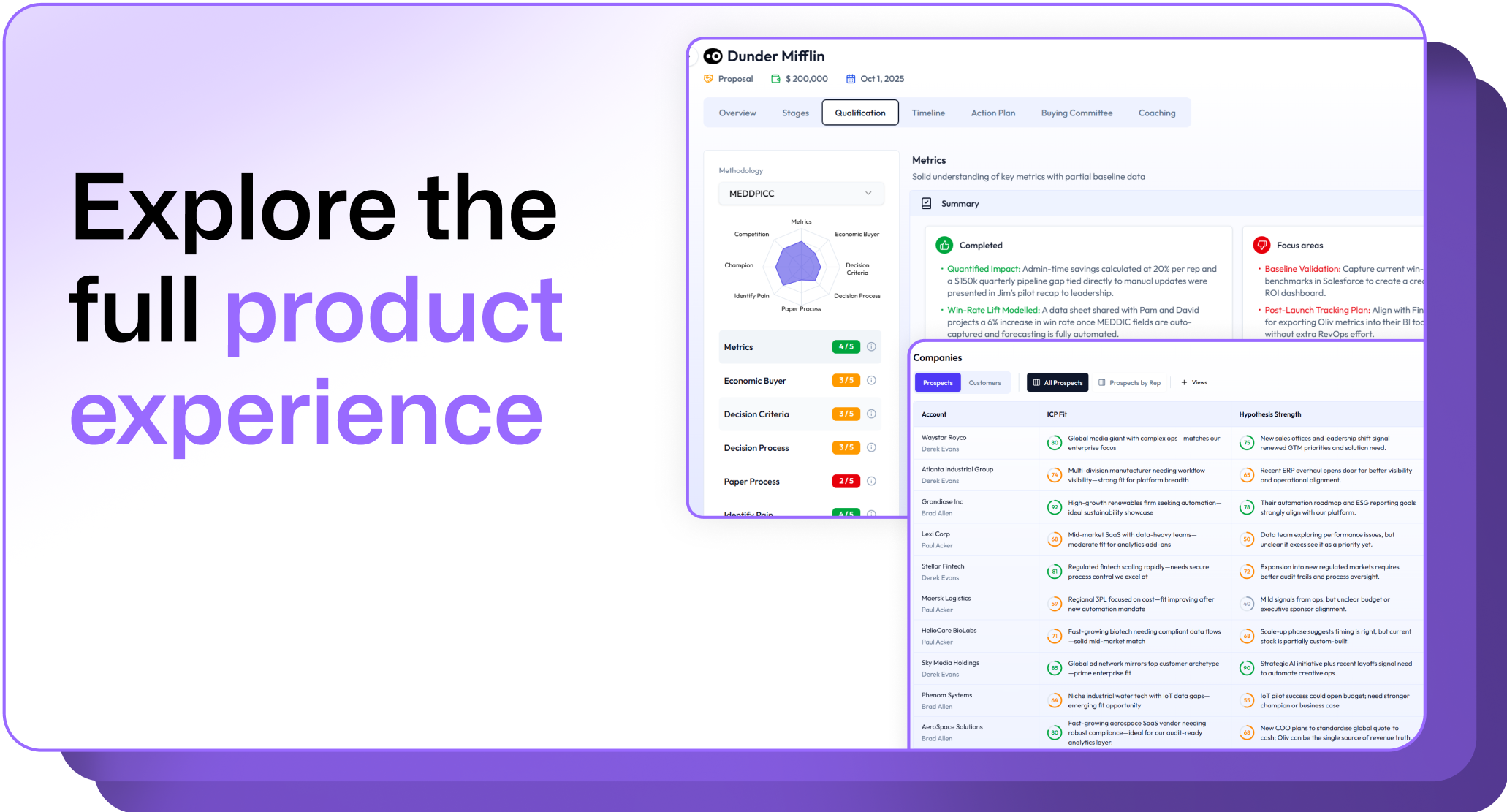
.avif)
.png)